Duramax Diesel. Manual - part 24
 

  Index      Engines     Chevrolet / GMC Duramax Diesel - service manual 2017 year


Search            


Content   ..  22  23  24  25   ..


Duramax Diesel. Manual - part 24


Vehicle Care

95

Caution

Failure to use the recommended
engine oil or equivalent can result
in engine damage not covered by
the vehicle warranty.

Viscosity Grade

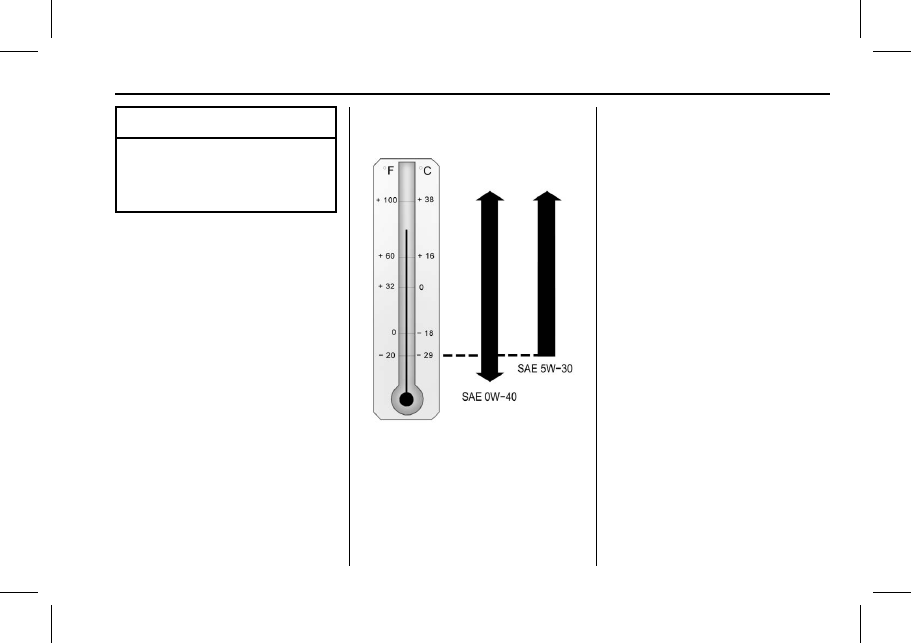
Use SAE 5W-30 viscosity grade
engine oil.

Cold Temperature Operation: In an
area of extreme cold, where the
temperature falls below −29 °C
(−20 °F), an SAE 0W-40 oil may be
used. An oil of this viscosity grade

will provide easier cold starting for
the engine at extremely low
temperatures. When selecting an oil
of the appropriate viscosity grade, it
is recommended to select an oil of
the correct specification. See
“Specification” earlier in this section.

Engine Oil Additives/Engine Oil
Flushes — dexos2

Do not add anything to the oil. The
recommended oils meeting the
dexos2 specification are all that is
needed for good performance and
engine protection.

Engine oil system flushes are not
recommended and could cause
engine damage not covered by the
vehicle warranty.

Selecting the Right Engine Oil
(6.6L 8-Cylinder Engine)

Specification

Oils designated as API CJ-4 are
required for the vehicle. The CJ-4
designation can appear either alone
or in combination with other
American Petroleum Institute (API)

96

Vehicle Care

designations, such as API CJ-4/SL.
These letters show API levels of
quality.

American Petroleum Institute (API)
Symbol

This doughnut-shaped logo
(symbol) is used on most oil
containers to help you select the
correct oil. It means that the oil has
been certified by the American
Petroleum Institute.

Look for this on the oil container,
and use only those oils that display
this logo.

Caution

Use only engine oils that have the
designation CJ-4 for the diesel
engine. Failure to use the
recommended oil can damage the
DPF and result in engine damage
not covered by the vehicle
warranty.

Viscosity Grade

Use SAE 15W-40 viscosity grade
engine oil.

When it is very cold, below −18 °C
(0 °F), use SAE 5W-40 to improve
cold starting. These numbers on the
oil container show its viscosity,
or thickness.

Vehicle Care

97

When selecting an oil of the
appropriate viscosity grade, always
select an oil of the correct
specification. See “Specification”
earlier in this section.

Engine Oil Additives/Engine Oil
Flushes — API

Do not add anything to the oil. The
recommended oils with the API
service symbol are all that is
needed for good performance and
engine protection.

Engine oil system flushes are not
recommended and could cause
engine damage not covered by the
vehicle warranty.

What to Do with Used Oil

Used engine oil contains certain
elements that can be unhealthy for
your skin and could even cause
cancer. Do not let used oil stay on
your skin for very long. Clean your
skin and nails with soap and water,
or a good hand cleaner. Wash or
properly dispose of clothing or rags
containing used engine oil. See the
manufacturer's warnings about the
use and disposal of oil products.

Used oil can be a threat to the
environment. If you change your
own oil, be sure to drain all the oil
from the filter before disposal. Never
dispose of oil by putting it in the
trash or pouring it on the ground,
into sewers, or into streams or
bodies of water. Recycle it by taking
it to a place that collects used oil.

Engine Oil Life System

The engine oil life system calculates
engine oil life based on vehicle use
and displays the CHANGE ENGINE
OIL SOON message when it is time
to change the engine oil and filter.
The oil life system should be reset
to 100% only following an oil
change. See “Engine Oil Life
System” in the owner manual.

Automatic Transmission
Fluid

When to Check and Change
(4-Cylinder Pickup Models)

See “Automatic Transmission Fluid”
in the owner manual.

When to Check and Change
(8-Cylinder Pickup Models)

Change the fluid and filter at the
intervals listed. See Maintenance
Schedule 
124
.

Use the transmission fluid listed in
Recommended Fluids and
Lubricants 
129.

How to Check

Because this operation can be a
little difficult, the decision may be
made to have this done by your
dealer.

If the decision is made to perform
this operation, be sure to follow all
the instructions here, or a false
reading on the dipstick could result.

Caution

Too much or too little fluid can
damage the transmission. Too
much can mean that some of the
fluid could come out and fall on
hot engine parts or exhaust
system parts, starting a fire. Too

(Continued)

98

Vehicle Care

Caution (Continued)

little fluid could cause the
transmission to overheat. Be sure
to get an accurate reading if
checking the transmission fluid.

Wait at least 30 minutes before
checking the transmission fluid level
if the vehicle has been driven:
.

When outside temperatures are
above 32 °C (90 °F).

.

At high speed for quite a while.

.

In heavy traffic — especially in
hot weather.

.

While pulling a trailer.

Checking the Fluid Level

Prepare the vehicle as follows:

1. Park the vehicle on a level

place. Keep the engine
running.

2. With the parking brake applied,

place the shift lever in P (Park).

3. With a foot on the brake pedal,

run the engine for at least
one minute and shift to D
(Drive). Then shift to
N (Neutral) and then
R (Reverse) to fill the hydraulic
system. Then, put the shift
lever in P (Park).

4. Allow the engine to run at idle

(500 – 800 rpm). Slowly
release the brake pedal.

Then, without shutting off the
engine, follow these steps:

Cold Check Procedure

The purpose of the cold check is to
determine if the transmission has
enough fluid to be operated safely
until a hot check can be made. The
fluid level rises as fluid temperature
increases. DO NOT fill above the

COLD band if the transmission fluid
is below normal operating
temperatures.

1. Pull out the dipstick and wipe it

with a clean rag or paper towel.
The transmission dipstick is
near the center of the engine
compartment. See Engine
Compartment Overview 
88
for location.

2. Push it back in all the way, wait

three seconds, and then pull it
back out again.

3. Check the fluid level reading.

Repeat the check procedure to
verify the reading.

4. If the fluid level is within the

COLD band, the transmission
may be operated until the fluid
is hot enough to perform a hot
check. If the fluid level is not
within the COLD band, add or
drain fluid as necessary to
bring the level into the middle
of the COLD band.


Content   ..  22  23  24  25   ..