Duramax Diesel. Manual - part 15
 

  Index      Engines     Chevrolet / GMC Duramax Diesel - service manual 2017 year


Search            


Content   ..  13  14  15  16   ..


Duramax Diesel. Manual - part 15


Driving and Operating

59

Warning (Continued)

.

Do not leave the fuel pump
unattended.

.

Do not use a cell phone
while refueling.

.

Do not re-enter the vehicle
while pumping fuel.

.

Keep children away from
the fuel pump and never let
children pump fuel.

.

Fuel can spray out if the fuel
cap is opened too quickly.
This spray can happen if the
tank is nearly full, and is
more likely in hot weather.
Open the fuel cap slowly
and wait for any hiss noise
to stop, then unscrew the
cap all the way.

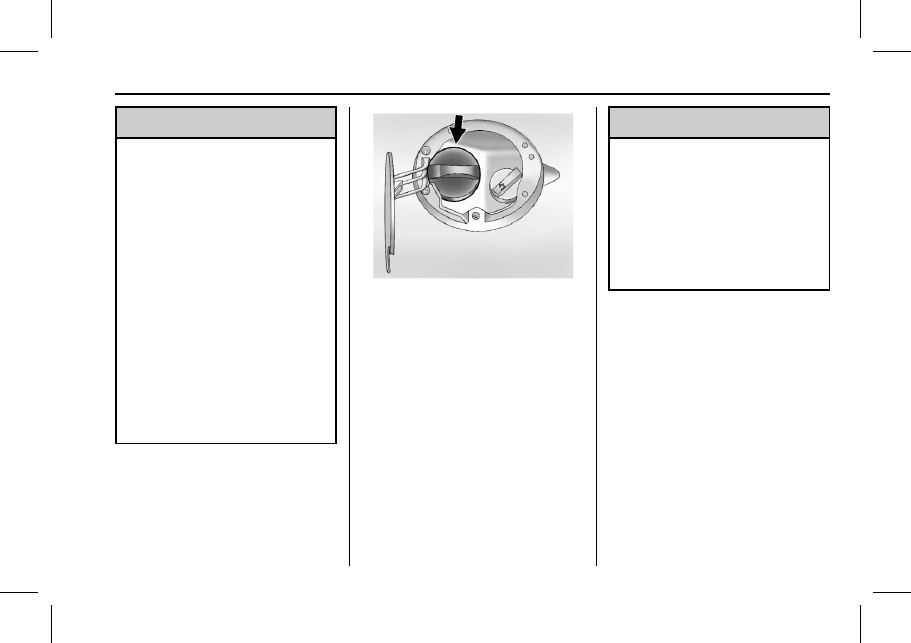
Van Shown, Pickup Similar

The green fuel cap is behind a
hinged door on the driver side of the
vehicle. On van and 4-cylinder
pickup models, the blue diesel
exhaust fluid cap is also behind the
fuel door. Do not remove both caps
at the same time.

For models with dual fuel tanks, the
fuel gauge shows an average of
both tanks. The rear tank is emptied
first. When refueling, refuel the front
tank first, then add fuel to the
rear tank.

To remove the fuel cap, turn it
slowly counterclockwise.

{

Warning

Overfilling the fuel tank by more
than three clicks of a standard fill
nozzle may cause:

.

Vehicle performance issues,
including engine stalling and
damage to the fuel system.

.

Fuel spills.

.

Potential fuel fires.

Be careful not to spill fuel. Wait a
few seconds after you have finished
pumping before removing the
nozzle. Clean fuel from painted
surfaces as soon as possible. See
“Exterior Care” in the owner manual.

Diesel fuel can foam when filling the
tank. This can cause the automatic
pump nozzle to shut off, even if the
tank is not full. If this happens, wait
for the foaming to stop, and then fill
the tank more slowly.

60

Driving and Operating

{

Warning

Heat coming from the engine can
cause the fuel to expand and
force the fuel out of the tank.
If something ignites the fuel, a fire
could start. To help avoid this, fill
the tank slowly and only until the
nozzle shuts off. Do not top it off.
Clean up any spilled fuel.

When replacing the fuel cap, turn it
clockwise until it clicks. Make sure
the cap is fully installed.

{

Warning

If a fire starts while you are
refueling, do not remove the
nozzle. Shut off the flow of fuel by
shutting off the pump or by
notifying the station attendant.
Leave the area immediately.

Caution

If a new fuel cap is needed, be
sure to get the right type of cap
from your dealer. The wrong type
of fuel cap might not fit properly
and could damage the fuel tank
and emissions system.

Accidental Refueling with
Gasoline

Caution

If the vehicle is accidentally
refueled with gasoline, do not
continue driving the vehicle
except to get to a location where
it can be stopped safely. Driving
the vehicle will damage the fuel
system. Have the vehicle towed
to a qualified technician to have
the gasoline removed from the
tank and fuel system. Flush the
fuel system with Ultra Low Sulfur
Diesel fuel to ensure all gasoline
is removed.

Filling a Portable Fuel
Container

{

Warning

Filling a portable fuel container
while it is in the vehicle can cause
fuel vapors that can ignite either
by static electricity or other
means. You or others could be
badly burned and the vehicle
could be damaged. Always:

.

Use approved fuel
containers.

.

Remove the container from
the vehicle, trunk, or pickup
bed before filling.

.

Place the container on the
ground.

.

Place the nozzle inside the
fill opening of the container
before dispensing fuel, and
keep it in contact with the fill
opening until filling is
complete.

(Continued)

Driving and Operating

61

Warning (Continued)

.

Fill the container no more
than 95% full to allow for
expansion.

.

Do not smoke, light
matches, or use lighters
while pumping fuel.

.

Avoid using cell phones or
other electronic devices.

Trailer Towing

When towing at high elevation on
steep uphill grades, consider the
following:

Engine coolant at higher elevation
will boil at a lower temperature than
at or near sea level. If the engine is
turned off immediately after towing
at high elevation on steep uphill
grades, the vehicle may show signs
similar to engine overheating. To
avoid this, let the engine run while
parked (preferably on level ground)
with the transmission in P (Park)
and the parking brake applied for at
least five minutes before turning the
engine off. If the overheat warning
comes on, see Engine Overheating
109.

Use the following chart to determine
the maximum the trailer can weigh,
based upon your vehicle model and
options.

All axles of the trailer must be
equipped with brakes adequate for
the intended use. Trailer braking
equipment conforming to Canadian
Standards Association (CSA)
requirement CAN3-D313, or its
equivalent, is recommended.

62

Driving and Operating

2500/3500 Series Pickup Models – SAE J2807 Compliant

Vehicle

Axle Ratio

Max. Trailer Wt.

5

GCWR *

C-2500 Pickup Models – 2WD

Pickup Model Double Cab
Standard Box

1

3.73

7 439 kg (16,400 lb)

11 476 kg (25,300 lb)

Pickup Model Crew Cab Standard
Box

1

3.73

6 985 kg (15,400 lb)

11 476 kg (25,300 lb)

Pickup Model Regular Cab Long
Box

2

3.73

8 210 kg (18,100 lb)

11 476 kg (25,300 lb)

Pickup Model Double Cab Long
Box

2

3.73

7 121 kg (15,700 lb)

11 476 kg (25,300 lb)

Pickup Model Crew Cab Long
Box

2

3.73

6 713 kg (14,800 lb)

11 476 kg (25,300 lb)

K-2500 Pickup Models – 4WD

Pickup Model Double Cab
Standard Box

1

3.73

6 532 kg (14,400 lb)

11 476 kg (25,300 lb)

Pickup Model Crew Cab Standard
Box

1

3.73

6 123 kg (13,500 lb)

11 476 kg (25,300 lb)

Pickup Model Regular Cab Long
Box

2

3.73

7 212 kg (15,900 lb)

11 476 kg (25,300 lb)


Content   ..  13  14  15  16   ..