Military reference books and manuals (2009-2023, Volume 8) - page 29
References
ARMY PUBLICATIONS
Most Army doctrinal publications are available online: www.apd.army.mil.
ADRP 1-03. The Army Universal Task List. 2 October 2015.
ADRP 3-07. Stability. 31 August 2012.
ADRP 6-0. Mission Command. 17 May 2012.
AR 195-5. Evidence Procedures. 22 February 2013.
AR 381-10. U.S. Army Intelligence Activities. 3 May 2007.
AR 525-13. Antiterrorism. 11 September 2008.
FM 2-22.3. Human Intelligence Collector Operations. 6 September 2006.
FM 3-24.2 (FM 7-98, FM 90-8). Tactics in Counterinsurgency. 21 April 2009.
CENTER FOR ARMY LESSONS LEARNED PUBLICATIONS
Most Center for Army Lessons Learned (CALL) products are available online: https://call2.army.mil.
Accessed 28 October 2015.
Army & USMC TTP—Stability Operations and Support Operations (SOSO). CALL Newsletter 03-20.
July 2003.
Interpreter Ops: Multi-Service Reference Manual for Interpreter Operations.
CALL Handbook 04-07. March 2004.
Urban Combat Operations TTP. CALL Newsletter 99-16. 1 November 1999.
Small Unit Leader’s Guide to Urban Operations. CALL Newsletter 03-4. 1 May 2003.
RAND PUBLICATIONS
Most RAND studies are available online: http://www.rand.org/publications/. Search for the document
number. Accessed 27 October 2015.
Aerospace Operations in Urban Environments: Exploring New Concepts. Alan Vick, John Stillion, et
al. RAND Document No. MR-1187-AF. 2002.
The Art of Darkness: Deception and Urban Operations. Scott Gerwehr and Russell W. Glenn. RAND
Document MR-1132-A. 2000.
The City’s Many Faces: Proceedings of the RAND Arroyo-MCWL-J8 UWG Urban Operations
Conference, April 13-14, 1999. Russell W. Glenn. RAND Document No. CF-148-A. 2000.
Heavy Matter: Urban Operations’ Density of Challenges. Russell W. Glenn.
RAND Document MR-1239-JS/A. 2000.
Marching under Darkening Skies: The American Military and the Impending Urban Operations
Threat. Russell W. Glenn. RAND Document MR-1007-A. 1998.
Mars Unmasked: The Changing Face of Urban Operations. Sean J.A. Edwards.
RAND Document MR-1173-A. 2000.
Street Smart: Intelligence Preparation of the Battlefield for Urban Operations. Russell W. Glenn and
Jamison Joe Medby. RAND Document MR-1287-A. 2002.
FOREIGN MILITARY STUDIES OFFICE
Foreign Military Studies Office publications are available online: http://fmso.leavenworth.army.mil. Select
the “Search FMSO Research” link. Accessed 27 October 2015.
Air Operations in Low Intensity Conflict: The Case of Chechnya. Timothy L. Thomas. This article was
previously published in Airpower Journal, Winter, 1997.
Bashing the Laser Range Finder with a Rock. Lester W. Grau. This article was first published in
Military Review, May-June 1997.
23 December 2015
TC 2-91.4
References-3
References
The Battle of Grozny: Deadly Classroom for Urban Combat. Timothy L. Thomas. This article was
previously published in Parameters, Summer, 1999.
Diehard Buildings: Control Architecture—A Challenge for the Urban Warrior. Lester W. Grau and
Geoffrey Demarest. This article was previously published in Military Review, September-
October 2003.
The Caucasus Conflict and Russian Security: The Russian Armed Forces Confront Chechnya, Part 1:
Section 1. Timothy L. Thomas. This article was previously published in Journal of Slavic
Military Studies, June 1995.
The Caucasus Conflict and Russian Security: The Russian Armed Forces Confront Chechnya, Part 1:
Section 2. Timothy L. Thomas. This article was previously published in Journal of Slavic
Military Studies, June 1995.
The Caucasus Conflict and Russian Security: The Russian Armed Forces Confront Chechnya III. The
Battle for Grozny, 1-26 January 1995. Timothy L. Thomas. This article was previously
published in Journal of Slavic Military Studies, March 1997.
Changing Russian Urban Tactics: The Aftermath of the Battle for Grozny. Lester W. Grau. This article
was previously published in INSS Strategic Forum, July 1995.
Combat in Cities: The LA Riots and Operation Rio. William W. Mendel. 1996.
A “Crushing” Victory: Fuel-Air Explosives and Grozny 2000. Lester W. Grau and Timothy Smith.
This article was previously published in Marine Corps Gazette, August 2000.
A Face of Future Battle: Chechen Fighter Shamil Basayev. Raymond C. Finch, III. This article was
previously published in Military Review, June-July 1997.
Geopolitics and Urban Armed Conflict in Latin America. Geoffrey Demarest. This article was
previously published in Small Wars and Insurgencies, Spring 1995.
Grozny 2000: Urban Combat Lessons Learned. Timothy L. Thomas. This article was previously
published in Military Review, July-August 2000.
Mars and Hippocrates in Megapolis: Urban Combat and Medical Support. Lester W. Grau and
Charles J. Gbur Jr. This article was previously published in U.S. Army Medical Department
Journal, January-March 2003.
MOUT in Iraq: Population Dependent? Timothy L. Thomas. 2002.
Night Stalkers and Mean Streets: Afghan Urban Guerrillas. Ali A. Jalali and Lester W. Grau. This
article was previously published in Infantry, January-April 1999.
Russian Lessons Learned From the Battles For Grozny. Timothy L. Thomas and Lester W. Grau. This
article was previously published in Marine Corps Gazette, April 2000.
Russian-Manufactured Armored Vehicle Vulnerability in Urban Combat: The Chechnya Experience.
Lester W. Grau. This article was previously published in Red Thrust Star, January 1997.
Russian Snipers in the Mountains and Cities of Chechnya. Lester W. Grau and Charles Q. Cutshaw.
This article was previously published in Infantry, Summer 2002.
“Soft Log” and Concrete Canyons: Russian Urban Combat Logistics in Grozny. Lester W. Grau and
Timothy L. Thomas. This article was previously published in Marine Corps Gazette,
October 1999.
Urban Warfare Communications: A Contemporary Russian View. Lester W. Grau. This article was
previously published in Red Thrust Star, July 1996.
Urban Combat: Confronting the Specter. Lester W. Grau and Jacob W. Kipp. This article was
previously published in Military Review, July-August 1999.
A Weapon For All Seasons: The Old But Effective RPG-7 Promises to Haunt the Battlefields of
Tomorrow. Lester W. Grau. This article was previously published in Infantry,
May-August 1998.
Why the Russian Military Failed in Chechnya. Raymond C. Finch. Foreign Military Studies Office
Special Study 98-16. August 1998.
References-4
TC 2-91.4
23 December 2015
References
OTHER PUBLICATIONS
Future War: Non-Lethal Weapons in Twenty-First Century Warfare. John B. Alexander. New York:
Saint Martin’s Press. 1999.
How They Fight: Armies of the World, volume 4-01, MOUT-Worldwide. National Ground Intelligence
Center. August 2001. Available online (SIPRNET): https://www.ngic.army.
smil.mil/products/htf/NGIC-1122-0062-01/0062.pdf. Accessed 28 October 2015.
The Savage Wars of Peace: Soldiers’ Voices 1945-1989. London: Michael Joseph. 1990.
Small Wars Manual. FMFRP 12-15. 1 April 1987. Reprint of 1940 U.S. Marine Corps Small Wars
Manual. Available online: https://www.doctrine.usmc.mil/#.
Urban Generic Information Requirements Handbook (UGIRH). Marine Corps Intelligence Activity.
2000. Available online (SIPRNET): https://intelink.sgov.gov. Accessed 28 October 2015.
PRESCRIBED FORMS
This section contains no entries.
REFERENCED FORMS
Unless otherwise indicated, DA forms are available on the Army Publishing Directorate Web site:
www.apd.army.mil.
DA Form 2028. Recommended Changes to Publications and Blank Forms.
23 December 2015
TC 2-91.4
References-5
This page intentionally left blank.
Index
Entries are by paragraph number unless stated otherwise.
terrain products supporting,
contingency support study, 3-41.
A
A-35-A-37
conventional forces
activities matrix, A-13, figure A-5
B-C
information requirements for,
air operations, 1-63, 3-19, A-35
table 2-1
Balkans
airspace
U.S. operations in Bosnia,
crime and criminal organizations,
in urban operations, 1-35,
2-10-2-11
1-76, 1-77, A-15
1-36, 1-38
in urban populations, table 1-5
U.S. operations in Kosovo,
air defense artillery, 3-21-3-22
1-76, 1-77, A-11, A-33
information requirements for,
table 2-4
air level. See multidimensional
Bosnia, 1-76, 1-77, A-15
battlefield.
Crimelink, A-4
boundaries, 1-106, 3-58
analysis, 1-35, 1-36, 1-41, A-8
culture, 1-70-1-85
buildings
civil considerations, 1-2-1-4
comparison chart or matrix,
analysis of, 1-27, 1-28,
demographic, A-20, table A-4
A-16
table 4-1
digital feature analysis data
and social structure, 1-70,
in core, 1-25
codes, A-37
1-75, 1-84
as engagement areas, 1-43
geospatial, A-50, A-52
in urban environment, 1-14,
example information
link, 2-6, A-4, A-6-A-14
1-70, 1-73, 4-3, A-16
requirements for, table 1-4,
nodal, 3-37
1-22
D
pattern, A-4, A-5, figure A-1
as infrastructure, 1-89
plot sheet, figure A-1
debriefing, 4-26-4-29
overlays, A-31-A-34, A-48
structural, 1-37, 1-39, 1-60,
of transportation personnel,
types of, 1-9, 1-31, 1-49,
2-25, A-52
3-36
table 1-4
terrain, 1-5-1-15
denial and deception, 2-14
CBRN, 3-20
terrain and society, 1-16-1-22,
information requirements for,
and military areas, 1-31
1-88-1-92
table 2-5
information requirements,
weather, 1-55-1-68
tables 2-1 and 2-2
digital terrain elevation data, 3-40
tools, A-4-A-23
weather effects on, 1-64
Digital Topographic Support
Analyst Notebook, A-4
civil affairs, 3-23-3-27
System, A-4
ASCOPE, 1-2-1-4, 3-25, 4-3,
assessment of, A-17
figure 1-1, table 4-1
E-F
products, 3-24, A-23
association matrix, A-8, figure A-3
electronic warfare, 2-11, 2-15,
civil considerations, 1-2-1-4, 3-
as software tool, A-4
table 2-5
25, 4-3, figure 1-1, table 4-1
used by military police, 3-29
engagement area, 1-49-1-52
civilians, 1-73-1-87
avenues of approach, 1-33, 1-38
in mobility corridors, 1-44
as aviation hazard, 2-24
in airspace, 1-28, 1-31
engineers, 3-9-3-11
civil information management,
and line of sight overlays,
and building analysis, 1-37,
3-26
A-42, A-43
table 1-4
and mobility corridors, 1-37
combined obstacle overlay, A-37
and communications
in a multidimensional
communications, 1-108-1-110,
infrastructure, 1-109
battlefield, 1-26, 1-27, 1-37
table 1-13. See also
engineers (continued)
and sniper placement, A-43
infrastructure.
city, 1-65
aviation, 3-19
computer network attack, 2-12,
national and local, 1-109
and avenues of approach,
table 2-5
topographic teams, 4-12
1-31
contingency support package,
explosive ordnance disposal
hazards, 2-24
3-42.
operations, 1-31, 2-24
23 December 2015
TC 2-91.4
Index-1
Index
Entries are by paragraph number unless indicated otherwise.
in information collection
facilities. 1-118. See also
subsurface, 1-42, table 1-3
planning, 3-35
medical, facilities.
water, 1-40
information requirements
fire hazards. 2-25
line of sight, 1-53-1-55
for, table 1-19
and vertical mobility corridors,
food distribution, 1-117, table 1-18
overlays, A-44-A-48
1-44
Forward Looking Infrared Radar
petroleum, information
and LOCs, table 4-1
(also called FLIR), 3-22
requirements for, table 1-15
overlay, A-42-A-43
resource and material
G-H
linguists, 3-37
production, 1-116
geospatial intelligence, 3-10,
information requirements
link analysis tools, A-6-A-14
3-11, 3-44-3-45, A-52
for, table 1-17
M
gridded reference graphic, 3-43
subterranean, 1-121
information requirements
maps, 4-11-4-14
guerrillas, 2-7. See also
for, table 1-22
and topographic teams, 3-10
insurgents.
systems, 1-14
city, sources of, 3-60
detection of, 3-22
transportation, 1-106-1-107
measurement and signature
information requirements for,
information requirements
intelligence, table 2-5
table 2-2
for, tables 1-6-1-12
medical, 3-12-3-18
health issues, 2-17-2-22. See
overlays, A-47
assessments, 3-13, 3-15-3-16
also medical.
in urban environments,
facilities, 1-118
human intelligence, 4-23, A-20
table 4-1
health issues, 2-17-2-22
water and waste, 1-114-1-115
host-nation, 1-105
I
information requirements
information requirements for,
imagery, A-50, figure A-11. See
for, table 1-16
table 1-19
also geospatial intelligence.
insurgents, 2-7. See also
infrastructure, 1-118,
briefs, 3-44
guerillas.
table 1-19
electro-optical, A-51
in criminal organizations, 2-10
intelligence information, 3-13,
and geospatial intelligence,
information requirements for,
3-17
A-52
table 2-4
National Center for Medical
land satellite, 3-40, 3-41
information collection, 4-6-4-8,
Intelligence, 3-13, 3-14
overhead, 3-46, A-49
4-21
local population requirements
products, 3-41-3-45, 4-9, A-50
assessing, 4-25
for, 1-86, 1-89
urban models, A-51, figure
and civil affairs forces, 3-27
overlays, A-46
A-11
and explosive ordnance
military information support
information operations, 2-12-2-16
disposal, 3-35
operations (MISO), 3-28-3-31
information requirements for,
plan, 4-6, 4-8, 4-15, 4-18
assessment of, A-17
table 2-5
and snipers, 3-6
examples, 1-99, A-18-A-19
influence activities
international/intergovernmental
perception assessment matrix,
target audience for, 1-94
organizations, 3-50-3-52
A-17
target audience of, 1-94
infrastructure, 1-102-1-105
J-K-L
in cities, 1-12
military police, 3-32-3-34
communications, 1-108-1-110
key infrastructure overlays, A-44-
mission variables (METT-TC):
information requirements
A-48
1-2-1-4, 4-2
for, table 1-13
Kosovo. See Balkans.
mobility corridors, 1-44
crisis management and civil
land satellite imagery, 3-40, 3-41
example of, 1-42
defense, 1-120
law enforcement and firefighting.
in multidimensional battlefield,
information requirements
See infrastructure.
1-26, 1-27, 1-37
for, table 1-21
energy, 1-111-1-113
lines of communications, 1-10,
multidimensional battlefield, 1-34-
information requirements
1-46-1-48, 3-36
1-43, 1-34, figure 1-4
for, table 1-14, 1-15
building characteristics, 1-61
N
firefighting, information
criminal, 2-10
requirements for, table 1-20
digital, 1-53
National Center for Medical
food distribution, 1-117
and gridded reference
Intelligence, 3-13, 3-14
information requirements
graphics, 3-43
National Geospatial-Intelligence
for, table 1-18
and hubs, 1-18-1-19
Agency (NGA), 3-44-3-45
law enforcement
and line of sight, table 4-1
products, 4-12
information requirements
and multidimensional
noncombatant evacuation
for, table 1-20
battlefield, 1-35, 1-44
operation intelligence support
medical
overlay, A-38-A-41
and satellite pattern, 1-20
Index-2
TC 2-91.4
23 December 2015
Index
Entries are by paragraph number unless indicated otherwise.
handbook (also called NISH),
police intelligence operations,
and infrastructure effects,
3-46
3-33
1-28, 1-36, 1-43
nongovernmental organizations
population, 1-86-1-91
staff weather officer, 1-69
(NGOs), 3-53-3-55
information requirements for,
street patterns, tables 1-2 and 1-7
and civil information
table 1-5
radial, 1-25
management, 3-26
infrastructure, 1-101-1-105
radial-ring, 1-25
and food distribution, 1-117
status overlay, 2-7, A-25-A-28,
rayed, 1-22
protection of, 1-117
figure A-8
studies, 3-13
psychological operations. See
O
area, 3-24
military information support
civil affairs, 3-23-3-24, 3-27
observation
operations.
contingency support, 3-41
aerial, 1-67, 3-19, A-35
medical, 3-13
air defense, 3-20
Q-R
MISO, 3-27-3-31
and line of sight, 1-53
railroads, 1-12
in aviation, 1-38, 3-18
subsurface level. 1-39-1-41,
LOC overlays, A-38, A-40
in supersurface levels, 1-36
figure 1-4. See also
information requirements for,
military aspects of terrain,
multidimensional battlefield.
table 1-9
table 4-1
information requirements for,
reconnaissance, 3-3-3-6
and structures, table 1-3
table 1-15
aerial, 1-38, A-50
mobility corridors, 1-44
obstacles
assets, 3-3
subterranean features,
of buildings, 1-37-1-38
considerations, 1-55
civilians as, 1-86
subterranean features, table 1-15.
and counterinsurgency, 2-7
and digital line of sight, 1-53
See also subsurface level.
and information collection, 4-7
garbage as, 1-115
by locals, 1-92
supersurface level, 1-36-1-38.
and engagement areas, 1-51
See also multidimensional
map, A-37
hubs as, 1-18
battlefield.
and trafficability estimates,
and LOCs, 1-46
1-48
mobility corridors, 1-44
locating, 3-9-3-10, 3-19
and visibility, 1-66
surface level, 1-39-1-41. See also
military areas as, 1-31
unmanned aircraft systems,
multidimensional battlefield.
and overlays, A-37, A-39, A-41
A-50
mobility corridors, 1-44
on streets, 1-12, 1-40
relationship matrix, A-9-A-12
obstacles. See obstacles.
reduction of, 1-66
figure A-4
overlays, 3-10
T
reporting. See also debriefing.
congregation or mass
terrain
and assessment, 4-26
assembly points, A-29
canalized, 1-18
during execution, 4-21, 4-23
key information, 3-10, A-44,
compartmented, 2-4
and preparation, 4-19
A-46, A-47
Digital Terrain Elevation Data,
timely, 3-36, 3-39
line of communications, A-38,
3-40
A-40
resource and material production.
key, 1-11, 1-45, 1-104, 3-58
line of sight, A-42-A-43
See infrastructure.
in the mission variables
population status, A-25-A-28
roof coverage overlay, A-35
(METT-TC), 1-2, 3-25, 4-2
urban terrain, A-30-A-37,
military aspects of, 1-104,
figure A-10
S
table 4-1
scouts, 3-3-3-6
P
terrain (continued)
snipers, 3-3-3-6
overlays, A-30-A-37
paramilitary forces. See also
cover and concealment for,
terrorists. See threat.
threat.
1-29, 1-50
information requirements for,
threat
table 2-1
society (socio-cultural), 1-70-
criminals, 2-10-2-11, table 2-4
1-100
pattern analysis, 2-7
electronic warfare, 2-15
critical nodes, 1-82, 1-103,
overlays, A-5
health, 3-12-3-18
1-113
information operations, 2-12-
plot sheet, figure A-1
cultural awareness, 1-73, 2-3,
software, A-4
2-16, table 2-5
3-37
Urban Tactical Planner, A-4
insurgents, 2-7, 2-10, 3-4,
religious aspects, 1-74-1-75,
3-22, table 2-2
perception. See also military
1-83, 1-84
paramilitary, 1-80, 2-6, 4-3,
information support operations.
special operations command and
table 2-1
assessment matrix, A-17-A22,
control element (also called
TTP, 2-3
figure A-7
SOCCE), 3-8
time event chart, A-14, figure A-6
planning considerations, 4-6-4-18
Special Operations Forces, 3-7-
topographic teams, 4-12
3-8, 3-30
23 December 2015
TC 2-91.4
Index-3
Index
Entries are by paragraph number unless indicated otherwise.
toxic industrial material, 1-64,
medical personnel in, 3-12-
urban terrain feature overlay (also
1-65, 2-20, 3-20, A-48
3-18
called UTFO), A-35-A-37,
patterns, 1-17-1-22
figure A-10
transportation. See infrastructure.
topography, 1-10
V-Z
U
weapons effects in, 1-53, 1-54
unmanned aircraft system, 1-54,
urban functional zones, 1-24-1-31
water and waste disposal, 1-114-
1-115. See also infrastructure.
3-21, A-50
Urban Tactical Planner, A-4. See
weapons of mass destruction, 2-5,
urban areas. See also terrain.
also pattern analysis.
2-22, table 2-3
and counterterrorism, 2-9
urban terrain overlay, A-30-A-37
chemical personnel in, 3-20
weather, 1-63-1-69
urban terrain orientation graphic
communications in, 1-55
(also called UTOG), A-35-
functional zones, 1-24-1-31
A-37, figure A-10
Index-4
TC 2-91.4
23 December 2015
TC 2-91.4
23 December 2015
By order of the Secretary of the Army:
MARK A. MILLEY
General, United States Army
Chief of Staff
Official:
GERALD B. O’KEEFE
Administrative Assistant to the
Secretary of the Army
1534202
DISTRIBUTION:
Active Army, Army National Guard, and U.S. Army Reserve: Not be distributed; electronic media only.
PIN: 105881-000
TC 18-01
Special Forces
Unconventional Warfare
November 2010
DISTRIBUTION RESTRICTION: Distribution authorized to U.S. Government agencies and their contractors only
to protect technical or operational information from automatic dissemination under the International Exchange
Program or by other means. This determination was made on 1 August 2010. Other requests for this document
must be referred to Commander, United States Army John F. Kennedy Special Warfare Center and School,
ATTN: AOJK-DTD-SF, 2175 Reilly Road, Stop A, Fort Bragg, NC 28310-5000.
DESTRUCTION NOTICE: Destroy by any method that will prevent disclosure of contents or reconstruction of the
document.
FOREIGN DISCLOSURE RESTRICTION (FD 6): This publication has been reviewed by the product developers
in coordination with the United States Army John F. Kennedy Special Warfare Center and School foreign
disclosure authority. This product is releasable to students from foreign countries on a case-by-case basis only.
Headquarters, Department of the Army
Training Circular
Headquarters
Department of the Army
No. 18-01
Washington, DC, 30 November 2010
Special Forces Unconventional Warfare
Contents
Page
PREFACE
iv
Chapter 1
OVERVIEW
1-1
Introduction to Unconventional Warfare
1-1
The Role of Unconventional Warfare in United States National Strategy
1-2
Feasibility for United States Sponsorship
1-3
Physical and Human Environmental Conditions
1-3
Resistance Movement Characterisics
1-5
The Criticality of the Feasibility Assessment
1-6
Ways the United States Conducts Unconventional Warfare
1-7
The Seven Phases of Unconventional Warfare
1-8
Elements in Unconventional Warfare
1-9
Chapter 2
FUNDAMENTALS OF RESISTANCE AND INSURGENCY
2-1
Why Populations Resist
2-1
Dynamics of Successful Insurgencies
2-3
The Components of an Insurgency
2-8
Additional Elements of an Insurgency
2-12
Infrastructure of a Resistance Movement or Insurgency
2-13
Organization of Medical Support Within the Area Complex
2-17
Insurgent Support Networks
2-18
DISTRIBUTION RESTRICTION: Distribution authorized to U.S. Government agencies and their
contractors only to protect technical or operational information from automatic dissemination under the
International Exchange Program or by other means. This determination was made on 1 August 2010.
Other requests for this document must be referred to Commander, United States Army John F. Kennedy
Special Warfare Center and School, ATTN: AOJK-DTD-SF, 2175 Reilly Road, Stop A, Fort Bragg, NC
28310-5000.
DESTRUCTION NOTICE: Destroy by any method that will prevent disclosure of contents or
reconstruction of the document.
FOREIGN DISCLOSURE RESTRICTION (FD 6): This publication has been reviewed by the product
developers in coordination with the United States Army John F. Kennedy Special Warfare Center and
School foreign disclosure authority. This product is releasable to students from foreign countries on a
case-by-case basis only.
i
Contents
Chapter 3
CONCEPT OF EMPLOYMENT
3-1
Planning for Unconventional Warfare
3-1
Seven Phases of Unconventional Warfare
3-2
Civil Affairs Support to the Seven Phases of Unconventional Warfare
3-8
Logistics Considerations
3-9
Supply Considerations
3-10
Command and Control
3-13
Legal Principles
3-15
Appendix A AREA STUDY
A-1
Appendix B SPECIAL FORCES AREA ASSESSMENT
B-1
Appendix C SAMPLE TRAINING PROGRAM OF INSTRUCTION
FOR RESISTANCE FORCES
C-1
Appendix D SPECIAL FORCES CACHING
D-1
GLOSSARY
Glossary-1
REFERENCES
References-1
INDEX
Index-1
Figures
Figure 1-1. Unconventional warfare terminology
1-2
Figure 1-2. Support for an insurgency
1-4
Figure 1-3. Phases of unconventional warfare
1-9
Figure 2-1. Resistance terminology
2-2
Figure 2-2. Structure of an insurgency or resistance movement
2-4
Figure 2-3. Operational cell
2-9
Figure 2-4. Intelligence cell
2-9
Figure 2-5. Parallel cells
2-10
Figure 2-6. Auxiliary cell
2-11
Figure 2-7. Cells in series
2-11
Figure 2-8. Resistance structure with government-in-exile
2-13
Figure 2-9. Area complex
2-14
Figure 2-10. Permanent base security
2-15
Figure 3-1. Unconventional warfare elements
3-2
Figure A-1. Area study outline format
A-1
Figure B-1. Sample principal assessment
B-1
ii
TC 18-01
30 November 2010
Contents
Figure C-1. Sample master training plan for 30-day leadership course
C-1
Figure C-2. Sample master training plan for 10-day leadership course
C-2
Figure C-3. Data card—personnel and training record
C-4
Tables
Table D-1. Buoyancy chart
D-16
30 November 2010
TC 18-01
iii
Preface
Training Circular (TC) 18-01, Special Forces Unconventional Warfare, defines the current United States (U.S.)
Army Special Forces (SF) concept of planning and conducting unconventional warfare (UW) operations. For
the foreseeable future, U.S. forces will predominantly engage in irregular warfare (IW) operations.
PURPOSE
TC 18-01 is authoritative but not directive. It serves as a guide and does not preclude SF units from developing
their own standing operating procedures (SOPs) to meet their needs. It explains planning and the roles of SF,
Military Information Support operations
(MISO), and Civil Affairs
(CA) in UW operations. There are
appropriate manuals within the series that addresses the other primary SF missions in detail.
SCOPE
The primary users of this manual are commanders, staff officers, and operational personnel at the team (Special
Forces operational detachment A [SFODA]), company (Special Forces operational detachment B [SFODB]),
and battalion
(Special Forces operational detachment C
[SFODC]) levels. This TC is specifically for
SF Soldiers; however, it is also intended for use Armywide to improve the integration of SF into the plans and
operations of other special operations forces (SOF) and conventional forces.
APPLICABILITY
Commanders and trainers should use this and other related manuals in conjunction with command guidance and
the Combined Arms Training Strategy to plan and conduct successful UW operations. This publication applies
to the Active Army, the Army National Guard (ARNG)/Army National Guard of the United States (ARNGUS),
and the United States Army Reserve (USAR) unless otherwise stated.
ADMINISTRATIVE INFORMATION
The proponent of this TC is the United States Army John F. Kennedy Special Warfare Center and School
(USAJFKSWCS). Submit comments and recommended changes on Department of the Army (DA) Form 2028
(Recommended Changes to Publications and Blank Forms) directly to Commander, USAJFKSWCS,
ATTN: AOJK-DTD-SF, 2175 Reilly Road, Stop A, Fort Bragg, NC 28310-5000. This TC is designed to be
UNCLASSIFIED in order to ensure the widest distribution possible to the appropriate Army special operations
forces (ARSOF) and other interested Department of Defense (DOD) and United States Government (USG)
agencies while protecting technical or operational information from automatic dissemination under the
International Exchange Program or by other means. Unless this publication states otherwise, masculine nouns
and pronouns do not refer exclusively to men.
iv
TC 18-01
30 November 2010
Chapter 1
Overview
There is another type of warfare—new in its intensity, ancient in its origin—war by
guerrillas, subversives, insurgents, assassins; war by ambush instead of by combat, by
infiltration instead of aggression, seeking victory by eroding and exhausting the enemy
instead of engaging him. It preys on unrest.
President John F. Kennedy, 1962
The Commander, United States Special Operations Command (USSOCOM), defines
UW as activities conducted to enable a resistance movement or insurgency to coerce,
disrupt, or overthrow a government or occupying power by operating through or with
an underground, auxiliary, and guerrilla force in a denied area.
INTRODUCTION TO UNCONVENTIONAL WARFARE
1-1. The intent of U.S. UW efforts is to exploit a hostile power’s political, military, economic, and
psychological vulnerabilities by developing and sustaining resistance forces to accomplish U.S. strategic
objectives. Historically, the military concept for the employment of UW was primarily in support of
resistance movements during general-war scenarios. While this concept remains valid, the operational
environment since the end of World War II has increasingly required U.S. forces to conduct UW in
scenarios short of general war (limited war).
1-2. Enabling a resistance movement or insurgency entails the development of an underground and
guerrilla forces, as well as supporting auxiliaries for each of these elements. Resistance movements or
insurgencies always have an underground element. The armed component of these groups is the guerrilla
force and is only present if the resistance transitions to conflict. The combined effects of two interrelated
lines of effort largely generate the end result of a UW campaign. The efforts are armed conflict and
subversion. Forces conduct armed conflict, normally in the form of guerrilla warfare, against the security
apparatus of the host nation (HN) or occupying military. Conflict also includes operations that attack and
degrade enemy morale, organizational cohesion, and operational effectiveness and separate the enemy from
the population. Over time, these attacks degrade the ability of the HN or occupying military to project
military power and exert control over the population. Subversion undermines the power of the government
or occupying element by portraying it as incapable of effective governance to the population.
1-3. Department of Defense Directive (DODD) 3000.07, Irregular Warfare, recognizes that IW is as
strategically important as traditional warfare. UW is inherently a USG interagency effort, with a scope that
frequently exceeds the capabilities of the DOD alone. There are numerous, uniquely defined terms
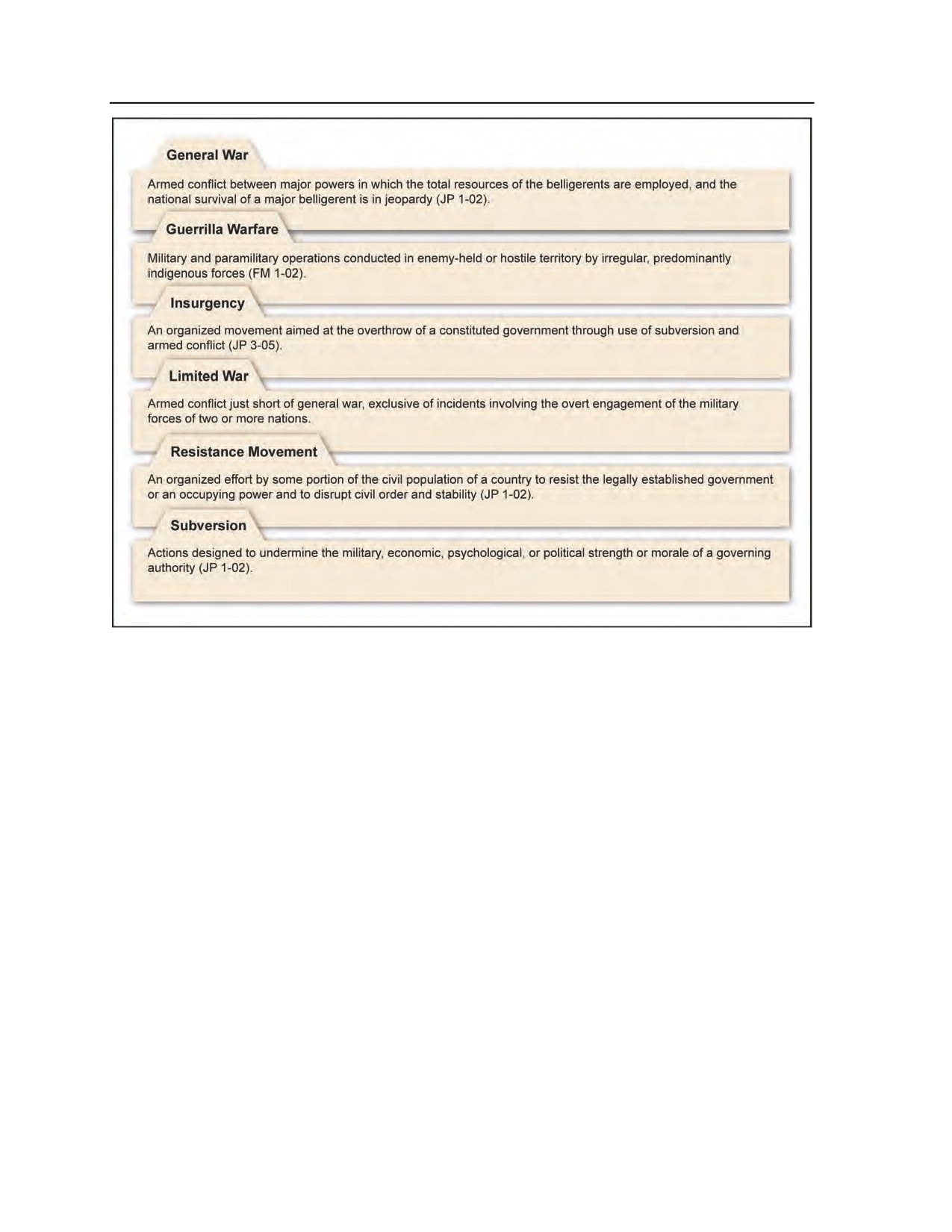
associated with UW (Figure 1-1, page 1-2). These terms developed over the years from various military
and government agencies, as well as the academic world. Many of the terms used to define UW appear to
closely resemble one another and most are found in Joint Publication (JP) 1-02, Department of Defense
Dictionary of Military and Associated Terms, or JP 3-05, Doctrine for Joint Special Operations.
1-4. The following chapters contain vital information for U.S. forces. In addition, there are four
appendixes. Appendix A provides an example of an area study, Appendix B gives an example of an SF
area assessment, Appendix C contains a sample program of instruction for resistance forces, and Appendix D
details SF caching.
30 November 2010
TC 18-01
1-1
Chapter 1
Figure 1-1. Unconventional warfare terminology
THE ROLE OF UNCONVENTIONAL WARFARE
IN UNITED STATES NATIONAL STRATEGY
1-5. Three documents capture the U.S. national strategy: the National Security Strategy, the National
Defense Strategy, and the National Military Strategy. The National Security Strategy states the President’s
interest and goals. The National Defense Strategy is the DOD contribution to the National Security
Strategy. The National Defense Strategy also provides a framework for other DOD strategic guidance,
specifically for campaign and contingency planning, force development, and intelligence. The goals and
objectives of the President’s National Security Strategy guide the National Military Strategy. In addition,
the National Military Strategy implements the Secretary of Defense’s National Defense Strategy. The
National Military Strategy provides focus for military activities by defining a set of interrelated military
objectives.
1-6. USG support to a resistance or insurgency can manifest in any of the following manners:
z
Indirect support. In limited-war scenarios, overt U.S. support for a resistance movement is
sometimes undesirable. In these cases, the USG may indirectly render support though a coalition
partner or a third-country location. The USG normally limits indirect support to logistical aid
and training. Limited war presents a much more restrictive environment that requires low-profile
execution of all USG support operations.
z
Direct support (less combat). In general-war scenarios, the visibility of USG support is less
controversial, which expands the nature of possible USG support to include a wider scope of
logistical support, training, and advisory assistance. U.S. assistance can include advisors in
1-2
TC 18-01
30 November 2010
Overview
sanctuaries or insurgent-controlled areas not in direct combat. The United States can also render
assistance from a neighboring country.
z
Combat support. Combat support includes all of the activities of indirect and direct support in
addition to combat operations.
1-7. Before providing support to a resistance movement or insurgency, planners must consider how the
ideology and objectives of the resistance movement affect strategic interests in the region. Planners must
ensure leadership clearly defines U.S. national strategy and goals before planners make any determination
regarding the appropriateness of support to a resistance movement or insurgency. Without a clear
understanding of the desired effects and end state for a region or conflict, it is impossible to assess whether
support to a resistance or insurgency would achieve favorable results.
1-8. Successful planners weigh the benefits of providing support to resistance forces against the overall
strategic context of a campaign. They must not allow a desire to conduct UW or to produce a purely
military effect dominate their judgment. Support to resistance forces does not simply contribute to a
military effort; it undoubtedly alters the geopolitical landscape of a given region. Planners may deem a
specific insurgent effort feasible and appropriate to the military effort, but consider it strategically
unfavorable because of the political risk of the effort or the potential for increased regional instability.
FEASIBILITY FOR UNITED STATES SPONSORSHIP
1-9. There are certain environments and situations that make UW the best option. Although outside
forces could alter and shape the existing environment to some degree, they cannot artificially manufacture
or transplant it.
1-10. There are two categories planners use when deciding to provide support. The first category is feasibility.
Feasibility is dependent upon the physical and human conditions of the environment. The second category is
appropriateness. Appropriateness is dependent upon the characteristics of the resistance movement.
1-11. U.S. UW forces possess capabilities that can profoundly affect the human terrain through shaping
operations that influence behavior in support of U.S. objectives. They can also influence resistance
movement characteristics, making them more appropriate to the mission. For example, U.S. UW forces
could emphasize guerrilla adherence to international norms and standards of behavior.
1-12. Planners further break down feasibility and appropriateness into the seven dynamics of an
insurgency. Chapter 2 discusses these dynamics in detail.
PHYSICAL AND HUMAN ENVIRONMENTAL CONDITIONS
1-13. There are specific physical and environmental conditions that allow for a successful resistance or
insurgency. The three main conditions are a weakened or unconsolidated government or occupying power,
a segmented population, and favorable terrain from which an element can organize and wage subversion
and armed resistance.
WEAKENED OR UNCONSOLIDATED GOVERNMENT OR OCCUPYING POWER
1-14. Conditions must sufficiently divide or weaken the organizational mechanisms that the ruling regime
uses to maintain control over the civilian population for the resistance to successfully organize the
minimum core of clandestine activities. It is extremely difficult to organize successful resistance under a
fully consolidated government or occupying power with a strong internal security apparatus. Despite the
general dissatisfaction of the society, the resistance has little chance of developing the supporting
infrastructure it needs to succeed. Planners need to recognize the significant differences in the ability of
different elements to exert control over a population. A recent foreign occupier does not have the same
ability as an indigenous long-standing dictatorial regime that has had years to consolidate power.
30 November 2010
TC 18-01
1-3

Chapter 1
WILL OF THE POPULATION
1-15. The population must possess not only the desire to resist but also the will to bear the significant
hardships associated with repressive countermeasures by the government or occupying power. Populations
that the regime subjugates or indoctrinates for long periods are less likely to possess the will required to
sustain a prolonged and difficult struggle. Populations living under repressive conditions generally either
retain their unique religious, cultural, and ethnic identity or begin to assimilate with the regime out of an
instinct to survive. Planners need to distinguish between the population’s moral opinion of their
“oppressors” and their actual willingness to accept hardship and risk on behalf of their values and beliefs.
Populations recently overtaken by an occupying military force have a very different character than those
that have had to survive for decades under an oppressive regime.
1-16. Information activities that increase dissatisfaction with the hostile regime or occupier and portray the
resistance as a viable alternative are important components of the resistance effort. These activities can
increase support for the resistance through persuasive messages that generate sympathy among populations.
1-17. In almost every scenario, resistance movements face a population with an active minority supporting
the government and an equally small militant faction supporting the resistance movement (Figure 1-2). For
the resistance to succeed, it must convince the uncommitted middle population, which includes passive
supporters of both sides, to accept it as a legitimate entity. A passive population is sometimes all a well-
supported insurgency needs to seize political power. As the level of support for the insurgency increases,
the passive majority will decrease.
Figure 1-2. Support for an insurgency
FAVORABLE TERRAIN
1-18. In order to conduct operations, resistance forces require human and physical terrain that provides
safe haven. This terrain must possess enough security for resistance members to train, organize, and
recuperate. The resistance must locate safe havens in relatively inaccessible areas that restrict the ability of
the HN military force to project power and exert control. Examples of favorable terrain include physically
1-4
TC 18-01
30 November 2010
Overview
inaccessible terrain, such as mountains, jungles, and swamps, or artificial safe havens (such as urban
ghettos or an international border). Artificial safe havens replicate actual restrictive terrain. However,
artificial safe havens are only restrictive for as long as the risk of penetrating them remains unacceptable to
HN forces. In contrast, safe havens in physically inaccessible terrain, such as mountains and jungles,
remain restrictive to pursuing counterinsurgent forces.
1-19. An important aspect of the human terrain is the opportunity it presents for the resistance to access
populations in enemy-controlled areas, to disseminate information about the resistance and its objectives,
and to establish beneficial lines of communications (LOCs) with key communicators. Active cultivation of
relationships with key communicators can lower barriers and increase cooperation between U.S. forces and
the resistance movement.
1-20. Elements can sometimes negate the limitations of physical terrain to shape the operational
environment. For example, forces may use shortwave transmitters to broadcast messages in areas where
mountain ranges prevent line-of-sight frequency modulation (FM) radio broadcasting with messages
targeted at a specific segment of the population. Shortwave transmitters (such as those used on EC-130J
Commando Solo) may be able to broadcast the messages to reach the populace in the target area.
Note: The U.S. military uses the specially configured Commando Solo to conduct information
operations to broadcast in amplitude modulation, FM, high-frequency, television, and military
communications bands.
RESISTANCE MOVEMENT CHARACTERISICS
1-21. There are certain characteristics of a resistance movement that make U.S. support favorable.
Characteristics of a favorable movement include the following:
z
Willingness to cooperate with the United States.
z
Compatible objectives and ideology.
z
Capable resistance leadership.
WILLINGNESS TO COOPERATE WITH THE UNITED STATES
1-22. A genuine willingness to collaborate and cooperate with the United States must exist within the
leadership of the indigenous force. It is unrealistic to expect a leader to relinquish control of his forces to
the United States. In general, insurgent leaders expect to retain authority and control over their forces while
benefiting their cause by collaborating with the United States. Tailored, persuasive messages targeting key
leaders and groups may increase their willingness to accept U.S. support.
COMPATIBLE OBJECTIVES AND IDEOLOGY
1-23. Successful movements must have compatible objectives and an ideology that binds their forces
together. Organizations bound through some commitment other than common ideology—such as forced
conscription or hired mercenaries—typically are only marginally capable over a protracted period. Armed
groups may find a common bond in ethnicity, religion, or tribal ties. Elements can use persuasive
techniques and messages emphasizing commonalities to unite different groups for a common cause. Once
the groups unite, other messages can reinforce unity by building morale, reinforcing organizational
cohesion, and emphasizing mutual goals.
CAPABLE RESISTANCE LEADERSHIP
1-24. Resistance movement leaders are cautious of quickly forming new partnerships. In order to
understand insurgent leaders, it is critical to understand their motivation and desires. Planners must
consider what the United States is requesting and offering in return from the insurgent’s perspective. The
best leader is not always the one that is the easiest to work with initially. In fact, an overly accommodating
30 November 2010
TC 18-01
1-5
Chapter 1
leader could be a desperate and incapable leader primarily interested in personal gain. Similarly, a
seemingly indifferent leader could be an effective leader that is unimpressed with offers of support without
an assurance of long-term commitment because of the potential risk involved. The determination of the
appropriateness of U.S. support requires an in-depth understanding of the resistance leadership and
organization. This level of fidelity normally requires a degree of first-hand observation in order to develop
an educated assessment.
1-25. Assessments are important sources of information on the psychological characteristics of leaders and
groups. This analysis provides a degree of prediction about the future behavior of these potential partners.
With prediction comes a degree of confidence in knowing how potential resistance leaders will conduct
themselves in the UW effort. It also provides information on guerrilla leader expectations for their forces in
terms of the method of fighting, treatment of civilians, and other key aspects that can have political and
legal ramifications for the operation. This information aids the commander or other decision-makers in
determining the appropriateness of any support to the movement.
THE CRITICALITY OF THE FEASIBILITY ASSESSMENT
1-26. Planning remains limited until leadership validates certain assumptions. If operations proceed
without a proper feasibility assessment, the likelihood of unintended consequences is high. To gain an
accurate picture, operational personnel need to meet with indigenous personnel who represent the
resistance forces. This meeting can take place inside the denied territory, in the United States, or in a third-
party nation. Although meeting representatives in the United States or a third-party nation is safer for an
assessment team, it also provides a less reliable assessment of potential capabilities. Participation of all
components is vital to enable an accurate assessment of potential resistance capabilities. No single ARSOF
element can provide a complete picture of the movement necessary for this crucial step in the UW effort.
1-27. The feasibility assessment analyzes the achievability, acceptability, and suitability of a mission. This
is an assessment based on mission, enemy, terrain and weather, troops and support available, time
available, and civil considerations (METT-TC) to determine if the necessary means and resources are
available to meet mission requirements. It also addresses whether the potential gain or desired effect
outweighs or otherwise justifies the potential losses or cost. Lastly, the assessment determines if achieving
the desired objectives would accomplish the desired effects.
1-28. The normal areas of concern that make up a feasibility assessment are as follows:
z
Are there groups that could develop into a viable force with assistance?
z
Is the United States in contact with or can it make contact with individuals representing the
resistance potential in an area?
z
Are there any capable leaders, whose goals are compatible with U.S. goals who are willing to
cooperate with the United States?
z
Can the United States influence the leaders to remain compliant with U.S. goals?
z
Are the groups’ tactics and battlefield conduct acceptable by the standards established in Field
Manual (FM) 27-10, The Law of Land Warfare, and to the U.S. population?
z
Will the environment geographically and demographically support resistance operations?
z
Is the enemy effectively in control of the population?
z
Is the potential gain worth the potential risk? Is this group’s participation politically acceptable
to other regional partners?
1-29. All U.S. UW elements are able to assist the commander in answering these questions. They assist with
individual perspectives for developing a particular resistance capability, as well as for an overall feasibility
assessment.
1-30. Expatriates are a valuable resource, particularly in regions where the culture is largely unfamiliar or
alien to a planner’s frame of reference. However, planners should carefully ensure the individual’s claims
are valid. An expatriate’s influence in a given country can be inversely proportional to the length of time
he has been away from his former homeland. Although there are many reasons an expatriate might
1-6
TC 18-01
30 November 2010
Overview
exaggerate his influence in a region and attempt to exploit the situation in his favor, he may be legitimately
surprised to find his own assessment of his influence to be grossly inaccurate. During normal peacetime
conditions, a person can spend years away from a country and expect to maintain their contacts and
influence. This period significantly shrinks under the pressures of a harsh regime or occupying force.
1-31. While determining the feasibility of a potential campaign, planning personnel must have clear
objectives, a desired end state, and knowledge of exactly what level of support is available and acceptable.
Without these specifics, negotiations with potential resistance forces are futile. If planners determine
conditions are unfavorable during the assessment, then they need to consider any measures that could
transform the current situation into a more favorable one. For example, can the United States—
z
Persuade a potential resistance group to cease unacceptable tactics or behavior?
z
Persuade a coalition to accept a specific resistance group’s participation under certain
conditions?
z
Degrade the enemy’s control over the population?
z
Bolster the will of the population to resist?
z
Achieve desired objectives within the given time constraints?
1-32. SF, Military Information Support (MIS), and CA Soldiers can actively engage their resistance
counterparts to encourage adherence to international norms of behavior and law. They can also change
attitudes and beliefs about other groups participating in the resistance effort as part of unity and cohesion
building.
1-33. Planners need to be careful of attempting to overcome a potential resistance shortcoming by creating
surrogate forces that are not indigenous. Historically, the United States has not had success creating and
transplanting these types of resistance forces to the operations environment without an existing clandestine
infrastructure that connects the local population to the foreign forces.
WAYS THE UNITED STATES CONDUCTS
UNCONVENTIONAL WARFARE
1-34. The United States conducts two types of UW. The United States executes UW with the anticipation
of large-scale U.S. military involvement or without anticipation of large-scale U.S. military involvement.
GENERAL WAR SCENARIOS
1-35. There are two possible goals of large-scale involvement. The goal is either to facilitate the eventual
introduction of conventional forces or to divert enemy resources away from other parts of the operational area.
1-36. UW forces can function as effective instruments in the psychological preparation of the population
for the introduction of conventional forces. Furthermore, deception and other measures can convince
enemy leaders to divert resources away from the main area of effort when it is not necessary to do so. For
example, the United States can disseminate messages suggesting guerrilla operations will occur in certain
locations, causing enemy leaders to divert their forces away from the actual route of advance to meet a
nonexistent threat. Examples of this type of UW effort by the United States include the following:
z
European and Pacific Theaters (1942-1945).
z
North Korea (1951-1953).
z
Cold War Contingency Plans for Eastern Europe (1952-1989).
z
Kuwait (1990-1991).
z
Afghanistan (2001-2002).
z
Iraq (2002-2003).
1-37. During large-scale UW, operations focus largely on military aspects of the conflict because of the
eventual introduction of conventional forces. The task is normally to disrupt or degrade enemy military
capabilities in order to make them more vulnerable to the pending introduction of conventional invasion
forces. The United States can use actions and messages to increase the disruption and degradation of
30 November 2010
TC 18-01
1-7
Chapter 1
enemy capabilities by lowering their morale and unit cohesion. This can increase desertion, surrender, and
malingering among their ranks. Use of such techniques increases the potential for enemy unit breakdown to
the point of rendering them combat-ineffective.
1-38. Resistance forces assume a one-time greater degree of risk in large-scale involvement scenarios by
exposing almost their entire infrastructure in exchange for the possibility of success and linkup with
friendly coalition forces following an invasion. The ultimate challenge is synchronizing resistance efforts
while maintaining a degree of operational security for the invasion.
1-39. If the intent of the UW operation is to develop an area in order to facilitate the entry of an invasion
force, the challenge is to ensure that the operations of the resistance complement (rather than inadvertently
interfere with or even compromise) those of the invasion forces. If the timing is wrong or the conventional
invasion forces fail to liberate the territory and linkup with resistance forces, it is likely that the resistance
organization (guerrillas, underground, and auxiliary personnel) will suffer significant losses.
1-40. With a few exceptions, it is relatively simple for U.S. forces to compel an adversary to commit
forces to an area away from a possible invasion site. The challenge in this scenario is determining which
resistance actions trigger the desirable responses and when to begin those operations to appropriately affect
the adversary’s decision cycle. If U.S. forces do not coordinate these operations with the invasion force or
time the operations incorrectly, they can cause significant negative consequences.
LIMITED WAR
1-41. In general, the United States uses limited-involvement operations to pressure an adversary. Examples
of this type of UW effort by the United States include the following:
z
The Baltic States (Estonia, Lithuania, Latvia-1950s).
z
Guatemala (1954).
z
Albania (1949-1954).
z
Tibet (1955-1965).
z
Indonesia (1958).
z
Cuba (1960s).
z
North Vietnam (1961-1964).
z
Afghanistan (1980s).
z
Nicaragua (1980s).
1-42. During limited-involvement missions, the overall operation takes place in the absence of overt or
eventual hostilities from the sponsor. Such operations take on a strategic and sensitive political aspect.
Typically, the United States limits its direct involvement, which mitigates the risks of unintended
consequences or premature escalation of the conflict. During limited-involvement operations, the manner
in which forces operate significantly differs from that of large-scale involvement scenarios. Without the
benefit of a conventional invasion force, the resistance forces must limit overt exposure of their forces and
supporting infrastructure in order to sustain operations over a protracted period. Forces must conduct
operations in a manner that accounts for the enemy’s response and retaliation.
1-43. If retaliation occurs, the resistance can exploit the negative consequences to garner more sympathy
and support from the population by emphasizing the sacrifices and hardship the resistance is enduring on
behalf of “the people.” If retaliation is ineffective or does not occur, the resistance can use this as proof of
its ability to wage effect combat against the enemy. In addition, the resistance can portray the inability or
reluctance of the enemy to retaliate as a weakness, which will demoralize enemy forces and instill a belief
in their eventual defeat.
THE SEVEN PHASES OF UNCONVENTIONAL WARFARE
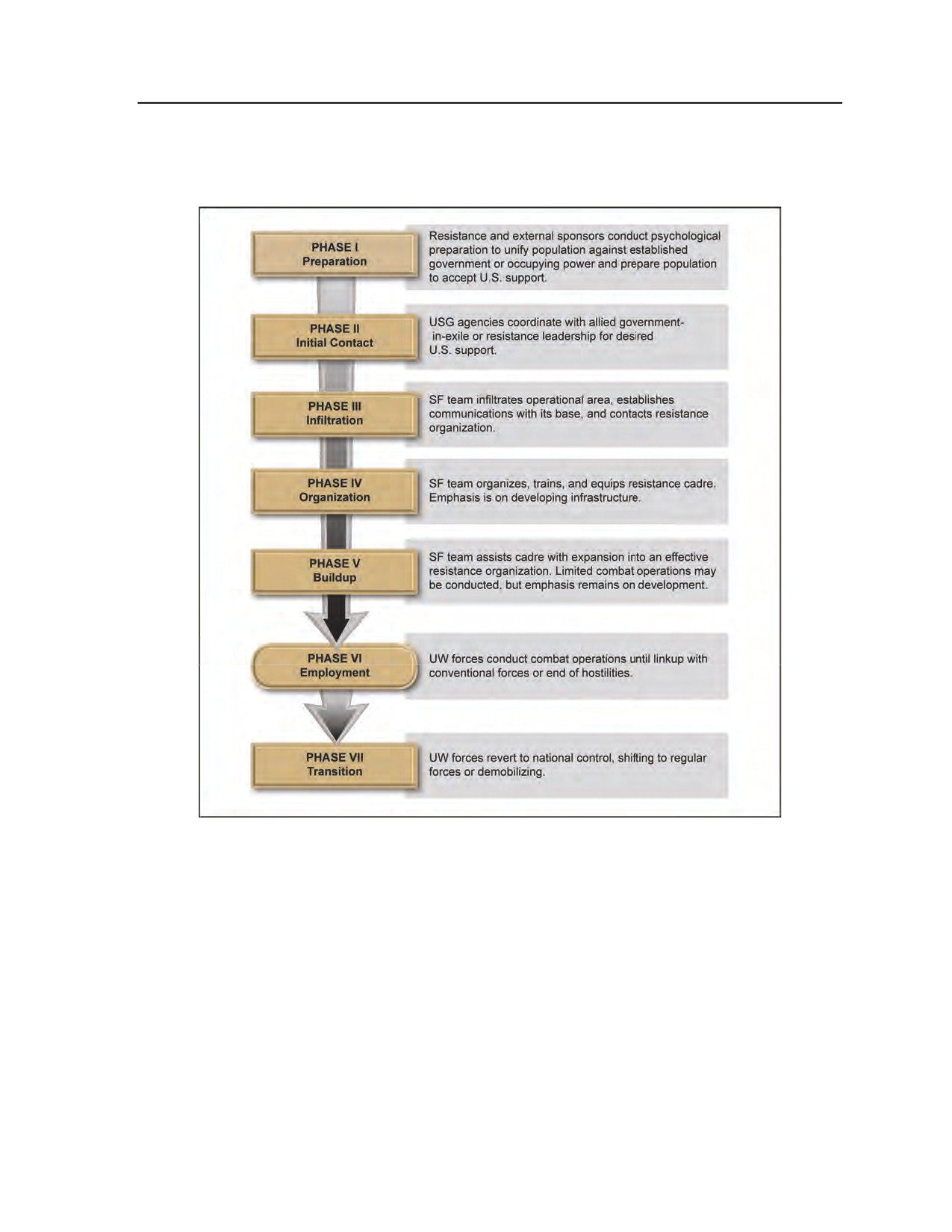
1-44. The seven-phase UW framework is a conceptual construct that aids in planning (Figure 1-3). It
depicts the normal phases of a UW operation. Personnel should not confuse the seven phases of UW with
the phases of development through which friendly resistance forces progress. It is important for planners to
1-8
TC 18-01
30 November 2010
Overview
recognize when factors, such as time, compress or change the normal progression of the seven phases. In
addition, operational elements may only support a portion of the overall campaign and therefore may miss
some of the seven phases. However, all operational elements should understand how their individual
efforts fit into the overall campaign. Chapter 3 contains more information on the seven phases of UW.
Figure 1-3. Phases of unconventional warfare
ELEMENTS IN UNCONVENTIONAL WARFARE
1-45. The operational requirements for conducting and supporting UW present some significant challenges
when compared to other types of special and conventional operations. UW efforts are normally of long
duration and primarily occur in denied areas. These conditions require participating forces to have the
capability of operating in a truly decentralized manner without the benefit of well-established LOCs. These
factors make many of the existing techniques for command and control (C2) and logistics inappropriate.
SPECIAL FORCES IN UNCONVENTIONAL WARFARE
1-46. Whereas other special operations and governmental organizations support UW, SF are the only unit
specifically designed to conduct UW. Unique SF capabilities include—
z
Infiltrating denied territory and linking up with resistance forces.
30 November 2010
TC 18-01
1-9
Chapter 1
z
Training and advising the guerrilla or underground forces part of a resistance.
z
Coordinating and synchronizing the various resistance command elements with U.S. efforts.
MILITARY INFORMATION SUPPORT OPERATIONS IN UNCONVENTIONAL WARFARE
1-47. U.S. forces can use MISO as part of ARSOF capabilities or in conjunction with other USG
capabilities to reduce the need for military force. When military force is necessary, Soldiers conduct MISO
to multiply the effects of the operations. Specifically, MIS elements—
z
Determine key psychological factors in the operational environment.
z
Provide training and advisory assistance to insurgent leaders and units on the development,
organization, and employment of resistance information capabilities.
z
Identify actions with psychological effects that can create, change, or reinforce desired
behaviors in identified target groups or individuals.
z
Shape popular perceptions to support UW objectives.
z
Counter enemy misinformation and disinformation that can undermine the UW mission.
CIVIL AFFAIRS IN UNCONVENTIONAL WARFARE
1-48. CA personnel augment the SF headquarters (HQ) by providing expertise in civil-military operations
(CMO). Although CMO plays a small role in resistance operations, planning CMO early in the campaign is
critical. CMO efforts can play a significant role in—
z
Mitigating the suffering of the population during resistance operations through humanitarian
assistance (HA) efforts. (Forces must conduct CMO and HA efforts in a manner that does not
link the population to the resistance effort, thereby bringing the retaliation of adversary forces.)
z
Planning mobilization of popular support to the UW campaign.
z
Analyzing impacts of resistance on indigenous populations and institutions and centers of
gravity through CA inputs to intelligence preparation of the operational environment (IPOE).
z
Providing the supported commander with critical elements of civil information to improve
situational awareness and understanding within the operational environment.
z
Assisting in stabilization postconflict.
z
Assisting in the demobilization and transition of former resistance forces postconflict.
Note: FM 3-05.40, Civil Affairs Operations, contains additional information on CA support to
UW.
OTHER UNITED STATES GOVERNMENT AGENCIES IN UNCONVENTIONAL WARFARE
1-49. Because of the military and political nature of UW, the U.S. interagency involvement is critical to
achieving a whole-of-government approach and long-term success. The full integration of joint,
interagency, intergovernmental, and multinational communities is necessary at various stages of an
unconventional conflict.
1-10
TC 18-01
30 November 2010
Chapter 2
Fundamentals of Resistance and Insurgency
The guerrilla must move amongst the people as a fish swims in the sea.
Mao Zedong
Secret operations are essential in war; upon them the army relies to make its every move.
Sun Tzu
Separate definitions exist for resistance movements and insurgencies within the DOD
and various academic communities. However, within this document, the two terms
convey a strategy of insurrection. Planners broadly use the term “insurgency” to
describe the concept of achieving aims through a strategy of armed conflict and
subversion against an indigenous government or occupying power. Planners use the
term “resistance movement” to convey a unique type of insurgency that focuses on
the removal of an occupying power. The difference in terminology is important to the
concept of UW, because planners must understand the significant differences in
dealing with a resistance movement that forms in response to an occupying power,
and an insurgency that grows over time out of discontent for an oppressive regime.
Planners generically use the term
“resistance” to categorize the activities of a
resistance movement or insurgency.
Insurgents are inherently indigenous. There remains confusion regarding external
support elements, such as foreign fighters. Even when the U.S. forces or foreign
fighters support an insurgency or resistance movement, planners should not
categorize them as part of the insurgency. Planners should categorize these elements
as enablers, facilitators, advisors, or supporters.
WHY POPULATIONS RESIST
2-1. Resistance generally begins with the desire of individuals to remove intolerable conditions imposed
by an unpopular regime or occupying power. Feelings of opposition toward the governing authority and
hatred of existing conditions that conflict with the individual’s values, interests, aspirations, and way of life
spread from the individual to his family, close friends, and neighbors. As a result, an entire community
may possess an obsessive hatred for the established authority. Initially, this hatred will manifest as
sporadic, spontaneous nonviolent and violent acts of resistance by the people toward authority. As the
discontent grows, natural leaders, such as former military personnel, clergymen, local office holders, and
neighborhood representatives, emerge to channel this discontent into organized resistance that promotes its
growth. The population must believe they have nothing to lose, or more to gain. Key to transitioning from
growing discontent to insurrection is the perception by a significant portion of the population that they
have nothing to lose by revolting and the belief that they can succeed. In addition, there must be a spark
that triggers insurrection, such as a catalyzing event that ignites popular support against the government
power and a dynamic insurgent leadership that is able to exploit the situation. Figure 2-1, page 2-2, defines
words critical to understanding resistance movements.
30 November 2010
TC 18-01
2-1

Chapter 2
Figure 2-1. Resistance terminology
2-2
TC 18-01
30 November 2010
Fundamentals of Resistance and Insurgency
CLANDESTINE RESISTANCE
2-2. People who outwardly follow their normal mode of existence conduct clandestine resistance. This
type of resistance is organized and controlled and conducts the following activities as groups and
individuals:
z
Political action.
z
Propaganda.
z
Espionage.
z
Sabotage.
z
Traffic in contraband.
z
Intelligence gathering.
OVERT RESISTANCE
2-3. Individuals and groups who train along military lines perform overt resistance. Planners refer to this
militant arm of the resistance movement as the guerrilla force. These elements make no secret of their
existence or their objectives. However, resistance leaders compartmentalize the specific relationship of the
guerrilla force to other components of the resistance movement to prevent compromise of the entire
movement.
2-4. Each insurgency or resistance movement has its own unique characteristics based upon its strategic
objectives, operational environment, and available resources. Insurgencies normally seek to change the
existing social order and reallocate power within the country. Typical insurgent goals include:
z
Removal of the established governing authority, whether an indigenous regime or occupying
military power.
z
Establishment of an autonomous national territory within the borders of a state.
z
Extraction of political concessions that the movement cannot attain through nonviolent means.
2-5. The structure of an insurgency or resistance movement is similar to an iceberg
(Figure
2-2,
page 2-4). Most of the structure is below the surface, and only the peak is visible. In building a resistance
structure, insurgent leaders give principal attention to the development of a clandestine supporting
infrastructure. This infrastructure works—
z
Among the citizens in rural villages, towns, and urban cities.
z
Within the military, police, and administrative apparatus of government.
z
Among labor groups and students.
DYNAMICS OF SUCCESSFUL INSURGENCIES
2-6. JP 3-24, Counterinsurgency Operations, lists eight dynamics of an insurgency. JP 3-24 includes
internal support and organizational and operational patterns. FM
3-24, Counterinsurgency, lists six
dynamics of an insurgency. FM 3-24 does not include organization and operational patterns. However, SF
continue to use organization as one of the dynamics of an insurgency to understand the form, function and
logic of insurgent movements.
2-7. Seven dynamics are common to most successful insurgencies. These dynamics provide a framework
for planners to analyze insurgencies. It is some combination of these dynamics that will generally
transform popular disconnect into an organized and effective movement.
LEADERSHIP
2-8. A group committing random political violence is not an insurgency. In an insurgency, the group is
committing directed and focused political violence. It requires leadership to provide vision, direction,
guidance, coordination, and organizational coherence. The insurgency leaders must make their cause
known to the people and gain popular support. Their key tasks are to break the ties between the people and
the government and to establish credibility for their movement. The leaders must replace the government’s
30 November 2010
TC 18-01
2-3

Chapter 2
legitimacy with that of their own. Their ability to serve as a catalyst that motivates and inspires others to
have faith in their cause is vital to the movement’s growth. Their ability to organize and willingness to
distribute power across the organization is vital to the long-term success of the movement. Organizations
dependent upon key charismatic personalities to provide cohesion and motivation for the movement are
vulnerable to disruptions if the enemy removes or co-opts those players.
Figure 2-2. Structure of an insurgency or resistance movement
IDEOLOGY
2-9. The insurgents must have a program that justifies its actions in relation to the movement’s grievances
and explains what is wrong with the status quo. The most important aspect of a successful insurgency is the
viability of the message. It is essential that the message physically reaches the people and possesses
2-4
TC 18-01
30 November 2010
Fundamentals of Resistance and Insurgency
meaning to their way of life. The insurgency cannot gain active or passive support without achieving these
goals. This makes the language, culture, and geography of the masses particularly important. Ideology is an
important factor in unifying the many divergent interests and goals among the insurgency membership. As
a common set of interrelated beliefs, values, and norms, ideology is used to manipulate and influence the
behavior of individuals within the group. Ideology will serve as the rallying call for all members of the
population to join the struggle. The ideology of the insurgency and the motivation of the insurgent must
remain linked. Once delinked, the counterinsurgent will be able to address individual grievances and
negate the unity of the insurgency.
OBJECTIVES
2-10. Although insurgency is a strategy, implementation requires intermediate objectives, specifically
strategic, operational, and tactical goals. Tactical goals most directly translate to actions. These actions lead
to operational goals. Insurgents need carefully to choose what efforts to undertake. For example, raids,
ambushes, and supporting propaganda urging enemy forces to serve their tour quietly and go home alive, to
consolidate into large bases away from the cities, or to stay to the roads for their own safety achieves the goals
of disrupting enemy control over territory and weakening enemy commitment to counterinsurgent strategy.
2-11. Operational objectives address how the insurgency will progress towards its strategic goal. Examples
could include the following:
z
Attaining a level of popular support in a key region.
z
Gaining international recognition or external support.
2-12. The strategic objective is the desired end state. In general, the strategic objective is to gain
concessions or remove the regime in power. Typically, the strategic objective is critical to cohesion among
insurgent groups. It might be the movement’s only clearly defined goal. Some examples of strategic goals
are as follows:
z
Political revolution.
z
Political reformation.
z
Succession.
z
Preservation.
z
Reversion.
ENVIRONMENT AND GEOGRAPHY
2-13. The environment and geography (demographics) greatly affect an insurgency’s strategies and tactics.
Insurgencies may form their base in urban environments, rural environments, or a combination of both. By
maintaining a combination of urban cells and rural bases, insurgencies can often take full advantage of the
benefits of both models (urban and rural) without becoming constrained by the shortcomings of either model.
2-14. Insurgents located in rural areas enjoy the relative safety of remote terrain or safe havens, such as
jungles or mountains. These geographical conditions make it possible for them to form larger guerrilla
bands and conduct large-scale guerrilla operations. Disadvantages of a rural base are—
z
Length and speed of communications and supply lines.
z
Displacement of insurgents from the populace.
z
Susceptibility of insurgents to conventional military counterguerrilla operations.
2-15. Urban insurgencies have overcome the lack of suitable restrictive terrain by operating within ethnic
ghettos or enclaves within sympathetic densely populated urban areas. These areas often create safe havens
that HN forces are unwilling or unable to access. This type of urban basing requires a high degree of
compartmentalization, which makes it more difficult for the group to train and organize for large-scale
operations.
30 November 2010
TC 18-01
2-5
Chapter 2
EXTERNAL SUPPORT
2-16. Historically, insurgencies do not succeed without some form of external support. This support can be
in the form of—
z
Moral or political support in the international forum.
z
Resources, such as money, weapons, food, advisors, and training.
z
Sanctuary, such as secure training sites, operational bases over a border, or protection from
extradition.
2-17. Governments providing support to an insurgency normally share beneficial interests or common
ideology with the insurgency. Ethnic enclaves or diasporas in third-party countries can provide significant
support in terms of political voice, money, personnel, and sanctuary.
2-18. With external support comes a degree of dependency on the foreign power. Insurgencies can view
this as a disadvantage because the foreign power can then attempt to control or manipulate the insurgency
to better serve its goals. To counterbalance the loss of the support from sympathetic foreign governments
since the end of the Cold War, many groups have resorted to alliances with organized crime groups,
narcotics trafficking, and kidnapping to raise funds. This tactic has proven extremely effective for
generating revenue, but counterproductive to the original goals of the movements.
PHASING AND TIMING
2-19. Successful insurgencies pass through common phases of development. Not all insurgencies
experience every phase, and progression through all phases is not a requirement for success. The same
insurgent movement may be in different phases in separate regions of a country. Successful insurgencies
can also revert to an earlier phase when under pressure, resuming development when favorable conditions
return. A common failure of insurgencies and counterinsurgencies is the inability to adapt tactics when
transitioning from one phase of a strategy to another.
2-20. The three-phase construct presented below is a historical representation of how insurgencies mature.
An extremely useful template allows planners to communicate precisely an insurgency’s stage of
development.
Phase I—Latent or Incipient Phase
2-21. During this phase, the leadership of the resistance develops the clandestine supporting infrastructure
upon which all future effort will rely. The resistance organization uses a variety of subversive techniques to
prepare the population psychologically to resist. Some techniques include propaganda, demonstrations,
boycotts, and sabotage. Subversive activities frequently occur in an organized pattern without any major
outbreak of armed violence. Activities include the following:
z
Recruit, organize, and train cadre.
z
Infiltrate key government organizations and civilian groups.
z
Establish cellular intelligence, operational, and support networks.
z
Organize or develop cooperative relationships with legitimate political action groups, youth
groups, trade unions, and other front organizations. This approach develops popular support for
later political and military activities.
z
Solicit and obtain funds.
z
Develop sources for external support.
2-22. An absent government will compromise with insurgent objectives. The goal is to prepare or
transition the population into accepting overt military operations (guerrilla warfare) as permissible. The
goal is to gain the support of the local population and weaken the power of the existing government.
Although the operational goal is to win popular support, the tactical goal is to convince the local
population to avoid collaboration with the government forces. This leads to a condition where the
insurgency can expand operations without the risk of compromise by the local population. It is impossible
2-6
TC 18-01
30 November 2010
Fundamentals of Resistance and Insurgency
for the insurgency to conduct the operations it desires without the population being aware of it. This
condition allows the insurgency to expand into Phase II (guerrilla warfare).
Phase II—Guerrilla Warfare
2-23. The objective of this phase is to degrade the government’s security apparatus (the military and police
elements of national power) to the point where the government is susceptible to defeat.
2-24. A campaign of guerrilla attacks and sabotage degrade the government’s military and police forces.
Subversive activities continue to build and maintain support from the population. Proinsurgency radio
broadcasts, newspapers, and pamphlets openly challenge the control and legitimacy of established
authority.
2-25. Unlike Phase I, in Phase II guerrillas need to gather forces, communicate and coordinate operations,
conduct training, receive logistics, rest and hide after operations, and plan future operations. Their need for
intelligence collection and security also increases in Phase II. As the guerrillas grow in numbers, so must
the clandestine support mechanisms.
2-26. The resistance fighters or insurgents may achieve legal belligerent status from the international
community if they meet the internationally accepted criteria.
Phase III—War of Movement
2-27. The goal of the insurgency in Phase III is to bring about the collapse of the established government
(military or internal actions) or the withdrawal of the occupying power. The insurgency does not
necessarily need to transform into a conventional military, but it must position itself to defeat the
government or occupying power. For example, the insurgency might degrade the enemy’s capabilities to a
point that an urban uprising against the presidential palace would topple the government. This tactic can
only succeed if the insurgency effectively removes the military first.
2-28. As the insurgency gains control over the country, the insurgent leadership becomes responsible for
the population, resources, and territory under its control. If the insurgency fails to plan and execute
posthostility activities, the population may lose confidence in the insurgency and turn to the old
government, a breakaway faction, or a splinter group of the insurgency.
2-29. Based on the conditions set earlier, an effective resistance or insurgency—
z
Establishes an effective civil administration.
z
Establishes an effective military organization.
z
Provides balanced social and economic development.
z
Mobilizes the population to support the resistance organization.
z
Protects the population from hostile actions.
Failure to achieve these objectives may cause the resistance movement to revert to an earlier phase.
ORGANIZATION AND OPERATIONAL PATTERNS
2-30. The organizational and operational pattern of a given movement is similar to its order of battle. From
its outset, the organization has a concept of its development based on its goals. Although there are
numerous traditional models for insurgencies
(for example, conspiratorial, military-focused, urban,
protracted popular war, or terror-based [not a methodology supported as a U.S. option]), the planner must
avoid following a famous model without considering the way that model worked for its historical
environment and if the model is appropriate for the current problem set. The structure of the organization
largely depends on the available resources, security threat, and population distribution. All insurgencies are
unique and rarely follow one model exclusively. It is unlikely the structure would resemble a uniform
30 November 2010
TC 18-01
2-7
Chapter 2
organization, such as the military, in which all units look relatively the same. Function takes precedence
over form. Planners must understand the organization’s—
z
Various subordinate components and their orientation.
z
Commands—down to the lowest tactical level.
z
Supporting infrastructure.
2-31. The organization’s most important component level is the local level, where it obtains and sustains
support and manifests actions. Echelons above the local level coordinate all functions (political, military,
external support, and so on). Overall command provides purpose and direction.
THE COMPONENTS OF AN INSURGENCY
2-32. There are three components of an insurgency. The underground is always present and is the first
component of the insurgency to form. Goals and objectives of the insurgency will determine the level of
development of the—
z
Underground.
z
Auxiliary.
z
Guerrillas.
THE UNDERGROUND
2-33. The underground is a cellular organization within the resistance movement or insurgency that has the
ability to conduct operations in areas that are inaccessible to guerrillas, such as urban areas under the
control of the local security forces. The underground can function in these areas because it operates in a
clandestine manner, which prevents it from receiving legal belligerent status under any international
conventions. Examples of underground functions include the following:
z
Intelligence and counterintelligence networks.
z
Subversive radio stations.
z
Propaganda networks that control newspaper or leaflet print shops and/or Web pages.
z
Special material fabrication, such as false identification, explosives, weapons, and munitions.
z
Control of networks for moving personnel and logistics.
z
Individuals or groups that conduct acts of sabotage in urban centers.
z
Clandestine medical facilities.
2-34. Underground members normally are active members of the community, and their service is a product
of their normal life or position within the community. They operate by maintaining compartmentalization
and delegating most risk to their auxiliary workers. The functions of the underground largely enable the
resistance movement to affect the urban areas.
2-35. The operation cell is usually composed of a leader and a few cell members operating directly as a unit
(Figure 2-3, page 2-9). The intelligence cell is unique in that the cell leader seldom in direct contact with the
members of the cell, and the members are rarely in contact with one another (Figure 2-4, page 2-9).
2-8
TC 18-01
30 November 2010

Fundamentals of Resistance and Insurgency
Figure 2-3. Operational cell
Figure 2-4. Intelligence cell
THE AUXILIARY
2-36. The auxiliary refers to that portion of the population that provides active clandestine support to the
guerrilla force or the underground. Members of the auxiliary are part-time volunteers that have value
because of their normal position in the community. Soldiers should not think of the auxiliary as a separate
organization but as a different type of individual providing specific functions as a component within an
urban underground network or guerrilla force’s network. These functions can take the form of logistics,
30 November 2010
TC 18-01
2-9

Chapter 2
labor, or intelligence collection. Auxiliary members may not know any more than how to perform their
specific function or service that supports the network or component of the organization. In many ways,
auxiliary personnel assume the greatest risk. They are also the most expendable element within the
insurgency. Insurgent leaders sometimes use auxiliary functions to test a recruit’s loyalty before exposing
him to other parts of the organization. Auxiliary functions are like embryonic fluid that forms a protective
layer, keeping the underground and guerrilla force alive. Specific functions include the following:
z
Logistics procurement (all classes of supply).
z
Logistics distribution (all classes of supply).
z
Labor for special materiel fabrication.
z
Security and early warning for underground facilities and guerrilla bases.
z
Intelligence collection.
z
Recruitment.
z
Communications network staff, such as couriers and messengers.
z
Propaganda distribution.
z
Safe house management.
z
Logistics and personnel transport.
2-37. Parallel cells are frequently set up to support a primary cell (Figure 2-5). The auxiliary cell is
commonly found in front groups or in sympathizers’ organizations. It contains an underground cell leader,
assistant cell leaders, and members (Figure 2-6, page 2-11). The cells in series provide a division of labor
in order to carry out functions, such as the manufacture of weapons, supply, escape and evasion,
propaganda, and printing of newspapers. The task assigned to a particular cell must transition or carry over
(depicted by arrows) to the next cell in order to accomplish the function in its entirety. For example, Cell 1
purchases certain items, cell 2 assembles the items, and cell 3 distributes the assembled item (Figure 2-7,
page 2-11). Based on the assigned mission, cell members do not communicate directly with one another.
However, cell leaders will communicate indirectly through intermediaries.
Figure 2-5. Parallel cells
2-10
TC 18-01
30 November 2010

Fundamentals of Resistance and Insurgency
Figure 2-6. Auxiliary cell
Figure 2-7. Cells in series
THE GUERRILLAS
2-38. Guerrillas are the overt military component of a resistance movement or insurgency. As the
individuals that engage the enemy in combat operations, guerrillas typically have a significant disadvantage
in terms of training, equipment, and firepower. For all their disadvantages, guerrillas have one advantage
that can offset this unfavorable balance—the initiative. In all his endeavors, the guerrilla commander must
30 November 2010
TC 18-01
2-11
Chapter 2
strive to maintain and protect this advantage. The guerrilla only attacks the enemy when he can generate a
relative, if temporary, state of superiority. The guerrilla commander must avoid decisive engagements,
thereby denying the enemy the opportunity to recover, regain their actual superiority, and use it against the
guerrilla force. The guerrilla force is only able to generate and maintain the initiative advantage in areas
where they have significant familiarity with the terrain and a connection with the local population that
allows them to harness clandestine support.
2-39. Depending on the degree of control over the local environment, the size of guerrilla elements can
range anywhere from squad to brigade-size groups or larger. In the early stages of an insurgency, the
guerrilla force’s offensive capability might be limited to small standoff attacks. As the guerrilla force’s
base of support from the population grows, its ability to challenge government security forces more openly
with larger-scale attacks increases. At some point in an insurgency or resistance movement, the guerrillas
may achieve a degree of parity with HN forces in certain areas. In these cases, units may start openly
fighting, rather than as guerrilla bands. In well-developed insurgencies, formerly isolated pockets of
resistance activity may eventually connect and create liberated territory, possibly even linking with a
friendly or sympathetic border state.
2-40. It is important to use the term “guerrilla” accurately in order to distinguish between other types of
irregular forces that might appear similar but are in fact something entirely different, such as militias,
mercenaries, or criminal gangs. The DOD defines a guerrilla as someone who engages in guerrilla warfare.
This definition is somewhat overly simple because people generally consider guerrilla warfare a tactic that
any force, regular or irregular, can use. True guerrilla forces normally only exist, for an extended period, as
part of a broader resistance movement or insurgency.
ADDITIONAL ELEMENTS OF AN INSURGENCY
2-41. There are additional elements that may be found in an insurgency. Some typical additional elements
include the following:
z
Leadership and C2.
z
Government-in-exile.
z
Shadow government.
z
Area command.
LEADERSHIP AND COMMAND AND CONTROL
2-42. Leadership is not a separate type of component as much as it is a function. The guerrilla or
underground component generally performs this function.
GOVERNMENT-IN-EXILE
2-43. A government-in-exile does not exist in every situation. A government-in-exile is normally present
only in situations in which an element displaces a government from its country but the government remains
recognized as the legitimate sovereign authority. Whether a government-in-exile does or does not exist, the
insurgency will usually still report to some form of a shadow government in-country. Figure 2-8, page 2-13,
depicts the structure of a resistance with a government-in-exile.
SHADOW GOVERNMENT
2-44. The shadow government is an organization the underground forms in occupied territory. Ideally, the
shadow government can perform normal governmental functions in a clandestine manner and synchronize
those functions with the resistance movement. The shadow government is critical because it exercises a
degree of control, supervision, and accountability over the population at all levels (district, village, city,
province, and so on), and further discredits and delegitimizes the existing government.
2-12
TC 18-01
30 November 2010

Fundamentals of Resistance and Insurgency
Figure 2-8. Resistance structure with government-in-exile
AREA COMMAND
2-45. Area command is a term planners use to denote the resistance leadership that directs, controls,
integrates, and supports all resistance activities in a region. The area commander’s location should be a
place where he can safely control the insurgency and its activities. Flexibility, intelligence, mobility, and
operations security are essential for survival and success. If the insurgency subdivides the area command
into sector commands, its component units are the subordinate sector commands.
INFRASTRUCTURE OF A RESISTANCE MOVEMENT
OR INSURGENCY
2-46. The infrastructure of a resistance movement or insurgency includes the area complex and the guerilla
bases. Guerrilla bases may be further subdivided into the inner security zone, outer security zone, and
insurgent logistics.
AREA COMPLEX
2-47. An area complex is a clandestine, dispersed network of facilities to support resistance activities in a
given area. The area complex is contested territory or an area that contains clandestine supporting
infrastructure. It is not liberated territory. It represents the insurgent’s area of operations (AO). Insurgent
forces can maintain their clandestine infrastructure in the area complex. The clandestine infrastructure
provides insurgent forces with a measure of freedom of movement and support. These areas overlay areas
under the control of the government or occupying military. These areas can eventually transform into
liberated areas if the enemy’s ability to challenge the insurgent forces degrades to a level of parity with the
guerrilla forces. To support resistance activities, an area complex must include a security system, guerrilla
bases, communications, logistics, medical facilities, and a series of networks capable of moving personnel
and supplies. The area complex may consist of friendly villages or towns under guerrilla military or
political control (Figure 2-9, page 2-14).
30 November 2010
TC 18-01
2-13

Chapter 2
Figure 2-9. Area complex
GUERRILLA BASES
2-48. A guerrilla base is an encampment that affords the guerrilla force the ability to rest, recuperate, plan,
and train. Guerrilla bases may be temporary or semipermanent camps. Their level of complexity is
proportional to the surrounding security situation. The security situation is a combination of the ability of
the guerrillas to receive warning of an enemy advance, the ability of the enemy to project force to the base
area, and the ability of the guerrillas to conceal their signature from all means of enemy detection. Guerrilla
leaders should locate bases in terrain that HN counterguerrilla forces cannot easily access, such as
restrictive rural or urban terrain. In environments that lack suitable restrictive physical terrain, certain
urban environments can serve as guerrilla base locations. Densely populated urban enclaves that are
sympathetic to the guerrilla cause can present an obstacle to counterguerrilla forces. Unlike actual
restrictive physical terrain that always restricts the enemy’s ability to attack, urban restrictive terrain only
serves its purpose while counterguerrilla forces remain unwilling to assume the physical and political risk
of entering the enclave. The security of the guerrilla camp comes from two bands of protection, which
planners refer to as bizonal security (Figure 2-10, page 2-15).
Inner Security Zone
2-49. The inner security zone encompasses normal camp security measures found in any military
encampment. These measures consist of static guard and sentry positions, flank observation posts, and
roving patrols. These measures provide a layer of physical protection and early warning to the potential
surprise of an advancing enemy patrol or attack. The security elements have a coordinated means of
signaling and communicating with the main base, as well as clear instructions that dictate how they will
respond to different threats. Bases have emergency procedures to respond to enemy attacks. These
procedures include plans for rapid evacuation and withdrawal, as well as possible dispersal of the main
body while a dedicated guerrilla element remains behind to temporarily delay any enemy penetration.
Fighting positions, obstacles, command-detonated or personnel-initiated mines, preestablished ambush
positions, mortars, explosives, or traps along probable enemy vehicular and personnel avenues of approach
may support the defense plans. It is essential that the guerrillas avoid becoming decisively engaged while
carrying out their delaying and defensive mission.
2-14
TC 18-01
30 November 2010
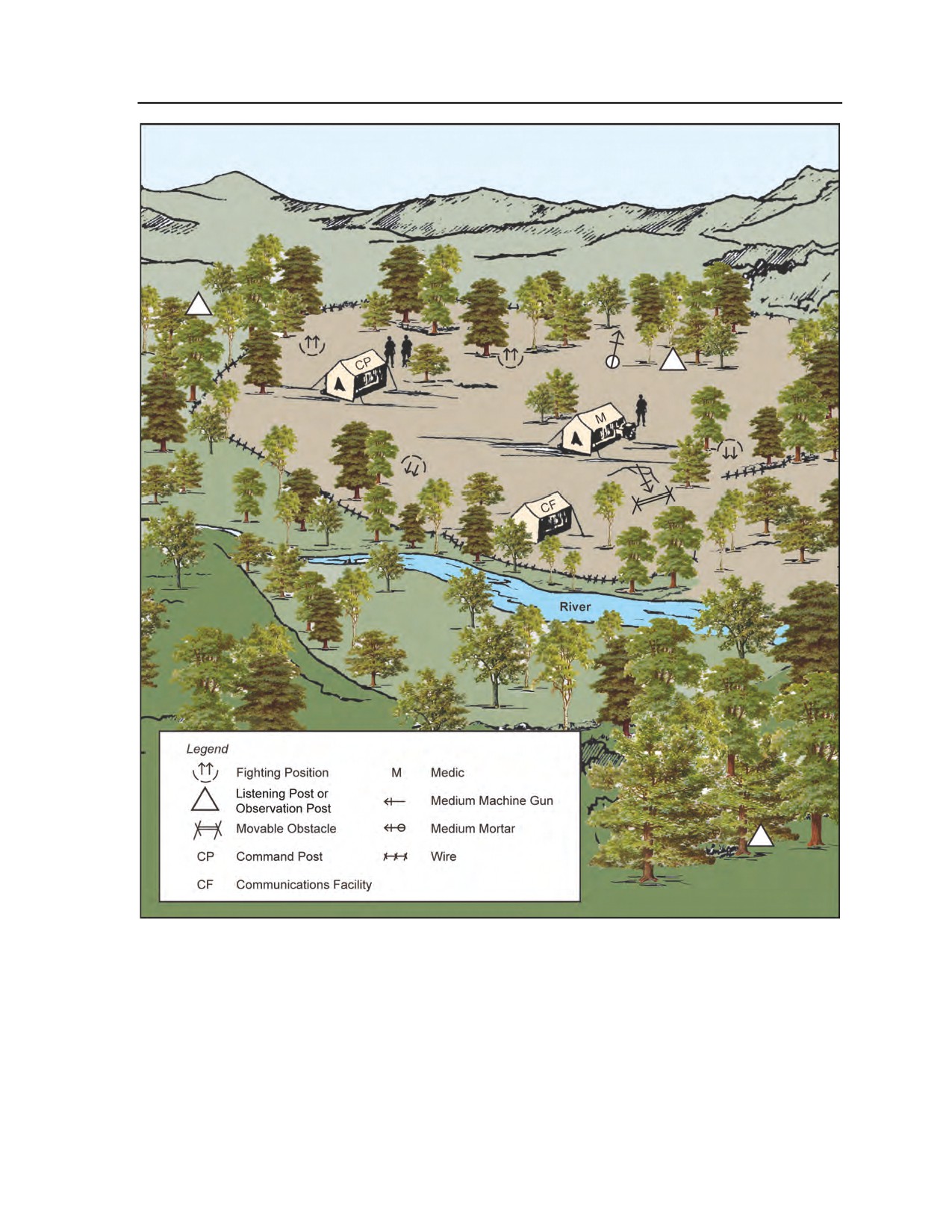
Fundamentals of Resistance and Insurgency
Figure 2-10. Permanent base security
Outer Security Zone
2-50. Insurgent leaders develop and organize the auxiliary’s clandestine supporting infrastructure in the
outer security zone. Clandestine LOCs connect the guerrilla base and other facilities within the area
complex. The outer zone consists of multiple networks of auxiliary agents that provide passive and active
surveillance of key enemy positions that would indicate a pending enemy operation, such as airfields,
motor pools, army compounds, police stations, or choke points along major roadways. These auxiliary
agents might also be in positions to observe indicators of pending offensive operations, such as the daily
itineraries of key leaders, the absence of clientele at popular enemy recreation spots, or the arrival of new
30 November 2010
TC 18-01
2-15
Chapter 2
special units. Auxiliary personnel may also be in positions to monitor unsecured telephone and radio
traffic, collect and sort the enemy’s trash, and take advantage of individual security force and soldier
operational security awareness. Auxiliary members may also extort or intimidate enemy security personnel
to procure operational information. Redundant collection methods and secure means of communications
between auxiliary members and guerrilla bases provide the guerrillas with significant information that
allows them to maintain the initiative over enemy security forces.
Insurgent Logistics
2-51. Each resistance organization must develop a logistics system to meet the specific requirements of
their situation. In general, however, a resistance organization meets its logistical requirements through a
combination of internal and external means.
2-52. The area complex must provide the bulk of an insurgent organization’s logistical requirements. The
area commander must balance his support requirements against his need for civilian cooperation. Imposing
excessive demands on the population may adversely affect popular support. Logistical constraints may
initially dictate the size of the resistance organization.
2-53. As the resistance organization expands, its logistical requirements may exceed the capability of the
area complex to provide adequate support. When this situation occurs, an external sponsor provides
supplemental logistical support or the resistance organization reduces the scale of its activities. External
support elements normally limit support to the necessities of life and the essential equipment and supplies
the resistance needs to conduct combat operations. Internal sources of resistance supply include the
following:
z
Battlefield recovery.
z
Purchase.
z
Levy.
z
Barter.
z
Production.
z
Confiscation.
2-54. Successful offensive operations permit resistance forces to satisfy some of their logistical
requirements through battlefield recovery. Capturing supplies from hostile forces also avoids alienating
civilians. The resistance organization normally limits its purchases to critical items unavailable by other
means. Excessive introduction of external currency may disrupt the local economy, which may not be in
the interest of the resistance organization or the United States.
2-55. The resistance organization may organize a levy system to ensure an equitable system for obtaining
supplies from the local population. Under a levy system, the resistance organization provides receipts and
maintains records of levy transactions to facilitate reimbursement at the end of hostilities. Obstacles to a
levy system include—
z
Chronic shortages among the local population.
z
Hostile populace and resources control (PRC) measures, including confiscation or destruction of
local resources.
z
Competition from the hostile power or rival resistance organizations.
z
Chemical, biological, radiological, nuclear, and high-yield explosives
(CBRNE) or other
contamination of local resources.
2-56. Barter may adversely affect the levy system. However, it is sometimes the only method of obtaining
critical services or items, such as medical supplies.
2-57. Resistance forces often have to improvise their own field expedients. They may even have to plant
and raise their own food, dig wells, and tend their own livestock. The area commander may consider
establishing clandestine factories to produce unobtainable items.
2-16
TC 18-01
30 November 2010
Fundamentals of Resistance and Insurgency
2-58. Confiscation alienates the local population. The resistance organization should use confiscation only
in emergencies or as punishment for individuals who refuse to cooperate or who actively collaborate with
the hostile power. In all cases, resistance leaders must strictly control confiscation to ensure that it does not
deteriorate into looting.
2-59. The resistance organization requires basic medicines and other medical supplies to treat its members.
Preventive medicine is especially important to a resistance organization because it normally does not have
adequate facilities to treat diseases.
2-60. The area commander normally obtains transportation support from the auxiliary on a mission basis.
The guerrilla force may have its own organic transportation system to meet its immediate needs. In remote
or undeveloped areas, the primary means may be human porters or pack animals.
2-61. The area commander caches extra supplies and equipment throughout the operational area. Caching is
not a haphazard affair. Caches must support anticipated operational requirements or specified emergencies.
2-62. The resistance organization obtains repair materiel from the local economy and through battlefield
recovery to perform all maintenance and repairs within its capability. It may establish repair facilities
within the area complex. The sponsor includes necessary maintenance and repair items with all equipment
it provides the resistance. Introducing sophisticated equipment into the area complex may complicate the
maintenance system.
ORGANIZATION OF MEDICAL SUPPORT WITHIN
THE AREA COMPLEX
2-63. The resistance initially confines clandestine medical treatment facilities to emergency and expedient
care, with little preventive medicine. Once the area complex sufficiently develops, the clandestine facilities
can expand and become a semipermanent medical organization, which serves the following purposes:
z
To sustain and preserve combat power.
z
To support the population.
MEDICAL REQUIREMENTS
2-64. If the area command has not established a degree of clandestine medical support, the result will be
evident in the guerrilla force’s morale. Historically, a lack of proper medical attention has led to serious
illness and disability that reduced overall unit combat effectiveness.
2-65. Medical elements supporting the resistance forces must be mobile, responsive, and effective in
preventing disease and restoring the sick and wounded to duty. It is unlikely the movement will have a safe
rear area where it can take casualties for treatment. Medical personnel help during combat operations by
operating casualty collection points, which allows the healthy guerrillas to keep fighting. Medical
personnel evacuate casualties from these points to a guerrilla base or civilian care facility.
2-66. Resistance personnel use existing logistics and transportation nets to gain supplies and move
casualties. The movement of wounded personnel across enemy-controlled areas by auxiliary members is a
clandestine operation, not a support function.
AID STATION
2-67. Trained medical personnel provide emergency treatment at aid stations. Evacuation of wounded
personnel from the battle area begins at these stations. Because the condition of the wounded may prevent
movement to the unit base, personnel hide them in secure locations and notify the auxiliary. The auxiliary
cares for and hides the wounded or evacuates them to a treatment facility.
2-68. The evacuation of the dead is important for security reasons. If the enemy identifies the dead, the
families of the guerrillas may be in danger. Personnel evacuate and cache the bodies of those killed in action
30 November 2010
TC 18-01
2-17
Chapter 2
until proper burial or disposal of the bodies in accordance with (IAW) the customs of the local population.
Removal and burial of the dead denies the enemy valuable intelligence concerning indigenous casualties.
GUERRILLA HOSPITAL
2-69. A guerrilla hospital is a medical treatment facility (or complex of smaller facilities) that provides
inpatient medical support to the guerrilla force. The resistance movement establishes a guerrilla hospital
during the organization and buildup phase of its development. The hospital must be ready for operation at
the start of combat operations and must be able to continue providing medical support until the leadership
directs otherwise.
2-70. A guerrilla hospital rarely outwardly resembles a conventional hospital. The requirement for strict
security, flexibility, and rapid mobility prevent visible comparison with conventional military or civilian
medical facilities. As the guerrilla force consolidates its hold on the area complex, all medical support
functions tends to consolidate. Safe areas allow the resistance to establish a centralized system of medical
care. Sophisticated hospitals provide more elaborate care because they provide a wider selection of trained
personnel and specialized equipment. These hospitals can also render more extensive and prolonged
treatment.
CONVALESCENT FACILITY
2-71. The area where guerrilla forces send patients to recuperate is a convalescent facility. A guerrilla
convalescent facility may be a safe house in which one or two convalescents are recuperating with an
appropriate alibi or it could be in any base in guerrilla-controlled areas.
INSURGENT SUPPORT NETWORKS
2-72. Just like other large organizations, insurgencies need support networks. Insurgent support networks
include the following:
z
Logistics support network.
z
Communications networks.
z
Information and propaganda networks.
z
Transportation networks.
z
Recruitment networks.
z
Intelligence and counterintelligence networks.
LOGISTICS SUPPORT NETWORK
2-73. Guerrillas need the ability to acquire, store, and distribute large quantities of supplies without
standard lines of supply and communications. They accomplish this by maintaining a decentralized
network of widely distributed caches instead of large centralized stockpiles. This minimizes the loss of
materiel if a guerrilla base moves quickly or faces destruction. This network allows the guerrillas to
conduct operations across a wide area without a long logistics tail.
2-74. The logistics supply network also includes facilities for materiel fabrication, such as false
documentation, improvised explosives and munitions, and medical aid. If the resistance is receiving external
support, this network will extend to clandestine airstrips, drop zones (DZ), seaports, and border-crossing sites.
COMMUNICATIONS NETWORKS
2-75. Guerrillas and underground leaders need to communicate with their subordinate elements in an area
where enemy forces are always actively looking and listening for any indicators that would compromise
the location of guerrilla forces or their supporting mechanism. Because of the likelihood of a high early-
warning threat, especially in the initial phases of the resistance movement, nontechnical communications
should prevail.
2-18
TC 18-01
30 November 2010
Fundamentals of Resistance and Insurgency
INFORMATION AND PROPAGANDA NETWORKS
2-76. Special networks are responsible for providing information to the population, against the will of the
controlling regime. This information will bolster the will of the population to support the insurgent cause,
undermine the legitimacy of the regime or occupying power, and undermine the morale of enemy security
forces. Guerrilla forces may produce and distribute bootleg radio broadcasts, underground newspapers,
Internet sites, and rumor campaigns. Guerrilla propaganda networks also draw new recruits to the
movement. The networks may also coordinate with sympathetic elements outside the country to raise
international favor and support. The resistance or insurgent leadership must have a degree of
communication with the propaganda network to produce a coordinated effort.
TRANSPORTATION NETWORKS
2-77. The resistance requires the capability to move personnel and logistics safely through enemy
controlled areas. Transportation networks include a compartmentalized series of safe houses or similar
hiding locations. These locations allow the transport of personnel and materiel over long distances under
the control of regional personnel who are familiar with the local enemy security measures. Security
requires a complex series of recognition signals and communications that allow the individual segments to
transfer the personnel and materiel safely with minimum exposure of either compartment to the other.
These networks can also facilitate the evacuation of wounded personnel or personnel evading the enemy,
such as downed airmen.
RECRUITMENT NETWORKS
2-78. The insurgency requires new recruits to join all aspects of the movement. The incorporation of these
individuals requires special security measures to prevent the compromise of the components. The
insurgency often sequesters recruits until it can check the recruit’s validity and the recruit can complete
training and possibly participate in an operation to prove his loyalty.
INTELLIGENCE AND COUNTERINTELLIGENCE NETWORKS
2-79. Aside from normal intelligence collection requirements, the resistance must recruit new members.
The resistance screens new members to ensure they are not infiltrators. Further details are beyond the scope
of this publication.
30 November 2010
TC 18-01
2-19
Chapter 3
Concept of Employment
Insurgents’ actions are similar in character to all others fought by second-rate troops;
they start out full of vigor and enthusiasm, but there is little level-headedness and
tenacity in the long run.
Clausewitz, On War
It was a critical task of the special operations executive (SOE) to make sure that, where
level-headedness and tenacity were lacking
(among resistance forces), these
characteristics were made available by first-rate organizers (from the SOE), so these
forces could be brought into combat.
M.R. Foot, The SOE 1940-1946
Planning for UW is slightly different from planning for other special operations.
Most SF core missions, other than UW and foreign internal defense (FID), are short-
term operations. UW, however, involves long-term campaigns that require
operational art to put forces in space and time and integrate ends, ways, and means
from the tactical to the strategic levels that attain the desired strategic effects or U.S.
political or military objectives and end states. The sensitivity of the planned action
dictates the level of compartmentalization the United States must use to ensure
operational security. Parallel planning by all levels ensures that each level
understands how their mission integrates with the missions of other levels.
PLANNING FOR UNCONVENTIONAL WARFARE
3-1. UW operations have a fundamental psychological component in both execution and
effects.
Consequently, UW planning should integrate MIS in all phases of the operation. MIS can develop,
maintain, and reinforce desired behaviors in target groups and individuals, while minimizing undesired
behaviors. MISO are the primary method of fulfilling the ARSOF imperative of anticipating and
controlling psychological effects. A key task of controlling psychological effects is ensuring that
populations in the unconventional warfare operational area (UWOA) understand that operations are for
their ultimate benefit, even if not immediately so. Failure to shape popular perceptions in ways that support
UW objectives leaves the operation vulnerable to enemy information operations that can adversely affect
even the best-planned and executed missions.
3-2. Planners must understand and distinguish between the resistance force’s conceptual campaign-like
activities and the Special Forces operational detachment’s (SFOD’s) immediate tactical operations, such as
infiltration and linkup with resistance forces. Planners base the conceptual portion of the plan on numerous
assumptions that they cannot confirm until after linkup with the resistance forces. Because of the
ambiguous nature of these types of operations, command involvement is critical.
3-3. During SFODA or SFODB planning, the battalion HQ or special operations task force (SOTF)
commander receives a concept brief to ensure synchronization of planning with his intent. This brief also
affords the SOTF commander the chance to interact with the SFODA or SFODB, which builds a degree of
confidence between the two elements.
3-4. The SOTF normally passes operations orders to companies, allowing them to further refine the tasks
assignments of their subordinate units. However, this is not the case in UW. Because of the highly sensitive
and complex nature of UW efforts, SFODAs receive their guidance directly from the SOTF. The mission
30 November 2010
TC 18-01
3-1
Chapter 3
may not require the involvement of an SFODB, but the SFODB may infiltrate and linkup with resistance
forces, as well. In the latter case, the SFODB in isolation stays abreast of the activities of its SFODAs, but
does not provide C2 until successful infiltration of the operational area and linkup with a resistance
counterpart HQ. Until this event occurs, it is more efficient for SFODAs to remain under direct SOTF
control, and the companies or advanced operations base (AOB) to remain focused on their pending tactical
infiltrations or other tasks.
3-5. The SOTF can simultaneously run an isolation facility and a support center with a launch and
recovery site, operations center, and signal center with 24-hour C2 for elements in denied territory. GTA
31-01-003, Detachment Mission Planning Guide, contains a more detailed description of specific planning.
Figure 3-1 contains definitions vital to understanding UW planning.
Figure 3-1. Unconventional warfare elements
SEVEN PHASES OF UNCONVENTIONAL WARFARE
3-6. The seven phases of U.S.-sponsored insurgency are a conceptual template that planners use to aid
understanding of a UW campaign effort. As a template, it merely serves as a guide for planning and
execution. With the exception of MIS forces, no other SOF will mirror the seven phases, but may support a
specific portion or phase of the larger UW campaign. Regardless, operational personnel should understand
how their efforts integrate with and contribute to the overall campaign plan.
PHASE ONE—PREPARATION
3-7. The preparation phase must begin with a complete IPOE. UW operations need to include, but are not
limited to, a thorough analysis of the resistance force’s strengths, weaknesses, logistics concerns, level of
training and experience, political or military agendas, factional relationships, and external political ties.
Along with this data, a thorough area study (Appendix A) of the target area is completed. At a minimum,
the area study includes governmental services, living conditions, and political, religious, economical,
environmental, medical, and educational issues.
3-8. The USG begins to shape the target environment as far in advance as possible. The shaping effort
may include operations to increase the legitimacy of U.S. operations and the resistance movement, building
internal and external support for the movement, and setting conditions for the introduction of U.S. forces
into the UWOA. MIS assessments are particularly important during the preparation phase because they
provide the SFODA with vital information on possible insurgent leaders and key communicators that have
psychological relevance with the population. Personnel could conduct these activities proactively in areas
under the control of adversarial regimes or reactively immediately following an act of aggression against
an ally’s territory, such as an invasion. The population of a recently occupied country may already be
psychologically ready to accept U.S. sponsorship, particularly if the country was a U.S. ally before its
occupation. In other cases, psychological preparation may require a protracted period before yielding any
favorable results.
3-2
TC 18-01
30 November 2010
Concept of Employment
PHASE TWO—INITIAL CONTACT
3-9. Before the USG decides to render support to a resistance, it establishes contact with representatives
of a resistance organization to assess the compatibility of U.S. and resistance interests and objectives. This
assessment is largely a political negotiation between the USG and the resistance organization. Once the
USG establishes compatibility, it assesses the resistance potential. During the initial contact, planners may
arrange for the reception of a pilot team. If possible, planners may exfiltrate a resistance representative,
referred to as an asset, from the operational area to brief the pilot team during its planning phase and
possibly to accompany the team during their infiltration into the operational area and linkup with resistance
forces.
3-10. The pilot team conducts detailed area assessments (Appendix B) to expand their understanding of the
operational environment, particularly human terrain analysis. This analysis provides information on the
degree of support for the UW effort among the local populations. MIS planners provide the pilot team with
area- and population-specific information requests to facilitate the evaluation of indigenous information
capabilities and the determination of the level of support necessary to fully develop those capabilities and
increase their operational effectiveness. MIS personnel may augment a pilot team.
PHASE THREE—INFILTRATION
3-11. During the infiltration phase, a pilot team clandestinely infiltrates the operational area in order to link
up with the resistance force and conduct or confirm a feasibility assessment. If the operational assessment
is favorable, the pilot team coordinates for the infiltration and reception of follow-on SF teams and
supplies. MIS personnel, attached to follow-on SF teams, provide SFODAs with an early information
capability while developing an indigenous capability. As follow-on teams infiltrate the operational area and
link up with their respective resistance-force counterparts, they begin their own operational assessment to
confirm or deny the assumptions of the overarching UW campaign plan.
3-12. Depending on the situation, circumstances may dictate the infiltration of SFODAs without the
benefit of a prior pilot-team effort, a trusted asset, or a completed feasibility assessment. In this case, the
SFODA will perform many of the required functions normally accomplished by the pilot team. If this
occurs, the SFODAs may need to adjust their infiltration plans to account for the higher risk of infiltration
without the benefit of a reception coordinated by other U.S. personnel.
3-13. Successful infiltration of SFODAs and right-sized C2 to ensure countrywide or theaterwide unity of
effort and apportionment of resources represents a decisive point for the operation, as well as a period of
increased operational risk. Infiltration plans and tactics need to remain focused on successfully achieving
this decisive point. Once the SFODA successfully links up with resistance forces, it must conduct the same
level of operational assessment that the pilot team normally conducts before the implementation of their
plan to render support.
3-14. In limited-war scenarios where the infiltration of U.S. personnel is undesirable, planners could
exfiltrate indigenous resistance personnel out of the target area, provide training in specific required skills,
and infiltrate the personnel back into the target area to function as cadre capable of conducting operations
or training other resistance forces. The enemy’s level of control over the population and the environment
affects how long planners can keep resistance personnel away from their region before they begin to
disconnect from the local population.
PHASE FOUR—ORGANIZATION
3-15. Once U.S. advisors link up with resistance leadership, the objective is to determine and agree upon a
plan to organize the resistance for expanded operations. In addition to physical preparations, this entails a
confirmation of mutual objectives and prior agreements. This requires a period of rapport-building to
develop trust and confidence, as well as a period of discussion of expectations from both sides.
3-16. Before a resistance organization can successfully engage in combat operations, its leadership must
organize an infrastructure that can sustain itself in combat and withstand the anticipated hostile reaction to
armed resistance. During the organization phase, the resistance leadership develops a resistance cadre to
30 November 2010
TC 18-01
3-3
Chapter 3
serve as the organizational nucleus during the buildup phase. The SFODA assists the resistance leadership
in this endeavor by providing training and advice to prepare for the eventual buildup of the resistance
organization.
3-17. MIS elements assist in this phase by organizing and developing a new (or building upon an existing)
resistance information capability. Once the resistance develops this capability, it can incorporate
information elements into insurgent and auxiliary organizations. Development includes training and
mentoring cadre and advising on their employment. The ultimate goal is the employment of resistance
information capabilities that are increasingly self-sustaining.
3-18. Many guerrilla leaders may not enthusiastically accept U.S. advisors but may tolerate them as a
precondition for other U.S. support, such as logistical aid. They may harbor suspicions that the U.S.
intentions are purely self-serving or lack the resolve to maintain their commitment long-term. Guerrilla
leaders are cautious of placing too much reliance in U.S. promises. It is the challenge of the SFODA
leadership to gain the confidence of the resistance leadership and demonstrate the value of cooperation
toward their mutual goals. The SFODA explains its capabilities and limitations and begins to assist the
resistance leadership with the development of the organization. Although rapport eases every aspect of
operations, operational personnel must not perceive rapport as the goal, but rather a means to a goal. The
goal is a strong relationship in which the SF leaders are trusted advisors who can influence the direction of
events. The amount of influence an advisor attains is directly proportional to the total sum of three factors
between himself and his counterpart. These factors equate to rapport, credibility, and continued belief in
the value of the relationship.
3-19. The resistance leader and U.S. advisors must agree upon C2 arrangements within the bounds of
higher-level political and military agreements. The specifics of a resistance organization depend on local
conditions. UW requires centralized direction and decentralized execution under conditions that place great
demands on the resistance organization and its leadership. Armed rebellion inherently creates an
ambiguous and unstructured environment. No two resistance organizations need the same degree or level
of organization. All levels of command should consider the following factors when advising the resistance
leadership concerning organization:
z
The effectiveness of the existing resistance organization.
z
The extent of cooperation between the resistance organization and the local population.
z
The level of hostile activity and security measures.
z
The political boundaries, natural terrain features, potential targets, and population density of the
operations environment.
z
The religious, ethnic, political, and ideological differences among elements of the population
and competing resistance organizations.
z
The proposed type and scope of combat operations.
z
The degree of U.S. influence with the resistance organization.
3-20. It is important that the SFODAs understand and report the strengths and weaknesses of the resistance
group. With this feedback, higher commanders can develop the UW campaign plan to effectively leverage
the strengths of the different groups while mitigating the inherent weaknesses. MIS assessments are
important sources of information that aid in understanding these strengths and weaknesses. These
assessments aid in understanding the cultural, religious, economic, and social factors affecting the
operational environment and the resistance movement. This analysis also provides key insights into
relationships and other influences affecting the behavior of targeted groups.
3-21. Planners cannot automatically fix the organization of the guerrilla force according to conventional
tables of organization and equipment. Guerrilla force missions and tactics dictate a simple, mobile, and
flexible organization capable of rapid dispersion and consolidation. Each unit must function as an
independent organization with its own intelligence, communications, and logistical systems. Guerrilla
organization normally determines auxiliary organization. Planners should compartment all auxiliary
functions from one another and from the guerrilla force that the auxiliary supports. MIS elements develop
complementary guerrilla and auxiliary information elements that are simple, mobile, and flexible. This
3-4
TC 18-01
30 November 2010
Concept of Employment
enables them to provide training in tactics, techniques, and procedures that match the capabilities of those
organizations.
3-22. Once U.S. advisors have an accurate assessment of the situation on the ground, a good working
relationship, and a concept for expanded operations, resistance leaders and planners work out the specifics
of the concept. The two parties work out these specifics at all levels, clearing them through U.S.
interagency channels to ensure concept agreement.
PHASE FIVE—BUILDUP
3-23. During the buildup phase, the resistance cadre improves the organization’s clandestine supporting
infrastructure in order to prepare for expanded offensive operations. When the organization begins to
conduct operations of a wider scope and across a wider area, many of these operations will draw attention
from counterguerrilla forces. The organization must have the supporting clandestine infrastructure to
prepare for and sustain these operations. Possible expansion efforts to prepare the area complex for future
combat operations include—
z
Increasing intelligence, counterintelligence, and early-warning networks.
z
Expanding recruiting efforts without compromising security of the force or operations.
z
Developing and expanding underground capabilities to conduct information, deception, and
sabotage activities.
z
Expanding the supply distribution and cache networks.
z
Expanding guerrilla training programs for new recruits or on new materiel supplied by the
SFODA, such as mortars, antitank systems, machine guns, demolitions, medical gear, CBRNE
protective gear, and so on.
z
Developing mechanisms and networks to support evasion and recovery of coalition forces, such
as downed airmen.
3-24. During this phase, the resistance force may conduct limited offensive operations to gain confidence
and experience, to procure needed materiel and supplies, or to confuse and harass the enemy forces in their
area. However, the emphasis remains on developing the resistance infrastructure to support future
operations. The resistance leadership must not let the organization expand beyond its organic capability to
sustain itself.
3-25. All parties must carefully consider the type and scope of future combat operations that are likely to
achieve each organization’s desired plans, as well as the plans of the overarching resistance C2 in
conjunction with or supporting U.S. efforts. All levels of command must be aware of the theater
commander’s intent for resistance combat operations. During isolation planning, units may focus on some
strategic- to tactical-level targets. It is unlikely the unit would have had the fidelity to determine
appropriate objectives and targets that achieve the theater commander’s desired effects before linkup with
the resistance leadership. After advisors and the resistance leadership agree upon a support plan for the
overall UW campaign, they must determine which actual targets achieve the desired goals.
3-26. The first step toward determining appropriate targets, objectives, and other supporting efforts is to
establish an understanding of the enemy’s capabilities and intentions. What are the enemy’s tactical,
operational, and strategic capabilities and efforts to ensure control over the population? What are the
enemy’s centers of gravity? What are the enemy’s psychological vulnerabilities? Where is the enemy
vulnerable to guerrilla or underground operations? The enemy situation may change drastically from the
current time to the time of a coalition invasion.
3-27. Depending on the length of the campaign effort, it is highly probable that the theater campaign plan
was still in development at the time of the SFODA’s isolation planning and infiltration. The intelligence
derived from the resistance in this phase is critical to the theater planning efforts.
3-28. Each level of SF HQ must identify potential objectives or lines of operations with their resistance
counterparts as part of the overall UW campaign plan. SF units ensure the resistance efforts complement
the theater campaign plans. Planners must take care to minimize the communication signature during
30 November 2010
TC 18-01
3-5
Chapter 3
coordination so that they do not burden or jeopardize resistance units while satisfying conventional
planning procedures.
3-29. Once planners determine the type and scope of operations, they develop supporting capabilities
specific to those efforts. Tasks outlined in the UW campaign plan or operation order drive supporting
capabilities. The SFODA may start to coordinate for specific supplies via airdrop or other resupply
methods. Planners need to prioritize resupply efforts for materials that forces cannot procure by other
means. Every resupply operation comes with the risk of exposure and potential loss of the supporting
apparatus. Planners need to develop and emplace capabilities without compromising the organization or
future operations. If resistance efforts are to support a pending coalition D-Day (start of the coalition
invasion), the capabilities—whether guerrilla, auxiliary, or underground—need to include notification and
activation procedures that allow the synchronization of efforts with conventional forces.
PHASE SIX—EMPLOYMENT
3-30. During the employment phase, the resistance force initiates an expanded scope of offensive operations
to achieve the desired effects. The desired effects can range from causing the enemy to commit limited
resources away from a pending invasion area, support to a pending invasion area (as in general war), or in the
case of a separate insurgency (limited war), the achievement of specific strategic politico-military objectives.
The main activities in this phase consist of interdiction and MISO. The specific tactics and activities that occur
during the conduct of UW are not exclusive to UW. Interdiction operations may include—
z
Interdicting LOCs.
z
Attacking C2 nodes, such as power lines, telecommunications towers, and key enemy leaders.
z
Attacking mobile air defense systems.
z
Targeting rear-area infrastructure and high-payoff targets, such as munitions and fuel depots,
rail yards, airfields, waterways, power plants, and radio, television, and other mass media
facilities.
z
Seizing key objectives, such as choke points, prisoner or concentration camps, and critical
national infrastructure, for very limited periods of time.
3-31. Planners need to consider the types of targets guerrilla forces attack. Guerrilla forces might avoid
conducting wide-scale operations in frontline combat areas during the introduction of conventional forces
because guerrilla force presence could inadvertently hinder the rapid advance of invasion forces. In order to
maximize their effect, resistance forces should attack less-than-optimal targets by other means, such as air
interdiction or missiles.
3-32. MISO seek to achieve two goals simultaneously in phase six. First, MISO exploit guerrilla successes for
their maximum psychological effect. This exploitation can increase the morale of resistance forces and
auxiliaries, which can further increase their operational effectiveness. In addition, success brings positive
attention to the movement and increases support from the indigenous population and external supporters in
terms of logistics, intelligence, and recruitment. Second, MISO exploit guerrilla successes to erode enemy
morale and decrease internal and external support. MISO may also increase dissension, desertion, and
surrender of enemy forces, further decreasing their operational effectiveness. MISO can further exploit enemy
reprisals against populations or the guerrillas to separate the population from the enemy government or
occupying forces.
3-33. Physical attacks that resistance forces conduct can significantly alter psychological effects during this
phase. Planning actions for psychological effect is a deliberate process requiring thorough analysis, detailed
coordination, and careful execution. Although this process is time- and labor-intensive, the effects can
potentially shape the course of the entire UW operation in a profound manner. SF units on the ground
coordinate and synchronize these efforts to ensure a complementary effect, first with partner force and then
conventional force efforts. Other supporting efforts may include—
z
Gathering and reporting vital intelligence to coalition forces.
z
Assisting in the evasion and recovery of isolated personnel (downed aircrews).
z
Reconnoitering and receiving airborne, air assault, or amphibious invasion forces.
3-6
TC 18-01
30 November 2010
Concept of Employment
3-34. MISO can enhance the effects of these supporting efforts. They can increase actionable intelligence
obtained from key segments of the population through persuasive messages that increase sympathy and
support for the resistance movement. Information on rewards and other messages can persuade target
groups to aid the evasion and recovery of isolated personnel. In addition, MISO can assist in building local
networks that provide support for incoming invasion forces by consistently emphasizing the benefits of
supporting the UW effort and highlighting the negative aspects of the enemy government or occupying
power.
3-35. In a general-war scenario involving a pending conventional force invasion, planners synchronize
combat operations around an undisclosed D-Day. For operations security, planners do not tell SF personnel
or resistance forces the specific time and date of D-Day, which makes synchronization particularly critical
and challenging. Planners may choose a defining date or event, such as the anniversary of a civil
disturbance, to motivate the guerrilla force and increase popular support for operations. Careful selection of
the D-Day can have significant psychological effects on UW operations. SF HQ coordinate notification
procedures and the amount of advance warning they require with theater HQ before the infiltration of
SFODAs. Resistance forces require time to notify and assemble their forces, recover equipment, and move
into position. Resistance forces must accomplish these tasks without the benefit of secure technical
communications gear and without alerting enemy forces. Based on the expectation of liberation by invasion
forces, the resistance can assume the risk associated with initiating more offensive operations than is
normally permissible. When properly coordinated, these offensive operations can have a devastating
disruptive effect on an adversary’s combat capability. However, if the resistance initiates its efforts too
early, they will alert enemy forces and possibly initiate retaliation. If the resistance initiates its efforts too
late, they may not have the required effect to be of value.
3-36. In a limited-war scenario, this phase still consists of a campaign of guerrilla warfare and subversion,
but forces execute them in a slightly different manner. Combat operations generally do not focus around a
single culminating D-Day event. Forces conduct these operations over a protracted period of time, with the
intent of slowly eroding enemy strength and morale. Guerrilla attacks and acts of sabotage and subversion
drain the hostile power’s morale and resources, disrupt its administration, and maintain the civilian
population’s morale and will to resist. By repeatedly attacking multiple and widely dispersed targets, the
resistance organization confuses, frustrates, and demoralizes hostile forces. Such attacks force the hostile
power to divide its reaction and reinforcement capabilities. This slowly creates an increasing demand on
the enemy to spend a disproportionate amount of strength to maintain its existing state of control over the
population. In either a general-war or limited-war scenario, advisors ensure that resistance activities
continue to support the objectives of the U.S. unified commander, mindful that resistance objectives are
rarely identical to those of the United States.
3-37. Some planners assume the goal is to enable resistance forces to transform and equate to additional
conventional infantry units. It is the responsibility of the SF HQ to ensure that campaign planners
understand the capabilities and limitations of the resistance forces, as well as the associated advantages and
disadvantages.
3-38. As conventional forces near areas with resistance forces, the SF HQ coordinates linkup between the
two forces. Planners arrange how linkup will occur before the SFODA’s infiltration. Successful linkup is
critical to avoid friendly-fire incidents and to give the maneuver commander the benefit of the resistance
force’s intimate knowledge of the local environment. This normally requires the placement of an element
with the advancing conventional force HQ. After linkup, resistance forces revert to some variety of
coalition or national control. These forces may demobilize or transition to a regular military or security
force. Possible missions include employment as—
z
Rear-area security of critical installations and LOC choke points.
z
Scouts and guides assigned to coalition conventional units.
PHASE SEVEN—TRANSITION
3-39. Elements conduct UW until they remove the hostile power and the indigenous population becomes
the government. At this point, it is critical to shift mindsets from defeating the adversary regime to
30 November 2010
TC 18-01
3-7
Chapter 3
protecting the newly installed government and its security personnel from insurgency, lawlessness, and
subversion by former regime elements that attempt to organize resistance. Planners should have addressed
transition planning in the feasibility assessment that formed the basis of the determination to support the
resistance organization. Elements must honor their commitment to promises made before transition.
Resistance forces are more likely to demobilize or transition if—
z
The postconflict government reflects their original expectations.
z
The belief exists that elements will honor promises made before transition, specifically in terms
of benefits, such as back pay for service to their country or future employment.
3-40. During the period of conflict, it is possible that attitudes of a given force change or allegiances
collapse. It is common for isolated guerrilla units to lose sight of their original objectives in order to
maintain a lifestyle that is now more familiar than their preconflict lives. For this reason, all levels need to
monitor attitudes and reinforce the end state objectives throughout the course of the campaign. MISO units
are particularly useful in disseminating information about the benefits of demobilization, reintegration, and
a reestablishment of society and civilian life. The manner in which the transition occurs affects the postwar
attitudes of the people and the government towards the United States. Perhaps the greatest danger in
transition is the possibility that former resistance members may resort to factional disputes, banditry, or
subversion of the new government. The new government must make every effort to reorient and absorb
former resistance members into a peaceful society and gain their acceptance. To achieve this goal, the new
government must—
z
Bring arms and ammunition under government control.
z
Assist resistance members in returning to civilian life.
z
Use resistance members as local militias or the base for future police and army forces.
z
Take positive measures to prevent resistance members from beginning or participating in further
political upheaval.
3-41. Because of their knowledge of resistance organization and history, SF teams initially remain in their
operational areas to assist in the demobilization effort or in the transition of former resistance forces into
national regular forces. SF personnel may serve as trainers and advisors to newly formed counterguerrilla
or counterterrorist units, particularly if former resistance forces reject transition and continue to violently
oppose the new indigenous government. During transition and demobilization, CA units are critical assets
in helping the new government meet the needs of the former resistance forces and their families. MISO are
essential during this phase. MIS assists in explaining the demobilization process to the guerrilla forces and
promotes loyalty of guerrilla forces to the new government as part of continuing efforts to maintain support
for the movement’s transition to a working government. The key to long-term strategic success in UW is
the planning and execution of SOF postconflict responsibilities.
CIVIL AFFAIRS SUPPORT TO THE SEVEN PHASES
OF UNCONVENTIONAL WARFARE
3-42. CA forces are capable of providing support to all seven phases of a UW campaign. CMO planners
and CA forces are well equipped to assist SFODs in developing the factors that make up the operational
environment of UW operations, in achieving the support or neutrality of various segments of society, or
influencing the JSOA. All Civil Affairs operations (CAO) may support UW, although the most important
role of CAO is facilitating the swift transition of power from the resistance forces to a legitimate
government after the cessation of hostilities.
3-43. CA operational support during phase one of UW may include the following:
z
Providing detailed civil considerations analysis of the JSOA.
z
Providing CAO inputs to the IPOE process.
z
Identifying foreign humanitarian assistance (FHA) funding sources.
z
Initiating transition planning by developing a disengagement concept and identifying the CMO
end state.
3-8
TC 18-01
30 November 2010
Concept of Employment
3-44. CA operational support during phase two of UW may include the following:
z
Integrating with the pilot team-planning cell.
z
Identifying sources of FHA, to include intergovernmental organizations
(IGOs) and
nongovernmental organizations (NGOs).
z
Preparing to insert with the pilot team to support initial assessments.
z
Preparing to provide detailed CAO or CMO analysis of pilot team assessments.
z
Identifying quick, high-impact projects based on pilot team assessments.
3-45. CA operational support during phase three of UW may include the following:
z
Validating CA inputs to the IPOE.
z
Identifying and liaising with key leaders within the indigenous population who may influence
the CAO/CMO plan.
z
Preparing to insert with the SFOD.
z
Conducting key leader engagement.
3-46. CA operational support during phase four of UW may include the following:
z
Refining CA input to IPOE.
z
Facilitating the build of the resistance force.
z
Initiating CAO (FHA, nation assistance, and PRC).
3-47. CA operational support during phase five of UW may include the following:
z
Validating measures of effectiveness (MOEs).
z
Monitoring or assessing effects
z
Executing CAO.
3-48. CA operational support during phase six of UW may include the following:
z
Mitigating impacts on the population.
z
Surging FHA.
z
Preparing to execute planned PRC (dislocated civilian operations).
z
Deconflicting IGO and NGO operations supporting unity of effort.
3-49. CA operational support during phase seven of UW may include the following:
z
Executing support to civil administration operations to advise and assist the new government.
z
Supporting posthostility institutions to foster legitimacy and transparency of government.
z
Supporting the interagency execution of strategic and operational stability operations.
LOGISTICS CONSIDERATIONS
3-50. Logistics support for UW is different from support to other types of special operations. UW missions
often require significant quantities of materiel to support resistance forces, specifically guerrillas. The
materiel includes lethal and nonlethal aid, some of which may not be organic to the U.S. Army supply
system. Every effort must be made to maximize the use of indigenous supply sources within the UWOA. In
addition, confiscation, barters or trades, IOUs, donations or levies, and battlefield recovery and purchase
are leveraged extensively in order to maximize demands of external resupply. Planners need to consider the
ability of the indigenous forces to make use of U.S. materiel. In some cases, the materiel may not be
compatible with other materiel acquired in the operational environment. The introduction of some U.S.
materiel could actually complicate the resistance forces efforts.
3-51. A key area that planners must address in the planning phase is that much of the MIS equipment is
unique to the force and not in the U.S. Army supply system. Furthermore, indigenous information
capabilities rely on locally sustainable equipment that is within their ability to supply and service. The
decentralization and mobility of the insurgent and auxiliary organizations necessitate equipment that
personnel can easily move and set up. Equipment in austere conditions must have minimum maintenance
30 November 2010
TC 18-01
3-9
Chapter 3
requirements. In some cases, personnel will need to conduct production, distribution, and dissemination
using theater resources rather than organic or indigenous assets.
3-52. The lack of established LOCs presents another significant challenge. Personnel must deliver materiel
in a manner that does not compromise the indigenous force’s location. For this reason, planners need to
carefully consider and prioritize external resupply efforts, keeping resupply to essential items only.
Planners need to ensure resupply efforts do not establish a pattern. Personnel should use various methods
and locations throughout the course of the buildup and combat employment phases.
3-53. To facilitate isolation and field planning, the theater special operations command (TSOC) and
subsequent joint special operations task force (JSOTF) must make detachments aware of available materiel.
These elements are responsible for establishing a catalog of available materiel for a campaign effort. This
catalog will include standard and nonstandard materiel. Detachments need to understand if quantities have
already been allocated and the given quota for the number of resupplies they can expect. They also need to
know whether resupply scheduling is by month or by phase (air, sea, and ground). The willingness to
assume risk with platforms to resupply forces may increase as phases progress towards initiation of combat
operations.
3-54. In addition, detachments need to know their allocation for emergency bundles to support evasion and
for resupply in support of their mission requirements. The JSOTF forwards requests for materiel not
immediately available to the TSOC for resourcing. Detachments need to understand the process and time
necessary for nonstandard requests.
SUPPLY CONSIDERATIONS
3-55. There are two main categories of resupply, accompanying resupply and external resupply. External
resupply is comprised of automatic, emergency, and on-call (or routine) resupply. The following sections
discuss each of these categories and subcategories.
ACCOMPANYING RESUPPLY
3-56. The SFODA may take accompanying supplies into the JSOA at the time of infiltration. The SFODA
receives these supplies in isolation at the JSOTF or SOTF. While undergoing mission preparation in
isolation, the SFODA prepares and rigs accompanying supplies for delivery in conjunction with
infiltration. This preparation must include packaging and load consideration to facilitate transportation
subsequent to infiltration. The situation may dictate that these supplies are cached following infiltration for
later use. The threat in the JSOA dictates the quantity and type of supplies and equipment the SFODA can
include. Other influences are the—
z
Capabilities, size, and responsiveness of the guerrilla force to sponsor assistance.
z
Enemy capabilities and situation.
z
Method of infiltration (air, land, or sea).
z
Requirements for survival, evasion, resistance, and escape.
z
Available resources in the JSOA.
z
Size and capability of the reception committee.
z
Requirements for sustaining operations pending receipt of an automatic resupply.
z
Need for key items of equipment to partially equip a cadre nucleus of the guerrilla force when
the SFODA expects a reception committee upon infiltration.
z
Other items of equipment and supplies to help establish rapport with the guerrillas.
EXTERNAL RESUPPLY
3-57. External resupplies are procured and delivered to the UWOA/JSOA by the sponsor (JSOTF), based
on the needs of the resistance force or insurgents, as well as the SFODA. Resupply is planned in isolation
to be delivered after infiltration at a coordinated location and time automatically, as requested, or based
upon a no-communications trigger. The SFODA preselects resupply items and delivery merchandise during
3-10
TC 18-01
30 November 2010
Concept of Employment
isolation to replenish or supplement supplies its members consume or to fulfill other requirements. The
SFODA receives these items after infiltration.
Automatic Resupply
3-58. The SFODA plans for automatic resupply before infiltration, coordinating for the delivery time,
location, contents, and the identification marking system or authentication. Personnel deliver automatic
resupply after the SFODA successfully infiltrates and establishes radio contact, unless the SFOD cancels,
modifies, or reschedules the delivery. Automatic resupply augments supplies or equipment that the SFOD
could not carry in on the initial infiltration or were not required until a later date. Automatic resupply also
reinforces U.S. support of the guerrillas. In addition, it fulfills the need for selected items to equip a
nucleus of the guerrilla force should accompanying supplies be unrecoverable during infiltration.
3-59. The JSOTF or SOTF schedules the delivery of automatic and emergency resupply to the SFODAs.
Preplanned automatic resupply provides the guerrilla force with immediate supplies and equipment until
on-call or routine resupply procedures are established. Supply personnel normally pack equipment and
supplies in appropriate aerial delivery containers that have a cargo capacity of 500 pounds or less to ease
handling and transportation within the JSOA. Packers mark door bundles for easy identification once they
arrive on the DZ. To allow rapid clearance of the DZ, personnel ensure the contents of each container are
in man-portable units of about 50 pounds each. Packers must brief DZ parties on these man-portable
containers. If personnel must carry the containers long distances, the SFODA must arrange transportation
assets with the guerrilla support arm (auxiliary). The SFOD can cancel, modify, or reschedule automatic
resupplies, depending on their requirements.
Emergency Resupply
3-60. The purpose of the emergency resupply is to provide essential equipment and supplies in order to
restore operational capability and survivability of the SFODA. Typical items contained in the bundle may
be communications equipment, batteries, weapons, ammunition, money, and handheld global positioning
systems. A coded message, a radio request, or the absence of any detachment communication over a
prearranged period can trigger an emergency resupply. The SFODA and the supporting HQ must clearly
understand the sequence of events, time required, and assets available to deliver the emergency resupply.
3-61. Although detachments can request special items, it is highly likely that all emergency resupply
bundles will contain generic items in order to support numerous detachments. As a minimum, resupply
should consist of communications equipment and enough mission-essential supplies to establish base
contact.
On-Call or Routine Resupply
3-62. When the SFODA establishes communications with the JSOTF or SOTF, external supply begins on
call. Personnel use the abbreviated code of a catalog supply system contained in the signal operating
instructions
(SOI) to request supplies based on operational need. These supplies consist of major
equipment items that units do not consume at a predictable rate. Theater Army area command (TAACOM)
depots, the JSOTF, or the SOTF hold these items in readiness for immediate delivery on a specific mission-
request basis.
3-63. To determine the quantity of supplies to request, the SFODA considers the rate of expansion of the
guerrilla force, the anticipated tempo of operations, and the detachment’s ability to receive, transport, store,
and secure incoming supplies.
3-64. The SFODA also anticipates its operational needs for supplies and equipment in the JSOA. The
mission operations cell at the JSOTF or SOTF packs and rigs the supplies into man-portable loads and
color-codes them before infiltration. The mission operations cell color-codes the supplies IAW the type of
supplies in the load so personnel need not open them for identification.
3-65. As the guerrilla force expands and logistic requirements increase, internal popular support will lose
its ability to provide subsistence for the resistance without creating hardships for or lowering the living
30 November 2010
TC 18-01
3-11
Chapter 3
standards of the civilians. At this point, the force must obtain logistics support from an external source.
This dependence on the external source requires a routine supply system. As the JSOA grows, the need for
external supply normally outgrows the on-call method of requesting supplies.
ORGANIZATION OF SUPPLY
3-66. The area command, with advice from U.S. advisors, plans, develops, operates, and controls the
guerrilla force logistics system. Each element of the area command has a specific role in the logistics
system, and the force develops each system to meet the specific needs and peculiarities of the JSOA.
Elements may centralize or decentralize supply organization systems. During the organization and buildup
phase, the command may centralize logistic operations, moving all supplies into one collection area. The
SFODA procures logistics items from throughout the JSOA, processes them through a centralized or
decentralized collection point, and distributes them to all units of the guerrilla force.
3-67. As the JSOA matures, subordinate units take over a sector in which they are responsible for
establishing a separate and decentralized supply procurement system. They distribute all supplies
throughout the JSOA to several distribution centers. This decentralization improves security because
compromise or destruction of the procurement system in one sector will not destroy the entire apparatus.
Another advantage of this system is that it permits an equitable distribution of the logistics burden on the
civilian population. Elements keep movement of supplies between sectors to a minimum, and personnel do
not pass names, storage sites, and caches from sector to sector. The area commander delegates supply
operations to sector commanders. He retains the responsibility for the overall plans. He also reports supply
needs to the sponsoring power and issues directives covering operations. Plans and directives may
include—
z
Organization of supply and service support units.
z
Organization and employment of civilian support units.
z
Systems of levy and barter on civilians.
z
Receipt of payment for supplies.
z
Collection, storage, transportation, and distribution of supplies.
z
Quantity and type of supplies personnel are to maintain.
z
Allocation of supplies to major lower commands.
3-68. The area commander provides all supply items to the sector commander. The sector commanders
supply their units and conduct supply operations according to the plans, directives, and orders of higher
HQ. Individual units within their assigned sectors conduct decentralized supply operations. The sector
commander makes his needs known to the next-higher HQ for supplies and equipment not available within
his area. He distributes all supplies and equipment received from higher HQ. Besides supplying his sector,
higher HQ may charge him with supplying adjacent sectors.
DELIVERY SYSTEMS
3-69. The SF detachments in the JSOA deliver all external supplies and equipment to the guerrilla force. It
is essential that personnel control access to sensitive items, such as weapons, ammunition, demolitions,
radios, drugs, or special equipment. An SFODA member must be present at all deliveries of external
supplies to ensure positive control and accountability.
DELIVERY MEANS
3-70. The preferred mission delivery method for external resupply is by sponsor aircraft, surface ship, or
submarine. At first, planners may determine aerial delivery by parachute is the best means of supply to a
JSOA. Personnel may use free-drop techniques for certain hardy items. Later, as the JSOA expands and
comes under greater friendly control, SFODA members use air-landed supply missions. Supply personnel
normally use surface ships or submarines when JSOAs are next to waterways or seas. Resupply operations
require secrecy to protect the resupply platform and the reception element. Personnel normally conduct
these operations during limited visibility.
3-12
TC 18-01
30 November 2010
Concept of Employment
PACKAGING
3-71. The JSOTF or SOTF support center personnel prepare supplies and equipment for delivery to a
JSOA. The size of the package and the number of packages determines the delivery means. Personnel base
the packaging system on man-portable packages weighing about 50 pounds. With this weight limitation,
members of the reception committee transportation party can easily move the packages from the supply
point to safe sites. Personnel equip man-portable packages with carrying straps and mount the packages on
pack boards. The transportation party color-codes the packages so personnel can easily identify their
contents upon arrival. The JSOTF or SOTF support center personnel ensure each package is—
z
Waterproofed to permit aboveground and limited underground or underwater cache.
z
Packed with instructions (in the indigenous language) for all equipment.
z
Marked with a prearranged code to identify the contents.
z
Packed with an inventory list to aid in identifying lost or damaged materiel.
z
Packed to protect sensitive communications and medical items by using clothing, blankets, or
other padding.
3-72. The JSOTF or SOTF support center personnel may put combat and morale supply items in the same
container. They package ammunition and cleaning equipment with weapons and batteries with flashlights.
Personnel may include additional small arms ammunition, by caliber, as an individual package.
SUPPLY PROCEDURES
3-73. SFODA members use a catalog supply system code to accelerate on-call resupply requests and
ensure accurate equipment identification and supply items. The system also reduces radio transmission
time. To permit maximum user flexibility, the system identifies single major equipment items or several
associated items by code words. Personnel catalog these items by class of supplies and group them in
individual packaged items or several associated unit items packed together. The catalog supply system is
not secure, but it reduces message length and transmission time when personnel request a variety of
supplies. The catalog supply system is—
z
Based on mission requirements, concept plans, and SOPs.
z
Prepared under the supervision of the group logistics staff section.
z
Reproduced in miniature form for operational missions and published in the SOI by the group
signal officer.
COMMAND AND CONTROL
3-74. Military commanders must understand that the C2 tactics and techniques used in other special
operations do not transfer well to UW missions. Units cannot communicate with their HQ in the same
manner as during other types of operations. Even if the communication architecture is available, leaders
must exercise great care before placing requirements on units operating from within enemy territory.
Unlike conventional units, UW organizations risk some degree of exposure with every communication.
Personnel must not confuse communications encryption with low electronic signature. Leaders must
balance a HQ commander’s desire for computer-based briefings and real-time communications with the
constraints of the operational environment. Units engaging in UW must operate in a decentralized manner.
They should always operate under the assumption that the enemy is trying to locate their position using
unusual signals in urban and rural areas.
3-75. Unlike conventional operations, the acceptable size and optimum location for the HQ of units
engaging in UW change as the mission progresses. The HQ base their decision to provide C2 from an
adjacent country or from an infiltrated point in the resistance area on where it provides the most value. The
SF company (AOB) and battalion (SOTF) HQ are tactical elements that not only coordinate the actions of
their subordinate units, but also integrate with their resistance force counterparts (sector or area command)
if needed.
30 November 2010
TC 18-01
3-13
Chapter 3
3-76. The U.S. Army specifically designed the SF group to operate in a decentralized manner,
synchronizing the efforts between displaced sector and area commands with their SFODAs and SFODBs.
The group provides SFODAs and SFODBs to perform tactical functions in addition to their inherent C2
responsibilities. Each one of these HQ maintains the ability to operate with its equivalent resistance-force
counterpart. Although the insertion of SFODBs greatly enhances C2 and synchronization with the
resistance force, it also removes the ability of that HQ to perform C2 for other special operations outside of
the area complex.
3-77. Before entering resistance controlled territory, the unit HQ must consider if their signature will
jeopardize the mission and if there is an appropriate level of resistance HQ that could benefit from their
direct interaction. In either case, it is inappropriate for these types of operations, particularly in forward
areas, for a large, unwieldy HQ.
3-78. UW operations present some unique force protection challenges. Because of the low signature of
many UW operations, the normal measures for force protection may be impractical or impossible.
Personnel can mitigate some aspects of the associated risk through good operational security measures and
signature reduction measures.
OPERATIONAL SECURITY
3-79. There are numerous aspects of operations beyond the control of advisors. As such, advisors should
always employ proactive measures to protect operational information regardless of their estimate of the
actual risk at hand. Compromises of operational information may occur hundreds of miles from the
operational area. Personnel should take the following precautions:
z
Limit the use of proper names with resistance members. Soldiers should not share personal
information with indigenous resistance personnel.
z
Provide code names for all advisors. This allows secure and unsecure communication regarding
SFODA personnel.
z
Keep operational information on a need-to-know basis.
z
Maintain internal communications procedures that indicate a compromise of information.
3-80. The situation may dictate that U.S. personnel reduce their distinctive appearance. This may include
the wear of articles of indigenous clothing, such as a scarf or hat, the carrying of indigenous weapons and
gear, or the adoption of normal customs of appearance, such as a mustache or beard. Signature reduction
measures can allow SF personnel to blend in with indigenous forces and prevent identification by enemy
personnel.
3-81. However, if advisors deviate from their normal U.S. military appearance but not toward that of the
allied military forces it can have the opposite intended effect of drawing attention to the U.S. personnel or
causing a perception of a lack of discipline on the advisor’s behalf. At times, Soldiers can reap significant
benefits from deviating from the normal U.S. military appearance, but this requires an understanding of the
local customs and culture. The Soldier must make deliberate and conscious decision to take this step. The
unit chain of command must approve any deviations from standard appearance and must ensure they
comply with the legal requirements of the operation.
PHYSICAL SECURITY
3-82. Decentralized elements often must rely on indigenous forces for security. However, U.S. personnel
should always maintain a degree of vigilance for their own security, at least passively, if not actively. As
much as the resistance forces are familiar with the local area, U.S. forces must not become complacent with
their trust of the resistance forces. Resistance forces may contain enemy collaborators or infiltrators among
their ranks. SFODAs maintain internal emergency communication signals, rally points, linkup plans and
evasion plans of action.
3-14
TC 18-01
30 November 2010
Concept of Employment
LEGAL PRINCIPLES
3-83. The foremost legal concern for UW operations is that every proposed operation receives a specific
legal review and that all aspects of planning and executing UW operations are closely coordinated with
legal advisors.
3-84. UW operations involve many unique and often unsettled legal matters, including authority to
conduct operations, funding, legal status of personnel, and a host of other issues. The legal parameters of
UW are rarely clear and depend on the specifics of a particular mission, campaign, or conflict. SF should
know the potential that individual and small-unit UW operations have to affect matters on the international
level. SF must possess awareness of the standards that apply to UW and the implications of conducting
UW under U.S. and international law. Because of its nature, UW requires close coordination with legal
advisors in all phases of planning and executing operations of this type.
3-85. This section provides general guidance on legal, regulatory, and policy considerations for UW
operations. It is not directive or exhaustive; rather, it serves as a base document of the law and policy that
exist as of the writing of this circular. Law and policy in the area of UW are subject to rapid change. New
U.S. congressional legislation and presidential executive policy can affect and often directly address UW
operations. New treaties, United Nations actions, and shifting views among nations can dramatically
change the international implications of UW operations. These changes often affect specific operations and
theaters while leaving others unaffected. Law and policy concerns have potential long-term effects for SF.
A single violation, real or perceived, can profoundly affect SF operations and organizations. In certain
situations, the fluid nature of UW operations may warrant precautions that exceed the strict letter of the
law. Other situations may require aggressive action that maximizes full use of all legal means at a
commander’s disposal. Consequently, SF commanders must draw on the expertise of their legal staff and
the organic socio-political expertise of SF Soldiers and relevant subject-matter experts before establishing
UW plans and policy. Constant monitoring of the legal ramifications of UW operations is also necessary.
3-86. There is no special body of law for UW. The usual operational authorities govern UW by applying
the unique facts of each operation on a case-by-case basis. A baseline consideration for U.S. UW
operations is that SF cannot do anything through irregular forces that SF could not legally do alone. UW is
not a means to circumvent FM 27-10 or U.S. and international law. U.S. forces must comply with
FM 27-10 in all military operations regardless of the nature of those operations. Further, all U.S. forces
have a duty to report any violations of FM 27-10 to their chain of command, whether committed by U.S.
forces, other regular forces, or irregular forces.
UNITED STATES LAW AND POLICY
3-87. Personnel must conduct UW operations IAW U.S. domestic and international law. U.S. special
assistance and arms transfers programs are subject to specific congressional authorization, appropriation,
and oversight. Commanders and other UW planners must consult with their legal advisors to ensure
operations are conducted IAW current U.S. legislation and policy. In general, legal considerations on the
international level center on the issue of describing the conflict as either international or internal
(insurgency). Legal considerations for the United States often focus on using the proper funds for the type
of mission forces are conducting, although compliance with FM 27-10 and U.S. law and policy is always a
requirement. Specific authorities control transfers and transport of lethal and nonlethal aid, as well as HA,
and examine each on a case-by-case basis. They must also consider additional country-specific issues and
applicable U.S. legislation.
Title 10, United States Code, Armed Forces
3-88. The baseline U.S. legal authority for UW is in Section 167(j), Title 10, United States Code (USC).
This provision states that UW is one of the activities of USSOCOM. Per Title 10, USSOCOM has the
authority to prepare, train, equip, fund, and sustain forces for UW. Personnel can only conduct actual UW
operations with specific approval and authorizations from the chain of command, often up to the Secretary
of Defense (SecDef) or executive level. Congress ultimately controls U.S. military operations though
30 November 2010
TC 18-01
3-15
Chapter 3
funding and legislative constraints. Personnel can only conduct UW with funds authorized and available
for that purpose. Failure to use the proper funds for UW missions is one of the greatest potential pitfalls for
commanders conducting UW operations.
3-89. UW operations in which U.S. SF employ lethal force to further national objectives fall under the
same Title 10 authorities as any other employment of U.S. forces. The United States ultimately derives all
rules of engagement (ROE) from Title 10. Typically, SF units receive existing ROE before conducting UW
operations. The President or SecDef may apply specific cautions and additional guidance regarding Title
10 provisions for UW operations on a case-by-case basis to best support U.S. national objectives. These
cautions and additional guidance augment the existing ROE. In given situations, subordinate commanders
may further restrict the ROE IAW applicable policy and regulation.
Title 50, United States Code, War and National Defense
3-90. Title 50 of the USC is a far-reaching document covering areas as diverse as the establishment and
scope of the Council of National Defense and the disclosure of classified information. Chapter 22 of Title
50 contains the Uniform Code of Military Justice (UCMJ). Title 50 also covers several legal aspects of the
intelligence warfighting function. UW planners should coordinate with the intelligence staff, as well as
staff legal personnel, to ensure that they properly classify communications regarding SF executing Title 50
responsibilities. In addition, per U.S. law, SF must comply with FM 2-22.3, Human Intelligence Collector
Operations. This requirement applies to all DOD entities and to all DOD civilians and contractors
engaging in human intelligence activities. The Detainee Treatment Act of 2005 mandated that FM 2-22.3 is
sole authority for interrogation rules and ordered compliance with the Geneva Conventions Common
Article 3 as the minimum standard for all detainees, regardless of the actual status of the detainee. In
certain situations, higher standards may apply.
International Legal Considerations
3-91. Under international law, armed conflicts fall into two broad areas. These areas are those of an
international character and those of a noninternational character.
International Armed Conflicts
3-92. A declaration of war and an invasion of one country by the armed forces of another clearly result in
an international armed conflict. The definition of an international armed conflict is broader, however. As a
rule, if the combat effects of a conflict go beyond a nation’s boundaries and seriously affect other
countries, the conflict is international. All the customary laws of war on hostilities between states govern
international armed conflicts. The 1949 Geneva Conventions and FM 27-10 also apply. Often a Soldier’s
biggest concerns fighting UW is his right to prisoner of war (PW) status if captured and combatant
immunity. Combatant immunity is the practice by which members of a given nation’s military forces are
not subject to prosecution under another nation’s domestic criminal law for legitimate acts of war.
Noninternational Armed Conflicts
3-93. Parties typically recognize noninternational armed conflicts as insurgencies. Clandestine forces
usually engage in hostilities. In general, their purpose is not to hold fixed territory or to engage government
troops in direct combat but to wage a guerrilla war. In this type of war, troops can blend in with the civilian
populace by posing as noncombatants. Insurgents, therefore, are organized bodies of people who, generally
for public political purposes, are in a state of armed hostility against the established government. An
important legal aspect of a noninternational conflict is that captured combatants do not normally enjoy
POW rights. Depending on the circumstances, countries can prosecute combatants as criminals under the
domestic laws of the nation in question. An insurgent’s wear of a uniform does not automatically give him
a protected status under international law in a purely internal, noninternational armed conflict.
3-16
TC 18-01
30 November 2010
Concept of Employment
GENEVA CONVENTIONS COMMON ARTICLE 3
3-94. Common Article 3 exists in each of the four Geneva Conventions of 1949. It provides the primary
source of rights and duties of persons participating in noninternational armed conflicts. The touchstone of
Common Article 3 is the humane treatment of all detainees.
3-95. Common Article 3 has two parts. The first part provides that persons taking no active part in the
hostilities (including members of armed forces who have laid down their arms and those out of combat
because of sickness, wounds, detention, or any other cause), shall be treated humanely in all circumstances.
Humane treatment specifically excludes—
z
Violence to life and person; in particular, murder, mutilation, torture, or any cruel treatment.
z
Hostage-taking.
z
Outrages upon personal dignity; in particular, humiliating and degrading treatment.
z
Passing of sentences and carrying out executions without previous judgment pronounced by a
regularly constituted court affording all the judicial guarantees that civilized peoples recognize
as vital.
3-96. The second part of Common Article 3 requires collecting and caring for the wounded and sick. It
does not grant POW status or combatant immunity to insurgents or irregular forces. It does require the
government to grant them a fair trial in a regularly constituted court before carrying out the court’s
sentence after a guilty verdict. Common Article 3 incorporates basic human rights. Human rights also
include other rights embodied in the phrase “life, liberty, and the pursuit of happiness,” such as the right of
free speech, freedom of worship, and freedom of the press. U.S. personnel who notice suspected violations
of basic human rights must report the facts to their chain of command.
3-97. Per U.S. law, all U.S. forces must comply with Common Article 3. The basic test for humane
treatment is a simple Golden Rule-like test: if the enemy were to give the same treatment to a U.S. Soldier,
would the individual consider it abuse? If so, that treatment is probably inhumane. Note that the specific
requirements for any particular detainee in U.S. custody may exceed the minimum standards of Common
Article 3. Commanders must coordinate closely with their legal advisor regarding any detainee in U.S.
custody.
3-98. Critical to building the legitimacy of any irregular forces under international law is engendering a
respect for and adherence to FM 27-10. Humane treatment and respect of the civilian population is also
nearly always an essential element in establishing the legitimacy of irregular forces in the view of the
subject population. Accordingly, SF should not only comply with FM 27-10 as U.S. law requires but
should also recognize the mission-enhancing potential of furthering irregular forces’ respect for humane
treatment and FM 27-10.
LEGAL STATUS OF UNITED STATES FORCES
3-99. U.S. forces performing a UW mission are not automatically immune from the jurisdiction of other
nations. Commanders must coordinate with their legal advisor to find out the legal status of their personnel
and try to obtain any necessary protection if there is no applicable international agreement.
3-100. Usually, anyone present in a foreign nation’s territory is subject to its jurisdiction. Jurisdiction is
the legal power a sovereign nation has to make and enforce its laws without foreign direction or control.
When a nation’s troops enter a friendly foreign country, international law subjects them to the territorial
jurisdiction of that nation and any jurisdiction that, because of their status, the sending state wishes to
exercise. U.S. military forces are always subject to the UCMJ. U.S. policy is to maximize U.S. jurisdiction
over the armed forces it may deploy to a foreign nation. International agreement, either by Status of Forces
Agreement, diplomatic notes or agreements, or unique mission or emergency agreements, define the legal
status of U.S. forces in a foreign nation. Normally, these agreements give the United States exclusive
jurisdiction over U.S. forces, and U.S. military personnel are not subject to HN laws and law enforcement
for anything done in the performance of official duty. However, agreements are negotiated individually,
and the level of protection from a given nation’s jurisdiction (and prosecution) can vary from complete
protection to no protection. Accordingly, planners must analyze each operation under the specific
30 November 2010
TC 18-01
3-17
Chapter 3
agreements and authorities regarding the nation or nations in question. U.S. forces performing a UW
mission are not automatically immune from HN jurisdiction. Commanders must coordinate with their legal
advisor to find out the legal status of their personnel and try to obtain any necessary protection if there is
no applicable international agreement.
3-101. The Rome Statute (a Treaty of Rome) of the International Court (ICC), established the ICC as a
court where certain criminal violations of international law may be prosecuted. The ICC entered into force
in 2002 and presently has 139 countries signed to the treaty, and of those, 114 has ratified (as of the date of
this manual). Although, the United States signed the treaty in December 2000, they rejected ratifying the
treaty. Accordingly, without an agreement with the subject nation that U.S. forces are not subject to ICC
jurisdiction, U.S. Soldiers could face prosecution. The United States has executed many agreements with
nations around the world to prevent prosecution of U.S. Soldiers in the ICC. However, commanders and
planners should work closely with their legal advisors concerning any implications the Treaty of Rome or
ICC may have on any specific operation or mission.
3-102. In situations where there are no agreements in place that establish the status of U.S. Soldiers in a
given nation, many of the protections of the Geneva Conventions should still apply under customary
international law of principles. In an international armed conflict involving the United States, the Geneva
Conventions typically entitle U.S. Soldiers to POW status. However, certain conduct may cause U.S.
Soldiers to lose that protected status, primarily through concealing their status as U.S. Soldiers using
nonstandard uniforms or civilian clothing, or committing acts of treachery or disloyalty. In a
noninternational armed conflict, under customary international law, Common Article 3 should entitle
U.S. Soldiers with its minimum protections. However, SF units planning and engaging in UW operations
should understand the possibility that, depending on their particular circumstances, a given nation may
subject them to ordinary criminal jurisdiction.
LEGAL STATUS OF IRREGULAR FORCES
3-103. Legal status of irregular forces is a fluid and fact-specific determination that can change during the
course of UW operations. Commanders should work closely with their legal advisors regarding the
determination of legal status for any irregular forces with whom SF interact.
3-104. In general, the full protections under the Geneva Conventions do not apply to irregular forces.
Protections depend on the type of conflict and the type of person at issue. Members of irregular forces are
not automatically given the protections of the Geneva Conventions.
3-105. Under the Geneva Conventions, several factors influence the determination of protected status for
irregular forces. Typically, when protections apply to irregular forces under the Geneva Conventions, the
protections are those of Common Article 3. However, in certain instances, higher protections than
Common Article 3 may apply. The factors for determining if and what protections apply under the Geneva
Conventions are nonbinding, and no specific checklist applies. Any determination of protections for
irregular forces under the Geneva Conventions should be based on a totality of the circumstances, focusing
on the listed factors and other relevant information. The traditional factors under Article 4, Geneva
Convention III (Treatment of Prisoners of War), to determine entitlement of PW status include the
following:
z
Have a superior responsible for subordinates (some form of adequate C2).
z
Wear a fixed, distinctive sign recognizable at a distance (no requirement for a full uniform, but
some method to distinguish members of the force from the civilian population).
z
Carry arms openly.
z
Conduct operations IAW FM 27-10.
3-106. Related factors to determine relevant protections under the Geneva Conventions include—
z
The control of territory.
z
The consistency of acts and conflict.
z
The response or lack of response from the government in question, using regular forces or
civilian law enforcement. Response from regular armed forces could indicate a military-
3-18
TC 18-01
30 November 2010
Concept of Employment
to-military conflict, whereas responding with civilian law enforcement could indicate the
government regards the irregular forces as mere criminals. Mere criminals are not entitled to
protection under the Geneva Conventions.
3-107. The later Additional Protocols to the Geneva Conventions modified the above factors. Additional
Protocol I to the Geneva Conventions (1977) introduced a more relaxed standard for allowing protected
status to irregular forces. For several reasons, the United States is not a party to Additional Protocol I, but
many nations are. Accordingly, Soldiers should consider the provisions of Additional Protocol I in
situations involving nations that recognize Additional Protocol I as binding authority. These more
contemporary factors only require that the members of the force—
z
Carry arms openly during the attack and while visible to the adversary when maneuvering for
that attack.
z
Be commanded by a person responsible for the actions of the force or organization.
z
Comply with FM 27-10.
z
Be subject to an internal discipline system of the force or organization.
3-108. Additional Protocol II to the Geneva Conventions further modified the determination of what
protections apply in a given circumstance by introducing the control of territory as a factor. As with
Additional Protocol I, the United States is not a party to Additional Protocol II. All the above factors
notwithstanding, in any situation, the determination of status depends on the facts and circumstances of the
particular armed conflict and the persons at issue.
3-109. In most internal armed conflicts, the government in question is unlikely to recognize irregular
forces as meriting protected status. Typically, governments classify irregular forces as criminals subject to
domestic criminal law and given no protections under international law. The criminal designation gives the
government maximum flexibility in dealing with the members of the irregular forces without international
constraints. Classifying the irregular forces as mere criminals also diminishes the legitimacy of those forces
in the eyes of the civilian population and the international community. SF Soldiers should work diligently
to ensure that any irregular forces they interact with do not merit that type of classification. Whereas the
United States and other nations may recognize the irregular forces as having protections under international
law, the subject nation will usually seek to regard them as domestic criminals.
USE OF ENEMY UNIFORMS
3-110. The Hague Conventions of 1907 prohibit the improper use of the enemy’s uniform, such as
wearing the enemy’s uniform while engaged in combat. It permits some use of the enemy’s uniform, but it
is difficult for personnel to discern the proper use. Although wearing the uniform while engaged in actual
combat is unlawful, U.S. forces may wear it to allow movement into and through the enemy’s territory.
U.S. policy states that Soldiers may use the enemy’s uniform for infiltration behind enemy lines. However,
Additional Protocol I to the Geneva Conventions prohibits this and other uses of the enemy’s uniform. An
enemy nation party to Additional Protocol I may consider the use of its uniform by U.S. forces as a war
crime.
USE OF CIVILIAN ATTIRE
3-111. Use of civilian attire by U.S. forces in any military operation is a sensitive matter that can only be
undertaken IAW all relevant regulations and policies. U.S. forces should closely coordinate with their legal
advisor in the use of nonstandard uniforms or civilian clothing in any military operation. Many of the
principles regarding the use of enemy uniforms apply to the use of civilian attire in military operations as
well. Wearing civilian attire while engaged in actual combat is unlawful; however, U.S. forces may wear it
to allow movement into and through the enemy’s territory. Under the Geneva Conventions, the failure to
use a “fixed sign recognizable at a distance” could factor into a nation’s decision to deprive captured U.S.
forces of POW status. Further, if an enemy nation can deem such use treachery, it may consider the use by
U.S. forces of civilian clothing in military operations as a war crime and take remedial action.
30 November 2010
TC 18-01
3-19
Chapter 3
ACTS OF TREACHERY
3-112. An act of treachery, also called perfidy, is a violation of FM 27-10. Soldiers commit treachery
when they commit acts that gain advantage by falsely convincing enemies that they cannot engage without
violating international rules of law. In other words, acts of treachery are acts that use an adversary’s
compliance with FM 27-10 against him to gain an advantage. Ruse or tactical deception is generally legal
under international law and U.S. policy as long as forces are still complying with FM 27-10 and their
actions are in good faith. The use of enemy codes and signals is a time-honored means of tactical deception
or ruse. However, misuse of distress signals or of signals exclusively reserved for the use of medical
aircraft would qualify as an act of treachery. FM 27-10 allows the use of deception measures, such as
camouflaging a military structure to thwart attack. However, falsely convincing the enemy not to attack a
military target by marking it as a hospital is an act of treachery. Under the Geneva Conventions, feigning
civilian noncombatant status to avoid targeting by enemy forces can qualify as an act of treachery.
CONTRACTORS
3-113. It is possible for enemy nations to prosecute contractors with U.S. forces in contingency
operations for criminal acts. Commanders and contracting authorities should work closely with their legal
advisors to ensure that all contractors involved in UW operations fully comply with all applicable laws and
regulations. There are two primary authorities for holding contractors accountable under U.S. criminal law,
the Military Extraterritorial Jurisdiction Act
(18 USC 3261) and Article
2, UCMJ. The Military
Extraterritorial Jurisdiction Act only applies outside of the continental United States and now covers other
agency contractors acting in support of DOD. A 2006 revision to Article 2, UCMJ, extends jurisdiction in a
time of war or contingency operation to persons serving with or accompanying an armed force in the field.
There is no geographic limitation to this jurisdiction. However, historically, “in the field” meant that the
individuals were acting against, in the presence of, or in action geared towards engaging the enemy. The
plain language of this article does not limit itself to contractors, but simply states “persons.” However, in
most circumstances, nonmilitary personnel subject to Article 2 would most likely be contractors of some
type. Any individual applying the UCMJ to individuals that are not members of U.S. military forces must
approach this area with caution and detailed legal analysis. Commanders must work closely with their legal
advisor when taking action against contractor personnel.
FUNDING
3-114. A critical legal consideration for commanders conducting UW operations is using the proper
funding authorizations for the mission. The two major types of funding are operations and maintenance
(O&M) funding for U.S. forces and what is commonly known as Section 1208 funding for irregular forces.
The restrictions on both types of funding are significant, and personnel should not use either for anything
other than the stated purposes of the funds. Misuse of funds could result in criminal liability. Problems in
this area usually arise when personnel use O&M funds for projects that require Section 1208 funding.
Personnel should observe the following general fiscal principles when conducting UW operations to ensure
that all activities are within the limits of U.S. law. Commanders must—
z
Know fiscal law principles to avoid possible violation of the Antideficiency Act (ADA).
Individuals may report violations to Congress, which can result in both civil and criminal
penalties. Commanders cannot make expenditures in advance or in excess of available
appropriations.
z
Ensure expenditures reasonably relate to the purpose of the appropriation; using the wrong type
of funds can result in an ADA “purpose” violation.
z
Disallow any expenditure the law prohibits.
z
Ensure the expenditure does not fall specifically within the scope of some other category of
appropriation.
z
Know that if two appropriations permit the expenditure, commanders may use either but not in
combination or interchangeably.
3-20
TC 18-01
30 November 2010
Concept of Employment
3-115. Section 1208 National Defense Authorization Act passed in the fiscal year (FY) 2005, and updated
in the FY 2010 National Defense Authorization Act. Section 1208 authorizes funds for U.S. SOF to
provide support to foreign forces, irregular forces, groups, or individuals engaging in support operations,
or facilitating ongoing military operations by U.S. SOF to combat terrorism. The primary limitation on
Section 1208 funds is that any operations of the irregular forces must be in support of ongoing U.S.
operations against terrorism and not completely independent of or unrelated to actual U.S. missions. This
requirement is easily met in certain areas, but in other areas, it is more difficult to establish the required
link to ongoing U.S. operations. Section 1208 does not ordinarily fund training and equipment. Section
1208 funding is a USSOCOM-administered program, under the direct authority of the SecDef. Section
1208 funds are limiters to the support of irregular forces only (no U.S. forces), and require specific
approvals before individuals can expend any funds under this authorization. Even with these constraints,
Section 1208 is an agile method of funding UW operations. Typically, leaders develop a concept in-theater
at the unit level and staff it through the chain of command. The timeline for this process can progress
rapidly, depending on the theater and the proposed operation. U.S. forces should closely coordinate with
their legal advisor for the most recent guidance on funding requests and coordinating approvals at higher
levels.
HUMANITARIAN ASSISTANCE
3-116. UW operations may involve HA to benefit populations sympathetic or potentially sympathetic to a
particular UW effort. Humanitarian crises or conditions that arise during the course of UW operations may
trigger HA. In these cases, SF units may provide and coordinate HA that supports UW operations.
Although not necessarily factored into a UW strategy, timely HA may greatly facilitate UW operations and
ultimate objectives. HA programs and authorities change often and vary from theater to theater. U.S. SF
commanders and Soldiers should closely coordinate any requests for HA with legal and related advisors to
maximize the sources available to a given mission at a particular time. A full discussion of all U.S. HA
programs is beyond the scope of this manual. However, the basic HA most readily available to U.S. SF is
known as de minimus HA. The basic rule for de minimus HA is, “a few Soldiers, a few dollars, a few
hours.” Leadership generally recognizes “a few dollars” as $2,500 or less of O&M funds for unplanned
HA opportunities. Other HA may exist for a given operation or mission, and commanders working closely
with their legal advisor should explore those avenues.
30 November 2010
TC 18-01
3-21
Appendix A
Area Study
This appendix provides an outline format for an area study (Figure A-1, pages A-1
through A-5). This format provides a systematic means for compiling and retaining
essential information to support SF operations. Although the basic outline is general,
it is flexible enough to permit detailed coverage of a given area. As time is available
for further study, the preparer should subdivide various subjects and assign them to
detachment members to produce a more detailed analysis of specified areas of
interest.
Area Study Outline
Copy of
Copies
Location:
Date:
Area Study of JSOA
1. Purpose and Limiting Factors.
a. Purpose. Delineate the area being studied.
b. Mission. State the mission the area study supports.
c. Limiting Factors. Identify factors that limit the completeness or accuracy of the area study.
2. Geography, Hydrography, and Climate. Divide the operational area into its various definable
subdivisions and analyze each subdivision using the subdivisions shown below.
a. Areas and Dimensions.
b. Strategic Locations.
(1) Neighboring countries and boundaries.
(2) Natural defenses, including frontiers.
(3) Points of entry and strategic routes.
c. Climate. Note variations from the norm and the months in which they occur. Note any extremes in
climate that would affect operations.
(1) Temperature.
(2) Rainfall and snow.
(3) Wind and visibility.
(4) Light data. Include begin morning nautical twilight (BMNT), end of evening nautical twilight
(EENT), sunrise, sunset, moonrise, and moonset.
(5) Seasonal effect of the weather on terrain and visibility.
d. Relief.
(1) General direction of mountain ranges or ridgelines, and if hills and ridges are dissected.
(2) General degree of slope.
(3) Characteristics of valleys and plains.
(4) Natural routes for and natural obstacles to cross-country movement.
(5) Location of area suitable for guerrilla bases, units, and other installations.
(6) Potential landing zones (LZs), DZs, and other reception sites.
Figure A-1. Area study outline format
30 November 2010
TC 18-01
A-1
Appendix A
Area Study Outline (continued)
Copy of
Copies
Location:
Date:
Area Study of JSOA
e.
Land Use. Note any peculiarities especially in the following:
(1) Former heavily forested land areas subjected to widespread cutting or dissected bypaths and
roads. Also note the reverse—pastureland or wasteland that has been reforested.
(2) Former wasteland or pastureland that has been resettled and cultivated and is now being
farmed. In addition, note the reverse—former rural countryside that has been depopulated and
allowed to return to wasteland.
(3) Former swampland or marshland that has been drained, former desert or wasteland now
irrigated and cultivated, and lakes created by dams.
f.
Drainage (General Pattern).
(1) Main rivers, direction of flow.
(2) Characteristics of rivers and streams, including widths, currents, banks, depths, kinds of
bottoms, and obstacles. Note seasonal variations, such as dry beds, flash floods.
(3) Large lakes or areas with many ponds or swamps. Include potential LZs for amphibious
aircraft.
g.
Coast. Examine primarily for infiltration, exfiltration, and resupply points.
(1) Tides and waves. Include winds and current.
(2) Beach footing and covered exit routes.
(3) Quiet coves and shallow inlets or estuaries. General direction of mountain ranges or ridgelines,
and if hills and ridges are dissected.
h.
Geological Basics. Identify types of soil and rock formations. Include areas for potential LZs for light
aircraft.
i.
Forests and Other Vegetation.
(1) Natural or cultivated.
(2) Types, characteristics, and significant variations from the norm at different elevations.
(3) Cover and concealment. Include density and seasonal variations.
j.
Water. Note ground, surface, seasonal, and potable.
k.
Subsistence.
(1) Seasonal or year-round.
(2) Cultivated. Include vegetables, grains, fruits, and nuts.
(3) Natural. Include berries, fruits, nuts, and herbs.
(4) Wildlife. Include animals, fish, and fowl.
3. Political Characteristics. Identify friendly and hostile political powers and analyze their capabilities,
intentions, and activities that influence mission execution.
a. Hostile Power.
(1) Number and status of nonnational personnel.
(2) Influence, organization, and mechanisms of control.
b. National Government (Indigenous).
(1) Government, international political orientation, and degree of popular support.
(2) Identifiable segments of the population with varying attitudes and probable behavior toward the
United States, its allies, and the hostile power.
(3) National historical backg3round.
(4) Foreign dependence or allies.
(5) National capital and significant political, military, and economic concentrations.
c. Political Parties.
(1) Leadership and organizational structure.
Figure A-1. Area study outline format (continued)
A-2
TC 18-01
30 November 2010
Area Study
Area Study Outline (continued)
Copy of
Copies
Location:
Date:
Area Study of JSOA
(2) Nationalistic origin and foreign ties (if single dominant party exists).
(3) Major legal parties with their policies and goals.
(4) Illegal or underground parties and their policies and goals.
(5) Violent opposition factions within major political organizations.
d. Control and Restrictions.
(1) Documentation.
(2) Rationing.
(3) Travel and movement restrictions.
(4) Blackouts and curfews.
(5) Political restrictions.
(6) Religious restrictions.
4.
Economic Characteristics. Identify those economic factors that influence mission execution.
a. Technological Standards.
b. Natural Resources and Degree of Self-Sufficiency.
c. Financial Structure and Dependence on Foreign Aid.
d. Monetary System.
(1) Value of money and rate of inflation.
(2) Wage scales.
(3) Currency controls.
e. Black Market Activities. Note the extent and effect of those activities.
f. Agriculture and Domestic Food Supply.
g. Industry and Level of Production.
h. Manufacture and Demand for Consumer Goods.
i.
Foreign and Domestic Trade and Facilities.
j.
Fuels and Power.
k. Telecommunications Adequacy by U.S. Standards.
l.
Transportation Adequacy by U.S. Standards.
(1) Railroads.
(2) Highways.
(3) Waterways.
(4) Commercial air installations.
m. Industry, Utilities, Agriculture, and Transportation. Note the control and operation of each.
5.
Civil Populace. Pay particular attention to those inhabitants in the area of operations who have
peculiarities and who vary considerably from the normal national way of life.
a. Total and Density.
b. Basic Racial Stock and Physical Characteristics.
(1) Types, features, dress, and habits.
(2) Significant variations from the norm.
c. Ethnic and/or Religious Groups. Analyze these groups to determine if they are of sufficient size,
cohesion, and power to constitute a dissident minority of some consequence.
(1) Location or concentration.
(2) Basis for discontent and motivation for change.
(3) Opposition to the majority or the political regime.
(4) Any external or foreign ties of significance.
Figure A-1. Area study outline format (continued)
30 November 2010
TC 18-01
A-3
Appendix A
Area Study Outline (continued)
Copy of
Copies
Location:
Date:
Area Study of JSOA
d. Attitudes. Determine the attitudes of the populace toward the existing regime or hostile power, the
resistance movement, and the United States and its allies.
e. Division. Division between urban, rural, or nomadic groups.
(1) Large cities and population centers. Rural settlement patterns.
(2) Area and movement patterns of nomads.
f. Standard of Living and Cultural (Educational) Levels.
(1) Extremes away from the national average.
(2) Class structure. Identify degree of established social stratification and percentage of populace
in each class.
g. Health and Medical Standards.
(1) General health and well-being.
(2) Common diseases.
(3) Standard of public health.
(4) Medical facilities and personnel.
(5) Potable water supply.
(6) Sufficiency of medical supplies and equipment.
h. Traditions and Customs (Particularly Taboos). Note wherever traditions and customs are so strong
and established that they may influence an individual’s actions or attitude even during a war
situation.
6.
Military and Paramilitary Forces. Identify friendly and hostile conventional military forces (Army, Navy,
and Air Force) and internal security forces (including border guards) that can influence mission
execution. Analyze nonnational (indigenous) forces using the subdivisions shown below.
a. Attitude. Morale, discipline, and political reliability.
b. Size. Personnel strength.
c. Structure. Organization and basic deployment.
d. Appearance. Uniforms and unit designations.
e. Identification. Ordinary and special insignia.
f. Control. Overall control mechanism.
g. Communication. Chain of command and communication.
h. Leadership. Note officer and noncommissioned officer corps.
i.
External Control. Nonnational surveillance and control over indigenous security forces.
j.
Practices. Training and doctrine.
k. Tactics. Note seasonal and terrain variations.
l.
Mobility. Equipment, transportation, and degree of mobility.
m. Logistics.
n. Effectiveness. Note any unusual capabilities or weaknesses.
o. Internal Security. Vulnerabilities in the internal security system.
p. Past and current reprisal actions.
q. Information Network. Use and effectiveness of informers.
r. Populace. Influence on and relations with the local populace.
s. Mind-set. Psychological vulnerabilities.
t. Activity. Recent and current unit activities.
u. Counterinsurgency Activities and Capabilities. Pay particular attention to reconnaissance units,
special troops (airborne, mountain, ranger), rotary-wing or vertical-lift aviation units,
counterintelligence units, and units having a mass CBRNE delivery capability.
Figure A-1. Area study outline format (continued)
A-4
TC 18-01
30 November 2010
Area Study
Area Study Outline (continued)
Copy of
Copies
Location:
Date:
Area Study of JSOA
v. Guard Posts and Wartime Security Coverage. Note the location of all known guard posts or
expected wartime security coverage along the main LOCs (railroads, highways, and
telecommunications lines) and along electrical power and petroleum, oil, and lubricant lines.
w. Forced Labor and Detention Camps. Note exact location and description of the physical
arrangement (particularly the security arrangements).
x. PRC Measures. Note locations, types, and effectiveness of internal security controls. Include
checkpoints, identification cards, passports, and travel permits.
7.
Resistance Organization. Identify the organizational elements and key personalities of the resistance
organization. Note each group’s attitude toward the United States, the hostile power, various elements
of the civil populace, and friendly political groups.
a. Guerrillas.
(1) Disposition, strength, and composition.
(2) Organization, armament, and equipment.
(3) Status of training, morale, and combat effectiveness.
(4) Operations to date.
(5) Cooperation and coordination between various existing groups.
(6) Motivation of the various groups and their receptivity.
(7) Quality of senior and subordinate leadership.
(8) General health.
b. Auxiliaries and the Underground.
(1) Disposition, strength, and degree of organization.
(2) General effectiveness and type of support.
(3) Responsiveness to guerrilla or resistance leaders.
c. Logistics Capability.
(1) Availability of food stocks and water. Include any restrictions for reasons of health.
(2) Agricultural capability.
(3) Type and availability of transportation of all categories.
(4) Types and location of civilian services available for manufacture and repair of equipment and
clothing.
(5) Medical facilities, to include personnel, medical supplies, and equipment.
(6) Enemy supply sources accessible to the resistance.
8.
Targets. (The objective in target selection is to inflict maximum damage on the hostile power with
minimum expenditures of men and materiel. Initially, a guerrilla force may have limited operational
capabilities to interdict or destroy hostile targets.) Study the target areas. Identify and analyze points of
attack. List targets in order of priority by system and IAW mission requirements. As appropriate,
address both fixed and mobile (generic) targets.
9. Effects of Characteristics. State conclusions reached through analysis of the facts developed in the
previous paragraphs.
(1) Effects on hostile courses of action.
(2) Effects on friendly courses of action.
Figure A-1. Area study outline format (continued)
30 November 2010
TC 18-01
A-5