Military reference books and manuals (2009-2023, Volume 8) - page 23
Chapter 9
actions. The CBRN team’s support role is terminated when the IED is safely mitigated and no other
hazards requiring their assistance are present at the incident.
SAFETY AND SECURITY
9-19. The safety of personnel is the number one concern when encountering a suspected IED. The area
around the IED must be secured until trained EOD personnel arrive. After initial evaluation, the EOD team
may seek assistance from a TE battalion if it is deemed that the IED may contain CBRN material. When
encountering a suspected IED, personnel should—
Stop all movement toward the suspected IED and immediately evaluate the surrounding area for
secondary IEDs.
Not approach the suspected IED.
Not attempt to move the suspected IED.
Avoid using any communication or electronic equipment within 300 meters of the suspected
IED.
Establish a secure area around the suspected IED.
Adjust the initial exclusion area based on—
METT-TC.
Local command policy and guidance.
TTP.
SOPs.
Search the initial secure area for possible secondary explosive devices or hazards. Following an
initial attack, terrorists often plant a secondary device designed to detonate minutes or hours
after the primary device. The purpose is to wipe out the emergency responders who are at the
scene, thereby crippling the community’s ability to respond to the attack.
Identify potential enemy force observation or vantage points. All available man-made and
natural frontal and overhead cover should be searched. The establishment of a “reaction” pattern
should be avoided.
Forward all known information to higher HQ using the standard 9-line Explosive Hazard (EH)
Spot Report (see Figure 9-4 and Figure 9-5). At a minimum, the report must contain—
Who discovered the item (POC).
What the item is (type/subgroup).
Where the item is located (using an 8-digit grid).
When the item was discovered (date-time group).
Recommended priority (immediate, indirect, minor, or no threat).
Line 1: Date-time group (date-time discovered; command policy dictates local or Zulu time).
Line 2: Reporting unit/EH location (unit identification code or unit designation/8- or 10-digit grid [include
landmarks, reference points, and street addresses]).
Line 3: Contact method (radio frequency and call sign or telephone number and name).
Line 4: Type of ordnance (dropped, projected, placed, or thrown).
Line 5: CBRN contamination (yes or no, known or suspected; if yes, type of agent if known or
identified).
Line 6: Resources threatened (identification of resource and determination of criticality).
Line 7: Impact on mission (description of how the UXO affects the mission).
Line 8: Protective measures (description of measures taken).
Line 9: Recommended priority (immediate, indirect, minor, or no threat).
Figure 9-4. Standard 9-Line EH Spot Report Format
9-6
FM 3-11.20
29 August 2007
Improvised Explosive Devices
Line 1: 121300LMAR07.
Line 2: 1-75th Infantry Battalion, C Company, EP2134567891, 150 meters south of the grid-referenced
road junction.
Line 3: 49.7000 (Tripwire 60) or 1-800-555-6789 (SFC Smith).
Line 4: Placed; possible IED with chemical fill.
Line 5: Yes; suspected GB nerve agent.
Line 6: MSR Speedway; critical.
Line 7: Unit cannot conduct resupply operations; main supply route is impassable.
Line 8: Constructed sandbag barricade and evacuated nonessential personnel 300 meters. Mission-
essential personnel are in protective gear and are utilizing frontal and overhead cover.
Line 9: Immediate.
Figure 9-5. Sample IED Report
29 August 2007
FM 3-11.20
9-7
This page is intentionally left blank.
Appendix A
National Response Plan
This appendix provides an overview of the NRP, the ICS, and the unified command
(UC) and outlines the strategies that can be used to reduce hazards associated with a
traditional or nontraditional CBRN incident.
GENERAL
A-1. The NRP is an all-discipline, all-hazard plan that establishes a single, comprehensive framework for
the management of domestic incidents. It provides the structure and mechanisms for coordinating federal
support with state, local, and tribal incident managers and for exercising direct federal authorities and
responsibilities. The NRP assists in the important homeland security mission of preventing terrorist attacks
within the United States, reducing the vulnerability to all natural and man-made hazards, minimizing the
damage, and assisting in the recovery from any type of incident that occurs.
ORGANIZATION
A-2. The NRP consists of the following components:
Base plan.
Appendices.
ESF annexes.
Base Plan
A-3. The base plan describes the structure and processes involved in a national approach to domestic
incident management. It is designed to integrate the efforts and resources of federal, state, local, tribal,
private-sector, and nongovernmental organizations. The base plan includes planning assumptions, roles and
responsibilities, operations concepts, incident management actions, and plan maintenance instructions.
Appendices
A-4. The appendices provide relevant, detailed supporting information, including terms, definitions,
acronyms, authorities, and a compendium of national interagency plans.
Emergency Support Function Annexes
A-5. The ESF annexes detail the missions, policies, structures, and responsibilities of federal agencies for
coordinating resource and programmatic support to states, tribes, and other federal agencies or jurisdictions
during incidents of national significance. The introduction to the ESF annexes summarizes the functions of
ESF coordinators and primary and support agencies.
ESF 1 covers transportation operations.
Federal and civil transportation support.
Transportation safety.
Restoration and recovery of transportation infrastructure.
Movement restrictions.
Damage and impact assessment.
29 August 2007
FM 3-11.20
A-1
Appendix A
ESF 2 covers communications operations.
Coordination with telecommunications industry.
Restoration and repair of telecommunications infrastructure.
Protection, restoration, and sustainment of national cyber and information
technology resources.
ESF 3 covers public works and engineering operations.
Infrastructure protection and emergency repairs.
Infrastructure restoration.
Engineering services and construction management.
Critical infrastructure liaison operations.
ESF 4 covers firefighting operations.
Incidents on federal land.
Resource support to rural and urban firefighting efforts.
ESF 5 covers emergency management operations.
Coordination of incident management efforts.
Issuance of mission assignments.
Resource and human capital.
Incident action planning.
Financial management.
ESF 6 covers mass care, housing, and human services.
Mass care.
Disaster housing.
Human services.
ESF 7 covers resource support.
Facility space.
Office equipment and supplies.
Contracting services.
ESF 8 covers public health and medical services.
Public health.
Medical treatment.
Mental health services.
Mortuary services.
ESF 9 covers urban search-and-rescue operations.
Lifesaving assistance.
Urban search and rescue.
ESF 10 covers oil and HAZMAT response operations.
Chemical, biological, and radiological releases.
Environmental safety and short- and long-term cleanup response.
ESF 11 covers agriculture and natural resources.
Nutrition assistance.
Animal and plant diseases and pest response.
Food safety and security.
Natural and cultural resources and historic properties protection and
restoration.
A-2
FM 3-11.20
29 August 2007
National Response Plan
ESF 12 covers energy.
Infrastructure assessment, repairs, and restoration.
Coordination with industry utilities.
Energy forecasts.
ESF 13 covers public safety and security operations.
Facility and resource security.
Security planning and technical and resource assistance.
Safety and security support.
Access, traffic, and crowd control.
ESF 14 covers long-term community recovery and mitigation operations.
Social and economic community impact assessment.
Long-term community recovery assistance to states, local governments, and
the private sector.
Mitigation analysis and program implementation.
ESF 15 covers external affairs.
Emergency public-information and protective-action guidance.
Media and community relations.
Congressional and international affairs.
Relations with tribal and insular residents.
Support Annexes
A-6. The support annexes provide guidance and describe the functional processes and administrative
requirements necessary to ensure efficient and effective implementation of NRP incident management
objectives. The support annexes include the following:
The financial-management annex provides guidance for NRP implementation to ensure that
incident-related funds are provided expeditiously and that financial-management activities are
conducted according to established law, policies, regulations, and standards.
The international coordination annex provides guidance for carrying out responsibilities
regarding coordination in support of the federal response to domestic incidents of national
significance.
The logistic management annex describes the framework for the overall NRP logistic
management function. It also outlines logistic management responsibilities and mechanisms for
integrating federal, state, local, and tribal resource providers.
The private-sector coordination annex outlines the processes used to conduct effective incident
management coordination and integration with private-sector representatives, including
representatives from critical infrastructure
(CI) and key resource
(KR) sectors and other
industries.
The public affairs annex describes the procedures used to conduct interagency incident
communications designed to enable the coordination and dissemination of timely public
information during incidents of national significance.
The science and technology annex provides the guidance and mechanisms to ensure that all
levels of government use the nation’s science and technology resources efficiently and
effectively during incidents of national significance.
The tribal-relations annex describes the policies, responsibilities, and concept of operations
(CONOPS) for effective coordination and interaction with tribal governments and communities
during incidents of national significance.
29 August 2007
FM 3-11.20
A-3
Appendix A
The volunteer and donations management annex provides guidance on volunteer and donations
functions related to incidents of national significance.
The worker safety and health annex details the processes for identifying responder safety and
health risks and outlines the procedures necessary to minimize or eliminate illnesses or injuries
during incident management and emergency response activities.
PURPOSE
A-7. The purpose of the NRP is to establish a comprehensive, national, all-hazards approach to domestic
incident management across a spectrum of activities, including prevention, preparedness, response, and
recovery operations. The NRP, using the NIMS, establishes mechanisms to⎯
Maximize the integration of incident-related prevention, preparedness, response, and recovery
activities.
Improve the coordination and integration among federal, state, local, tribal, regional, private-
sector, and nongovernmental organization partners.
Maximize the efficient use of resources needed for effective incident management and CI and
KR protection and restoration.
Improve incident management communications and increase situational awareness across
jurisdictions and between the public and private sectors.
Facilitate emergency mutual aid and federal emergency support to state, local, and tribal
governments.
Facilitate federal-to-federal interaction and emergency support.
Provide a proactive and integrated federal response to catastrophic events.
Access links to other federal incident management and emergency response plans developed for
specific types of incidents or hazards.
CONCEPT OF OPERATIONS
A-8. A basic premise of the NRP dictates that incidents be handled at the lowest jurisdictional level
possible. Police, fire, public health, medical, emergency management, and other personnel are responsible
for incident management at the local level. In some instances, a federal agency in the local area may act as
a first responder and provide direction or assistance consistent with its specific statutory authorities and
responsibilities. In the vast majority of incidents, state and local resources and interstate mutual aid provide
first-line emergency response and incident management support.
A-9. When an incident or potential incident is of such severity, magnitude, and/or complexity that it is
considered an incident of national significance according to the criteria established in this plan, the
Secretary of Homeland Security, in coordination with other federal departments and agencies, initiates
actions to prevent, prepare for, respond to, and recover from the incident. These actions are taken in
conjunction with state, local, tribal, nongovernmental, and private-sector entities (as appropriate to the
threat or incident). When an emergency or disaster incident exceeds state, local, or tribal capabilities, the
DHS will coordinate supplemental federal assistance for incidents covered under the Robert T. Stafford
Disaster Relief and Emergency Assistance Act (PL 93-288).
ORGANIZATIONAL STRUCTURE
A-10. The national structure for incident management establishes a clear progression of coordination and
communication from the local level to the regional and national HQ levels. This structure is diagramed in
Figure A-1.
A-11. According to the NIMS process, resource and policy issues are addressed at the lowest
organizational level practicable. If the issues cannot be resolved at that level, they are forwarded to the next
level for
A-4
FM 3-11.20
29 August 2007

National Response Plan
29 August 2007
FM 3-11.20
A-5
Appendix A
resolution. Keeping with the NIMS construct, the NRP includes the following command and coordination
structures:
Incident command posts (ICPs) on scene using ICS and UC.
Area commands (if needed).
State, local, tribal, and private-sector EOCs.
The joint forces operations (JFO) coordination group, which is responsible for coordinating
federal assistance and supporting incident management activities locally.
A regional response coordination center (RRCC) and a homeland security operations center
(HSOC), which serve as multiagency situational awareness and operational coordination centers
at the regional and national levels.
An interagency incident management group
(IIMG), which serves as the national HQ
multiagency coordination entity for domestic incident management.
The Homeland Security Council (HSC) and other White House organizations, which serve as
the national-level multiagency coordination entities to advise and assist the President on
homeland security and other policy issues.
A-12. The NRP organizational structure addresses site-specific incident management activities and broader
regional or national issues related to the incident (such as the possible implications on other areas of the
country), the immediate regional or national actions required to avert or prepare for potential subsequent
events, and the management of multiple threats or incidents (particularly those that are not site-specific,
geographically dispersed, or could evolve over a long period of time).
A-13. Figure A-2 depicts initial incident management actions. In situations where it is apparent that an
incident of national significance may be imminent or has already occurred, the assessment and preincident
interagency coordination phase is compressed. In these instances, DHS moves quickly to coordinate
multiple federal activities, to include information sharing, interagency COAs, alert and deployment of
resources, operational coordination, and other assistance as required, in consultation and coordination with
other federal departments and agencies and the affected jurisdictions.
RESPONSE GUIDANCE
A-14. CBRN teams should plan and prepare to respond to a terrorist CBRN emergency. This response
capability could be organic or established through reach-back capabilities (as discussed in Chapter 2).
Strategic guidance for CBRN response to terrorist CBRN incidents and attacks is given in presidential and
federal directives, joint doctrinal publications, and CONOPSs.
A-15. The presidential directive that covers responses to a CBRN incident is found in HSPD-5. It indicates
that there is a single federal response to domestic incidents based on DHS guidance. HSPD-5 directs the
DHS to publish an NRP and requires federal departments and agencies to adopt the NIMS to manage
domestic incidents. The Initial National Response Plan (INRP) was released in September 2003. On
1 March 2004, DHS published the NIMS as the underlying architecture to govern the full range of U.S.
incident management efforts. The NIMS employs incident response directives using the operational
structure of the ICS and UC system. Joint guidance is governed by the Chairman, Joint Chiefs of Staff
(CJCS) CBRN protection policy and a number of standards that include CBRN protection, response
capabilities, prioritization criteria, management and oversight of protection and response efforts, flow of
threat information, and protection risk assessments.
A-16. Public law designates DOD responsibilities under the CBRN preparedness program. This program
provides the CONOPS, guidance, procedures, policies, and mandatory standards for protecting personnel
and critical resources from attacks and CBRN events.
A-6
FM 3-11.20
29 August 2007

National Response Plan
Figure A-2. Flow of Initial National-Level Incident Management Actions
A-17. Personnel should be protected from CBRN attacks. They should respond to attacks with trained and
equipped emergency responders. Ports and vessels should remain in operation during critical periods and
resume essential operations following an attack. Personnel should adhere to established protection
standards as follows:
Donning of the appropriate level of protection necessary to support mission continuity (essential
personnel⎯military, civilian, and contract personnel).
Compliance with the procedures and protection level necessary to safely survive an incident
(nonessential personnel or the general populace).
Implementation of the strategic guidance for protection. This is accomplished through
proficiency in and proper application of the following joint enabling tasks:
Define the parameters of the CBRN.
Detect and identify immediate CBRN incidents.
Provide information to the decision makers regarding a threat to the
populace.
Protect all people appropriately.
29 August 2007
FM 3-11.20
A-7
Appendix A
Initiate a response through crisis responders.
Restore services and protect the infrastructure.
CHEMICAL, BIOLOGICAL, RADIOLOGICAL, AND NUCLEAR
INCIDENT RESPONSE
A-18. When a CBRN incident is detected, trained personnel initiate the ICS/UC and establish an ICP for an
on-site response. The ICP is the tactical-level, on-scene incident command authority and is typically
located at or in the immediate vicinity of the incident site.
A-19. The ICP also keeps higher HQ informed. The ICP provides directive and nondirective guidance on
support and operational procedures for the CBRN response. It serves as the focal point for monitoring unit
resources and mission capabilities and coordinates support activities during a response. The location for the
site of the incident operations commander (IOC) should be based on criteria established using CBRN and
antiterrorism (AT) vulnerability assessments (VAs) Planners should also use this process to identify areas
that could serve as alternate ICP sites.
A-20. The CBRN response organizations and operational tasks can be laid across distinct time phases to
form a model of response that effectively protects lives and promotes mission accomplishment in the face
of a CBRN threat (see Figure A-3). Three phases⎯preincident, incident, and postincident⎯make up the
incident timeline.
Preincident
Incident
Postincident
Incident occurs/
ICS disestablished
ICS established
Figure A-3. CBRN Incident Timeline
A-21. Preincident tasks conducted in the first phase provide a constant process of improvement that
continues until an incident occurs and the ICS/UC is activated. The incident phase begins when an incident
occurs (or if not known, when a responder activates the ICS/UC) and ends when it is deactivated. The
postincident phase begins when the ICS/UC is deactivated and continues until the hazard is mitigated.
A-22. The model for response to a CBRN incident (Figure A-4) uses crisis responders in the preincident
phase to plan and prepare for an attack. During an incident, the team employs the ICS/UC to accomplish
incident response tasks. In the postincident phase, the IC and the federal on-scene commander (FOSC),
with federal assistance, mitigate the incident using CBRN incident management tasks and HAZMAT
remediation.
A-8
FM 3-11.20
29 August 2007

National Response Plan
Phase
Preincident
Incident
Postincident
Conduct
CBRN
incident
Conduct
Conduct
management.
CBRN incident
CBRN incident
Task
response
response
planning.
preparation.
Conduct
Conduct
CBRN
HAZMAT
incident
remediation.
response.
Crisis responders (TE BN)
ICS/UC
Federal
Event
Incident occurs/
ICS disestablished
ICS established
Figure A-4. CBRN Incident Response Model
INCIDENT RESPONSE TASKS
A-23. In Figure A-4, five operational tasks illustrate the preparation, mitigation, and recovery necessary in
a CBRN incident. Those tasks are further defined below:
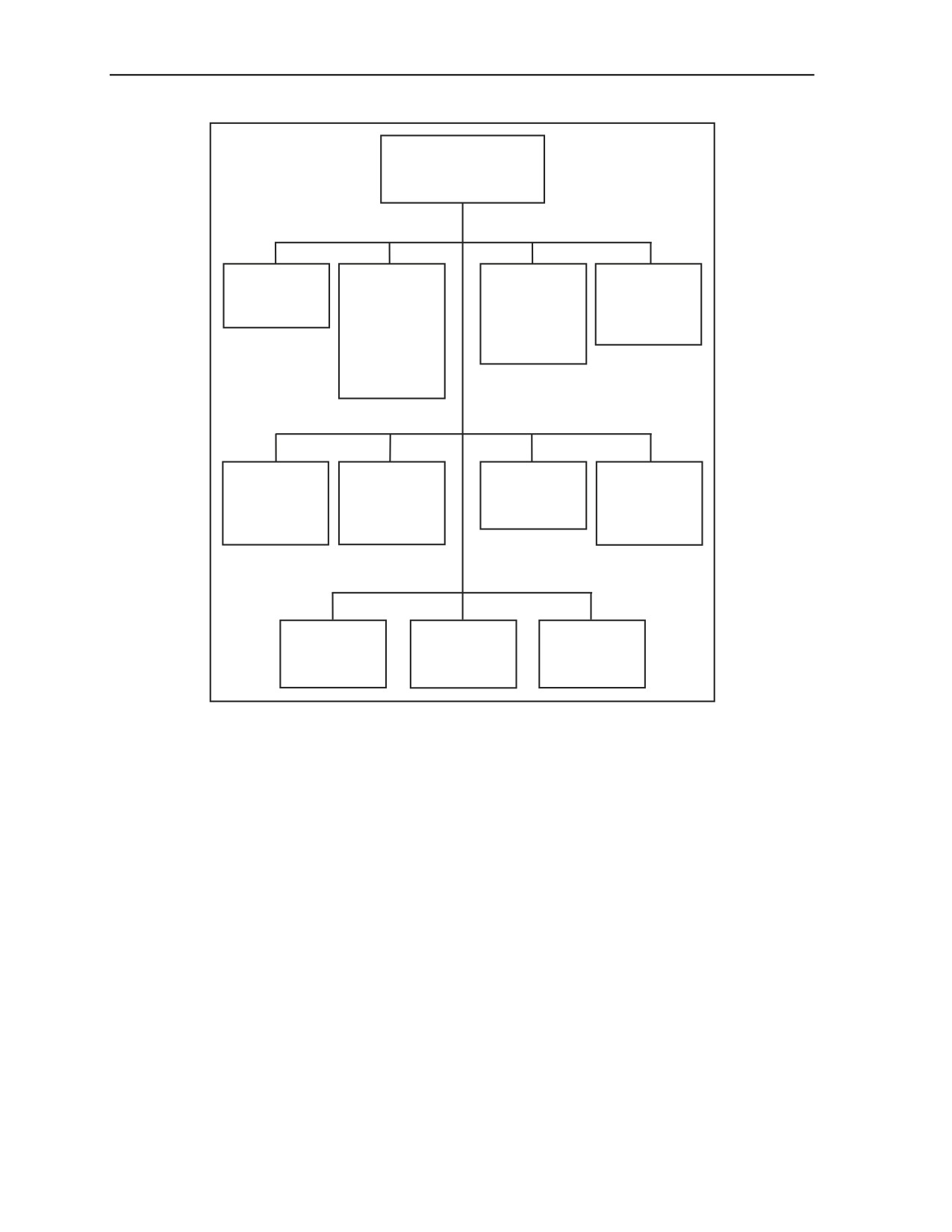
Conduct CBRN incident response planning (Figure A-5, page A-10). This planning task
determines the vulnerabilities and vulnerability reduction measures through the conduct of a VA
and other analyses. The CBRN response plan, including plans for all functional areas, is written
and coordinated.
Conduct CBRN incident response preparation
(Figure A-6, page A-11). This task
implements the vulnerability reduction measures determined through the VA and functional area
analyses. This task and the previous planning task are conducted in a continuous cycle to
systematically reduce the attack vulnerability.
Conduct CBRN incident response (Figure A-7, page A-12). This task, conducted after a
CBRN attack occurs, includes executing the CBRN response plan and mitigating the hazard.
Conduct CBRN incident management (Figure A-8, page A-13). This task is conducted after
an attack occurs and continues until full recovery is achieved.
Conduct HAZMAT remediation. This task, conducted after the ICS/UC is disestablished,
implements the programs needed to assist personnel and resume functions directly impacted by
the incident.
29 August 2007
FM 3-11.20
A-9
Appendix A
Conduct CBRN
incident response
planning.
Develop
Determine
Determine
Plan
written
installation
installation
installation
plans.
requirements
requirements
facilities
for response
for response
improvement.
managers,
equipment.
personnel,
and teams.
Determine
Plan
Plan
Determine
response
integrated
installation
logistic and
training
response
IPB and VAs.
administrative
requirements.
exercises.
requirements.
Plan
Plan
Plan public
detection
medical
affairs
operations.
operations.
operations.
Figure A-5. CBRN Incident Response Planning
A-10
FM 3-11.20
29 August 2007

National Response Plan
Prepare for
CBRN
incident response.
Refine
Designate
Designate
Acquire
emergency
response
response
managers,
personnel
equipment.
and
and teams.
establish
chain of
Configure
Train
Conduct
Assess
installation
response
response
threat and
for FP.
personnel.
exercises.
installation
vulnerability.
Apply
Perform
Conduct PA
Conduct
prophylaxis
logistic and
operations.
detection
and medical
administrative
operations.
pretreatments.
functions, as
required.
Figure A-6. CBRN Incident Response Preparation
29 August 2007
FM 3-11.20
A-11

Appendix A
Conduct
CBRN
incident
response
Establish
Notify chain
Activate
Assess CBRN
on-site IC.
of command.
HAZMAT/
incident(s).
EOD team.
Treat
Develop
Establish
Task
casualties
and
incident
functional
on site.
coordinate
zones,
teams, as
incident
staging
required.
action plan.
areas, and
site control.
Decon
Conduct
Conduct
Disestablish
on-site
on-site
finance and
ICS.
personnel
logistic
administrative
and critical
operations.
operations.
equipment.
Figure A-7. CBRN Incident Response
A-12
FM 3-11.20
29 August 2007

National Response Plan
Manage CBRN
incident.
Report incident
Assemble
Warn
Conduct
to higher,
ops
personnel
avoidance
lower, and
center
of hazard.
operations.
adjacent HQ.
personnel
Perform
Conduct
Conduct
Conduct
protection
health and
mass care
sustainment
procedures
medical
operations.
operations.
operations.
Conduct
Conduct
logistic
finance and
operations.
administrativ
e operations.
Figure A-8. CBRN Incident Management
INCIDENT COMMAND SYSTEM AND UNIFIED COMMAND
A-24. Federal law mandates the ICS and UC response system. The senior first responder (with the proper
training requisite) implements the ICS or UC response system. The person who assumes the role of the IC
has responsibility for directing and/or controlling resources by virtue of legal, agency, or delegated
authority.
Note. The senior first responder must meet the proper training requirements to implement an
ICS or UC response.
A-25. The IC is responsible for all aspects of a response, including developing incident objectives
and managing all incident operations. The IC sets priorities and defines the ICS organization.
Regardless of whether other positions are assigned, an IC will always be designated.
A-26. The IC may assign deputies. The deputies must have the same qualifications as the IC and
be prepared to take over the IC position anytime.
A-27. The organization of an ICS is built around five major management functions: command, planning,
operations, logistics, and finance. These functions can be applied to any incident, large or small. The IC
retains responsibility for these functions, sometimes delegating them to another individual. A major
advantage of using the ICS organization is the flexibility of the IC to tailor the organization as needed. The
modular organization of the ICS allows responders to scale their efforts and apply sections of the structure
that best meet the specifics of the incident. In some incidents, functional elements that may be formally
established or delegated to another individual are limited. However, if there is a need to expand an
organization, additional positions exist within the ICS framework to meet virtually any need. For example,
while one incident may not require the activation of planning, logistic, or finance and administration
sections, other incidents may require that some or all sections of the ICS organization be established. There
29 August 2007
FM 3-11.20
A-13
Appendix A
are no hard-and-fast rules for when or how to expand the ICS organization. In addition, in responses
involving responders from a single jurisdiction, the ICS establishes an organization for comprehensive
response management. If an incident involves more than one agency or jurisdiction, the IC can expand the
ICS framework to address multijurisdictional coverage.
A-28. The roles of the ICS participants vary depending on the incident; the roles may even vary during the
same incident. Staffing considerations are always based on the needs of the incident. The number of
personnel and the organizational structure are based solely on the size and complexity of the incident.
There is no absolute standard to follow. However, large-scale incidents usually require that each
component or section be set up separately, with different staff members managing each section. A basic
operating guideline is that the IC is responsible for all activities until command authority is transferred.
A-29. Another key aspect of an ICS is the development of an incident action plan (IAP). The IC and the
planning section chief typically establish a planning cycle. The planning section develops an IAP for the
next operational period (usually 12 or 24 hours long) and submits it to the IC for approval. The creation of
a planning cycle and the development of an IAP for a particular operational period help the IC to focus
available resources on the highest priorities and incident objectives. The planning cycle, if properly
practiced, brings together everyone’s input and identifies critical shortfalls that need to be addressed to
carry out the IC’s objectives.
A-30. Agencies must be able to use the ICS on a day-to-day basis for routine situations and major
emergencies.
INCIDENT COMMANDER
A-31. The senior emergency response official responding to an incident is in charge of the site-specific
ICS. All emergency responders and their communications are coordinated and controlled through this
individual or by designated senior officials.
A-32. The senior official on site has the responsibility for controlling operations. Initially, it is the senior
officer on scene with responding emergency equipment. As more senior officers arrive (division officer,
senior law enforcement official, IC), the position is passed up the previously established line of authority.
A-33. The senior official in charge of the ICS identifies, to the extent possible, all hazardous substances
present and addresses a site analysis, the use of engineering measures, maximum exposure limits,
HAZMAT handling procedures, and the use of new technologies.
A-34. Based on the hazardous substances and/or conditions present, the senior official in charge of the ICS
implements the appropriate emergency operations and ensures that the level of PPE is appropriate for the
hazard.
A-35. Personnel exposed to hazardous substances presenting an inhalation hazard or potential inhalation
hazard must wear a positive-pressure SCBA while engaged in emergency response operations. The senior
official in charge of the ICS determines, through the use of air-monitoring equipment, the level of
respiratory protection necessary.
A-36. The senior official in charge of the ICS must limit the number of emergency response personnel in
the areas of potential or actual exposure to incident or site hazards. Only personnel actively performing
emergency operations should enter the site. Operations conducted in hazardous areas must be performed
using the buddy system (groups of two or more).
A-37. The senior official in charge of the ICS must designate a safety officer (SO) to identify and evaluate
hazards and implement safety precautions. The person must have specific knowledge of the dangers
presented at the site.
A-38. When site operations are judged by the SO to be IDLH and/or to otherwise involve imminent danger,
the SO has the authority to alter, suspend, or terminate operations. The SO must immediately inform the
senior official in charge of the ICS of any actions to be taken to reduce the hazard.
A-39. After emergency operations have terminated, the senior official in charge of the ICS implements the
appropriate decontamination procedures.
A-14
FM 3-11.20
29 August 2007
National Response Plan
A-40. An IC who assumes control of an incident scene beyond the first-responder awareness level (such as
the on-scene commander), must have completed at least 24 hours of training equivalent to the first-
responder operations level. Additionally, the IC’s supervisor must certify that he⎯
Knows how to implement the ICS.
Knows how to implement an emergency response plan.
Understands the hazards and risks associated with working in chemical-protective clothing.
Knows how to implement the local emergency response plan.
Understands the state emergency response plan and the availability of the federal regional
response team.
Understands the importance of decontamination procedures.
UNIFIED COMMAND
A-41. Although a single IC normally controls all command functions, an ICS organization may be
expanded to a UC. The UC is a structure that brings together the ICs of all major organizations involved in
the incident to coordinate an effective response, while continuing to carry out their own jurisdictional
responsibilities. The UC links the organizations responding to the incident and provides a forum for these
entities to make consensus decisions. Under a UC, responders from various jurisdictions and/or agencies
(such as the FBI, the Department of Energy [DOE], and the Centers for Disease Control and Prevention
[CDC]) may blend to create an integrated response team.
A-42. A UC may be initiated when multiple jurisdictions are involved in a response effort. These
jurisdictions may be represented by⎯
Geographic boundaries (such as two states).
Governmental levels (such as local, state, or federal).
Functional responsibilities (such as firefighting or nuclear releases).
Statutory responsibilities (such as responsibilities of the FBI or the DOD).
Various combinations of levels and responsibilities.
A-43. The UC makeup for a specific incident is determined on a case-by-case basis, taking into account
the⎯
Specifics of the incident.
Objectives outlined in existing response plans.
Decisions reached during the initial meeting of the UC.
A-44. The makeup of a UC may change as an incident progresses and the situation transforms. The UC
requires a team effort, but the number of personnel involved must remain small to maintain simplicity and
efficiency.
A-45. The UC is not a “decision committee.” It is created to command response operations. Since time is of
the essence, the UC must develop synergy operations based on the capabilities of the various
representatives. There should be a personal acknowledgement of each representative’s unique capabilities,
a shared understanding of the situation, and agreed-upon common objectives. With different perspectives,
comes the risk of disagreements—most of which can be resolved through an understanding of the
underlying issues. Contentious issues may arise, but the UC framework provides a forum and a process to
resolve problems and find solutions. If situations arise where members of the UC cannot reach a consensus,
the UC member representing the agency with primary jurisdiction over the issue makes the final decision.
A-46. A complete list of OSHA regulations regarding the ICS and UC is located at
c_level=0&p_keyvalue>.
A-47. There are a number of ICS and/or UC training tools available on the Internet to prepare personnel
for an installation response. Many of the responders in the follow-on elements must be familiar with these
tools to promote a unity of effort. Some of these tools include⎯
29 August 2007
FM 3-11.20
A-15
Appendix A
Position task books (PTBs). PTBs⎯
Were developed for designated positions within the National Interagency
Incident Management System (NIIMS).
Include requirements for certification in ICS positions.
Include tasks for ICs (Types 1, 2, and 3 per the NRP); SOs; liaison officers;
information officers; and positions in the planning, logistic, and finance
sections.
Can be viewed at Web site
ics_tasks.html#ops>.
ICS site safety plan (SSP) worksheets. ICS SSP worksheets⎯
Include a hazard identification, evaluation, and control section; an air-
monitoring log; a site map; a PPE section; decontamination procedures; an
emergency response plan; and a 29 CFR 1910.120 site safety and health
compliance plan that includes a drum compliance checklist.
pdf/ics_uscg_ssp_checklists.pdf>.
Information on the National Mutual-Aid and Resource Management System. The National
Mutual-Aid and Resource Management System is⎯
An initiative undertaken by the Federal Emergency Management Agency
(FEMA) within the DHS to support the NIIMS.
Designed to enhance emergency readiness and response operations through
a comprehensive and integrated system. The installation IOC can use this
tool to obtain information on specific resource capabilities, locations, costs,
and support requirements to augment needed resources.
A national typing protocol. The national typing protocol is⎯
Used to assess current and required CBRN response capabilities.
Installations may use a resource management process outlined in NIMS to
identify and type resources.
Designed to inventory and manage resources. This is one of the NIMS
resource management tools designed to promote common interoperability
and a “common language” for interagency discussion and the integration of
resources.
Note. For the purposes of this FM, “typing” a resource means categorizing the resources that an
IC would need when responding to a CBRN event. The elements of the national typing protocol
include category, kind, components, metrics, and type data. These elements are defined and
discussed in Appendix B.
PLANNING
A-48. The preparation for responding to a CBRN incident includes identifying response planning
assumptions. These assumptions may include⎯
A situation where responders are overwhelmed by the extent of the response effort.
Multiple CBRN incidents.
Infrastructure (communications or transportation) damage, destruction, or contamination.
Difficulty reaching the incident scene.
Unknown hazards.
The need for additional response personnel (based on factors such as work-and-rest cycle
management for CBRN response teams).
TIM hazards.
A-16
FM 3-11.20
29 August 2007
National Response Plan
Note. This portion of the plan should include a CONOPS that outlines guidance and suggested
actions. A tailored CONOPS, appropriate to each, provides a template. A CONOPS should
outline—
Actions to detect, identify, and contain CBRN contamination.
Follow-on actions during recovery operations (cleanup and/or disposal of contaminated
materials).
Representation, as required, to support incident command operations.
Additional support requirements for various response capabilities.
Coordination with other support elements (surveillance, sampling, or sheltering).
Procedures for maintaining, receiving, analyzing, and forwarding status reports.
Damage assessments.
Reach-back capability for technical and operational information.
Note. Operational requirements for HAZMAT response include incident response and
postincident remediation requirements as follows:
HAZMAT emergency response requirements (according to 29 CFR 1910.120q).
Access to DA Pam 50-6 to reference the policies and procedures for a response to a
chemical accident or incident and for reference to the policies and procedures prescribed
for chemical accident or incident response and assistance (CAIRA) operations.
Access to references outlining the operational requirements for postincident CBRN
remediation, including Engineer Manual
(EM) 1110-1-502
(guidance on performing
remedial and corrective actions at HAZMAT waste sites, such as preliminary assessments,
site investigations, remedial investigations, and feasibility studies).
EOD support. The Army is responsible for providing EOD support to U.S. military
operations. Each EOD element is geographically positioned to support large regional or
national response efforts and FEMA regions.
Medical
A-49. FM 4-02.7 provides information on planning health service support in a CBRN environment. This
information may include⎯
Medical treatment.
Information on medical treatment for exposure to biological agents can be
found in FM 8-284.
Medical treatment and control measures regarding communicable diseases
can be found in FM 4-02.33. This FM identifies diseases by numeric codes
assigned according to the International Classification of Diseases.
Medical treatment requirements for operations in CBRN environments can
be found in AR 40-12 and FM 4-02.7.
Medical treatment for nuclear and radiological exposure can be found in
FM 4-02.283. This manual classifies and describes potential nuclear and
radiological threats and hazards; describes the biological aspects of blast,
thermal radiation, and ionizing radiation and their effects on the body; and
describes the procedures for administering first aid and diagnosing, treating,
and managing casualties.
FM 8-285 is a reference guide for trained members of the Armed Forces
Medical Services and other medically qualified personnel regarding the
treatment of chemical-agent casualties and conventional military chemical
injuries. This FM also provides information on first aid (self-aid, buddy aid,
and combat lifesaver [CLS] aid).
29 August 2007
FM 3-11.20
A-17
Appendix A
Emergency medical requirements.
FM 8-500 provides responders and hospital emergency personnel with
guidance on the proper medical management for patients exposed to
HAZMAT in a field environment. This FM organizes chemicals by groups
and protocol, taking into account the physiological effects of the agent on
the body. It also includes a protocol for radioactive compounds.
AR 40-13 outlines the procedures for medical support following a nuclear
and/or chemical accident or incident. This regulation identifies potential
chemical accidents and/or incidents and the response and assistance
requirements necessary to control the events. It describes the use of
laboratory services and lists required equipment.
Telecommunications and Information Technology
A-50. The preparation for responding to a CBRN incident includes identifying communications and
information technology (IT) planning assumptions. These assumptions may include the possibility that⎯
The initial reports outlining CBRN-related information are fragmented and present an
incomplete picture of communications capabilities.
Adverse weather conditions and other environmental factors may disrupt the use of external and
mobile communications.
The capability to acquire real-time information may be restricted or nonexistent.
The initial priority following an incident is lifesaving operations, concurrent with establishing
control of the area and restoring communications (as the situation permits).
A-51. The IT portion of the plan includes a CONOPS that outlines guidance and suggested actions. A
CONOPS should⎯
Identify the uniform emergency communications procedures to be used.
Stipulate that communications management occur on a bottom-up basis and that decisions be
made at the lowest level. Only issues requiring adjudication or additional resources are referred
to a higher level.
Require that a damage assessment be performed on the communications and IT infrastructure
and that a timeline for restoring capabilities be developed.
Prioritize the requirements and monitor the developing situation and the response.
Identify the procedures for receiving and providing information and status reports.
Identify the procedures for coordinating service provisions and restoration, as required.
Address communications interoperability with supporting response assets.
Identify reach-back capabilities for support, as required.
Outline the procedures for communicating with the ICP.
Identify communications assets (as required) within the affected areas.
Identify the training required for telecommunications and IT personnel
(awareness level
training).
Include weather information for the area of concern.
A-18
FM 3-11.20
29 August 2007
National Response Plan
Transportation
A-52. The preparation for responding to a CBRN incident includes identifying transportation planning
assumptions. These assumptions may include the possibility that the⎯
Transportation infrastructure might sustain damage or contamination, limiting access to the
incident site.
Limited transformation capacity might decrease the effectiveness of the response.
Damage and communications disruptions might delay or prevent coordination for transportation
support.
Movement of resupply or support assets might create congestion.
A-53. The transportation plan outlines procedure guidance and suggests a tailored CONOPS. The
execution of the plan may be modified based on the METT-TC. A transportation CONOPS should⎯
Provide for representation at the ICP.
Provide memorandums of understanding (MOUs) or memorandums of agreement (MOAs) to
use civilian transportation assets, as required.
Recognize state transportation policies and plans.
Provide time-phased response guidelines for required transportation resources
(additional
response teams or supplies).
Provide a list of transportation resources to facilitate the movement of personnel and goods to
and from the incident site.
Incorporate the control function for assistance in obtaining transportation assets and track the
movement of resources to the incident site.
Emphasize communication and coordination between the unit and the supporting transportation
assets.
Include situational-awareness information (such as downwind hazard areas and contaminated
areas).
Include a transportation damage assessment.
Emergency Public Information and External Communications
A-54. The preparation for responding to a CBRN incident involves the identification of emergency public
information and the planning for external communications. Plans may⎯
Ensure that authoritative information regarding the incident is disseminated to the lowest level
to squelch unsubstantiated rumors.
Ensure the dissemination of critical information to the public and outside agencies.
Provide accurate, consistent, timely, and easy-to-understand information.
A-55. The plan for emergency public information and external communications information should include
a CONOPS that outlines the operational guidance, provides suggested actions, and provides a template
appropriately tailored to each requirement. Additionally, the CONOPS should⎯
Provide for representation at the ICP, when required.
Identify training requirements.
Identify a central point for coordination and information release.
Identify the type of information to be released.
Identify specialized capabilities such as linguists, if required.
Identify procedures for monitoring news coverage to ensure the accurate dissemination of
information.
Identify the broad range of resources to be used to convey and/or correct information.
29 August 2007
FM 3-11.20
A-19
Appendix A
A-56. DODD 5230.16 contains DOD policies, responsibilities, and procedures for releasing information to
the public during accidents and incidents involving nuclear weapons, radioactive materials, and improvised
nuclear devices.
A-57. DODD 4650.2 contains policies, responsibilities, and requirements for using the Military Affiliate
Radio System (MARS). The MARS is used as an alternate communications capability during emergency
situations.
EXECUTION
A-58. If a terrorist CBRN event occurs, personnel in the ICP immediately initiate the notification and
resource activation process. Depending on the initial assessment, the IOC may direct personnel to⎯
Activate the emergency rosters and initiate post notification and warning sirens.
Implement local MOUs/MOAs and alert local off-post or HN offices.
Request additional resources through Army, federal, and established civilian channels to
augment the response capability.
Note. A terrorist CBRN attack may overwhelm the capability of personnel to respond, detect,
assess, maintain operations, and contain the threat. The TE battalion, as with most other local,
state, or federal entities, does not have the authority or the expertise to respond unilaterally to all
aspects of terrorist CBRN threats or incidents. However, the NRP provides direction and
guidance.
A-59. Critical or disastrous situations triggering national-level interest are initially reported on an
operations report (OPREP) 3 PINNACLE level. (Refer to Figure A-9 for a visual representation of this
process.) The OPREP 3 system is used to report significant events and incidents to the highest levels of
command. According to Chairman of the Joint Chiefs of Staff Memorandum (CJCSM) 3150.03, the ICP
submits an OPREP 3 when national-level interest has been determined. Therefore, in the event of a terrorist
CBRN incident, the ICP sends an OPREP 3 (with the flag word PINNACLE) directly to the National
Military Command Center (NMCC). Initial voice reports should be made within 15 minutes of an incident;
message reports should be submitted within 1 hour. The initial report must not be delayed to gain
additional information. Follow-up reports can be submitted as additional information becomes available.
The IC submits⎯
Voice reports. The IC submits voice reports sequentially to the NMCC, appropriate commands,
reporting unit parent service, and intermediate superior command. Conference calls or
concurrent telephone calls may be used if no delays are encountered and security is maintained.
A telephone line between the NMCC and the IC must remain open throughout the duration of
the incident.
Communications reports. The IC submits OPREP 3 reports (with IMMEDIATE or FLASH
precedence) as soon as possible following an event or incident.
Note. Actions taken in the first minutes following a terrorist attack are critical to the success of
the response.
Note. The CJCSM 3150.03 series contains specific guidance on preparing an OPREP 3.
A-20
FM 3-11.20
29 August 2007

National Response Plan
JCS
President
SecDef
NMC
(NSC)
National assets
LFAs
NORTHCOM
FBI
DHS
FEMA
JTF-CS
Support agencies
USA Ops
USAF Ops
USN Ops
OPREP 3
NIH
USPHS
Center
Center
Center
CDC
EPA
DOE
FORSCOM
AFRAT
NMRI
20th SUPCOM
CAP
NRL
(CBRNE)
Hammer ACE
CBIRF
CM BN (TE)
MAJCOM
MEDCOM
Responders
USAMRIID
USAMRICD
AMC
RDECOM
(TE) CBRN
ECBC
response
DOD resources
teams
IC
Local agencies
(TE BN)
and authorities
Execute mutual aid agreements
Figure A-9. Notification and Resource Activation Process for Domestic CBRN Events
IMPLEMENTING A PLANNED CHEMICAL, BIOLOGICAL,
RADIOLOGICAL, AND NUCLEAR RESPONSE
A-60. A planned CBRN response begins when an incident report is submitted in the notification chain
(emergency operators, fire or law enforcement personnel), CBRN detectors sound an alert, or observer
personnel report an event. All personnel (including noncombatants) should be trained to recognize CBRN
events and know how to notify authorities of a suspected attack. The planned CBRN response includes⎯
Initiating the response.
The IC maintains and activates the alert notification procedures. The IC
uses designated means, such as the radio net, to notify members of the ICP,
emergency responders, and other functional teams
(depending on the
severity of the incident).
The IC establishes the ICS after the area is secured and begins establishing
the parameters of the hot and warm zones. If, following hostile force
actions, the event is determined to be CBRN-related, fire suppression,
casualty evacuation, and CBRN teams enter the site to provide the IC with a
full assessment of the situation. EOD (or equivalent) personnel lead the way
into the hot zone to assess the situation for secondary devices. The initial IC
may delegate direct control of the hot zone to another designated officer.
29 August 2007
FM 3-11.20
A-21
Appendix A
The IC provides C2 information on the entire incident scene (including the
hot, warm, and cold zones) to the IOC.
Responders approach the incident site from an upwind or crosswind
direction when directed, maintaining a safe distance from the site to
maximize individual safety. The likelihood of numerous victims is
extremely high when dealing with a terrorist attack. However, if there is
confirmation that no victims are involved, the IC may conduct detection
operations and then cordon the area to conduct decontamination operations.
Responders must treat the incident site as a potential crime scene when
safety permits. If CBRN materials are suspected or detected, the
commander ensures that the IOC accomplishes the appropriate notification
and reporting requirements.
If the FBI (or DOS if overseas) assumes jurisdiction for the investigation,
the commander must provide the initial and immediate response to isolate,
contain, and mitigate the effects of the incident. Command of military
elements remains within military channels.
The IOC activates response organizations, beginning with those requested
by the IC. Response at the incident site should be initially limited to
minimum elements until the degree of damage can be determined. The
severity of the incident may dictate that the IC remain located at a distance
(the functional area responders and the designated IC may or may not be
physically located at the incident site). The IC may request additional
elements from the various functional areas, depending on the situation.
Resources requested by the IC assemble at a predesignated staging area.
The staging area should be located a safe distance from the incident site to
prevent interference with the CBRN team and to reduce exposure to
hazards. In a CBRN environment, the IC should limit the number of
personnel responding to or near the incident site.
The ICs must ensure a smooth transition. The smooth transition between the
initial and follow-on IC depends on the transfer of accurate information.
This transition may occur when all initial emergency actions have been
completed and it is safe for the IC to move toward the incident perimeter.
The initial IC maintains control of the incident site and evaluates the site
situation to determine when it is safe and practical for other response
elements to proceed closer. This information is relayed through the IOC.
The CBRN/HAZMAT team assists the IC in determining the nature of the
incident. If the team does not possess a detection capability for a particular
hazard, it must continue to assist with operations until a team with detection
capability arrives. When follow-on forces are required, the CBRN team
remains on site to inform them of the extent and characteristics of the
incident.
The CBRN/HAZMAT team establishes the parameters of the incident site.
Due to the technical nature of detection equipment and the potential hazards
of various CBRN materials, initial response operations are likely to proceed
slowly. A large number of responders may be required to mitigate a CBRN
emergency. Personnel must use extreme caution during all known and
suspected CBRN events to ensure the safety of functional area responders.
Expect delays in identifying or mitigating the effects of CBRN material at
the site, particularly when functional area responders lack resources and
must wait for the arrival of properly trained personnel, specialized
equipment or vehicles, and support personnel.
A-22
FM 3-11.20
29 August 2007
National Response Plan
Initiating protective measures.
Responders must don the appropriate level of PPE. Most CBRN material
can penetrate ordinary clothing. Without proper PPE and individual
breathing apparatuses, personnel entering a contaminated area may become
casualties. If there are indications of a CBRN attack or evidence of
hazardous agents, PPE provides personnel protection; however, equipment
contamination may occur during rescue operations.
The IOC activates the required notification plan, contacts designated
civilian authorities, and notifies higher HQ. The commander implements
the appropriate DOD force protection condition (FPCON).
The IOC activates established mass notification measures to warn, advise,
or support persons in a potentially affected area when it is apparent that an
incident will endanger the population or the local community.
Note. The Homeland Security Advisory System does not apply to incidents involving military
installations. The FPCON is used to rate threats and set specific measures for military facilities.
Identifying the threat and taking control of the incident area.
The IC determines the cordon size based on the presence or suspected
presence of hazardous agents before responders are permitted to enter a hot
zone. Security forces then establish the cordon perimeter based on the IC’s
recommendation. The security forces control access to the site by
establishing an entry control point (ECP) to serve as the sole entrance and
exit from the incident site. Only authorized personnel are allowed to enter
the site. Additionally, the security forces establish ECP procedures by
creating authorization lists, checking identification cards, and issuing
badges. Firefighters or other designated personnel establish
decontamination lanes (separate lanes for victims and responders), which
are staffed by qualified personnel.
Emergency medical personnel treat and transport casualties, but on-site
responders perform decontamination operations in the field. The responders
provide on-site medical support (such as ensuring that personnel donning
PPE receive preentry physical screenings) and protect critical systems from
damage or additional damage. The IC establishes and maintains
communications between the incident site and the IOC to ensure that the
most up-to-date information is transmitted. As the situation allows, on-site
responders should begin stabilizing the incident to mitigate the impact.
Responders must be prepared to manage multiple incidents and be alert to
the possibility
(after arriving at the incident site and throughout the
response phase) of secondary devices deployed at each incident site. A
thorough search by trained personnel must be conducted as soon as the
situation allows.
Note. Terrorists may execute several incidents at different locations in quick succession.
A-61. Detailed information about an incident site should be formulated into an SSP. This document is
essential for advance planning and safe incident operations. Information in this plan includes—
Hazard identification worksheets
(with potential health effects, pathways of dispersion,
exposure routes, and control measures)
An air-monitoring log
A site map
A PPE log
29 August 2007
FM 3-11.20
A-23
Appendix A
An emergency response plan showing places of refuge and site security measures
A decontamination log that includes the location, size, and diagram of the decontamination site
The equipment used at the site
The contamination avoidance practices implemented
The decontamination steps taken.
Also, commanders must develop a sketch containing the locations and types of specific hazards. The sketch
should contain, at a minimum, the⎯
Hazard areas (cold zone, warm zone, hot zone, and minimum safe distances [MSDs]).
Site terrain.
Ingress and egress routes.
Site accessibility by vehicle and on foot.
Off-site populations or environments at risk.
Pertinent weather information
(such as the wind conditions, temperature, and predicted
forecast).
Site maps (detailed and to scale).
A-62. Trained first responders must be equipped with CBRN detection capabilities for the identification of
specific threats. These responders should be assembled at predesignated locations until called forward by
the IC. The CBRN team may be able to make presumptive CBRN identification, but if initial test results
prove to be negative or ambiguous, more sensitive CBRN detection devices or methods may be required.
Once the incident site has been established, trained detection teams gather additional information through
the employment of specialized detection equipment and methods. Biological and unknown chemical-agent
samples collected at the incident sites should be evacuated, through controlled channels, to a laboratory
facility for definitive identification. Specific chain-of-custody, packaging, and marking requirements apply
to all items removed from the scene.
A-63. Determining hazards from a low-level radiological incident includes estimating the exposure to
external ionizing radiation. To address concerns regarding potential long-term health hazards, the Army
medical community has developed ways to detect, assess, and record health risks. Procedures for Level II
radiation surveys and assessments by preventative medicine personnel have been established. These
methods require minimal resources and give a quick estimate of the dose or maximum duration of a
mission in a low-level radiation environment.
A-64. Responders should take every precaution possible to preserve evidence following a terrorist attack.
The evidence obtained and supported by a properly documented chain of custody is crucial in the
investigation, arrest, and conviction of the perpetrator(s). Preserving evidence should come second only to
individual safety and protection and the preservation of property.
A-65. To assist with the CBRN identification and warning process, the IC uses an approved software
program to prepare a hazard effects prediction. Personnel should select, institute, and train with a software
program that supports the process requirements and enhances the emergency planning capabilities for
hazard identification, vulnerability assessments, risk analyses, response capabilities assessments, and
planning development. Also, the type of hazard and the weather conditions are critical factors in the
process.
A-66. Response elements must make every effort to reduce or avoid the contamination of personnel and the
surrounding population. Using the hazard effects prediction process, the IC may be able to identify areas
requiring evacuation. Shifting winds and weather conditions may require the movement of an established
cordon and result in the evacuation of areas with potential contamination. The security force manages
evacuations authorized by the IC and provides assistance with establishing a new cordoned area.
Responders are directed to avoid the hazard area unless wearing the appropriate PPE established by the IC.
A-67. The IC establishes decontamination priorities. The decontamination of exposed personnel and
casualties is the top priority, followed by equipment, facilities, and areas. Personnel must establish, as soon
A-24
FM 3-11.20
29 August 2007
National Response Plan
as possible, emergency decontamination lanes to process responders, contaminated persons, and
contaminated casualties.
DECONTAMINATION OPERATIONS
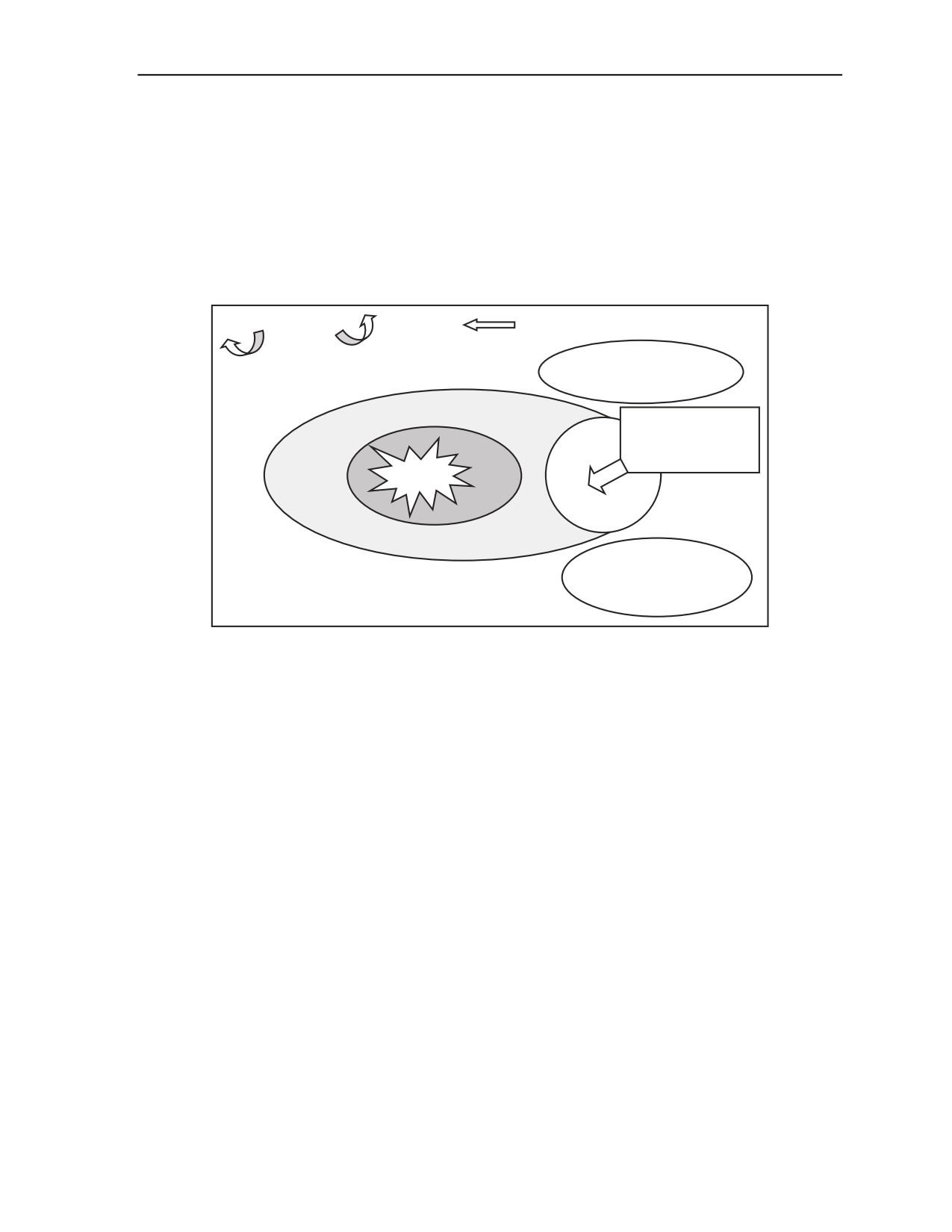
A-68. The IC assembles the functional area response elements in a secure staging area, upwind from the
incident site and outside the contamination control line. A staging area manager is assigned to check all
incoming resources, dispatch resources at the IC’s request, and request support at the staging area (as
required). See Figure A-10 for information on setting up the cordon perimeter, decontamination lanes, and
assembly areas and identifying the hot, warm, and cold zones.
Cordon area
Wind direction
Staging area:
follow-on response
capability
Emergency
decontamination
corridor system
Incident
Hot
site
zone
Entry/exit
lane
Warm zone
Medical treatment and
transport augmentation
elements
Figure A-10. Site Management Operations
A-69. Site management must include established procedures to rapidly account for and communicate with
functional-area response team members engaged in activities at the incident site. These procedures must
include a means to specifically identify and track the activities of all response team members entering and
leaving the hot zone and any area where individual medical survival and special PPE is required.
Additional site management operations include⎯
Maintaining incident site control. Security response elements should treat the incident site as a
potential crime scene until relieved by the applicable investigative element, such as the FBI. All
responders, including firefighting personnel, should perform crime scene maintenance and
protect potential evidence during their operations (within the limits of their response efforts to
control fires, save lives, and protect property). Physical evidence collected at the scene of an
incident site is often the most reliable evidence, and it serves a crucial role in connecting the
perpetrator to the scene. No evidence, including a confession, is uncontestable in court.
Protecting and securing classified information and material. Staff planners and security
personnel should develop plans to protect and secure classified material until it is turned over to
proper authorities. The IC, the IC’s staff, firefighters, EOD, and emergency medical services
(EMS), in conjunction with security response elements, should be trained and exercised in the
procedures for releasing information through the public affairs office (PAO) and/or the Joint
Information System (JIS). The PAO, using the JIS to encompass all public information related to
an incident, conducts information release functions. The JIS includes all federal, state, local,
private organization, and public information officers and joint information centers
(JICs)
established to support an incident. The JIC is established to provide a physical location where
public affairs professionals involved in incident management activities can come together to
perform critical emergency information and crisis communications functions. It is vital that the
JICs have the most current and accurate information regarding incident management activities.
29 August 2007
FM 3-11.20
A-25
Appendix A
Conducting casualty management operations. Medical and fire emergency services provide
emergency medical response at the incident site, including lifesaving medical care and support
for responders. The use of CB agent pretreatment drugs, prophylaxis medication, and agent
antidotes is determined based on the type of incident and the availability of medical supplies.
Ideally, casualties and personnel in the designated cordon area should be decontaminated before
leaving the scene. However, if decontamination is incomplete or if contaminated persons leave
the scene voluntarily, the receiving medical facility (military or civilian) must be prepared to
decontaminate and treat personnel upon arrival. After the medical facility receives notice of a
CBRN incident or attack, all medical personnel engaged in the response must be informed of the
nature of the emergency and the type of suspected contamination. Medical personnel must don
PPE and be prepared to perform additional decontamination operations as necessary.
Note. Many military medical facilities only offer limited inpatient care or reduced operating
hours. Additionally, civilian medical facilities may not accept contaminated patients. These
issues must be addressed in MOUs or MOAs with the local community.
Designating decontamination facilities. The CBRN emergency response plan should designate
the procedures for identifying and operating decontamination facilities. Commanders must
ensure that⎯
Staff planners; engineers; and facility management, transportation, security,
public health, and IT offices assist the medical officer in the selection of the
appropriate locations. Although areas need not be set aside solely for
decontamination operations, planners must ensure that the appropriate
procedures are in place to prevent or minimize the spread of contamination
during an incident.
Primary and alternate facilities are clearly identified, stocked with supplies,
and staffed
(by name or position) according to the procedures for
emergencies.
Outside portable facilities such as wading pools or outdoor showers are
considered as alternatives to indoor decontamination areas, when necessary.
Wastewater from decontamination sites is contaminated and must be
contained to prevent the spread of contamination.
Bags are available to collect, identify, and retain or dispose of contaminated
clothing and personal effects. Plans and provisions must be made for
managing patients and securing their personal effects until proper disposal
methods are determined.
The decontamination plan includes measures for primary, supplementary,
and auxiliary ventilation separate from the ventilation system for the rest of
the selected facility. Real-time detection instruments should be used to
monitor the inside ambient air. Although not all chemicals are volatile
enough to produce a gas vapor, the ventilation should be turned off in a
decontamination facility without a self-contained ventilation system.
Note. Airborne contaminants can be transported via the ventilation system. Morgues with
isolated ventilation systems are often used for decontamination operations.
Preventing the spread of contamination. Responders must ensure that contamination does not
spread beyond the cordoned area. Using existing building and area notification systems,
responders should notify the area population and provide information on the proper safety
precautions to be taken. When contamination cannot be contained within the condoned area, the
local community or HN must be warned and advised to institute mutual agreements
(MOAs/MOUs). Shelter-in-place operations may be directed to ensure that ventilation systems,
doors, and windows are airtight.
A-26
FM 3-11.20
29 August 2007
National Response Plan
Ensuring the availability of reach-back support. Various organizations can provide technical
reach-back support in the form of individual expertise, plans, and material. Response plans and
procedures should include current technical reach-back contact information (with organization
names and telephone numbers) of specialized DOD support, such as EOD, WMD-civil support
team (CST), and TE battalion personnel. See Chapter 7 for more information on reach-back
support.
Providing relief-in-place support. Emergency responders (individuals or teams) are relieved of
their mission by a second shift, augmentees, or other incoming responders. Procedures must be
in place to ensure a safe and seamless transition. These procedures may include⎯
Relieving responders sequentially, simultaneously, or in a staggered
sequence. A sequential relief occurs when each team is relieved in
succession. A simultaneous relief occurs when all teams are relieved at the
same time. A staggered relief occurs when the commander relieves each
team in a sequence determined by the state of operations. Simultaneous
relief takes the least time to execute. Sequential or staggered relief can take
place over an extended period of time.
Conducting a deliberate or hasty relief operation, depending on the amount
of time available for planning, preparation, and execution. In a hasty relief,
detailed planning that describes exactly what an IC needs to accomplish a
mission results in a shorter execution time. In a deliberate relief, the ICS
and his staff need more planning time to identify, develop, and coordinate
solutions to potential problems and to ensure the availability of resources
when and where they are needed.
Implementing a UC. If federal civil authorities assume command of a scene, they must be
prepared to implement and participate in a UC.
ON-SITE CONSIDERATIONS
A-70. After arriving at the scene, the entry leader conducts a complete site-specific risk assessment. The
risk of entering a hazardous environment must be weighed against the need. The risk assessment must
include the⎯
Identification of on-site hazards.
Level of potential risk exposure to identified hazards.
Level of chemical toxicity.
Methods used to control hazard exposure.
A-71. During a chemical response operation, personnel may encounter hazardous conditions that require
them to consult with personnel in authoritative leadership roles or with personnel who have specific
knowledge or training. These hazardous conditions may include⎯
Confined spaces. A marine chemist or technician must be consulted to ensure that a confined
space is safe for entry. Refer to 29 CFR 1910.146 for additional information.
Note. The definition of a confined space (per 29 CFR 1910.146) is a space that—
Is large enough and configured in such a way that an employee can bodily enter and
perform assigned work.
Has limited or restricted means for entry or exit. For example, tanks, vessels, silos, storage
bins, hoppers, vaults, and pits are spaces that may have limited means of entry.
Is not designed for continuous employee occupancy.
Unknown hazards. An unknown hazard is any substance not confidently identified or
supported by documents (manufacturer or shipping papers) to confirm its presence. Level A
29 August 2007
FM 3-11.20
A-27
Appendix A
protection is required to enter areas with unknown hazards. If the safety hazard increases, the
entry leader may authorize Level B protection. Common safety hazards include⎯
Restricted access or egress areas.
Slippery conditions.
Climbing or steep elevations
Thermal limitations (frosting, freezing, heat stress on PPE or equipment).
The need to don PPE. To determine the level of PPE required, the entry leader must consider
the⎯
Chemical resistance level of the hazardous substance (including that for
temperature changes).
Durability of the PPE.
Movement limitations the PPE imposes on personnel.
Level of contamination upon site entry.
Physical state of the hazardous substance.
Note. Material safety data sheets
(MSDSs), toxicology occupational medicines and
environmental sciences (TOMES) database, and decision support tools (DSTs) must be used to
obtain specific chemical information and manufacturer recommendations when determining the
level of PPE protection required. The level and type of protection must continually be
reevaluated to ensure that it is adequate for current operations and changing conditions.
The need to don respiratory protection. The team supervisor, in coordination with the entry
leader, must determine the level and type of respiratory protection required. The respiratory
protection program must also provide guidelines for determining the appropriate level of
protection.
SITE SAFETY PLAN
A-72. Following the emergency phase of the response, the responders must develop an SSP for each
incident. The SSP⎯
Is reviewed by the hazardous-substance team supervisor and presented to the FOSC for
signature.
Is read and signed by all members of the response team (at the request of the hazardous-
substance team supervisor).
Follows the lead agency’s SSP.
HEAT STRESS HAZARDS
A-73. During a chemical response, team personnel may encounter heat stress hazards. Personnel wearing
permeable clothing with evaporative cooling should follow the manufacturer’s recommendations for
environmental heat stress monitoring and a work/rest regimen. Personnel wearing impermeable clothing
should follow the recommendations for monitoring heat stress as established by the EPA (Table A-1) and
perform the following:
Measure the air temperature (ta) using a mercury thermometer. Ensure that the bulb is shielded
from radiant heat. Estimate the percentage of sunshine by figuring the amount of time the sun is
not covered by clouds thick enough to produce a shadow (100 percent sunshine equates to no
cloud cover and a sharp, distinct shadow; 0 percent sunshine equates to no shadows).
Calculate the adjusted air temperature (ta adj) by using the equation ta adj ºF = ta ºF + 13 times
the percentage of sunshine to obtain information for a work level of 250 kilocalories/hour.
Note. A normal work ensemble consists of cotton coveralls or other cotton clothing with long
sleeves and pants.
A-28
FM 3-11.20
29 August 2007
National Response Plan
Table A-1. Suggested Frequency of Physiological Monitoring for Fit and Acclimatized Workers
Adjusted temperature
Normal work ensemble
Impermeable ensemble
90ºF (32.2ºC) or above
After each 45 min
After each 15 min
of work
of work
87.5o-90ºF (30.8o-32.2ºC)
After each 60 min
After each 30 min
of work
of work
82.5o-87.5ºF (28.1o-30.8ºC)
After each 90 min
After each 60 min
of work
of work
77.5o-82.5oF (25.3o-28.1ºC)
After each 120 min
After each 90 min
of work
of work
72.5o-77.5ºF (22.5o-25.3ºC)
After each 150 min
After each 120 min
of work
of work
SITE SETUP
A-74. The following requirements apply to the setup of response sites (RSs):
The entry team leader must ensure that members of the response team are assigned specific
tasks. All assignments must be noted on the RS setup checklist.
The hazardous-substance team supervisor or entry leader must use the standard three-zone
system (exclusion, contamination reduction, and support) at all chemical incidents.
The team members must ensure that the proper PPE is worn during all duties.
Team personnel must evaluate the decontamination selection, as discussed in Chapter 4. In
cases where decontamination must be performed using solutions, team personnel should follow
the minimum standard decontamination line setup as identified in Chapter 4.
The team members must calibrate and/or field-test equipment, according to the manufacturer’s
instructions, prior to initial entry. All equipment discrepancies must be reported to the entry
leader and corrected prior to equipment use.
PREENTRY PROCEDURES
A-75. Medical personnel must conduct examinations on all entry, backup, and decontamination personnel
before responders enter the exclusion zone. Follow-up medical monitoring must also be conducted at the
conclusion of each work shift. All information must be recorded. The medical personnel use the following
guidelines from the American Heart Association:
Blood pressure must not exceed 140 systolic or 100 diastolic beats per minute (bpm).
Pulse rate must not exceed 100 bpm.
Body temperature must not drop below 98ºF or rise above 99.2ºF.
Resting respiration range must be between 15 and 20 breaths per minute.
A-76. The entry leader must ensure that the backup and decontamination teams, when assigned, are at their
designated areas prior to and throughout entry operations.
A-77. The FOSC must meet with the team supervisor and/or entry leader to develop and review initial
entry objectives. The entry leader must ensure that the objectives are clearly communicated to the entry
teams.
A-78. Personnel entering into locations where the contamination levels are unknown must carry the proper
warning equipment. This equipment includes⎯
A photoionization detector (PID).
A flame ionization detector (FID).
29 August 2007
FM 3-11.20
A-29
Appendix A
A combustible gas indicator (CGI).
An oxygen meter.
An alarming radiation dose rate meter.
Note. The number of entry personnel and the entry objectives determine if additional
instrumentation is required.
A-79. Hazardous-substance teams responding to an incident must complete the mission with zero chemical
exposure. The following levels have been established to measure the exposure risk. These action levels
may not be exceeded unless authorized by the team commander. More stringent standards may be
established for a given site and will be set by the team supervisor or entry leader.
Flammable atmospheres must not exceed 10 percent of the lower explosive limit (LEL) for PPE
Levels A through D.
Oxygen-enriched atmospheres must not exceed a level greater than 22 percent oxygen for sea
level shipboard responses or greater than 23.5 percent oxygen for shore side responses.
Sea level atmospheres must not drop below 19.5 percent oxygen for PPE Levels C and D if all
other hazards have been eliminated.
Radiation dose rates must fall within established standards.
Concentrations of toxic chemicals must not exceed the most conservative exposure limits found
in standard HAZMAT response chemical references (NIOSH Pocket Guide, OSHA guidance,
American Conference of Governmental Industrial Hygienists
[ACGIH] guidance, MSDSs,
TOMES database), as determined by the IC.
Sampling Plans
A-80. Sampling plans are used to establish transfer points, escort requirements, and chain-of-custody
operations. Team personnel rarely develop sampling plans on their own. These plans are normally
developed in concert with the EPA or NOAA scientific support coordinator. The SO or unit industrial
hygienist (IH) reviews any sampling plans developed by team personnel and ensures that the FOSC, team
supervisor, and entry leader receive the plans for review.
Briefings
A-81. The site team leaders must brief the entry, backup, and decontamination teams and ensure that all
personnel understand their assignments prior to entry into the exclusion zone.
A-82. The site team leaders must ensure, at a minimum, that personnel information briefings occur at the
start and end of each operational shift. Safety briefings must occur when there are significant changes in
operations or in the hazard characteristics. The SO or unit IH must ensure that the safety plan is continually
updated. The team leaders must ensure that any changes are brought to the attention of the entire response
team.
A-83. The team supervisor and/or team leader ensure that personnel know and understand the procedures
for handling emergencies within the exclusion zone.
A-84. The decontamination team supervisor and/or team leader ensure that the decontamination line and
emergency decontamination procedures are thoroughly explained to all personnel during a walk-through
demonstration.
ENTRY PROCEDURES
A-85. There are several procedures that must be observed as the team prepares to enter the exclusion zone.
Safety Considerations
A-86. The following safety procedures must be observed while the team is in the exclusion zone:
A-30
FM 3-11.20
29 August 2007
National Response Plan
The team supervisor or entry leader must authorize the supplied “on-air” time. The SO must
record the start time, and the entry leader must monitor the air time.
The team supervisor and entry leader must notify the command when CBRN exposure, injury,
or modifications to an action level occurs.
The entry team must monitor the wind direction at all times.
All team personnel must ensure that they have clear paths to the evacuation routes and are able
to hear emergency evacuation signals at all times.
The entry team must avoid unnecessary contact with contaminated surfaces whenever possible.
The entire entry team must proceed to the decontamination line if an SCBA low-pressure alarm
sounds on any team member.
All responders must use the buddy system. Entries must always be made with at least two
responders.
The entry team must leave the immediate area and notify the entry team leader for further
guidance when an action level is reached.
The entry leader must maintain a continuous line of sight with his team members. If this is not
practical, continuous radio communications are acceptable. Other acceptable means of
maintaining contact include the use of lifelines or staging radio repeaters at various intervals or
the use of an air horn with prearranged signals.
All unexpected hazards must be reported to the entry leader for further action.
Communications
A-87. The following communication operations must be observed while the team remains in the exclusion
zone:
The entry team must report initial entry readings, changes in readings, new hazards, and
instrument difficulties.
The entry leader must conduct a communications check every 5 minutes if a line of sight cannot
be maintained.
The only personnel authorized to use the entry team’s radio frequency are the team supervisor,
entry leader, and SO. Other personnel may use this frequency if a serious safety concern arises.
A-88. Emergency communications must be identified in the SSP and communicated to the entry leaders.
Backup measures, including standard hand signals and/or the use of an air horn must be used as outlined in
the safety plan.
Emergency Procedures
A-89. The team supervisor or entry leader must review the emergency response plan with the response
team. The following emergency procedures must be observed while the team remains in the exclusion
zone:
If a team member is injured or involved in an emergency situation, the team supervisor, entry
leader, SO, or FOSC must he notified.
The team supervisor must conduct an assessment and coordinate the emergency efforts.
29 August 2007
FM 3-11.20
A-31
Appendix A
EGRESS PROCEDURES
A-90. The following egress procedures must be observed as the team exists the exclusion zone and begins
decontamination operations:
The decontamination team leader must be informed of all issues concerning decontamination
procedures.
The SO must observe decontamination operations to ensure contamination is removed as
thoroughly as possible. If the SO determines that a modification to the decontamination line is
needed, he notifies the decontamination team leader.
Team members should remove and properly dispose of work clothing worn under the PPE to
prevent the possible spread of contamination.
The medical team must examine all team personnel and record the amount of time spent in the
hot zone, the body temperature, and the respiration rate on a potential exposure and medical
monitoring form.
The entry team supervisor, entry team leader, SO and, if available, the replacement entry team
conduct debriefing operations with the exiting entry team. The exiting team should report
monitor readings, hazards, and physical descriptions of the exclusion zone.
The team supervisor, entry leader, SO, and/or EMT review the SSP and update it as necessary.
Site Demobilization
A-91. The following procedures must be performed as the team begins site demobilization procedures:
The team supervisor and entry leader ensure that all equipment is decontaminated and
inventoried prior to stowage.
The team supervisor and/or entry team leader meet with the IC to discuss repair or replacement
of damaged and destroyed equipment.
The team supervisor and entry team leader ensure that all consumable items are disposed of
according to applicable regulations.
All personnel complete potential exposure forms and turn them over to the EMT or SO before
leaving the site. The EMT or SO routes the forms to the team supervisor or entry team leader
Debriefing
A-92. The team supervisor and/or the entry leader meet with the FOSC or IC and conduct a final
debriefing. The discussion should focus on the pros and cons of the operation and should be documented
for use in future operations. The team supervisor and/or entry leader must also ensure that the IC signs all
cost documentation and purchase orders.
A-32
FM 3-11.20
29 August 2007
Appendix B
Personal Protection
This appendix focuses primarily on levels of personal protection, the PPE currently
available, and general guidelines for selecting PPE. The amount and type of
protection required during a HAZMAT incident depends on the type of hazard that
may be encountered. Multiple types of PPE may be needed to ensure proper
protection for all potential installation CBRN/HAZMAT scenarios.
LEVELS OF PERSONAL PROTECTION
B-1. Individual protection levels have been established for protection against toxic industrial chemicals
(TIC)/TIM, and MOPP levels have been established for protection against CBRN.
INDIVIDUAL PROTECTION
B-2. OSHA has established four levels of individual skin and respiratory protection (29 CFR 1910.120,
Appendix B). The type of PPE worn is determined by the level of protection necessary for a particular
incident. The PPE must be worn in accordance with guidelines published by OSHA and the NFPA. The
use of PPE results in an increase in mental and physiological stress (heat stress, respiratory resistance),
which must be carefully monitored and evaluated through all phases of the operation. The four OSHA-
established levels of protection are—
Level D. Level D protection consists of the work uniform. Neither skin nor respiratory
protection is provided; therefore, this level should not be specified at an incident site where such
hazards exist. Military battle dress uniforms and coveralls meet Level D requirements.
Level C. The Level C ensemble consists of a chemical-resistant suit, full face piece, and air
purification device. Chemical-resistant hoods, aprons, boots, and gloves should also be worn.
Three layers of gloves may be used—an inner layer of latex gloves and middle and outer layers
of chemical-resistant gloves. Level C protection may be selected when an airborne substance has
been identified and is being monitored. All criteria for the use of air purification devices must be
met, and the proper filters for the known hazard must be available. Air monitoring must
continue throughout the operation to ensure that Level C protection remains effective. An
escape mask should be worn in case of a change in conditions that renders the air purification
device ineffective. The escape mask provides the responder with the protection necessary to
move to the decontamination line.
Level B. Level B protection consists of nonencapsulating, chemical-resistant suits—often called
splash suits or rain suits. There are several Level B configurations, but none are vapor-tight.
Depending on the configuration, an SCBA is worn inside or outside the suit. The Level B
ensemble also includes chemical-resistant outer boots and three pairs of gloves—an inner layer
of latex gloves and middle and outer layers of chemical-resistant gloves. Level B protection
should be considered when the highest level of respiratory protection is required but lower
levels of skin and eye protection are adequate. Level B is the minimum level of protection
recommended for initial site entry—prior to the identification and monitoring of all hazards.
Level A. Level A protection consists of a totally encapsulating suit with gloves and boots
attached. Respiratory protection is provided by an SCBA worn inside the suit or by a supplied-
air system. Chemical-resistant boots are worn over the boots attached to the suit. Two pairs of
gloves (inner latex gloves and outer chemical-resistant gloves) are worn under the suit gloves. A
radio may also be worn under the suit. Additional items that may be necessary include hard hats,
29 August 2007
FM 3-11.20
B-1
Appendix B
cooling vests, and kneepads. The Level A ensemble should be used when the highest level of
respiratory, skin, and eye protection is required.
MISSION-ORIENTED PROTECTIVE POSTURE
B-3. The purpose of MOPP gear is to protect personnel against CBRN contamination. The MOPP
ensemble consists of an overgarment, protective mask, hood, overboots, and protective gloves. In addition,
personnel have mask carriers, M8/M9 detector paper, individual decontamination kits, and nerve agent
antidote kits
(NAAK). Standardized MOPP levels are used to communicate the necessary level of
protection for a specific situation. Flexibility of the system allows commanders to adjust MOPP levels to
accomplish a particular mission with the maximum protection and lowest risk possible. The standardized
MOPP levels are—
MOPP-ready. Protective masks are carried with the load-bearing equipment (LBE). Individual
MOPP gear is labeled and stored no farther back than a logistic site; it is ready to be brought
forward to the individual when needed—a process that should take no longer than 2 hours. Units
in MOPP-ready status are highly vulnerable to persistent agent attacks. Therefore, personnel are
equipped with field-expedient items (wet-weather gear) that are identified for use in the event of
an unanticipated CBRN attack or release. If it is determined that CBRN weapons have been used
or that their use is a threat, the unit automatically upgrades to MOPP0.
MOPP0. PPE is issued to individuals, who then inspect and prepare the equipment for use.
Protective masks are carried with the load-carrying equipment
(LCE). Other PPE items,
including the standard-issue overgarment, must be
“readily available.” To be considered
“readily available,” the equipment must be carried by each individual and stored within reach
(work area, vehicle, watercraft). Individuals should be capable of donning their PPE in 8 to 10
minutes. Units in MOPP0 status are highly vulnerable to persistent agent attacks and
automatically upgrade to MOPP1 if it is determined that persistent CBRN weapons have been
used or that their use is a threat. MOPP0 is primarily specified when an enemy is capable of CB
employment but there is no indication of immediate CB use.
MOPP1. When directed to MOPP1 status, personnel immediately don the overgarment. Other
PPE making up the individual MOPP gear (mask, gloves) is carried or readily available. Contact
lenses must be removed and protective-mask optical inserts used, if necessary. The M8 or M9
paper is attached to the overgarment, and the decontamination kit and NAAK are carried or kept
at hand. In hot weather, the overgarment jacket may be left open and the overgarment may be
worn directly over underwear. Leaders are responsible for monitoring hydration levels. The
MOPP1 ensemble provides a great deal of protection against persistent agents. This level is
primarily specified when a CB attack is possible.
MOPP2. Personnel wear the overgarment and footwear covers. The mask, mask carrier, and
gloves are carried. Decontamination kits, the M8 or M9 paper, and NAAK are carried or kept at
hand. Personnel wear protective-mask optical inserts, if necessary. As with MOPP1, the
overgarment jacket may be left open, but trousers must remain closed. Hydration levels must
also be maintained. MOPP2 is primarily specified when a CB attack is possible.
MOPP3. Personnel wear the overgarment and protective mask. The protective gloves are
carried. To allow for relief at MOPP3, particularly in hot weather or when the heat stress index
(HSI) is high, personnel may open the overgarment jacket and roll up the protective-mask hood
for ventilation, but the trousers must remain closed. MOPP3 is used when personnel are
operating inside areas where there are no chemical-agent contact hazards; MOPP3 is not
appropriate if a contact hazard is present.
MOPP4. Personnel completely encapsulate themselves by closing the overgarments, adjusting
all drawstrings to minimize openings, and donning the protective gloves. MOPP4 is used when
the highest degree of protection is required or when CB agents are known to be present but the
actual hazard has not been determined. MOPP4 is a level of protection similar to that of OSHA
Level C. As with the other MOPP levels, flexibility is allowed so that relief may be provided to
the individual. Once the hazard has been identified and risk assessment measures have been
employed, the overgarment may be left open.
B-2
FM 3-11.20
29 August 2007
Personal Protection
Mask-only. The mask is worn with the long-sleeve duty uniform (for limited skin protection).
The mask-only command may be issued in situations where riot control agents are employed
and no CB threat exists or where there is a downwind vapor hazard from a nonpersistent CB
agent. However, mask-only is not normally appropriate when blister or nerve agents are
involved.
B-4. MOPP gear is designed to protect personnel from CBRN agents in a contaminated environment; it
provides only limited protection from some TIM. Therefore, personnel equipped with standard MOPP gear
must not remain in a TIM environment; they must seek a clean area as soon as possible. Operations that
take place in a suspected TIM environment may require the use of a higher level of protection than
standard MOPP.
PERSONAL PROTECTIVE EQUIPMENT
B-5. Various types of PPE, including respiratory equipment and protective ensembles, are used to protect
personnel from exposure to toxic agents.
Note. This discussion does not include a comprehensive list of all CBRN defense equipment.
Furthermore, the products described in this section may not necessarily be available as standard
equipment for all CBRN crisis responders.
RESPIRATORY PROTECTION
B-6. The respiratory system is the most direct and generally the most critical exposure route. Therefore,
respiratory protection is the primary personal-protection concern.
Definitions
B-7. The following definitions pertaining to respiratory protection are included in 29 CFR 1910.134 (the
OSHA Respiratory Standard):
Canister or cartridge refers to a container that houses a filter, sorbent, or catalyst
(or a
combination of these items) and is designed to remove specific contaminants from the air which
passes through.
Escape-only respirator refers to a respirator which is intended to be used only for emergency
exit.
High-efficiency particulate air (HEPA) filter refers to a filter that is at least 99.97 percent
efficient in removing monodisperse particles of 0.3 micrometers in diameter from the air.
Powered air-purifying respirator (PAPR) refers to an air purification device that uses a blower
to force ambient air through air-purifying elements to the air inlet covering.
SCBA refers to a particular type of atmosphere-supplying device for which the breathing-air
source is designed to be carried by the user.
Supplied-air respirator (SAR) or airline respirator refers to a particular type of atmosphere-
supplying device for which the breathing-air source is not designed to be carried by the user.
Occupational Safety and Health Administration Requirements
B-8.
html>, specifies that an effective respiratory protection program include a written program document that,
at a minimum, addresses the following elements:
Procedures for the selection of respirators.
Medical evaluations of personnel required to wear respirators.
Procedures for the fit-testing of respirators.
29 August 2007
FM 3-11.20
B-3
Appendix B
Procedures for the proper use of respirators in routine and emergency situations.
Procedures to ensure adequate air quality, quantity, and (for SARs) flow.
Training on respiratory hazards and the proper use, maintenance, and limitations of respirators.
Identification of filters, cartridges, and canisters.
Procedures for maintaining pertinent records (medical evaluations, fit tests).
Procedures and schedules for cleaning, disinfecting, maintaining, repairing, storing, inspecting,
and discarding respirators.
Procedures for evaluating program effectiveness.
The Army Respiratory Program
B-9. According to AR 11-34, when required by the job, the ability to use respiratory protective equipment
(RPE) is a condition of employment. Therefore, personnel who are assigned duties that involve access to
chemical surety materiel must be capable of wearing protective clothing and equipment (PCE) (AR 50-6,
paragraphs 3-13 a [3] and 6-3 g). In addition, prior to being assigned to tasks that require the use of a
respirator, personnel must undergo a medical evaluation. The requirements of this evaluation are listed in
AR 40-5, Technical Bulletin (TB) Medical (MED) 502/Defense Logistics Agency Manual (DLAM) 1000.2,
and TB MED 509. The medical status of respirator users is reviewed at least annually by the installation
medical authority (IMA).
Types of Respiratory Protection
B-10. Respiratory protection may be provided by either air purification or atmosphere-supplying devices.
Air Purification Devices
B-11. Air purification devices are respirators or filtration devices that remove particulate matter, gases, or
vapors from the atmosphere. There is no separate source of air; air purification devices use ambient air,
which is then purified or filtered before inhalation. These devices range from half-mask, face piece-
mounted cartridges with no eye protection to full face piece, dual-cartridge masks with eye protection.
Particle-removing respirators have a mechanical filter that separates contaminants from the air. Air
purification devices used for gases or vapors are commonly equipped with a cartridge which contains
sorbent material that absorbs or reacts with the hazardous gas or vapor. The cartridge appropriate for the
expected contaminant(s) (acid gas, organic vapor) must be selected.
B-12. There are limitations to the use of air purification devices. They—
Should never be used in the presence or potential presence of unidentified contaminants.
Should never be used in IDLH or oxygen-deficient atmospheres containing less than 19.5
percent oxygen.
Must be used in conjunction with the constant monitoring of contaminant and oxygen levels.
Protect only against specific chemicals and only at specific concentrations. Their effectiveness
against two or more chemicals simultaneously is highly questionable.
Have relatively short protection durations. Once they have been opened, the sorbent canisters
begin to absorb humidity and air contaminants—whether they have actually been put into use or
not. As a result, the efficiency and service life of the air purification device dramatically
decrease.
B-13. The limitations of air purification devices make their use in emergency response situations
challenging. Air purification devices should not be used at nontraditional release sites unless qualified
personnel (IHs) have monitored the surrounding environment and determined that such devices may be
safety used.
B-4
FM 3-11.20
29 August 2007

Personal Protection
Atmosphere-Supplying Devices
B-14. An atmosphere-supplying device is a respiratory protection device that supplies a source of air.
These devices provide the highest level of protection available against airborne contaminants, and they
may be used when operating in IDLH and oxygen-deficient atmospheres.
B-15. There are two types of atmosphere-supplying devices—SCBA and SARs. Although SCBA is the
most commonly used type, SARs, or airline respirators (which supply air from a remote source, through an
airline hose, to the user), may be used when extended working times are required—such as during
decontamination or remedial operations. Dual-flow SCBAs, which receive air supplies from either an
SCBA or an airline, may provide additional flexibility for both entry and decontamination operations.
B-16. Only positive-pressure devices, which maintain positive pressure in the face piece during both
inhalation and exhalation, should be used during nontraditional CBRN or HAZMAT response operations.
Respiratory Products
B-17. Government-approved COTS supplies and equipment are used for personal protection. The results of
ongoing, government-conducted testing and evaluation programs enable the continuing addition of items to
the list of government-approved COTS supplies and equipment. Information on approved COTS items may
be obtained through the chain of command or from the AMC logistics assistance representative.
Note. The mention of trade names does not constitute official or commercial endorsement of
particular products.
B-18. Examples of specific products designed for respiratory protection include—
MSA 4500 SCBA rebreather with rebreather bottles. The MSA 4500 (Figure B-1) is a
rugged SCBA that connects to a portable air supply. It has a unique “heads-up” display that
shows low air-pressure warnings. This SCBA, which is flame- and heat-resistant, should be
worn during the most demanding CBRN activities. The MSA 4500 is available in three sizes for
optimum fit.
Figure B-1. MSA 4500 SCBA Rebreather
3M™ 6000 DIN air purification device and FR 64 respirator. The 3M 6000 DIN air
purification device and FR 64 respirator provide respiratory protection against all known TIM
and CWAs and many biological agents. Air purification devices are certified for use only when
the types of contaminants are known, contamination is below IDLH levels, and sufficient
oxygen is present. Protection times for air purification devices vary based on the type of hazard
present, the fitness level of the individual, and the level of physical activity that must be
sustained during operations. When mated with the FR 64 single DIN-threaded cartridge, the air
purification device is capable of filtering CWAs. It is also NIOSH-approved for use against
organic vapors, chlorine, hydrogen chloride, sulfur dioxide, hydrogen fluoride, chlorine dioxide,
29 August 2007
FM 3-11.20
B-5

Appendix B
hydrogen sulfide (escape), ammonia, methylamine, formaldehyde, and all known TIM. When
exposed to moisture, the FR 64 canister does lose some of its protective capability; therefore, it
is hermitically sealed in a pouch to minimize contact with the environment. The manufacturer-
supplied user’s guide provides further guidance on the use of the equipment and a more
complete list of TIM.
3M PAPR with FR 64 cartridges. The PAPR (Figure B-2) is a motorized system which uses a
filter to clean ambient air before the air is delivered to the breathing cavity in the mask. Each
PAPR system includes a headpiece, blower, breathing tube, and battery. Due to the clean,
forced-air supply, PAPRs allow for easier breathing and generally provide some relief against
heat stress. The PAPR is usually included in Level B protective equipment when there is a wide
array of unknown dusty agents, mists, fumes or radionuclides. Although FR 64 cartridges are
acceptable for a wide array of agents, filter cartridge selection may need to be reassessed once
specific agents are positively identified. The
3M™ Respirator Selection Guide should be
consulted for further information on filter selection.
Figure B-2. 3M Power-Flow PAPR With FR 64 Cartridge
3M full face piece respirator, FR-M40. The 3M FR-M40 full face piece respirator has
been NIOSH-approved for use with 3M cartridge FR-C2A1 or 3M cartridge FR 64 for acid
gases (including chlorine), chloroacetophenone (CN), 2-chlorobenzalmalononitrile (CS), and
P100 particulate filters. A single FR-C2A1-DIN threaded cartridge may be mounted on either
the right or left side of the respirator. The FR-C2A1 cartridge meets military specifications
Military Specification (MIL-SPEC)-C-51560 and EA-C-1704. The respirator has several unique
design features. For example, silicone creates a perfect face seal, allowing for maximum comfort
and increased confidence in fit-testing results, while an optional butyl rubber second skin
protects the face piece, increasing respirator life and decreasing decontamination costs. In
addition, a butyl-coated nylon hood, which covers the head and neck, is easily donned to add
additional protection against chemical agents. The hood meets MIL-SPEC-C-51251. An integral
drinking device permits the user to replenish fluids without removing the mask. A dual-eyepiece
format permits a simple interface between the respirator and the optics and allows for the
equipment to be folded for storage. FR-M40 accessories include clear and gray eyepiece
outserts, spectacle kits, and butyl rubber second skins. The FR-M40 fits into a storage
bag/carrying pouch with a strap and has been used for years by U.S. armed forces all around the
world.
PROTECTIVE ENSEMBLES
B-19. Acceptable types of chemical-protective clothing include totally encapsulating and nonencapsulating
ensembles, which offer specific levels of liquid and/or vapor hazard threat protection.
B-6
FM 3-11.20
29 August 2007
Personal Protection
National Fire Protection Agency Standards
B-20. The NFPA has established three standards for hazardous materials protective ensembles.
Commercial protective ensembles should be certified to meet these NFPA standards. The NFPA standards
are—
NFPA 1991 Standard on Vapor-Protective Ensembles for Hazardous Materials Emergencies.
This standard is equivalent to that of the OSHA Level A protective ensemble. It includes
protective garments, gloves, and footwear; respiratory protection is not addressed as part of this
standard.
NFPA 1992 Standard on Liquid Splash-Protective Ensembles and Clothing for Hazardous
Materials Emergencies. This standard is equivalent to that of the OSHA Level B protective
ensemble. It includes protective garments, gloves, and footwear; respiratory protection is not
addressed as part of this standard.
NFPA 1994 Standard on Protective Ensembles for First Responders to CBRN Terrorism
Incidents. This standard applies to garments, gloves, and footwear designed to protect against
TIC, chemical warfare agents (CWAs), and biological warfare agents (BWAs). It does not apply
to respiratory protection or to ensembles designed for firefighting or protecting against
radioactive materials. It also does not apply to protective ensembles that were manufactured
before 2 August 2001 and intended for use in chemical/biological terrorism incidents.
Note. The NFPA 1994 standard and other relevant NFPA standards/supplements are available at
Note. A list of PPE which has been certified by the Safety Equipment Institute (SEI) to meet
specific standards, such as those outlined in NFPA 1991, NFPA 1992, and NFPA 1994, is
Products
B-21. Examples of specific protective ensembles include—
Joint service lightweight integrated suit technology
(JSLIST) ensemble. The current
standard DOD protective ensemble is the JSLIST ensemble (Figure B-3, page B-8). This
ensemble consists of a two-piece, front-opening suit (jacket with hood and trousers); adjustable
suspenders; a pair of multipurpose over boots (MULO) (effective for rain/snow/CB); and
gloves. The suit liner has a nonwoven front that is laminated to activate carbon spheres and is
bonded to a knitted back that absorbs chemical agents. The JSLIST ensemble provides 24 hours
of continuous protection against CWAs, BWAs, and radiological (alpha and beta) particles. In
an uncontaminated environment, the ensemble may be worn for 45 days with up to six
launderings or over
120 days with no launderings. The JSLIST ensemble should be the
protective ensemble of choice during fair-weather CBRN counterterrorism operations in which
personnel are likely to encounter a suspect agent but are not expected to be immersed in water.
Under the direction of combatant commanders, personnel may be required to carry and wear the
JSLIST ensemble. At just under 6 pounds, the new JSLIST suit is about half the weight of the
battledress overgarment. It is available in a four-color woodland or three-color desert
camouflage pattern.
29 August 2007
FM 3-11.20
B-7
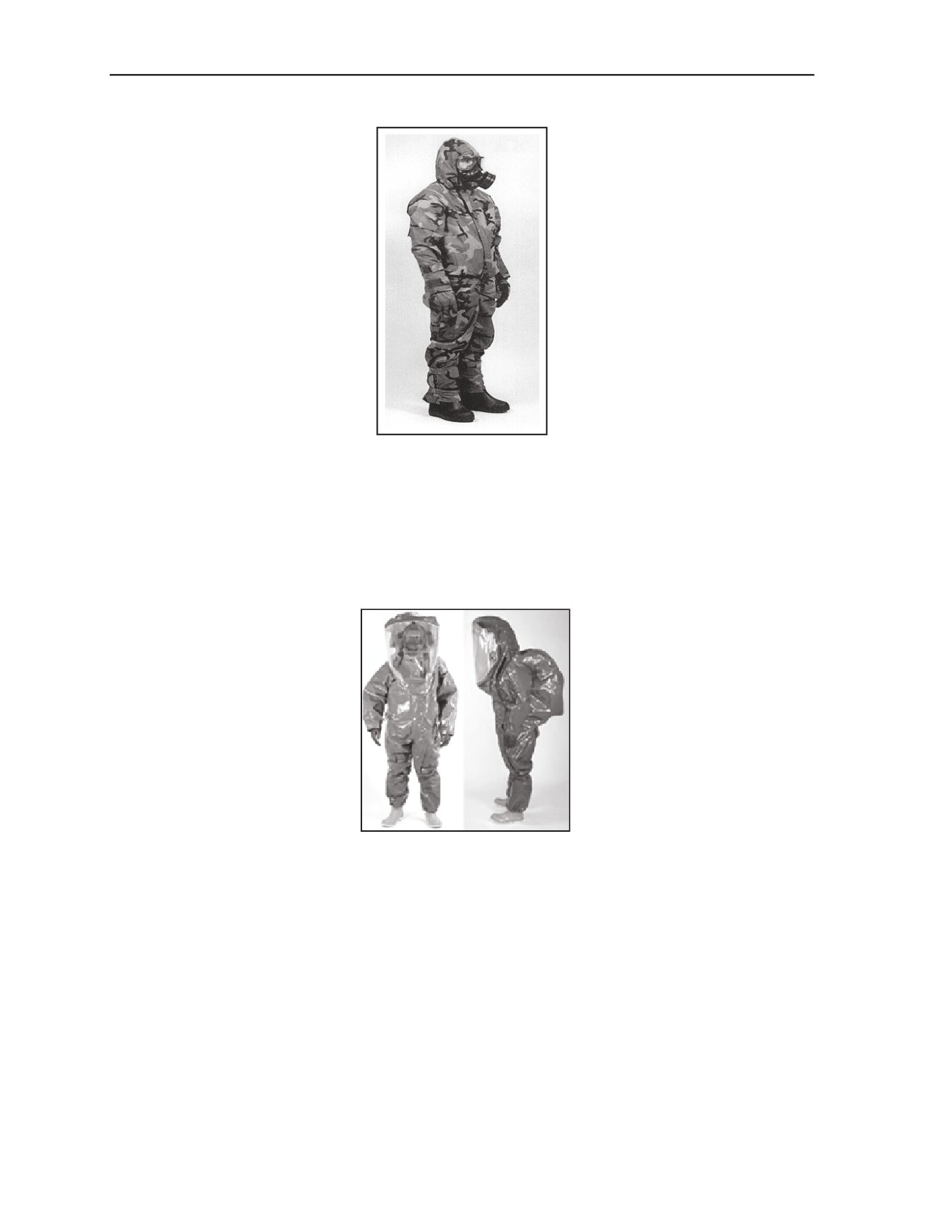
Appendix B
Figure B-3. JSLIST Ensemble
Disposable Toxicological Agent Protective System (DTAPS)®. The Level A DTAPS (Figure
B-4) was specifically designed for use in domestic preparedness, CBRN, and WMD
environments. The suit is constructed of low-visibility fabric that consists of a multilayer
composite chemical barrier laminated to a strong, nonwoven substrate. It features a vapor-tight
zipper with double splash flaps and an expanded, three-layer visor for improved field of vision.
The system protects against industrial chemicals and chemical and biological warfare agents.
Figure B-4. DTAPS
Level B TYCHEM® suit. Level B protection requires that the operator wear a hooded, one- or
two-piece, chemical-resistant
(splash-proof) suit and an SCBA. Level B TYCHEM suits
(Figure B-5) are constructed of high-strength, nonwoven materials containing nonhalogenated
films on either side. The seams are taped or double-taped. The suit was specifically developed
for protection against toxic and corrosive gases, liquids, and solid chemicals. It has been tested
against more than 280 substances; in 260 of these cases, there was no permeation observed after
8 hours of continuous contact. Level B TYCHEM suits are used by the chemical and
petrochemical industries, emergency HAZMAT teams, and hazardous materials/waste cleanup
crews. The suits are lime-yellow in color (for high visibility) and are available in a variety of
styles—from aprons and coveralls to Level A gas-protective ensembles.
B-8
FM 3-11.20
29 August 2007
Personal Protection
Figure B-5. Level B TYCHEM Suit
TYVEK® F suit. The TYVEK F suit (Figure B-6, page B-10) is a lightweight, impermeable,
coverall-type suit with an inherent hood and booties to reduce the number of
enclosures/fasteners necessary. The hood and the wrist and ankle openings have close-fitting
elastic seals. The front closure, near the chest area, has double-baffled zippers. All enclosure
areas (front chest zipper, wrist to glove, boot to leg, hood to mask) must be duct-taped to ensure
a proper “air-tight” seal. Although all impermeable membranes do break down at some point
(depending on the contact hazards present and the amount of time the suit is exposed to these
hazards), the TYVEK F suit provides excellent protection against almost all known TIM,
CWAs, biological agents, and radiological particulates (alpha and beta). The suit is designed as
a one-time-use overgarment for emergency personnel when dermal protection is necessary and
evacuation from a site is expected to take an extended period of time. The suit must not be used
to continue inspections or to perform rescue response activities. TYVEK F suits may pose a
significant health concern to the user due to a lack of material “breathability,” which quickly
results in increases in core temperatures of the body—especially during periods of intense
physical activity. Therefore, team members must be continually monitored during escape
operations. Suit size is not critical, except that the suit must be large enough to fit comfortably.
Additional TYVEK F protective slip-over boots are available and should be worn over any
footwear and duct-taped to the suit for additional protection.
29 August 2007
FM 3-11.20
B-9

Appendix B
Figure B-6. TYVEK F Suit
Kleenguard® coveralls (recycled Kleenguard extra suits). Kleenguard coveralls (recycled
Kleenguard extra suits) (Figure B-7) are constructed of a patented Microforce™ barrier fabric.
The fabric is three layers thick—the first and third layers are spun and bonded, and the second
layer is melted. This arrangement results in excellent breathability and particulate holdout. The
coverall suits have zippered fronts with 1-inch flaps and elastic backs, wrists, and ankles. They
are relatively well-fitted, due to the Reflex® garment design. The Kleenguard suit is worn
during general cleanup, maintenance, and shutdown operations; in environments containing dust
or other fine particles, such as fiberglass; when working with oil or grease; or while processing
food or performing mold remediation.
Figure B-7. Kleenguard Coveralls (Recycled Kleenguard Extra Suits)
ADDITIONAL ITEMS
B-22. In addition to respiratory equipment and chemical ensembles, there are other PPE items that may be
used to protect against toxic agents.
Chemical-Protective Undergarment
B-23. The chemical-protective undergarment (CPU) (Figure B-8) consists of a hooded or nonhooded
jacket, pants, booties and gloves. CPUs are constructed of a durable composite fabric containing
polymerically encapsulated carbon for the absorption of CWAs. These undergarments offer an additional
barrier against liquid or vapor incursions into the outer layer of protective garments. The polymerically
encapsulated carbon reduces sweat poisoning (skin pruning). The fabric also possesses unique stretch
characteristics, providing enhanced comfort.
B-10
FM 3-11.20
29 August 2007
Personal Protection
Figure B-8. CPU
Multipurpose Over Boots
B-24. The MULO is created by injection-molding an elastomer blend that has been compounded to provide
the necessary chemical and environmental protection. MULOs, which incorporate two quick-release side
buckles, are designed to be worn over standard-issue footwear. They provide protection against water’
snow; mud; and petroleum, oil, and lubricants (POL). They are also flame-resistant. MULOs can be
decontaminated to an operationally safe level using standard decontaminants. They provide 60 days of
durability and 24 hours of protection against liquid chemical agents.
Vinyl Overshoes
B-25. The green vinyl overshoe (GVO) is a plain, olive-drab (OD) green, vinyl overshoe with elastic
fasteners. The black vinyl overshoe (BVO) is very similar to the GVO—except for the color and enlarged
tabs on each elastic fastener. Personnel may wear GVOs or BVOs over their combat boots to protect their
feet from contamination by all known agents, vectors, and radiological particles (alpha and beta). As long
as GVOs/BVOs remain uncontaminated and serviceable, protection may continue for a maximum of 60
days. Following exposure to any known CB agent, GVOs/BVOs worn with combat boots provide 24 hours
of protection. GVOs/BVOs may be decontaminated with a 5 percent high-test hypochlorite (HTH solution
or a 5 percent household bleach solution. If signs of deterioration are evident following decontamination,
the overshoe should be replaced.
Gloves
B-26. Personnel operating in a CBRN environment should wear chemical-protective gloves. The thicker
the glove, the greater the degree of protection, but also the greater the loss of manual dexterity.
B-27. Heavy gloves may make it difficult for medical personnel to provide advanced medical care. Other
potential health issues regarding gloves include meeting Food and Drug Administration
(FDA)
requirements for examination gloves, maintaining sterility, and changing gloves after touching each
patient.
B-28. There are several types of chemical-protective gloves available, including—
Outer butyl rubber/inner nitrile gloves. An outer butyl rubber glove may be worn over an
inner, disposable, nitrile glove. Butyl rubber gloves are available in varying thicknesses (7, 14,
17, 25, and 30 mils). A minimum thickness of 14 mils is recommended for the outer glove. Inner
nitrile gloves, which are comparatively thin, are available in 4 and 5 mils.
JSB1GU gloves. JSB1GU gloves (Figure B-9, page B-12) consist of an outer glove and a thin,
inner, impermeable liner. They provide protection from liquid, vapor, and aerosol CB hazards.
The JSB1GU fulfilled an urgent U.S. Special Operations Command requirement for a glove
29 August 2007
FM 3-11.20
B-11
Appendix B
with increased tactility and dexterity. The glove is durable for up to 14 days and offers 24 hours
of protection in a contaminated environment.
Figure B-9. JSB1GU Gloves
Chemical-protective glove set. As long as chemical-protective glove sets remain serviceable,
they protect against CB agents and alpha and beta radioactive particles. The glove sets are
available in three thicknesses—7, 14, and 25 mils. Personnel whose tasks require extreme
tactility and/or sensitivity and who will not be exposing the gloves to harsh treatment generally
use the 7-mil glove set. Personnel (aviators, vehicle mechanics, and members of weapons crews)
whose tasks require tactility and sensitivity and who will not be exposing the gloves to harsh
treatment use the 14-mil glove set. Personnel who perform close combat tasks and other types of
heavy labor use the more durable 25-mil glove set. In the event that 14- or 25-mil glove sets
become contaminated with liquid chemical agents, they should be decontaminated or replaced
within 24 hours of exposure. In the event that a 7-mil glove set becomes contaminated, it should
be replaced or decontaminated within 6 hours of exposure. Gloves may be decontaminated with
a 5 percent chlorine solution or a 5 percent HTH solution. Members of all services use the
chemical-protective glove sets.
Skin Exposure Reduction Paste Against Chemical Warfare Agents
B-29. Skin exposure reduction paste against chemical warfare agents (SERPACWA) is a topical skin
protectant. Imprecise taping or natural folds of material at the neck, wrist, ankle, or any other closure site
may cause the skin immediately under these areas to be vulnerable to CWA exposure. The simple
application of SERPACWA (Figure B-10) to the skin at these closure sites can provide significant
protection against the threat of dermal contact with chemical agents and offers personnel yet another option
for enhancing individual protection and survivability.
Chemical-Protective Helmet Cover
B-30. The chemical-protective helmet cover is a one-piece configuration constructed of butyl-coated nylon
cloth, which is gathered at the opening by elastic webbing enclosed in the hem. The helmet cover protects
the helmet from CB contamination and radioactive alpha and beta particles. It is OD green in color and is
available in only one size. U.S. Army and Marine Corps units are the primary users of the chemical-
protective helmet cover.
B-12
FM 3-11.20
29 August 2007
Personal Protection
Figure B-10. Label for SERPACWA
GENERAL GUIDELINES FOR SELECTING PERSONAL
PROTECTIVE EQUIPMENT
B-31. The level and type of PPE required for a specific CBRN incident depends on the threat analysis,
hazard assessment, and exposure estimates conducted for the particular situation. For instance, a threat
analysis might indicate that there is a reasonably high probability of exposure to a certain TIM; thus, the
use of a particular type of air purification device cartridge or a specific type of glove may be necessary.
Likewise, CBRN and TIM hazard assessments and exposure estimates conducted for the CBRN incident
might indicate that the level of PPE needs to be upgraded or may be permitted to be downgraded. Based on
the professional judgment of properly trained and certified personnel, the commander determines the level
and type of PPE to be worn in any given situation. It is, however, possible to make some general
recommendations regarding the selection of PPE; such recommendations are presented in this section.
FIRST RESPONSE
B-32. Personnel who respond during the initial phase of a CBRN event or incident, when the agent or
airborne concentration is unknown, usually wear Level A or Level B PPE. A lesser level of protection is
generally not deemed acceptable, unless or until air monitoring or a hazard analysis indicates otherwise.
B-33. The NAERG, which serves as a reference for first responders during the initial phase of a TIM or
release other than attack (ROTA) incident, provides information regarding initial isolation and minimum
protective action distances, as well as PPE. The NAERG provides a quick cross-reference index for
identification numbers, guide numbers, and an alphabetical listing of names of materials that are then
incorporated into a table of initial isolation and minimum protective action distances to the 90th percentile
(90 percent probability that the hazard will not exceed these distances). Like FM 3-11.3, the NAERG is
primarily designed for use during the initial phases of an incident; therefore, it may have limited
applicability at fixed locations. The NAERG is available at
gydebook.htm>.
B-34. The American Industrial Hygiene Association (AIHA) Emergency Response Planning Guidelines
(ERPGs) consist of 1-hour contact duration planning guidelines to protect workers and the general public
from the consequences of accidental chemical releases. The ERPGs should also be considered in instances
of terrorism involving TIC.
29 August 2007
FM 3-11.20
B-13
Appendix B
FOLLOW-ON RESPONSE
B-35. The area surrounding a CBRN incident is divided into three concentric zones—a hot zone, a
decontamination zone, and a support zone. The PPE selected for a particular individual depends on which
zone(s) that individual is expected to enter.
Hot Zone
B-36. The hot zone (or exclusion area) is the area immediately surrounding the chemical release; it is
presumed to pose an immediate health risk to all persons, including rescuers. The following general PPE
recommendations apply to personnel operating in the hot zone:
Worst-case possibilities concerning toxicity must be assumed when an unidentified chemical is
present. Depending on the situation, Level A PPE (including pressure-demand SCBA) must be
worn.
SARs (airline respirators) should not be used because the air hose may be degraded by
chemicals or heat or the hose may become tangled. In addition, the use of SARs is impractical
during emergency operations.
Air purification devices are rarely appropriate for responding to CBRN incidents, since most of
these incidents involve at least one of the following conditions which would preclude the use of
an air purification device: an unidentified contaminant, an unknown concentration of
contaminant, a concentration of contaminant above the NIOSH IDLH value, an oxygen-
deficient atmosphere (less than 19.5 percent O2), or high relative humidity.
Toxic Industrial Chemical Environment
B-37. When selecting respirators to be used at a TIC incident site, the following exposure limits should be
considered:
IDLH concentrations, as published by the NIOSH. Atmosphere-supplying devices are the only
types of respirators considered acceptable for use in an IDLH atmosphere. Air purification
devices are not allowed in IDLH atmospheres, as permanent adverse health effects or even death
may result.
PELs, as published by OSHA.
Threshold limit values (TLVs), as published by the ACGIH.
Workplace environmental exposure levels (WEELs), as published by the AIHA.
The appropriate respirator must be selected when the IDLH, PELs, TLVs, or WEELs concentrations are
exceeded.
Biological Warfare Agent Environment
B-38. When inhaled, BWAs may cause infection and disease. The risk of exposure to infectious aerosols
may be reduced through the use of respiratory protection. The selection of respiratory protection against
BWAs should consider the—
Severity of the disease (lethality rate).
Probability of infection. The probability of acquiring an infection via inhalation is based on the
dose inhaled, the infectious dose of the agent (which depends on the particle size and the
individual’s immune system, vaccination status, nutritional status, stress level, and age), where
the agent is deposited in the respiratory tract, and the respirator-assigned protection factor.
Availability and use of an effective vaccine or other prophylaxis.
Historical/epidemiological record with regard to the ability of specific PPE to prevent secondary
transmission.
B-39. Although respiratory protection reduces the risk of exposure to infectious aerosols, it may not
eliminate the risk altogether. Some leakage into the mask may occur—either through the filter media or
between the user’s face and the face piece seal. However, even in the event that leakage does occur, the
B-14
FM 3-11.20
29 August 2007
Personal Protection
dose inhaled is reduced, and the probability of infection subsequently decreases. If the dose inhaled as a
result of respirator leakage is lower than the infectious dose, the risk is effectively eliminated.
B-40. Some efforts have been made to develop risk-based methods for the selection of respiratory
protection against infectious aerosols. The probability of infection is calculated based on the estimated dose
inhaled, the infectious dose of the BWA, and the type of respirator used (and the associated leakage and
protection factor). Risk-based methods for respiratory protection against infectious aerosols in general are
under development by the AIHA and the American National Standards Institute (ANSI). Though risk-
based methods may theoretically be ideal for selecting respiratory protection against BWA, they may not
currently be practical or realistic
B-41. A tight-fitting, Class N-95 particulate, half face piece air purification device is the minimum level of
respiratory protection required for infectious aerosols. The use of a more protective respirator may lower
the risk of infection even more. For instance, general rules of thumb are as follows:
A tight-fitting, full face piece air purification device provides more protection than a half face
piece air purification device.
A tight-fitting, full face piece PAPR provides more protection than a nonpowered, full face
piece air purification device.
An atmosphere-supplying device (SCBA, airline) provides more protection than a tight-fitting,
full face piece PAPR.
B-42. Regarding the air-purifying, particulate-filter media currently used in respirators, Class
100
particulate filters provide a higher level of filtration efficiency than Class 99 and Class 95 particulate filters
and Class 99 filters provide a higher level of filtration than Class 95 filters.
Decontamination Zone
B-43. The decontamination (or warm) zone surrounds the hot zone. Primary contamination is not expected;
however, to avoid chemical exposure from contaminated victims, personnel working in the
decontamination zone must make use of protective clothing and equipment. The following
recommendations apply to personnel operating in the decontamination zone:
B-44. Generally, the level of PPE worn in the decontamination zone is the same as that worn in the hot
zone unless air monitoring or professional judgment indicates that a lower level of PPE is safe. For
example, if a Level A encapsulating (NFPA vapor-protective) suit is required in the hot zone, but the risk
of secondary contamination is low, a Level B nonencapsulating (NFPA splash-protective) suit may be
acceptable for the decontamination zone. Likewise, if the risk of inhaling off-gassing vapors is low (the
chemical is not highly volatile or the decontamination area is established in an outdoor location with good
natural ventilation), a lower level of respiratory protection may be acceptable. However, air contaminants
should be identified and their concentrations measured prior to recommending a lower level of respiratory
protection.
B-45. If the agents of concern are CWAs or TIM, personnel working in primary triage direct potentially
contaminated patients to the ambulatory
(nonmedical) or nonambulatory
(medical) decontamination
station. If necessary, lifesaving procedures are performed at the nonambulatory decontamination station.
Those performing decontamination or assisting in the decontamination must wear PPE. Once patients leave
decontamination stations, they are considered clean and proceed to secondary triage.
B-46. If the agents of concern are BWAs or radioactive materials, a minimum of Level C PPE is
recommended. This includes TYVEK (or equivalent) garments, a hood, rubber gloves, boot covers, and a
full face piece air purification device equipped with a P-100 or HEPA filter. However, if available, a PAPR
is preferred for respiratory protection.
B-47. It is difficult for medical personnel wearing respirators and heavy gloves to provide advanced
medical care in the decontamination zone. Furthermore, it may not be safe to operate electronic equipment
(cardiac monitors) in the decontamination zone and it may also be difficult to decontaminate such
equipment. Therefore, electronic equipment is not usually taken into the decontamination zone. For these
29 August 2007
FM 3-11.20
B-15
Appendix B
reasons, advanced medical care is generally not administered until after the victim has been transferred out
of the decontamination zone into the surrounding support zone.
Support Zone
B-48. The support (or cold) zone is the area surrounding the decontamination zone. There is expected to be
no risk of exposure in the support zone.
Table B-1 contains additional information regarding the type of PPE appropriate for various
categories of agents that may be encountered in the hot, decontamination, and support zones.
CONFINED-SPACE OPERATIONS
B-49. Confined spaces increase the hazards associated with toxic, flammable, and explosive materials or
atmospheres and oxygen-depleted or enriched atmospheres. Personnel operating in confined spaces may
experience fires, explosions, injury, illness, or death. Therefore, confined spaces are considered unsafe for
entry or work until testing has been conducted and conditions have been determined to be acceptable.
Personnel who operate in confined spaces must be appropriately trained and certified according to
applicable regulatory guidance, and they must wear the appropriate PPE.
Special Safety Requirements
B-50. Confined-space operations are considered hazardous. The following restrictions apply:
Supervisors of personnel required to enter or work in a confined space must ensure the use of
appropriate PPE for the operation, exposure, and expected hazards. PPE shall be available when
needed, maintained in good condition, and cleaned daily following contact with irritants,
caustics or toxic materials (fuels, sludge).
When toxic materials or atmospheres are present or may be introduced into a confined space,
personnel must, regardless of ventilation, wear approved respiratory-protective equipment in
addition to any other required PPE.
When operating in oxygen-enriched atmospheres or when flammable or explosive materials,
gases, or vapors are present or may be introduced into the confined space, only approved,
intrinsically safe, spark-proof or explosive-proof equipment may be used. All other potential
ignition sources must be controlled, and adequate fire protection must be provided.
Respiratory Protection
B-51. All exposures or potential exposures within a confined space must be carefully evaluated prior to the
selection of the appropriate respiratory protective devices. Only approved respirators may be used for
confined-space operations. At a minimum, evaluations shall consider—
The atmosphere in general.
Whether the confined space is IDLH.
The oxygen level.
The types of contaminants present or likely to be present or generated (vapors, mists, fumes).
Concentrations of contaminants.
Appropriate exposure limits of contaminants (TLV, PEL, threshold limit value ceiling [TLVC]).
B-16
FM 3-11.20
29 August 2007
Personal Protection
Table B-1. PPE Recommendations
CWA
TIM
BWA
Radiological/nuclear
Level A (initially)
Level A or B
Level A or Level B
Short-duration
with NIOSH-
(initially) with
(with NIOSH-
exposure: Level C
certified SCBA.
NIOSH-certified
certified SCBA) or
with a NIOSH-
The PPE level may
SCBA—the level
Level C (either with
certified full face
be lowered if air
depends on the
NIOSH-certified
piece, nonpowered
monitoring
chemical or
PAPR equipped
air purification
indicates it is safe
situation. The
with HEPA filters or
device equipped with
to do so.
PPE level may
with NIOSH-certified
a combination P-100
be lowered if air
full face piece air
filter and organic
monitoring
purification device
vapor and acid gas
indicates it is
equipped with a P
cartridges/
safe to do so.
100 filter, depending
canister (acceptable)
on the situation).
or a PAPR equipped
with a combination
HEPA or
P-100 filter and
organic vapor and
acid gas
cartridges/canister
(preferred); gloves;
TYVEK or equivalent
garments; hood; and
boot covers.
Extended-duration
exposure (days,
weeks, months):
Level B or Level C
with a PAPR
equipped with a
HEPA or P-100 filter
and organic vapor
and acid gas
cartridges/canister,
depending on the
situation; gloves;
TYVEK or equivalent
garments; hood; and
boot covers.
Same PPE level as
Same PPE level
One PPE level
Same PPE level as
that used in the hot
as that used in
lower than that used
that used during
zone or one PPE
the hot zone or
in the hot zone.
short-duration
level lower than
one PPE level
exposure in the hot
that used in the hot
lower than that
zone.
zone if professional
used in the hot
judgment or air
zone if
monitoring
professional
indicates it is safe.
judgment or air
monitoring
indicates it is
safe.
29 August 2007
FM 3-11.20
B-17

Appendix B
Table B-1. PPE Recommendations (continued)
CWA
TIM
BWA
Radiological/nuclear
Standard
Standard
Standard
Standard
precautionary PPE
precautionary
precautionary PPE
precautionary PPE
PPE
Note. When responding to fires or entering buildings on fire, structural firefighting gear should be worn—including
helmet, SCBA, and turnout gear (thermally insulated coat, pants, and boots).
Note. For T-2 mycotoxins, the PPE to be used is the same as that described for CWAs and TIM.
B-52. Breathable air is to be provided during confined-space operations. Compressed breathable air
supplied to respiratory protective devices, such as SCBA, shall, at a minimum, meet the ANSI
requirements for Grade D (compressor source) breathable air. The requirements for Grade D breathable air
are presented in Table B-2.
Table B-2. ANSI Requirements for Breathable Air
Component
Grade D (compressor source) breathable air
Oxygen (by volume)
19.5-23.5%
Carbon dioxide (by volume)
1,000 ppm (maximum)
Carbon monoxide (by volume)
10 ppm (maximum)
Oil (mist and vapor) and particulate
5 mg/m3 (maximum)
matter
ADDITIONAL RESOURCES
B-53. Other resources that provide further guidance regarding the selection of PPE are shown below.
Guide for the Selection of Personal Protective Equipment for Emergency First Responders
B-54. The Guide for the Selection of Personal Protective Equipment for Emergency First Responders
(National Institute of Justice [NIJ] Guide 102-00, Volumes I, IIa, IIb, and IIc) contains an overview of
types of respirators and other PPE, an explanation of the factors to be considered in PPE selection, and an
evaluation of the ability of manufacturers’ PPE to protect against CWA, TIM, and BWA. The guide is
Managing Hazardous Material Incidents
B-55. There are three volumes contained in the ATSDR guide entitled Managing Hazardous Material
Incidents (MHMIs). Volume I covers emergency medical services, Volume II addresses hospital emergency
departments, and Volume III deals with medical management guidelines for acute chemical exposures to
CWAs, TIC, and other chemicals. Each of these volumes is available at <http://www.atsdr.cdc.gov/mhmi/ >.
Occupational Safety and Health Administration Personal Protective Equipment Requirements
B-56. The basic OSHA requirements for a PPE program are covered under 29 CFR 1910.132, with specific
pieces of protective equipment addressed in subsequent parts of the regulation. The requirements can be
accessed at
ARDS&p_id=9777>.
B-18
FM 3-11.20
29 August 2007
Personal Protection
NIOSH Guide to Industrial Respiratory Protection
B-57. The NIOSH Guide to Industrial Respiratory Protection (DHHS [NIOSH] Publication No. 87-116) is
NIOSH Guide to the Selection and Use of Particulate Respirators
B-58. The NIOSH Guide to the Selection and Use of Particulate Respirators (DHHS [NIOSH] Publication
TB Respiratory Protection Program in Health Care Facilities—Administrator’s Guide
B-59. The TB Respiratory Protection Program in Health Care Facilities—Administrator’s Guide (DHHS
Recommendations for Chemical Protective Clothing (A Companion to the NIOSH Pocket Guide to
Chemical Hazards)
B-60. Recommendations for Chemical Protective Clothing (A Companion to the NIOSH Pocket Guide to
A Guide for Evaluating the Performance of Chemical Protective Clothing
B-61. A Guide for Evaluating the Performance of Chemical Protective Clothing
(DHHS [NIOSH]
Miscellaneous Web Sites
B-62. The following Web sites provide additional information regarding the selection of PPE:
Standards for personal protective gear for first responders may be found at
Emergency response guidance is available at
emergencyresponse/index.html>.
Guidance regarding hospital emergency response may be accessed at
Publications/OSHA3152/osha3152.html>.
A list of PPE which has been certified by the Safety Equipment Institute (SEI) as meeting
certain standards, such as those of the NFPA, ANSI, and American Society for Testing and
Guidance on the selection of PPE is available at <http://www.osha.gov/SLTC/
personalprotectiveequipment/index.html>.
The following link for NIOSH-approved CBRN SCBA respirators is sponsored by the CDC and
the NIOSH:
html>.
OSHA guidance regarding respiratory protection may be found at <http://www.osha.gov/
SLTC/respiratoryprotection/index.html>.
The following site has links to various other Web sites which contain information about
Information about protecting against blood-borne pathogens can be found at
The DOD-NIOSH-OSHA-Sponsored Chemical and Biological Respiratory Protection Workshop
29 August 2007
FM 3-11.20
B-19
This page is intentionally left blank.
Appendix C
Chemical Warfare Agent Threshold Values
This appendix provides exposure guidance to be used for military and domestic
support operations. Included are TLVs, worker population limits (WPLs), PELs,
IDLH levels, ERPGs, short-term public emergency guidance levels (SPEGLs), acute
exposure guideline levels (AEGLs), airborne exposure limits (AELs), short-term
exposure limits (STELs), and air military exposure guideline limits (MEGs) for
selected CWAs.
Note. This appendix contains a comprehensive—but not all-inclusive—list of low-level
protective limits. Commanders should not rely on this information as the sole source for search
and survey, PPE selection, extraction, decontamination, medical support, or any other operation
conducted in a chemical warfare environment.
HEALTH EFFECTS AND EXPOSURE LIMITS
C-1. Health effects and exposure limits depend on the toxicity and carcinogenicity of the CWA.
TOXICITY
C-2. Toxicity is a measure of the degree to which a substance is considered poisonous (capable of causing
injury, illness, or death). The toxicity of a CWA is determined by its effects on the target (organism, organ,
tissue). There are many factors which affect the toxicity of a substance—its physical form (solid, liquid,
gas), the concentration, the pathway of administration (ingestion, inhalation, dermal contact, injection), the
duration and frequency of exposure, and the genetic makeup and overall health of the individual.
C-3. For noncarcinogenic CWAs, it is presumed that there is a threshold concentration below which
exposure to the CWA will not result in adverse health effects. However, because individuals typically
respond differently to identical doses of a toxin, a population level measure of toxicity, which relates the
probability of an outcome for a given individual in a population, is often used to determine exposure limits.
Threshold levels used as occupational exposure limits (chemical concentrations to which workers may be
exposed without experiencing adverse health effects) are defined in Table C-1, page C-2. Threshold levels
used as general population exposure limits in emergency situations are defined in Table C-2, page C-3.
29 August 2007
FM 3-11.20
C-1
Appendix C
Table C-1. Occupational Exposure Limits
Threshold level
Definition
TLV1
Refers to airborne concentrations of
substances and represents conditions
under which it is believed that nearly all
workers may be repeatedly exposed, day
after day, without adverse effects.
TLV-TWA1
The TWA concentration for a normal 8-hr
work day and 40-hr work week to which
nearly all workers may be repeatedly
exposed, day after day, without adverse
effects.
TLV-STEL1
The concentration to which workers may
be continuously exposed for a short
period of time without suffering from (1)
irritation, (2) chronic or irreversible tissue
damage, or (3) narcosis of a sufficient
degree to increase the likelihood of
accidental injury, to impair self-rescue, or
to materially reduce work efficiency,
provided that the daily TLV-TWA is not
exceeded.
TLV ceiling1
The concentration that should never be
exceeded during working exposure.
WPL
The TWA concentration for a normal 8-hr
work day and 40-hr work week to which
nearly all workers may be repeatedly
exposed, day after day, without adverse
effects.
PEL2
The TWA concentration for a normal 8-hr
work day and 40-hr work week to which
nearly all workers may be repeatedly
exposed, day after day, without adverse
effects.
IDLH2
A maximum airborne concentration from
which one could escape without any
irreversible health effects within 30 min.
1ACGIH
2OSHA
Note. Of the levels listed, only those defined by OSHA constitute actual regulatory limits;
the ACGIH-defined levels serve only as guidance.
C-2
FM 3-11.20
29 August 2007
Chemical Warfare Agent Threshold Values
Table C-2. General Population Exposure Limits
Threshold level
Definition
ERPG1
The maximum concentration in air below which it is
believed nearly all individuals could be exposed for up
to 1 hour without (1) experiencing other than mild,
transient adverse health effects or perceiving a clearly
defined objectionable odor (ERPG-1), (2) experiencing
or developing irreversible or other serious health effects
or symptoms that could impair their abilities to take
protective action (ERPG-2), or (3) experiencing or
developing life-threatening health effects (ERPG-3).
SPEGL2
An acceptable concentration for unpredicted, single,
short-term exposure of the general public in emergency
situations. May be developed for different exposure
periods (1, 2, 4, 8, 16, or 24 hr).
AEGL (EPA NAC/AEGL)3
Proposed short-term threshold or ceiling exposure value
intended for the protection of the general public,
including susceptible or sensitive individuals, but not
those who are hypersusceptible or hypersensitive.
Represents the airborne concentration of a substance at
or above which it is predicted that the general
population (as defined above) could experience (1)
notable discomfort (AEGL-1), (2) irreversible or other
serious, long-lasting effects or impaired ability to escape
(AEGL-2), or (3) life-threatening health effects or death
(AEGL-3). Developed for four exposure periods—
30 min and 1, 4, and 8 hr.
1ERPGs, which are used during emergency planning and response operations, are intended to protect
most, but not all, individuals in the general population (AIHA 2002). All populations include hypersensitive
individuals who experience adverse effects at concentrations below these guidelines.
2SPEGLs (defined by the NRC, 1986b) and AEGL-1 levels are equivalent.
3AEGLs are synonymous with CEELs.
Note. The DOE SCAPA has published TEELs for about 680 chemicals. TEELs are based on the levels set
forth by the AIHA and are designed to serve as interim ERPGs until final ERPG values can be established.
TEELs, which range from TEEL-0 to TEEL-3, are based on the correlation between acute data and existing
values (TLVs, IDLHs, and STELs).
C-4. Actual threshold concentration values for selected CWAs are presented in Tables C-3 to C-5.
Table C-3, page C-4, lists AELs for unprotected personnel exposed to the G series nerve agents
tabun (GA), sarin (GB), soman (GD), and cyclosarin (GF); the V-series nerve agent VX; and the
sulfur mustard gas blister agents HD, H, and HT.
Table C-4, page C-5, lists AELs for protected personnel exposed to GA, GB, GD, GF, VX, HD,
H, HT, the blister agent lewisite (L), the sulfur mustard gas blister agent HL, and the nitrogen
mustard gas blister agents HN-1 and HN-3.
Table C-5, page C-6, lists exposure limits for other industrial chemicals that may be used as
CWAs (blood, choking, vomiting, and incapacitating agents). The exposure limits presented in
these tables are useful only if appropriate instrumentation and trained personnel are available to
measure agent concentrations at the site.
29 August 2007
FM 3-11.20
C-3
Appendix C
Table C-3. AELs for Unprotected Personnel
Agent
WPL (8-hr)
STEL
IDLH
GPL
(mg/m3)
(mg/m3)1&2
(mg/m3)
(mg/m3)
GA1, GB1
0.000030
0.00010
0.100
0.0000010
GD1, GF1
0.000030
0.00020
0.050
0.0000010
VX2
0.000001
0.00001
0.003
0.0000006
HD2, H2
0.000400
0.00300
0.700
0.0000200
(includes HT)
1For GA, GB, GD, and GF, a worker may be exposed to the STEL concentration no
more than four times per day, with a time lapse of at least 60 min between successive
exposures.
2For VX, HD, H, and HT exposures, a worker may be exposed only once per day at the
STEL.
Note. AELs are listed in AR 385-61 and 68 FR 58348-58351.
Note. All AELs are concentration and time values, as opposed to concentration-only
values. While administrative controls may be used to limit the duration of potential
exposure to workers, they cannot be used to limit potential public exposure. Therefore,
administrative controls significantly affect only the WPL protective action level.
C-4
FM 3-11.20
29 August 2007
Chemical Warfare Agent Threshold Values
Table C-4. AELs for Protected Workers
Agent and level
12-hr
8-hr
4-hr
2-hr
15-min STEL
of protection
(mg/m3)
(mg/m3)
(mg/m3)
(mg/m3)
(mg/m3)1
GA, GB
APR
0.00100
0.00150
0.0030
0.0030
0.0050
SAR2
0.02000
0.03000
0.0600
0.0600
0.1000
SCBA/SAR3
0.20000
0.30000
0.6000
0.6000
1.0000
GD, GF
APR
0.0015
0.00150
0.0015
0.0015
0.0015
SAR2
0.0300
0.03000
0.0300
0.0300
0.0300
SCBA/SAR3
0.3000
0.30000
0.3000
0.3000
0.3000
VX
APR
0.00003
0.00005
0.0001
0.0002
0.0005
SAR2/SAR3
0.00060
0.00100
0.0020
0.0040
0.0100
SCBA
0.00600
0.01000
0.0200
0.0400
0.1000
HD4, H, HT
SAR2
0.27000
0.40000
0.8000
1.6000
3.0000
SCBA/SAR3
0.00200
4.00000
8.0000
16.0000
30.0000
L4, HL
SAR2
3.00000
3.00000
3.0000
3.0000
3.0000
SCBA/SAR3
30.00000
30.00000
30.0000
30.0000
30.0000
HN-14, HN-3
SAR2
3.00000
3.00000
3.0000
3.0000
3.0000
SCBA/SAR3
30.00000
30.00000
30.0000
30.0000
30.0000
1Exposures at the STEL shall not occur more than once per day.
2SAR without an escape bottle.
3SAR with an escape bottle.
4For mustard agents, APRs are to be used for escape only.
Note. AELs are listed in AR 385-61 and 68 FR 58348-58351.
Note. All AELs are concentration and time values, as opposed to concentration-only values. While
administrative controls may be used to limit the duration of potential exposure to workers, they
cannot be used to limit potential public exposure. Therefore, administrative controls significantly
affect only the WPL protective action level.
29 August 2007
FM 3-11.20
C-5
Appendix C
Table C-5. Exposure Limits for Industrial Chemicals Used as CWAs
Chemical or
PEL as 8-hr TWA
IDLH
agent
(or 15-min STEL)
mg/m3
ppm1
mg/m3
ppm1
CK
0.600
0.30
NS
NS
AC
11.000
10.00
55.0
50.0
SA2
0.200
0.05
3.0
CG2
0.400
0.10
8.1
2.0
DP3
--
--
NS
NS
BZ
0.004
--
0.2
0.5
Chlorine
(2.900)
(1.00)
29.0
10.0
DF
0.008
--
--
--
QL
0.030
--
0.9
--
HF2
2.500
--
--
--
PS
0.700
0.10
13.4
2.0
2
Chloroform
9.700
2.00
--
500.0
DM, DA, DC
No air monitoring required4
1Parts per million (ppm) is by volume at 20°C and 1 atmosphere.
2From the NIOSH Pocket Guide.
3Monitored as phosgene.
4Appropriate engineering/process controls shall be used to minimize
exposure.
Note. “No standard (NS)” means there is data available; however, no
OSHA or Army standard has been established. Commanders shall be
notified prior to operations involving these chemicals/agents, and
monitoring/exposure levels are to be determined on a case-by-case
basis.
Note. “- - “ means there is no data available.
C-6
FM 3-11.20
29 August 2007
Chemical Warfare Agent Threshold Values
CARCINOGENICITY
C-5. Carcinogens are substances that promote cancer by altering cellular metabolism or by directly
damaging cellular deoxyribonucleic acid (DNA), thereby interfering with normal biological processes. The
EPA has developed the following scheme for categorizing chemicals according to their carcinogenic
potential:
Cancer A. Chemicals in this category are known human carcinogens. Epidemiological studies
have indicated that there is sufficient evidence to support a causal association between exposure
to the chemical and the occurrence of cancer.
Cancer B. These chemicals are probable human carcinogens. There is limited evidence from
epidemiological studies and/or sufficient evidence from animal studies to indicate that there is
an association between exposure to the chemical and the occurrence of cancer.
Cancer C. Cancer C chemicals are possible human carcinogens. There is limited evidence from
animal studies, but inadequate evidence or a lack of data from epidemiological studies to
indicate that there is an association between exposure to the chemical and the occurrence of
cancer.
Cancer D. These chemicals are nonclassifiable. There is inadequate or no human or animal
evidence of association with carcinogenicity.
Cancer E. There is no evidence that these chemicals are associated with human carcinogenicity.
There is no evidence of carcinogenicity in adequate epidemiological or animal studies.
C-6. It is presumed that exposure to carcinogenic CWAs results in adverse health effects, regardless of
the dose. Because the risk of exposure to cancer-causing chemicals cannot be completely eliminated, health
guidelines are traditionally established based on predetermined “acceptable” increased risks of cancer. The
EPA often identifies a range of 1 in 10,000 (or 1 x 10⁻⁴) to 1 in 1,000,000 (or 1 x 10⁻⁶) increased risk of
cancer cases from involuntary exposure to environmental chemicals as acceptable over the course of a
lifetime. An excess cancer risk of 1 x 10⁻⁶, which represents the more conservative end of the spectrum, is
the number most frequently used in decisions regarding the protection of large sectors of the general
civilian population in cases where the population has no choice in exposure. (For example, the FDA limits
carcinogenic food additives to levels that present no greater than a 1 x 10⁻⁶ excess cancer risk.) In contrast,
many industrial standards for the work environment offer protection only to the level of 1 x 10⁻³ increased
cancer risk or lower. (For example, the protection level could be as low as an increased risk of 1 x 10⁻² [1 in
100 or 1 percent].) This increased cancer risk is sometimes considered “acceptable” in the workplace
because of the “voluntary” nature of the exposure and because it is often not technologically and/or
financially feasible to control exposures to even lower levels in the work environment. The U.S. Supreme
Court has upheld the industry basis for such standards.
MILITARY APPLICATION
C-7. Because they may be called upon to render assistance to civil authorities, military response personnel
should be familiar with the threshold concentration values presented in Tables C-3 to C-5 (pages C-4 to
C-6). However, these threshold values were developed for settings that differ considerably from those
associated with uncontrolled spill sites. Therefore, the use of these values by military personnel responding
to a CWA incident is somewhat limited. At best, published TLV, PEL, and IDLH values may be used as
benchmarks for assessing the relative toxicity of agents and, possibly, as aids for selecting appropriate
levels of PPE. Alternate threshold levels are required for military personnel operating in a CWA
environment.
29 August 2007
FM 3-11.20
C-7
Appendix C
EXPOSURE ASSUMPTIONS
C-8. Military personnel may be exposed to CWAs through ingestion, inhalation, dermal contact, or
injection. The first indication that exposure has occurred is likely to be the onset of noticeable health
effects. The severity of these effects depends on the physical form of the agent (solid, liquid, or gas), its
concentration, the pathway of administration, the duration and frequency of exposure, and the genetic
makeup and overall health of the individual. For example, a short-duration or low-frequency exposure to a
CWA may result only in minimal adverse effects (mild irritation), whereas a longer-duration or higher-
frequency exposure may produce more severe effects (immediate, significant, and/or prolonged medical
symptoms), which could interfere with the mission function—or even result in death. Sensitive individuals
are especially vulnerable to the effects of CWAs.
C-9. In general, deployed military populations consist of relatively healthy, fit, male and nonpregnant
female adults, usually 18 to 55 years of age, with an average weight of about 70 kilograms (approximately
154 pounds); exposure guidelines are generally developed accordingly. While it is common to assume that
military personnel, who must meet and maintain basic health and fitness requirements, have no
predisposing physical or mental factors that could exacerbate exposure to environmental chemicals, such
assumptions are not entirely supported by scientific evidence. An assessment of factors that may lead to
chemical-specific susceptibilities suggests that many predisposing factors—such as illness
(asthma),
physical and emotional stressors, lifestyle choices (smoking, alcohol use), and genetic traits—exist within
the deployed military population (which includes active duty, reserve, and National Guard personnel).
Therefore, the possibility of heightened sensitivity may need to be considered when establishing certain
protective measures—even for military personnel. For example, although only a minority of the U.S.
population is genetically predisposed to anticholinesterase depression, it is not a condition for which
military personnel are screened. Therefore, the greater sensitivity of individuals who are affected by this
condition is taken into account when establishing nerve-agent guidelines.
C-10. The risk of exposure must be assessed and integrated into overall military operational risk
management. One of the goals of the military is to limit exposure so that it is as low as reasonably
achievable
(ALARA). As a result, MEGs have been developed for several CWAs. In addition,
commanders must ensure that all personnel—including military, civilians, and contractors—use
appropriate PPE when participating in operations involving detected or suspected CWAs.
MILITARY EXPOSURE GUIDELINES
C-11. Due to the breadth of military operations, several “representative” conditions were considered for the
development of MEGs for CWAs. The selected exposure scenarios were based on reasonable anticipations
of deployment conditions and durations; however, actual exposure conditions are rarely identical to those
assumed during guidance development. Therefore, the use of assumed exposure conditions results in
varying degrees of certainty with regard to the level of protection provided by the MEGs. The MEGs that
should be applied in any particular situation are those that were developed using exposure scenarios which
most closely approximate the actual conditions encountered.
C-12. For military operations, the level of acceptable risk varies depending on the mission. In some
situations—particularly those involving adversarial or hostile environments—high levels of exposure to
relatively potent CWAs are considered acceptable given the alternative hazards faced. However, MEG
values were developed so that—taking sensitivity into account—exposures at levels below the MEGs are
not expected to result in the adverse health effects associated with a particular agent, while exposures at
levels above the MEGs may or may not result in the adverse health effects. The inability to attribute
adverse health effects to exposures above MEGs indicates that the guidelines should not be used for the
retrospective assessment of health effects and cannot be used to determine specific numbers of casualties.
C-13. Although AEGLs were established for use with the general population and are applicable mainly to
domestic accident/terrorist scenarios, they include federally endorsed health criteria and, in spite of their
C-8
FM 3-11.20
29 August 2007
Chemical Warfare Agent Threshold Values
conservatism, are also considered appropriate for military application. MEGs, therefore, consist largely of
AEGLs. Where AEGLs were not available, ERPGs were used.
1-Hour Air Military Exposure Guidelines
C-14. The
1-hour air MEGs were developed for three general levels of health effects—minimal,
significant, and severe. These three levels of 1-hour air MEGs are defined as follows:
Minimal. The 1-hour, minimal-effects air MEG is the airborne concentration above which
continuous exposure for 1 hour could begin to produce mild, nondisabling, transient, reversible
effects, if any. Such effects should not impair performance. An increase in concentration or
duration of exposure could result in performance degradation—especially for tasks requiring
extreme mental/visual acuity or physical dexterity/strength.
Significant. The 1-hour, significant-effects air MEG is the airborne concentration above which
continuous exposure for 1 hour could begin to produce irreversible, permanent, or serious health
effects that may result in performance degradation and incapacitate a small portion of
individuals. An increase in concentration and/or duration of exposure increases the incidence
and severity of effects.
Severe. The
1-hour, severe-effects air MEG is the airborne concentration above which
continuous exposure for 1 hour could begin to produce life-threatening or lethal effects in a
small portion of individuals. An increase in concentration or duration of exposure increases the
incidence of lethality and severity of nonlethal effects.
8-Hour and 14-Day Air Military Exposure Guidelines
C-15. The 8-hour and 14-day air MEG values have been established for continuous, 8-hour to 14-day
exposures representative of brief deployments. The potential variation in the circumstances for exposure
and properties of health effects for many substances can be significant for exposures of this duration range.
The 8-hour and 14-day air MEGs are defined as follows:
8-hour air MEGs. The 8-hour air MEG is the airborne concentration above which continuous
exposure for 8 hours could begin to produce mild, nondisabling, transient, reversible effects, if
any. Such effects should not impair performance. An increase in concentration or duration of
exposure could result in performance degradation—especially for tasks requiring extreme
mental/visual acuity or physical dexterity/strength.
14-day air MEGs. The 14-day air MEG is the airborne concentration below which continuous
exposure (24 hours per day) for up to 14 days should not impair performance; significant,
noncarcinogenic threats should not be an issue. An increase in concentration or duration of
exposure could result in the degradation of performance or an increase in the potential for
delayed/permanent disease.
C-16. Although it was not possible to delineate three separate levels of health effects for exposures of
14 days, the levels established for 8-hour exposures can be considered intermediate guidance for exposure
levels between the 1-hour minimal effects air MEGs and the 14-day air MEGs.
29 August 2007
FM 3-11.20
C-9
Appendix C
Military Exposure Guideline Limits
C-17. Actual MEG limits for G series nerve agents (GA, GB, GD, and GF), nerve agent VX, and sulfur
mustard (blister agent HD) are presented in Table C-6, page C-11. For each of these CWAs, health effects
have been categorized into three levels (minimal, significant, and severe) for 10-minute, 1-hour, 8-hour,
and 24-hour exposure intervals. These three health effect levels, which directly correspond to AEGL
Levels 1 through 3, are described as follows:
Minimal health effect level
(AEGL-1). A minimal health effect level is the airborne
concentration at or above which it is predicted that the general population, including
“susceptible” individuals, could experience notable discomfort; irritation; or certain
asymptomatic, nonsensory effects. However, the effects are transient, are not disabling, and are
reversible upon cessation of exposure.
Significant health effect level (AEGL-2). A significant health effect level is the airborne
concentration at or above which it is predicted that the general population, including
“susceptible” individuals, could experience an impaired ability to escape or irreversible or other
serious, long-lasting health effects.
Severe health effect level (AEGL-3). A severe health effect level is the airborne concentration
at or above which it is predicted that the general population, including “susceptible” individuals,
could experience life-threatening health effects or death.
C-18. The information contained in Table C-6 is intended to be used as guidance when conducting military
operations involving CWAs. Because environmental monitoring may indicate variations in actual
concentrations of a CWA over time, MEG limits should be selected based on the most representative
exposure durations listed in Table C-6.
EMERGENCY EXPOSURE GUIDANCE LEVELS
C-19. The National Research Council (NRC)/Committee on Toxicology (COT) has developed emergency
exposure guidance levels (EEGLs) for military personnel operating in emergency situations. An EEGL is
defined as “a concentration of a substance in air that may be judged by DOD to be acceptable for the
performance of specific tasks during rare emergency conditions.” EEGLs may allow for more substantial
effects than do the primary levels cited as MEGs; therefore, EEGLs should not be considered to be
“hygienic” or “safe.”
PUBLIC EXPOSURE GUIDELINES
C-20. If an incident occurs near a population center, military response personnel may be required to render
assistance to civil authorities. It is, therefore, necessary that military responders be familiar with public
exposure limits. When military personnel are involved in assisting civil authorities, public guidelines must
be followed in accordance with 68 Federal Register (FR) 58348-58351.
C-10
FM 3-11.20
29 August 2007

Chemical Warfare Agent Threshold Values
Table C-6. MEG Limits
Chemical
Air MEG
Potential symptoms
and target
CAS no.
Health
10-min
1-hr
8-hr
24-hr
organs/systems
effect level
mg/m3
mg/m3
mg/m3
mg/m3
[ppm]
[ppm]
[ppm]
[ppm]
GA
Minimal
0.0069
0.00280
0.00100
0.00030
Runny nose, tightness
[0.0010]
[0.00042]
[0.00015]
[0.00005]
of chest, miosis,
77-81-6
dimness of vision,
Significant
0.0870
0.03500
0.01300
0.00400
difficulty breathing,
[0.0130]
[0.00530]
[0.00200]
[0.00067]
drooling, excessive
Severe
0.7600
0.26000
0.10000
0.03000
sweating, nausea,
[0.1100]
[0.03900]
[0.01500]
[0.00500]
vomiting, and CNS
effects.
Local effects to pupils,
respiratory system,
and CNS.
Note. This information is based on the relative potency from GB (NRC 2003).
Note. The 24-hr MEG is derived from the 8-hr AEGL by straight-line extrapolation of the 8-hr AEGL Ct.
Note. The IDLH is 0.1 mg/m3 (DA Pam 40-173).
GB
Minimal
0.0069
0.00280
0.00100
0.000300
Runny nose, tightness
107-44-8
[0.0012]
[0.00048]
[0.00017]
[0.000057]
of chest, miosis,
dimness of vision,
Significant
0.0870
0.03500
0.01300
0.004000
difficulty breathing,
[0.0150]
[0.00600]
[0.00220]
[0.000730]
drooling, excessive
Severe
0.3800
0.13000
0.05100
0.020000
sweating, nausea,
[0.0640]
[0.02200]
[0.00870]
[0.002900]
vomiting, cramps,
involuntary defecation
or urination, twitching,
jerking, staggering,
headache, confusion,
and drowsiness.
Coma and convulsion,
at high exposures,
leading to cessation of
breathing and death.
Local effects to pupils,
respiratory system,
CNS, and
gastrointestinal
system.
Note. At the minimal level, symptoms include reversible miosis, headache, eye pain, rhinorrhea, tightness in the chest, cramps,
nausea, and malaise. Performance limitations are possible for night operations and aircrews and for tasks involving distance or
spatial judgment. At the significant level, symptoms include reversible miosis, dyspnea, red blood cell (RBC)-ChE inhibition,
and single fibre electromyography (SFEMG) changes. Performance limitations are possible for night operations and aircrews
and for tasks involving distance or spatial judgment. Symptoms at the severe level are based on GB vapor experimental
Sprague-Dawley rat lethality data (LC01, LC50).
Note. The IDLH is 0.1 mg/m3 (DA Pam 40-173).
29 August 2007
FM 3-11.20
C-11

Appendix C
Table C-6. MEG Limits (continued)
Chemical
Air MEG
Potential symptoms
and target
CAS no.
Health
10-min
1-hr
8-hr
24-hr
organs/systems
effect level
mg/m3
mg/m3
mg/m3
mg/m3
[ppm]
[ppm]
[ppm]
[ppm]
GD
Minimal
0.00350
0.00140
0.000500
0.000200
Runny nose,
96-64-0
[0.00046]
[0.00018]
[0.000065]
[0.000022]
tightness of chest,
miosis, dimness of
Significant
0.04400
0.01800
0.006500
0.002000
vision, difficulty
[0.00570]
[0.00220]
[0.000850]
[0.000280]
breathing, drooling,
Severe
0.38000
0.13000
0.051000
0.020000
excessive sweating,
[0.04900]
[0.01700]
[0.006600]
[0.002200]
nausea, vomiting,
cramps, involuntary
defecation or
urination, twitching,
jerking, staggering,
headache, confusion,
and drowsiness.
Coma and convulsion
at high exposures,
leading to cessation
of breathing and
death.
Local effects to
pupils, respiratory
system, CNS, and
gastrointestinal
system.
Note. This information is based on the relative potency from GB (NRC 2003).
Note. The 24-hr MEG is derived from the 8-hr AEGL by straight-line extrapolation of the 8-hour AEGL Ct.
Note. The IDLH is 0.05 mg/m3 (DA Pam 40-173).
C-12
FM 3-11.20
29 August 2007

Chemical Warfare Agent Threshold Values
Table C-6. MEG Limits (continued)
Chemical
Air MEG
Potential symptoms
and target
CAS no.
Health
10-min
1-hr
8-hr
24-hr
organs/systems
effect level
mg/m3
mg/m3
mg/m3
mg/m3
[ppm]
[ppm]
[ppm]
[ppm]
GF
Minimal
0.00350
0.0014
0.000500
0.000200
Runny nose,
329-99-7
[0.00049]
[0.00020]
[0.000070]
[0.000023]
tightness of chest,
miosis, dimness of
Significant
0.04400
0.018
0.006500
0.002000
vision, difficulty
[0.00620]
[0.0024]
[0.000910]
[0.000300]
breathing, drooling,
Severe
0.38000
0.13
0.051000
0.020000
excessive sweating,
[0.05300]
[0.018]
[0.007100]
[0.002400]
nausea, vomiting,
cramps, involuntary
defecation or
urination, twitching,
jerking, staggering,
headache, confusion,
and drowsiness.
Coma and
convulsion, at high
exposures, leading to
cessation of breathing
and death.
Local effects to
pupils, respiratory
system, CNS, and
gastrointestinal
system.
Note. This information is based on the relative potency from GB (NRC 2003).
Note. The 24-hr MEG is derived from the 8-hr AEGL by straight-line extrapolation of the 8-hr AEGL Ct.
Note. The IDLH is 0.05 mg/m3 (DA Pam 40-173).
29 August 2007
FM 3-11.20
C-13

Appendix C
Table C-6. MEG Limits (continued)
Chemical
Air MEG
Potential
symptoms and
CAS no.
Health
10-min
1-hr mg/m3
8-hr
24-hr
target
effect
mg/m3
[ppm]
mg/m3
mg/m3
organs/systems
level
[ppm]
[ppm]
[ppm]
VX
Minimal
0.000570
0.000170
0.0000710
0.0000240
AChE inhibitor.
50782-69-9
[0.000052]
[0.000016]
[0.0000065]
[0.0000022]
Headache, runny
Significant
0.007200
0.002900
0.0010000
0.0003300
nose, nasal
[0.000650]
[0.000270]
[0.0000950]
[0.0000320]
congestion, nausea,
vomiting, giddiness,
Severe
0.029000
0.010000
0.0038000
0.0013000
anxiety, difficulty
[0.002700]
[0.000910]
[0.0003500]
[0.0001200]
sleeping/thinking,
muscle twitching,
weakness,
abdominal cramps,
and CNS effects.
Local effects to
pupils, respiratory
system, CNS, and
gastrointestinal
system.
Note. Symptoms at the minimal and significant levels are derived by relative potency from the study of multiple
minimal or transient effects in human volunteers exposed to agent GB. Performance limitations are possible for
night operations and aircrews and for and tasks involving distance or spatial judgment. Symptoms at the severe
level are derived by relative potency from the study of GB vapor experimental Sprague-Dawley rat lethality data
(LC01, LC50) (NRC 2003).
Note. The IDLH is 0.01 mg/m3 (DA Pam 40-173).
HD
Minimal
0.40
0.067
0.008
0.00300
Potent alkylating
505-60-2
[0.06]
[0.010]
0.001
[0.00033]
agent; mutagenic.
Significant
0.60
0.100
0.013
0.00400
Delayed eye and
[0.09]
[0.020]
[0.002]
[0.00067]
mucous membrane
irritation,
Severe
3.90
2.100
0.270
0.09000
conjunctivitis,
[0.59]
[0.320]
[0.040]
[0.01300]
blindness, edema of
the eyelids, necrosis
of the respiratory
tract and exposed
skin, nausea, and
vomiting.
Note. The 24-hr MEG estimate is derived from the 8-hr AEGL by straight-line extrapolation of the 8-hr AEGL Ct.
Note. The IDLH is 2 mg/m3 (DA Pam 40-8).
C-14
FM 3-11.20
29 August 2007
Appendix D
Standard Decontaminants
This appendix contains an overview of the various types of military standard
decontaminants, standard expedient decontaminants, and natural decontaminants. It
does not, however, include a complete listing of all substances that may be used as
decontaminants. Numerous substances are currently undergoing testing to determine
their potential for use as decontaminants. Existing military utility assessment test data
should be sought and caution should be exercised when considering the use of
nonstandard decontaminants.
MILITARY STANDARD DECONTAMINANTS
D-1. Military standard decontaminants are those decontaminants that have undergone sufficient testing to
allow for accurate predictions of outcome when they are used in decontamination operations. These
decontaminants are endorsed by the military and are available through the military supply system. There
are several types of military standard decontaminants.
DECONTAMINATING AGENT, SUPER-TROPICAL BLEACH
D-2. Decontaminating agent, super-tropical bleach (STB) is a mixture of chlorinated lime and calcium
oxide in white powder form. It is suitable for use against most CWAs. Upon manufacture, STB contains
30-35 percent available chlorine. Due to this high chlorine content, protective masks and gloves are
required for handling. Packaged STB is very stable and, under normal storage conditions, decomposes
slowly. However, when stored in high-temperature environments, STB loses about
1 percent of its
available chlorine content each month. Therefore, STB should be stored in a cool, dry place and discarded
after the expiration date—which is subject to extension based on random testing.
D-3. STB is particularly effective against G and V series nerve agents, lewisite, and most biological
agents. However, vapors—which could be toxic—are generated during decontamination operations
involving these agents. While STB is also effective against liquid mustard agents, strong exothermic
reactions may occur. The severity of these reactions depends on numerous variables (such as the purity of
the liquid mustard). Some reactions may be severe enough to result in flash fires or damage to the
decontaminated surface itself. Therefore, if liquid mustard is present, STB should be used only in
exceptional circumstances—and then only when special consideration has been given and measures have
been taken to mitigate the effects of the toxic vapors expected to be emitted. For example, the mixing of
STB with water or earth not only facilitates its distribution, but also diminishes the severity of the
exothermic reaction.
D-4. To reduce the severity of exothermic reactions resulting from the use of STB on surfaces
contaminated with liquid mustard, the STB may be mixed with water to form a “slurry” or “paste” or with
earth to form a “dry mix.”
Slurry or paste. There are two types of slurry or paste—one for manual application and another
for application with the M12A1 power-driven decontaminating apparatus (PDDA).
For manual application with swabs, brushes, or brooms, the most effective
slurry consists of approximately equal parts (by weight) of STB and water,
prepared by mixing 50 pounds of bleach with 6 gallons of water.
For application with the PDDA, 1,300 pounds (or approximately 26 50
pound cans) of STB, 225 gallons of water, and both antiseize and anti
foam compounds are combined and continuously agitated.
29 August 2007
FM 3-11.20
D-1