Military reference books and manuals (2009-2023, Volume 8) - page 21
Chapter 4
synchronization. Space capabilities enhance these attributes from the strategic to tactical levels. Space-
based capabilities are adaptable; they are and will continue to be particularly valuable in remote and austere
theaters with insufficient or unreliable infrastructure. Joint capabilities provide a seamless space-to-soldier
infrastructure linking terrestrial air- and space-based sensors, networks that provide situational awareness,
and mission command capabilities. Space systems enable the U.S. and multinational forces to operate with
full integration in a more efficient and effective manner.
4-30. ADP 3-0 details the Army’s unified land operations. Army forces combine offensive, defensive, and
stability or DSCA operations simultaneously as part of an interdependent joint force to seize, retain, and
exploit the initiative, accepting prudent risk to create opportunities to achieve decisive results. They employ
synchronized action, lethal and nonlethal, proportional to the mission and informed by a thorough
understanding of all variables of an operational environment.
FLEXIBILITY
4-31. Required to achieve tactical, operational, and strategic success in spite of adversity. The Army
provides long-haul SATCOM critical to mission command through the WGS and DSCS constellations to
enable flexibility. It also provides this support through integration with other space systems, such as
commercial SATCOM, Milstar, and UFO. Interoperability between command elements across joint and
multinational forces fosters collaboration and is a necessity the Army will continue to use and develop.
These long-haul SATCOM support flexibility in operations through the communication of real time
information and support improved situational understanding. Flexible space planning allows units to
quickly adapt to changing operations and SSA supports rapid, flexible responses.
INTEGRATION
4-32. Army space operations are most successful when they are integrated across the full range of joint
military operations as part of a larger joint, interagency, and frequently multinational effort. Each Service
component has a unique role to play in providing space capabilities, and the capabilities provided by one
service are used and integrated into the planning and operations of all Services. Army space operations use
Army’s unique space capabilities to complement those of their joint, interagency, and multinational
partners. It is this shared purpose and understanding through collaboration with all Services and other
elements of the friendly forces that makes space operations a force multiplier.
LETHALITY
4-33. The U.S. Army is the world’s premier land fighting force. The Army’s ability to meet operational
objectives and hold territory hinges not only on Soldiers and firepower, but also on space capabilities such
as comprehensive SSA that can support the synchronization of lethal effects. Gaining and maintaining
early, accurate, and comprehensive knowledge of the evolving operational environment is facilitated by
indigenous Army capabilities to access information streams made available by national and DOD assets.
The ability to sort and fuse information and provide rapid dissemination to area of operation planners and
commanders also improves their situational awareness of the evolving operational environment. This is
facilitated by synoptic or wide-area graphics of the area of operations as well as detailed information
features, both of which can be provided partly through space-based information collection and
environmental monitoring resources.
ADAPTABILITY
4-34. Reflects a quality that Army leaders and forces exhibit through their ability to rapidly adapt their
thinking, their formations, and their employment techniques to each specific situation they face. Space
operations help Army leaders to better understand the operating environment through near real time
communications and space-based information collection. Space operations may be used to help deprive the
enemy of the ability to adapt by disrupting communications and forcing the enemy to continually react to
U.S. operations. The Army may also use space control to negate enemy space-based information streams.
4-6
FM 3-14, C1
28 November 2017
Space Operations in Unified Land Operations
Supporting friendly communications and information while disrupting the enemy of their information
networks, if necessary, is essential to facilitate continuous assessments necessary to seize, retain, and
exploit the initiative based on relevant understanding of the specific situation.
DEPTH
4-35. The extension of operations in space, time, or purpose. Space-based assets help find and identify
enemy reserves, command and control nodes, logistics, and other capabilities both in an out of direct
contact with friendly forces and can help prevent effective employment of those assets. Space-based assets
detect adverse space weather that can impact satellites, communications links, and ground stations which
may have a cascading effect on Army ground operations. Knowledge of these potential impacts assists a
commander in building operational depth by using these environmental factors to take advantage of
favorable and unfavorable conditions to achieve the most decisive results. Space assets also assist the
commander in operating in depth by providing continuous reconnaissance and real time communications to
manage an operational tempo that is favorable to U.S. forces.
SYNCHRONIZATION
4-36. The arrangement of military actions in time, space, and purpose to produce maximum relative
combat power at a decisive place and time (JP 2-0). It is the ability to execute multiple related and mutually
supporting tasks in different locations at the same time, producing greater effects than executing each in
isolation, and is enabled by space capabilities. Success in controlling and defending land, people, and
natural resources requires maximizing situational understanding through force synchronization. Space-
enabled capabilities make major contributions to that understanding. The Army keeps pace with current and
changing situations in part through the use of imagery, environmental monitoring data from meteorological
satellites, space-enabled in-theater communications between Army units, and reachback to multiple global
analysis resources to ensure all forces are synchronized and operating from a common reference.
RISK MANAGEMENT
4-37. Risk management is the Army‘s primary decision-making process for identifying hazards and
controlling risks across the range of military operations, Army missions, functions, operations, and
activities. Army leaders take prudent risks and make risk decisions based on informed judgment and
intuition. Failure to include space-related information during mission assessment may lead to an inaccurate
risk assessment for the mission. Risk management is a function of the probability of an event occurring and
the severity of the event expressed in terms of the degree to which the incident affects combat power or
mission capability.
4-38. Some space-related risk management items to consider during any mission execution risk assessment
should include, but not be limited to, SATCOM availability and security, PNT accuracy for fires, and
identification of space-based and terrestrial weather and the impacts on land operations.
Note: For more information on the risk management, refer to ATP 5-19, Risk Management.
19 August 2014
FM 3-14
4-7
Chapter 4
This page intentionally left blank.
4-8
FM 3-14
19 August 2014
Chapter 5
Planning, Preparing, Executing, and Assessing Space
Operations
“The Army is evolving from a position of simply exploiting strategic space-based
capabilities to one where the Army is fully engaged in the planning, development, and use
of theater-focused operational and tactical space applications.”
Lieutenant General (retired) Richard B. Formica
former Commander, USASMDC/ARSTRAT
Senate Armed Services Committee Statement
12 March 2012
The operations process describes the activities performed by any military unit to
accomplish a mission (See ADRP 5-0). Army space organizations follow the operations
process to conduct space operations, the same way maneuver units do to conduct their
operations. This chapter discusses how space operations are incorporated into the
operations process.
PLANNING FOR SPACE OPERATIONS
5-1. Planning is the art and science of understanding a situation, envisioning a desired future, and laying
out effective ways of bringing about that future (ADP 5-0). It results in a plan or order that communicates
the commander’s intent, understanding, and visualization of the operation to subordinates, focusing on
desired results. During the plan activity, the supported unit performs the MDMP, developing a plan or order
that lays out the schemes of support for space that support the concept of operations. Commanders and
staffs use Annex N - Space Operations to describe how space operations support the concept of operations
described in the base plan or order. The space operations officer develops Annex N which is used to
coordinate early with the staff. Coordination includes the G-2, assistant chief of staff for operations (G-3),
G-6, fires officer, and the special technical operations personnel to synchronize efforts and avoid
duplication of information. While the assistant chief of staff for intelligence may want to produce and
include the enemy space assessment portion in Annex B
- Intelligence, there are products space
professionals may uniquely contribute. The space operations officer requests the space order of battle
through the Joint Space Operations Center prior to deployment. Since space operations is inherently joint in
nature, the space operations officer should be familiar with joint operational planning methodologies as
described in JP 5-0, Joint Operation Planning.
Note: For more information on the operations process, refer to ADP 5-0 and ADRP 5-0, The
Operations Process.
5-2. Methodologies that assist commanders and staffs to plan operations using the operations process
include Army design methodology, the MDMP, and troop leading procedures. The Chief of Staff manages
or coordinates the staff’s planning efforts. Planning space operations requires integrating it with all the
other planning activities and processes of the organization. SSE and ARSST members synchronize their
activities with the overall operation.
19 August 2014
FM 3-14
5-1
Chapter 5
5-3. Conducting space operations requires synchronization of comprehensive DOD, Service, and in some
cases, foreign nation efforts that are specifically designed to use and employ space products and services in
support of military operations and training. This effort is usually continuous and may surge to support
military requirements that will require the integration of the capabilities and complex coordination
requirements. The commander uses the operations process to recognize what needs to be done and the
mission command process is used to ensure that appropriate actions are taken. Combatant commanders
serve as a primary mechanism for implementing space operations, through USSTRATCOM. Through the
joint operation planning process, commanders and staffs apply operational art to operational design to
provide the conceptual framework that underpins theater plans to achieve the national security objectives
stated in the National Space Strategy. The theater plan is the primary vehicle for designing, organizing,
integrating, assessing, and setting conditions for unified action in a region and setting conditions for space
operations and military operational plans.
5-4. The MDMP is an iterative planning methodology to understand the situation and mission, develop a
COA, and produce an operation plan or order (ADRP 5-0). The MDMP comprises seven steps:
z
Receipt of mission;
z
Mission analysis;
z
COA development;
z
COA analysis (war game);
z
COA comparison;
z
COA approval; and
z
Orders production, dissemination, and transition.
5-5. The SSE develops the space operations mission statement and concept of space operations,
emphasizing aspects of the base plan that require space support and that may affect space capabilities.
Some space assets, resources, and related activities require a long lead time for planning and preparation.
Some space operations are executed before other aspects of the overall operation. Defined, but flexible,
processes are used to structure space operations planning. The SSE identifies space activities required to
support the operation or that impact it, including all SSA, space force enhancement, space control, and
enemy space activities.
5-6. Receipt of the mission. Planning begins at receipt or anticipation of a mission or when circumstances
indicate the need to create a new plan, even in the absence of guidance from higher headquarters (for
example, changed circumstances render the current plan irrelevant and dictate a new concept of
operations). The SSE proceeds with analysis and assessment of the relevant aspects of the operational
environment within the area of operations, emphasizing space environment, friendly, enemy, and neutral
space capabilities. Based on the commander’s guidance, planning includes formulating one or more
supportable space operations COAs to accomplish the mission.
5-7. Mission analysis. The SSE updates the existing space operations estimate (see Chapter 8, Section II),
or prepares a new one. Other actions may include:
z
Review higher HQs and Joint space plans and annexes;
z
Develop commander’s intent for space;
z
Recommend commanders’ critical information requirements and essential elements of friendly
information related to space;
z
Assisting the G-2 in identifying and analyzing enemy space capabilities and friendly
information collection capabilities; and
z
Provide G-3 with likely impacts from space weather on friendly and enemy space capabilities
regarding PNT, SATCOM, missile warning, and environmental monitoring.
5-8. COA development. The SSE begins COA development by estimating the relative combat power of
friendly and enemy space assets, including commercially contracted assets and space situational awareness,
space control, space support, and space force application assets, if applicable. SSEs should integrate their
5-2
FM 3-14
19 August 2014
Planning, Preparing, Executing, and Assessing Space Operations
assessment of force ratio into the overall estimate. As the staff develops COA options, the SSE explores
friendly space-related activities required to support the operation. These activities may include:
z
Plan and integrate degraded space operations impacts and mitigation into COAs and Annex N
(Space Operations);
z
Identifying methods for providing multinational forces non-encrypted GPS capabilities;
z
Updating space weather impacts to COAs;
z
Determine where space control assets are needed to protect friendly use of space;
z
Assisting the G-2 in analyzing and wargaming enemy COAs for the use of space;
z
Assist G-6 in determining SATCOM constellation status and impacts on COAs; and
z
Comparing friendly and enemy space capabilities and shortfalls.
5-9. COA analysis. The SSE participates in the COA Analysis or war game. Actions may include:
z
Identifying risks to space operations associated with each COA;
z
Assist the G-2 in analyzing and wargaming enemy COAs for the use of space;
z
Identifying new requirements for space-related activities;
z
Refining space input to the commanders’ critical information requirements; and
z
Assisting the G-2 in identifying enemy space high payoff targets.
5-10. COA comparison. The SSE members analyze and evaluate the advantages and disadvantages of each
COA from the space operations perspective, considering all applicable JP 3-14 space mission areas.
Depending on the degree of space-related activities affecting the mission, SSEs may use their own matrix
to compare COAs, or may integrate space operations input along the elements of combat power or other
decision matrix system the staff uses.
5-11. While the SSE participates in the COA development, analysis, and comparisons, the two principle
roles the SSE has in the COA process is:
z
Provide input on which COA is most supportable from a space perspective; and
z
Determine how space can best support each of the COAs.
5-12. COA approval and orders production. The SSE prepares Annex N (Space Operations) in accordance
with Army procedures for orders production.
5-13. Weather influences military forces and those forces should attempt to account for it during the
planning. Weather information is part of the intelligence required by commanders and staffs when planning
for combat operations. The planning results from analyzing weather data, identifying potential weather
effects, and assessing the impact of weather on systems, tactics, and operations provide vital information
for commanders to optimally employ their forces.
5-14. Planners must focus mission analysis over a widespread, geographically diverse area. For military
planning, weather forecast information must be tailored to support operations that range from small surgical
strikes to theater-wide operations. Terrestrial weather, space weather, or both may significantly impact both
friendly and threat operations. Factoring these aspects into the planning process may significantly reduce
and mitigate mission risk.
5-15. Forecasting adverse effects on space and terrestrial resources will give commanders increased SSA
during planning of combat missions. Some of the more common effects from solar activity that should be
considered during all phases of planning include:
z
Solar and lunar effects on tides and illumination;
z
Solar flares may disturb the ionosphere, which impedes high-frequency radio and navigation
systems, often causing isolated, widespread, and occasionally total communications losses;
z
Geomagnetic storms create disturbances in the geomagnetic field due to the solar wind which
may affect power systems, spacecraft operations, radio signal propagation, and PNT errors;
z
Solar radiation storms from solar flares greatly increase the radiation count, which creates a
radiation hazard to SATCOM, satellite operations, and terrestrial communications systems;
19 August 2014
FM 3-14
5-3
Chapter 5
z
As solar radiation increases the density of the ionosphere with energized particles, GPS
operations may be adversely affected. As the signals from the GPS satellites pass through the
varying density of the ionosphere, the signals are affected and cause a propagation delay in the
GPS signal that may result in PNT errors; and
z
Sun fades and Sun outages. The sun produces radiation in all radio frequency bands. As the
Earth goes through spring and fall equinox, the sun may be positioned directly behind a
SATCOM satellite and may overpower the satellites ability to close a link on the Earth as the
sun’s radio frequency energy directly impacts on the ground antenna.
PREPARING FOR SPACE OPERATIONS
5-16. Preparation consists of those activities performed by units and Soldiers to improve their ability to
execute an operation (ADP 5-0). Preparation creates conditions that improve friendly forces’ opportunities
for success. It requires commander, staff, unit, and Soldier actions to ensure the force is trained, equipped,
and ready to execute operations. Preparation activities help commanders, staffs, and Soldiers understand a
situation and their roles in upcoming operations.
5-17. The SSE routinely works with other members of the coordinating and special staffs such as the
intelligence cell, signal operations, network operations, movement and maneuver cell, AMD section, fires
cell, and staff weather office element. The SSE focuses on the integration of the wide range of space
capabilities across all warfighting functions. The SSE educates members of the staff to ensure they are fully
aware of space capabilities, limitations, and vulnerabilities that pertain to the various warfighting functions.
5-18. Mission success depends as much on preparation as on planning. Higher headquarters may develop
the best of plans; however, plans serve little purpose if subordinates do not receive them in time.
Subordinates need enough time to understand plans well enough to execute them. Subordinates develop
their own plans and preparations for an operation. After they fully comprehend the plan, subordinate
leaders rehearse key portions of it and ensure Soldiers and equipment are positioned and ready to execute
the operation.
5-19. Peacetime preparation by units involves building contingency planning databases about the
anticipated area of operations. These databases can be used for space operations input to the space estimate
and to plan initial space operations.
5-20. An important element of preparation is developing and implementing the ability to coordinate
among relevant units and agencies. The SSE initiates the explicit and implicit coordinating activities within
itself and with other staff sections. Much of this coordination occurs during meetings and working groups,
but SSE members are monitoring other activities that might relate to space operations.
5-21. External coordination includes subordinate units and higher headquarters. This coordination
concerns space operations assets and resources or forces that may not be under unit control during
planning. External coordination also includes coordinating with adjacent units or agencies. In space
operations, adjacent refers to any organization that can affect a unit’s operations. Liaison is an important
coordination means. Effective liaison is through command liaison officers, and a member of the SSE may
be part of a liaison team. Establishing liaison early in planning supports effective coordination. Practical
liaison can be achieved through personal contact between space organizations.
5-22. The protection warfighting function is a continuous process executed by all commanders, regardless
of mission, location, or threat. It consists of a broad set of unit specific, coordinated actions conducted to
protect the force. The SSE develops and initiates protection actions during planning, but executes them
mainly during preparation and execution. Space operations actions related to protection include tasks
involving all space activities. Threat assessment begins during planning and continues during preparation.
Protection measures may explicitly include space operations elements.
5-23. Resupplying, maintaining, and issuing special supplies or equipment to space operations units takes
place during preparation. Repositioning logistic assets for units assigned space operations tasks also occurs
5-4
FM 3-14
19 August 2014
Planning, Preparing, Executing, and Assessing Space Operations
during preparation. The SSE coordinates with the assistant chief of staff, logistics sustainment section to
ensure that units assigned space operations tasks receive the necessary support.
EXECUTING SPACE OPERATIONS
5-24. Successful space operations execution relies on teamwork by several staff sections and organizations
and rapid information exchange among them. As operations unfold, space operations objectives and tasks
are modified to provide effective support.
5-25. Monitoring space operations execution focuses principally on maintaining the effectiveness of space
operations. The SSE uses the critical assets list to monitor the status of critical friendly space activities and
the status of critical terrestrial, aerial, and space-based systems.
5-26. During execution, the SSE assesses space operations execution and how to adjust space operations
as the operation unfolds. The need for responsive staff coordination among the SSEs and headquarters and
units with space-related tasks intensifies during execution as an operation progresses and variances from
the operations order increase. The decentralized nature of space operations execution, combined with the
multiple command levels involved, entail a wide span of coordination for the SSE.
5-27. Decision making during execution includes executing space operations as planned, adjusting space
operations to a changing friendly situation, and adjusting space operations to unexpected enemy actions.
Space operations may not be executed exactly as planned for a variety of reasons. The SSE’s challenge
under adverse circumstances is to rapidly assess how changes in space operations execution affect the
overall operation and to determine necessary follow-on actions.
ASSESSING SPACE OPERATIONS
5-28. Assessment is continuously monitoring and evaluating the current situation and the progress of an
operation. SSEs and space forces continually assess operations by using measures of effectiveness
(measure of effectiveness is a criterion used to assess changes in system behavior, capability, or operational
environment) and measures of performance (measure of performance is a criterion used to assess friendly
actions that is tied to measuring task accomplishment) (ADP/ADRP 5-0). Measures of performance helps
answer questions such as: Was the action taken? Or Were the tasks completed to standard? A measure of
performance confirms or denies that a task has been properly performed.
z
Examples of measures of effectiveness may include the following:
o Has solar activity impacted GPS and precision navigation;
o Ability of electromagnetic interference resolution processes to resolve SATCOM or GPS
electromagnetic interference in a timely manner; and
o Timeliness of receipt of commercial satellite imagery products;
z
Examples of measures of performance include the following:
o Success or failure of FFT infrastructure to enable the COP;
o Have mitigation measures enable uninterrupted operations; and
o Have the missile warning alerts provided sufficient accuracy and time to take protective
measures.
19 August 2014
FM 3-14
5-5
Chapter 5
This page intentionally left blank.
5-6
FM 3-14
19 August 2014
Chapter 6
Army Space Organizations and Capabilities
The Army maintains non-deployable and deployable organizations and capabilities to
provide space force enhancement, space support, space control, and space situational
awareness to operating forces. These are units and teams that have routine, day-to-day
support responsibilities, or are intended to support contingencies or other surge
requirements.
SECTION I - THE SPACE BRIGADE
SPACE BRIGADE
6-1. The 1st Space Brigade is the primary USASMDC/ARSTRAT space force provider. The 1st Space
Brigade is a multi-component organization comprised of regular Army, Army Reserve, and Army National
Guard Soldiers through a training readiness oversight relationship. The space brigade exercises mission
command over its subordinate space battalions and the 53rd Signal Battalion (SATCON). Space units are
organized in a cellular manner, utilizing a building-block approach to field or adjust capabilities
incrementally as Army requirements change and resourcing becomes available.
6-2. The
1st Space Brigade’s mission is to conduct continuous, global space support, space force
enhancement, and space control operations that support USSTRATCOM and supported combatant
commanders and enable the delivery of decisive combat power. To accomplish this mission, the 1st Space
Brigade coordinates with combatant commanders, Army Service component commands, and SSEs, as
required, to execute space operations, deploy combat ready Army space forces, perform theater space
operations, and conduct space control planning, coordination, integration, and execution in support of the
combatant commander’s priorities. The 1st Space Brigade performs the following functions, as requested:
z
Provides theater-of-operations level Army space force enhancement, space control, space
situational awareness, and space support forces and capabilities;
z
Provides tailored Army space forces to assist SSEs as required;
z
Provides tailored Army space forces to assist units without organic SSEs such as theater
sustainment commands, joint task forces and Marine forces;
z
Deploys a scalable, tailorable ASCE to assist battlefield coordination detachment staff in
planning space operations;
z
Deploys SSAPT and tactical SSAPTs to provide in-theater liaison and planning support for
space control operations at the geographical combatant commander level and at tactical
headquarters;
z
Provides select sustainment functions for Army space forces;
z
Conducts pre-deployment planning for Army space forces and supported units;
z
Provides recommendations to USASMDC/ARSTRAT on the most effective and efficient
employment of space brigade forces;
z
Manages commercial service and maintenance contracts for unique, low-density or one of a
kind type of equipment;
19 August 2014
FM 3-14
6-1

Chapter 6
z
Conducts regular Army and Reserve Component integration; and
z
Provides brigade space planners forward to JFCC SPACE to support space control planning.
6-3. USASMDC/ARSTRAT has the 1st Space Brigade which consists of two battalions and they also
have training and readiness oversight of a third battalion. A multi-component Army space battalion
provides TMW, space control, and space force enhancement to operating forces. The 53rd Signal Battalion
(SATCON) provides continuous wideband SATCOM transmission and satellite payload control of DOD
wideband constellations. The space brigade also has training and readiness oversight over the National
Guard battalion for Title 10 mobilizations and demobilizations that provide TMW, space control, and space
force enhancement to operating forces. The Army National Guard space battalion specializes in Title 10
DSCA and Title 32 National Guard civil support. The dashed line in figure 6-1 indicates training and
readiness oversight.
Figure 6-1. 1st Space Brigade organization
6-4. As a matter of DOD policy, training and readiness oversight authority includes:
z
Providing guidance to Service component commanders on operational requirements and
priorities to be addressed in military department training and readiness programs;
z
Commenting on Service component program recommendations and budget requests;
z
Coordinating and approving participation by assigned Reserve Component forces in joint
exercises and other joint training when on active duty for training or performing inactive duty
for training;
z
Obtaining and reviewing readiness and inspection reports on assigned Reserve Component
forces; and
z
Coordinating and reviewing mobilization plans (including post-mobilization training activities
and deployability validation procedures) developed for assigned Reserve Component.
SPACE BRIGADE HEADQUARTERS
6-5. The brigade headquarters is the dedicated mission command headquarters for 1st Space Brigade
forces that provide focus for their tactical and operational mission accomplishment, and provides (or
coordinates) logistic and administrative support. When requested by the combatant commander, Army
Service component command, or SSE, and directed by USASMDC/ARSTRAT, the brigade deploys a
scalable support package, often referred to as an ASCE into a theater to provide mission command for
Army space forces, general Army space support to forces, and direct space support to the joint force
commander.
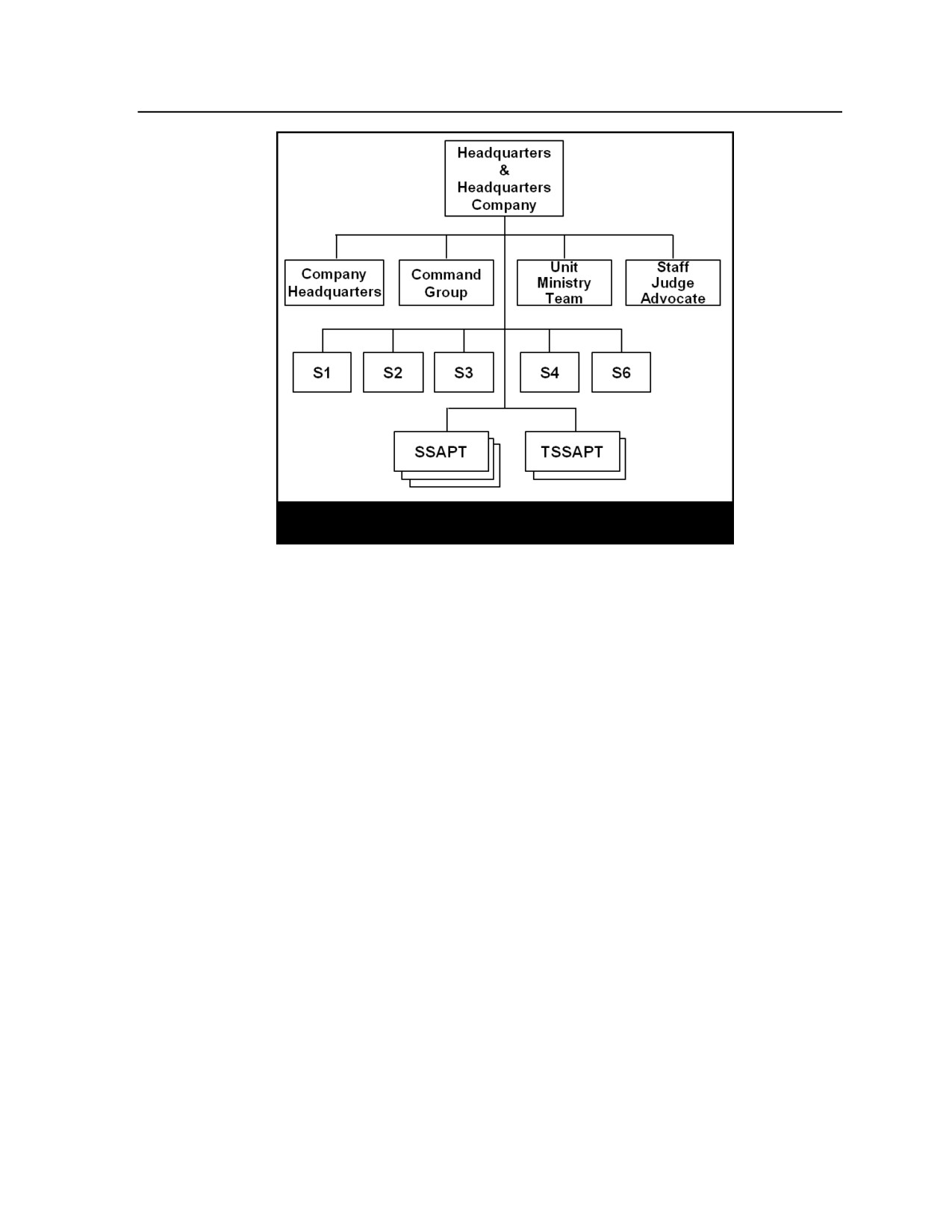
6-6. The headquarters and headquarters company is multi-component and consists of the command
group, the coordinating staff, and the special staffs. See the headquarters and headquarters company
organization in figure 6-2.
6-2
FM 3-14
19 August 2014
Army Space Organizations and Capabilities
Figure 6-2. Space Brigade headquarters and headquarters company
ASCE
6-7.
1st Space Brigade forms tailored space support packages known as ASCEs, and deploys them when
directed based on the factors of mission variables. The size and composition of the ASCE is dependent on
the missions required to be performed in-theater. The ASCE is tailorable which depends on the degree of
involvement of Space capabilities in-theater, Army requirements, and operational control or tactical control
relationships. The ASCE draws its personnel from those staff elements within the headquarters and
headquarters company as needed. If there is an in-theater requirement for space-specific personnel
management, elements of the brigade personnel section would be included in the ASCE. The primary
headquarters element responsible for preparing and training the ASCE is the brigade operations section.
6-8. The 1st Space Brigade’s deployable elements, in coordination with combatant commander, Army
Service component command, and SSE, plan, synchronize, coordinate, and prioritize space operations
support to military operations. This capability allows these elements to augment Army headquarters SSEs
or battlefield coordination detachments and submit land component space needs to the SCA. When the
Theater Army is not assigned as a joint force land component commander and a corps is designated as the
primary warfighting headquarters the ASCE support packages will be adjusted. The functions of these
tailored space support packages continues to evolve as deployment missions are assessed. The following is
a list of responsibilities for the ASCE:
z
The ASCE is normally attached to the joint force land component commander or Army Service
component command and may perform the following functions on arrival in a theater of
operations. When directed by the senior Army space officer in theater, augments the SSE or
becomes the joint force land component commanders space planning cell if there is no organic
SSE. An ASCE integrates into the gaining headquarters joint operations staff to plan space
operations;
z
Assists the division, corps, and Army headquarters SSEs in ensuring Army space equities are
recognized and incorporated into the SCA concept of space operations and execution support;
z
Assists in the joint space planning process and development of the space priorities;
19 August 2014
FM 3-14
6-3
Chapter 6
z
Recommends and coordinates space-related capabilities and receives guidance and priorities
from the Army Service component command or joint force land component commander;
z
Assists in the joint space planning process and development of the space priorities of effort and
support;
z
Assists in the planning, coordination, and synchronization of joint space control operations with
joint force air component commander and the air and space operations center, as required;
z
Coordinates space operations with the Army battlefield coordination detachment, Army air and
missile defense command, and joint force land component commander for land component
space requirements;
z
Provides Army space representation and support to the SCA, JFCC SPACE, the fires and effects
coordination cell, and the Air Force air and space expeditionary task force when necessary;
z
Serves as the principal Army advocate to the SCA and the joint warfighting space expeditionary
force; and
z
Supports the joint SCA when directed and in coordination with other Service components.
SSAPTS
6-9. SSAPTs provide planning information and expertise on Army space control capabilities in order to
coordinate effects, timing, and tempo with centralized operational space capabilities. The specific missions
and capabilities of SSAPTs assets are generally classified and require controlled access to mission
programs. Space control planning and controlling is limited to a small group of personnel who are granted
access to specific programs.
6-10. SSAPTs operate at the combatant commander level, integrating into the headquarters responsible
for planning and executing space control operations which is normally the headquarters where designated
SCA resides. When deployed in a joint environment, SSAPTs augment joint space control coordination
elements where they provide Army and joint headquarters staffs with the expertise on Army space control
capabilities.
6-11. As required, the 1st Space Brigade headquarters may deploy up to three, three-person SSAPTs to
support commands exercising operational control of space control systems and capabilities. The three
SSAPTs provide for rotational depth in one theater, but may support three separate theaters simultaneously
if no rotational capability is required. Some of the functions performed by SSAPTs are:
z
Assist operations in mission command of space control systems;
z
Assist combined air and space operations center in developing space control plans, which
includes developing the space control portion of the space tasking order;
z
Support Integrated joint special technical operations planning and operations; and
z
Update space tasking order to account for emerging targets or operational changes.
6-12. Tactical SSAPTs are employed when space control planning and expertise are required at a tactical
headquarters such as a corps, joint task force, or Marine expeditionary force. The brigade may deploy up to
two, two-person tactical SSAPTs to support a tactical headquarters in planning for and coordinating the
periodic application of space control capabilities. The team’s link to the tactical headquarters is through the
SSE or ARSST if there is no SSE. Some of the function performed by tactical SSAPTs are:
z
Assist tactical-level headquarters in developing space control plans;
z
Requesting space control capabilities from theater; and
z
Coordinating application of space control effects.
SPACE BATTALIONS
6-13. The mission of a space battalion is to plan, coordinate, integrate, and synchronize execution of space
force enhancement functions. The battalion headquarters provides mission command, services, support, and
staff assistance for line companies and the headquarters company. The space battalion also has training and
6-4
FM 3-14
19 August 2014

Army Space Organizations and Capabilities
readiness oversight over its Army Reserve companies and detachments for Title 10 mobilizations and
demobilizations. Space battalions typically perform the following space force enhancement functions:
z
Provide and integrate continuous assured theater ballistic missile warning, combined early
warning, and characterization of the operational environment into operations;
z
Provide SSA, space assets, and space products through the ARSSTs and SSA Company; and
z
Provide low-density, high-demand capabilities such as ARSSTs.
6-14. The space battalion is designed to have mission command over following types of units:
z
TMW space companies;
z
Army space support companies; and
z
Army space control detachments.
6-15. Space battalions are cellular in nature, meaning that the number and type of subordinate space
companies is variable. It has mission command of two to five subordinate space companies. The
organization is shown in figure 6-3.
Figure 6-3. Space battalion organization
SPACE COMPANY (TMW)
6-16. The TMW space company provides space-based ballistic missile warning to a combatant
commander and reports on other infrared events. These support the passive defense, active defense, and
attack operation pillars of theater missile defense and contribute to the theater commander’s operational
environment awareness.
6-17. The company, like the space battalion, is cellular in nature, meaning that the number of subordinate
TMW detachments varies between 3-5 detachments. It is comprised of a headquarters section (including a
training and evaluation section) and
3-5 subordinate TMW detachments, all forward-stationed. Each
detachment operates one TMW system known as JTAGS. A typical organization is shown in figure 6-4 on
page 6-6.
19 August 2014
FM 3-14
6-5

Chapter 6
Figure 6-4. TMW space company organization
SPACE SITUATIONAL AWARENESS COMPANY
6-18. The mission of the SSA company is to provide trained and operationally ready SSA detachments to
combatant commands. The SSA company coordinates services and mission support for assigned elements.
The SSA company conducts mission command of subordinated detachments and maintains operational
oversight of deployed elements to ensure they maintain situational awareness and provide updates to the
COP.
6-19. The SSA companies provide training, certification, mission command, and supervision of up to
seven subordinate Space Detachment-Electronic (SATCOM), known as E-Dets, and reachback operational
support for deployed unit.
6-20. The mission of the Space Detachment-Electronic (SATCOM) is to deploy globally, on orders, and
conduct ground mobile surveillance and assessment of space systems in support of military and civil
operations. Each Space Detachment-Electronic
(SATCOM) plans and conducts system diagnostic
monitoring, vulnerability assessments, data integrity studies, and quality control in support of U.S. military
SATCOM using the Mobile Integrated Ground Suite or other capabilities. A typical SSA company
organization is shown in figure 6-5.
Figure 6-5. SSA company organization
6-6
FM 3-14
19 August 2014

Army Space Organizations and Capabilities
ARMY SPACE SUPPORT COMPANY
6-21. The mission of space support companies are to organize, train, and equip ARSSTs to deploy globally
to plan, coordinate, and analyze space force enhancement and SSA in support of military and civil
operations. Space support companies are organized with a variable number of ARSSTs, but generally do
not exceed ten per company. The organization enables the rapid deployment of ARSSTs to provide space
force enhancement analysis, space-based commercial satellite imagery, space control coordination,
characterization of the operational environment, and to inject USASMDC/ARSTRAT emerging capabilities
into the fight. A generic example of a space support company is shown in figure 6-6.
Figure 6-6. Army space support company organization
ARSSTS
6-22. ARSSTs provide situational awareness of space capabilities, space assets, and space products and
their impact on operations. The company provides divisions, corps, joint task force, Marine expeditionary
force, Theater Sustainment Command, and Army Service component command headquarters a six-Soldier
space force enhancement analysis team, comprising two officers and four enlisted Soldiers, each having
unique space-related skills, knowledge, and abilities. ARSST organization is shown in figure 6-7.
Figure 6-7. Army space support team organization
6-23. ARSSTs plan, coordinate, and analyze the space force enhancement areas. The ability to provide
space input to the IPB is a significant value-added to the MDMP. ARSST prepare and train for unified land
operations supporting all operations.
6-24. In the absence of (or in support of) an SSE, ARSSTs provide a daily space update to the commander
and staff and track the daily status of all space systems available to the commander in a specific area of
responsibility or joint operating area.
19 August 2014
FM 3-14
6-7
Chapter 6
6-25. In absence of (or in support of) an SSE, ARSSTs work with supported commands to determine
systems that use GPS and what level of accuracy they desire for those systems. ARSSTs can alert the
command when the GPS accuracy falls below established tolerances.
6-26. ARSSTs assist the G-2 or intelligence staff officer with IPB effort to analyze the mission variables in
the operational environment by helping to assess the operational impacts of space weather. ARSSTs use
space weather forecasts from Air Force Weather Agency to assess forecasted impacts of space weather on
space assets, terrestrial communications, and impacts of terrestrial weather space-based sensors. By
interpreting the Air Force Weather Agency forecast against space and land component system capabilities
and limitations, ARSSTs are able to identify potential impacts to space systems and terrestrial
communication systems and disseminate that information to the affected parties, commander, and staff.
6-27. ARSSTs are equipped with Distributed Common Ground System-Army (DCGS-A) workstations,
which are replacing the space operations system workstations. Teams also utilize other equipment that
provides space forces with reachback capability when integrated into the supported units’ unclassified and
classified communication and information networks. The DCGS-A workstations are certified by the Army
program office and have approval to operate certificates for use on any Army network. The DCGS-A
workstations are equipped with approved space-unique applications to conduct space analysis, space force
enhancement, and space planning to support Army and joint missions. Other equipment the ARSSTs use
includes printers, plotters, telephone communications, network attached storage devices, and
communications systems for DCGS-A workstations. To conduct and develop mission products, ARSSTS
utilize equipment and communications networks to download a variety of files and datasets that typically
range in the multi-gigabyte file sizes.
53RD SIGNAL BATTALION (SATELLITE CONTROL)
6-28. The mission of the 53rd Signal Battalion (SATCON) is to provide satellite transmission and payload
control of the DSCS and WGS constellations for the President of the U.S., the Secretary of Defense, and
joint commands by operating and maintaining five WSOCs and a DSCS certification facility. The 53rd
Signal Battalion (SATCON) enables various users, including the President of the U.S., DOD components,
national agencies, and joint commands, to access and use the essential wideband SATCOM.
6-29. The mission of the 53rd Signal Battalion (SATCON) is to provide global wideband payload control,
transmissions control, and defensive space control ensuring the DOD wideband satellite constellations’
continuous support to peacetime, contingency, surge, and crisis action plans supporting DOD, U.S.
government agencies, and allied partners by sustaining, operating, and maintaining five global WSOC and
a DSCS Certification Facility. The 53rd Signal Battalion (SATCON) also provides global defensive space
control supporting USSTRATCOMs ability to assure access of DOD leased commercial satellite
transmission paths of interest. The 53rd Signal Battalion (SATCON) enables various users, including the
President of the U.S., DOD components, national agencies, and joint commands, to access and use the
essential wideband SATCOM, to include the DSCS and WGS constellations. Figure 6-8 shows the
organization of the 53rd Signal Battalion (SATCON).
6-30. SATCON line companies operate each WSOC. The WSOC is the focal point for conducting satellite
command and telemetry functions, transmission monitoring functions, and Earth terminal control functions
for DSCS and WGS satellites. Responsibilities include controlling terminal access, maintaining operational
databases, responding to transmission anomalies and alarms, evaluating the quality of communication links,
and the implementation of restoral plans on a 24-hour basis. Capabilities include transmission control,
payload control, defensive space control, Eagle Sentry, and platform control. WSOCs are further described
in Section V of chapter 6.
6-8
FM 3-14
19 August 2014

Army Space Organizations and Capabilities
Figure 6-8. Signal battalion (satellite control) organization
SECTION II - USASMDC/ARSTRAT OPERATIONS CENTER
6-31. The USASMDC/ARSTRAT operations center provides continuous, responsive, Army space-related
reachback for all combatant commands, Army Service component command, and deployed and forward
stationed space forces. The operations center accomplishes this function by leveraging Army space
expertise available within the USASMDC/ARSTRAT staff and 1st Space Brigade.
6-32. The operations center maintains continuous situational awareness of the operational capabilities of
all deployed and forward stationed subordinate commands ensuring uninterrupted mission execution and
support to Soldiers. It maintains communications with USSTRATCOM global operations center,
USSTRATCOM’s JFCC operation centers, and the U.S. Army operations center on all Army operational
space missions. It monitors developing world situations and intelligence to anticipate potential Army space
mission requirements and or support.
6-33. The operations center serves as the USASMDC/ARSTRAT information fusion center for all ongoing
operations. It also serves as the incoming and outgoing distribution center for all orders and official
message traffic. The operations center analyzes all orders from higher headquarters, identifying specified
and implied tasks, and then distributes to the appropriate staff directorate for action. It also distributes,
monitors execution, and maintains all USASMDC/ARSTRAT internal orders.
SECTION III - FRIENDLY FORCE TRACKING
FFT ROLES AND RESPONSIBILITIES
6-34. CJCSI 3910.01B, Friendly Force Tracking Operation Guidance, tasks USSTRATCOM to provide
continuous FFT data services and capability development support to combatant commanders, agencies,
allies, and multinational partners. Commander, USSTRATCOM, through USSTRATCOM SI 534-05,
Friendly Force Tracking Operations Guidance
(Space and Satellite Operations), has delegated the
execution of its FFT responsibilities and tasks to its Army Service component command,
USASMDC/ARSTRAT. The joint, interagency and multinational nature of this assigned mission is unique
and requires the command to work across the broad FFT community of interest to execute these
responsibilities in addressing user needs and accomplishing essential tasks that enable data sharing and
integrated operations.
6-35. USASMDC/ARSTRAT’s space expertise, established integrator roles, and stakeholder relationships
provide value in successfully executing this information-centric assignment. USASMDC/ARSTRAT
satisfies FFT mission responsibilities by equipping, staffing, and operating the FFT MMC. The MMC
28 November 2017
FM 3-14, C1
6-9
Chapter 6
ensures requirements for use of the system are properly validated; coordinates FFT collection, processes
FFT messages for COP integration and accomplishes the dissemination of FFT information back to user
designated destinations. The MMC ensures all information delivered to the COP is accurate, timely and
actionable. USASMDC/ARSTRAT determines the priority of user support requests and endeavors to
support all valid operational needs. USASMDC/ARSTRAT provides FFT research, development, testing,
and integration capabilities support through the joint FFT division. The joint FFT Division executes
capabilities development tasks using engineering, test, and network support expertise and by maintaining
and operating a FFT test bed to provide direct support to the MMC and general support to other authorized
users.
6-36.
6-36. As FFT continues to evolve and more systems and devices are deployed globally, the critical
need for data interoperability across security domains and mission command systems continues to increase.
Accordingly, FFT roles include:
z
Execution of other position location information related data services such as tagging, tracking,
and locating support;
z
FFT system expertise for advice in planning, information assurance, device procurement and
management, data owner guidance, and COP integration;
z
Development of FFT data integration capabilities consistent with network enabled mission
command modernization;
z
Emergency message alerting and notification;
z
Deliberate planning assistance in support of operational plans and concept plans for FFT
activities;
z
Operations and limited exercise and demonstration support to include troubleshooting, subject
matter expert support, testing and limited training; and
z
Analyzing and developing solutions to satisfy requests for FFT support.
FFT CAPABILITIES AND SUPPORT
6-37. To support assigned FFT responsibilities USASMDC/ARSTRAT staffs, equips, and operates the
MMC for organizations and users that require these services and support. It is the critical FFT link between
operating forces, national agencies, and a variety of dissemination architectures. The MMC is the central
point of contact for FFT troubleshooting and coordination.
6-38. The MMC is a operations center with global reach that leverages the Department of Defense
information networks to provide tailored FFT data translation, cross-domain data transfer, and data
dissemination services for authorized users. Users require these services to be interoperable and support
integrated COP display. The MMC and operating staff provide subject matter expertise to verify new
system requirements, coordinate FFT data collection, and accomplish the transmission of information back
to strategic, operational, and tactical levels. The MMC gets the right data to the right user in the right
format, and ensures the FFT information transmitted for use in COP is accurate, timely, and actionable.
6-39. FFT data is used to improve situational awareness by providing the location and movement of force
assets equipped with devices that transmit their position location information. Typically, FFT data is
transmitted between devices and systems using one or a combination of several communications methods.
These methods include line of sight or beyond line of sight, which include commercial and or national
technical means SATCOM systems where most FFT devices and systems leverage the coverage and
beyond line of sight capabilities of SATCOM. FFT devices typically use an embedded GPS receiver to
establish its location. Then they repackage the date, time, and location information, and transmit it to a data
processing node using established communications infrastructure. The information is routed from the data
processing node directly to a COP or through the MMC for further processing and dissemination. A graphic
illustration of the FFT data flow is in figure 6-9 on page 6-11.
6-10
FM 3-14, C1
28 November 2017
Army Space Organizations and Capabilities
Figure 6-9. FFT data flow overview
6-40. Line of sight communications. The receiving platform collects and passes position location
information along to a central gathering point. The line of sight system is limited to relatively local use and
may experience outages as individual platforms lose line of sight access to one another.
6-41. Commercial SATCOM. Some commercial satellites host a transceiver that collects and sends the
signal back to a ground site where a mission command system manager gathers individual platform
location information. This information is sent to the user’s headquarters and incorporated into their COP. In
most cases, the MMC provides translation, cross domain transfer, and dissemination of position location
information data to a Global Command Control System via SIPRNET or through a designated Integrated
Broadcast Service satellite for broadcast over all or part of the area of operations.
6-42. National technical means relies on national satellites and the MMC. The area of operation platform
transmits its location information to a national satellite that acts as a transceiver. The national satellite sends
the location information to the MMC. MMC personnel translate location information and pass it to Global
Command Control System via SIPRNET or through a designated Integrated Broadcast Service satellite for
broadcast over all or part of the area of operations.
6-43. The mission support intent is to responsively deliver FFT capabilities that provide authorized users
with timely, accurate, and secure information to improve their situational awareness. These capabilities are
provided to meet data sharing and dissemination needs to enable FFT systems to interoperate with other
systems and feed common mission command systems and COP. USASMDC/ARSTRAT is committed to
protection of FFT data as required by the data owner and will ensure all connections within the Command’s
network meet DOD or U.S. government accreditation standards and regulations.
SECTION IV - GEOSPATIAL INTELLIGENCE DIVISION
6-44. The USASMDC/ARSTRAT G-2 geospatial intelligence division is a member of the Army’s
National-to-Theater geospatial intelligence program that provides geospatial intelligence services and
products to combatant commands and their subordinate joint forces worldwide. The National-to-Theater
19 August 2014
FM 3-14
6-11
Chapter 6
program, under the operational direction of headquarters U.S. Army Intelligence and Security Command,
conducts federated production of all varieties of geospatial intelligence products but specializes in
advanced geospatial intelligence production using non-literal analysis of imagery data obtained from
commercial and National sources in the visible and non-visible areas of the electromagnetic spectrum.
6-45. This division conducts analysis of both airborne and satellite imagery including synthetic aperture
radar, panchromatic, multispectral imagery, hyperspectral imagery, thermal, full motion video, OPIR, and
light detection and ranging imagery. This division also creates detailed geospatial information services and
mapping data.
6-46. The USASMDC/ARSTRAT G-2 geospatial intelligence division is located at Peterson Air Force
base. As a member of the U.S. Army National-to-Theater geospatial intelligence federation, it provides
full-spectrum geospatial intelligence support to USSTRATCOM, United States Northern Command, and
United States Transportation Command. Additionally, the geospatial intelligence division is the Army’s
node for producing OPIR products in support of United States European Command and United States
Africa Command.
6-47. The Army National-to-Theater program is functionally managed by the headquarters, Department of
the Army G-2 and consists of headquarters, Department of the Army G-2 staff, U.S. Army Intelligence and
Security Command units, and the USASMDC/ARSTRAT geospatial intelligence division. As a distributive
federation, these elements provide reinforcing support to each other, when necessary.
6-48. Requests for USASMDC/ARSTRAT geospatial intelligence division and National-to-Theater
support and access to its products are available through the Army geospatial intelligence enterprise tasking,
collection, processing, exploitation, and dissemination service web portal on both Joint Worldwide
Intelligence Communications System and SIPRNET.
SECTION V - SATELLITE COMMUNICATIONS
REGIONAL SATELLITE COMMUNICATIONS SUPPORT CENTER
6-49. USASMDC/ARSTRAT operates four RSSCs per the directions of USSTRATCOM. The RSSCs
provide theater communication planners with a single point of contact for satellite access planning
management of SATCOM resources. Staffed by representatives from Department of the Army, Department
of the Air Force, Depart of the Navy, and DISA, the RSSC is the theater center of expertise for all military
and commercial SATCOM serving the operating forces. RSSC duties and responsibilities are described in
USSTRATCOM SI 714-03, Satellite Communications Support Center Management.
SATCOM SYSTEM EXPERTS
6-50. USSTRATCOM designated USASMDC/ARSTRAT as the military narrowband consolidated
SATCOM system expert and the specific Mobile Users Objective System SATCOM system expert. These
responsibilities include the manning of the RSSCs for narrowband planning and managing the increased
resources for payload operations management and transmission control, as well as the responsibility to
certify all terminals that will be used across the narrowband satellite payload.
6-51. USSTRATCOM designated USASMDC/ARSTRAT as the military wideband consolidated
SATCOM system expert and the specific WGS and Global Broadcast Service SATCOM support expert.
These responsibilities include the operational payload management of an increased constellation and the
development and sustainment of control architecture for the increased WGS payloads on-orbit.
6-52. SATCOM system experts and consolidated SATCOM system expert have detailed knowledge of
assigned system and spectrum, as well as provide technical, operational, and engineering support to
USSTRATCOM. SATCOM system expert duties and responsibilities are described in USSTRATCOM SI
714-02, Satellite Communications System Expert and Consolidated Satellite Communications System
Expert Responsibilities. Specific duties include:
6-12
FM 3-14
19 August 2014

Army Space Organizations and Capabilities
z
Advocate user requirements;
z
Operationally advise PMs;
z
Develop policy and procedures;
z
Assist transition planning;
z
Provide continuous, 24 hour per day operational support;
z
Ensure integrated spectrum operations; and
z
Provide RSSC manning.
6-53. USASMDC/ARSTRAT staffs a wideband SATCOM watch office and a narrowband SATCOM
watch office out of the USASMDC/ARSTRAT operations center. Narrowband and wideband watch
officers continuous, 24 hour per day operational support to all SATCOM users. Watch officers are charged
with reachback support for any issues relating to SATCOM usage.
6-54. The RSSC commercial spectrum works with the customer and DISA’s defense information
technology contracting organization which contracts for commercial SATCOM service.
RSSC CAPABILITIES
6-55. RSSCs are the day-to-day operational interface with the user. All users are assigned to an RSSC as
their focal point for SATCOM planning, management, and access support. Locations of the four fixed
RSSCs and current combatant command support assignments are depicted in figure 6-10. In general, the
RSSCs support combatant commanders and their forces in routine, deliberate, and crisis action planning of
SATCOM resources. RSSC personnel participate in planning conferences and appropriate working groups
to identify and plan theater SATCOM support requirements for mission operations. RSSCs process user
satellite access requests and publish satellite access authorizations for approved missions.
Figure 6-10. RSSC locations and support assignments
19 August 2014
FM 3-14
6-13
Chapter 6
6-56. RSSCs perform the following day-to-day management functions for SATCOM resources in direct
support of combatant commander assigned theater forces and other users:
z
Accept and analyze validated satellite access requests and develop solutions;
z
Plan resource assignments; coordinate resource sharing, resource borrowing; publish satellite
access authorizations;
z
Assist combatant commander and user planners to implement networks and adjudicate usage
conflicts;
z
Monitor SATCOM systems status (readiness) and outage information; and
z
Coordinate user response to satellite anomalies.
6-57. RSSCs support combatant commander and user deliberate and crisis action planning:
z
Assist combatant commander and user staffs in defining requirements and developing operation
plans, contingency plans, and communication annexes;
z
Perform what if drills, analyze scenarios, and provide assessments;
z
Track resource utilization and recommend changes for optimizing resources;
z
Assist combatant commander and user planners to develop theater policy and procedures; and
z
Provide training, technical assistance, and performance feedback to end users.
6-58. RSSCs support to theater spectrum management activities:
z
Assist in SATCOM restoral actions in response to electromagnetic interference or anomalous
conditions; and
z
Assist in the joint force intelligence processes by which spectrum allocations and frequency
assignments are approved.
6-59. RSSCs coordinate planning for SATCOM interfaces to the Department of Defense information
networks:
z
Facilitate interfaces to the gateways; and
z
Coordinate planning with DISA field offices contingency and exercises branch for Department
of Defense information networks access.
6-60. RSSCs support JFCC SPACE in maintaining global situational awareness:
z
Support assessment of SATCOM support for each combatant command operation plans;
z
Monitor current SATCOM support and assess impact of system changes and anomalies on
current, planned, and future operations;
z
Provide data updates on SATCOM resources allocated to specific users;
z
Coordinate allocation and resource sharing with other RSSCs;
z
Develop contingency plans for catastrophic failure;
z
Assist in system performance trend analysis; and
z
Assist in user performance trend identification and analysis.
6-61. RSSCs direct and coordinate SATCOM resource configuration changes with transmission control
facilities such as WSOCs, Milstar satellite operations center, and the naval computer and
telecommunications area master station.
RSSC STAFFING
6-62. The RSSCs are staff elements of headquarters USASMDC/ARSTRAT. The RSSCs provide direct
support to the combatant command and theater forces as the focal point for all SATCOM planning matters.
RSSCs interact with each other, consolidated - SATCOM systems expert, JFCC SPACE, spectrum specific
global watch officers, and Service unique satellite command and control centers to coordinate and facilitate
the implementation of their plans.
6-14
FM 3-14
19 August 2014

Army Space Organizations and Capabilities
6-63. USASMDC/ARSTRAT provides key management personnel for each RSSC, which includes a
director, operations noncommissioned officer, and administrative assistant. Furthermore, each RSSC
consists of individual SATCOM spectrum planning cells staffed by respective Service or agency as
depicted in figure 6-11. USASMDC/ARSTRAT is assigned management responsibilities for day-to-day
operations but each Service and or agency has administrative control responsibilities for their respective
assigned personnel. The RSSCs conduct operations a continuous, 24-hour basis.
Figure 6-11. RSSC staffing and organization
6-64. The RSSCs are staffed with planners from each USSTRATCOM service component and DISA. The
planners are proficient in dealing with management and control issues for their particular systems. Current
staffing responsibilities are identified below.
z
Army (USASMDC/ARSTRAT): Wideband and or SHF SATCOM such as DSCS, WGS, and
Global Broadcast Service and narrowband and UHF SATCOM such as Mobile Users Objective
System.
z
Navy (Naval Fleet Cyber Command): Narrowband and legacy UHF SATCOM such as Fleet
SATCOM and UFO.
z
Air Force Space Command: Protected and Advanced EHF SATCOM such as Milstar, Advanced
EHF, and selected EHF payloads on UFO.
z
DISA: Commercial SATCOM such as C, Ku, Ka, X band fixed, and mobile satellite services.
RSSC TASKING PROCESS
6-65. The RSSCs employ standardized processes for operational management of SATCOM resources.
These processes are described in the USSTRATCOM SI 714-04. Figure 6-12 on page 6-16 outlines the
primary process for requesting SATCOM access. Request for additional support and products described
above can be made via the appropriate combatant commander or in many cases directly to the RSSC.
6-66. A unit requiring satellite access submits a satellite access request via its theater chain of command,
including the theater Service component, to the combatant commander communications directorate,
Service, or Agency for review and validation.
19 August 2014
FM 3-14
6-15

Chapter 6
Figure 6-12. Requesting SATCOM access
6-67. A validated satellite access request is sent to the appropriate RSSC for analysis and planning. If
sufficient resources are available, the RSSC develops a satellite access authorization, coordinates pertinent
terrestrial interfaces, provides data for satellite configuration and control, and reports its status. If resources
are unavailable, the request is denied and sent to the combatant commander communications directorate to
determine if resources can be borrowed or preempted from other users. RSSCs also continually analyze
resource assignments to make optimization recommendations to combatant commanders and users.
6-68. Approved satellite access authorizations are sent to the originating unit authorizing operational
access. Additionally, RSSCs direct and coordinate resource configuration directives with satellite
operations centers (such as WSOCs, detailed below), which implement and monitor communication plans.
6-69. Although the individual satellite operations centers have primary responsibility for monitoring and
troubleshooting active networks, RSSCs liaise with combatant commanders, consolidated SATCOM
system experts, users, and control centers to maintain situational awareness and respond to changing
demands and requirements.
6-70. RSSC Contingency Deployment. Each RSSC can deploy an element to provide onsite SATCOM
planning and management support for major or contingency operations. Potential deployment locations
include supported combatant command headquarters, joint task force, joint or theater communications
control centers, or supported combatant command component headquarters. This provides the theater
commanders short-term, direct access to the resident SATCOM planner in the RSSC.
6-71. RSSC Augmentation. An RSSC may require additional support for extreme workloads during
contingencies, equipment failures, or personnel losses. The RSSC receives augmentation support from
another RSSC or USASMDC/ARSTRAT G-6 staff to ensure consistent support to operational forces.
6-16
FM 3-14
19 August 2014
Army Space Organizations and Capabilities
WIDEBAND SATCOM OPERATIONS CENTER
6-72. WSOCs provide satellite payload and transmission control for DOD communications satellites
providing wideband SATCOM for military forces. Strategic wideband SATCOM is used to carry high
volumes of communications through large terminals located around the world. The primary means for
reachback communications from in-theater headquarters to those in continental U.S. is via wideband
SATCOM through DSCS and WGS satellites.
6-73. The WGS program has established international partnerships with Australia, Canada, New Zealand,
Denmark, Luxembourg, and the Netherlands. International memorandums of understanding allow these
countries to provide funding to support the acquisition of additional WGS spacecraft in return for a
percentage use of the WGS constellation.
6-74. The WSOCs are the focal point for:
z
Conducting payload command and telemetry functions;
z
Transmissions monitoring functions; and
z
Strategic and tactical terminal control functions for DSCS and WGS satellites.
6-75. WSOC responsibilities include:
z
Controlling terminal access;
z
Maintaining operational databases;
z
Responding to transmission anomalies and alarms;
z
Monitoring the health and status of the spacecraft;
z
Monitoring for unauthorized users and electromagnetic interference;
z
Evaluating the quality of communication links and the implementation of restoral plans on a 24-
hour basis; and
z
Reporting SSA information.
WSOC MISSION COMMAND
6-76. USASMDC/ARSTRAT, through the 53rd Signal Battalion (SATCON), provides mission command
and operational direction for the WSOCs, including operational control responsibility. The Wideband
consolidated SATCOM system expert provides technical direction and the RSSCs provide satellite
authorizations for the communications payload direction to the WSOCs.
6-77. The five WSOCs are geographically located to provide continuous, 24-hour coverage of all assigned
satellites. Each company of the 53rd Signal Battalion (SATCON) is strategically positioned to provide
mission command for one or more DSCS and WGS satellites. Figure 6-13 on page 6-18 provides an
illustration of the battalion’s mission, which includes transmission control, assured access, and payload
control.
WSOC CAPABILITIES
6-78. Five geographically dispersed WSOCs provide DSCS and WGS communications payload control.
The WSOCs constantly monitor the condition of assigned satellites by watching for anomalies or
problematic trends on the spacecraft, such as declining power output from solar arrays or unexpected
buildup of heat in electronic components. Additionally, three WSOCs operate the Eagle Sentry mission in
support of interference detection, spectrum monitoring, and integrated geo-location capabilities. All
WSOCs perform interference detection and spectrum monitoring.
19 August 2014
FM 3-14
6-17

Chapter 6
Figure 6-13. 53rd Signal Battalion (SATCON) mission overview
6-79. WSOCs also conduct transmission control. The WSOCs ensure users do not exceed their allocated
share of power and bandwidth resources. WSOC personnel manage satellite resources and monitor user’s
compliance with established directives and resource allocations. The WSOCs implement the rules of
access, bandwidth, and frequency allocations. Through this system, the WSOCs provide continuous
worldwide support to the President of the U.S., the Joint Chiefs of Staff, the State Department, intelligence
communities, the combatant commanders, Services, and international partners in their various
communications missions.
6-80. WSOC Tasking Process. The WSOCs are tasked by the appropriate RSSC to execute satellite
payload configuration changes, thereby implementing payload and transmission control. Upon detailed
allocation planning for SATCOM resources, the RSSCs task the appropriate WSOC in accordance with
configuration management requirements levied by the wideband consolidated SATCOM system expert.
The wideband consolidated SATCOM system expert acts in part on direction from JFCC SPACE and
USSTRATCOM, taking into consideration combatant commander and other communications requirements
from around the world and direction from the Joint Staff in accordance with CJCSI 6250.01E.
6-18
FM 3-14
19 August 2014
Chapter 7
Space Support Elements
The Army deploys specialized Army Space Support Teams to support Army corps and
divisions, other Services, Joint task forces, and multinational forces.
Lieutenant General David L. Mann
Commanding General, USASMDC/ARSTRAT
Senate Armed Services Committee Statement
12 March 2014
This chapter discusses specific roles and functions of SSEs in the Army, corps, and
divisions. The SSE is the commander’s primary advisor on space operations. The SSE
plans, integrates, and coordinates space force enhancement across all warfighting
functions. The SSE plans, integrates, and coordinates space control and SSA activities.
The SSE provides space analysis and expertise, and specific products to the staff and
subordinate units. An ARSST may augment the SSE under certain circumstances, such as
when the headquarters is serving as the joint forces land component command or joint
task force headquarters, or when the number of subordinate units requiring space support
exceeds the capacity of the SSE to support.
ARMY HEADQUARTERS SSE
7-1. The Army Service component command SSE mission is to provide enhanced Army space support to
the combatant commander and Title 10 support to Army space forces deployed in the Army Service
component command’s area of operations. The Army Service component command SSE is assigned to the
G-3, and provides organic space operations planning, support, and integration for the commander, staff,
assigned and attached subordinate units. The Army Service component command SSE supports all
combatant commander space-related operational missions by properly planning and coordinating with all
Army space forces supporting the theater commander. The SSE is responsible to provide recommendations
for space-based support, forces, and interfaces required to support Army operations in a joint operations
area. The senior Army space operations officer in the Army Service component command is the primary
space staff advisor to the Army Service component commander. The SSE will coordinate any space
augmentation requirements prior to deployment and ensure the augmentation is troop listed and deploys
with the Army Service component command. The SSE provides the following functions and capabilities:
z
Provide space-based expertise, services, and training where applicable;
z
Provide space input and develop the space portion of the MDMP;
z
Develop the space estimate;
z
Recommend space-specific priority intelligence requirements to the G-2;
z
Ensure G-6 awareness of SATCOM capabilities;
z
Provide support to information related capabilities;
z
Integrate USSTRATCOM-unique capabilities for missile warning, PNT, environmental
monitoring, and SATCOM capabilities into staff planning; and
z
Be prepared to perform special technical operations duties and responsibilities, as directed.
7-2. In Army and joint organizations, the senior FA40 may be designated as the command’s chief for
special technical operations. When directed to fill this position as an additional responsibility, duties
19 August 2014
FM 3-14
7-1
Chapter 7
include managing billets for the command, oversight of special technical operations planning, exercises,
operations, and inspections.
7-3. The SSE routinely works with other members of the coordinating and special staffs such as the
intelligence cell, signal operations, network operations, movement and maneuver cell, AMD section, fires
cell, and staff weather office element. The SSE focuses on the integration of the wide range of space
capabilities across all warfighting functions. The SSE educates members of the staff to ensure they are fully
aware of space capabilities, limitations, and vulnerabilities that pertain to the various warfighting functions.
The SSE may request ARSSTs to provide space support capabilities required for theater-level subordinate
commands.
7-4. The SSE’s primary analytical tool is the DCGS-A workstation with Army approved space-unique
and space-related applications, which may connect to the SIPRNET. The analytical tools on the DCGS-A
workstations provide the SSE with the necessary equipment to accomplish their required tasks.
CORPS AND DIVISION SSE
7-5. If the corps commander is designated as the joint force land component commander and SCA is
delegated to this commander, the SSE within the corps supports the joint force land component commander
with planning and operations in the role as the SCA. When the requirements of serving as the SCA exceed
the capabilities of the corps, the corps SSE may be augmented by a tailored space support package from the
1st Space Brigade, an SSAPT, an ARSST or joint organizations to enable this functionality.
7-6. The corps is the principal integrator of space capabilities in support of unified land operations, and
headquarters each contain an SSE. The Army relies on space-based capabilities such as PNT, SATCOM,
missile warning, environmental monitoring of the space environment, and information collection. These
capabilities are critical enablers used by the corps and division to plan, communicate, navigate and
maneuver, maintain situational awareness, engage the enemy, provide missile warning, and protect and
sustain forces.
7-7. Within the division staff, the SSE is organic to the movement and maneuver cell in the current
operations section. The SSE provides, plans, coordinates, and integrates space force enhancements and
space control for corps, division, and subordinate units. The SSE performs the day-to-day staff functions
required to execute SCA, should the commander be so designated. The SSE coordinates directly with the
joint SCA, normally the joint force air component commander, for support by space-based systems to meet
corps requirements. An SSE may be augmented by an ARSST.
7-8. The corps mission command structure has four design requirements. The corps serves as the Army
component and senior Army headquarters for all Army forces assigned to the combatant commander.
Depending on the scope of the mission, the corps headquarters can serve as a joint task force or joint force
land component commander with the appropriate joint augmentation. It can function as an intermediate
tactical headquarters in a major combat operation. Each corps contains an SSE in the movement and
maneuver cell. For operational space planning, all land component coordination runs up to the corps
headquarters. If serving as a joint task force or joint force land component commander headquarters, the
SSE should consider requesting ARSST augmentation.
7-9. The primary tactical warfighting headquarters is the division. The primary task of the division
headquarters is to direct the operations of its subordinate brigade combat teams and supporting brigades.
The division contains the resources needed to be an Army forces headquarters during the conduct of a crisis
response or limited contingency operations without additional Army augmentation, but requires substantial
augmentation to serve as a joint task force or joint force land component commander headquarters. Each
division contains an SSE in the movement and maneuver cell. Due to the small size of the division SSE, it
requires augmentation to perform 24-hour operations if serving as a joint task force, joint force land
component commander, or Army forces headquarters. When the number of subordinate brigades exceeds
the capacity of the SSE to provide effective support, augmentation by an ARSST should be requested.
7-2
FM 3-14
19 August 2014
Space Support Elements
7-10. The division headquarters is a modular mission command organization capable of directing decisive
operations. The Army builds expeditionary force packages around the division headquarters. As the Army’s
primary warfighting headquarters, the division conducts decisive, shaping, and sustaining operations that
translate operational-level goals into tactical action.
7-11. As in the Army Service component command, the corps or division SSE routinely works with other
members of the coordinating and special staffs to integrate space capabilities across all warfighting
functions.
INTERNAL COORDINATION RESPONSIBILITIES AND TASKS
STAFF COORDINATION, RESPONSIBILITIES, AND TASKS
7-12. The coordination responsibilities discussed below as they pertain to the intelligence cell, movement
and maneuver cell, and G-6 are guidelines for staff interaction at the theater Army and corps level. At the
corps these staff sections are the intelligence cell, movement and maneuver cell, and G-6. At the division
level these staff sections are: the intelligence cell, movement and maneuver cell, G-6 and network
operations. The SSE does not provide unilateral answers about space capabilities that should be provided
by other command staffs who have warfighting function proponency. In all cases, the SSE coordinates all
space-related actions with the appropriate command and staff.
7-13. The SSE maintains awareness of the total space picture and has in-depth understanding of the space
mission command elements, such as the joint force commander with SCA and its supporting staff. The SSE
maintains contact with other space teams, such as the subordinate unit SSEs, ARSSTs, and TMW
detachments, as well as other teams such as national intelligence support teams and sister Service space
capabilities. The SSE pursues any direct liaison authority clearances that are needed but not already
directed. Gaining necessary situational understanding requires the SSE to network actively with a space
community that will very likely be dynamic and different from theater to theater.
7-14. The SSE is charged to:
z
Develop space requirements;
z
Maintain the space portion of the COP;
z
Plan, integrate, and coordinate space force enhancement, SSA, and space control capabilities;
z
Provide space-based expertise and services; and
z
Provide space input to the MDMP.
7-15. To properly execute assigned tasks, the SSE maintains awareness of the challenges the unit faces and
is prepared to offer potential space solutions, when applicable.
7-16. The major contribution of the SSE to planning is support to the MDMP and development of Annex
N (Space Operations) to the base order. Commanders and staffs use Annex N (Space Operations) to
describe how space operations support the concept of operations described in the base plan or order. The
SSE is fully involved in the process, flow of information, and decisions in the headquarters. Additionally,
the SSE works closely with the entire staff to ensure space support is optimized to all warfighting
functions. However, the majority of the SSE’s time is focused on the intelligence cell, movement and
maneuver cell, and G-6 section at the Theater Army level (or equivalent staff sections at corps and
division) because these staffs rely most heavily on space capabilities. Discussed below is how the SSE
integrates into MDMP planning, followed by specific ways the SSE works with the coordinating staff
elements. Refer back to the planning section of chapter 5for how SSEs support the MDMP.
19 August 2014
FM 3-14
7-3
Chapter 7
G-2, INTELLIGENCE CELL
7-17. SSE coordination with intelligence cell includes the following:
z
Develop the space analysis contribution to the IPB (see Chapter 8, Section I);
z
Assist Intelligence cell with development of space-related priority intelligence requirements
information and recommend its inclusion in the collection plan;
z
Assist Intelligence Cell with incorporating space capabilities into personnel recovery and
combat search and rescue plans, operation drills, and operations;
z
Maintain the space portion of the COP by regularly reviewing space products. Ensure the
analytical control element is aware of significant space data to incorporate into the all source
analysis effort;
z
Provide space-related requirements to the collection manager;
z
Analyze effectiveness of missile warning architecture to identify threat missile activity and
support battle damage assessment and situational awareness requirements. Ensure Intelligence
Cell staff is aware of missile warning constellation technical intelligence and battle space
characterization capabilities;
z
Provide space environment assessments and integrate space environment updates into the space
estimate;
z
Determine and monitor vulnerabilities to supporting space-based surveillance, reconnaissance,
or attack; and
z
Apprise the Intelligence Cell of ongoing or available space control protection measures.
G-3, MOVEMENT AND MANEUVER CELL OR FIRES AND EFFECTS CELL
7-18.
SSE coordination with movement and maneuver cell includes the following:
z
Monitor status of friendly space systems, platforms and operations to maintain that portion of
the COP. Ensure appropriate staff elements are able to access the space portion of the COP for
space-related issues that may affect the operation;
z
Maintain close coordination with the staff to ensure space integration into all future planning
efforts;
z
Maintain close coordination with the current operations section regarding space input to staff
update briefs, warning orders, and fragmentary orders;
z
Provide recommendations to apply military, civil, and commercial space systems and concepts
for land force applications;
z
Brief the movement and maneuver cell on the capabilities and roles of the ARSST, and integrate
the ARSST into daily operations. The ARSST provides space products and support, and allows
the SSE to sustain continuous space duty staff capability;
z
Coordinate for space control protection;
z
Coordinate for SATCOM electromagnetic interference resolution, GPS electromagnetic
interference resolution, and PNT augmentation to support operations;
z
Coordinate with the knowledge management section to ensure GPS capabilities, to include FFT,
are optimally supporting the Army, corps, or division, and subordinate elements;
z
Provide information on the capabilities and limitations of U.S. space and associated ground
systems. Assist in ensuring space-related support is available within theater, such as TMW and
GPS;
z
In concert with the intelligence cell, G-6 section, signal operations, network operations, analyze
and monitor the command operations security posture from a space perspective;
z
In concert with the intelligence cell, movement and maneuver cell, fire support coordinator, and
G-6, nominate enemy space assets for targeting, as required;
z
Ensure space capabilities are fully integrated into unmanned aerial systems;
7-4
FM 3-14
19 August 2014
Space Support Elements
z
Implement space control prevention measures to prevent the enemy from using friendly and
foreign systems, such as communications channels and GPS signals; and
z
Ensure that critical ground segments of friendly space systems are designated as restricted
operations zones in the airspace command and control element plan and are on the air defense or
theater missile defense defended asset list.
7-19.
SSE coordination with the plans cell includes the following:
z
Upon receipt of mission, provide space-based capabilities and products to the planning staff
during the MDMP by:
o Analyze higher headquarters mission and commander’s intent from a space perspective;
o Develop the space estimate by coordinating with other cells and elements during mission
analysis. The space estimate will specifically address the capabilities and effects on
operations of GPS and PNT; FFT; missile warning, in coordination with the AMD Section;
SATCOM, in accordance with the G-6 section, signal operations, network operations
planner; space control capabilities, limitations, and asset availability; and satellite
operational status;
o Recommend space-specific commanders’ critical information requirements, priority
intelligence requirements, friendly forces information requirements, and essential elements
of friendly information;
o Provide space input to COA analysis; and
o Integrate national level asset capabilities into staff planning, to include: ballistic missile
warning, PNT, environmental monitoring, and SATCOM capabilities;
z
Integrate the ARSST with the MDMP planning effort, if applicable;
z
Coordinate with the personnel recovery and combat search and rescue cell to optimize GPS for
these missions;
z
Analyze the potential employment of additional (other than ARSST) USASMDC/ARSTRAT
operational capabilities; and
z
Write Annex N (Space Operations) for the operation plans and orders after a COA is selected
and approved.
G-3, INFORMATION OPERATIONS ELEMENT
7-20. SSE coordination with G-3 Section, information operations, includes the following:
z
Provide information on space-based products that could support information related capabilities
requirements;
z
Provide a representative to information related capabilities working groups;
z
Include information related capabilities requirements in the space operations appendix to Annex
N (Space Operations);
z
Coordinate information related capabilities requirements with higher headquarters SSEs;
z
Coordinate with the G-3 to include enemy space system elements in the targeting process; and
z
Provide insight into the friendly, enemy, and rest-of-world space orders of battle and friendly
space operational status.
CHIEF OF SUSTAINMENT
7-21. SSE coordination with the assistant chief of staff, logistic sustainment section includes the
following:
z
Provide an understanding of in-transit visibility tracking architectures;
z
Provide an understanding of FFT architectures supporting sustainment;
19 August 2014
FM 3-14
7-5
Chapter 7
z
Provide GPS navigational accuracy predictions in support of precision sustainment; and
z
In concert with the geospatial cell, enable assistant chief of staff, logistic sustainment section to
request and receive main supply route space-based imagery.
G-6, SIGNAL OPERATIONS
7-22. SSE coordination with G-6 section, signal operations, network operations includes the following:
z
Through the COP, provide environmental impacts on SATCOM and from enemy threat to
SATCOM and terrestrial communications;
z
Through the COP, provide awareness of all military and commercial SATCOM capabilities that
may contribute to unit mission accomplishment;
z
Through the COP, provide status of supporting SATCOM systems, to include known
deficiencies and announced service interruptions and unannounced service interruptions;
z
Coordinate for space control protection; assist the G-6 section, signal operations, and network
operations in developing space control protection priorities;
z
Coordinate for SATCOM and GPS electromagnetic interference resolution;
z
Determine and recommend to the G-6 section, signal operations, and network operations
SATCOM related essential elements of information;
z
Ensure G-6 section, signal operations, and network operations is aware of Army SATCOM
mission command organizations that contribute to operational contingency support;
z
Provide information on the space coordination network within theater, specifically, the location
and mission of the entity delegated SCA and ASCE, if applicable;
z
In coordination with the movement and maneuver cell and knowledge management section,
provide information on tracking such as FFT systems architecture to support G-6 section, signal
operations, or network operations troubleshooting; and
z
In coordination with the G-2, G-3, facility engineer, and knowledge manager, plan the various
hardware and software platform integrations of supporting space forces such as ARSSTs, into
the supported unit’s communication and information networks.
ASSISTANT CHIEF OF STAFF, CIVIL AFFAIRS, CIVIL AFFAIRS ELEMENT
7-23. SSE coordination with assistant chief of staff for civil affairs, civil affairs section includes the
following:
z
Provide information on space-based products that could support civil-military requirements; and
z
Include civil-military operations requirements in the space operations appendix to the civil
military operations annex.
AMD SECTION OR ELEMENT
7-24. The SSE must not attempt to duplicate the air defense role in warning and dissemination.
Coordination with the AMD section or element includes the following:
z
Through the COP, advise the AMD section or element on the status of TES elements’
effectiveness and ability to support command theater ballistic missile early warning
requirements; and
z
Ensure dissemination and warning of theater ballistic missile attacks is timely and accurate.
Provide staff training on capabilities and limitations of the OPIR constellation and other TMW
assets.
7-6
FM 3-14
19 August 2014
Space Support Elements
EXTERNAL COORDINATION RESPONSIBILITIES AND TASKS
7-25. The space command and control and technical channels may be different in every theater of
operations; therefore, this section is intended to provide general guidelines for SSEs to conduct
coordination with units, forces, and agencies external to the Army chain of command.
7-26. SSEs maintain connectivity with other SSEs and various worldwide operations and analysis centers.
These include, but are not limited to:
z
The Joint Space Operations Center;
z
The GPS operations center;
z
USASMDC/ARSTRAT operations center;
z
The commander delegated SCA staff;
z
The ASCE, if one is present;
z
Higher echelon SSEs;
z
Adjacent SSEs;
z
Army components and Service components from adjacent Services with space expertise;
z
Lower echelon SSEs; and
z
ARSSTs supporting units without SSEs.
7-27. Space Support Request. The senior space officer with SCA may establish a space support request
procedure for creating, submitting, prioritizing, and synchronizing requests for space force enhancement,
SSA, space control services, products, and effects. SSEs should forward space support requests to the
appropriate addressee, normally the staff supporting the commander delegated SCA. SSEs should handle
space support requests in the following manner:
z
Resolve space support requests at the lowest echelon possible;
z
Coordinate space requirements with higher headquarters SSEs;
z
Satisfy space operations requirements with organic capabilities if possible; and
z
Space support requests may eventually reach the Joint Space Operations Center and be further
disseminated to other space related units or agencies.
19 August 2014
FM 3-14
7-7
Chapter 7
This page intentionally left blank.
7-8
FM 3-14
19 August 2014
Chapter 8
Space Products
The three separate products the SSE prepares are the space-unique inputs to the IPB, the
space estimate, and Annex N - Space Operations. The space estimate is prepared as a tab
to the Annex N to the operation plans, while the SSE provides space input to the
intelligence cell’s IPB activity. Both the space estimate and space input to IPB process
are systematic, continuous methods of analyzing and documenting factors affecting space
capabilities that affect the operational environment. These space-unique products present
the supported commander and staff with information about the space situation that
pertains to accomplishing the unit mission. These products are designed to support other
estimates and the MDMP. The purpose of the space estimate is to consider systematically
the space dimension of the area of operation. This chapter outlines the necessary content
of space analysis as a tool to identify how space influences the operations.
SECTION I - SPACE INPUT TO IPB
PURPOSE
8-1. The purpose of space input to the IPB is to provide the intelligence cell and other staff elements,
with a highly detailed analysis of the space domain and its capabilities and effects within the operational
environment. IPB is an analytical methodology to reduce uncertainties concerning the enemy and the
operational environment, in three dimensions, and fuses air, space, terrain, and weather into a consolidated,
coordinated assessment. IPB is the key to preparing for the next engagement and, during peacetime, builds
the foundational data that will be updated and enhanced continuously and simultaneously during
operations.
8-2. An enemy’s access to space and or space control capabilities can generate effects that impact across
the levels of war. Space input to IPB conducted at the maneuver unit level to support combat operations
needs to be a highly focused effort directly impacting the mission or operations that leverages the results of
the JFCC SPACE space IPB production program. This multi-agency intelligence production effort is
designed to augment a combatant command’s joint IPB tailored to assessing enemy usage of space and
space control systems with predictive courses of action. The space IPB process executed at JFCC SPACE is
a continuous all-source intelligence production effort tailored to support combatant commander
contingency plans and operation plans in existence.
8-3. The SSE should coordinate through the intelligence cell for access to existing JFCC SPACE IPB
products during mission analysis. If the SSE’s area of responsibility doesn’t have an available space IPB
product, or if further tailoring is necessary, the SSE should submit an intelligence requirement through the
collections manager to JFCC SPACE. The SSE and intelligence cell should review the joint space IPB to
understand the enemy’s use of the space domain, space order of battle, and space control courses of action
to integrate into the unit IPB process. Based on the intelligence cell’s limited capacity to focus on the space
domain, the SSE should lead the space threat analysis effort, which will eventually be incorporated into the
overall intelligence estimate.
8-4. Based on mission variables, staffs down to brigade level need to determine how best to integrate
space capabilities and vulnerabilities into their mission analysis process. This effort supports all facets of
MDMP and is the key space situation analysis tool used during the operation. The use of space systems
may significantly affect operations involving communications, navigation, threat warning, weather
monitoring, reconnaissance, and surveillance. Throughout all phases of an operation (from pre-deployment
28 November 2017
FM 3-14, C1
8-1
Chapter 8
to mission completion), the space impact on military operations is a key factor for which the commander
plans. The SSE, in coordination with the rest of the staff, conducts the space estimate process and space
input to IPB, and makes the products available to the staff and the commander.
SPACE INPUT TO THE IPB PROCESS
8-5. The SSE provides all space unique IPB products for integration to the intelligence cell. These space
unique products are incorporated into the IPB products generated by the intelligence cell for use in the
planning, preparing, and executing of all operations. The SSE coordinates closely with the intelligence cell
to reduce the potential for redundant analysis.
8-6. The four steps of IPB (per ATP 2-01.3, Intelligence Preparation of the Battlefield/Battlespace)
adequately describe the process required for the SSE to provide the space input to IPB. However, as part of
the overall mission analysis effort, step 4 also supports the space estimate with linkage to the army
warfighting functions. This is done because the SSE must evaluate the overall capability of the threat to
attack or degrade U.S. space operations, and this needs to be reflected in graphic format as part of the space
IPB. The four IPB analysis steps are:
z
Describe the operational environment;
z
Describe the environmental effects on operations;
z
Evaluate the threat; and
z
Determine threat courses of action.
STEP 1—DEFINE THE OPERATIONAL ENVIRONMENT
Identification of Space Area of Interest
8-7. Step 1 begins with identification of the supported unit area of operations. Once the area of operations
is identified, the area of interest is coordinated with the intelligence cell. Based on a clear understanding of
the operational commander’s area of operations, the intelligence cell specified area of interest, and the
supported unit mission, the SSE determines a separate and distinct space area of interest. The space portion
of the area of interest supports and complements the total intelligence cell and movement and maneuver
cell effort and is designed to depict the relevance of space to the maneuver commander’s engagement.
8-8. The space portion of the area of interest includes the region above and adjacent to the ground portion
of the area of operations as illustrated in figure 8-1. The SSE may further subdivide the space area of
interest in named area of interests that roughly correspond to low, medium, and highly elliptical Earth
orbits. It starts at ground level, continues through low Earth orbit, and terminates with the geosynchronous
Earth orbit and above. Satellites moving through the identified space area of interest, space weather, and
key terrestrial space-related locations (and associated terrestrial weather) are all considered in the space
input to IPB. Space-related activity occurring anywhere outside of the designated space area of interest
(such as solar weather, space launches, and ground station activity) needs to be considered in this effort
only if it directly impacts the operational mission. Identification of the space area of interest should help
answer questions, such as:
z
What is the status and capabilities of U.S. satellites to support the mission?
z
Is the satellite orbit conducive to support operations within the area of operations?
8-2
FM 3-14, C1
28 November 2017

Space Products
Figure 8-1. Situation template with space area of interest
Initial Examination
8-9. Once the space area of interest is identified, the SSE begins an initial examination, in conjunction
with the other staff elements, of available information and knowledge gaps that need to be addressed.
During the initial examination, the following issues may help determine the information and knowledge
gaps and areas where space-based sensors may be requested:
z
Impact of solar and terrestrial weather on space operations;
z
Initial assessment of enemy space capabilities;
z
Initial assessment of commercial space, and how it may impact both enemy and friendly
operations; and
z
The operational status of friendly space systems, availability, and importance to mission
accomplishment.
STEP 2—DESCRIBE THE ENVIRONMENTAL EFFECTS ON OPERATIONS
8-10. Step 2 includes solar and terrestrial weather and terrain analysis relevant to space capabilities. Care
is taken during this step to limit the focus to the weather and terrain impacts on space operations; otherwise
there is duplication with the intelligence cell effort. In fact, this step is conducted in close coordination with
the intelligence cell staff weather officer and terrain team to ensure a complementary effort.
Impact of Solar Weather
8-11. The first task of step 2 is to examine the impact of solar weather on space operations. The space
environment consists of the full range of electromagnetic radiation and charged particles (electrons and
19 August 2014
FM 3-14
8-3
Chapter 8
protons, which constitute solar wind) that continually flow from the sun at varying intensities. Several types
of solar activity cause energetic particle streams to intensify the normal (or backg2round) levels of solar
wind. These changes in solar wind speed and density disturb the Earth’s magnetic field as they sweep by,
creating geomagnetic and ionospheric storms. The fundamental drivers of space weather activity include
solar flares
(a rapid, intense variation in solar brightness, including a release of radiation across the
electromagnetic spectrum) and coronal mass ejections (huge bubbles of gas ejected from the sun over the
course of several hours). These solar weather disturbances may potentially degrade both commercial and
military capabilities for periods ranging from several minutes to a few hours to more extreme impacts such
as loss of system performance. In extreme circumstances, solar weather may cause a loss of system
performance. The potential for solar weather to disrupt friendly, civil, commercial, and enemy space
systems needs to be integrated early during step 2. Table 8-1 is a summary of a space estimate product
reflecting the space weather effects in an area of operation.
Table 8-1. Solar weather impact summary
Space Weather Threat
Systems impacted
Effects
Support available
Solar flare (X-rays)
• High frequency
• Shortwave fade
• Shortwave fade
communications
advisory
Solar radio bursts
• Radars
• Frequency
• Solar radio burst
interface
advisory
• Ultrahigh frequency
satellite
• Target mask
communications
Ionospheric scintillation
• Ultrahigh frequency
• Signal fade
• Scintillation forecast
satellite
• Loss of signal
• Post event
communications
lock
assessment
• Global Positioning
System
8-12. The specific phenomena that need to be included in the solar weather analysis effort include:
z
Electromagnetic radiation that may interfere with communications and radar systems during
daylight hours;
z
Energetic charged particles that degrade the performance of high-latitude, ground-based
communications and radar systems and that disrupt or damage satellites; and
z
Solar wind events that cause ionospheric scintillation in the polar areas and impair or disrupt
SATCOM and GPS signals.
Impact of Terrestrial Weather
8-13. The second task of step 2 is determining the impact terrestrial weather will have on space operations.
The staff weather officer has access to the Air Force Weather Agency and to the theater specific weather
support element databases of terrestrial weather information for the area of operations. The SSE tailors the
staff weather officer product to the space analysis effort. For example, the impact on space capabilities will
be considerably different during monsoon season in parts of the United States Pacific Command area of
responsibility when compared to the stable, high pressure weather conditions which are common over
much of the United States Central Command area of responsibility. The SSE develops a thorough
understanding of the mission and effectively analyzes the linkage between terrestrial weather and space
capabilities.
8-4
FM 3-14
19 August 2014
Space Products
8-14. Some factors related to weather analysis include:
z
Terrestrial weather, such as heavy precipitation, can interfere with SATCOM reception;
particularly when operating in frequencies of 10 GHz and higher-KU band (upper level SHF)
and above EHF;
z
Cloud cover impacting collection of electro-optical imagery and data;
o Interference with electro-optical, multispectral imagery, and infrared collection;
o The high moisture content in cloud cover can hinder the infrared detection capability of
missile warning sensors; and
z
Degradation of space-based infrared due to cloud cover. If there is a missile threat, the SSE
determines if cloud cover inhibits detecting and reporting on threat missile launches.
Relation Between Terrain and Space Support
8-15. The third task of the area of operation effects analysis effort focuses on the relation between terrain
and space support. It must be understood that while terrestrial impacts are typically addressed in other
sections of the IPB, the SSE must consider terrain impacts on the space information chain. For example, in
restrictive terrain, line of sight issues may restrict access to space systems and result in degraded
operations. Analysis for space-based products and services may be evaluated automatically or through
observation and fields of fire, avenues of approach, key terrain, obstacles, and cover and concealment.
Some examples of how terrain impacts space are identified below.
z
Mountainous terrain may impede the basic line of sight between a satellite and a ground
terminal or receiver
(primarily SATCOM and GPS). Communication satellites in a
geosynchronous orbit with inclinations may move the satellite in and out of the line of site of a
receiver due to their figure eight ground trace. Mountains and buildings may also affect GPS
accuracy. GPS signals from a satellite may experience multi-pathing, which occurs when the
signal is reflected off a mountains or buildings on the way to a receiver. The timing of the GPS
signal is affected which affects the accuracy of the receiver. Though this should only be a minor
problem for navigation, it has the potential for a greater impact on GPS guided munitions.
z
Information collections systems may also be impacted by terrain as off-center imagery
collection may be blocked by mountains and tall buildings. If this happens, the satellite cannot
take an image to complete its mission until another revisit provides a better angle.
z
Vegetation may also be a consideration when conducting the space related terrain analysis.
Dense jungles may require a higher reliance on UHF communications, GPS signal reception
may be impeded, and panchromatic imagery will only provide a black and white image of the
top of the forests with no penetration. However, multispectral imagery may be able to detect
changes in vegetation (destroying, modifying, camouflage) that indicate enemy activity.
STEP 3 - EVALUATE THE THREAT
8-16. Step 3 transitions from an orientation on the environment as a whole to a detailed focus on enemy
capabilities. The SSE coordinates with the intelligence cell staff for this information. The desired end effect
is knowledge of adversarial space forces, the doctrinal principles that indicate how these space forces are
employed, recommended space high-value targets, and an initial assessment of adversarial space courses of
action.
8-17. In step 3 of the IPB process, the SSE will coordinate with the intelligence cell for an examination of
key enemy space capabilities including use of civil and commercial space assets. The SSE needs to ensure
the intelligence cell understands the resulting intelligence products are important and will provide support
to the intelligence cell as requested. Important factors to include in step are below.
z
Assist the intelligence cell in developing information requirements for intelligence support to
space operations.
z
A detailed review of the adversarial space threat characteristics and the potential commercial
space threat characteristics available to support enemy operations. Knowledge of the space
19 August 2014
FM 3-14
8-5
Chapter 8
threat characteristics is the necessary first step to understanding the threat. As part of this initial
analysis, the SSE needs to consider enemy counter-space capabilities.
z
An identification of space capabilities that will probably be employed by the enemy in the
specific operation that the SSE is analyzing. These enemy space capabilities include organic
space systems, third-party space support, enemy access to space via consortia, and direct enemy
use of commercial space assets.
z
An analysis of the following factors, regarding enemy force enhancement operations:
o Reconnaissance and surveillance. What are the near-space and space-based
(organic,
commercial, third-party) information collection systems available to support military
operations? Does the enemy use space reconnaissance and surveillance for strategic or
tactical operations? What are enemy tasking, collection, processing, exploitation, and
dissemination capabilities for space-based reconnaissance and surveillance? Does the
enemy have the ability to receive and disseminate information in a timely manner to
support the targeting process?
o Missile warning. Most potential adversaries have no missile warning capability. However,
the SSE should consider what threat ballistic and cruise missile assets are available, and the
capability of friendly space-based warning systems to collect and accurately identify
potential threat missile systems. The SSE does not need to analyze threat missile targeting
strategies (intelligence cell role) nor attempt to duplicate the air defense role in warning and
dissemination.
o Environmental monitoring. What space-based weather and remote sensing assets are
available to support the enemy? Determine the doctrinal employment of these systems.
o PNT. To what degree does the enemy rely on space-based PNT? What are the key
adversarial capabilities that rely on PNT? How is it incorporated into critical operations?
o SATCOM. What key military and commercial SATCOM systems does the enemy employ?
What is the reliance of the enemy on SATCOM to perform effective mission control?
z
A review of the enemy’s space control capabilities, which includes:
o Jammers, ground-based electronic warfare, direct ascent weapons, or directed energy
capabilities that may be directed against friendly space assets;
o Friendly force space capabilities that may be targeted as part of the enemy space control
strategy to include satellites, data links, and ground control segments; and
o Analysis of potential enemy space-related vulnerabilities. Examples are enemy reliance on
a single ground station, a single satellite for weather support, poor resolution, or slow
tasking, collection, processing, exploitation, and dissemination process for space
surveillance and reconnaissance.
z
A recommendation of space-related high-value targets. These high-value targets could be
vulnerabilities uncovered by analysis or those used to support a specific friendly force mission
objective. The SSE should assist the movement and maneuver cell in developing the targeting
strategy for nominating high-value targets as part of the targeting process to provide space
targeting focus to the Intelligence Cell staff. The high-value targets should be considered for
potential negation operations.
z
An analysis of general space-related COAs based on enemy doctrine, accessibility to space
assets, and the enemy’s operational objectives. Examples include:
o What type of space capabilities will be most relied upon, such as information collection,
SATCOM, and or PNT; and
o How the enemy will attempt to attack friendly space assets and or protect their forces from
U.S. space operations.
STEP 4—DETERMINE THREAT COURSES OF ACTION
8-18. Step 4 of the IPB incorporates efforts from steps 1 through 3. The key tool and most important
product of step 4 is the space situation template (refer back to figure 8-1 on page 8-3). The space situation
8-6
FM 3-14
19 August 2014
Space Products
template is a depiction of the space situation: the who, what, where, when, and why of the space operations
in support of the plan. It is an assessment and should be presented as such.
8-19. The situation template depicts how the staff believes space impacts the supported command
operations. The SSE coordinates with the intelligence cell or staff for this information. Because it includes
a detailed threat analysis, the space situation template is coordinated with the staff prior to being briefed or
disseminated to the commander and staff. This template is an excellent tool to depict graphically the
enemy’s most probable COA as it relates to the space aspects of the fight, to include the enemy’s
perception of how civil, commercial, and friendly satellites are employed. The space situation template can
be an important contribution to both the intelligence and the space estimates. The space situation template
is tailored to reflect the impact that enemy, civil, and commercial space systems have on the operational
mission. The space situation template is the culminating piece of the space estimate developed to support
the mission analysis phase of MDMP. The following component pieces can be included in development of
the space situation template. Each of these component pieces is briefed as part of the space mission analysis
to help the rest of the staff clearly understand the impact of space on the tactical operation. When building
the space situation template, consider the following:
z
It is a snapshot in time (for example, 301200Z), and must be continually updated;
z
It focuses on the space portion of the area of interest to show the direct relation of the space area
of interest to the terrestrial maneuver area of operations;
z
It depicts the general disposition of friendly and enemy maneuver forces to show the relevance
of space capabilities to operations; and
z
It reflects key enemy space capabilities; space related targets the enemy may attack, and other
actions the enemy may take related to space.
8-20. The space situation template depicts friendly satellite systems that may be targeted by the enemy
through uses such as SATCOM jamming or the use of camouflage, concealment and deception to deceive
friendly space-based assets. The intelligence cell is a key contributor to this process to ensure enemy space
intent and capabilities are accurately assessed in relation to the overall enemy operational objectives. The
assessment includes when and where the enemy may conduct counter-space operations to degrade friendly
satellites effectiveness, and whether the enemy understands the reliance the Army places on key space
capabilities like SATCOM to support extended range operations. The template reflects appropriate
symbology to depict this activity, such as a line from the enemy’s electronic warfare system to the targeted
SATCOM. The SSE will assist the intelligence cell with technical knowledge of enemy space systems and
capabilities as required.
8-21. The situation template enables staff to project the most probable enemy space COA for organic,
third-party, civil, and commercial space assets, such as:
z
Attempts to deceive information collections during satellite over-flight through the use of
deceptive activity such as troop movement, muster, decoys, and mock ups;
z
Threatened use of weapons of mass destruction;
z
The probable targets for enemy collection, the means (electro-optical, radar), and the tasking,
collection, processing, exploitation, and dissemination process to get data to the enemy. An
example might be to anticipate the enemy will use electro-optical against a headquarters because
it is a high-value target. The enemy’s dissemination timelines support targeting fixed or semi-
fixed facilities only; and
z
Critical enemy space and associated terrestrial nodes to recommend for friendly targeting of
high payoff targets. If the enemy has a single point of failure for receipt of satellite imagery, this
could be a high payoff target. A key part of the space estimate effort during step 4 is the
identification of enemy space-related high payoff targets.
19 August 2014
FM 3-14
8-7
Chapter 8
z
Attempt to jam SATCOM, or GPS to protect from precision guided munitions;
z
Use commercial SATCOM for regime survival, propaganda, or command and control;
8-22. The desired end state is that, on completion of step 4, the supported commander and staffs have a
thorough understanding of how space influences the coming operation, and the ability to be proactive. The
completed space input to IPB will:
z
Set the stage for development of the Annex N (Space Operations) to the operation plans;
z
Contribute to the development of the intelligence cells’ Annex B, collection priorities, and
intelligence estimates;
z
Provide valid high-value target recommendations;
z
Contribute to information superiority over the enemy; and
z
Influence COA development and mission execution.
8-23. The space IPB remains valid throughout the operation and should be updated and included in staff
updates, as the situation dictates. Although it is an extensive undertaking, the intelligence cell, in
coordination with the SSE, will produce tailored and effective mission variable focused space IPB input in
a reasonable time.
SECTION II - SPACE ESTIMATE
8-24. The space estimate is a complementary product of the space input to the IPB and is provided by the
SSE. It is used to recommend the best use of available space capabilities and must be accomplished in close
coordination with the commander and staff elements as part of the overall planning process. The space
estimate must be regularly updated to stay current with ongoing operations.
8-25. The space estimate should not address space-based information collection capabilities. The SSE
should coordinate all intelligence requirements through the G-2. The format and content of the space
estimate includes the following:
z
Describe the area of operation environment or space area of interest. This can be derived from
the information compiled during steps one and two of space IPB;
z
Assess enemy space capabilities may be derived from steps three and four of space IPB and is
conducted in close coordination with the intelligence cell;
z
Evaluate friendly space force capabilities;
o Define essential, specified, and implied space tasks;
o Define space capabilities strengths and vulnerabilities;
o Identify operational status and relative importance of each space force enhancement
function;
o Identify space control capabilities status, relevance, and possible employment options;
o Compare current mission requirements versus existing space capabilities’ ability to support
the operation; and
o Identify additional space forces which may be necessary for the operation.
z
The SSE, in coordination with the staff elements, conducts COA analysis;
o Describe how space capabilities can support each of the identified friendly force COAs in
terms such as suitability, feasibility, and completeness;
o Identify how space force enhancement capabilities will affect each COA;
o Identify the space control strategy for each COA; and
o The SSE recommends which COA is most supportable from a space perspective. The most
supportable COA is the one where the space architecture is most capable and best suited to
support. It is not necessarily the COA that is most dependent upon space.
8-8
FM 3-14
19 August 2014
Space Products
z
Identify space related assumptions;
z
Key members of the staff the SSE must coordinate with are:
o G-2 for space intelligence, threat; and information collection issues;
o G-3 for support to operations and the commander’s intent;
o G-6 for SATCOM, FFT, and GPS;
o Air defense cell for missile warning; and
o Staff weather officer for space and terrestrial weather.
8-26. Table 3-2, Space to warfighting function crosswalk (refer back to page 3-20 and 3-21) is a key
summary tool to assist the key conclusions found in the space estimate. Information in the table:
z
Reflects space strengths, concerns, and vulnerabilities when relating space support to a given
warfighting functions. For example, PNT is important to all the warfighting functions, but it
may be vulnerable to jamming;
z
Shows the space linkage to the Army warfighting functions by mission area or function;
z
May be tailored to meet the preferences of the SSE and or supported staff; and
z
May be shared with the commander and the rest of staff, and provides a snapshot of how space
capabilities support operational mission accomplishment.
SATELLITE OPERATIONAL STATUS
8-27. The satellite operational status describes the status of satellites that support
(or affect) the
commander’s area of operations. This includes analysis of key commercial satellites affecting operations to
the maximum extent possible. Commercial satellite operators are obligated to provide responsive satellite
capabilities to the Army or DOD users who pay for the services, and provide relevant status information
through the appropriate channels. Satellites may be partially operational or nonoperational for a variety of
reasons that include, but is not limited to:
z
Satellite sensor malfunction;
z
Satellite maintenance, maneuvering, or repositioning;
z
Space environment; and
z
Ground station control updating communications software or installing upgrades to satellite
systems.
19 August 2014
FM 3-14
8-9
Chapter 8
This page intentionally left blank.
8-10
FM 3-14
19 August 2014
Appendix A
Annex N - Space Operations
The SSE is responsible to prepare Annex N, Space Operations to an operations order.
This appendix provides a format for Annex N (Space Operations) in Army plans and
orders. The format for the annex can be modified to meet the requirements of the
base order and operations. This chapter also includes an example information
collection plan.
A-1. Annex N
(Space Operations) provides fundamental considerations, detailed information, and
instructions on space forces and capabilities to the base operation plans or order that the supported
commander can use throughout the operation. Annex N is used to coordinate early with the staff, to include
the G-2, G-6, air defense artillery officer, and the special technical operations cell to synchronize efforts
and avoid duplication of information. Annex N is the primary annex for space operations, but space may
also be found in other annexes. Planners should consider the integration of space operations into Annexes
A (Task Organization), B (Intelligence), C (Operations), D (Fires), E (Protection), G (Engineer), H
(Signal), J
(Public Affairs), L
(Information Collection), S
(Special Technical Operations), and V
(Interagency Coordination) as well as others when applicable. While the G-2 is responsible for producing a
space threat portion in the intelligence estimate to Annex B, the SSE may contribute to this product such as
providing impacts of space weather on operations. The SSE is responsible for preparing Annex N to the
operation plans or operation order. Commanders and staffs use Annex N to describe how space operations
support the concept of operations described in the base plan or order.
A-2. Annex N uses the standard five-paragraph operations order format and contains the information
indicated in figure Appendix-1 on pages A-2 thru A-5. All references in the content, such as Appendix 2
(Operation Overlay) to Annex refer to the base plan or order.
Note: Refer to FM 6-0, Commander and Staff Organization and Operations for additional
guidance on formatting and procedures. FM 6-0 is the source document for Annex N. FM 6-0
takes precedence over FM 3-14 for any discrepancies that may arise.
19 August 2014
FM 3-14
A-1
Appendix A
[CLASSIFICATION]
Place the classification at the top and bottom of every page of the attachments. Place the classification
marking at the front of each paragraph and subparagraph in parentheses. Refer to AR 380-5 for
classification and release marking instructions.
Copy ## of ## copies
Issuing headquarters
Place of issue
Date-time group of signature
Message reference number
Include heading if attachment is distributed separately from the base order or higher-level attachment.
ANNEX N (SPACE OPERATIONS) TO OPERATION PLAN (OPLAN)/OPERATION ORDER
(OPORD) [number] [(code name)]—[issuing headquarters] [(classification of title)]
(U) References: List documents essential to understanding the attachment.
a. List maps and charts first. Map entries include series number, country, sheet names, or numbers,
edition, and scale.
b. List other references in subparagraphs labeled as shown.
c. Doctrinal references for space operations include FM 3-14, FM 6-0, JP 3-14, and U.S. National
Space Policy.
(U) Time Zone Used Throughout the Order: Write the time zone established in the base plan or order.
1. (U) Situation. Include information affecting space operations that paragraph 1 of the OPLAN or
OPORD does not cover or that needs expansion.
a.
(U) Area of Interest. Describe the area of interest as it relates to space operations. Refer to Annex B
(Intelligence) as required.
b.
(U) Area of Operations. Refer to Appendix 2 (Operation Overlay) to Annex C (Operations).
(1)
(U) Terrain. Describe the aspects of terrain that impact space operations such as terrain
masking. Refer to Annex B (Intelligence) as required.
(2)
(U) Weather. Describe the aspects of space and terrestrial weather that impact space
operations. Refer to Annex B (Intelligence) as required.
c.
(U) Enemy Forces. List known locations and activities of enemy space capable assets and units. List
enemy space capabilities that can impact friendly operations. State expected enemy courses of action and
employment of enemy and commercial space assets. Refer to Annex B (Intelligence) as required.
d.
(U) Friendly Forces. Outline the higher headquarters’ plan for space operations and space support
teams including but not limited to space support elements, Army space support teams, and an organic space
weapons officer. List designation, location, and outline of plans of higher, adjacent, and other space
operations-related assets that support or impact the issuing headquarters or require coordination and
additional support. For example, the space coordinating authority and specified processes established for
the area of responsibility.
[page number]
[CLASSIFICATION]
Figure Appendix-1. Sample Annex N (Space Operations) format
A-2
FM 3-14
19 August 2014
Annex N - Space Operations
[CLASSIFICATION]
ANNEX N (SPACE OPERATIONS) TO OPLAN/OPORD [number] [(code name)]—[issuing
headquarters] [(classification of title)]
e.
(U) Interagency, Intergovernmental, and Nongovernmental Organizations. Identify and describe
other organizations in the area of operations that may impact the conduct of space operations or
implementation of space-specific equipment, tactics, and capabilities. Consider all multinational, civil, and
nongovernmental organizations such as civilian relief agencies and other customers and providers of space-
based capabilities. Refer to Annex V (Interagency Coordination) as required.
f.
(U) Civil Considerations. Describe the aspects of the civil situation that impact space operations.
Refer to Annex B (Intelligence) and Annex K (Civil Affairs Operations) as required.
g.
(U) Attachments and Detachments. List units attached or detached only as necessary to clarify task
organization. Refer to Annex A (Task Organization) as required.
h.
(U) Assumptions. List space operations-specific assumptions that support the annex development.
2. (U) Mission. State the mission of space operations in support of the base plan or order.
3. (U) Execution.
a.
(U) Scheme of Space Operations. Describe how space capabilities support the commander’s intent
and concept of operations. Establish the priorities of space support to units for each phase of the operation.
For example, electromagnetic interference resolution and defended asset list. Also address unique space
reliances or vulnerabilities related to unit systems and capabilities. Refer to Annex C (Operations) as
required.
(1)
(U) Space Force Enhancement. Identify space activities required to support the operation plan,
including the following specific areas as applicable:
(a)
(U) Satellite Communication. Describe the space operations communications plan.
Ensure defensive space priorities for satellite communication links are established and coordinated based
on operational priorities. Refer to Annex H (Signal) as required.
(b)
(U) Remote Sensing/Environmental Monitoring. Identify and list meteorological,
oceanographic, geodetic, and other environmental support information provided by space assets that affect
space, air, surface, or subsurface activities and assets. Refer to Annex G (Engineer) as required.
(c)
(U) Position, Navigation, and Timing. Provide navigational capabilities that would aid
the transit of ships, aircraft, personnel, or ground vehicles and determine the course and distance traveled
or position location. Provide Global Positioning System (GPS) accuracy to support GPS-aided munitions.
(d)
(U) Information Collection. Provide information pertaining to friendly and enemy forces
in or external to the operational areas that would aid in operations and force positioning. Refer to Annex L
(Information Collection) as required.
(e)
(U) Theater Missile Warning. Provide information on the notification of enemy ballistic
missile or space-weapon attacks evaluated from available sensor and sources and the possible affect on the
operational area. Provide notification of friendly ballistic missile launches and the impacts on the
operational areas that would require early warning of affected friendly forces and an estimated point of
impact for each launch. Establish provisions, in coordination with the air defense artillery officer, to
disseminate information quickly throughout the operational areas. Refer to Annex B (Intelligence), Annex D
(Fires), and Annex E (Protection) as required.
[page number]
[CLASSIFICATION]
Figure Appendix-1. Sample Annex N (Space Operations) format (continued)
19 August 2014
FM 3-14
A-3
Appendix A
[CLASSIFICATION]
ANNEX N (SPACE OPERATIONS) TO OPLAN/OPORD [number] [(code name)]—[issuing
headquarters] [(classification of title)]
(2)
(U) Space Control. Provide information on space-related activities, whether performed by
space, air, or surface assets that ensure friendly forces and deny enemy forces the unrestricted use of space
and space assets. Identify targetable enemy assets and limitations of targeting. Address all capabilities and
effects related to offensive or defensive space control and space situational awareness [understanding]
requirements.
(3)
(U) Nuclear Detonation. Provide information on the notification of detected nuclear
detonations that might affect the operation and require evaluation as to yield and location. Refer to Annex B
(Intelligence) as required.
(4)
(U) Cyber Electromagnetic Activities. Integrate cyber electromagnetic activities to optimally
synchronize their effects. Refer to Annex C (Operations) as required.
(5)
(U) Special Technical Programs. Provide information on the organization and synchronization
of the integrated Army and integrated joint special technical operations and alternate compensatory control
measures plans in support of the commander’s objectives. Refer to Annex S (Special Technical Operations)
as required.
(6)
(U) Mission Command. Provide information and an assessment on friendly space reliance
upon satellite communications, missile warning, and network architectures. Determine how organic unit
systems and equipment rely upon these communications paths (architectures).
b.
(U) Tasks to Subordinate Units. List space tasks assigned to specific subordinate units not contained
in the base plan or order. Refer to any tasks in base order.
c.
(U) Coordinating Instructions. List only instructions applicable to two or more subordinate units not
covered in the base plan or order. Document coordination and reachback support requests in accordance
with space coordinating authority guidance such as “Space Coordinating Plans” and other directives for
the area of responsibility; include unique equipment sustainment and technical points of contact.
4. (U) Sustainment. Identify priorities of sustainment for space operations key tasks and specify additional
instructions as required. Refer to Annex F (Sustainment) as required.
a.
(U) Logistics. Identify unique sustainment requirements, procedures, and guidance to support space
operations teams and operations. Specify procedures for specialized technical logistics support from
external organizations as necessary. Use subparagraphs to identify priorities and specific instructions for
space operations logistic support. Refer to Annex F (Sustainment) and Annex P (Host-Nation Support) as
required.
b.
(U) Personnel. Use subparagraphs to identify priorities and specific instructions for human
resources support, financial management, legal support, and religious support. Refer to Annex F
(Sustainment) as required.
c.
(U) Health System Support. Identify availability, priorities, and instructions for medical care. Refer
to Annex F (Sustainment) as required.
[page number]
[CLASSIFICATION]
Figure Appendix-1. Sample Annex N (Space Operations) format (continued)
A-4
FM 3-14
19 August 2014
Annex N - Space Operations
[CLASSIFICATION]
ANNEX N (SPACE OPERATIONS) TO OPLAN/OPORD [number] [(code name)]—[issuing
headquarters] [(classification of title)]
5. (U) Command and Signal.
a.
(U) Command.
(1)
(U) Location of the Commander and Key Leaders. State the location of the commander and
key space leaders such as the space coordinating authority, director of space forces, Joint Space Operations
Center, electronic warfare officers, and other key reachback leaders.
(2)
(U) Succession of Command. State the succession of command if not covered in the unit’s
standard operating procedures.
(3)
(U) Liaison Requirements. State the space liaison requirements not covered in the unit’s
standard operating procedures, such as air component coordination element or multinational space officers.
b.
(U) Control.
(1)
(U) Command Posts. Describe the employment of space command, control, and functional
chains including their location and contact information.
(2)
(U) Reports. List space related reports not covered in standard operating procedures. Refer to
any space coordinating authority concept of operations or guidance and Annex R (Reports) as required.
c.
(U) Signal. Address any space-specific communications requirements such as secure chat
communications applications. These often require a lengthy approval process to tunnel through existing
networks and should be specified well in advance. Refer to Annex H (Signal) as required.
ACKNOWLEDGE: Include only if attachment is distributed separately from the base order.
[Commander’s last name]
[Commander’s rank]
The commander or authorized representative signs the original copy. If the representative signs the original,
add the phrase “For the Commander.” The signed copy is the historical copy and remains in the
headquarters’ files.
OFFICIAL:
[Authenticator’s name]
[Authenticator’s position]
Use only if the commander does not sign the original attachment. If the commander signs the original, no
further authentication is required. If the commander does not sign the signature of the preparing staff
officer requires authentication and only the last name and rank of the commander appear in the signature
block.
ATTACHMENTS: List lower-level attachments (appendixes, tabs, and exhibits).
DISTRIBUTION: Show only if distributed separately from the base order or higher-level attachment.
[page number]
[CLASSIFICATION]
Figure Appendix-1. Sample Annex N (Space Operations) format (continued)
19 August 2014
FM 3-14
A-5
Appendix A
This page intentionally left blank.
A-6
FM 3-14
19 August 2014
Source Notes
This section lists sources by page number. Where material appears in a paragraph, it lists both the
page number and paragraph number.
1-1
“Army space forces contribute to the Joint Force and …”. Senate Armed Services Committee
Statement, March 2014. Available at: http://www.armed-services.senate.gov/imo/media/doc/
1-2
“The Army must prepare to fight in denied, degraded, and disrupted space operational
environment.” TRADOC Commander memorandum to Army Service component command titled
Unified Quest 2010 (UQ2010) Results and Implementation, 27 July 2010.
1-2
“Army forces no longer treat space systems as enablers, …”. Enclosure 6 to TRADOC
Commander memorandum to Army Service component command titled Unified Quest 2010
(UQ2010) Results and Implementation, 27 July 2010.
1-3
“To facilitate effective integration, joint …”. JP 3-14, Space Operations. Available at:
1-5
“The U.S. Army is one of the largest users of space-based …”. AR 900-1, Army Space Policy.
Available at: http://www.apd.army.mil/AdminPubs/browse_reg4.asp
1-5
“For the effective execution of unified land operations, the Army depends …”. Army Strategic
Space Plan, 23 May 2011. Available from Army G-3/5/7, Strategic Plans and Policy Directorate
(Attention: DAMO-SSS, 400 Army Pentagon, 2D337, Washington, DC 20310).
2-1
“The Army ‘requires access to space capabilities to …”. TRADOC Pamphlet 525-3-0, The U.S.
2-3
“The SCA has primary responsibility for joint space operations …”. JP 3-14, Space Operations.
Available at: https://jdeis.js.mil/jdeis/index.jsp?pindex=2
2-6
“a cadre of space qualified professionals comprised of military and civilian…”. Secretary of
Defense Memorandum titled National Security Space Management and Organization, 18 October
2001.
3-1
“Fully integrated [space] capabilities will provide depth, …” Senate Armed Services Committee
3-17
“The Army depends on capabilities from space-based systems …”. …” Army Strategic Space
Plan, 23 May 2011. Available from Army G-3/5/7, Strategic Plans and Policy Directorate
(Attention: DAMO-SSS, 400 Army Pentagon, 2D337, Washington, DC 20310).
3-17
“a group of tasks and systems (people, organizations, information, …”. ADP 3-0, Unified Land
3-17
“We must fully leverage allied, national, and joint space …”. 2013 Army Strategic Planning
Guidance. Available at:
4-1
“The Army is dependent on space capabilities to …” Senate Armed Services Committee Statement,
19 August 2014
FM 3-14
Source Notes-1
Source Notes
5-1
“The Army is evolving from a position of simply exploiting …” Senate Armed Services
Committee Statement, May 2011. Available at:
7-1
“The Army deploys specialized Army Space Support Teams to support …” Senate Armed Services
Committee Statement, March 2014. Available at: http://www.armed-
Source Notes-2
FM 3-14
19 August 2014
GLOSSARY
The glossary lists acronyms and abbreviations and terms with Army or joint definitions,
and other selected terms. Where Army and joint definitions are different, (Army) follows
the term. Terms for which FM 3-14 is the proponent (authority) manual are marked with
an asterisk (*). The proponent manual for other terms is listed in parentheses after the
definition.
SECTION I - ACRONYMS AND ABBREVIATIONS
ADP
Army doctrine publication
ADRP
Army doctrine reference publication
AMD
air and missile defense
AR
Army regulation
ARSST
Army space support team
ASCE
Army space coordination element
ATP
Army techniques publication
CJCSI
Chairman of the Joint Chiefs of Staff instruction
COA
course of action
COP
common operational picture
D3SOE
denied, degraded, and disrupted space operational environment
DCGS-A
Distributed Common Ground System-Army
DIRSPACEFOR
director of space forces (USAF)
DISA
Defense Information Systems Agency
DOD
Department of Defense
DODD
Department of Defense directive
DODI
Department of Defense instruction
DOTMLPF
doctrine, organization, training, materiel, leadership and education, personnel,
and facilities
DSCA
defense support of civil authorities
DSCS
Defense Satellite Communications System
EHF
extremely high frequency
FA40
functional area 40 (space professional)
FFT
friendly force tracking
FM
field manual
G-2
assistant chief of staff, intelligence
G-3
assistant chief of staff, operations
G-6
assistant chief of staff, signal
GPS
Global Positioning System
IPB
Intelligence preparation of the battlefield
13 February 2018
FM 3-14, C2
Glossary-1
Glossary
ISR
intelligence, surveillance, and reconnaissance
JFCC
joint functional component command
JP
joint publication
JTAGS
joint tactical ground station (Army)
MDMP
military decision-making process
MMC
mission management center
OPIR
overhead persistent infrared
OPLAN
operation plan
OPORD
operation order
PNT
positioning, navigation, and timing
RSSC
regional satellite communications support center
SATCOM
satellite communications
SATCON
satellite control
SBIRS
Space-Based Infrared System
SCA
space coordinating authority
SHF
super-high frequency
SIPRNET
SECRET Internet Protocol Router Network
SSA
space situational awareness
SSAPT
space situational awareness planning team
SSE
space support element
TENCAP
tactical exploitation of national capabilities
TES
theater event system
TMW
theater missile warning
UFO
ultrahigh frequency follow-on
UHF
ultrahigh frequency
U.S.
United States
USASMDC/ARSTRAT
United States Army Space and Missile Defense Command/Army Forces
Strategic Command
USSTRATCOM
United States Strategic Command
WGS
Wideband Global Satellite Communications
WSOC
wideband satellite communications operations center
SECTION II - TERMS
defense support of civil authorities
(DOD) Support provided by U.S. Federal military forces, Department of Defense civilians, Department
of Defense contract personnel, Department of Defense component assets, and National Guard forces
(when the Secretary of Defense, in coordination with the governors of the affected states, elects and
requests to use those forces in Title 32, United States Code, status) in response to requests for
assistance from civil authorities for domestic emergencies, law enforcement support, and other
domestic activities, or from qualifying entities for special events. Also called DSCA. Also known as
civil support. (DODD 3025.18).
Glossary-2
FM 3-14, C1
13 February 2018
Glossary
*denied, degraded, and disrupted space operational environment
A composite of those conditions and influences in which space-enabled capabilities have been
impaired by hostile threats or non-hostile means. Also called D3SOE.
friendly force tracking
(DOD) A system that provides commanders and forces with location information about friendly and
hostile military forces. Also called FFT. (JP 3-14).
geospatial information and services
(DOD) The collection, information extraction, storage, dissemination, and exploitation of geodetic,
geomagnetic, imagery, gravimetric, aeronautical, topographic, hydrographic, littoral, cultural, and
toponymic data accurately referenced to a precise location on the Earth’s surface. Also called GI&S.
(JP 2-03).
geospatial intelligence
(DOD) The exploitation and analysis of imagery and geospatial information to describe, assess, and
visually depict physical features and geographically referenced activities on the Earth. Geospatial
Intelligence consists of imagery, imagery intelligence, and geospatial information. Also called
GEOINT. (JP 2-03).
global positioning system
(DOD) A satellite-based radio navigation system operated by the Department of Defense to provide all
military, civil, and commercial users with precise positioning, navigation, and timing. Also called
GPS. (JP 3-14).
multispectral imagery
(DOD) The image of an object obtained simultaneously in a number of discrete spectral bands. Also
called MSI. (JP 3-14).
negation
(DOD) In space operations, active and offensive measures to deceive, disrupt, degrade, deny, or
destroy space capabilities being used to interfere with or attack Unites States/allied systems. See also
space control. (JP 3-14).
prevention
(DOD) In space usage, measures to preclude an adversary’s hostile use of United States or third-party
space systems and services. See also space control. (JP 3-14).
protection
(DOD) 2. In space usage, active and passive defensive measures to ensure that United States and
friendly space systems perform as designed by seeking to overcome an adversary’s attempts to negate
them and to minimize damage if negation is attempted. (JP 3-14).
regional satellite communications support center
(DOD) United States Strategic Command operational element responsible for providing the
operational communications planners with a point of contact for accessing and managing satellite
communications resources. Also called RSSC. (JP 3-14).
space asset
(DOD) Equipment that is an individual part of a space system, which is or can be placed in space or
directly supports space activity terrestrially. (JP 3-14).
space capability
(DOD) 1. The ability of a space asset to accomplish a mission. 2. The ability of a terrestrial-based asset
to accomplish a mission in or through space. See also space asset. (JP 3-14).
space coordinating authority
(DOD) A commander or individual assigned responsibility for planning, integrating, and coordinating
space operations support in the operational area. Also called SCA. (JP 3-14).
13 February 2018
FM 3-14, C2
Glossary-3
Glossary
space environment
(DOD) The environment corresponding to the space domain, where electromagnetic radiation, charged
particles, and electric and magnetic fields are the dominant physical influences, and that encompasses
the earth’s ionosphere and magnetosphere, interplanetary space, and the solar atmosphere. (JP 3-59).
space forces
(DOD) The space and terrestrial systems, equipment, facilities, organizations, and personnel necessary
to access, use and, if directed, control space for national security. (JP 3-14).
space power
(DOD) The total strength of a nation’s capabilities to conduct and influence activities to, in, through,
and from space to achieve its objectives. (JP 3-14).
space superiority
(DOD) The degree of dominance in space of one force over another that permits the conduct of its
operations at a given time and place without prohibitive interference from space-based threats. (JP 3-
14).
theater event system
(DOD) Architecture for reporting ballistic missile events, composed of three independent processing
and reporting elements: the joint tactical ground station, tactical detection and reporting, and the space-
based infrared system mission control station. Also called TES. (JP 3-14).
training and readiness oversight
(DOD) The authority that combatant commanders may exercise over assigned Reserve Component
forces when not on active duty or when on active duty for training. (JP 1).
Glossary-4
FM 3-14, C1
13 February 2018
References
REQUIRED PUBLICATIONS
These documents must be available to the intended users of this publication.
ADRP 1-02, Terms and Military Symbols, 16 November 2016.
DOD Dictionary of Military and Associated Terms, August 2017.
RELATED PUBLICATIONS
These documents contain relevant supplemental information.
DEPARTMENT OF DEFENSE AND JOINT PUBLICATIONS
Most Chairman, Joint Chiefs of Staff Instructions are located on the CJCS Directives Library
20Limited/Forms/Instr_CJCSJS.aspx
CJCSI 3910.01B, Friendly Force Tracking Operation Guidance, 17 November 2014.
CJCSI 6130.01F, 2016 CJCS Master Position, Navigation, and Timing Plan, 30 September 2016.
CJCSI 6250.01E, Satellite Communications. 14 March 2013.
Most DOD Directives and Instructions are located on the DOD Issuance webpage located at:
DODD 3025.18, Defense Support of Civil Authorities (DSCA), 29 December 2010.
DODD 3100.10, Space Policy. 18 October 2012.
DODD 3100.16. DOD Management of Space Professional Development, 26 January 2009.
DODD 4650.05, Positioning, Navigation, and Timing, 9 June 2016.
DODI 3100.12. Space Support (U). 14 September 2000.
DODI S-3100.13. Space Force Application (U). 14 September 2000.
DODI S-3100.14. Space Force Enhancement (U). 12 January 2001.
DODI S-3100.15. Space Control (U). 19 January 2001.
Most joint publications are available online from the Joint Doctrine Education and Training Electronic
Information System (JDEIS) webpage at: https://jdeis.js.mil/jdeis/
JP 1, Doctrine for the Armed Forces of the United States, 25 March 2013.
JP 2-0, Joint Intelligence, 22 October 2013.
JP 2-03, Geospatial Intelligence in Joint Operations, 5 July 2017.
JP 3-0, Joint Operations, 17 January 2017.
JP 3-14, Space Operations, 29 May 2013.
JP 3-28, Defense Support of Civil Authorities. 31 July 2013.
JP 3-33, Joint Task Force Headquarters, 30 Jul 2012.
JP 3-59, Meteorological and Oceanographic Operations, 7 December 2012.
JP 5-0, Joint Planning, 16 June 2017.
Strategic Instructions are located on the USSTRATCOM SIPRNET webpage.
USSTRATCOM SI 322-01, Geospatial Information and Services (GI&S) Requirements Program,
9 November 2011.
USSTRATCOM SI 534-03, Sharing Space Situational Awareness (SSA) Information, 18 January 2013.
USSTRATCOM SI 534-05, Friendly Force Tracking Operations Guidance, 4 June 2012.
USSTRATCOM SI 541-01, Meteorology and Oceanography (METOC) Operations, 5 March 2012.
13 February 2018
FM 3-14, C2
References-1
References
USSTRATCOM SI 714-02, Satellite Communications (SATCOM) System Expert (SSE) and
Consolidated SSE Responsibilities, 29 September 2009.
USSTRATCOM SI 714-03, Satellite Communications Support Center (SSC) Management, 18 July
2006.
USSTRATCOM SI 714-04, Consolidated Satellite Communications (SATCOM) Management Policies
and Procedures, 15 October 2007.
USSTRATCOM SI 714-05, Satellite Communications (SATCOM) Electro-Magnetic Interference
Resolution Procedures, 14 April 2009.
ARMY PUBLICATIONS
Most Army doctrinal publication are available online: http://www.apd.army.mil
ADP 1, The Army. 17 September 2012.
ADP 2-0, Intelligence. 31 August 2012.
ADP 3-0, Operations. 6 October 2017.
ADP 3-09, Fires. 31 August 2012.
ADP 3-28, Defense Support of Civil Authorities. 26 July 2012.
ADP 3-37, Protection. 31 August 2012.
ADP 4-0, Sustainment. 31 July 2012.
ADP 5-0, The Operations Process. 17 May 2012.
ADP 6-0, Mission Command. 17 May 2012.
ADRP 1, The Army Profession, 14 June 2015.
ADRP 3-0, Operations. 6 October 2017.
ADRP 3-28, Defense Support of Civil Authorities. 14 June 2013.
ADRP 5-0, The Operations Process. 17 May 2012.
AR 5-22, The Army Force Modernization Proponent System, 28 October 2015.
AR 10-87, Army Commands, Army Service Component Commands, and Direct Reporting Units, 11
December 2017.
AR 25-13, Army Telecommunications and Unified Capabilities. 11 May 2017.
AR 380-5, Department of the Army Information Security Program, 29 September 2000.
AR 380-13, Acquisition and Storage of Information Concerning Non-Affiliated Persons and
Organizations, 30 September 1974.
AR 381-10, U.S. Army Intelligence Activities, 3 May 2007.
AR 600-3, The Army Personnel Development System, 26 February 2009.
AR 900-1, Department of the Army Space Policy, 21 April 2017.
ATP 2-01.3, Intelligence Preparation of the Battlefield /Battlespace. 10 November 2014.
ATP 2-19.4, Brigade Combat Teams Intelligence Techniques, 10 February 2015.
ATP 2-22.7, Geospatial Intelligence, 26 March 2015.
ATP 3-28.1/MCWP 3-36.2/NTTP 3-57.2/AFTTP 3-2.67, Multi-Service Tactics, Techniques, and
Procedures for Defense Support of Civil Authority, 25 September 2015.
ATP 5-19, Risk Management, 14 April 2014.
FM 3-13, Information Operations, 6 December 2016.
FM 3-27, Army Global Ballistic Missile Defense Operations, 31 March 2014.
FM 6-0, Commander and Staff Organization and Operations, 5 May 2014.
FM 27-10, The Law of Land Warfare, 18 July 1956.
References-2
FM 3-14, C2
13 February 2018
References
UNITED STATES CODE
This document is available at http://uscode.house.gov/
United States Code, Title 10 - Armed Forces. § 135, Space Programs.
United States Code, Title 32 - National Guard.
OTHER PUBLICATIONS
2013 Army Strategic Planning Guidance. Available at: http://www.army.mil/info/references/
Army Strategic Space Plan, 23 May 2011.
Charter of the United States Army Space Program Office, Chief of Staff and Secretary of the Army
Memorandum, 23 October 2007.
Geospatial Intelligence (GEOINT) Basic Doctrine, September 2006. Available at:
Joint Tactical Exploitation of National Systems Manual. Available on Joint Worldwide Intelligence
Communications System.
Joint Vision 2020, June 2000. Available at:
National Space Policy of the United States of America, 28 June 2010. Available at:
National Security Space Management and Organization, Secretary of Defense Memorandum, 18
October 2001. Available at: http://www.au.af.mil/au/awc/awcgate/space/natsecspace.pdf
Statement by Lieutenant General David L. Mann, USA, Commanding General of
USASMDC/ARSTRAT, before the Committee on Armed Services, Strategic Forces
Subcommittee, United States Senate, first session, 113th Congress, 12 March 2014. Available
Statement by Lieutenant General (retired) Richard P. Formica, USA, former Commander of
USASMDC/ARSTRAT, before the Committee on Armed Services, Strategic Forces
Subcommittee, United States Senate, first session, 112th Congress, 11 May 2011. Available
Statement by Lieutenant General (retired) Richard P. Formica, USA, former Commander of
USASMDC/ARSTRAT, before the Committee on Armed Services, Strategic Forces
Subcommittee, United States Senate, first session, 112th Congress, 12 March 2012. Available at:
Strategy for Homeland Defense and Civil Support, published by DOD, June 2005. Available at:
The U.S. Army Capstone Concept. 19 December 2012. Available at:
Treaty on Principles Governing the Activities of States in the Exploration and Use of Outer Space,
Including the Moon and other Celestial Bodies. 10 October 1967. Available at:
Unified Quest 2010 (UQ2010) Results and Implementation, Commander of Army Training and
Doctrine Command Memorandum, 27 July 2010.
USSTRATCOM Friendly Force Tracking Concept of Operations (FFT CONOPS), 30 November 2012.
RECOMMENDED READINGS
Report of the Commission to Assess United States National Security Space Management and
Organization. 11 January 2001. Available at: http://space.au.af.mil/space_commission
23October 2017
FM 3-14, C1
References-3
References
Executive Summary of the Report of the Commission to Assess the Ballistic Missile Threat to the
United States, July 15, 1998.
PRESCRIBED FORMS
No Forms Entries.
REFERENCE FORMS
Except where otherwise indicated below, the following forms are available as follows; DA Forms are
available on the APD Web site (http://www.apd.army.mil).
DA Form 2028, Recommended Changes to Publications and Blank Forms.
References-4
FM 3-14, C1
28 November 2017
Index
1
D
H
1st Space Brigade, 6-1, 6-2, 6-3, 6-
Defense support of civil
Hyperspectral imagery, 3-6, 3-8,
9, 7-2
authorities, 4-3, 4-4, 4-5, 6-2
6-12
operations, 4-3, 4-6
Defensive operations, 3-15, 4-4
5
I
Denied, degraded, and disrupted
53rd Signal Battalion (SATCON), 3-
space operational
Intelligence preparation of the
16, 6-8, 6-17, 6-18
environment, 1-2, 3-5
battlefield, 3-6, 3-7, 6-7, 7-4, 8-
Dependency on space
1, 8-2, 8-5, 8-7
Army, 1-2
Space inputs, 8-1, 8-2, 8-8
A
Joint, 1-1
Intelligence, surveillance, and
Administrative control, 2-5, 6-15
Director of Space Forces, 2-4, A-5
reconnaissance, 1-2, 2-6, 3-4,
Air and missile defense, 3-9, 5-4,
Deputy, 2-4
3-6, 3-19, 4-4, 8-7, 8-8
7-2, 7-5, 7-6
Distributed common ground
Air Force Weather Agency, 6-8, 8-
station - Army, 6-8
J
4
Annex N (Space Operations), 5-3,
JFCC for Integrated Missile
E
7-5, 8-8, A-1
Defense, 2-5
Anti access/Area of denial, 1-8
Electromagnetic interference, 3-5,
JFCC SPACE, 2-2, 3-14, 6-2, 6-14,
Army space coordination
3-14
6-18, 7-1, 8-1
elements, 2-5, 2-7, 6-1, 6-2, 6-
Activities, 1-7, 6-14
Commander, JFCC SPACE, 2-2,
3, 7-4, 7-7
Issues, 3-15
2-3
Army space support company, 6-
Radiation, 8-3, 8-4
Joint force air component
5, 6-7
Resolution, 5-5, 7-4, 7-6
commander, 2-3, 2-4, 2-7
Army space support team, 1-7, 2-
Electronic warfare, 8-6, 8-7, A-5
Joint force commander, 1-3, 2-1,
5, 2-6, 4-5, 6-4, 6-5, 6-7, 6-8, 7-
Essential Elements of Friendly
2-3, 2-7, 4-3, 6-2, 7-3
1, 7-2, 7-3, 7-4, 7-5, 7-7
Information, 5-2, 7-5
Joint force land component
Army Warfighting functions, 3-17
commander, 2-3, 6-3, 6-4, 7-2
Joint Space Operations Center, 2-
F
2, 5-1, 7-7, A-5
B
Friendly force tracking, 3-4, 3-15,
Joint Tactical Ground Station, 2-1,
Battlefield coordination
3-18, 4-5, 6-9, 6-10, 6-11, 7-5,
2-5, 2-6, 3-9, 6-5
detachment, 2-7, 6-1, 6-3, 6-4
7-6, 8-8
Joint FFT Division, 6-9
M
Mission management center,
C
6-9
Mission command, 1-7, 2-3, 2-4,
Chemical, biological, radiological,
2-5, 2-7, 2-8, 3-4, 3-9, 3-10, 3-
and nuclear, 3-9, 3-19
12, 3-15, 3-18, 4-2, 4-4, 4-6, 6-
G
Combat search and rescue, 7-4, 7-
1, 6-2, 6-4, 6-5, 6-11, 6-17, 7-2,
5
Geospatial Information and
7-3, 7-6, 7-7, 8-2
Commanders’ critical information
Services, 3-8
Mobile User Objective System, 2-
requirements, 5-3, 7-5
Geospatial intelligence, 2-2, 3-12,
2, 3-12, 6-12, 6-15
Common operational picture, 2-7,
4-5, 6-11, 6-12
Multispectral imagery, 3-6, 3-8, 4-
3-3, 3-10, 3-18, 4-4, 6-11, 7-3,
Global Positioning System, 1-9, 3-
5, 6-12, 8-5
7-4, 7-6
4, 3-5, 3-7, 3-8, 3-14, 3-15, 3-
Consolidated SATCOM System
18, 4-2, 4-5, 5-3, 5-5, 6-8, 7-4,
Expert, 2-1, 6-12, 6-17, 6-18
7-5, 7-6, 7-7, 8-4
19 August 2014
FM 3-14
Index-1
Index
request, 6-13, 6-15, 6-16
Space superiority, 1-6, 1-7, 3-1, 4-
N
Request, 6-14
2
National security, 1-1, 1-3, 1-4, 1-
Satellite communications, 1-1, 1-
Space support element, 2-3, 2-7,
5, 1-7, 2-2
7, 3-1, 3-4, 3-6, 3-7, 3-8, 3-10,
3-18, 5-1, 5-2, 5-3, 5-4, 5-5, 6-2,
National Security Strategy, 1-5
3-12, 3-13, 3-14, 3-18, 3-19, 3-
6-3, 6-4, 6-7, 6-8, 7-1, 7-2, 7-3,
National technical means, 6-10, 6-
20, 4-3, 4-4, 4-5, 4-6, 4-7, 5-3,
7-4, 7-5, 7-6, 7-7, 8-1, 8-2, 8-3,
11
5-5, 6-2, 6-6, 6-8, 6-12, 6-13, 6-
8-4, 8-5, 8-6, 8-7, 8-8, A-1
14, 6-15, 6-16, 6-17, 7-5, 7-6, 8-
Space support request, 7-7
4, 8-5, 8-6, 8-7
O
Satellite orbits, 1-8
T
Operational control, 1-7, 2-5, 3-
SBIRS Mission Control Station, 3-9
13, 6-4, 6-17
SMDC Operations Center, 2-8, 6-
Tactical control, 2-5
Operational environment, 1-12, 3-
9, 6-13, 7-7
Theater event system, 3-9, 7-6
1, 3-2, 3-18, 3-19, 4-6, 5-2, 6-5,
Space cadre, 2-6
Theater missile defense, 6-5, 7-5
6-7, 8-1, 8-2
Space control
Theater missile warning, 6-5
Mission variables, 1-13, 6-3, 8-
Defensive, 3-3, 3-4, 3-5, 6-17
Title 10, 2-7, 6-2, 7-1
1
Offensive, 3-1, 3-3, 3-4, 4-2
Title 32, 6-2
Operational Variables, 1-13
Space coordinating authority, 2-2,
Overhead persistent infrared, 3-9,
2-3, 2-4, 2-7, 6-3, 6-4, 7-2, 7-3,
U
3-12
7-6, 7-7
Space domain, 1-6, 1-7
Unified command plan, 2-2
Space environment, 1-7
Unified land operations, 1-1, 1-2,
P
Space estimate, 5-4, 7-4, 7-5, 8-1,
1-7, 3-17, 4-1, 4-2, 4-3, 4-6
Planning, 1-1, 1-7, 2-4, 2-7, 3-11,
8-2, 8-4, 8-7, 8-8
USASMDC/ARSTRAT, 1-7, 2-2, 2-4,
3-19, 4-5, 4-6, 5-2, 5-4
Space forces, 1-1, 1-3, 1-7, 2-1, 2-
2-5, 2-7, 2-8, 3-13, 4-5, 6-1, 6-7,
Space, 2-1, 2-2, 2-3, 2-4, 2-7, 3-
3, 2-4, 2-5, 2-7, 3-1, 3-6, 4-4, 4-
6-9, 6-10, 6-11, 6-12, 6-14, 6-
3, 3-7, 4-6, 5-1, 5-2, 5-4, 6-1,
5, 6-1, 6-2, 6-9, 7-1, 8-5, A-1
15, 6-16, 7-5
6-2, 6-3, 6-4, 6-8, 6-12, 6-13,
Space mission areas, 1-1, 1-4, 2-1,
Commander,
6-14, 6-15, 6-16, 7-1, 7-4, 7-
2-5, 2-7, 3-1, 3-2, 3-17
USASMDC/ARSTRAT, 2-5
5, 8-2
Space Control, 1-4, 1-5, 2-4, 2-
USCENTCOM, 2-2, 2-4
Space Situational Awareness
6, 3-1, 3-4, 3-5, 4-2, 4-3, 4-4,
USSTRATCOM, 1-7, 2-1, 2-2, 2-3,
Planning Team, 6-1, 6-4, 7-2
4-6, 5-2, 6-1, 6-2, 6-4, 6-5, 6-
2-4, 2-5, 2-7, 3-2, 3-8, 3-13, 3-
Tactical Space Situational
7, 7-2, 7-3, 7-4, 7-5, 7-6, 7-7,
14, 4-5, 6-1, 6-9, 6-12, 6-15, 6-
Awareness Planning Team,
8-1, 8-6
18
6-1, 6-4
Space Force Application, 3-1
Commander, USSTRATCOM, 2-
Position, navigation, and timing,
Space Force Enhancement, 1-5,
1, 2-3, 2-7, 6-9
1-6, 1-7, 1-8, 2-6, 3-1, 3-6, 3-14,
2-4, 3-1, 3-6, 4-3, 4-4, 4-5, 5-
3-17, 4-4, 4-7, 7-4, 7-5, 8-6, 8-8
2, 6-1, 6-2, 6-4, 6-5, 6-7, 6-8,
W
7-2, 7-3, 7-7
Space Situational Awareness,
Weather, 1-7, 1-8, 3-7, 3-8, 4-2, 8-
R
3-1, 3-2, 3-3, 3-4, 3-6, 4-2, 4-
1
Regional SATCOM Support
3, 4-6, 5-2, 6-4, 6-5, 6-7, 6-
Solar, 1-3, 1-8, 3-7, 3-8, 4-5, 4-
Centers, 2-1, 3-13, 6-12, 6-13,
17, 7-1, 7-3, 7-7
7, 5-2, 5-3, 5-4, 6-8, 8-2, 8-3,
6-14, 6-15, 6-16
Space Support, 1-4, 1-5, 2-2, 2-
8-4, 8-6
Capabilities, 6-13
7, 3-1, 3-15, 5-2, 6-1, 6-7
Terrestrial, 3-3, 3-8, 3-14, 4-7,
Locations, 6-13
Space operations
8-1, 8-3, 8-4
Mission command, 6-14
Executing, 5-5
Wideband Global SATCOM
Staffing, 6-15
Space operations system, 6-8
System, 2-1, 3-12, 3-14, 3-16,
Support assignments, 6-13
Space Policy
4-6, 6-8, 6-12, 6-15, 6-17
Tasking process, 6-15
Army, 1-5
Wideband SATCOM Operations
Risk management, 4-7
DOD, 1-4
Center, 3-14, 6-8, 6-14, 6-16, 6-
National, 1-3, 1-4, 1-5, 3-1
17, 6-18
Space power, 1-4
Capabilities, 6-17
S
Space situation template, 8-7
Mission command, 6-17
Space Strategic Plan-Army, 1-5, 1-
Satellite access, 3-13, 6-15
6
authorizations, 6-13, 6-16
Authorizations, 6-14
Index-2
FM 3-14
19 August 2014
FM 3-14
19 August 2014
By order of the Secretary of the Army:
RAYMOND T. ODIERNO
General, United States Army
Chief of Staff
Official:
GERALD B. O’KEEFE
Administrative Assistant to the
Secretary of the Army
1422502
DISTRIBUTION:
Active Army, Army National Guard, and United States Army Reserve: To be distributed in accordance
with the initial distribution number (IDN) 000000, requirements for FM 3-14.
PIN: 082461-000
FM 3-11.20 (FM 9-20)
Technical Escort Battalion Operations
August 2007
DISTRIBUTION RESTRICTION: Distribution authorized to U.S. Government agencies and
their contractors only, due to the sensitive nature of information within this manual. This
determination was made on 1 June 2007. Other requests for this document must be referred
to Commander, U.S. Army Chemical School, ATTN: ATSN-TD, 464 MANSCEN Loop,
Suite 2617, Fort Leonard Wood, MO 65473.
DESTRUCTION NOTICE: Destroy by any method that will prevent disclosure of contents or
reconstruction of the document.
Headquarters, Department of the Army
This publication is available at
and General Dennis J. Reimer Training and Doctrine
*FM 3-11.20 (FM 9-20)
Field Manual
Headquarters
Department of the Army
No. 3-11.20 (9-20)
Washington, DC, 29 August 2007
Technical Escort Battalion Operations
Contents
Page
PREFACE
vi
Chapter 1
EMPLOYMENT FUNDAMENTALS
1-1
Mission
1-1
Organization
1-1
Capabilities
1-2
Limitations
1-2
Operational Environments
1-2
Roles and Responsibilities
1-3
Chapter 2
PLANNING AND OPERATIONS
2-1
Command Relationship
2-1
Support Relationship
2-1
Core Capabilities
2-2
Personnel Training Requirements
2-6
Requests for Support
2-8
Operational Phases
2-9
Planning Considerations
2-11
Chapter 3
EXTERNAL LOGISTICAL SUPPORT
3-1
Maintenance
3-1
Transportation
3-2
Contractor Logistic Support
3-2
Chapter 4
EMERGENCY RESPONSE
4-1
Distribution Restriction: Distribution authorized to U.S. Government agencies and their contractors
only, due to the sensitive nature of information within this manual. This determination was made on
1 June 2007. Other requests for this document must be referred to Commander, U.S. Army Chemical
School, ATTN: ATSN-TD, 464 MANSCEN Loop, Suite 2617, Fort Leonard Wood, MO 65473.
Destruction Notice: Destroy by any method that will prevent disclosure of contents or reconstruction of
the document.
*This publication supercedes FM 9-20, 3 November 1997.
i
Contents
Mission Characteristics
4-1
Preparedness
4-3
Incident Priorities
4-4
Site Safety and Security
4-6
Decontamination
4-8
Contamination Control
4-9
Environmental Considerations
4-9
Confined-Space Operations
4-10
Terminating the Incident
4-11
Chapter 5
REMEDIATION AND RESTORATION
5-1
Recovered Chemical Warfare Materiel
5-1
Recovered Biological Warfare Materiel
5-4
Chapter 6
TECHNICAL ESCORTS
6-1
Mission Planning
6-1
Procedures
6-1
Security
6-5
Emergencies
6-5
Training
6-6
Chapter 7
SUPPORT TO COMBATANT COMMANDERS
7-1
Technical Chemical, Biological, Radiological, and Nuclear Advice
7-1
Chemical, Biological, Radiological, and Nuclear Munitions Assessment
7-1
Elimination Operations
7-2
Disablement Operations
7-2
Sensitive-Site Exploitation Support
7-2
North Atlantic Treaty Organization Chemical, Biological, Radiological, and
Nuclear Battalion Support
7-5
Reach-Back
7-5
Chapter 8
HOMELAND SECURITY
8-1
Overview
8-1
Homeland Defense
8-1
Civil Support
8-2
Outside the Continental United States
8-3
Chapter 9
IMPROVISED EXPLOSIVE DEVICES
9-1
General
9-1
Types of Devices
9-1
Support
9-5
Safety and Security
9-6
Appendix A
NATIONAL RESPONSE PLAN
A-1
General
A-1
Response Guidance
A-6
Chemical, Biological, Radiological, and Nuclear Incident Response
A-8
Incident Command System and Unified Command
A-13
Implementing a Planned Chemical, Biological, Radiological, and Nuclear
Response
A-21
Appendix B
PERSONAL PROTECTION
B-1
Levels of Personal Protection
B-1
ii
FM 3-11.20
29 August 2007
Contents
Personal Protective Equipment
B-3
General Guidelines for Selecting Personal Protective Equipment
B-13
Appendix C
CHEMICAL WARFARE AGENT THRESHOLD VALUES
C-1
Health Effects and Exposure Limits
C-1
Military Application
C-7
Appendix D
STANDARD DECONTAMINANTS
D-1
Military Standard Decontaminants
D-1
Standard Expedient Decontaminants
D-4
Natural Decontaminants
D-6
Additional Information
D-6
Appendix E
FORMS, DOCUMENTATION, AND REPORTS
E-1
Escort Operations
E-1
Forms and Documentation for Sampling Operations
E-25
Reporting Criteria
E-29
GLOSSARY
Glossary-1
Acronyms and Abbreviations
Glossary-1
Terms
Glossary-13
REFERENCES
References-1
Sources Used
References-1
Required Documents
References-5
Recommended Reading
References-6
INDEX
Index-1
Figures
Figure 1-1. Employment Within Operational Environments
1-3
Figure 2-1. Sample Site Sketch
2-4
Figure 2-2. Request for Assistance (DOD is not the LFA)
2-9
Figure 2-3. Operational Phases
2-10
Figure 4-1. Control Zones
4-2
Figure 4-2. Layout of a PDS
4-9
Figure 5-1. PINS
5-2
Figure 5-2. Sample Leak-Sealing and Packaging Procedures
5-3
Figure 7-1. CBRN Team SSE Support
7-4
Figure 8-1. DOD Support Relationships
8-2
Figure 9-1. Soda Can Used as an IED
9-2
Figure 9-2. Conventional Projectiles Rigged With Explosives and Triggered by
Electronic Devices
9-2
Figure 9-3. Sophisticated Briefcase IED
9-3
Figure 9-4. Standard 9-Line EH Spot Report Format
9-6
Figure 9-5. Sample IED Report
9-7
29 August 2007
FM 3-11.20
iii