Military reference books and manuals (2009-2023, Volume 8) - page 20
This page intentionally left blank.
FOR OFFICIAL USE ONLY
References
SOURCES USED
These are the sources quoted or paraphrased in this publication.
FM 1-02, Operational Terms and Graphics, 21 September 2004
FM 2-0, Intelligence, 17 May 2004
FM 2-22.3, Human Intelligence Collector Operations, 6 September 2006
FM 3-21.8, The Infantry Platoon and Squad, 28 March 2007
FM 6-99.2, U.S. Army Report and Message Format, 30 April 2007
FM 27-10, The Law of Land Warfare, 18 July 1956
FMI 5-0.1, The Operations Process, 31 March 2006
DOD Directive 3115-09, DOD Intelligence Interrogations, Detainee Debriefings, and Tactical
Questioning, 3 November 2005
DD Form 2745, Enemy Prisoner of War (EPW) Capture Tag. Available online from the Army
Publishing Directorate at http://www.army.mil/usapa
Men Against Fire: The Problem of Battle Command in Future War, BG S.L.A. Marshall, Byrrd
Enterprises, Inc., Alexandria, VA 22308 (1947)
DOCUMENTS NEEDED
These documents must be available to the intended users of this publication.
FM 3-21.71, Mechanized Infantry Platoon and Squad (Bradley), 20 August 2002
FM 7-92, The Infantry Reconnaissance Platoon and Squad (Airborne, Air Assault, Light Infantry),
23 December 1992
FM 34-3, Intelligence Analysis, 15 March 1990
DA Form 4137, Evidence/Property Custody Document. Available online from the Army Publishing
Directorate at http://www.army.mil/usapa
READINGS RECOMMENDED
These sources contain relevant supplemental information.
ARMY PUBLICATIONS
AR 195-5, Evidence Procedures, 25 June 2007
AR 381-10, US Army Intelligence Activities, 3 May 2007
FM 3-0, Operations, 14 June 2001
FM 3-05.40, Civil Affairs Operations, 29 September 2006
FM 3-05.401, Civil Affairs Tactics, Techniques, and Procedures, 5 July 2007
FM 6-0, Mission Command: Command and Control of Army Forces, 11 August 2003
FM 34-54, Technical Intelligence, 30 January 1998
TC 25-20, A Leader’s Guide to After-Action Reviews, 30 September 1993
DOD Directive 2310.01E, The Department of Defense Detainee Program, 5 September 2006
JP 3-07.6, Joint Tactics, Techniques, and Procedures for Foreign Humanitarian Assistance, 15 August
2001
Interpreter Operations, Multi-Service Reference Manual for Interpreter Operations, February 2004.
(Copies can be obtained by email: alsa.director@langley.af.mil
10 October 2007
FM 2-91.6
Reference-1
FOR OFFICIAL USE ONLY
FOR OFFICIAL USE ONLY
Reference
Detainee Treatment Act of 2005
CJCSI 3121.01B, Standing Rules of Engagement for US Forces, 5 July 2007
DA Form 2028, Recommended Changes to Publications and Blank Forms. Available online from the
Army Publishing Directorate at http://www.army.mil/usapa
Reference-2
FM 2-91.6
10 October 2007
FOR OFFICIAL USE ONLY
FOR OFFICIAL USE ONLY
Index
Entries are by paragraph number unless stated otherwise.
A
captured enemy materiel
B
(CEM)
areas, 2-12, 3-55, E-60
biometrics tools and
documentation, 1-23
assessments, E-40, E-41
applications, 1-13, 2-3, 2-13
handling, Appendix C
IGO, E-13
briefing, 1-12, 1-31
chain of custody, 3-17, 3-23
in civil considerations, D-2
mission, 2-38, 3-53
civil considerations, D-1, D-2
in convoys, 1-45
patrol, 2-36, 2-39
part of METT-TC, 3-27
NGO, E-39, E-41
pre-mission, 1-31
combat assessment, E-12
of criminal activity, E-24
program, 4-10
collection, 3-49, 4-22
of PSYOP, E-49
HUMINT, 4-6, B-11
part of ASCOPE, D-2
C
intelligence, E-16
patrol, 1-34
capabilities
requirements, Appendix C
target, E-18
AMD systems, E-3
combat information, 1-9, 1-10
urban, E-5, E-14, E-30,
enemy, E-4
E-32, E-40
command debriefing team.
engineer, E-8
See debriefing.
ASCOPE characteristics:
intelligence collection,
communication
areas, D-2
E-16
equipment, 1-23
capabilities, D-2
interpreter, 3-4
JWICS, E-22
events, D-2
of HUMINT collection,
liaison, 1-29
organizations, D-2
1-37
methods,
people, D-2
medical, E-26
routes, D-2, E-20
structures, D-2
MSO, 1-38
SOCCE, E-58
assess, 2-7, 2-16, 2-31, 3-1, 4-
part of ASCOPE, D-2
2, 4-8, 4-9, 4-10,
Figure
techniques, B-27
planning, 2-2, 2-6
2-1
verbal, 3-5, 3-8, 3-9
USMTF, 3-46
sensors on the battlefield,
with interpreters, 3-3, B-6,
captured enemy document
4-22
B-8, B-16, B-29
(CED)
Assessing, 2-2, 2-3, 3-1, 4-2
conversation
field expedient, Figure 3-3
assessment, 2-2, 3-40, 3-41,
delivery, B-18
handling, 3-17
4-1, 4-2, B-15
questions, 3-8, 3-11
sample, Figure A-2
combat, E-12
techniques, 3-14, B-10,
tag, 3-29 through 3-38,
IGO, E-13, E-15
Figure 3-2
Figure A-1
intelligence, 1-31
with interpreters, 3-4,
CCIR, 1-15, 1-31, 2-20, 2-26,
medical, 5-26
B-12, B-18, B-25
2-28, 2-36
MOP and MOE, 4-12, 4-13
with local populace, 1-16,
captured enemy equipment
1-19, 3-5, 3-7, 3-42, B-9
NGO, E-41
(CEE), 1-23
process, 4-2
documentation, 3-28
cultural awareness, 1-8, 1-13,
risk, 2-36
handling, 3-23 through
2-3, 2-10, 2-11, 2-12
3-26, 3-29
SPA, E-49
and civil considerations,
threat, 2-50, E-2
2-29
10 October 2007
FM 2-91.6
Index-1
FOR OFFICIAL USE ONLY
FOR OFFICIAL USE ONLY
Index
D
for handling CEDs, 3-17
as links between Soldiers
and target audience,
debriefing, 1-32 through 1-35,
for handling CEEs, 3-23
B-1
2-6, 3-2, 3-44, 3-50, 3-56
every Soldier is a sensor. See
communications with, B-6,
command debriefing team,
ES2.
B-27
1-30, 1-35, 2-44
F
categories, B-11
formats, A-1
criterion, B-8
MDMP, 3-43
feedback, 4-3, 4-21, 4-22
Do’s and Don’ts, B-29
program, 3-45,
in assessments, 4-2
Appendix C
FFIR, 2-20, 3-4
establishing rapport with,
B-2, B-3
tactical information, 2-21
forensic support activities. See
orienting, B-14
topics, 3-55
also tracking, 1-13, 2-3,
2-
15 through 2-17.
part of patrols, 3-3
detainee handling, 1-25, Figure
2-2
providing escorts for, B-6
H
The 5 S's and T, 3-39
security, B-18, B-22, B-23
HUMINT, 1-15, 1-37
document exploitation
selecting, B-7, B-9
collection team (HCT),
2-
(DOCEX), 3-19, 3-32
used in tactical
41, 4-6
questioning, B-18
E
operations, 1-30, 1-36,
working with, 3-3, B-4,
3-14, B-11
evaluate
B-25, Appendix C
HUMINT collector, 1-26, 1-28,
combat data, 1-10
1-36, 1-38
J
events, D-2
activities, 1-44
JUMPS, 1-26, 3-36, Figure 3-2
information, E-42
MOS, 1-37
interpreters, B-21
MSO, 2-44
M
relevant information, 4-8
tactical questioning, 1-26
Measures of Effectiveness
Soldier preparedness, 1-8
through 1-28, 3-1, 3-36
(MOE)
tactical site exploitation,
criterion, 4-14, 4-17
1-21
I
Measures of Performance
events. See ASCOPE.
indicators
(MOP)
execute
CCIR, 1-31, 1-35
criterion, 4-14
operations, 2-52
critical, 1-11, 2-32
Military Support Operations
part of intelligence
(MSO)
measuring, 4-17, 4-20
process, 1-8, 1-48
activities, 1-36, 2-44
potential, 1-47, Table 1-1
tasks or mission, 2-16,
networks, 1-38
information
2-36
purpose, 1-38
collection, Appendix C
ES2, 1-7, 1-9, 1-11
monitoring
of HUMINT value, 3-45
activities, 1-48, 2-3
assessments, 4-2, 4-4, 4-7
intelligence assessment, 1-31
program, 1-12
current situations, 4-4
interaction with the local
tasks, 1-12, 1-13, 2-5, 2-9,
populace, 1-16, 1-19, 1-35,
interpreters, B-21
3-2, 4-22
2-6, 4-7
medical risks, E-29
evidence
conducting
open-source information,
forensic, 2-15, 2-16
reconnaissance, 1-18,
E-43
in potential indicators,
4-7, Appendix C
patrol coordination, 2-37,
Table 1-1
operational liaison, 1-12,
4-5, Figure 2-1
in tactical exploitation,
3-42
situational awareness, 4-4
2-41, 3-31, 4-20
interpreters
evidentiary standard
Index-2
FM 2-91.6
10 October 2007
FOR OFFICIAL USE ONLY
FOR OFFICIAL USE ONLY
Index
situational understanding,
IGO, 3-55, E-13
part of intelligence
4-4
process, 1-8, 1-48
NGO, E-6, E-39 through
E-42
patrols, 2-33
O
part of ASCOPE, D-2
research, 2-10
observation
PVO, E-6
ADA and AMD role, E-2
R
and CBRNE, 2-52
P
rapport
and interaction with local
patrols, 1-12
building, 1-16, 1-17, 3-9,
populace, 1-35, 2-36,
B-3
briefing, 2-39, Figure 2-2
3-5, 3-9
developing, 1-30
combat, 1-31
and reporting, 1-5, 1-6,
establishing, 3-8, B-1, B-2,
debriefing, 1-8, 3-41, 3-47,
1-8, 2-6, 2-27, 3-44,
B-26
3-50 through 3-52
4-6, 4-21
maintaining, B-20
people. See ASCOPE.
and situational awareness,
reconnaissance. See also
1-8, 1-16, 1-46, 4-4
priority intelligence requirement
surveillance.
(PIR), 2-20
aviation, E-4
and TTP, 1-2
planning
contribution to intelligence
assets, E-51, E-52
process, 1-16, 1-46,
and operations, 1-18, 3-34
1-48, 4-11, Appendix C
and preparation, 3-2, 2-48
ISR, 4-1, E-52
in surveillance and
contingency, E-18
means of information
reconnaissance, 1-4
collection, 1-1
deployed, 2-20
through 1-8, 4-1, E-51
missions, 1-1, 1-2
for interpreters, B-5
medical, E-30
observation and reporting,
for medical risks,
military police, E-33
1-5, 1-6
hostage recovery, E-23
patrol, 4-10
patrols, 1-4, 1-14, 1-15,
intelligence, 2-20
2-33, 2-34, E-55
post, 1-45, E-53
interaction with the
planning, 2-2, 2-6, 2-8
operational liaison
populace, 2-25, 2-36
specialized units, 1-1, 1-4
and ES2, 1-12, 3-2
ISR, 2-2, 2-6, 2-22
tasks, 1-17, 4-7
assessments, 3-41, 4-13,
mission, 1-11, 1-14, E-20,
4-16
tracking, 2-18
Figure 2-2
conducting, 1-18, 1-29,
1-
risk assessment, 2-36
part of intelligence
30, 3-40
reporting, 1-5, 1-31, 3-44, 3-56
process, 1-8, 1-48
debriefing, 1-32, 1-35
and debriefings, 1-34,
3-
patrol, 2-22, 3-18, 4-5,
feedback, 4-21
Appendix C
44
interaction with the
pre-deployment, 2-1
and interpreters, 3-2
populace, 1-44, 2-6,
and situational awareness,
with Chemical Corps, E-5
2-26, 3-42, 3-43, 4-7,
1-17, 1-8, 1-45, 2-31
with Engineers, E-7
4-15, 4-18, Appendix C
by patrols, 1-45, 2-6, 2-35,
with EOD personnel, E-11
purpose, 2-43, 2-44
3-47, 3-52, 4-7
with Medical personnel,
with interpreters, 3-3
feedback, 4-21, 4-22
E-28
organizations
formats, 3-46, 3-48, A-1
prepare
and civil considerations, D-
information collection,
3-
for deployment, 2-10
1
49
for S-2’s debriefing
criminal, E-24
levels, 3-44, 3-45
program, Appendix C
Joint and DOD, E-16
10 October 2007
FM 2-91.6
Index-3
FOR OFFICIAL USE ONLY
FOR OFFICIAL USE ONLY
Index
plan, 2-27
SOFAs. See also ROE, 2-51
forensic support activities,
1-13, 2-3, 2-15 through
procedures, E-16, E-61
structures. See also ASCOPE.
2-17
responsibilities, 1-9, 1-11,
in local infrastructure, E-24
MOP and MOE, 4-20
1-12, 1-43, 2-26, 3-51,
in the AO, E-7
Appendix C
preparation, 2-41, 2-42,
part of ASCOPE, D-2
3-2
tasks, Appendix C
site exploitation of, 1-22
purpose, 1-21
violations, 1-43
surveillance. See also
specialized units, 2-41
Rules of Engagement (ROE).
reconnaissance.
See also SOFAs.
tracking, 2-18
and TTP, 1-2
and the law, 2-45
tactical questioning, 1-8, 1-27,
assets, E-51, E-52
2-25, 4-11
examples of, 2-47
ISR, 4-1, E-52
and detainee handling,
in OPORD or OPLAN,
means of information
1-12, 1-25, 1-26, 3-34
2-47
collection, 1-1
and HUMINT collectors,
limitations, 1-17
missions, 1-1, 1-2
1-26 through 1-28
use of patrols, 2-50
observation and reporting,
and interpreters, 3-2, B-18
1-5, 1-6
S
and the law, 1-41, 3-35
patrols, 1-4, 1-14, 1-15,
mission responsibilities,
situational awareness. See
2-33, 2-34, E-55
Appendix C
also situational
planning, 2-2, 2-6, 2-8
understanding.
planning, 2-36
specialized units, 1-1, 1-4
and ES2, 1-48
tasks, 1-8, 4-10
tasks, 1-17, 4-7
changes to, 2-48
threat assessment, 2-50
tracking, 2-18
in patrol briefings, Figure
tracking. See also forensic
2-2
support activities, 1-13, 2-3,
T
2-18, E-4, E-9
monitoring, 4-4
tactical information. See also
dog teams, 2-19
need for, 1-7, 1-28, 1-45,
combat information, 1-10, 3-
1-46
form of reconnaissance,
56
2-18
risks, 2-51
collection of, 2-26, 2-31
patrol, 2-19
through contact and
in briefings, 2-21
observation, 1-46, 3-42
training guidance, 2-5
in OPORD, 2-21
situational understanding. See
also situational awareness.
in site exploitation, 2-42
V
and debriefing, 1-33
reporting, 3-44
verbal communication, 3-5, 3-9
and ES2, 1-9
tactical site exploitation, 1-12,
3-15
feedback, 4-21
and interpreters, 3-2
monitoring, 4-4
briefings, 1-31
of the OE, 1-7, 1-33
Index-4
FM 2-91.6
10 October 2007
FOR OFFICIAL USE ONLY
FOR OFFICIAL USE ONLY
FM 2-91.6
10 October 2007
By order of the Secretary of the Army:
GEORGE W. CASEY, JR.
General, United States Army
Chief of Staff
Official:
JOYCE E. MORROW
Administrative Assistant to the
Secretary of the Army
0726206
DISTRIBUTION:
Regular Army, Army National Guard, and Army Reserve: To be distributed in accordance with the
initial distribution number (IDN) 115979, requirements for FM 2-91.6.
FOR OFFICIAL USE ONLY
PIN: 084353-000
FM 3-14
ARMY SPACE OPERATIONS
AUGUST 2014
DISTRIBUTION RESTRICTION: Distribution authorized to the DOD and DOD contractors only to protect
information of technical data on current technology in areas of significant or potentially significant military
applications or that related to specific military deficiencies of potential adversaries. This determination was made
on 21 April 2013. Other requests must be referred to Headquarters USASMDC, ATTN: SMDC-FWT, 1330
Inverness Drive, Suite
440, Colorado Springs, Colorado
80910.
(e-mail: usarmy.peterson.smdc.list.smdc-
doctrine@mail.mil)
DESTRUCTION NOTICE: Destroy by any method that will prevent disclosure of contents or reconstruction of the
document.
WARNING NOTICE: This document contains technical data whose export is restricted by the Arms Export
Control Act (22 USC 2751 et seq.) or the Export Administration Act of 1979, as amended (50 USC App. 2401 et
seq.). Violations of these export laws are subject of severe criminal penalties.
Headquarters Department of the Army
Publication is available at Army Knowledge Online
To receive publishing updates, please subscribe at
FM 3-14, C2
Change 2
Headquarters
No. 3-14
Department of the Army
Washington, DC, 13 February 2018
Army Space Operations
1.
Change 2 to FM 3-14, 19 August 2014 clarifies the full form meaning of D3SOE.
Remove Old Page
Insert New Page
v thru vi
v thru vi
Glossary-1 thru Glossary-4
Glossary-1 thru Glossary-4
References-1 thru References-2
References-1 thru References-2
2.
A double bar ( | | ) on the outside margin marks changed material.
3.
File this transmittal sheet in the front of the publication.
DISTRIBUTION D (RESTRICTIONS): Distribution authorized to the DOD and DOD contractors only to protect
information on technical data on current technology in areas of significant or potentially significant military applications or
that related to specific military deficiencies of potential adversaries. This determination was made on 21 August 2007. Other
requests must be referred to HQ USASMDC, ATTN: SMDC-FWT, 1330 Inverness Drive, Suite 440, Colorado Springs, CO
80910. (e-mail: usarmy.peterson.smdc.list.smdc-doctrine@mail.mil).
WARNING NOTICE: This document contains technical data whose export is restricted by the Arms Export Control Act
(22 USC 2751 et seq.) or Executive Order 12470. Violations of these export laws are subject of severe criminal penalties.
DESTRUCTION NOTICE: Destroy by any method that will prevent disclosure of contents or reconstruction of the
document.
FM 3-14, C2
13 February 2018
By Order of the Secretary of the Army:
MARK A. MILLEY
General, United States Army
Chief of Staff
Official:
GERALD B. O’KEEFE
Administrative Assistant to the
Secretary of the Army
1803201
DISTRIBUTION:
Active Army, Army National Guard, and United States Army Reserve: Distributed in electronic media
only (EMO).
PIN: 082461-002
FM 3-14, C1
Change 1
Headquarters
No. 3-14
Department of the Army
Washington, DC, 28 November 2017
Army Space Operations
1.
Change 1 to FM 3-14, 19 August 2014 adds discussion on D3SOE to clarify it meaning and application.
Remove Old Page
Insert New Page
iii thru vi
iii thru vi
1-1 thru 1-14
1-1 thru 1-14
3-5 thru 3-6
3-5 thru 3-6
3-13 thru 3-14
3-13 thru 3-14
3-19 thru 3-20
3-19 thru 3-20
4-5 thru 4-6
4-5 thru 4-6
6-9 thru 6-10
6-9 thru 6-10
8-1 thru 8-2
8-1 thru 8-2
Glossary-1 thru Glossary-4
Glossary-1 thru Glossary-4
References-1 thru References-4
References-1 thru References-4
2.
A bar ( | ) on the outside margin marks new or changed material.
3.
File this transmittal sheet in the front of the publication.
DISTRIBUTION D (RESTRICTIONS): Distribution authorized to the DOD and DOD contractors only to protect
information on technical data on current technology in areas of significant or potentially significant military applications or
that related to specific military deficiencies of potential adversaries. This determination was made on 21 August 2007. Other
requests must be referred to HQ USASMDC, ATTN: SMDC-FWT, 1330 Inverness Drive, Suite 440, Colorado Springs, CO
80910. (e-mail: usarmy.peterson.smdc.list.smdc-doctrine@mail.mil).
WARNING NOTICE: This document contains technical data whose export is restricted by the Arms Export Control Act
(22 USC 2751 et seq.) or Executive Order 12470. Violations of these export laws are subject of severe criminal penalties.
DESTRUCTION NOTICE: Destroy by any method that will prevent disclosure of contents or reconstruction of the
document.
FM 3-14, C1
28 November 2017
By Order of the Secretary of the Army:
MARK A. MILLEY
General, United States Army
Chief of Staff
Official:
GERALD B. O’KEEFE
Administrative Assistant to the
Secretary of the Army
1730604
DISTRIBUTION:
Active Army, Army National Guard, and United States Army Reserve: Distributed in electronic media
only (EMO).
PIN: 082461-001
*FM 3-14
Field Manual
Headquarters
No. 3-14
Department of the Army
Washington, DC, 19 August 2014
Army Space Operations
Contents
Page
PREFACE
iv
INTRODUCTION
v
Chapter 1
ARMY SPACE OPERATIONS
1-1
Section I - Operational Dependency On Space
1-1
Joint Dependency on Space
1-1
Army’s Dependency on Space
1-2
Section II - Space Component of National Security Policy
1-3
National Space Policy
1-3
DOD Space Policy
1-4
Army Space Policy
1-5
Army Strategic Space Plan
1-5
Section III - Space Operations Overview
1-6
Space Domain
1-6
Operating in Space
1-7
The Operational Environment
1-12
Chapter 2
MISSION COMMAND OF SPACE FORCES
2-1
Army-Joint Space Operations Relationships
2-1
USSTRATCOM
2-2
DISTRIBUTION RESTRICTION: Distribution authorized to the DOD and DOD contractors only to protect
information of technical data on current technology in areas of significant or potentially significant military
applications or that relate to specific military deficiencies of potential adversaries. This determination was made
on 21 April 2013. Other requests must be referred to Headquarters USASMDC, ATTN: SMDC-FWT, 1330
Inverness Drive, Suite
440, Colorado Springs, Colorado
80910.
(e-mail: usarmy.peterson.smdc.list.smdc-
doctrine@mail.mil)
DESTRUCTION NOTICE: Destroy by any method that will prevent disclosure of contents or reconstruction of the
document.
WARNING NOTICE: This document contains technical data whose export is restricted by the Arms Export
Control Act (22 USC 2751 et seq.) or the Export Administration Act of 1979, as amended (50 USC App. 2401 et
seq.). Violations of these export laws are subject to severe criminal penalties.
*This publication supersedes FM 3-14, 6 January 2010.
19 August 2014
FM 3-14
i
Contents
Space Coordinating Authority
2-2
Space Coordination in a Joint EnviroNment
2-3
USASMDC/ARSTRAT
2-5
Army, Corps, and DivisIon Space Staff
2-7
Coordination of Army Space Operations
2-7
Chapter 3
SPACE MISSION AREAS AND ARMY WARFIGHTING FUNCTION
3-1
Section I - Space Mission Areas Overview
3-1
Space Situational Awareness
3-2
Space Control
3-4
Space Force Enhancement
3-5
Space Support
3-15
Space Force Application
3-16
Section II - Space Contribution to Army Warfighting Functions
3-16
Chapter 4
SPACE OPERATIONS IN UNIFIED LAND OPERATIONS
4-1
Space Operations Enhance Unified Land Operations
4-1
Foundation of Unified Land Operations
4-2
Tenets of Unified Land Operations
4-5
Chapter 5
PLANNING, PREPARING, EXECUTING, AND ASSESSING SPACE OPERATIONS
............................................................................................................................ 5-1
Planning for Space Operations
5-1
Preparing for Space Operations
5-4
Executing Space Operations
5-5
Assessing Space Operations
5-5
Chapter 6
ARMY SPACE ORGANIZATIONS AND CAPABILITIES
6-1
Section I - The Space Brigade
6-1
Space Brigade
6-1
Space Battalions
6-4
53rd Signal Battalion (Satellite Control)
6-8
Section II - USASMDC/ARSTRAT Operations Center
6-9
Section III - Friendly Force Tracking
6-9
FFT Roles and Responsibilities
6-9
FFT Capabilities and Support
6-10
Section IV - Geospatial Intelligence Division
6-11
Section V - Satellite Communications
6-12
Regional Satellite Communications Support Center
6-12
Wideband SATCOM Operations Center
6-17
Chapter 7
SPACE SUPPORT ELEMENTS
7-1
Army Headquarters SSE
7-1
Corps and Division SSE
7-2
Internal Coordination Responsibilities and Tasks
7-3
External Coordination Responsibilities and Tasks
7-7
Chapter 8
SPACE PRODUCTS
8-1
Section I - Space Input to IPB
8-1
ii
FM 3-14
19 August 2014
Contents
Purpose
8-1
Space Input to the IPB process
8-2
Section II - Space Estimate
8-8
Satellite operational status
8-9
Appendix A ANNEX N - SPACE OPERATIONS
A-1
SOURCE NOTES
Source Notes-1
GLOSSARY
Glossary-1
REFERENCES
References-1
INDEX
Index-1
Figures
Figure 1-1: Illustration of basic Earth orbits
1-9
Figure 2-1. USASMDC/ARSTRAT operating forces
2-6
Figure 2-2. Army space coordination relationships to Coalition & Joint Task Force
2-8
Figure 3-1. Space mission areas and relationship
3-2
Figure 3-2. Key SATCOM features
3-10
Figure 6-1. 1st Space Brigade organization
6-2
Figure 6-2. Space Brigade headquarters and headquarters company
6-3
Figure 6-3. Space battalion organization
6-5
Figure 6-4. TMW space company organization
6-6
Figure 6-5. SSA company organization
6-6
Figure 6-6. Army space support company organization
6-7
Figure 6-7. Army space support team organization
6-7
Figure 6-8. Signal battalion (satellite control) organization
6-9
Figure 6-9. FFT data flow overview
6-11
Figure 6-10. RSSC locations and support assignments
6-13
Figure 6-11. RSSC staffing and organization
6-15
Figure 6-12. Requesting SATCOM access
6-16
Figure 6-13. 53rd Signal Battalion (SATCON) mission overview
6-18
Figure 8-1. Situation template with space area of interest
8-3
Figure A-1. Sample Annex N (Space Operations) format
A-2
Tables
Introductory table-1. New Army terms
vi
Table 1-1. Characteristics of satellite orbit types
1-9
Table 1-2. Methods of dissemination
1-10
Table 3-1. SATCOM attributes
3-11
Table 3-2. Space to warfighting function crosswalk
3-20
Table 8-1. Solar weather impact summary
8-4
28 November 2017
FM 3-14, C1
iii
Preface
FM 3-14, Army Space Operations, provides an overview of space operations in the Army and is consistent
and compatible with joint doctrine. FM 3-14 links Army space operations doctrine to joint space operations
doctrine as expressed in JP 3-14, Space Operations and other joint doctrinal publications. This FM
establishes guidance for employing space and space-based systems and capabilities to support United States
(U.S.) Army land warfighting dominance. It provides a general overview of overhead support to Army
operations, reviews national guidance and direction, and outlines selected unique space-related Army
capabilities. The doctrine in this manual documents Army thought for the best use of space capabilities.
This manual also contains tactics and procedures outlining how to plan, integrate, and execute Army space
operations.
The principal audience for FM 3-14 is all members of the Army profession, including Army commanders
and staffs to assist the planning and incorporation of space capabilities to operations. It will aid Army and
joint force commanders in planning and executing cohesive joint operations throughout the entire
operational environment. Commanders and staffs of Army headquarters serving as joint task force or
multinational headquarters should also refer to applicable joint or multinational doctrine concerning the
range of military operations and joint or multinational forces. Trainers and educators throughout the Army
will also use this manual.
Commanders, staffs, and subordinates ensure their decisions and actions comply with applicable U.S.,
international, and in some cases, host-nation laws and regulations. Commanders at all levels ensure their
Soldiers operate in accordance with the law of war and the rules of engagement (see FM 27-10).
FM 3-14 uses joint terms where applicable. Selected joint and Army terms and definitions appear in both
the glossary and the text. Terms for which FM 3-14 is the proponent publication (the authority) are marked
with an asterisk (*) in the glossary. Definitions for which FM 3-14 is the proponent publication are
boldfaced in the text. For other definitions shown in the text, the term is italicized and the number of the
proponent publication follows the definition.
FM 3-14 applies to the Active Army, Army National Guard/Army National Guard of the United States, and
United States Army Reserve unless otherwise stated.
The proponent of FM 3-14 is the United States Army Space and Missile Defense Command/Army Forces
Strategic Command (USASMDC/ARSTRAT). The preparing agency is the USASMDC Future Warfare
Center-Directorate of Training and Doctrine
(USASMDC FWC-DOTD). Send comments and
recommendations on a DA Form 2028 (Recommended Changes to Publications and Blank Forms) to
Director, Directorate of Training and Doctrine, Headquarters USASMDC/ARSTRAT ATTN: SMDC-FW-
D (FM 3-14), 1330 Inverness Drive, Suite
440, Colorado Springs, Colorado
80910; by e-mail to
usarmy.peterson.smdc.list.smdc-doctrine@mail.mil; or submit an electronic DA Form 2028.
iv
FM 3-14, C1
28 November 2017
Introduction
Space is a warfighting domain with different characteristics from air, land, sea, and cyberspace domains.
Space is identified as one of the Global Commons as defined in the National Military Strategy of the
United States of America. Army space operations enable Army and joint warfighting, and use of space
capabilities is an inherently joint venture. The need for the Army to accomplish space operations is firmly
established in national and Service level policies. Moreover, this FM is rooted in Army operations and
consistent with Joint doctrine. Space capabilities and the space domain provide a global perspective as
satellites allow routine access to denied areas of the Earth.
The space environment is harsh and the distances involved are vast, but it offers unique advantages that
make it worthwhile to overcome the adversities of the operational environment. To that end, the space
environment continues to become more congested, contested, and competitive. The uses of space are many,
applications vary, and space-enabled capabilities are constantly evolving. It is important that Soldiers
continue to look to the future with responsiveness, adaptability, and flexibility toward how space enables
the Army’s warfighting functions in the conduct of unified land operations.
Army space operations includes all aspects of the employment of specialized Army space forces but also
the spectrum of activities associated to the planning, preparation, integration and execution support
required to ensure synchronized and effective space-based capabilities from all sources are available to
support dominant land operations as part of Unified Action. Army space operations are heavily influenced
by understanding the constraints, limitations, and operational needs of the land component users with
regard to those space-based capabilities.
The Army depends on space capabilities to enable and enhance unified land operations. Virtually every
Army operation relies on space capabilities to some degree to enhance the effectiveness of combat forces.
Space capabilities enable the Army to communicate, navigate, target the enemy, and protect forces.
The principles that successfully guide unified land operations are applicable to the space domain. The
Army uses space-based capabilities to support its dominance in unified land operations. Space operations
are critical to the range of military operations as many space capabilities are embedded in Army operations.
The space mission areas form the framework for how space supports the Army warfighting functions, and
operations conducted through decisive operations.
FM 3-14 contains eight chapters and an Annex:
Chapter 1 contains material that identifies how Army Space operations are framed by national and Army
level space policies. Section II discusses the space domain and operations in the space operational
environment.
Chapter 2 identifies the mission command of space forces.
Chapter 3 identifies the five space mission areas and uses them as the operational foundation of Army
space capabilities. Section II identifies how Army space contributes to and directly supports the Army’s
Warfighting Functions.
Chapter 4 identifies space operations in Unified Land Operations.
Chapter 5 discusses planning, preparing, and executing the space mission within the Operations Process.
Chapter 6 discusses Army space capabilities.
Chapter 7 identifies and describes the Space Support Elements.
Chapter 8 identifies space input to the intelligence preparation of the battlefield (IPB), and developing the
Space Estimate.
13 February 2018
FM 3-14, C1
v
Introduction
Appendix A identifies Annex N - Space Operations to a base operations order, its relationship to other
annexes, its content, and the template for preparing Annex N.
Based on current doctrinal changes, certain terms for which FM 3-14 is proponent have been added for
purposes of this manual. The glossary contains acronyms and defined terms. See introductory table-1 for
specific term changes.
Introductory table-1. New Army terms
Term
Remarks
denied, degraded, and disrupted
New definition.
space operational environment
Summary of Changes
FM 3-14 has changed substantially from the previous version dated 6 January 2010. The current manual
highlights the critical support Army space operations play in joint operations, links space operations with
the warfighting functions, and aligns it to the Unified Land Operations framework. The entire document
has been reorganized, but a summary of changes is below.
z
Adds a section on Joint and Army dependency on space operations.
z
Adds text on Army Strategic Space Plan.
z
Adds a definition for space domain and includes material on the operational environment.
z
Adds additional text on operating in space and characteristics of satellite orbit types.
z
Adds text on commercial imagery; deletes references to Commercial Imagery Team and CIT.
z
Adds text on Tactical Exploitation of National Capabilities and Commercial Imagery.
z
Adds a new chapter on mission command of Army space forces. It addresses major command
relationships, space coordinating authority, and the director of space forces roles and
responsibilities as they relate to Army space operations.
z
Adds Space Situational Awareness as a fifth space mission and updates the four existing
mission areas area to align with recent joint doctrine changes.
z
Adds a section that identifies how Army space operations supports each warfighting function
and includes a summary chart that crosswalks the space mission areas to the support provided to
each warfighting function.
z
Updates existing text to frame space operations against Unified Land Operations.
z
Adds additional text on the operations process and separates Executing and Assessing Space
Operations into two separate sections.
z
Adds additional material on friendly force tracking and its mission management center.
z
Updates the space situation template to reflect a more robust portrayal of space operations.
z
Adds Appendix A (Annex N - Space Operations) which is dedicated entirely to Annex N to a
base operations order.
Summary of Change 1
z
Adds definition and supporting information on denied, degraded, and disrupted space operational
environment D3SOE.
Summary of Change 2
z
Changes 'or' to 'and' in the full form of D3SOE in the Introduction and in the Glossary.
vi
FM 3-14, C2
13 February 2018
Chapter 1
Army Space Operations
“Army space forces contribute to the Joint Force and the Army’s ability to be adaptive,
versatile, and agile to meet tomorrow’s security challenges. Simply put, space
capabilities are critical elements to the Army’s ability to see, shoot, move, and
communicate.”
Lieutenant General David L. Mann
former Commanding General, USASMDC/ARSTRAT
Senate Armed Services Committee Statement
12 March 2014
The Army uses space-based capabilities to support its dominance in decisive actions. Space is a
critical element of Army operations. Moreover, the need for the U.S. Army to accomplish space-
enabled operations are firmly established in policy and practice; in fact, many space capabilities
are well integrated into Army operations. The space mission areas are critical components of
offensive, defensive, stability or defense support of civil authority (DSCA) operations. Army
space operations enable Army and joint warfighting. The use of space capabilities is an inherently
joint venture.
This chapter describes how Army Space operations directly support and contribute to joint
operations and the Army’s Warfighting Functions. It also describes how Army space operations
help enable the tenets of unified land operations.
SECTION I - OPERATIONAL DEPENDENCY ON SPACE
JOINT DEPENDENCY ON SPACE
1-1. Space operations are inherently joint in nature. Space capabilities have been used to enhance both
peacetime and wartime effectiveness of joint forces for nearly four decades and have proven to be a
significant force multiplier when integrated across the range of joint military operations.
1-2. JP 3-14, Space Operations, lays the foundation of joint space doctrine by establishing principles for
the integrated employment of space capabilities. The Air Force and Navy provide military satellites, the
Army manages long-haul military satellite communications (SATCOM), and the Air Force provides launch
services. The Army, Navy, and Air Force provide ground hardware, and all services use space capabilities.
JP 3-14 recognizes each component has a unique role to play in providing space capabilities, and the
capabilities provided by one service are integrated into the planning and operations of all services.
1-3. Space forces and space capabilities contribute to joint operations and are integrated with all military
operations to achieve U.S. national security objectives. To achieve optimal military utility from space,
commanders must:
z
Ensure a basic practical and relevant understanding of space tools and utility exists among all
services;
z
Require end-to-end lifecycle integration of space capabilities with military utility into all
policies and procedures; and
z
Include these space capabilities in operational planning, execution, and assessment activities.
28 November 2017
FM 3-14, C1
1-1
Chapter 1
ARMY’S DEPENDENCY ON SPACE
1-4. This FM is rooted in basic Army and joint doctrine that is characteristically progressive and
evolving. Space is a warfighting domain with different characteristics from land, sea, air, and cyberspace
domains. The Army depends on space operations to effectively execute unified land operations. Every
Army warfighting function relies on space contributions to some degree to enhance the effectiveness of our
combat forces. Space capabilities enable the Army to communicate, navigate, accurately target the enemy,
protect, and sustain our forces.
1-5. The U.S. Army is one the largest consumers of space-based capabilities within Department of
Defense (DOD). The Army depends on Army space forces (personnel, organizations, space and terrestrial
systems, equipment, and facilities), to ensure full access to all current and future space capability in order
to fight and survive on today’s area of operations. The Army must leverage the capabilities of space assets.
Consistent with the inherent right of self-defense, the Army must deter others from interference and attack,
defend our space systems, and contribute to the defense of multinational space systems. If deterrence fails,
the Army must defeat efforts to attack its space assets. This must be done while operating in a global
information environment against any threats. Consequently, the Army space capabilities must provide
continuous, secure, global communications, space situational awareness, space control, and space force
enhancement to Army and joint warfighters from strategic to tactical levels.
1-6. In a memo to the Army Service component commands titled Unified Quest 2010 (UQ2010) Results
and Implementation, 27 July 2010, the Commander of Army Training and Doctrine Command stated, “The
Army must prepare to fight in denied, degraded, and disrupted space operational environment (D3SOE).”
In enclosure 6 of the memo, denied, degraded, and disrupted space operational environment is expanded
upon.
Army forces no longer treat space systems as enablers, they depend on them as essential
tools that cut across every warfighting function. As Army requirements, space
capabilities, and access to space have grown in importance, Army forces have gained
greater confidence in those systems and have acknowledged them as crucial to land
combat operations.
Adversaries are actively seeking ways to degrade space capabilities, and the demand for
bandwidth is expected to outstrip supply. The threat to cyberspace operations, and the
cyber connections to space create vulnerabilities that make both domains exploitable by
adversaries. Fully functional space, cyber, and network capabilities means greater
operational adaptability, but degraded space and network capabilities may seriously test
the limits of operational adaptability.
General Martin Dempsey
Commander, Training and Doctrine Command
Memo to Army Service component commands, 27 July 2010
1-7. Commanders at all echelons and in all disciplines must understand the fundamental principles and
advantages space operations bring to their mission areas, and the disadvantages associated with not
utilizing and or misunderstanding space-enabled operations. Space operations bring essential tools that
possess unique capabilities to influence and enhance each of the warfighting functions as employed in
unified land operations.
1-8. Soldiers should have a basic understanding of how space contributes to Army operations, and Army
unit commander must have a common and clear understanding of the space resources available that
contribute to mission operations and how best to utilize those assets. This basic understanding is echoed at
the joint level.
1-2
FM 3-14, C1
28 November 2017
Army Space Operations
To facilitate effective integration, joint force commanders and their staffs should have a
common and clear understanding of how space forces contribute to joint operations and
how military space operations should be integrated with other military operations to
achieve U.S. national security objectives.
JP 3-14
THE ARMY PROFESSIONAL
1-9. Army Doctrine Reference Publication (ADRP) 1, states the Army professional is a member of the
Army profession who meets the Army’s certification criteria of competence, character, and commitment.
The space professional is a member of the Army profession who embraces professional and ethical
behavior and values-based decision making.
1-10. It is the responsibilities of all commanders and leaders, as stewards of the Army Profession to:
z
Establish and sustain a positive ethical command climate;
z
Be moral exemplars;
z
Professionally develop their subordinates’ competence and character; and
z
Set unit standards, discipline, and accountability of all Soldiers - especially commanders.
SECTION II - SPACE COMPONENT OF NATIONAL SECURITY POLICY
1-11. Historically, the policy of the U.S. has been to use space for military advantage while developing
civil and commercial use of space. The National Space Policy clearly articulates this. Current national and
DOD space policy, joint direction, and Army space policy embrace the prudent use of space for security
purposes. These policies make it clear that space is a critical element of U.S. defense capabilities and
should be carefully and purposefully developed, as appropriate by each Service, to help provide a balanced
overall capability for full-spectrum dominance. These national-level policies and joint directives have a
direct bearing on Army space operations in support of unified land operations.
NATIONAL SPACE POLICY
1-12. The National Space Policy issued in June 2010 commits the U.S. space program to a leadership role
in the world. The U.S. will use space to preserve peace and protect national security, civil, and commercial
interests. The
2010 policy reaffirms and enhances many of the goals of the previous policy while
deemphasizing the unhindered U.S. access to space for defense of U.S. interests in space. The specific
goals of the National Space Policy that support Army operations are:
z
Expand international cooperation on mutually beneficial space activities to: broaden and extend
the benefits of space; further the peaceful use of space; and enhance collection and partnership
in sharing of space-derived information;
z
Strengthen stability in space through: domestic and international measures to promote safe and
responsible operations in space; improved information collection and sharing for space object
collision avoidance; protection of critical space systems and supporting infrastructures, with
special attention to the critical interdependence of space and information systems; and
strengthening measures to mitigate orbital debris;
z
Increase assurance and resilience of mission-essential functions enabled by commercial, civil,
scientific, and national security spacecraft and supporting infrastructure against disruption,
degradation, and destruction, whether from environmental, mechanical, electronic, or hostile
causes; and
z
Improve space-based Earth and solar observation capabilities needed to conduct science,
forecast terrestrial and near-Earth space weather, monitor climate and global change, manage
natural resources, and support disaster response and recovery.
28 November 2017
FM 3-14, C1
1-3
Chapter 1
1-13. The policy identifies a set of guidelines that apply to all federal departments and agencies and sector
guidelines for activities conducted in the three distinct but independent sectors of commercial, civil space,
and national security (space activities of the DOD and intelligence community). The U.S. will conduct
those space activities deemed necessary for national security. Per National Security Space Guidelines, the
Secretary of Defense and the Director of National Intelligence oversee these activities. Some prominent
national security space activities supporting Army operations include:
z
Develop, acquire, and operate space systems and supporting information systems and networks
to support U.S. national security and enable defense and intelligence operations during times of
peace, crisis, and conflict;
z
Ensure cost-effective survivability of space capabilities, including supporting information
systems and networks, commensurate with their planned use, the consequences of lost or
degraded capability, the threat, and the availability of other means to perform the mission;
z
Develop and implement plans, procedures, techniques, and capabilities necessary to assure
critical national security space-enabled missions. Options for mission assurance may include
rapid restoration of space assets and leveraging allied, foreign, and or commercial space and
non-space capabilities to help perform the mission;
z
Maintain and integrate space surveillance, intelligence, and other information to develop
accurate and timely space situational awareness (SSA). SSA information shall be used to
support national and homeland security, civil space agencies, human space flight activities, and
commercial and foreign space operations; and
z
Develop and apply advanced technologies and capabilities that respond to changes to the threat
environment.
1-14.
The National Space Policy has specific guidelines for DOD where the Secretary of Defense shall:
z
Be responsible, with support from the Director of National Intelligence, for the development,
acquisition, operation, maintenance, and modernization of SSA capabilities;
z
Develop capabilities, plans, and options to deter, defend against, and, if necessary, defeat efforts
to interfere with or attack U.S. or allied space systems;
z
Maintain the capabilities to execute the space support, force enhancement, space control, and
force application missions; and
z
Provide, as launch agent for both the defense and intelligence sectors, reliable, affordable, and
timely space access for national security purposes.
1-15.
DOD space mission area activities contribute to U.S. national security by:
z
Providing support for the U.S.’ inherent right of self-defense and defense commitments to allies
and friends;
z
Deterring, warning, and, if necessary, defending against enemy attack;
z
Ensuring hostile forces cannot prevent U.S. use of space;
z
Countering, if necessary, space systems and services used for hostile purposes;
z
Enhancing operations of U.S. and allied forces;
z
Ensuring U.S. ability to conduct military and intelligence space-related activities;
z
Satisfying military and intelligence requirements during peace and crisis as well as through all
levels of conflict; and
z
Supporting the activities of national policy makers, the intelligence community, the President of
the U.S., Secretary of Defense, combatant commander, military Services, other federal officials,
other government agencies, and continuity of government operations.
DOD SPACE POLICY
1-16. Department of Defense directive (DODD) 3100.10, Space Policy implements the National Space
Policy and assigns responsibilities for space and space-related activities. This directive states the primary
DOD goal is to provide operational space force capabilities to ensure the U.S. has the space power to
1-4
FM 3-14, C1
28 November 2017
Army Space Operations
achieve its national security objectives in accordance with the U.S. National Security Strategy. Additionally
the U.S. National Military Strategy recognizes space as one of the global commons and notes that our
ability to project power from the global commons may be at risk. The space domain is critical for Army
operations, yet becoming increasingly more vulnerable to malicious actions that create a D3SOE. The
space environment is continuously becoming more congested, contested, and competitive. Space
capabilities and applications will be integrated into the strategy, doctrine, concepts of operations, education,
exercises, and operations and contingency plans of U.S. military forces. DOD operational space force
structure will be sufficiently robust, ready, secure, survivable, resilient, and interoperable.
1-17. In accordance with DODD 3100.10, Space Policy, Department of Defense instruction (DODI)
3100.12, Space Support, DODI S-3100.13, Space Force Application, DODI S-3100.14, Space Force
Enhancement, and DODI S-3100.15, Space Control, the Services shall integrate space capabilities and
applications into all facets of their strategy, doctrine, education, training, exercises, and operations of U.S.
military forces.
ARMY SPACE POLICY
1-18. According to Army Regulation (AR) 900-1, The Army will integrate space capabilities across the
force, provide needed space capabilities and support, and develop capabilities needed to provide space
effects in support of Army requirements. In order to do so, the Army must:
z
Ensure the Army and CCDRs can utilize space capabilities in the most effective manner.
z
Maintain a trained and ready cadre to execute space operations.
z
Ensure necessary space force structure and systems are developed and acquired.
z
Actively participate in defining space-related capability needs in coordination with the joint
community.
1-19. The Army Space Policy clearly recognizes the Army’s dependency on space capabilities and
continuing commitment to space. The Army’s three broad space policy objectives are:
z
Provide space capabilities and support.
z
Integrate space capabilities across the force.
z
Develop space requirements and capabilities.
1-20. The Army Space Policy confirms the Army’s access to, and use of, space capabilities is essential to
operational success. Army space-related activities enhance operational support to operating forces and
contribute to successful execution of Army missions.
1-21. The National Space Policy, DOD space policy, and Army Space Policy reflect the criticality of space
for current and future U.S. military operations. Space is already an integral part of Army operations and
continues to contribute to increasing Army and joint land warfighting dominance.
ARMY STRATEGIC SPACE PLAN
1-22. The purpose of the Army Strategic Space Plan is to create an overarching Army strategy that
synchronizes Service functions in support of the Army missions The Secretary of the Army and the Chief
of Staff of the Army approved the Army Strategic Space Plan on 23 May 2011.
For the effective execution of unified land operations, the Army depends on capabilities from
space-based systems such as global positioning satellites, communication satellites, weather
satellites, and intelligence collection platforms.
Army Strategic Space Plan
1-23. The Army space vision is assured access to resilient and relevant space-enabled capabilities to
ensure Army operational and generating forces can conduct a variety of unified land operations around the
world.
28 November 2017
FM 3-14, C1
1-5
Chapter 1
1-24. The Army space principles guide the Army’s space strategy. They link the priorities presented in
National and DOD guidance to facilitate integration with sister Services and other organizations. These
principles are derived from existing relevant polices and directives as they pertain to the space mission
areas:
z
Enable the Army’s enduring mission: Provide requisite space-enabled capabilities in support of
current contingency operations as well as the Army’s future transformation efforts when and
where needed.
z
Leverage joint interoperability and interdependency: Establish joint synchronization and
maintain enduring relationships to advance effective use of responsive, timely, and assured
National, international, and commercial space-based products and services; provide Army
forces in support joint space operations.
z
Network enterprise and or multi-domain approach: Employ a resilient architecture to help assure
the delivery of critical capabilities across multiple domains and seamlessly integrate these
activities into the Army.
1-25. The Army Strategic Space Plan is consistent with national, DOD, and Army policy. It establishes
functional lines of effort to achieve the strategic space goals. The functional lines of effort align with the
space mission areas and are prioritized to support tactical operations.
SECTION III - SPACE OPERATIONS OVERVIEW
SPACE DOMAIN
1-26. The Army’s ability to capitalize on and protect space systems with space control, and attack enemy
capabilities being used for purposes hostile to the U.S. Army, yields military power and contributes to U.S.
military space superiority. Space superiority is the degree of dominance in space of one force over another.
It permits the conduct of operations at a given time and place without prohibitive interference by the
opposing force. The purpose of space superiority is to secure the freedom to take advantage of the
capabilities provided by space systems at a given time and place without interference by opposing forces.
1-27. The space domain optimizes the high ground, which optimizes the use of space-enabled functions
such as information collection, early warning, environmental monitoring, SATCOM, and positioning,
navigation, and timing (PNT). Activities in the space domain enable freedom of action for operations in all
other domains, and operations in the other domains can create effects in and through the space domain.
Operations in the space domain grant significant operational advantage in order to achieve U.S. national
policy and military objectives. Operations in all domains are positively impacted by maintaining assured
access to the space domain.
1-28. The space domain is the area above the altitude where atmospheric effects on airborne objects
become negligible. Like the air, land, and maritime domains, space is a physical domain within which
military, civil, and commercial activities are conducted to achieve U.S. national security objective.
According to JP 3-59, the space environment is the environment corresponding to the space domain, where
electromagnetic radiation, charged particles, and electric and magnetic fields are the dominant physical
influences, and that encompasses the Earth’s ionosphere and magnetosphere, interplanetary space, and the
solar atmosphere.
1-29. The Space domain supports all domains. It is separate but interdependent with the air, land, and sea
domains; it is interconnected with the cyberspace domain. Operations in all domains, including space, rely
on space for real-time or near real-time communications. The relationship between the space domain and
the cyber domain is unique in that many space operations depend on cyberspace, and a critical portion of
cyberspace is enabled by the space domain and can only be provided via space operations. Cyberspace
provides the means by which space mission control and transmission of space sensor data are conducted.
This interrelationship is critical and the linkages must be addressed during all phases of military planning
and operations to ensure synergy between space and cyberspace.
1-6
FM 3-14, C1
28 November 2017
Army Space Operations
1-30. The Army continually incorporates existing and emerging space domain capabilities to further
improve the effectiveness of its operations. The Army executes space operations and contributes to
establishing and maintaining space superiority consistent with unified land operations needs.
1-31. The Army leverages space capabilities to accomplish a wide variety of missions. Space-based and
space-enabled communications, PNT, environmental monitoring, surveillance, reconnaissance, space
control, and missile warning support are robust capabilities that continue to be necessities for success on
the area of operations. They enhance situational awareness, information related capabilities, cyber
electromagnetic activities, and aid high-tempo, noncontiguous, dispersed, and decentralized operations.
1-32. Space forces are the space and terrestrial systems, equipment, facilities, organizations, and personnel
necessary to access, use, and control space for national security (JP 3-14). Other personnel are directly
involved in routinely using space-based capabilities but are not considered space forces per the definition in
JP 3-14. For example, SATCOM equipment operators in a brigade combat team or intelligence personnel
who use space services who task and operate sensors and sensor feeds are not considered as part of the
space force. For command purposes, JP 3-14 indicates that DOD space forces “…are directed by United
States Strategic Command component commanders….” However, not all Army space forces are under the
command of United States Strategic Command
(USSTRATCOM) component commanders. As an
example, Army space support teams
(ARSST) assigned to USASMDC/ARSTRAT, or under the
operational control of a combatant command, but are still considered Army space forces.
OPERATING IN SPACE
1-33. Space is the ultimate high ground and gives land forces the advantage of a global, persistent
perspective of the strategic, operational, and tactical situation. Space systems consist of satellites on orbit,
ground stations, launch bases, and the communications links and capabilities. Space hosts communications
transponders, observation posts for surveillance and reconnaissance, transmitters broadcasting location and
exact time information, sensors for weather and other environmental data, and sensors that can warn of
enemy actions.
1-34. Space is a domain like land, sea, air, and cyberspace within which military activities are conducted
to achieve U.S. national security objectives. Space begins above the atmosphere of the Earth and extends
infinitely outward. The U.S. does not formally recognize a lower limit to space. However, space is
considered to be the region around the Earth with little atmosphere, where satellites are placed in orbit.
Space operations are those enabling operations that create or present opportunities to employ space
capabilities to enhance the warfighting potential of the U.S. military and multinational partners. Space
operations are generally supported by satellites in orbits around the Earth. Space is interrelated with the
other domains and properly integrating these complex functions with the other military activities is critical
for successful operations.
1-35. The 1967 Outer Space Treaty, officially known as Treaty on Principles Governing the Activities of
States in the Exploration and Use of Outer Space, Including the Moon and Other Celestial Bodies dictates
satellites in orbit must be allowed free passage over countries. Nations cannot claim the space directly
above them as their own, as they do with airspace. This allows the U.S., other countries, and commercial
entities to orbit satellites that freely traverse or occupy positions while in space over other countries.
1-36. Space-based resources provide freedom of action, global reach, responsiveness, insights in an anti-
access, area of denial arena, and are not constrained by geographic borders of otherwise geographically
denied regions. Satellites are well suited for reconnaissance and surveillance, imagery, mapping, and
intelligence operations because of the access they provide. However, operations in the space environment
are bound by other constraints such as the laws of physics, international law, and policies that have a
unique set of vulnerabilities.
1-37. Space-based platforms provide unique capabilities across all operational missions. The unique
operating parameters of sensors on space-based platforms are a function of orbit characteristics, not the
sensors. For example, space-based platforms may have frequent revisit rates or long dwell times.
28 November 2017
FM 3-14, C1
1-7
Chapter 1
1-38. Satellite orbits are generally grouped into categories defined by their altitude above the Earth and by
the shape of their orbits. The four orbits are graphically represented in figure 1-1 on page 1-9.
z
Low Earth orbit - up to 1,000 miles above the surface of the Earth. Satellites in this orbit are
close to the Earth but moving quickly relative to the ground. A special category is the polar
orbit, which is a low Earth orbit inclined approximately 90 degrees from the equatorial plane so
the satellite orbits over the Earth’s poles. Satellites in polar orbits can view the entire surface of
the Earth over the course of several orbital passes as the Earth rotates. Satellites in low Earth
orbit are the well-suited for:
o Surveillance and reconnaissance;
o Weather collection; and
o Manned space missions.
z
Medium Earth orbit - any orbital asset above low Earth orbit and below geosynchronous Earth
orbit, but is most frequently associated with a distance of approximately 12,000 miles above the
surface of the Earth. Commercial satellite providers have begun to explore medium Earth orbit
alternatives that can provide wideband SATCOM with low latency and high capacity. This orbit
is used mostly for PNT satellites.
z
Geosynchronous Earth orbit - approximately 22,300 miles above the Earth and orbits the Earth
once every 24 hour with the rotation of the Earth. Satellites in a geostationary orbit appear to be
stationary relative to the surface of the Earth. Satellites in geosynchronous Earth orbit are the
well-suited for:
o Communications;
o Weather collection;
o Surveillance and reconnaissance; and
o Missile-warning.
z
Highly elliptical orbit. These orbits are oval-shaped with the Earth near one end inside the oval.
In highly elliptical orbits, the satellite’s altitude typically ranges from 600 miles above the Earth
at perigee (point of closest approach), to 24,000 miles at apogee (point of farthest from the
Earth) where it has a long dwell time over a large area similar in size to geosynchronous Earth
orbit. The highly elliptical orbit is inclined from the equatorial plane so the total effect is that the
satellite spends the majority of its time over higher latitudes that geosynchronous Earth orbits do
not have coverage. Satellites in highly elliptical orbit are the well-suited for:
o Communication over high northern or southern latitudes;
o Scientific missions; and
o Surveillance and reconnaissance.
1-39.
For perspective, if the Earth were represented by a basketball, most low Earth orbits would be within
one inch of the surface of the basketball. Global Positioning System (GPS) satellites in medium Earth orbit
would be 14.5 inches above the ball, and satellites in a geosynchronous Earth orbit would be 27 inches
above the ball. Important aspects of satellite utility come to light in this example and are highlighted in
table 1-1 on page 1-9.
1-40. Except for those in a geostationary orbit, satellites are constantly moving relative to the surface of
the Earth. A satellite may be able to view a point on Earth for just a short time. Nevertheless, satellites as
part of a larger constellation provide line of sight access to terrestrial terminals, linking them globally.
Satellites facilitate broadcast, hub-spoke, mesh, and point-to-point communications.
1-41. While unfettered access from high and relatively safe Earth orbits provides a tremendous advantage
for information collection, there are limitations. Spacecraft must follow strict laws of motion and orbital
mechanics. Revisit rates, coverage area, and dwell time over areas targeted for observation are functions of
spacecraft orbits. For example, a highly elliptical orbit yields a long dwell time but lacks global access,
while a low Earth orbit provides global access but a short dwell time. Generally, only minor changes to
orbits are made after initial spacecraft insertion.
1-8
FM 3-14, C1
28 November 2017
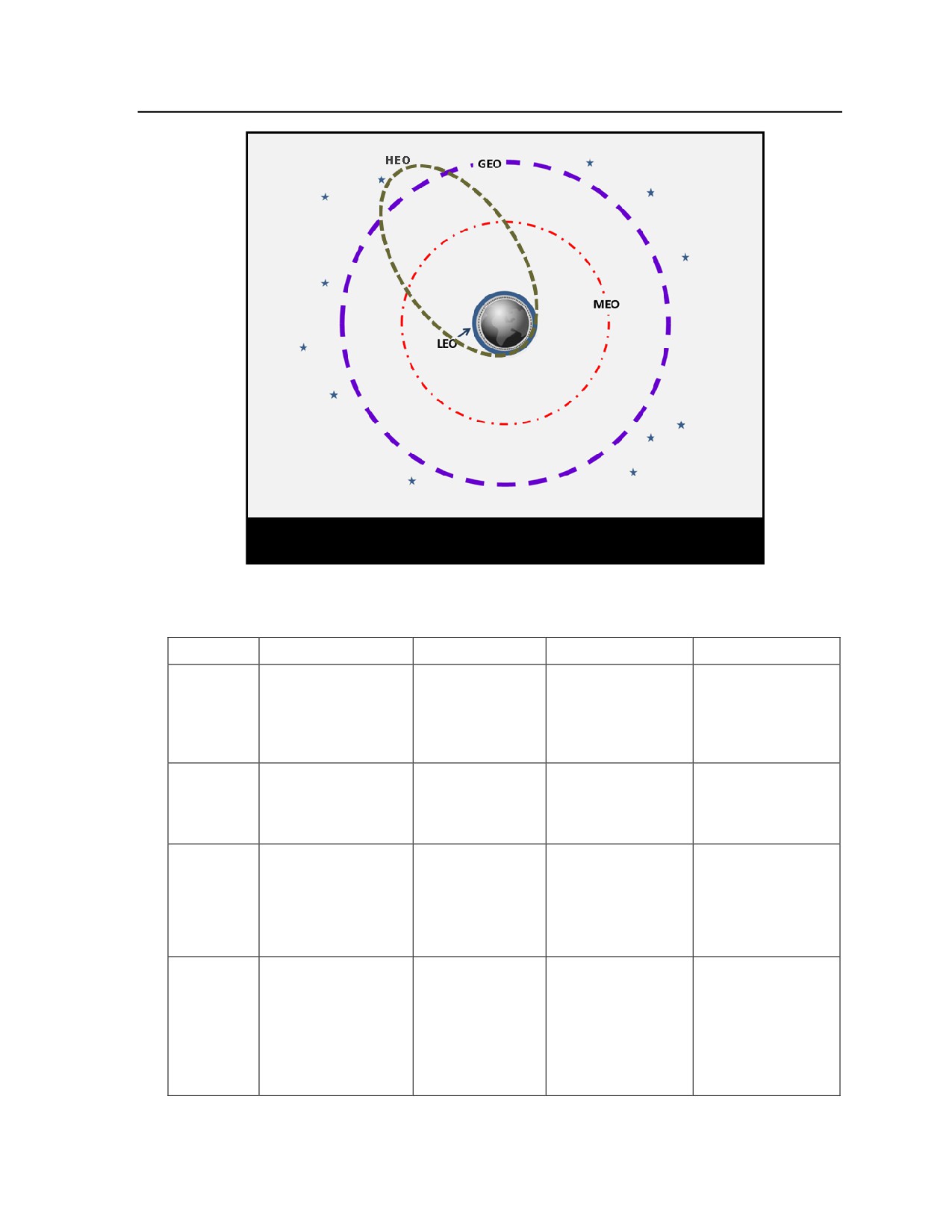
Army Space Operations
Figure 1-1: Illustration of basic Earth orbits
Table 1-1. Characteristics of satellite orbit types
Type
Description
Advantages
Disadvantages
Uses
Low Earth
• Roughly circular
• Near Earth - high
• Small coverage
• Surveillance
Orbit
resolution and
area over Earth
•
Up to ~1,000 miles
• Reconnaissance
signal strength
surface
above Earth’s
• Weather collection
surface
• Limited time over
• Manned space
Earth’s surface
Medium
• Roughly circular
• Stable orbit
• Highest radiation
• Position,
Earth Orbit
level environment
navigation, and
• Between ~1,000-
• Less signal
22,000 miles above
latency
timing
Earth’s surface
• Communication
Geo-
• Roughly circular
• Continuous
• Far from Earth -
• Communication
synchronous
coverage over
resolution and
• ~23,000 miles above
• Surveillance
Earth Orbit
specific area
signal limitations
Earth’s surface
• Reconnaissance
• Coverage nearly
• Easier to jam
• Weather collection
hemispheric
• Signal latency
• Missile warning
Highly
• Oval shaped
• Long dwell time
• Continuous
• Communication
Elliptical
over a large area
coverage requires
• ~ 600 miles at
over high North or
Orbit
multiple satellites
South latitudes
perigee (closest to
• Coverage of high
Earth)
North or South
• Scientific
latitudes
• ~24,000 miles at
• Surveillance
apogee (farthest
• Reconnaissance
from Earth)
28 November 2017
FM 3-14, C1
1-9
Chapter 1
1-42. A related limitation is predictability. The position of satellites in low Earth orbit can be accurately
predicted; therefore, predictions of satellite locations based on current orbit characteristics can be made
weeks in advance. This predictability makes space-based information collection susceptible to camouflage,
denial, and deception. Space operator can use this information to their benefits when dealing with enemy
capabilities, and not considering its limitation could lead to unanticipated results. In addition to these
limitations, information collection spacecraft are high-demand, low-density assets and cannot satisfy all
information requests. It is the responsibility of space professionals to ensure this information is known by
the staff during mission planning.
1-43. In-place orbiting space assets are quite responsive to the operating forces’ needs. However, if the
assets are not in place before the conflict or operation begins, it is unlikely more assets will become
available within the time required to support the operations. It often takes weeks to move satellites from
one orbital location to another, and this movement can deplete limited propellant and shorten the satellite’s
operational life. Propellant expenditure rates directly impact satellite life expectancy. When propellant is
used for significant orbital changes or maneuvers, it is no longer available for station keeping, resulting in
decreased mission life. Moving satellites can also affect several theaters’ access to the limited resource.
Currently, launching new satellites can take years and the additional months required for on-orbit checkout
makes launching new satellites to augment a theater impractical for short-term needs.
1-44. When a satellite is tasked to provide data, whether its purpose is to update PNT, collect information,
or provide communications, a task command is sent to the appropriate asset through a ground station. Once
the task is processed, data is disseminated through a variety of means, dependent on the sensor employed,
support architecture, and required product. The three methods include direct downlink, theater downlink,
and reachback. Table 1-2 provides an overview of the three different methods
and some common
characteristics.
Table 1-2. Methods of dissemination
Method
Description
Advantages
Disadvantages
Use
Direct
Spacecraft collects data,
• Near real time
• Limited ability
• Position,
downlink
for intended
navigation, and
uses onboard
• Limited ability for
processing, and
users to
timing
adversaries to
immediately
manipulate raw
manipulate raw
• Missile warning
disseminates
data
data
• Beyond line of
information in near real
sight
time to multiple
communication
terrestrial receivers.
Theater
Aircraft like the Joint
• Timely
• Requires
• COP
downlink
Surveillance Target
additional
• Near-continuous
• FFT
Attack Radar System
access
spacecraft
• Non-line of
disseminates
• Reduced ability
• Higher bandwidth
sight
information in near real
to manipulate
communication
time to ground station or
raw data
satellite with the sole
• Multiple hops
duty of relaying data to
designated receivers.
Reachback
Data is transmitted to a
• Data processing is
• Not as timely
• COP
consolidated mission
consolidated
• Multiple hops
• FFT
station where it is
• Users receive
• Operational and
• Battle damage
processed and
finished product
tactical sites with
assessment
disseminated to the
limited
• Imagery
forward users.
bandwidth
COP - common operational picture
FFT - friendly force tracking
1-10
FM 3-14, C1
28 November 2017
Army Space Operations
COMMERCIAL IMAGERY
1-45. Unclassified commercial satellite imagery is used by U.S. forces, other government agencies, and
multinational partners in the combatant commander’s area of responsibility to enhance knowledge of the
environment within the operational area. Soldiers with commercial imagery requirements should initially
contact and utilize their command elements in place such as Expeditionary Military Intelligence Brigade,
Geospatial Production Cell, unit intelligence staff officer (commonly referred to as S-2) or assistant chief of
staff for intelligence
(G-2). Soldiers should also be mindful of operations security when describing
requirements and mission needs to their command elements as well as the Army Geospatial Center and
mission partners. Users that do not have access to Joint Worldwide Intelligence Communications System,
or the local geospatial unit, can contact the Army Geospatial Center Imagery Office via email at dll-agc-
aio@usace.army.mil.
Note: For specific details on commercial imagery requirements see ATP 2-22.7, Geospatial
Intelligence.
1-46. Army Geospatial Center Imagery Office provides expertise on the National System for
geointelligence tasking, collection, processing, exploitation, and dissemination cycle, most specifically
through fulfillment of collection management services for users requiring new commercial imagery
collections or unfunded/unlicensed archived imagery requirements. The Army Geospatial Center Imagery
Office collaborates directly with the Army Departmental Requirements Office, National Geospatial-
Intelligence Agency Source Directorate & National Geospatial-Intelligence Agency St. Louis, the United
States Geological Survey and various commercial satellite/aerial digital imagery vendors to provide
requested imagery availability information, data acquisition, data processing, and administrative
coordination. Additional Army Geospatial Center Imagery Office services include an online repository of
selected commercial imagery pertaining to terrain & urban analysis and water resources operations, and
assistance to users with existing commercial imagery research, acquisition, and dissemination needs if they
do not have access to NGA resources.
1-47. Commercial imagery provides direct support for DSCA. The ARSSTs and Army space coordination
elements (ASCE) rely on unclassified commercial space imagery for a wide variety of reasons during
planning and real-time operations. ARSSTs and ASCEs may receive unclassified commercial imagery
using direct downlink capabilities that are available to deployed Soldiers.
TACTICAL EXPLOITATION OF NATIONAL CAPABILITY
1-48. Army Tactical Exploitation of National Capabilities (TENCAP) program delivers unique capability
as the Army’s lead activity to influence, leverage, and integrate the national intelligence enterprise to
benefit the Army through the space-enabled capabilities.
1-49. Army TENCAP evolved from a U.S. Army recognition that national overhead systems developed
for the National Command Authorities had potential to support Army forces with space-enabled
capabilities at the tactical level. Throughout the early and mid-1970s the Army explored the tactical
applicability of national systems to corps level operations and began developing and fielding tools needed
to leverage those systems. The office created to do this, under the auspices of the Deputy Chief of Staff for
Operations (now the Army assistant chief of staff, operations), became the U.S. Army TENCAP Program
by Army Chief of Staff Directive in May 1975.
1-50. The Army's TENCAP Program is managed by Program Executive Office for Intelligence, Electronic
Warfare, and Sensors and is directed by a general officer steering group chaired by the Assistant Secretary
of the Army for Acquisition, Logistics, and Technology, Military Deputy, Army G-2, and Army G-8.
Selected Department of the Army headquarters principal staff, the Army Capabilities Integration Center,
and the Intelligence Center of Excellence round-out a general officer steering group membership.
1-51. The TENCAP mission is fivefold:
z
Conduct cross-agency systems engineering to leverage national capabilities for Army purposes;
28 November 2017
FM 3-14, C1
1-11
Chapter 1
z
Understand and influence National technologies and architectures;
z
Provide core engineering expertise across the national and theater intelligence, surveillance, and
reconnaissance (ISR) layers to integrate national capabilities within Army space, terrestrial, and
foundation layers;
z
Be the Army’s technical interface to the National Reconnaissance Office; and
z
Leverage the Intelligence Community’s investment in overhead technologies, and transition
applicable technologies to the Army to satisfy validated Army requirements.
Note: For specific details see the Joint Tactical Exploitation of National Systems Manual.
THE OPERATIONAL ENVIRONMENT
1-52. An operational environment is a composite of the conditions, circumstances, and influences that
affect the employment of capabilities and bear on the decisions of the commander (JP 3-0). An operational
environment includes physical areas
(air, land, maritime, and space domains) and the information
environment, which includes the cyberspace domain. An operational environment for any specific
operation not only includes isolated conditions of interacting variables that exist within a specific area of
operations, but also interconnected influences from a global or regional perspective, such as the political
and economic influences that impact conditions and operations.
Note. The operational environment in which a unit conducts operations should not be confused
with training environments created by the commander for local training.
1-53. Analysis of the broad aspects of the space operational environment in terms of the operational
variables provides relevant information that senior commanders use to understand, visualize, and describe
the operational environment. The operational variables are political, military, economic, social,
information, infrastructure, physical environment, and time. Upon receipt of a warning order or mission,
Army commanders filter relevant information and narrow their focus to six mission variables. The mission
variables are mission, enemy, terrain and weather, troops and support available, time available, and civil
considerations. These variables are used by space operators during analysis and to facilitate understanding.
(See ADRP 3-0).
DENIED, DEGRADED, AND DISRUPTED SPACE OPERATIONAL ENVIRONMENT
1-54. Army and joint operations are dependent on space-based capabilities delivered to the other domains
via the electromagnetic spectrum. The threat to Army and joint operations from a contested operational
environment may create vulnerabilities which makes contesting space capabilities attractive to adversaries
and enemies. Army space operations must remain responsive and flexible to commanders’ needs and stay
agile in response to adversary and enemy efforts to place joint forces in a contested operational
environment.
1-55. Army forces must be prepared to conduct operations in a contested operational environment. Denied,
degraded, and disrupted space operational environment is a composite of those conditions and influences
in which space-enabled capabilities have been impaired by hostile threats or non-hostile means.
Adversaries may attempt to create one or multiple effects against U.S. and allied forces. The use of denied,
degraded, and disrupted are consistent with JP 3-14. For the purpose of this document, the use of these
terms are clarified as denied—temporary total elimination of the use of space capabilities, effects, or
associated linkages; degraded—permanent impairment
(either partial or total) of the use of space
capabilities, effects, or associated linkages usually with physical damage; or disrupted—a temporary
impairment that weakens or diminishes the use of space capabilities, effects, or associated linkages upon
which the Army, joint forces, and allies depend. D3SOE includes both threats and hazards.
z
A threat is a fundamental part of an overall operational environment for any operation. A threat
is any combination of actors, entities, or forces that have the capability and intent to harm
1-12
FM 3-14, C1
28 November 2017
Army Space Operations
United States forces, United States national interests, or the homeland (ADRP 3-0). Threats may
include individuals, groups of individuals (organized or not organized), paramilitary or military
forces, nation-states, or national alliances and their actions. A threat may cause a D3SOE by
attacking a physical asset or using electromagnetic interference.
z
A hazard is a condition with the potential to cause injury, illness, or death of personnel; damage
to or loss of equipment or property; or mission degradation (JP 3-33). Hazards are not strictly
viewed as threats. They are usually predictable and preventable, and may be reduced through
effective risk management efforts. Natural phenomena may create hazardous conditions which
cause damage, destroy life and vital resources, or prevent mission accomplishment. Naturally
occurring environmental factors are hazards which may negatively impact the electromagnetic
spectrum and must be considered during the planning process.
1-56. D3SOE applies to physical assets and electromagnetic interference which may impair space-enabled
capabilities. D3SOE focuses on identifying adversaries’ actions to deny, degrade, or disrupt U.S. and allied
space capabilities, effects, or associated linkages necessary to protect against those actions. Some threats
which may contribute to a D3SOE include physical damage; signal jamming; signal spoofing; electronic
interference with space-related assets, ground control nodes, control link, or on-orbit segments; and
disabling or deceiving user equipment. The most likely risk to the tactical Army is signal jamming and
spoofing directed against the ground user SATCOM and PNT linkages.
1-57. D3SOE is the Army space operations portion of the larger contested electromagnetic spectrum
environment and the area which Army space forces operate. A contested operational environment may
affect operations in any one, any combination, or all five domains, and may impact active and passive
measures. A contested environment applies to a wide variety of operations, including, but not limited to
space operations, cyberspace, electronic warfare, ballistic missile warning, space and terrestrial weather,
lethal and non-lethal fires, and many intelligence disciplines such as signals, geospatial, measurement and
signature, and technical intelligence. Operating within a contested environment has the potential to severely
impact operations in the mission command, movement and maneuver, fires, intelligence, sustainment, and
protection warfighting functions. Army unit are dependent upon the electromagnetic spectrum for mission
operations. Mission critical systems operate in the radio, microwave, infrared, ultraviolet, and x-ray
portions of the spectrum.
1-58. Commanders and staffs must understand how current and potential threats and hazards affect their
forces. Threats and hazards must be analyzed during the initial planning phase. They must be continually
identified, monitored, assessed, and revised to identify vulnerabilities throughout mission operations as
they adapt and change over time. It helps the commander visualize potential impacts on operations when
they understand both threats and hazards.
1-59. Adversaries are constantly seeking ways to create D3SOE effects and use them to their advantage.
The threat to Army and joint operations from D3SOE may create vulnerabilities which may make
electromagnetic interference or physical attack against space capabilities look attractive to adversaries. The
U.S. Army depends on Soldiers to understand unit equipment, capabilities, limitations, and tactics,
techniques, and procedures to fight through a D3SOE. Army space capabilities and effects contribute to
successful unified land operations.
28 November 2017
FM 3-14, C1
1-13
This page intentionally left blank.
Chapter 2
Mission Command of Space Forces
“The Army ‘requires access to space capabilities to exercise effective mission command
and support combatant commanders.’ ”
The U.S. Army Capstone Concept
19 December 2012
The Army is committed to the effective employment of all available space-related
resources as space offers unique advantages so great, it is clearly worthwhile to overcome
the characteristic difficulties of the space environment. Mission command of space forces
and assets must be thoroughly defined, understood, and well coordinated to maximize
space resource utilization. Refer to JP 3-14, Space Operations for more information.
ARMY-JOINT SPACE OPERATIONS RELATIONSHIPS
2-1. JP 3-14 lays the foundation of joint space doctrine by establishing principles for the integrated
employment of space capabilities. It also recognizes the Service components have both common and
distinct space missions. Each Service component contributes to an integrated whole that is synchronized by
the joint force headquarters. Space forces both employ principles of joint operations and enable the
application of the principles of joint operations by other joint forces. All Army space operations flow from
and support the joint force commanders campaign plan. Army space operations support joint force missions
and receive support from Service and other joint force, government, civil, and commercial space assets.
Based on unit mission, space operations are integrated throughout the land component forces and other
components of the joint force to maximize the space contribution to the joint fight (see JP 3-14, ADP 3-0).
2-2. Common responsibilities of each of the Service components are advocating for space requirements
within their respective Services; providing a single service point of contact for access to Service resources
and capabilities; making recommendations to Commander, USSTRATCOM on appropriate employment of
Service forces; providing assigned space forces to Commander, USSTRATCOM and combatant
commanders as directed; assisting in planning in support of space operations and assigned tasking; and
supporting Commander, USSTRATCOM and other combatant commanders with space mission area
expertise and advocacy of desired capabilities as requested.
2-3. Service components have distinctly unique roles to play in providing space capabilities. The space-
specific, distinctly Army roles are identified in JP 3-14, but are summarized below:
z
Conduct space operations and provides planning, integration, control and coordination of Army
forces and capabilities in support of USSTRATCOM missions;
z
Provides friendly force tracking (FFT);
Provide ballistic missile warning from deployed joint tactical ground station (JTAGS);
z
Provide space expertise with ARSSTs;
z
Conduct SATCOM planning by regional satellite communications support centers (RSSC);
z
Conduct communication transmissions and satellite payload control of the wideband satellite
constellations, and support to SSA; and
z
Designated by Commander, USSTRATCOM as the consolidated SATCOM system expert for
wideband, military ultrahigh frequency (UHF), and the specific SATCOM system expert for the
Wideband Global Satellite Communications (WGS), the Global Broadcast Service, and Mobile
Users Objective System.
19 August 2014
FM 3-14
2-1
Chapter 2
2-4. In the case of USASMDC/ARSTRAT, in its role as the Army Service component command to
USSTRATCOM as directed by the Forces For Unified Commands section of the Global Force
Management Implementation Guidance, or when requested by a combatant commander and validated by
the Joint Staff and USSTRATCOM, USASMDC/ARSTRAT provides space forces through the 1st Space
Brigade (further detail is provided in Chapter
6). As a member of the Army’s National-to-Theater
geospatial intelligence federation, USASMDC/ARSTRAT’s G-2, geospatial intelligence division is tasked
by the Army G-2 to provide full-spectrum geospatial intelligence support to USSTRATCOM, United States
Northern Command, and United States Transportation Command. Additionally, it also provides overhead
persistent infrared (OPIR) analysis support to United States European Command and United States Africa
Command. The Army provides space capabilities to the modular force through the space support element
(SSE) organic to army, corps, division, special forces groups, fires brigade, and other organizations with
emerging requirements. The Army also provides space capabilities that do not require deployed teams.
These are detailed in chapter six and seven.
USSTRATCOM
2-5. The Unified Command Plan establishes USSTRATCOM as the functional unified command with
overall responsibility for military space operations. Joint functional component command (JFCC) for Space
(JFCC SPACE) is a component of USSTRATCOM and is the focal point for military space operations and
is responsible for executing day-to-day, integrated space operations to deliver theater and global effects in
support of national and combatant commander objectives. JFCC SPACE coordinates space operational-
level planning, integration, and coordination to ensure unity of effort in support of military and national
security operations and support to civil authorities. Commander, JFCC SPACE executes space operation
taskings through the Joint Space Operations Center. Army space teams and elements use coordinate on a
daily basis with JFCC SPACE.
2-6. Commander, USSTRATCOM has operational authority for all SATCOM on-orbit assets, control
systems, and SATCOM terminal infrastructure. Commander, JFCC SPACE, as the supported commander
for SATCOM, performs functions and activities of the SATCOM operational manager, including oversight,
management, and control of SATCOM resources. USSTRATCOM has delegated day-to-day operation of
DOD-owned SATCOM resources to Commander, JFCC SPACE and or the applicable SATCOM system
experts assigned by USSTRATCOM to provide authorized users with global SATCOM support for
operations and evolving requirements.
SPACE COORDINATING AUTHORITY
2-7. The space coordinating authority (SCA) is a commander or individual assigned responsibility for
planning, integrating, and coordinating space operations support in the operational area. The SCA will
coordinate space support of established objectives and act on behalf of the combatant commander, if
designated, with primary responsibility for joint space operations planning. SCA is not a person, but rather
an authority imparted upon a commander or individual to coordinate space efforts within the area of
responsibility. Based on the complexity and scope of operations, the joint force commander can either
remain SCA or designate a component commander, or other individual, as the SCA. The commander with
SCA is responsible for coordinating joint space operations and integrating space capabilities in an
operational area. The joint force commander may retain responsibility as the SCA or may designate a
component commander as the SCA. The joint force commander may consider a variety of variables to
include, but not limited to, the mission, nature, and space force capabilities when selecting to remain or
delegate SCA, and to whom to delegate this authority.
The SCA has primary responsibility for joint space operations planning, to include
ascertaining space requirements within the joint force. The SCA gathers operational
requirements that may be satisfied by space capabilities and facilitates the use of
established processes by joint force staffs to plan and conduct space operations.
2-2
FM 3-14
19 August 2014
Mission Command of Space Forces
A supported joint force commander (when delegated space coordinating authority from
the Geographic Combatant Commander) integrates space capabilities and coordinates
joint space operations in the operational area.
JP 3-14
2-8. The commander or individual with SCA gathers operational requirements that may be satisfied by
space capabilities and facilitates the use of established processes by joint force staffs to plan and conduct
space operations. The commander or individual with SCA’s roles and responsibilities include:
z
Coordinating, integrating, and synchronizing space capabilities in the operational area;
z
Planning space operations;
z
Maintaining SSA of theater space operations, and coordinating with the individual with
combatant command SCA or Commander, JFCC SPACE to integrate theater space operations
into global space operations; and
z
Providing consolidated space requirements through the joint force commander for coordination.
2-9. If SCA is not delegated to the Army, the joint force land component commander SSE advocates for
land component space forces and space support. In this case, it is entirely appropriate for the Army Service
component command SSE to provide an officer to augment the organization with SCA as part of a joint
manning document.
SPACE COORDINATION IN A JOINT ENVIRONMENT
2-10. JP 3-14 outlines general strategic and operational situations for joint space operations. Due to the
nature of space resources, changes to satellite tasking to support one theater can affect other theaters.
Therefore, day-to-day mission command and satellite control is accomplished from a strategic perspective.
Commander, USSTRATCOM is responsible for conducting joint space operations, and coordinating and
conducting space planning through the joint planning process in support of the national military strategy.
USSTRATCOM assigns appropriate command relationships for space operations to the component
commanders; components maintain this strategic perspective in their space planning and operations.
Commander, USSTRATCOM ensures coordination and integration from the global perspective, and
together with the SCA, ensures space activities are coordinated, deconflicted, integrated, and synchronized
at the theater level.
2-11. In joint operations, the joint force commander may designate a commander or individual with SCA
and delegate to the SCA appropriate responsibility to conduct space planning, integrate space capabilities,
and coordinate joint space operations within the operational area, to include ascertaining space
requirements within the joint force. It is important to limit the possibility of interference or redundancy
between various space operations, and to deconflict space activities. The joint force commander may retain
SCA or designate a component commander with SCA. The joint force commander considers the mission,
nature, and duration of the operation; preponderance of space force capabilities made available; and
resident command and control capabilities (including reachback) in selecting the appropriate option.
2-12. The commander, Air Force forces, is the Service component commander for Air Force space forces.
The functional component commander is usually the joint force air component commander in-theater. The
joint force commander normally delegates SCA to the joint force air component commander to coordinate
joint space operations and integrate theater and global space capabilities and effects. The commander, Air
Force forces is normally dual-hatted as the joint force air component commander. The commander, Air
Force forces and joint force air component commander are well suited to coordinate space operations
because of their ability to exercise control of space forces, theater-wide perspective, and expertise on staff.
2-13. The joint force land component commander may be delegated SCA at the discretion of the joint
force commander. This is most likely to happen if the Army has the preponderance of space capabilities in
theater or otherwise has sufficient expertise available to justify joint force commander confidence, and has
adequate mission command to fully coordinate space issues. The nature and duration of the overall mission
are also factors when assigning SCA to a commander. If joint force land component commander is
19 August 2014
FM 3-14
2-3
Chapter 2
designated with SCA, that headquarters should request appropriate Army, Joint, and Service space
augmentation in order to perform the functions required to support the execution of SCA. The commander
with SCA consolidates joint force commander component space requirements and issues, and coordinates
implementation through joint force commander to USSTRATCOM. When delegated SCA, the joint force
land component commander may exercise direct liaison with other Service space components if authorized.
DIRECTOR OF SPACE FORCES
2-14. A director of space forces (DIRSPACEFOR) is assigned to the commander, Air Force forces staff
and serves as the senior space advisor to integrate space capabilities and effects. If the commander, Air
Force forces or joint force air component commander is delegated SCA, the DIRSPACEFOR will normally
execute SCA responsibilities on behalf of the commander, Air Force forces or joint force air component
commander. While each combatant commander may have a DIRSPACEFOR, United States Central
Command is the only combatant commander with a standing DIRSPACEFOR with a formal agreement to
utilize an Army functional area 40 (FA40) space professional as the Deputy DIRSPACEFOR. When an
Army FA40 is serving as the United States Central Command Deputy DIRSPACEFOR, the individual is
assigned to USASMDC/ARSTRAT with duty at Air Force Central Command.
2-15. The DIRSPACEFOR is responsible for:
z
Integration of space force enhancement, space control operations, and planning in joint
operations on behalf of the combined force air component commander when acting as SCA;
z
Oversee day-to-day functions of the DIRSPACEFOR staff and accomplish assigned duties of
SCA;
z
Provide the combined force air component commander and key staff counsel and training in
space operations;
z
Assist with planning and executing theater space operations and applying space capabilities
throughout the joint targeting cycle;
z
Assist in coordinating tailored space support for operations throughout the area of
responsibility;
z
Work directly for the combined force air component commander as special staff providing
advice on space capabilities and employment;
z
Ensure continuity of operations, focus, operational stability, and unity of command with
multiple rotations of joint space personnel across the area of responsibility;
z
Conduct deliberate planning for contingency operations and exercises, and validate process;
z
Provide reachback support for all forward deployed space forces from all Services in area of
responsibility;
z
Interact with multiservice space professionals within the combined air and space operations
center; and
z
Provide insight and participate in special technical operations planning, as required.
2-16. During larger standing operations and in crisis planning and execution, the theater SCA function is
supported with appropriate manning for staff support based upon the nature of the pending contingency.
The manpower and expertise requirements will be reflected in the final approved joint manning document
for that headquarters along with an identification of a responsible Service to fill the position. In most cases
where the SCA is delegated to the Commander, Air Force forces with an assigned DIRSPACEFOR to
support those functions, the Deputy DIRSPACEFOR is normally sourced as an Army space officer, as
established in operations. An Army Deputy DIRSPACEFOR supports all the joint functions of the
DIRSPACEFOR, can represent specific land component space-related needs and issues to the theater SCA
for resolution. An Army Deputy DIRSPACEFOR also acts as an intermediary between DIRSPACEFOR
staff and Army SSEs, ARSSTs, ASCE, JTAGS detachments, space situational awareness planning teams
(SSAPT), and space control detachments.
2-4
FM 3-14
19 August 2014
Mission Command of Space Forces
USASMDC/ARSTRAT
2-17. The mission of USASMDC/ARSTRAT is to conduct space and missile defense operations and
provide planning, integration, control, and coordination of Army forces and capabilities in support of
USSTRATCOM missions; serve as the Army specified proponent for space, high altitude, and ground-
based midcourse defense; and conduct mission-related research and development in support of Army Title
10 responsibilities.
2-18. Per AR 10-87, Army Commands, Army Service Component Commands, and Direct Reporting Units
USASMDC/ARSTRAT is an operational level Army force designated by the Secretary of the Army as
Army Service component command to USSTRATCOM. USASMDC/ARSTRAT exercises administrative
control authority and responsibilities on behalf of the Secretary of the Army over Army forces assigned to
USSTRATCOM and operational control over forces delegated by Commander, USSTRATCOM.
2-19. Per AR
5-22, The Army Force Modernization Proponent System, USASMDC/ARSTRAT is
designated as the force modernization proponents for space. The Army force modernization proponent
system is the process of managing change within the Army. It is the strategic-level process for interaction
between the Department of the Army and force modernization proponents used to transform the Army.
Proponent responsibilities are defined below:
z
Execute force management responsibilities which include doctrine, organization, training,
materiel, leadership and education, personnel, and facilities (DOTMLPF) and policy changes for
their particular function or branch.
z
Ensure DOTMLPF actions are coordinated with Army commands, Army Service component
commands, direct reporting units, field operating agencies, headquarter Department of the Army
staff, and others, as required.
2-20. USASMDC/ARSTRAT, as the Army Service component commander to USSTRATCOM, is the
Army space force provider for combatant commanders. They execute mission command for
USASMDC/ARSTRAT space forces that are not operational control or tactical control to combatant
commander organizations. USASMDC/ARSTRAT provides existing and emerging Army space
capabilities to U.S. forces and allies to deliver decisive combat power on the area of operations.
USASMDC/ARSTRAT plans and executes continuous military space operations and sustains assigned
units supporting USSTRATCOM (see figure 2-1 on page 2-6). USASMDC/ARSTRAT supports all
USSTRATCOM space-related operational mission areas and is the focal point for the employment and
integration of USASMDC/ARSTRAT space forces into global, national, and military operations.
USASMDC/ARSTRAT supports Army and USSTRATCOM policies, objectives, and land component
commander operation plans.
2-21. The Commander, USASMDC/ARSTRAT, serves as the Army integrator for global missile defense
systems, and commands USASMDC/ARSTRAT. The Commander, USASMDC/ARSTRAT also
commands JFCC for Integrated missile defense because of the roles and responsibilities as the Army
specified proponent for ground-based midcourse defense system.
2-22. The Commander, USASMDC/ARSTRAT is also the personnel developer for FA40s per AR 600-3,
The Army Personnel Development System, and serves as the Army focal point and lead agent for
implementation of Army space cadre efforts; these functions are executed by the Army Space Personnel
Development Office.
19 August 2014
FM 3-14
2-5
Chapter 2
Figure 2-1. USASMDC/ARSTRAT operating forces
ARMY SPACE CADRE
2-23. The Army has been involved in space-related operations for over five decades with Army signal
corps Soldiers involved in SATCOM and military intelligence involved with space-based systems. While
those activities certainly continue, the Army space cadre is directly involved in space operations in support
of Army operations throughout DOD, joint, and Service space activities. Since the beginning of the 21st
century, Army space operations have grown to include all aspects of space operations that support the
Army core competencies, all warfighting functions, and operations. In the Secretary of Defense
Memorandum titled National Security Space Management and Organization, 18 October
2001, the
Secretary of Defense directed the Army to develop “a cadre of space qualified professionals comprised of
military and civilian personnel in sufficient quantities to represent their military departments and DOD
agency’s interests in space requirements, acquisition, and operations.” DODD 3100.16, DOD Management
of Space Professional Development. Describes the processes for managing space professional development.
2-24. Army space operations are founded on the depth and breadth of knowledge of the Army space
operations officer. The Army space cadre is comprised of Soldiers and Army civilians identified as either
space professionals or space enablers. Space professionals are military and civilian career space specialists,
whose principal duties include planning, developing, resourcing, acquiring, integrating, or operating space
forces, concepts, applications, or capabilities in accordance with DODD 3100.10 and JP 3-14. Space
enablers are military and civilian career space specialists assigned to positions whose primary career field is
not space, but who perform unique tasks or require skills to apply space capabilities. Space enabler
positions may be in operations, such as ARSST, ASCE, SSA, and JTAGS operators, or they may be
support staff such as command staff members, USASMDC/ARSTRAT operations center, FFT mission
management center (MMC) members, and designated Battle-lab Soldiers and civilians. Additionally, some
signal, military intelligence, and logistic positions are also designated as space enablers.
2-25. Army space operations are conducted by knowledgeable, well educated Army space cadre. Army
space operations officers are designated from nearly every branch within the Army. This experience gives
the FA40 community a broad level of understanding of Army operations. Every FA40 is educated to bring
detailed knowledge of all aspects of space operations to military operations, including SSA, Space Control,
information collection, early warning, environmental monitoring, SATCOM, PNT, and electromagnetic
interference.
2-26. Army space cadre professionals support Army and joint space operations across all space mission
areas. Refer to chapter 3 for definitions and overview of the five space mission areas.
2-6
FM 3-14
19 August 2014
Mission Command of Space Forces
ARMY, CORPS, AND DIVISION SPACE STAFF
2-27. Theater Armies, field armies, corps, and divisions headquarters have organic SSE for planning,
integration, coordination of space capabilities, and to conduct mission command of space forces. The
Army, corps, and division movement and maneuver cells have SSEs comprised of FA40 space operations
officers. In special forces groups and fires brigades, a single FA40 officer is assigned to the operations staff
officer.
2-28. The primary function of the SSE is to synchronize space mission area activities throughout the
operations process using effective mission command to maximizing the positive impact of space-based
capabilities for the commanders needs. The SSE is responsible for maintaining SSA and updating the space
protion of the common operational picture (COP). SSE members coordinate space operations objectives
and tasks with their counterparts at higher and lower echelons. The SSE serves as the primary mission
command element within the staffs for space operations. They may also work alternative compensatory
control measures and special technical operations, as directed.
COORDINATION OF ARMY SPACE OPERATIONS
2-29. The corps may serve as the warfighting headquarters in the role of a joint task force or land
component to a joint task force. The corps serving as a joint task force is the focal point for the planning
and execution of space operations. The joint task force coordinates with the theater commander having
SCA, which is commonly the joint force air component commander. The theater army will normally be
responsible for the Title 10 role of providing trained and ready land forces to the combatant commander as
well as the executor of reception, staging, onward movement, and integration of land forces for a theater
commander. Figure 2-2 on page 2-8 depicts these mission command relationships at a high level. In certain
short-term contingency situations, the Army Service component command staff can deploy a contingency
command post, which serves as a joint task force until either the short-term contingency ends or a follow-
on headquarters takes over. Divisions may serve as subordinate headquarters to the joint task force
headquarters if the scale and scope of the mission allows, or as subordinate headquarters to the joint task
force and execute mission command over brigade combat teams and functional brigades, such as fires,
sustainment, and surveillance brigades.
2-30. Army space forces are normally provided to Commander, USSTRATCOM via
USASMDC/ARSTRAT.
2-31. The joint force commander may request an ASCE to provide Army space operations expertise via a
request for forces. Upon validation of the request for forces, a Chairman of the Joint Chiefs of Staff
deployment execution order will be sent to USSTRATCOM. USSTRATCOM may task
USASMDC/ARSTRAT to provide the forces. If tasked, the Commander, USASMDC/ARSTRAT will
designate an ASCE to provide Army space operations expertise and coordination support to the battlefield
coordination detachment staff. The ASCE is discussed in greater detail in chapter 6.
2-32. If an ASCE is requested, then the ASCE may perform the following functions:
z
Provides Army space representation and support to the commander with SCA;
z
Assists the SSEs in ensuring Army space equities are recognized and incorporated into joint
space operations;
z
Assists in the joint space planning process and development of the space priorities; and
z
Coordinates space operations through the Army battlefield coordination detachment.
19 August 2014
FM 3-14
2-7
Chapter 2
Figure 2-2. Army space coordination relationships to Coalition & Joint Task Force
2-33. The USASMDC/ARSTRAT operations center provides the USASMDC/ARSTRAT commander the
means to communicate and execute mission command of USASMDC/ARSTRAT space and missile
defense assets. It provides command situational awareness and maintains command asset operational status.
The USASMDC/ARSTRAT operations center provides around-the-clock reachback for space operations
officers and deployed space assets.
2-8
FM 3-14
19 August 2014
Chapter 3
Space Mission Areas and Army Warfighting Functions
“Fully integrated
[space] capabilities will provide depth, persistence, and reach
capabilities for commanders at the strategic, operational, and tactical levels. Assured
space systems and well-trained and experienced space professionals significantly reduce
the fog, friction, and uncertainty of warfare.”
Lieutenant General (retired) Richard B. Formica
former Commander, USASMDC/ARSTRAT
Senate Armed Services Committee Statement
11 May 2011
Global power brings global responsibilities to our nation and the Army. Among the
Army’s array of formidable capabilities designed to fulfill those responsibilities is its
global space reach, with space-related assets and operations that surround the world. The
framework used to organize the many space functions are the space mission areas. The
Army categorizes space missions into five primary mission areas consistent with JP 3-14.
SECTION I - SPACE MISSION AREAS OVERVIEW
3-1. Space operations are categorized into the five space mission areas of SSA, space control, space force
enhancement, space support, and space force application. SSA is a key component for space operations
because it builds the foundation for accomplishing all other space mission areas as graphically illustrated in
figure 3-1 on page 3-2. The definitions of the five space mission areas are included in JP 3-14, but are
summarized below.
z
SSA is the requisite current and predictive knowledge of the space environment and the
operational environment upon which space operations depend. SSA involves characterizing, as
completely as necessary, the space capabilities operating within the terrestrial environment and
the space domain. SSA is fundamental to conducting space operations.
z
Space control consists of offensive space control and defensive space control and supports
freedom of action in space for friendly forces, and when necessary, defeats adversary efforts
that interfere with or attack U.S. or allied space systems and negates adversary space
capabilities.
z
Space force enhancement operations increase joint force effectiveness by increasing the combat
potential of that force, enhancing operational awareness, and providing critical joint force
support. Space force enhancement is composed of ISR, missile warning, environmental
monitoring, SATCOM, and PNT.
z
The space support mission area includes the essential capabilities, functions, activities, and tasks
necessary to operate and sustain all elements of space forces throughout the range of military
operations. It is composed of spacelift, satellite operations, and reconstitution of space forces.
z
Space force application is combat operations in, through, and from space to influence the course
and outcome of conflict by holding terrestrial targets at risk. This mission area includes ballistic
missile defense and force projection capabilities such as intercontinental ballistic missiles. The
space force application mission area is codified into national space policy.
19 August 2014
FM 3-14
3-1

Chapter 3
Figure 3-1. Space mission areas and relationship
SPACE SITUATIONAL AWARENESS
3-2. SSA is fundamental to conducting space operations because it is the foundation for all other space
mission areas as it involves characterizing space capabilities, operating within the land domain and space
domain, and integrating analysis of information collections that contribute to the joint force commanders
ability to understand enemy intent. The four functional capabilities of SSA are: detect, track, identify;
threat warning and assessment; characterization; and data integration and exploitation. SSA involves
characterization, analysis, and prediction, as completely as necessary, of the space capabilities operating
within the space domain, land domain, and natural phenomena.
3-3. SSA requires in-depth knowledge of the space domain, understanding of the operational
environment, intelligence on all non U.S. space systems, correlation of effects to the cause, and proper
distribution and sharing of SSA information. Processes for distributing, sharing, and integrating SSA are
described in the USSTRATCOM Strategic Instruction (SI) 534-03, Sharing Space Situational Awareness
Information. SSA supports these four key objectives.
z
Ensure space operations and spaceflight safety. SSA provides the infrastructure that ensures that
U.S. space operators understand the conditions that could adversely impact successful space
operations and spaceflight safety, such as collision avoidance.
z
Implement international treaties and agreements. SSA is a means by which compliance, via
attribution, can be verified and by which violations can be detected.
z
Protect space capabilities. The ability of the U.S. to monitor all space activity enables protection
of space capabilities, helps deter others from initiating attacks against space and terrestrial
capabilities, and assures allies of continuing U.S. support during times of peace, crisis, and
conflict.
z
Protect military operations and national interests. SSA supports and enhances military
operations.
3-4. SSA operations are continuous to ensure the current and future locations of all space-based and
terrestrial space systems are known with reliable accuracy. SSA is fundamental to combined arms
3-2
FM 3-14
19 August 2014
Space Mission Areas and Army Warfighting Functions
maneuver and wide area security because it characterizes space capabilities and integrates information
collections analysis that contribute to the Army’s ability to understand and react to an enemy intent.
3-5. Detect, Track, Identify. The ability to search, discover, track, maintain custody of space objects and
events, distinguish objects from others, and recognize objects as belonging to certain types, missions. The
primary role of detect, track, identify is in support of safety of flight and support of offensive space control
and defensive space control missions. This capability is required to provide the operations center data for
creation of a COP and presentation to the decision makers. The joint force commander benefits through
comprehensive knowledge of inventory of space objects, events, and status, which may affect the user’s
missions.
3-6. Threat Warning and Assessment. The ability to predict and differentiate between potential or actual
attacks, space weather environment effects, and space system anomalies, as well as provide timely friendly
force status. Threat warning and assessment’s primary role is in direct support of offensive space control
and defensive space control and relies heavily on detect, track, identify, characterization, and data
integration and exploitation. This capability is required to provide the joint force commander with an
assessment of events related to all aspects of space capabilities which includes the space segment, ground
segment and communications link, as well as advanced warning of potential events of threats and their
impacts to space capabilities or other capabilities dependent on space. These threat warnings and
assessments may also contribute to or serve as indications and warnings of other potential events or threats,
which might affect non-space capabilities and or non-DOD capabilities and services.
3-7. Characterization. The ability to determine strategy, tactics, intent, and activity, including
characteristics and operating parameters of all space capabilities (ground, link, space) and threats posed by
those capabilities. This provides the joint force commander, and other decision makers, with the knowledge
and confidence to make assessments of space capabilities, objects, and events, which may affect the
mission. Characterization of blue assets is necessary to support blue system anomaly resolution, establish
baselines for evaluating enemy space object surveillance and identification capabilities, enemy concept of
operations, and supports indications and warning development.
3-8. Data Integration and Exploitation. The ability to fuse, correlate and integrate multi-source data into a
tailorable COP and enable decision making for the entire set of space operations missions. This capability
enhances the other three functional capabilities of SSA and provides the ability to identify, correlate, and
integrate multiple sources of data and information and to provide SSA services. These enhancements
support higher confidence and more responsive course of action (COA) for space and non-space forces.
Data Integration and Exploitation should provide the information technology capability to:
z
Search and discover better sources of data and information across multiple organizations,
missions, and security levels;
z
Rapidly integrate that data into real time SSA operations centers;
z
Identify to the operator or commander the discovery and context of changes as they occur;
z
Retrieve, process, and store data according to its use, such as real time or routine operations,
training, rehearsal, or research;
z
Provide user-centric displays tailored to needs and access levels; and
z
Provide these functions via operator-centric displays and tools that permit autonomous or
manual execution as well as reminders and status of pending or ongoing tasks such as blue force
status.
3-9. The result of data integration and exploitation is seamless fusion of space information into the COP.
This provides the relevant space information needed in planning, assessment, and execution by fusing
multiple sources of information from the space mission areas and placing it into one cohesive picture. The
space portion of the COP aggregates information about ground and on-orbit space systems, space and
terrestrial weather that could impact both space systems and mission operations, and space debris tracking.
It includes blue space picture which includes space-related friendly, allied, and civilian capabilities, red
space picture which shows enemy capabilities, and grey space picture which shows neutral space
capabilities.
19 August 2014
FM 3-14
3-3
Chapter 3
3-10. SSA provides the commander the ability to identify the space capabilities available and impacts to
operations in the local area. It also provides insight into enemy space capabilities and their threats to U.S.
space capabilities. Understanding enemy intent is critical to every operation. SSA operations are
continually ongoing to ensure the current and future locations of all satellites are known with reliable
accuracy. Friendly forces may be warned when enemy space-based information collection assets will be in
position to view and record friendly force activities. SSA supports assured communications which are
critical for friendly PNT, FFT, and SATCOM capabilities to assess unwanted intrusions, attacks,
interference, or unintentional hazards, and safeguards targeting and fires assets from unintentional hazards
such as radio frequency interference and other naturally occurring phenomenon.
3-11. FFT systems provide the commander the ability to track small unit patrols and teams that are often
intermingled with the local populace. Integrating the FFT information into the theater COP is of great
importance if a friendly force unit needs to be reinforced or removed from a difficult situation. FFT
systems provide the exact location information necessary to track units, and thus contribute to effective
mission command, situational understanding, personnel recovery, and fratricide avoidance.
SPACE CONTROL
3-12. The foundation of space control operations is SSA. Space control operations ensure freedom of
action in space for the U.S. and its allies and defeat efforts to interfere with or attack U.S. or multinational
space systems. Space control is comprised of offensive space control and defensive space control.
Offensive space control operations are based on prevention and negation measures whereas defensive space
control operations are conducted to preserve the ability to exploit space capabilities via active and passive
actions, while protecting friendly space capabilities from attack, interference, or unintentional hazards.
3-13. Offensive space control are measures taken for prevention of an enemy’s hostile use of U.S. or third-
party space capabilities or offensive operations to negate an enemy’s space capabilities used to interfere
with or attack U.S. and multinational space systems. Offensive space control entails the negation of enemy
space capabilities through deception, disruption, denial, degradation, or destruction actions. State and non-
state adversaries will exploit the increased access to space-based capabilities to support their operations.
Consequently, the importance of space capabilities in military operations makes it crucial for the U.S. to
prevent or negate enemy efforts that interfere with or attack U.S. and multinational space capabilities.
Offensive space control actions target an enemy’s space-related capabilities and forces, using both lethal
and nonlethal means. Offensive space control operations support U.S. national security actions taken to
negate attacks against U.S. and friendly space assets.
z
Prevention measures preclude an enemy’s hostile use of U.S. or third party space systems or
services to support their operations. Prevention is normally accomplished through diplomatic,
informational, military, and economic measures, as appropriate.
z
Negation is active defensive and offensive measures to deceive, disrupt, degrade, deny, or
destroy an enemy’s space capabilities. Measures include actions against ground, data link, user,
and or space segments to negate enemy’s space systems, or to thwart hostile interference with or
attacks on U.S. and multinational space systems.
3-14. Defensive space control is defined as those operations conducted to preserve the ability to exploit
space capabilities via active and passive actions. These actions protect friendly SATCOM and other space
capabilities from attack, interference, unauthorized intrusions, or unintentional hazards. Although defensive
space control is focused on responding to man-made threats, such as GPS and SATCOM jammers,
defensive space control actions also safeguard assets from unintentional hazards such as space debris, radio
frequency interference, and other naturally occurring phenomenon such as radiation. A robust defensive
space control capability influences enemies’ perceptions of U.S. space capabilities and makes them less
confident of success in interfering with those capabilities. Friendly forces may be warned when enemy
space-based reconnaissance and surveillance assets will be in a position to view and record U.S. activity.
Forces can then use camouflage, concealment, and deception techniques, if necessary, to protect
themselves. This is an example of defensive space control enabled by SSA.
3-4
FM 3-14
19 August 2014
Space Mission Areas and Army Warfighting Functions
3-15. Defensive space control measures include operations that protect U.S. or third-party space
capabilities from adversaries’ attacks. Defensive space control preserves U.S. access to, and use of, space
by employing all means available to react to events affecting U.S. and multinational space capabilities.
Defensive space control is built on several elements including capabilities to detect and characterize an
attack, ability to attribute an attack to an enemy, ability to defeat the attack, and the ability to operate
through or deter an attack (JP 3-14). Defensive space control is consistent with the inherent right of self-
defense, deters others from interference and attack, defends our space systems, contributes to the defense of
multinational space systems, and if deterrence fails, defeats efforts to attack them.
3-16. Although focused on responding to man-made threats that can affect either terrestrial or space-based
systems such as GPS and SATCOM jammers, defensive space control actions may also safeguard assets
from unintentional hazards such as space debris, radio frequency interference, and other naturally occurring
phenomena such as radiation and weather. Space control provides encryption and protection of vital
communications and information collection links necessary to support the force during normal and denied,
degraded, and disrupted space operational environment. Protection of U.S. assets from adversarial
exploitation protects the commander’s ability to communicate and navigate in a challenged environment.
Passive defensive space control protection measures such as encryption and electronic hardening of GPS
receivers to preclude electromagnetic interference ensure Army forces can receive GPS information in a
contested environment. Active defensive space control protection actions such as geo-locating jamming
sources assist Army forces to find, fix, and destroy jammers.
3-17. Space control can be used to deny communications and propaganda tools, such as satellite television
and satellite radio, to enemy leadership. Space surveillance systems monitor the status of enemy and
commercial satellite operations to determine potential threats to friendly forces. Space control ensures
combined arms maneuver freedom of action for U.S. forces and allies, and when directed, defeat efforts to
interfere with or attack U.S. and multinational space systems.
3-18. According to ADRP 3-0, combat power has eight elements: leadership, information, mission
command, movement and maneuver, intelligence, fires, sustainment, and protection. Information enables
commanders at all levels to make informed decisions on how best to apply combat power. Ultimately, this
creates opportunities to achieve definitive results. Space control operations help ensure information is
available at all times throughout the range of military operations. Knowledge management enables
commanders to make informed, timely decisions despite the uncertainty of operations. Information
management helps commanders make and disseminate effective decisions faster than the enemy. Every
operation requires complementary tasks of information related capabilities that affect the commander’s
intent and concept of operations. Every operation also requires cyber electromagnetic activities. Coupled
with space control, these activities ensure information availability, protection, and delivery as well as a
means to deny, degrade, or disrupt the enemy’s use of its command and control systems and other cyber
capabilities. Commanders use information and a mission command system to understand, visualize,
describe, direct, lead and assess operations.
Note: For more information on information operations, refer to FM
3-13, Information
Operations.
SPACE FORCE ENHANCEMENT
3-19. The Army relies on space-based capabilities and systems, such as global positioning,
communication, weather satellites, and intelligence collection platforms. These systems are critical enablers
used by the corps to plan, communicate, navigate, maneuver, maintain situational awareness, engage the
enemy, provide missile warning, protect, and sustain forces. Space-enabled capabilities are ubiquitous,
required, and regularly used by every element of the joint force. Planning and coordination of space support
with national, Service, joint, and theater resources takes place through liaison with space professionals. The
corps becomes the principal integrator of space capabilities in support of the land component. The corps
staff employs its organic SSE within the main command post. The SSE coordinates directly with the joint
28 November 2017
FM 3-14, C1
3-5
Chapter 3
SCA, normally the joint force air component commander, for support by space-based systems to meet corps
requirements.
3-20. Space force enhancement functions increase force effectiveness across the range of military
operations through improved SSA, increased efficiency with which units employ fires, and other
capabilities, as required. Space force enhancement is composed of ISR, missile warning which is divided
into missile tracking and launch detection, environmental monitoring, SATCOM, and PNT. Space force
enhancement operations afford commanders near-persistent access to denied areas, which is an important
characteristic not always afforded to air, land, or maritime capabilities.
3-21. Space force enhancement components are often provided by other Services, civil agencies, and
commercial and foreign entities. Units plan, coordinate, and integrate space force enhancement functions
into their operations through organic coordinating staffs. SSEs or other attached space forces provide space
support to organizational staff as directed by the unit commander. Users should be aware of the
vulnerabilities associated with using civil, commercial, or foreign space systems.
ISR
3-22. Space-based capabilities are well suited for information collection missions. The use of satellite
systems for imaging and information collection missions is optimal as they allow the U.S. access to
otherwise denied areas. Space-based information collection systems are a crucial enabler supporting all
Army operations. Army access to overhead information collection is provided through established
intelligence channels, and the U.S. Army Intelligence Center is responsible for space-based reconnaissance
and surveillance force integration and life-cycle management of related user equipment.
3-23. Space-based information collection complements air and ground based information collection.
Surveillance from space enables the forces to overcome terrestrial line of sight restrictions and affords
coverage of virtually the entire area of interest. In some cases, such as forced entry, the only early
surveillance available will be from space-based assets. Space-based sensors can provide multispectral
imagery, hyperspectral imagery, electro-optical data, infrared data, and other various capabilities that are of
value to the supported Army commander. The Army leverages space-based collection through the
submission of requests for collection through the joint collection management process. Additional
information on the joint collection management process is contained within JP 2-0.
3-24. When a requirement is designated for collection, a tasking is sent to the appropriate asset through a
ground station. Once collected, data is disseminated to the original requester through a variety of means,
dependent on the sensor employed, the classification of the data, and the maturity of the theater intelligence
support architecture. These methods include direct downlink, theater downlink, and reachback and are
summarized in table 1-2 on page 1-11.
3-25. Space-based information collection systems are vital to shaping and entry phases and operations in
non-contiguous areas. Theater downlink and direct downlink is fundamental to timely, assured, and
responsive support to the ground maneuver force.
3-26. As with any information collection asset, the capabilities and limitations should be considered.
Space-based collection assets operate within established orbital paths. Changing the orbit requires time and
the use of a limited propellant supply. Space-based assets are also susceptible to threat denial and deception
practices.
3-27. Space-based surveillance activities enable the commander to plan for troop placement and maintain
an understanding of enemy activities that may negatively or otherwise impact operations. The information
gathered through the use of space-based capabilities supports the development of intelligence that supports
mission success, and other actions that may influence the commander’s current and future operational
decisions. In-theater downlink capabilities provide timely assured access to information collection
products, as well as provide responsive support to the ground maneuver force requests for information.
Imagery products provide planners with current information on subsurface, surface, and air conditions such
as traffic-ability, beach conditions, vegetation, and land use that the commander can assess for impacts to
the unit’s movement and maneuver capabilities. Capabilities include using space-based assets for battle
3-6
FM 3-14, C1
28 November 2017
Space Mission Areas and Army Warfighting Functions
damage assessment, strategic warning, monitoring for force buildups, and precision location of enemy
forces.
ENVIRONMENTAL MONITORING
3-28. Weather influences military forces as those forces attempt to account for it during the planning,
preparation, execution, and assessing of operations. Weather data is part of the information collection that
is required by commanders and staffs when planning, preparing, executing, and assessing combat
operations. The results from analyzing weather data, identifying potential weather effects, and assessing the
impact of weather on systems, tactics, and operations provide vital information for commanders to
optimally employ their forces.
3-29. Knowledge and understanding of operational effects presented by the space environment are
increasingly more relevant within the IPB process. Historically, analysis of the space environment focused
on solar and lunar predictions and their effects on tides and illumination. As our understanding of space
weather has increased, military considerations for space weather conditions and the implications on
operations have increased as well. Space weather events may adversely affect PNT, surveillance and
reconnaissance missions, as well as terrestrial- and space-based SATCOM capabilities. Net-centric
operations rely extensively on continuously available SATCOM; understanding the influences of space
weather events on all communication requirements allow commanders to work mitigation efforts for
predicted periods of reduced availability.
3-30. Adverse space weather can impact satellites, communications links, and ground stations which have
a cascading effect on Army ground operations. Knowledge of these factors allows forces to mitigate
adverse environmental conditions while taking advantage of favorable conditions elsewhere to enhance
operations. Such monitoring also supports IPB by providing the commander with information needed to
identify and analyze potential enemy COAs.
3-31. Space capabilities provide data that forms the basis for forecasts, alerts, and warnings for the space
environment that may negatively impact space assets and space operations. These space-based
environmental monitoring capabilities provide the ability to forecast and warn operating forces of degraded
SATCOM and GPS signals due to ionospheric disturbances from space weather.
3-32. Operational planners must focus mission analysis over widespread, geographically diverse area. For
military applications, weather forecast information must be tailored to support operations that range from
small surgical strikes to theater-wide operations. Terrestrial weather, space weather, or both may
significantly impact both friendly and threat operations.
3-33. Space weather has become an important facet in SATCOM, which is a common means of
communication. Although it is impossible to prevent phenomena produced by the sun from affecting
communications and navigation systems, forecasting adverse effects on space and terrestrial resources will
give commanders increased SSA during planning, preparation and execution of combat missions. For
example, the Enhanced Position Location Reporting System provides brigade combat teams with the ability
to enhance control and communications capabilities by supporting mission command requirements for
SATCOM, PNT, reporting and friendly identification. Any space weather impacts on SATCOM may have
an adverse affect on brigade combat team operations and mission success.
3-34. Space-based meteorological systems provide timely and accurate weather, details on environmental
conditions, and space environment data. Current technologies provide the commander a clear
understanding of the environmental impacts on operations throughout the depth of the operational area.
Space-based environmental monitoring benefits for planning support to operations include:
z
Detect terrestrial weather throughout the area of responsibility;
z
Timely receipt and access of weather observations from remote locations;
z
Detect space weather to forecast potential effects and understand actual effects on
communications and space-based assets;
19 August 2014
FM 3-14
3-7
Chapter 3
z
Detect soil moisture content which can support assessments of trafficability such as unrestricted,
restricted, and severely restricted terrain based on recent precipitation and analysis of soil type;
z
Vegetation and materials analysis has important benefits to counterinsurgency and law
enforcement operations, as well as effects on crop yield and production;
z
Detect obscurants and differentiate between dust, smoke, fog, oil mist, and so forth;
z
Detect ionospheric disturbances, such as scintillation, which can impact UHF SATCOM and
GPS reliability;
z
Detect changes in activity in a given area which can be especially beneficial supporting
counterdrug, law enforcement, detecting and monitoring environmental damage, and disaster
relief; and
z
Increasing overall understanding of the area of responsibility by using multispectral imagery.
3-35. Terrestrial weather can impact space-based surveillance and reconnaissance. Clouds, heavy rain, and
sand storms, for example, can affect imagery. Time of day and lighting conditions may affect electro-
optical imagery quality. Additionally, severe weather around the mission ground station can impact data
reception. JP 3-14 further identifies impacts of weather on space capabilities.
z
Weather. The terrestrial and space environment can adversely impact a wide range of space
systems and missions. Space-derived meteorological information is crucial to understanding and
reacting to the effects of the environment on both space and terrestrial operations. The
environment affects almost all aspects of operations. A few examples are: mission timing, route
selection, target and weapon selection, mode of weapon delivery, communications,
reconnaissance, and surveillance.
z
Space Environment. Space capabilities provide data that forms the basis for forecasts, alerts, and
warning for space environment that may negatively impact space assets, space operations and
their terrestrial users.
z
Oceanography. Knowledge of the location and characteristics of oceanographic features, such as
sea heights, sea surface ice, currents, fronts, and eddies, is essential to all maritime forces. It is
especially critical for undersea warfare operations and can be used by commanders to avoid
submarine or maritime mine threats. This knowledge can also be used to concentrate forces in
an area where an adversary is most likely to be operating to optimize search and rescue
operations at sea, and to help determine optimum locations for amphibious landings.
Meteorological and Oceanographic processes are described in the USSTRATCOM SI 541-01,
Meteorology and Oceanography Operations.
3-36. The Army receives weather support from the Air Force and it receives topographic support through
Army geospatial information and services assets. Space-based capabilities, received from systems such as
the geostationary operational environmental satellites and Defense Meteorological Satellite Program, can
provide data on environmental factors that may affect military operations. Imagery capabilities such as
multispectral imagery and hyperspectral imagery can provide planners with current information on sub-
surface, surface, and air conditions such as trafficability, beach conditions, vegetation, and land use.
Note: For additional details see USSTRATCOM SI 322-01, Geospatial Information and
Services Requirements Program.
MISSILE WARNING
3-37. Missile warning is comprised of launch detection and missile tracking components. Both launch
detection and missile tracking require space-based and ground-based systems to process raw sensor data
into missile warning reports. Missile warning reports are transmitted to commanders regarding detection
and predicted impact point location for their decision making. Reports are also transmitted to air defense
assets to allow these systems to respond to the attack.
3-38. Missile tracking uses all available ground- and space-based system data to provide senior leaders and
allies the requisite timely warning and characterization of ballistic missile events. Missile Tracking
3-8
FM 3-14
19 August 2014
Space Mission Areas and Army Warfighting Functions
includes launch, mid-course tracking, terminal phase re-entry, launch and impact prediction, nuclear
detonations to support threat and non-threat determination, and follow-on decision making.
3-39. Launch detection sensors provide real time and post-launch analysis to determine orbital
characteristics and potential conjunctions with other objects in space. Launch detection data is used to
evaluate events that could directly or indirectly threaten U.S. or multinational space assets. Similar to
missile warning, this data is analyzed to determine potential impacts on assets so timely warnings and
recommendations for suitable countermeasures can be made. Detection of space launches is accomplished
for both domestic and foreign launches. Launch detection information on domestic launches is used to
support the characterization of nominal and anomalous space launch events.
3-40. Air and missile defense (AMD) mission command nodes use missile warning to cue active and
passive defenses against incoming enemy ballistic missiles. Active defense includes use of Army missiles
to destroy enemy ballistic missiles before they impact their targets as well as cueing other land, air, and
sea-based missile defense sensors. Passive defenses include warning affected troops and populations to take
protective measures. Missile warning sensors are hosted on platforms in space, in the air, and on the
ground. The Space-Based Infrared System (SBIRS), and the legacy Defense Support Program satellites,
provides space-based missile warning platforms. SBIRS and Defense Support Program satellites host OPIR
sensors that detect infrared energy from sources such as missiles during powered flight. Data from SBIRS
satellites is transmitted to the SBIRS Mission Control Station and the theater event system (TES) element
of missile warning.
3-41. The TES has two unclassified components. The first is the SBIRS Mission Control Station. It is a
high confidence operational system that provides assured missile warning to operating forces worldwide.
The SBIRS Mission Control Station monitors all major regional conflict areas and potential hot spots
simultaneously by fusing SBIRS, Defense Support Program legacy satellites, and other data sources into a
cohesive picture.
3-42. The second unclassified component of TES is theater missile warning (TMW) detachments, which
operate the JTAGS. These stations are strategically forward-stationed worldwide and receive data directly
from SBIRS and Defense Support Program satellites in their fields of view. TMW detachments provide
direct downlink, processing, and dissemination of ballistic missile warning information. TMW detachments
identify missile launch points, trajectory, and locations where warheads are likely to impact. TMW
detachments are located to optimize warning data receipt and missile warning dissemination. Chapter 6,
Section I discusses TMW detachments in greater detail.
3-43. Space-based missile detection capabilities assist the unit commander by providing early warning of
enemy ballistic missile launches via the TES reporting. TES support the missile defense operational
elements of active defense, passive defense, attack operations and operations management, mission
command, control, communications and computers, and intelligence. The TES broadcasts data to forward
units where the AMD section or element coordinates warning distribution to subordinate units and allies.
The TES warning supports mission command, fires, and maneuver operations.
z
Identification of missile type
(supporting passive defense). This may help determine the
appropriate chemical, biological, radiological, and nuclear protection measures (for example, if
the missile is capable of carrying a chemical, biological, radiological, or nuclear warhead) and if
maneuver units need to go to a higher mission-oriented protective posture level.
z
Predicted impact point and time (supporting passive defense). The TES warns units near the
impact point to take protective action. A very significant implication is that maneuver units
confirmed not to be in danger can continue normal operations.
z
Estimated launch point (supporting attack operations). This provides target intelligence in
support of deep attack operations and active defense. The commander may employ combat
maneuver forces and fires to attack mobile launch systems, their support areas, and installations.
The commander may also employ fires to attack incoming ballistic missiles.
3-44. Information provided by OPIR supports strategic and TMW. OPIR systems support technical
intelligence provided to combatant commands, force planners, and policy makers. It contributes to
19 August 2014
FM 3-14
3-9

Chapter 3
scientific and technical intelligence on foreign threat systems, selected space programs or systems, and
supports materiel acquisition. This information supports commanders in executing their intelligence
warfighting function in a near real time manner, and influences his decision making process through the
provision of a more complete COP.
3-45. To help influence theater activity, space-based ballistic missile detection capabilities assist the unit
commander by providing early warning of enemy launches. The scope and advertised capabilities of the
missile warning systems aids in deterring the enemy from conducting such activities. This helps unit
commanders assess the current and future risk, and gives the commander the ability to shape and influence
the current engagement as well as help develop teams with joint, interagency, and multinational partner
capacity.
3-46. The U.S. also exchanges missile detection and warning information with its allies and multinational
partners. Shared early warning allows U.S. forces to provide missile warning to civilian populations of
foreign partners, or neutral parties. The objective of shared early warning is the continuous exchange of
missile early warning information derived from U.S. missile early warning sensors to allow partners or
neutral parties to take protective measures that could help stabilize political and military situations as well
as help protect noncombatants. Information on missile launches is provided on a near real time basis and is
approximately the same quality and timeliness as that which would be provided to U.S. forces, if
collocated.
SATCOM
3-47. SATCOM offers many unique features to the operating forces and figure 3-2 illustrates some of
these features. Using a global network of joint military and commercial communication satellites, operating
forces at all levels of command can overcome limited infrastructure, execute reachback operations, enable
two-way flow of data to critical nodes, provide support to special users, and increase overall command and
control effectiveness. Further, SATCOM provides critical connectivity for maneuvering forces whose rapid
movement and deployments in non-contiguous areas take them beyond available line of sight
communication networks.
Figure 3-2. Key SATCOM features
3-48. SATCOM collectively provides an essential element of national and DOD communications
worldwide. It allows information transfer from the highest levels of government to the theater and tactical
level for all matters, to include operations, sustainment, intelligence, personnel, and diplomacy. SATCOM
3-10
FM 3-14
19 August 2014
Space Mission Areas and Army Warfighting Functions
supports a variety of media, including voice, data, and video services. The satellites’ functionality is
generally transparent to the user; they do not create information, but they serve as a transport medium.
3-49. Space-enabled capabilities, such as direct sensor-to-shooter SATCOM provide updated targeting
information and intelligence updates in near real time. The sensor-to-shooter links enables improved
situational awareness, allowing Soldiers to assess fire control techniques and effectiveness. SATCOM
capabilities facilitate transition of data such as position, operational status, equipment, aircraft conditions,
transit data, maintenance diagnostics, and prognostics.
3-50. Military SATCOM uses a range of frequencies to meet SATCOM requirements at all levels of
conflict. UHF and super-high frequency (SHF) lend themselves to supporting SATCOM in benign and
contested environments, whereas, extremely high frequency
(EHF) lends itself to providing greater
protection in the highly contested to nuclear environments. Systems such as ultrahigh frequency follow-on
(UFO) and Mobile Users Objective System that primarily use UHF frequencies are referred to as
narrowband SATCOM systems. Systems such as Defense Satellite Communications System (DSCS) and
WGS operating in the SHF and EHF bands where the bandwidth is primarily used for large capacity are
referred to as wideband SATCOM systems. Systems such as Milstar and Advanced EHF using SHF and
EHF bands and are specifically designed to use the bandwidth to counter electromagnetic interference
events and work through nuclear scintillated environments are referred to as protected band SATCOM
systems. The frequency band of a signal influences the throughput capacity and the degree of protection
provided to the communications system, such as anti-jam, low probability of interception, and low
probability of detection capabilities. Table 3-1 summarizes these general attributes.
Table 3-1. SATCOM attributes
Frequency
Applicable
Advantages
Limitations
Spectra
Bands
UHF
Military UHF,
• Small terminals, low power
• Vulnerable to nuclear events
.3-3 GHz
L, S
• Economical
• Susceptible to jamming,
interference, scintillation
• Flexible, highly mobile
• Penetrates foliage
• Low capacity, crowded spectrum
• Access is limited
SHF
S, C, X
• More bandwidth and channel
• Limited frequency allocation
3-30 GHz
Ku, K, Ka
available
• Susceptible to jamming
• Global connectivity
• Ground terminals are larger, more
• Flexibility in routing
complex, and expensive
• Greater protection features
• Less vulnerability to nuclear
blackout or scintillation
EHF
Ka, V, W
• Extensive bandwidth
• Technologically immature
30-300 GHz
• Uncrowded spectrum
• Susceptible to rain and
atmospheric attenuation
• Jam resistant
• Expensive to outfit
• Small equipment
• Ground terminals are large,
• Least vulnerability to nuclear
complex, and expensive
blackout or scintillation
EHF - extremely high frequency
GHz - gigahertz
SHF - super-high frequency
UHF - ultrahigh frequency
SATCOM Systems
3-51. The Army employs a combination of military and commercial systems to support its requirements.
All Army forces require narrowband, wideband, commercial and protected SATCOM for rapid transport of
19 August 2014
FM 3-14
3-11
Chapter 3
voice and data between the lowest tactical level and headquarters at all echelons. The capability to move
operational information provides increased situational awareness, enables commanders the opportunity to
conduct decentralized operations, and extends joint capabilities to the tactical level.
3-52. SATCOM capabilities provide to the Army, corps, and division the following:
z
Near real time information from sensor to shooter;
z
Direct downlink of space-based reconnaissance and surveillance sensors into Army TENCAP
systems in support of both situational understanding and targeting;
z
Advanced geospatial intelligence to enable operations and defeat enemy camouflage,
concealment and deception;
z
Missile warning indications provided from OPIR assets may also support to area of operation
surveillance by detecting the infrared signatures of enemy theater ballistic missiles, surface-to-
air missiles, and multiple rocket launcher systems to support timely combat assessments; and
z
Commercial space imagery to supplement national sources, providing additional imagery to
support planning, theater security cooperation, combat assessment, situational awareness, and
cartography.
DOD Narrowband SATCOM Systems
3-53. These systems support secure voice and data transmission at relatively low data rates for mobile and
fixed users. In particular, these systems primarily support highly mobile, tactical users. Compact terminal
equipment and omni-directional antennas allow deployed forces to conduct tactical mission command and
quickly exchange both voice and data communications. These systems, which include UFO and Mobile
Users Objective System, operate in the L, S, and Ka frequency bands.
3-54. Mobile Users Objective System has cellular-like capabilities that will increase DOD narrowband
capacity and access nearly ten-fold. Mobile Users Objective System will allow the soldier to connect
directly to Defense Information Systems Network services such as to Defense Switched Network,
Nonsecure Internet Protocol Router Network, and SECRET Internet Protocol Router Network (SIPRNET).
3-55. Mobile Users Objective System is part of the military narrowband SATCOM component of the
emerging DOD architecture. The primary purpose of Mobile Users Objective System is to provide
worldwide, point-to-point, beyond line of sight, communication to multi-Service organizations with fixed
and mobile terminal users. Its primary user community is the tactical level force on land, sea, and air that is
typically on-the-move and beyond line of sight, operates in irregular terrain environments, and has small
mobile terminals.
DOD Wideband SATCOM Systems
3-56. These systems support multichannel, secure voice, and high data-rate communications for mission
command, crisis management, and intelligence data transfer services. The heaviest use of wideband
communications is multiplexed, wideband, switched networks. Many wideband users employ large, fixed
ground terminals to support DOD enterprise-wide voice, data, and video wideband networks. Smaller
mobile and relocatable terminals support exercises and deployed operations requirements of operating
forces for high-capacity, multichannel communications aboard ships and aircraft as well as in support of
ground forces. These systems typically operate in the wideband and protected frequency band and
examples include DSCS, WGS, and Global Broadcast Service.
DOD Protected SATCOM Systems
3-57. These systems support survivable voice and data communications not normally found on other
systems. Its unique characteristics, such as its narrow beam width and use of spread spectrum and
frequency hopping, give it attributes such as anti-jam and scintillation-resistance along with low probability
of interception or detection. Because of these capabilities, use of the protected SATCOM has often been
associated with the most critical strategic forces and mission command systems, but these capabilities are
also in demand by tactical and special forces that require anti-jam and low probability of interception or
3-12
FM 3-14
19 August 2014
Space Mission Areas and Army Warfighting Functions
detection for the completion of their missions. These systems typically operate in the EHF frequency.
Examples include Milstar, Advanced EHF, and EHF packages on UFO satellites.
Commercial SATCOM Systems
3-58. Commercial SATCOM offers greater capacity that can be exploited to meet and augment the Army’s
rapidly growing information needs. Some wideband services and personal communications services such as
fixed satellite service and mobile satellite service are examples of current commercial SATCOM support to
strategic and tactical mobile users. Fixed satellite service provides invaluable airborne support to current
military operations. Mobile Satellite Service uses Iridium and Inmarsat services to compliment military
SATCOM narrowband services to provide highly mobile communications. Additionally, commercial
systems are advantageous to support much of the Army’s predictable, wideband fixed SATCOM needs.
Leasing commercial services is costly, but may afford the Army faster access to advanced commercial
technologies than traditional government research, development, and acquisition programs. However, in an
environment where both the Army and its potential adversaries have almost equal access to the same
advanced technologies and commercial services, sustaining military advantage may largely rest on U.S.
ability to integrate those technologies and commercial services into its force structure faster and more
effectively than the enemy. These systems typically operate in the L-, C-, X-, Ku-, and Ka-band
frequencies.
3-59. In accordance with Chairman of the Joint Chiefs of Staff instruction (CJCSI) 6250.01E, Satellite
Communications, Army units seeking to employ commercial SATCOM must follow all specified
procedures to include satellite access requests, appropriate reports, and satellite database numbers for each
commercial satellite network. In accordance with AR 25-13, Army Telecommunications and Unified
Capabilities, Army units must obtain commercial SATCOM services through the U.S. Army
Network Enterprise Technology Command and the Defense Information Systems Agency
(DISA),
and must report their arrangements and expenditures for commercial satellite services to the
headquarters, Department of the Army chief information officer or assistant chief of staff for signal
(G-6) office. Satellite provisions obtained through DISA include terms and conditions for resolution
and mitigation of electromagnetic interference and other anomalies in commercial satellite systems.
3-60. Army communicators need to be cognizant of the unpredictable threat environment when choosing
to use commercial SATCOM. To ensure DOD receives ready assured access to commercial services when
and where needed, leases for those services must be procured in the early stages of a contested environment
or before the spectrum becomes too congested. Access and availability to commercial services are based on
the terms of the lease or contract. Experience shows that commercial satellite services may sometimes
become unreliable during periods of political tension or open hostilities. While commercial SATCOM is an
important component of DOD communications, mission requirements are thoroughly reviewed before
employing these communications.
SATCOM Processes
3-61. There are two primary SATCOM processes: the requirements process and the access process. The
Joint Staff administers the requirements process, which formally documents user needs for SATCOM as a
precondition for satellite access. USSTRATCOM, as the DOD SATCOM operational manager, has
responsibility for the satellite database process, which validates combatant commands and agencies
requirement for SATCOM resources. These processes are further detailed in CJCSI
6250.01E and
USSTRATCOM SI 714-04, Consolidated Satellite Communications Management Policies and Procedures.
Army SATCOM Support
3-62. USASMDC/ARSTRAT operates four RSSCs, as directed by USSTRATCOM. The RSSCs plan and
manage regional SATCOM support to the operating forces. They are multi-service and multi-agency
organizations managed by USASMDC/ARSTRAT, and provide a single point of contact for narrowband,
wideband, protected band, and commercial SATCOM support. JFCC SPACE provides joint forces with
global SATCOM system status, maintains situational awareness for SATCOM planned and current
operations, and supports satellite anomaly and electromagnetic interference resolution and management.
28 November 2017
FM 3-14, C1
3-13
Chapter 3
Resolution processes are described in the USSTRATCOM SI 714-05, Satellite Communications Electro-
Magnetic Interference Resolution Procedures. See Chapter 6, Section V, for a detailed discussion of the
RSSC and its capabilities.
3-63. The 53rd Signal Battalion satellite control
(SATCON) provides satellite transmission, payload
control, and electromagnetic interference detection of the WGS and DSCS, by operating and maintaining
five wideband satellite communications operations centers (WSOC) and a DSCS certification facility. See
Chapter 6, Section V for a detailed description of the WSOC and its capabilities.
3-64. Global Network Operations and Security Center. The Army global network operations and security
center provides situational awareness and reporting for the Army LandWarNet. It includes the SATCOM
transport layer which provides end-to-end communication services for applications within a layered
architecture of network components. In this capacity, the Army global network operations and security
center monitors the performance and operation of SATCOM ground terminals in support of the Army’s
regional communications requirements. By assessing bandwidth, utilization, environmental factors,
throughput, performance, and planned and unplanned outages, they provide on-demand operational
situational awareness of Army SATCOM communications in order to determine system availability and
integrity.
POSITIONING, NAVIGATION, AND TIMING
3-65. The GPS is a constellation of orbiting satellites and associated ground control stations that provide
navigation data to military and civilian users all over the world. Public law (Title 10, Chapter 136, §2281)
and national policy, states GPS is designated for dual military-civilian use. The GPS system is operated and
controlled by the Air Force. Each GPS satellite broadcasts a continuous signal. Coded signals from the
satellites are broadcast so properly equipped users with direct line of sight access to the satellites can
receive them, and an unlimited number of users can receive and use them at the same time. When signals
from at least four satellites can be received simultaneously, the GPS receiver equipment can calculate
three-dimensional position and time. With the proper equipment, users can calculate position, velocity,
navigation information, and time. Receivers are available for use in land vehicles, aircraft, spacecraft, and
ships, as well as for dismounted Soldiers.
3-66. GPS provides continuous navigation services, including:
z
Three-dimensional position information (latitude, longitude, and altitude) accurate to 5 meters;
z
Velocity within a fraction of a mile per hour;
z
Precise time within a few ten-billionths of a second;
z
Passive all-weather operations; and
z
Support to an unlimited number of users and areas.
3-67. Only DOD-approved PNT systems such as inertial navigation systems and GPS precise positioning
service shall be used for Army operations. Users must be aware that civil GPS receivers do not offer the
same performance or protection that military receivers provide. However, in order to provide the best anti-
jam protection, military receivers must be loaded with the latest communications security key and powered
on outside of any jamming environment. All DOD combatant users must acquire, train with, and use GPS
precise positioning service systems in accordance with the DODD 4650.05, Positioning, Navigation,
and Timing and CJCSI 6130.01F, CJCS Master Position, Navigation, and Timing Plan.
3-68. GPS systems enhance navigational accuracy, which is particularly useful in featureless or obscured
terrain. They allow precise maneuver without sighting specific geographic features. Soldiers can
rendezvous to join or support other troops using GPS waypoints. GPS is a passive system; therefore, a
Soldier can receive and use the signal without emitting a signal that might compromise location.
3-69. Sometimes GPS equipment is enhanced with extremely accurate data concerning the GPS satellite to
reduce ranging errors. GPS signals can be received and the calculations made in a highly dynamic
environment, so the GPS signal receive and processing equipment can be used in precision-guided
munitions as a means to increase their accuracy.
3-14
FM 3-14, C1
28 November 2017
Space Mission Areas and Army Warfighting Functions
3-70. The use of satellite-based navigation is widespread not only for position information, but also for
weapon system applications. GPS is integrated in equipment such as field artillery cannon and rocket
systems and munitions that significantly increase delivery accuracy. The Army Tactical Missile System, the
Global Positioning System Multiple Launch Rocket System, and Excalibur
155 millimeter artillery
ammunition, are a few examples of munitions that use GPS for guidance. The GPS components in missiles
and projectiles enable in-flight corrections that significantly improve accuracy over previous munitions
using only inertial guidance. Positional accuracy of the GPS navigational signal is dependent on various
types of errors, some of which are environmental and some of which are user induced.
3-71. Precision munitions may require greater accuracy; therefore, GPS receive equipment is sometimes
coupled with a terrain matching system, terminal homing device, or automatic target recognition capability
to increase accuracy. This facilitates target destruction with smaller or fewer munitions while reducing
collateral damage. This leads to reducing munitions transport requirements and more stable unit stocking
levels. It also enables strikes in direct support of combat action to be executed closer to friendly positions.
Employment of GPS-aided munitions can assist in reducing fratricide and collateral damage. GPS-aided
delivery also allows for smaller warheads, thus increasing the range of the weapon.
3-72. Offensive and defensive operations are enabled through precision navigation aids and through
networked mission command, control, and communications capabilities that depend on timing signals from
the GPS transmission. The GPS signal with its positioning information can be used in stability operations to
maintain a distance buffer between opposing forces in a truce or stand-down situation. Providing both
parties with GPS receivers and the coordinates for a demarcation line may make it easier for forces on both
sides to remain on their own side of the demarcation line. Surveying demarcation lines and marking them
with GPS-surveyed locations allows forces with GPS receivers to avoid inadvertently crossing these lines.
3-73. FFT capabilities allow the commander to track friendly forces and subordinate elements to help
avoiding fratricide incidents while maintaining a high operations tempo. The majority of FFT devices rely
on space-based components to maintain critical links associated with tactical navigation operations. The
primary information technology application for situational understanding and mission command at tactical
command posts is joint battle command-platform, which uses FFT to share GPS-enabled situational
awareness information among command posts at tactical echelons. GPS generated PNT data used by FFT
devices, tagging, tracking and locating devices, and personnel recovery devices supports tracking of
vehicles and personnel; enabling more accurate area of operations situational awareness and enhancing
awareness of deployed forces.
3-74. Although GPS provides these advantages, the GPS signal is susceptible to jamming and
electromagnetic interference because the signal is relatively weak, the electromagnetic environment is
contested, and GPS operates on a limited number of frequencies that cannot be changed.
SPACE SUPPORT
3-75. Space support consists of spacelift operations, satellite operations, and reconstitution of space forces.
All are designed to deploy, operate, and sustain military and intelligence systems in space. A brief
description of each follows.
19 August 2014
FM 3-14
3-15
Chapter 3
z
Spacelift. Spacelift is the ability to deliver satellites, payloads, and material into space. Range
operations are a key enabler of spacelift operations and include the capability to provide
assured, responsive access to space safely and reliably.
z
Satellite Operations. Satellite operations are characterized as spacecraft operations, payload
operations, or rendezvous and proximity operations. Payload operations include monitoring and
commanding of the satellite payload to collect data or provide capability in the operational
environment. For example, the 53rd Signal Battalion (SATCON) conducts payload operations
when it provides communications transmission control and satellite payload control of DOD
wideband constellations. Spacecraft operations include telemetry, tracking, and commanding,
satellite maneuvering, monitoring state-of-health, and maintenance satellite sub-functions.
Rendezvous and proximity operations are specific processes where two resident space objects
are intentionally brought close together. Servicing of space assets requires the capability to
rendezvous, conduct close proximity operations, and or dock with the space asset.
z
Reconstitution of Space Forces. Reconstitution refers to plans and operations for replenishing
lost or diminished space capabilities. This includes repositioning, reconfiguring unaffected and
surviving assets, augmenting capabilities with civil and commercial capabilities, and replacing
lost assets.
3-76. Army space operations play a critical role in operating space systems and reconstitution of space
forces. Additionally, the Army conducts space support in the form of satellite transmission and payload
control of the DSCS and WGS constellations for DOD use. Army space operations maintains a backup
control capability through its WSOCs for the Air Force Satellite Control Network common user equipment.
3-77. Space Support contributes to both combined arms maneuver and wide area security through payload
operations by ensuring secure SATCOM is available for use when needed. Combined arms maneuver and
wide area security are more efficient because of the enhanced mission command enabled by active payload
management and communications transmission control.
SPACE FORCE APPLICATION
3-78. Space force application consists of attacks against terrestrial-based targets carried out by military
weapons systems operating in or through space. The space force application mission area includes ballistic
missile defense and force projection such as intercontinental ballistic missiles. The ground-based midcourse
defense ballistic missile defense system is the space force application weapon system provided to the joint
force by the Army. The Army depends upon space-based assets to provide missile warning cue and
tracking data as a predecessor to missile defense.
3-79. Space force application contributes to combined arms maneuver through the protection provided by
an umbrella of a multi-tiered missile defense system to protect localized, point defenses in theater from
short range ballistic missiles and homeland defense from intercontinental ballistic missiles. The same
multi-tiered missile defense system enables combined arms maneuver by providing freedom to maneuver.
Note: For more information on ballistic missile defense as it relates to space force
application, refer to FM 3-27, Army Global Ballistic Missile Defense Operations.
SECTION II - SPACE CONTRIBUTION TO ARMY WARFIGHTING FUNCTIONS
3-80. Operations conducted in the space domain are a significant force multiplier because of their cross
domain connectivity and the asymmetric advantage they provide. Due to accessibility of space assets, space
operations are integral to successfully conducting of wide area security and combined arms maneuver.
Commanders apply combat power through one or a combination of warfighting functions using leadership
and information to fulfill the core competencies.
The Army depends on capabilities from space-based systems such as global positioning
satellites, communication satellites, weather satellites, and intelligence collection
3-16
FM 3-14
19 August 2014
Space Mission Areas and Army Warfighting Functions
platforms. These systems enable the Army to communicate, navigate, develop situational
awareness, target the enemy, protect, and sustain its forces. Most [space-based] services
are seamlessly integrated into weapon systems and support processes to an extent that
Soldiers are frequently unaware of the space connection.
Army Strategic Space Plan
3-81. Army space operations are founded on the depth and breadth of knowledge of the Army space
operations officer, space cadre, and space enablers. These FA40 space professionals are the core of the
Army space cadre and designated from nearly every branch within the Army, which gives the space
operations community a broad level of understanding of Army operations. Every FA40 brings detailed
knowledge of space operations, including SSA, space control, and space force enhancement, space force
applications, and space support. In addition to FA40s, the Army has other space cadre members serving in
positions that bring space capabilities to Army operations. The Army space cadre develops, plans, acquires,
and operates space and missile defense systems and capabilities to fulfill mission requirements.
The Army’s warfighting functions, weapons, and battle systems are vitally dependent on
space. We must fully leverage allied, national, and joint space capabilities to enable our
warfighting functions and provide space support to all ground component forces.
2013 Army Strategic Planning Guidance
3-82. According to ADP 3-0, Unified Land Operations, the definition of a warfighting function is, “a
group of tasks and systems (people, organizations, information, and processes) united by a common
purpose that commanders use to accomplish missions.” The Army’s warfighting functions are
fundamentally linked to the joint functions.
3-83. The Army warfighting functions are enhanced by the five space mission areas. It is within the
framework of these five space mission areas that space operations are identified for each of the Army’s
warfighting functions.
3-84. Within the Army, ISR and environmental monitoring are intelligence functions and are executed
under the authority and oversight of the headquarters, Department of the Army G-2. Space operations
enable intelligence operations, but are also dependent upon intelligence to provide reconnaissance,
surveillance, and intelligence products.
3-85. All Services contribute to and use the body of knowledge that resides within the five space mission
areas. Some space mission area functions are the responsibility of other Services and Agencies, but are
require to support Army operations and contribute to the success of Army missions. Army space operations
may receive space-related intelligence and environmental monitoring products directly from the JFCC
SPACE, other Services, or through Army intelligence channels.
MISSION COMMAND
3-86. As the Army’s philosophy of command, mission command emphasizes that command is essentially
a human endeavor. This fundamental philosophy of command places people, rather than technology or
systems, at the center. Under this philosophy, commanders drive the operations process through the
activities of understand, visualize, describe, direct, lead, and assess. They develop teams, both within their
own organizations and with joint, interagency, and multinational partners. Commanders influence
audiences, inside and outside their organizations. According to ADP 6-0, the six principles of mission
command are:
z
Build cohesive teams through mutual trust;
z
Create shared understanding;
z
Provide a clear commander’s intent;
z
Exercise disciplined initiative;
z
Use mission orders; and
z
Accept prudent risk.
19 August 2014
FM 3-14
3-17
Chapter 3
3-87. Army space operations that uniquely support mission command contribute to developing a shared
understanding of the operational environment that helps build cohesive teams. A large percentage of the
intelligence required to make mission command decisions for employment of ground forces are obtained
from space-based reconnaissance and surveillance assets. SATCOM provides secure, integrated
communications to all echelons to ensure mission orders and commander’s intent are clearly and securely
conveyed to all Soldiers. The space portion of a COP provides situational awareness, supports shared
understanding, and supports control of forces by empowering subordinate leaders to be granted greater
freedom of action and independence to facilitate initiative and agility to accomplish commander’s overall
intent. Space professionals form the SSE, who are organic to, and thoroughly integrated into Army, corps,
and division headquarters. The SSEs support mission command and ensure space systems vulnerabilities
are assessed for risks to mission execution. Army space operations are integrated through the mission
command warfighting function to complement and reinforce the other five warfighting functions.
Note: Refer to ADP 6-0 for discussions on the mission command warfighting function.
MOVEMENT AND MANEUVER
3-88. The movement and maneuver warfighting function is the related tasks and systems that move and
employ forces to achieve a position of relative advantage over the enemy and other threats (ADRP 3-0).
Direct fire and close combat are inherent in maneuver. This function includes tasks associated with force
projection related to gaining a positional advantage over the enemy. The tasks of the movement and
maneuver warfighting function are:
z
Deploy;
z
Move;
z
Maneuver;
z
Employ direct fires;
z
Occupy an area;
z
Conduct mobility and countermobility operations;
z
Conduct reconnaissance and surveillance; and
z
Employ area of operations obscuration.
3-89. Army space operations that uniquely support movement and maneuver warfighting function
provides the units with the capabilities that enable rapid movement by providing a positional advantage to
the friendly forces. Various space domain mission areas are used to facilitate the decision making process
for movement and maneuver. SATCOM enables communications on the move; GPS provides enhanced
navigational accuracy in featureless or obscured operational environments and provides accurate location
and timings critical to tactical missions. Space-based environmental monitoring provides the commander
with information that may affect military operations, enabling forces to take advantage of adverse
environmental conditions, or avoid situations negatively impacting their ability to maneuver. The use of
FFT capabilities adds a level of fidelity useful to the commander when making decisions impacting
movement and maneuver.
Note: Refer to ADP 3-0 for discussions on the movement and maneuver warfighting function.
INTELLIGENCE
3-90. The intelligence warfighting function is the related tasks and systems that facilitate understanding
the enemy, terrain, and civil considerations (ADRP 3-0). This warfighting function includes understanding
threats, adversaries, and weather. It synchronizes information collection with the primary tactical tasks of
reconnaissance, surveillance, security, and intelligence operations. Intelligence is driven by commanders
and is more than just collection. Developing intelligence is a continuous process that involves analyzing
information from all sources and conducting operations to develop the situation. The four tasks of the
intelligence warfighting function are:
3-18
FM 3-14
19 August 2014
Space Mission Areas and Army Warfighting Functions
z
Intelligence support to force generation;
z
Intelligence support to situational understanding;
z
Collect information; and
z
Intelligence support to targeting and information capabilities.
3-91. Army space operations that uniquely support the intelligence warfighting function include space-
based sensors providing critical input for the production of intelligence. Space-based sensors are uniquely
positioned to gather information concerning relevant operational environment, as well as provide positional
relationship of threat forces during operations. SATCOM provides the link for direct communications and
dissemination of intelligence products.
Note: Refer to ADP 2-0 for discussions on the intelligence warfighting function.
FIRES
3-92. The fires warfighting function is the related task and systems that provide collective and coordinated
use of Army indirect fires, joint fires, and AMD through the targeting process in accordance with JP 2-0,
Joint Intelligence, and ATP 2-19.4, Brigade Combat Teams Intelligence Techniques. The three tasks of
the fires warfighting function are:
z
Deliver fires;
z
Integrate all forms of Army, joint, and multinational fires; and
z
Conduct targeting.
3-93. Army space operations that uniquely support the fires warfighting function include space-based
services provide robust and reliable geolocation and communications capabilities. GPS supports precision
targeting. SATCOM enables real time communications between commanders and forces to enable
immediate redirection of fires over extended distances to shape the operations.
Note: Refer to ADP 3-09 for discussions on the fires warfighting function.
SUSTAINMENT
3-94. The sustainment warfighting function is the related tasks and systems that provide support and
services to ensure freedom of action, extend operational reach, and prolong endurance. The endurance of
Army forces is primarily a function of their sustainment. Sustainment determines the depth and duration of
Army operations. It is essential to retaining and exploiting the initiative. The three major elements of the
sustainment warfighting function are:
z
Logistics - planning and execution of the movement and support of forces;
z
Personnel services - sustainment functions that staff and fund the force; and
z
Health service support
- medical, dental, hospitalization, behavior health, and suspected
chemical, biological, radiological, and nuclear treatment.
3-95. Army space operations that uniquely support the sustainment warfighting function include
facilitating real time logistics data transfer and visibility for an expeditionary Army. Long-haul SATCOM
has made it possible to conduct nearly instantaneous control of the operational force with the ability to
reach worldwide, prolonging endurance through efficient communications. Exact location information
helps logistic support by expediting resupply efforts and also supports the timely and efficient evacuation
of wounded personnel to aid stations. Space-based resources are crucial during entry and shaping phases
and operations. SATCOM linking theaters is fundamental to timely assured and responsive support to the
sustainment force.
Note: Refer to ADP 4-0 for discussions on the sustainment warfighting function.
28 November 2017
FM 3-14, C1
3-19

Chapter 3
PROTECTION
3-96. The protection warfighting function is the related tasks and systems that preserve the force so the
commander can apply maximum combat power to accomplish the mission. Preserving the force includes
protecting personnel (friendly, combatants, and noncombatants) and physical assets of the United States,
host-nation, and multinational military and civilian partners. The four tasks directly supported by space
operations are:
z
Conduct operational area security;
z
Employ safety techniques;
z
Implement operations security; and
z
Provide intelligence support to security.
3-97. Army space operations that uniquely support the protection warfighting function support freedom of
action in all domains preserving the commander’s freedom of action and protecting the forces. The use of
GPS and FFT, tagging, tracking and locating devices, and personnel recovery devices supports tracking of
vehicles and personnel on the area of operations; enabling protection through situational awareness. With
situational understanding, commanders have information necessary to respond to given situations such as
personnel recovery operations. SATCOM provides the ability to transport data to all levels of command,
expands the area of operations, and improves situational awareness for the commanders.
Note: Refer to ADP 3-37 for discussions on the protection warfighting function.
3-98. Table 3-2 below, and continued on page 3-21, provides a crosswalk of space mission areas that
support each warfighting function.
Table 3-2. Space to warfighting function crosswalk
Mission
Movement
Intelligence1
Fires
Sustainment
Protection
Command
and Maneuver
Space Situational Awareness Mission Area
• Common
• Common
• Common
• Common
• Common
• Common
Space
operational
operational
operational
operational
operational
operational
situational
picture
picture
picture
picture
picture
picture
awareness
• Characteriza-
• Characteriza-
• Characteriza-
• Characteriza-
tion
tion
tion
tion
Space Control Mission Area
Space
• Offensive
• Offensive
• Offensive
• Offensive
• Defensive
• Offensive
Control
• Defensive
• Defensive
• Defensive
• Defensive
• Defensive
Space Force Enhancement Mission Area
• Geospatial
• Geospatial
• Geospatial,
• Battle
Not
• Geospatial
Info
Info
measures,
damage
applicable
Info
• Situational
• Situational
and signal
assessment
• Situational
ISR
awareness
awareness
intelligence
• Terrain
awareness
• Imagery
• Imagery
• Terrain
Imagery
• Terrain
• Terrain
• Terrain
• Missile launch
• Predicted
• OPIR
• Missile
Not
• Predicted
and impact
Impact points
• Operational
launch cueing
applicable
impact
Missile
• Ballistic
area
• Ballistic
Warning
missile
awareness
missile
warning
warning
3-20
FM 3-14, C1
28 November 2017
Space Mission Areas and Army Warfighting Functions
Table 3-2. Space to warfighting function crosswalk (continued)
Mission
Movement
Intelligence1
Fires
Sustainment
Protection
Command
and Maneuver
• Weather
• Operational
• Weather
• Operational
• Operational
Not
Environmental
planning
planning
planning
applicable
Monitoring
• Imagery
• Imagery
• Mobility
• Mobility
• BLOS comms
• BLOS comms
• Reachback
• BLOS comms
• BLOS comms
• BLOS comms
SATCOM
• NLOS comms
• NLOS comms
• Reach
• NLOS comms
• NLOS comms
• NLOS comms
• Reachback
forward
• FFT
• FFT
• FFT
• Precision
• FFT
• FFT
Position,
• JBCP with FFT• JBCP with FFT
• JBCP with
targeting
• JBCP with
• JBCP with
navigation,
• Critical
• Position,
FFT
• NLOS Fires
FFT
FFT
and timing
timing
navigation,
• JBCP with
• In-transit
and timing
FFT
Visibility
1. Space operations enable certain capabilities within the Intelligence warfighting function operations, but Space
operations are also dependent upon Army Intelligence to provide reconnaissance, surveillance, and intelligence
products and information.
BLOS - beyond line of sight
FFT - friendly force tracking
JBCP - joint battle command platform
NLOS - non-line of sight
OPIR - overhead persistent infrared
SATCOM - satellite communications
ISR - intelligence, surveillance, and reconnaissance
19 August 2014
FM 3-14
3-21
Chapter 3
This page intentionally left blank.
3-22
FM 3-14
19 August 2014
Chapter 4
Space Operations in Unified Land Operations
“The Army is dependent on space capabilities to execute Unified Land Operations in
support of the nation’s objectives.”
Lieutenant General David L. Mann
Commanding General, USASMDC/ARSTRAT
Senate Armed Services Committee Statement
12 March 2014
In all operational environments, the initiative of Army leaders, agility of Army units,
depth of Army resources, and versatility of Soldiers combine to allow Army forces to
conduct unified land operations. Space capabilities are thoroughly integrated into the
force structure to enable all of these Army operations, and are essential for mission
accomplishment. This chapter explains the integration between space support and general
Army operations.
4-1. This section provides examples of how unified land operations are tied to space. Unified land
operations describe how the Army seizes, retains, and exploits the initiative to gain and maintain a position
of relative advantage in sustained land operations through simultaneous offensive, defensive, and stability
operations in order to prevent or deter conflict, prevail in war, and create the conditions for favorable
conflict resolution. Unified land operations are the Army’s operational concepts and the Army’s
contribution to unified action. Unified action is the synchronization, coordination, and or integration of the
activities of governmental and nongovernmental entities with military operations to achieve unity of effort
(ADP 3-0).
4-2. Effective use of space capabilities is essential to the conduct of successful Army unified land
operations. Information provided by and through space-based systems, coupled with information from
airborne and terrestrial systems, increase tempo and the number of offensive options. Better situational
understanding allows commanders to shift forces and efforts from one area to another. Opportunities to
exploit operations in a non-contiguous area of operations can be created based on increased understanding.
Commanders can project attacking forces on multiple axes throughout the area of operations, thus enabling
commanders to focus combat power at decisive points.
4-3. Space operations cover the entire spectrum of activities from launching, controlling, and maintaining
satellites, to leveraging space capabilities and defeating efforts to interfere with or attack U.S. and
multinational space systems. Space operations also include facilitating the use of space assets and enabling
Soldiers to apply space capabilities to Army unified land operations.
SPACE OPERATIONS ENHANCE UNIFIED LAND OPERATIONS
4-4. Army space operations contribute to U.S. land warfighting dominance. Army space operations are
land centric. The joint space mission areas form the basis for leveraging space capabilities to enhance Army
unified land operations. The Army is not solely responsible for any of these mission areas, but relies on
joint and national partners, as well as commercial providers, to achieve full benefits from space
capabilities.
4-5. The prerequisite to exploiting space for U.S. advantage is the same as in other realms of warfare:
control the domain of operations. Landpower cannot function effectively without control of territory. Sea
power cannot function effectively without control of sea lanes. Air power cannot function effectively
without control of airspace. The Army cannot exploit space without being able to ensure freedom of action
19 August 2014
FM 3-14
4-1
Chapter 4
in space for friendly forces and, when directed, limit or deny an enemy’s ability to control space for hostile
purposes.
4-6. Controlling space for security purposes is similar to controlling the seas for security purposes. It is
not necessary to exercise absolute control over all enemy operations and movements on and in the sea.
Rather, defense forces control certain areas of the sea at critical times, and control certain heavily used lines
of communication at all times. There are so many ships and boats over the broad expanse of the ocean that
it is impractical to control all of them all of the time; the same is true of satellites in space.
4-7. The Army requires maximum control of particular space assets at particular times; this requires the
ability to exercise control of organic space assets at any time that they are not committed to supporting
higher priority missions. It is important to understand that this is different from exercising control over all
space assets all of the time. The Army may need to establish access to space relevant to area of operations
during specific periods, coinciding with preparation or execution of unified land operations, and at other
times take no offensive space control actions. SSA and space control protection are continuous processes
and are always at work. Space control is a necessity for the land force to exercise the Army’s will at
decisive points in support of joint operations. ADRP 3-0, Unified Land Operations, contains Army doctrine
concerning decisive points in operational design.
4-8. Accordingly, it is essential to control decisive points or exercise control during specific, limited
periods. These decisive points may include friendly or enemy space systems. When the joint force does
this, it establishes space superiority, which is the space equivalent to air, land, and sea superiority. Having
space superiority maximizes the contribution space can make to unified operations.
4-9. Having established space superiority where and when necessary, the U.S. can exploit space to gain
maximum military advantage. The Army plays a strategically responsive, decisive role across the range of
military operations. Whether joint, interagency, or multinational, Army military operations include decisive
action capability. Units develop situations out of contact, maneuver to positions of advantage, engage
enemy forces beyond the range of enemy weapons, destroy the enemy with precision fires, and conduct
tactical assault at times and places of their choosing. Commanders accomplish this by maneuvering
dispersed tactical formations linked by mission command and enabled, in part, by integrated space systems.
4-10. To accomplish these tasks, space-based capabilities and services should provide assured, responsive,
and timely support all the way down to the tactical level commander, and must be fully integrated with
other area of operation systems, to include space, air, and terrestrial-based systems. Space-based
capabilities and resources are integrated components of transparent processes and products provided to
unified operating forces.
4-11. Integrating civil, commercial, and foreign space assets may be vital to mission accomplishment.
Similarly, integration of space operations, signals, computers, communications, intelligence capabilities,
and the other warfighting functions, whether they are space-based or space-enabled, is the responsibility of
the respective commander. The most effective solutions are not found by creating duplicative layers, but in
purposeful integration of existing missions.
4-12. Multinational forces will have many of the same requirements for space support as do U.S. forces.
Sharing of intelligence products with multinational forces is controlled according to intelligence and
foreign disclosure guidelines. Commercial imagery products are normally unclassified and will be of great
benefit to other multinational forces. Weather data is also readily available to share, as is GPS navigation
support.
FOUNDATION OF UNIFIED LAND OPERATIONS
4-13. The foundation of unified land operations is built on initiative, decisive action, the Army core
competencies, and mission command. They are linked to achieve the commander’s intent and desired end
state.
4-2
FM 3-14
19 August 2014
Space Operations in Unified Land Operations
INITIATIVE
4-14. All Army operations aim to seize, retain, and exploit the initiative and achieve decisive results.
Space-enabled intelligence capabilities greatly facilitate the Army’s ability to seize, retain, and exploit the
initiative to limit enemy achievement of objectives, reverse enemy success, and lead towards eventual
success. These capabilities include strategic warning through intelligence, monitoring for force buildups
and precisely locating enemy force elements through information collection, providing targeting
information to Army and joint fires, and finding optimum staging areas and lines of communication
through information collection.
DECISIVE ACTION
4-15. Unified land operations are the Army’s operational concept. This concept is based on the central idea
that Army units seize, retain, and exploit the initiative to gain a position of relative advantage over the
enemy. This is accomplished through decisive action
- the simultaneous combination of offensive,
defensive, and stability tasks or DSCA that set the conditions for favorable conflict resolution. (ADRP 3-0).
In conducting decisive action in unified land operations, the Army depends on space capabilities to
accomplish missions in all environments and in performing any combination of operations. Different
phases of operations have varying needs for space capabilities and differ based on echelon, time, and
location.
4-16. Space-enabled capabilities such as Army mission command systems provide en route planning,
communication, and intelligence updates and enables situational awareness during movement to an
objective. This allows Soldiers to exploit optimum routes, access points, and fire control techniques to
engage the enemy with appropriate force from the initial contact.
4-17. All deployed units may find terrestrial communications infrastructure has been damaged to the point
that landline and line of sight communications lack assured access. Landline communications in other
countries may not be compatible with Army systems for secure communications. Military and commercial
SATCOM provide means of ensuring reliable and secure communications with subordinate and adjacent
units as well as other government agencies. The requirement to communicate with civil authorities and
other agencies makes the combination of commercial and military SATCOM very valuable.
4-18. Transitioning or balancing between types of operations normally requires adjustments in the space
force enhancement needs. Space contributions to stability and DSCA operations can be significant. For
example, information needs may shift from targeting data to environmental monitoring, providing insight
into agricultural production (spectral products can indicate the need for changes in irrigation or fertilizer
application) to aid reconstruction in stability operations.
4-19. The Army’s core competencies provide the means for balancing the application of the combat power
elements within the tactical actions and tasks. Combined arms maneuver and wide area security define
what the Army provides to the joint force commander, but they are not tasks; rather they are specific
missions designed to defeat or destroy enemy forces and protect civilians, troops, and infrastructure. In
general terms, combined arms maneuver is appropriate when attempting to defeat or destroy the enemy,
while wide area security is more appropriate for stability operations.
4-20. Army space operations are particularly well suited to make significant contributions to decisive
action operations. The five space mission areas are necessary to ensure the Army’s core competencies can
be carried out.
z
SSA is fundamental to combined arms maneuver and wide area security because it characterizes
space capabilities and integrates information collections analysis that contribute to the Army’s
ability to understand and react to an enemy intent.
z
Space Control ensures combined arms maneuver freedom of action for U.S. forces and allies,
and when directed, defeat efforts to interfere with or attack U.S. and multinational space
systems.
19 August 2014
FM 3-14
4-3
Chapter 4
z
Space force enhancement functions increase force effectiveness across the range of military
operations and are critical enablers used by the Army to plan, communicate, navigate,
maneuver, maintain situational awareness, engage the enemy, employ fires, provide missile
warning and ballistic missile defense, protect, and sustain forces.
z
Space Support contributes to both core competencies through payload operations by ensuring
secure SATCOM is available for use when needed. Combined arms maneuver and wide area
security are more efficient because of the enhanced mission command enabled by active
payload management and communications transmission control.
z
Space force application contributes to combined arms maneuver through the protection provided
by an umbrella of a multi-tiered missile defense system to protect localized, point defenses in
theater from short range ballistic missiles and homeland defense from intercontinental ballistic
missiles. The same multi-tiered missile defense system enables combined arms maneuver by
providing freedom to maneuver.
OFFENSIVE AND DEFENSIVE TASKS
4-21. Space contributions to offensive and defensive tasks include many elements. These elements include
Space Control, information collection, early warning, environmental monitoring, SATCOM, and PNT. The
capabilities provided by space-enabled systems significantly enhance both offensive and defensive
operations.
4-22. SATCOM allows the commander to exercise effective mission command away from the command
post for missions that require beyond line of sight or command on the move. The location of the
commander has historically been constrained by limited communications capabilities. Mobile SATCOM
enables the commander to receive a clear COP of the operations and remain at the best location to assess
and control the situation. Mobile SATCOM is especially useful during exploitation or pursuit, where units
move swiftly and cover significant distances. In both offensive and defensive operations, SATCOM
facilitates split-based operations, linking commanders and staffs with forward deployed forces.
STABILITY OPERATIONS
4-23. Space assets provide important contributions to effective employment and success of stability
operations. Stability operations take place outside the U.S. Past and present stability operations such as
those conducted in Bosnia-Herzegovina, Kosovo, Haiti, Iraq, Afghanistan, and other locations have
demonstrated the need to implement timely and effective space capabilities. This also holds true when
conducting noncombat operations.
DSCA TASKS
4-24. DSCA is the support provided by U.S. Federal military forces, DOD civilians, DOD contract
personnel, DOD component assets, and National Guard forces
(when the Secretary of Defense, in
coordination with the governors of the affected states, elects and requests to use those forces in Title 32,
United States Code, status) in response to requests for assistance from civil authorities for domestic
emergencies, law enforcement support, and other domestic activities, or from qualifying entities for special
events. DSCA is provided under the framework provided in the U.S. National Response Plan, ADP 3-28,
Defense Support of Civil Authorities. While DOD’s support of civil authorities focus is on preparation
and response, DOD may provide critical support to U.S. civil authorities in all areas of the DSCA
framework. Civil authorities are defined as those elected and appointed officers and employees who
constitute the government of the U.S., the governments of the 50 states, the District of Columbia, the
Commonwealth of Puerto Rico, U.S. possessions and territories, and political subdivisions thereof (JP 3-28,
Defense Support of Civil Authorities). DSCA tasks take place in the U.S. and are organized by emergency
support functions rather than warfighting functions.
4-4
FM 3-14
19 August 2014
Space Operations in Unified Land Operations
Note: For more information on civil support, refer to ATP 3-28.1/MCWP 3-36.2/NTTP
3-57.2/AFTTP 3-2.67, Multi-Service Tactics, Techniques, and Procedures for Defense
Support of Civil Authorities.
4-25. USSTRATCOM has tasked USASMDC/ARSTRAT to provide ARSST, SATCOM planners, and
geospatial intelligence support for DSCA missions, when requested. Although space operations are not
confined by geographical boarders, DSCA missions are strictly limited to operations conducted within the
U.S., its territories, and political subdivisions. Space-based capabilities are essential to the conduct of
DSCA missions. Space-derived products provide civil authorities imagery products for planning and
cooperation in DSCA operations. Commercial and civil space-based products are used for disaster relief
support, incident management, and damage assessment. Imagery can be combined with manmade and
natural hazard models along with other relevant data, such as population densities, first responder assets,
schools, medical treatment facilities, and lines of communication. Such products provide situational
awareness of what has occurred, where it happened, and what is in the affected area. They enable effects
assessments that enhance the military decision-making process (MDMP) and help commanders and first
responders visualize the situation.
4-26. Products derived from space-based assets provide situational awareness and understanding of what
has occurred, where it occurred, what is in the affected area, and trending and forecast analysis for potential
evacuation operations. Space-based products enable assessments that enhance the MDMP and help first
responders, civil leadership, and DSCA commanders visualize the situation. Space-based weather satellites
allow the early identification of hurricanes and enable military planners to stage Soldiers and relief supplies
based on forecast landfall time and location. Many natural disasters, such as hurricanes, tornadoes and
earthquakes, may severely disrupt the electrical grid and destroy critical infrastructure rendering the impact
zone much like an austere theater. Accordingly, SATCOM and space-enabled FFT offer tremendous
advantages during DSCA operations. Additionally, multispectral imagery systems may contribute to the
support of law enforcement agencies in the counter-drug mission area. Army space forces support to
response efforts for hurricanes Katrina and Rita have demonstrated the utility of space force enhancement
to disaster relief and national emergency response.
4-27. In DSCA operations, GPS-aided devices may be used to determine or record precise locations of
streets, buildings, casualties, damaged property, emergency service resources, and disaster relief resources
in order to protect life and reduce property losses.
4-28. When the information collection activities constitute intelligence or intelligence support operations
undertaken within the homeland, these activities must comply with the intelligence oversight provisions
outlined in AR 381-10, U.S. Army Intelligence Activities. If intelligence in DSCA missions is not involved,
but U.S. persons or persons not affiliated with the DOD are identified or identifiable through image or
likeness capture, then sensitive information rules may apply pursuant to AR 380-13, Acquisition and
Storage of Information Concerning Non-Affiliated Persons and Organizations. Always consult with the
local intelligence oversight officer or supporting office of the staff Judge Advocate before undertaking
information collection operations in the homeland to ensure regulatory compliance. Proper use
memorandums will be required for the collection and use of imagery products from national systems
conducted within the homeland and its territories.
Note: For more information on DSCA, refer to ADRP 3-28, Defense Support of Civil
Authorities.
TENETS OF UNIFIED LAND OPERATIONS
4-29. The Army, as an interdependent member of the space community, relies on space products and
services provided by the other Services, DOD agencies, intergovernmental agencies, and commercial space
capabilities to enable situational understanding and joint command and control. According to ADP 3-0,
Army operations are characterized by flexibility, integration, lethality, adaptability, depth, and
28 November 2017
FM 3-14, C1
4-5