Military reference books and manuals (2009-2023, Volume 7) - page 23
FM 3-19.40
DISCIPLINE
8-22. Public law and AR 190-47 authorize facility commanders to—
• Restrict the movement and action of prisoners.
• Take action to maintain control as required.
• Protect the safety and welfare of prisoners and other personnel.
• Ensure orderly operation and administration of the FCF.
8-23. A prisoner is considered in an on-duty status except during mandatory
sleeping hours, mealtimes, and reasonable periods of voluntary religious
observations (as determined by the facility commander in coordination with
the facility chaplain). A prisoner who is denied recreation time as part of an
administrative disciplinary action may be required to perform recreation time
duties as deemed necessary by the appropriate authority. Recreation time
duties are not considered extra duty. Privileges are withheld from prisoners on
an individual basis, without regard to custody requirements or grade and only
as an administrative disciplinary measure authorized by AR 190-47. The
attractiveness of living quarters and the type and amount of material items
that can be possessed by prisoners may differ by custody grade to provide
incentives for custody elevation. Prisoners are denied the privilege of
rendering the military salute. Pretrial prisoners will salute when they are in
the appropriate service uniform.
8-24. Authorized forms of administrative disciplinary action and punishment
are described in AR 190-47 and the UCMJ. Constantly review procedures,
rules, regulations, living conditions, and similar factors affecting discipline for
violations and disciplinary problems. Physical and mental punishments are
strictly prohibited. Authorized administrative disciplinary actions (listed in
ascending order) and are as follows:
• A written or oral reprimand or warning.
• Deprivation of one or more privileges. Visits can be deprived or
restricted as a disciplinary action only when the offense involves a
violation of visitation privileges. Restrictions on mail cannot be
imposed as a disciplinary measure.
• Extra duty. Extra duty on work projects cannot exceed 2 hours per day
for 14 consecutive days. It cannot conflict with regular meals, sleeping
hours, or attendance at regularly scheduled religious services.
• Reduction of custody grade or classification.
• Segregation. Segregation can be imposed for an indefinite period, but
it normally should not exceed 60 consecutive days. Tell prisoners why
they are being segregated and that they will be released when the
segregation has served its intended purpose. Segregated prisoners
receive the same diet as other prisoners. Withhold nonessential food
items, such as soft drinks and candies, that are in addition to the diet
stipulated by the Army master menu.
• Forfeiture of all or part of earned good-conduct time or EGCT
according to AR 633-30. The forfeiture need not specify whether it is
good-conduct time or EGCT. Both forms of abatement satisfy
forfeiture; however, take good-conduct time before taking EGCT.
Battlefield Confinement of United States Military Prisoners 8-9
FM 3-19.40
8-25. The facility commander is authorized to administer punishment, and he
can delegate the authority to a subordinate officer (captain [CPT] or above) for
minor punishments. The first field grade commander in the chain of command
can impose major punishment when delegated authority by the first general
officer in the chain of command. The following are prohibited punitive
measures:
• Clipping a prisoner’s hair excessively close.
• Ordering the lock-step.
• Requiring silence at meals.
• Requiring a prisoner to break rocks.
• Using hand or leg irons, restraining straps or jackets, or shackles as
punishment. (The FCF SOP gives authority for the use of these
devices and specifies the circumstances warranting their use.)
• Fastening a prisoner to a fixed or stationary object.
• Removing a prisoner’s underclothing or clothing or using other
debasing practices.
• Flogging, branding, tattooing, or using any other cruel or unusual
punishment.
• Requiring domicile in a tent as punishment.
• Ordering strenuous physical activity or body positions designed to
place undue stress on a prisoner.
• Using hand or leg irons or belly chains that give the appearance of a
chain gang.
8-26.
The following are prohibited security measures:
• Using dogs to guard prisoners. Dogs can be used to track escaped
prisoners.
• Using chemicals except as riot control agents.
• Using machine guns, rifles, or automatic weapons at guard towers
except to protect the facility from enemy or hostile fire by a belligerent
power. Selected marksmen who are equipped with rifles can be used
when directed as part of a disorder plan and when specifically
authorized by a higher echelon commander other than the facility
commander.
• Using an electrically charged wire.
• Securing a prisoner to a fixed object except in emergencies or when
specifically approved by the facility commander to prevent potential
danger to the facility staff or the outside community. Consult medical
authorities to assess the health risk to prisoners.
NOTE: See AR 190-47 for additional guidance and procedures on
disciplinary measures.
CONTROL
8-27. The facility commander follows control and custody guidelines as
outlined in AR 190-47. The inspecting officer’s report includes the verification
of prisoner strength. He conducts a physical count of prisoners daily that
includes a—
8-10 Battlefield Confinement of United States Military Prisoners
FM 3-19.40
• Roll call or a similar accounting method during morning, noon, and
evening formations.
• Head count immediately upon the return of prisoners from work
detail.
• Bed check between 2300 and 2400 and again between 2400 and 0600.
8-28. The degree of custodial supervision necessary for an individual prisoner
is based on a review his records, the Army Inmate Correction System (AICS),
and the recommendations of correctional supervisors and
professional-services support personnel. Prisoners are not assigned a
permanent custody grade based solely on the offenses for which they were
incarcerated. Classification is the minimum custody grade necessary based on
security requirements and the AICS. Custody grades include trustee and
minimum, medium, and maximum security. Facility commanders can
subdivide the custody grades as required to facilitate additional security
controls.
ADMINISTRATION
8-29. The FCF is administered by a CS MP unit or an I/R MP unit with an MP
I/R confinement detachment if available. The facility commander appoints a
guard commander who—
• Supervises facility guards and correctional and custodial personnel
within the facility.
• Monitors custody, control, and security measures and informs the
facility commander on matters that affect the facility.
• Ensures that rules, regulations, and SOPs are followed and enforced.
• Is responsible for prisoners’ activities and the facility blotter.
• Ensures compliance with the schedule of calls.
• Initiates emergency control measures.
NOTE: CSB personnel assigned to the FCF may also perform these
duties.
8-30. Facility guards are responsible for the custody, control, and discipline of
prisoners under their supervision. See Table 8-2, page 8-12, for a complete list
of their duties.
NOTE: Control team guards assigned to the FCF may also perform
these duties.
Battlefield Confinement of United States Military Prisoners 8-11
FM 3-19.40
Table 8-2. Guard Duties
Position
Actions
Close-confinement
Maintain custody and control of prisoners who are segregated from the general
guards
population due to inprocessing or administrative or disciplinary reasons.
Accomplish activities within the schedule of calls, as applicable to the
close-confinement area.
Conduct 30-minute checks (or 15-minute checks for special-status prisoners) when
a DD Form 509 is required.
Ensure that all required signatures on DD Form 509 are obtained on a daily basis.
Dining-facility guards
Maintain custody and control of prisoners during mealtime.
Ensure that the dining-facility traffic plan is followed.
Prevent congestion at condiment and juice areas.
Account for silverware before and after a meal.
Search prisoners before they leave the dining facility.
Employment detail
Maintain custody, control, and supervision of prisoners while on details.
guards
Ensure that work details are accomplished and safety precautions are observed.
Maintain strict accountability of equipment and tools.
Assist with frisk and strip searches of prisoners returning from details.
Account for prisoners on details according to the schedule of calls.
Track prisoners’ locations at all times while on details.
Escort and AWOL
Maintain custody and control of prisoners while moving them to and from
apprehension guards
designated places.
May be armed with a pistol if required and authorized by the facility commander.
Are qualified with a pistol and trained in the use of force and the ROE.
Are trained in firearms safety procedures for transporting prisoners by land, air, and
sea.
NOTE: If available, an escort guard MP company may perform these duties.
Main gate and sally port
Maintain custody and control of prisoners.
guards
Ensure that only authorized persons enter the facility.
Inspect vehicles entering and exiting the facility.
Inspect packages.
Conduct inventories of items entering and exiting the facility.
Require noncustodial personnel to register on sign-in logs.
NOTE: If available, an MP guard company may perform these duties.
NOTE: The facility commander adjusts the number and type of guards based on the available
personnel.
8-12 Battlefield Confinement of United States Military Prisoners
FM 3-19.40
Table 8-2. Guard Duties (continued)
Position
Actions
Visitor room guards
Maintain custody and control of prisoners during visits by family members and other
authorized persons.
Detect violations of rules and regulations, improper behavior, and contraband.
Maintain positions in inconspicuous places and observe conversations rather than
listening to them.
Identify and report infractions, which may be grounds for terminating visits.
Hospital guards
Maintain custody and control of prisoners while escorting them to and from medical
appointments and during hospitalization.
Ensure that rooms are clear of contraband.
Prevent unauthorized communications.
Tower guards
Maintain custody and control by observing specific sectors of the perimeter.
Are briefed on the use of force and are qualified with a 12-gauge shotgun or their
assigned weapon.
Ensure that contraband is not passed through the fence.
Provide protection for compound guards.
NOTE: The facility commander adjusts the number and type of guards based on the available
personnel.
Required Regulations and Forms
8-31. Each facility must have a complete, current set of regulations covering
correctional administration. The facility commander ensures that the facility
is part of the publications distribution system. The following regulations and
publications must be available:
• AR 15-130.
• AR 190-14.
• AR 190-47.
• AR 210-174.
• AR 633-30.
• Misc Pub 27-7.
• UCMJ.
8-32. Confinement facilities use a variety of forms to maintain records and
reports. The following forms must be available:
• DA Form 1124.
• DA Form 1125-R.
• DA Form 1128.
• DA Form 1129-R.
• DA Form 1130-R.
• DA Form 1131-R.
• DA Form 1132-R.
• DA Form 1134-R.
• DA Form 1135-R.
Battlefield Confinement of United States Military Prisoners 8-13
FM 3-19.40
• DA Form 3078.
• DA Form 3955.
• DA Form 3997.
• DD Form 2 (ACT).
• DD Form 499.
• DD Form 503.
• DD Form 504.
• DD Form 506.
• DD Form 509.
• DD Form 515.
• DD Form 2707.
• DD Form 2710.
• DD Form 2718.
• FBI Form FD-249.
Correctional-Treatment File
8-33. Establish a CTF within the first 72 hours of confinement, maintain it
throughout the confinement period, and transfer it with the prisoner when he
is evacuated to another facility. (See AR 190-47 for more information.)
Sentence Computation
8-34. Based on the type of operation and its projected duration, the theater
commander may determine that certain sentences will be served in the TO.
The FCF commander computes sentences according to AR 633-30 and DOD
Directive 1325.4. He ensures that NCOs working in the personnel section are
properly trained to compute sentences. Incorrect computations result in
incorrect release dates and can violate a prisoner’s legal rights. The rate of
earnings for good-conduct time is calculated based on the prisoner’s length of
confinement, including pretrial time (see Table 8-3).
Table 8-3. Rates for Good-Conduct Time
Length of Sentence
Good-Conduct Time
Less than 1 year
5 days for each month of the sentence
1 year to less than 3 years
6 days for each month of the sentence
3 years to less than 5 years
7 days for each month of the sentence
5 years to less than 10 years
8 days for each month of the sentence
10 years or more, excluding life
10 days for each month of the sentence
NOTE: If the term of confinement is reduced or if an additional sentence increases
the term of confinement, recompute the good-conduct time at the abatement
appropriate to the new term of confinement.
Mail and Correspondence
8-35. The FCF staff keeps a record of inspection of each prisoner’s mail,
correspondence, and authorized correspondents on DD Form 499. The
8-14 Battlefield Confinement of United States Military Prisoners
FM 3-19.40
guidance outlined in Chapter 7 and AR 190-47 also applies to the battlefield
confinement of US military prisoners.
Prisoner Personal Property and Funds
8-36. Prisoners in the FCF are permitted to place personal property in
safekeeping if it is not authorized for retention by the facility commander. The
guidance outlined in Chapter 7 and AR 190-47 also applies to the battlefield
confinement of US military prisoners.
Support Personnel
8-37. Support personnel organic to a CS MP unit or an I/R MP unit provide
support to the FCF. Support personnel include medical officers, chaplains, and
social-service workers. They may help administer the facility and are oriented
and trained in custody and control procedures. Establish a formal training
program that includes—
• Supervisory and interpersonal communications skills.
• Self-defense techniques.
• The use of force.
• Weapons qualification (see DA Pam 350-38).
• First aid.
• Emergency action plans.
• Facility regulations.
• Riot control techniques.
Supply Services
8-38. Supply functions in an FCF are the same as in other military
operations. However, stronger security measures and accountability
procedures are necessary to prevent certain supplies and equipment from
falling into the hands of prisoners. Weapons, ammunition, and emergency
equipment, such as hand and leg irons, must be stored in maximum-security,
locked racks or cabinets in a room that is located away from prisoner areas.
8-39. The unit logistics officer ensures that a sufficient amount of general and
janitorial items are available to keep the facility sanitary and free of potential
diseases. Issue the items under strict control procedures and on an as-needed
basis to prisoners and staff. Items include mops, buckets, brooms, cleansers,
and office supplies.
8-40. Issue health and comfort items to new prisoners during inprocessing
and regularly thereafter. Prisoners request additional supplies on DD Form
504, and they receive the supplies gratuitously if they are in a nonpay status.
Basic supplies include safety razors, bath soap, toothbrushes, toothpaste, and
shoe polish.
8-41. Conduct a physical inventory monthly to reconcile and balance the
records of the previous inventory, supplies received, and supplies issued to
prisoners. The facility commander or his designated representative verifies
the inventory in writing.
Battlefield Confinement of United States Military Prisoners 8-15
FM 3-19.40
EMERGENCY PLANNING AND INVESTIGATIONS
8-42. The facility commander publishes formal plans for the apprehension of
escaped prisoners, fire prevention, facility evacuation, prisoner riots and
disorders, NBC evacuation, mass casualty, quarantine, special confinements,
and prisoner processing. The plans must form part of the unit’s SOP and be
tailored to the operational environment where the FCF is located. Test the
plans at least every six months, and record tests of emergency action plans in
the facility blotter. The EEI are as follows:
• Alarm, notification, and escape validation procedures.
• The manning of critical points outside the facility; for example, crowd
control procedures, likely escape routes, observation points, and
defensive positions.
• Procedures to secure the prisoner population while executing an
emergency action plan.
• Prisoner and cadre recall procedures and a means for organizing
forces; for example, search parties and riot control teams.
• Procedures to terminate the plan and follow-up actions.
• The mass casualty plan, including how to secure prisoners.
8-43. The facility commander organizes a reactionary force that is trained in
the use of force, riot control procedures, and other emergency actions. The size
of the reactionary force depends on the personnel assets available and the
nature of the emergency.
8-44. Where appropriate or legally required, use AR 15-6 to investigate
reported incidents of misconduct, breaches of discipline, or violations of the
UCMJ. Before interviewing prisoners suspected or accused of violations,
advise them of their rights under Article
31, UCMJ, against
self-incrimination. Any statement made may be used as evidence against
them in a criminal trial or disciplinary-and-adjustment board proceeding.
They have the right to consult with counsel and to have counsel present
during questioning. A request to consult with counsel at this point does not
automatically result in the case being referred to a three-member board. If
requested, make arrangements for the prisoner to meet with an attorney as
soon as practical. Interview relevant witnesses, including those identified by
the prisoner, as deemed appropriate; and obtain written, sworn statements
when possible. Complete the investigation expeditiously, and submit a
disciplinary report to the facility commander.
8-45. Upon receipt of the disciplinary-and-adjustment board report, the
facility commander reduces the report to a memorandum for record. He refers
the case for counseling or reprimand, refers it to the
disciplinary-and-adjustment board, or takes other appropriate action. (See AR
190-47 for more information.)
RULES OF INTERACTION
8-46. The facility commander establishes and enforces the ROI that allow
humane treatment and care of prisoners, despite the reason they are
incarcerated. The ROI are established by the facility commander, and some
include—
8-16 Battlefield Confinement of United States Military Prisoners
FM 3-19.40
• Remaining professional and serving as positive role models for
prisoners.
• Being firm, fair, and decisive in actions concerning prisoners.
• Refraining from being too familiar or too belligerent with prisoners.
• Avoiding becoming emotionally or personally involved with prisoners.
• Not gambling, fraternizing, or engaging in any commercial activities
with prisoners.
• Not showing favoritism to any prisoners.
USE OF FORCE
8-47. Guidance on the use of force is incorporated in orders, plans, SOPs, and
instructions at FDFs and FCFs. Using firearms or other means of deadly force
is justified only under conditions of extreme necessity and as a last resort. Do
not use physical force against a prisoner except in self-defense, to prevent
escape, to prevent injury to others, to prevent damage to property, to quell a
disturbance, to move an unruly prisoner, or as otherwise authorized in AR
190-47.
8-48. In the event of an imminent group or mass breakout from the FCF or
another general disorder, ensure that prisoners know authority prevails, order
will be restored, and means are available to restore order by force if necessary.
Before applying force, try to reason with prisoners if the situation permits. If
reasoning fails or if the existing situation does not permit reasoning, issue
prisoners a direct order to terminate the disorder. Do not give the order until
it can be enforced effectively by applying force as the situation requires.
Before escalating beyond a show of force, allow uninvolved prisoners to
voluntarily assemble in a controlled area away from the disturbance.
8-49. When force is necessary, apply it according to the priorities of force and
limit it to the minimum degree necessary. The use of deadly force is prescribed
by AR 190-14. The application of the priorities of force, or the application of a
higher numbered priority without first employing a lower numbered one,
depends on and is consistent with the situation encountered during any
particular disorder. The priorities of force for an FCF are as follows:
• First: Verbal persuasion.
• Second: Show of force.
• Third: Chemical aerosol irritant projectors (subject to local and HN
restrictions).
• Fourth: Use of physical force other than weapons fire.
• Fifth: Presentation of deadly force capability.
• Sixth: Deadly force.
8-50. The facility commander coordinates with the higher echelon commander
and the SJA. He designates representatives who are authorized to direct the
use of firearms and riot control agents in the event of a riot or other
disturbance. Orders, plans, SOPs, and instructions include use-of-force rules
and specify the types of weapons to be used.
Battlefield Confinement of United States Military Prisoners 8-17
FM 3-19.40
ESCAPE
8-51. Provide each guard with a whistle or other suitable alarm. Per AR
190-14, using firearms to prevent an escape is justified only when there is no
other reasonable means available. If a prisoner tries to escape from the
facility, the guard—
• Alerts other guards of the attempted escape by blowing three short
blasts on a whistle or delivering the signal with another alarm.
• Orders the prisoner to halt three times in a loud voice.
• Fires only when the prisoner has passed all barriers of the facility and
is continuing to escape. (The location of a barrier is determined by the
physical arrangement of the facility. It normally includes fences or
walls enclosing athletic, drill, recreation, housing, and administrative
areas.)
8-52. Do not fire on an escapee if it endangers others. When firing is
necessary, aim shots to disable the prisoner rather than kill him. Guidance for
the use of firearms by guards escorting prisoners outside the facility are the
same as those for using firearms in the facility. (See AR 190-47 for more
information.)
8-53. The facility commander ensures that guards are trained in the use of
their assigned weapons. Orient all personnel on policies regarding the use of
force and the provisions of AR 190-14. Issue 12-gauge shotguns with cylinder
(unchoked) barrels to facility guards, and ensure that barrels do not exceed 20
inches in length. Authorized ammunition for armed guards (perimeter and
escort) is number 9 shot in trap loads of 2 3/4 grams of powder and 1 1/8
ounces of shot. Tower guards use number 00 buckshot ammunition.
8-54. Instruct tower and escort guards not to fire at less than 20 meters to
prevent prisoner escapes. Ensure that these instructions appear in training
programs and special instructions for guards.
8-55. Guards use a 9-millimeter pistol when escorting prisoners. Do not use
rifles, machine guns, or submachine guns when guarding prisoners. Do not
take weapons inside the controlled areas of an FCF except as directed by the
facility commander.
TRANSPORTATION
8-56. The facility commander maintains safety and security for prisoners
under his control. He is also responsible for transportation requirements
when prisoners are in his custody. Ensure that guard and escort personnel are
familiar with the use-of-force guidelines above and the movement tasks
outlined in STP 19-95C14-SM-TG. Some of the tasks are as follows:
• Motor vehicle transport. Escort guards—
■
Know the type of vehicle, the departure time, the number of
prisoners and their status, the number of assigned escorts, and the
type of weapon and restraint (if applicable), and the release
procedures at the final destination.
■
Know the actions to take in case of a disorder or an escape
attempt.
8-18 Battlefield Confinement of United States Military Prisoners
FM 3-19.40
■
Conduct a thorough vehicle search and remove or secure all items
that can be used as weapons.
■
Do not handcuff two escape risk prisoners together or handcuff
prisoners to any part of the vehicle.
■
Sign DD Form 2708 for each prisoner escorted out of the facility
and frisk him before he enters the vehicle.
■
Follow the loading procedures for the vehicle.
•
Aircraft transport. Escort guards—
■
Know the type of aircraft, the departure time, the number of
prisoners and their status, the number of assigned escorts, and the
type of weapon and restraint (if applicable), and the release
procedures at the final destination.
■
Follow the procedures outlined in AR 190-47 for transporting
prisoners via a commercial aircraft.
■
Sign for each prisoner on DD Form 2708.
■
Do not secure prisoners to any part of the aircraft.
■
Know latrine, beverage, meal, loading, and unloading procedures
as outlined in AR 190-47.
•
Rail transport. Use two escort guards (one armed and one unarmed)
when transporting prisoners by rail. If possible, transport prisoners in
enclosed accommodations or compartments (day and night). If they
are unavailable, use coach class or standard sleeping cars. Escort
guards seat themselves in such a way that they block avenues of
escape. The unarmed guard accompanies prisoners who use latrine
facilities and remains in visual contact with them.
TRANSFER AND DISPOSITION OF PRISONERS
8-57. The FCF commander is prepared to transfer US military prisoners from
his facility to other confinement facilities outside the TO or back to their units.
He releases prisoners from confinement with proper authorization. He
coordinates with the SJA and the next higher commander to determine
release authority and for authentication of DD Form 2718. (See Chapter 7 and
AR 190-47 for detailed guidance on transferring prisoners.)
Battlefield Confinement of United States Military Prisoners 8-19
PART FOUR
Military Police Support to Civil-Military Operations
The CMO establish, maintain, influence, or exploit relations between the civilian
populace and military forces or government and nongovernment civilian organizations
and authorities. Operations are conducted in friendly, neutral, and hostile AOs to
facilitate military operations and to consolidate and achieve US objectives. Military
forces may perform activities and functions that a local, regional, or national
government normally performs. Activities may occur before, during, or after military
operations or, if directed, in the absence of military operations. The CMO may be
performed by designated CA forces and/or other military forces.
The CA forces help plan, coordinate, and supervise CA activities to support CMO.
The activities are mission-dependent and are determined after careful evaluation of
mission requirements and the force mix and time available. Under the umbrella of
CMO, CA forces perform FN support, civil-administration support, PRC, HA, and ES.
If required, I/R units are deployed and employed to support CMO in CONUS and
OCONUS. The I/R units provide an array of significant capabilities by performing their
wartime mission in peace and during conflicts. The MP must understand the intent of
CMO because SA and the correct mind-set are critical. Since forces may be called
upon to relieve human suffering, such as that encountered after a natural disaster,
strict discipline measures and control may not be appropriate.
In Parts Two and Three, this manual addressed MP units’ capabilities during
internment and confinement operations. Part Four expands on these capabilities and
addresses resettlement operations in support CMO.
Chapter 9
Populace and Resource Control
Civilian and military authorities exercise PRC to provide security for the
populace, deny personnel and materiel to an enemy, mobilize population
and materiel resources, and detect and reduce the effectiveness of enemy
agents. Populace control includes curfews, movement restrictions, travel
permits, registration cards, and resettlement operations. Resource control
includes licenses, regulations, guidelines, checkpoints, ration controls,
amnesty programs, and facility inspections. This chapter addresses MP
support to DC operations conducted under the umbrella of PRC
operations.
Populace and Resource Control 9-1
FM 3-19.40
DISLOCATED-CIVILIAN OPERATIONS
9-1. The DC operations are a special category of PRC, and they are the most
basic collective tasks performed by CA personnel. The DC operations
minimize civilian interference with military operations and protect civilians
from combat operations. They are normally performed with minimal military
resources. Nonmilitary international-aid organizations, NGOs, and IHOs are
the primary resources used by CA forces. However, CA forces may depend on
other military units, such as I/R MP units, to assist with a particular category
of civilians.
9-2. Controlling civilians is essential during military operations because
uncontrolled masses of people can seriously impair the military mission.
Commanders plan measures to protect civilians in the AO and to prevent their
interference with the mission.
CATEGORIES
9-3. During military operations, US forces must consider two distinct
categories of civilians—those who remained in place and those who are
dislocated. The first category includes civilians who are indigenous to the area
and the local populace, including civilians from other countries. They may or
may not need help; and if they can take care of themselves, they should
remain in place.
9-4. The second category includes civilians who leave their homes for various
reasons. They are categorized as DCs, and their movement and physical
presence can hinder military operations. They probably require some degree
of aid (medicine, food, clothing, water, and shelter) and may not be native to
the area or the country. The term DC is generic, and it is further subdivided
into categories (see Chapter 1).
LEGAL OBLIGATIONS
9-5. All commanders are under the legal obligation imposed by international
law, including the Geneva Conventions and other applicable international
humanitarian laws. In particular, commanders must comply with the
principles and spirit of the law of land warfare during armed conflicts (and
other operations unless directed otherwise by competent authorities),
regardless of how they are characterized. (See FM 27-10 and the SJA for
additional information.)
OBJECTIVES AND PRINCIPLES
9-6. The primary objective of DC operations is to minimize civilian
interference with military operations. They also—
• Protect DCs from combat operations.
• Prevent and control the outbreak of disease.
• Relieve human suffering.
• Centralize masses of DCs.
9-7. Although the Assistant Chief of Staff, G5 (Civil Affairs) (G5) or the Civil
Affairs Officer (US Army) (S5) is the primary planner of DC operations, all
9-2 Populace and Resource Control
FM 3-19.40
military planners consider DC operations. The G5 or the S5, in conjunction
with supporting CA units, assesses the needs of DCs to ensure that they
receive adequate and proper help. He considers the cultural backg1round of
DCs and the cultural backg1round of the country where DCs are located. The
planning of DC operations differs at each level of command. All commands
and national and international agencies involved in DC operations have
clearly defined responsibilities within a single overall program. The following
principles apply to DC operations:
• Coordinate with the DOS, the UNOCHA, and FN civil and military
authorities to determine the appropriate levels and types of aid
required and available.
• Minimize outside contributions to meet basic needs as DCs become
self-sufficient, and encourage DCs to become as independent as
possible.
• Review the effectiveness of humanitarian responses, and adjust relief
activities as necessary.
• Coordinate with CA units to use US, HN, international, and
third-nation organizations such as the United Nations Children’s
Fund (UNICEF) and the Cooperative for American Relief Everywhere,
Incorporated (CARE). Their use not only capitalizes on experience but
also reduces requirements placed on US military forces.
• Restrict the rights of DCs as required. Under international law, DCs
have the right to freedom of movement; but in the event of a mass
influx, security considerations may require restrictions.
PLANNING DISLOCATED-CIVILIAN OPERATIONS
9-8. The planning scope for DC operations and the actual task
implementation differ, depending on the command level and the TO. Before
describing how MP units support DC operations, MP leaders must have a
basic understanding of how CA forces plan DC operations. Except as
specifically noted, planning considerations discussed in this manual are
applicable to all tactical scenarios, including logistics operations for units in
the COMMZ.
POLICES AND PROCEDURES
9-9. Based on national policy directives and other political efforts, the theater
commander provides directives on the care, control, and disposition of DCs.
The corps commander integrates the theater commander’s guidance with the
corps ground tactical plan. The driving force for DC planning must be
generated at corps level. At division, COSCOM, and other subordinate
command levels, the DC plan must—
• Allow the accomplishment of tasks assigned by higher command
echelons.
• Be within the restrictions imposed by higher headquarters.
• Guide subordinate commands in handling and routing DCs.
• Ensure that all concerned parties—including the fire support
coordination center and the Assistant Chief of Staff, G3 (Operations
and Plans) (G3), or the Operations and Training Officer (US Army)
Populace and Resource Control 9-3
FM 3-19.40
(S3)—receive information on DC plans, routes, and areas of
concentration.
• Help DCs by alleviating their suffering while awaiting status
determination.
• Provide security and safety for DCs and soldiers by maintaining
proper order and discipline within the facility.
• Provide an aggressive information program by using support agencies
and DC leadership.
9-10. The DC plans support the OPLAN. As a minimum, DC plans must
address the—
• Authorized extent of migration and evacuation.
• Minimum standards of care.
• Status and disposition of DCs.
• Designation of routes and movement control measures.
• Cultural and dietary considerations.
• Designation and delegation of responsibilities.
HANDLING CONSIDERATIONS
9-11. The care and control of DCs fulfill a dual purpose—to ensure that DCs
receive the minimum essentials to subsist (food, water, clothing, shelter, and
emergency medical aid) and to maximize the mobility of tactical forces and
minimize civilian interference with military operations. The CA and MP forces
coordinate and establish movement control early. Major considerations
include a stay-put policy, collection points, and assembly areas (see Figure
9-1):
•
Stay-put policy. Civilians remain near their homes and under
controlled movement. The policy assumes the capability for
enforcement, information dissemination, and ES. The HN may have a
policy that US forces support, but US forces do not have the authority
or the right to enforce the policy. It is not within the authoritative
capability of US forces.
•
Collection points. A collection point establishes control and
direction over the movement of the civilian populace, and it is the
primary measure for gaining initial control over DCs. It is a temporary
area for small numbers of DCs until they can return to their homes or
move to a safer area. It is as far forward as possible during the flow of
battle. Because a collection point is temporary, screening by CA forces,
MI, or MP is quick and may include screening for intelligence
information and emergency assistance. Screening takes place to
segregate EPWs, CIs, and allied soldiers from DCs. Local civilians or
civilian agencies can operate collection points under the supervision of
tactical or support troops or CA personnel. The MP become involved in
DC operations when civilian congestion along MSRs threatens the
mobility of the maneuver force. They may be the first US elements to
address DC problems and initiate actions to restore force mobility.
•
Assembly areas. Assembly areas are temporary holding areas for
civilians before they return to their homes or move to a more secure
area. Detailed screening or segregation of DC categories takes place at
9-4 Populace and Resource Control

FM 3-19.40
Figure 9-1. Sample DC Overlay
assembly areas. They are usually located in a secure, stable
environment and may include schools, churches, hotels, and
warehouses. When selecting a specific area, consider the ability to
provide overnight accommodations for several days. Local civilians
can operate assembly areas under the supervision of tactical or
support troops or CA personnel.
EVACUATION
9-12. Evacuation creates serious problems and is only considered as a last
resort. Per US doctrine, a division or higher commander can order an
evacuation. When the decision is made to evacuate a community, CA and MP
make detailed plans to prevent uncontrolled groups from disrupting the
movement of military units and supplies. Consider the following when
planning a mass evacuation:
• Transportation. The CA plans for the maximum use of civilian
transportation.
• Security. The CA helps the Assistant Chief of Staff, G2 (Intelligence)
(G2) with security screening and documentation of evacuees. Since the
civilians are being removed from the area where they can best take
care of themselves, the military provides security for them after
Populace and Resource Control 9-5
FM 3-19.40
evacuation. They also provide security for property left behind,
including farm animals and pets.
• Documentation. Evacuees may need ID documents showing their
name and the locality from which they were evacuated. As a control
technique, CA personnel prepare a manifest that lists evacuees for
movement.
• Briefing. The MCO briefs evacuees before movement. He uses
leaflets, loudspeakers, posters, and other means available. The
briefing explains details of the move, such as restrictions on personal
belongings and the organization and schedule for the movement.
• Rations. For a movement lasting no more than 2 days, supply
personnel issue rations to each evacuee at the time of departure or at
designated points en route.
• Health care. The public health team makes maximum use of civilian
medical personnel, equipment, and supplies to provide health care to
evacuees. Use military medical personnel, equipment, and supplies as
supplements if necessary. Take proper steps to prevent the spread of
infectious diseases before movement.
• Return. Evacuation plans provide for evacuees’ return and the
criteria for determining the duration of their absence.
MOVEMENT
9-13. Directing and controlling movement are vital when handling masses of
DCs. The G5 and HN authorities are responsible for mass DC operations, and
the MP may help direct DCs to alternate routes. If possible, incorporate HN
assets in planning and implementation. Consider the following:
•
Route selection. When selecting routes for civilian movement, CA
personnel consider the types of transportation common to the area.
They coordinate the proposed traffic circulation plan with the
transportation officer and the PM. All DC movements take place on
designated civilian evacuation routes.
•
Route ID. After designating movement routes, CA personnel mark
them in languages and symbols that civilians, US forces, and allied
forces understand. The PSYOP units, MP, HN military forces, and
other allied military units can help mark routes.
•
Control and assembly points. After selecting and marking
movement routes, CA and HN authorities establish control and
assembly points at selected key intersections. The G5 or S5
coordinates locations with the PM, the movement control center, and
the Assistant Chief of Staff, G4 (Logistics) (G4) to include control and
assembly points in the traffic circulation plan.
•
Emergency rest areas. The CA personnel set up emergency rest
areas at congested points to provide immediate needs (water, food,
fuel, maintenance, and medical services). Notify the PM to ensure that
these areas are included in MP area security operations.
•
Local and national agencies. Using local and national agencies
conserves military resources and reduces the need for interpreters and
translators. Civilian authorities normally have legal status and are
best equipped to handle their own people.
9-6 Populace and Resource Control
FM 3-19.40
FACILITIES
9-14. When large groups of civilians are quartered temporarily (less than 6
months) or semipermanently (more than 6 months), the commander may task
CA units to establish a DC facility. If existing facilities (HN, NGO, IHO, or IO)
are suitable for DC facilities and HN personnel are available to administer
and operate the facility, MP units may not be required to establish I/R
facilities. Under this scenario, CA units provide the HN with technical advice,
support, and assistance, depending on the requirements. They may also
furnish additional detachments and functional teams or specialists to resolve
public health, welfare, and safety problems at the facility.
9-15. If the commander deploys MP units to the TO or tasks them to support
DC operations, MP help set up, administer, and operate facilities in close
coordination with CA forces, the HN, PSYOP units, NGOs, IHO, IOs, and
other interested agencies. The MP unit commander becomes the I/R facility
commander.
MILITARY POLICE SUPPORT TO DISLOCATED-CIVILIAN
OPERATIONS
9-16. The support of DC operations begins before an MP unit arrives in the
TO or is tasked with the mission. The I/R facility commander has a thorough
understanding of international law, the concept of DC operations, and how
they apply to the mission. If time permits, he contacts the in-country G5/S5,
CA units, and other organizations that may have a role in DC operations (see
Chapter 1). The CA forces provide MP leaders and soldiers with expertise on
factors that directly affect DC operations. Some of the factors include—
• The availability of HN agencies and the status of infrastructure.
• Ethnic differences and resentments.
• Social structures (family and regional).
• Religious and symbolic systems (beliefs and behaviors).
• Political structures (distribution of power).
• Economic systems (sources and distribution of wealth).
• Links among social, religious, political, and economic dynamics.
• The cultural history of the area.
• Attitudes toward US military forces.
• Logistical requirements.
9-17. When deployed to the TO, MP leaders coordinate with higher
headquarters G5/S5, CA, PSYOP, HN, NGOs, IHO, and IOs before setting up
and operating the I/R facility. After a clear understanding of the mission, the
concept of operations, and other available information, the I/R facility
commander uses the MDMP to determine specific tasks the MP unit performs
to accomplish the mission. Some considerations include—
• Location.
• Construction.
• Setup.
• Processing.
• Screening.
Populace and Resource Control 9-7
FM 3-19.40
• Classification.
• ID.
• Clothing and equipment.
• Subsistence.
• Dining facilities.
• Medical and sanitation.
• Self-government.
• Discipline.
• Control.
• Administration.
• L&O.
• ROI.
• ROE.
• Transportation.
• Disposition.
LOCATION
9-18. The I/R facility commander coordinates with CA, the G5/S5, and other
military and nonmilitary organizations when selecting a site for DC
operations. The location depends on the availability of supply routes, food,
water, power, and waste disposal. Avoid sites near vital communications
centers, large military installations, or other potential military targets. Also
consider the susceptibility of the area to natural and man-made disasters
(floods, pollution, and fire) and the use of facility personnel as a source of local
labor support.
CONSTRUCTION
9-19. The DCs, local agencies, or government employees construct facilities
when possible. The supporting command’s logistics and transportation assets
acquire and transport materials to build or modify existing facilities. Local
sources may provide materials within legal limitations. The supporting
command also furnishes medical, subsistence, and other supporting assets to
establish DC facilities. Engineer support and military construction materials
may be necessary when I/R facilities are set up in areas where local facilities
are unavailable; for example, hotels, schools, halls, theaters, vacant
warehouses, and unused factories.
9-20. The TCMS contains basic plans, specifications, and material
requirements for building EPW/CI facilities based on population. The plans
can be easily modified for DC operations in temperate, frigid, tropic, and
desert climates.
9-21. If necessary, CS MP units and I/R MP units set up the facility using
acquisitioned tentage and additional materials. The I/R facility commander
considers the type of construction necessary to satisfy the needs of the DC
operation. Some considerations are the—
• Local climate.
• Anticipated permanency of the facility.
9-8 Populace and Resource Control
FM 3-19.40
• Number of facilities to be constructed.
• Availability of local materials.
• Extent of available military resources and assistance.
SETUP
9-22. Subdivide the facility into sections or separate compounds to ease
administration and DC tension. Each section can serve as an administrative
subunit for transacting facility business. Major sections normally include
facility headquarters, hospital, dining facility, and sleeping areas. Subdivide
sleeping areas for families, unaccompanied children, unattached females, and
unattached males. Consider cultural and religious practices, and try to keep
families together. Figure 9-2, page 9-10, shows a sample DC I/R facility.
Additional facilities, fencing, and other requirements are based on the—
• Number of civilians.
• Diversity of the population.
• Resources available.
• Need for a reactionary force.
• Need to establish an animal compound.
• Need to establish a vehicle-parking area.
PROCESSING
9-23. The initial reception of DCs begins with their transport from the
assembly area to the inprocessing center of the I/R facility. Conduct processing
in a positive manner because DCs are fearful. Ensure that DCs clearly
understand why they are being processed and know what to expect at each
station. The facility commander, a HN representative, or another official
conducts an entrance briefing to DCs upon their arrival.
9-24. While the EPW/CI processing procedures discussed in previous chapters
provide a foundation, I/R personnel must be aware of unique aspects when
processing DCs. Military personnel provide training and support, while
NGOs, IHOs, and IOs actually process DCs. The number and type of
processing stations vary from operation to operation. Table 9-1, page 9-11,
shows stations that may be required during DC operations.
9-25. The I/R facility commander determines the accountability procedures
and requirements necessary for DC operations. Translators are present
throughout processing. A senior person greets new arrivals and makes them
feel welcome. Brief DCs on facility policies and procedures and screen them to
identify security and medical concerns. Offer them the use of personal-hygiene
facilities, and always maintain family integrity.
9-26. Conduct pat-down searches to ensure that weapons are not introduced
into the compound. Conduct same-gender searches when possible, and do not
conduct strip searches. Speed and security considerations may require
mixed-gender searches. If so, perform them in a respectful manner, using all
possible measures to prevent any action that could be interpreted as sexual
molestation or assault. The on-site supervisor carefully controls soldiers doing
mixed-gender searches to prevent allegations of sexual misconduct. Using
HN, NGO, or IHO assets to conduct searches may prevent an intense
situation from developing.
Populace and Resource Control 9-9

FM 3-19.40
Figure 9-2. Sample DC I/R Facility
9-10 Populace and Resource Control
FM 3-19.40
Table 9-1. Actions During Inprocessing
Station
Purpose
Responsible Individuals*
Actions
1
Search and
I/R staff, MI, NGOs, IHOs,
Conduct a pat-down search to ensure that
screening
and IOs
weapons are not introduced into the
facility.
Ensure that the facility is not infiltrated by
insurgents.
2
Accountability
I/R staff
Prepare forms and records to maintain
accountability of DCs. Use forms and
records provided by HN, CA, or those
used for EPW/CI operations that may
apply to DCs.
3
ID card or band
I/R staff
Issue an ID card or band to each DC if
required to ease facility administration and
control.
4
Medical evaluation
Medical personnel
Evaluate DCs for signs of illness or injury,
and treat them as necessary.
5
Assignment
I/R staff
Assign a sleeping area to each DC.
6
Personal items
I/R staff
Issue personal-comfort items and clothing
if available.
*The number of people performing these tasks depends on the number of DCs and the time available. When
possible, allow HN authorities to conduct most of the inprocessing.
SCREENING
9-27. Screening may be necessary to prevent infiltration by insurgents,
enemy agents, or escaped members of hostile armed forces. Although
intelligence and other units may screen DCs, friendly and reliable local
civilians can perform this function under the supervision of MP and CA
personnel. Screeners carefully apply administrative controls to prevent
infiltration and preclude alienation of people who are sympathetic to US
objectives. The screening process also identifies technicians and professionals
to help administer the facility; for example, policemen, schoolteachers,
doctors, dentists, nurses, lawyers, mechanics, carpenters, and cooks.
CLASSIFICATION
9-28. The MP classify DCs during processing. They coordinate with CA,
NGOs, IHOs, and IOs to determine proper classifications. Expect a continuing
need for reclassification and reassignment of DCs. Statements made by a DC
and the information on his ID papers determine his initial classification.
Agitators, enemy plants, and individuals who should be classified as EPWs or
CIs will be identified by their activities. Reclassify them according to their
identity or ideology.
IDENTIFICATION
9-29. Identifying DCs may or may not be necessary; it depends on guidance
from higher headquarters, CA, the HN, and other agencies. The need for ID
varies from operation to operation, and it is used to—
• Verify rosters against the actual population.
Populace and Resource Control 9-11
FM 3-19.40
• Provide timely reunification of family members.
• Match DCs with their medical records in case of a medical emergency
or evacuation.
• Check identities of DCs against the transfer roster.
9-30. An ID card can be used to facilitate ID. It contains the DC’s name,
photograph, and control number. The control number may be an ISN or a
sequenced control number specific to the DC. Color-coded IDs permit ID by
categories (see Chapter 1). An ID band permits rapid, reliable ID of an
individual and may also be used in DC operations. While DCs cannot be
prevented from removing or destroying ID bands, most will accept their use
for ID purposes. When ID bands or cards deteriorate, replace them
immediately.
CLOTHING AND EQUIPMENT
9-31. Supply DCs with adequate, suitable clothing and sleeping equipment if
they do not have supplies with them. Requisition clothing and equipment
through NGOs, IHOs, IOs, and HN sources when possible. In a combat
environment, use available captured clothing and equipment. Ensure that
DCs wear clothing until it is unserviceable, and replace it as necessary.
SUBSISTENCE
9-32. Ensure that food rations are sufficient in quantity, quality, and variety
to maintain health and prevent weight loss and nutritional deficiencies.
Consider the habitual diet of the DC population, and be aware that DCs may
bring their own rations and cooking utensils. Allow DCs to prepare their own
meals after coordination with CA; the HN; and NGOs, IHOs, IOs who support
the facility.
9-33. Ensure that expectant and nursing mothers and children under the age
of 15 receive additional food in proportion to their needs. Increase the rations
of workers based on the type of labor performed. Provide plenty of fresh water.
A good planning factor is 20 gallons per individual per day.
9-34. Make minimal menu and feeding-schedule changes to prevent unrest
among the DC population. Inform the DC leadership when changes must be
made.
DINING FACILITIES
9-35. Dining-facility requirements vary depending on the number of DCs and
the availability of equipment. If deemed necessary, the I/R facility commander
can authorize local procurement of cooking equipment. Consult with SJA to
determine the purchasing mechanism and the legality of items being
purchased. Coordinate with NGOs, IHOs, and IOs for food service support.
Train selected DCs to perform food service operations, and ensure that they
are constantly supervised by US food service personnel.
MEDICAL AND SANITATION CONSIDERATIONS
9-36. Due to the temporary nature of an I/R facility, the need for medical care
and sanitation intensifies. If possible, locate a sick call tent adjacent to each
9-12 Populace and Resource Control
FM 3-19.40
major compound inside the facility to ensure prompt medical screening and
treatment. Enforcement and education measures ensure that the facility
population complies with basic sanitation measures. Provide medical care via
organic I/R medical personnel or coordinate with the appropriate HN medical
authorities. To prevent communicable diseases, follow the guidance in FM
21-10 and other applicable publications. Conduct routine, preplanned health,
comfort, and welfare inspections that appear to be random. Inspections ensure
that the facility is safe, sanitary, and hazard-free. When conducting
inspections—
• Ensure that their purpose is conveyed and emphasized to DC leaders.
• Respect cultural beliefs such as religious tenets and shrines. The INS,
international support groups, community leaders, CA, and DC leaders
are good sources for information regarding cultural sensitivities.
• Treat DCs and their possessions with respect.
SELF-GOVERNMENT
9-37. One of the best ways to ensure DC cooperation in a facility is to
establish a form of self-government. It minimizes the impression that DCs are
under the control of a foreign government and allows them to feel a degree of
control over their lives. Chapter 5 and AR 190-8 contain procedures for
establishing a CI committee. Use the procedures as a model for establishing a
DC self-government, and coordinate with CA for assistance.
9-38. Self-government leaders can help solve problems before they become
major events. The infrastructure of self-government promotes a stable
environment where rapport is built between the facility commander, the DC
leadership, and the DC population. This, in turn, reduces tension and provides
an effective means of communicating reliable information to the facility
population.
9-39. The DCs can submit complaints and requests to the I/R facility
commander via—
• An elected DC internment committee.
• A written complaint.
• A visiting representative of the UNHRC or a similar agency.
DISCIPLINE
9-40. Facility commanders establish and strictly enforce measures to
maintain discipline and security. Establish rules that can be easily followed by
everyone, and coordinate the rules with SJA and HN authorities. Determine
how to enforce rules and how to deal with DCs who violate noncriminal rules.
Establish daily or periodic routines and responses that are conducive to good
discipline and control. Ensure that facility personnel—
• Enforce policies and procedures to control DCs.
• Give reasonable orders decisively and in a language that DCs
understand.
• Post copies of the UN mandate relating to the situation in every
compound where DCs can easily read them.
Populace and Resource Control 9-13
FM 3-19.40
• Post facility rules, regulations, instructions, notices, orders, and
announcements that DCs are expected to obey in an easily accessed
area. Ensure that the information is printed in a language that DCs
understand, and provide a copy to DCs who do not have access to
posted copies.
• Ensure that DCs obey orders, rules, and directives.
• Report DCs who refuse or fail to obey an order or a regulation to DC
leaders and HN authorities.
• Do not fraternize with DCs.
• Do not donate or receive gifts or engage in any commercial activity
with DCs.
9-41. Discipline and control also apply to I/R facility personnel. They—
• Observe rigorous self-discipline.
• Maintain a professional, impersonal attitude.
• Follow ROI and ROE guidelines.
• Cope with hostile or unruly behavior and incidents calmly.
• Take fair, immediate, decisive action.
CONTROL
9-42. Controlling personnel is the key to successful facility operations. The I/R
facility commander ensures efficient, effective control that meets US
obligations under international law. Facility control includes measures to
reduce waste and avoid duplication of effort. The commander—
• Establishes and maintains discipline quickly and fairly.
• Publishes and enforces rules of conduct and updates them as
necessary.
• Serves as the single POC, coordinating all matters within the facility
and with outside organizations and agencies.
• Establishes and posts barracks rules such as those shown in Figure
9-3.
9-43. Use HN civilians as cadre for facility administration, and encourage
DCs to become involved in facility administration. Past experience shows that
about 6 percent of DCs should be employed on a full-time basis. If possible, I/R
facility and CA personnel organize and train cadre before the facility opens.
The HN civilians come from public and private welfare organizations and are
under military supervision.
9-44. Problems might stem from DCs’ state of mind. The difficulties they
experienced may affect their acceptance of authority. They may have little
initiative or may be uncooperative because of an uncertain future. They may
be angry because of their losses, or they may resort to looting and general
lawlessness because of their destitution. The I/R facility commander can
minimize difficulties through careful administration and—
• Maintaining different national and cultural groups in separate
facilities or sections.
• Keeping families together.
9-14 Populace and Resource Control
FM 3-19.40
Barracks Rules
1.
Do not move from assigned barracks without permission.
2.
Maintain the sanitary and physical condition of barracks.
3.
Empty and wash trash cans daily.
4.
Do not bring food or cooking utensils in barracks.
5.
Do not take food, except baby food and fruit, from the dining facility.
6.
Do not have weapons in barracks or surrounding facilities.
7.
Do not have pets in the dining facility.
8.
Turn off indoor lights in barracks by 2300.
9.
Do not play radios, record players, or tape recorders in barracks after 2300.
10. Do not allow children to play on fire escapes.
11. Watch children carefully, and do not allow them to wander out of residential areas.
12. Do not throw diapers or sanitary napkins in toilets. Place these items in trash cans.
13. Do not allow children to chase or play with wild animals because they bite and carry
diseases.
14. Obtain barracks supplies from the barracks chief.
15. Do not smoke, use electrical appliances for heating or cooking, or have open fires
in barracks.
Figure 9-3. Sample Barracks Rules
• Separating unaccompanied males, females, and children under the
age of 18 (based on HN laws as to when a child becomes an adult).
• Furnishing DCs with information about their status and future.
• Allowing DCs to speak freely to facility officials.
• Involving DCs in facility administration, work, and recreation.
• Establishing quick contact with agencies for aid and family
reunification.
ADMINISTRATION
9-45. Disseminating instructions and information to the facility population is
vital. Communications may be in the form of notices on bulletin boards,
posters, public address systems, loudspeakers, facility meetings and
assemblies, or a facility radio station. The CA teams and area PSYOP units
can help disseminate information.
9-46. Another tool for effective administration is using liaison personnel.
Liaison involves coordination with all interested agencies. The US
government and military authorities, allied liaison officers, and
representatives of local governments and international agencies can provide
assistance. Implement the following standards related to DC treatment:
• Do not penalize or expose them to unfavorable treatment because
their presence in the country is considered unlawful.
Populace and Resource Control 9-15
FM 3-19.40
• Do not restrict their movement except when necessary for public
health and order.
• Allow them to enjoy their fundamental rights.
• Treat them as persons whose plight requires special understanding
and sympathy. Provide necessary assistance; and do not subject them
to cruel, inhumane, or degrading treatment.
• Do not discriminate because of race, religion, political opinion,
nationality, or country of origin.
• Recognize that they are persons before the law who enjoy free access
to the courts of law and other competent administrative authorities.
• Base the I/R facility’s location on the safety needs and well-being of
DCs and the security needs of the receiving state.
• Provide them with necessities (food, shelter, and basic sanitary and
health facilities).
• Maintain family units when possible.
• Provide assistance for tracing relatives.
• Protect minors and unaccompanied children.
• Allow them to send and receive mail.
LAW AND ORDER
9-47. The I/R facility commander is also the safety and security officer. He
deals with crimes against persons and property, performs security patrols, and
conducts reaction team operations. If an L&O team is attached to the
organization, it performs L&O-related functions. Otherwise, the commander
uses organic resources, such as an MP guard company, to establish an MP
desk and blotter and perform other specific functions. The location of the MP
station depends on the facility’s layout and the commander’s needs.
9-48. Some other sources for security officers include local police forces, HN
paramilitary and military forces, and the facility population. Police personnel
within the population can supplement security teams or constitute a facility
police force if necessary. Internal and external patrols are necessary; however,
ensure that security does not give the impression that the facility is a prison.
Base patrol areas and distribution plans on the size of the facility and the
number of DCs in each subdivision. If a DC is apprehended for committing a
crime, coordinate with SJA and HN authorities to determine the disposition
and the status of the subject and the disposition of the case paperwork,
evidence (including crime lab analysis results), and recovered property. Also
obtain information on items, procedures, and agreements unique to the
supported HN.
9-49. Be prepared to perform civil-disturbance operations to restore L&O.
Identify a reactionary force that can be immediately deployed and employed
inside the facility to control a disturbance. The size of the reactionary force
depends on the facility population and the available military forces. The
reactionary force is well trained, well organized, and knowledgeable of
applicable ROE, the use-of-force policy, and the use of NLWs and
civil-disturbance measures. (See Appendix B and FM 19-15 for more
information.)
9-16 Populace and Resource Control
FM 3-19.40
9-50. Basic guidelines and the foundation for I/R facility L&O are provided in
FMs 19-10 and 19-20. The I/R facility commander tailors the forms and
procedures to his specific mission.
RULES OF INTERACTION
9-51. The ROI provide soldiers with a guide for interacting with the DC
population. The following points may be included in the ROI:
• Avoid discussing politics or immigration policies with DCs.
• Avoid making promises to DCs. If cornered, reply with, “I will see
what I can do.”
• Refrain from making obscene gestures at DCs because they may
understand the meaning.
• Avoid making derogatory remarks or political comments about DCs.
Local linguists understand English, and DCs might understand it.
• Treat DCs equally. They may become offended if they do not receive
the same treatment or resources others receive.
• Respect religious articles and materials.
• Treat medical problems seriously.
• Treat DCs with respect.
• Greet DCs in their own language.
• Clear phrases that DCs teach to soldiers through a linguist to ensure
that they do not contain obscene language.
RULES OF ENGAGEMENT
9-52. The DC ROE vary from operation to operation. The CINC establishes
ROE in conjunction with SJA and upon joint staff approval. The CINC
approves special ROE developed for use in DC facilities that are controlled
and secured by MP. The ROE may evolve to fit the changing environment,
ensuring continued protection and safety for the DC population and US
personnel. Ensure that ROE remain simple and understandable so that
soldiers are not confused and do not have to memorize extensive checklists.
Key definitions are—
• Deadly force. Force that is likely to cause death or serious bodily
harm. An attack with an edged weapon and the use of a firearm are
examples of deadly force.
• Hostile act. An attack or the use of deadly force against a person.
• Hostile intent. A threat of deadly force against a person. This term is
used to anticipate a hostile act or to react to a threat before it occurs
by applying graduated levels of nondeadly force.
9-53. Design ROE around escalating use of force. Resolve a conflict with the
minimum force necessary, but allow leaders and soldiers to escalate the level
of force as necessary to retain control. For example—
• First: Give a verbal warning.
• Second: Present a show of force, such as pepper spray, a stun gun, or a
shotgun.
• Third: Use pepper spray or a stun gun.
Populace and Resource Control 9-17
FM 3-19.40
• Fourth: Use a riot baton.
• Fifth: Fire a shotgun using nonlethal rounds or bird shot.
9-54. Nonlethal measures can be authorized by the ROE anytime during an
operation to protect soldiers and DCs from injury. The NLWs include riot
batons, pepper spray, stun guns, and shotguns loaded with nonlethal
munitions or bird shot. The ROE may include nondeadly force to protect
mission-essential equipment from damage or destruction. Mission-essential
equipment includes tactical and nontactical vehicles, communications
equipment, weapons, computers, and office and personal equipment.
9-55. The ROE normally authorize the use of deadly force only in extreme
situations, such as—
• When there is an immediate or imminent threat of death or serious
bodily harm to US personnel, civilians, or DCs.
• When its use would not significantly increase the risk of death or
serious bodily harm to innocent persons.
• When lesser, nondeadly force fails or is impractical.
• When it is a last resort.
TRANSPORTATION
9-56. The DC facility requires adequate transportation assets. Since MP units
have limited organic transportation assets, the unit MCO or the CA
transportation specialist coordinates and determines the types and numbers
of vehicles required and makes provisions to have them on hand. The I/R
facility commander uses civilian or captured enemy vehicles when possible.
DISPOSITION
9-57. The final step in DC operations is the disposition of DCs. Allowing DCs
to return to their homes as quickly as tactical considerations permit lessens
the burden on military and civilian economies. It also reduces the danger of
diseases that are common among people in confined areas. When DCs return
home, they can help restore their towns and can better contribute to their own
support. If DCs cannot return home, they may resettle elsewhere in their
country or in a country that accepts them. Guidance on the disposition of DCs
comes from higher authority upon coordination with US forces, national
authorities, and international agencies.
9-58. The most important step in the disposition of DCs is the final handling
of personnel and property. Before the DC operation is terminated, the I/R
facility commander consults with higher headquarters, the SJA, and other
pertinent agencies to determine the proper disposition of records.
9-18 Populace and Resource Control
Chapter 10
Humanitarian Assistance and Emergency Services
The HA operations encompass short-range programs aimed at ending or
alleviating human suffering. They are usually conducted in response to
natural or man-made disasters. The HA operations are designed to
supplement or complement the efforts of HN civil authorities or agencies
that have primary responsibility to provide relief. This type of assistance
must not duplicate other forms of assistance provided by the US
government. Government agencies are primarily responsible for ES
operations (police, fire, rescue, and disaster preparedness). The
effectiveness of ES plans and organization has a direct impact on CMO,
and support to ES agencies can be provided as civil-military assistance.
Although HA and ES operations can be conducted OCONUS, they are
primarily conducted in CONUS.
SECTION I - HUMANITARIAN ASSISTANCE
10-1. Military forces provide a secure environment for humanitarian-relief
efforts. The HA mission covers a broad range of tasks, and specific
requirements are situation-dependent. The HA operations have different
meanings to different people, based on their perspective. The operation can
encompass reactive programs (disaster relief) and proactive programs
(humanitarian and civic assistance [H/CA]).
10-2. The HA operations present a different set of challenges to US military
forces. While civilian and military authorities exercise PRC, they may not
know the magnitude of the situation requiring HA. In addition, US forces may
be tasked to perform HA operations in numerous and complex environments.
As with MP support to PRC operations, the MP commander has a clear
understanding of the operational environment, the ROE, and legal
considerations before setting up an I/R facility to support HA operations.
OPERATIONAL ENVIRONMENT
10-3. The US force commander coordinates with other responding
organizations and assesses the environment where US forces will conduct HA
operations. The operational environment includes the political situation,
physical boundaries, the potential threat to forces, global visibility, and the
media interest climate.
10-4. After the US force commander confirms the operational environment,
he determines the types and numbers of forces required to meet the mission.
Humanitarian Assistance and Emergency Services 10-1
FM 3-19.40
The operational environment also determines the ROE to be used within the
AO. The more permissive the environment, the more predictable the outcome
of the mission. The HA operational environments are categorized as
permissive, uncertain, and hostile. The distinction between HA conducted in a
permissive environment versus a hostile environment is clear. Failure to make
this distinction results in inadequate planning and unrealistic expectations.
PERMISSIVE ENVIRONMENT
10-5. A permissive environment is normally associated with relief operations
following a natural disaster or an economic collapse. Assistance is provided at
the request of the host government. A permissive environment is conducive to
HA operations, and little or no opposition or resistance to military forces is
expected. Nonhostile, anti-US interests may try to disrupt US military
activities. The physical-security environment may be permissive; however,
other nonthreatening means (demonstrations) may be employed to impair
credibility or to reduce the effectiveness of US military activities. A permissive
environment is characterized by—
• A commonality of purpose for all parties.
• A quantifiable problem (often a single, natural disaster).
• Clear objectives (providing support until normalcy returns).
• HN cooperation.
UNCERTAIN ENVIRONMENT
10-6. In an uncertain environment, FN forces do not have effective control of
the territory and population in the intended AO. They may or may not be
receptive to HA operations.
HOSTILE ENVIRONMENT
10-7. A hostile environment includes conditions, circumstances, and
influences ranging from a civil disorder or a terrorist act to full-scale combat.
Forces conducting HA must be prepared for a full range of contingencies.
Commanders can employ forces to safeguard the populace, defend the
perimeter, provide escort convoys, screen the local populace, and assist in
personnel recovery operations. A hostile environment is characterized by—
• Multiple conflicting parties.
• Imminent danger to all parties.
• Relief as a weapon manipulated by combatants for political gain.
10-8. The more hostile the environment, the less predictable the outcome of
the mission. The HA forces must be prepared to counter actions by hostile
forces attempting to disrupt the HA mission and to counter actions by a
previously friendly populace. Commanders do not depend on their
humanitarian mission to shield them from hostile acts. The joint forces
commander (JFC) coordinates with higher authorities and determines the
appropriateness of the use of force. The effects of the environment on HA
activities are shown in Figure 10-1. As the environment becomes more hostile,
the requirement for security increases and the capability for HA (such as food
distribution and medical assistance) decreases. (See FM 100-23-1 for more
information on HA operations.)
10-2 Humanitarian Assistance and Emergency Services

FM 3-19.40
Figure 10-1. HA Environment
RULES OF ENGAGEMENT
10-9. The sensitive political and international nature of HA operations
means that the CINC must coordinate the ROE details (which may change as
the operation evolves) with the JFC. Under normal circumstances, the joint
chief of staff’s (JCS’s) standing ROE apply to all military operations. The
CINC requests supplemental measures to deal with the specifics of the
mission. Actual ROE established for each HA mission depend on the
individual situation and the operational environment.
10-10. The ROE development for forces participating in HA operations is
essential to mission success and is characterized by restraint. The levels of
force, tactics, and weaponry are evaluated and addressed. For multinational
operations, all participating military forces establish common HA ROE to
provide consistency within the force. Individual nations using separate ROE
respond differently to the same situation. The following precepts are essential
to the ROE for US military forces:
• The right of self-defense is never prohibited. The two elements of
self-defense are necessity and proportionality.
• A unit commander defends against a hostile act or intent. A hostile act
must occur or a hostile intent must be apparent. The use of force must
be reasonable in intensity, duration, and magnitude to ensure the
safety of forces.
LEGAL CONSIDERATIONS
10-11. Regardless of the circumstances under which US forces are employed,
international law obligates the commander with respect to civilians,
governments, and economics. Agreements or the law of land warfare usually
specify the requirements. The Hague and Geneva Conventions and similar
Humanitarian Assistance and Emergency Services 10-3
FM 3-19.40
documents set forth treaty obligations, and FM 27-10 and other service
publications explain the commander’s legal obligations.
10-12. The JFC must be aware of existing international agreements that may
limit the flexibility of the HA mission. Existing agreements may not be shaped
to support HA operations. Military HA commanders dealing with HNs and
IOs should anticipate the difficulties that international agreements can
impose on HA operations.
10-13. Normally, the law of land warfare does not apply to HA operations.
However, it is used in conjunction with the Geneva and Hague Conventions,
protocols, and custom laws that may provide guidance to the JFC.
Commanders, unless otherwise directed by competent authorities, comply
with the principles and spirit of the law of land warfare during HA operations.
Mission imperatives and tasks must have a sound legal basis, and
commanders ensure that personnel conform to internationally accepted
standards of behavior and actions—especially as they relate to the humane
treatment of civilians, the respect for private property, and the use of force.
MILITARY POLICE SUPPORT
10-14. There are some key differences between MP support to DC operations
and MP support to HA. Since HA operations are usually conducted in
response to a disaster, the level of property devastation and human suffering
may require special attention and planning considerations. One of the special
considerations may be the need for temporary shelter. If the JFC determines
that the availability of HN shelters or other services is inadequate, he may
request the assistance and deployment of CS or I/R units to accomplish the
HA mission. When the decision is made to employ an MP unit, the MP
commander becomes the I/R facility commander.
10-15. The MP support to HA operations begins before the unit arrives in the
TO or is tasked with the mission. The I/R facility commander has a thorough
understanding of the legal considerations and the concept of operations,
including how they apply to the MP mission. If time permits, the I/R facility
commander contacts the JFC G5/S5, SJA, CA, and other organizations that
may have a role in HA operations. The CA forces can provide expertise on
factors that affect HA operations, such as—
• The availability of HN agencies and the status of infrastructure.
• Ethnic differences and resentments.
• Social structures (family and regional).
• Religious and symbolic systems (beliefs and behaviors).
• Political structures (distribution of power).
• Economic systems (sources and distribution of wealth).
• Links among social, religious, political, and economic dynamics.
• The cultural history of the area.
• Attitudes toward US military forces.
10-16. When deployed to the TO, an I/R facility commander coordinates with
and receives updated information from higher headquarters G5/S5, CA, and
PSYOP; the HN; and applicable NGOs, IHOs, and IOs before setting up and
10-4 Humanitarian Assistance and Emergency Services
FM 3-19.40
operating an I/R facility. He uses the MDMP to determine the specific tasks
the MP unit performs to accomplish the HA mission. Some considerations
include—
• Location.
• Construction.
• Setup.
• Processing.
• Screening.
• ID.
• Clothing and equipment.
• Subsistence.
• Dining facilities.
• Medical and sanitation.
• Self-government.
• Control and discipline.
• Administration.
• L&O.
• ROI.
• Transportation.
• Disposition.
LOCATION
10-17. The location of the I/R facility is extremely important, especially when
responding to a disaster. Consider METT-TC, the susceptibility of the area to
natural or man-made disasters (flood, pollution, and fire), and the use of HN
personnel as a source of local labor support. The location also depends on the
availability of supply routes, food, water, power, and waste disposal. The I/R
facility commander selects the location of the facility after coordinating with
JFC, CA, G5/S5, the HN, and other military and nonmilitary organizations.
CONSTRUCTION
10-18. Try to construct the facility using local agencies or government
employees. The goal is to have the facility fully constructed and operational
before accepting any civilians. This is important because the civilian
population may have suffered total family or property loss and may not be in
the best psychological or physical condition to help with construction efforts.
Within legal limitations, use local sources and materials if they are available.
Otherwise, use the supporting command’s logistics and transportation assets
to acquire and transport the resources required to build or modify existing
facilities for HA operations. The supporting command and the HN also furnish
medical, subsistence, and other supporting assets to establish I/R facilities.
Engineer support and military construction materials may be necessary when
I/R facilities are set up in areas where local facilities are unavailable or
destroyed; for example, hotels, schools, halls, theaters, vacant warehouses,
unused factories, or workers’ camps. The TCMS can be used for HA
operations. If necessary, MP units set up a facility using acquisitioned tentage
and additional materials. The I/R facility commander considers the type of
Humanitarian Assistance and Emergency Services 10-5
FM 3-19.40
construction necessary to satisfy the needs of the HA operation. Some
considerations are—
• The local climate.
• The anticipated permanency of the facility.
• The number of facilities to be constructed.
• Local materials available.
• Military resources and assistance available.
SETUP
10-19. Subdivide the facility into sections or separate compounds to ease
administration and alleviate stress among civilians. Each section can serve as
an administrative subunit for transacting facility business. Major sections
normally include facility headquarters, a hospital, a dining facility, and
sleeping areas. Subdivide sleeping areas for families, unaccompanied
children, unattached females, and unattached males. Consider cultural and
religious practices, and try to keep families together. Figure 10-2 shows a
sample HA I/R facility. Additional facilities, fencing, and other requirements
are based on—
• The number of civilians.
• The diversity of the population.
• Resources available.
• The need for a reactionary force.
• Guidance from higher headquarters, CA, and the HN.
• The need for temporary storage.
• The duration of the operation.
• The number of animals to be housed.
• The number of vehicles.
PROCESSING
10-20. Processing may or may not be required. Coordinate the decision to
process civilians with NGOs, IHOs, IOs, the HN, CA, and other interested
agencies. The initial reception begins with the transport of civilians from their
neighborhoods or other places to the inprocessing center of the I/R facility. The
HN (in coordination with NGOs, IHOs and IOs) normally arranges
transportation. Civilians may be fearful and in a state of shock, so conduct
processing in a positive manner. In most situations, they should clearly
understand why they are being processed and know what to expect at each
station. The facility commander, an HN representative, or another official
conducts an entrance briefing to civilians upon their arrival.
10-6 Humanitarian Assistance and Emergency Services
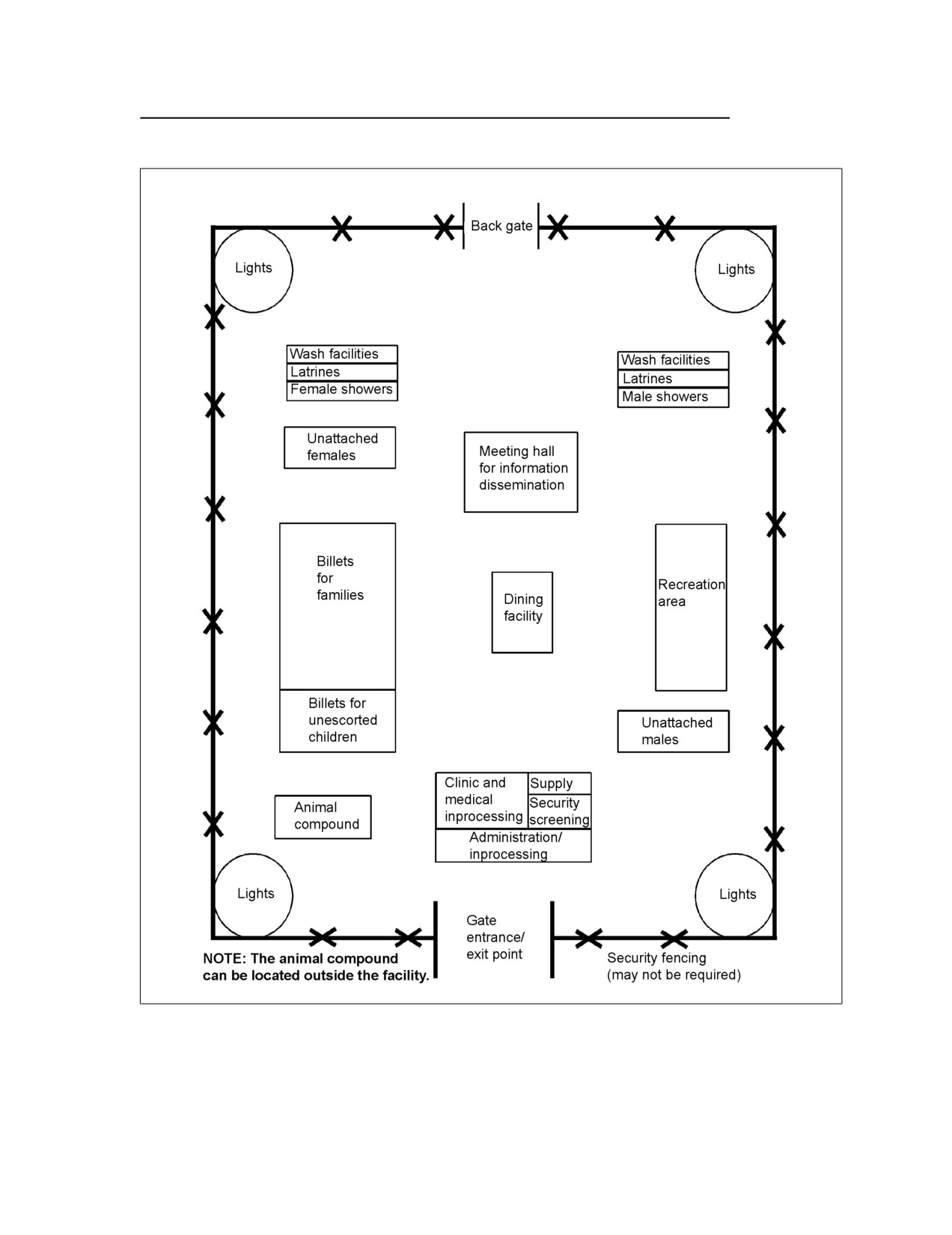
FM 3-19.40
Figure 10-2. Sample HA I/R Facility
Humanitarian Assistance and Emergency Services 10-7
FM 3-19.40
10-21. While DC processing procedures in Chapter 9 provide a foundation, I/R
facility personnel must be aware of unique aspects when conducting HA
operations. Military personnel normally provide training and support, and
HN authorities do the actual processing. The number and type of processing
stations vary from operation to operation. Table 10-1 shows stations that are
required for HA operations.
Table 10-1. Actions During Inprocessing
Station
Purpose
Responsible Individuals*
Actions
1
Accountability
HN and I/R staff
Prepare forms and records to maintain
accountability of civilians. Use forms and records
provided by the HN, CA, or those used for EPW/CI
operations that may apply to HA operations.
2
ID card or
HN and I/R staff
Issue ID cards or bands to facilitate administration
band
and control of the facility if necessary.
3
Medical
HN, I/R staff, and medical
Evaluate civilians for signs of illness or injury.
evaluation
personnel
4
Assignment
HN and I/R staff
Assign each civilian a sleeping area.
5
Personal items
HN and I/R staff
Issue personal-comfort items and, if available,
clothing.
*The number of people performing these tasks depends on the number of civilians and the time available.
Allow HN authorities to conduct most of the inprocessing.
10-22. The I/R facility commander determines the accountability procedures
and requirements necessary for HA operations. Translators are present
throughout processing. A senior person greets new arrivals and makes them
feel welcome. Brief civilians on facility policies and procedures and screen
them to identify security and medical concerns. Offer them the use of
personal-hygiene facilities, and always maintain family integrity.
10-23. Conduct pat-down searches to ensure that weapons are not introduced
into the compound. Conduct same-gender searches when possible, and do not
conduct strip searches. Speed and security considerations may require
mixed-gender searches. If so, perform them in a respectful manner, using all
possible measures to prevent any action that could be interpreted as sexual
molestation or assault. The on-site supervisor carefully controls soldiers doing
mixed-gender searches to prevent allegations of sexual misconduct.
SCREENING
10-24. Depending on the environment, screening may or may not be
necessary. The screening process also identifies technicians and professionals
to help administer the facility; for example, policemen, schoolteachers,
doctors, dentists, nurses, lawyers, mechanics, carpenters, and cooks.
IDENTIFICATION
10-25. Identifying DCs may or may not be necessary; and it depends on
guidance from higher headquarters, CA, and the HN. The need for ID varies
from operation to operation, and it is used to—
• Verify rosters against the actual population.
10-8 Humanitarian Assistance and Emergency Services
FM 3-19.40
• Provide timely reunification of family members.
• Match civilians with their medical records in case of a medical
emergency or evacuation.
• Check identities of civilians against the transfer roster.
10-26. An ID card can be used to facilitate ID. It contains the civilian’s name,
photograph, and control number. The control number may be an ISN or a
sequenced control number specific to the civilian. Color-coded IDs may be
necessary to permit ID. An ID band permits rapid, reliable ID of an individual
and may also be used in HA operations. While civilians cannot be prevented
from removing or destroying bands, most will accept their use for ID purposes.
When ID bands or cards deteriorate, replace them immediately.
CLOTHING AND EQUIPMENT
10-27. Supply civilians with adequate, suitable clothing and sleeping
equipment if they do not have supplies with them. Requisition clothing and
equipment through NGOs, IHOs, and IOs when possible. In a hostile
environment, use available captured clothing and equipment. Ensure that
civilians wear clothing until it is unserviceable, and replace it as necessary.
SUBSISTENCE
10-28. Ensure that food rations are sufficient in quantity, quality, and variety
to maintain health and prevent weight loss and nutritional deficiencies.
Consider the habitual diet of the civilian population. Ensure that expectant
and nursing mothers and children under the age of 15 receive additional food
in proportion to their needs. Increase the rations of workers based on the type
of labor performed. Provide plenty of fresh potable water. Make minimal menu
and feeding-schedule changes to prevent unrest among the population, and
inform civilians when changes must be made.
DINING FACILITIES
10-29. Dining-facility requirements for HA operations are similar to those for
DC operations. If deemed necessary, the I/R facility commander can authorize
local procurement of cooking equipment. Consult with SJA to determine the
purchasing mechanism and the legality of items being purchased. Coordinate
with NGOs, IHOs, and IOs for food service support. A qualified food service
person is authorized in each 19547AB I/R detachment, and a food operations
sergeant and a first cook provide food service support for each compound.
Train selected civilians to perform food service operations, and ensure that
they are constantly supervised by US food service personnel.
MEDICAL AND SANITATION CONSIDERATIONS
10-30. The need for medical care and sanitation intensifies in an I/R
environment due to its temporary nature, the lack of proper sanitation
facilities, and the lack of basic community services (potable water and sewer).
Enforcement and education measures ensure that the facility population
complies with basic sanitation measures. Provide medical care via organic I/R
medical personnel or coordinate with the appropriate HN medical authorities.
To prevent communicable diseases, follow the guidance in FM 21-10 and other
Humanitarian Assistance and Emergency Services 10-9
FM 3-19.40
applicable publications. Conduct routine, preplanned health, comfort, and
welfare inspections that appear to be random. Ensure that inspections cause
minimal disruption of space and privacy. Inspections ensure that the facility is
safe, sanitary, and hazard-free. When conducting inspections—
• Ensure that their purpose is conveyed and emphasized to the civilian
population.
• Respect cultural beliefs such as religious tenets and shrines. The INS,
international support groups, community leaders, CA, and HN
authorities are good sources for information regarding cultural
sensitivities.
• Treat civilians and their possessions with respect.
SELF-GOVERNMENT
10-31. The I/R facility commander determines whether self-government is
required and appropriate. If responding to a natural disaster, such as an
earthquake, the civilian government may not be affected and the I/R facility
may be used as shelter only. However, if the civilian government cannot be
established or is nonoperational, self-government may be appropriate.
Chapter 5 and AR 190-8 contain procedures for establishing a CI committee.
Use the procedures as a model for establishing a CA self-government, and
coordinate with CA for assistance.
10-32. Self-government leaders can help solve problems before they become
major events. The infrastructure of self-government promotes a stable
environment where rapport is built between the facility commander, the
civilian leadership, and the civilian population. This, in turn, reduces tension
and provides an effective means of communicating reliable information to the
facility population.
10-33. Civilians can submit complaints and requests to the I/R facility
commander via—
• An elected civilian internment committee.
• A written complaint.
• A visiting representative of the UNHRC or a similar agency.
CONTROL AND DISCIPLINE
10-34. Controlling people is the key to successful facility operations. Civilians
housed in I/R facilities during HA are not prisoners. Consider this fact when
drafting rules and guidelines. Establish, maintain, and enforce discipline and
security to avoid unstable conditions that may further affect civilians during
HA operations. Establish and explain rules that can be easily followed by
everyone in the facility. Coordinate with SJA and HN authorities to determine
how to enforce rules and how to deal with civilians who violate noncriminal
rules. Publish and enforce rules of conduct and update them as necessary. The
I/R facility commander serves as the single POC and coordinates all matters
with outside organizations or agencies. Keep barracks rules brief and to a
minimum (see Figure 9-3, page 9-15).
10-35. Discipline and control also apply to I/R facility personnel. They—
• Observe rigorous self-discipline.
10-10 Humanitarian Assistance and Emergency Services
FM 3-19.40
• Maintain a professional, impersonal attitude.
• Follow the ROI and the ROE.
• Cope with hostile or unruly behavior and incidents calmly.
• Take fair, immediate, decisive action.
10-36. The I/R facility commander takes positive action to establish daily or
periodic routines and responses that are conducive to good discipline and
control. He ensures that I/R facility personnel—
• Enforce policies and procedures.
• Give reasonable orders decisively and in a language that residents
understand.
• Post facility rules, regulations, instructions, notices, orders, and
announcements that residents are expected to obey in an easily
accessed area. Ensure that the information is printed in a language
that residents understand, and provide a copy to residents who do not
have access to posted copies.
• Ensure that residents obey orders, rules, and directives.
• Report residents who refuse or fail to obey an order or a regulation.
• Do not fraternize with residents.
• Do not donate or receive gifts or engage in any commercial activity
with residents.
ADMINISTRATION
10-37. Due to the large number of civilians requiring control and care, use HN
civilians as cadre for facility administration when possible. The HN civilians
should come from public and private welfare organizations and be under
military supervision. Also encourage residents to become involved in facility
administration. If possible, CA and I/R facility personnel organize and train
cadre before the facility opens.
10-38. Problems might stem from civilians’ state of mind. The difficulties they
experienced may affect their acceptance of authority. They may have little
initiative or may be uncooperative because of an uncertain future. They may
be angry because of their losses, or they may resort to looting and general
lawlessness because of their condition. The I/R facility commander can
minimize difficulties through careful administration and—
• Maintaining different national and cultural groups in separate
facilities or sections.
• Keeping families together.
• Separating unaccompanied males, females, and children under the
age of 18 (based on HN laws as to when a child becomes an adult).
• Allowing civilians to speak freely to facility officials.
• Involving civilians in facility administration, work, and recreation.
• Establishing quick contact with agencies for aid and family
reunification.
10-39. The I/R facility commander administers the facility to ensure that
civilians are treated according to the following basic standards:
Humanitarian Assistance and Emergency Services 10-11
FM 3-19.40
•
Do not restrict their movement except when necessary for public
health and order.
•
Allow them to enjoy their fundamental rights.
•
Treat them as persons whose plight requires special understanding
and sympathy. Provide necessary assistance, and do not subject them
to cruel, inhumane, or degrading treatment.
•
Do not discriminate because of race, religion, political opinion,
nationality, or country of origin.
•
Recognize that they are persons before the law who enjoy free access
to the courts of law and other competent administrative authorities.
•
Provide them with necessities (food, shelter, and basic sanitary and
health facilities).
•
Maintain family units when possible.
•
Provide assistance for tracing relatives.
•
Protect minors and unaccompanied children.
•
Allow them to send and receive mail.
•
Permit material assistance from friends and relatives.
•
Arrange for the registration of births, deaths, and marriages if
possible.
•
Grant them the means necessary to obtain a satisfactory, durable
solution.
•
Permit them to transfer assets to the country where they obtain a
durable solution.
•
Take steps to facilitate voluntary repatriation.
•
Provide humane treatment and protect them against violence,
intimidation, insults, and public curiosity.
10-40.
Disseminating instructions and information to the facility population
is vital. Communications may be in the form of notices on bulletin boards,
posters, public address systems, loudspeakers, camp meetings and assemblies,
or a facility radio station. The CA teams and area PSYOP units can help
disseminate information.
10-41. Another tool for effective administration is using liaison personnel.
Liaison involves coordination with all interested agencies. The US
government and military authorities, allied liaison officers, and
representatives of local governments and international agencies can provide
assistance.
LAW AND ORDER
10-42. The I/R facility commander is also the safety and security officer. He
deals with crimes against persons and property, performs security patrols, and
conducts reaction team operations. If an L&O team is attached to the
organization, it performs L&O-related functions. Otherwise, the commander
uses organic resources, such as an MP guard company, to establish an MP
desk and blotter and perform other specific functions. The location of the MP
station depends on the facility’s layout and the commander’s needs.
10-12 Humanitarian Assistance and Emergency Services
FM 3-19.40
10-43. Some other sources for security officers include local police forces, HN
paramilitary and military forces, and the facility population. Police personnel
within the population can supplement security teams or constitute a facility
police force if necessary. Internal and external patrols are necessary; however,
ensure that security does not give the impression that the facility is a prison.
Base patrol areas and distribution plans on the size of the facility and the
number of civilians in each subdivision. Before apprehending a civilian, the
commander coordinates with SJA and HN authorities to determine his
jurisdiction and authority. He determines the disposition and the status of the
subject and the disposition of the case paperwork, evidence (including crime
lab analysis results), and recovered property. The commander also obtains
information on items, procedures, and agreements unique to the supported
HN.
10-44. Be prepared to perform civil-disturbance operations to restore L&O if
HN reactionary forces are unavailable. Identify a reactionary force that can be
immediately deployed and employed inside the facility to control a
disturbance. The size of the reactionary force depends on the facility
population and the available military forces. The reactionary force is well
trained, well organized, and knowledgeable of applicable ROE, the
use-of-force policy, and the use of NLWs and civil-disturbance measures. (See
Appendix B and FM 19-15 for more information.)
10-45. Basic guidelines and the foundation for I/R facility L&O are provided
in FMs 19-10 and 19-20. The I/R facility commander tailors the forms and
procedures to his specific mission.
RULES OF INTERACTION
10-46. The ROI provide soldiers with a guide for interacting with the civilian
population. The following points may be included in the ROI:
• Avoid discussing politics or other policies with civilians.
• Avoid making promises. If cornered, reply with, “I will see what I can
do.”
• Refrain from making obscene gestures because civilians may
understand the meaning.
• Avoid making derogatory remarks. Local linguists understand English
and civilians might.
• Treat civilians equally. They may become offended if they do not
receive the same treatment or resources others receive.
• Respect religious articles and materials.
• Treat medical problems seriously.
• Treat civilians with respect.
• Greet civilians in their own language.
• Clear phrases that civilians teach to soldiers through a linguist to
ensure that they do not contain obscene language.
TRANSPORTATION
10-47. The I/R facility requires adequate transportation assets. Since MP
units have limited organic transportation assets, the unit MCO, the CA
Humanitarian Assistance and Emergency Services 10-13
FM 3-19.40
transportation specialist, the HN, NGOs, and IHOs coordinate and determine
the types and numbers of vehicles required and make provisions to have them
on hand.
DISPOSITION
10-48. The final step in HA operations is the disposition of civilians. Allowing
civilians to return to their homes as quickly as conditions permit lessens the
burden on military and civilian economies. It also reduces the danger of
diseases that are common among people in confined areas. When civilians
return home, they can help restore their towns and can better contribute to
their own support. If civilians cannot return home, they may resettle
elsewhere in their country. Guidance on the disposition of civilians comes from
higher authority upon coordination with US forces, national authorities, and
international agencies.
SECTION II - EMERGENCY SERVICES
10-49. Government agencies are primarily responsible for ES (police, fire,
rescue, and disaster preparedness). Military support to ES agencies can be
provided as civil-military assistance. The ES operations are normally
conducted in CONUS, but they can be conducted OCONUS.
IN CONTINENTAL UNITED STATES
10-50. In the US, the federal government is responsible for ES at all levels. It
provides planning advice and coordinates research, equipment, and financial
aid. State and local governments determine the allocation of these resources.
In the event of an emergency, US forces are prepared to help civil authorities
restore essential services, repair essential facilities and, if necessary, ensure
national survival. Federal statutes and military regulations govern conditions
for employing active component (AC) and United States Army Reserve
(USAR) military forces. (See FM 100-19 for more information.)
10-51. The DOD components develop appropriate contingency plans for
disaster assistance and ensure coordination with the appropriate federal,
state, and local civil authorities. When a disaster is so serious that waiting for
instructions from higher authority causes unwarranted delays, a military
commander can take action under DOD Directive 3025.1. The directive
authorizes military forces to respond immediately to save lives, prevent
human suffering, and mitigate great property damage. This support cannot
exceed 72 hours without DOD approval. The commander promptly reports the
action to higher authority and requests guidance if continued support is
necessary or beyond his capability.
10-52. The AC and USAR forces used in disaster relief are under the
command of their military superiors. Other military participation and the use
of military resources occur on a mission-by-mission basis and end at the
earliest practicable time. Commanders ensure that personnel participating in
domestic assistance are not in violation of the Posse Comitatus Act. This act
prohibits the use of federal military personnel to enforce federal, state, or local
10-14 Humanitarian Assistance and Emergency Services
FM 3-19.40
laws unless expressly authorized by the Constitution or by an act of Congress.
The act does not apply to state national guard (NG) forces unless they have
been federalized. When placed on state active duty, NG forces (Army and Air)
are under the C2 of state authorities, not federal forces.
10-53. Measures to ensure the continuity of operations, troop survival, and
the rehabilitation of essential military bases take precedence over military
support of local communities. Consider requests for support on a
mission-by-mission basis. With the exception of support directed in response
to a nationally declared emergency, the military commander decides the
necessity, amount, duration, and employment method of support rendered.
10-54. When committing USAR units or individual reservists to disaster
relief operations, ensure that—
• The President’s reserve call-up allows CONUS deployment of USAR
troops.
• The commitment of USAR volunteers is consistent with Army policy
for military assistance and is coordinated with the proper Corps of
Engineer district or division to avoid duplication of effort. (The
authority to commit USAR volunteers can be delegated no lower than
CONUS Army.)
• Civil authorities make a firm commitment to repay active-duty tour
(ADT) costs.
• State and local assets
(including the NG) are committed if the
requested assistance is within their capabilities.
10-55. A USAR commander can approve immediate-response, voluntary
USAR participation during imminently serious conditions in a nondrill,
nonpay status per DOD Directive 3025.1. The USAR members taking part in
such support are performing official duty. The USAR commander—
• Does not order members to participate.
• Approves voluntary participation only when time or conditions do not
permit seeking guidance from higher headquarters.
• Ensures that state and local assets are fully committed if the
requested assistance is within their capabilities.
• Provides support on a mission-by-mission basis.
• Discontinues support when adequate state and local assets become
available.
10-56. The MP units assisting ES operations in CONUS involve
DOD-sponsored military programs that support the people and the
government at all levels within the US and its territories. These programs and
operations are classified as domestic support, and civil law and military
regulations closely regulate a commander’s authority and responsibilities.
10-57. Protecting life and property within the territorial jurisdiction of a
community is the primary responsibility of state and local governments and
civil authorities. Federal armed forces can be employed when—
• The situation is beyond state and local capabilities.
• State and local authorities do not take appropriate action.
Humanitarian Assistance and Emergency Services 10-15
FM 3-19.40
FEDERAL EMERGENCY MANAGEMENT AGENCY
10-58. The FEMA serves as the single POC within the US government for all
emergency planning and management. It establishes and maintains a
comprehensive, coordinated emergency management capability in the US. The
FEMA plans and prepares for, responds and recovers from, and most
importantly, mitigates the effects of emergencies, disasters, and hazards that
range from safety and protection in the home to a nuclear attack. Within
FEMA, two primary departments provide civil-defense plans and guidance.
Plans and Preparedness Department
10-59. The Plans and Preparedness Department develops and implements
overall concepts and policy guidance. It directs activities for nationwide plans
and preparedness for emergencies during peace and war. The department
develops guidance for federal emergency plans and state and local response
capabilities, including tests and exercises for communications, warning, and
damage assessment systems. It also develops policy guidance for stockpiling
strategic materiel and develops plans, systems, and capabilities—
• To protect the US populace, government, and industry.
• For resource management and stabilization of the economy during
emergencies.
Disaster Response and Recovery Department
10-60. The Disaster Response and Recovery Department provides direction
and overall policy coordination for federal disaster assistance programs. It
advises the FEMA director on the mission, organization, and operation of the
agency’s disaster assistance program and the federal response and recovery
capabilities. It administers federal disaster assistance and provides overall
direction and management of federal response and recovery activities. The
department develops summaries of existing situations to support the
director’s recommendation to the President on a state governor’s request for a
Presidential declaration of a major disaster or an emergency.
MILITARY POLICE SUPPORT
10-61. The MP can be extremely valuable to civil authorities during ES. The
CS and I/R MP units can operate an I/R-type facility that may become
essential during ES. The MP units may be called upon to provide shelter to
people whose community has been struck by a powerful disaster, such as a
tornado or a hurricane. When civil authorities request assistance, MP units
may be deployed and employed as part of a JTF anywhere in CONUS or its
territories.
10-62. The MP support to ES in CONUS varies significantly from other I/R
operations. The basic difference is that local and state governments and the
federal government and its agencies have a greater impact and role in
supporting and meeting the needs of an affected community. In CMO for
disaster relief, MP receive missions from the FEMA through the DOMS and
the chain of command. The MP commander uses the MDMP to determine the
specific tasks necessary to accomplish the mission. Using the same format as
10-16 Humanitarian Assistance and Emergency Services
FM 3-19.40
used in HA operations, the commander modifies and tailors the tasks as
necessary.
10-63. If tasked to set up and operate an I/R facility, the MP commander
retains control of military forces under his command. Depending on the
situation, overall control of the facility may or may not be maintained by
FEMA or the DOJ. Coordinate the location of the I/R facility with local
authorities. The city chief of police, mayor, or ES director may have already
selected a site that has easy access, is located on high ground, or is adjacent to
other services.
10-64. The I/R facility commander may or may not be able to depend on local
labor to help set up the facility. The victims’ state of mind and their physical
conditions may prevent them from participating in construction efforts.
However, assistance may not be required if the Engineer Corps uses the
TCMS to build shelters or if other shelters are available. Discuss the facility’s
setup with local, state, and federal relief agencies. Although the basic setup
for HA operations may be adequate, the I/R facility commander can modify the
setup to meet local needs. As a minimum, the facility should have stations for
processing, medical screening, and distribution of personal-hygiene items.
10-65. Screening, classification, and ID requirements may not be needed in
CONUS ES operations. Discuss these capabilities with local authorities to
determine the need for them. As with HA operations, clothing requirements
may exceed supply. This will be the case during destructive disasters such as
tornadoes, fires, and hurricanes. Coordinate clothing, subsistence, medical,
and dining-facility requirements with local, state, and federal relief agencies
responding to the disaster.
10-66. Since the Posse Comitatus Act prohibits MP from enforcing civilian
laws, local, state, and federal law enforcement officials perform discipline,
control, and L&O of the facility. The MP can be used in conjunction with local,
state, and federal law enforcement officials; but they cannot be directly
involved in law enforcement functions such as search, seizure, and arrest. A
facility staff member who observes a violation of criminal law reports the
incident to civilian law enforcement officials. The ROI, if applicable, are
provided by the JFC.
OUTSIDE CONTINENTAL UNITED STATES
10-67. The FNs are responsible for providing ES for their citizens. When
requirements exceed their capabilities, they may request assistance through
the US Embassy.
10-68. The DOD components support or participate in foreign disaster relief
operations when the DOS determines that disaster relief will be provided to
the requesting country. Military commanders at the immediate scene of a
foreign disaster may provide prompt relief operations to preserve lives and
prevent injuries when time is of the essence and when humanitarian
considerations make it advisable. Commanders taking such action
immediately report operations according to the provisions of DOD Directive
5100.46.
Humanitarian Assistance and Emergency Services 10-17
FM 3-19.40
10-69. The Assistant Secretary of Defense (ASD) for Democracy and
Peacekeeping is the approval authority for committing DOD resources or
services to foreign disaster relief operations. The DASD for H&RA (Global
Affairs) is the DOD coordinator for foreign disaster relief operations. The
Logistics Directorate (J4) is the joint staff’s POC for the DOD Foreign
Disaster Relief and Humanitarian Assistance Program.
10-70. The ASD for International Security Affairs approves DOD supplies
and services for disaster and humanitarian purposes. He provides supplies
and services from the most expedient source, which is normally the geographic
command from whose theater the request emanates.
10-71. The geographic CINC assumes the primary coordinating role for
providing DOD supplies and services. The military departments and the joint
staff support the designated commander of a unified command as required,
primarily by coordinating interdepartmental approval and funding processes
through the DASD for H&RA (Global Affairs).
10-72. When a request emanates from a country not assigned to a geographic
CINC under the Unified Command Plan, the joint staff or the J4 assumes the
primary coordinating role in conjunction with the DASD for H&RA. Requests
for DOD assistance are received from the DOS or the USAID through the
OFDA.
UNITED STATES AGENCY FOR INTERNATIONAL DEVELOPMENT
10-73. The USAID administers the President’s authority to coordinate
assistance in response to disasters, as declared by the ambassador within the
country or a higher DOS authority. The USAID is authorized to provide
assistance, notwithstanding any other provision of law. This authority allows
the USAID to expedite interventions at the operational and tactical levels
using NGOs and other relief sources. The USAID—
• Organizes and coordinates the US disaster relief response.
• Responds to requests for disaster assistance.
• Initiates procurement of supplies, services, and transportation.
10-74. The Foreign Assistance Act is the authority for providing disaster
relief to—
• Preserve life and minimize suffering by providing sufficient warning
of natural events that cause disasters.
• Preserve life and minimize suffering by responding to natural and
man-made disasters.
• Foster self-sufficiency among disaster-prone nations by helping them
achieve some measure of preparedness.
• Alleviate suffering by providing rapid, appropriate responses to
requests for aid.
• Enhance recovery through rehabilitation programs.
10-75. The USAID coordinates with the DOD on matters concerning defense
equipment and personnel provided to the affected nation and to arrange DOD
transportation. DOD Directive 5100.46 establishes the relationship between
the DOD and the USAID. The DASD for H&RA is the primary POC. When the
10-18 Humanitarian Assistance and Emergency Services
FM 3-19.40
USAID requests specific services from the DOD, typically airlift, it pays for
the services. The CINC coordinates with the OFDA to arrange military and
civilian assistance efforts. The USAID provides an excellent means for
military and civilian operational-level coordination.
10-76. The USAID has operational links and grants relationships with many
NGOs and IOs that have relief programs outside the US. These include the
ICRC, the IFRC, the UNICEF, and the WFP. The USAID also coordinates with
other governments responding to disasters through donor country
coordination meetings to solve operational and political problems. The USAID
can deploy a disaster assistance response team (DART) into the AOR to
manage US relief efforts.
DISASTER ASSISTANCE RESPONSE TEAM
10-77. The DART concept was developed to provide rapid response to
international disasters. A DART provides specialists trained in a variety of
disaster relief skills who assist US Embassies and the USAID in managing
the US government’s response to disasters.
10-78. The activities of a DART vary depending on the type, size, and
complexity of the disaster. The DARTs coordinate with the affected country,
other assisting countries, NGOs, IOs, and US military assets deployed to the
disaster. During rapid-onset disasters, DARTs—
• Coordinate the needs assessment.
• Recommend US government response actions.
• Manage US government on-site relief activities.
During long-term, complex disasters, DARTs—
• Gather information on the disaster situation.
• Monitor the effectiveness of current US government-funded relief
activities.
• Review proposals of relief activities for future funding.
• Recommend follow-on strategies and actions to the OFDA.
10-79. The number of people assigned to a DART depends on the activities
needed to meet the strategic objectives. A DART consists of five functional
areas—management, operations, planning, logistics, and administration:
• Management. It includes the oversight of DART activities, NGOs,
IOs, other assisting countries, and the US military. It also involves the
development and implementation of plans to meet strategic objectives.
• Operations. It includes all operational activities carried out by a
DART, such as search, rescue, and aerial operations; technical
support; and medical response. This function is most active during
rapid-onset disasters.
• Planning. It includes collecting, evaluating, tracking, and
disseminating information on the disaster. It also includes reviewing
activities, recommending future actions, and developing operational
(tactical) plans.
• Logistics. It includes providing support to the OFDA and DARTs by
managing supplies, equipment, and services and by ordering,
Humanitarian Assistance and Emergency Services 10-19
FM 3-19.40
receiving, distributing, and tracking people and US
government-provided relief supplies.
• Administration. It includes the management of contracts, the
procurement of goods and services required by the OFDA and DARTs,
and the fiscal activities of DARTs.
10-80. The DART team leader organizes and supervises the DART. He is
delegated authority from and works for the Assistant Director for Disaster
Response or his designee. The delegation lists the objectives, priorities,
constraints, and reporting requirements for the DART.
10-81. Before the DART departs, the team leader contacts the USAID or the
US Embassy (if present in the affected country) to discuss the situation;
review the structure, size, objectives, and capabilities of the DART; and
identify the areas of support needed by the DART. Upon arriving in the
affected country, he reports to the senior US official or the appropriate country
official to discuss DART objectives and capabilities and to receive additional
instructions and authority.
10-82. While in the affected country, the team leader advises the USAID or
the US Embassy and receives periodic instructions from the agency. The
DART follows instructions unless they conflict with OFDA policies,
authorities, and procedures. Throughout the operation, the team leader
maintains direct LOC with the OFDA.
10-83. The USAID or the US Embassy and the OFDA determine the duration
of a DART operation after reviewing the disaster situation and the progress in
meeting operational objectives. The DART is a highly flexible, mobile
organization that is capable of adjusting its size and mission to satisfy the
changing needs of the disaster situation.
10-84. A DART normally tailors its capabilities to the particular situation. It
assesses the damage to the civil infrastructure, helps operate temporary
shelters, and manages a CMO center. The CA units serve as liaison between
military and local relief organizations, NGOs, IOs, and DARTs.
MILITARY POLICE SUPPORT
10-85. The I/R unit support to ES OCONUS is similar to MP support during
HA operations. The location, setup, construction, and tasks are based on the
nature of the emergency and the needs of the HN.
10-20 Humanitarian Assistance and Emergency Services
Appendix A
Metric Conversions
This appendix complies with current Army directives which state that the
metric system will be incorporated into all new publications. Table A-1 is a
conversion chart.
Table A-1. Metric Conversion Chart
US Units
Multiplied By
Metric Units
Cubic feet
0.0283
Cubic meters
Feet
0.305
Meters
Inches
2.54
Centimeters
Square yards
0.836
Square meters
Metric Units
Multiplied By
US Units
Centimeters
0.0394
Inches
Cubic meters
35.3
Cubic feet
Meters
3.28
Feet
Square meters
1.196
Square yards
Metric Conversions A-1
Appendix B
Use of Force and Riot Control Measures
The I/R facility commander provides guidance to all MP guard forces in the
appropriate use of force to protect internees and internment facilities and
to control unruly and rebellious internee populations. This includes
establishing uniform procedures that govern the use of force, weapons, and
restraining devices. He ensures that a QRF is organized and trained to
respond to disturbances inside and outside the facility—whether prisoners
are creating a disturbance or there is a Level I threat against the facility.
Supporting MP units train squad- to platoon-sized QRFs and squad-sized
elements for extraction and apprehension teams. (See FM 19-15 for more
information on civil disturbances.)
USE OF FORCE
B-1. When force is necessary, use it according to the priorities of force and
limit it to the minimum degree necessary. (See AR 190-14 for the use of deadly
force.) The application of any or all of the priorities of force, or the application
of a higher numbered priority without first employing a lower numbered one,
depends on and will be consistent with the situation encountered. Per AR
190-47, the priorities of force are—
• First: Verbal persuasion.
• Second: Show of force.
• Third: Chemical aerosol irritant projectors (subject to local and HN
restrictions).
• Fourth: Use of physical force (other than weapons fire).
• Fifth: Presentation of deadly force.
• Sixth: Deadly force.
B-2. The I/R commander coordinates with the higher echelon commander and
the SJA. He designates representatives who are authorized to direct the use of
firearms and riot control agents during riots or disturbances. He includes the
rules for using these means in appropriate plans, orders, SOPs, and
instructions. He specifies the types of weapons to be used, which are not
limited to shotguns and pistols for guarding prisoners.
DEADLY FORCE
B-3. Deadly force causes death or serious bodily harm. It is a destructive
physical force against a person using a weapon or equipment that exerts
deadly force. Use deadly force in extreme situations, when all lesser means
have failed or cannot be used reasonably. Deadly force is authorized for the
following reasons:
Use of Force and Riot Control Measures B-1
FM 3-19.40
• Self-defense and the defense of others. Deadly force is authorized
to protect an MP, a guard, or any person who believes he or others are
in imminent danger of death or serious bodily harm.
• Protection of assets involving national security. Deadly force is
authorized to prevent the theft or sabotage of assets vital to national
security.
• Protection of assets inherently dangerous to others. Deadly
force is authorized to prevent the theft or sabotage of resources, such
as operable weapons or ammunition, that are inherently dangerous to
others.
• Serious offenses against persons. Deadly force is authorized to
prevent a serious offense involving violence or a threat of death or
serious bodily harm.
• Arrests and apprehensions. Deadly force is authorized to arrest or
apprehend a person who has committed an offense as specified in
bullets 2 through 4 above.
• Escapes. The law of land warfare permits deadly force to prevent an
EPW or an RP from escaping if he poses a threat of serious bodily
harm to security personnel or others. If a CI tries to escape, force can
only be used when the ROE authorizes it (see AR 190-8).
NOTE: See AR 190-14 for more information on the use of deadly force.
B-4. The I/R facility commander ensures that soldiers understand the ROE,
including the use of the term halt, the use of deadly force, and the ban on
using physical or imaginary deadlines. He also ensures that EPWs and RPs
understand the meaning of the English word halt.
B-5. When a prisoner tries to escape, the guard shouts HALT three times. He
then uses the least amount of force necessary to stop the escape. If there is no
other effective means of preventing escape, deadly force can be used. Do not
fire on a prisoner unless he has cleared the outside fence (barrier, concertina
wire, or razor tape) and is making a further effort to escape. Do not fire on a
prisoner attempting to escape outside a fenced enclosure unless he does not
halt after the third command. An escape is successful if a prisoner—
• Reaches the lines of a force of which he is a member or the allies of
that power.
• Leaves a territory that is not controlled by the US or its allies.
RULES OF ENGAGEMENT
B-6. Commanders balance the physical security of forces with mission
accomplishment and the ROE issued for the mission. The unified commander
develops ROE for his forces. They are based on guidance from the national
command authority; operational, political, diplomatic, and legal
considerations; mission requirements; threat assessments; the law of land
warfare; and HN or third-country constraints on deployed forces.
B-7. The political situation may influence the ROE and conflict with
physical-security needs. In these cases, commanders weigh the political gains
against the risk to the force. They clearly state their objectives with defined
B-2 Use of Force and Riot Control Measures
FM 3-19.40
operational limits that allow mission accomplishment and protect deployed
forces.
B-8. Restrictions on combat operations and the use of force are clearly
explained in the ROE and understood and obeyed at all levels. Soldiers study
and train in the use of the ROE and discuss the ROE for their mission.
Misunderstandings and actions, no matter how minor, may have far-reaching
repercussions because friendly and enemy media can exploit incidents rapidly.
B-9. The ROE address specific distinctions between internee categories and
the instruments of control available for each. Use the following issues to
develop guidelines:
• What is considered deadly force?
• Under what conditions—
■
Will deadly force be used?
■
Will nonlethal technology be used?
• What are the required warnings (see ARs 190-8 and 190-14) before
using force (nonlethal or lethal)?
NONLETHAL WEAPONS
B-10. The DOD defines NLWs as weapons that are explicitly designed and
primarily employed to incapacitate personnel or material, while minimizing
fatalities, permanent injury to personnel, and undesired damage to property
and the environment. Unlike conventional weapons that destroy their targets
through blast, penetration, and fragmentation, NLWs employ other means to
prevent the target from functioning.
B-11. The NLW doctrine and concepts of operation are designed to reinforce
deterrence and expand the range of options available to commanders. They
enhance the capability of US forces to accomplish the following objectives:
• Discourage, delay, and prevent hostile actions.
• Limit escalation.
• Take military action in situations where the use of lethal force is not
the preferred option.
• Protect US forces.
• Disable equipment, facilities, and personnel.
B-12. The zero probability of producing fatalities or permanent injuries is not
a requirement of NLWs. Complete avoidance of these effects is not guaranteed
or expected; however, NLWs significantly reduce them as compared to lethal
weapons. When drafting the ROE, clearly articulate that using NLWs is an
additional means of employing force for the particular purpose of limiting the
probability of death or serious injury to noncombatants or belligerents.
However, the use of deadly force is an inherent right of individuals when they,
their fellow soldiers, or personnel in their charge are threatened with death or
serious bodily harm. The use of NLWs adds flexibility when controlling
disturbances in an I/R facility by providing an environment where guard
forces can permissively engage threatening targets with limited risk of
noncombatant casualties and collateral damage (see FM 90-40). Table B-1,
page B-4, shows lethal, nonlethal, and ineffective zones of NLWs.
Use of Force and Riot Control Measures B-3
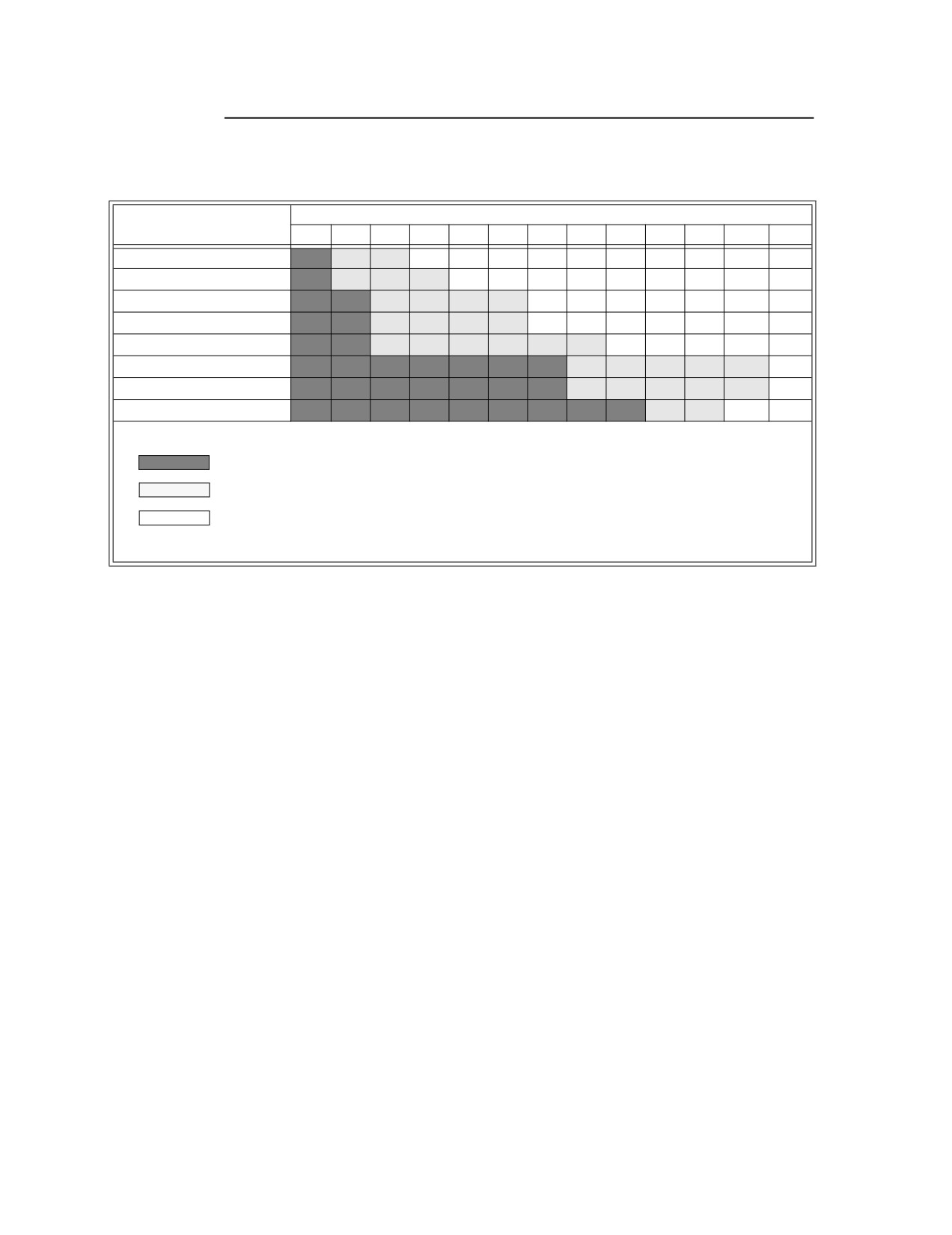
FM 3-19.40
Table B-1. Range of NLWs
Meters
NLW
0
5
15
20
25
30
35
50
55
65
95
100
120
MCCM
Stun hand grenade
12-gauge point
12-gauge area
40-millimeter point
66-millimeter sting ball
66-millimeter flash bang
66-millimeter CS grenade
Lethal zone
Nonlethal zone
Ineffective zone
B-13. The use of lethal force under the standing ROE is never denied. Never
deploy forces without giving them the ability to defend themselves against a
lethal threat. Ensure that they are trained, armed, and equipped for combat.
Nonlethal force is a complement to, not a replacement for, lethal force. Expand
a proactive response across the range of military operations. Delegate the
decision to use NLWs against an adversary during a confrontation to the
lowest possible level, preferably to the platoon or the squad. Ensure that all
personnel, not just leaders, have a clear understanding of the ROE and the
commander’s intent (see FM 90-40).
B-14. Facility commanders consider the use-of-force options discussed in this
appendix and AR 190-14 when dealing with disruptions. They substitute
nonlethal devices for firearms when they are adequate for MP to safely
perform their duties. Currently, MP have the following nonlethal options
available for crowd control:
• Riot control agents.
■
O-chlorobenzylidine malonitrile (CS).
■
Oleoresin capsicum (OC).
• MWDs.
• MP clubs.
• Riot batons.
B-15. Commanders and public affairs officers are prepared to address media
questions and concerns regarding the use and role of NLWs. They make it
clear that the presence of NLWs in no way indicates abandoning the option to
employ deadly force in appropriate circumstances.
B-4 Use of Force and Riot Control Measures
FM 3-19.40
ADVANTAGES
B-16. The NLWs provide the flexibility to favorably influence a situation with
reduced risk of noncombatant fatalities and collateral damage. They are more
humane, which is consistent with the political and social intent of
humanitarian and peacekeeping missions. The force that properly employs
NLWs gains an advantage over forces who rely on lethal options alone because
the degree of provocation required to employ these options is substantially
less. This advantage provides a proactive posture and a quicker response. It
also diminishes the likelihood of a situation escalating to a point where deadly
force is required.
B-17. The NLWs are less likely to provoke others; however, they may provoke
a negative response. Demonstrated restraint greatly diminishes feelings of
anger and remorse when deadly force is required after nonlethal options fail.
The NLWs facilitate postincident stabilization by reducing internee alienation
and collateral damage.
TRAINING
B-18. Soldiers and leaders are trained in the correct employment of NLWs.
They understand the limited use of these systems in environments with
restrictive ROE. Their training is continuous at all levels so that they
understand when and how to effectively and properly employ NLWs. The
incorrect application of NLWs can have significant operational and political
ramifications. Well-trained MP leaders who provide timely, clear guidance to
soldiers ensure mission accomplishment.
B-19. Many NLWs have maximum-effective and minimum-safety ranges.
Individuals struck short of the minimum safety range often suffer severe
injuries or death, while the effects of most nonlethal devices are greatly
mitigated at longer ranges. Engage the threat within the nonlethal zone,
which is beyond the lethal zone and short of the ineffective zone (see Table
B-1).
B-20. When training with and planning for the use of NLWs—
• Never apply them in situations where deadly force is appropriate.
• Never apply them in situations that will place troops in undue danger.
• Always cover them with deadly force.
TACTICS
B-21. Establish riot control teams that have a minimum response time. Due
to the physical nature of riot control, individuals in riot control formations do
not carry long rifles. Lethal attachments follow closely behind riot control
formations to provide lethal coverage for the entire formation.
B-22. During a nonlethal engagement, a designated marksman supplies
lethal overwatch to provide confidence and safety to those facing a riot. The
marksman is in an overwatch position and armed with a standard infantry
rifle, mounted with a high-powered scope. If a lethal threat is presented, he
can scan the crowd to identify agitators and riot leaders for apprehension. He
can also fire lethal rounds if warranted. Designated marksmen are ideally
suited for flank security and countersniper operations.
Use of Force and Riot Control Measures B-5
FM 3-19.40
NOTE: See FM 90-40 for an in-depth discussion on the tactics
associated with employing NLWs.
CROWD DYNAMICS
B-23. A commanders considers crowd control and the dynamics caused by
several people living in close quarters. Generally, he is concerned with two
types of disturbances—riots and disorders. Prisoners may organize
disturbances within an I/R facility to wear down the guard force.
B-24. Simply being a part of a crowd affects a person. Each person is open to
actions that are different from his usual behavior. For example, crowds
provide a sense of anonymity because they are large, often temporary,
congregations. Crowd members often feel that their moral responsibility has
shifted from themselves to the crowd as a whole. Large numbers of people
discourage individual behavior, and the urge to imitate is strong in humans.
People look to others for cues and disregard their own backg1round and
training. Only well-disciplined persons with strong convictions can resist
conforming to crowd behavior. Crowd behavior influences the actions of
disorderly participants and the authorities tasked to control them.
B-25. Under normal circumstances, a crowd is orderly and does not present a
problem to authorities. However, when crowd behavior violates laws or
threatens life or property, a disturbance ensues.
CROWD BEHAVIOR
B-26. The presence or absence of social factors (leadership, moral attitudes,
and social uniformity) may influence crowd behavior. Leadership has a
profound effect on the intensity and direction of crowd behavior. When blocked
from expressing its emotions in one direction, a crowd’s frustration and
hostility may be redirected elsewhere. The first person to give clear orders in
an authoritative manner may become the leader. Agitators can exploit the
crowd’s mood and convert a group of frustrated, resentful people into a
vengeful mob. Skillful agitators, using clandestine communications within an
I/R facility, can reach large portions of the population and incite them to
unlawful acts without having direct personal contact. In an I/R environment,
any crowd can be a threat to L&O because it is open to manipulation.
B-27. Crowd behavior may be affected by panic or emotional contagion, which
provides psychological unity. The unity is usually temporary, but it may be
long enough to push a crowd to mob action. When emotional contagion
prevails, normal L&O are suppressed, increasing the potential for violence.
Panic can occur during a disturbance when—
• Crowd members perceive that their safety is at risk and they attempt
to flee the area.
• Crowd members cannot disperse quickly after exposure to riot control
agents.
• Escape routes are limited, blocked, or congested.
B-28. Members of the control force are also susceptible to crowd behavior.
They may become emotionally stimulated during a tense confrontation and
must exercise individual and collective restraint. Rigorous training, firm and
B-6 Use of Force and Riot Control Measures
FM 3-19.40
effective leadership, and complete awareness and understanding of the ROE
and the ROI are necessary to offset the effect of crowd contagion on the control
force.
CROWD TACTICS
B-29. In disturbances, crowds employ any number of tactics to resist control
and achieve their goals. Tactics may be planned or unplanned and violent or
nonviolent. The more purposeful the disturbance, the more likely the
possibility of well-planned tactics.
Nonviolent Tactics (Disorders)
B-30. Nonviolent tactics include name calling, conducting demonstrations,
refusing to work or eat, participating in a work slowdown, damaging or
destroying property, and building barricades. Demonstrators may converse
with control force members to distract them or gain their sympathy. They may
use verbal abuse such as obscene remarks, taunts, ridicules, and jeers. Crowd
members want to anger and demoralize the opposition, and they want
authorities to take actions that can later be exploited as acts of brutality.
B-31. In compounds where women, children, and elders are interned, they
may be placed in the front ranks of the demonstration to discourage
countermeasures by the control force. When countermeasures are taken,
agitators try to stir public displeasure and embarrass the control force
through the media. Internees may form human blockades to impede
movement by sitting down in footpaths or entrances to buildings within the
compound. This disrupts normal activity and forces control personnel to
remove demonstrators physically. Demonstrators may lock arms, making it
hard for the control force to separate and remove them, so that it appears the
control force is using excessive force.
B-32. Nonviolent tactics include the following types of disorders:
• Demonstrations. Demonstrations are actions by groups of people
whose behavior, while not violent, is in conflict with those in authority.
They are characterized by unruliness and vocal expressiveness
without violence. Demonstrations may be organized in celebration of
national holidays or as protests against food, clothing, living
conditions, or treatment.
• Refusal to work or eat. Housed personnel may refuse to work or eat,
collectively or individually, as a means of harassing the detaining
power or in an attempt to gain concessions from the detaining power.
This type of disorder can normally be controlled by promptly isolating
and segregating offenders and ringleaders.
• Work slowdown. Housed personnel may initiate a deliberate work
slowdown to delay the completion of projects, thereby harassing the
detaining power. Disorders of this nature can also be controlled by
promptly isolating and segregating offenders and ringleaders.
• Damage or destruction of property. Housed personnel often
damage or destroy property to harass the detaining power, to impede
or prevent normal operation of the facility, or for tactical purposes.
Use of Force and Riot Control Measures B-7
FM 3-19.40
This type of disorder can normally be controlled by identifying,
isolating, and segregating offenders.
• Unorganized disorders. Unorganized disorders are spontaneous
and are started by the actions of a single individual. Like all
disturbances, their prompt control is essential.
Violent Tactics (Riots)
B-33. Violent crowd tactics can be extremely destructive. They include
attacking other internees, guards, or government property and setting fires or
bombings for escape, grievance, tactical, or political advantages. The attitude
and ingenuity of crowd members, the training of their leaders, and the
materials available are the only limits to violent crowd tactics. Crowd or mob
members may commit violence with crude, homemade weapons or anything
else that is available. If violence is planned, crowd members conceal makeshift
weapons or tools for vandalism.
B-34. Crowd members can erect barricades to impede movement or to prevent
the control force from entering an area or a building. They may use vehicles,
trees, furniture, fences, or other material to build barricades. In an effort to
breach barriers, rioters may throw grapples into wire barricades and drag
them. They may use grapples, chains, wires, or ropes to pull down gates or
fences to effect a mass escape. They may use long poles or homemade spears
(tent poles) to keep control forces back while removing barricades or to
prevent the use of bayonets.
B-35. Rioters can be expected to vent their emotions on individuals, troop
formations, and control force equipment. They may throw rotten fruits and
vegetables, rocks, bricks, bottles, or improvised bombs. They may direct
dangerous objects (vehicles, carts, barrels, or liquids) at troops located on or at
the bottom of a slope. They may drive commandeered vehicles toward troops
to scatter the control force formation and jump out of vehicles before reaching
roadblocks and barricades. Rioters may set fire to buildings or vehicles to
block the advance of the control force formation, create confusion and
diversion, destroy property, and mask escapes. Types of riots include—
• Organized riots. Leaders of housed personnel reorganize the
internee population into quasi-military groups. The groups are
capable of developing plans and tactics for riots and disorders. Riots
can be instigated for—
■
Escapes. Leaders organize a riot as a diversion for an escape
attempt by selected individuals or small groups or for a mass
escape attempt.
■
Political purposes. Riots are often organized for propaganda or
to embarrass the detaining power in its relations with protecting
powers and other nations. They may also be organized to
intimidate individuals or groups that may have been cooperative
with the detaining power.
■
Grievance protests. A grievance protest can be organized as a
riot. Under normal circumstances, this type of riot is not
extremely violent in nature. It may turn violent when leaders try
B-8 Use of Force and Riot Control Measures
FM 3-19.40
to exploit the successes of the riot or the weaknesses of the
detaining power.
■
Tactical purposes. Riots are often organized for the sole purpose
of diverting the detaining power, thereby limiting its ability to
perform the mission.
• Unorganized riots. Unorganized riots are spontaneous, although
they can be exploited and diverted by leaders into different types of
riots. They may begin as a holiday celebration, a group singing, or a
religious gathering. Under determined leadership, the pattern of these
gatherings can change to an organized riot.
• Multiple riots. When housed personnel in one compound start
rioting, personnel in other compounds may also riot. To meet this
situation with only one riot control force available, the force
commander first subdues the most riotous compound. He also employs
riot control teams to contain the other compounds where rioting is
taking place until the riot control force is free to subdue offenders. If
another alert force is available, it channels additional rioters to a
different area than the original rioters.
RECORD OF EVENTS
B-36. Initiate a record of events to provide a basis for preparing and
submitting a formal report to higher headquarters. Include the—
• Time the incident was reported and by whom.
• Time the enclosure commander reported to his commander.
• Time the riot control force was alerted.
• Time the riot control force commander reported to the affected
enclosure.
• Time the riot control force entered the enclosure.
• Weather conditions as they relate to the use of riot control munitions,
the types and amounts used, and their results and effects.
• Number of US personnel injured or killed, a description of how they
were injured or killed, and the medical attention they received.
• Number of housed personnel injured or killed, a description of how
they were injured or killed, and the medical attention they received.
• Time the operation was completed and when the riot control force
cleared the enclosure.
RIOT CONTROL MEASURES
B-37. The commander exercises effective control of internees by quickly
restoring order. Have a well-developed, well-rehearsed plan for defusing tense
situations, handling unruly captives, and quelling riots. Because of the
differences in I/R facilities, consider the—
• Terrain features.
• Types of structures.
• Number of internees.
• Size of control forces.
Use of Force and Riot Control Measures B-9
FM 3-19.40
B-38. Restore order using the least amount of force possible. The PSYOP
resources often play an effective role in restoring order to the compound. If
necessary, use riot control agents (CS and OC) and NLWs to incapacitate
rioters.
B-39. Preplan riot control measures before a crisis occurs. Control forces will
be prepared to react in an emergency and can successfully contain and
neutralize the situation. The preplanning process includes training, planning,
and intelligence gathering.
TRAINING
B-40. Train the QRF and associated teams in the five basic riot control
formations—line, wedge, echelon, diamond, and circle—on a regular basis.
Establish a continuous training program that includes—
• Law of land warfare principles, specifically the provisions of the
Geneva Conventions.
• Supervisory and human relations techniques.
• Self-defense methods.
• The use of force (riot batons, M16 with and without bayonet, and fatal
areas of the body to avoid when using them).
• Weapons familiarization and qualification.
• Public relations.
• First aid.
• Emergency plans.
• Compound regulations.
• Intelligence and counterintelligence techniques.
• Cultural customs, habits, and religious practices.
• Simple training in internees’ language.
• The use of riot control agents and the various methods of dispersing
them.
• The use of NLWs.
B-41. Ensure that personnel assigned or attached to I/R facilities are oriented
and specially trained in the custody and control of EPWs and CIs. Everyone
working in the compound must be fully cognizant of the provisions of the
Geneva Conventions as they apply to EPWs, CIs, and soldiers who are
guarding prisoners.
PLANNING
B-42. The planning process begins during the preplanning process. When the
QRF is alerted of a riot situation, leaders and members further develop
preplans to fit the situation. This planning process is essential to successfully
contain and neutralize a riot. When using riot control agents, ensure that
plans are flexible enough to accommodate changes in the situation and
weather. Consider the strict accountability and control required when
employing riot control agents. They can be employed only when the
commander specifically authorizes their use, and their use must be reported.
B-10 Use of Force and Riot Control Measures
FM 3-19.40
B-43. Other planning factors to consider are the weather; the cause, nature,
and extent of the disturbance; and the demeanor and intent of the gathered
EPWs. Based on an analysis of these factors, the commander makes an
estimate (as thorough as time permits) of the situation. He considers a course
of action, selects riot control agents, and determines munition needs.
B-44. Plans also address the security of riot control agents during storage,
transportation, and employment. The wind direction, the size of the area, and
the proximity of civilian communities may preclude the use of large quantities
of riot control agents. In such cases, it may be necessary to use low
concentrations to break up a crowd into smaller groups.
B-45. When dealing with a large group of rioting EPWs, plans should indicate
how the control force channels and controls EPW movement in a specific
direction. This is usually to an area where another force is waiting to receive,
hold, and search them. Include information on how riot control agents are
employed to cover the target area with a cloud of sufficient strength to
produce desired results. Once the proper concentration is reached, the control
force maintains the concentration until rioters are channeled into the
predetermined area. When dispersers are used, the dispersal team maintains
the concentration by moving along the release line at an even rate and
repeating the application as necessary.
B-46. During a riot, another riot may start in a neighboring compound, so
ensure that contingency plans are in place to subdue it also. Quell the most
riotous compound first, and then move to the next. Employ riot control teams
to contain other compounds where rioting is taking place until a riot control
force is free to subdue them.
B-47. Include serious-incident reporting procedures in riot control plans.
Initiate a record of events to provide a basis for preparing and submitting a
formal report to higher headquarters. (See paragraph B-36.)
INTELLIGENCE GATHERING
B-48. The preplanning process also includes intelligence gathering. It
includes maintaining updated drawings of the I/R compound and identifying
potential threats from within the EPW population. (See Chapter 3.)
RIOT CONTROL AGENTS
B-49. There are two riot control agents used to quell riots and disperse
crowds. They are CS and OC.
O-CHLOROBENZYLIDINE-MALONITRILE
B-50. The CS is effective in very small quantities, and its effect on eyes and
respiratory systems are realized within seconds. It causes an extreme burning
sensation in eyes, an abundant flow of tears, coughing, breathing difficulty,
tightness in chest, involuntary closing of eyes, stinging sensation on
moist-skin areas, and sinus and nasal drip. High concentrations also cause
nausea and vomiting, especially when ingested. The effects last 5 to 10
minutes after individuals are removed from the contaminated area and placed
Use of Force and Riot Control Measures B-11
FM 3-19.40
in a clean area. Exposure to CS makes individuals incapable of executing
organized or concerted actions.
B-51. Administer first aid to victims by moving them to uncontaminated
areas and facing them into the wind. Caution them not to rub their eyes, and
keep affected people well apart. Have victims shower with cool water for 3 to 5
minutes and then proceed with normal showering. For gross contamination,
flush victims’ bodies with large amounts of cool water, wash them with a 5
percent sodium bisulfite solution (except in and around their eyes), and flush
them again with water. (A 1 percent sodium carbonate or sodium bicarbonate
solution can be substituted for the sodium bisulfite solution.)
B-52. The CS is delivered by a variety means—bursting, aerosol,
37-millimeter and 12-gauge projectiles, and fogging. It has the greatest effect
when there is little or no wind, and effectiveness is greatly diminished by rain.
The persistency of CS varies according to wind conditions. The powder form
persists longer in still air and in wooded terrain, and it should not be used in
areas where lingering contamination could cause problems.
OLEORESIN CAPSICUM
B-53. The OC provides a safe, effective alternative to traditionally employed
riot control agents. When used properly, it turns the most violent offender into
a docile, cooperative individual who no longer poses a threat to others. It
diverts the threat’s attention from making or continuing an assault. NOTE:
HN laws may prohibit or restrict the use of certain chemical
compounds, such as OC.
B-54. The OC is not a chemical agent, but it is 750 times more powerful than
CS. It is an organic, naturally occurring, inflammatory compound that is
derived from a blend of 300 varieties of pepper plants. As an inflammatory
agent, OC causes swelling of eyes and breathing passages almost immediately.
When inhaled, the respiratory tract is inflamed and breathing is restricted to
short, shallow breaths. However, it does not shut down the respiratory system.
The physiological response increases OC’s effectiveness, regardless of the
subject’s emotional or physical state. It is effective against emotionally
disturbed individuals, persons under the influence of drugs or alcohol, and
domestic and wild animals.
B-55. The OC causes intense burning of exposed skin, dilation of capillaries,
swelling of eyelids, burning and involuntary closing of eyes, uncontrollable
coughing, gagging, gasping for air, temporary loss of strength and
coordination, and a change in skin color (slight to bright red). The effects of
OC last 30 to 40 minutes after removal to fresh air. There is no permanent
damage to the respiratory system, eyes, or skin.
B-56. There is a risk of fatalities in persons with preexisting respiratory or
cardiac conditions. Ensure that medical support is readily available when
using OC in a civilian/refugee situation to prevent injury or death if an
individual fails to recover.
B-57. Disadvantages of OC include—
• Canisters will depressurize over time if they are not checked regularly.
• Criminals have access to OC and may use it against the control force.
B-12 Use of Force and Riot Control Measures
FM 3-19.40
• Canisters must be shaken on a regular basis.
• Individuals from cultures that use cayenne pepper on a regular basis
may become immune to OC.
• Rain decreases the effectiveness and requires a longer spray duration.
• Strong winds decrease effectiveness and can result in blowback that
might contaminate control forces.
DISSEMINATION OF CHEMICAL IRRITANTS
B-58. There are five methods of dissemination for chemical irritants. They are
pyrotechnic, bursting, aerosol, fogging, and a multipurpose grenade.
Pyrotechnic
B-59. The irritant and an inert material are placed in a canister that is
ignited when the device is activated. The irritant is carried into the air on
smoke particles of the inert material. This method of dissemination has the
following disadvantages:
• May cause a fire.
• Has a very slow saturation time.
• Takes 40 to 45 seconds to completely burn.
• Can be thrown back even while burning.
Bursting
B-60. The irritant and an inert powder are contained in a serrated canister.
After a small detonation, the canister splits and expels the irritant in the form
of a cloud. This method of dissemination has the following advantages and
disadvantages:
• Advantages.
■
Has no risk of fire.
■
Cannot be thrown back.
■
Disseminates quickly.
■
Is very effective, easy to carry, and easy to control.
• Disadvantages.
■
The canister may fragment when detonated.
■
The fuse head may separate from the canister.
■
The percentage of irritant disseminated is 50 to 90 percent.
■
The direction of the cloud formation depends on where the device
is detonated.
Aerosol
B-61. The irritant is suspended in an inert liquid located in the rear of a
projectile. When the projectile strikes a structure and penetrates, the rear
portion splits open and the irritant is disseminated in the form of a mist. The
aerosol device is the most appropriate for tactical operations when chemical
irritants are used before entry. This method of dissemination has the following
advantages and disadvantages:
• Advantages.
Use of Force and Riot Control Measures B-13
FM 3-19.40
■
Is easy to carry and control.
■
Can be deployed with 40-millimeter, 37-millimeter, or 12-gauge
ammunition.
■
Disperses contents quickly.
■
Is accurate (fin-stabilized), but practice firing is necessary.
• Disadvantages.
■
May cause injury if fired from close range.
■
May strike a weak portion of a structure.
Fogging
B-62. The irritant is suspended in a fogging solution and dispersed with a
fogging machine. It is used for riot control and crowd dispersal. This method of
dissemination has the following advantages and disadvantages:
• Advantages.
■
Is capable of producing enough irritant to cover 100,000 cubic feet
of an enclosed area in 26 seconds.
■
Disseminates very quickly.
■
Has high-volume capabilities.
• Disadvantages.
■
Is too noisy for a close-in tactical situation.
■
Is cumbersome and not recommended for tactical operations.
Multipurpose Grenade
B-63. A multipurpose grenade can be hand-thrown or launched from a
shotgun with an adapter. It has an extended shelf life of 6 years and an
adjustable fuse delay of 2 to 5 seconds. The irritant is located in the cylinder
portion of the device and is forced out the bottom of the grenade upon
detonation.
WARNING
Injury to your hand may result if a multipurpose grenade
is deployed incorrectly. Observe all safety rules.
POSITIONS
B-64. Riot control formations are usually equipped with riot batons, rifles
(with or without bayonets), or shotguns. All personnel use the right hand grip
when holding a baton or a weapon. This presents a uniform, formidable
appearance to rioters, eliminates weak spots in the formation caused by
inconsistent weapon positions, and is safer for soldiers in close movements.
(See STP 19-95B1-SM for more information on individual movements and
positions.)
B-14 Use of Force and Riot Control Measures
FM 3-19.40
BATONS
B-65. Three steps are necessary to obtain a secure grip on the riot baton. This
method of gripping the baton provides a secure grasp, and the baton can be
released quickly by simply relaxing your hand.
Step 1. Place the thong of the baton around your right thumb.
Step 2. Hold the baton so that the thong hangs over the back of your
hand.
Step 3. Roll your hand into the baton handle so that the thong is pressed
against the back of your hand.
B-66. There are three baton positions used in riot control. They are parade
rest, port, and on guard:
•
Parade rest position. The parade rest position is a relaxed, ready
position. Your feet are shoulder width apart, both arms hang naturally
in front of your body, and the baton is horizontal. Your left palm is
facing out, and your right palm is facing in toward your body. Your
hands are about 6 inches from the ends of the baton.
•
Port position. The port position is a ready position. It is particularly
well suited for individual defense. Your right hand and forearm are
parallel to the ground, and your left hand is level with your left
shoulder. The striking end of the baton bisects the angle between your
neck and left shoulder. The baton is held about 8 inches from your
body, and your feet are shoulder width apart.
•
On-guard position. The on-guard position is a ready position. Do not
maintain it for long periods of time, because it is tiring. Your left foot is
placed forward of your right foot. Your feet are spread apart, and your
knees are slightly bent. Your right hand and the butt end of the baton
are placed snugly against your hip. Your body is bent slightly forward
at your waist. Your left arm is bent so that your forearm protects your
throat area, yet allows a thrust to be made. From the on-guard
position, soldiers can execute a—
■
Short thrust. Rapidly step forward with your left foot, and drive
the striking end of the baton into a vulnerable point of the
opponent’s body. Return to the on-guard position after delivery.
■
Long thrust. Rapidly step forward with your right foot, and
thrust the striking end of the baton into a vulnerable point of the
opponent’s body. Return to the on-guard position after delivery.
■
Butt stroke. Advance your body rapidly off your right foot, and
snap the butt end of the baton to the left, striking the opponent’s
shoulder or jaw. Return to the on-guard position after delivery.
Baton Smash
B-67.
A baton smash can be delivered from a parade rest, port, or on-guard
position. Hold the baton horizontal to the ground, about chest height. Advance
your left foot rapidly, snap both arms straight, and smash the length of the
baton across the opponent’s chest. Return to the on-guard position after
delivery.
Use of Force and Riot Control Measures B-15
FM 3-19.40
Fatal Areas
B-68. Do not use a riot baton to strike a fatal area (the head, the side of the
neck, the throat, the heart area, or the armpit). Do not raise a riot baton above
your head to strike an adversary in club fashion. It is likely to cause
permanent injury and also projects an unfavorable image of the control force.
B-69. Soldiers use riot batons to defend themselves against armed and
unarmed attackers. Use the baton to block or deflect an opponent’s blow; then
counter with a thrust, a butt stroke, or a baton smash. These defensive
techniques can be performed from any position.
NOTE: See FM 19-15 for detailed information on using a riot baton.
WEAPONS
B-70. There are three weapon positions used in riot control—safe-port,
safeguard, and on-guard positions.
•
Safe-port position. The safe-port position is quite effective when
making a show of force. It is similar to the port arms position in FM
22-5, except the weapon is raised until your left, upper arm is parallel
with the ground. In this elevated position, participants in the rear of
the crowd can see bayonets. The sight of bayonets creates an
impression of strength and numerical superiority. Do not keep troops
in this position long because it is very tiring. The control force moves
into and assembles from all riot control formations with weapons in
the safe-port position. Upon receiving the preparatory command to
move into or assemble from a riot control formation, soldiers assume
the safe-port position.
•
Safeguard position. This is a position of semireadiness. It is less
tiring than the on-guard position and is used to rest troops when
circumstances permit. As troops advance, they maintain the safeguard
position until contact is made or resistance is expected. The safeguard
position is also used when troops are pursuing a crowd that is
withdrawing without resistance. In the safeguard position, your right
hand is against the right side of your waist, and the weapon is pivoted
forward until the bayonet is at the crowd’s throat level.
•
On-guard position. This is a position of complete readiness. It is
used when troops are in contact with a group that is showing
resistance or hesitance to withdraw. Assume the on-guard position
from the safeguard position. Place your feet a comfortable distance
apart, and align your left heel with your right toe. Bend your knees
slightly and lean forward at your waist, keeping the bayonet at throat
level. Do not keep troops in this position long because it is very tiring.
Rest troops when circumstances permit.
FORMATIONS
B-71.
The five basic formations for riot control operations are line, wedge,
echelon, diamond, and circle. Apprehension teams normally use diamond and
circle formations. Small teams, squad-sized elements, and augmented squads
B-16 Use of Force and Riot Control Measures

FM 3-19.40
are not used for crowds, but they are used by larger riot control forces to
snatch or protect.
B-72. Line, wedge, and echelon formations are trained at squad level and
above; but they are normally used by platoon- and company-sized units.
Squad line, echelon left, echelon right, and wedge formations are the basis for
platoon and company formations. Each squad must be adept in the basic
formations before practicing in platoon-sized or larger formations. Any size
unit can be employed, and a riot control formation can be adapted to fit a
unit’s organization. (See STP 19-95B1-SM for more information on
formations.)
B-73. The platoon headquarters for riot control formations consists of a
platoon leader, a platoon sergeant, a selected marksman, and a radio operator
or messenger. Figure B-1 shows symbols for a formation element. When
directed by the platoon leader, disperser operators, firefighters, and others
may augment the platoon headquarters.
Platoon leader
Selected marksman
Platoon sergeant
Disperser
Squad leader
Assistant squad leader
Radio operator
Figure B-1. Symbols for a Formation Element
B-74. The control force moves to the site of a disturbance in a column
formation and then executes a riot control formation on site. To form a riot
control formation from a column formation, the platoon leader moves to the
right of the platoon and faces troops when giving commands. He gives the
arm-and-hand signal and the preparatory command. On the execution
command MOVE, he points to the approximate location where he wants the
platoon to form. The platoon leader pauses between the preparatory command
and the execution command to allow each squad leader to issue a preparatory
command to his squad.
B-75. In a three-squad platoon, the first and third squads are usually the lead
elements in formations when one squad provides general or lateral support.
The support squad, when held in general support, may be in a single column
or a column of twos. The following examples presume that the second squad is
the support squad.
B-76. When the support squad moves from general support to lateral support
or to extend the existing formation, the even-numbered members move to the
right and the odd-numbered members move to the left. The squad leader
Use of Force and Riot Control Measures B-17

FM 3-19.40
usually controls the even-numbered members, and the assistant squad leader
controls the odd-numbered members. To assemble the support squad from any
position to general support, the platoon leader commands SECOND SQUAD
IN SUPPORT, MOVE. The second squad then returns to a column behind the
line formed by the other two squads.
LINE FORMATION
B-77. The line formation (Figure B-2) is used the most because of its offensive
and defensive applications. As an offensive formation, it is used to push or
drive crowds straight back, across an open area, or up a city street. As a
defensive formation, it is used to hold crowds or deny access to restricted
streets or areas.
1st squad
2d squad
3d squad
Figure B-2. Line Formation
B-78. The command for forming a platoon line is PLATOON AS
SKIRMISHERS, MOVE. The second squad moves forward to the point
designated by the platoon leader. The number two man of the second squad is
the baseman for the platoon formation. The—
• Second squad forms a squad line to the right of the baseman.
• First squad forms a squad line to the left of the second squad.
• Third squad forms a squad line to the right of the second squad.
• First and third squads dress on the second squad.
B-79. When assembling a platoon from the line formation, the platoon leader
and headquarters personnel take a position to the rear of the platoon. The
platoon leader gives the command PLATOON ASSEMBLE, MOVE. He raises
his right arm and makes a circular motion above his head. The squad leader of
the second squad commands FOLLOW ME and double-times to the
designated spot. Other squad members follow the squad leader. As the second
squad clears the line formation, the first and third squad leaders command
FOLLOW ME and double-time toward the platoon leader, dressing on either
B-18 Use of Force and Riot Control Measures
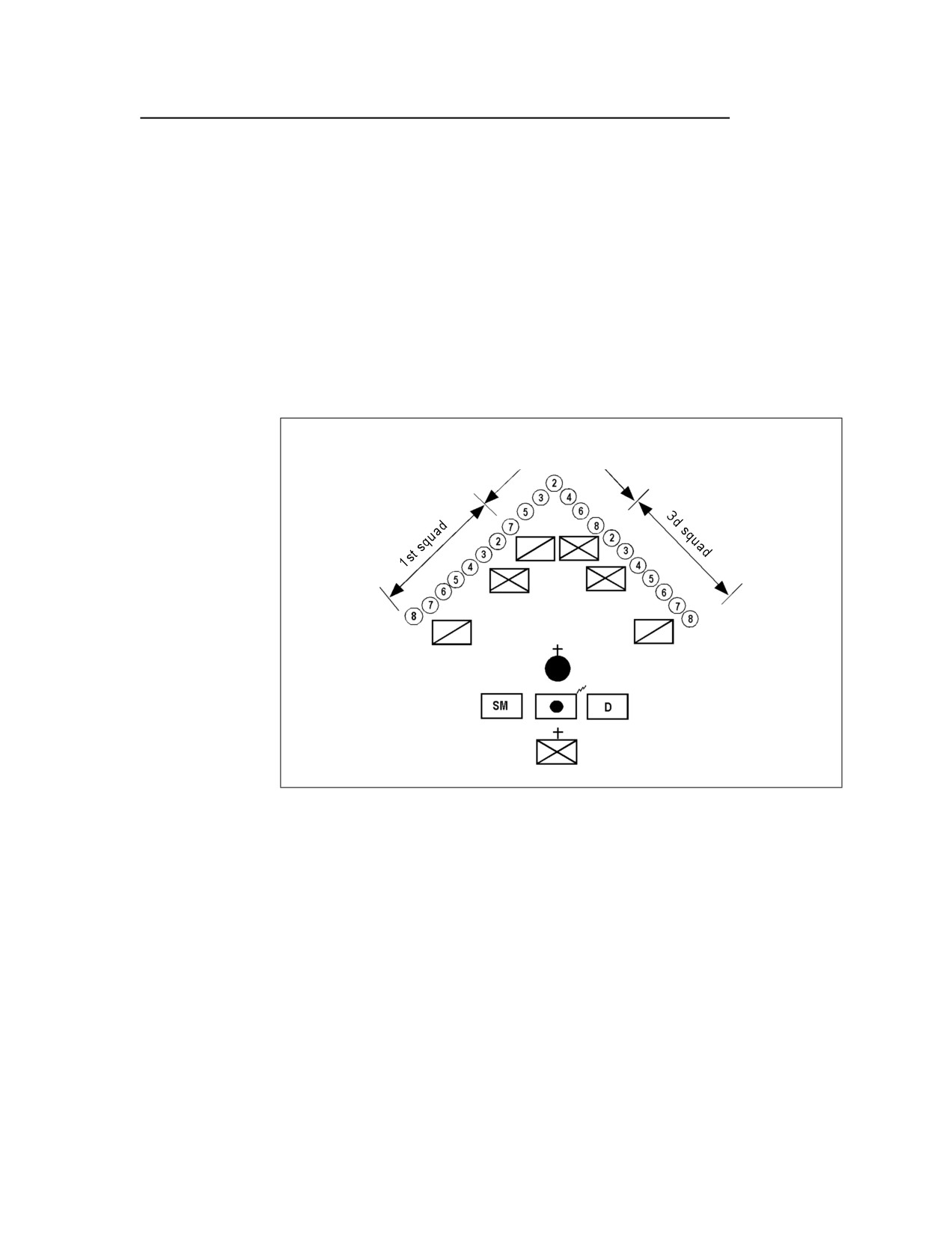
FM 3-19.40
side of the second squad. All squads halt automatically behind the platoon
headquarters and dress.
WEDGE FORMATION
B-80. The wedge formation (Figure B-3) is an offensive formation that is used
to penetrate and split crowds. The command for forming the platoon wedge is
PLATOON WEDGE, MOVE. The second squad executes a squad wedge at the
point designated by the platoon leader. The squad wedge consists of an
echelon left of the odd-numbered members and an echelon right of the
even-numbered members, with the baseman at the apex of the wedge. The
first and third squads form echelons left and right, respectively, of the second
squad.
2d squad
Figure B-3. Wedge Formation
B-81. Assembling from a wedge formation is similar to assembling from a
platoon echelon. The second squad assembles first. On the command
PLATOON ASSEMBLE, MOVE, the second squad leader moves to the point
designated by the platoon leader. The second squad assembles behind the
squad leader in numerical order. The first and third squads move into column
formation to the left and right of the second squad, respectively, and dress on
the second squad.
ECHELON FORMATION
B-82. The echelon formation (Figure B-4, page B-20) is an offensive
formation. It is used to turn or divert groups in open or built-up areas and to
move crowds away from buildings, fences, and walls. An echelon formation can
be an echelon right or an echelon left, depending on the direction in which the
crowd is to be moved.
Use of Force and Riot Control Measures B-19
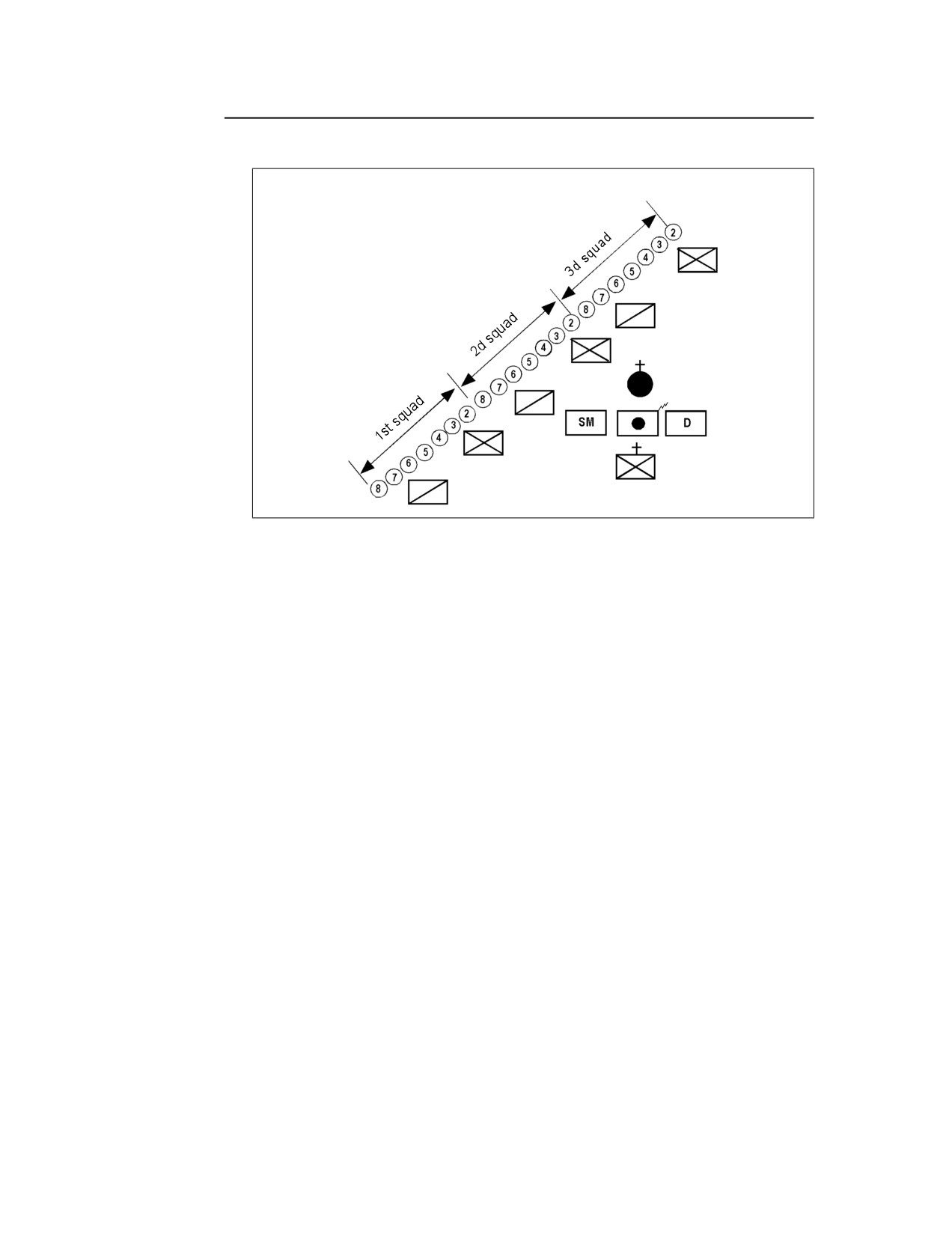
FM 3-19.40
Figure B-4. Echelon Left Formation
Platoon Echelon Left
B-83. The command for forming a platoon echelon left is PLATOON
ECHELON LEFT, MOVE. The third squad baseman posts himself at the
location designated by the platoon leader. Remaining squad members position
themselves one step back and one step to the left of the preceding soldier. As
each squad clears the column, the next successive squad moves out and
extends the echelon that has been formed.
B-84. To assemble the platoon from an echelon left, the commander takes his
position to the rear of the formation with the platoon headquarters. On the
command PLATOON ASSEMBLE, MOVE, the third squad moves and forms a
column at the point designated by the platoon leader. The first and second
squads assemble in column formation to the left of and dressed on the third
squad.
Platoon Echelon Right
B-85. The command for forming a platoon echelon right is PLATOON
ECHELON RIGHT, MOVE. The first squad baseman posts himself at the
location designated by the platoon leader. Remaining squad members position
themselves one step back and one step to the right of the preceding soldier. As
each squad clears the column, the next successive squad moves out and
extends the echelon that has been formed.
B-86. To assemble a platoon from an echelon right, the commander takes his
position to the rear of the formation with the platoon headquarters. On the
command PLATOON ASSEMBLE, MOVE, the first squad moves and forms a
column at the point designated by the platoon leader. The second and third
squads assemble in column formation to the right of and dressed on the first
squad.
B-20 Use of Force and Riot Control Measures