Military reference books and manuals (2009-2023, Volume 7) - page 19

Appendix B
Table B-4. Disseminate (continued)
Database management
Database managers address database development, management, and maintenance; data sources; information
redundancy; import and export standards; data management; update and backup procedures; and data mining, query,
and search protocols.
•
Establishing new databases. Have SOPs for establishing new databases to ensure all unit databases
conform to minimum standards established by unit automation personnel. Establishing new databases
prevents storage duplicate data and mixing of information to be stored at different classification levels and
with different security or access requirements.
•
Data entry. Have SOPs for data entry standards that include specific formats and standardized naming
conventions and fields (based on the category of information entered into the database). For example,
standardizing data entry on an IED with a primary field of “IED” and a secondary field specifying IED “type”
(such as VBIED, remote-controlled IED, or explosively formed projectile) allows the analyst to conduct an
organized search for information and intelligence.
•
Security protocols. Establish protocols:
Ensure authorized personnel can access the network, system, or database.
Prevent the import or export of data, based on accesses or classification levels, to unauthorized
networks, systems, or databases.
•
Associated applications. Ensure the appropriate software applications are legally installed on their systems
so that relevant databases can be created and accessed and that the data can be appropriately manipulated
in order to support the unit’s mission.
•
Data sources.
As early as possible, identify data sources required during the mission to ensure required
communications and security authorizations are appropriately coordinated.
May require different computer systems to access all the necessary data sources required for the
mission.
•
Database normalization. Have SOPs for database normalization to minimize data redundancy in a
database.
•
Import and export standards. A standardization of import and export protocols ensures transferred
databases are accessible immediately upon transfer. The DCGS-A enterprise open architecture should
assist in importing and exporting databases.
•
Update and backup procedures. Have a plan for updating software on networks and systems. Have
procedures in place to backup the data on networks and systems to prevent a loss if hardware or software
fails. Establish a system of archiving data.
CCIR—commander’s critical information requirement
PIR—priority intelligence requirement
DCGS-A—Distributed Common Ground System-Army
RFI—request for information
ISR—intelligence, surveillance, and reconnaissance
SCI—sensitive compartmented information
LTIOV—latest time information is of value
SIR—specific information requirement
MI—military intelligence
SOP—standing operating procedure
OPORD—operation order
VIED-vehicle-borne improvised explosive device
B-12
TC 2-50.5
6 January 2010
FOR OFFICIAL USE ONLY
Intelligence, Surveillance, and Reconnaissance Synchronization
ASSESS INTELLIGENCE, SURVEILLANCE, AND RECONNAISSANCE OPERATIONS
B-20. Assessment of ISR operations allows the staff to determine if the system is satisfying all
requirements. Table B-5 describes the subordinate
“Assess ISR Operations” activities and lists
considerations.
Table B-5. Assess ISR operations
Monitor operations
Through coordination with the G-2/S-2, the staff knows when and what critical information is missing from the
commander's estimate of the situation.
The staff uses the ISR synchronization matrix and ISR plan to ensure synchronization with the overall operation and
scheme of maneuver.
DST is the staff’s other critical tool for the staff, which has a complete copy of the DST to ensure the ISR
synchronization matrix does not miss collection requirements.
The intelligence officer—
•
Tracks the flow of the operation against the requirements and ISR synchronization matrices.
•
As necessary, prompts subordinate commanders and collectors to keep their reporting synchronized with the
operation and the commander’s needs.
•
Establishes a system to evaluate all reports, including reports going directly from the collector to the user.
•
Establishes a system that allows the intelligence section to monitor synchronization and evaluates if the
intelligence system meets requirements without delaying intelligence dissemination.
Correlate reports to requirements
•
The staff tracks ISR tasks and the PIRs from which they originate to ensure the collected information was
provided to the original requester.
•
The tracking allows the staff to determine quickly which asset is available for retasking.
Screen reports
The G-2/S-2 staff screens each report received for the following criteria:
•
Relevance. Does the information actually address the tasked ISR task? If not, can the information satisfy
other requirements?
•
Completeness. Is essential information missing? (Refer to the original ISR task.)
•
Timeliness. Has the collector reported by the LTIOV established in the original ISR task?
•
Opportunities for cueing. Can this system or another system take advantage of the new information to
increase the effectiveness and efficiency of the overall ISR effort? If the report suggests an opportunity to
cue other assets, take immediate action to do so and record any new requirements into the ISR plan and
audit trail.
If the report satisfies the ISR task, make the appropriate entry in the tracking log or register of intelligence requirements
and disseminate the final intelligence to the requestor. Coordinate with the requestor to ensure the requestor also
considers the requirements satisfied.
If the report only partially satisfies the ISR task, annotate in the audit trail or register what was accomplished and what
remains to be done.
Provide feedback
The staff—
•
Provides essential feedback to all the ISR assets—usually provided through the unit’s C2 element.
•
May provide additional information on its collection or analysis if the G-2/S-2 indicates what is needed.
C2—command and control
LTIOV—latest time information is of value
DST—decision support template
PIR—priority intelligence requirement
ISR—intelligence, surveillance, and reconnaissance
6 January 2010
TC 2-50.5
B-13
FOR OFFICIAL USE ONLY
Appendix B
UPDATE INTELLIGENCE, SURVEILLANCE, AND RECONNAISSANCE OPERATIONS
B-21. Updating ISR operations is the adjustment of the overall ISR plan to maintain ISR synchronized,
collection, and exploitation capabilities optimized as the current situation changes. As SIRs and,
subsequently, PIRs are answered, the G-3/S-3, in coordination with the G-2/S-2 and staff, updates the ISR
plan and refocuses assets to answer other or new ISR tasks within the constraints of the mission variables—
mission, enemy, terrain and weather, troops and support available-time available and civil considerations
(METT-TC). Simultaneously, the higher headquarters is going through the same process and may answer
subordinate unit PIRs or intelligence requirements. Thus, the requirements are linked to the headquarters
requirements process, and the staff updates the ISR plan in a dynamic environment. Table B-6 describes the
subordinate “Update ISR Operations” activities and lists considerations.
Table B-6. Update ISR operations
Maintain ISR synchronization
The intelligence staff stays alert to changes in the ISR plan resulting from changes to the LTIOV or other changes. If
the branches and sequels were considered in the original plan adjustments, minor variances can be adjusted
automatically by the staff.
Unanticipated situations—such as a friendly force aircraft crash or shoot down, loss of a UAS asset to enemy fire,
mechanical failure, or loss of signal—may require dynamic or ad-hoc tasking of additional ISR assets.
Cue assets to other collection opportunities
Cueing opportunities, whether prompted through combat information or analysis, allow intelligence officers to satisfy
requirements more efficiently than previously planned.
Eliminate satisfied requirements
Once a requirement is satisfied or irrelevant, it should be eliminated. Requirements require continuous coordination
with the agency that generated the original requirement.
When higher headquarters declares a requirement satisfied, the requirement should be eliminated from the ISR
synchronization matrix and the ISR plan, and other logs and records should be updated.
Develop and add new requirements
As the operation unfolds and the threat situation develops, commanders generate new requirements that lead to—
•
Updating the ISR synchronization tools.
•
Prioritizing the new requirements against the remaining requirements.
•
Consolidating the new requirements with the existing requirements.
•
Reprioritizing the requirements.
•
Evaluating resources based on newly developed requirements and priorities.
•
Making appropriate recommendations to the commander and the operations officer.
Recommend redirecting assets to unsatisfied requirements
Retasking is assigning an ISR asset a new task and purpose to ensure intelligence and operational synchronization.
After eliminating satisfied requirements from the ISR plan, reevaluate each ISR asset based on its capability.
Operations officers with input from the intelligence officers redirect ISR assets and units within the AO.
Focus the ISR asset on the most important unsatisfied requirements.
Redirecting an ISR asset does not change the asset’s mission; instead, it updates or corrects the focus of the
collection that allows the asset to more effectively execute that mission. When redirecting assets, consider—
•
New requirements from higher headquarters received before the completion of redirected missions.
•
The priority of new requirements relative to the remaining unsatisfied requirements.
•
The command or support relationship.
•
The ability of available ISR assets to respond to new missions while working on redirected missions.
•
Necessary responses to second- and third-order effects (see appendix E for further discussion on second-
and third-order effects), branches, and sequels.
Transition to next operation
A transition occurs when the commander decides to change focus from one type of military operation to another
(FM 3-90). Updating ISR operations can result in focus change for several ISR assets.
ISR assets, as with any other unit, may require rest and refit, or employment lead-time to effectively transition from one
mission or operation to another.
AO—area of operations
LTIOV—latest time information is of value
FM—field manual
UAS—unmanned aircraft system
ISR—intelligence, surveillance, and reconnaissance
B-14
TC 2-50.5
6 January 2010
FOR OFFICIAL USE ONLY
Appendix C
Briefing and Debriefing Program
The commander establishes, supports, and allocates appropriate resources for a
premission briefing and debriefing program. Battle updates and after-action reviews
are distinct and separate tasks from the premission briefing and debriefing program.
The G-2/S-2 develops a premission intelligence briefing plan and complementary
debriefing plan to support the commander’s program. The intelligence premission
briefing and debriefing generally follow the mission-briefing format, including a
review of the patrol route, mission patrol collection objectives, and methods
employed.
PREMISSION INTELLIGENCE BRIEFING
C-1. The purpose of the premission intelligence briefing is to ensure all personnel conducting tactical
operations, tactical movements, nontactical movements, and operational liaisons are sensitized to specific
information and reporting requirements, intelligence gaps, and unique mission requirements. (For more
information on operational liaison, see FM 2-91.6.)
C-2. Premission intelligence briefings may be an updated intelligence assessment or a detailed intelligence
brief, depending on the nature of the mission. Missions that occur routinely, like convoy operations or
presence patrols, are preceded by an updated intelligence assessment, including indicators of activity
related to the commander’s critical information requirements (CCIRs). Tactical operations, such as planned
raids, combat patrols, or patrols that can result in site exploitation, are preceded by a more detailed
intelligence briefing specific to the mission. This briefing has indicators related to the CCIRs and
instructions on handling captured enemy documents and materiel. Premission briefings include reporting
guidance for observed information. See FM 3-90.15 for more information on site exploitation.
KEY PREMISSION INTELLIGENCE BRIEFING POINTS
C-3. Patrols, tactical movements, and nontactical movements receive a premission intelligence briefing
containing—
Terrain impact updates.
Civil considerations (areas, structures, capabilities, organizations, people, events [ASCOPE])
updates.
Weather effects update.
Threat updates.
Route updates.
Focus areas for observation.
Collection requirements.
Reporting requirements for unusual activity or lack of activity by the local population.
Requirements for handling and disposing collected documents.
Requirements for the handling and disposition of enemy prisoners of war (EPWs), detainees, and
captured enemy materiel.
Requirements for digital photography use.
C-4. A premission intelligence briefing provides criteria for immediate reporting requirements and
nonpriority reporting requirements.
6 January 2010
TC 2-50.5
C-1
FOR OFFICIAL USE ONLY
Appendix C
MISSION RESPONSIBILITIES
C-5. Every mission entails personnel responsibilities for the mission’s success. Table C-1 provides a list
of mission personnel responsibilities.
Table C-1. Mission responsibilities
Battalion S-2 and S-3 sections—
•
Provide tasking and guidance on topic areas for tactical questioning based on unit PIRs.
•
Provide unit-focused intelligence and information, including open-source information, to help Soldiers
improve their cultural knowledge and awareness of the current situation to conduct tactical questioning.
•
Establish a program patrols, checkpoints or roadblocks, and convoys are debriefed.
•
Establish procedures for immediate information reporting of critical tactical value, for example, spot report in
SALUTE format.
•
Establish procedures for proper handling of captured equipment or media, such as cell phones, documents,
or computers.
•
Coordinate HUMINT collection teams and other intelligence support as appropriate.
Unit commanders—
•
Provide tasking and guidance to subordinate leaders on topic areas for tactical questioning based on unit
tasking and guidance.
•
Review IPB products and disseminate information to personnel within the G-2/S-2 section to improve their
knowledge of the AO.
•
Support the unit G-2/S-2 debriefing program and ensure that all patrols, traffic control points or roadblocks,
and convoy Soldiers participate in the debriefing.
•
Reinforce the importance of the procedures for immediate information reporting of critical tactical value.
•
Are cautious about information reported by patrols and HUMINT collection teams.
Note. Single-source, unanalyzed information can be misleading. When used, it should be fused with all-source
analyzed intelligence or other corroborating information.
Platoon leaders—
•
Provide tasking and guidance to squads, sections, patrols, checkpoints or roadblocks, and convoy leaders
on topic areas for tactical questioning based on unit tasking and guidance.
•
Support the unit G-2/S-2 debriefing program and ensure all patrols, checkpoints or roadblocks, and convoy
Soldiers participate in the debriefing.
•
Reinforce the importance of the procedures for immediate reporting of information of critical tactical value.
Squad/section/patrol/traffic control point/roadblock/convoy leaders—
•
Train and integrate specific tactical questioning in the planning, preparation, and execution of patrols,
checkpoints or roadblocks, and convoys based on unit tasking and guidance.
•
Prepare for and participate in the unit S-2’s debriefing program (if necessary, demand the debriefing) after all
patrols, traffic control points or roadblocks, and convoys.
•
Report information based on visual observations and tactical questioning in preparation for the debriefing or
immediate reporting of information of critical tactical value.
•
Carefully carry out EPW/detainee and document handling during patrols, checkpoints or roadblocks, and
convoys.
•
Conduct captured enemy materiel handling in accordance with local SOPs or OPORDs.
AO—area of operations
OPORD—operation order
EPW—enemy prisoner of war
PIR—priority intelligence requirement
HUMINT—human intelligence
SALUTE—size, activity, location, unit, time, equipment
IPB—intelligence preparation of the battlefield
SOP—standing operating procedure
POSTMISSION DEBRIEFING
C-6. Debriefing is the systematic questioning of cooperating human sources to satisfy intelligence
requirements consistent with applicable law. The source is usually not in custody and is usually willing to
cooperate. Debriefing may be conducted at all echelons and in all operational environments (FM 2-0).
Friendly force debriefing operations are the systematic debriefing of U.S. forces to answer intelligence,
surveillance, and reconnaissance (ISR) tasks. Predictive intelligence is enhanced by analyzing what is
occurring within an area of operations (AO). Debriefing also facilitates situational understanding of the
AO.
C-2
TC 2-50.5
6 January 2010
FOR OFFICIAL USE ONLY
Briefing and Debriefing Program
C-7. The purpose of debriefing is to identify and record data pertaining to assigned specific information
requirements (SIRs) and ISR tasks, and any additional information and observations concerning the AO,
and to collect any fliers, pamphlets, media, or pictures the patrol found or obtained.
C-8. Debriefing participants should include—
All leaders returning from operational liaison or meetings.
Returning patrols.
Human intelligence (HUMINT) collection teams (HCTs).
Helicopter pilots.
Convoy personnel.
Others who may have obtained information of intelligence value.
C-9. The intelligence section—
Debriefs personnel.
Writes and submits reports.
Reports information verbally, as appropriate.
C-10. Table C-2 provides key debriefing points that assist the intelligence staff or command debriefing
team in the debriefing process.
Table C-2. Key debriefing points
•
The requirement for a debriefing by the intelligence section following each mission should be a part of the
intelligence premission briefing.
•
Leaders should not consider the mission complete or release mission personnel until reporting and
debriefings are completed.
•
Once the element (leader, patrol, convoy) returns from the mission, the intelligence staff or command
debriefing team conducts a thorough debriefing.
•
Debriefing should include all patrol members—the leader, unit members, and any attached personnel. In the
event that the returning patrol splits into different locations, the intelligence staff should visit each location to
debrief all patrol members.
•
When company, platoon, or smaller elements deploy to remote locations, intelligence staff debriefings may
be impossible. Platoon and company leaders conduct debriefings in accordance with standing operating
procedures to ensure reports are available to the intelligence section and staff. Expeditious reporting
ensures that patrol debriefing reports and additional notes are available for timely intelligence analysis.
•
Like the mission briefing, the debriefing intelligence staff should review the route traveled, collection
objectives of the patrol, and methods employed.
•
After the debriefing, the intelligence staff should have received the patrol report, which will streamline the
intelligence staff debriefing process. This allows the intelligence staff to concentrate on filling in gaps and
following up on reported information.
•
A practical method of debriefing is reviewing all patrol or mission actions chronologically.
•
A detailed sketch provides a visual reference of debriefed patrol areas. Recalling and recording information
is simplified when the information is divided into segments that flow logically. For example—
Use a map to determine segments of the route traveled.
Coordination points, checkpoints, phase lines, or significant events may divide segments.
Start at the beginning of the patrol route and let the patrol leader demonstrates—using the map—the
route traveled.
Ask the patrol leader, “From Checkpoint 1 to Checkpoint 2, what did you observe?” The goal is to
extract information of intelligence value.
Avoid requesting priority intelligence requirements only. This limits the patrol leader’s answers and
increases the likelihood of missing significant information. Instead, let the patrol leader provide the
information obtained while on that segment of the trip.
Use follow-up questions to obtain complete information. Always ask, “What else?” or “What other?”
before closing a topic.
If the patrol used digital cameras, it is helpful to use their pictures during the debriefing.
•
Once a travel segment has been fully exploited, continue to the next segment. Question the patrol leader
from Checkpoint 2 to Checkpoint 3—continuing the process until the entire route has been exploited.
6 January 2010
TC 2-50.5
C-3
FOR OFFICIAL USE ONLY

Appendix C
Table C-2. Key debriefing points (continued)
•
Written report information should include—
Use a map to determine segments of the route traveled.
Size and composition of the unit conducting the patrol.
Mission (type, location, and purpose).
Departure and return date-time groups.
Routes. Use checkpoints and grid coordinates for each leg or include an overlay or detailed sketch.
Detailed description of identified terrain and threat positions.
Results of any contact with the local population or the threat (activities and demeanor or attitude).
Unit status at the conclusion of the mission, including the disposition of dead or wounded Soldiers.
Description of collected materiel, such as fliers, pamphlets, media, or pictures the patrol found or
obtained.
•
Conclusions or recommendations.
C-11. See table C-3 for more debriefing considerations.
Table C-3. Debriefing considerations
Sight
Hearing
Touch
Smell
•
Threat personnel,
•
Running engines or
•
Warmth of
•
Vehicle
vehicles, and
track sounds.
coals and
exhaust.
aircraft.
•
Voices.
materials from
•
Burning
•
Sudden or unusual
•
Metallic sounds.
fires.
petroleum
movement.
•
Gunfire (by
•
Freshness of
products.
•
New local
weapon type).
tracks.
•
Cooking
inhabitants.
•
Unusual calm or
•
Age of food or
food.
•
Smoke or dust.
silence.
trash.
•
Age of food
•
Unusual movement
•
Dismounted
or trash.
of farm or wild
movement.
•
Human
animals.
•
Aircraft.
waste.
•
Unusual activity or
Other considerations
lack of activity by
•
Armed elements: Location of factional forces, minefields, and potential
local inhabitants,
threats.
especially at times
•
Homes and buildings: Condition of the roofs, doors, windows, lights,
and places that are
normally inactive or
power lines, water, sanitation, roads, bridges, crops, and livestock.
active.
•
Infrastructure: Presence of functioning stores, service stations, other.
•
Vehicle or
•
People: Numbers, sex, age, residence or status of dislocated civilians,
personnel tracks.
visible health, clothing, daily activities, and leaders.
•
Movement of local
•
Contrast: Has anything changed? For example, are there new locks on
inhabitants along
buildings? Are windows boarded up or previously boarded-up windows
uncleared areas,
now open, indicating a change of use of a building? Have buildings been
routes, or paths.
defaced with graffiti?
•
Signs or evidence
of threat occupation
or threat trends.
•
Recently cut foliage
or vegetation.
•
Muzzle flashes,
lights, fires, or
reflections.
•
Amount and type of
trash.
C-4
TC 2-50.5
6 January 2010
FOR OFFICIAL USE ONLY
Appendix D
Graphic Intelligence Reports
Intelligence personnel use a variety of formats to request, report, and disseminate
information. (See TC 2-33.4.) The formats assimilate information into automated
intelligence support systems, such as the Distributed Common Ground System-Army
(DCGS-A). This appendix concentrates on the graphic intelligence summary
(INTSUM) and the use of storyboards.
GRAPHIC INTELLIGENCE SUMMARY AND STORYBOARD
D-1. The graphic INTSUM is used by units at all echelons to convey threat situation dynamics. It is a
current depiction of significant threat dispositions, activities, strengths, and weaknesses and an assessment
of the most probable threat courses of action (COAs). A current, complete graphic INTSUM provides
intelligence, surveillance, and reconnaissance (ISR) efficiency and enables the commander to exploit
fleeting threat vulnerabilities.
D-2. A storyboard tells a story using bulleted points, charts, and graphs. However, it should be regarded as
the story summary—containing only pertinent data. It should communicate the who, what, where, when,
and why/how. Storyboards are typically used to convey significant actions to the commander.
D-3. There is not a specific format for a graphic INTSUM or storyboard. The formats for each are
determined by the user of the information—namely, the commander.
GRAPHIC INTELLIGENCE SUMMARY—OFFENSIVE AND
DEFENSIVE OPERATIONS
D-4. At a minimum the graphic INTSUM should contain the following information for offensive/
defensive operations. (See figure D-1 [page D-2].)
Legend and margin information.
Area orientation.
Threat unit locations and mission activities.
Threat mission capabilities assessment.
Threat boundaries and front-line trace.
Threat objectives.
Threat air activity.
Threat weaknesses and vulnerabilities.
Threat strengths and capabilities.
Threat intentions assessment.
Friendly commander’s intent and priority intelligence requirements (PIRs).
Predicted future threat activity.
6 January 2010
TC 2-50.5
D-1
FOR OFFICIAL USE ONLY

Appendix D
Figure D-1. One-page graphic intelligence summary example
LEGEND AND MARGIN INFORMATION
D-5. Legend and margin content information may include—
Classification of the graphic INTSUM—posted on top and bottom—including a “Classified by”
line and declassification instructions.
Title.
D-2
TC 2-50.5
6 January 2010
FOR OFFICIAL USE ONLY

Graphic Intelligence Reports
Issuing headquarters.
As of Date. Use either local or Zulu time—this is critical since predicted threat activity is
depicted based on the As of Date in addition to a given number of hours.
AREA ORIENTATION
D-6. Selected geographic features are highlighted on the overlay to orient the user to the displayed area.
The features selected depend on the specific area of operations (AO) and the friendly unit’s mission type.
D-7. Common features may include cities, rivers, and major relief features. Selected features for some
stability operations are highlighted on a smaller scale. Highlighted features may include airports, fuel
stations, housing areas, and other features that play prominently in the operation. A graphic INTSUM
should provide only those features necessary for orientation.
THREAT UNIT LOCATIONS AND MISSION ACTIVITIES
D-8. Depict committed threat unit locations with a bracket followed by the identification. The bracket
size indicates the frontage occupied by the unit. The unit’s mission is depicted graphically. (See figure D-2.)
Figure D-2. Threat unit locations and mission activities (committed)
D-9. Depict uncommitted threat units with the symbology shown in figure D-3.
Figure D-3. Threat unit locations and mission activities (uncommitted)
6 January 2010
TC 2-50.5
D-3
FOR OFFICIAL USE ONLY

Appendix D
THREAT MISSION CAPABILITIES ASSESSMENT
D-10. Use combat effectiveness graphics to assess and display a threat unit’s capability to perform its
mission. Consider all factors, tangible and intangible, in making the assessment. Include unit strength,
sustainment status, maintenance and readiness status, morale, mission, terrain, and weather. Place selected
symbols in the vicinity of the identified unit. (See figure D-4.)
Figure D-4. Threat mission capabilities assessment
D-11. A diminished threat mission capability is usually due to one or more specific problem areas—
damaged or destroyed weapons systems, a lack of ammunition, petroleum, oils, and lubricants (POL), or
replacement personnel. Graphically depict the problem areas for each unit adjacent to the threat mission
capabilities assessment symbol. The friendly commander can then exploit what is possibly crucial, but
fleeting threat vulnerability.
D-12. Indicate specific problem areas by blackening the appropriate quadrant of the circle. The problem
area categories are not static; other problem areas can be displayed on the symbol if the selection is clearly
explained in the graphic. Figure D-5 shows a sample problem area symbol and an example of a problem
area symbol used in conjunction with the threat mission capabilities assessment symbol.
Figure D-5. Threat problem area symbology
D-4
TC 2-50.5
6 January 2010
FOR OFFICIAL USE ONLY

Graphic Intelligence Reports
THREAT BOUNDARIES AND FRONT-LINE TRACE
D-13. In conventional military operations, threat boundaries are depicted two echelons below the friendly
unit. For example, at the brigade combat team (BCT) level, boundary lines for the threat battalion and
company elements are depicted. Depicting threat boundaries beyond two echelons lower is difficult to
delineate and clutters the graphic INTSUM. In some irregular warfare operations, such as support to
insurgency and counterinsurgency, smaller units are the rule and constantly accounted for on the graphic
INTSUM.
D-14. The front-line trace is not shown on the graphic INTSUM. The brackets depicting the threat unit, in
contact, frontages is sufficient for an effective front-line trace. Addition of a front-line trace is easily
confused with depicting predicted threat activity.
THREAT OBJECTIVES
D-15. If threat objectives are discernable, they will be placed on the graphic INTSUM.
THREAT AIR ACTIVITY
D-16. Depict threat air activity on the graphic INTSUM. Use an aircraft symbol with the direction of travel
and total number of sorties in parentheses. Some units may opt to break down the sortie count by category,
such as fighter (F), bomber (B), and reconnaissance (R). For example, a total sortie count of 12 could be
depicted as (12). The same sortie count could also be depicted as (4F/6B/2R). The sortie breakdown should
be used only if it does not clutter the graphic INTSUM. Include sortie breakdown symbols, such as F, B,
and R. (See figure D-6.)
Figure D-6. Threat air activity symbology
THREAT WEAKNESSES AND VULNERABILITIES
D-17. Show specific weaknesses or vulnerabilities by using a numbered circle on the graphic INTSUM.
(See figure D-1 [page D-2].) A supporting message could list threat weaknesses and vulnerabilities in
narrative form.
THREAT STRENGTHS AND CAPABILITIES
D-18. Show threat strengths and capabilities by using numbered squares. (See figure D-1 [page D-2].)
THREAT INTENTIONS ASSESSMENT
D-19. Write an assessment of threat intentions and most probable COA in a concise narrative format;
graphically key it to the graphic INTSUM when possible.
6 January 2010
TC 2-50.5
D-5
FOR OFFICIAL USE ONLY

Appendix D
FRIENDLY COMMANDER’S INTENT AND PRIORITY INTELLIGENCE REQUIREMENTS
D-20. List the friendly commander’s intent and PIRs in narrative format on the graphic INTSUM.
Graphically key these statements to the overlay.
PREDICTED FUTURE THREAT ACTIVITY
D-21. Draw predicted lines of threat advance or withdrawal and link them to a timeline to convey
information about possible future threat activity. (See figure D-7.) Predicted lines of advance or withdrawal
are based on the “AS OF” time located in the legend and margin information.
Note. Predicted lines are only an aid to planners. Current threat situations must be continuously
monitored to update the predictions.
Figure D-7. Predicted threat activity timelines
GRAPHIC INTELLIGENCE SUMMARY—COUNTERINSURGENCY
OPERATIONS
D-22. The graphic INTSUM may contain the following information for counterinsurgency operations:
Legend and margin information.
Weather.
Significant activity (SIGACT) in the AO.
AO executive summary.
Indications and warning (I&W).
Battle damage assessment (BDA) rollup.
Special assessments, as required.
Significant dates.
Current threat situation template.
Predicted threat activity—next 24 to 48-hours.
Current commander’s critical information requirements (CCIRs)/changes to CCIRs.
High-payoff target list (HPTL).
High-value target list (HVTL).
Be on the look-out (BOLO) list.
ISR plan.
D-6
TC 2-50.5
6 January 2010
FOR OFFICIAL USE ONLY
Graphic Intelligence Reports
LEGEND AND MARGIN INFORMATION
D-23. Legend and margin content information may include—
Classification of the graphic INTSUM—posted on top and bottom—including a “Classified by”
line and declassification instructions.
Title of document.
Issuing headquarters.
Note. Appropriate classification markings must be on every slide or page (top and bottom).
WEATHER
D-24. Weather contents may include—
A near term weather forecast and at least a 5-day forecast for the AO, as required.
The effects of the weather on threat and friendly operations.
A legend if using color-coding system.
See appendix G, for an example.
SIGNIFICANT ACTIVITIES IN THE AREA OF OPERATIONS
D-25. SIGACTs content may include—
Summary of SIGACTs for the AO—with analyst assessment. (See figure D-8 [page D-8].)
Storyboard with a detailed summary of SIGACTs. (See figure D-9 [page D-9]):
Location—Zone/Neighborhood with grid (Where).
Date-time group (DTG) of the activity (When).
Unit reporting the SIGACT and the intelligence sources (Who).
Description of the activity (What).
Assessment—near term analysis of threat intent and activity (Why).
Summaries of SIGACTs over time, such as improvised explosive device (IED) incidents in the
last 24 hours. (See figures D-10 [page D-10] and D-11 [page D-11].)
Map or imagery with callouts or symbols that depict where the SIGACT occurred and the type of
activity.
Grouping by unit, activity, timeframe, or operation (situation dependent).
6 January 2010
TC 2-50.5
D-7
FOR OFFICIAL USE ONLY

Appendix D
Figure D-8. Significant activities in the area of operations
D-8
TC 2-50.5
6 January 2010
FOR OFFICIAL USE ONLY

Graphic Intelligence Reports
Figure D-9. Storyboard example
6 January 2010
TC 2-50.5
D-9
FOR OFFICIAL USE ONLY

Appendix D
Figure D-10. Sample summary of weekly murders
D-10
TC 2-50.5
6 January 2010
FOR OFFICIAL USE ONLY

Graphic Intelligence Reports
Figure D-11. Improvised explosive device activity summary
AREA OF OPERATIONS EXECUTIVE SUMMARY
D-26. The AO executive summary contents may include—
G-2/S-2 assessment of current threat activity within the AO and the effects on operations.
Assessment of threat activity in each of the lower echelon S-2’s AO.
6 January 2010
TC 2-50.5
D-11
FOR OFFICIAL USE ONLY

Appendix D
INDICATIONS AND WARNING
D-27. I&W contents (see figure D-12) may include—
Gist of the significant reports for the last two weeks.
Map of the area of interest (AOI).
Threat condition level.
Grouping by intelligence source
(human intelligence
[HUMINT], signals intelligence
[SIGINT]), or time period.
Figure D-12. Indications and warning reporting
BATTLE DAMAGE ASSESSMENT ROLLUP
D-28. BDA rollup contents (see figure D-13) may include—
Number of threat personnel wounded in action
(WIA), killed in action
(KIA), captured
(detained) in the AO.
Disposition of the detainees (in holding facility, released, transferred).
D-12
TC 2-50.5
6 January 2010
FOR OFFICIAL USE ONLY

Graphic Intelligence Reports
Figure D-13. Sample detainee rollup
SPECIAL ASSESSMENT
D-29. The requirements for and the components of a special assessment are determined by the commander
or the staff. Generally, special assessment components may include—
Subject title.
Synopsis of the incident or activity.
Detailed reporting.
6 January 2010
TC 2-50.5
D-13
FOR OFFICIAL USE ONLY
Appendix D
Related PIRs.
Map, imagery, or photograph.
Analyst assessment or comments detailing the affect the incident or activity will have on future
operations.
SIGNIFICANT DATES
D-30. Contents (see figure D-14) may include—
Date.
Event.
Popular significance, such as special prayers, fasting, visiting holy shrines, processions.
Level of impact on the AO—the “so what” factor.
UNCLASSIFIED
For Official Use Only
Upcoming Significant Dates
Probable impact
Date
Event
Popular significance
on the AO
Special prayers, fasting, larger
Laylat al-Bara’ah
No/Low
8 September
processions around the shrines,
(Night of absolution)
Level of impact
chanting
Birth of the 12th Iman
Visiting the holy shrines, processions,
Low
8 September
(Shia)
chanting
Level of impact
Low
22 September
Iran-Iraq war begins (1980)
Level of impact
UNCLASSIFIED
For Official Use Only
Figure D-14. Significant dates
THREAT CURRENT SITUATION TEMPLATE
D-31. Threat current situation template contents may include—
Threat locations.
Threat task and purpose.
Threat capabilities assessment.
Threat AOs.
Threat weaknesses and vulnerabilities.
Threat strengths and capabilities.
Threat intentions assessment.
PREDICTED THREAT ACTIVITY—NEXT 24 TO 48 HOURS
D-32. Contents (see figure D-15) may include—
Continuous threats in the AOI.
Threats expected in the next 24 to 48 hours.
Description of activity expected.
DTG or hours activity is expected.
Map or imagery of AOI with threat activity depicted.
D-14
TC 2-50.5
6 January 2010
FOR OFFICIAL USE ONLY

Graphic Intelligence Reports
Figure D-15. Predicted threat activity—next 24-48 hours example
HIGH-PAYOFF TARGET LIST
D-33. HPTL contents may include—
Current HPTL (prepared by targeting officer).
Highlighted HPTL changes or new additions.
HIGH-VALUE TARGET LIST
D-34. HVTL contents (see figure D-16 [page D-16]) may include—
Target number.
Unit.
Target value analysis (TVA).
Individual’s description (as detailed as possible).
Execution criteria.
Photo.
D-35. See appendix E for more information.
6 January 2010
TC 2-50.5
D-15
FOR OFFICIAL USE ONLY

Appendix D
UNCLASSIFIED
For Official Use Only
High-Value Target List
Target #
Execution
Version 045, 06Jul07
Status/photo
unit
criteria
Sheik Samee—
•
Is anti-Iraqi force cell leader and Imam of
the neighborhood mosque.
•
Receives logistic support from Jeff
BCT
PID
regularly.
•
Is associated with Sheik Tamir
Source
(Cavalry)
(detained), Sabir (detained), and Sheik
Location
No photo available
Sabir.
Trigger
TVA #
•
Used the mosque to screen, torture, and
kill Sunni Muslims in the area. Use of
Evidence
mosque as a torture facility can be
verified by several HUMINT reports and
accounts of a kidnapped Iraqi released
due to Shia status.
Kadeer (last name unknown)—
•
Is anti-Iraqi force cell leader and
facilitator living in Muhallah ### in a city
PID
BCT
neighborhood.
Source
•
Acquired possible IEDs (some are
(Infantry)
operational), as indicated by reports.
Location
No photo available
•
Has an extensive network of informants
Trigger
TVA #
who warn of operations conducted
Evidence
against cell members.
•
Is involved in weapons trafficking,
assassinations, IEDs, and kidnappings.
Shayikh Walid—
PID
BCT
•
Is anti-Iraqi force cell leader under
Shayikh Mansur.
Source
•
Is responsible for the protection of all
(Cavalry)
Location
No photo available
personnel at the mosque.
Trigger
•
Is in charge of cells responsible for
TVA #
various insurgent activities in the area.
Evidence
•
Meets with Shayikh Merwan daily.
Shayikh Mustafa—
•
Is high-level anti-Iraqi force cell leader in
PID
the area.
Source
BCT
•
Is quite involved with the detention and
execution of dozens of Sunnis in
Location
No photo available
TVA #
surrounding areas.
Trigger
•
Manages the mosque in the area.
Evidence
•
Is associated with Hassaan, Haashim,
Rami, and Malik.
BCT—brigade combat team
PID—positive identification
HUMINT—human intelligence
TVA—target value analysis
IED—improvised explosive device
UNCLASSIFIED
For Official Use Only
Figure D-16. Sample high-value target list
D-16
TC 2-50.5
6 January 2010
FOR OFFICIAL USE ONLY
Graphic Intelligence Reports
BE ON THE LOOK-OUT LIST
D-36. BOLO list contents (see figure D-17) may include—
Date.
Description of vehicle.
Level of threat.
Date
Vehicle
Threat
Anti-Iraqi force planned to detonate a VBIED at
Acura Legend 1991 model, dark blue, Baghdad
5 July 2008
0730 hours in a neighborhood targeting coalition
plate number 127557.
forces.
Dodge Ram 2004 model, black, Baghdad plate
VBIED may be located in a city neighborhood—
3 July 2008
number 39341.
to be used against a target within the city.
Toyota Matrix 2004 model, red, Baghdad plate
An unspecified number of VBIEDs entered the
3 July 2008
number 39341.
city planning to attack police Army checkpoints.
Vehicle description and license plate number, if
The vehicle may be a VBIED.
2 July 2008
possible.
Anti-Iraqi forces execute attacks against
Vehicle description and license plate number, if
2 July 2008
unspecified objectives in the AOI. The mentioned
possible.
cell should be in possession of rockets.
Extremist group elements supposedly planned
hostile actions in the city in the direction of
2 July 2008
objectives not yet defined. The extremist cell
should be in possession of three vehicles
allegedly built as VBIEB.
AOI—area of interest
VBIED—vehicle-borne improvised explosive device
Figure D-17. Be on the look-out list example
INTELLIGENCE, SURVEILLANCE, AND RECONNAISSANCE PLAN
D-37. ISR plan contents may include—
ISR overlay.
PIRs—with changes highlighted.
ISR synchronization matrix.
6 January 2010
TC 2-50.5
D-17
FOR OFFICIAL USE ONLY
This page intentionally left blank.
Appendix E
Intelligence Support to Targeting
A target is an entity or object considered for possible engagement or action (JP 3-60). It
may be an area, complex, installation, force, equipment, capability, function,
individual, group, system, entity, or behavior identified for possible action to support
the commander’s objectives, guidance, and intent. Targets are categorized as planned
and immediate.
TARGETING PROCESS
E-1. Targeting is the process of selecting and prioritizing targets and matching the appropriate response to
them, considering operational requirements and capabilities (JP 3-0). Targeting is based on the enemy’s
assets, which provide an advantage, friendly scheme of maneuver, and tactical plans. Therefore, its purpose
is to disrupt, delay, or limit threat interference with friendly courses of action (COAs). Targeting options
can be lethal or nonlethal. It requires coordinated interaction between the fires cell’s operations,
intelligence, information engagement, information operations
(IO), and plans cells. Based on the
commander’s guidance and targeting objectives, the staff determines what targets to attack and how and
where to attack them. Targets should be assigned to the best systems to achieve the desired effects, which
can also be thought of as conditions that support achieving an associated objective.
E-2. Direct effects are immediate, first-order consequences of a military action, unaltered by intervening
events or mechanisms. Indirect effects are the delayed and/or displaced second-, third-, and higher-order
consequences of action, created through intermediate events or mechanisms. (See JP 3-60.)
E-3. In stability operations, target development and targeting are difficult because of the greater emphasis
on the effects of combat operations on the local government, Army, police, and the civilian population—
second- and third-order effects are considered.
E-4. For more information on targeting, see FM 6-20-10 and JP 3-60.
Second- and Third-Order Effects Example
In Iraq, separating anti-Iraqi forces from the Iraqi population avoids the possibility of
further combat. For example, Friendly forces conduct a successful cordon and search
by finding a room full of IEDs. They do not address and mitigate the civilians’
concerns over the damage caused by the cordon and search (second-order effect).
Consequently, the friendly forces will deal with civilian demonstrations or uprisings
that will deplete combat power needed for other operations. If the population’s
security and facility needs are not addressed, the anti-Iraqi forces personnel and
weapons will resume threat activities (third-order effects).
6 January 2010
TC 2-50.5
E-1
FOR OFFICIAL USE ONLY
Appendix E
INTELLIGENCE SUPPORT TO TARGETING
E-5. Providing intelligence support to targeting is one of the four primary intelligence tasks on the Army
Universal Task List (AUTL), which provides the commander information and intelligence support to
targeting through lethal and nonlethal actions. It includes intelligence support to the planning (target
development) and execution of direct and indirect fires, command and control (C2) engagement, and
information engagement as well as assessing the effects of those operations. The intelligence officer also
ensures the intelligence, surveillance, and reconnaissance (ISR) plan supports the finalized targeting plan.
Table E-1 lists the functions of intelligence support to targeting.
Table E-1. Functions of intelligence support to targeting
•
Commander’s intent.
•
HPTs.
•
Attack criteria.
Receive guidance on—
•
Lead time between decision points and TAIs.
•
ROE.
•
Conditions to establish combat assessment requirements.
•
MCOO.
Develop—
•
Situation and event templates.
•
HVTs.
•
Threat COA as part of wargaming based on friendly COA, refine event
Explain—
template, assist in developing the HPLT, TSS matrix, and sensor or
attack systems matrix.
Produce—
•
ISR synchronization tools.
Brief—
(Ensure all analysts and ISR
•
Intelligence analyst sections (threat COA, HPTL, TSS, and AGM).
asset managers understand the
commander’s intent.)
Collect—
•
Information for nomination, validation, and combat assessment.
•
HPT related information and intelligence to the fires cell immediately.
Disseminate—
•
Pertinent information and BDA per SOPs and TTP.
Ensure—
•
Information collection and intelligence production support all FRAGOs.
AGM—attack guidance matrix
ISR—intelligence, surveillance, and reconnaissance
BDA—battle damage assessment
MCOO—modified combined obstacle overlay
COA—course of action
ROE—rules of engagement
FRAGO—fragmentary order
SOP—standing operating procedure
HPT—high-payoff target
TOI—targets of interest
HPTL—high-payoff target list
TSS—target selection standard
HVT—high-value target
TTP—tactics, techniques, and procedures
E-2
TC 2-50.5
6 January 2010
FOR OFFICIAL USE ONLY
Intelligence Support to Targeting
METHODOLOGY
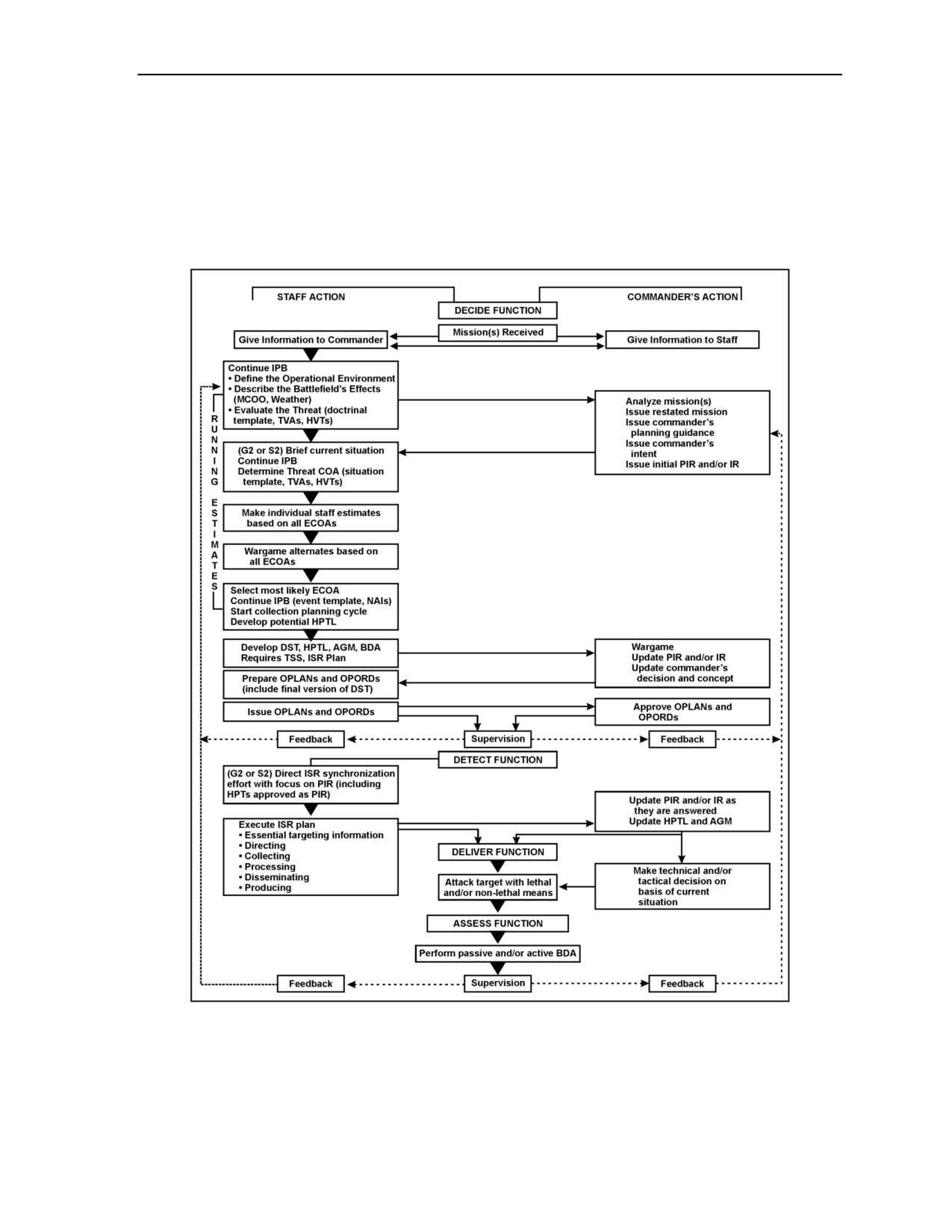
E-6. Decisions create the guidelines for the acquisition and engagement of targets. Target acquisition
(TA) and attack are made through a decision cycle. (See figure E-1.) Decide, detect, deliver, and assess
(D3A) together represent the decision cycle or methodology used to translate the commander’s intent into a
plan. Table E-2 (page E-4) shows the targeting methodology. Table E-3 (page E-4) lists factors to consider
during targeting.
Figure E-1. D3A targeting process
6 January 2010
TC 2-50.5
E-3
FOR OFFICIAL USE ONLY
Appendix E
Table E-2. Targeting methodology
Decide
Detect
Deliver
Assess
•
Target
•
Target detection
•
Attack.
•
Tactical level.
development.
means.
•
Planned targets.
•
Operational
•
TVA.
•
Detection
•
Targets of
level.
•
HPTs and HVTs.
procedures.
opportunity.
•
Restrike.
•
TSS.
•
Target tracking.
•
Desired effects.
•
Feedback.
•
Attack options.
•
Attack systems.
•
Attack guidance.
Note. Tracking the target is applicable during all steps.
HPT—high-payoff target
TSS—target selection standard
HVT—high-value target
TVA—target value analysis
Table E-3. Targeting considerations
Decide: Conduct during the planning phase of the operation. Who or what to attack? Is the target worth
engaging with available assets?
Are the commander’s planning guidance and intent detailed enough to enable the targeting team to determine—
•
HVTs to nominate as HPTs?
•
Desired effects on each HPT?
•
When to attack each HPT?
•
Any restrictions or constraints?
•
Which HPTs require BDA?
What targeting assets (organic, attached, or supporting) are available to detect and attack HPTs?
What detect, deliver, and assess support is needed from higher headquarters?
When are requests to higher headquarters submitted to obtain the support when required?
Have target-tracking responsibilities been established?
Are systems in place to handoff the detected targets to assets that are capable of tracking them?
What detect, deliver, and assess support is required from subordinate units, and when is it required?
What detect, deliver, and assess support requests were received from subordinate units, and what was done with
them?
Has the AGM been synchronized with the decision support matrix and the maneuver and fire support plans?
Are all commands using a common datum for locations? If not, are there procedures to correct differences in data?
Detect: Conduct mainly during the preparation and execution phases of the operation. How to acquire the
Do ISR synchronization tools focus on the appropriate PIRs?
What accuracy, timeliness, and validity standards, such as, TSSs, are in effect for detection and delivery systems?
Are all target acquisition systems fully employed?
Have backup target acquisition systems been identified for HPTs?
Have responsibilities been assigned to the appropriate unit or agency for detecting each HPT?
Are HPTs being tracked?
Have verification procedures using backup systems been established where necessary?
Are target acquisition and BDA requirements distributed properly among systems that can accomplish both?
E-4
TC 2-50.5
6 January 2010
FOR OFFICIAL USE ONLY
Intelligence Support to Targeting
Table E-3. Targeting considerations (continued)
Deliver: Execute the mission to achieve the desired results. Execute attacks on selected targets IAW the FRAGO and
the target synchronization matrix. This includes lethal and nonlethal operations.
Have communications links been established between detection systems, the decisionmaker, and delivery systems?
Have responsibilities been assigned to the appropriate unit or agency for attacking each HPT?
Has a backup attack system been identified for each critical HPT? (The primary system may not be available when the
HPT is verified.)
Have fire support coordination measures or AGM and clearance procedures been established to facilitate target
engagement?
Have on-order fire support coordination measures or AGMs been established to facilitate future and transition
operations?
Have potential fratricide situations been identified? Have procedures been established to positively control each
situation?
Have responsibilities been assigned to the appropriate unit or agency for tracking specific HPTs and providing BDA on
specified HPTs?
What are the procedures to update the HPTL and synchronize the AGM and decision support template if it becomes
necessary to change the maneuver scheme and fire support as the situation changes?
Assess: Occurs mostly during the execution phase of the operations, but also occurs in all phases. How to verify
targeting effectiveness. Were desired effects achieved?
Are the ISR assets linked to specific HPTs still available?
Have the ISR asset managers been notified of the attack to a target requiring assessment?
Have assessment asset managers been updated on the actual target’s location?
Has all the coordination for the assessment mission, particularly airborne assets, been accomplished?
What is the status of BDA collection?
Has the information from the mission been delivered to the appropriate agency for evaluation?
AGM—attack guidance matrix
HVT—high-value target
BDA—battle damage assessment
IAW—in accordance with
FRAGO—fragmentary order
ISR—intelligence, surveillance, and reconnaissance
HPT—high-payoff target
PIR—priority intelligence requirement
HPTL—high-payoff target list
TSS—target selection standard
DECIDE
E-7. Decide provides the overall focus and sets priorities for ISR and attack planning (figure E-1 [page
E-3]). Targeting priorities are addressed for each phase or critical event of an operation. The decisions
made are reflected in visual products as follows:
High-payoff target list (HPTL) is a prioritized list of HPTs. Their loss to the enemy contributes
to the success of the friendly COA.
ISR plan focuses the collection effort to answer the priority intelligence requirements (PIRs),
including high-payoff targets (HPTs) designated as PIRs. The plan, within the availability of
additional ISR assets, supports the acquisition of more HPTs. (See FM 2-0 and FMI 2-01.)
Target selection standards (TSS) matrices address accuracy or other specific criteria requiring
compliance before targets can be attacked.
Attack guidance matrix (AGM), approved by the commander, addresses which targets will be
attacked, how, when, and the desired effects.
6 January 2010
TC 2-50.5
E-5
FOR OFFICIAL USE ONLY

Appendix E
Intelligence Support to Target Development
E-8. Target development is the systematic evaluation of potential target systems and their components. It
is used to determine which elements of military action should, or could, be sued against the targets to
achieve the stated objectives. (See FM 6-20-10.)
A high-value target (HVT) is a target the enemy commander requires for the successful
completion of the mission. The loss of high-value targets would be expected to seriously degrade
important enemy functions throughout the friendly commander’s area of interest (AOI) (JP 3-09).
(See figure E-2.)
A high-payoff target is a target whose loss to the enemy will significantly contribute to the
success of the friendly course of action. High-payoff targets are those high-value targets that
must be acquired and successfully attacked for the success of the friendly commander’s mission
(JP 3-60). High-payoff targets are developed from high-value targets when the various courses of
action are wargamed.
Warfighting function
Examples of HVTs for offense, defense, and stability operations
Movement and
Maneuver.
maneuver
Terrorist cells, criminals, VBIED.
RSTA/ISR.
Intelligence
Reconnaissance teams, surveillance personnel, informant.
Fires cell.
Fires
Mortar systems (82, 60 mm), rockets.
Engineer.
IEDs (preparation team, emplacer, executor, bomb maker).
Bulk fuels (Class III POL).
Gas station.
Maintenance and repair units (Class IX maintenance).
Sustainment
Garage.
Ammunition storage sites and distribution points (Class V ammunition).
Weapons black marketing, caches, smugglers.
Lift.
Enemy transport systems.
CBRN.
Chemical IEDs.
Protection
Air and missile defense.
SA-7s, SA-16s.
Command, control, communications
Cell C2 node, financiers, planners, ideologues.
Radio electronic combat.
C2
Radio communications, cell phones.
Lines of communications.
Couriers, meetings, dead drops.
C2—command and control
mm—millimeter
CBRN—chemical, biological, radiological, nuclear
POL—petroleum, oil, lubricants
HVT—high-value target
RSTA—reconnaissance, surveillance, target acquisition
IED—improvised explosive device
VBIED—vehicle-borne improvised explosive device
ISR—intelligence, surveillance, and reconnaissance
Figure E-2. Examples of high-value targets
Intelligence Preparation of the Battlefield and Mission Analysis
E-9. Intelligence preparation of the battlefield (IPB) is a continuous process and starts in the preparation
phase. It provides updated and new products and supports the targeting process. The intelligence running
estimate provides key support to target development. Modified combined obstacle overlay (MCOO), threat,
situation, event, and decision support templates (DSTs) help identify threat COAs, named areas of interest
(NAIs), target areas of interest (TAIs), and HVTs.
E-6
TC 2-50.5
6 January 2010
FOR OFFICIAL USE ONLY
Intelligence Support to Targeting
Target Value Analysis and Wargaming
E-10. Target value analysis (TVA) yields HVTs for a specific threat COA. Target spreadsheets identify the
HVTs in relation to a type of operation, and target sheets offer detailed targeting information for each HVT.
(See FM 6-20-10, appendix A.) This information is used during the IPB and the wargaming processes. Both
tools are developed by the G-2/S-2 analysis section.
E-11. TVA, a detailed analysis of the threat in selected COAs, focuses on the following threat
characteristics:
Composition.
Disposition.
Tactics.
Training.
Logistics.
Operational effectiveness.
Communications.
Intelligence.
Recruitment.
Support.
Reach.
National agencies.
Law enforcement agencies.
International agencies and nongovernmental organizations.
Personality.
Other threats.
E-12. For more information about threat characteristics, see TC 2-33.4.
E-13. TVA methodology supports a relative ranking of target sets or categories. The methodology begins
when target analysts in the G-2/S-2 assume the position of enemy commander. The target analyst, in
coordination with other staff members, wargames the operation.
E-14. During the war game, alternate friendly COAs are analyzed based on their affect to enemy operations
and likely responses. Attacked enemy battlefield functions that force the enemy response are identified.
The commander and staff analyze the criticality of friendly battlefield functions on a specific COA. TAIs
are considered the best locations to attack HPTs. Commanders and staff use decision points or time phase
lines to ensure the decision to engage or not to engage occurs at the right time. The war game prioritizes
identified HVTs that are critical for the enemy mission to succeed. It also identifies HVT subsets, which are
HPTs acquired and attacked for the friendly mission to succeed. Selected HPTs are recorded on the DST, at
which time the commander and staff analyze the second- and third-order effects.
E-15. ISR managers evaluate HVTs to determine asset detection capability. HPTs receive priority in the
allocation of assets. The fires cell determines friendly weapons systems capable of attacking HVTs with
lethal fires, and the electronic warfare officer (EWO) nominates and coordinates to provide nonlethal fires.
E-16. Using the capabilities of the system to attack the targets, the G-2/S-2 analyzes and synthesizes the
threat’s response to each attack. Targets should be assigned priorities based on description, signature,
degradation, and graphic representation. If targets have the same relative importance, a targeting team
prioritizes the targets by seeking advice from the fires cell’s targeting analyst and the field artillery
intelligence officer (FAIO).
6 January 2010
TC 2-50.5
E-7
FOR OFFICIAL USE ONLY
Appendix E
High-Payoff Target List
E-17. Once prioritized, targets are placed on an HPTL. (See table E-4.) After the HPTL is approved, the G-2/S-2
uses the list to develop the ISR synchronization tools.
Table E-4. High-payoff target list example
Event or phase
Priority
Category
Target
Desired effect
1
fire support
AA5001
suppress
2
air defense
AA5002
neutralize
Target Selection Standards
E-18. TSS are criteria, determined by the commander, applied to enemy activity
(acquisitions and
battlefield information) and used to decide whether the activity is a target. There are two TSS categories—
targets that meet accuracy and timeliness requirements for attack, and suspected targets that require
confirmation before any attack. TSS are comprised of the following essential elements:
High-payoff target. Designated HPTs the ISR synchronization manager is tasked to acquire.
Timeliness. Valid targets are reported to attack systems within the designated timeliness criteria.
Accuracy. Valid targets are reported to the attack system complying with the required target
location error
(TLE) criteria. The criterion is the least restrictive TLE considering the
capabilities of available attack systems.
E-19. Different TSS may exist for a given enemy activity based on different attack systems. For example,
an enemy artillery battery may have a 150-meter TLE requirement for attack by cannon artillery and a
1-kilometer requirement for attack helicopters. TSS are developed by the fires cells in conjunction with the
intelligence cell. Intelligence analysts use TSS to quickly determine targets from battlefield information
and pass the targets to the fires cell.
E-20. Attack system managers, such as fires cell, fire control elements, or fire direction centers, use TSS to
identify targets for attack. Commands can develop TSS based on anticipated threat characteristics and
doctrine equivalent to the available attack systems.
E-21. The G-2/S-2 knows the accuracy of acquisition systems, associated TLE, and the expected enemy
target dwell times. The G-2/S-2 can specify whether information reported to the attack system manager is a
target or a suspected target. Certain situations require the system to identify friendly and neutral from
enemy before approval to fire. HPTs that comply with the criteria are tracked until they are attacked in
accordance with the AGM. Target locations that do not comply with TSS are confirmed before attacked.
The TSS can be depicted in a TSS matrix. (See figures E-3 and E-4.)
E-22. The matrix lists each system that forwards targets directly to the fires cell or fire direction center. The
effects of terrain and weather on the ISR assets and on enemy equipment are considered. TSS are keyed to
the situation. However, the greatest emphasis is on the enemy situation considering deception and the
reliability of the source or agency that is reporting.
High-payoff target
Timeliness
Accuracy
2S3
30 minutes
500 meter
M-46
30 minutes
500 meter
Air and missile defense
15 minutes
500 meter
Command posts
3 hour
500 meter
Ammunition
6 hour
1 kilometer
Maneuver
1 hour
150 meter
Figure E-3. Example of target selection standards matrix
E-8
TC 2-50.5
6 January 2010
FOR OFFICIAL USE ONLY

Intelligence Support to Targeting
Execution criteria
Status
Definitions
A picture identified by a source as the targeted individual or a source willing to
Green
identify the target on the objective.
Positive
A picture that has not been identified by a source, a source willing to identify after
identification
Amber
the target has been removed from the object (in person or from a detainee
photo), or a detailed description of the target.
Red
No knowledge of target’s description or a general description only.
Reporting from at least two different sources with at least three reports on the
Green
Corroborate
targeted individual.
sources
Amber
Single source with multiple reports or two sources with only two reports.
(source)
Red
Single source, single report.
A 10-digit grid or muhalla (neighborhood), street, or house address with
Green
knowledge of when the target will be at the location; generally triggers action.
Location
A 10-digit grid or muhalla (neighborhood), street, house address with no
Amber
knowledge of target movement patterns.
Red
No known location for target.
Capturing or killing the target minimally affects the ability to collect on the
Green
network.
Intelligence cost
Amber
Capturing or killing the target degrades the ability to collect on the network.
Red
Capturing or killing the target negates the ability to collect on the network.
Green
At least two sworn statements from two different individuals or physical evidence.
Evidence
(used for detention
Amber
One sworn statement.
and legal conviction)
Red
No sworn statements or evidence.
Figure E-4. Example of target selection standards matrix used in OIF
Attack Guidance Matrix
E-23. Knowledge of target vulnerabilities and the effect an attack will have on enemy operations allows a
staff to propose the most efficient available attack option. Key guidance is whether the commander wishes
to disrupt, delay, limit damage, or destroy the enemy. During wargaming, decision points linked to events,
areas (NAIs and TAIs), or points on the battlefield are developed. These decision points cue command
decisions and staff actions where tactical decisions are needed.
E-24. Based on the commander’s guidance, the targeting team recommends target engagement in terms of
the effects of fire and attack options. Effects of fire can be—harass, suppress, neutralize, or destroy the
target. Subjectively, the commander ensures the targeting team understands the commander’s use of these
terms. Applying fires support automation system default values further complicates this understanding.
Harassing Fire
E-25. Harassing fire is designed to disturb enemy troops, to curtail movement, and—by threat of losses—
lower morale. The decision to employ harassing fires requires careful consideration, since harassing fires
have little real effect on the enemy, subject gun crews to an additional workload, and increase the threat of
counterfire. Rules of engagement (ROE) or the potential for adverse public opinion may prohibit its use.
However, harassing fires may be a combat multiplier in some situations. Consider using harassing fires in
stability operations, delaying actions, and economy of force operations.
Suppressive Fire
E-26. Suppressive fire, on or about a weapon system degrades, the system’s performance below the level
required to fulfill its mission objectives. Suppression lasts as long as the fires continue—the duration is
specified in the call for fire or established by standing operating procedures (SOPs). Suppression use
prevents effective fire on friendly forces. Usually, suppression is used to support a specified movement of
forces. The fire support coordinator (FSCOORD) asks or calculates the when and how long questions.
6 January 2010
TC 2-50.5
E-9
FOR OFFICIAL USE ONLY
Appendix E
Neutralization Fire
E-27. Neutralization fire renders a target temporarily ineffective or unusable. It leaves enemy personnel or
materiel incapable of interfering with an operation or COA. The FSCOORD asks when and for how long
the commander wants a target to be neutralized. Most planned missions are neutralization fires.
Destruction Fire
E-28. Destruction fire’s sole purpose is the destruction of materiel objects. It physically renders a target
permanently combat-ineffective unless the target is restored, reconstituted, or rebuilt. Setting automated fire
support default values, for 30-percent destruction, does not guarantee achievement of the commander’s
intent. The remaining 70 percent may still influence the operation. Destruction missions are expensive time
and materiel wise, therefore, consider whether neutralization or suppression is more efficient.
Deciding on Attack Systems
E-29. Deciding on which attack system to use occurs simultaneously as deciding when to acquire and
attack the target. When deciding to attack by two different means, such as electronic warfare (EW) and
combat air operations, coordination is required. Coordination requirements are recorded during the
wargaming process. In stability operations, the attack system may be using IO and civil affairs operations
to engage and cause a division between the local populace and the insurgents.
E-30. Commanders approve AGMs, which detail—
Prioritized HPTLs.
When, how, and the desired effects of attack.
Special instructions.
HPTs requiring a battle damage assessment (BDA).
E-31. This information is developed during the war game. Attack guidance—
Applies to planned targets and targets of opportunity.
May address specific or general target descriptions.
Is provided to attack system managers through the AGM.
May change as the operation progresses.
E-32. The AGM is updated during staff planning meetings and when the enemy situation changes. (See
figure E-5.) Consider separate AGMs for each phase of an operation.
Phase/Event: Attack through the security zone
High-payoff target list
When
How
Effect
Remarks
Command observation
P
Fires brigade
N
Plan in initial preparation
posts
Reconnaissance and
P
Fires brigade
N
Plan in initial preparation
surveillance
Target acquisition
P
Fires brigade
N
Plan in initial preparation
2S1 and 2S3
P
Multiple Launch Rocket System
N
Plan in initial preparation
2S6, SA9, and SA13
P
Fires brigade
S
SEAD for aviation operations
Regimental command post
A
MLRS
N
Intent to attack reserve
Reserve battalion
P
Combat aviation brigade
D
battalion in each HOT
Note.
1This is only an example of an attack guidance matrix. Actual matrices are developed based on the situation.
2An "H" for harassing fires may be included in the Effect column during stability operations.
A—as acquired
I—immediate
P—planned
SEAD—suppression of
D—destroy
N—neutralize
S—suppress
enemy air defense
Figure E-5. Example attack guidance matrix
E-33. High-payoff target list shows the prioritized HPTs identified during wargaming. They have priority
for engagement.
E-10
TC 2-50.5
6 January 2010
FOR OFFICIAL USE ONLY
Intelligence Support to Targeting
E-34. When. Timing the target attacks is critical to maximizing effects. During wargaming, the optimum
time is identified and reflected in the when column:
A “P” indicates the target should not be engaged; rather, it should be planned for future firing—
for example, a preparation, a suppression of enemy air defense
(SEAD) program, or a
countermobility program—or simply put on file.
An “A” indicates targets should be engaged as acquired by the headquarters, in the priority
noted on the HPTL.
An “I” indicates an immediate attack in special cases. This designation should be limited to a
small percentage and only for the most critical types of targets—too many immediate targets are
disruptive and lower the efficiency of attack systems. Immediate attacks take precedence over
all other attacks and are conducted whether attack systems are diverted from attacks in progress.
Examples of immediate targets include—
Missile systems capable of chemical, biological, radiological, nuclear, and high-explosive
(CBRNE) attacks.
Division headquarters.
CBRNE weapons storage and support facilities.
The Multiple Launch Rocket System
(MLRS) may be considered for immediate attack
depending on its effectiveness against friendly forces and tactical employment. The G-3/S-3 and
FSCOORD or fires cell officer establishes procedures within the tactical operation center that
allow for immediate target attack.
E-35. How does the attack system link to the HPT? Identify a primary and backup attack system for HPT
attacks.
E-36. Effect refers to the target attack criteria. The targeting team specifies attack criteria as per the
commander’s guidance. Target attack criteria should be quantifiable, for example, percentage of casualties
or destroyed elements, time, ordnance, and allocation or application of assets. Effect can be viewed as the
number of battery or battalion volleys.
E-37. Remarks. Note which targets should not be attacked in certain tactical situations, for example, if the
enemy is withdrawing. Examples of how to use this column:
Accuracy or time constraints.
Coordination requirements.
Amount or type of ammunition limitations.
Requirement for BDA.
DETECT
E-38. The G-2/S-2 directs the effort to detect identified HPTs. To identify who, what, when, and how for
TA, the G-2/S-2 coordinates with the—
Intelligence all-source analysis section.
FAIO.
Targeting officer and fires cell analyst.
IO officer.
Higher, lower, and adjacent G-2s/S-2s.
Special operations forces (as applicable).
National agency support teams (as applicable).
E-39. This process determines accurate, identifiable, and timely requirements for ISR systems. The
analysis section ensures ISR system managers understand these requirements.
E-40. Target detection and action requirements are expressed as PIRs and information requirements. Their
priority depends on the importance of the target to the friendly COA and tracking requirements. PIRs and
information requirements that support HPT detection are incorporated into the overall unit ISR plan.
6 January 2010
TC 2-50.5
E-11
FOR OFFICIAL USE ONLY
Appendix E
E-41. The maximum use of all available ISR assets detects targets. The G-2/S-2 focuses the intelligence
acquisition efforts on designated HPTs and PIRs. Situation development information, through detection and
tracking, accumulates as ISR assets satisfy PIRs and information requirements. The ISR requirements
manager—
Considers ISR assets’ capabilities and availability within the echelon, and those assets available
to subordinate, higher, and adjacent units.
Considers joint or combined force assets.
Translates the PIRs and information requirements into specific information requirements (SIRs)
and recommended ISR tasks and request for information (RFIs).
Arranges direct dissemination of targeting information, from the ISR asset to the targeting cell or
targeting intelligence, to the fires cell if possible.
Detection in Counterinsurgency Operations
E-42. Targeting in counterinsurgency operations requires a detailed understanding of social networks,
insurgent networks, actions, and civil considerations. A target can be any aspect of the populace; a person,
place, or thing considered vital to defeat or deny threat activities. The target can be successful civic
initiatives or new businesses in the IO strategy. Therefore, in a counterinsurgency environment, the detect
phase often precedes the decide phase because it is difficult to decide who to target without knowing who
or what are the targets.
Detection Procedures
E-43. The following procedures assist in the target detection process:
Use all TA assets effectively and efficiently.
Avoid effort duplication among available ISR assets unless confirmation of target information is
required. The intelligence officer ensures there are no gaps in planned coverage, which allows
timely collection of combat information to answer the commander’s intelligence and TA
requirements.
To detect HPTs, give clear and concise taskings to those TA systems capable of detecting a
given target. This information allows analysts to develop the enemy situation and identify
targets. (See table E-5.)
E-44. Fires cell personnel provide the G-2/S-2 with the degree of located accuracy:
Accuracy requirements are matched to the TLE of the ISR asset, which allows the G-2/S-2 to
develop more detailed TSS.
Identified NAIs and TAIs are matched with the most capable detection system available. If the
target type and its associated signatures—for example, electronic, visual, thermal—are known,
the most capable ISR asset can be directed against the target. The asset can be positioned based
on when and where estimations of the enemy target’s location.
E-45. Information needed to detect targets is expressed in PIRs and information requirements, which are
incorporated into the ISR synchronization tools. The ISR synchronization manager—
Translates the PIRs and information requirements into SIRs.
Considers the availability of all ISR assets at all echelons.
E-46. When a target is detected, the information is quickly delivered to FAIOs if they are located in the
analysis and control element (ACE) and have communications with the fires cell. The FAIOs—
Determine if the target is an HPT, its priority, and if it complies with the TSS.
If the target is an HPT, coordinate with their respective G-2s/S-2s and deliver the target directly
to the fires cell.
If the commander approves the target, transfer it to a firing unit.
E-12
TC 2-50.5
6 January 2010
FOR OFFICIAL USE ONLY
Intelligence Support to Targeting
Note. Mobile HPTs are detected and tracked to maintain a current target location. Target
tracking is inherent to detection.
Table E-5. Warfighting function detection capabilities
Warfighting function
Target acquisition means
Movement and maneuver
Engineer units, patrols, scouts, units in contact, air or ground cavalry or air units.
Intelligence
SIGINT, IMINT, TECHINT, MASINT systems; HUMINT and CI personnel.
Fires
TA battery, AN/TPQ-36/37 radars, forward observers, combat observation laser teams.
Sustainment
Truck drivers, base cluster reconnaissance and counterreconnaissance patrols.
C2
MIJI reports.
Air and missile defense scouts, air and missile defense system’s acquisition radars, and
Protection
CBRN reconnaissance.
Other Services
USAF
JSTARS and the Airborne Warning and Control System.
U.S. Navy
EP-3.
C2—command and control
MASINT—measurement and signature intelligence
CBRN—chemical, biological, radiological, nuclear
MIJI—meaconing , interference, jamming, and intrusion
CI—counterintelligence
SIGINT—signals intelligence
HUMINT—human intelligence
TA—target acquisition
IMINT—imagery intelligence
TECHINT—technical intelligence
JSTARTS—Joint Surveillance Target Attack Radar
USAF—United States Air Force
System
E-47. As the assets collect information for target development, the information is forwarded to the all-
source intelligence analysts. The all-source intelligence analyst—
Uses the information to perform situation and target development.
Delivers it to the fires cell after identification of a target specified for attack. The fires cell
executes the attack guidance against the target.
Note. Coordination between the intelligence staff and the fires cell is essential to ensure the
targets are delivered to an attack system that will engage the target.
E-48. The FAIOs coordinate with the G-2/S-2 and fires cell to deliver HPTs and other targets directly to
the fire control element at the fires brigade, or, if approved, through the maneuver commander directly to a
firing unit. The results are efficient targets designated in advance for attack.
E-49. When the FAIOs obtain intelligence information that warrants attack, the fires cell is notified. This
allows the FAIO to focus on intelligence analysis and the fires cell to manage the control of fires. The
targeting officer, at the maneuver brigade, and the S-2, at the battalion, perform FAIO functions.
E-50. Tracking priorities are based on the commander’s concept of the operation and targeting priorities.
Tracking is executed through the ISR plan. Although every target is not tracked, critical targets move
frequently, therefore, require tracking.
DELIVER
E-51. Deliver executes the target attack guidance and supports the commander’s plan once the HPTs have
been located and identified. (See table E-6 [page E-14].)
6 January 2010
TC 2-50.5
E-13
FOR OFFICIAL USE ONLY
Appendix E
Table E-6. Deliver functions and responsibilities
•
Satisfy attack guidance developed in decide function.
Target attacks should—
•
Require two categories of decisions—tactical and technical.
•
Desired effects, degree of damage, or both.
•
Attack system to be used.
•
Attack time based on in the type of target—planned target or target of
opportunity.
Tactical decisions
•
Planned target:
determine—
Some targets will not appear as anticipated.
Target attack takes place only when the forecasted enemy activity
occurs in projected time or place. Detection and tracking of activities
associated with a target triggers a target attack.
Targeting team
•
Verify enemy activity as the planned target to attack.
G-2/S-2 responsibilities
•
Validate target by conducting final reliability check of target source and
accuracy (time and location). Deliver target to the fires cell.
•
Current operations officer—check target legality in terms of ROE.
•
Determine planned attack system availability. Verify as the appropriate
system for attack.
•
Coordinate with higher, lower, or adjacent units; other Services; and
multinational and host-nation forces (important where potential fratricide
Fires cell
situations are identified).
responsibilities
•
Issue fire mission request to appropriate executing units.
•
Inform G-2/S-2 of target attack. G-2/S-2 alerts appropriate system
responsible for BDA (when applicable).
•
Targets of opportunity are processed as are planned HPTs. Evaluate
those not on HPTLs for their attack potentiality.
•
Decision to attack follows attack guidance and is based on—
Target activity.
Dwell time.
Target payoff compared to other targets processed for engagement.
Fires cell
o If the decision to attack is immediate, process the target further.
o Assess attack availability and attack system capabilities to
responsibilities
engage targets.
o If target exceeds availability or capabilities, send target to higher
headquarters for immediate attack.
o If deferring the attack, continue tracking, determine attack
decision points, and modify ISR tasks as appropriate.
•
Precise delivery means.
•
Munitions number and type.
•
Unit conducting the attack.
•
Attacking unit response time.
Technical decisions
•
Results in the physical attack of targets by lethal or nonlethal means. The
(based on tactical
fires cell directs attack systems to attack a target once tactical decisions are
decisions)
made.
•
Fires cell provides attack system manager with—
Selected attack time.
Desired effects IAW the previous discussion.
Special restraints or requests for particular munitions.
Targeting team
•
Attack system managers—such as, FSCOORDs, air LNOs, aviation brigade
LNOs, naval gunfire LNOs, maneuver units—determine whether the system
Technical decisions
complies with requirements. If not, they notify the targeting cell. Some
reasons for noncompliance include—
(based on tactical
System or assets unavailable at specified time.
decisions)
Required munitions unavailable.
Target out of range.
•
Targeting cell decides whether selected system attacks under different
criteria or whether to use a different system.
Targets of opportunity
•
The target’s activity.
are attacked based on—
•
Estimated assembly area activity.
E-14
TC 2-50.5
6 January 2010
FOR OFFICIAL USE ONLY
Intelligence Support to Targeting
Table E-6. Deliver functions and responsibilities (continued)
•
Planned targets:
Verify threat activity as that planned to be attacked.
Desired effects:
Reaffirm decision to attack.
Disrupt
Issue the fire mission request (through the fires cell) to appropriate
Delay
executing units.
•
Targets of opportunity:
Limit
Targeting team decides payoff and availability of attack systems and
munitions.
•
Planned targets:
Decision made during the decide function.
Attack system
Determine system availability and capability.
Targeting team determines the best system available to attack target
if system unavailable or capable.
•
Targets of Opportunity:
Targeting team determines attack system, subject to maneuver
commander’s approval.
Consider all available attack systems.
Attacking targets should optimize capabilities of—
o Light and heavy ground forces.
o Attack helicopters.
o Field artillery.
o Mortars.
o Naval gunfire.
o Combat air operations (CAS and air interdiction).
Attack system
o Offensive EW.
Consider availability and capabilities of each resource using—
o Desired effects on the target.
o Payoff of the target.
o Degree of risk to use asset against target.
o Impact on friendly operations.
o Impact on populace (second and third order effects).
Target attack should be coordinated among two or more attack
systems.
Engaging a target by lethal means, along with jamming or monitoring,
may be more beneficial than simply firing at the target.
BDA—battle damage assessment
HPTL—high-payoff target list
CAS—close air support
IAW—in accordance with
EW—electronic warfare
ISR—intelligence, surveillance, and reconnaissance
FSCOORD—fire support coordinator
LNO—liaison officer
HPT—high-payoff target
ROE—rules of engagement
COMBAT ASSESSMENT
E-52. Combat assessment is the determination of the effectiveness of force employment during military
operations (JP 3-60). It is composed of three elements:
Battle damage assessment is timely and accurate estimate of damage resulting from the
application of lethal or nonlethal military force against a target (JP 3-0).
Munitions effects assessment is an assessment of the military force in terms of the weapon
system and munitions effectiveness (JP 2-01).
Reattack recommendation.
E-53. Together, BDA and MEA inform the commander of effects against targets and target sets. The
threat’s ability to make and sustain war is estimated continually. During the effects review of the targets,
restrike recommendations are proposed or executed. BDA pertains to the results of attacks on targets
designated by the commander. Producing BDA is primarily an intelligence responsibility, but requires
coordination with operational elements. BDA requirements are translated into PIRs. BDA—
Is used, at the tactical level, by commanders to obtain a series of timely and accurate snapshots
of their effect on the enemy. BDA provides commanders an estimate of the enemy’s combat
6 January 2010
TC 2-50.5
E-15
FOR OFFICIAL USE ONLY
Appendix E
effectiveness, capabilities, and intentions. From this information, commanders determine when
or whether their targeting effort accomplishes their objectives.
Helps determine if restrike is necessary. Commanders use BDA to allocate or redirect attack
systems to make use of available combat power.
Munitions Effects Assessment
E-54. The G-3/S-3, through the targeting team, conducts MEA concurrently and interactively with BDA as
a function of combat assessment. From the MEA, changes are recommended to increase effectiveness in—
Methodology.
Tactics.
Weapon systems.
Munitions.
Weapon delivery parameters.
E-55. Munitions effect on targets is calculated by obtaining rounds fired on specific targets divided by
artillery assets. The targeting team may generate modified commander’s guidance concerning—
Unit, base load.
Required supply rate.
Controlled supply rate.
Battle Damage Assessment
E-56. BDA for specific HPTs is determined during the decide function. BDA is recorded on the AGM and
the ISR synchronization matrix. The resources used for BDA are the same resources used for target
development and TA. An asset used for BDA may be unavailable for target development and TA. The ACE
receives, processes, and disseminates, to the targeting team, attack results, analyzed in terms of desired
effects.
E-57. The targeting team should consider the following BDA principles:
BDA should measure what is important to commanders, not make important what is easily
measurable.
BDA should be objective. When a G-2/S-2 receives a BDA product from another echelon, the
conclusions should be verified (time permitting). G-2s/S-2s at all echelons strive to identify and
resolve discrepancies among the BDA analysts at different headquarters.
The assessment’s degree of reliability and credibility relies largely on ISR resources. The
quantity and quality of ISR assets influence whether the assessment is highly reliable (concrete,
quantifiable, and precise) or has low reliability (an estimation). Effective BDAs use more than
one intelligence discipline to verify each conclusion.
E-58. Each BDA has three assessment components. (See table E-7.) Each requires different sensors,
analytical elements, and timeliness—not necessarily subcomponents of each BDA report. (See FM 6-20
10.)
E-59. BDA is more than determining the number of casualties or the amount of equipment destroyed. The
targeting team can use other information, such as—
Whether the targets are moving or hardening in response to the attack.
Changes in deception efforts and techniques.
Increased communication efforts due to jamming.
Whether the damage achieved is affecting the enemy’s combat effectiveness as expected.
E-60. BDA may simply be compiled information about a particular target or area, for example, the area’s
cessation of fires. If BDA is developed, the targeting team gives intelligence acquisition systems adequate
warning to direct sensors at the target at the right time. BDA outcomes may result in changed plans and
E-16
TC 2-50.5
6 January 2010
FOR OFFICIAL USE ONLY
Intelligence Support to Targeting
earlier decisions. The targeting team periodically updates earlier decisions during the decide function
concerning—
IPB products.
HPTLs.
TSS.
AGMs.
ISR synchronization tools.
OPLANs.
Table E-7. Battle damage assessment functions
Components
Description
Physical damage
•
Quantitative physical damage from munitions blast, fragmentation, or fire.
assessment
•
Based on observed or interpreted damage.
•
Estimates the effects on the target’s capability to perform its mission.
•
Assessment based on all-source intelligence.
Functional damage
•
Includes a time estimate required to reconstitute or replace the target.
assessment
•
Temporary assessment—compared to a target system assessment—used
for specific missions.
•
The overall affect of the full spectrum of operations on an entire target
system’s capability.
Target system assessment
•
Applicable against an adversary’s combat effectiveness.
•
May address significant subdivisions of a target.
•
A more permanent assessment.
E-61. From the BDA and MEA, the G-2/S-2 or G-3/S-3 considers the achievement of operational
objectives and makes recommendations to the commander. Reattack and other recommendations address
operational objectives relative to the—
Target.
Target critical elements.
Target systems.
Enemy combat force strengths.
E-62. BDA key players include the commander, operations officer, FSCOORD, Army aviation officer, air
liaison officer
(LNO), and G-2/S-2. The G-2/S-2 integrates intelligence and operational data. In
coordination with the G-3/S-3, the G-2/S-2—
Recommends HPTs.
Develops and recommends information requirements, including those for targeting and BDA.
Some requirements become PIRs.
Coordinates with the G-3/S-3, aviation officer, and the fires cell to develop a fully coordinated
targeting and BDA plan.
Develops ISR synchronization tools to answer the commander’s information requirements and
tracks and maintains BDA charts and files.
Tasks or requests ISR support from the appropriate unit or agency to collect information
required to satisfy the commander’s targeting objectives and BDA reporting requirements.
Establishes procedures to ensure reports from forward observers, scouts, troops in contact, and
pilots are available for BDA analysis.
Matches BDA reporting requirements against the commander’s objectives to determine targeting
effort drain; develops and maintains historical BDA databases, and disseminates hard and soft
copy intelligence and BDA results.
Uses the results of BDA and combat assessment to determine further threat COA development:
Determines priority for ISR assets between the targeting effort and the BDA supporting
requirements.
Determines and updates enemy capabilities based on targeting effort results.
6 January 2010
TC 2-50.5
E-17
FOR OFFICIAL USE ONLY
Appendix E
TARGETING IN STABILITY OPERATIONS
E-63. Although the principles of the targeting process apply, in stability operations consider the following:
ROE are restrictive compared to conventional combat situations.
Targeting personnel understand the targeting process and the ROE.
Targeting personnel have a detailed understanding of social networks, insurgent networks,
actions, and community atmospherics.
A target is any aspect of the populace—a person, place, or thing deemed necessary or vital to
defeat or deny threat activities—including successful civic initiatives, or new businesses in the
IO strategy.
The detect function often precedes the decide function because it is difficult to decide who to
target without knowing who or what are the targets.
HVT, threat intention, threat location, and weapons systems identification are slowly developed;
therefore, targeting personnel may be unable to act on them when fully developed.
The nature of a threat—such as a relatively small, unconventional enemy that constitutes a
significant threat to U.S. forces—makes it difficult to ascertain an HVT—specifically, what
constitutes an HVT—which makes it difficult to develop precise time, location, and march rates
for a threat force.
Targets that blend into the population, are often less visible than conventional targets.
When targets are identified, reaction and decision times decrease.
Host-nation population considerations require targeting precision and the correct weapons
system selection.
Interaction and coordination with nontraditional elements and agencies—such as the private
sector,
indigenous populations and institutions, intergovernmental organizations,
nongovernmental organizations, interagency partners, multinational forces, and host-nation
forces—may be required.
An attack system can be using IO and civil affairs operations to engage and form a wedge
between the local populace and the insurgents.
PERSONALITY TARGETING—FIND, FIX, FINISH, EXPLOIT,
ANALYZE, AND DISSEMINATE
E-64. Find, fix, finish, exploit, analyze, and disseminate (F3EAD) is a subset of the D3A targeting
process used to engage selected high-value individuals (HVIs)—sometimes referred to as personality
targets. (See figure E-6.) F3EAD, an aggressive targeting model, features massed, persistent ISR cued to a
powerful and decentralized all-source intelligence apparatus.
E-65. The goal of F3EAD is to find and fix an HVI’s precise location amid civilian clutter. This precise
location enables surgical finish operations (lethal or nonlethal) that emphasize the speedy capture of a
fleeting target—which removes the target from the battlefield, and affords an opportunity to gain
information on and from the target. The exploit and analyze steps are often the “main effort” of F3EAD
because they provide insight into the threat’s network and may offer new lines of operations. The
information collected during the exploit and analyze steps restarts the cycle by providing leads to an
observable and traceable network.
E-18
TC 2-50.5
6 January 2010
FOR OFFICIAL USE ONLY

Intelligence Support to Targeting
Figure E-6. D3A versus F3EAD
E-66. F3EAD is not a linear process with a start and end block. (See figure E-7.) Although adaptable, it is
limited only by human ingenuity. F3EAD usually starts with a find.
Figure E-7. F3EAD methodology
6 January 2010
TC 2-50.5
E-19
FOR OFFICIAL USE ONLY
Appendix E
E-67. The following is a brief description of each of the elements of F3EAD:
Find. Determine area of operations (AO) or AOI for target. Refine through ISR synchronization
tools. Information can be derived from but are not limited to—
Analytical SIGINT.
Analyst driven interrogations.
Imagery intelligence (IMINT).
Human intelligence (HUMINT).
Fix. Use NAI’s and TAI’s to acquire information to trigger decision points for action, ability to
track targets in real time or near real time. Sources include—
SIGINT or EW assets to geolocate target.
ISR assets that provide an “unblinking eye” on objectives such as unmanned aircraft
systems (UASs).
Finish. Deliberate operations to kill, capture, or influence individuals. These operations may be—
Unilateral.
Bilateral.
Multinational.
Indigenous.
Exploit. Exploit begins with tactical site assessment and transitions to people and objects
exploitation. Thoroughly review all information pertaining to the objective received from
HUMINT collection teams (HCTs).
Technical exploitation.
Document and media exploitation (DOMEX).
Analyze. Analysis is ongoing throughout the F3EAD process. It assists in confirming
assumptions, gaining awareness, identifying linkages and intelligence gaps. Analyze includes—
Assessing postdetention intelligence.
Expanding the network picture.
Developing future targets.
Disseminate. The findings and results must be disseminated to adjacent, higher, and lower units
and key communicators in the local AO.
E-68. Measurements of success with F3EAD include—
Changes in local attitudes (friendliness towards U.S. and host-nation personnel).
Changes in public perceptions.
Changes in the quality or quantity of information provided by individuals or groups.
Changes in the economic or political situation of an area.
Changes in insurgent patterns.
Captured and killed insurgents.
Captured equipment and documents.
CARVER TECHNIQUE
E-69. Army special operations forces
(SOF) use CARVER (criticality, accessibility, recuperability,
vulnerability, effect, and recognizability) factors to assess mission, validity, and requirements. CARVER is
also used in technical appreciation and target analysis. (See table E-8.)
E-70. The CARVER selection factors assist in selecting the best targets or components to attack. As the
factors are considered, they are assigned a numerical value, which represents the desirability to attack the
target. The values are recorded, in numerical order, on a decision matrix. After assigning CARVER values
to each target or component, the sum of the values indicates the highest value target or component to be
attacked within the limits of the statement of requirements and commander’s intent.
E-20
TC 2-50.5
6 January 2010
FOR OFFICIAL USE ONLY

Intelligence Support to Targeting
Table E-8. CARVER technique
C—Criticality
Decision
Factors
Criteria and values*
Scale
• Target value means.
• Time—how rapidly will the
• Immediate halt; target
9 to 10
• Primary consideration in
target attack affect
cannot function
targeting.
operations?
without it.
• Target is critical when its
• Quality—what percentage of
• Halt within one day, or
7 to 8
destruction or damage has
output, production, or service
66 percent.
impacted military, political, or
will be curtailed by target
• Halt within one week,
5 to 6
economic operations.
damage?
or 33 percent.
• Consider targets within a
• Surrogates—what will be the
• Halt within 10 days, or
3 to 4
system relative to other ele
affect on output, production,
ments of the target system.
and service?
10 percent.
• Target value changes as
• Relativity—how many
• No significant affect.
1 to 2
situation develops.
targets? What are their
positions? How is their
• Target requires time-sensitive
relative value determined?
methods that respond to
What will be affected in the
changing situations.
system or complex stream?
• Example: When there are few
locomotives, railroad bridges
Note. * Refers to time or
may be less critical as tar
percentage; curtailment in
gets; however, safeguarding
output, production, or
bridges may be critical to
service.
maneuvering conventional
forces requiring use of such
bridges.
• High-value individuals—where
does the target fit into the net
work (cell leader, financier)?
A—Accessibility
Decision
Factors
Criteria and values*
Scale
• Target is accessible when
•
Active and passive early
•
Easily accessible,
9 to 10
operations element reaches
warning system.
standoff weapons can
the target with sufficient
•
Detection devices.
be employed.
personnel and equipment to
•
Air defense capabilities within
•
Inside a perimeter
7 to 8
accomplish mission.
target area.
fence but outdoors.
• Identifying and studying critical
•
Road and rail transportation
•
Inside a building but on
5 to 6
paths by the operational
systems.
ground floor.
element to achieve objectives
•
Terrain type and its use.
and measuring what aids or
•
Inside a building but on
3 to 4
•
Concealment and cover.
impedes access.
second floor or in a
•
Population density.
• Reach target AND remain
basement; climbing or
stationary for extended
•
Other natural or synthetic
lowering is required.
periods.
obstacles and barriers.
•
Not accessible or
1 to 2
• Basic steps to identify
•
Current and climatic weather
inaccessible without
accessibility:
conditions.
extreme difficulty.
Infiltration from staging
•
Analysis, along each critical
base to target.
path to target, measures time
Movement from entry
for action element to bypass,
point to target or
neutralize, or penetrate
objective.
barriers or obstacles.
Movement to target's
•
Measured by ease or
critical element.
difficulty of movement of
Exfiltration.
operational element and
High-value individuals—
likelihood of detection.
what intelligence gives
Consider using standoff
access to the target?
weapons in such evaluations.
HUMINT—expresses
reliability, credibility, and
degree of separation.
SIGINT—reporting on the
target’s pattern of life.
6 January 2010
TC 2-50.5
E-21
FOR OFFICIAL USE ONLY

Appendix E
Table E-8. CARVER technique (continued)
R—Recuperability
Decision
Factors
Criteria and values
Scale
• Measured in time—how long
• On-hand equipment, such as
Replacement, repair, or
will it take to replace, repair, or
railroad cranes, dry docks,
substitution requires—
bypass destruction of or
and cannibalization.
•
1 month or more.
9 to 10
damage to the target?
• Restoration and substitution
•
1 week to 1 month.
7 to 8
• Varies with sources and type
through redundancies.
of targeted components and
• On-hand spares.
•
72 hours to 1 week.
5 to 6
availability of spare parts
• Equivalent threat
•
24 to 72 hours.
3 to 4
availability.
characteristics equipment
• Same day replacement,
1 to 2
• High-value individuals—what
sets that back up critical
repair, or substitution.
is the ability of the cell or
equipment or components;
network associated with the
effects of economic
target to rebound,
embargoes and labor unrest.
reconstitute, or assign a
replacement?
What intelligence gives
access to the target?
Who is accessed to be the
replacement?
V—Vulnerability
Decision
Factors
Criteria and values
Scale
• Target is vulnerable if
Depends on—
• Vulnerable to long-
9 to 10
operational element has
• Nature and construction of
range laser target
means and expertise to attack
the target.
designation, small arms
the target successfully.
fire, or charges of 5 lbs
• Amount of damage required.
• Scale of critical component
or less.
• Assets available, such as
should be compared to
personnel, expertise,
• Vulnerable to light
7 to 8
capability of attacking element
motivation, weapons,
antiarmor weapons fire
to destroy or damage it.
explosives, and equipment.
or charges of 5 to 10
• Attacking element may—
lbs.
Choose special
• Vulnerable to medium
5 to 6
components.
antiarmor weapons fire,
Do permanent damage.
bulk charges of 10 to
Maximize effects through
30 lbs, or very careful
use of on-site materials.
placement of smaller
Cause the target to self-
charges.
destruct.
• Vulnerable to heavy
3 to 4
• High-value individuals—what
antiarmor fire, bulk
prosecutorial evidence can
charges of 30 to 50 lbs,
ensure long-term detention?
or requires special
If the evidence is lacking,
weapons.
who can be targeted to
establish the necessary
• Not vulnerable to all but
1 to 2
evidence to make the
the most extreme
primary target vulnerable?
targeting measures.
lbs—pounds
E-22
TC 2-50.5
6 January 2010
FOR OFFICIAL USE ONLY

Intelligence Support to Targeting
Table E-8. CARVER technique (continued)
E—Effect
Decision
Factors
Criteria and values
Scale
•
Measure of possible military,
•
Primary effect—of destruction
•
Overwhelmingly
9 to 10
political, economic,
of two adjacent long-range
positive effects; no
psychological and sociological
radar sites in early warning
significant negative
impacts at target and beyond.
system—may be to open a
effects.
•
Closely related to the
hole in a system of sufficient
•
Moderately positive
7 to 8
measure of target criticality.
size and duration to permit
effects; few significant
attacker to launch a
•
Type and magnitude of given
negative effects.
successful air or missile
effects desired will help
nuclear strike against
•
No significant effects;
5 to 6
planners select targets and
defender.
neutral.
target components.
•
Can include—
•
Moderately negative
3 to 4
•
Addresses all significant
Countermeasures
effects; few significant
effects, whether desired or
triggers.
positive effects.
not, that may result once
selected target component is
Supporting the negation
•
Overwhelmingly
1 to 2
attacked.
of psychological
negative effects; no
operations themes.
•
Traditionally, this element
significant positive
Unemployment.
addressed effect on local
effects.
Reprisals against the
population; now there are
civilian populace.
broader considerations.
Collateral damage to
•
Frequently neutral at tactical
other targets.
level.
•
Possible effects can be
•
High-value individuals—what
speculative, therefore, should
are the anticipated effects
be labeled.
associated with an operation
•
Effects of same attack may
against this target?
be different at tactical,
•
How are desired second- and
operational and strategic
third-order effects derived
levels.
through various options lethal
•
Example: Destruction of a
and nonlethal?
substation may not affect
local power but cuts off power
to adjacent region.
6 January 2010
TC 2-50.5
E-23
FOR OFFICIAL USE ONLY

Appendix E
Table E-8. CARVER technique (continued)
R—Recognizability
Decision
Factors
Criteria and values
Scale
• Target’s recognizability is the
• Site and complexity of target.
• Target is clearly
9 to 10
degree it can be recognized by
• Existence of distinctive target
recognizable under all
an operational element or ISR
signatures.
conditions and from a
assets under varying conditions.
distance; requires little
• Presence of masking or
• Weather affects visibility.
camouflage.
or no training.
• Rain, snow, and ground fog may
• Technical sophistication and
• Target is easily
7 to 8
obscure observation.
training of attackers.
recognizable at small-
• Road segments with sparse
arms range and
vegetation and adjacent high
requires small amount
ground provide excellent
of training.
conditions for good observation.
• Target is difficult to
5 to 6
• Consider distance, light, and
recognize at night or in
season.
bad weather, or might
• High-value individuals—can the
be confused with other
target be positively identified?
targets or components;
• Is there a photograph of the
requires some training.
target or are there any
• Target is difficult to
3 to 4
characteristics that will
recognize at night or in
distinguish the target from other
bad weather, even
detainees?
within small-arms
range; it is easily
confused with other
targets or components;
requires extensive
training.
• Target cannot be
1 to 2
recognized under any
conditions, except by
experts.
E-71. CARVER factors and their assigned values are used to construct a CARVER matrix. Table E-9 is a
tool for rating the desirability of potential targets and allocating attack resources.
List the potential targets in the left column.
For strategic level analysis, list the enemy’s systems or subsystems (electric power supply, rail
system).
For tactical level analysis, list the complexes or components of the subsystems or complexes
selected for attack by higher headquarters.
As each potential target is evaluated for each CARVER factor, enter the appropriate value into
the matrix.
Once all the potential targets are evaluated, add the values for each potential target.
Each sum represents the relative desirability of each potential target; this constitutes a prioritized
list of targets.
Attack the targets with the highest totals first.
If additional men or munitions are available as resources, allocate them to the remaining
potential targets in descending numerical order.
This allocation scheme maximizes the use of limited resources.
E-72. The G-2/S-2 can present the CARVER matrix, with a variety of attack options to operation planners,
and discuss the strengths and weaknesses of each COA against the target. Because of this the rigorous
evaluation process, the G-2/S-2 can comfortably defend conclusions.
E-24
TC 2-50.5
6 January 2010
FOR OFFICIAL USE ONLY
Intelligence Support to Targeting
Table E-9. Bulk electric power supply
Potential
C
A
R
V
E
R
Total
targets
Fuel tanks
8
9
3
8
5
6
41
Fuel pumps
8
6
2
10
5
3
34
Boilers
6
2
10
4
5
4
31
Turbines
8
6
10
7
5
9
45
Generators
4
6
10
7
5
9
41
Condenser
8
8
5
2
5
4
34
Feed pumps
3
8
5
8
5
6
33
Water pumps
3
8
5
8
5
4
33
Generator step up
10
10
10
9
5
9
53
transformer
E-73. Some OIF units have added three additional CARVER factors—CARVERSHP. Analyzing the
symbolism, historical significance, and political significance of an HVI has proven effective while fighting
in a counterinsurgency environment.
Symbolism. How the population accepts relations with the counterinsurgents.
Will the general population be indifferent to, support, or oppose a relationship with the
group?
If a relationship is generally accepted by the local population, will there be factions
opposing the relationship? If yes, how will they disrupt the relationship?
Historical significance. How long have relations with the counterinsurgents existed?
What other external groups, agencies, or ideologies have formed alliances with the
counterinsurgents?
Did U.S. or other forces have established relationships with this group?
Did these relationships occur rarely or regularly?
Does this group establish relationships with others when there is a common interest?
Will relations with this group set a historical precedence?
Political significance. How important are relations with the group on the international political
scene?
What is the political advantage or disadvantage?
Will relations with the group have any political significance—locally, regionally, nationally,
or internationally? If yes, what significance?
TARGETING MEETING
E-74. The targeting meeting allows the staff to—
Focus and synchronize the unit’s efforts based on the current enemy situation, current unit
success, and fragmentary orders (FRAGOs) from higher echelons.
Assess the current lethal and nonlethal effects to determine if a change to the current plan is
needed.
E-75. The end state of a targeting meeting is a FRAGO to the subordinate staffs that decides what to target,
how to detect it, how to deliver combat power against the target, and how to assess operation results. The
FRAGO should address both lethal and nonlethal tasks.
6 January 2010
TC 2-50.5
E-25
FOR OFFICIAL USE ONLY
Appendix E
PRETARGETING MEETING
E-76. The G-2/S-2 offers inputs during the pretargeting meeting:
Light, weather forecast, and terrain data.
BDA and TSM assessments.
Proposed HVTL and link or pattern analysis (D, D+1/2/3).
Current and proposed PIRs.
Enemy COA and event template (D, D+1/2/3).
Current ISR synchronization tools and proposed changes.
E-77. At the conclusion of the pretargeting meeting, the staff should have developed a TSM with baseline
data sufficient to begin developing resources, synchronizing engagements, and other preparatory work
necessary to conduct the targeting meeting. At a minimum, the decision column, and desired effect should
be completed.
TARGETING MEETING
E-78. The G-2/S-2 offers input during the targeting meeting:
Light, weather forecast, and terrain data.
Current enemy situation template, incident overlay, pattern and link analysis.
Status of ISR synchronization tools—NAIs tasked, gaps in coverage, significant reports,
required synchronization.)
Status of ISR assets available.
BDA of attacked targets—in the past 12-24 hours—highlighting changes in enemy capabilities.
Current or proposed PIRs and HVTs.
Enemy COA for the targeting period.
THE HIGH-VALUE INDIVIDUAL TARGET PACKET
E-79. The target packet is a folder, hardcopy or electronic, that contains intelligence, operational, and
related materials for the purpose of planning and executing action against a specific target. The G-2/S-2
produces a most of the target packet as an all-source product with vetted, validated information to support
the designated desired effect. Table E-10 shows considerations used in OIF to build the intelligence portion
of a target packet on an HVI.
Table E-10. Target packet intelligence considerations
Task
Name of HVI.
Suspected location of HVI.
Collection overview. Map with objective locations (grid coordinate) of target, target’s known pattern of activity,
intelligence sources (HUMINT detainee, SIGINT report, IMINT such as national imagery or UAS).
Photo of HVI.
Intelligence gaps—positive identification.
Physical description
•
Age. Unless know accurately, should be bracketed.
•
Build. Thin, medium, well built.
•
Clothes. Dish dash or western style trousers and shirt.
•
Distinguishing features. Scars, tattoos, missing limbs, small head.
•
Height/Weight. xxx inches/xxx lbs.
•
Eyes. Blue, green.
E-26
TC 2-50.5
6 January 2010
FOR OFFICIAL USE ONLY
Intelligence Support to Targeting
Table E-10. Target packet intelligence considerations (continued)
Physical description
•
Face. Round, slim, gaunt, fat, jowls, double chin, big nose.
•
Gait. The walk, upright, slouched, any limp.
•
Hair. Color, length, and style. Does the individual wear a hat?
•
License plate numbers. For all vehicles used by HVI.
•
Vehicles. All vehicles used by HVI.
•
Aliases. All known aliases for primary target.
Background. Key bullets on the individual’s backg1round—family, education, past events, or experiences known by
the reviewer to determine the individual’s character, leadership potential, or past roles.
•
Category. To which major category does the individual belong (for example, Jihadist)?
•
Affiliation. To which group is the individual affiliated (for example, 1920 Revolutionary Group)?
•
Connections with government, military, or police?
•
Role. List functions the individual provides (for example, leader, facilitator, enabler, financier).
•
AO. Where does the individual operate (for example, Baghdad, Iraq, trans-national)?
•
Religious affiliation. Sunni, Shia?
•
Province from.
•
Civilian education. Associate’s, bachelor’s, or master’s degree or doctorate.
•
Military education. MI, War College.
•
Known disabilities. Uses a cane.
•
Health status. Heart disease.
•
Travel. Locations outside of country the HVI travels.
•
Previously detained. Where, when, why, by who?
•
Military or insurgency experience. IED maker, sniper, VBIED maker or combatant in Afghanistan.
•
Expected actions. Will surrender. Will fight until captured or killed.
Responsibilities. List key events or actions for which the individual is responsible or involved. Summary of few
specific key events that depict what the individual has done to support the insurgency.
HVI associates. List the top five associates (secondary targets) that might be on objective. Associates attitude and
capabilities. Insert pictures and description if available.
•
Photo of HVI associates.
•
Associates description.
•
Connections with government, military, or police.
•
Previously detained. Where, when, why, by who?
•
Military or insurgency experience. IED maker, sniper, VBIED maker, combatant in Afghanistan.
•
Expected actions. Will surrender. Will fight until captured or killed.
•
Aliases. List all known aliases for secondary targets.
HVI family. List all family members that might be on objective with HVI. Family attitude and capabilities. Insert
pictures and description.
•
Photo of HVI family.
•
Family backg1round and descriptions.
•
Family member’s locations. List locations with grid for each family members.
•
Connections with government, military, or police.
•
Previously detained. Where, when, why, by who?
•
Military or insurgency experience. IED maker, sniper, VBIED maker, combatant in Afghanistan.
•
Expected actions. Will surrender. Will fight until captured or killed.
•
Aliases. List all known aliases for family members.
Intelligence products
•
HUMINT.
Assessment of HUMINT source. Assess the source as it applies to the suspected location of the target
(report type and number). Develop this information for each objective—source description and rating, who
vetted the source?
Note. Keep information at the NOFORN level.
Summary of HUMINT reports. Gist of reports and how they tie the target to the objective.
6 January 2010
TC 2-50.5
E-27
FOR OFFICIAL USE ONLY
Appendix E
Table E-10. Target packet intelligence considerations (continued)
Intelligence products
•
HUMINT.
HUMINT RFIs for source handler.
Grid of HVI family or meeting location.
Map with location of HVI.
Map to HVI with routes.
Sketch of HVI location.
Photo of HVI location.
Photo of HVI and family.
HUMINT—is source available to perform these tasks?
GPS—use waypoint to develop route to site or pattern of life.
Drive by HVI location and give signal to UAS.
Drive by HVI family location and give signal to UAS.
Go to HVI location and leave a marker—infrared or beacon.
Go to HVI family location and leave a marker—infrared or beacon.
Drive by meeting place and give signal to UAS.
Drive by meeting place and leave a marker—infrared or beacon.
Pinpoint spider holes or weapons storage sites at HVI location.
Pinpoint security positions or vehicles.
Details of security forces weapons and emplacements.
Ride to site with unit taking action.
•
IMINT.
Imagery products pertaining to the objective. Example: With a view from the cardinal—directions,
security positions, vehicles, roads, trails, activity on objective, activity around objective (national-level
imagery, UAS).
IMINT PIRs example.
Trails around structure—to spider holes or weapons storage sites.
Roads, alleys, or trails.
Terrain, ditches, walls, fences, abandoned vehicles, makeshift barriers or any other obstacles that will stop
or slow a vehicle.
Utility access points—sewer manholes, ingress and egress points.
Obstacles around structure—vegetation, antenna towers, power lines, or any other obstacles that will restrict
the use of aircraft on objective.
Structures that can be used as observation points next to site.
All smaller structures on site—tool sheds, garages, boathouses, or dog houses.
Security positions.
Fighting positions including trails to fighting positions.
Vehicles on objective.
Pattern of life.
•
SIGINT.
SIGINT products or PIRs. Assessment of the objective, including communication devices, scanners or
jammers at objective.
•
MASINT.
MASINT products or RFIs. Trails, spider holes, fighting positions directions, security positions, vehicles,
roads, trails, activity on objective, activity around objective.
Objective summary
•
Collective assessment of the intelligence.
•
Pattern of activity. Dates and times at locations, lights on or off, meeting times, vehicle traffic.
•
Include details from collections. Security element signature, posture and attitude, special weapons or
equipment, numbers, enemy situation in area, possible booby traps.
•
Attitude and capabilities of surrounding population. (Surrounding population support of insurgency,
surrounding populations support for individual, is this a heavily populated area?)
•
Potential triggers. Identify any recommended or available triggers for the operations, including source
trigger, SIGINT trigger, or other intelligence trigger.
•
History of objective. Previous missions conducted against objective, has objective been previously
prosecuted?
•
Alternate locations. Alternate locations, in vicinity of primary objective, to which target may flee or occupy
as an alternate site.
•
All known persons that are part of security. Neighbors acting as lookouts or other security forces.
E-28
TC 2-50.5
6 January 2010
FOR OFFICIAL USE ONLY
Intelligence Support to Targeting
Table E-10. Target packet intelligence considerations (continued)
Objective details
•
Provide tactical information on structure.
Construction type.
New or old structure.
Floor plan.
Number of stories.
Number of exits in building.
Structure configuration.
Walls or fences.
Vegetation around structure.
Details of roads or alleyways surrounding the structure.
Condition or width.
Openings in walls, fences.
Window locations in structure.
Type or direction of opening.
Hardware.
Door locations in structure.
Type or direction of opening.
Hardware.
Possible routes of ingress and egress.
External lights on and around structure.
What utilities are connected?
Electronic burglar alarm.
Animals.
Blind spots, dead spaces, tallest building providing view of structure in area.
Details of electronic equipment at site.
Special terrain features—roads (name or number for all major roads in area), rivers, major power lines,
tunnels, mines.
Overall lighting in area.
Checkpoints, bottlenecks, bridges on roads to objective.
Overall assessment of the surrounding terrain for traffic purposes.
•
Personnel at objective. Details of personnel—groundskeepers, housekeepers—at structure.
Gender.
Age.
Willingness to fight or surrender.
•
Route to objective. Map with detailed annotations for best route to objective, the objective with grid.
•
Alternate objective summaries.
All known alternate locations with grids.
Safe houses.
Houses, offices, meeting places.
Primary residence.
Secondary residence.
Note. Develop HUMINT and IMINT objective folders for each location.
•
Provide intelligence to support the IO strategy as required.
AO—area of operations
MI—military intelligence
GPS—Global Positioning System
NOFORN—not releasable to foreign nationals
HUMINT—human intelligence
PIR—priority intelligence requirement
HVI—high-value individual
RFI—request for information
IED—improvised explosive device
SIGINT—signals intelligence
IMINT—imagery intelligence
UAS—unmanned aircraft system
IO—information operations
VBIED—vehicle-borne improvised explosive device
MASINT—measurement and signature intelligence
6 January 2010
TC 2-50.5
E-29
FOR OFFICIAL USE ONLY
This page intentionally left blank.
Appendix F
Weather Elements and Support
Weather is critical to Army operations. The command’s intelligence officer is
responsible for providing information on enemy, terrain, weather, and civil
considerations to the commander and staff. Weather information is a part of
intelligence as are threat and terrain data. Weather affects every aspect of Army
operations.
RESPONSIBILITIES
F-1. The intelligence officer is responsible for weather intelligence. The G-2/S-2 is supported by a U.S.
Air Force staff weather officer (SWO), who provides a staff weather specialty team to support the unit. The
intelligence officer, the terrain analysis technician of the topographic support team, and the SWO comprise
“the integrated weather support team.” (See table F-1.)
Table F-1. Weather intelligence officer responsibilities
The intelligence officer—
•
Interprets, in coordination with the terrain analysis technician, weather effects on Army weapon systems and
tactics.
•
Interprets threat potential to exploit the use of weather and weather modification through tactics and
operations.
•
Knows where to obtain weather data or information and the types of weather products available.
•
Coordinates with the staff weather officer to ensure correct analysis of weather information affecting
intelligence.
•
Coordinates and consolidates the commander’s requirements for weather support.
•
Coordinates with the staff weather officer and artillery commander to arrange for the timely exchange of
meteorological information.
•
Disseminates processed weather information and intelligence to appropriate command elements.
•
Coordinates weather training requirements of Army personnel with the G-3/S-3 and the commander.
•
Assists the staff weather officer in special or general staff relations.
•
Informs subordinate Army units of weather observations requested by the staff weather officer. The G-2/S-2
instructs subordinate units on required information—where and when it is required, and how it will be
forwarded.
•
Receives required information from the staff weather officer and disseminates weather intelligence through
electrical means, briefings, and written studies.
•
Integrates weather intelligence into the advance planning to ensure the incorporation of weather into future
operations.
•
Receives from the chemical staff officer interpretations of fallout prediction and travel of fallout clouds based
on data provided by artillery meteorological sections and the weather teams.
The staff weather officer—
•
Coordinates, supervises, and oversees all weather support for the designated Army units.
•
Incorporates and coordinates weather support services from higher echelons and centralized weather
facilities into the overall weather support structure.
•
Develops weather observation collection strategies, forecast support, and dissemination procedures for the
supported unit, and, as required, any associated lower echelon units without dedicated direct or host
support.
•
Supervises weather activities, performs weather intelligence preparation of the battlefield (IPB), and uses
automated weather data processing systems, as available.
•
Evaluates, interprets, analyzes, coordinates, supervises, and oversees the production of all weather support
products to support Department of Defense and combatant commanders’ requirements.
•
Advises the commander and subordinate units on weather considerations for operations.
6 January 2010
TC 2-50.5
F-1
FOR OFFICIAL USE ONLY
Appendix F
INTEGRATED METEOROLOGICAL SYSTEM
F-2. The Integrated Meteorological System
(IMETS) is a mobile, tactical automated weather data
receiving, processing, and dissemination system designed to provide timely weather and decision aid
information to multiple command elements and their subordinate commands. IMETS can be a vehicle-
mounted system or a laptop. The laptop configuration is referred to as IMETS-Light. IMETS is deployed to
Army Service component command (ASCC), corps, division, special operations, aviation brigades, and
brigade combat team (BCT) units. (See table F-2.)
Note. The IMETS is a program of record and part of the Distributed Common Ground System-
Army (DCGS-A) (see MIHB 2-50). Their capabilities will be replaced in a series of system
fieldings, culminating in DCGS-A weather services.
Table F-2. Integrated meteorological system capabilities
•
Receives weather data from USAF strategic and theater centers. (In DCGS-A the weather service will host the joint
environmental toolkit that provides the same capability.)
•
Receives, processes, tailors, stores, and disseminates weather data.
•
Hosts the weather running estimate mesoscale weather forecast model.
•
Displays and loops, on client machines, geostationary weather satellite imagery.
•
Displays and processes local weather observations from the AN/TMQ-53 or the IMETS Meteorological Station
Group.
•
Provides weather situation portion of the COP.
•
Provides weather and effects or impacts on Army missions, displayed on the COP.
•
Provides weather messages.
•
IMETS hosts a Web page that allows sharing weather graphics and text products to a variety of users, using Web-
based technology.
•
Products are available by Army functional area.
•
Web-page generator graphical user interface assists the weather team in the production of Web-page graphics
products.
COP—common operational picture
IMETS—Integrated Meteorological System
DCGS-A—Distributed Common Ground System-Army
USAF—U.S. Air Force
WEATHER IMPACTS ON MILITARY OPERATIONS
F-3. Virtually all forces that comprise the military capability are influenced by the weather—warfighting
more often adapts to the weather rather than surmounts it, as it adapts to terrain and sea conditions.
Weather exerts a constant influence on the readiness, morale, and effectiveness of military forces, the
choice of military strategy and tactics, and the performance and useful life of military weapons systems.
Advanced, high-cost weapon systems are also affected by the aerospace environment. Therefore,
accounting for weather conditions should be incorporated into every facet of military force planning,
deployment, employment, and system design and evaluation.
F-4. Weather impacts military forces and subsequent operations. Each forces type responds differently to
the impact—dictating the types of forces that can be employed effectively. Weather data is part of the
intelligence information required by commanders and staffs to plan and conduct combat operations. The
results—from analyzing weather data, identifying weather effects, and assessing the impact of weather on
systems, tactics, and operations—provide vital information for commanders to optimally employ their
forces.
WEATHER CONDITIONS EFFECT ON MILITARY OPERATIONS
F-5. Weather significantly impacts friendly and threat operations. The military aspects of weather include
visibility, wind aloft, precipitation, cloud cover, and temperature and humidity. Weather factor overlays are
integrated with terrain overlays to predict areas where maneuver is possible. Table F-3 provides a
description of weather conditions that affect the successful deployment of a broad spectrum of U.S.
weapons systems—from ships to tanks to fighter planes.
F-2
TC 2-50.5
6 January 2010
FOR OFFICIAL USE ONLY
Weather Elements and Support
Table F-3. Effects of weather conditions on military operations
Temperature
High temperatures—
•
Reduce aircraft lift capability and decrease the time personnel can remain in armored vehicles.
•
Cause gun tube droop, shimmers, and mirages.
•
Make vehicle exteriors too hot to touch.
•
Increase water consumption by troops.
Humidity
•
Coupled with high temperatures, humidity further decreases crew effectiveness in closed armored vehicles
and aircraft lift.
•
Humidity reduces a Soldier’s ability to work and fight.
•
High humidity occurs in several potential battlegrounds. Failure to consider the effects on Soldiers,
machines, and the area of operations (AO) can cause costly military mistakes.
•
Low humidity can stress Soldiers, machines, and the AO, as does high humidity. Low humidity is difficult for
some automated sensors to measure. One effect of low humidity is static electricity generation around
sensitive electronic boards. Low humidity allows for efficient infrared energy transmission through the
atmosphere, allowing for target detection at further distances by infrared sensors.
Barometric pressure
Barometric pressure affects gunnery computations and ballistic performance.
Density
The combination of the temperature, humidity, and barometric pressure determines the air density.
Wind
Strong winds, especially crosswinds and high crosswinds—
•
Affect aircraft control near the ground during take-offs and landings.
•
Affect ground speed for low-level flights.
•
Affect trajectory projections and first-round capabilities for armored vehicles.
•
In the desert, produce dust storms that can last for hours or days.
Note. Wind speed and direction are critical when predicting the airborne speed of chemical, biological, radiological,
and nuclear (CBRN) weapons.
Visibility
Bad visibility affects—
•
Landings and takeoffs.
•
Visual reconnaissance.
•
Target acquisition and designation.
•
Terminally guided munitions.
•
The ability to scatter mines.
Cloud coverage
Clouds are always a major consideration for air operations:
•
Low overcast clouds limit the effectiveness of aerial illumination devices.
•
Overcast skies tend to limit heating of inactive targets and lower target detection range for thermal sights.
•
Clouds blocking ambient light from the moon or the stars limit night vision devices.
•
Low clouds degrade combat air support and aerial resupply missions.
Precipitation
•
Rain affects visibility and the safety of flight crews and aircrafts.
•
Precipitation can cause predetonation of munitions.
•
Water droplets in the air disrupt electro-optical transmissions.
•
In infrared systems, rain cools objects differently in imagery, causing objects to appear differently.
Aircraft icing
•
Under certain atmospheric conditions, aircraft structural icing becomes a serious, even deadly problem:
•
It places added weight and drag on an aircraft and can change the aerodynamic shape of the wings,
reducing lift and maneuverability.
•
Chunks of ice can break off the airfoil, get sucked in into the jet intake, and destroy the engine.
•
Ice seriously affects radar reflective measurements at frequencies of major interest to military equipment
designers.
•
Ice crystals have different shapes, and with temperatures hovering around the freezing point, they change
form as they melt and refreeze. This effect can cause poor performance of equipment, such as mine
detectors.
6 January 2010
TC 2-50.5
F-3
FOR OFFICIAL USE ONLY

Appendix F
Table F-3. Weather conditions effect on military operations (continued)
Thunderstorms and lightning
•
Extreme weather that includes thunderstorms and lightning is hazardous to in-flight operations, refueling,
and rearming operations.
•
Severe weather can affect Navy vessels.
•
Small vessels, in particular, are susceptible to bad weather, which impairs their ability to transit or conduct
operations.
•
Because a typical lightning strike involves millions of volts and amperes, not only does it destroy by direct hit,
lightning can also destroy by induced potentials on networks of wires nearby.
Turbulence
•
Severe weather and clear air turbulence is a critical condition affecting all aviation assets and missions.
•
Turbulence can cause aircraft structural damage or crashes on takeoffs and landings.
•
Severe turbulence may cancel all operations.
Space weather
•
Space weather affects military communications, especially in the high-frequency spectrum.
•
Space weather has become an important facet in the satellite communication age. Although it is impossible
to prevent phenomena, produced by the sun, from affecting communications and navigation systems,
learning new methods to predict weather-event occurrences can minimize their effects.
SOLAR ACTIVITY DISTURBANCES
F-6. Solar activity causes three main disturbances:
Radio blackout. Solar flares disturb the ionosphere with X-ray transmission, which impedes
high frequency radio and navigation systems, often causing total communication loss.
Geomagnetic storms. Disturbances in the geomagnetic field due to gusts in the solar wind that
blow by Earth. Coronal mass ejections, closely associated with solar flares, cause geomagnetic
storms, which affect power systems, spacecraft operations, and radio propagation and
navigation.
Solar radiation storms. Solar flares greatly increase the radiation count, which creates a
radiation hazard to astronauts, high-flying planes, satellite operations, and communications
systems. (See figure F-1.)
Figure F-1. Solar radiation
F-4
TC 2-50.5
6 January 2010
FOR OFFICIAL USE ONLY
Weather Elements and Support
F-7. Because solar radiation increases the density of the ionosphere with energized particles, Global
Positioning System (GPS) operations are adversely affected. GPS receivers depend on radio signals from
several orbiting satellites. When these signals pass through the ionosphere, the various density changes
affect the speed at which the signals travel, causing a “propagation delay” in the GPS signal resulting in
range errors.
WEATHER EXPLOITATION
F-8. Weather exploitation is the deliberate use of knowledge about friendly and threat operations
capabilities under given natural environmental conditions to set the terms of battle, resulting in optimal
performance of the friendly force and reduced effectiveness of the threat force. Using this definition, one
can examine and assess three aspects of weather exploitation:
Military force capability in terms of personnel, equipment, and doctrine—as a whole, a
nation’s military capability is largely independent of the natural environment. However,
individual engagements, missions, or even major operations can be significantly affected by the
natural environment.
Effect of relevant observed weather on military operations—requires the most improvement
in terms of learning the vulnerabilities of both sides and incorporating that intelligence into the
air and space strategy.
Prediction accuracy of relevant observed weather—important in the planning phase because
forces and weapons mixes and strategy decisions, such as target selection and route of attack, are
determined. Modern air and space forces improve how to incorporate weather predictions into
the planning cycle, especially with the advent of new and faster ways to access and visualize
relevant, real-time weather information.
WEATHER EFFECTS ON STABILITY AND CIVIL SUPPORT
OPERATIONS
F-9. Terrain and weather analysis occur simultaneously, in most instances. However, operations in an
urban environment present some unique concerns. Inclement weather affects the availability of food
supplies. Mass demonstrations use good weather for maximum turnout. Bad weather further degrades poor
road networks. Rain and heavy winds disrupt or stop a PSYOP such as a leaflet drop. Common concerns
include—
Wind.
Precipitation.
Visibility.
Cloud cover.
Temperature and humidity.
WIND
F-10. Wind patterns and effects are important concerns in most environments; however, larger urban areas
have unique challenges that, otherwise, usually occur in rugged mountain areas. Depending on weather
conditions, when compared to unrestricted terrain, the wind may be blocked, reduced, or enhanced in areas
surrounded by large structures, which can cause a buildup of smog (or lethal chemicals, if present), enhance
the fire threat, restrict helicopter use (swirling winds), and other factors. These factors make downwind
predictions for chemical, biological, radiological, nuclear (CBRN) difficult. Radical temperature changes
associated with the combination of wind, precipitation, and structures, such as tunnels or high rises,
significantly affect urban operations, especially during cold and wet periods, which affect the wind chill
factor.
6 January 2010
TC 2-50.5
F-5
FOR OFFICIAL USE ONLY
Appendix F
PRECIPITATION
F-11. City engineers and urban sanitation workers are aware of artificial changes to the topography caused
by manmade structures. Rain or melting snow often floods basements, underpasses, tunnels, sewers, and
subway systems; streets become impassable due to water, snow, or ice; and exposed or weathered electrical
systems may short-circuit. Precipitation washes CBRN agents into underground systems. Some areas
become impassable contaminated “hot spots” that affect drinking water supplies. As CBRN agents are
absorbed by brick or unsealed concrete sewer walls, the effects are pronounced, and CBRN detection and
decontamination crews will be required when operating in these areas.
VISIBILITY
F-12. Although visibility is critical at any given time, it is more so during operations in urban
environments. Traditionally, night and periods of reduced visibility favor surprise, infiltration, detailed
reconnaissance, attacks across open areas, seizure of defended strong points, and reduction of defended
obstacles. Areas, regardless of size, with considerable amounts of artificial and backg1round light, put
unobserved movement at risk. The urban area’s numerous structures, easily identified during the day, may
not be so visible at night, which increases disorientation. Technology enhancements become a necessity
(night vision devices or GPS) for Soldiers operating in the area.
F-13. Many urban areas are located along canals or rivers, which creates a potential for fog in low-lying
areas. Industrial and transportation areas are the most affected by fog due to their usual proximity to
waterways. In heavy industrial areas, smog can limit visibility regardless of light conditions. Fog and smog
can ground operations by limiting illumination and reflective heating as well as by degrading many target
acquisition (TA) systems and limiting the use of infrared-guided artillery rounds and general aviation.
CLOUD COVER
F-14. In an urban environment, cloud cover has significant tactical effects. In addition to visibility effects,
cloud cover above an urban area can combine with building shadows to affect observation. Intermittent
cloud cover may cause shadows on the ground, which could confuse observers. Low cloud cover over
urban areas can restrict air operations due to the numerous vertical manmade obstructions in these areas.
TEMPERATURE AND HUMIDITY
F-15. Lower atmospheric inversions are common over cities, especially cities located in low-lying “bowls”
or river valleys. Inversion layers may trap dust, pollutants, or chemical agents and reduce visibility. The
atmospheric conditions that create inversions cause higher than normal air temperature. The heating of
buildings during the winter and the reflection and absorption of summer heat make built-up areas warmer
than surrounding open areas during both summer and winter. The temperature difference ranges from 10 to
20 degrees, which adds significantly to the problems faced in urban operations. Summer heat, combined
with the physical requirement of urban combat, can cause severe heat exhaustion. In the winter, Soldiers
fall victim to exposure in nominally protected areas such as tunnels or causeways.
F-16. Temperature variances, due to air inversions, also affect thermal sights during crossover periods of
warm to cold and vice versa. Air inversions trap pollution, smoke from fires, or gases (such as tear gas)
closer to the ground. This crossover period should be identified, since it may differ from urban area to
urban area. Extremely cold temperatures and heavily constructed buildings affect target identification for
thermal sights. For example, thick walls may make combat vehicle identification difficult by distorting
hotspots, and increased use of heaters and warming fires may clutter thermal sights with numerous
hotspots.
F-17. Before Soldiers are sent into an urban area, especially those comprised of numerous large structures,
staff planners have a good understanding of the weather and the weather effects in the urban environment.
The SWO provides the basic weather forecasts for planning purposes.
F-6
TC 2-50.5
6 January 2010
FOR OFFICIAL USE ONLY
Weather Elements and Support
LIGHT DATA
F-18. Although light data is not weather data, like weather factors, it affects visibility. Light data describes
astronomical event, such as—
Sunrise and sunset.
Associated twilight periods.
Moonrise and moonset.
Illumination amounts.
RISE, SET
F-19. Sunrise and sunset refer to the times when the upper edge of the Sun’s disk is on the horizon—
considered unobstructed relative to the location of interest. Moonrise and moonset times are computed for
the same circumstances as for sunrise and sunset. However, moonrise and moonset occurs at any time
during a 24-hour period.
TWILIGHT
F-20. Before sunrise and again after sunset, there are intervals of time—twilight—when there is natural
light provided by the upper atmosphere, which does receive direct sunlight and reflects part of its light
toward the Earth’s surface. Some outdoor activities are conducted without artificial illumination during
these intervals—it is useful to have means to set limits beyond which a certain activity should be assisted
by artificial lighting. What mostly determines the amount of natural light during twilight are the state of the
atmosphere and local weather conditions.
CIVIL TWILIGHT
F-21. Civil twilight begins in the morning and ends in the evening when the Sun’s center is geometrically
six degrees below the horizon. This is the limit at which twilight illumination is sufficient, in good weather
conditions, for terrestrial objects to be distinguishable.
NAUTICAL TWILIGHT
F-22. Nautical twilight begins in the morning and ends in the evening when the Sun’s center is
geometrically 12 degrees below the horizon. At the beginning or end of nautical twilight, under good
atmospheric conditions and in the absence of other illumination, general outlines of ground objects are
distinguishable, but detailed outdoor operations are impossible, and the horizon is indistinct. (See table F-4.)
Table F-4. Light data visibility
Period of time
Location of Sun’s center in degrees below the horizon
Beginning morning nautical twilight (BMNT)
12 degrees
Beginning morning civil twilight (BMCT)
6 degrees
End evening civil twilight (EECT)
6 degrees
End evening nautical twilight (EENT)
12 degrees
6 January 2010
TC 2-50.5
F-7
FOR OFFICIAL USE ONLY

Appendix F
F-23. Under ideal conditions, the period when there is adequate visibility for large-scale operations is
between beginning morning civil twilight (BMCT) and end evening civil twilight (EECT). Generally,
visibility at beginning morning nautical twilight (BMNT) is about 400 meters—enough light for close
coordination between personnel. Halfway between BMNT and BMCT (or EECT and end evening nautical
twilight [EENT]), there is enough light for visual ground adjustment of close-in artillery fire and air strikes.
WEATHER PRODUCTS
F-24. The G-2/S-2 provides weather and weather effects information to the commander and supported or
subordinate units. Methods may vary among units and echelons. Figure F-2 depicts how the weather
elements and parameters in the forecast might be displayed.
Weather forecast
valid for 121200Z to 131200Z
Pungsan
24-hour forecast
Skies
Clear morning and night, partly cloudy in the afternoon, bases 3,000 feet.
Visibility
Unlimited, occasionally 1 to 2 miles in blowing snow during afternoon.
Winds
North to northwest, 10 to 15 knots, occasional gusts to 25 knots in afternoon.
Temperatures
Maximum: 10°F Minimum: -20°F.
Cloudy skies, snow flurries during afternoon hours lowering visibility to 2 to 4 miles.
72-hour outlook
Temperatures: Maximum: 20°F Minimum: -5°F.
BMNT: 1247Z
Sunset: 0820Z
Moonset: 0819Z
Light data
BMCT: 2221Z
EECT: 0851Z
Night-vision goggles use
Sunrise: 2251Z
Moonrise: 1924Z
BMCT—beginning morning civil twilight
EECT—end evening civil twilight
Z—Zulu time
BMNT—beginning morning nautical twilight
NVG—night-vision goggles
Figure F-2. Example of a weather forecast chart
F-25. A weather effects forecast matrix uses color codes as one way to display potential weather impacts
on operations, systems, and unit personnel. (See figure 3-4 [page 3-9].) The words “moderate” and “severe”
can be used, also. Do not list all equipment or systems, but have the list available to answer commander or
staff questions. Emphasize critical systems.
F-26. If weather conditions change significantly during the period covered by the SWO’s forecast, update
the weather effects chart. Because a brigade or battalion’s area of interest (AOI) is small, the SWO’s
forecast is likely to be uniform across the AOI.
F-8
TC 2-50.5
6 January 2010
FOR OFFICIAL USE ONLY
Weather Elements and Support
WEATHER TOOLS
F-27. Figures F-3 and F-4 (page F-10) and tables F-5 through F-11 (pages F-10 though F-13) depict
weather tools that assist in ascertaining conditions during military operations.
Unfavorable
Weather
Favorable
Marginal
Mission
(severely
element
(unrestricted)
(restricted)
restricted)
Maneuver: mobility
Visibility
>1.5 km
0.8 to 1.5 km
<0.8 km
(track vehicles, day)
Rainfall
<0.1 in per h
0.1 to 0.5 in per h
>0.5 in per h
Snow depth
<12 in
12 to 20 in
>20 in
Maneuver: mobility
Visibility
>0.2 km
0.1 to 0.2 km
<0.1 km
(track vehicles, night
Rainfall
<0.1 in per h
0.1 to 0.5 in per h
>0.5 in per h
with PVS-5 NVG)
Snow depth
>12 in
12 to 20 in
>20 in
Visibility
>0.3 km
0.1 to 0.3 km
<0.1 km
Rainfall
<0.1 in per h
0.1 to 0.5 in per h
>0.5 in per h
Maneuver: mobility
Snow depth
<3 in
3 to 6 in
>6 in
(dismounted infantry)
Temperature
<32 C
>32 C
--------------
Wind chill
>0 C
0 C to -30 C
<-30 C
temperature
Maneuver: weapons
Visibility
>3.0 km
0.5 to 3.0 km
<0.5 km
positioning (antiarmor
Temperature
>18 C
<-18 C
-----------
direct fire)
Visibility
>5.0 km
1.5 to 5.0 km
<1.5 km
Ceiling
>800 ft
500 to 800 ft
<500 ft
Fire support (155 mm)
Surface wind
< 35 knots
35 to 50 knots
>50 knots
Snow depth
<4.0 in
4.0 to 6.0 in
>6 in
Visibility
>8.0 km
5.0 to 8.0 km
<5.0 km
Fire support (CAS A-10)
Ceiling
>3,000 ft
500 to 3,000 ft
<500 ft
Intelligence (fixed-wing
Visibility
>5.0 km
3.0 to 5.0 km
<3.0 km
visual reconnaissance)
Ceiling
<3/8 clouds
3/8 to 5/8 clouds
>5/8 clouds
Air defense artillery
Visibility
>5.0 km
3.0 to 5.0 km
<3.0 km
(Vulcan, Chaparral,
Ceiling
>5,000 ft
3,000 to 5,000 ft
<3,000 ft
Stinger)
Rainfall
<0.5 in per h
0.5 to 1.0 in per h
>1.0 in per h
Wind below 16 m
<5 knots
5 to 7 knots
<7 knots
CBRN (chemical,
Stability
Stable
Neutral
Unstable (lapse)
artillery delivery)
Temperature
>21 C
4 to 21 C
<4 C
Humidity
>60 percent
40 to 60 percent
<40 percent
Smoke
Precipitation
None
Light
Moderate or heavy
Visibility
>5.0 km
1.0 to 5.0 km
<1.0 km
Ceiling
>500 ft
300 to 500 ft
<300 ft
Airborne (C-130 to C-17)
Surface wind
<10 knots
10 to 13 knots
>13 knots
Precipitation
None
Light
Freezing rain or hail
Visibility
>1.5 km
0.4 to 1.5 km
<0.4 km
Ceiling
> 500 ft
300 to 500 ft
<300 ft
Aviation (rotary wing)
Surface wind
<20 knots
20 to 30 knots
>30 knots
Precipitation
None
Light
Freezing rain or hail
C—Celsius
ft—foot/feet
mm—millimeter(s)
CAS—close-air support
h—hour(s)
m—meter
CBRN—chemical, biological,
in—inch(es)
NVG—night vision goggles
radiological, nuclear
km—kilometer(s)
Figure F-3. Sample weather effects critical values
6 January 2010
TC 2-50.5
F-9
FOR OFFICIAL USE ONLY

Appendix F
Figure F-4. National weather service wind chill chart
Table F-5. Extreme weather conditions
Distance covered in one day
Maximum snow
March rates in extreme cold
of marching
depths
Infantry—12 to 24 km
Wet snow
Infantry (snow < 30 cm deep)
3 to 4 km/h
Ski unit—32 to 40 km
Personnel—12 to 18 in
Tracked vehicles—96 to 112 km
Wheeled vehicles
Infantry (snow > 30 cm deep)
1 to 2 km/h
(with chains)—18 in
Thickness of ice required for
Tracked vehicles—30 in
Soldier on skis
6 to 8 km/h
passage
Tracked vehicles
10 to 24 km/h
Tanks and APCs in—
Dry snow
Snow < 50 cm—employed as usual
Personnel—18 to 24 in
Infantry—10 cm
Snow 50 to 75 cm—short moves
Wheeled vehicles (with
Medium tanks—70 cm
Snow > 75 cm—restricted to roads or cleared
chains)—24 in
routes
Tracked vehicles—48 in
APC—armored personnel carrier
h—hour(s)
km—kilometer(s)
> —more than
cm—centimeter(s)
in—inch(es)
< —less than
Table F-6. Estimating wind speed
Knots
Observation
1
Smoke, vapor from breath, or dust raised by vehicles or personnel—rises vertically. No leaf movement.
Direction of wind shown from smoke, vapor from breath, or dust raised by vehicles or personnel. Slight
1 to 3
intermittent movement of leaves.
4 to 6
Wind slightly felt on face. Leaves rustle.
7 to 10
Leaves and small twigs in constant motion.
11 to 16
Wind raises dust from ground. Loose paper and small branches move.
17 to 21
Small trees with leaves sway. Coastal wavelets form on inland waters.
22 to 27
Large branches on trees in motion. Whistle heard in telephone or fence wires.
28 to 33
Whole trees in motion. Inconvenience felt walking against wind.
One knot = 1 to 15 miles per hour
F-10
TC 2-50.5
6 January 2010
FOR OFFICIAL USE ONLY

Weather Elements and Support
Table F-7. Load-bearing capacity on fresh water ice
Minimum ice thickness
Minimum distance between load
Load
(cm)
(m)
Soldier on foot
5
5
Soldier on skis or snowshoes
3
5
Vehicles
¼-ton truck
20
15
¾-ton truck
25
20
1 ¼-ton truck
33
25
2 ¼-ton truck
40
25
2 ½-ton truck
40
25
5-ton truck
55
60
5-ton tanker
90
80
5-ton tractor with loaded trailer
90
80
M561 Cargo Carrier
25
20
Main battle tank
80
70
M88 Recovery Vehicle
85
70
M108 Howitzer, Self-propelled, 105 mm
50
40
M109 Howitzer, Self-propelled, 155 mm
50
40
M110 Howitzer, Self-propelled, 8 inch
55
50
M113 APC
45
25
M548 Cargo Carrier
45
25
M577 Command Post Carrier
45
25
M578 Recovery Vehicle
65
60
BV209 Small Unit Support Vehicle
35
15
APC—armored personnel carrier
cm—centimeter(s)
m—meter(s)
mm—millimeter(s)
Table F-8. Weather effects on courses of action
Temperature
Humidity
Wind (knots)
Precipitation
Ceiling (feet)
13
1,500
Cold
Med
Hot
Low
High
<13
to
>30
Rain
Snow
Fog
<1,5000
to
>3,000
30
3,000
Attack
+
0
-
0
-
0
+
-1
+
-1
+
0
0
0
Defend
-
0
-2
0
-2
0
-
-
-
-
-
0
0
0
Reinforce
+
0
-
0
-
0
0
-
+/-3
-
+
0
0
0
Withdraw
+
0
-
0
-
0
+
-
+/-3
-
+
0
0
0
Artillery
-
0
0
0
-
0
-
-
-
-
-
-
0
0
Airmobility
-
0
-
0
-
0
-
x
x
x
-
-
+
+
Airborne
-
0
-
0
-
0
-
x
-
-
-
-
0
+
CAS
0
0
-
0
-
0
-
x
x
x
x
-
-
+
Chemical
-
0
+
0
+
+
-
-
-
-
0
0
0
+
UW
-
0
0
0
0
+
+
-
0
-
+
+
0
-
Intel collect
-
0
-
0
-
0
-
-
-
-
-
-
-
-
EW/Commo
-
0
-
0
-
0
0
-
-
-
-
0
0
-
Smoke
0
0
0
-
+
+/-
-
-
+/-1
+
+
0
0
-
+ Favors.
CAS—close-air support
collect—collection
-
Disfavors.
commo—communication(s)
+/- May favor or disfavor, depending on circumstances.
EW—electronic warfare
0 Neither favors or degrades.
Intel—intelligence
X Strongly disfavors.
UW—unconventional warfare
1 Does not favor any military operations; favors attack relative to defense.
< —less than
> —more than
2 Does not favor most military operations; favors defense relative to attack.
3 Hinders mobility but increases concealment.
Note. Weather effects depend on tactical situations. Use chart as a general guide only. Effects on attack and defense are
shown in isolation, rather than as relative to each other.
6 January 2010
TC 2-50.5
F-11
FOR OFFICIAL USE ONLY

Appendix F
Table F-9. Precipitation terms
Term
Specifications
Reduction in visibility
Scattered drops or flakes that do not
None
Very light
completely wet an exposed surface
regardless of duration.
A trace of 0.10 of an inch of
Visibility 5/8 statute mile or more.
Light
precipitation per hour; maximum 0.01
of an inch in six minutes.
1.11 to 0.30 of an inch per hour;
Visibility less than 5/8 statute mile,
Moderate
between 0.01 and 0.03 of an inch in
but not less than 5/16 statute mile.
six minutes.
More than 0.30 of an inch per hour;
Visibility less than 5/16 statute mile.
Heavy
more than 0.03 inches in six minutes.
Table F-10. Beaufort wind scale
No.
Miles per hour
Knots
Description
Sea condition
Specifications
Glassy-smooth,
Calm; smoke rises
0
0-1.7
0-1
Calm
Mirror-like.
vertically.
Direction of wind shown
1
1.8-4.0
1-3
Light air
Scale-like ripples.
by smoke drift, but not by
wind vanes.
Wind felt on face, leaves
Small, short wavelets
2
4.1-7.4
4-6
Light breeze
rustle, ordinary vane
with glassy crests.
moved by wind.
Large wavelets, crests
Leaves and small twigs in
3
7.5-12.0
7-10
Gentle breeze
begin to break,
constant motion, wind
occasional foam.
extends light flag.
Small waves, some
Raises dust and loose
4
12.1-18.9
11-16
Moderate breeze
white caps, more
paper; small branches
frequent foam.
are moved.
Moderate longer waves,
Small trees begin to
better formed, many
sway; crested wavelets
5
19.0-24.7
17-21
Fresh breeze
white caps, much foam,
begin to form on inland
some spray.
waters.
Large branches in
Large waves form,
motion, whistling heard in
many whitecaps, foam
6
24.8-31.6
22-27
Strong breeze
telegraph wires,
everywhere, more
umbrellas used with
spray.
difficulty.
Sea heaps up; streaks
Whole trees in motion,
7
31.7-38.5
28-33
Moderate
of foam, spindrift
inconvenience felt in
begins.
walking against wind.
Moderately high, long
Breaks twigs off trees,
waves, crests into
8
28.6-46.6
34-40
Fresh gale
generally impedes
spindrift, well-marked
progress.
streaks of foam.
High waves, sea rolls,
Slight structural damage
9
46.7-53.9
41-47
Strong gale
dense streaks, spray
occurs (chimney pots and
affects visibility.
slates removed).
Trees uprooted,
10
54-63
48-55
Whole gale
considerable structural
damage occurs.
11
64-72
56-63
Storm
Widespread damage.
12
73-82
64-71
Hurricane
Conversion:
Wind (knots) = 0.868391 wind (miles per hour)
Wind (miles per hour) = 1.15155 wind (knots)
F-12
TC 2-50.5
6 January 2010
FOR OFFICIAL USE ONLY
Weather Elements and Support
Table F-11. Conversion factors
To convert
To
Use
Temperature
Degrees Fahrenheit (°F)
°C
°C = 5/9 (°F - 32)
Degrees Celsius (°C)
°F
°F = (9/5 °C) + 32)
Distance
Kilometers
Miles
0.62
Kilometers
Nautical miles
0.54
Kilometers
Feet
3,280.80
Miles
Kilometers
1.61
Miles
Nautical miles
0.87
Miles
Yards
1,760.00
Miles
Feet
5,280.00
Nautical miles
Kilometers
1.85
Nautical miles
Miles
1.15
Meters
Feet
3.28
Yards
Feet
3.00
Speed
Kilometers/hour
Miles/hour
0.62
Kilometers/hour
Knots (nautical miles/hour)
0.54
Miles/hour
Kilometers/hour
1.61
Miles/hour
Knots
0.87
Miles/hour
Feet/second
1.467
Knots
Kilometers/hour
1.85
Knots
Miles/hour
1.15
Meters/second
Feet/second
3.281
Meters/second
Miles/hour
2.237
Pressure
Inches of mercury (Hg)
Millibar
33.86395
Millibar (Mb)
Inches of mercury
0.295299
Length
Feet
Meters
0.3048
Feet
Centimeters
30.48
Inches
Meters
0.0254
Inches
Centimeters
2.54
Meters
Yards
1.094
Yards
Meters
0.9144
6 January 2010
TC 2-50.5
F-13
FOR OFFICIAL USE ONLY
This page intentionally left blank.
Appendix G
Intelligence Resources
There are numerous resources available to the intelligence professional to assist in
conducting intelligence operations. Knowing where to start when looking for specific
information can be the biggest obstacle to overcome when conducting these
operations. This appendix lists some starting points for obtaining
information/intelligence and contains some of the most commonly used analyst aids.
For a more comprehensive list of resources used for intelligence reach operations, see
FM 2-33.5.
MILITARY PUBLICATIONS
G-1. The references mentioned in this manual can be found at the following Web sites:
Army publications. Army Publication Directorate Web portal: http://www.apd.army.mil/.
Joint publications. Joint Doctrine, Education, and Training Electronic Information System
(JDEIS) Web portal: https://jdeis.js.mil/jdeis/index.jsp.
MILITARY INTELLIGENCE TRAINING PUBLICATIONS
G-2. Military intelligence
(MI) approved and draft individual and collective training manuals
(for
example, Soldier training plans [STPs] and MI Gunnery) are also available for downloading and viewing
on the Intelligence Knowledge Network (IKN), at https://icon.army.mil/.
PERSONNEL SECURITY RESOURCE
G-3. Joint Personnel Adjudication System (JPAS), at
https://www.dss.mil/portal/ShowBinary/BEA%20Repository/new_dss_internet/diss/jpas/jpas.html , is the
Department of Defense (DOD) personnel security migration system for—
The virtual consolidation of the DOD central adjudication facilities.
Use by nonsensitive compartmented information (non-SCI) security program managers and
special security officers.
Special access program managers.
DOD contractor security officers.
G-4. JPAS automates both core and central adjudication facility-unique functionality and provides “real
time” information about clearance, access, and investigative status to authorized DOD security personnel
and other interfacing organizations, such as Defense Security Service, Defense Manpower Data Center,
Defense Civilian Personnel Management System, Office of Personnel Management, and U.S. Air Force
Personnel Center.
MILITARY INTELLIGENCE OPEN-SOURCE RESOURCES
G-5. Intelligence Knowledge Network (IKN), at https://icon.army.mil/ , is a knowledge management tool
that enables intelligence Soldiers worldwide to communicate, collaborate, and investigate. IKN—
Hosts discussion forums.
Serves as a single point of entry to get to U.S. Army Intelligence Center of Excellence
(USAICoE) and other intelligence community Web sites.
6 January 2010
TC 2-50.5
G-1
FOR OFFICIAL USE ONLY