Military reference books and manuals (2009-2023, Volume 7) - page 18
Chapter 1
Table 1-2. Intelligence disciplines
All-source intelligence
•
All-source intelligence—Intelligence products or organizations and activities that incorporate all sources of
information, most frequently including human resources intelligence, imagery intelligence, measurement and
signature intelligence, signals intelligence, and open-source data in the production of finished intelligence (FM 1-02).
•
MOSs/AOCs associated with all-source intelligence—35F/350F, 35D.
•
For more information on all-source intelligence, see FM 2-0.
Counterintelligence
•
Counterintelligence—counters or neutralizes intelligence collection efforts through collection,
counterintelligence investigations, operations, analysis and production, and functional and technical services.
Counterintelligence includes all actions taken to detect, identify, exploit, and neutralize the multidiscipline
intelligence activities of friends, competitors, opponents, adversaries, and enemies; and is the key
intelligence community contributor to protect U.S. interests and equities (FM 2-0).
•
MOSs/AOCs associated with CI—35L/351L, 35E.
•
For more information on CI, see FM 2-22.2.
Human intelligence
•
Human intelligence—Collection by a trained human intelligence collector of foreign information from people
and multimedia to identify elements, intentions, composition, strength, dispositions, tactics, equipment,
personnel, and capabilities. It uses human sources and a variety of collection methods, both passively and
actively, to gather information to satisfy the commander’s intelligence requirements and cross-cue other
intelligence disciplines (FM 2-0).
•
MOSs/AOCs associated with HUMINT—35M/351M, 35F.
•
For more information on HUMINT, see FM 2-22.3.
Geospatial intelligence
•
Geospatial intelligence—The exploitation and analysis of imagery and geospatial information to describe,
assess, and visually depict physical features and geographically referenced activities on the Earth.
Geospatial intelligence consists of imagery, imagery intelligence, and geospatial information (FM 2-0).
•
MOSs/AOCs associated with GEOINT—21Y, 35G, 35H/350G, 215D, 35C.
•
For more information on GEOINT, see FM 2-0.
Imagery intelligence
•
Imagery intelligence—Intelligence derived from the exploitation of imagery collected by visual photography,
infrared, lasers, multispectral sensors, and radar. These sensors produce images of objects optically,
electronically, or digitally on film, electronic display devices, or other media (FM 2-0).
•
MOSs/AOCs associated with IMINT—35G, 35H/350G, 35C.
•
For more information on IMINT, see FM 2-0.
Measurement and signature intelligence
•
Measurement and signature intelligence—Technically derived intelligence that detects, locates, tracks,
identifies, and/or describes the specific characteristics of fixed and dynamic target objects and sources. It
also includes the additional advanced processing and exploitation of data derived from imagery intelligence
and signals intelligence collection (FM 2-0).
•
MOSs/AOCs associated with MASINT—35G, 35S/350G, 352S, 35C.
•
For more information on MASINT, see FM 2-0.
Open-source intelligence
•
Open-source intelligence—Relevant information derived from the systematic collection, processing, and
analysis of publicly available information in response to intelligence requirements (FM 2-0).
•
The Army does not have a specific MOS, AOC, additional skill identifier, or special qualification identifier for
OSINT.
•
For more information on OSINT, see FM 2-0.
Signals intelligence
•
Signals intelligence—Category of intelligence comprising individually or in combination all communications
intelligence, electronic intelligence, and foreign instrumentation signals intelligence, however transmitted.
Signals intelligence is derived from communications, electronics, and foreign instrumentation signals (FM 2-0).
•
MOSs/AOCs associated with SIGINT—35N, 35P, 35S/352N, 352P, 352S, 35G.
•
For more information on SIGINT, see FM 2-0.
1-4
TC 2-50.5
6 January 2010
FOR OFFICIAL USE ONLY
The Intelligence Warfighting Function
Table 1-2. Intelligence disciplines (continued)
Technical intelligence
•
Technical intelligence—Intelligence derived from the collection and analysis of threat and foreign military
equipment and associated materiel for the purposes of preventing technological surprise, assessing foreign
scientific and technical capabilities, and developing countermeasures designed to neutralize an adversary’s
technological advantages (FM 2-0).
•
The Army does not have a specific MOS, AOC, additional skill identifier, or special qualification identifier for
TECHINT.
•
For more information on TECHINT, see FM 2-0.
AOC—area of concentration
MOS—military occupational specialty
CI—counterintelligence
OSINT—open-source intelligence
GEOINT—geospatial intelligence
SIGINT—signals intelligence
IMINT—imagery intelligence
TECHINT—technical intelligence
MASINT—measurement and signature intelligence
6 January 2010
TC 2-50.5
1-5
FOR OFFICIAL USE ONLY
This page intentionally left blank.
Chapter 2
Role of Intelligence in Military Decisionmaking
This chapter discusses the two processes available to develop operational planning—
the rapid decisionmaking and synchronization process
(RDSP) and the military
decisionmaking process (MDMP). The role of intelligence in each process is also
discussed. See FM 5-0 for detailed information on the MDMP.
THE RAPID DECISIONMAKING AND SYNCHRONIZATION
PROCESS
2-1. The RDSP is the operational planning process routinely employed by commanders and staff when
MDMP and troop-leading procedures are not timely enough for mission execution. This technique is used
by leaders to focus on executing rather than planning. The RDSP is based on an existing order and seeks an
acceptable solution, while the MDMP seeks an optimal solution.
2-2. Intelligence support to the RDSP focuses on experience and situational awareness in predicting
activities or events and managing assets dynamically to adapt rapidly to a changing threat environment.
RDSP facilitates continuous integration and synchronization of the warfighting functions to address the
constantly changing situations.
THE MILITARY DECISIONMAKING PROCESS
2-3. The military decisionmaking process is a process that integrates the activities of the commander,
staff, and subordinate commanders in developing an operation plan or order. It establishes methods for
understanding the situation and analyzing a mission; developing, analyzing, and comparing courses of
action; selecting the most favorable course of action; and producing an operation plan or order (FM 5-0).
Unlike the RDSP, the MDMP is detailed, deliberate, sequential, and time consuming. It helps the
commander and staff examine the area of operations (AO) and reach logical decisions.
2-4. Commanders follow the “one-third/two-thirds rule” to allocate time available for planning and
preparation: they use one-third of the time available for their planning and allocate the remaining two-thirds
to their subordinates. However, modern information systems and parallel and collaborative planning
techniques can enable commanders to obtain more of a one-fifth/four-fifths planning ratio.
2-5. Intelligence support to MDMP is based on continuous intelligence preparation of the battlefield
(IPB), which is an integrated staff function driven by the commander. The intelligence officer must train
the intelligence section to conduct IPB and coordinate closely with other staff and warfighting function
representatives. The intelligence officer should have a thorough understanding of all the warfighting
functions to effectively integrate intelligence during planning.
2-6. The MDMP is a seven-step analytical process with each step building from the previous steps.
Within each step, the commander and staff assess the operation based on their understanding, monitoring,
and evaluation of the situation and operation. The seven steps of the MDMP are—
Receipt of mission.
Mission analysis.
Course of action (COA) development.
COA analysis (wargaming).
6 January 2010
TC 2-50.5
2-1
FOR OFFICIAL USE ONLY
Chapter 2
COA comparison.
COA approval.
Orders production.
2-7. Each step in the process has different intelligence requirements and imposes different tasks on the
supporting intelligence, surveillance, and reconnaissance (ISR) units and/or organizations at all levels. The
intelligence staff assists the commander in planning, preparing, executing, and assessing operations by—
Providing timely, relevant, accurate, predictive, and tailored intelligence.
Making running estimates and recommendations.
Preparing the intelligence portions of the operation plan
(OPLAN) and operation order
(OPORD).
Monitoring the execution of ISR operations.
RUNNING ESTIMATE
2-8. The MDMP is much more than simply selecting a particular COA. It results in a series of products,
including updated running estimates. A running estimate is a staff section’s continuous assessment of
current and future operations to determine if the current operation is proceeding according to the
commander’s intent and if future operations are supportable (FM 6-0).
2-9. As staff members receive information, they prepare and maintain the running estimate. Table 2-1
lists staff duties and responsibilities for preparing and maintaining a running estimate.
Table 2-1. The running estimate
Running estimate
The intelligence staff’s running estimate
•
Staff members continuously consider the
•
Intelligence staff members use format in TC 2-33.4.
effect of new information and update facts,
•
The running estimate, at an absolute minimum,
assumptions, friendly force status, enemy
focuses on the threat’s most likely and dangerous
activities and capabilities, and civil
courses of action. As new information is obtained,
considerations.
the intelligence section updates and assesses the
•
Staff members include updated
following:
conclusions and recommendations in the
Facts.
running estimate.
Assumptions.
•
Staff members use running estimates to
Friendly force capabilities regarding the
form, analyze, compare, and recommend
enemy’s capabilities.
friendly COAs to help commanders make
Enemy capabilities for current operations and
decisions and establish policies.
future plans.
•
Staff members use war game results and
Terrain and weather effects on current and
running estimates to compare COAs.
future operations.
Civil considerations affecting current
operations and future plans.
Conclusions and recommendations.
INTELLIGENCE SUPPORT TO THE MILITARY DECISIONMAKING PROCESS
2-10. Table 2-2 describes each of the seven steps of the MDMP accompanied by an intelligence support to
the MDMP list of the G-2/S-2 section’s responsibilities.
2-2
TC 2-50.5
6 January 2010
FOR OFFICIAL USE ONLY
Role of Intelligence in Military Decisionmaking
Table 2-2. Intelligence support to the MDMP
Step 1—Receipt of mission
Intelligence support to step 1
•
The mission comes from higher head
•
Begin parallel planning and collaborate with higher
quarters or is derived from an ongoing
and lower G-2/S-2 before and during mission
mission.
receipt to facilitate the IPB process.
•
Upon receipt of a new mission, the G-3/S-3
•
Focus activities on the mission variables.
issues a WARNO to the staff.
•
Identify gaps in intelligence holdings.
•
The staff immediately prepares for mission
•
Use intelligence reach to gather updated or
analysis.
additional enemy, terrain, weather, and civil
•
The commander and staff immediately
consideration data.
perform a quick initial assessment with
•
Coordinate with the geospatial engineer and
emphasis on an initial allocation of
weather specialty teams to ensure required
available time.
products are being developed and refined.
•
The commander issues the initial guidance
•
Develop and submit initial RFIs based on gaps in
and the G-3/S-3 issues a WARNO to
intelligence.
subordinate units.
•
Continuously update the MCOO templates, and
threat situation.
•
Update intelligence running estimates.
Step 2—Mission analysis
Intelligence support to step 2
1.
Analyze the higher headquarters’ order. (Seek
•
Identify gaps in higher headquarters ISR plan and
clarification or resolution if confused or
IPB.
opposed.)
•
Lead the staff through the IPB process.
2.
Perform initial IPB.
•
Begin the ISR synchronization process by
3.
Determine specified, implied, and essential
identifying specified and implied intelligence tasks
tasks. (It is important to understand specific
from the higher headquarters order.
requirements for each task.)
Intelligence and intelligence-related products:
4.
Review available assets. (Identify additional
•
Assist in determining the AO and AOI.
resources needed to ensure the mission's
•
Initial information requirements (with staff).
success.)
•
Recommend initial PIRs to the commander.
5.
Determine constraints normally found in the
•
Assist with initial OPSEC vulnerabilities and EEFI.
scheme of maneuver, concept of the operation,
and coordinating instructions.
MCOO and terrain—as described by observation and fields
6.
Identify critical facts and assumptions.
of fire, AAs, key terrain obstacles, and cover and conceal
(List all appropriate assumptions from higher
ment (OAKOC) and its effects. Does the MCOO—
headquarters; state relevant conditions of
•
Identify restricted or severely restricted terrain?
which the commander has no control.)
•
Identify mobility corridors (air and ground)?
7.
Perform risk assessment.
•
Identify infiltration lanes and landing and pickup
8.
Determine initial CCIRs (limit to 10 or less) and
zones?
EEFI.
•
Identify key or decisive terrain?
9.
Determine an initial ISR plan. (The resulting
•
Define defensible terrain?
ISR annex sets ISR in motion.)
Situation templates (unrefined)—Do the situation
10.
Update operational timelines. The commander
templates—
and staff refine initial plan for use of available
time.
•
Include all committed and reinforcing forces as well
as combat multipliers?
11.
Write the restated mission—who, what, when,
where, and why.
•
Focus at a minimum two levels down in detail (or as
12.
Deliver a mission analysis briefing. (Given to
command dictates) including all threat warfighting
commander and staff, this briefing is critical to
functions?
ensure a thorough understanding of planning.)
•
Identify with graphics threat characteristics,
13.
Approve the restated mission.
weaknesses and peculiarities, activities, and
14.
Develop the initial commander's intent—a clear,
capabilities for each COA?
concise statement of what the force should do
Event templates and matrices (unrefined)—Do the event
and the conditions that represent the desired
templates identify and focus on—
end state.
•
NAIs?
15.
Issue the commander's planning guidance,
•
Time phase lines?
which provides additional guidance to focus
•
Time distance analysis?
staff planning.
•
Critical actions?
16.
Issue a WARNO.
•
Threat decision plan?
6 January 2010
TC 2-50.5
2-3
FOR OFFICIAL USE ONLY
Chapter 2
Table 2-2. Intelligence support to the MDMP (continued)
Step 2—Mission analysis
Intelligence support to step 2
17.
Review facts and assumptions. When facts or
IPB products—
assumptions change, the commander and staff
• Identify facts and assumptions that assist in the
must assess their impact.
determination of likely threat COAs.
• Assist with defining threat objectives.
Prepare terrain and weather analysis products to describe
what effects will significantly impact the AO on both threat
and friendly forces.
ISR synchronization tools (initial).
• Do the initial ISR synchronization tools—
Consider the AO and the mission statement?
Consider the current event template and the
amount and location of all ISR assets?
Incorporate higher headquarters ISR
requirements?
• Are the initial ISR synchronization tools based on—
PIRs?
Information requirements?
NAIs?
Update intelligence running estimate.
These products are used to write Annex B of the OPORD or
OPLAN and as the foundation for the DST later in the MDMP.
Forward intelligence requirements that cannot be answered
by assigned ISR assets to higher headquarters as RFIs.
Start the subsequent steps of ISR synchronization to support
the initial ISR plan (at a minimum; SIRs).
The ISR plan is a coordinated staff effort that includes fire
support, casualty evacuation, and contingency plans, for
example, what the brigade does if two key scout sections are
destroyed?
The MI unit commander participates in mission analysis and
briefs the unit asset’s status and capabilities.
Step 3—COA development
Intelligence support to step 3
1.
Analyze relative combat power. See FM 2-01.3.
•
Intelligence and intelligence-related products:
2.
Generate options. Develop COAs for every
Situation templates (refined and prioritized).
feasible threat COA; however, the commander
Event templates and matrices (refined).
usually limits that option with guidance.
Update the intelligence running estimate.
3.
Array initial forces. Identify number of units
•
Provide input to the EW target list (initial).
needed and operational methods. Develop a
•
Ensure the G-3/S-3 uses the IPB facts,
knowledge base for decisionmaking.
assumptions, and products developed during
4.
Develop the concept of operations.
mission analysis and subsequently refined.
5.
Assign headquarters, which creates the task
•
Coordinate with the staff to ensure that friendly
organization.
COAs take advantage of the AO, civil
6.
Prepare COA statements and sketches.
considerations, and threat situation. Coordinate
The G-3/S-3 uses appropriate media to portray
with the staff to refine information requirements.
how unit will accomplish the mission, for
•
Provide input, which is critical when analyzing
example, concept of operations.
relative combat power.
Focus on threat vulnerabilities.
•
Remember to support deception planning (when
appropriate).
•
Provide critical input through continual analysis of
information provided by ongoing ISR operations.
2-4
TC 2-50.5
6 January 2010
FOR OFFICIAL USE ONLY
Role of Intelligence in Military Decisionmaking
Table 2-2. Intelligence support to the MDMP (continued)
Step 4—COA analysis (wargaming)
Intelligence support to step 4
The war game is a critical and disciplined process
•
Intelligence and intelligence-related products:
used to visualize the flow of battle.
PIRs with LTIOV (refined).
1.
Gather the tools.
Assist with the development of HPTL from
2.
List all friendly forces.
HVTs.
3.
List assumptions.
Assist in confirming and/or denying the threat
4.
List known critical events and decision points.
objectives determined during step 2.
5.
Determine evaluation criteria.
Situation templates (final).
6.
Select the wargaming method.
Vulnerabilities to CBRNE operations.
7.
Select a method to record and display results.
Assist with refining the EW target list.
8.
Wargame the battle and assess results.
Update the intelligence running estimate.
•
The commander selects the order of
•
Acting as the threat commander, project threat
comparison of threats to friendly COAs.
actions or reactions, develop decision points, and
•
The staff must evaluate the need for
project threat losses.
branches and sequels.
•
During the war game, address all relevant threat
•
When technically possible, the staff should
warfighting function capabilities.
capture as much of the war game on Army
•
As the friendly G-2/S-2, identify information
Tactical Command and Control Systems as
requirements and NAIs; refine the situation template;
possible, otherwise, use a wargaming
and participate in the targeting conference.
worksheet or intelligence synchronization
•
Ensure the G-3/S-3 honestly portrays friendly
matrix.
capabilities during the war game.
•
These wargaming results are key to
•
Coordinate with entire staff to ensure friendly COAs
developing DSTs and warfighting function
take advantage of the AO and threat situation.
synchronization matrix.
•
Ensure HPTs, AGM, and TSS support the operation.
•
Use the action, reaction, counteraction
•
The AGM is approved by the commander and
method (consider at a minimum maneuver,
addresses which targets will be attacked, how, when,
fire support, mobility, countermobility,
and the desired effects.
survivability, intelligence, and electronic
•
TSS are criteria used in deciding whether to pass
warfare).
information as a target nomination.
•
The staff should track force ratios
•
The MI company commander and ISR
throughout the war game.
synchronization managers are important participants
at the war game.
•
Refine all products as well as the ISR
synchronization tools based on the wargaming
results for the next steps (with the staff).
Step 5—COA comparison
Intelligence support to step 5
•
Conduct a COA advantage and
•
Intelligence products:
disadvantage analysis.
Update the intelligence running estimate.
•
Used to identify COA that has highest
Refine products from step 4.
probability of success.
Play a key role during this step.
•
Staff may use any technique; the decision
matrix is the most common.
•
Staff gets its criteria from the commander
(for example the principles of war or tenets
of Army operations).
6 January 2010
TC 2-50.5
2-5
FOR OFFICIAL USE ONLY
Chapter 2
Table 2-2. Intelligence support to the MDMP (continued)
Step 6—COA approval
Intelligence support to step 6
•
The staff recommends a COA, usually in a
•
Intelligence and intelligence-related products:
decision briefing. (If the commander
PIRs with LTIOV (approved).
modifies a recommended COA or gives the
Support DST development (integrated staff
staff a new COA, the staff wargames that
product).
COA.)
Assist with the warfighting function
•
The commander decides which COA to
synchronization matrix.
approve.
Intelligence synchronization matrix (final).
•
The commander issues the final planning
Event templates and matrices (final).
guidance.
ISR synchronization tools (refined, staff
•
The staff captures all the information in
effort).
verbal orders and WARNOs and produces
•
Support ISR integration (G-3/S-3) development of
a written order to follow up on any
the ISR plan.
previously issued orders.
•
Begin the subsequent ISR steps synchronization,
such as development of new SIRs and RFIs.
•
If the commander designates the staff to perform
BDA to support one of the decisions, plan the BDA
support and tie that plan into the ISR synch matrix.
Step 7—Orders production
Intelligence support to step 7
•
Orders production is based on the
•
Intelligence and intelligence-related products:
commander's decision and final guidance.
OPORD or OPLAN Annex B (Intelligence).
Assist with OPORD or OPLAN annexes.
Update intelligence running estimate.
Update the ISR synchronization matrix.
AA—avenue of approach
ISR—intelligence, surveillance, reconnaissance
AGM—attack guidance matrix
LTIOV—latest time information is of value
AO—area of operations
MCOO—modified combined obstacle overlay
AOI—area of interest
MDMP—military decisionmaking process
BDA—battle damage assessment
METT-TC—mission, enemy, terrain and weather, troops and
CBRNE—chemical, biological, radiological, nuclear,
support available-time available and civil considerations
high-yield explosives
MI—military intelligence
CCIR—commander’s critical information requirement
NAI—named area of interest
COA—course of action
OPLAN—operation plan
DST—decision support template
OPORD—operation order
EEFI—essential element of friendly information
OPSEC—operations security
EW—electronic warfare
PIR—priority intelligence requirement
HPT—high-payoff target
RFI—request for information
HPTL—high-payoff target list
SIR—specific information requirement
HVT—high-value target
TSS—target selection standard
IO—information operations
WARNO—warning order
IPB—intelligence preparation of the battlefield
2-6
TC 2-50.5
6 January 2010
FOR OFFICIAL USE ONLY
Chapter 3
Intelligence Preparation of the Battlefield
Intelligence preparation of the battlefield is led by the G-2/S-2 with participation by
the entire staff. It is the staff planning activity undertaken to define and understand
the advantages and disadvantages presented to friendly and enemy forces. The
intelligence staff conducts effective IPB when it understands the operational
environment and produces IPB products that support the staff’s preparation of
estimates and the military decisionmaking process. (See FM 2-01.3.)
INTELLIGENCE PREPARATION OF THE BATTLEFIELD PROCESS
3-1. The G-2/S-2 staff element is the proponent for intelligence preparation of the battlefield (IPB);
however, the entire staff participates in the process. The IPB process consists of four steps that are
performed or assessed and refined continuously to ensure IPB products remain complete and relevant, and
the commander receives intelligence support during current and future operations. The four steps are—
Define the operational environment.
Describe environmental effects on operations.
Evaluate the threat.
Determine threat courses of action (COAs).
STEP 1—DEFINE THE OPERATIONAL ENVIRONMENT
3-2. Step 1 of the IPB process focuses the unit’s initial planning efforts and the remaining steps of the IPB
process. The G-2/S-2 leads the staff in identifying characteristics of the area of operations (AO) and area of
interest
(AOI). The AO’s and AOI’s effects on friendly and threat operations as well as the local
population, require in-depth evaluation. See table 3-1 (page 3-2) and figure 3-1 (page 3-3).
3-3. There are multiple operational environments, and the analysis of any operational environment is a
resource-intensive analytical task. The operational environment for each campaign or major operation is
different, and it evolves as each campaign or operation progresses. The operational variables (political,
military, economic, social, information, infrastructure, physical environment, and time—PMESII-PT) and
the mission variables (mission, enemy, terrain and weather, troop and support available, time available, and
civil considerations—METT-TC) are used across the different echelons to describe each operational
environment. The Army uses the ASCOPE (areas, structures, capabilities, organizations, people, and
events) characteristics to describe civil considerations as part of the mission variables (METT-TC) during
IPB and mission analysis.
6 January 2010
TC 2-50.5
3-1
FOR OFFICIAL USE ONLY
Chapter 3
Table 3-1. Step 1—Define the operational environment
G-2/S-2 considerations
Task—Identify significant characteristics of the environment.
Identify for further analysis in step 2:
Enemy. Identify enemy forces anticipated during the operation—
•
Location.
•
Mobility.
•
General capabilities.
•
Weapon ranges.
Terrain. Coordinate with the geospatial engineer teams to ensure the required products are being developed and
refined regarding—
•
Hydrological data.
•
Elevation data.
•
Soil composition.
•
Vegetation.
Task—Identify significant characteristics of the environment.
Weather (terrestrial and spatial). Coordinate with the weather specialty team to ensure the required products are
being developed and refined regarding—
•
Visibility.
•
Wind velocity.
•
Precipitation.
•
Cloud cover.
•
Temperature.
•
Humidity.
•
Atmospheric pressure (as required).
Civil considerations. Six characteristics expressed in the memory aid ASCOPE (see figure 3-1):
•
Areas.
•
Structures.
•
Capabilities.
•
Organizations.
•
People.
•
Events.
Task—Identify the limitations of the command’s AO.
•
If not determined by the higher headquarters, the G-2/S-2 coordinates with the G-3/S-3 to develop a
recommendation on the AO for the commander’s approval and submission to higher headquarters.
•
The G-3/S-3, in coordination with the G-2/S-2, assigns AOs to subordinate units.
Task—Establish the limits of the area of influence and the AOI.
Area of influence—
•
Is determined by both the G-2/S-2 and the G-3/S-3.
•
Includes geographical areas where a commander is directly capable of influencing operations by maneuver
and fire support systems.
AOI—
•
Is established by the commander with input from the G-2/S-2 and G-3/S-3.
•
Is an area normally larger than the area of influence and may require more ISR assets to monitor.
•
May include staging areas.
Task—Evaluate existing databases and identify intelligence gaps.
The G-2/S-2 staff—
•
Conducts data mining via the DCGS-A to determine intelligence gaps using national, multinational, joint, and
higher echelon databases.
•
Identifies and prioritizes the gaps in the current holdings.
•
Once approved by the commander, these gaps become the commander's initial intelligence requirements.
Task—Initiate collection of information required to complete IPB.
To fill the intelligence gaps—
•
The G-2/S-2 and G-3/S-3 initiate collection.
•
The G-2/S-2 submits RFIs.
AO—area of operations
IPB—intelligence preparation of the battlefield
AOI—area of interest
ISR—intelligence, surveillance, and reconnaissance
DCGS-A—Distributed Common Ground System-Army
RFI—request for information
3-2
TC 2-50.5
6 January 2010
FOR OFFICIAL USE ONLY

Intelligence Preparation of the Battlefield
Areas
Structures
Capabilities
Organizations
People
Events
Tribes
Cemeteries
Sewer
Tribal
Phones
Weddings
Family or clans
Religious shrines
Water
Family or clans
Speeches
Birthdays
Houses of
Face-to-face
Religious
Ethnicity
Electrical
Religious
worship
meetings
gatherings
Bars and tea
Religion
Academic
Ethnic
Media—radio
Funerals
shops
Economic
Social gathering
U.S./multinational
Media—
Major religious
Trash
districts
places
forces
television
events
Anniversaries
Smuggling
Governmental
Print shops
Medical
Media—print
of wars and
routes
agencies
battles
National
Farmers or
Visual—graffiti,
Birthdays or
Internet cafes
Security
boundaries
merchants
signs
remembrances
Social class—
Television
Market (use and
Community
Visual—videos,
Harvest of
rich, middle,
stations
controls)
organizations
DVDs
plantings
poor
Employment and
Military and militia
Audio—pirated or
Reconstruction
Political districts
Radio stations
commerce
units
illegal radio
openings
Rallies or
Town council
Military districts
Hospitals
Crime and justice
Illicit organizations
demonstrations
meetings
School districts
Banks
Basic needs
Insurgent groups
Restaurants
Elections
Road systems
Dams
Public health
Gangs
Door-to-door
Sports events
Water sources
Gas stations
Religion
Nomads
Sports
Displaced
Construction
Displaced persons
Religious
Military barracks
persons and
sites
and refugees
gatherings
refugees
Gang territory
Jails
Political voices
Volunteer groups
Parks
Safe areas and
Water pumping
Civil rights,
Intergovernmental
Family
sanctuaries
stations
individual rights
organizations
gatherings
Oil and gas
Trade routes
Political
Gas lines
pipelines
Bars and tea
Power grids
Water lines
Contractors
shops
Nongovernmental
Power lines
Food lines
organizations
Storage facilities
Labor unions
Job lines
Electric
Speaking to
Indigenous groups
substations
reporters
Figure 3-1. Examples of ASCOPE characteristics
6 January 2010
TC 2-50.5
3-3
FOR OFFICIAL USE ONLY
Chapter 3
STEP 2—DESCRIBE ENVIRONMENTAL EFFECTS ON OPERATIONS
3-4. In this step of the IPB process, the G-2/S-2 analyzes the environmental effects with which U.S.
forces, multinational partners, threats, and local population must contend. (See table 3-2.)
Table 3-2. Step 2—Describe environmental effects on operations
G-2/S-2 considerations
Task—Analyze the environment.
The G-2/S-2—
•
Analyzes the effects of the terrain, weather, and civil considerations with which U.S. forces, multinational
partners, threats, and noncombatants have to contend.
•
Identifies the limitations and opportunities the environment offers to potential operations of friendly and threat
forces as well as the local population.
•
Focuses the analytic effort on the general capabilities of each force until COAs are developed in later steps
of the IPB process.
Task—Describe the environmental effects on threat and friendly capabilities and COAs.
Working with the geospatial engineer team and weather specialty teams, the G-2/S-2 section produces the following
noninclusive list of products during step 2 of the IPB process. (See paragraphs following table 3-3 [page 3-7].):
•
Integrated products such as the MCOO.
•
Overlays that depict the military aspects and effects of terrain include—
LOCs.
Line of sight.
Imagery.
Urban terrain.
Key infrastructure.
Congregation and mass assembly points overlays.
•
Weather analysis matrices and graphic displays.
•
Population status overlays.
COA—course of action
LOC—line of communication
IPB—intelligence preparation of the battlefield
MCOO—modified combined obstacle overlay
3-5. To achieve desired step 2 results, develop the following products as appropriate to the situation:
Modified combined obstacle overlay (MCOO).
Line of communications overlay.
Line of sight overlay.
Imagery overlay.
Urban terrain overlay.
Key infrastructure overlay.
Weather analysis matrices and graphic displays.
Congregation and mass assembly points overlay.
Population status overlays.
MODIFIED COMBINED OBSTACLE OVERLAY
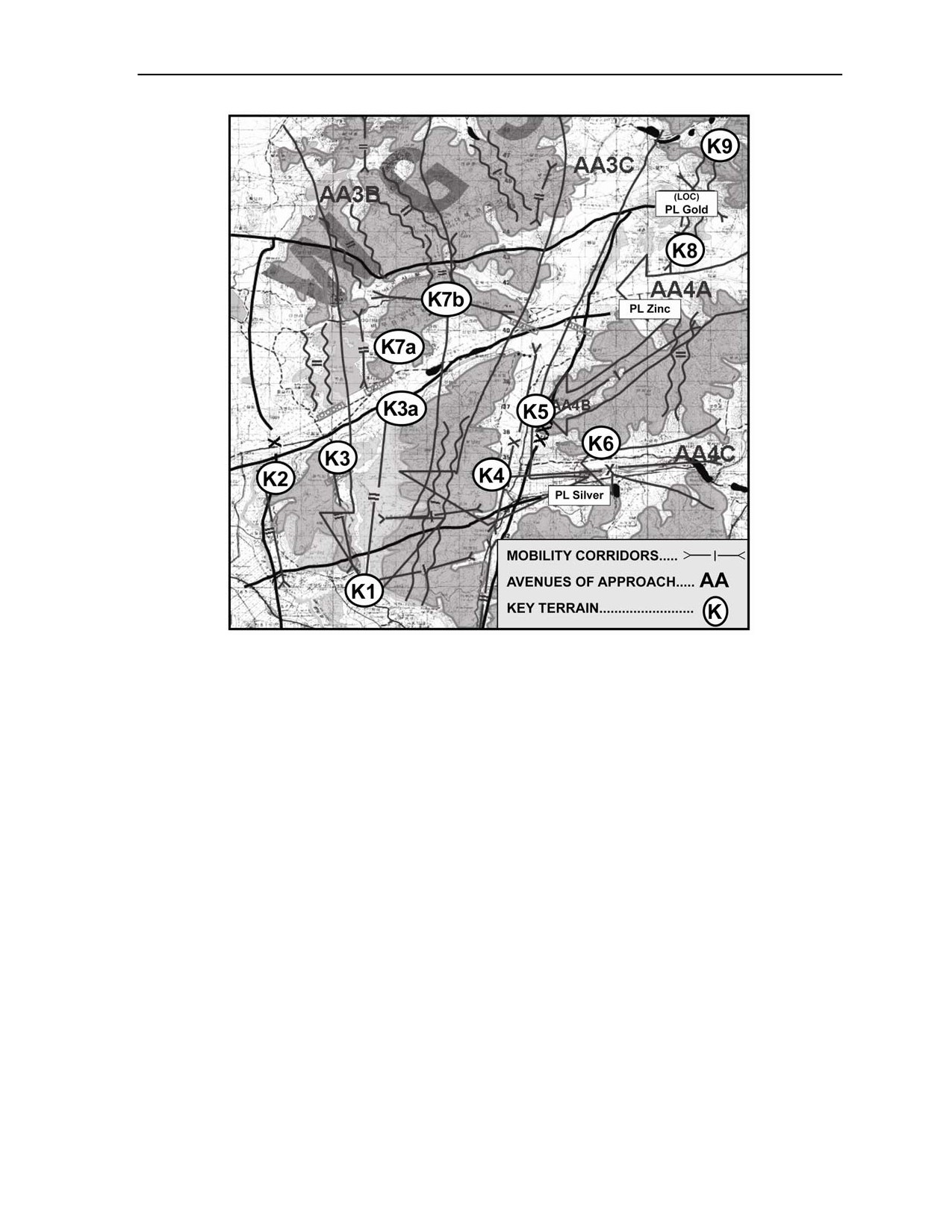
3-6. Figure 3-2 depicts an example MCOO. The MCOO fuses the—
Combined obstacle overlay.
Avenue of approach (AA) overlay with mobility corridors.
Operational graphics.
Key terrain.
Known threat objectives into a comprehensive terrain product.
3-4
TC 2-50.5
6 January 2010
FOR OFFICIAL USE ONLY
Intelligence Preparation of the Battlefield
Figure 3-2. Example modified combined obstacle overlay
LINE OF COMMUNICATIONS OVERLAY
3-7. The line of communications (LOC) overlay depicts major LOCs within and around an AO. The LOC
overlay—
Includes roads, airfields, mountain passes, waterways, and footpaths.
Includes pertinent data, such as road widths, their load capacity, sharp turns, potential ambush
positions, potential sniper positions, and overhanging obstacles.
Provides mobility information to assist planners and operators determine what personnel and
equipment can move along the mobility corridors.
In urban operations, depicts normal traffic conditions that help the unit determine the best times
to operate and provide an indicator of an unusual event.
With local water systems can list important items, such as the width and depth of the waterway,
key crossing sites (depending on the size of the waterway), and key uses of that waterway (for
example, commerce, water source for crops, drinking water source for the local population).
LINE OF SIGHT OVERLAY
3-8. The line of sight overlay is particularly important in complex terrain. This overlay—
Can help define AAs to an objective.
Can help pinpoint potential observation or sniper positions along each relevant AA based on the
best possible locations given line of sight, elevation, exposure, and other pertinent
considerations.
6 January 2010
TC 2-50.5
3-5
FOR OFFICIAL USE ONLY
Chapter 3
Note. Reverse line-of sight overlays, which show the friendly AAs from the enemy standpoint,
are just as important as line of sight overlays. The enemy can be expected to try to cover dead
space from the objective area with other positions or devices such as mines or improvised
explosive devices (IEDs). If the enemy on the objective simply wants to flee, dead spaces may
simply be covered by some type of early warning system.
IMAGERY OVERLAY
3-9. Imagery is important in the analysis of any situation. Imagery products include both aerial
photography and satellite imagery. In many cases, tasked aerial reconnaissance platforms, such as
unmanned aircraft systems (UASs), respond directly to the commander, ensuring timely and focused data
collection. Because of technical limitations or priorities established at the higher echelons, space-based and
other national collection assets may not be available to the commander and staff. Additionally, as each
collection system has its own unique capabilities, traditional black and white or infrared imagery may offer
the best view of the target in a given situation.
3-10. Distributed Common Ground System-Army (DCGS-A) provides the G-2/S-2 access to tactical,
theater, and national imagery systems as well as the Image Processing Library. Data collected from such
sources is transferred in digital format that can be manipulated to address specific requirements.
3-11. Advanced geospatial intelligence
(GEOINT) products are produced using any combination of
imaging platforms: visible, infrared, radar, or spectral depending on the requestor’s needs. Due to the
versatility of these products, they have a wide range of applications. Combining imagery with digital terrain
elevation data presents an oblique perspective. Spectral imagery accomplishes discovery and identification
of manmade and indigenous activity from patterns of heat distribution and determination of changes in a
scene imaged at various times. Other uses include facility analysis, structural analysis, target detection, soil
analysis, and damage assessment.
URBAN TERRAIN OVERLAY
3-12. Urban terrain overlays depict specific aspects of terrain unique to the urban environment, for
example—
Details of a single building, a group of buildings, a section of an urban area, or even an entire
urban area.
Different terrain zones apparent in an urban area. Different types of terrain can be indicated
using hatch marks or other indicators on a map or aerial photograph. Zone types may be defined
as close, orderly block, or dense random construction (see FM 3-06.11), or by any other
designated characteristics required by the mission, such as zones of threat occupation or zones
divided by the types of predicted weapons effects.
A building type overlay that depicts particular types of buildings, such as industrial, government,
and military buildings, residential areas, businesses, warehouses or storage buildings, religious
centers, or media locations. Each building can be numbered or otherwise identified depending on
the needs of the commander and the commander’s staff.
Entire sections of a city can be marked depending on the customary type of construction in a
particular area. For example, an area of dense construction or a shantytown can be identified by
appropriately labeling it on an overlay or directly onto an aerial photograph.
Shantytowns may require highlighting because they may be areas with notable food shortages
and disease and pollution are most prevalent. They may lack public utility infrastructure (for
example, plumbing and electricity). Buildings are often constructed from miscellaneous
materials, and there is no consistent pattern of streets or corridors, which can complicate military
operations. These types of conditions result in a generally dissatisfied population—a potential
source of unrest.
3-6
TC 2-50.5
6 January 2010
FOR OFFICIAL USE ONLY
Intelligence Preparation of the Battlefield
Unoccupied locations or buildings should be identified, since these locations or buildings can be
used as shelter for troops (friendly or threat) or as locations for friendly forces to demonstrate
firepower if necessary. The latter utility was demonstrated in Kosovo when a tank round was
shot into an unoccupied building to quell an increasingly worrisome civil disturbance.
Additionally, unoccupied locations or buildings could be storage or meeting sites for threat
forces.
Depicting street widths in terms of major weapons systems can help identify formations or
routes that are most advisable for an area. Streets that allow two Abrams tanks to advance, side
by side, enable the vehicles to better cover upper floors on opposite sides of the street, thereby
providing security for each other. In addition, depicting buildings that exceed the depression or
elevation capabilities of vehicle weapons systems can identify areas of concern and potential
enemy ambush positions. Routes with such “dead spaces” may enable convoys with additional
or alternative weapons systems to eliminate this vulnerability.
KEY INFRASTRUCTURE OVERLAY
3-13. The key infrastructure overlay is a group of products rather than a single product. (See table 3-3.)
These overlays can be produced by using—
A map.
Aerial photography.
A graphic design that is appropriately marked with a numbering or color-coded system that
indicates the type of asset as well as its specific attributes.
Table 3-3. Key infrastructure overlay
Critical infrastructure. Anything that, if harmed, can affect the living conditions of the population.
•
Electricity generation plants.
•
Government buildings.
•
Hydroelectric dams.
•
Oil pumping stations.
•
Police stations.
•
Public markets.
•
Pumping stations.
•
Sewage treatment plants.
•
Water purification plants.
Protected urban terrain. Areas that should not be destroyed, attacked, or occupied, or that have
other use restrictions based on international treaties, rules of engagement, and common sense.
•
Schools.
•
Hospitals.
•
Areas with large amounts of
•
Buildings with many stories.
phone and/or electrical
wiring.
Example: Medical facilities may be depicted on their own key infrastructure overlay. Medical facilities are generally no-
fire areas for friendly forces and should be protected from damage or destruction so that they can continue to take care
of the local population once friendly forces have secured the urban area. Inadequate health care for the local
population can lead to both a negative perception of friendly forces and an uncontrolled increase in disease, which can
affect friendly forces personnel working in the urban environment directly.
Media facilities include locations of—
•
Transmission stations.
•
Transmission antennas.
•
Newspaper production.
•
Distribution sites.
•
Television stations.
•
Radio stations.
Transportation facilities include locations of—
•
Rail hubs.
•
Major bus connection sites.
•
Freeways.
•
Subway lines.
•
Major thoroughfares and intersections that are significant to the operation.
6 January 2010
TC 2-50.5
3-7
FOR OFFICIAL USE ONLY

Chapter 3
Table 3-3. Key infrastructure overlay (continued)
Resource sites. The resources and infrastructure used to support the critical resource needs of a
population such as—
•
Building material locations.
•
Car lots.
•
Appliance warehouses.
•
Petroleum and natural gas processing plants.
Culturally significant structures such as—
•
Places of religious worship (for example, churches, temples, mosques).
•
All relevant government and internationally significant buildings (for example, embassies, consulates).
•
War memorials.
Dangerous facilities
•
Structures with known chemical, biological, or incendiary features.
•
Toxic industrial material sites such as pharmaceutical plants, oil refineries, or fertilizer plants.
•
Ammunition storage sites.
Key subterranean infrastructure
•
Underground railways.
•
Any other underground feature of significance for the operation.
•
Sewer systems.
•
Underground electrical wiring.
WEATHER ANALYSIS MATRICES AND GRAPHIC DISPLAYS
3-14. An integral element within the IPB process is weather analysis. Weather data pertaining to IPB is
either climatological information or current forecasts. This climatological data is fused with terrain
information to produce collaborative weather and terrain products. The G-2/S-2 should collaborate with the
weather specialty team to develop weather products that depict weather effects—
On friendly operations.
On enemy operations.
That are common to both friendly and enemy operations.
3-15. Figure 3-3 exemplifies a weather effects matrix and figure 3-4 exemplifies a weather impact chart.
Weather Effects
Operation
06-09
09-12
12-15
15-18
18-21
21-24
00-03
03-06
Comments
EAC reconnaissance
Tactical
C
C
C
y Transitional
reconnaissance
period between
UAS—Hunter
C
C
C
northeast and
UAS—Predator
C
C
C
southwest
Ground
monsoons.
reconnaissance
y Northeast
Armor maneuverability
P
P
monsoons
Infantry
provide favorable
P
P
maneuverability
weather for
operations with
Helicopter, CAS (A-10),
decreased rain
C-130 (non-AWADS)
and
CAS (Non-A-10)
thunderstorms.
C-130 (AWADS)
y During the
Artillery
transitional
Air defense
period tropical
cyclone
Engineers
P
P
frequency
Laser or thermal
P
P
P
increases.
operations
MOPP IV
T
T
T
T
T
T
T
F—moderate degradation T—temperature
V—visibility
C—ceiling
F—severe degradation
W—wind
P—perception
Figure 3-3. Example weather effects forecast matrix
3-8
TC 2-50.5
6 January 2010
FOR OFFICIAL USE ONLY

Intelligence Preparation of the Battlefield
Next 24 Hours
Area of Operations Forecast Overview
September
13
14
15
16
Alexandria
Alexandria
• Next 72 hours: 20% chance of
thunderstorms in the vicinity of
Rotary
TS
Partly
Alexandria and Baton Rouge.
Cloudy
Convoy
T
T
T
T
71/95
• Tropical Storm Ophelia.
Communications
TS
New Orleans
• Average rainfall expected to be 6 - 10
New Orleans
inches.
APOD
•
70 mph winds.
Rotary
Partly
Cloudy
• Widespread flooding not expected.
Convoy
F
F
F
F
71/95
Communications
Troops
T
T
T
T
Baton Rouge
Baton Rouge
APOD
TS
Sunny
Rotary
TS
70/95
Convoy
T
T
T
T
Communications
TS
Date
13 September
14 September
15 September
16 September
Forecast
Sunny
Partly cloudy
Partly cloudy
Partly cloudy
Low/High
69/91
69/91
71/91
71/90
Wind
Direction
Speed
V 0 - 5 mph
SW 0 - 5 mph
SW 0 - 5 mph
V 0 - 5 mph
APOD—aerial port of debarkation
SW—southwest
V—visibility
F—flooding
T—temperature
W—wind
mph—miles per hour
TS—thunderstorm
Figure 3-4. Example weather impact chart for civil support operations
CONGREGATION AND MASS ASSEMBLY POINTS OVERLAY
3-16. Congregation and mass assembly point overlays depict the numbers, types, and locations of sites
where a large number of people can be gathered for demonstrations, protection, or feeding in the event of a
disaster. If normally used for large gatherings of people, these locations can also be coded with information
on the population group that frequents them, days and hours of operation, and type of activity that occurs.
These sites include—
Places of religious worship.
Parks.
Schools.
Restaurants.
Town squares.
Recreational centers.
Sports facilities.
Entertainment centers.
6 January 2010
TC 2-50.5
3-9
FOR OFFICIAL USE ONLY
Chapter 3
POPULATION STATUS OVERLAYS
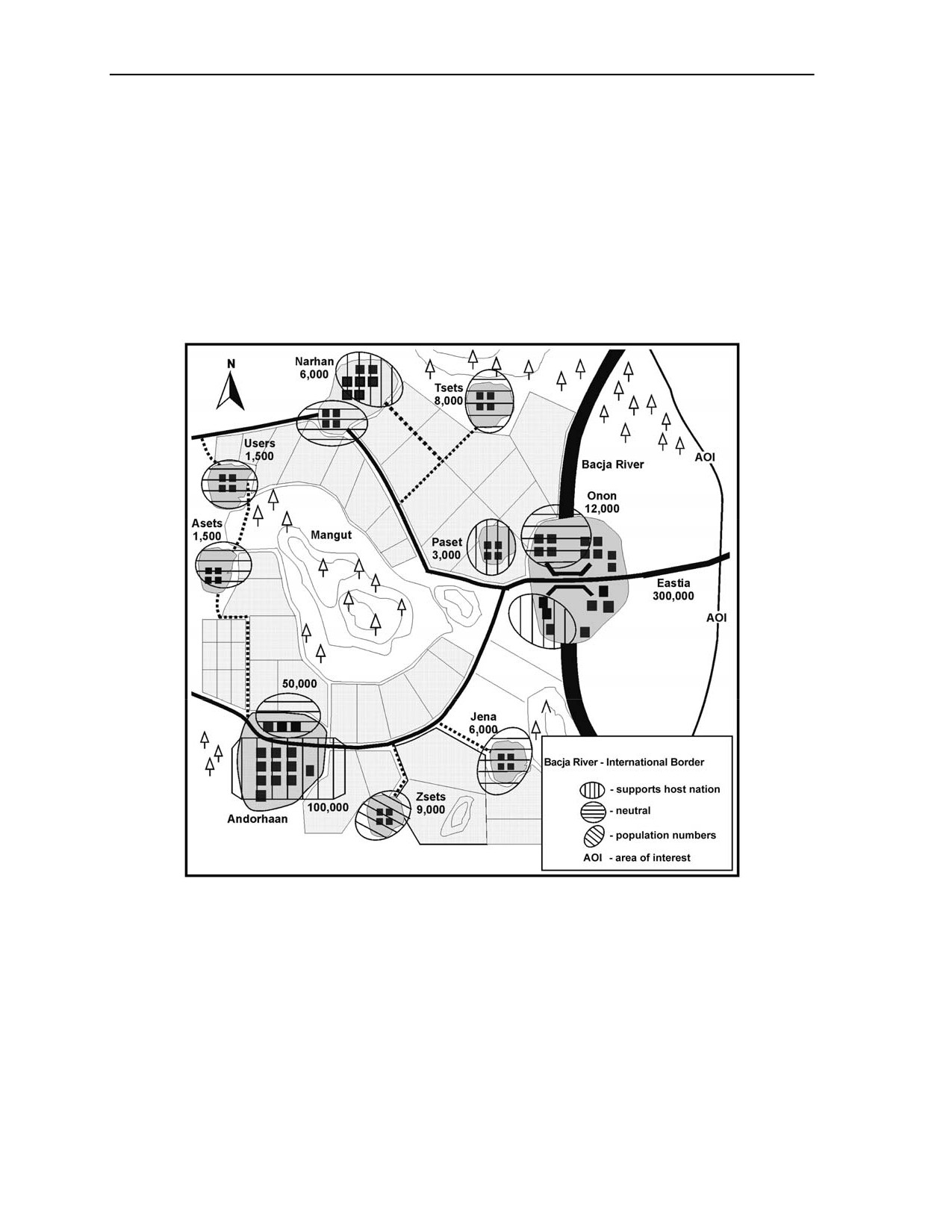
3-17. Population status overlays are a group of products rather than a single product. These products depict
how the population of a designated area is divided based on a single characteristic (see figure 3-5) such as—
Age.
Religion.
Ethnicity.
Tribal affiliation.
Income.
Population dispersal variances (day versus night)—identifying possibly restrictive operating
conditions or revealing times that are most conducive for the completion of a given mission.
Figure 3-5. Example population status overlay
3-18. Some of the benefits of population status overlays—
Help determine possible sources of friction (that can exist between groups).
Identify the population or location in greatest need of a certain activity or asset.
3-19. Methods of constructing population status overlays include—
Color-coding sections of an AO-based on the area’s populations.
Dividing the AO into specific areas such as the same service or political boundaries used by
local authorities--local police precincts, municipal districts, or counties--that can help clarify
3-10
TC 2-50.5
6 January 2010
FOR OFFICIAL USE ONLY
Intelligence Preparation of the Battlefield
the situation and aid in coordination efforts with the local authorities. Inserting pie charts for
each AO shows each group and numbers or percentages.
STEP 3—EVALUATE THE THREAT
3-20. In step 3, the G-2/S-2 and staff analyze the command’s intelligence holdings, which they identified
in step 1, to determine how the threat normally conducts operations under similar circumstances. When
operating against a new or less-defined threat, the G-2/S-2 may need to develop or expand intelligence
databases and threat models concurrently. To accomplish this, the G-2/S-2 should conduct threat
characteristic (previously order of battle [OB] factors) analysis for each group identified in step 1. See table
3-4 for threat characteristic examples and table 3-5 (page 3-12) for G-2/S-2 considerations for step 3 of the
IPB process.
Table 3-4. Threat characteristics
Threat characteristic
Considerations
Regular Army
Militia
Unit designation
Composition
Unit history
Uniforms
Insignia
Type of unit
Disposition
Historic
Current
Proposed future
Method of operations
Intent
Propaganda
Tactics
Conventional
Unconventional
Asymmetrical
Terrorism
Individual
Team
Unit
Training
Source of training
Uniforms
Insignia
Specialized training
Food
Transportation
Fuel
Sustainment
Spare parts
Water
Ammunition
Maintenance status
Strength
Goals
Personnel
Operational effectiveness
Morale
Weapons
Leadership
Equipment
Chain of command
Loyalty
Written
Internet
Signal
Communications
Verbal and live drops
Emitter type
Frequency range
Electronic
Surveillance
Countersurveillance
Intelligence
Deception
Reconnaissance
EW capability
Local
National
Regional
Recruitment
International
Coercion
Volunteers
Motivation
Financial
Media
Local
Support
National
Regional
Religious
International
Popular
Tribal/Ethnic
Databases
Assets
Connectivity
Reach
Architecture
Access
Informal networks
Loyalties
Agenda
National agencies
Leadership
Capabilities
Relationships
Loyalties
Agenda
Law enforcement agencies
Leadership
Capabilities
Relationships
Loyalties
Agenda
Leadership
IAs and NGOs
Capabilities
Relationships
AO
Personality
Key leaders
Education level
Idiosyncrasies
Natural diseases
Radiological
Biohazards
Other aspects
Chemical hazards
Toxic industrial
Wildlife
Criminal activity
material
AO—area of operations
IA—international agency
EW—electronic warfare
NGO—nongovernmental organization
6 January 2010
TC 2-50.5
3-11
FOR OFFICIAL USE ONLY
Chapter 3
Table 3-5. Step 3—Evaluate the threat
G-2/S-2 considerations
Task: Update or create threat models
Analyze the unit’s intelligence database to determine how the threat normally organizes for combat and conducts
operations under similar circumstances.
•
When facing a well-known threat, the G-2/S-2 can rely on historical databases and well-developed threat
models.
•
When operating against a new or less well-known threat, the G-2/S-2 may need to develop intelligence
databases and threat models concurrently.
Convert threat doctrine or patterns of operations into graphics such as—
•
Threat templates. (See figures 3-6 through 3-9 [pages 3-13 through 3-15].)
•
Incident overlays. (See figure 3-10 [page 3-16].)
•
Pattern analysis plot charts. (See figure 3-11 [page 3-16].)
•
Time event charts. (See figure 3-12 [page 3-17].)
•
Association, relationship, and activities matrices. (See figures 3-13 through 3-16 [pages 3-18 through 3-21].)
Describe the threat’s tactics and options.
Identify HVTs and HPTs.
Task: Identify threat capabilities
Define the capabilities with the use of statements. The following are examples of capability statements:
•
“The threat has the capability to attack with up to eight divisions supported by 150 daily sorties of fixed-wing
aircraft.”
•
“The criminal organization has the ability to pay off local law enforcement agencies.”
•
“The terrorists have the capability to send destructive viruses over the Internet, which can destroy computer
files and archives.”
•
“The threat can establish a prepared defense by 14 May.”
•
“The terrorists have the capability to use CBRNE.”
•
“The drug smugglers have the ability to conduct three drug-smuggling operations simultaneously.”
•
“The terrorists have the ability to conduct multiple car bombings simultaneously.”
•
“The threat has the ability to target friendly convoys along main supply routes using remotely detonated
IEDs.”
Other capabilities include supporting COAs (attack, defend, reinforce, retrograde), specific types of operations, or
operations that allow the threat force to use a COA that is usually unavailable or would be severely hindered if the
supporting operations were not conducted. Examples of these types of operations include--
•
Use of CBRNE weapons.
•
Intelligence collection.
•
EW operations.
•
Use of air assets (fixed and rotary).
•
Engineering operations.
•
Air assault or airborne operations.
•
Amphibious operations.
•
River operations.
•
Propaganda.
•
Deception operations.
•
Car bombings, bomb scares, and suicide bombers.
•
Raids on weapon storage facilities.
•
Carjacking or hijacking of vehicles used in transporting personnel, weapons, and drugs.
•
Theft of chemicals related to drug manufacturing.
•
Threat to IO.
CBRNE—chemical, biological, radiological,
HPT—high-payoff target
nuclear, high-yield explosives
HVT—high-value target
COA—course of action
IED—improvised explosive device
EW—electronic warfare
IO—information operations
3-12
TC 2-50.5
6 January 2010
FOR OFFICIAL USE ONLY

Intelligence Preparation of the Battlefield
3-21. To achieve desired step 3 results, develop the following key products as appropriate to the situation:
Threat template.
Incident overlay.
Pattern analysis plot sheet.
Time event chart.
Association matrix.
Relationship matrix.
Activities matrix.
Link diagram.
Cultural comparison chart.
Perception assessment matrix.
THREAT TEMPLATE
3-22. Threat templates (see figures 3-6 through 3-9 [pages 3-13 through 3-15]) are tailored to the needs of
the unit or staff section creating them, for example:
Some threat templates consider the threat forces as a whole.
Others focus on a single warfighting function, such as intelligence or fires, while other products
depict pattern analysis, time event charts, and association matrices.
Figure 3-6. Example offensive threat template
6 January 2010
TC 2-50.5
3-13
FOR OFFICIAL USE ONLY

Chapter 3
Figure 3-7. Example defensive threat template
Figure 3-8. Example threat template for attacks on facilities or base camps
3-14
TC 2-50.5
6 January 2010
FOR OFFICIAL USE ONLY

Intelligence Preparation of the Battlefield
Figure 3-9. Example threat template in an urban environment
INCIDENT OVERLAY
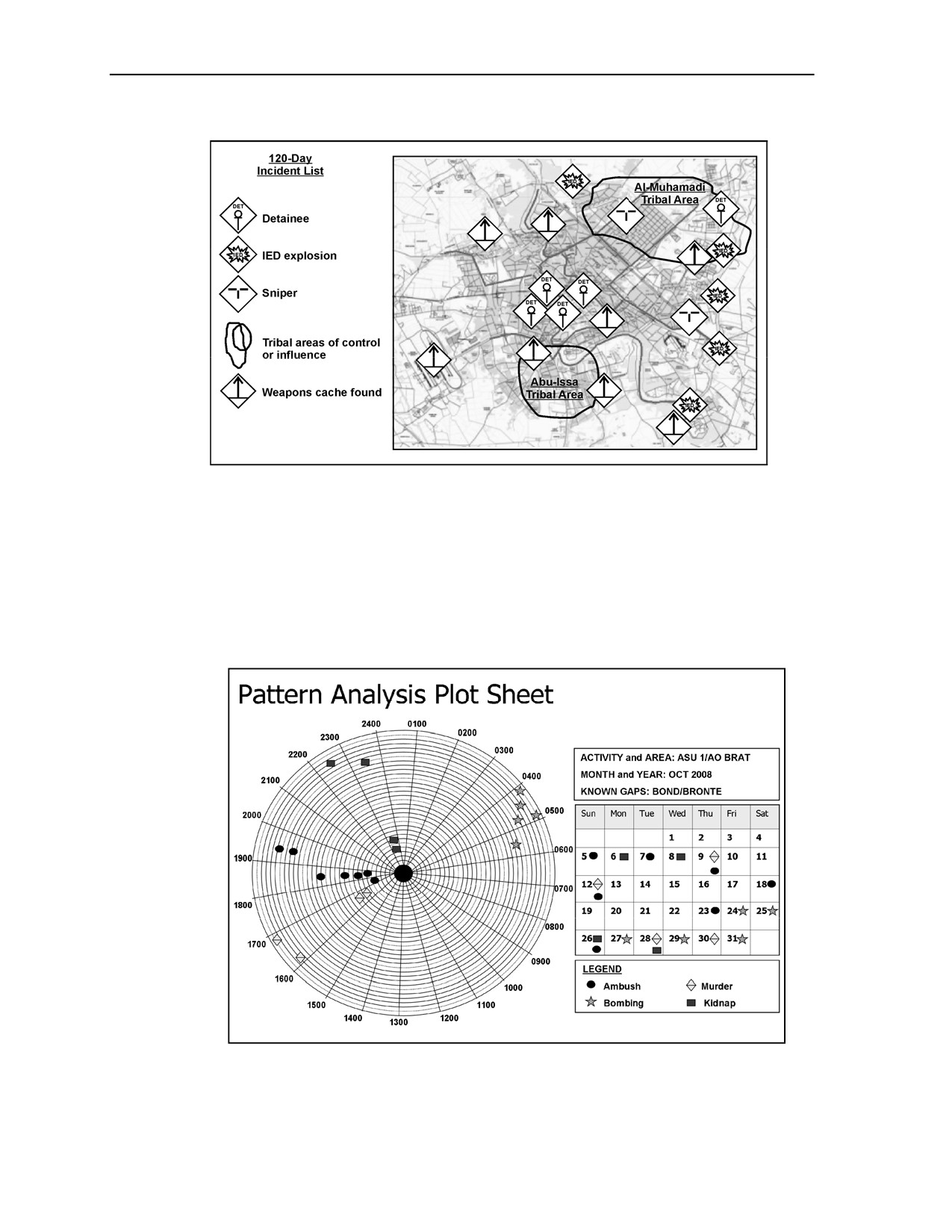
3-23. Figure 3-10 (page 3-16) is an example of an incident overlay illustrating cumulative events that have
occurred within the AO and focuses on the “where” of an event. The incident overlay—
May be created in multiple layers to focus on different subjects or as a single overlay to blend
subjects.
Normally includes additional information such as notes or graphics.
Should be used in conjunction with the pattern analysis plot sheet.
6 January 2010
TC 2-50.5
3-15
FOR OFFICIAL USE ONLY
Chapter 3
Figure 3-10. Example incident overlay
PATTERN ANALYSIS PLOT SHEET
3-24. The analyst uses the pattern analysis plot sheet (see figure 3-11) to focus on the “time” and “date” of
each serious incident that takes place within the AO. The pattern analysis plot sheet—
Helps distinguish patterns in activities that are tied to particular days, dates, or times.
Supplies the bulk of the data needed to complete an event template, when used in conjunction
with the incident overlay and any threat templates.
Figure 3-11. Example of a pattern analysis plot sheet
3-16
TC 2-50.5
6 January 2010
FOR OFFICIAL USE ONLY

Intelligence Preparation of the Battlefield
TIME EVENT CHART
3-25. Time event charts are chronological records of individual or group activities designed to store and
display large amounts of information in a small space. (See figure 3-12.) The time event chart helps analyze
larger-scale patterns of activity and relationships. Characteristics of time event charts include—
Triangles representing the beginning and end of the activity.
Rectangles representing other events.
“Xs” through noteworthy events.
Triangles and rectangles, each with a sequence number and date.
Brief descriptions of each event below each rectangle.
Arrows representing time flow from the left to the right, for each row employed.
Figure 3-12. Example time event chart—Southwest Asia
ASSOCIATION MATRIX
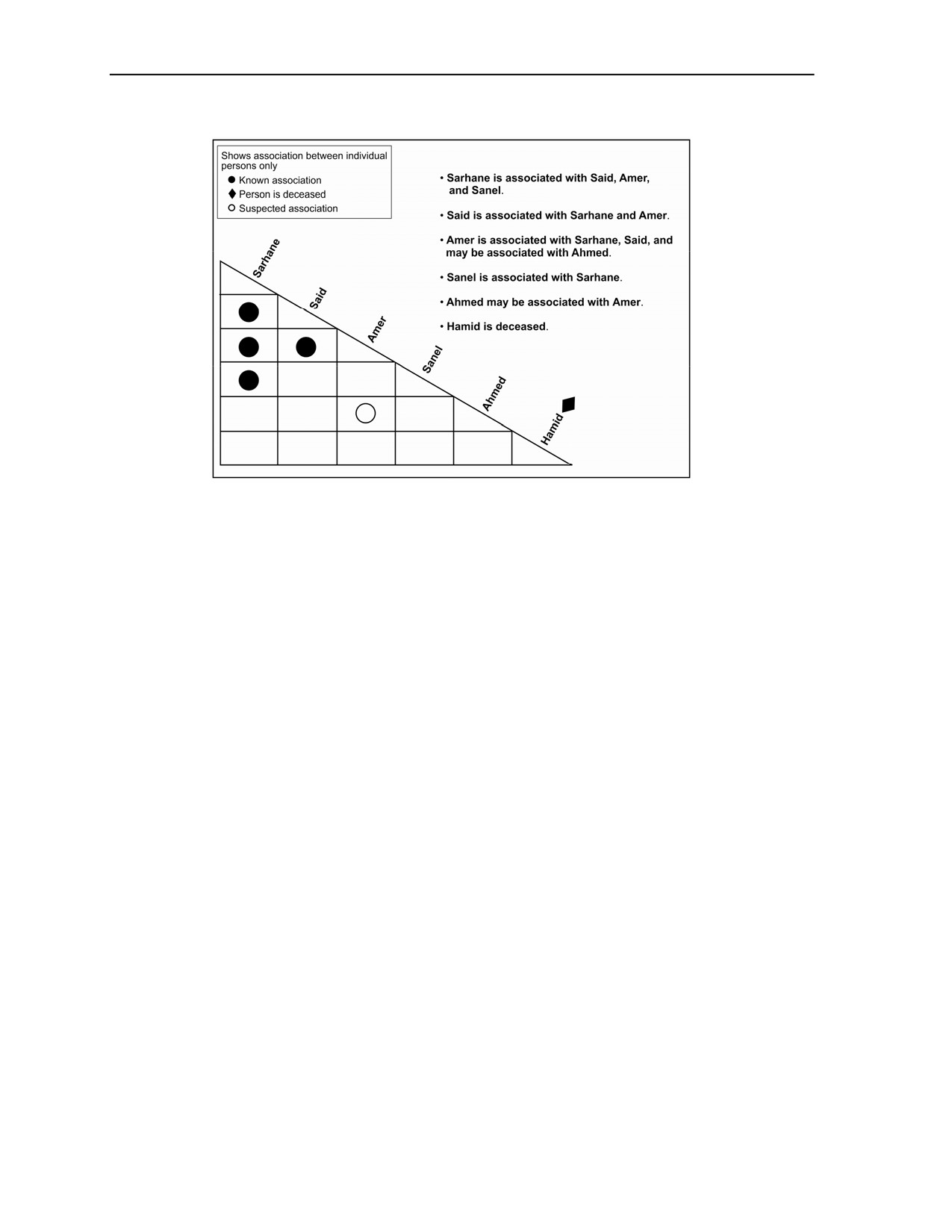
3-26. The association matrix (see figure 3-13 [page 3-18])—
Is used to establish the existence of an association, known or suspected, between individuals.
Depicts
“direct connections,” for example, face-to-face meetings or confirmed telephonic
conversations.
Can be used to identify those personalities and associations needing a more in-depth analysis to
determine the degree of relationship, contacts, or knowledge between the individuals.
Helps form the structure of the threat organization as connections between personalities are
made.
6 January 2010
TC 2-50.5
3-17
FOR OFFICIAL USE ONLY
Chapter 3
Figure 3-13. Example association matrix
RELATIONSHIP MATRIX
3-27. Relationship matrices depict the nature of relationships between elements of the AO. The nature of
the relationship between two or more components includes measures of contention, collusion, or
dependency. This tool demonstrates graphically how each component of the city interacts with the others
and whether these interactions promote or degrade the likelihood of mission success. The elements can
include—
Members from the noncombatant population.
The friendly force.
International organizations.
Adversarial groups.
Utility infrastructure.
Significant buildings.
Media.
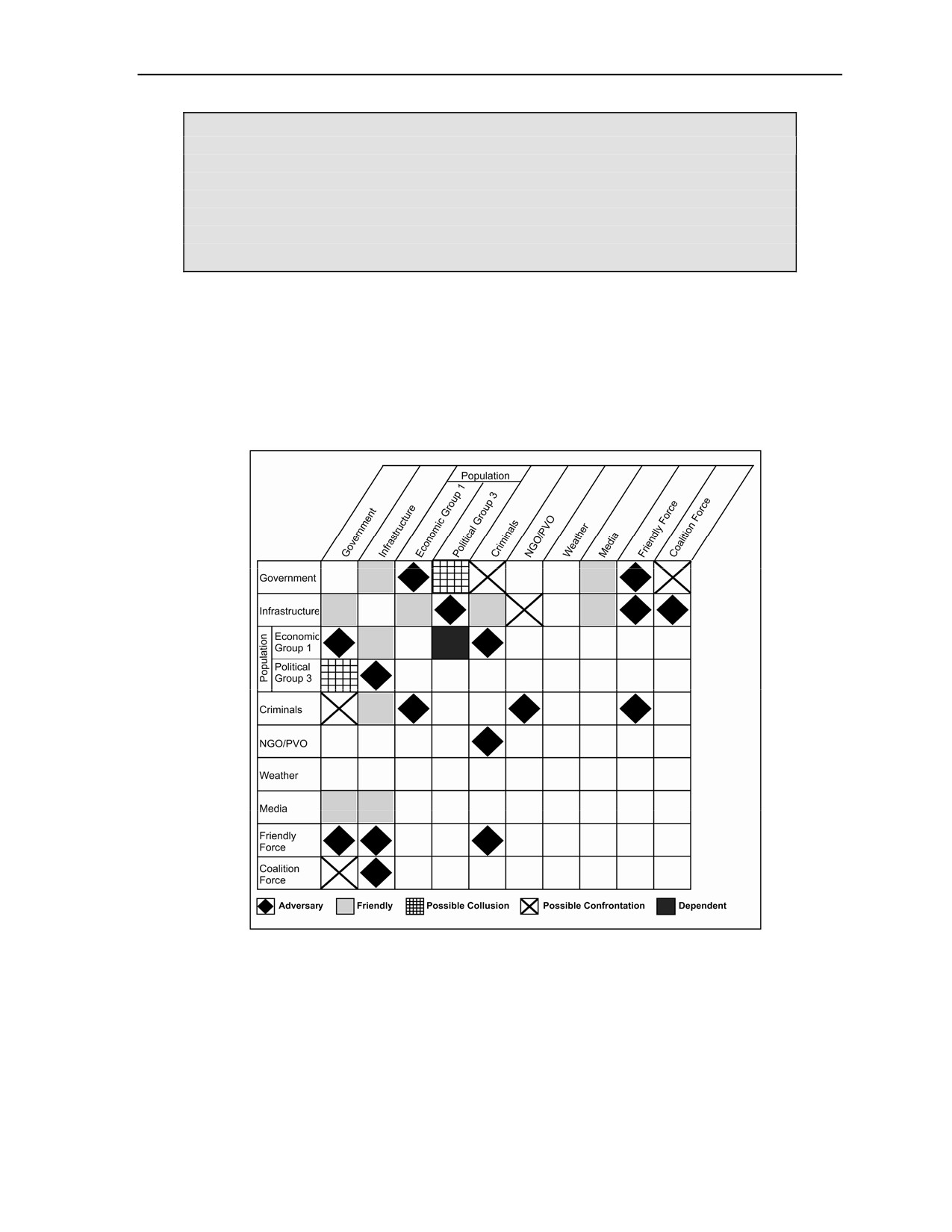
3-28. Figure 3-14 depicts the relationships among a representative compilation of population groups. This
example is an extremely simple version of what might be used during an operation with many actors and
other population elements. For instance, the section marked “Population” might include considerably more
population subgroups than the two included in figure 3-14. When used during a deployment, it is important
for the analysts to realize what groups, subgroups, and other elements should be represented in the matrix,
which could also be used to depict the perceived differences in relationships. For example, in figure 3-14,
“Political Group
3” has a dependent relationship with
“Economic Group 1.” The complementary
relationship (a similar mark in the corresponding box linking Political Group 3 and Economic Group 1) is
not indicated because it might not exist.
3-29. To illustrate the usefulness of the matrix, consider the relationship of the “Government” with the
Infrastructure. In this case, the relationship is “friendly,” perhaps because the Government is in control of
the Infrastructure without contest from the owners or suppliers of the infrastructure.
3-18
TC 2-50.5
6 January 2010
FOR OFFICIAL USE ONLY
Intelligence Preparation of the Battlefield
Example
As an example, consider communist leaders who control the electricity supply. These
leaders use the infrastructure at their disposal to supply electricity to the population,
but intermittently threatened to deny the service in order to maintain control over a
possibly hostile population. How can this information be used by the commander and
the staff? Perhaps by understanding the nature of two elements of the AO, the link
between the two elements can either be eliminated or leveraged in order to suit the
needs of the friendly unit.
3-30. Figure 3-14 depicts a possible collusion relationship between the Government and Political Group 3,
and a friendly relationship between the Government and the Media. Listed are questions an intelligence
analyst might ask when reviewing this information:
How can the Government use the Media to its advantage?
Will the Government seek to discredit Political Group 3 using the Media?
Will the Population view the Media’s reporting as credible?
Does the Population see the Government as willfully using the Media to suit its own ends?
Figure 3-14. Example relationship matrix
6 January 2010
TC 2-50.5
3-19
FOR OFFICIAL USE ONLY

Chapter 3
ACTIVITIES MATRIX
3-31. Activities matrices—
Help connect individuals
(such as those in association matrices) to organizations, events,
entities, addresses, and activities—anything other than people.
When combined with information from association matrices, assists in linking personalities as
well.
3-32. The activities matrix is constructed as a rectangle with rows and columns tailored to the needs of the
analyst exemplifying the problem at hand. (See figure 3-15.)
Figure 3-15. Example activities matrix
LINK DIAGRAM
3-33. A link diagram—
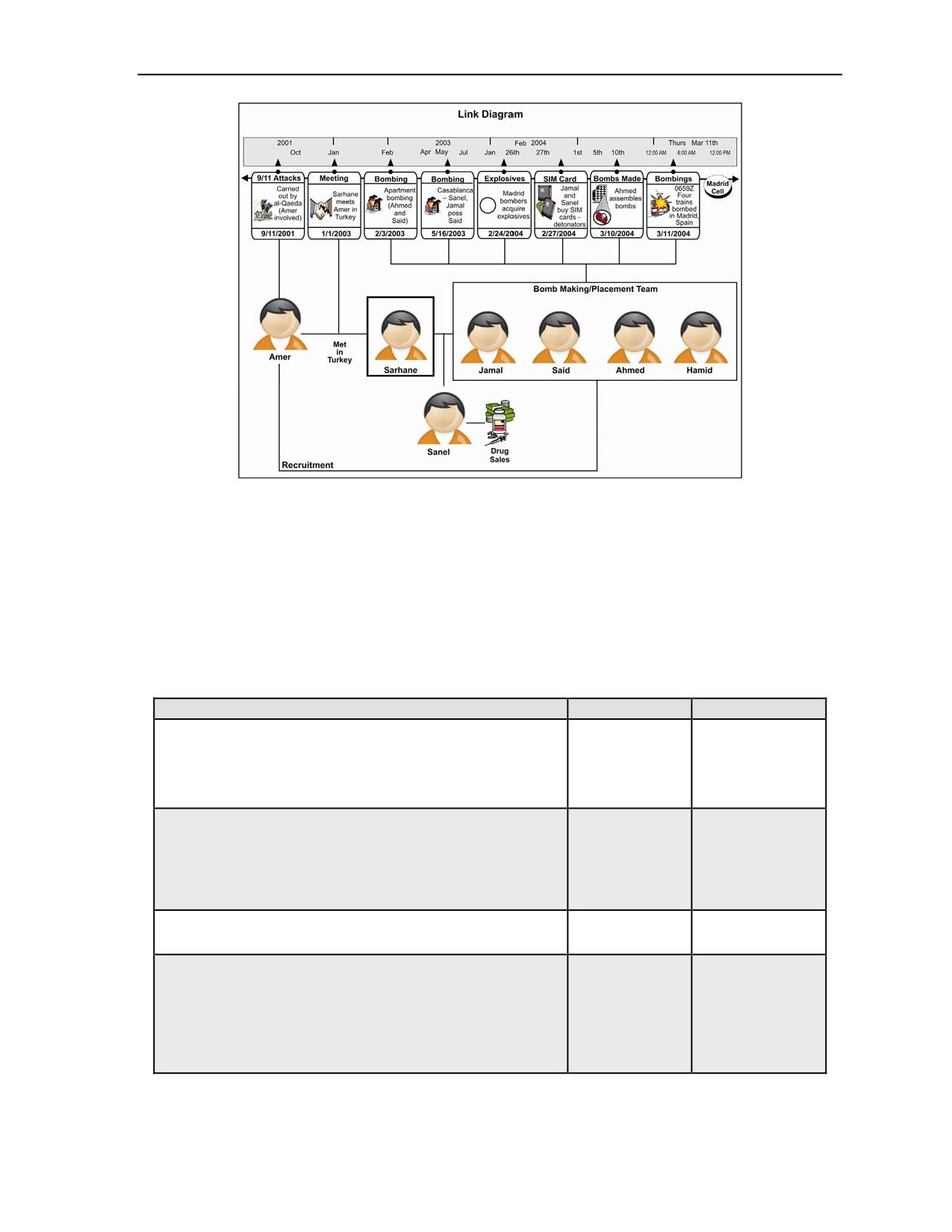
Combines the association, relationship, and activities matrices into a single graphic.
Depicts how individuals and their functional groups are related.
When analyzed, helps determine intelligence gaps.
3-34. Figure 3-16 depicts a link diagram with a timeline of a train bombing in Madrid, Spain.
3-20
TC 2-50.5
6 January 2010
FOR OFFICIAL USE ONLY
Intelligence Preparation of the Battlefield
Figure 3-16. Example link diagram
CULTURAL COMPARISON CHART
3-35. A cultural comparison chart (see table 3-6):
Is used to deter the idea that only one perspective exists. It may be helpful to clearly point out
the differences between local ideology, politics, predominant religion, acceptable standards of
living, regional populace interests, and U.S. norms.
Can be a stand-alone tool—listing the characteristics of the culture in question—or it can be
comparative—assessing the host country population relative to known and familiar conditions.
Table 3-6. Cultural comparison chart
Value
Western
Middle Eastern
Individualist and collectivist societies:
Individualist
Collectivist
•
Individualists hold that the individual is the primary unit of
Self-sufficient.
Team work (family).
reality and the ultimate standard of value.
Independent.
Reliance/Patronage.
•
Collectivists believe everyone belongs to a certain group.
Personal
Family honor.
The group protects its “members” and expects their loyalty in
achievement.
return.
Universalism and particularism:
Universalist
Particularist
•
Universalists are more likely to apply absolutes regardless
Right is right and
Right and wrong are
of circumstances or situations. The same rules apply to
wrong is wrong.
situation dependent.
everyone in similar situations.
Treat everyone
Life is not fair.
•
Particularists believe one’s behavior, in any given situation,
alike.
Exceptions are made
depends on specific circumstances.
Everyone has the
for certain people.
same rights.
Achieved status
Ascribed status
Achieved and ascribed status
Earn status
Status through birth,
•
How different cultures deal with different levels of status.
through work.
age, or seniority.
Uncertainty avoidance
High-uncertainty
Low-uncertainty
•
The ability of people in a specific culture to adapt to changes
avoidance
avoidance
or the unknown.
Unknown is
Curious of unknown.
•
Those with high-uncertainty avoidance do not like change
frustrating.
and, to some extent, fear the unknown.
•
People with low-uncertainty avoidance do not feel very
threatened or anxious about uncertainty and are curious
rather than frightened of the unknown.
6 January 2010
TC 2-50.5
3-21
FOR OFFICIAL USE ONLY
Chapter 3
PERCEPTION ASSESSMENT MATRIX
3-36. Friendly force activities intended as benign or benevolent might have negative consequences if a
population’s perceptions are ignored, yet assessed or measured. Perceptions--more than reality--drive
decisionmaking and consequently could influence the reactions of entire populations.
3-37. Perception assessment matrices—
Are often used by psychological operations (PSYOP) personnel.
Can be a valuable tool for intelligence analysts once completed by trained PSYOP personnel.
Provide some measure of effectiveness for the unit’s ability to reach an effect (for example,
maintain legitimacy) during an operation. The matrix can also be used to directly measure the
effectiveness of the unit’s civil affairs, public affairs, and PSYOP efforts.
Example
One proposed PSYOP program developed for Operation Restore Democracy in Haiti
illustrates why perception assessment is necessary. Before deployment, published
leaflets informed the Haitian populace of U.S. intentions. The original leaflet was
published in French—the language of the Haitian elite. The leaflet actually used for
the PSYOP program was published in Creole—the official language of Haiti—
because an astute PSYOP team member realized the need to publish to a wider
audience. If the French leaflet had been dropped on Port-au-Prince, it could have
undermined the U.S. mission in many ways. The majority of the population would
have been unable to read the leaflet. The subsequent deployment of U.S. forces into
the Haiti could have been perceived as hostile. The mission, which was intended, in
part, to restore equity within the Haiti’s social structure, could have backfired if the
Haitians viewed the French leaflet as an indication of U.S. favoritism to the Haitian
elite.
3-38. Perceptions can counter operational objectives; therefore, they should be assessed before and
throughout an operation. Although it is impossible to read the minds of the local population, there are
several means to measure the perceptions:
Demographic analysis and cultural intelligence are key components of perception analysis.
Understanding a population’s history can help predict expectations and reactions.
Human intelligence (HUMINT) can provide information on population perceptions.
Reactions and key activities can be observed to decipher whether people behave based on real
conditions or perceived conditions.
Editorial and opinion pieces of relevant newspapers can be monitored for changes in tone or
opinion shifts that can steer or may be reacting to the opinions of a population group.
3-39. Perception assessment matrices aim to measure the disparities between friendly force actions and
population groups’ perceptions.
(See figure
3-17.) In addition to assessing each population group’s
perceptions, it might benefit the unit to assess its own perceptions of its activities. The unit should address
the following questions to scrutinize its view of an operation:
Are members of the unit exhibiting decidedly Western or American values that are not
appreciated by the host-nation population?
Are embedded U.S. beliefs preventing the unit from understanding the host-nation population or
its multinational partners?
Are the intelligence and command staffs’ perceptions of the AO valid?
Does the population believe what the unit believes?
Can the population’s (or a subgroup’s) perception be detrimental to the unit?
3-22
TC 2-50.5
6 January 2010
FOR OFFICIAL USE ONLY

Intelligence Preparation of the Battlefield
Government
Condition
Food
Use of guns
structure
All men carry
Cultural norm
Rice
Tribal
weapons
All weapons
Alternative proposed by friendly forces
Meat and potatoes
Hierarchical
confiscated
Tolerable if needs
Inadequate or
Population’s perception
Unfair
are fulfilled by group
inconsiderate
in charge
Acceptable difference in perception?
No
No
Yes
Culturally accepted
norms; no known
Root of difference
Culture
History
physically detrimental
effects
No, logistically
Possible to change perception?
No, Soldier safety
No
restricted
PSYOP activities,
Just offer potatoes;
Proposed solution
weapons turn-in
Bargain
seek exchange for rice
program
Possible consequences of changed
Starvation, rioting
Armed backlash
Unknown
perception
Figure 3-17. Example perception assessment matrix
STEP 4—DETERMINE THREAT COURSES OF ACTION
3-40. The intelligence analyst describes the threat’s intentions verbally, graphically, and in writing. An
effective understanding and presentation of the threat’s COA may be accomplished by developing a
doctrinal narrative. Narratives describe the tasks the threat will accomplish during operations, and describe
other factors that will affect the threat’s intentions during operations. Narratives answer the questions—
“What is the threat doing now?” and “What does the threat want to do?” The best technique for developing
a doctrinal narrative is analyzing the threat through warfighting functions—movement and maneuver,
intelligence, fires, sustainment, command and control (C2), and protection. See table 3-7 for G-2/S-2
considerations during step 4 of the IPB process.
Table 3-7. Step 4—Determine threat courses of action
G-2/S-2 considerations
Task: Identify the threat’s likely objectives and desired end state
The G-2/S-2 depicts the threat based on the commander’s guidance (for example, echelon or cell).
Every staff officer possesses specific information the G-2/S-2 can use to piece together the IPB.
Staff input to enemy COA development, enemy situation template and event template development are listed below.
Staff
Responsibility
•
Evaluate likely air corridors.
•
Determine likely timing of air fires, air assault, or airborne operations.
Air and
•
Determine likely targets and objectives of enemy air operations.
missile
•
Evaluate how the enemy air defense artillery is organized to protect its forces.
defense
•
Evaluate whether the enemy will use air defense in a reconnaissance or a
counterreconnaissance role.
•
Determine where the enemy will deploy mortars or artillery.
Fire support
•
Recommend HVTs (developed into HPTs during wargaming).
•
Anticipate the depth of range of the threat’s indirect fires.
6 January 2010
TC 2-50.5
3-23
FOR OFFICIAL USE ONLY

Chapter 3
Table 3-7. Step 4—Determine threat courses of action (continued)
•
Determine where the enemy is most likely to emplace conventional (for example, mines)
and unconventional (for example, IED) obstacles.
•
Determine the time--
To emplace each type of obstacle.
Engineer
To breach or neutralize obstacles.
For an enemy to establish a given level of defensive preparedness.
•
Determine ability to bridge different river and stream sizes and the time required for each.
•
Make an initial assessment of effort required for stability assessments, such as building
construction.
•
Determine types of delivery systems, including minimum and maximum ranges.
•
Appraise threat CBRN protection capabilities.
CBRN
•
Provide preparation indicators to employ CBRN weapons.
•
Predict friendly assets the enemy is likely to consider as HPTs for CBRN targeting.
•
Analyze existing contaminated areas that may indicate COAs adopted by the enemy.
•
Determine the threat’s ability to locate or intercept friendly systems.
•
Predict the speed at which the enemy can collect, process, and target communications
Signals
and C2 sites.
•
Evaluate the threat’s ability to link collection systems to indirect or direct fires.
•
Estimate the deployment patterns of SIGINT collection systems.
•
Analyze the political and economic situation in the AO.
•
Determine what factions are friendly, neutral, or threatening.
•
Determine who the key leaders are.
Civil affairs
•
Provide the cultural indicators that identify the populace (such as friendly, neutral, anti- or
pro-United States).
•
Predict areas where civilians gather to protest or demonstrate.
•
Determine from whom or where to obtain information about particular AOs.
Task: Identify the full set of COAs available to the threat
The staff considers—
•
The COAs that the threat believes are appropriate to the current situation, and the identification of the
threat’s likely objectives. This requires an understanding of the threat’s decisionmaking process, as well as
an understanding of the threat’s perception of the current situation.
•
The threat COAs that could significantly influence the unit’s mission—for example, diverting combat power to
cover increasing protection requirements.
•
The COAs that may go beyond the boundaries of known threat doctrine or TTP, especially if the known
threat is an individual terrorist, a terrorist cell, or a terrorist group.
•
The threat COAs indicated by recent activities and events. To avoid surprise from an unanticipated COA,
consider all possible explanations for the threat’s activity with an emphasis on ethnic bias, groupthink, and
misunderstanding the threat’s logic.
Task: Evaluate and prioritize COAs
The staff evaluates each threat COA and prioritizes each based on the threat’s likelihood to adopt that COA.
•
Analyze each COA to identify threat strengths, weaknesses, decision points, and objectives.
•
Evaluate how well each COA meets the criteria—suitability, feasibility, acceptability, distinguishability, and
completeness—of threat doctrine, their previous operation, and threat TTP.
•
Evaluate how well each COA takes advantage of the operational environment. How does the operational
environment encourage or discourage COA selection?
•
Analyze the threat’s recent activity to determine if a COA has been adopted.
3-24
TC 2-50.5
6 January 2010
FOR OFFICIAL USE ONLY
Intelligence Preparation of the Battlefield
Table 3-7. Step 4—Determine threat courses of action (continued)
G-2/S-2 considerations
Task: Develop each COA in detail
Each COA answers the following six basic questions:
Who: The threat and its makeup—a conventional force, terrorist organization (group or cell), insurgency, or criminal
(gang, group, cartel).
What: The type of operation—such as attack, defend, bank robbery, or suicide bombing. In stability operations, the
what factors are target types, target selection, and objectives.
When: The time of the action—when usually refers to the earliest time the threat can adopt the COA under
consideration. In an operational environment, consider the following factors:
•
Capability.
•
Intent.
•
History.
•
Activity.
•
Target environment.
•
Personalities.
Where: The location of the objective or objectives in the AO.
How: The method the threat may use to employ their assets, such as dispositions, location of main effort, scheme of
maneuver, or time and place of a terrorist attack and how it may be supported.
Why: The objective or end state the threat intends to accomplish. The objective or end state of an asymmetrical threat
would factor in the vision or mission of that type of threat (for example, purify Islam through violence; overthrow the
secular government and replace it with an Islamic state).
Each developed threat COA has three key products:
•
Situation templates.
•
Threat COAs and options.
•
HVTs.
Task: Identify initial ISR requirements
Identify initial ISR requirements using threat COA key products:
•
Event template.
•
Event matrix.
•
ISR plan.
AO—area of operations
IED—improvised explosive device
C2—command and control
IPB—intelligence preparation of the battlefield
CBRN—chemical, biological, radiological, nuclear
ISR—intelligence, surveillance, reconnaissance
COA—course of actions
SIGINT—signals intelligence
HPT—high-payoff target
TTP—tactics, techniques, and procedures
HVT—high-value target
6 January 2010
TC 2-50.5
3-25
FOR OFFICIAL USE ONLY

Chapter 3
3-41. To achieve the desired results of step 4, the following key products are developed:
Situation template.
Event template.
Event matrix.
Decision support template (DST).
High-value target list (HVTL).
SITUATION TEMPLATE
3-42. Figure 3-18 shows how situation templates are built.
Figure 3-18. Example situation template
EVENT TEMPLATE
3-43. The event template is a guide for intelligence, surveillance, and reconnaissance (ISR) planning. (See
figure 3-19.) The event template—
Depicts the named areas of interest (NAIs) where activity (or inactivity) indicates the threat
COA.
Displays a description of the indicators and activity expected in each NAI.
Usually cross-references each NAI and indicator with the expected times of occurrence and
helps to confirm or deny threat COAs.
3-26
TC 2-50.5
6 January 2010
FOR OFFICIAL USE ONLY

Intelligence Preparation of the Battlefield
Figure 3-19. Example event template
EVENT MATRIX
3-44. The event matrix is an intelligence tool that works in conjunction with the event template. (See figure
3-20.) The event matrix—
Is the basis for building the ISR plan, and with the event template for building the DST.
Used in conjunction with the event template as an analytical tool to analyze threat actions and
intentions during battle tracking.
Has no prescribed format. However, disseminate it along with the event template to the
subordinate intelligence staff as long as it remains within intelligence channels.
Figure 3-20. Example event matrix
6 January 2010
TC 2-50.5
3-27
FOR OFFICIAL USE ONLY

Chapter 3
DECISION SUPPORT TEMPLATE
3-45. The DST is used to depict current and predicted threat locations—designated as NAIs on the DST.
Once identified, NAIs can then be used to confirm or deny a threat’s activities or adoption of a particular
COA. Additionally, threat decision points or decision phase lines, target areas of interest (TAIs), and high-
payoff targets (HPTs) are identified. (See figure 3-21.)
Figure 3-21. Decision support template
HIGH-VALUE TARGET LIST
3-46. A HVTL is a list of targets the enemy commander requires for the successful completion of a
mission. The loss of an HVT could seriously degrade important enemy functions throughout the friendly
commander’s AO. Figure 3-22 shows an example of a HVTL.
High-
Category
value
Justification
target
Engineers
MTK
Necessary to clear route for assault force.
Fire support
2S1
Necessary to neutralize friendly forces in BP1 to support the assault force.
Command and control
BMP-2K
Necessary to control close fight and commit the exploitation force.
Figure 3-22. Example high-value target list
3-28
TC 2-50.5
6 January 2010
FOR OFFICIAL USE ONLY
Chapter 4
G-2/S-2 Operations
The G-2/S-2 can use the information in this chapter to monitor intelligence readiness
before receipt of a mission and subsequently to verify preparations and facilitate
mission planning. It is critical that the intelligence section have deliberate procedures
that are diligently followed for successful mission accomplishment. See appendix A
for intelligence readiness during persistent conflict in which the Army employs Army
force generation (ARFORGEN), a process that progressively builds unit readiness
over time during predictable periods of availability to provide trained, ready, and
cohesive units prepared for operational deployments.
OVERVIEW
4-1. This chapter uses the five processes of force projection, and the intelligence operations that support
each. FM 3-0 has a detailed discussion of force projection. The G-2/S-2 answers the commander’s critical
intelligence requirements (CCIRs) during the force projection processes. Until the unit’s intelligence,
surveillance, reconnaissance (ISR) assets are operational in the area of operations (AO), the G-2/S-2
depends on intelligence from the senior Army force component or joint task force intelligence sections to
answer the unit’s intelligence needs. The five processes of force projection are—
Mobilization.
Deployment.
Employment.
Sustainment.
Redeployment.
MOBILIZATION
4-2. Mobilization is the process of assembling and organizing resources to support national objectives in
time of war and other emergencies (FMI 3-35). During the mobilization process the G-2/S-2⎯
Establishes habitual training relationships with their Active and Reserve augmentation units as
well as higher echelon intelligence organizations as identified in existing operation plans
(OPLANs).
Identifies ISR force requirements for the different types of operations and contingency plans.
Identifies individual military, civilian, and contractor manpower augmentation requirements for
intelligence operations.
Supports the Reserve Component units by preparing and conducting intelligence training and
threat update briefings and by disseminating intelligence.
Identifies individual mobilization augmentees to fill gaps created by personnel shortages. If
possible, these augmentees should be individuals with a working knowledge of unit standing
operating procedures (SOPs) who understand the mission.
Monitors intelligence reporting on threat activity and indications and warning (I&W), data and
watches condition levels.
Manages information requirements and requests for information (RFIs) from the unit and
subordinate units.
Updates ISR synchronization planning based on augmentation or changes to task organization.
6 January 2010
TC 2-50.5
4-1
FOR OFFICIAL USE ONLY
Chapter 4
Notifies attachments to provide updated access rosters and obtains higher headquarters access
rosters. Updates throughout mission cycle as required.
Within the unit, verifies clearances and accesses, including sensitive positions and
radiotelephone operators.
Coordinates the subversion and espionage directed against the Army program,
counterintelligence (CI), and operations security (OPSEC) training and operations.
Verifies access to intelligence databases through division or subordinate units. Ensures unit
intelligence personnel have access to national and strategic databases.
Obtains current technical intelligence
(TECHINT) and user bulletins and the Defense
Intelligence Agency (DIA) “Top Ten Equipment Acquisition” list from the 203d Military
Intelligence (MI) Battalion (TECHINT).
Acquires information on disposition directives from the Joint Chiefs of Staff and combatant
commanders.
Reviews section files. Designates deployable and nondeployable records.
Coordinates contingency area of interest (AOI) briefings.
Inspects unit areas and equipment for physical security deficiencies. Coordinates for support and
access.
Coordinates security force requirements with tasked units and military police (MPs).
Provides updated section alert notification roster to the G-1/S-1.
Finalizes security plans and instructions. Checks guard and MP patrols.
DEPLOYMENT
4-3. Deployment is the relocation of forces and materiel to desired operational areas
(JP
1-02).
Deployment has four supporting phases that are not always sequential, could overlap, or occur
simultaneously (see FMI 3-35 for more information on the deployment phases):
Predeployment activities.
Fort-to-port.
Port-to-port.
Reception, staging, onward movement, and integration.
4-4. In deployment, the commander—
Ensures Active and Reserve MI organizations or augmentees are trained and equipped to
conduct ISR operations.
Focuses on intelligence to support specific mission decisions and planning requirements, as
OPLANs are activated.
Begins planning for the crossover point in intelligence when tactical ISR assets within the AO
replace initial reliance on higher echelon intelligence.
4-5. In deployment, the G-2/S-2—
Establishes collection strategies that will activate upon alert notification.
Coordinates collection and communications plans before a crisis occurs.
4-2
TC 2-50.5
6 January 2010
FOR OFFICIAL USE ONLY
G-2/S-2 Operations
Uses the OPLAN, which identifies the intelligence requirements supporting the ISR
synchronization tools, including⎯
ISR elements providing support, both in and outside the AO.
Command and support relationships of ISR assets (agencies and systems) at each echelon.
Report and request procedures not covered in unit tactical SOPs.
Sequence of deployment of MI personnel and equipment. Early deployment of key ISR
personnel and equipment is essential for protecting the force and combat readiness. Composition
of initial and follow-on deploying ISR assets is influenced by the mission variables (mission,
enemy, terrain and weather, troops and support available, time available, and civil considerations
[METT-TC]), availability of communications, availability of lift, and ability of the national
collection system to support the operation.
Communications architecture supporting both intelligence staffs and ISR assets. Signal
commands must be involved in communications planning.
Friendly vulnerabilities to hostile intelligence threats and plans for conducting OPSEC,
deception, and other measures to protect the force. CI personnel plan as early as possible to
ensure adequate CI support to protect deploying and initial entry forces.
4-6. The G-3/S-3 and ISR assets must continually monitor and update their OPLANs to reflect the
evolving situation, especially during a crisis. National intelligence activities monitor regional threats
throughout the world and can answer some intelligence requirements supporting OPLAN development. The
commander and G-2/S-2 must proactively identify requirements that can be answered by national and
theater intelligence.
4-7. Upon alert notification—
The G-2/S-2 updates estimates and intelligence preparation of the battlefield (IPB) products
needed to support command decisions on force composition, deployment priorities, and
sequence, as well as in the AO.
ISR elements reassess requirements immediately after alert notification.
G-2/S-2 or ISR planners begin verifying planning assumptions within the OPLANs.
CI and ISR personnel provide support to optimize OPSEC and antiterrorism measures.
4-8. Throughout the deployment process, intelligence activities provide the deploying forces with the
most recent intelligence in the AO. The G-2/S-2 and ISR elements update technical databases and situation
graphics. The G-2/S-2⎯
Understands the unit, Army Service component command
(ASCC), and joint task force
intelligence organizations.
Conducts a predeployment site survey with commander and staff elements if mission and time
allow.
Determines and coordinates any special access required for personnel to conduct operations.
Develops intelligence and intelligence-related communications architecture:
Use Army intelligence communications and reporting systems such as the Distributed
Common Ground System-Army (DCGS-A) to access other Army, joint intelligence, and
national databases.
Establish automated message handling system profiles.
Establish unclassified and classified databases, including addressing the requirements for
format and standardization, indexing and correlation, storage, procedures for establishing new
databases, security protocols, and associated applications.
6 January 2010
TC 2-50.5
4-3
FOR OFFICIAL USE ONLY
Chapter 4
Plans for requirements to support 24-hour operations:
Automation.
Communications capacity.
Personnel necessary to provide continuous intelligence, ISR synchronization, collection,
processing, and reporting.
Prepares and submits a request for forces for U.S. Air Force (USAF) weather specialty teams.
Note. Weather specialty teams must be requested for deployments since they are not a
permanent part of Army units. Weather specialty teams will be deployed by the USAF to
theaters and then assigned to support units using METT-TC considerations. These teams may or
may not come from the same installation as the deploying Army unit.
Plans all procedures to access specific intelligence products and reports:
Obtain status of ISR assets, and provide the current intelligence picture from the lodgment
back to the senior echelon commanders, if not in theater.
Plan all links to higher intelligence organizations, including joint intelligence operations
centers (JIOCs) and the elements designed to leverage theater intelligence.
Understands the capabilities of and coordinates with joint task force intelligence
organizations, including the national intelligence support team if formed.
Provides higher headquarters intelligence organizations with the unit’s priority intelligence
requirements (PIRs), as well as any special intelligence requirements.
Coordinates an electronic intelligence (ELINT) “reach” link (Web page) for the unit to extract
information as required.
Determines transportation requirements and availability
(aircraft or naval vessel) for
deployment.
Determines all sustainability requirements.
Determines intelligence release requirements and restrictions such as releasability to
multinational forces or the host nation.
Reviews status of forces agreements
(SOFAs), defense cooperation agreements, rules of
engagement (ROE), international laws, and other agreements, emphasizing the effect each has
on ISR operations. (Coordinates with the staff judge advocate on these issues.)
Establishes force deployment priorities to support intelligence collection and analysis operations
based on the mission variables:
Sequence initial required forces and capabilities, build-up priorities, and follow-on forces to
ensure a sequenced plan, a tailored force, and established command and support relationships.
Consider sensors, processors, preprocessors, human intelligence (HUMINT), and CI.
Maintain unit integrity.
Plan phased communications architecture. (Build redundancy when possible.)
Ensures intelligence links provide the early-entry commander with vital access to multisource
Army and joint intelligence ISR assets, processing systems, and databases. Ensures collection is
synchronized with production, and intelligence is synchronized with operations.
(Specify
reporting procedures and timelines.)
Determines gaps in finished products, databases, and collection by discipline.
Develops and submits production requirements for identified gaps.
Develops and submits ISR requirements for identified gaps.
Coordinates with the reconnaissance squadron and MI commanders on their tactical military
decisionmaking process (MDMP).
Incorporates all augmentation and support elements quickly within unit SOPs and unit training.
Continuously updates databases to support the IPB process that follows.
4-4
TC 2-50.5
6 January 2010
FOR OFFICIAL USE ONLY
G-2/S-2 Operations
Supports the protection warfighting function:
Determine threat vulnerabilities for route to staging areas.
Intelligence operations identify, locate, and target the threat ability to target and affect
friendly forces, facilities, and operations.
Intelligence support conducts threat and risk assessments and develops a
counterreconnaissance plan.
Develops a familiarity with supporting units.
Uses CI personnel to assess and review friendly vulnerabilities to foreign intelligence collection
and the threat’s ability to exploit them:
Provide intelligence analysis to commanders and operators.
Incorporate CI threat assessments into the situation and decision briefings and all planning
(especially deception planning).
Assign CI personnel to appropriate missions and analytical responsibilities.
Uses the intelligence enterprise to access national geospatial intelligence (GEOINT), HUMINT,
imagery intelligence
(IMINT), measurement and signature intelligence
(MASINT), signals
intelligence
(SIGINT), and CI databases, as well as automated links to joint Service,
multinational, and host-nation sources.
Supports further contingency plan and OPLAN development. ISR elements continually monitor
and update their contingency plans to reflect the evolving situation, especially during crises.
Immediately before deployment, updates deploying forces, technical databases, and situation
graphics with the most recent intelligence on the AO.
Develops contingency-tailored packages that allow placement of the right force support team in
a deployable posture with adequate training.
Coordinates security requirements for augmentees.
Prepares DA Form 3964 (Classified Document Accountability Record) for classified materiel
transported with deploying elements.
Finalizes section personnel and equipment support list.
Briefs rear detachment commander on unit’s security plan.
Notifies and assembles units.
Initiates telephone control.
Initiates area security plan.
Prepares staff equipment to be transported to the staging area.
Verifies section’s basic load and load plans, including such items as maps and batteries.
Distributes updated access roster.
Presents the intelligence update to unit personnel.
Coordinates with G-3/S-3 to initiate OPSEC plan.
Presents the intelligence running estimate.
Verifies attachments’ security clearances through supporting G-2/S-2.
Imposes restrictions on incoming and outgoing mail when given proper authority.
Issues guard instructions. Provides access rosters to rear-detachment personnel and to higher and
supported headquarters.
Provides latest intelligence update to commander and staff.
6 January 2010
TC 2-50.5
4-5
FOR OFFICIAL USE ONLY
Chapter 4
4-9. Depending on the exact parameters of the contingency mission, the unit may be supported by a
division intelligence support element or joint intelligence support element.
The division intelligence support element—
Provides the deployed commander with timely, relevant, accurate, predictable, and tailored
intelligence to support the quick introduction of U.S. forces.
May be the only MI asset deployed in the country to support the unit, depending on the size
and mission of the deployed force.
In large operations, may deploy—as the entry force—with and support a brigade combat
team (BCT) until the division and the remaining analysis and control element (ACE) arrive.
Once the ACE is established, the division intelligence support element moves forward to support
the tactical command post, or moves to wherever its capabilities are required.
The joint intelligence support element—
May be established during the initial phases of an operation to augment the subordinate joint
force intelligence element.
Usually manages the intelligence collection, production, and dissemination for a joint force.
Is scalable and can expand to meet the needs of the joint task force and the deployed
commander.
4-10. Intelligence organizations in sustainment areas
(such as the corps ACE) use modern satellite
communications, broadcast technology, and automated data processing systems, such as DCGS-A, to
provide graphic and textual intelligence updates to the forces in movement:
In route updates help eliminate information voids and allow the commander to adjust the
operation order (OPORD) before arrival in theater.
Intelligence units extend established networks to connect intelligence staffs and ISR assets at
various stages of the deployment flow.
Where necessary, units establish new communications paths to meet unique mission demands.
The ASCC, MI brigades, and corps G-2 elements play a critical role in making communications
paths, networks, and intelligence databases available to deploying forces.
4-11. Space based systems play an important role in supporting intelligence during the deployment and the
subsequent processes of force projection operations by⎯
Providing communications links between forces in route and in the continental United States
(CONUS).
Permitting ISR assets to determine their position accurately through the Global Positioning
System (GPS).
Providing timely and accurate weather information to all commanders through the Integrated
Meteorological System (IMETS) or DCGS-A.
4-12. Situation development dominates ISR activities during the initial employment process:
The G-2/S-2 attempts to identify—from all threats to arriving forces—and assists the G-3/S-3
and commander in developing protection measures.
ASCC organizations provide major intelligence support, which includes providing access to
departmental and joint intelligence and deploying scalable echelon above corps intelligence
assets.
The entire effort focuses downwardly to provide tailored support to deploying and deployed
echelons in response to their PIRs and information requirements.
4-6
TC 2-50.5
6 January 2010
FOR OFFICIAL USE ONLY
G-2/S-2 Operations
4-13. As ISR assets build up in the deployment area, collection and processing capabilities are enhanced:
Emphasis is placed on the build-up of the in-theater capability required to conduct sustained ISR
operations.
As the build-up continues, the G-2/S-2 strives to reduce total dependence on extended split
based “top-driven” intelligence from outside the AO.
As organic ISR assets flow into the theater, the G-2/S-2 relies on them for tactical intelligence
although division and higher organizations remain a source of tactical and operational
intelligence.
4-14. The G-2/S-2 provides the commander with support in planning the composition and deployment of
follow-on units:
As the Army forces enter the theater of operations, the joint task force J-2 implements and
modifies, where necessary, the theater intelligence architecture planned during predeployment.
Deploying intelligence assets establish liaison with staffs and units present in the AO.
Liaison personnel and basic communications should be in place before the scheduled arrival of
parent commands.
ISR elements establish intelligence communications networks to support combat commanders.
Coordinating staffs at all levels establish reporting and request procedures to ensure the timely
receipt of intelligence.
4-15. CONUS and other secure intelligence support bases outside the AO and continue to support deployed
units:
As systems, such as Joint Surveillance Target Attack Radar System (JSTARS), begin operating,
units equipped with the common ground station or DCGS-A will receive downlink data in near
real time tailored to each unit’s AO.
Systems capable of rapid receipt and processing of intelligence from national systems and high
capacity, long-haul communications systems are critical to the success of split-based support of a
force projection operation.
DCGS-A integrates the ISR feeds of these systems to provide a continuous flow of intelligence,
including annotated imagery products, to satisfy many operational needs. Examples of these
systems include the Tactical Exploitation System (TES), TROJAN Special Purpose Integrated
Remote Intelligence Terminal (SPIRIT), and the synthesized ultra-high frequency computer
controller enhanced subsystem radio.
EMPLOYMENT
4-16. Employment is the strategic, operational, or tactical use of forces
(JP 5-0).
(See FM 3-0 and
JP 3-0 for further discussion of employment. For a list of the intelligence tasks, see chapter 1.) At the
beginning of the employment process, intelligence reaches the crossover point. Tactical intelligence
becomes the commander’s primary source of support, replacing
“top driven” national and theater
intelligence. The commander uses both tactical and operational intelligence to decisively engage and defeat
the enemy in combat operations. In stability operations or civil support operations, the commander may use
all levels of intelligence to accomplish the mission.
4-17. During all operations, the G-2/S-2 staff and ISR elements support the development and execution of
plans by identifying threat objectives and decision points within the AO. The G-2/S-2 ensures the ISR
synchronization processes focus on the PIRs. ISR elements continually evolve their concepts of
employment to reflect changes in the operation.
4-18. The Army is restructuring to a modular, capabilities-based force to meet combatant commanders’
requirements. Modularity gives smaller units a greater degree of flexibility and increased combat power.
These modular units constitute a uniquely organized force capable of early entry to counter the threat, but
are highly dependent on ISR to achieve dominant maneuver and precision engagement. See FM 2-19.4 for
information regarding MI units and their capabilities.
6 January 2010
TC 2-50.5
4-7
FOR OFFICIAL USE ONLY
Chapter 4
SUSTAINMENT
4-19. Sustainment is the provisions of logistics and personnel required to maintain and prolong operations
until successful mission accomplishment (JP 3-0). See JP 4-0 and FM 4-0 for details on the sustainment
process of force projection operations.
REDEPLOYMENT
4-20. Redeployment is the transfer of forces and materiel to support another joint force commander’s
operational requirements, or to return personnel, equipment, and materiel to the home and/or
demobilization stations for reintegration and/or out-processing (JP 3-35). (See FMI 3-35 and FM 4-01.011
for further discussion of redeployment.) As combat power and resources decrease in the AO, protection and
I&W become the focus of the commander’s intelligence requirements. This drives the selection of ISR
elements that remain deployed and those that may redeploy. The G-2/S-2⎯
Monitors intelligence reporting on threat activity and I&W data.
Continues to conduct intelligence support to protection planning.
Requests intelligence support (theater and national systems) and provides intelligence to support
redeployment (reverse intelligence crossover point).
Captures consolidated databases.
Transfers data to appropriate repository such as national databases.
Evaluates the need for individual mobilization augmentees.
Captures lessons learned after-action reviews.
Maintains intelligence readiness.
4-21. If the unit is replaced by another U.S. or multinational force, the mission continues, but there is a
parallel focus to provide the incoming unit with situational understanding before conducting relief in place
(RIP)/transfer of authority (TOA) operations. Products and product sources should be shared at the earliest
time possible to facilitate the transition. Table 4-1 provides factors to address during a transition of
intelligence responsibility from a departing unit to an incoming unit and when transitioning an area between
units. The status of all items listed is thoroughly coordinated between the transitioning G-2s/S-2s to ensure an
effective hand-off of responsibility.
4-8
TC 2-50.5
6 January 2010
FOR OFFICIAL USE ONLY
G-2/S-2 Operations
Table 4-1. Intelligence transition factors
Current situation
Threat disposition (the threat warfighting functions):
•
Movement and maneuver.
•
Intelligence.
•
Fires.
•
Sustainment.
•
Protection.
•
C2.
•
Communications.
•
Deception.
Threat strength:
•
Percentage strength of units.
•
BDA:
Personnel.
Equipments.
Weapons.
Sustainment.
Threat vulnerabilities.
Threat capabilities.
Probable COA.
HVTs.
Previous and current threat TTP, such as attack methods used IEDs.
Areas prone to frequent insurgent attacks.
Friendly intelligence situation
ISR synchronization tools:
•
IMINT:
Required coverage.
Focus (CCIRs).
•
SIGINT:
Required coverage.
Focus (EEFI, PIRs, SIRs).
•
HUMINT:
NAIs.
Surveillance.
Detainee/EPW.
Focus (RFIs, PIRs, SIRs).
Assist with DOMEX.
•
CI:
NAIs.
Surveillance.
Focus (RFIs, PIRs, SIRs).
•
ISR asset status:
Assets.
Asset schedule—previous 24 hours, next 24 hours.
Focus (CCIRs).
•
Points of contact.
•
Downlinks.
•
Reporting times (time to report, due times).
•
Lists of stay-behind elements.
•
Intelligence assets (organic, theater, national).
•
Communications architecture and frequencies.
SIGINT:
•
Technical data (additions, changes, deletions).
Detainee/EPW:
•
Numbers, locations, Category A, SOFA.
•
Handover to JTF or Army forces.
•
Host-nation handover.
Host-nation intelligence/security:
•
Support, assets, communications.
•
Points of contact and liaison officers.
6 January 2010
TC 2-50.5
4-9
FOR OFFICIAL USE ONLY
Chapter 4
Table 4-1. Intelligence transition factors (continued)
Key terrain
Map updates and corrections
Detainable, of interest, and protectable lists
ISR synchronization tools
Coordination for stay-behind personnel
Status and plans for cover, security, and OPSEC
List of stay-behind products
Annex B.
Single-source estimates.
Military source operations (source registry).
Current operational picture, intelligence running estimate, and supporting intelligence products.
All-source intelligence support and sources.
Imagery products and sources.
Current weather forecast and on-hand weather, light data, and sources.
Historical documents, locations, and sources.
Enclosures
List of threats, strengths, capabilities, COAs, weaknesses and vulnerabilities, and effects of friendly action.
Threat situation overlays.
Troop list of friendly ISR assets.
Friendly ISR asset location overlays.
Intelligence communications net diagrams and points of contact list.
Key terrain, overlays.
Map updates and corrections (may be overlay).
Detainable, of interest, and protectable lists.
ISR synchronization tools.
Other
ROE.
Written guidance and policy letters.
Battle rhythm.
SOPs.
TTP—friendly, host-nation, and threat.
Hand receipts.
Technical manuals and training for stay behind equipment.
BDA—battle damage assessment
EPW—enemy prisoner of war
PIR—priority intelligence requirement
C2—command and control
HUMINT—human intelligence
SIGINT—signals intelligence
CCIR—commander’s critical
HVT—high-value target
RFI—request for information
information requirement
IED—improvised explosive device
ROE—rules of engagement
CI—counterintelligence
IMINT—imagery intelligence
SIR—specific information
COA—course of action
ISR—intelligence, surveillance, and
requirement
DOMEX—document and media
reconnaissance
SOFA—status-of-forces agreement
exploitation
MI—military intelligence
SOP—standing operating procedure
EEFI—essential element of friendly
NAI—named area of interest
TTP—tactics, techniques, and
information
OPSEC—operations security
procedures
4-10
TC 2-50.5
6 January 2010
FOR OFFICIAL USE ONLY
Appendix A
Intelligence Readiness Training
This appendix is designed to assist newly assigned S-2s in maintaining technical and
tactical intelligence proficiency for themselves, their subordinates as well as the
intelligence Soldiers within the parent unit. It is the S-2’s responsibility
(in
coordination with the military intelligence (MI) company commander) to ensure the
intelligence Soldiers are provided every opportunity to continually meet and maintain
their technical skills. The tables are designed in a building-block approach that is
systematic and consistent with the Army force generation (ARFORGEN) three-
phased readiness cycle—reset, train/ready, and available force pools—to meet
operational requirements at the brigade level. Tables A-1 (page A-2), A-2 (page A-5),
and A-3 (page A-6) show sample factors that may be modified for any echelon.
INTELLIGENCE READINESS TRAINING
A-1.
Intelligence readiness training can be streamlined if the intelligence officer and staff—
Practice battle rhythm and prepare operational products in garrison.
Preplan and practice an intelligence “surge” on likely contingency crises.
Prepare and practice—from predeployment through redeployment—in coordination
with
personnel (including databases and connectivity) from—
Counterintelligence (CI).
Geospatial intelligence (GEOINT).
Human intelligence (HUMINT).
Imagery intelligence (IMINT).
Measurement and signature intelligence (MASINT).
Open-source intelligence (OSINT).
Signals intelligence (SIGINT).
Information operations (IO).
Staff weather officer (SWO).
Civil affairs.
Psychological operations (PSYOP).
Special operations forces units.
Use Distributed Common Ground System-Army (DCGS-A) enterprise to gain and maintain
contact with forward units and adversary.
Ensure the following are a part of daily operations:
External augmentation.
Standing operating procedures
(SOPs) that include a linguist plan with proficiency
requirements (alert through early entry phases of deployment).
Training (individual and collective).
Employ intelligence reach concepts to form ad hoc intelligence links and networks early on to
meet a developing contingency.
Incorporate, request, and receive intelligence from unfamiliar sources (MI augmentation and
other Services); exploit nongovernmental organizations
(NGOs) and private volunteer
organizations once a crisis emerges.
6 January 2010
TC 2-50.5
A-1
FOR OFFICIAL USE ONLY
Appendix A
Implement “Every Soldier is a Sensor” program, which ensures all Soldiers understand the
commander’s critical information requirements
(CCIRs), priority intelligence requirements
(PIRs), and information requirements, and are trained to actively observe, detect, and report
changes in the area of operations (AO) to support the fusion of collected information into
intelligence.
Exchange communications protocols with higher headquarters, subordinate, and lateral units.
Forward all requests for intelligence information to higher headquarters in accordance with
SOPs.
Take advantage of the Foundry Program training opportunities as well as mobile training team
(MTT) opportunities.
RESET
A-2. The reset force pool redeploys from operations, receives and stabilizes personnel and reset
equipment, and conducts individual and collective training. (See table A-1.) Unit collective training is
focused on the unit’s mission essential task list (METL). Units in the reset force pool are not ready or
available for major combat operations. However, they are ready to respond to civil support operations at all
times.
A-3. For the incoming intelligence officer, reset begins with a basic orientation to the unit and next higher
echelon mission. The goal is to quickly acquaint the intelligence officer and staff with an understanding of
the battalion, brigade, and division roles within corps, possible missions, and deployment areas. The
intelligence officer, the intelligence staff, and assisted by the MI commander will further develop their
knowledge, insight, and assessments of intelligence and security within their unit focusing on the
intelligence preparation of the battlefield
(IPB) process, intelligence production and dissemination,
intelligence, surveillance, and reconnaissance (ISR) operations, and security.
Table A-1. Intelligence factors for reset
S-2 section (may be modified for intelligence officers and their sections at any echelon)
Mission/Unit orientation
Coordinate with and receive briefing from outgoing S-2 counterpart.
Receive unit commander, in brief.
•
Communicate with unit commander.
•
Inquire about the required intelligence and intelligence products.
•
Tailor intelligence to the needs of the commander.
Study division, brigade, and battalion OPLANs.
Determine country and area study requirements from open and classified sources based on contingency and assigned
OPLANs.
•
Inspect unit maps, terrain, and weather products.
•
Identify shortages.
•
Request authority from the NGA (unclassified or at the lowest classification) to—
Declassify products locally.
Download digitized products (map sheets for the All-source Analysis System, terrain data, and
imagery), as required.
Begin country studies.
Be knowledgeable on threat equipment, electro-optical devices, doctrine, and tactics. Teach a class on the subject at
least once during this phase.
Determine all organic or assigned intelligence assets that may support the ISR efforts.
Review unit’s ISR synchronization tools.
Study the commander's current PIRs and information requirements as developed.
Meet with the next higher echelon G-2/S-2 to discuss the ISR synchronization process.
Brief the next lower units on division and corps intelligence specific ISR assets.
Review and update S-2 section SOPs.
A-2
TC 2-50.5
6 January 2010
FOR OFFICIAL USE ONLY
Intelligence Readiness Training
Table A-1. Intelligence factors for reset (continued)
S-2 section (may be modified for intelligence officers and their sections at any echelon)
Mission/Unit orientation
•
Review and evaluate intelligence annex to unit SOPs. (Use FM 2-0, FM 5-0, unit SOPs, and intelligence
annex to the division SOPs.)
•
Provide the commander with an updated evaluation of the unit intelligence annexes.
•
Develop SOPs if one is missing or outdated.
Visit and receive briefings from G-2, deputy G-2, G-2 operations chief, G-2 plans chief, G-2 training chief, G-2X, IO
officer, and EWO.
Meet with subordinate S-2 to gain an understanding of—
•
Commander’s intelligence priorities.
•
Personnel and equipment status.
•
Training proficiencies and deficiencies.
•
Areas requiring echelon assistance.
Visit MI commander or BSB commander for unit and equipment briefings, displays, and demonstrations.
Meet and discuss intelligence missions and products, and coordinate a training plan with the—
•
S-2X.
•
MI company commander.
•
Scout platoon leader.
•
Local CI team.
•
Analysis section chief and ISR synchronization manager.
•
Terrain detachment team.
•
Other staff officers.
Coordinate with commanders. Inquire about required intelligence during field training exercises and OPORD briefings.
Visit unit staff sections and attached sections from other units (fires cell, air-and-missile defense, CBRN, special
operations C2 element, and engineers).
Coordinate with the fires cell to develop and review unit targeting and BDA procedures.
Know the unit air liaison officer. Request BDA and in-flight reports that will bolster reporting.
Become familiar with capabilities, limitations, and vulnerabilities of unit’s equipment (tanks, Bradley’s, other assigned,
attached systems, or OPCON warfighting function operating in the unit’s AO; particularly the TA and information
dissemination capabilities).
Visit and observe the division’s primary weapon systems training.
Become knowledgeable of the unit’s and next higher echelon field SOPs and deployment procedures.
Training—section
•
Review mission and section METL and battle tasks.
•
Have section members give assessments of the current training level.
•
Begin coordination for the training plan.
If linguists are organic to the unit—
•
Review language proficiency requirements.
•
Assist S-3 in coordinating training.
•
Retain a list of the unit’s linguist capabilities, including unpaid abilities.
Visit G-2 training for intelligence training products.
•
Obtain recent CTC and applicable CALL documents.
•
Develop a plan to correct any deficiencies.
•
Incorporate plan into future exercises or CTC rotations.
Submit training requests (MTTs, new equipment training, Foundry Program, and language immersion program)
through applicable higher S-2 to G-2 training, as required.
Attend or send Soldiers to appropriate training. (See discussion on training by section/intelligence discipline in this
appendix.)
Visit nearest battle simulation center and become familiar with computer operations.
Design opposing force plan for training exercises.
Training—equipment
Use the section’s automation equipment and programs.
Receive briefing and training from the unit signals officer on communications procedures and communications
equipment, preventive maintenance, checks, and services.
Become familiar with S-2 section vehicles and generators, as necessary.
Learn the connectivity, reporting, and requesting procedures.
6 January 2010
TC 2-50.5
A-3
FOR OFFICIAL USE ONLY
Appendix A
Table A-1. Intelligence factors for reset (continued)
S-2 section (may be modified for intelligence officers and their sections at any echelon)
Personnel security
Obtain SCI access through the special security officer and review SCI billets for unit.
Obtain access to the security clearance system, such as the JPAS, through the special security officer.
Review the unit’s personnel security procedures. (See AR 380-67.)
Continually review clearance requirements, applications, and updates.
Physical security
Review and update the unit’s arms room security SOPs.
Inventory all sensitive items per company.
Review and update key control program SOPs.
Review and update physical security and crime prevention SOPs. (See AR 190-13.)
Receive crime prevention and physical security program briefings from the MPs and directorate of security. Update the
unit’s crime-prevention program as necessary.
Test the arms room’s Joint-Services Intrusion Detection System.
Conduct random, unannounced security checks. Report results and recommendations to the commander.
Information security
Understand additional duty responsibilities as required:
•
Top secret document custodian.
•
Information systems security officer.
Understand current division policy on CONUS and OCONUS transport of classified material.
•
Conduct inventory of classified materials.
•
Learn destruction and verification methods.
•
Review destruction and transfer SOPs.
Develop and implement a detailed internal security inspection program that covers intelligence areas within the unit.
AO—area of operations
JPAS—Joint Personnel Adjudication System
AR—Army regulation
METL—mission-essential task list
BDA—battle damage assessment
MI—military intelligence
BSB—brigade support battalion
MP—military police
C2—command and control
MTT—mobile training team
CALL—Center for Army Lessons Learned
NGA—National Geospatial-Intelligence Agency
CBRN—chemical, biological, radiological, nuclear
OCONUS—outside the continental United States
CI—counterintelligence
OPLAN—operation plan
CONUS—continental United States
OPORD—operation order
CTC—combat training center
PIR—priority intelligence requirement
EWO—electronic warfare officer
SCI—sensitive compartmented information
IO—information operations
SOP—standing operating procedure
ISR—intelligence, surveillance, and reconnaissance
TA—target acquisition
A-4
TC 2-50.5
6 January 2010
FOR OFFICIAL USE ONLY
Intelligence Readiness Training
TRAIN/READY
A-4. Units in the train/ready force pool continue mission-specific collective training and are eligible for
sourcing, if necessary, to meet joint requirements. (See table A-2.) Their collective training focuses on its
directed METL, such as intelligence support to stability operations.
A-5. For the S-2 section, train/ready expands on the knowledge gained during reset. It consists of the same
basic intelligence functions, but in more detail and culminates with a rotation at a combat training center
(CTC).
Table A-2. Intelligence factors for train/ready
S-2 section (may be modified for intelligence officers and their sections at any echelon)
Understand the S-2’s functions at the unit’s tactical operations center and how they drive other tactical operations
centers’ functions.
Review threat characteristics holdings and files. Update material as required.
Determine available intelligence databases and "work the system" to obtain data to support a contingency plan. Brief
results to the commander.
Identify information gaps in battle books, threat characteristics holdings and files, and intelligence annexes. Submit
RFIs to satisfy intelligence requirements. The S-2 can access numerous products developed at the national level
through the DGCS-A. Examples of these products include⎯
•
Daily INTSUMs and briefings.
•
Global security forecasts.
•
Battlefield development plans.
•
Automated and hardcopy databases.
•
Arms proliferation and military power studies related to weapons acquisition strategies and the overall
military power and potential of selected foreign military forces.
•
TECHINT and user bulletins.
•
CIA World Fact Book and the DIA country studies.
•
JIOC assessments.
•
Open-source studies and articles.
•
JIOC threat characteristics database.
•
DIA intelligence support plans.
•
DIA contingency support studies and contingency support packages.
•
Other services.
Evaluate intelligence training and provide written results to the unit and commander.
Evaluate the unit Soldiers’ knowledge of intelligence training tasks and provide a written report to the commander.
Develop an internal S-2 section intelligence cross-training program. Have section Soldiers teach the classes.
Become familiar with and teach a class on doctrine, tactics, and equipment of a contingency-plan threat.
Act as threat commander during the wargaming process and rehearsals.
Successfully deploy section and perform S-2 operations during a combat training center rotation.
Accurately predict threat actions during CTC rotation using IPB and all intelligence assets.
Successfully integrate with higher echelon G-2/S-2 during combat training center rotation.
Continually review and update intelligence running estimate and products.
Determine if all automated data processing systems are accredited. Brief the commander on steps required to correct
any problems.
Determine the unit’s security posture during field training exercises and CTC rotations. Recommend corrective actions
to the commander.
Continually review clearance requirements, applications, and updates.
CIA—Central Intelligence Agency
IPB—intelligence preparation of the battlefield
CTC—combat training center
JIOC—joint intelligence operations center
DCGS-A—Distributed Common Ground System-Army
RFI—request for information
DIA—Defense Intelligence Agency
TECHINT—technical intelligence
INTSUM—intelligence summary
6 January 2010
TC 2-50.5
A-5
FOR OFFICIAL USE ONLY
Appendix A
AVAILABLE
A-6. Units in the available force pool are in their planned deployment windows and fully trained,
equipped, and resourced to meet operational requirements and conduct full spectrum operations. (See table A-3.)
A-7. Available takes the S-2, who has mastered the intelligence fundamentals through the first year, at
which time the unit participated in the full annual training program and deployment process.
Table A-3. Intelligence factors for available
S-2 section (may be modified for intelligence officers and their sections at any echelon)
Qualify on all unit weapon systems.
Continually review clearance requirements, applications, and updates.
Continually review and update intelligence running estimate and products.
Successfully integrate with higher echelon G-2/S-2.
Determine all theater provided equipment or assets that may support the unit’s ISR effort.
Conduct theater-specific individual, leader, and collective training.
Conduct mission-specific predeployment training and operations.
Successfully deploy section and perform S-2 RIP/TOA.
TOA—transfer of authority
INTELLIGENCE TRAINING RESOURCES
A-8. Some of the primary training resources used for intelligence Soldiers and units include—
Noncommissioned officer education system (NCOES).
Officer education system (OES).
MI functional courses.
New Systems Training and Integration Office.
Language training.
Cultural awareness training.
Soldiers training plans (STPs).
Joint Intelligence Combat Training Center.
Foundry Program.
MI Gunnery.
NONCOMMISSIONED OFFICER EDUCATION SYSTEM AND OFFICER EDUCATION SYSTEM
A-9. NCOES and OES train individual basic and advanced tasks. Both are managed by the U.S. Army
Intelligence Center of Excellence (USAICoE) at Fort Huachuca, AZ. For more information, log onto the
Intelligence Knowledge Network (IKN) Web site at https://icon.army.mil/.
MILITARY INTELLIGENCE FUNCTIONAL COURSES
A-10. MI functional courses train individual basic and advanced tasks. The courses are managed by
USAICoE. Courses available include—
Tactical Electronic Warfare (EW) Operations.
F121 Sun Server Workstation Maintenance.
F123 Highcastle Maintenance.
F28 U.S. Air Force (USAF) Tactical Receive.
Foreign Disclosure Certification.
Information Systems Security Monitoring.
Intelligence Master Analyst.
A-6
TC 2-50.5
6 January 2010
FOR OFFICIAL USE ONLY
Intelligence Readiness Training
TROJAN SPIRIT II V3/TROJAN LITE V3.
J1 Basic Foreign Instrumentation Signals Intelligence (FISINT).
MI Precommand.
T6 Tactical Exploitation System (TES) Analyst.
A-11. For more information on MI functional courses, visit the University of MI Web site at
http://www.universityofmilitaryintelligence.us/functional_courses/default.asp.
NEW SYSTEMS TRAINING AND INTEGRATION OFFICE
A-12. The New Systems Training and Integration Office at Fort Huachuca, AZ manages training
development for new and product improved intelligence systems and capabilities, and the development of
systems and nonsystems training devices. For more information and points of contact, log onto the IKN
LANGUAGE TRAINING
A-13. Language training involves training individual tasks. Funding for language training is available
through the Total Army Language Program. Resources include—
The Defense Language Institute Foreign Language Center (DLIFLC). As the proponent for
the Defense Foreign Language Program, DLIFLC assists commanders in developing a unit
command language program, as well as the maintenance and local evaluation of the program.
Visit the DLIFLC Web site at http://fieldsupport.lingnet.org/.
G-2 Language team (Training and Language Technology and Contracting). Visit the Language
team Web site at https://www.us.army.mil/suite/page/179065.
Army e-Learning—with access to Rosetta Stone® courses in the 30 languages listed in table A-4.
language training tool.
Table A-4. Rosetta Stone® language courses
Military Arabic
German
Latin
Swedish
Chinese (Mandarin)
Greek
Pashto
Tagalog
Danish
Hebrew
Polish
Thai
Dutch
Hindi
Portuguese
Turkish
English (United
Indonesian
Russian
Vietnamese
Kingdom)
Italian
Spanish (Latin America)
Welsh
English (U.S.)
Japanese
Spanish (Spain)
Farsi (Persian)
Korean
Swahili
French
CULTURAL AWARENESS TRAINING
A-14. Cultural awareness training. The Professional Military Education Cultural Awareness Training
Support Package contains four levels of training—initial military training to a captain’s career course. The
package offers lessons in defining culture, discussions of American and personal culture to determine areas
of conflict and biases, the cultures of Iraq and Afghanistan, and the affect of culture on military operations
through multiple practical exercises and situational training exercises. Materials available include—
Presentations, levels 1 through 4.
Training support package, levels 1 through 4.
Lane training, levels 1 through 4.
A-15. Visit http://www.universityofmilitaryintelligence.us/tcc/cultural/default.asp for more information on
cultural awareness training.
6 January 2010
TC 2-50.5
A-7
FOR OFFICIAL USE ONLY
Appendix A
SOLDIER TRAINING PLANS
A-16. Soldiers training plans (STPs) provide training materials and information on individual military
occupational specialties (MOSs) and warrior tasks. STPs are listed on the Army Knowledge Online (AKO)
Web site.
JOINT INTELLIGENCE COMBAT TRAINING CENTER
A-17. The Joint Intelligence Combat Training Center trains individual and collective tasks in a simulated
AO. The center uses realistic scenarios based on real-world operations and applies recent lessons learned
from Operation IRAQI FREEDOM (OIF) and Operation ENDURING FREEDOM (OEF). This two-week
course can be modified for a unit’s mission. USAICoE manages the course. For more information, visit the
IKN Web site at https://icon.army.mil/.
FOUNDRY PROGRAM
A-18. The Foundry Program trains individual and collective tasks. Led by the Department of the Army
(DA) G-2, the training is an advanced skill, live environment certification program. Ultimately, the
program assists tactical commanders and G-2s with a single point of entry for intelligence training
coordination and opportunities that are otherwise unavailable. The Foundry Program handbook and
quarterly training request worksheets are available on AKO and Secure Internet Protocol Router Network
(SIPRNET). Training offered under the Foundry Program includes—
MTTs sponsored through the Army Intelligence and Security Command, (INSCOM), Training
and Doctrine Command
(TRADOC), the National Reconnaissance Office, the Defense
Intelligence Agency (DIA), and other joint and national activities.
Formal classroom training events.
Live environment training—usually 30 to 60 days in length.
Funding for travel and per diem to attend MI training events sponsored by other units.
Sponsoring short-duration (30 to 60 days) dialect training events to support operational missions.
For example, Foundry Opportunity #019 (a basic Iraqi dialect course) to support OIF and
Foundry Opportunity # 75 (Intermediate Pashtu) to support OEF.
Note. The Foundry Program does not sustain foreign language skills. Total Army Language
Program funds are used for this.
MILITARY INTELLIGENCE GUNNERY
A-19. MI Gunnery trains and certifies individual and collective tasks. The MI Gunnery tables enable MI
and unit commanders determine whether the MI Soldier and unit are prepared for their wartime mission.
MI Gunnery tables are roughly modeled after Tank Gunnery tables—as a “crawl, walk, run” methodology
of training and certifying Soldiers, teams, sections, platoons, and the unit in individual and collective tasks
necessary to accomplish the unit’s primary mission. MI Gunnery tables are organized as follows:
First section:
STP individual tasks. Unit leaders ensure Soldiers are trained and certified as proficient in
these tasks, as a part of the unit’s combat readiness.
Annual common tactical tasks. Training directed by Army Forces Command (FORSCOM)
for units deploying to support OIF/OEF. Soldiers are proficient in the 40 warrior individual tasks
before deploying to a theater of operations.
MI individual tasks (by section). To provide intelligence support to operations, Soldiers are
proficient in these tasks.
A table of instructions and guidance for leaders to certify MI element Soldiers in the
aforementioned individual tasks.
A-8
TC 2-50.5
6 January 2010
FOR OFFICIAL USE ONLY
Intelligence Readiness Training
Second section:
Collective tasks and drill tasks. Teams, sections, and platoons are proficient and certified in
these tasks before proceeding to company level training events.
Nine collective warrior battle drills. Teams, sections, and platoons are certified as proficient
in these drills as a matter of tactical protection.
Collective tasks and crew drill tasks. MI teams, sections, and platoons are proficient in
these tasks to perform their missions in a specific AO.
Company level collective tasks. The MI company performs these tasks, as a whole, to
successfully conduct intelligence operations.
Third section:
Home-station training event or exercise. Conducted and used by parent units to externally
evaluate and certify the MI unit as proficient in all individual and collective tasks before a CTC
or mission readiness exercise and deployment to a theater of operations.
Deployment to a CTC training exercise or mission readiness exercise. The entire brigade
combat team (BCT) is externally evaluated based on the conduct of the training exercise. There
is a robust opposing force designed to depict a tough, competent threat.
A-20. Information on MI Gunnery is available on AKO.
TRAINING BY SECTION INTELLIGENCE DISCIPLINE
A-21. Table A-5 is list of training opportunities available to intelligence Soldiers. These training
opportunities, combined with tactical overwatch of the assigned area of interest (AOI), ensure intelligence
Soldiers can provide the commander with the intelligence required to plan, prepare, execute, and assess
operations.
Table A-5. Training by section/intelligence discipline
Intelligence warfighting function personnel
NCOES/OES (as required)—(managed by USAICoE).
New equipment fielding and training.
Individual language and cultural awareness training.
Tactical questioning—(USAICoE).
DCGS-A MTT—(DCGS-A Program Manager).
Intelligence in Combating Terrorism—(USAICoE).
Individual and collective training certified (based on METL and IAW standards).
MI Gunnery.
Weapons qualification.
Vehicle licensing program.
Convoy staff exercise and live fire exercise.
Leader training program.
CP exercise.
CTC preparation.
CTC deployment.
CTC recovery.
CIED training.
Counterinsurgency seminar—(FORSCOM/TRADOC).
Theater-specific individual readiness training—(FORSCOM).
Deployment preparations.
Deploy.
If assuming an ongoing mission from another U.S. or multinational force conduct—
•
Theater briefings.
•
Theater reception, staging, onward movement, and integration training.
•
RIP/TOA.
6 January 2010
TC 2-50.5
A-9
FOR OFFICIAL USE ONLY
Appendix A
Table A-5. Training by section/intelligence discipline (continued)
S-2 section
BCT S-2 course—(USAICoE).
G-2X/S-2X course—(USAICoE).
Special Security Officer/Special Security Representative course—(coordinate with higher special security officer).
Foreign Disclosure Officer course—(USAICoE).
NGIC All-Source Briefing—(NGIC).
MI Gunnery—(evaluated by the S-2 or the S-2 NCOIC).
JICTC—(USAICoE).
Section collective training.
Conduct tactical overwatch—(Target folders).
Lessons Learned Conference—(USAICoE) (If assuming an ongoing mission from another U.S. or multinational force).
All-source analysts/ISR synchronization managers
Collection Management Officer course—(DIA)/ISR Synchronization MTT—(USAICoE).
Intelligence Master Analyst course—(USAICoE).
National Intelligence Familiarization course—(DIA).
Joint Targeting course—(U.S. Joint Forces Command).
Joint Analyst-Interrogator Collaboration course—(USAICoE).
Computer forensics training—(Defense Cyber Investigation Training Academy).
All-source MI Gunnery.
JICTC—(USAICoE).
TROJAN SPIRIT training—(USAICoE).
Biometrics MTT—(Battlefield Forensics Course).
NGIC visit/briefing—(NGIC).
CI
CI Special Agent course—(DIA, HT-JCOE at Fort Huachuca).
CI and HUMINT Operations Management (S-2X/G-2X) course—(USAICoE).
Source Operations course—(DIA, HT-JCOE at Fort Huachuca).
Advanced Source Operations course—(DIA, HT-JCOE at Fort Huachuca).
DOMEX MTT—(NGIC).
Special capability equipment MTT—(USAICoE).
Biometrics MTT—(Battlefield Forensics Course).
Tactical overwatch—(Target folders).
Language immersion training—(Army G-2 Language Team, DLIFLC).
DOD Strategic Debriefing course—(DIA, HT-JCOE at Fort Huachuca).
CI and HUMINT Operations Management (S-2X/G-2X) course—(USAICoE).
Source Operations course—(DIA, HT-JCOE at Fort Huachuca).
Joint Analyst-Interrogator Collaboration course—(USAICoE).
Advanced Source Operations course—(DIA, HT-JCOE at Fort Huachuca).
HCT MTT—(USAICoE).
DOMEX MTT—(NGIC).
Special capability equipment MTT—(USAICoE).
Biometrics MTT—(Battlefield Forensics Course).
Tactical overwatch—(Target folders).
Language immersion training—(Army G-2 Language Team, DLIFLC).
Intermediate IMINT Analysis course—(Foundry-NGA).
TES course—(USAICoE).
Shadow flight training—(USAICoE/Unit).
IMINT live environment training—(Foundry-3d MI Center).
Imagery workstation training—(Army Space Program Office/3d MI Center).
JSTARS MTT—(Foundry).
JSTARS sustainment training—(Foundry).
Advanced IMINT Analysis course—(Foundry-3d MI Center).
Global Broadcast System training—(Foundry-3d MI Center).
GEOINT training cell—(USAICoE).
JSTARS Outreach—(Foundry-3d MI Center).
A-10
TC 2-50.5
6 January 2010
FOR OFFICIAL USE ONLY
Intelligence Readiness Training
Table A-5. Training by section/intelligence discipline (continued)
MASINT and advanced GEOINT
MASINT fundamentals and equipment—(Foundry).
MASINT MTT—(Foundry).
Advanced GEOINT Analysis course—(Foundry).
UGS MTT—(USAICoE, New Systems Training and Integration Office).
MASINT QRC sensor training—(Foundry).
MASINT operations/immersion—(Foundry).
OSINT
OSINT Research and Analysis course—(Fort Leavenworth).
Open-Source Academy—(USAICoE).
DAIIS—(Foundry and MTT).
Nonattributable Internet access—(JIVU).
Untangling the Web—(JIVU).
Advanced Googling—(JIVU).
SIGINT
SIGINT Leaders course—(ATCAE, Fort Meade, MD).
Reporting guidance—(ATCAE).
Prerequisite computer based training for Deployer 2000—(ATCAE).
Deployer 2000/U.S. SIGINT Directives 18/Annex P—(ATCAE).
PROPHET team training/special collection and exploitation capability equipment training—(ATCAE, Army Cryptologic
Operations-USAICoE).
ONEROOF operations training—(ATCAE/Army Cryptologic Operations-USAICoE).
Analyst Notebook training—(ATCAE-USAICoE).
Security identifier on the NSA’s secure network—(ATCAE).
ArcView/target package development—(ATCAE-USAICoE).
TES course—(USAICoE).
Tactical EW Operations course—(USAICoE).
TROJAN SPIRIT training—(USAICoE).
SIGINT MI Gunnery.
Combat Operations Support—(Foundry).
Analysis and reporting—(Foundry).
SIGINT Tactical Overwatch—(Foundry).
Target familiarization and packets.
Language immersion training—(Army G-2 Language Team, DLIFLC).
ATCAE—Army Technical Control and Analysis Element
JSTARS—Joint Surveillance Target Attack Radar System
BCT—brigade combat team
MASINT—measurement and signature intelligence
CI—counterintelligence
METL—mission-essential task list
CIED—counterimprovised explosive device
MI—military intelligence
CP—command post
IMINT—imagery intelligence
CTC—combat training center
JICTC—Joint Intelligence Combat Training Center
DAIIS—Department of the Army Intelligence Information
MTT—mobile training team
Service
NCOES—noncommissioned officer education system
DCGS-A—Distributed Common Ground System-Army
NCOIC—noncommissioned officer in charge
DIA—Defense Intelligence Agency
NGA—National Geospatial-Intelligence Agency
DLIFLC—Defense Language Institute Foreign Language
NGIC—National Ground Intelligence Center
Center
NSA—National Security Agency
DOD—Department of Defense
OES—officer education system
DOMEX—document and media exploitation
OSINT—open-source intelligence
EW—electronic warfare
QRC—quick reaction capability
FORSCOM—U.S. Army Forces Command
RIP—relief in place
GEOINT—geospatial intelligence
SIGINT—signals intelligence
HCT—HUMINT collection team
TES—Tactical Exploitation System
HT-JCOE—HUMINT Team Joint Center of Excellence
TOA—transfer of authority
HUMINT—human intelligence
TRADOC—U.S. Army Training and Doctrine Command
IAW—in accordance with
USAICoE—U.S. Army Intelligence Center of Excellence
JIVU—Joint Intelligence Virtual University
UGS—unattended ground sensor
6 January 2010
TC 2-50.5
A-11
FOR OFFICIAL USE ONLY
This page intentionally left blank.
Appendix B
Intelligence, Surveillance, and Reconnaissance
Synchronization
Intelligence, surveillance, and reconnaissance is an activity that synchronizes and
integrates the planning and operation of sensors, assets, and processing, exploitation,
and dissemination systems in direct support of current and future operations. This is
an integrated intelligence and operations function. For Army forces, this activity is a
combined arms operation that focuses on priority intelligence requirements, while
answering the commander’s critical information requirements (FM 3-0).
INTELLIGENCE, SURVEILLANCE, AND RECONNAISSANCE
B-1. Through intelligence, surveillance, and reconnaissance (ISR), commanders and staffs continually
plan, task, and employ collection assets and forces. They collect, process, and disseminate timely and
accurate combat information and intelligence to satisfy the commander’s critical information requirements
(CCIRs) and other intelligence requirements. When necessary, ISR assets may focus on special
requirements, such as information required for personnel recovery operations.
B-2. ISR is fundamental to information superiority and the support of friendly operations through the four
ISR tasks:
ISR synchronization.
ISR integration.
Surveillance.
Reconnaissance.
ISR SYNCHRONIZATION
B-3. Intelligence, surveillance, and reconnaissance synchronization is the task that accomplishes the
following: analyzes information requirements and intelligence gaps; evaluates available assets internal and
external to the organization; determines gaps in the use of those assets; recommends intelligence,
surveillance, and reconnaissance assets controlled by the organization to collect on the commander’s
critical information requirements; and submits requests for information for adjacent and higher collection
support (FM 3-0).
ISR INTEGRATION
B-4. Intelligence, surveillance, and reconnaissance integration is the task of assigning and controlling a
unit’s intelligence, surveillance, and reconnaissance assets (in terms of space, time, and purpose) to collect
and report information as a concerted and integrated portion of operation plans and orders (FM 3-0).
Integrating ISR into an operation ensures assignment of the best ISR assets (internal and external, including
joint assets) through a deliberate and coordinated effort of the entire staff across all warfighting functions.
SURVEILLANCE
B-5. Surveillance is the systematic observation of aerospace, surface, or subsurface areas, places, persons,
or things by visual, aural, electronic, photographic, or other means
(JP
3-0). Surveillance involves
observing an area to collect information.
6 January 2010
TC 2-50.5
B-1
FOR OFFICIAL USE ONLY

Appendix B
RECONNAISSANCE
B-6. Reconnaissance is a mission undertaken to obtain, by visual observation or other detection methods,
information about the activities and resources of an enemy or adversary, or to secure data concerning the
meteorological, hydrographic, or geographic characteristics of a particular area (JP 2-0).
RELATED MISSIONS AND OPERATIONS
B-7. Within the context of the intelligence warfighting function, ISR related missions and operations are
the activities and tasks associated with support to the conduct of ISR operations or providing ISR support to
specialized missions. This task has four subtasks:
Establish a mission intelligence briefing and debriefing program.
Conduct intelligence coordination.
Support sensitive site exploitation.
Intelligence support to personnel recovery.
B-8. Related missions and operations are described, in detail, in FM 2-0.
COMMANDER’S CRITICAL INFORMATION REQUIREMENTS
B-9. The commander decides what information is critical based on experience, the mission, input from the
staff, the higher commander’s intent, and the staff’s estimate of the situation. CCIRs are based on events or
activities linked directly to the current and future situation. CCIRs consist of priority intelligence
requirements (PIRs) and friendly force information requirements (FFIRs), which assist the commander in
controlling the flow of critical information.
B-10. Although essential elements of friendly information (EEFIs) are not part of the CCIRs, they may be a
priority if the commander so deems. Essential elements of friendly information are the critical aspects of a
friendly operation that, if known by the enemy, would subsequently compromise, lead to failure, or limit
success of the operation, and therefore, must be protected from threat detection (FM 3-0).
B-11. Figure B-1 depicts the relationship of information requirements, including CCIR (PIR and FFIR) and
EEFI.
Figure B-1. Relationship of information requirements
THE ISR SYNCHRONIZATION PROCESS
B-12. The ISR synchronization process involves six continuous activities, as depicted in figure B-2. These
activities and subordinate activities are not necessarily sequential and often overlap. The ISR
synchronization process supports the staff planning and operations processes throughout the full spectrum
B-2
TC 2-50.5
6 January 2010
FOR OFFICIAL USE ONLY

Intelligence, Surveillance, and Reconnaissance Synchronization
of operations. The process does not dramatically change with echelon, although organization, terminology,
and tools may vary. For example, in the joint environment, there are differences in terminology and
procedures that may require adjustments to unit standing operating procedures (SOPs).
Figure B-2. ISR synchronization activities
DEVELOP REQUIREMENTS
B-13. Developing requirements refers to identifying, prioritizing, and refining gaps in data, relevant
information, and knowledge concerning the operational environment requiring resolution, so the
commander achieves situational understanding. Table B-1 (page B-4) describes the subordinate “Develop
Requirements” activities and lists the G-2/S-2’s responsibilities and products.
6 January 2010
TC 2-50.5
B-3
FOR OFFICIAL USE ONLY
Appendix B
Table B-1. Develop requirements
Anticipate
•
Identify new or refine existing requirements and present them to commanders for approval.
•
Recognize when and where to recommend a collection shift to the G-3/S-3.
Analyze
Separate. Categorize intelligence gaps answered through—
•
Organic asset collection.
•
Intelligence reach. Although not as responsive as a unit’s own assets, intelligence reach may be the only
way to answer a PIR.
•
RFIs for collection to higher and lateral echelons.
Record.
•
Record requirements from higher, adjacent, and subordinate units along with the requirements produced
during mission planning.
•
Track each requirement from its receipt to its eventual satisfaction, merger, or elimination.
•
Record using a spreadsheet, database, or other mechanism prescribed by unit SOPs.
Validate. Consider the following:
•
Necessity. Is this requirement necessary or valid? If yes, has it been satisfied? Check databases to
determine whether the intelligence was produced or the information was collected. If a product that satisfies
the requirement already exists, refer the requestor to the producing agency. If the requestor does not have
access to that agency’s database, obtain and provide the product to the requestor. Refer requests for
production to the appropriate agency.
Note. In some cases, the intelligence already exists, but not in the format requested. One example is a unit that
requests a demographics map put together from existing data.
•
Feasibility. Does the unit have the assets with the capabilities to execute the mission on time and with the
detail required to support a decision? If not, can the unit submit an RFI to the echelon owning the ISR
capability, with a reasonable expectation of receiving a timely response?
•
Completeness. All requirements should specify—
Who (needs the results).
When (time that the indicator is expected to occur and the LTIOV).
What (activity or indicator).
Where (geolocation, NAI, or TAI).
Why (justification).
Other (specific instructions or information).
Consolidate. Simplify the collection effort by merging similar requirements. Exercise caution when merging
requirements to ensure—
•
The intent of the original requirements is not lost.
•
The accountability is maintained through accurate recordkeeping.
•
Dissemination is made to every requesting headquarters whenever a requirement is satisfied or eliminated.
Prioritize. Prioritize each intelligence requirement based on its importance to support the commander’s intent and
decisions. Consider the importance of the requirement above its generating echelon. Throughout the operation,
intelligence officers prioritizing requirements should consider the ability to meet the requirement as well as justification,
specificity, significance, and time phasing of the requirements.
•
Justification. Requirements are justified by their linkage to decisions.
•
Specificity. Requirements are narrowed and refined to the most specific what, when, and where questions
possible. The why is the justification.
•
Significance. The relative significance of the activity to the commander’s intent.
•
Time phasing. Time phasing influences prioritization. Time phasing of intelligence requirements, such as
synchronization, is a continuous process. The operation may progress slower or faster during staff
wargaming. Monitor the conduct of the operation and remain alert to changes in the LTIOV, based on shifts
in the operational timeline.
Develop indicators
Indicator is an item of information that reflects the intention or capability of an adversary to adopt or reject a COA (JP 2-0).
In Army intelligence, indicators—
•
May result from previous actions or from threat failure to take action.
•
Are the bases for situation development.
•
Are positive or negative evidence of threat, other activity, or AO characteristic that points toward capabilities,
vulnerabilities, or intentions.
•
Show the adoption or rejection by the threat of a particular COA that may influence the commander’s COA.
B-4
TC 2-50.5
6 January 2010
FOR OFFICIAL USE ONLY
Intelligence, Surveillance, and Reconnaissance Synchronization
Table B-1. Develop requirements (continued)
Develop SIRs
SIRs describe the information required and should include the location and the time the information can be collected.
•
Develop SIR sets while the operations officers develop the collection strategy for each requirement and the
general scheme of maneuver.
•
Make each indicator more specific by identifying the collection location—tying it to a point in the AO, such as
a specific NAI.
•
Specify the collection time. Use the situation templates depicting the enemy COA and the graphics depicting
the friendly scheme of maneuver to establish collection timelines for the NAI.
•
Identify the specific (detailed) information that supports the indicator. For example, specific information that
supports the indicator “artillery deployed in NAI 12” might include the—
Presence of M-1978 (KOKSAN) self-propelled gun.
Presence of fire direction control equipment or vehicles.
Presence of the digital data signal equipment.
Presence of artillery ammunition carriers.
•
Label each SIR with an identifier to trace it back to the original intelligence requirement.
•
A final SIR might be written as, “Are there digital data signals active in NAI 12 between 041200 and 060200
March? LTIOV: 060400 March.”
AO—area of operations
PIR—priority intelligence requirement
COA—course of action
RFI—request for information
ISR—intelligence, surveillance, and reconnaissance
SIR—specific information requirement
LTIOV—latest time information is of value
SOP—standing operating procedure
NAI—named area of interest
TAI—target area of interest
6 January 2010
TC 2-50.5
B-5
FOR OFFICIAL USE ONLY
Appendix B
DEVELOP INTELLIGENCE, SURVEILLANCE, AND RECONNAISSANCE SYNCHRONIZATION
TOOLS
B-14. Intelligence officers use ISR synchronization tools with staff input to synchronize the entire
collection effort, including all assets the commander controls, assets of lateral units and higher echelon
units and organizations, and intelligence reach to answer CCIRs. Table B-2 describes the subordinate
“Develop ISR Synchronization Tools” activities and lists the G-2/S-2’s responsibilities and products.
Figure B-3 (page B-8) is an example of an ISR synchronization matrix.
Table B-2. Develop ISR synchronization tools
Evaluate resources
Note. See MIHB 2-50 for asset capabilities and limitations.
The intelligence officer and staff take the prioritized requirements and match them with suitable ISR assets using the
following criteria.
Availability.
•
Know the collectors and processors available at the unit’s echelon, at echelons above and below, and know
how to access the ISR assets.
•
Determine higher echelon and other Service asset availability by reviewing various scheduling and tracking
mechanisms.
•
HUMINT assets are not linked to traditional schedules; their availability is linked to geographic access,
support relationships, and workload.
Capability. Capability includes—
•
Range. What is the asset’s ability to move and maneuver, including travel and support times? If the best
asset is a UAS, what are its transit and dwell times?
•
Day and night effectiveness. Consider factors such as available optics and thermal crossover.
•
Technical characteristics. Can the system see through fog or smoke? Can it continue despite hostile EW?
Each asset has time factors for task accomplishment to be considered.
•
Reporting timeliness.
•
Geolocation accuracy.
•
Durability. Can the aircraft launch in high winds or limited visibility? Can the prime mover go across
restricted terrain?
Evaluate resources
Sustainability.
•
Consider the collection asset’s sustainability for extended duration operations.
•
The longer the collection period on the ISR synchronization matrix, the more difficult it is to find assets for
continuous activity.
•
Weather can significantly affect sustainability of certain ISR assets.
•
Redundancy is one solution to the sustainability problem.
Vulnerability.
•
Evaluate the threat’s ability to locate, identify, and destroy ISR assets.
•
Evaluate the collector’s vulnerability to threat forces in the target area and along the entire travel route.
Performance history.
•
Which ISR assets are relied on to meet the commander’s intelligence requirements?
•
Consider readiness rates, responsiveness, and accuracy over time.
Develop ISR synchronization matrix and overlay (See figure B-3 [page B-8].)
Consider the following factors:
Redundancy.
•
Use of same type assets to cover the same NAI.
•
Use of redundant tasking when the probability of success by any one system is low.
•
Use of redundancy improves the chance of accurate geolocation.
Mix.
•
Complementary coverage by a combination of assets from multiple units.
•
Sensor mix increases the probability of collection, reduces the risk of successful threat deception, facilitates
cueing, and provides more complete reporting.
Cue.
•
Use of one or more sensor systems to provide data that directs collection by other systems.
•
Cueing maximizes the efficient use of finite ISR assets to support multiple, often competing, intelligence
collection priorities.
B-6
TC 2-50.5
6 January 2010
FOR OFFICIAL USE ONLY
Intelligence, Surveillance, and Reconnaissance Synchronization
Table B-2. Develop ISR synchronization tools (continued)
Develop ISR tasks, RFIs, and requests for collection or support
ISR task.
•
Intelligence and operations officers work to convert the SIRs into ISR tasks using organic ISR assets—these
tasks are published in Annex L of the OPORD or FRAGO.
•
Tailor the reporting criteria to the capabilities of the tasked ISR asset. For example—
SIR: Will more than 20 insurgents, subordinate to the Mahdi Army or Muqtada Al-Sadr, pass through
NAI 8 between 041800 and 052000 March?
ISR task: Report the presence of Mahdi Army personnel in NAI 8 between 041800 and 052000
March. Specify direction of movement, numbers, and types of vehicles. LTIOV: 060400 March.
SIR: Is there normal activity in the city of Fallujah, NAI 10 on 21 June?
ISR task: Report the presence of threat counterreconnaissance activity in NAI 10 between 210900
and 211800 June. LTIOV: 211800 June.
Develop ISR tasks, RFIs, and requests for collection or support
•
Prioritize ISR tasks for the ISR assets. Be specific. However, avoid overly restrictive reporting guidelines.
•
Include instructions for direct dissemination of combat or targeting information to the original requestor.
•
Tailor the ISR task to the selected collection system or organization. For example—
Some imaging systems require a basic encyclopedia number rather than a geographic or universal
transverse Mercator coordinate for target location.
USAF airborne collection platforms recognize geographic coordinates only.
HUMINT collectors require specific timeliness, reporting, and dissemination guidance.
RFI.
•
Used when unable to satisfy a collection requirement through organic assets.
•
Submitted to the next higher echelon (or lateral units) for integration within that unit’s ISR plan.
•
At each echelon, the requirement is validated and a determination made as to whether or not that echelon
can satisfy the requirement. If no, the requirement is passed to the next higher echelon. This process
continues until the requirement is satisfied, the intelligence is no longer needed, or it is determined that the
requirement cannot be satisfied.
•
Alert the submitting organization of the RFI’s status—accepted for action, passed to another organization for
action, returned without action (invalid or infeasible request), or closed (satisfied).
•
Track all production requirements, particularly those transmitted to higher echelons.
•
When a requirement is satisfied or overcome by events, notify the higher headquarters that the requirement
is closed.
Develop and synchronize production requirements
•
G-2/S-2 coordinates and plans intelligence analysis and production activities to provide timely and relevant
intelligence products to commanders, staff, and subordinate forces.
•
Use the ISR synchronization matrix to plan production activities and timelines to answer CCIRs.
•
Intelligence production involves analyzing information and intelligence and presenting intelligence products,
assessments, conclusions, or projections regarding the AO and threat forces in a format that assists the
commander in achieving situational understanding.
•
Continuously evaluate the success of production based on commanders’ and staffs’ satisfaction.
AO—area of operations
MIHB—military intelligence handbook
CCIR—commander’s critical information requirement
NAI—named area of interest
EW—electronic warfare
OPORD—operation order
FRAGO—fragmentary order
RFI—request for information
HUMINT—human intelligence
USAF—U.S. Air Force
ISR—intelligence, surveillance, and reconnaissance
UAS—unmanned aircraft system
LTIOV—latest time information is of value
6 January 2010
TC 2-50.5
B-7
FOR OFFICIAL USE ONLY

Appendix B
BCT—brigade combat team
HUMINT—human intelligence
BSB—brigade support battalion
IMINT—imagery intelligence
CAB—combat aviation brigade
ISR—intelligence, surveillance, and reconnaissance
CI—counterintelligence
LRS—long-range surveillance
CO—company
MI—military intelligence
COLT—combat observation and lasing team
MTI—moving target indicator
COMINT—communications intelligence
PLT—platoon
DTG—date-time group
RECON—reconnaissance
EAB—echelons above brigade
SF—Special Forces
ELINT—electronic intelligence
SQDRN—squadron
EQ—equipment
SURV—surveillance
FA—field artillery
TRP—troop
FLT—flight
UAS—unmanned aircraft system
HCT—HUMINT collection team
Figure B-3. Example ISR synchronization matrix
B-15. The ISR synchronization matrix does not provide details regarding technical channels of the ISR
effort. In OIF, S-2s use a working matrix to assist in managing this effort and to help analysts. Figure B-4 is
an example of a working matrix. As a tool, the working matrix—
Links PIRs to the commander’s decision points.
Links collection requirements to NAIs and TAIs.
Provides the task and purpose for the collection task.
Provides detailed collection and reporting requirements.
Is formatted as a spreadsheet and comprised of individual worksheets for the brigade and the
subordinate battalions.
Is posted to the unit’s Web page and updated as needed by the G-2/S-2 at each echelon.
B-8
TC 2-50.5
6 January 2010
FOR OFFICIAL USE ONLY
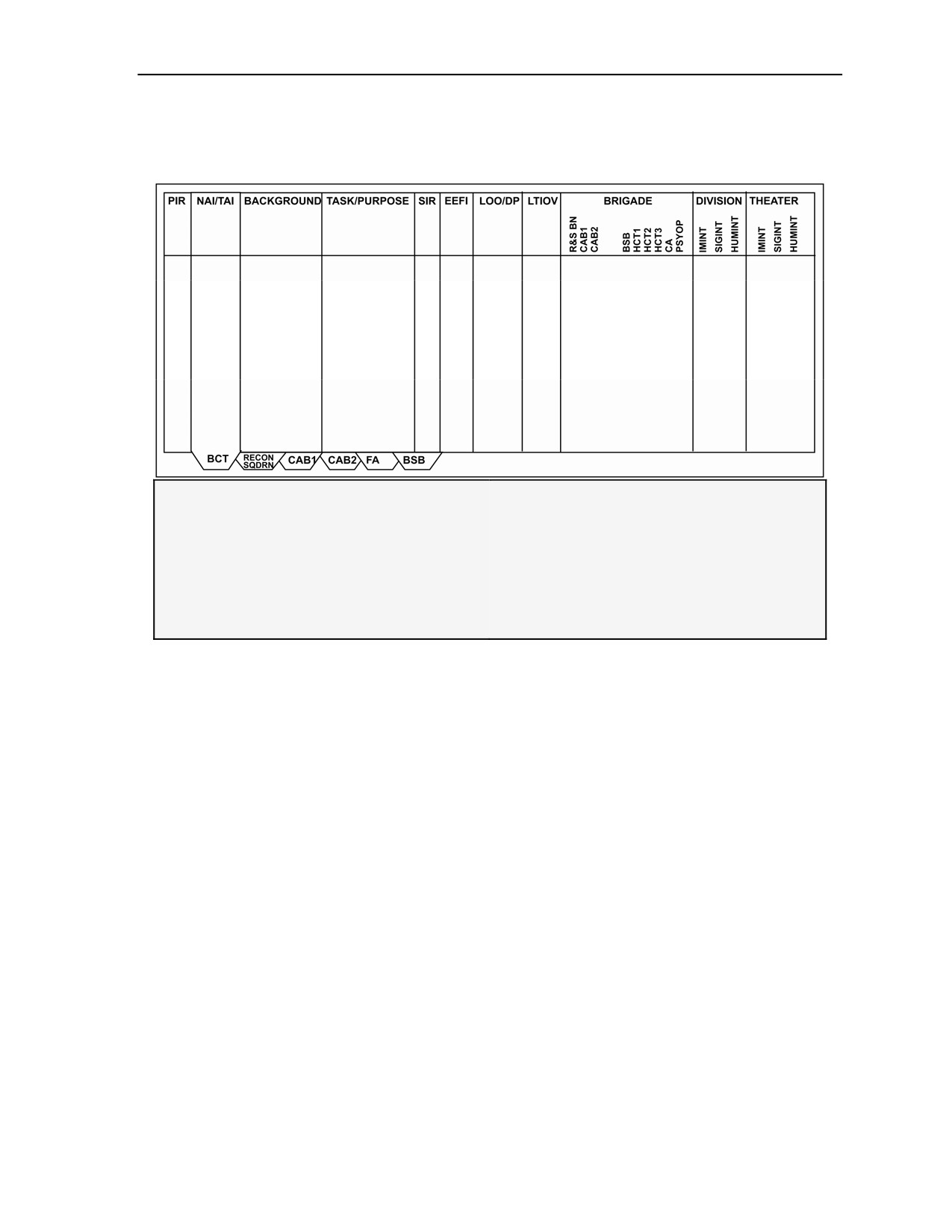
Intelligence, Surveillance, and Reconnaissance Synchronization
Is not a tasking document and is not published as part of the base order.
Is a working aid that assists the intelligence staff in synchronizing internal operations across
echelons.
BCT—brigade combat team
LTIOV—latest time information is of value
BN—battalion
NAI—named area of interest
BSB—brigade support battalion
PIR—priority intelligence requirement
CA—civil affairs
PSYOP—psychological operations
CAB—combat aviation brigade
R&S—reconnaissance and surveillance
DP—decision point
RECON—reconnaissance
EEFI—essential element of friendly information
SIGINT—signals intelligence
FA—field artillery
SIR—specific information requirement
HCT—HUMINT collection team
SQDRN—squadron
HUMINT—human intelligence
TAI—target area of interest
IMINT—imagery intelligence
Figure B-4. Example working matrix
SUPPORT INTELLIGENCE, SURVEILLANCE, AND RECONNAISSANCE INTEGRATION
B-16. During ISR integration, responsibility for ISR planning transitions from the G-2/S-2 to the G-3/S-3.
ISR synchronization and ISR integration result in a fused effort focused on answering the commander’s
requirements through ISR tasks translated into orders. (See table B-3 [page B-10].)
B-17. The key to successful reconnaissance and surveillance is an ISR plan that—
Is developed from well-reasoned enemy situation overlays, course of action (COA) statements,
and event templates and matrices.
Is driven by the CCIRs and focused on command directed tasks.
Is linked to the commander’s decisions points.
Facilitates the commander’s visualization of the AO.
Is prepared jointly by the G-3/S-3, G-2/S-2, and their staff.
Remains synchronized with the scheme of maneuver.
Is issued and updated as part of the orders process.
Assigns appropriate collection tasks to subordinate units.
Requests intelligence support as needed from higher and adjacent units.
6 January 2010
TC 2-50.5
B-9
FOR OFFICIAL USE ONLY
Appendix B
Table B-3. Support ISR integration
Develop the ISR plan
•
The G-3/S-3 assigns tasks based on LTIOV and limitations of available ISR assets.
•
The G-2/S-2 assists the G-3/S-3 in ensuring intelligence requirements are identified, prioritized, and
validated.
•
The G-2/S-2 also assists the G-3/S-3 in ensuring an ISR plan is developed and synchronized with the overall
operation.
•
The G-2/S-2 coordinates with the staff and the ISR assets’ commander. For example, the MI company
commander coordinates sustainment of ISR assets on the battlefield.
Issue the WARNO, OPORD, FRAGO
The basis of all R&S missions is the ISR plan published in Annex L of the OPORD and continually modified through
FRAGOs. There are many supporting documents developed by the G-3/S-3 and G-2/S-2 then submitted to the
commander for approval:
Base OPORD
•
Paragraph 3a(3), R&S (Commander’s Intent).
•
Paragraph 3a(4), Intelligence (Commander’s Intent).
•
Paragraph 3b, Tasks to Maneuver Units (Collection Tasks).
•
Paragraph 3c, Tasks to Subordinate Units (Collection Tasks).
•
Paragraph 3d(2), CCIR (PIR/FFIR).
•
Paragraph 3d(7), Limit of Reconnaissance.
•
Paragraph 3d(8), AOs (for the intelligence warfighting function).
Annex B (Intelligence)
•
Paragraph 2, Mission.
•
Paragraph 3a, Scheme of Intelligence.
•
Paragraph 3b, Tasks to Subordinate Units.
•
Paragraph 3d(2), RFIs.
•
Paragraph 3d(5), Distribution of Intelligence Products.
•
Appendix 2, ISR Synchronization Matrix.
•
Appendix 2: Tab A, ISR Overlay.
Annex L (ISR)
AO—area of operations
MI—military intelligence
CCIR—commander’s critical information requirement
OPORD—operation order
FFIR—friendly force information requirement
PIR—priority intelligence requirement
FRAGO—fragmentary order
R&S—reconnaissance and surveillance
ISR—intelligence, surveillance, and reconnaissance
RFI—request for information
LTIOV—latest time information is of value
WARNO—warning order
DISSEMINATE INFORMATION AND INTELLIGENCE
B-18. Dissemination includes intelligence sharing and granting access to databases, information,
or
intelligence for others to conduct intelligence reach. It also encompasses posting information to unit Web
pages and the intelligence and ISR data required to update the common operational picture (COP). Table B
4 describes the subordinate “Disseminate” activities and lists the G-2/S-2’s responsibilities.
B-19. There are three channels through which commanders and their staffs communicate:
Command channel. The command channel is the direct chain-of-command link that
commanders, or authorized staff officers, use for command-related activities. Command
channels include command radio nets, video teleconferences, and the Maneuver Control System.
Staff channel. The staff channel is the staff-to-staff link within and between headquarters. The
staff uses the staff channel for control-related activities. Through the staff channel, the staff
coordinates and transmits intelligence, controlling instructions, planning information, and
provides early warning information and other information to support command and control (C2).
Examples of staff channels include the operations and intelligence radio net, telephone, the staff
huddle, video teleconference, and the warfighting function-specific components of DCGS-A to
provide information and intelligence to the rest of the intelligence architecture.
Technical channel. Staffs typically use technical channels to control specific activities. These
activities include fire direction and the technical support and SCI reporting channels of
intelligence and ISR operations. The SIGINT tasking and reporting radio net, intelligence
B-10
TC 2-50.5
6 January 2010
FOR OFFICIAL USE ONLY
Intelligence, Surveillance, and Reconnaissance Synchronization
broadcast communications, and the wide area networks supporting single intelligence discipline
collection, processing, and production are examples of technical channels.
Table B-4. Disseminate
Arrange for direct dissemination
•
Have ISR assets report directly to the unit requiring the information for decisions.
•
This dissemination method is written into the ISR task or RFI if the G-2/S-2, with the commander’s approval,
requires the unit to execute it. Include the required coordinating information, such as call signs, frequencies,
and routing addresses.
•
If the G-2/S-2 allows the asset to report directly to the requesting unit, the intelligence staff provides the
G-2/S-2 with a copy of the information to update the ISR synchronization tools.
•
Direct dissemination is commonly used for fires and air defense units, and the target nomination process.
Determine perishability
•
Determine what information will bypass intelligence processing functions and delivered directly to the
commander for decisionmaking based on LTIOV.
•
Set alarms for critical intelligence using DCGS-A tools to alert analysts of the information’s arrival.
Determine quantity
•
Provide precise amounts of information to commanders and staffs to support their decisionmaking while
avoiding overwhelming them with unnecessary detail or compromising security techniques, means, and
sources.
•
Evaluate each element of reported information against the decisions, requirements, and supporting SIRs and
ISR tasks for the identified consumer.
•
Ensure that SCI is not disseminated to unauthorized users.
•
Legal restrictions may prohibit information dissemination to multinational forces.
Determine dissemination methods
Dissemination methods are unique to each unit and usually specified by SOPs.
•
At a minimum, plan for primary and alternate dissemination methods (redundant means and pathways) for
intelligence or reporting that supports CCIRs and decisionmaking.
•
Coordinate with operations and signals staff to determine the available dissemination methods.
•
Continuously monitor the status of the dissemination means.
Identify dissemination media
Choose the correct dissemination media to ensure timely delivery of mission-critical and time-sensitive information:
•
Voice. Most useful when speed in the transmission of small amounts of information is critical.
•
Graphics and text dissemination. Use graphics for information on disposition, composition, and strength;
use text for the other threat characteristics.
•
Messenger with a hardcopy. Least desirable; however, if the messenger is well briefed, this technique is
effective for user understanding.
Identify dissemination media
When disseminating information, the intelligence officers ensure the staff—
•
Uses the precedence coding system (FLASH, PRIORITY)—careful not to deflate the value of the highest
precedence codes.
•
Is proficient at operating automated systems and familiar with message formats.
•
Answers questions about accuracy, source, and completeness.
•
Disseminates essential information to all appropriate commanders and staff sections and informs them of
what is available.
Note. The act of posting intelligence reports on a Web page or uploading a new database is not dissemination.
Develop audit trail
Coordinate with the signals officer to develop audit trails to ensure all appropriate commanders and staff sections
receive each report only once.
Audit trail techniques include—
•
Providing columns on the ISR plan to record messages received that satisfy an ISR task and where
messages were sent.
•
Developing a matrix separate from the ISR plan, with “time received” and “sent to” on one axis and “ISR
tasks” on the other axis.
•
Annotating the dissemination list directly into a message’s remarks section.
Note. A collection and dissemination journal is a simple method for tracking who sent what messages. Automation is
especially useful—relational databases and automated journals allow complete and thorough cross-indexing, which solves many
of the problems intelligence officers usually experience when relating requirements to reports and tracking dissemination.
6 January 2010
TC 2-50.5
B-11
FOR OFFICIAL USE ONLY