Military reference books and manuals (2009-2023, Volume 7) - page 2
Appendix A (Final Draft—Not for Implementation)
2047
ANALOG MEDIA
2048
A-6. Most files will be digitized and screened. CAT II linguists and analysts in screening will move analog
2049
media files containing SLC to an SLC folder with restricted access. The processing site will move these SLC
2050
files to the appropriate folder on the CI SIPRNET directory for processing. The processing site will also retrieve
2051
the original media from the warehouse and store it in a secure storage area.
2052
HANDLING SPECIFIC LIMITING CRITERIA FROM END-OF-SHIFT REPORTS
2053
A-7. Some documents containing SLC may inadvertently be overlooked during screening and be processed
2054
through translation, quality control, and review. In order to ensure SLC data doesn’t filter into the National
2055
Harmony Database, there is an additional opportunity to remove SLC from the DOMEX workflow — the daily
2056
end-of-shift report in the DOMEX Suite. This report contains the Harmony number, date of information, batch
2057
number, number of pages, and the gist summary of every file that cleared review during the previous day,
2058
including any reports from either digital or analog media sections on items exploited within their respective
2059
sections. This report is titled by the date and indicates whether or not the report has been reviewed by the CI
2060
custodian/team. This report is sent only to the processing site analysts, S-2 section, other Government agency
2061
(OGA) representative, FBI representative, and the CI custodian/team.
2062
z
The CI team reviews the end-of-shift report and removes any information that contains SLC. Upon
2063
completion of the CI review, the CI team will rename the report to indicate it has passed the CI
2064
review and send it back to the S-2 for distribution.
2065
z
The S-2 renames the report to the daily watch report and distributes it.
2066
z
The CI team logs any new Harmony records, from the watch report that contains SLC, into their
2067
tracking database.
2068
EXPUNGING HARMONY DATABASE RECORDS AND PORTABLE DATA FILES (PDFS) CONTAINING
2069
SPECIFIC LIMITING CRITERIA
2070
A-8. The following procedures will ensure SLC information is expunged:
2071
z
For documents removed during screening, there is no Harmony database record or PDF to expunge.
2072
z
For Harmony database records identified in the end-of-shift report, the CI team will take the
2073
following actions:
2074
Log Harmony numbers into the CI custodian/team document tracking database.
2075
Contact all teams who may have had access to the identified files directing them to expunge the
2076
files from the DHDS database and the National Harmony Database. The National Harmony Database
2077
record (and associate TIFF or PDF) will be cut from the local system and copied to an internal CI
2078
DOMEX Suite local area network (LAN). This will allow the CI custodian/team to have access to the
2079
metadata and summary translation that were already created. The CI custodian/team will verify that
2080
the files have been expunged from the local DOMEX Suite database then record the expunge date in
2081
the tracking database.
2082
Contact NGIC with information of the National Harmony Database files containing SLC
2083
requesting them to expunge the PDFs. NGIC will reply via e-mail when the PDFs have been
2084
expunged. The expunge date will be recorded in the tracking database.
2085
The hardcopy file containing SLC will be retrieved from the warehouse and filed in a secure
2086
storage area.
2087
A-9. The CI custodian/team at the processing site will conduct periodic checks in both the National Harmony
2088
Database and the local DOMEX Suite database to ensure the process is working. This is achieved by conducting
2089
an audit of records in the CI DOMEX Suite LAN to see if any of those same records are in the National
2090
Harmony Database. If any SLC records are found, steps will be taken to expunge those records.
A-2
ATTP 2-91.5
Publication Date (Date Pending)
FOR OFFICIAL USE ONLY
Handling and Processing of Specific Limiting Criteria Information (Final Draft—Not for Implementation)
2091
REINTRODUCING NON- SPECIFIC LIMITING CRITERIA DOCUMENTS INTO WORKFLOW
2092
A-10. Since many Harmony records contain groupings of files that are not necessarily from the same document,
2093
for example, a grouping of memos and other correspondence, it is highly likely that there will be several
2094
documents that don’t contain SLC that should be reintroduced into the workflow process.
2095
A-11. The document or documents containing SLC will retain the original Harmony number. The non-SLC
2096
documents will be reintroduced at screening. If the non-SLC information that is being reintroduced comes from
2097
a document that has SLC, then the Harmony number assigned to the SLC information is referenced in the
2098
comment field in DOMEX Suite. The documents are turned in for screening.
2099
A-12. They are screened, assigned a new Harmony number, scanned, and returned to the warehouse for
2100
archiving.
2101
REINTRODUCING HARMONY RECORDS WITHOUT SPECIFIC LIMITING CRITERIA DATA
2102
A-13. When the CI team pulls Harmony records with suspected SLC data from the end-of-shift report, they
2103
sometimes determine that the records, in fact, do not contain any SLC data.
2104
A-14. In these cases, the metadata and portable data file would have already been expunged from both the local
2105
database and the National Harmony Database and must therefore be reintroduced. The processing site must take
2106
steps to ensure that the file is then transferred to the National Harmony Database.
2107
Publication Date (Date Pending)
ATTP 2-91.5
A-3
FOR OFFICIAL USE ONLY
(Final Draft—Not for Implementation)
2108
Appendix B
2109
Sworn Statement
2110
B-1. Sworn statements are recorded on DA Form 2823 (Sworn Statement) as depicted in figure B-1.
2111
B-2. To permit written statements to be used in judicial proceedings, the DA Form 2823 must be carefully and
2112
completely prepared as indicated in following—
2113
z
Block 1. Enter the geographic location such as the city or installation in which the statement was
2114
rendered.
2115
z
Block 2. Enter the date of the interview. Have the interviewee initial above the date after he signs the
2116
sworn affidavit located on the last page of the statement.
2117
z
Block 3. Have the interviewee write in the time and initial above it after he signs the sworn affidavit
2118
located on the last page of the statement.
2119
z
Block 4. Enter the CID or military police case file sequence number, if applicable.
2120
z
Block 5. Enter the interviewee’s last name, first name, and middle initial.
2121
z
Block 6. Enter the interviewee’s SSN, if applicable.
2122
z
Block 7. Enter the military or civilian pay grade of the person being advised; for example, E-3, O-3,
2123
GS-09, or ―Civ‖ if there is no military affiliation. If the person is in the military, indicate his status as
2124
AD, USAR, or USNG.
2125
z
Block 8. Enter the interviewee’s complete military or governmental organization including unit,
2126
installation, state, and zip code or APO or FPO. If interviewing a civilian who does not have any
2127
military affiliation, enter his current home address including the city, state, and zip code or APO or
2128
FPO.
2129
z
Block 9. In most cases, the statement will consist of a narrative section followed by a question and
2130
answer portion. The narrative format is where the interviewee provides his version (in his own words
2131
but not necessarily verbatim) of events in a logical story-based format. After the entire story is laid
2132
out in the narrative format, questions and answers will be used to draw out inconsistencies, gaps, and
2133
other issues that are not clear. If the teams of proof were not adequately addressed in the narrative,
2134
they must be addressed by specific questions that will draw out these details. Seasoned investigators
2135
may use several questions to resolve one team of an offense, as opposed to formulating one question
2136
directly from the Uniform Code of Military Justice (UCMJ). For example, do not ask the interviewee
2137
―When you struck the man in the head with the brick, did you intend to cause grievous bodily harm
2138
or death?‖ because this almost compels him to lie. The entirety of the statement should answer the
2139
who, what, when, where, why, and how of the incident. The statement must specify the times and
2140
dates of specific acts and the methods used to complete the crime or incident. The interviewee must
2141
be given the chance to edit the statement when it is completed by asking, ―Is there anything you
2142
would like to add or delete from this statement at this time?‖ After the last word in the body of the
2143
statement, write ―End of Statement‖ to close it out. If the statement will not fit on the front, back, and
2144
top of the final page of DA Form 2823, use continuation pages.
2145
Publication Date (Date Pending)
ATTP 2-91.5
B-1
FOR OFFICIAL USE ONLY
Appendix B (Final Draft—Not for Implementation)
2146
Figure B-1. DA Form 2823 example
2147
B-2
ATTP 2-91.5
Publication Date (Date Pending)
FOR OFFICIAL USE ONLY
(Final Draft—Not for Implementation)
2148
Glossary
2149
SECTION I - ACRONYMS AND ABBREVIATIONS
5Ss + T
search, silence, segregate, speed, safeguard, and tag
AC
analyst comment
ADCON
administrative control
AHA
ammunition holding area
AO
area of operations
AR
Army regulation
ATTP
Army tactics, techniques, and procedures
BAT
biometric automated toolkit
CAPCO
controlled access program coordination office
CAT
category
CBRNE
chemical, biological, radiological, nuclear, and high-yield explosive
CCIR
commanders’ critical information requirements
CD
compact disk
CDSE
cryptologic direct support team
CED
captured enemy document
CELLEX
cell phone exploitation
CEM
captured enemy material
CI
counterintelligence
CMPC
combined media processing center
CONUS
continental United States
COP
common operational picture
D2C
dirty-to-clean
DHDS
deployable harmony document exploitation suite
DHDS-CT
deployable harmony document exploitation suite -collection tool
DHDS-T
deployable harmony document exploitation suite -template
DOCEX
document exploitation
DOD
Department of Defense
DOI
date of issue
DOMEX
document and media exploitation
DOT
date of translation
DRS
detainee reporting system
DTG
date-time group
DV
digital video
DVD
digital video disk
Publication Date (Draft)
ATTP 2-91.5
Glossary-1
FOR OFFICIAL USE ONLY
Glossary (Final Draft—Not for Implementation)
EOD
Explosive Ordinance Detachment
FM
field manual
FOUO
for official use only
GMID
General Military Intelligence Directorate
HIIDE
handheld interagency identity detection equipment
HUMINT
human intelligence
ID
identification
IDCP
initial detainee collection point
IED
improvised explosive device
IIR
intelligence information report
ISR
intelligence, surveillance, and reconnaissance
JDEC
joint document exploitation center
JIDC
joint interrogation and debriefing center
JP
joint publication
MDMP
military decisionmaking process
MEDEX
media exploitation
METT-TC
mission, enemy, terrain and weather, troops and support available-time
available and civil considerations
MFLT
machine foreign language translation
MI
military intelligence
MP
military police
NEW
net explosive weight
NGIC
National Ground Intelligence Center
OPORD
operation order
PIR
priority intelligence requirements
PSA
personal search agent
PSYOP
Psychological Operations
RSLP
reserve language support program
RST
raid support team
SALUTE
size, activity, location, unit, time, and equipment
SIGINT
signals intelligence
SIM
subscriber identity module
SIR
specific information requirement
SLC
specific limiting criteria
SMS
short message service
SOP
standing operating procedures
TC
training circular
TC
translator comment
TECHINT
technical intelligence
TED
theater exploitation database
Glossary-2
ATTP 2-91.5
Publication Date (Draft)
FOR OFFICIAL USE ONLY
Glossary (Final Draft—Not for Implementation)
TTP
tactics, techniques, and procedures
U.S.
United States
USAICoE
United States Army Intelligence Center of Excellence
USATRADOC
United States Army Training and Doctrine Command
VQL
verity query language
WIT
weapons intelligence team
2150
SECTION II - TERMS
2151
term
2152
definition
2153
2154
2155
2156
2157
2158
2159
2160
Publication Date (Draft)
FM 2-91.1
Glossary-3
FOR OFFICIAL USE ONLY
(Final Draft—Not for Implementation)
2161
References
2162
REQUIRED PUBLICATIONS
2163
These documents must be available to the intended user of this publication.
2164
ARMY PUBLICATIONS
2165
FM 1-02. Operational Terms and Graphics. 21 September 2004.
2166
FM 2-0. Intelligence. 23 March 2010.
2167
FM 3-0. Operations. 27 February 2008.
2168
TC 2-91.8. Document and Media Exploitation. DD Month 2010.
2169
JOINT PUBLICATIONS
2170
JP 1-02. Department of Defense Dictionary of Military and Associated Terms. 12 April 2001.
2171
JP 2-0. Joint Intelligence. 22 June 2007.
2172
JP 3-0. Joint Operations. 17 September 2006.
2173
RELATED PUBLICATIONS
2174
These sources contain relevant supplemental information.
2175
JOINT PUBLICATIONS
2176
JP 3-35. Deployment and Redeployment Operations. 7 May 2007.
2177
JP 3-59. Meteorological and Oceanic Operations. 24 September 2008.
2178
JP 3-60. Joint Targeting. 13 April 2007.
2179
JP 4-0. Joint Logistics. 18 July 2008.
2180
JP 5-0. Doctrine for Planning Joint Operations. 20 January 2005.
2181
ARMY PUBLICATIONS
2182
AR 190-11. Physical Security of Arms, Ammunition, and Explosives. DD Month YYYY
2183
AR 190-13. The Army Physical Security Program. 4 June 1993.
2184
AR 380-67. The Department of the Army Personnel Security Program. 9 September 1988.
2185
AR 381-10. U.S. Army Intelligence Activities. 3 May 2007.
2186
ATTP 3-90.15. Site Exploitation Operations. DD Month 2010.
2187
DA PAM 385-64. Ammunition and Explosives Safety Standards. DD Month YYYY
2188
FM 2-19.4. Brigade Combat Team Intelligence Operations. 25 November 2008.
2189
FM 2-22.3. Human Intelligence Collector Operations. 6 September 2006.
2190
TC 2-22.4. Technical Intelligence. 19 November 2010.
2191
RELATED PUBLICATIONS
2192
These sources contain relevant supplemental information.
2193
None.
Publication Date (Date Pending)
ATTP 2-91.5
References-1
FOR OFFICIAL USE ONLY
References (Final Draft—Not for Implementation)
2194
SOURCES USED
2195
AFMAN 24-204 (I)/TM 38-250/NAVSUP PUB 505/MCO P4030.19H/DLAI 4145.3. Preparing
2196
Hazardous Materials for Military Air Shipments. DD Month YYYY
2197
DA PAM 385-64. Ammunition and Explosives Safety Standards. DD Month YYYY
2198
DOD 6055.9-STD. DOD Ammunition and Explosives Safety Standards. DD Month YYYY
2199
TM 60A 1-1-22. EOD Procedures /General EOD Safety Procedures. DD Month YYYY
2200
USDOT, Transportation—Code of Federal Regulations (CFR) Title 49 Parts 100-185. Hazardous
2201
Materials Regulations. DD Month YYYY
2202
References-2
ATTP 2-91.5
Publication Date (Date Pending)
FOR OFFICIAL USE ONLY
2203
Index
2204
No index entries found.
Publication Date (Date Pending)
ATTP 2-91.5
Index-1
FOR OFFICIAL USE ONLY
(Final Draft—Not for Implementation)
2205
ATTP 2-19.5
2206
Publication Date (Date Pending)
2207
By order of the Secretary of the Army:
2208
GEORGE W. CASEY, JR.
2209
General, United States Army
2210
Chief of Staff
2211
Official:
2212
JOYCE E. MORROW
2213
Administrative Assistant to the
2214
Secretary of the Army
2215
DISTRIBUTION:
2216
Active Army, the Army National Guard, and the United States Army Reserve: Not to be distributed;
2217
electronic
media
online.
FOR OFFICIAL USE ONLY
(Final Draft—Not for Implementation)
2218
2219
2220
PIN
FOR OFFICIAL USE ONLY
Handling Instructions for CALL
Electronic Media and Paper Products
Center for Army Lessons Learned (CALL) authorizes official use of this CALL
product for operational and institutional purposes that contribute to the overall
success of U.S., coalition, and allied efforts.
The information contained in this product reflects the actions of units in the field
and may not necessarily be approved U.S. Army policy or doctrine.
This product is designed for official use by U.S., coalition, and allied personnel and
cannot be released to the public without the expressed written consent of CALL.
This product has been furnished with the expressed understanding that it will be
used for official defense-related purposes only and that it will be afforded the same
degree of protection that the U.S. affords information marked “U.S.
UNCLASSIFIED, For Official Use Only [FOUO]” in accordance with U.S. Army
Regulation (AR) 380-5, section 5-2.
Official military and civil service/government personnel, to include all coalition
and allied partners may paraphrase; quote; or use sentences, phrases, and
paragraphs for integration into official products or research. However, integration
of CALL “U.S. UNCLASSIFIED, For Official Use Only [FOUO]” information into
official products or research renders them FOUO, and they must be maintained and
controlled within official channels and cannot be released to the public without the
expressed written consent of CALL.
This product may be placed on protected UNCLASSIFIED intranets within military
organizations or units, provided that access is restricted through user ID and
password or other authentication means to ensure that only properly accredited
military and government officials have access to these products.
Regulations strictly forbid posting CALL “U.S. UNCLASSIFIED, For Official Use
Only [FOUO]” documents to Department of Defense (DOD) Websites that do not
restrict access to authorized personnel. AR-25-1, 15 Jul 2005, Army Knowledge
Management and Information Technology, paragraph 6-4 n (2) (b) and DOD Web
Site Administration Policy and Procedures (11 Jan 2002), Part II, paragraph 3.6.1
require appropriate mechanisms to protect sensitive information.
When no longer needed, all CALL “U.S. UNCLASSIFIED, For Official Use Only
[FOUO]” paper products and electronic media will be shredded or destroyed using
approved paper shredders or CDROM destroyers.
To allied and coalition personnel:
This information is furnished with the understanding that it is to be used for defense
purposes only, that it is to be afforded essentially the same degree of security
protection as such information is afforded by the United States, and that it is not to
be revealed to another country or international organization without the written
consent of CALL.
U.S. UNCLASSIFIED
REL NATO, GCTF, ISAF, MCFI, ABCA
For Official Use Only
DRILL SERGEANT HANDBOOK
Foreword
The Center for Army Lessons Learned has partnered with the Basic Combat
Training Center of Excellence and Fort Jackson to assist drill sergeants to prepare,
train, and lead our new Soldiers in their transition to ground combatant.
Mistakes occur more frequently during the first and last cycles of your drill
sergeant tour. During the first cycle, you are one of the least experienced drill
sergeants and lack knowledge of the command climate. This handbook will alert
you to some common errors so you do not make them. These mistakes can be
detrimental to your Army career and negatively affect the lives of your Soldiers.
During your last cycle, you may get too relaxed and have a false sense of security.
Do not fall into that trap. We, as leaders, must give you all the tools you need for
success.
This handbook is designed to help you through one of the most difficult and
challenging missions of your Army career—teaching and molding our future
Soldiers to train, fight, and win in the Global War on Terrorism. It gives “street
smart” advice from more experienced current and former drill sergeants who also
want you to succeed. In this handbook, they show you how to be a better leader,
handle the many pressures of your position, and overcome numerous training
obstacles.
Your excellence as a drill sergeant equates to hundreds of Soldiers’ lives saved.
Being a drill sergeant is a serious and tough job, but with perseverance and
dedication, you can do it!
BRADLEY W. MAY
Brigadier General, U.S. Army
Commanding
U.S. UNCLASSIFIED
REL NATO, GCTF, ISAF, MCFI, ABCA
i
For Official Use Only
DRILL SERGEANT HANDBOOK
Drill Sergeant Handbook
Table of Contents
Introduction
1
Chapter 1. Knowledge
3
Chapter 2. Skills
19
Chapter 3. Abilities
29
Chapter 4. Attitude
37
Appendix A. References
41
Appendix B. Drill Sergeant Peer Evaluation Form
43
Appendix C. Soldier Assessment Form(IET Soldiers)
45
Appendix D. Basic Combat Training Smart Card
47
Appendix E. Major General John M. Schofield's Definition of
49
Discipline
Center for Army Lessons Learned
Director
Colonel Robert W. Forrester
Project Analyst
Michael Pridgen
Production Coordinator
Valerie Tystad
Editor
Jenny Solon
Graphic Artist
Dan Neal
Printing Support Liaison
Candice Miller
The point of contact for this handbook is Mr. James E. Walthes, Director, Doctrine
and Training Development Division (803-751-6511/1137 or DSN 734-6511/1137;
jim.walthes@us.army.mil).
U.S. UNCLASSIFIED
REL NATO, GCTF, ISAF, MCFI, ABCA
iii
For Official Use Only
CENTER FOR ARMY LESSONS LEARNED
The Secretary of the Army has determined that the publication of this periodical is
necessary in the transaction of the public business as required by law of the
Department.
Unless otherwise stated, whenever the masculine or feminine gender is used, both
are intended.
Note: Any publications (other than CALL publications) referenced in this product,
such as ARs, FMs, and TMs, must be obtained through your pinpoint distribution
system.
U.S. UNCLASSIFIED
REL NATO, GCTF, ISAF, MCFI, ABCA
iv
For Official Use Only
DRILL SERGEANT HANDBOOK
Introduction
Being a drill sergeant may be the most challenging and rewarding assignment a
noncommissioned officer will ever experience during his military career.
While training initial entry Soldiers to fight and win in today’s Global War on
Terrorism, drill sergeants must embody and reflect the Army’s values and
standards. They must also be:
• Effective communicators.
• Sound administrators.
• Motivators.
• Proficient instructors.
• Effective coaches, mentors, and counselors.
This handbook is designed to help new drill sergeants conquer the many challenges
of their assignment and succeed in their mission of training Soldiers.
Primary sources for this handbook are current drill sergeants from The United
States Army Drill Sergeant School, Fort Jackson, SC, and former drill sergeants at
the Basic Combat Training Center of Excellence. Special thanks to each installation
Drill Sergeant of the Year for their valued input. A full list of references is located
at Appendix A.
U.S. UNCLASSIFIED
REL NATO, GCTF, ISAF, MCFI, ABCA
1
For Official Use Only
DRILL SERGEANT HANDBOOK
Chapter 1
Knowledge
On Orders for Drill Sergeant Duty?
Prepare yourself for your new mission:
•
Learn the Drill Sergeant Creed and the Soldier’s Creed.
•
Get in shape (mentally as well as physically) and eat right while
preparing yourself for a challenging but rewarding experience. Be
open-minded.
•
Prepare your Family for a challenging assignment. Explain that you will
be required to work late nights, early mornings, weekends, and holidays.
Connect your spouse with local Family resource centers.
•
Talk to other current or former drill sergeants in your unit or area. They
will give you helpful advice and support.
•
Be familiar with the talk-through, step-by-step, and by-the-numbers
methods of instruction located in the Module Handbook (at
<http://www.jackson.army.mil/units/drill/index.html>) for the following:
º Stationary drills
º Facing movements at the halt
º Steps and marching
º Basic manual of arms
º Advanced manual of arms
º Squad drill
º Platoon drill
•
Study Field Manual (FM) 3-22.20, Army Physical Readiness Training.
Focus on executing the exercises.
•
Be familiar with United States Army Training and Doctrine Command
(TRADOC) Regulation (TR) 350-6, Enlisted Initial Entry Training (IET)
Policies and Administration, and TR 350-16, Drill Sergeant Program.
•
Have confidence in yourself. If you are an outstanding noncommissioned
officer (NCO), then you will be an outstanding drill sergeant. If you are
not an outstanding NCO, determine what you need to improve with a
solid action plan.
•
Learn a couple of marching and running cadences prior to attending Drill
Sergeant School. Practice calling cadence with your current unit.
U.S. UNCLASSIFIED
REL NATO, GCTF, ISAF, MCFI, ABCA
3
For Official Use Only
CENTER FOR ARMY LESSONS LEARNED
• Study the drill sergeant history to get a different perspective of the
organization and a new level of pride. Visit the Basic Combat Training
(BCT) homepage at <http://www.bct.army.mil> to see the history of the
Drill Sergeant School or the United States Army Drill Sergeant School
(USADSS) Website at <http://www.jackson.army.mil/units/drill/index.html>
for more information.
When you report to your unit:
•
Be motivated and open-minded. Drill sergeant duty is what you make of
it. Do not be afraid to ask questions or say “I don’t know.”
•
Look for great leadership. Seek a mentor with similar leadership styles
and abilities. Pick his brain—find out how he does things so well.
•
Find out what works for you. Surround yourself with positive, motivated
leaders.
•
Observe and then jump in with both feet while being critiqued by the
more experienced drill sergeants. Seek feedback from your peers.
Volunteer to explain or demonstrate so you can ultimately become the
training expert.
•
Keep the lines of communication open between you, your peers, and your
chain of command.
•
Keep your supervisor informed of any Family issues or appointments that
can distract you from training Soldiers. Make sure your Family is settled.
Ask your supervisor for more time up front if you need it.
•
Stress the Army Values and never violate them! Enforce respect and
self-discipline.
•
Be knowledgeable on FM 3-22.20, TR 350-6 (especially Chapter 2,
which discusses phase training and the associated goals and privileges for
BCT, advanced individual training [AIT], and one station unit training
[OSUT] Soldiers), and TR 350-16.
•
Consult subject matter experts (SMEs) on tactics and become an SME
yourself. Do not pretend to know what you are talking about.
•
Seek advice from the more experienced drill sergeants on how and when
to counsel your Soldiers.
•
Check your emotions at the door—be thick skinned! Remember your own
BCT experience (what frustrated you and what motivated you).
•
Take what you learned at the USADSS and integrate it into your scope of
training.
U.S. UNCLASSIFIED
REL NATO, GCTF, ISAF, MCFI, ABCA
4
For Official Use Only
DRILL SERGEANT HANDBOOK
New Drill Sergeants
As a new drill sergeant, you should:
• Avoid being extra tough or mean in order to gain respect from the other
drill sergeants. You will be judged on your knowledge and abilities.
• Speak up. If you have a question, ask! Go directly to the SME for
assistance, advice, or guidance prior to instructing a class.
• Take control of the situation, and do not let yourself be intimidated.
• Avoid using gender to circumvent a duty or task.
• Design your own techniques on how to handle Soldiers. Be direct and fair
to ensure all Soldiers know the rules and regulations. Let them know
what will and will not be tolerated or accepted.
• Counsel all violations.
• Avoid excessive screaming; it becomes a distraction and could make your
job difficult.
• Ensure your battle buddy supports your decisions; you are part of a team.
Outcomes-Based Training
Outcomes-based training (OBT) is the approach to training that stresses the
desired end state/outcomes for all tasks; this approach equally develops
mental intangibles, attributes, and a deeper understanding of the tasks being
trained as they apply to combat, personal accountability, and Warrior
Ethos. Every military task trained should be based on mastering
fundamentals required for excellence and combat success, how the task ties
into other supported or supporting tasks/functions, how the task applies to
the individual’s personal responsibilities, and how the execution of the task
develops and validates the Warrior Ethos.
Every individual task that we train should be viewed holistically, combining
all possible associated training benefits. This approach allows trainers the
opportunity to train supplemental/related individual tasks simultaneously,
to teach how these tasks work together to achieve superior synergistic
results, and to tie into training the development of multiple intangible
attributes which link directly to the Warrior Ethos. While individual OBT
will need focused attention (specific movements, zeroing procedures,
plotting coordinates, etc.), trainers should always tie back into the training
session all related factors: how the task ties into others, the combat
application (if applicable—some tasks have little combat application but are
important for the soldierization process), personal responsibilities tied to
tasks, and the Warrior Ethos.
U.S. UNCLASSIFIED
REL NATO, GCTF, ISAF, MCFI, ABCA
5
For Official Use Only
CENTER FOR ARMY LESSONS LEARNED
All of these should be linked to the specified individual tasks and explained in
enough detail to provide the fundamental knowledge to allow Soldiers to
understand fully, make future decisions as conditions change, and provide
input for better methods. It is implied that throughout the execution of OBT,
trainers must teach the fundamentals/principles to a level that ensures
Soldiers retain the knowledge required to understand the task completely and
gain personal accountability in the task execution.
Trainers must consistently talk with their Soldiers to ensure that this deeper
understanding is resonating with each individual and that they have
explained in enough detail that the Soldier truly understands what
performance is expected.
They must measure how well the Soldiers understand through the Soldiers’
demonstrated application, their ability to explain, the level of personal
responsibility they take with task execution, and the level of excellence they
achieve. As the trainer moves Soldiers through individual tasks, they must
ensure the Soldier understands how tasks support additional or related tasks,
building towards holistic achievements for multiple tasks. This approach will
assist unit leaders as they develop training into collective requirements;
Soldiers will better understand the linkage of individual tasks to collective
tasks. They will also better understand how individual performance ties into
unit success and mission accomplishment. When executed properly, this
methodology will ultimately lead to task proficiency, development of
intangible attributes, knowledge-based understanding, and an understanding
of how all tasks combine for unit success.
—Comments from a Command Sergeant Major
These concept slides may also help:
Working Definition for Outcomes-Based Training
Outcomes-based training is a philosophical approach to military training
that stresses the end state of the Soldier’s mental intangibles, attributes, and
skills required by the commander for combat. The training is guided by the
commander’s intent and unit initiative to obtain the greatest effectiveness
and not focused on process-driven requirements.
U.S. UNCLASSIFIED
REL NATO, GCTF, ISAF, MCFI, ABCA
6
For Official Use Only
DRILL SERGEANT HANDBOOK
Working Principles of Outcomes-Based Training
Training designed to obtain desired combat-required outcomes in Soldiers
to include mental intangibles, attributes, and skills.
Develops effectiveness instead of fixating on efficiency and restrictive
processes.
Training allows Soldiers to make appropriate decisions and to understand
the "why" behind various tasks.
Commanders and cadre assess Soldier outcomes to ensure desired results
are obtained.
Outcomes-based training is a tool commanders use to measure their Soldiers’ and
units’ progress and make adjustments as they see fit. By carefully analyzing and
evaluating training, commanders can determine if Soldiers are obtaining the desired
outcome.
Units across United States Army Accessions Command (USAAC) have adopted
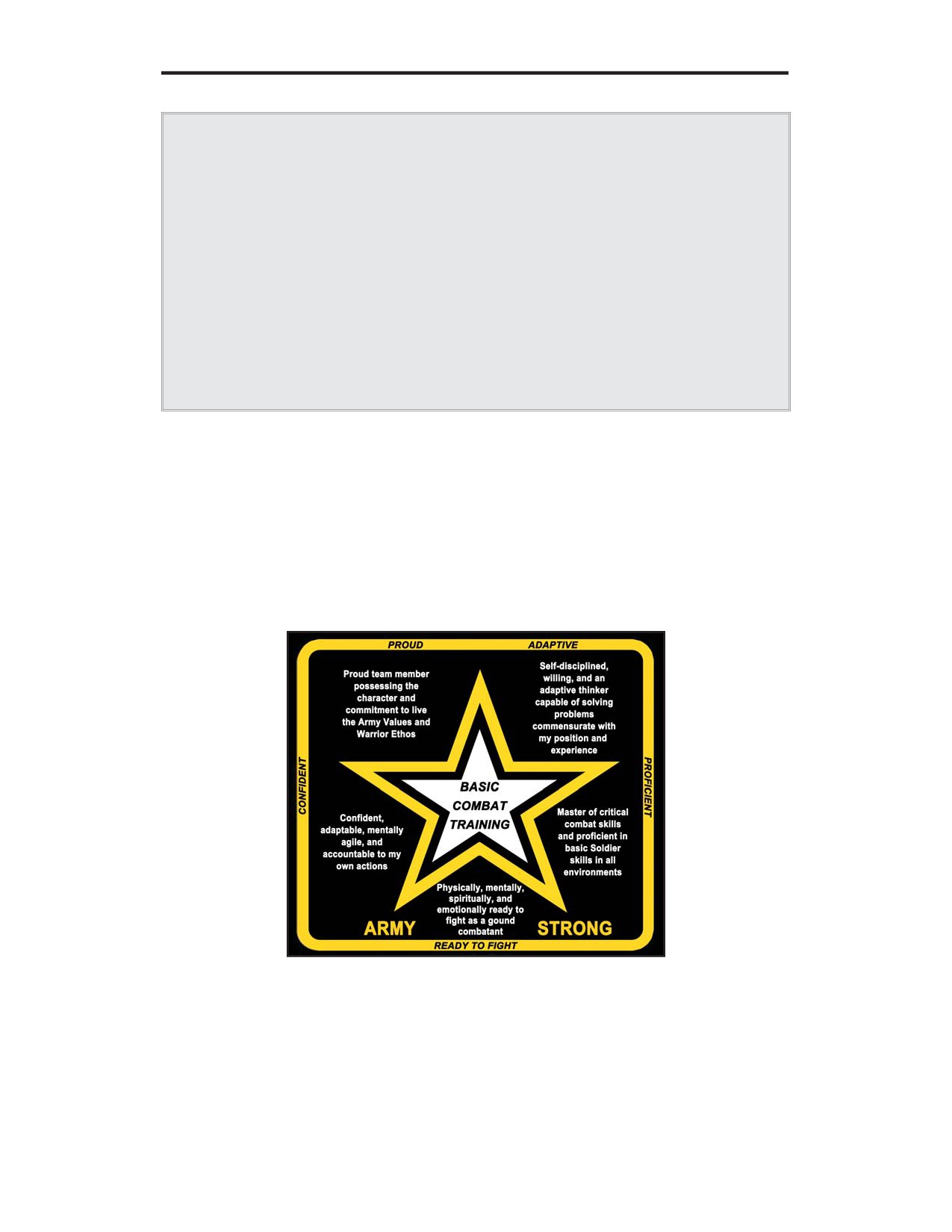
outcomes-based training in different ways. The five elements depicted in Figure 1-1
have been approved by USAAC; however, they can be modified by units to fit their
particular missions and desires.
Figure 1-1
Use outcomes-based training posters throughout your company or training area to
inspire Soldiers.
Refer to the outcomes-based training concept before, during, and after training
sessions. Believe in the concept, and you will come across to the Soldiers as
U.S. UNCLASSIFIED
REL NATO, GCTF, ISAF, MCFI, ABCA
7
For Official Use Only
CENTER FOR ARMY LESSONS LEARNED
genuine. Incorporate everything you do or say with the desired outcomes. Always
reassess yourself so you can give the most effective training.
An additional week of basic combat training is provided for commanders to meet
outcomes-based training requirements in FY09. No additional training is added to
the program of instruction, allowing commanders to schedule training events based
on the unit’s training performance.
New Soldier Processing
As a drill sergeant, you should take the time to know and understand the entire
Soldier processing flow—recruitment, military enlistment processing station
(MEPS), Reception Battalion, BCT/OSUT/AIT, and reporting to the first duty
station. You have the most important role in the development process:
• Develop a good rapport with the reception personnel.
• Correct every deficiency as early as possible (especially in the first two
weeks). Make sure Soldiers understand why they are being corrected and
what the action could cause. For example, new Soldiers who do not make
their bunks to standard display a lack of attention to detail and
time-management skills. Remember that every Soldier brings a certain
amount of baggage with him that could possibly interfere with his
performance during training.
• Ensure Soldiers know that they are now a part of the Army Family and
that you care about their safety and well-being, are willing to help, and
believe in them and their abilities.
• Take time to learn about new Soldiers. Do not assume they are weak or
“worse” than Soldiers you trained in the past. Some Soldiers will be older
than you; some will still be in high school
Reception Battalion Operations
Understand the Reception Battalion's role in processing new Soldiers and how the
battalion can assist you.
Typical arrival schedule:
• First four hours:
º Meet your drill sergeant
º Initial processing
º Amnesty room
º Physical training (PT) uniform issue
º Late dinner
º Assigned to a company
U.S. UNCLASSIFIED
REL NATO, GCTF, ISAF, MCFI, ABCA
8
For Official Use Only
DRILL SERGEANT HANDBOOK
•
Day
1:
º
Wake up
º
Tuberculosis Tine test
º
Pay (via EZPay card)
º
Haircut
º
Medical processing (DNA, blood, optometry, audiology)
º
Post exchange (shoe type and size check)
•
Day
2:
º
Personnel administration branch
º
Common access card
º
Clothing initial issue point (CIIP)
º
Dental processing
º
Top Secret security screening
•
Day
3:
º
PPDE evaluation (medical)
º
Immunizations (mumps, measles, rubella; polio; meningitis; flu;
tetanus)
º
Optometry
º
Photographs
º
PPDE brief (medical)
º
Correct various discrepancies
º
Moment of truth ceremony
º
Ship to BCT
Expedited/Blended Reception Model
Expedited/blended reception is the process of receiving, processing, and training
Soldiers from the moment of arrival. The blending of reception and training
immediately starts the transformation process from civilian to Soldier. BCT/OSUT
drill sergeants command and control all newly arriving Soldiers from the moment
they arrive on the installation. This process creates an environment where
BCT/OSUT cadre set and enforce standards from the Soldier’s night of arrival
U.S. UNCLASSIFIED
REL NATO, GCTF, ISAF, MCFI, ABCA
9
For Official Use Only

CENTER FOR ARMY LESSONS LEARNED
through graduation day. The one BCT/OSUT cadre has immediate ownership of the
new Soldier.
BCT units receive all Soldiers arriving Monday-Thursday. Soldiers who arrive
Friday-Sunday will be processed by the reception battalion and handed off on
Monday to their BCT unit.
Expedited/Blended Reception Model
Sun
M
T
W
Th
F
Sat
Sun
M
T
W
Th
F
Sat
Monday
arrivals
Tuesday arrivals
Wednesday arrivals
Thursday arrivals
Friday and
weekend arrivals
Monday arrivals
Received by Rec BN
Received by BCT BN
Notes:
Legend:
BCT unit will receive all Soldiers arriving Monday -
Thursday
Processing window
Soldiers who arrive on Friday - Sunday will be
processed by the Reception BN and handed off on
BCT Start Date
Monday to the next BCT unit
Figure 1-2
Use expedited/blended reception to get to know your Soldiers. Read the Soldiers’
personnel data forms or talk to them about why they joined the Army, any Family
issues they have, names of their children, and so on.
Develop an effective reception so Soldiers are focused on being Soldiers and not on
the process. The goal of this program is for Soldiers to receive a best first
impression of the Army and embrace their decision to join.
Expedited/blended reception eliminates multiple chains of command, establishes
defined standards, and reduces a Soldier’s confusion. It increases drill
sergeant/Soldier fusion; you understand the Soldier and begin to teach, coach, and
mentor faster. Expedited/blended reception reduces a new Soldier's emotional
turbulence.
U.S. UNCLASSIFIED
REL NATO, GCTF, ISAF, MCFI, ABCA
10
For Official Use Only
DRILL SERGEANT HANDBOOK
Conduct a one-on-one informal counseling session between you and the Soldier
within 48 hours of the Soldier’s arrival:
• Find out why your new Soldiers really joined the military.
• Conduct in-depth counseling to determine the success of the platoon for
the next several months.
One of the biggest challenges in expedited/blended reception is communication
between the Reception Battalion cadre/staff and the drill sergeants. Reception
Battalion cadre/staff need to support the drill sergeants’ needs/requests, and drill
sergeants need to coordinate (as early as possible) with the Reception Battalion
cadre/staff and be open to suggestions.
Some advantages to expedited/blended reception include the following:
•
You are the primary trainer and have the ability to manage the reception
process and intertwine key training tasks associated with BCT while
capturing unused time to instruct Soldiers on vital warrior tasks.
•
Drill sergeants can quickly begin training Red Phase tasks (immersion in
the Army’s core values, traditions, Warrior Ethos, ethics, individual BCT
skills, teamwork, and PT) earlier.
•
Time spent at the Reception Battalion is reduced or eliminated.
•
Drill sergeant is upfront during new Soldier processing so that problems
(clothing issue, medical problems, pay, boots, glasses, etc.) are corrected
at the earliest possible time.
•
Soldiers have no time to pick up bad habits or advice from others at the
Reception Battalion.
•
Soldiers experience one BCT standard. Soldiers are more responsive
when they have one chain of command leading them from start to finish.
•
Soldiers arrive at reception as close to Army Training Requirements and
Resources System (ATRRS) start date as possible.
•
Transportation requirements for moving new Soldiers are reduced. The
ultimate goal is movement from arrival by airplane/bus to BCT barracks.
Reception barracks may be necessary based on installation needs.
•
Expedited/blended reception could possibly limit your cycle breaks. For
example, you could graduate a class on Friday, ship them on Saturday,
and then pick up a new class on Monday (depending on the time of year).
Drill and Ceremonies
Use cadence to reinforce learning while marching to and from all training sites or
during PT (dress-right-dress, cover, recover, right face, left face, etc.).
U.S. UNCLASSIFIED
REL NATO, GCTF, ISAF, MCFI, ABCA
11
For Official Use Only
CENTER FOR ARMY LESSONS LEARNED
Teach Soldiers as much drill and ceremonies as possible; go beyond the minimum
requirements; take advantage of breaks in training. Help Soldiers improve through
continuous practice or drill and ceremonies competitions. Your training will pay off
when you proudly march them at graduation.
There are many advantages to using your Junior Reserve Officer Training Corps
(JROTC) Soldiers to demonstrate drill and ceremonies:
• They know most of the techniques and can show other Soldiers how to
perform them correctly.
• They provide a good visualization, so you will have less to correct.
• They show how receptive the Soldiers are; they learn faster using this
approach, and it gives them an opportunity to develop their leadership
skills.
Army Knowledge Online (AKO) Website
During registration at the MEPS, Soldiers are assigned an AKO account and
receive specific instructions on its use. During training, Soldiers have little
opportunity to use their AKO accounts. They normally forget their AKO login
information by the time they get to AIT. Soldiers are also not familiar with the
“MyPay” system. You should brief them on both AKO and MyPay prior to
completing training.
Recognizing the Soldier’s Potential
Techniques for using Soldiers to assist training include the following:
• Identify all Soldiers early so you can use them in different leadership
positions (platoon leaders, squad leaders, or team leaders). Pinpoint their
leadership traits/strengths and leverage as much as possible.
• Have the platoon come up with its own motto; it gives them a sense of
ownership and instills pride.
• Have Soldiers assist you in preparing packets for the next cycle; it makes
for a smoother reception.
• Have Soldiers write a “real deal” history of themselves (stress how
important it is for them to tell the truth no matter how difficult it may be).
This history will assist you in identifying their strengths and weaknesses
as well as how to individually deal with and assist them.
• While awaiting transportation or during a break after training, brief
Soldiers on upcoming training events so they can start preparing for the
next day. Encourage Soldiers to help each other.
• Use platoon, squad, and team leaders to help make your job easier and to
prepare them for higher leadership positions.
U.S. UNCLASSIFIED
REL NATO, GCTF, ISAF, MCFI, ABCA
12
For Official Use Only
DRILL SERGEANT HANDBOOK
•
Explain the responsibilities of a platoon, squad, or team leader to
Soldiers. Inspire them to take on the challenge.
•
Soldiers want to be challenged (both mentally and physically). Give them
the opportunity to excel by creating different challenges.
Common sense techniques:
•
Understand that training support packages (TSPs) are guidelines and
might not always relate to current situations. Use your personal
experiences, paint a picture or visual, and make training realistic.
•
“Smoking” the Soldiers is not always the right answer. A firm talk,
having the Soldier write an essay, taking away a privilege, even getting a
parent on the phone might be more effective. Seek clear guidance from
your chain of command first.
•
Know when to raise your voice to make a point. Do not be someone who
is always screaming, because the Soldiers will tune you out. “When in
doubt, don't scream or shout!” Be direct and clear without yelling or
using profanity—take the high road.
•
Know the difference between being strict/enforcing standards and being
abusive/demeaning. Strict drill sergeants motivate Soldiers; demeaning
drill sergeants shut Soldiers down.
•
Every unit has that one drill sergeant who is just one mistake away from
being relieved. Do not fall for it just because he is getting away with
something. It is not okay for you to do it.
•
When a Soldier compromises the Army Values, use one of the Army’s
outstanding Soldier stories (such as SFC Smith who was awarded the
Iraqi War Congressional Medal of Honor) to inspire him.
•
Challenge the Soldiers with nightly assignments from their smart book or
the Skill Level I Common Tasks Manual. The assignments can be based
on upcoming training. Use drill sergeant time to educate and quiz the
Soldiers. Demonstrate how they can put their basic knowledge to use.
This technique is very effective, and the Soldiers are usually excited
about learning.
•
Print and put additional FMs into binders for use at the field training
exercise. Have the Soldiers teach from the manuals with your
supervision. It gives them a chance to get in front of their peers and show
what they have learned. Many of them are very good at it—they just need
a little support and confidence.
•
Demonstrate everything you can—obstacle courses, first aid, land
navigation, and so forth. Show Soldiers that you are a master of these
tasks and can perform them yourself. Your are not just talk—you are a
Soldier too!
U.S. UNCLASSIFIED
REL NATO, GCTF, ISAF, MCFI, ABCA
13
For Official Use Only
CENTER FOR ARMY LESSONS LEARNED
•
Talk to your Soldiers about your experiences in the Army, especially in
combat. Fear of the unknown is always a demotivator.
•
Maintain and account for all equipment. Check and re-check your hand
receipts. Assign Soldiers to assist to build leadership/accountability.
•
Conduct an inventory after all major training events, end of cycle, or
when any equipment is turned in. Develop an equipment smart book for
hand receipts, inventories, and statements of charges; and keep it updated.
•
Keep a leader’s book that includes pertinent information on all of your
Soldiers (hot/cold weather injuries, medical profiles, mandatory release
dates, etc.).
•
Always focus on bay area security. Ensure your Soldiers know how to
secure their personal items properly. Let them know they should report
any missing or stolen property to you immediately.
•
Be cognizant of your unit’s hazardous material requirements. Ensure all
hazardous material is stored properly in accordance with Army and
installation policies, regulations, or guidance.
•
You may encounter Soldiers going through various life changes or
emotions such as homesickness, withdrawal from certain medications,
anxiety, depression, anger, fear, or resistance to discipline. Seek clear
guidance from your chain of command immediately on how to handle
these challenges.
•
Become familiar with the Community Mental Health Services (CMHS)
process. Get your chain of command involved to ensure Soldiers get
proper treatment or counseling.
•
Deal with disciplinary issues up front. Do not let the Soldiers talk back to
you—correct them on the spot! This sends a message to the other Soldiers
that this behavior will not be tolerated.
•
Make all instructions easy to understand. Link Soldiers who are
struggling to comprehend with a buddy who can help them. Follow up
with these Soldiers after the training is complete. If possible, match your
stronger Soldiers with your weaker Soldiers for successful buddy teams.
•
Conduct a check on learning after each training session. Make sure you
ask the Soldiers specific questions. If you ask yes or no questions (such as
“Do you understand?”), the Soldiers will automatically respond with
“Yes, Drill Sergeant!” (whether they understand or not).
•
Do not let the Soldiers give up or quit on a task or event. Push and
challenge them to meet the training standard while focusing on precision.
Have patience; do not sacrifice standards to time.
•
Decide early with your battle buddy who will be the primary trainer and
then focus on your responsibilities.
U.S. UNCLASSIFIED
REL NATO, GCTF, ISAF, MCFI, ABCA
14
For Official Use Only
DRILL SERGEANT HANDBOOK
•
Emphasize teaching Soldiers the fundamentals of every task. Attention to
detail is important to the successful completion of every task.
•
Always factor in excess time for motor movements, vehicle maintenance,
dispatching, or personal hygiene when planning your training.
•
Become more knowledgeable by asking questions, reading regulations,
and observing more experienced drill sergeants.
•
Set the example by always treating your Soldiers fairly and equally,
participating in PT, and wearing the same equipment on foot marches.
•
Find out the standard at the Central Issue Facility prior to turning in or
picking up equipment so that you will be prepared for what the facility
will be inspecting. Ensure Soldiers receive the correct size uniforms and
equipment.
•
Be flexible and open-minded to new ideas, approaches, and tasks.
•
Be creative in helping your Soldiers achieve their goals. Possessing an
optimistic and positive attitude is critical to their success. Promote a
positive environment.
•
Reinforce all skills learned on a regular basis.
•
Help your Soldiers build their intangible skills (confidence, pride,
willpower, and resilience) and overcome their fears through training and
repetition (completing road marches, finishing a PT run, passing the end
of cycle Army physical fitness test, or overcoming the obstacle course).
•
Keep your goals, objectives, and mission on the forefront while building
your mental, physical, and emotional skills.
•
Focus on your duty and remember why you are here—to lead, coach, and
train the Army’s future leaders!
Trainee Abuse
Do not abuse trainees or condone abuse from other drill sergeants (have zero
tolerance). There is plenty of written guidance established to help keep you out of
trouble. Read and follow it! Know TR 350-6, Enlisted Initial Entry Training (IET)
Policies and Administration. The regulation can answer a lot of your questions and
offer clarification on your conduct in the IET environment.
Never touch Soldiers unless you are making a necessary correction for training or
safety. Do not be timid when making necessary physical corrections to Soldiers. If
you act like you are doing something wrong, Soldiers will think you are doing
something wrong.
Remember: Your hat and badge do not give you the right to abuse Soldiers!
U.S. UNCLASSIFIED
REL NATO, GCTF, ISAF, MCFI, ABCA
15
For Official Use Only
CENTER FOR ARMY LESSONS LEARNED
Trainee Abuse Definition
(TRADOC Regulation 350-6 Glossary)
Trainee abuse is any improper or unlawful physical, verbal, or sexual act
against a trainee. (This definition does not include acts involving a trainee
against a trainee.)
Examples might include:
• Assault.
• Extreme physical training not in accordance with a program of
instruction.
• Extreme profanity.
• Sodomy and rape.
• Sexual harassment.
• Extortion of money.
• Any personal relationship not required by the training mission.
In accordance with this regulation, only a commander can determine trainee
abuse has occurred.
A trainee’s consent to the act in no way affects this definition.
Inappropriate Relationships
Improper relationships with IET Soldiers are unacceptable. When drill sergeants
violate the standards of proper relationships with IET Soldiers, they undermine the
entire value system of the Army, and their misconduct reflects negatively upon the
rest of the drill sergeant corps. Remember that you symbolize the epitome of what
an NCO should be.
Look out for your battle buddies, especially in the first six and last six months of
their drill sergeant duty. Do not get complacement at the end of your tour. Many
drill sergeants become callous, insensitive, and even cruel towards Soldiers at the
end of their tour. Keep the same mentality from the first day you began drill
sergeant duty to the last day.
If you are not sure about a situation, ask someone. The old belief of “it’s better to
ask for forgiveness than to ask for permission” does not apply in the IET world.
The most important resources a drill sergeant has are other drill sergeants. It is
important to look out for each other to prevent trainee abuse and improper
relationships. Go to your “battle buddy,” another drill sergeant, or your supervisor
for support or advice before confronting Soldiers. Female drill sergeants can often
detect the inappropriate actions of a female Soldier quicker than a male drill
U.S. UNCLASSIFIED
REL NATO, GCTF, ISAF, MCFI, ABCA
16
For Official Use Only
DRILL SERGEANT HANDBOOK
sergeant. They can spot “parade pretty” a mile away. Male drill sergeants can also
often spot inappropriate conduct from male Soldiers quicker than female drill
sergeants.
Be fair and consistent. Showing favoritism will bring your judgment into question,
and you will lose your credibility.
Warning signs:
•
Drill sergeants previously investigated for abuse are sometimes more
prone to abusing Soldiers again because they feel they got away with it
once and can do it again.
•
Watch your fellow drill sergeants closely in the last six months of their
duty, because many are under the impression that they can beat the
system and not get caught. Watch for callousness—those drill sergeants
who think all new Soldiers are bad. Their patience will be gone.
•
Watch out for battle buddy distress signs and signals. On certain days,
you and your battle buddy will be extremely tired or physically
exhausted. Make a pact to look out for one another, because this is the
time when the most mistakes occur. The increase in your physical
deterioration may cloud your judgment.
•
When you or your battle buddy start looking over your shoulder to see
who is watching what you are doing, you should not be doing it. Stop and
walk away before you regret your actions.
•
If you see a drill sergeant start to lose control, remove him from the
situation without alerting Soldiers. Tell the drill sergeant that he has a
phone call or is needed somewhere else.
•
When drill sergeants act in an unprofessional manner (yelling, screaming,
throwing things, getting too close to the Soldiers, etc.), stop and correct
them on the spot. Standing by and watching while your peer loses control
is unacceptable.
•
When your buddy does not heed your warnings, write the issue down and
go to your senior drill sergeant or your first sergeant.
•
Do not put yourself in any compromising positions. Do not ever be alone
with the Soldiers (make sure they have their battle buddy with them).
•
Know the following warning signs of a drill sergeant who may be acting
inappropriately:
º Gets offended when another drill sergeant enters his bay.
º Does not want to talk to another drill sergeant about a certain
incident or behaves as if he has something to hide.
º Constantly talks to certain Soldiers on nonmilitary topics.
U.S. UNCLASSIFIED
REL NATO, GCTF, ISAF, MCFI, ABCA
17
For Official Use Only
CENTER FOR ARMY LESSONS LEARNED
º Starts coming in late for work.
º Hangs around the bay areas for no particular reason.
º Shows favoritism or becomes too friendly toward a particular
Soldier.
º Does not spend time with his Family when he is off duty.
º Drinks too much.
º Allows smiling, laughing, or giggling from Soldiers.
º Uses excessive profanity around or directly to the Soldiers.
º Jokes about sleeping with his Soldiers.
º Borrows money from or lends money to Soldiers.
º Purchases items for Soldiers.
º Over disciplines his Soldiers.
Separation Process
Prior to considering this step, you should exhaust all your other resources such as
counseling, retraining, or restarting in another unit/platoon:
• Show your support for the Soldier without jeopardizing your integrity.
• Counsel every violation and keep it on file.
• Keep a notebook and write every shortcoming down. You might not be
able to address it right at that moment; use it to remind you to make the
correction later.
• Do sufficient and proper counseling so that a separation packet is not
rejected for lack of evidence.
Your command deciding to retain the Soldier is not a lack of trust in you; talk to
your chain of command about their decision. Do not interpret a decision to retain as
a directive to graduate.
Track separation packets from beginning to end and know the process thoroughly
(initial counseling, rehabilitative transfers, mental health procedures, etc.). It can
save you and the Army a lot of time.
If Soldiers are assigned to a rehabilitation unit, visit them to help motivate them to
heal and return to duty.
U.S. UNCLASSIFIED
REL NATO, GCTF, ISAF, MCFI, ABCA
18
For Official Use Only
DRILL SERGEANT HANDBOOK
Chapter 2
Skills
Effective Counseling
I am a proud team member possessing the character and commitment
to live the Army Values and Warrior Ethos
It is extremely important for drill sergeants to counsel their Soldiers. Counseling is
a great tool that is too often overlooked in the initial entry training (IET)
environment. Counseling your Soldiers for good performance will set them up for
success. Many drill sergeants are quick to counsel their Soldiers when their
performance is substandard, but it is important to counsel Soldiers on their
outstanding performance as well. It will definitely mean a lot to the Soldier, and it
will show them that the Army acknowledges Soldiers who go above and beyond the
requirements.
Do not wait until the last minute to counsel your Soldiers. One of the hardest things
for a new drill sergeant to do is to keep up with counseling Soldiers. Get some
sample counseling forms from other drill sergeants, and begin saving the forms
from every counseling that you do. That way when a situation arrives, you will be
prepared.
Before you begin to counsel a Soldier, explain the counseling form to him to ensure
he understands it. It may be easier if you relate the form to a report card (their
performance = their grade). Remember: You cannot hold the Soldiers to a standard
you have not set for them.
Counsel all Soldiers who have been placed in leadership positions so they fully
understand what you expect of them. The counseling session will also give them an
understanding of what to expect in the operational Army and show them where they
are, where to improve, and what they are doing well.
Discuss the Soldier’s strengths as well as weaknesses based on your observations
and his peer evaluations. Give him guidance on how to improve his performance. A
sample Drill Sergeant Peer Evaluation Form is located at Appendix B (formats may
vary based on installation) and can be found in the Directorate of Basic Combat
Training Center of Excellence (drill sergeant program proponent) AKO Knowledge
Center at <http://www.us.army.mil/suite/portal/index.jsp>.
The Soldier Assessment Report for IET Soldiers at Appendix C is another helpful
tool that assists drill sergeants in verifying enlistment eligibility and in identifying
Soldier leadership and personal readiness issues having a predictable, direct, and
substantial impact on IET. For use of this form, see United States Army Training
and Doctrine Command (TRADOC) Regulation (TR) 350-6, Enlisted IET Policies
and Administration, or visit the TRADOC Website at <http://www.tradoc.army.mil>.
Time and Stress Management
Maximize time during the training day to set Soldiers up for success. This may
mean additional face time in the beginning of the cycle, but it will pay off in the
end. The more effort you put into your Soldiers, the better the effort you will
U.S. UNCLASSIFIED
REL NATO, GCTF, ISAF, MCFI, ABCA
19
For Official Use Only
CENTER FOR ARMY LESSONS LEARNED
receive from them every day. Conduct precombat checks and precombat
inspections prior to executing any training. Use end of cycle after-action review
comments to help improve your performance.
Stress is going to be a part of your everyday life. The most important thing to
remember is to always deal with stress constructively. When it comes to training,
remember that stress should always be between the Soldier and their task, not
between you and the Soldier. The Army has a wide variety of resources to help deal
with stress. The Drill Sergeant Wellness Program is discussed in TR 350-16, Drill
Sergeant Program, and is a great tool for you to use.
You can help your battle buddy and his Family members deal with a variety of
difficult situations, from preparing for a new baby and stress management to
finding help for domestic violence, child abuse, or sexual assault from various
outside agencies (Army Community Service, Army Emergency Relief, chaplain,
Red Cross, etc.). You can also utilize those same agencies to assist your Soldiers
with Family emergencies, coping issues, or financial problems. Sit them down and
find out the issue; show them that you care. Contact your command for guidance.
Read and implement all training support packages (TSPs) in line with unit
guidance. When used properly, TSPs give you the information and guidance to
conduct training properly; knowledge helps you teach better. The latest versions of
the TSPs are available through AKO or your unit first sergeant.
Manage your time wisely. There may not be enough hours in the day for you to
accomplish all of your tasks unless you prioritize and work with other drill
sergeants. Focus on time management and multi-tasking. Do not spend too much
time on one single thing (Soldier issues, taskings, range coordination, etc.); you
may be ignoring the other ten important issues occurring at the same time. Trust
your Soldier’s leadership and use them during each phase of training.
Duty Platoon/Week/Day
Duty platoon is a program run by the unit first sergeant that directs a certain platoon
(on a rotational basis) to provide support for the company during a certain time
frame (day or week). The support includes providing personnel for any details and
range support, coordinating training events, and transporting Soldiers to and from
training events.
Stay flexible and adaptable—change is constant. It will be a challenging time
(especially during basic rifle marksmanship), but the number one rule is not to
forget anything. It is vital to keep a checklist or tracking sheet with you. Always
know what is going on and the location of all your personnel.
Communication is vital—keep your command (commander, executive officer [XO],
and first sergeant) informed. If you are in charge of duty week/day, make sure all
training is planned and executed ahead of time. Check and then re-check to ensure
that the entire duty runs smoothly, and there is sufficient reaction time to correct
any issues.
Know your responsibilities and the responsibilities of your command. The XO is
responsible for chow (meals, ready to eat; hot meals; dining facility meals) and the
U.S. UNCLASSIFIED
REL NATO, GCTF, ISAF, MCFI, ABCA
20
For Official Use Only
DRILL SERGEANT HANDBOOK
setup/coordination for ranges. You are responsible for ice sheets, training aids, any
tasks, and transportation.
Stress teamwork. Ensure Soldiers police up after themselves. Use your junior
leaders to check the area after training is complete.
Teach your Soldiers how to read and use the Wet Bulb Globe Temperature Index
Calculator (illustrated in Chapter 3). They can assist in monitoring the temperature
and possibly prevent a heat injury from occurring.
Once you direct a task, you must follow up and observe to ensure it is completed
correctly. Do not be afraid to delegate tasks. Clearly explain your requirements so
there are no misunderstandings.
Conduct coordination meetings with your key personnel (especially your platoon
sergeants) at every opportunity. If time permits, conduct a rock drill with them
(factor in travel time to and from training locations).
Brainstorm with your peers. Brainstorming can help you catch and fix problems.
Make sure you rehearse any scheduled briefings or classes you are designated to
give. Appoint a demonstrator prior to the briefing or class and practice with him.
Check the Range Facility Management Support System (RFMSS) at least 72 hours
prior to ensure all coordination is in place.
Range Setup
Keep your first sergeant informed. He has overall responsibility of the range.
Coordinate and set up as soon as you are notified of your range duty. The more you
prepare, the smoother it will go.
Use a range checklist/book or continuity book to help you remember each of your
tasks. Check to ensure transportation coordination is locked in, trucks are loaded
with the proper equipment, and a risk assessment has been done. Double-check the
risk assessment to ensure it is correct, signed, and dated. Make sure it goes to the
range with the range detail.
Make sure you know how many Soldiers are assigned to the ammunition supply
point detail to load magazines, fill coolers, get targets up, and break down
ammunition. Put the Soldier leader in charge once you have thought through the
task.
Do a face-to-face linkup with range/tower cadre prior to your range briefing. They
will provide you with the range standing operating procedures and any special
instructions for that particular range (procedures may vary at each range). Go to the
site 24 hours prior. Give your Soldiers proper range safety procedure briefings and
instructions. If time permits, do a dry-run with all participants.
Meet the ammunition truck at the designated time and place on the range (be there
30 minutes prior). Make sure the range is serviceable and the targets are functioning
properly, especially if it rained the night before.
U.S. UNCLASSIFIED
REL NATO, GCTF, ISAF, MCFI, ABCA
21
For Official Use Only
CENTER FOR ARMY LESSONS LEARNED
Do not forget a staple gun and any other equipment you will be using. Check the
equipment early to ensure it is functioning properly (especially fire extinguishers).
Remind the charge of quarters (CQ) to prep the targets/equipment.
Basic Rifle Marksmanship
Patience is the key, especially during BRM. Maintaining a calm attitude will carry
over to the Soldier and have a positive outcome on what you are trying to achieve.
If you are calm, the Soldier will be calm.
Coaching, teaching, and counseling techniques:
•
When the Soldiers zero their weapons, have them write their adjustments
down and put them somewhere on their weapons for future reference.
Help the Soldier determine which eye is dominant.
•
Use different colored markers during BRM to identify the Soldiers’
various grouping and zeroing shot groups.
•
When Soldiers are having a difficult time at BRM, get down next to them
and “coach” them. Talk calmly to them; reassure them that they can do it
while keeping them focused on their mission.
•
Constantly rehearse and capitalize on training time. The “dime washer”
exercise is an effective technique used to help Soldiers improve during
BRM.
•
Make magazine changing, malfunction, and clearing drills a fun
competition. All Soldiers gain the skills they need to avoid wasting
valuable time during qualification while boosting their confidence levels
and becoming proficient. Mastering these skills will set them up for
success.
•
Try not to intimidate the Soldiers while they are firing. For best results,
consistently practice relaxation tips such as clearing the mind, using
steady breathing, applying a smooth trigger squeeze, and forming a
steady but comfortable position. Holding the weapon steady helps build
their muscle strength and avoid muscle fatigue. To better evaluate the
Soldiers, have them practice the firing position while lying on their
physical training (PT) mat.
•
To enhance self-reliance, confidence, and responsibility, have the
Soldiers review and interpret their own zero cards and make weapons
adjustments under supervision.
•
Cognitive muscle memory and repetition are vital during this phase.
Introduce BRM as soon as Soldiers arrive to get them mentally prepared.
•
Use the target box exercise to help the Soldiers improve their grouping
and zeroing skills.
•
Always monitor the Soldiers to ensure they are following the proper
procedures.
U.S. UNCLASSIFIED
REL NATO, GCTF, ISAF, MCFI, ABCA
22
For Official Use Only
DRILL SERGEANT HANDBOOK
•
Drill the basics; BRM fundamentals are vital to their success.
•
Be careful not to overwhelm the Soldiers with information. They are
getting a lot of instruction upfront and may not remember most of it.
•
Preach safety throughout the entire BRM process: Do not point the
weapon at anyone. Only point the weapon at a target you intend to shoot.
•
As soon as the Soldiers get their weapons, show them how to maintain
them, clean them, and carry them. Go over the “do’s and don’ts.”
•
Constantly work on and reinforce the fundamentals of BRM (especially
the shot group). Understanding the concept of how to get the bullet to hit
the target is very important. Continuously drilling it and reviewing it
daily will help Soldiers automatically react with the correct action. Break
down the instruction properly, and review it daily. It is important that the
Soldiers comprehend. Teach ballistics to Soldiers so they understand
what the weapon is doing.
•
Do not approach the engagement skills trainer as a waste of time. It helps
you detect and fix problems before the Soldiers get to the actual range.
You can see exactly what the Soldiers are doing correctly or incorrectly.
•
Make sure the Soldiers’ gear fits them correctly so it does not interfere
with zeroing and qualifying successfully.
•
During BRM, a Soldier will face many obstacles such as not knowing
which eye is dominant, not remembering his site, or not using his
front/rear sites correctly. It is important that the Soldiers keep the same
site picture each time. Teaching them the fundamentals and continuing to
drill the basic concepts will eventually pay off.
•
Do not use the “tape over the eye” approach; it becomes a crutch for the
Soldier and a shortcut to training for the drill sergeant. The Soldiers must
be able to fight in combat using and relying on the skills and abilities they
obtain through training and practice.
•
Conduct grouping and zeroing using various drill sergeants from different
platoons. This gives each drill sergeant within the company a chance to
cross-train with other Soldiers and provides an alternate approach to
learning.
•
As early as possible, place the Soldiers in interceptor body armor when
firing so they can start getting comfortable wearing it.
•
Build a mock range in your battalion area to include various stations and
areas. The mock range allows for additional training on BRM
fundamentals and techniques while giving the Soldiers a realistic view of
range requirements.
U.S. UNCLASSIFIED
REL NATO, GCTF, ISAF, MCFI, ABCA
23
For Official Use Only
CENTER FOR ARMY LESSONS LEARNED
• Give the Soldiers immediate feedback; let them know exactly what they
are doing wrong and how to correct it.
• Build the Soldiers’ confidence with the weapon. They must trust
themselves and conquer their fear of the weapon.
Do not get frustrated. Continue to teach, coach, and counsel (stick to the process)
the Soldiers until they qualify. Let the Soldiers know you are proud of them.
Warrior Tasks and Battle Drills
Warrior tasks and battle drills are critical tasks and drills required for all Soldiers to
train. Applying the warrior tasks and battle drills to your specified training ensures
Soldiers are proficient in their required tasks.
Conduct training sessions with your Soldiers using Figure 2-1 below. Sometimes
the Soldiers get a better understanding of their requirements from a visual aid.
As of 25 Feb 08
FY08 Warrior Tasks and Battle Drills
Shoot
Fight
Qualify with individual assigned weapon
Move under direct fire
React to indirect fire (dismounted and mounted)
Operate M240B MG
React to direct fire (dismounted and mounted)
Operate M249 MG
React to unexploded ordnance hazard
Operate M2 50 cal. MG
React to man-to-man contact (combatives)
Employ Claymore Mine and hand grenades
React to chemical or biological attack/hazard
Decontaminate yourself and individual equipment using
Engage targets with weapon using a night vision sight
chemical decon kit
Engage targets with weapon using an aiming light
Maintain weapons and equipment
Select temporary fighting positon
Communicate
Certify as a Combat Lifesaver
Improvised explosive device (IED) defeat
Perform voice communications
Assess and respond to threats (escalation of force)
(SITREP/SPOTREP/9-line)
Understand personnel recovery responsibility
Use visual signaling techniques
Maintain situational awareness (every Soldier is a sensor)
Perform field sanitation and preventive medicine field craft
Urban Operations
Maintain battle-focused physical and mental readiness
Perform detainee operations at point of capture
Perform movement techniques during an urban operation
Perform sniper countermeasures
Engage targets during an urban operation
Battle Drills
Move
React to contact (visual, IED, direct fire [includes RPG])
React to indirect fire
Determine location ground (terrain association/map/GPS)
React to chemical attack
Navigate from one point to another (dismounted)
Break contact
Move over, through, or around obstacles
Dismount a vehicle
React to ambush (near)
React to ambush (far)
Total warrior tasks: 32
Evacuate a casualty (dismounted and mounted)
Total battle drills: 12
Establish security at a halt
Note: All tasks and supporting tasks are
Checkpoint entry operations
defined in STP 21-1-SMCT (chapter 4)
React to vehicle roll-over
Enter and clear a room
Figure
2-1
U.S. UNCLASSIFIED
REL NATO, GCTF, ISAF, MCFI, ABCA
24
For Official Use Only
DRILL SERGEANT HANDBOOK
Charge of quarters
Be clear on your CQ duties and responsibilities. Read the unit CQ book for
instructions, and do not neglect your tasks for supporting the duty platoon.
Coordinate with the CQ from each company for assistance or advice (especially if
you need to leave the company area). CG duties include the following:
•
Stay awake! Check on your Soldiers. Ensure they are focused on the next
day’s training and studying with a buddy. Quiz them with training
questions.
•
Double-check the duty roster to ensure duties (CQ runner, fire guard, etc.)
are assigned equally and fairly to each Soldier.
•
Make sure you complete your accountability checks prior to performing
“lights out” procedures or issuing weapons (always know the status of
every Soldier).
•
Complete all of your checks (especially personnel and weapons) on time
and closely follow your checklist.
•
Continue to monitor the detail roster to ensure CQ runners and fire guards
are performing their assigned duties to standard.
•
Ensure all door alarms are functioning properly to deter Soldiers from
sneaking out and to prevent unauthorized entry.
•
Monitor your Soldiers. If you catch someone being disruptive in the
middle of the night, do not wake up everyone, but give that Soldier an
impromptu class on respect—tie it into the Army values.
•
Make sure your last shift of CQ runners and fire guards are in their PT
uniform.
Sick call
Send Soldiers on sick call to the aid station so they do not miss an entire day of
training. Make sure they have a buddy with them (normally Soldiers going on sick
call will become buddy teams). Do not ever deny a Soldier’s right to go on sick
call.
Some Soldiers will try to hide their injuries. If you see your Soldiers limping, send
them to sick call immediately. This practice could prevent an even bigger injury.
Watch for those Soldiers you suspect of malingering or pretending to be sick. Save
all of their sick slips in addition to counseling them.
Tactical training
Incorporate tactical training into everything you do. Practice patrolling whenever
you enter or leave the company training area. Show the Soldiers how to form a
wedge, file formation, or other tactical movement. Conduct proper security
procedures (choke point, secure the area, accountability, count out, various
U.S. UNCLASSIFIED
REL NATO, GCTF, ISAF, MCFI, ABCA
25
For Official Use Only
CENTER FOR ARMY LESSONS LEARNED
hand-and-arm signals, noise discipline, or room clearing) when arriving or
departing the PT field or classroom.
Tactical training techniques:
•
Always maintain proper command and control.
•
Apply the crawl-walk-run method of instruction.
•
Choose an area conducive to training (under a tree or shaded area, in the
bleachers, or in a classroom). Have the Soldiers form up around a
sandbox, and use pine cones, rocks, or sticks to simulate their
roles/positions in the training.
•
Take the Soldiers step by step through the entire tactical training process,
but keep it simple. Remember: When training Soldiers, they will believe
everything you teach and tell them. Make sure the information you put
out is correct—it could save their lives one day.
•
Always review what the Soldiers have learned prior to proceeding to the
next step. They will eventually start to see the big picture.
•
Once you have completed the sandbox demonstration, physically walk
through the process with them. Continuously make corrections to ensure
the Soldiers are confident and knowledgeable at each step.
•
Automatic performance results from continuous practice and mitigates
issues or problems. Pre-train the day before on the next day’s training.
Place Soldiers in different positions so they will be familiar with each
role (they will not always be in the same position).
•
Beginning tactical training in an open field helps Soldiers see what is
required in each position. Gradually add more protective posture and
obstacles (woods, opposing forces, movement to contact, etc.) as you
increase the intensity of training.
•
Have the Soldiers physically show you what battle drills they have
learned. Do not train the same tasks over and over. Mix up the tasks;
make the Soldiers think. They need to understand why they are doing the
tasks as well as how to do them.
•
Perform situational training exercises to standard. Do not cut corners;
give the Soldiers realistic and effective training.
•
Conduct after-action reviews after each training event to ensure Soldiers
know what they did well, what they should sustain, and what they need to
improve.
•
The BCT smart card at Appendix D is another great tool for Soldiers to
use as a quick reference snapshot of various tactics, techniques, and
procedures.
U.S. UNCLASSIFIED
REL NATO, GCTF, ISAF, MCFI, ABCA
26
For Official Use Only
DRILL SERGEANT HANDBOOK
Field training
Apply all of your tactical training to the field training exercise. When you train
your Soldiers thoroughly and review/practice each tactical exercise with them, their
performance shines, and they operate with a high level of confidence, precision, and
professionalism.
Field training techniques:
•
Make the training as fun and interesting as you possibly can—Soldiers
will be more alert and motivated.
•
Check your Soldiers’ equipment early to allow for extra time to repair or
exchange the equipment if needed.
•
Review the next training day with your Soldiers; prepare them for
success.
•
Utilize your Junior Reserve Officer Training Corps Soldiers as much as
possible. They can help the less experienced Soldiers.
•
Thoroughly brief the Soldiers on the importance of the buddy team.
•
Emphasize attention to detail while challenging the Soldiers.
•
It is a good idea to teach the phases of tactical field training to your
Soldiers. It helps them mentally prepare for the next level of challenges.
•
Brief the Soldiers on the importance of taking the training seriously.
Sustainment military occupational specialties (human resources
specialists, financial management technicians, etc.) could easily find
themselves in a war zone forced to apply these very skills.
•
Review videos, slide presentations, and other training aids to help
reinforce tactical field training.
U.S. UNCLASSIFIED
REL NATO, GCTF, ISAF, MCFI, ABCA
27
For Official Use Only
DRILL SERGEANT HANDBOOK
Chapter 3
Abilities
Confidence
I am confident, adaptable, mentally agile, and accountable for my own actions.
The confidence to be a drill sergeant and a mentor to other Soldiers has always
been held in high regard. Many seek the position as a stepping stone in their
military careers. Others choose the road to Drill Sergeant School to have their own
personal effect on future Soldiers. Whatever the reason, good drill sergeants must
possess the following attributes:
• Superior leadership and exemplary bearing, personal appearance, and
physical stamina.
• Exceptional maturity, patience, human understanding, and self-control in
dealing with training new Soldiers.
• Ability to speak and instruct effectively without profanity, hazing, or
degradation of human dignity.
• Professional skill, competence, and knowledge in the basics of being a
Soldier.
Having confidence in yourself and a positive attitude will make you a success.
Many noncommissioned officers (NCOs) start their drill sergeant duty on the wrong
foot. They make it clear they do not want to be a drill sergeant because they want to
stay in the operational Army and and be with their friends, or they had a bad
experience with their drill sergeant. The sooner you embrace your role as a drill
sergeant, the better. If not, your young Soldiers will sense a poor attitude and feed
off it. They will become rebellious, start acting out, and create conflicts. They say,
“If you don’t care, why should I?” Do the right thing!
Physical Fitness
Physical fitness techniques:
• Focus on safety and injury prevention during all physical training (PT)
sessions. Make PT safe, fun, and challenging for your Soldiers while you
improve their physical fitness level.
• Do PT with your Soldiers:
º Soldiers like a challenge, and they will try their best to impress
you.
º In order to get overall good results in physical fitness, you need to
be a good role model for your Soldiers.
º Set the example by training with your Soldiers. The training keeps
you in shape, although you may want to work out more based on
U.S. UNCLASSIFIED
REL NATO, GCTF, ISAF, MCFI, ABCA
29
For Official Use Only
CENTER FOR ARMY LESSONS LEARNED
your personal PT needs. Most drill sergeants experience a
reduction in physical fitness due to constantly starting PT over
with new and inexperienced Soldiers.
º Be motivated during PT. PT gets monotonous and repetitious if
you do not put in that extra effort.
•
At the end of the third week of training, the Soldiers should be familiar
with how to properly conduct the standardized PT (SPT) exercises.
Ensure your SPT program:
º Improves the Soldiers’ physical fitness while controlling injuries.
º Progressively conditions and toughens the Soldiers while
developing their self-confidence and discipline.
•
Stay focused on ensuring Soldiers perform the exercises to standard, and
make immediate corrections when necessary.
•
Stress precision during the exercises. Help them improve the execution of
the exercises (train their body through form and repetition). Give more
advanced PT requirements to the more physically fit Soldiers.
•
In order to achieve the desired results, ensure the PT schedule is
followed. The schedule is methodically sequenced to adequately
challenge all Soldiers entering the Army. Explain the guidelines for every
ability group (i.e., Ability Group A, B, C, or D). Give Soldiers incentives
for moving up to the higher group.
•
Ensure your program emphasizes progressive conditioning of the entire
body and embodies the fundamental components of strength, endurance,
and mobility. Make sure your program progressively increases training
intensity while controlling injuries.
•
Do not invent exercises; this could cause Soldier injuries or abuse.
•
Continually monitor what the Soldiers are doing. Do not just stand around
giving orders. Do PT with the Soldiers.
•
Use platoon, squad, and team leaders to help ensure the other Soldiers
conduct the exercises correctly.
U.S. UNCLASSIFIED
REL NATO, GCTF, ISAF, MCFI, ABCA
30
For Official Use Only

DRILL SERGEANT HANDBOOK
Figure 3-1
• Offer the Soldiers incentives such as earning the unit an additional PT
streamer, which represents pride and discipline in the entire unit and can
often result in increased Army physical fitness test scores.
• Drill sergeants should rotate into different run groups on a weekly basis.
If you are always running in Group D, you are not challenging yourself.
Your Soldiers will notice and lose confidence in your ability to lead from
the front.
• Different training events such as combatives and pugil stick are great
confidence builders.
Nutrition and Performance
Remember that your Soldiers' ability to learn and perform at their best is related to
their opportunities for rest and recovery. Part of the recovery must include fueling
their bodies for success.
Ask your Soldiers their performance goals and guide their food choices toward
achieving these goals (these same concepts can also enhance your performance as a
drill sergeant):
• For increased energy: Fuel with complex carbohydrates like whole
wheat breads, pasta, and cereals; brown rice; and potatoes. Avoid simple
sugars (sucrose and high-fructose corn syrup) that may cause a rise in
energy followed by a crash. Some fat (nuts and unsaturated oils) are
necessary in the diet to provide some energy and store vitamins, but limit
their intake.
U.S. UNCLASSIFIED
REL NATO, GCTF, ISAF, MCFI, ABCA
31
For Official Use Only
CENTER FOR ARMY LESSONS LEARNED
• For muscles: Fuel with lean meats like (broiled or baked) fish, turkey, or
chicken; egg whites; and skim milk (ensure Soldiers include resistance
training to increase lean muscle mass).
• For stronger bones: Fuel with skim milk, low-fat chocolate or white
milk, yogurt, or calcium-fortified juices (low-fat chocolate milk is the
best recovery beverage).
• To enhance performance, repair, and growth: Fuel with a variety of
fruits and vegetables to obtain the minerals and vitamins necessary for
optimal performance. Choose a variety of colors (red, yellow, orange, and
green) to ensure a wide spectrum of nutrients. Choose high-fiber foods to
extend the energy system and decrease hunger.
• For hydration: Choose nutrient-dense fluids such as skim milk, fruit
juices, or vegetable juices. Vegetables and fruits also contain high levels
of water. Leave the energy drinks for field training.
Dining procedures:
•
Orient the Soldiers on how the dining facility and serving lines are set up
to eliminate the unknown and possibly speed up the process.
•
Prior to taking the Soldiers to the dining facility, task a Soldier team to
recon the serving line and report back to the unit. The report should
include the menu with a focus on where the high-performance foods are
located.
•
Ensure that during Red Phase, your Soldiers have at least ten minutes to
fuel (eat). This will enable them to replace needed glycogen stores and
take in needed nutrients—especially during this more stressful period of
training.
•
Know which Soldiers are vegetarians, have food allergies, or follow a
certain religious practice. Ensure that these Soldiers have appropriate
alternatives available.
•
As you walk through the serving line area/dining room, look to see if
your Soldiers’ trays consist of a variety of foods to meet their fueling
needs. You should see one-half of the tray covered with a variety of fruits
and vegetables, one-quarter of the tray composed of complex
carbohydrates (starches), and one-quarter of the tray in the form of lean
protein.
•
Encourage those Soldiers who have high metabolic rates to increase
calories by consuming low-fat milk or increasing portions of
calorie-nutrient dense foods like raisins, peanut butter, and mixed nuts.
U.S. UNCLASSIFIED
REL NATO, GCTF, ISAF, MCFI, ABCA
32
For Official Use Only
DRILL SERGEANT HANDBOOK
Safety Awareness
Conduct a safety briefing before all training. Instill in your Soldiers that everyone is
a safety officer. Soldiers should:
• Hydrate and monitor their fluid intake by using pace count beads or
simple Ogden cords and placing a knot for each canteen they drink.
• Check each other’s equipment.
• Keep the lines of communication open and clear and report any safety
violations to the drill sergeant or another cadre member immediately.
Safety tips:
•
Preventing injuries is the first priority.
•
Modify training if more than one Soldier exhibits symptoms of heat
injury.
•
Use iced sheets for rapid cooling. When in doubt, contact medical
personnel or call for an ambulance.
•
Make sure the Soldiers know the importance of monitoring each other for
any signs of heat or cold injury symptoms. Assess the entire group once
an individual Soldier exhibits symptoms of heat injury.
•
During each phase of training, check to ensure transportation
coordination is locked in, trucks are loaded with the proper equipment, all
personnel are accounted for, and a risk assessment has been completed.
Double-check the risk assessment to ensure it is correct, signed, and
dated.
•
Ensure the Work/Rest and Water Consumption Table (Figure 3-2) and the
Wet Bulb Globe Temperature Index Calculator (Figure 3-3) are checked
and constantly monitored in order to help prevent any heat casualties.
Know how to read and use the Work/Rest and Water Consumption Table
and teach it to your Soldiers—it can save their lives! Use your installation
card if one is available.
•
Do not forget to monitor yourself and your battle buddies. The Soldiers
get a lot more breaks than you do.
•
Keep packs or cups of ice in your office freezer or cooler for Soldiers to
use on sore muscles (it can also cut down on sick call visits).
U.S. UNCLASSIFIED
REL NATO, GCTF, ISAF, MCFI, ABCA
33
For Official Use Only

CENTER FOR ARMY LESSONS LEARNED
Figure 3-2
Figure 3-3
U.S. UNCLASSIFIED
REL NATO, GCTF, ISAF, MCFI, ABCA
34
For Official Use Only
DRILL SERGEANT HANDBOOK
Self-Discipline
I am a self-disciplined, willing, and adaptive thinker capable of
solving problems commensurate with my position and experience.
People learn in different ways, and some Soldiers may require more assistance than
others. Be creative and flexible when showing Soldiers how to accomplish a task.
Never underestimate Soldiers. They are constantly watching everything you do.
Always do the right thing. Make sure you are in the right place at the right time and
are mentally ready for any mission regardless of the challenges. The impression that
you leave on the Soldiers can have a profound impact on them for the rest of their
lives.
Learn your responsibilities as a drill sergeant. Pair up with one of the more
experienced drill sergeants in your unit. Make sure you read and familiarize
yourself with United States Army Training and Doctrine Command (TRADOC)
Regulation (TR) 350-6, Enlisted IET Policies and Administration, as soon as
possible. Consult your chain of command for any variations within your unit. Get
certified in everything required by the unit as soon as possible (mail handling class,
bus, 5-ton truck, ranges, etc.). Remember that as long as you are not qualified, your
“battle buddies” are pulling your slack.
U.S. UNCLASSIFIED
REL NATO, GCTF, ISAF, MCFI, ABCA
35
For Official Use Only
DRILL SERGEANT HANDBOOK
Chapter 4
Attitude
Dedication
I am physically, mentally, spiritually, and emotionally
ready to fight as a ground combatant.
Remember to stay disciplined. Your Soldiers will have a natural tendency to
emulate you whether your example is good or bad. Uphold and maintain the Army
standards. You truly set the standard for your Soldiers. Make sure the standards you
set are the right ones.
Your dedication to the Army and your Soldiers must be the most important item on
your agenda. As you prepare them for combat, remember that your Soldiers depend
on you to give them the highest quality training and guidance. Do not let them
down!
Always be firm but approachable. It is easier to be hard at the beginning and then
gradually tone it down (if necessary) as training progresses.
Self-Evaluation
I am a master of critical combat skills and proficient
in basic Soldier skills in all environments.
Drill sergeant duty is a time of constant and honest self-evaluation. Nowhere in the
Army is it more necessary to train properly than during drill sergeant duty. The
Soldiers placed in your charge must be trained in the basic Army tactics and
standards. Your honest self-evaluation and willingness to accept positive criticism
will ensure you constantly improve as a trainer, enforce standards, and be a role
model to your Soldiers.
You must be receptive to new ideas and absorb information from all the other drill
sergeants. After-action reviews will play an important role in identifying strengths
and weaknesses in training. Do not take comments personally; correct them and
drive on.
Choose thoughts over emotion to guide your behavior—that is the professional
mindset of the noncommissioned officer. Show the Soldiers that you are a rock;
control your actions. If you have an emotional reaction to every single Soldier
action, the Soldiers will see it as a sign of weakness and think they can manipulate
you.
Communication is essential. If you have a disagreement with one of your fellow
drill sergeants, do not let that affect your performance. When you are not on the
same page, it creates confusion, and Soldiers do not normally perform to their
potential. Keeping your concerns bottled up could result in saying or doing the
wrong thing, which could jeopardize your career.
U.S. UNCLASSIFIED
REL NATO, GCTF, ISAF, MCFI, ABCA
37
For Official Use Only
CENTER FOR ARMY LESSONS LEARNED
Evaluate yourself. Make sure your boots are broken in; too many new drill
sergeants get hot spots, shin splints, and knee and ankle pain from being on their
feet too long.
Positive Leadership
The Army will train you in Drill Sergeant School on positive leadership. This is not
a softer method of training—it is the Army standard. (See Major General John M.
Schofield’s Definition of Discipline at Appendix E.)
Positive leadership techniques:
• When problems arise, address the Soldier’s inappropriate behavior or
standards the Soldier did not met.
• If you are in a gender-integrated environment, make sure you know the
needs of the genders as well as your limitations.
• Take ownership of your Soldiers. Treat them with respect. Show them
you care.
•
“This is the way we’ve always done it” is not a reason for training; it is an
excuse for not knowing the reason. Understand all of the training you do
and be prepared to explain the reason for the training. Understanding is
part of positive leadership.
Avoid Burn-out
Techniques to avoid burn-out:
• Focus on teamwork, and keep communication open. Share
responsibilities with your battle buddy. Delegate or trade off tasks (when
possible). Give a good backbrief before and after any duties or tasks.
• Rotate taking power naps.
• Do not drink caffeine or power drinks regularly to perk up. Avoid the use
of alcohol to calm down.
• Use an early or late person schedule so that everyone gets an equal
amount of breaks. Balance your Family and work.
• Rotate Sunday duty with your buddies.
• Let your battle buddies leave or take a break if you do not need them.
• Master time management. Do not be a procrastinator; jump on your tasks
and plan early. Get organized. Make a “to do” list; prioritize your actions;
lay out your uniform, boots, and so forth the night before; and use a
checklist for each phase or task.
• Seek medical attention when you need to (small problems can easily
become bigger ones). Keep your shots up to date.
U.S. UNCLASSIFIED
REL NATO, GCTF, ISAF, MCFI, ABCA
38
For Official Use Only
DRILL SERGEANT HANDBOOK
• Learn from your mistakes and do not take things personally.
• Stay motivated! Your enthusiasm will spread to your Soldiers.
• Take pride in everything you do.
• Eat and sleep when you can.
Drill Sergeant Wellness Program—Balance Family and Career
Swap out time with battle buddies or other drill sergeants to take care of personal
Family matters or issues without jeopardizing the mission. This arrangement helps
maintain stress levels and provides additional Family time to everyone.
Make time for your Family—they need you as much as you need them. Make sure
you attend Family events. Call your Family during your personal time or scheduled
breaks—they really appreciate it (especially your children).
You must have a healthy Family life. Do not bring your problems, anger, or
frustrations to work and take them out on your Soldiers. Do not bring your work
frustrations home and take them out on your spouse or kids.
Take advantage of cycle passes to get a stress break. During your cycle break,
update your records and take care of anything you have been putting off. Do not
assume cycle breaks are just time off; communicate what you want to accomplish
with your chain of command. Without input from you, your commander or first
sergeant will fill the schedule with what needs to be done for the unit and may not
be able to make changes later. If possible, plan a Family function during your cycle
break. Focus on making the time more memorable and enjoyable for everyone.
Motivation
Soldiers need to be motivated:
• Eat together as a team to build teamwork; do not sit separately from them.
• Visit with your Soldiers on Sundays to show how much you care about
them (this also builds morale and motivation).
• Keep the Soldiers motivated by constantly setting the example. When
Soldiers see the drill sergeant with a Master Fitness Badge, they also
want one. They are motivated and encouraged to do their best at PT.
• Know what you can control and what you cannot control. Soldiers will be
disciplined and motivated if they believe in the training or feel as strongly
about it as you do.
• Realize that you can influence more than you can control. Leading by
example is the best motivational tool; your Soldiers want to be like you.
• Make training a competition. The Soldiers will push themselves harder in
an effort to beat their drill sergeant.
U.S. UNCLASSIFIED
REL NATO, GCTF, ISAF, MCFI, ABCA
39
For Official Use Only
CENTER FOR ARMY LESSONS LEARNED
• Do not just challenge your Soldiers physically; create mental and
teamwork leadership challenges as well. They are here to train, so make it
a memorable and worthwhile experience. After you gain their respect,
they will work harder for you.
• Find out what motivates your Soldiers (everyone is different and requires
different motivational strategies). Playing trivia games with the Soldiers
about any training they have done up to that point is a good learning and
memorization technique. Try everything, but stay with what works.
• Memorization and repetition of the Soldier's Creed is great, but ensure
they know what it means and how to live it.
U.S. UNCLASSIFIED
REL NATO, GCTF, ISAF, MCFI, ABCA
40
For Official Use Only
DRILL SERGEANT HANDBOOK
Appendix A
References
Army Regulation (AR) 614-200, Enlisted Assignments and Utilization
Management, June 2007
United States Army Training and Doctrine Command (TRADOC) Regulation (TR)
350-6, Enlisted Initial Entry Training (IET) Policies and Administration, May 2007
TR 350-16, Drill Sergeant Program, March 2008
TR 350-70, Systems Approach to Training, Management, and Products, March
1999
TRADOC Pamphlet 600-4, IET Soldier’s Handbook, September 2007
Basic Combat Training (BCT) Smart Card
Center for Army Lessons Learned homepage, -<http://call.army.mil/>
Directorate of BCT homepage, -<http://www.bct.army.mil/>
IET Family Handbook, <https://www.us.army.mil/suite/page/352804>
TRADOC homepage, <http://www.tradoc.army.mil/>
U.S. Army homepage, <http://www.army.mil/>
U.S. Army Accessions Command homepage, <http://www.usaac.army.mil/>
U.S. Army Drill Sergeant School homepage,
U.S. UNCLASSIFIED
REL NATO, GCTF, ISAF, MCFI, ABCA
41
For Official Use Only
DRILL SERGEANT HANDBOOK
Appendix B
Sample Drill Sergeant Peer Evaluation Form
Figure AB-1
U.S. UNCLASSIFIED
REL NATO, GCTF, ISAF, MCFI, ABCA
43
For Official Use Only
DRILL SERGEANT HANDBOOK
Appendix C
Soldier Assessment Report (IET Soldiers)
Figure AC-1 (front)
U.S. UNCLASSIFIED
REL NATO, GCTF, ISAF, MCFI, ABCA
45
For Official Use Only

CENTER FOR ARMY LESSONS LEARNED
Figure AC-1 (back)
U.S. UNCLASSIFIED
REL NATO, GCTF, ISAF, MCFI, ABCA
46
For Official Use Only
DRILL SERGEANT HANDBOOK
Appendix D
Basic Combat Training Smart Card
The basic combat training smart card is a great tool designed to give Soldiers a
quick reference snapshot of various tactics, techniques, and procedures to use in
combat. The smart card will be helpful during the final field training exercise and
as concurrent training.
The front of the card includes:
•
9-line medical evacuation request
• Improvised explosive device (IED) 9-line size, activity, location, time
(SALT) report
• Tactical combat casualty care report
• Vehicle search procedures
• Escalation of force procedures
• Detainee operations
• Law of War (Army Regulation 350-1, Army Training and Leader
Development)
Figure AD-1
U.S. UNCLASSIFIED
REL NATO, GCTF, ISAF, MCFI, ABCA
47
For Official Use Only
CENTER FOR ARMY LESSONS LEARNED
The back of the basic combat training smart card includes:
• Keys to defeating IED threats
• Identifying IEDs
•
5 and 25 meter scan
• Unexploded ordnance and IEDs
• Weapon status
• Weapon clearing
• Heat/cold safety
• Instructions on what to do when the media calls
Figure AD-2
Contact your local Training Support Center to obtain the basic combat training
smart card.
U.S. UNCLASSIFIED
REL NATO, GCTF, ISAF, MCFI, ABCA
48
For Official Use Only
DRILL SERGEANT HANDBOOK
Appendix E
Major General John M. Schofield’s Definition of Discipline
The discipline which makes the Soldiers of a free country reliable in battle is not to
be gained by harsh or tyrannical treatment. On the contrary, such treatment is far
more likely to destroy than to make an Army. It is possible to impart instruction and
to give commands in such a manner and such a tone of voice to inspire in the
Soldier no feeling but an intense desire to obey, while the opposite manner and tone
of voice cannot fail to excite strong resentment and a desire to disobey. The one
mode or the other of dealing with subordinates springs from a corresponding spirit
in the breast of the commander. He who feels the respect which is due to others
cannot fail to inspire in them regard for himself, while he who feels, and hence
manifests, disrespect toward others, especially his inferiors, cannot fail to inspire
hatred against himself.
U.S. UNCLASSIFIED
REL NATO, GCTF, ISAF, MCFI, ABCA
49
For Official Use Only
DRILL SERGEANT HANDBOOK
PROVIDE US YOUR INPUT
To help you access information quickly and efficiently, Center for Army Lessons Learned
(CALL) posts all publications, along with numerous other useful products, on the CALL
Web site. The CALL Web site is restricted to U.S. government and allied personnel.
PROVIDE FEEDBACK OR REQUEST INFORMATION
If you have any comments, suggestions, or requests for information (RFIs), use the
following links on the CALL home page: “Request for Information or a CALL Product” or
“Give Us Your Feedback.”
PROVIDE TACTICS, TECHNIQUES, AND PROCEDURES (TTP) OR
SUBMIT AN AFTER-ACTION REVIEW (AAR)
If your unit has identified lessons learned or TTP or would like to submit an AAR, please
contact CALL using the following information:
Telephone: DSN 552-9569/9533; Commercial 913-684-9569/9533
Fax: DSN 552-4387; Commercial 913-684-4387
NIPR Email address: call.rfimanager@conus.army.mil
SIPR Email address: call.rfiagent@conus.army.smil.mil
Mailing Address: Center for Army Lessons Learned, ATTN: OCC, 10 Meade Ave.,
Bldg 50, Fort Leavenworth, KS 66027-1350.
TO REQUEST COPIES OF THIS PUBLICATION
If you would like copies of this publication, please submit your request at:
<http://call.army.mil>. Use the “Request for Information or a CALL Product” link. Please
fill in all the information, including your unit name and official military address. Please
include building number and street for military posts.
U.S. UNCLASSIFIED
REL NATO, GCTF, ISAF, MCFI, ABCA
51
For Official Use Only
CENTER FOR ARMY LESSONS LEARNED
PRODUCTS AVAILABLE "ONLINE"
CENTER FOR ARMY LESSONS LEARNED (CALL)
Access and download information from CALL's Web site. CALL also offers Web-based
access to the CALL Archives. The CALL home page address is:
CALL produces the following publications on a variety of subjects:
• Combat Training Center Bulletins, Newsletters, and Trends
• Special Editions
• News From the Front
• Training Techniques
• Handbooks
• Initial Impressions Reports
You may request these publications by using the “Request for Information or a CALL
Product” link on the CALL home page.
COMBINED ARMS CENTER (CAC)
Additional Publications and Resources
The CAC home page address is:
Battle Command Knowledge System (BCKS)
BCKS supports the online generation, application, management, and exploitation of Army
knowledge to foster collaboration among Soldiers and units in order to share expertise and
experience, facilitate leader development and intuitive decision making, and support the
development of organizations and teams. Find BCKS at
Center for Army Leadership (CAL)
CAL plans and programs leadership instruction, doctrine, and research. CAL integrates and
synchronizes the Professional Military Education Systems and Civilian Education System.
Find CAL products at <http://usacac.army.mil/CAC/CAL/index.asp>.
Combat Studies Institute (CSI)
CSI is a military history “think tank” that produces timely and relevant military history and
contemporary operational history. Find CSI products at
U.S. UNCLASSIFIED
REL NATO, GCTF, ISAF, MCFI, ABCA
52
For Official Use Only
DRILL SERGEANT HANDBOOK
Combined Arms Center-Training: The Road to Deployment
This site provides brigade combat teams, divisions, and support brigades the latest road to
deployment information. This site also includes U.S. Forces Command’s latest training
guidance and most current Battle Command Training Program Counterinsurgency
Seminars. Find The Road to Deployment at <http://rtd.leavenworth.army.smil.mil>.
Combined Arms Doctrine Directorate (CADD)
CADD develops, writes, and updates Army doctrine at the corps and division level. Find
the doctrinal publications at either the Army Publishing Directorate (APD)
Foreign Military Studies Office (FMSO)
FMSO is a research and analysis center on Fort Leavenworth under the TRADOC G-2.
FMSO manages and conducts analytical programs focused on emerging and asymmetric
threats, regional military and security developments, and other issues that define evolving
operational environments around the world. Find FMSO products at
Military Review (MR)
MR is a refereed journal that provides a forum for original thought and debate on the art
and science of land warfare and other issues of current interest to the U.S. Army and the
Department of Defense. Find MR at <http://usacac.leavenworth.army.mil/CAC/milreview>.
TRADOC Intelligence Support Activity (TRISA)
TRISA is a field agency of the TRADOC G2 and a tenant organization on Fort Leavenworth.
TRISA is responsible for the development of intelligence products to support the
policy-making, training, combat development, models, and simulations arenas. Find TRISA
(requires AKO password and ID).
United States Army Information Operations Proponent (USAIOP)
USAIOP is responsible for developing and documenting all IO requirements for doctrine,
organization, training, materiel, leadership and education, personnel, and facilities;
managing the eight personnel lifecycles for officers in the IO functional area; and
coordinating and teaching the qualification course for information operations officers. Find
USAIOP at <http://usacac.army.mil/CAC/usaiop.asp>.
U.S. Army and Marine Corps Counterinsurgency (COIN) Center
The U.S. Army and Marine Corps COIN Center acts as an advocate and integrator for
COIN programs throughout the combined, joint, and interagency arena. Find the U.S.
Army/U.S. Marine Corps COIN Center at: <http://usacac.army.mil/cac2/coin/index.asp>.
Support CAC in the exchange of information by telling us about your
successes so they may be shared and become Army successes.
U.S. UNCLASSIFIED
REL NATO, GCTF, ISAF, MCFI, ABCA
53
For Official Use Only
Combined Arms Center (CAC)
Ft. Leavenworth, KS
U.S. UNCLASSIFIED
REL NATO, GCTF, ISAF, MCFI, ABCA
For Official Use Only
STP 34-96U14-SM-TG
SOLDIER'S MANUAL
AND
TRAINER'S GUIDE
FOR
MOS 96U
TACTICAL UNMANNED AERIAL
VEHICLE OPERATOR
SKILL LEVELS 1, 2, 3, and 4
MARCH 2004
HEADQUARTERS
DEPARTMENT OF THE ARMY
DISTRIBUTION RESTRICTION: Distribution authorized to U.S. Government agencies only to protect technical or
operational information from automatic dissemination under the International Exchange Program or by other means.
This determination was made on 21 March 2003. Other requests for this document must be referred to U.S. Army
Intelligence Center and Fort Huachuca, ATZS-FDT-IA, BLDG 61730, 550 Cibeque Street, STE 195, Fort Huachuca,
AZ 85613-7017.
DESTRUCTION NOTICE: Destroy by any method that will prevent disclosure of contents or reconstruction of the
document.
STP-34-96U14-SM-TG
Soldier’s Training Publication
Headquarters
No. 34-96U14-Soldier’s Manual and Trainer’s Guide
Department of the Army
Washington, DC, 29 March 2004
SOLDIER'S MANUAL AND TRAINER'S GUIDE
for MOS 96U
TACTICAL UNMANNED AERIAL VEHICLE
OPERATOR
Skill Levels 1, 2, 3, and 4
Table of Contents
Page
PREFACE
viii
Chapter 1. Introduction
1-1
1-1. General
1-1
1-2. Task Summaries
1-1
1-3. Soldier Responsibilities
1-2
1-4. NCO Self-Development and the Soldier’s Manual
1-2
1-5. Training Support
1-2
Chapter 2. Trainer's Guide
2-1
2-1. General
2-1
2-2. Subject Area Codes
2-2
2-3. Duty Position Training Requirements
2-3
2-4. Critical Tasks List
2-3
DISTRIBUTION RESTRICTION: Distribution authorized to U.S. Government agencies only to protect technical or
operational information from automatic dissemination under the International Exchange Program or by other means.
This determination was made on 21 March 2003. Other requests for this document must be referred to U.S. Army
Intelligence Center and Fort Huachuca, ATZS-FDT-IA, BLDG 61730, 550 Cibeque Street, STE 195, Fort Huachuca,
AZ 85613-7017.
DESTRUCTION NOTICE: Destroy by any method that will prevent disclosure of contents or reconstruction of the
document.
i
STP 34-96U14-SM-TG
Chapter 3. MOS/Skill Level Tasks
3-1
Skill Level 1
Subject Area 1: Emplacement Operations
301-96U-1012S Emplace an Unmanned Aerial Vehicle (UAV) Air Vehicle
Transport (AVT) (Shadow)
3-1
301-96U-1013H Emplace an Unmanned Aerial Vehicle (UAV) Fuel Point
(Hunter)
3-2
301-96U-1014H Emplace an Unmanned Aerial Vehicle (UAV) Mobile Power Unit
(MPU) (Hunter)
3-12
301-96U-1015 Emplace an Unmanned Aerial Vehicle (UAV) Ground Control
Station (GCS)
3-13
301-96U-1016S Emplace an Unmanned Aerial Vehicle (UAV) Portable Ground
Control Station (PGCS) (Shadow)
3-14
301-96U-1018 Emplace an Unmanned Aerial Vehicle (UAV) Ground Data
Terminal (GDT)
3-15
301-96U-1019S Emplace an Unmanned Aerial Vehicle (UAV) Portable Ground
Data Terminal (PGDT) (Shadow)
3-16
301-96U-1026H Emplace an Unmanned Aerial Vehicle (UAV) Launch and
Recovery Terminal (LRT) (Hunter)
3-17
301-96U-1027S Emplace an Unmanned Aerial Vehicle (UAV) Launcher (LAU)
(Shadow)
3-18
301-96U-1028S Emplace an Unmanned Aerial Vehicle (UAV) Tactical
Automated Landing Systems (TALS) (Shadow)
3-19
301-96U-1029S Emplace Unmanned Aerial Vehicle (UAV) Arresting Gear (AG)
(Shadow)
3-20
301-96U-1030H Emplace Unmanned Aerial Vehicle (UAV) Flight Line Support
Equipment (Hunter)
3-21
301-96U-1031H Emplace an Unmanned Aerial Vehicle (UAV) Mobile
Maintenance Facility (MMF) (Hunter)
3-22
301-96U-1032 Emplace an Unmanned Aerial Vehicle (UAV) Remote Video
Terminal (RVT)
3-23
301-96U-1033 Assemble an Unmanned Aerial Vehicle (UAV)
3-24
Subject Area 2: Flight/Mission Operations
301-96D-1050 Plot Universal Transverse Mercator (UTM) Coordinates on a
Map, Image or Geospatial Data
3-25
301-96U-1060 Prepare an Unmanned Aerial Vehicle (UAV) Ground Control
Station (GCS) for Operation
3-27
301-96U-1061S Prepare an Unmanned Aerial Vehicle (UAV) Portable Ground
Control Station (PGCS) for Operation (Shadow)
3-29
301-96U-1063S Prepare an Unmanned Aerial Vehicle (UAV) Launcher (LAU) for
Operation (Shadow)
3-30
301-96U-1064 Prepare Unmanned Aerial Vehicle (UAV) Remote Video Terminal
(RVT) for Operation
3-31
301-96U-1065 Perform Unmanned Aerial Vehicle (UAV) System Preflight
Procedures
3-32
301-96U-1066 Perform Unmanned Aerial Vehicle (UAV) Launch Procedures
3-33
ii
Table of Contents
301-96U-1067 Perform Unmanned Aerial Vehicle (UAV) Mission Planning
Procedures
3-34
301-96U-1068H Perform an Unmanned Aerial Vehicle (UAV) Air Data Relay
(ADR) Mission (Hunter)
3-35
301-96U-1069 Perform Unmanned Aerial Vehicle (UAV) Control Station Transfer ... 3-36
301-96U-1070 Operate an Unmanned Aerial Vehicle (UAV) Remote Video
Terminal (RVT)
3-37
301-96U-1071 Perform Unmanned Aerial Vehicle (UAV) Flight Procedures
3-38
301-96U-1072 Perform Unmanned Aerial Vehicle (UAV) Payload Operations
3-42
301-96U-1073 Perform Unmanned Aerial Vehicle (UAV) Reconnaissance
Operations
3-46
301-96U-1074 Perform Unmanned Aerial Vehicle (UAV) Surveillance Operations ... 3-48
301-96U-1075 Perform Unmanned Aerial Vehicle (UAV) Target Acquisition
Operations
3-50
301-96U-1076 Perform Unmanned Aerial Vehicle (UAV) Emergency Procedures
3-52
301-96U-1077 Perform Unmanned Aerial Vehicle (UAV) Recovery Procedures
3-54
301-96U-1078 Perform Power Down Procedures for an Unmanned Aerial
Vehicle (UAV) Ground Control Station (GCS)
3-55
301-96U-1079S Perform Power Down Procedures for an Unmanned Aerial
Vehicle (UAV) Portable Ground Control Station (PGCS)
(Shadow)
3-56
Subject Area 3: Displacement Operations
301-96U-1112S Displace an Unmanned Aerial Vehicle (UAV) Air Vehicle
Transport (AVT) (Shadow)
3-57
301-96U-1113H Displace an Unmanned Aerial Vehicle (UAV) Fuel Point
(Hunter)
3-58
301-96U-1114H Displace an Unmanned Aerial Vehicle (UAV) Mobile Power Unit
(MPU) (Hunter)
3-59
301-96U-1115 Displace an Unmanned Aerial Vehicle (UAV) Ground Control
Station (GCS)
3-60
301-96U-1116S Displace an Unmanned Aerial Vehicle (UAV) Portable Ground
Control Station (PGCS) (Shadow)
3-61
301-96U-1118 Displace an Unmanned Aerial Vehicle (UAV) Ground Data
Terminal (GDT)
3-62
301-96U-1119S Displace an Unmanned Aerial Vehicle (UAV) Portable Ground
Data Terminal (PGDT) (Shadow)
3-63
301-96U-1126H Displace an Unmanned Aerial Vehicle (UAV) Launch Recovery
Terminal (LRT) (Hunter)
3-64
301-96U-1127S Displace an Unmanned Aerial Vehicle (UAV) Launcher (LAU)
(Shadow)
3-65
301-96U-1128S Displace an Unmanned Aerial Vehicle (UAV) Tactical
Automated Landing System (TALS) (Shadow)
3-66
301-96U-1129S Displace Unmanned Aerial Vehicle (UAV) Arresting Gear (AG)
(Shadow)
3-67
301-96U-1130H Displace Unmanned Aerial Vehicle (UAV) Flight Line Support
Equipment (Hunter)
3-68
iii