Military reference books and manuals (2009-2023, Volume 5) - page 12
SUPPORTING INDIVIDUAL TASKS: NONE
SUPPORTING COLLECTIVE TASKS
Task Title
Conduct Tactical Movement (Infantry Company)
Employ Obstacle(s) (Infantry Company)
Conduct an Area or Zone Reconnaissance (Infantry Company)
Report Tactical Information (Infantry Company)
Integrate Direct Fires (Infantry Company)
Integrate Indirect Fire Support (Infantry Company)
Handle Enemy Prisoners of War (Infantry Company)
Process Captured Documents and Equipment (Infantry Company)
Treat and Evacuate Casualties (Antiarmor/Infantry Company)
Conduct a Rehearsal (Infantry Company)
Conduct Consolidation and Reorganization (Infantry Company)
Conduct Risk Management (Infantry Company)
Conduct Troop-leading Procedures (Infantry Company)
Prepare for Combat (Infantry Company)
Maintain Operations Security (Infantry Company)
247
Questionnaire and Request for Feedback
This is a coordinating draft of Infantry Rifle Company final approved ANA Doctrine. The
intent is for units in the field to use this coordinating draft to confirm or void the tasks, task
steps, and performance measures then provide feedback for the final doctrinal manuals.
Be as specific as possible when providing feedback and let us know how to contact you so
we can clarify any questions we may have regarding your suggestions.
Forward your feedback to milpribroadwater@aol.com. Feel free to respond to any of the
questions below or shoot from the hip and let us know something we have overlooked.
1.
Training and Evaluation Outlines
a.
Does each of these tasks apply to the ANA Infantry Rifle Company?
b.
Are additional training and evaluation outlines (T&EO’s) needed?
2.
Task Steps and Performance Measures.
a.
Which task steps do not apply for ANA units?
b.
What additional task steps are required to successfully accomplish the tasks?
c.
Do the task steps make sense; are they understandable?
248
TRAINING AND EVALUATION OUTLINE
TASK:
INTERATION:
1
2
3
4
5
M
(CIRCLE)
COMMANDER/LEADER ASSESSMENT:
T P U
(CIRCLE)
CONDITIONS:
TASK STANDARDS:
TASK STEPS AND PERFORMANCE MEASURES
GO
NO
GO
TASK PERFORMANCE SUMMARY BLOCK
ITERATION
1
2
3
4
5
TOTAL
TOTAL TASK STEPS AND PERFORMANCE
MEASURES EVALUATED
TOTAL TASK STEPS AND PERFORMANCE
MEASURES “GO”
“*” indicates a leader task step.
ARTEP 7-10-MTP
GLOSSARY
AAR
after-action review
ADA
air defense artillery
AMB
ambush
ARTEP
army training and evaluation program
AT
antitank
ATGM
antitank guided missile
ATK
attack
BOS
battlefield operating system
C2
command and control
CAS
close air support
COMMEX
communications exercise
CP
command post
CPT
captain
CS
combat support
CSM
command sergeant major
CSR
controlled supply rate
CSS
combat service support
DEF
defend
DZ
drop zone
ENDEX
end of exercise
EPW
enemy prisoners of war
1LT
first lieutenant
1SG
first sergeant
FASCAM
family of scatterable mines
FDC
fire direction center
FIST
fire support team
FM
field manual
FO
forward observer
FPF
final protective fires
FRAGO
fragmentary order
FSO
fire support officer
FTX
field training exercise
GS
general support
HE
high explosive
IAW
in accordance with
INTSUM
intelligence summary
IR
intelligence requirements
KIA
killed in action
LAW
light antitank weapon
1
LD
line of departure
LOC
lines of communication
LOS
line of sight
LTC
lieutenant colonel
LZ
landing zone
MAPEX
map exercise
MEDEVAC
Medical evacuation
METL
mission-essential task list
METT-
mission, enemy, terrain, troops and time
T
available
MM
millimeter
MOUT
military operations on urbanized terrain
MRE
meal, ready-to-eat
MSD
minimum safe distance
MTC
movement to contact
MTOE
modified table of organization and equipment
MTP
mission training plan
NAI
named areas of interest
NCO
noncommissioned officer
NLT
not later than
NVD
night vision device
OAKOC obstacles and movement, avenues of approach,
key terrain, observation and fields of fire, cover
and concealment
OP
observation point
OPCON operational control
OPFOR opposing force
OPORD operations order
OPSEC operations security
ORP
objective rally point
PIR
priority intelligence requirements
PMCS
preventative maintenance checks and services
PSG
platoon sergeant
2
PSYOP psychological operations
PZ
pick-up zone (for helicopters)
R&S
reconnaissance and surveillance
ROE
rules of engagement
RP
release point
2LT
second lieutenant
SITREP situation report
SOP
standard operating procedures
STX
situational training exercise
T&EO
training and evaluation exercise
TAI
targeted area of interest
TEWT
tactical exercise without troops
TOC
tactical operations center
TOT
time on target
3
Benzene Exposure Risk Management
Page 1 of 5
Benzene Exposure Risk Management
AZSPU-HSSE-DOC- 00315-2
Authority:
AzSPU Health Manager
Custodian:
AzSPU Industrial Hygiene
Lead
Scope:
AzSPU All Operations
Document
Document Asset
Administrator:
Technician Name
Issue Date:
September 30, 2010
Issuing Dept:
HSE &
Engineering/Health
Revision Date:
September 30, 2010
Control Tier:
2
Next Review Date:
September 30, 2011
Control Tier : 2-AZSPU
Revision Date : 30/09/2010
Document Number: AZSPU-HSSE-DOC-00315-2
Print Date: 2/1/2011
PAPER COPIES ARE UNCONTROLLED. THIS COPY VALID ONLY AT THE TIME OF PRINTING. THE CONTROLLED VERSION
OF THIS DOCUMENT CAN BE FOUND AT http://docs.bpweb.bp.com/dkazspu/component/hssesms
Benzene Exposure Risk Management
Page 2 of 5
1. Introduction
Benzene is commonly found in crude oil and gas operations, and in crude oil products such as condensate
and gasoline.
Significant exposures should be expected either when process equipment is opened for service or when
process fluids leak or spill.
Benzene is a volatile flammable liquid which has a flashpoint of -11oC.
Benzene and other hydrocarbon vapours (e.g. toluene, ethyl benzene, Xylene) are heavier than air and are
able to travel along the ground towards ignition sources.
Benzene could cause adverse health effects following exposure by inhalation, ingestion or skin contact.
Acute exposure could result in narcotic effects. High exposures lead rapidly to deep anaesthesia. Symptoms
of chronic exposure to low levels of benzene include: headaches, dizziness, fatigue, anorexia, shortness of
breath, vertigo, pallor (unnatural paleness) and visual disturbances.
Benzene is a known carcinogen, affecting the blood-making tissues of the body.
Benzene absorption through the skin could contribute to total dose, but the effects of skin contact with
benzene are likely to be limited to direct local effects such as skin irritation, de-fatting, dryness and cracking.
The risks from the hazards of benzene are directly related to the dose and exposure time. Monitoring needs
to be carried out in order to evaluate where, or if, significant exposure exists for both routine and non-routine
work (eg working in a confined space with potential exposure to any toxic substance must always be
completed in accordance with Safe Systems of Work
WARNING: BENZENE IS A CARCINOGENIC SUBSTANCE WITH A WORKPLACE EXPOSURE LIMIT
(WEL) WHICH MUST BE CONTROLLED TO AS LOW AS REASONABLY PRACTICABLE (ALARP) AND
WHICH MUST NOT BE EXCEEDED UNDER ANY CIRCUMSTANCES.
2. Purpose
The purpose of this document is to provide instruction on safe management of benzene, including hazard
identification, monitoring, control measures and the management of benzene exposure, within the onshore
and offshore workplaces, and to detail the procedure for managing the risks from benzene exposure.
3. Scope
This document for the management of benzene applies to all AzSPU operational sites and is intended to be
used by all of those directly or indirectly involved in processes that have a potential for benzene exposure.
3.1. Standards and Compliance
This document ensures full compliance with GRP 3.4-0004 Managing Industrial Hygiene
Standards which known as Occupational Exposure Limits (OELs) are used by Industrial Hygienists to inform
decisions about safe levels of exposure to various chemical agents and physical hazards found in the
workplace.
If there are no OELs in the local jurisdiction, Industrial Hygienists shall consider using American Conference
of Governmental Industrial Hygienists (ACGIH) Threshold Limit Values (TLVs) or Workplace Exposure
Limits (WELs) approved by UK Health and Safety Commission.
Control Tier : 2-AZSPU
Revision Date : 30/09/2010
Document Number: AZSPU-HSSE-DOC-00315-2
Print Date: 2/1/2011
PAPER COPIES ARE UNCONTROLLED. THIS COPY VALID ONLY AT THE TIME OF PRINTING. THE CONTROLLED VERSION
OF THIS DOCUMENT CAN BE FOUND AT http://docs.bpweb.bp.com/dkazspu/component/hssesms
Benzene Exposure Risk Management
Page 3 of 5
In comparison of the findings between ACGIH TLVs and WELs for exposure to any chemicals the more
strict values shall be considered
Exposure monitoring for benzene is required, if the following applied:
When failure or deterioration of the control measures could result in a serious health effect
To ensure that WELs are not exceeded:
o UK legislation gives a WEL 1 parts per million (ppm) for 8hr Time Weighted Average (TWA)
o ACGIH TLV gives 0.5ppm
To provide additional checks on the effectiveness of the existing controls
When any significant change occurs in conditions affecting employees’ exposure, e.g. system
changes. Due to the potentially severe effects of uncontrolled benzene exposure BP has a duty to
identify benzene as a hazard to its workforce and provide them with the information and training
required to avoid exposure.
Note: Refer also to COSHH (Control of Substances Hazardous to Health)
4. Roles and Responsibilities
Refer to the Tier 2 AzSPU Chemical and Hazardous Material Management Procedure AzSPU-HSSE-DOC-
00078-2, Appendix 1 COSHH.
5. Monitoring
Monitoring for benzene enables immediate changes to be carried out to work practices, or repetition of
venting/purging procedures, where necessary to minimise exposure risk.
When to monitor:
Monitor either if you are uncertain of the benzene levels or if they have never been measured
previously
Monitor to ensure that the WEL has not been exceeded during routine operations, until a reliable
baseline level has been determined
Measure during a shutdown to ensure that the controls are adequate
Measure as an additional check on the effectiveness of the controls, or if the controls fail or
deteriorate
Monitor following any significant process or procedural change Spot/Area Monitoring
The preferred instruments for area or spot monitoring:
Colorimetric measurement devices such as Drager
Direct reading instruments with Photo Ionising Detector (PID) such as Ultra Rae Benzene Monitor
and /or Mini Rae
Personal monitoring:
Control Tier : 2-AZSPU
Revision Date : 30/09/2010
Document Number: AZSPU-HSSE-DOC-00315-2
Print Date: 2/1/2011
PAPER COPIES ARE UNCONTROLLED. THIS COPY VALID ONLY AT THE TIME OF PRINTING. THE CONTROLLED VERSION
OF THIS DOCUMENT CAN BE FOUND AT http://docs.bpweb.bp.com/dkazspu/component/hssesms
Benzene Exposure Risk Management
Page 4 of 5
Personal monitoring for Benzene and/or BTEX (Benzene, Ethylbenzene, Toluene and Xylene) must
be considered if workplace exposure assessment indicates its presence is likely:
o Baseline assessment shall be done for Similar Exposure Groups quarterly for 1 year
o The frequency of follow-up monitoring to be established as per Industrial Hygiene judgment
based on previous monitoring data and if exposure to benzene exceeds UK HSE WEL or
ACGIH TLV
Area or spot monitoring is not a substitute for personal monitoring.
Personal benzene or BTEX exposure monitoring will be conducted by the industrial hygienist,
industrial hygiene technician, or safety advisor using integrated sampling methods.
o Workers will wear passive monitoring badges (3M) or personal air sampling pumps with
charcoal tubes mounted to collect the sample in the breathing zone.
o The industrial hygienist will report laboratory analytical results to the site management. BP
approved laboratories shall be used for samples testing (e.g. Bureau Veritas, US)
Note: Samples should be taken within the breathing zone, to ensure that they are representative of
exposure.
6. Control Measures
If it is not known what the exposure levels will be or if direct-reading samples indicate breathing zone
concentrations of 0.25ppm or greater of benzene, control of exposure must be exercised. These controls
should follow the following hierarchical approach.
Eliminate - Consideration should be given to purging, venting and in-situ cleaning, to reduce the
levels of benzene to acceptable levels (<0.25ppm).
Control - Consider the installation of temporary local exhaust ventilation, to capture hydrocarbon
vapours at the source before these can reach breathing zones of workers (eg laboratory fume
cupboards, air movers etc).
Procedural - Consider restricting access and exposure times.
Protect - Consideration should be given to Respiratory Protection Equipment (RPE) and skin and
eye protection
WARNING: ENSURE THAT ALL RPE WEARERS HAVE BEEN FACE-FIT TESTED.
Control Tier : 2-AZSPU
Revision Date : 30/09/2010
Document Number: AZSPU-HSSE-DOC-00315-2
Print Date: 2/1/2011
PAPER COPIES ARE UNCONTROLLED. THIS COPY VALID ONLY AT THE TIME OF PRINTING. THE CONTROLLED VERSION
OF THIS DOCUMENT CAN BE FOUND AT http://docs.bpweb.bp.com/dkazspu/component/hssesms

Benzene Exposure Risk Management
Page 5 of 5
7. Health Surveillance
To date, monitoring has shown that benzene health surveillance is not appropriate for normal operations.
However, if there is any possibility of people being exposed to levels above 1ppm, health surveillance should
be considered. Please refer to Tier 2 AzSPU Fitness for Task and Health Surveillance Management
programme AzSPU-HSSE-DOC-00007-2.
8. Records
Spot/area records of Benzene measurements have to be kept as per the COSHH recordkeeping
requirements.
Revision/Review Log
Revision
Authority
Custodian
Revision Details
Date
30.09.2010
Almaz
Hijran
Initial issue
Agazade
Jafarova
Control Tier : 2-AZSPU
Revision Date : 30/09/2010
Document Number: AZSPU-HSSE-DOC-00315-2
Print Date: 2/1/2011
PAPER COPIES ARE UNCONTROLLED. THIS COPY VALID ONLY AT THE TIME OF PRINTING. THE CONTROLLED VERSION
OF THIS DOCUMENT CAN BE FOUND AT http://docs.bpweb.bp.com/dkazspu/component/hssesms
BP AZERBAIJAN SECURITY
FIRST AID RESPONSE BY SECURITY PROCEDURE
FIRST AID RESPONSE BY SECURITY
PROCEDURE
AZSPU-HSSE-DOC-00150-2
Authority:
E.Nurizada - Country Security Manager
Custodian:
Security Adviser
Abdulla Alakbarov
Scope:
SPU Onshore
Doc. Admin.:
HSSEMS Coordinator
Issue Date:
23 November 2009
Issuing Dept:
Central Security
Revision Date:
28 July, 2010
Control Tier:
2
Next Review:
23 May, 2011
Control Tier: 2
Revision Date: 28 July 20009
Document Number: AzSPU-HSSE-DOC-00150-2
Print Date: 01/02/2011
PAPER COPIES ARE UNCONTROLLED. THIS COPY VALID ONLY AT THE TIME OF PRINTING. THE CONTROLLED VERSION
OF THIS DOCUMENT CAN BE FOUND AT http://docs.bpweb.bp.com/dkazspu/
BP AZERBAIJAN SECURITY
FIRST AID RESPONSE BY SECURITY PROCEDURE
FIRST AID RESPONSE BY SECURITY
PROCEDURE
The purpose of this document is to establish general guidelines and leading instructions to
follow by Security guards at posts for provision and implementation of First Aid Response.
In general, the scope of your job in context of First Aid Response is:
making your and others’ workplace safe and without risks to health;
ensuring that safe systems of work are followed;
ensuring articles and substances are moved, stored and used safely:
be aware of adequate welfare facilities available;
change which may substantially affect your health and safety at work.
Security Guard’s First Aid Response to an incident
Security Guard must leave their post at short notice without compromising
operational activity or safety and fulfill their FA responsibilities without conflict with
other emergency duties.
All emergency cases related to the health of Employee or Visitor within company
premises must be reported immediately to the Medic Club by the following
numbers (city line 497 09 11; Emergency Mobile 050 225 59 11; mob 050 220 48
11; 050 220 47 43) if injured person is National) and
To ISOS clinic (city line 493 73 54; Emergency Mobile: 050 212 69 21) if injured
person is Expatriate)
After informing appropriate medical centers/providers Security must inform BP IMT
on duty Medical Case Manager on mobile
050
221
4877; and Security
Management in the form of written report.
Control Tier: 2
Revision Date: 28 July 20009
Document Number: AzSPU-HSSE-DOC-00150-2
Print Date: 01/02/2011
PAPER COPIES ARE UNCONTROLLED. THIS COPY VALID ONLY AT THE TIME OF PRINTING. THE CONTROLLED VERSION
OF THIS DOCUMENT CAN BE FOUND AT http://docs.bpweb.bp.com/dkazspu/
BP AZERBAIJAN SECURITY
FIRST AID RESPONSE BY SECURITY PROCEDURE
Orders
1. Security Guard shall know the exact locations of First Aid Room, First Aid boxes
and carry-bags.
2. Security Shift Supervisor shall ensure First Aid room key is available at the
reception area and every user is recorded in the log book.
3. Security Shift Supervisor shall ensure the check of First Aid room after each use to
ensure that no unauthorized items left in First Aid Room by users.
4. All items used from First Aid boxes at receptions will be registered in a special form
and signed by Reception/Post Security.
Revision/Review Log
Revision
Authority
Custodian
Revision Details
Date
23
Country
Security
Initial issue in dK Documentum
November
Security
Adviser
2009e>>
Manager -
Abdulla
E.Nurizada
Alakbarov
28 July 2010
Country
Security
Formatting
Security
Adviser
Check, update of and reflect
Manager -
Abdulla
additional Azercell contact numbers
E.Nurizada
Alakbarov
Check and update of ISOS contact
number
Control Tier: 2
Revision Date: 28 July 20009
Document Number: AzSPU-HSSE-DOC-00150-2
Print Date: 01/02/2011
PAPER COPIES ARE UNCONTROLLED. THIS COPY VALID ONLY AT THE TIME OF PRINTING. THE CONTROLLED VERSION
OF THIS DOCUMENT CAN BE FOUND AT http://docs.bpweb.bp.com/dkazspu/
Medical Equipment and Pharmaceuticals import
Permit
AZSPU-HSSE-DOC-00280-2
Authority:
AzSPU HSE & TD VP
Custodian:
HSE and TD Permitting &
Greg Mattson
Regulatory
Affairs
Technical Team Leader
Rovhsan Guliev
Scope:
Az SPU
Document
Az SPU HSE & TD MS
Administrator:
Document Coordinator
Issue Date:
02 April 2009
Issuing Dept:
HSE & TD P&RA
Revision Date:
08 April 2010
Control Tier:
2 - AzSPU
Next Review Date:
08 October 2011
Control Tier:
2-AzSPU
Revision Date: 08 April 2010
Document Number: AzSPU-HSSE-DOC-00280-2
Print Date: 2/1/2011
PAPER COPIES ARE UNCONTROLLED. THIS COPY VALID ONLY AT THE TIME OF PRINTING. THE CONTROLLED
VERSION OF THIS DOCUMENT CAN BE FOUND AT http://docs.bpweb.bp.com/dkazspu/
TABLE OF CONTENTS
1.
PURPOSE /SCOPE
3
2.
DEFINITIONS
3
3.
GENERAL REQUIREMENTS
3
4.
ROLES AND RESPONSIBILITIES
4
5.
PROCEDURE/PROCESS
5
5.1 TIMETABLE
5
6.
DOCUMENTS/REFERENCES
6
Control Tier:
2-AzSPU
Revision Date: 08 April 2010
Document Number: AzSPU-HSSE-DOC-00280-2
Print Date: 2/1/2011
PAPER COPIES ARE UNCONTROLLED. THIS COPY VALID ONLY AT THE TIME OF PRINTING. THE CONTROLLED
VERSION OF THIS DOCUMENT CAN BE FOUND AT http://docs.bpweb.bp.com/dkazspu/
1.
PURPOSE /SCOPE
The purpose of this procedure is to provide all prospective clients with:
A description of application procedure for Medical Equipment and Pharmaceuticals
Import Permit ensuring compliance with applicable Local and International laws.
Details of the package documents which should be enclosed in the application pack
The Procedure describes common rules, sequence and procedures for Medical Equipment and
Pharmaceuticals Import Permit application for equipment and material to be imported for any
operation of BP Az SPU for its projects within the Azerbaijan Republic.
The Procedure has been developed in accordance with International Regulations and
applicable local legislation as given in “REFERENCES” chapter below.
2.
DEFINITIONS
Refer to document AzSPU-HSSE-DOC-00021-2 HSE Definitions for definitions common to
this Procedure. Definitions specific to the Procedure are included below.
BP Az SPU
BP Azerbaijan Strategic Performance Unit
CAM
Contract Accountable Manager
HSE & TD
Health, Safety, Environment and Technical Directorate
P&RA
Permitting and Regulatory Affairs
PU
Performance Unit
PUL
Performance Unit Leader
SPA
Single Point of Accountability
VP
Vice President
“Medical Equipment and Pharmaceuticals” are meant as:
“Medical equipment” means medical equipment, products, items and materials, instruments,
chemical agents and optical instruments used in diagnosing, prevention and treatment of
diseases shall be deemed equal to pharmaceuticals.
“Pharmaceuticals” means natural (of herb, animal, mineral and other origin), synthetic,
biotechnological pharmaceutical agents or their mixtures, including immune-biological
pharmaceutical agents, possessing biological and pharmacological effect and used in
diagnosing, prevention and treatment of diseases, prevention of pregnancy, rehabilitation of
patients, changing the condition of a human organism or its physiological functions.
3.
GENERAL REQUIREMENTS
This procedure is applicable for all BP Az SPU construction and operation activity in
Azerbaijan and obligatory for BP Az SPU, as well as all legal entities regardless of the type of
ownership or organizational and legal structure (hereinafter “Organization”), which act as
contractors/ subcontractors to BP Az SPU and implement activities which requires availability
of Medical Equipment and Pharmaceuticals.
Control Tier:
2-AzSPU
Revision Date: 08 April 2010
Document Number: AzSPU-HSSE-DOC-00280-2
Print Date: 2/1/2011
PAPER COPIES ARE UNCONTROLLED. THIS COPY VALID ONLY AT THE TIME OF PRINTING. THE CONTROLLED
VERSION OF THIS DOCUMENT CAN BE FOUND AT http://docs.bpweb.bp.com/dkazspu/
BP Az SPU, as well as their contractors operating under the given below PSAs and HGAs
conditions and whose operations shall require import of Medical Equipment and
Pharmaceuticals should have available all papers and documents which required for Medical
Equipment and Pharmaceuticals Import Permit in accordance with established BP Internal
Procedures, Local and International laws, including:
-
Law No. 933 of the Azerbaijan Republic approving the “Agreement on the Joint
Development and Production Sharing for the Azeri and Chirag Fields and the Deep
Water Portion of the Guneshli Field,” dated 2 December 1994.
-
Law No. 160-IQ of the Azerbaijan Republic approving the “Agreement on the
Exploration, Development Production and Sharing for the Shah Deniz Prospective
Area in the Azerbaijan Sector of the Caspian Sea,” dated 4 October 1996.
-
Law 885-IQ of the Azerbaijan Republic approving the
“Agreement among the
Azerbaijan Republic, Georgia and the Republic of Turkey relating to the
Transportation of Petroleum via the territories of the Azerbaijan Republic, Georgia
and the Republic of Turkey through the Baku-Tbilisi-Ceyhan Main Export Pipeline,”
dated 26 May 2000.
-
Law 211-IIQ approving the of the Azerbaijan Republic approving the “Agreement
between Georgia and the Azerbaijan Republic Relating to the Transit, Transportation
and Sale of Natural Gas In and Beyond the Territories of Georgia and the Azerbaijan
Republic Through the South Caucasus Pipeline System,” dated 26 October 2001.
4.
ROLES AND RESPONSIBILITIES
BP Az SPU Vice President
BP Az SPU VP shall be responsible for:
Sanctioning PU/Contractor’s application for Permit for Medical Equipment and
Pharmaceuticals;
Providing direct instructions to corresponding Assets, Project and Operations
Managers and other responsible staff to comply with the current procedure for
Medical Equipment and Pharmaceuticals import
Being addressee for sending and receiving documents from the State Authorities and
its further distribution.
Az SPU HSE & Technical Directorate Vice President
Az SPU HSE & Technical Directorate Vice President shall approve any update and revision
of the current Procedures.
BP Az SPU HSE&TD Permitting & Regulatory Affairs Manager or his delegate
BP Az SPU HSE&TD P&RA Manager shall be responsible for:
Controlling the process of Permit issuing
Updating this Procedure
Assigning person to coordinate application package collating, controlling content
and compliance with procedures, submission to State Authority and following up
Control Tier:
2-AzSPU
Revision Date: 08 April 2010
Document Number: AzSPU-HSSE-DOC-00280-2
Print Date: 2/1/2011
PAPER COPIES ARE UNCONTROLLED. THIS COPY VALID ONLY AT THE TIME OF PRINTING. THE CONTROLLED
VERSION OF THIS DOCUMENT CAN BE FOUND AT http://docs.bpweb.bp.com/dkazspu/
PUL and/or Project Director
PUL and Project Director shall remain responsible for assignment of SPA (CAM) from his/her
team for preparation of the application pack and coordination of Contractor’s compliance with
this procedure.
BP Contractor
Should Contractor require import permit to be issued to own name then Contractor shall be
responsible for preparation of application pack in accordance with this procedure.
5.
PROCEDURE/PROCESS
Application pack shall contain following content and order both in English and Azerbaijani
language:
1. Agreement (between the importing company and the shipper or manufacturer, copied
from the original).
2. Invoice.
3. Manufacturer’s quality certificate.
4. Certificate of origin (including certificates issued by other responsible organizations).
5. Application letter to BP’s name (in a case the permit to be issued to Contractor’s
name).
This section provides the “step by step” process of obtaining Permit for import of Medical
Equipment and Material and clearly demonstrates the roles and responsibilities of all.
Stage 1 - BP’s application to the Ministry of Health signed by BP Az SPU VP
Stage 2 - Internal readdressing of the application to the Analytical Expertise Center for
Medicines
Stage 3 - Issuing of Permit by the Analytical Expertise Centre for Medicines to the Main
Customs Department on Civil Aviation’s name
5.1
TIMETABLE
The following timetable shall be observed while planning import of Medical Equipment and
Materials on a routine basis. It is also important to note that the table is compiled based on
work practice since there is no time indication for application review by State Authorities in
applicable laws of Azerbaijan. However, pursuant to HGAs State Authorities must, on a
priority basis, issue necessary permits and approvals within 30 days of application, which
period can be extended to 60 days in extraordinary circumstances.
Stage
Action by:
Durations
Control Tier:
2-AzSPU
Revision Date: 08 April 2010
Document Number: AzSPU-HSSE-DOC-00280-2
Print Date: 2/1/2011
PAPER COPIES ARE UNCONTROLLED. THIS COPY VALID ONLY AT THE TIME OF PRINTING. THE CONTROLLED
VERSION OF THIS DOCUMENT CAN BE FOUND AT http://docs.bpweb.bp.com/dkazspu/
Review
of documents pack,
translation,
preparation
of
application for BP Az SPU VP
P&R Affairs, BP
1 week1
signature
and
sending
application to MH
Review
of documents pack,
preparation
for
internal
forwarding of the application to
Ministy of Health
1 week
Analytical Expertise Center for
Medicines
Review
of
documents,
preparation of the request for
Analytical Expertise Center
Main Customs Department on
1 week
for Medicines
Civil Aviation’s name
6.
DOCUMENTS/REFERENCES
Requirements of this procedure are based on the documents constituting the present-day
scientific recommendations, local skills and the experience of other countries.
This document, together with those listed below represent an integrated regulatory
management system of pharmaceuticals and medical equipment.
No
Document No
Title
1.
Law of the Azerbaijan Republic dated 22
“On pharmaceuticals”
December 2006 N 208 -IIIQ
Changes
to
the
Law
“On
pharmaceuticals” dated 1 October 2007
N 416 -IIIQD
2.
Decree of the President of the Azerbaijan
“On the introduction of additions and
Republic dated
23 November 2007 N
amendments to the Law of the Azerbaijan
663.
Republic on pharmaceuticals“
3.
Order of the President of the Azerbaijan
“Further Liberalization of Foreign Trade in
Republic dated 24 June 1997 N 609.
the Azerbaijan Republic”
Rules for regulating import-export
operations in the Azerbaijan Republic
approved by Order of the President of
the Azerbaijan Republic dated 24 June
1997 N 609
4.
Procurement, Supply Chain Management
Handbook, BP Az SPU
5.
Other applicable laws and regulations as
may be adopted from time to time.
1 It requires a day to review and prepare application for BP Az SPU VP’s signature provided all the documents
sent to Permitting and Regulatory Team are translated.
Control Tier:
2-AzSPU
Revision Date: 08 April 2010
Document Number: AzSPU-HSSE-DOC-00280-2
Print Date: 2/1/2011
PAPER COPIES ARE UNCONTROLLED. THIS COPY VALID ONLY AT THE TIME OF PRINTING. THE CONTROLLED
VERSION OF THIS DOCUMENT CAN BE FOUND AT http://docs.bpweb.bp.com/dkazspu/
Revision/Review Log
Revision Date
Authority
Custodian
Revision Details
02 April 2009
Greg Mattson
Rovshan Guliyev
Initial Issue
08 April 2010
Greg Mattson
Rovshan Guliyev
Title Changed
Control Tier:
2-AzSPU
Revision Date: 08 April 2010
Document Number: AzSPU-HSSE-DOC-00280-2
Print Date: 2/1/2011
PAPER COPIES ARE UNCONTROLLED. THIS COPY VALID ONLY AT THE TIME OF PRINTING. THE CONTROLLED
VERSION OF THIS DOCUMENT CAN BE FOUND AT http://docs.bpweb.bp.com/dkazspu/
Pyrotechnics Import Permit Procedure
AZSPU-HSSE-DOC-00134-2
Authority:
AzSPU HSE & TD VP
Custodian:
HSE and TD Permitting &
Greg Mattson
Regulatory Affairs
Technical Team Leader
Rovshan Guliyev
Scope:
Az SPU
Document
Az SPU HSE & TD MS
Administrator:
Document Coordinator
Issue Date:
February, 6 2008
Issuing Dept:
HSE & TD P&RA
Revision Date:
April 6, 2010
Control Tier:
2 - AzSPU
Next Review Date:
October 2, 2011
TABLE OF CONTENTS
1.
SCOPE/PURPOSE
2
2.
DEFINITIONS
2
3.
GENERAL REQUIREMENTS
3
4.
ROLES AND RESPONSIBILITIES
3
5.
PROCEDURE/PROCESS
4
5.1 TIMETABLE
5
6.
DOCUMENTS/REFERENCES
5
1.
SCOPE/PURPOSE
The purpose of this procedure is to provide all prospective clients with:
A description of application procedure for Pyrotechnics Import Permit ensuring
compliance with Local and International Legislation.
Details of the package documents which should be enclosed in the application pack
The Procedure describes common rules, sequence and procedures for Pyrotechnics Import
Permit application for any pyrotechnics to be imported for any operation of BP Az SPU for its
projects within the Azerbaijan Republic.
The Procedure has been developed in accordance with International Regulations and
applicable local legislation as given in “REFERENCES” chapter below.
2.
DEFINITIONS
Refer to document AzSPU-HSSE-DOC-00021-2 HSE Definitions for definitions common to
this Procedure. Definitions specific to the Procedure are included below.
BP Az SPU
BP Azerbaijan Strategic Performance Unit
CAM
Contract Accountable Manager
HSE & TD
Health, Safety, Environment and Technical Directorate
P&RA
Permitting and Regulatory Affairs
PU
Performance Unit
PUL
Performance Unit Leader
SPA
Single Point of Accountability
VP
Vice President
Under “Pyrotechnics” are meant the type of product used in BP Az SPU operations and fallen
under description of Pyrotechnic materials applicable Azerbaijani Legislation. They include,
but not limited by the following:
Sound rockets
Signal rockets
Line thrower set
Line-throwing gun cartridges
Nail gun cartridges
Pipelines cut-off balls
Smoke signal rockets
3.
GENERAL REQUIREMENTS
This procedure is applicable for all BP Az SPU construction and operation activity in
Azerbaijan and obligatory for BP Az SPU, as well as all legal entities regardless of the type of
ownership or organizational and legal structure (hereinafter “Organization”), which act as
contractors/ subcontractors to BP Az SPU and implement activities relating to the storage,
transportation, use and keeping record of Pyrotechnics, as well as import of Pyrotechnics via
the customs border of the Azerbaijan Republic.
BP Az SPU, as well as their contractors operating under PSA conditions in Azerbaijan and
whose operations shall require use of Pyrotechnics should have available certificates/permits
issued in accordance with established BP Internal Procedures and Local and International
legislation. These requirements are applicable for pyrotechnics storage, transportation, use
and disposal and cover but not limited the following assets/facilities of BP Az SPU :
Marine vessels
Helicopters
Mobile Drilling Units (MODUS)
Platforms
Vehicles
Etc.
4.
ROLES AND RESPONSIBILITIES
BP Vice President
BP VP shall be responsible for:
Sanctioning PU/Contractor’s application for Permit for Pyrotechnics;
Providing direct instructions to corresponding Assets, Project and Operations
Managers and other responsible staff to comply with the current procedure for
Pyrotechnics Import Permit issues;
Being addressee for sending and receiving documents from the State Authorities and
its further distribution.
Az SPU HSE & Technical Vice President
Az SPU HSE & Technical Directorate Vice President shall approve any update and revision
of the current Procedures.
AzSPU Central HSE & TD P&RA Manager or his delegate
AzSPU Central HSE & TD P&RA Manager shall be responsible for:
Controlling the process of Permit issuing
Updating this Procedure
Assigning person to coordinate application package collating, controlling content
and compliance with procedures, submission to State Authority and following up
PUL and Project Operations Director
PUL and Project Operations Director shall remain responsible for assignment of SPA (CAM)
from his/her team for coordination of Subcontractor’s compliance with this procedure and
document preparation.
BP contractor
BP’s Contractor shall be responsible for preparation of application pack in accordance with
this procedure. It shall contain following content and order both in English and Azerbaijani
language:
1. Bilateral Statement on Contract between BP and Contractor Company1
2. Bilateral Statement on Contract between Contractor and Subcontractors on the
following services (if applicable):
a. Transportation
b. Storage
3. Copy of license to operate hazardous cargo vehicle.
4. Hazardous cargo car certificate
5. Hazardous cargo route sheet (issued by the Agency on State Mining Control and
Industry Safety (SMCIS) of the Ministry of Emergencies)
6. Copy of licence to operate for Temporarily Storage Pyrotechnics (issued by the
Agency on State Mining Control and Industry Safety (SMCIS) of the Ministry of
Emergencies)
7. Purchase Order
8. Certificate of Origin
9. Dangerous Goods Declaration
10. Safety Data Sheet
11. Permit - Letter for purchase Pyrotechnics (issued by Ministry of Internal Affairs)
5.
PROCEDURE/PROCESS
This section provides the “step by step” process of obtaining Permit for import/export of
Pyrotechnics and clearly demonstrates the roles and responsibilities of all.
Stage 1 - Contractor’s application to BP Az SPU (see Chapter 6 for application pack content)
Stage 2 - BP’s application to SOCAR on subcontractor’s behalf signed by VP
Stage 3 - SOCAR’s application to the Cabinet of Ministers on BP’s behalf
Stage 4 - Issuing of Permit by the Cabinet of Ministers to SOCAR’s name
Stage 5 - SOCAR’s letter to BP
Stage 6 - BP’s letter to Contractor
Stage 7 - Follow up audits2
Once Pyrotechnics Import Permit is issued by the Cabinet of Ministers an application is
required to be filed with the Ministry of Emergency Situations (MES) for transportation
notification for Pyrotechnics (from airport to temporary storage/facility).
1 Sample of the Bilateral Statement is attached to this procedure
2 Audit mechanism is to be adopted by P&RA team through subsequent annual reviews of the current document
5.1
TIMETABLE
The following timetable shall be observed while planning import of Pyrotechnics on a routine
basis. It is also important to note that the table is compiled based on work practice since there
is no applicable legal time indication for application review by State Authorities.
Stage
Action by:
Durations
Review
of documents pack,
preparation of application for
PUL’s signature and sending
BP
1 week
application to SOCAR
Review
of documents pack,
preparation of application for
SOCAR
2 weeks
SOCAR’s VP signature and
sending to Cabinet of Ministers
Review
of pack, circulation
amongst related departments
Cabinet of Ministers
2 weeks
and issuance of permit
Preparation reply to BP signed
SOCAR
1 week
by SOCAR’s VP
Official
response
to
BP
1 week
Subcontractor
6.
DOCUMENTS/REFERENCES
Requirements of this procedure are based on the documents constituting the present-day
scientific recommendations, local skills and the experience of other countries that have
achieved high standards of pyrotechnics management safety standards.
This document, together with those listed below represent an integrated regulatory
management system of pyrotechnics.
No
Document No
Title
1.
UNIF-HSE-PRO-159-C1
Safe Systems of Work. Fire protection
Management HSE Safe Systems of Work
2.
Law of the Azerbaijan Republic 146
Merchant Maritime code of the Azerbaijan
IIQ dated of 22nd June 2001
Republic
3.
Decree № 292 of 12 September 2005
“On additional preventive measures against
of the President of the Azerbaijan
restricted for civil circulation materials“
Republic
4.
Decree № 609 of 24 February 1997
“Rules for regulation of International trade in
of the President of the Azerbaijan
Azerbaijan Republic”
Republic
5.
Decree № 10 of 27 January 2000 of
“Guidelines for Transportation of Explosive
the Cabinet Ministers of the
Materials”
Azerbaijan Republic
6.
Decree
№120
08.05.06 of the
Conformation of the “On additional preventive
Control Tier:
2-AzSPU
Revision Date: 06 April 2010
Document Number: AzSPU-HSSE-DOC-00134-2
Print Date: 2/1/2011
PAPER COPIES ARE UNCONTROLLED. THIS COPY VALID ONLY AT THE TIME OF PRINTING. THE CONTROLLED
VERSION OF THIS DOCUMENT CAN BE FOUND AT http://docs.bpweb.bp.com/dkazspu/
Cabinet Ministry of the Azerbaijan
measures against restricted for civil circulation
Republic
materials”
7.
Law
№ 933 of the Azerbaijan
“On Adoption, Ratification and Approval of the
Republic dated of
2nd December
Implementation of the Agreement on the Joint
1994
Development and Production Sharing for the
Azeri, Chirag Fields and the Deep Water Portion
of the Guneshli Field in the Azerbaijan Sector of
the Caspian Sea” (PSA)
8.
Law of the Azerbaijan Republic
“Technical Safety”
733IQ dated of 2nd November 1999
9.
Law № 727-IG of the Azerbaijan
“On Police”
Republic dated of 28th October 1999
10.
Decision
№167 of the Cabinet of
Procedure for the State Registration of
Ministers
of
the
Azerbaijan
Potentially Hazardous Facilities
Republic dated of
25th October,
2001
11
Decree of the President of the
Regulations of the Ministry of Emergencies
Azerbaijan Republic dated April 19,
2006
Control Tier:
2-AzSPU
Revision Date: 06 April 2010
Document Number: AzSPU-HSSE-DOC-00134-2
Print Date: 2/1/2011
PAPER COPIES ARE UNCONTROLLED. THIS COPY VALID ONLY AT THE TIME OF PRINTING. THE CONTROLLED
VERSION OF THIS DOCUMENT CAN BE FOUND AT http://docs.bpweb.bp.com/dkazspu/
Revision/Review Log
Revision Date
Authority
Custodian
Revision Details
31 December 2008
Greg Mattson
Rovshan Guliyev
Initial Issue
02 April 2009
Greg Mattson
Rovshan Guliyev
Review term and duration has
been adjusted updated
Titles table has been changed
06 April 2010
Greg Mattson
Rovshan Guliyev
The numbering of the whole
procedure was changed in
accordance with requirements of
Standardized Document Control
Procedure Template(AzSPU-
HSSE-DOC-00026-2)
Title in cover sheet has been
changed
Patterns added
Control Tier:
2-AzSPU
Revision Date: 06 April 2010
Document Number: AzSPU-HSSE-DOC-00134-2
Print Date: 2/1/2011
PAPER COPIES ARE UNCONTROLLED. THIS COPY VALID ONLY AT THE TIME OF PRINTING. THE CONTROLLED
VERSION OF THIS DOCUMENT CAN BE FOUND AT http://docs.bpweb.bp.com/dkazspu/
BP Azerbaijan Warden System Manual
Page 1 of 18
BP Azerbaijan
Warden System Manual
AZSPU-HSSE-DOC-00116-2
Authority:
Country Security Manager
Custodian:
Security Advisor Abdulla Alakbarov
Eldar Nurizade
Scope:
Warden Manual of Civil Crisis
Document
Planning
Administrator: Security Advisor Abdulla Alakbarov
Issue Date:
September 30, 2007
Issuing Dept: Security
Revision Date
December 11, 2010
Control Tier:
Tier 2
Next Review
May 30, 2011
Date:
Control Tier:
2
Revision Date: <<11 Dec 2010>>
Document Number: AZSPU-HSSE-DOC-00116-2
Print Date: 2/1/2011
PAPER COPIES ARE UNCONTROLLED. THIS COPY VALID ONLY AT THE TIME OF PRINTING. THE CONTROLLED
VERSION OF THIS DOCUMENT CAN BE FOUND AT http://docs.bpweb.bp.com/dkazspu/
BP Azerbaijan Warden System Manual
Page 2 of 18
TABLE OF CONTENTS
1.0 Introduction
3
2.0 Definitions
3
3.0 Key Responsibilities
3
4.0 BP Azerbaijan Warden System Process
5
4.1 General Rules
5
4.2 Warden System Exercise
5
4.3 Warden System Activation & Notification Flow
6
5.0 BP Azerbaijan Warden System Communication Protocol
8
5.1 Use of Two - Way Radios & Radio Channels
8
5.2 Warden System Satellite Phones
9
6.0 Warden System Network Drive
9
APPENDIX 1 - Thuraya (SO-2510)
10
APPENDIX 2 - Hand Held Radio Controls
11
APPENDIX 3 - Radio Conversation
12
APPENDIX 4 - Warden Group Information Form
13
APPENDIX 5 - Warden Report Basic User Guide
14
5.1 Access to Warden Report
14
5.2 How to Generate Warden Report
14
5.3 Export of Warden Report to Excel Format *
15
5.4 Subscription to Warden Report
16
5.5 My personal information in Warden Database
17
Key Documents
17
Review Log
18
Control Tier:
2
Revision Date: <<11 Dec 2010>>
Document Number: AZSPU-HSSE-DOC-00116-2
Print Date: 2/1/2011
PAPER COPIES ARE UNCONTROLLED. THIS COPY VALID ONLY AT THE TIME OF PRINTING. THE CONTROLLED
VERSION OF THIS DOCUMENT CAN BE FOUND AT http://docs.bpweb.bp.com/dkazspu/
BP Azerbaijan Warden System Manual
Page 3 of 18
1.0 Introduction
In BP Azerbaijan Warden System is structured to ensure a two-way flow of communications
between the CCP Committee / IMT and BP Azerbaijan expatriates. The primary role is to inform
expatriates and dependents of emergencies impacting (or likely to impact) BP AZERBAIJAN in-
country and to communicate management decisions and specific instructions received from Incident
Commander. The primary method of communication is telephone. If there is disruption in landline or
mobile communication systems:
The company radio system or Thuraya satellite phones should be used for communication
among IMT and Wardens.
Wardens will physically visit each resident to account for their respective community.
Follow up will continue until each expatriate and dependent is located.
The purpose of this manual is to familiarize all wardens with:
Chief Warden and Group Warden responsibilities
Warden System general processes
Warden System activation and notification flow
Warden System communication process
Serve as reference during Warden System activation.
2.0 Definitions
Civil Crisis Plan (BP Azerbaijan) - The plan details pre-planned responses to anticipated levels of
emergencies; these responses range from slight deviations in routine activities to complete
evacuation of CCP dependents.
CCP Committee - In case if CCP Committee is activated the AzSPU Business Support Team‟s
(BST) Duty Call-out List will be used for mobilization.
Safe Heaven - In the event it is not possible to relocate immediately, it may be necessary to delay
departure until an opportune moment. The Management Team should identify one or more safe
havens. Providing that it is safe to do so all Assembly Points will be considered and used as Safe
Heavens.
Assembly Points - There are Assembly Points throughout the city where the majority of BP
expatriate staff reside.
3.0 Key Responsibilities
WARDEN COORDINATOR
Review and update this manual, as well as to assure its correct implementation.
Assure that this manual is completely understood by all the ones involved.
Program at least one warden tabletop exercise every six months or when it is considered
necessary.
Assure the compliance of this manual with the BP Crisis Management Framework.
CHIEF WARDEN
Fully applicable to the Alternative Chief Warden when the Chief Warden is out of country.
Preparation role
Liaise with Wardens and assist in recruiting new and Alternative Wardens as necessary.
Pass emergency radio/satellite phone (batteries, charger etc) and the Manual to an Alternative
Chief Warden when travelling (inside/outside) of Baku, Azerbaijan.
Control Tier:
2
Revision Date: <<11 Dec 2010>>
Document Number: AZSPU-HSSE-DOC-00116-2
Print Date: 2/1/2011
PAPER COPIES ARE UNCONTROLLED. THIS COPY VALID ONLY AT THE TIME OF PRINTING. THE CONTROLLED
VERSION OF THIS DOCUMENT CAN BE FOUND AT http://docs.bpweb.bp.com/dkazspu/
BP Azerbaijan Warden System Manual
Page 4 of 18
Hold Warden Sessions with respective Wardens once a year, or more as appropriate.
Have regular dialogue with Security on related matters.
Send out periodically Warden communicate note to all Wardens.
Maintain updated Chief Warden “hand - over” pack to pass to an Alternative Chief Wardens
respectively in case of planned or ad hoc leave.
Emergency / Exercise role
Communicate and initiate with each Warden details of an exercise or real emergency to
determine and report the status and location of all expatriates/family.
Report back findings to CCP Coordinator/Incident Commander, in case of a real emergency, and
Warden Coordinator, in case of an exercise, of all un-accounted personnel and reasons.
Maintain contact with Wardens and pass on IMT updates/instructions.
Receive information, questions, requests, etc. from Wardens for transmission back to the
Warden Coordinator (during exercise) or IMT (during real emergency).
In the event of Evacuation liaise with Wardens assembly points and instructions.
GROUP WARDEN
Fully applicable to an Alternative Warden when the Group Warden is out of country.
Wardens act as communication links and co-ordinators to families in their geographical area.
Mutual support and the rapid dissemination of information during emergencies are vital.
Preparation role
Address mistakes/omissions identified in the report to Warden Coordinator
Collect and pass personal data change messages received at any point in time from Warden
Group members to Warden Coordinator.
Inform Alternative (Main) Warden(s) of the Group on upcoming travel plans to ensure Group
coverage.
Recruit proactively Alternative Wardens in proportion to Group size increase to ensure
functionality and notify Warden Coordinator to provide Browser access etc.
Do emergency hand held radio check with BP Reception Security on monthly basis. Please, refer
to the “5.3 Use of Two - Way Radios & Radio Channels”, “Appendix 2” and “Appendix 3” of this
document.
Pass emergency radio/satellite phone (batteries, charger etc) and the Manual to an Alternative
Chief Warden when travelling (inside/outside) of Baku, Azerbaijan.
Hold Warden Sessions with respective Group members twice a year.
Session Agenda:
Brief introduction of Group Warden and Alternative Wardens to current group members
(All)
Refreshment on Warden-Group communication procedure during Emergency
(Wardens)
Send a courteous note to every new Warden Group member, outlining:
Contact details of Warden and Alternatives
Warden Group description, Security and Safety tips etc.
Emergency / Exercise role
Determine and report the status and location of all expatriates/family members to the Chief
Warden in case of real emergency or an exercise.
Maintain contact with expatriates/dependents and pass on IMT updates/instructions.
Receive information, questions, requests, etc. from expatriates/dependents for transmission
back to the Chief Warden.
Control Tier:
2
Revision Date: <<11 Dec 2010>>
Document Number: AZSPU-HSSE-DOC-00116-2
Print Date: 2/1/2011
PAPER COPIES ARE UNCONTROLLED. THIS COPY VALID ONLY AT THE TIME OF PRINTING. THE CONTROLLED
VERSION OF THIS DOCUMENT CAN BE FOUND AT http://docs.bpweb.bp.com/dkazspu/
BP Azerbaijan Warden System Manual
Page 5 of 18
BP EXPATRIATE EMPLOYEES
BP Azerbaijan expatriate staff is responsible for:
Being aware of the name, address and contact numbers for their warden and alternate.
Notification to their Group Wardens:
The contact details in case these have been changed
The family information in case it has been changed.
Their trips outside of Baku for the periods exceeding 24 hours.
Notification within 24 hours to the Group Warden and Security Team of their emergency trips
outside of Baku for more than 24 hours.
4.0 BP Azerbaijan Warden System Process
4.1 General Rules
To alert BP personnel in case of any catastrophic situation, risk or national emergency the
Security Management maintains a process called Warden System. Through this procedure a
controlled message can be spread to all levels of the organization.
The Warden System consists in grouping expat employees of the BP utilised
complexes/apartments in Azerbaijan, appointing a Group Warden and his/her Alternates for each
of these groups, who are responsible, within the process, of communicating by phone to the
assigned employees and retransmitting the original message.
4.2 Warden System Exercise
Security management will program at least one warden tabletop exercise every six months or
when it is considered necessary.
The drill will be announced to all BP Group Wardens prior to the exercise.
The each Warden Group drill results must be reported to the Warden Coordinator, who will
evaluate the results and propose the improvements to make this procedure more efficient.
See also Warden System Activation & Notification Flow
Control Tier:
2
Revision Date: <<11 Dec 2010>>
Document Number: AZSPU-HSSE-DOC-00116-2
Print Date: 2/1/2011
PAPER COPIES ARE UNCONTROLLED. THIS COPY VALID ONLY AT THE TIME OF PRINTING. THE CONTROLLED
VERSION OF THIS DOCUMENT CAN BE FOUND AT http://docs.bpweb.bp.com/dkazspu/

BP Azerbaijan Warden System Manual
Page 6 of 18
4.3 Warden System Activation & Notification Flow
The activation of the Warden System must be authorized by:
- Civil Crisis Plan Committee
- Incident Management Team
BP AZERBAIJAN EXTERNAL COMMUNICATIONS
BP GROUP CRISIS
SOCAR - GIOC -
AZERBAIJAN
TEAM - LONDON
BP TURKEY
GOVERNMENT
BP AZERBAIJAN INTERNAL COMMUNICATIONS
CCP COMMITTEE /
COUNTRY SECURITY
BST
MANAGER / CCP
COORDINATOR
IMT INCIDENT
COMMANDER
CHIEF WARDEN
WARDEN
COORDINATOR
STONEPAY RP
TISA GROUP
GROUP WARDEN
WARDEN
BAYHOLDING
BOULEVARD
GROUP WARDEN
PALACE GROUP
WARDEN
SEA VIEW PLAZA /
VP RECEPTION
WELLINGTONE
SECURITY FOR
HEIGHTS GROUP
BUSINESS VISITORS
WARDEN
Control Tier:
2
Revision Date: <<11 Dec 2010>>
Document Number: AZSPU-HSSE-DOC-00116-2
Print Date: 2/1/2011
PAPER COPIES ARE UNCONTROLLED. THIS COPY VALID ONLY AT THE TIME OF PRINTING. THE CONTROLLED
VERSION OF THIS DOCUMENT CAN BE FOUND AT http://docs.bpweb.bp.com/dkazspu/
BP Azerbaijan Warden System Manual
Page 7 of 18
Note: In case Group Warden and his/her Alternatives of any Warden Group are not
available in the country Warden Coordinator can fulfill their responsibility.
a. Once the text of the message to be sent is confirmed, each one of the group wardens will start
the circulation of the message.
b. The group wardens must transmit the message in the following manner:
- If it‟s a real situation:
- “THIS IS A REAL EMERGENCY WARDEN MESSAGE…
„This is (Your name) Warden of (Residence name...) Group calling.
“Please locate and account for the members of your family, including dependents that are presently
in Azerbaijan. Please phone me back at (Telephone no
) as soon as you have fully
accounted for your dependents.
Example of the message:
Tomorrow you must not come to the office and wait for further instructions”
- If it‟s a drill:
THIS IS AN EXERCISE!!!
„This is (Your name) Warden of (Residence name...) Group calling. We are conducting a routine
exercise of the Civil Crisis Plan Warden System.
“Please locate and account for the members of your family, including dependents that are presently
in Azerbaijan. Please phone me back at (Telephone no
) as soon as you have fully
accounted for your dependents.”
Repeat - „THIS IS A ROUTINE EXERCISE. We‟re checking the effectiveness of communications
lines. No further actions are required after you account for and report about location of your
dependents.‟
Please also remind your group members about need to either inform CWT in case of travel outside
Azerbaijan or Baku and/or fill in and submit the Out-of-Town/ Out of Country form (available on the
BP Azerbaijan Security intranet).
c. In any of the cases you must specify if it‟s a real message or a drill, then you must deliver the
message word by word and end with the time in which the message is being delivered.
d. The group wardens must retransmit the message to each one of the persons named in their
respective Warden Group.
e. Also, the group wardens must report to the Chief Warden the time in which the message has
been retransmitted to the last member of his/her warden group and must specify which
employee wasn‟t contacted.
f.
The group wardens to the extent possible, will keep track/locate “missing”
expatriates/dependents and report to Incident Commander. In this last group the employees
who received a voice message in their phones, must be included.
g. In case Wardens and his/her Alternatives of any Warden Group are not available in the country
Warden Coordinator can fulfil their responsibility.
h. The group wardens must only transmit the message to the indicated people in their part of
warden report. With the objective of assuring the reliability of the information, the message must
not be retransmitted through third parties or outsiders to the company.
i.
The BP expatriate staff employees must make sure that they understand and receive the
message as it is being transmitted. It is recommended to write down the message and ask the
Control Tier:
2
Revision Date: <<11 Dec 2010>>
Document Number: AZSPU-HSSE-DOC-00116-2
Print Date: 2/1/2011
PAPER COPIES ARE UNCONTROLLED. THIS COPY VALID ONLY AT THE TIME OF PRINTING. THE CONTROLLED
VERSION OF THIS DOCUMENT CAN BE FOUND AT http://docs.bpweb.bp.com/dkazspu/
BP Azerbaijan Warden System Manual
Page 8 of 18
person transmitting the message to repeat it as many times as necessary, until making sure it
has been understood as it has been transmitted.
5.0 BP Azerbaijan Warden System Communication Protocol
One of the most important aspects of BP response to crisis / disaster incidents is communications. It
is essential that the appropriate information be gathered and forwarded to the appropriate person or
persons in an accurate and timely fashion, whether it is Incident Commander (IC) communicates
with the On-scene Commander (OC), or employees and their families establishing contact through
an available communications, or the AzSPU Leader communicating with the BP Group in London.
When civil crisis or natural disaster (an earthquake, flood, etc) occurs, employees may be apart, and
their ability to communicate may be compromised by interruptions in telephone service. In this case
Chief Warden or Alternative Chief Warden will activate the Warden System. When landline and
mobile service are overloaded or interrupted, the communications network will consist of one or
more of the following elements:
1. Hand held radios
2. Satellite phones
5.1 Use of Two - Way Radios & Radio Channels
There are seven warden groups and for all groups wardens are provided with hand held radios. If
the group warden is out of country, he/she is responsible to pass the radio to the appropriate group
alternate.
Emergency radios are adapted for use during an emergency when no other mean of
communication is available. Radios should be kept switched off on day-to-day basis.
Turn on the radio when you phone, cell phone and other means are not operational.
Keep the radio in the apartment until further notification from the Security Department or the
Chief Warden.
Radio holder must ensure the radio is always charged and operational.
Hand-over the radio with accessories to the Alt Warden of the Group when going on leave.
Three channels (5, 6, and 10) are currently programmed on the emergency radios.
The main channel for communicating Emergency is Channel 10, if doesn‟t operate switch to
channel 6, if doesn‟t operate proceed to Villa to contact Security.
Channel 6 can be used for communication with Security during Emergency.
Radio Channels Range
Channel 5 (limited range) approx. 5 km
Channel 6 (security, fleet dispatcher, drivers etc)., covers all Baku area
Channel 10 (emergency channel), covers all Baku area
See Appendix 2 and Appendix 3 of this document
Control Tier:
2
Revision Date: <<11 Dec 2010>>
Document Number: AZSPU-HSSE-DOC-00116-2
Print Date: 2/1/2011
PAPER COPIES ARE UNCONTROLLED. THIS COPY VALID ONLY AT THE TIME OF PRINTING. THE CONTROLLED
VERSION OF THIS DOCUMENT CAN BE FOUND AT http://docs.bpweb.bp.com/dkazspu/

BP Azerbaijan Warden System Manual
Page 9 of 18
5.2 Warden System Satellite Phones
To provide additional mean of communication during emergency Thuraya Satellite Phones have
been provided to all BP utilised Residential Complexes. These Thuraya phone numbers are
presented in the table below. PLEASE NOTE THAT NUMBERS FOR STA PHONES HAVE BEEN
CHANGED IN NOVEMBER 2010. THE TABLE BELOW REFLECTS NEW AND CORRECT
NUMBERS.
THURAYA Satellite Phones
MSISDN - TO DIAL
N:
Assigned to Warden Group
Card Number
THIS SAT PHONE
1
CHIEF WARDEN
898820 527090 50833 191
8821651077533
2
WARDEN COORDINATOR
898820 527090 50833233
8821651074957
3
STONEPAY GROUP WARDEN
898820 527090 508 33217
8821651074908
4
BAYHOLDING GROUP WARDEN
898820 527090 508 33209
8821651078791
5
SEA VIEW GROUP WARDEN
898820 527090 508 33241
8821651078763
6
BOULVAR PALACE GROUP WARDEN
898820 527090 508 33225
8821651077534
INMARSAT Satellite Phones
Voice
Fax
Location of Inmarsat
761481852
761481854
IMC, ROOM # 187 (Villa Petrolea)
Calling codes between GSM and SAT service providers
To Baku dial +994 12 XXXXXXX (City Number)
To Azercell dial +994 50 XXXXXXX (Cell phone number)
For call from Thuraya
To Azercell dial +994 51 XXXXXXX (Cell phone number)
To Bakcell dial +994 55 XXXXXXX (Cell phone number)
To NarMobile dial +994 70 XXXXXXX (Cell phone number)
To Inmarsat (in Azerbaijan) dial + 873 XXXXXX (Inmarsat)
For call from Thuraya
To Thuraya (in Azerbaijan) dial Thuraya MSISDN number shown
To Inmarsat (in Azerbaijan) dial 00 873 XXXXXX (Inmarsat)
For call from Inmarsat
To Thuraya (in Azerbaijan) dial 00 88216 XXXXXX (Thuraya)
Dialling Instructions to call a Thuraya subscriber from other countries / networks:
International Access Code in the country you are calling from (e.g. 00, +)
Thuraya Country Code (88216)
Thuraya Subscriber Number
Dial “+” or 00, ˛ country code, ˛ subscriber number
Example: To call a Thuraya customer whose number is 12345678 from Azercell,
Dial + 88216 12345678
6.0 Warden System Network Drive
Warden System Network Drive was created to have a single source folder for all Wardens to ensure
that consistent and the most updated information is used for Warden System needs.
Access to the drive is restricted to Group Wardens and their Alternates. Please contact Warden
Coordinator on alekpear@bp.com for access to Warden Report.
In case you encounter a problem to access to the drive for the first time please, e-mail to Warden
Coordinator on alekpear@bp.com
How to connect to shared network drive:
1. Copy the link \\bp1bakis001\Warden_System
Control Tier:
2
Revision Date: <<11 Dec 2010>>
Document Number: AZSPU-HSSE-DOC-00116-2
Print Date: 2/1/2011
PAPER COPIES ARE UNCONTROLLED. THIS COPY VALID ONLY AT THE TIME OF PRINTING. THE CONTROLLED
VERSION OF THIS DOCUMENT CAN BE FOUND AT http://docs.bpweb.bp.com/dkazspu/

BP Azerbaijan Warden System Manual
Page 10 of 18
2. Right mouse click on “My Computer” icon on your desktop or in explorer window
3. Select “Map Network drive…”
4. Paste the link to “Folder” field and press browse
Make sure “Reconnect at logon” is checked for permanent access to the drive
5. When drive is found press OK, then Finish
APPENDIX 1 - Thuraya (SO-2510)
Your SO-2510 is a high performance mobile phone using satellites for communication.
The combination of Satellite (SAT) communications and GPS (Global Positioning System)
technology allows phone communications without base stations.
SAT phone communications are similar to GSM and any GSM phone user can easily use it.
However, there are a few specific differences between GSM and SAT.
These are explained below.
While idle with SAT or communicating with a good quality signal, the antenna need not be
pulled out. However, the antenna should be pulled out to receive SAT calls or to start SAT.
While watching the indicator for SAT signal strength, move around to achieve the best
connection quality for the mobile phone. SAT communication requires clear space without
obstructions. Avoid obstructions such as buildings, trees or mountains.
Also, it is important to direct the antenna of the mobile phone towards satellites.
Control Tier:
2
Revision Date: <<11 Dec 2010>>
Document Number: AZSPU-HSSE-DOC-00116-2
Print Date: 2/1/2011
PAPER COPIES ARE UNCONTROLLED. THIS COPY VALID ONLY AT THE TIME OF PRINTING. THE CONTROLLED
VERSION OF THIS DOCUMENT CAN BE FOUND AT http://docs.bpweb.bp.com/dkazspu/
BP Azerbaijan Warden System Manual
Page 11 of 18
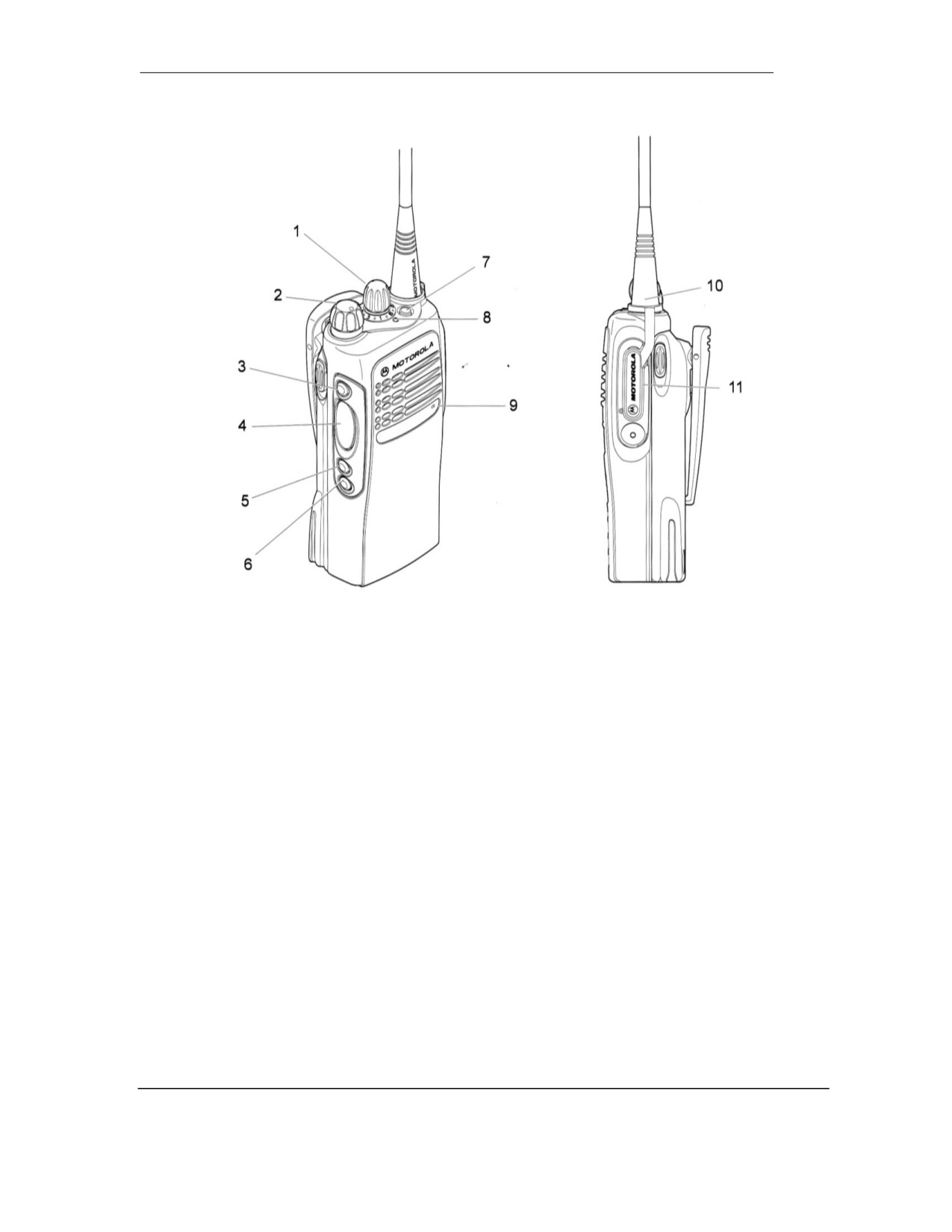
APPENDIX 2 - Hand Held Radio Controls
1 Channel Selector Knob (16 Position)
2 On-Off / Volume Knob
Used to turn the radio on or off, and to adjust the radio’s volume
3 Side button 1 (Will not be used)
4 Push to Talk Button (PTT)
Press and hold down this button to talk, release it to listen
5 Side button 2 (Will not be used)
6 Side button 3 (Will not be used)
7 Top button (programmable)
8 LED Indicator
Green:
Successful power up.
Green Flashing:
Radio scanning.
Red:
Radio transmitting.
Red Flashing:
Channel busy - when receiving.
Yellow:
Radio called.
Yellow Flashing:
Radio call reminder alert.
Red Flashing:
Low battery - when transmitting.
9 Microphone
Speak clearly into the microphone when sending a message.
10 Antenna
11 Accessory Connector
Control Tier:
2
Revision Date: <<11 Dec 2010>>
Document Number: AZSPU-HSSE-DOC-00116-2
Print Date: 2/1/2011
PAPER COPIES ARE UNCONTROLLED. THIS COPY VALID ONLY AT THE TIME OF PRINTING. THE CONTROLLED
VERSION OF THIS DOCUMENT CAN BE FOUND AT http://docs.bpweb.bp.com/dkazspu/
BP Azerbaijan Warden System Manual
Page 12 of 18
APPENDIX 3 - Radio Conversation
Important Note
Conversations over the radio can be very confusing if they are disordered. It is important that a
uniform radio language is used so that people know who is calling whom and when a message or
conversation is finished.
Call Sign
The first issue to resolve is how to identify callers over the radio net. In this case the best option is to
use surnames rather than codes. It is simpler and more easily understood.
Sending a Message
1. Use the Channel Selector knob to change to the required channel.
2. Press the PTT button and speak clearly into the microphone.
3. Your mouth should be about 2.5 to 5 cm away from the microphone.
4. To call someone simply repeat their surname twice and then say “this is XXXX, over”. For
example, “Smith, Smith, this is Jones, over”. (Over indicates that you have finished talking and
are waiting for a reply)
5. Release the PTT button when you finish speaking.
Receiving a Message
1. Adjust the volume level.
2. If, at any time, a call is received, you will hear the call at the volume level you have set.
3. To inform the message sender that you are receiving them, simply say “XXXX send”. For
example “Jones, send”.
Continuing the Conversation
You can then continue the conversation. Each time you have finished your sentence and expect a
reply, simply say “Over”. For example “Are you OK, over”
Ending a Conversation
To end a radio conversation, simply say “Over and out”.
Conversation Example
A simple conversation could be as follows:
Security: “BP Villa Petrolea Security to Jones”
Warden: “BP Villa Petrolea Security, this is Jones, over”
Security: “Jones, go to Assembly Point 5 immediately, over”
Warden: “BP Villa Petrolea Security, message received. Over and out”
Security: “BP Villa Petrolea Security to Smith……
Note: (Only say “Over” if you understand the instructions completely. If you need further
classification then ask using the normal conversation method.)
Radio Check
You can check the radio through channel 6 (security) periodically and when receiving at the hand-
over, keeping to the wording:
Warden: “VP Security. Call Back”
Security: “Go ahead, over”
Warden: “Radio Check. Do you copy me? Over”
Security: “I copied you. Over”
Warden: “Over and out.”
Control Tier:
2
Revision Date: <<11 Dec 2010>>
Document Number: AZSPU-HSSE-DOC-00116-2
Print Date: 2/1/2011
PAPER COPIES ARE UNCONTROLLED. THIS COPY VALID ONLY AT THE TIME OF PRINTING. THE CONTROLLED
VERSION OF THIS DOCUMENT CAN BE FOUND AT http://docs.bpweb.bp.com/dkazspu/
BP Azerbaijan Warden System Manual
Page 13 of 18
APPENDIX 4 - Warden Group Information Form
Note: This form is to be filled in by all BP Baku Residents
Your Name
Work E-Mail address
Mobile Phone Number
Spouse/Partner Name
(If accompanying in Azerbaijan)
Spouse’s Citizenship
Spouse’s Date of birth
Spouse’s mobile phone
Children Name(s)
(If accompanying in Azerbaijan)
(Please indicate dates of birth next
to names)
Partner’s Home Email Address
Any additional relevant contact
details.
Please submit this form by e-mail to Abdulla Alakbarov in Security.
Control Tier:
2
Revision Date: <<11 Dec 2010>>
Document Number: AZSPU-HSSE-DOC-00116-2
Print Date: 2/1/2011
PAPER COPIES ARE UNCONTROLLED. THIS COPY VALID ONLY AT THE TIME OF PRINTING. THE CONTROLLED
VERSION OF THIS DOCUMENT CAN BE FOUND AT http://docs.bpweb.bp.com/dkazspu/
BP Azerbaijan Warden System Manual
Page 14 of 18
APPENDIX 5 - Warden Report Basic User Guide
PDMS (People Data Management System) is used for Warden Database:
To have a single source database to ensure that consistent data is used for warden system
To ensure efficient integration with existing HR, Travel and Housing data management systems
used by SPU
The information provided for Warden Report is only used in case of emergency.
5.1 Access to Warden Report
Web Warden Report can be found on the following link.
Access to Warden Report is restricted to Group Wardens and their Alternates. Please contact
Warden Coordinator on alekpear@bp.com for access to Warden Report.
In case you encounter a problem to access to the Report for the first time please, e-mail to
Warden Coordinator on alekpear@bp.com
5.2 How to Generate Warden Report
To generate Warden Report follow four steps:
STEP 1 Follow the link below
STEP 2 Select “All Statuses” in “Warden Status” field
STEP 3 Select Your Respective Group Number in “Warden Group” field
STEP 4 Press “View Report” button
Control Tier:
2
Revision Date: <<11 Dec 2010>>
Document Number: AZSPU-HSSE-DOC-00116-2
Print Date: 2/1/2011
PAPER COPIES ARE UNCONTROLLED. THIS COPY VALID ONLY AT THE TIME OF PRINTING. THE CONTROLLED
VERSION OF THIS DOCUMENT CAN BE FOUND AT http://docs.bpweb.bp.com/dkazspu/

BP Azerbaijan Warden System Manual
Page 15 of 18
5.3 Export of Warden Report to Excel Format *
STEP 1 Select Excel in “Select a Format” field
STEP 2 Press “Export” button and wait until you are offered to save the file on your computer.
Control Tier:
2
Revision Date: <<11 Dec 2010>>
Document Number: AZSPU-HSSE-DOC-00116-2
Print Date: 2/1/2011
PAPER COPIES ARE UNCONTROLLED. THIS COPY VALID ONLY AT THE TIME OF PRINTING. THE CONTROLLED
VERSION OF THIS DOCUMENT CAN BE FOUND AT http://docs.bpweb.bp.com/dkazspu/

BP Azerbaijan Warden System Manual
Page 16 of 18
5.4 Subscription to Warden Report
There is possibility to subscribe on Warden Report with the aim to receive Warden Report
automatically on your BP e-mail address. Contact Warden Coordinator on alekpear@bp.com to
check for subscription options. **
* Note: You can choose other formats nonetheless Excel is the most advisable since you’ll be able
easily format file for the best viewing and printing.
** Note: Only Group Wardens and their Alternates are eligible to check for the subscription options
Control Tier:
2
Revision Date: <<11 Dec 2010>>
Document Number: AZSPU-HSSE-DOC-00116-2
Print Date: 2/1/2011
PAPER COPIES ARE UNCONTROLLED. THIS COPY VALID ONLY AT THE TIME OF PRINTING. THE CONTROLLED
VERSION OF THIS DOCUMENT CAN BE FOUND AT http://docs.bpweb.bp.com/dkazspu/
BP Azerbaijan Warden System Manual
Page 17 of 18
5.5 My personal information in Warden Database
The link below should be included in a Welcome note for new residents.
It is important that Warden System has all of BP expatriate employee current contact details, such
as mobile phone numbers, e-mail addresses, and contact numbers for family members or partners
who are living in Azerbaijan. This information is critical for Group Wardens to contact Warden
Members in an emergency. Each employee registered within warden System can check information
accuracy following the link below.
ormation+in+Warden+Database
In case Warden Database needs to be updated send appropriate updates of your contact
information to the respective Group Warden or Warden Coordinator at alekpear@bp.com Use the
form in Appendix 4
Key Documents
Civil Crisis Plan:
Name
Abdulla Alakbarov
Job title
Warden Security Coordinator
Phone number
+994 55 4250207
Summary
Alternative
Rauf Rustamov
The purpose of the BP Azerbaijan CCP is to
Phone number
+994 55 2250678
provide agreed and practised procedures to meet
an increasing threat and for the relocation of BP
„at risk‟ personnel and dependants to a safe
location within the country or from the country
itself if necessary. The Warden System is an
integral part of the Civil Crisis Plan and is
functioning within IMT. The CCP is administered
by Azerbaijan Security Team.
Control Tier:
2
Revision Date: <<11 Dec 2010>>
Document Number: AZSPU-HSSE-DOC-00116-2
Print Date: 2/1/2011
PAPER COPIES ARE UNCONTROLLED. THIS COPY VALID ONLY AT THE TIME OF PRINTING. THE CONTROLLED
VERSION OF THIS DOCUMENT CAN BE FOUND AT http://docs.bpweb.bp.com/dkazspu/
BP Azerbaijan Warden System Manual
Page 18 of 18
Review Log
Revision Date
Authority
Custodian
Revision Details
30 Sept 2007
Eldar Nurizade
Dmitry
Initial issue
Adamovich
2 April 2009
Eldar Nurizade
Abdulla
1. Change of reference names and
Alakbarov
email accounts from “Dmitry
Adamovich” to “Abdulla
Alakbarov” and from “adamd0” to
“alekpear” respectively.
2. Minor grammatical corrections.
2 Nov 2009
Eldar Nurizada
Abdulla
3. Update of Notification matrix
Alakbarov
under Section 4.3
4. Update of mobile phones after
switch to Bakcell.
28 Apr 2010
Eldar Nurizada
Abdulla
1. Update of Warden
Alakbarov
Communication matrix - page 6
2. Update of Warden Sattelite
phone list - page 9
3. Calling codes between GSM and
SAT service providers - Azercell
“051” added - page 9
4. Slight page formatting - whole
document.
11 Dec 2010
Eldar Nurizada
Abdulla
1.
Update of Satellite Thuraya New
Alakbarov
numbers table on page 8
2.
Some updates re dialing Satellite
phones - page 8
3.
New version sent to for upload into
dK.
Control Tier:
2
Revision Date: <<11 Dec 2010>>
Document Number: AZSPU-HSSE-DOC-00116-2
Print Date: 2/1/2011
PAPER COPIES ARE UNCONTROLLED. THIS COPY VALID ONLY AT THE TIME OF PRINTING. THE CONTROLLED
VERSION OF THIS DOCUMENT CAN BE FOUND AT http://docs.bpweb.bp.com/dkazspu/
BP Logistics
Baku Sea Port Station (BSPS)
Security Procedures
Post orders
AZSPU-HSSE-DOC-00290-2
Authority:
<< Aviation & Crew Boat
Custodian:
<< Offshore Security TL / Babayev, Elshad>>
Services Manager / Vass,
Derek>>
Scope:
<< AzSPU >>
Document
<< Position Title / Name>>
Administrator:
Issue Date:
<< 18 February 2010 >>
Issuing Dept:
<< Security >>
Revision Date:
<< 18 February 2010 >>
Control Tier:
<< 2 >>
Next Review
<< 18 February 2011 >>
Date:
Control Tier:
<<2>>
Revision Date: <<18 February 2010>>
Document Number: << AZSPU-HSSE-DOC-00290-2>>
Print Date: 2/1/2011
PAPER COPIES ARE UNCONTROLLED. THIS COPY VALID ONLY AT THE TIME OF PRINTING. THE CONTROLLED VERSION OF THIS
DOCUMENT CAN BE FOUND AT http://docs.bpweb.bp.com/dkazspu/component/hssesms
Security Procedures
Purpose
The purpose of this document is to establish the set of security procedures, rules and regulations for
Baku Sea Port Station (BSPS) Security Guard Service to ensure the security of personnel working at the
offshore facilities and operations.
Security Guard must diligently follow the procedures, rules and regulations listed below and make full
use of all the information provided.
This document is the property of BP Exploration Caspian Sea Ltd. and is intended for the sole and
exclusive use of the Logistics and Security Management.
It must not be removed from the work location to which it is assigned, may not be reproduced or
distributed to third parties.
Objectives
The objectives of the security strategy for BSPS (onshore embarkation point) are to:
Prevent unauthorized access of people, cargo and prohibited items to the Offshore facilities;
Deter unauthorized introduction of dangerous/banned substances and devices;
Conduct verification and identification of 100% of the outgoing personnel against their Vantage ID
cards, company’s ID and passport;
Prevent access of people under influence of alcohol or drug to Offshore facilities;
Minimize the likelihood of successful third party interference with, or damage to, the operation of
the facilities.
Security and Safety Restrictions
The whole site is Non-smoking area. Smoking is permitted only at designated area indicated by signs.
No Alcohol can be brought in/utilized within site under any circumstances. Access will be denied to
those who cause reasonable suspicion of being under alcohol influence and tested through Alco-Check
machine according to AzSPU Substance Abuse Policy. Such a case will immediately be reported to
Logistics, Site, Security and Health management.
General requirements for Security stuff:
Control Tier:
<<2>>
Revision Date: <<18 February 2010>>
Document Number: << AZSPU-HSSE-DOC-00290-2>>
Print Date: 2/1/2011
PAPER COPIES ARE UNCONTROLLED. THIS COPY VALID ONLY AT THE TIME OF PRINTING. THE CONTROLLED VERSION OF THIS
DOCUMENT CAN BE FOUND AT http://docs.bpweb.bp.com/dkazspu/component/hssesms
Read, know and comply with provided Standard Operating Procedures which detail their duties
to be performed.
Act in accordance with all sections of the Standard Operating Procedures, the Security Officers
Code of Conduct and Post Orders.
Pay particular attention to any 'Temporary Instructions' which may frequently change
depending on the Management’s requirements and take up additional duties as and when
requested.
Relationships, communication and on-duty actions with personnel must be made with respect to
their personality. Security should be friendly, polite and welcoming. The rights and dignity of
the individual must be respected at all times.
Report a case of deliberate disregard of the security procedures to the line and site
management.
Report security incidents to BP Security and Ste Management and file as appropriate. Assist in
possible internal investigations.
Assist Security and Site Management and implement other roles/tasks as required by business.
Ensure safety of personnel and operations at BSPS and promote safety culture. Report unsafe
behaviors and findings through submission of BOOS cards and ASA.
Check all assigned premises of BSPS building (both internal & external) and Jetty site before the
registration’s operations begin if there any suspicious item, break downs, damage, threat etc.
Work in accordance to the schedule.
Remember: Failure to implement and execute above written instructions and post orders
by on duty guard will be considered as poor performance and lead to a disciplinary action.
Security Equipment
CCTV:
Camera 1 & 2 cover the area in front of the Passenger Handling Facility.
Camera 3 & 4 cover the territory/route from the Passenger Handling Facility to the Jetty.
Camera 5 covers the Jetty territory.
Camera 6 covers the main entrance gate to the Passenger Handling Facility.
Camera 7 covers X-Ray machine zone.
Camera 8 covers the temporary passengers’ baggage storage area.
Camera 9 covers the entrance to the “sterile zone” from security inspection area.
Camera 10 & 11 covers the exits from the “sterile zone”.
Electronic Access Control (EAC):
2 Card Readers installed at the main entrance gate to monitor the movement of people to/from
Passenger Handling Facility.
2 Card Readers installed at the exit gates from the “sterile zone” to the Jetty.
Intruder Detection System (IDS):
Detectors installed at the all gates of the Passenger Handling Facility.
X-Ray machine:
Control Tier:
<<2>>
Revision Date: <<18 February 2010>>
Document Number: << AZSPU-HSSE-DOC-00290-2>>
Print Date: 2/1/2011
PAPER COPIES ARE UNCONTROLLED. THIS COPY VALID ONLY AT THE TIME OF PRINTING. THE CONTROLLED VERSION OF THIS
DOCUMENT CAN BE FOUND AT http://docs.bpweb.bp.com/dkazspu/component/hssesms
1 X-Ray machine is installed at the registration area of the Passenger Handling Facility area for
baggage/cargo/personal belongings security check.
Walk Through Metal Detector:
1 Walk Through Metal Detector is installed at the entrance to the
“sterile zone” for the
personnel security check.
Hand Held Metal Detector:
1 Hand Held Metal Detector is provided to the security guard for the additional assurance of the
personnel security check.
Sequence of the passenger handling process:
1.
All personnel (100%) going to offshore should be verified, identified and registered against
their Vantage ID cards, company’s ID and passport at the entrance to the Passenger Handling
Area.
2.
All personnel (100%) entering the passenger handling area after registration (e.g. going to
offshore, service and based staff etc.), their baggage (including hand bags, laptop cases etc),
cargo and personal belongings should be searched by security guards using X-Ray machine and
Metal detectors.
3.
After security search the baggage and cargo should be kept in the storage under the security
control. Hand bags, laptop cases etc. are allowed to the waiting/lounge area and to the vessel -
seating area and each passenger is responsible for the security/purity of his hand bags.
4.
After security search the outgoing personnel should pass to the waiting/lounge area. i.e. “sterile
zone”. One of the senior position passengers among the passenger crew staff should be
nominated as a Senior Passenger. He/she should control and be responsible for the
security/purity of passengers’ hand bags during being in the Passenger Handling Facility and
during a trip by a vessel until arriving to the 500mtr of the relevant installation.
5.
In case of any exits from the “sterile zone” and return an individual should pass through all
registration/security check again.
6.
In all cases of exits from the “sterile zone” and Passenger Handling Facility (non-connected with
loading to the vessel, e.g. smoking) the main entrance gate should be used.
7.
Checked baggage/cargo, which is going to the boat (through the main entrance), should be
escorted by a security guard. The loading process of baggage/cargo to the vessel and to the
on-board baggage’s container/s should be controlled by a security guard. When all assigned
baggage/cargo are loaded into the container security guard should seal a container with a
numbered plastic tie-wrap seals (security guard and a Passenger Attendant (Vessel) should
record the number of a seal), which could be break opened only by the Passenger Attendant
(Vessel) at the entering to the 500mtr of the relevant installation:
o The Passenger Attendant (Vessel) should control the process of a loading of hand bags,
laptop cases etc. into the relevant container, put simple plastic tie-wrap seal on the
container, control and monitor the process of loading of the container/s to the platform.
Control Tier:
<<2>>
Revision Date: <<18 February 2010>>
Document Number: << AZSPU-HSSE-DOC-00290-2>>
Print Date: 2/1/2011
PAPER COPIES ARE UNCONTROLLED. THIS COPY VALID ONLY AT THE TIME OF PRINTING. THE CONTROLLED VERSION OF THIS
DOCUMENT CAN BE FOUND AT http://docs.bpweb.bp.com/dkazspu/component/hssesms
o In case of detection of any break down of seals (on a vessel) a case should be
appropriately recorded and informed by instance to the platform, PHF management and
Security.
o On the whole the Passenger Attendant (Vessel) should control all personnel during the
embarkation/disembarkation process, all passenger movements on vessel, assist/control
baggage handling.
8. Outgoing personnel loading to the vessel should be escorted by security guards. Offshore
personnel should leave the
“sterile zone” through the two exits. The loading process of
personnel should be controlled by a security guard.
9. In case if any passenger refused to go offshore by any reason (when his/her baggage already
passed a security search) all checked baggage should be re-checked again (except the cases
when he will not have passed the medical/alcohol checks).
10. In case of in any passenger’s baggage a weapon or its components and ammunitions will be
found, all checked baggage should be re-checked again. Shift Supervisor, Site and Security
management must be informed immediately. The case should be acted and handovered to a
local police for further official investigations.
11. If X-ray Operator suspects that a baggage may contain a bomb or detects a suspicious items on
explosive devices or their any components his below actions are necessary:
Keep calm, under no circumstances nobody should touch, shake, squeeze or bend it!
The baggage should not be rolled out from X-Ray machine!
Security Shift Supervisor, Site and Security management should be informed
immediately.
Security Manager and Incident Commander should immediately be informed.
Security Shift Supervisor should act according to the instructions given by Security
Manager or Incident Commander.
If Incident Commander, Security Manager or Site Manager orders full evacuation of the
personnel from the Passenger Handling Facility, Security Shift Supervisor should:
o Evacuate all people from the Passenger Handling Facility;
o Check the Assembly area, and if it is safe post a guard there;
o Arrange guards and set cordons to block the access to the area;
o Inform BSPS Security and Management, local police about the threat.
12. Based on a request from Offshore (OIM or delegate), Site and Security Management the
baggage, cargo and personal belongings of passengers returning from offshore should be searched
by security guards using X-Ray machine and Metal detectors etc.
Vessel crews and visitors
A Captain of each vessel or his delegate should supply the BSPS Security with an updated crew
list as soon as a change in the crew.
The BSPS Security should have the updated crew lists available at all times to confirm names
prior to entering any movements in the log.
Security should inform a vessel Captain of a crew and visitors’ arrival and check and log them
according to the provided list. All personnel except crew to board on the vessel are considered
visitors.
Control Tier:
<<2>>
Revision Date: <<18 February 2010>>
Document Number: << AZSPU-HSSE-DOC-00290-2>>
Print Date: 2/1/2011
PAPER COPIES ARE UNCONTROLLED. THIS COPY VALID ONLY AT THE TIME OF PRINTING. THE CONTROLLED VERSION OF THIS
DOCUMENT CAN BE FOUND AT http://docs.bpweb.bp.com/dkazspu/component/hssesms
All vessel crews’ personnel and vessels visitors should report to BSPS Security about their arrival
and departure.
The BSPS Security should provide visitor badges for visitors and liaise with the vessels’ captains
whether such visitors are allowed on board or not.
All vessel crew members, visitors and their belongings should pass through the security check
(X-Ray, Metal detectors) before entering to the vessel.
A Captain of each vessel or his delegate should supply the BSPS Security with the list of the
crew temporarily leaving the boat for non-work related reasons.
On return they (crew and visitors) should apply again to the Security guard for the registration,
then they, their baggage and personal belongings should be searched by security guard (X-Ray
machine and Metal detectors) prior the returning to their designated boat.
All vessels’ crew should pass through 100% alcohol check each time prior the entering to the
Jetty/Vessel. Marine onshore support team (Ship Operator), visitors will be subject to alcohol
check on random or suspicious bases.
Security should report immediately to the Shift Supervisor or Site Management of any personnel
refusing or not wishing to comply with this procedure.
Entry to the Jetty/boat by vehicle of vessel crews and visitors will be denied.
All goods aimed for and leaving the vessels should be documented (manifested) and copy of
such document should be provided to BSPS Security prior to entering or leaving the boat.
In case of when a name of a vessel crew member cannot be verified with the lists and goods
cannot be matched with the in-line documentation Shift Security Supervisor and Site
management should be informed immediately. The person or goods will be denied access to
the Jetty pending the management approval.
Checked vessel crew, visitors and goods should be observed and loading/embarkation process
should be controlled by a security guard.
Vehicle Access Control - Delivery vehicle to the Jetty/vessel only:
Delivery vehicles should be allowed to the Jetty only after getting the permission from Site
Management.
Vehicles with granted access to the Jetty should be subject to safety and security check.
The entry and leaving of the vehicles should be appropriately logged and copies of in-line
documents should be collected by security.
The following information should be logged:
- Vehicle registration number
- Drivers Name
- Time of Entry or departure
- Destination
In case if above requirements are not completed/or declined no vehicle should be allowed to
the Jetty unless advised by Site management.
Access Control to the Passenger Handling Facility
Control Tier:
<<2>>
Revision Date: <<18 February 2010>>
Document Number: << AZSPU-HSSE-DOC-00290-2>>
Print Date: 2/1/2011
PAPER COPIES ARE UNCONTROLLED. THIS COPY VALID ONLY AT THE TIME OF PRINTING. THE CONTROLLED VERSION OF THIS
DOCUMENT CAN BE FOUND AT http://docs.bpweb.bp.com/dkazspu/component/hssesms
All employees based at BSPS i.e. Aviation/FCB, Marine Contractor and Security staff etc must be
electronically registered at the main entrance gate and passed through security check as it
mentioned above each time when they proceed to/from the Passenger Handling Facility.
Site Manager gives an approval for the activation of badges of the mentioned staffs.
The updated list of employees is to be kept at the post. Site Management is responsible for the
updating of the list.
All authorized employees, not in possession of a valid Badge will be given a visitor’s pass which
will be handed to the Guard at the end of the shift.
The Guard will keep a register of all temporary badges handed out.
All BP employees who are not based at BSPS, Contractors and Visitors shall be classified as
visitors and shall be required to report to security at the main entrance gate.
After getting a confirmation from the visiting person the below mentioned information should
be entered into the visitor’s log and then visitor pass issued:
- Name of person requiring access
- Name of company he or she represents
- Name of employee being visited
- Visitors pass number
Visitors should be met and accompanied within the facility by an employee (host) at all times.
Host holds full responsibility for visitor’ action/behavior while in the facility.
On leaving the base the visitors pass should be returned to security at the main entrance gate
and the visitors log updated with time of departure.
Only the Site Manager or his delegate should authorize the removal of property from Passenger
Handling Facility.
Control Tier:
<<2>>
Revision Date: <<18 February 2010>>
Document Number: << AZSPU-HSSE-DOC-00290-2>>
Print Date: 2/1/2011
PAPER COPIES ARE UNCONTROLLED. THIS COPY VALID ONLY AT THE TIME OF PRINTING. THE CONTROLLED VERSION OF THIS
DOCUMENT CAN BE FOUND AT http://docs.bpweb.bp.com/dkazspu/component/hssesms
Security Guard Service
Baku Sea Port Station (BSPS)
Security Post Orders
Security Shift Supervisor - one guard
(Positioned at the security operator desk point)
Manage the BSPS security staff so as to protect staff, protect assets and prevent loss.
Ensure that all instructions are compliance with the Security Officer’s Code of Conduct, SOPs and
Security Post Orders.
Manage the discipline, morale and welfare of the security staff.
Is responsible for the dress and behavior of all security personnel on site.
Register appropriately all changes/amendments that affect initial schedules indicating sick leave,
vacation leaves and change of days-off.
Is responsible for the co-ordination and control of all Security Guards assigned to him, their
trainings, their duty rotas and shifts, and for their day-to-day duty instructions.
Constantly seek ways to improve the company security, identifying risks to company safety and
security, advising the Management of security options for the management/control of those risks.
Be ensure that security staff is aware, in advance, of their duty shift times and, where appropriate,
their duty location, substitute other guards in case of necessity.
Should have a good level of capabilities to work (as trained) with security equipment utilizing at the
site, i.e. X-Ray machine, Walk through metal detector gate, hand held metal detector.
Hold regular shift meetings with security guards on performance and discipline and report to line
management.
Randomly carry out searches of all guards. Whilst on duty in accordance with SOPs the Security
Shift Supervisor is liable to inspection by the Senior Shift Commander or BP Security management
at first instance.
Implement permanent safe-key control by in time and proper registrations made on Keys Issuance.
Take immediate and appropriate actions in case of keys missing or not returned and make proper
registrations in Occurrence Log.
Control the radio communications held among guards.
Induct new hired guards about Security First Aid response, ensure each guard that boxes and carry
bags registrations to be made for each use FA items. In case of serious injures IMT Medical Case
Manager should be informed (mob. Phone: 0552214877).
Ensure each guard knows the location of fire hose reels and fire extinguishers.
Is responsible for the registrations of all information into the Occurrence Log on daily basis and
information handover within the stuff.
Maintain clean and accurate posts, and supervise that during shift handover/takeover by every
guard at each post.
Monitor and track implementation of team’s safety targets on ASA/BOSS on monthly basis. Report
unsafe actions and behaviors filling in ASA/BOSS online registration forms.
As instructed should ensure that he keeps a close liaison with the site managers or department
heads, assist and cooperate with management and other teams on business needs, be point of
contact with Navigation (Aviation) team, BSPS security, a boat Captains and local Police.
Should be in overall charge of the site security operation during his duty shift. This includes
managing the functions of any electronic security systems or equipment installed on the site.
Implement permanent security CCTV monitoring and control proper operation of EAC (Electronic
Access Control), IDS (Intruder Detection system) systems.
Keep under CCTV control entrance/exit doors, detect and react immediately to any illegal intrusion
observed by CCTV.
Control Tier:
<<2>>
Revision Date: <<18 February 2010>>
Document Number: << AZSPU-HSSE-DOC-00290-2>>
Print Date: 2/1/2011
PAPER COPIES ARE UNCONTROLLED. THIS COPY VALID ONLY AT THE TIME OF PRINTING. THE CONTROLLED VERSION OF THIS
DOCUMENT CAN BE FOUND AT http://docs.bpweb.bp.com/dkazspu/component/hssesms
Monitor traffic (pedestrian/vehicular) flow in front of BSPS, jetty and adjacent areas captured by
CCTV cameras.
Communicate immediately with the Site management if any area is alarm-displayed on CCTV
monitor.
Every Friday of each week after completion of all vessel departures Shift Supervisor must check all
the CCTV cameras’ status during the past week by selective viewing of morning, day, evening &
night time recordings for each Date of the past week and provide weekly report on CCTV check
status to line management.
In case of emergency/major incident Security Shift Supervisor should inform Site Manager/On-
Scene Commander without delay.
React promptly to any emergency and take necessary actions according to the site emergency
response plan/procedure to protect the Company, its employees and its assets.
Receive information about fire/emergency and contact immediately with Police/Fire/Medical
services as required by the nature of incident.
In case of fire alarm/evacuation act in accordance with emergency procedures.
X-Ray operator - one guard
(Positioned at the X-Ray - main entrance after registration desk during operation times).
Should have a good level of capabilities to work (as trained) with security equipment utilizing at
the site, i.e. X-Ray machine, Walk through metal detector gate, hand held metal detector.
Conduct 100% security check of baggage/personnel belongings of outgoing personnel (after
their registration), of Aviation/FCB staff or any other visitors entering to the Passenger Handling
Facility i.e. “sterile zone”, of vessels’ crews and their visitors, of Service staff etc. each time
when they proceed to the passenger handling facility.
Conduct 100% check of cargos going offshore after the relevant registration and request by
dispatcher/aviation representative.
Register and report any failure in X- Ray monitoring and recording, and inform Shift Supervisor
immediately.
In case if any failures in X-Ray machine conduct all aforementioned checks manually.
Substitute other guards in case of necessity.
Maintain clean and accurate post, and follow that during shift handover/takeover.
Report unsafe actions and behaviors filling in ASA/BOSS online registration forms.
Report suspicious activity immediately to Shift Supervisor.
If X-ray Operator detects a suspicious item in the baggage he should request his Assistant to
conduct manual check of the baggage.
If X-ray Operator suspects that a baggage may contain a bomb or detects a suspicious items on
explosive devices or their any components his below actions are necessary:
Keep calm, under no circumstances nobody should touch, shake, squeeze or bend it!
The baggage should not be rolled out from X-Ray machine!
Security Shift Supervisor, Site and Security management must be informed immediately.
X-Ray operator assistant - one guard
(Positioned at the X-Ray during operation times)
Should have a good level of capabilities to work (as trained) with security equipment utilizing at
the site, i.e. X-Ray machine, Walk through metal detector gate, hand held metal detector..
Control Tier:
<<2>>
Revision Date: <<18 February 2010>>
Document Number: << AZSPU-HSSE-DOC-00290-2>>
Print Date: 2/1/2011
PAPER COPIES ARE UNCONTROLLED. THIS COPY VALID ONLY AT THE TIME OF PRINTING. THE CONTROLLED VERSION OF THIS
DOCUMENT CAN BE FOUND AT http://docs.bpweb.bp.com/dkazspu/component/hssesms
Manual check of baggage/cargo/personnel belongings upon the request of X-Ray Operator if he
detects a suspicious item in the baggage etc.
Keep under the control the storage area.
Provide relief for X-Ray operator and metal detector operator.
Substitute other guards in case of necessity.
Security escort of outgoing personnel and baggage/cargo.
Maintain clean and accurate post, and follow that during shift handover/takeover.
Report unsafe actions and behaviors filling in ASA/BOSS online registration forms.
Report suspicious activity immediately to X-Ray Operator and Shift Supervisor.
Metal detectors operator - one guard
(Positioned at the Walk through metal detector during operation times)
Should have a good level of capabilities to work (as trained) with security equipment utilizing at
the site, i.e. X-Ray machine, Walk through metal detector gate, hand held metal detector.
Conduct 100% personal security check of outgoing personnel entering to the “sterile zone”, of
Aviation/FCB staff or any other visitors entering to the Passenger Handling Facility i.e. “sterile
zone”, of vessels’ crews and their visitors, of Service staff etc. each time when they proceed to
the passenger handling facility through Walk through metal detector and manual check by Hand
held metal detector.
Should control and monitor on the hand bags, laptop cases etc. taken by the passengers into
the waiting/lounge area.
Security escort of outgoing personnel and baggage/cargo.
Substitute other guards in case of necessity.
Maintain clean and accurate post, and follow that during shift handover/takeover.
Report unsafe actions and behaviors filling in ASA/BOSS online registration forms.
Report suspicious activity immediately to X-Ray Shift Supervisor.
Access to the Jetty and a boat - one guard
(Positioned at the Jetty gatehouse during operation times)
Should have a good level of capabilities to work (as trained) with security equipment utilizing at
the site, i.e. X-Ray machine, Walk through metal detector gate, hand held metal detector.
Control access to the Jetty and a boat.
Control over the loading process of a personnel to a vessel.
Control over the loading process of baggage/cargo to the vessel and to the on-board baggage’s
container/s. Should seal a container with a numbered plastic tie-wrap seals when all assigned
baggage/cargo are loaded into the container and make relevant records in the log book.
Substitute other guards in case of necessity.
Maintain clean and accurate post, and follow that during shift handover/takeover.
Report unsafe actions and behaviors filling in ASA/BOSS online registration forms.
Report suspicious activity immediately to Shift Supervisor.
On-Duty Security Guard - two guards (7x24)
(during non operation times)
Should have a good level of capabilities to work (as trained) with security equipment utilizing at
the site, i.e. X-Ray machine, Walk through metal detector gate, hand held metal detector
Control Tier:
<<2>>
Revision Date: <<18 February 2010>>
Document Number: << AZSPU-HSSE-DOC-00290-2>>
Print Date: 2/1/2011
PAPER COPIES ARE UNCONTROLLED. THIS COPY VALID ONLY AT THE TIME OF PRINTING. THE CONTROLLED VERSION OF THIS
DOCUMENT CAN BE FOUND AT http://docs.bpweb.bp.com/dkazspu/component/hssesms
Control access to the Jetty and a boat.
Permanent monitoring CCTV, EAC and IDS systems.
Conduct personal and baggage security check (x-ray and metal detectors) of all personnel and
visitors entering to the “sterile zone” and of vessels’ crews and their visitors, of service staff etc.
Security escort of vessel crew member/vessel visitors and their baggage.
Conduct check of vessels’’ goods and cargos going offshore after the relevant registration and
request by dispatcher/aviation representative.
Control over the loading process both personnel and baggage/cargo.
Register and report any failure in metal detectors and in X- Ray monitoring and recording, and
inform Shift Supervisor immediately.
In case if any failures in X-Ray machine conduct all aforementioned checks manually.
Substitute each other in case of necessity.
Maintain clean and accurate post, and follow that during shift handover/takeover.
Report suspicious activity immediately to Shift Supervisor.
Act as mentioned in aforementioned instructions and post orders.
Vantage registrar - one receptionist (female)
Conduct 100% check-in/registration of all outgoing to offshore passengers through Vantage
POB system.
Should have a good level of capabilities to work (as trained) with security equipment utilizing at
the site, i.e. Walk through metal detector gate, hand held metal detector.
Conduct personal security check through Walk through metal detector and manual check by
Hand held metal detector of outgoing personnel entering to the “sterile zone”, of staff or
visitors entering to the Passenger Handling Facility i.e. “sterile zone”, of vessels’ crews and their
visitors in case if they are females.
Assist with terminal administration as required.
Remember: Failure to implement and execute above written instructions and post orders
by on duty guard will be considered as poor performance and lead to a disciplinary action.
(+994 12) 598 4358 is the contact phone number with BSPS Security.
Control Tier:
<<2>>
Revision Date: <<18 February 2010>>
Document Number: << AZSPU-HSSE-DOC-00290-2>>
Print Date: 2/1/2011
PAPER COPIES ARE UNCONTROLLED. THIS COPY VALID ONLY AT THE TIME OF PRINTING. THE CONTROLLED VERSION OF THIS
DOCUMENT CAN BE FOUND AT http://docs.bpweb.bp.com/dkazspu/component/hssesms
Appendix 1.
Listed below are dangerous and other goods which are not allowed offshore:
1.
All types of fire, gas, pneumatic, side and mechanical arms: pistols, revolvers, rifles, guns*,
carbines, and other types of fire, gas, pneumatic arms, electroshock devices and their
imitator; Arbalests, arms for submarine hunting, sabers, broadswords, cutlasses, spears,
daggers, hangers, dirks, stilettos, knifes:
any types of knifes (e.g. hunting, troops landing, Finnish dagger/knifes, spear knifes, gully,
common household knifes, switchblade knife, sharp knife, flick knife, penknife, Stanley
knives etc) are prohibited to offshore except cases described in the
“Azerbaijan SPU
Offshore Operations Knife Policy AZSPU-HSSE-DOC-00014-3” document (e.g. food knifes,
canteen cutlery, scissors, medical instruments used by medical personnel, or tools such as
chisels, scrapers etc). Link to the document is attached below:
ZSPU-HSSE-DOC-00014-3
Any exception to this rule must be approved by the site controller, i.e. OIM. In these cases
contractors may bring knives with them offshore as a part of their tool kits. These knives
must be handed in to the platform nominated person immediately on arrival and are subject
to the common knife issue/ return and PTW (Permit to Work) process outlined in the knife
policy (security should remind to passengers about this rule during check-ins).
All vendors are therefore requested not to carry knives of any description in their toolboxes.
2.
Explosive substances/materials, explosive devices, and objects charged into them like: all
types of gun powders regardless of quantity and packed forms; Live cartridges (including
small-calibers gas arms’ bullets); Hunting percussion caps (muskets); Pyrotechnic devices:
signals, light signals, signal flares, signal bullets, pull down sabers, smoke sabers, special
matches for explosives, sparklers; Trotyl, dynamite, tolite (trinitrotoluene), ammonal and
other explosive materials; Capsule-detonators, electric detonators, electric fuses, detonating
fuses etc. Common domestic matches and cigarette lighters.
3.
Pressured and low pressed gases: common household use gases (butane, propane) and
other gases; neuro-paralytic gases, tear gas cylinders.
Control Tier:
<<2>>
Revision Date: <<18 February 2010>>
Document Number: << AZSPU-HSSE-DOC-00290-2>>
Print Date: 2/1/2011
PAPER COPIES ARE UNCONTROLLED. THIS COPY VALID ONLY AT THE TIME OF PRINTING. THE CONTROLLED VERSION OF THIS
DOCUMENT CAN BE FOUND AT http://docs.bpweb.bp.com/dkazspu/component/hssesms
4. Quick inflammable liquids, fluids: acetone, benzene, gasoline, sample products of quick
inflammable oil products, methanol, methyl acetate ester, boracic acid, esters, ethyl
cellulose, and all other types of quick inflammable liquids.
5. Inflammable solid explosives: potassium, natrium, metal calcium, phosphoric calcium and
others; White, red, yellow phosphorus and other chain of inflammable solid explosives;
organic heroxide; Colloid nitrocellulose in the form of solute wet or dry granular or fold with
content less than 25% of water; dry or wet nitrocellulose with content less than 30% of
solute or less than 20% of water.
6. Toxic and poisonous / toxic substances: regardless of the packed forms and types (solid or
liquid) toxic and poisonous
/ toxic substances with any poisonous strength: brusine,
nicotine, strychnine, tetrahydrofurfuryl alcohol, antifreeze, braking fluid, ethylene glycol,
mercury, different types of prussic acid and others.
7. Caustic and corrosive substance: strong inorganic acids: chlorides, sulfates, nitrates and
others; other strong acids and corrosive substances.
8. Any other devices, materials, substances, objects and items which suspicious to be used to
put in practice any unlawful interference actions.
All the above-mentioned forbidden items are to be safe-kept till the return of owner.
* Except offshore platforms’ flare guns registered as BP property. Refer to the Document “Azerbaijan Offshore Operations Performance Unit.
Safe Working Practice. Control and use of flare ignition gun. AZSPU-HSSE-DOC-000XX-3”.
Revision Date
Authority
Custodian
Revision Details
<<12 February
<< Aviation &
<< Offshore
Initial Issue
2010>>
Crew Boat
Security TL /
Services
Babayev,
Elshad>>
Manager / Vass,
Derek>>
<<11 March
<< Fast Crew
<< Offshore
Minor updates re consistency with
2010>>
Boat Services
Security TL /
offshore knife policy
Team Leader /
Babayev,
Elshad>>
Nariman
Aydamirov>>
Control Tier:
<<2>>
Revision Date: <<18 February 2010>>
Document Number: << AZSPU-HSSE-DOC-00290-2>>
Print Date: 2/1/2011
PAPER COPIES ARE UNCONTROLLED. THIS COPY VALID ONLY AT THE TIME OF PRINTING. THE CONTROLLED VERSION OF THIS
DOCUMENT CAN BE FOUND AT http://docs.bpweb.bp.com/dkazspu/component/hssesms
Handling Instructions for Center for Army Lessons Learned (CALL) Products
Center for Army Lessons Learned (CALL) authorizes official use of this CALL product for operational and institutional purposes that contribute to the
overall success of U.S., coalition, and allied efforts.
The information contained in this product reflects the actions of units in the field and may not necessarily be approved U.S. Army policy or
doctrine.
This product is designed for official use by U.S., coalition, and allied personnel and cannot be released to the public without the expressed written
consent of CALL. This product has been furnished with the expressed understanding that it will be used for official defense-related purposes only
and that it will be afforded the same degree of protection that the U.S. affords information marked “U.S. UNCLASSIFIED, For Official Use Only
[FOUO]” in accordance with U.S. Army Regulation (AR) 380-5, section 5-2.
Official military and civil service/government personnel, to include all coalition and allied partners may paraphrase; quote; or use sentences,
phrases, and paragraphs for integration into official products or research. However, integration of CALL “U.S. UNCLASSIFIED, For Official Use
Only [FOUO]” information into official products or research renders them FOUO, and they must be maintained and controlled within official
channels and cannot be released to the public without the expressed written consent of CALL.
This product may be placed on protected UNCLASSIFIED intranets within military organizations or units, provided that access is restricted
through user ID and password or other authentication means to ensure that only properly accredited military and government officials have access
to these products.
Regulations strictly forbid posting CALL “U.S. UNCLASSIFIED, For Official Use Only [FOUO]” documents to Department of Defense (DOD)
Websites that do not restrict access to authorized personnel. AR-25-1, 15 Jul 2005, Army Knowledge Management and Information Technology,
paragraph 6-4 n (2) (b) and DOD Web Site Administration Policy and Procedures (11 Jan 2002), Part II, paragraph 3.6.1 require appropriate
mechanisms to protect sensitive information.
When no longer needed, all CALL “U.S. UNCLASSIFIED, For Official Use Only [FOUO]” paper products and electronic media will be shredded
or destroyed using approved paper shredders or CDROM destroyers.
To allied and coalition personnel:
This information is furnished with the understanding that it is to be used for defense purposes only, that it is to be afforded essentially the same
degree of security protection as such information is afforded by the United States, and that it is not to be revealed to another country or
international organization without the written consent of CALL.
U.S. UNCLASSIFIED
REL NATO, GCTF, ISAF, MCFI, ABCA
For Official Use Only
FIRST 100 DAYS OEF ETT HANDBOOK
i
Foreword
This handbook is written for you, the embedded training team (ETT) member. Traditionally, this mission was reserved for Special Forces’ units or
teams. With the revision of Army Field Manual 3.0, Operations, this is now a mission for general purpose forces. The Army has not yet officially
designated one organization or agency as the ETT proponent; therefore, information concerning TTs circulates at all levels. This handbook has
been vetted by the Joint Center for International Security Forces Assistance, 1st Infantry Division, Combined Security Transition
Command-Afghanistan, and the Center for Army Lessons Learned Integration Network.
There are two key facts ETT members must consider:
• Your first 100 days in theater will set the tone for the rest of your tour.
• You will not have much time for professional reading while at the predeployment site. So, if you only read one handbook, we think it
should be this one.
The subjects in this handbook are a compilation of the most important topics raised by your predecessors during in theater interviews and
redeployment surveys.
Your success in this mission has greater impact than you may imagine. Your success means that the United States is one step closer to reducing its
footprint in Afghanistan and bringing our Soldiers home.
Steven Mains
Colonel, Armor
Director
Center for Army Lessons Learned
U.S. UNCLASSIFIED
REL NATO, GCTF, ISAF, MCFI, ABCA
For Official Use Only
FIRST 100 DAYS OEF ETT HANDBOOK
iii
First 100 Days OEF ETT Handbook
Table of Contents
Introduction
1
Chapter 1: Establishing Relationships
3
Chapter 2: Embedded Training Team Command and Control
15
Chapter 3: Languages
21
Chapter 4: Afghan National Security Forces
27
Chapter 5: Afghan Counterinsurgency Training
41
Chapter 6: Afghan National Security Forces Logistics
45
Chapter 7: Coalition Units
53
Chapter 8: Field Ordering Officers and Commander’s Emergency Response Program
59
U.S. UNCLASSIFIED
REL NATO, GCTF, ISAF, MCFI, ABCA
For Official Use Only
CENTER FOR ARMY LESSONS LEARNED
iv
Center for Army Lessons Learned
Director
Colonel Steven Mains
Branch Chief
David Bialas
CALL Analyst
Major Daniel Morris
Production Coordinator
Valerie Tystad
Editor
Patricia McAllister
Graphic Artist
Eric Eck
Publication Liaison
Carrie Harrod
The Secretary of the Army has determined that the publication of this periodical is necessary in the transaction of the public business
as required by law of the Department. Use of funds for printing this publication has been approved by Commander, U.S. Army
Training and Doctrine Command, 1985, IAW AR 25-30.
Unless otherwise stated, whenever the masculine or feminine gender is used, both are intended.
Note: Any publications referenced in this newsletter (other than the CALL newsletters), such as ARs, FMs, and TMs, must be
obtained through your pinpoint distribution system.
U.S. UNCLASSIFIED
REL NATO, GCTF, ISAF, MCFI, ABCA
For Official Use Only
FIRST 100 DAYS OEF ETT HANDBOOK
1
Introduction
“Arguably, the most important military component in the War on Terror is not the fighting we do ourselves, but how well we
enable and empower our partners to defend and govern their own countries.”
-Secretary of Defense Robert Gates, 10 October 2007
Congratulations on your assignment as an embedded training team (ETT) member. As the Afghanistan government continues to build
its national security forces in a dynamic environment, the U.S. Army is focusing on ETTs. Because there is not a great deal of doctrine
or materials written on ETTs, the Center for Army Lessons Learned (CALL) is working to fill the gap until the Army can develop
solid doctrine for this important mission.
In April and May of 2008, CALL surveyed ETT Soldiers returning from Afghanistan. The survey asked respondents to identify what
information (or training) would have facilitated their first 100 days in theater. What Soldiers identified as important in training, skills,
and knowledge for those first 100 days forms the basis for this handbook. This handbook passes that knowledge along to other
Soldiers, especially those who have never been an ETT member.
This handbook is designed to complement a series of already published First 100 Days Handbooks (Soldiers’, Leaders’, and
Commander and Staff ). This handbook will not repeat subjects covered in other handbooks, nor address all topics of interest. CALL’s
intent is to address the most important topics based on historical data.
Keep in mind that information not covered in this handbook may be available in other CALL resources accessible from the CALL
Web site, a one-stop-shop for any and all the information you may need. See the last page of this handbook for the CALL Products
“Online.”
Each section of the handbook begins with a quotation taken from the April/May 2008 survey.
U.S. UNCLASSIFIED
REL NATO, GCTF, ISAF, MCFI, ABCA
For Official Use Only
FIRST 100 DAYS OEF ETT HANDBOOK
3
Chapter 1
Establishing Relationships
“I would have liked to have had more training on interaction with host nation forces.”
-MAJ, Corps G2 mentor
Advising and Mentoring
As an embedded training team (ETT) member, you can count on playing the roles of advisor and mentor. Some of you may also be
trainers.
Definitions:
• Military advisor: Soldier sent to foreign nations to aid that nation with its military training, organization, and other military
tasks.
• Mentor: A trusted friend, counselor, or teacher; usually a more experienced person.
Doctrinally, ETT members conduct an advisory mission; however, within Afghanistan, the use of the term mentor is more readily
used by the Afghan National Security Forces (ANSF) (e.g., Afghan National Army [ANA], Afghan National Police [ANP], etc.).
An effective advisor performs not only the advisory role, but will be a mentor to his counterpart.
Mentor basics
The ANSF unit has much to gain from coalition advisors:
• Coalition funding and equipment (lethal and nonlethal)
• Coalition intelligence
• Coalition effects (lethal and nonlethal)
U.S. UNCLASSIFIED
REL NATO, GCTF, ISAF, MCFI, ABCA
For Official Use Only
CENTER FOR ARMY LESSONS LEARNED
4
• Coalition training
• Operational and tactical advice
A great advisor can:
• See solutions to seemingly unsolvable problems.
• Work from the commander’s intent and guidance.
• Orchestrate events to ensure success from behind the scenes (focus on the mission versus seeking personal credit).
A great advisor must:
• Be part diplomat and part warrior.
• Stay aware of local power struggles and how they will affect his organization.
• Attempt to influence ANSF according to long-term interests rather than short-term gains.
A mediocre advisor:
• Does not understand the dynamics of rapport, credibility, and value.
• Is often reduced to liaison roles with counterparts, while liaison officers who understand these dynamics often achieve status
similar to advisors or confidantes with counterparts.
Key Skill Areas for Mentoring
The ANA are skillful in:
• Dismounted patrolling
• Combined arms
• Branch-specific skills
U.S. UNCLASSIFIED
REL NATO, GCTF, ISAF, MCFI, ABCA
For Official Use Only
FIRST 100 DAYS OEF ETT HANDBOOK
5
The ANP are skillful in:
• Community-oriented policing
• Problem-oriented policing
• Evidence procedures
• Arrests
The Afghan Border Police (ABP) are skillful in:
• Search
• Border rules
• Border checkpoints
Everyone should be skillful in:
• Ethical training
• Combat lifesaver
• Targeting
• Communications
• Intelligence preparation of the battlefield
• Human intelligence
• Planning
• Orders
U.S. UNCLASSIFIED
REL NATO, GCTF, ISAF, MCFI, ABCA
For Official Use Only
CENTER FOR ARMY LESSONS LEARNED
6
• Leadership
• De-escalation of force
• Systems
• Civil-military operations
Missions of an ANA Advisor/PMT
Primary missions
Mentor ANA in:
• Leadership, staff, and support functions.
• Planning, assessing, supporting, and executing operations and training.
• Doctrine, tactics, techniques, and procedures.
Provide ANA access to combat enablers such as:
• Close air support/fires.
• Medical evacuation.
• Quick reaction force (QRF).
• Redundant command and control capability.
Sustain ANA units:
• Monitor ANA pay operations and personnel
• Contract or cash purchase ANA support/sustainment
U.S. UNCLASSIFIED
REL NATO, GCTF, ISAF, MCFI, ABCA
For Official Use Only