Military reference books and manuals (2009-2023, Volume 5) - page 2
NATO-UNCLASSIFIED
MXP-1(D)(NAVY)(AIR)
that CATAS must always be recovered during surfacing procedures with Italian submarines.
(3) Inform the ASW unit assigned the responsibility for surfacing the submarine, of the actual
VDS/DTAS cable length.
b. Take position to remain a distance of at least 1500 yards off the submarine course, if known. It
should be noted that sonar fixes may be unreliable since units may be in contact with a non-
submarine contact.
c.
(1) If the submarine position is known (for example, sonar fix confirmed by the Mark-Snap
procedure), steer the ordered safety course or it’s reciprocal as ordered.
(2) If they have a short range sonar - normal transmission watch.
d. During the entire time that the submarine is coming to PD, proceed at above cavitation speed and
at not less than 12 knots (unless Relaxation 3*G is in force), secure Prairie Masker if applicable, and
have switched off or recovered decoys. At night, show navigation lights at full brilliance. If a ship
must stop during the surfacing procedure, it is to tap the hull, run its echo sounder or make some
other form of noise until voice communication is established with the submarine.
e.
(1) Ships fitted only with medium or long range sonar systems may transmit at low power,
provided underwater telephone communications can be established and maintained.
(2) Ships with VDS/DTAS streamed (Relaxation 8*G) are to apply the following special
transmitting procedure:
(a) If they have a short range sonar - normal transmission watch.
(b) If they have medium or long range sonar - normal transmissions at low power or 3
transmissions every
5 minutes if required to establish and maintain UWT
communications. If UWT communications cannot be established - normal transmission
watch.
(c) If they cannot transmit with any of their sonar systems act in accordance with Article
2236.
(d) Except in an emergency, units should not transmit on underwater telephone from the
time the submarine acknowledges the all-clear-to-surface signal
(DDD) until the
submarine is at PD.
(3) When authorization B is applicable (Table 2-4), ships with CATAS streamed must
comply with the rules of Article 2238.1.a (3).
f. Keep a sharp lookout for the submarine while it is coming to PD. Should the submarine be on a
course or in a position other than anticipated, ships should be ready to move clear of the submarine
immediately.
3. Conduct of ASW Units Responsible for Executing the Surfacing Procedure. The ASW unit
assigned by the OTC/OCS with the responsibility of bringing the submarine up to PD, should in
addition to Article 2273.2:
2-52
CHANGE 5
NATO-UNCLASSIFIED
NATO-UNCLASSIFIED
MXP-1(D)(NAVY)(AIR)
a. warn units which are not complying with the preceding procedures;
b. maintain UWT listening watch (see Article 2218);
c. exchange range by MARK-SNAP method;
d. upon sighting the first pyrotechnic from the submarine, make "ROGER SMOKE, Bearing ..." on
UWT (if fitted) or "QPQ" on SST;
e. upon sighting the second pyrotechnic from the submarine, make "ROGER SMOKE, Bearing ..."
on UWT (if fitted) or "QPQ" on SST; and
f. pass a surface situation report on
UWT.
NOTE:
Example of Surface SITREP
This is not to be considered a mandatory format, but is an illustration of the type of
information of interest to submarines. If UWT communications are difficult, the
information passed should be kept to a minimum consistent with submarine safety to
prevent unnecessary delays in coming to PD. If exercises are of short duration, only
significant changes to visibility, wind, and sea conditions need be transmitted. Position
reports may be delayed until the submarine is at PD. The position of all ships within
five miles, and those within
10 miles which are closing, should be included.
"L6X this is 2PG ROGER SMOKE standby Surface SITREP.
1. Your position at 1203, 175 position AA 15 miles.
4. Visibility 7 miles.
5. Wind 230 15 knots.
6. Sea and swell from 230, height 1 metre (3 feet).
7.
2PG bears 165 degrees, 200 yards from you, steering safety course, VDS streamed
to 30 metres (98 feet), 5XC bears 010, 2300 yards from you, steering safety course. One
tanker bears 330 degrees, 4 miles, course 090, speed 15 knots, will pass 2 miles north of
you. No other ships 5 miles. Over.”
g. Inform the submarine of any ship in the vicinity which has VDS/ DTAS streamed to a greater
depth than allowed during the surfacing procedure, and of the depth to which the VDS/DTAS is
streamed. This may be necessary if bad weather restricts the recovery of VDS/DTAS.
h. Once the position of the submarine has been definitely established and it is safe for the submarine
to come to periscope depth in the next 10 minutes, transmit "DDD" on UWT or SST or signal A5
(five charges) or signal MK84 Code 3, unless Relaxation 3*E is in force. If it is NOT SAFE for the
submarine to come to periscope depth, pass "JJJ" on UWT or SST or signal A3 (three charges) or
signal MK 84 Code 2. If in any doubt that "JJJ" or MK 84 Code 2 has been received by the
submarine, signal A3 must also be made.
2-53
CHANGE 5
NATO-UNCLASSIFIED
NATO-UNCLASSIFIED
MXP-1(D)(NAVY)(AIR)
i. If "JJJ", signal A3, or signal MK 84 Code 2 have been made, the entire surfacing procedure must
be restarted as described above.
j. The surfacing procedure may be considered as completed when the submarine has reported that it
is at PD and operations normal.
k. If no communications have been established at STOP TIME Plus one hour, return to the last
known position of the submarine, initiate a search, attempt to establish communications by all means
possible and follow the instructions of ATP-10.
2274 CONDUCT AND PROCEDURES FOR SURFACE SHIPS AND/OR HELICOPTERS IN
THE VICINITY OF A SUBMARINE THAT IS COMING TO PD - METHOD BRAVO
1. Conduct of the Submarine. When Relaxation 3*J is in force, a submarine intending to come to
PD from Safe Depth when ships and/or helos are in the vicinity, is to carry out the following
procedures unless Relaxation 3*K, 8*E and/or 9*F are in force:
a. turn to the safety course;
b. may fire pyrotechnics to indicate his position; and
c. when it is considered safe to do so by the submarine CO, return to PD and contact the OTC/OCS
on UHF, HF or VHF.
2. Conduct of Ships and Helicopters. All ASW units in the vicinity of a submarine known to be
coming to PD are to act as follows:
a. Raise helicopter sonar and decoys to a depth of 30 metres (98 feet) or less or to the reduced ship's
draft which may be authorized by Relaxation 12*B;
(1) before FINEX or STOP TIME, raise VDS/DTAS to a cable length not exceeding 30
metres (98 feet), or the cable length authorized by Relaxation 8*G - CATAS need not be
recovered. However, it should be noted that CATAS must always be recovered during
surfacing procedures with Italian sub-marines.
b. Assume the safety course or reciprocal, whichever course opens from the last known position of
the submarine. At times it may be desirable for the OTC/OCS to order ships to steer either the safety
course or the reciprocal if the OCS wishes to keep the formation together for subsequent operations.
This should only be done if the submarine's position is known and all ships are displaced at least
1500 yards off the submarine's course.
c. At STOP TIME the OTC/OCS may assign an ASW unit, which is the nearest unit from the
probable submarine position, with the responsibility to pass a short surface Situation Report on UWT
(blind transmission). The surface SITREP is passed once all units are on the safety course (or it’s
reciprocal). SITREP only contains the position of all non-exercise ships within 5 miles of the forces
and those within 10 miles which are closing.
d. During the entire time that the submarine is coming to PD, proceed at above cavitation speed and
at not less than 12 knots unless Relaxation 3*G is in effect, and at night show navigation lights at full
brilliance, and secure Prairie Masker if applicable. If a ship must stop during the surfacing procedure,
it is to tap its hull, run its echo sounder or make some form of noise until voice communication is
established with the submarine. Ships must transmit continuously on SRS/MRS from FINEX until
2-54
CHANGE 5
NATO-UNCLASSIFIED
NATO-UNCLASSIFIED
MXP-1(D)(NAVY)(AIR)
UHF/HF/VHF communications with the submarine have been established.
e. If no communications have been established at STOP TIME plus one hour, return to the last
known position of the submarine, initiate a search, attempt to establish communications by all
means possible and follow the instructions of ATP-10.
2275 CONDUCT OF ASW SHIPS AT STOP TIME
1. The procedures for the submarine returning to PD outlined in Articles 2272, 2273 and 2274
(Methods ALPHA and BRAVO) apply at STOP TIME (unless Relaxations 3*F, 3*H or 3*K are
authorized) in the following cases:
a. The ASW ships are in contact with the submarine.
b. The ASW ships are not in contact with the submarine, but are remaining in the exercise area.
If no contact has been established with the submarine at STOP TIME plus one hour, return to the last
known position of the submarine, initiate a search, attempt to establish communications by all means
possible and follow the instructions of ATP-10.
NOTE 1:
The ASW ships are allowed to depart the exercise area before STOP TIME when relaxation 3*H is
authorized, but continue to observe safety precautions in accordance with serial instructions in force,
whilst operating in the ASW exercise area, until STOP TIME.
NOTE 2:
When the procedure for returning to PD is applied, Relaxations 3*G, 8*G and 12*B, if authorized,
remain in effect until the submarine returns to PD.
2276-2279 Spare
2280 NOT RELEASABLE
2-55
CHANGE 5
NATO-UNCLASSIFIED
NATO-UNCLASSIFIED
MXP-1(D)(NAVY)(AIR)
NOT RELEASABLE
2-56
CHANGE 5
NATO-UNCLASSIFIED
NATO-UNCLASSIFIED
MXP-1(D)(NAVY)(AIR)
NOT RELEASABLE
2-57
CHANGE 5
NATO-UNCLASSIFIED
NATO-UNCLASSIFIED
MXP-1(D)(NAVY)(AIR)
NOT RELEASABLE
2281 - 2289 Spare
2290 ASW EXERCISES IN SHALLOW AND CONFINED WATERS
1. In shallow and confined waters submarines have a need to update their position frequently to
ensure safe navigation. In planning ASW exercises, the following should be taken into consideration:
a. Duration of ASW action.
b. Establishment of a special safety area where prosecution of contacts by surface forces is
prohibited. The special safety area should be established for submarine safety only, and
not in order to give the submarine tactical advantage.
2-58
CHANGE 5
NATO-UNCLASSIFIED
NATO-UNCLASSIFIED
MXP-1(D)(NAVY)(AIR)
CHAPTER 3
STANDARD EXERCISES AND METHOD OF ORDERING
3000 SUMMARY OF STANDARD EXERCISES
1. Standard ASW Exercises (CASEXes) are listed in this Chapter and are grouped as follows:
(1) A Series - Exercises involving ships and/or Helicopters (Table 3-7)
(2) B Series - Exercises involving Aircraft (Table 3-8)
(3) C Series - Exercises involving Multiple Forces (Table 3-9)
(4) D Series - NOT RELEASABLE
(5) E Series - Exercises of a Miscellaneous Nature (Table 3-11)
(6) F Series
- Synthetic Exercises for surface ships and aircraft when no submarine is
available
NOTE:
A further group of Exercises (S Series) involving Submarines vs Submarines is included in Chapter 4.
2. Within the above series, the exercises have been placed in an approximate degree of complexity.
However, by use of the Relaxation Table (Table 3-2), the Exercise Instruction Table (Table 3-3), and
Special Instructions, the exercises may be varied to achieve virtually any desired complexity and also
provide opportunities for pro-submarine training.
3. When the term Unit is used, it signifies a ship or aircraft or a small group of ships and/or aircraft
acting as an entity.
4. When the term Aircraft is used, it includes both fixed-wing aircraft and helicopters.
5. CASEXes may be carried out by day or night unless otherwise specified.
3001 SUBSTITUTION FOR A SUBMARINE
In certain joint exercises, a ship may take the place of a submarine when it is desired to exercise
Air/Surface Cooperation procedures. A mobile ASW target may take the place of a submarine in any
CASEX.
3002 METHOD OF ORDERING EXERCISES
1. This section contains information on the method of ordering the various ASW exercises listed in
this Chapter.
2. Security of the Order Table:
3-1
CHANGE 4
NATO-UNCLASSIFIED
NATO-UNCLASSIFIED
MXP-1(D)(NAVY)(AIR)
a. Although AXP 1 is classified NATO Confidential, the major part of the message ordering the
exercises does not contain material requiring security and may, subject to any special instructions
issued by National or Area Commanders, be passed by unclassified message.
b. Certain sections however (particularly Q, R and S) may contain information of a classified
nature.
3003 ORDER TABLE (TABLE 3-1)
When scheduling an ASW Exercise, the authority ordering the exercise should first decide which of
the exercises in Chapter 3 most nearly meets his requirements. Individual CASEXes list the procedure
to be followed for starting, conducting and stopping the exercise. The Order Table should then be used
by the authority ordering the exercise in compiling the Operation Order or CASEX message. The
authority ordering the exercise should always consider the whole Order Table when compiling his
orders, but omitting those headings not applicable or required.
3004 RELAXATION TABLE (TABLE 3-2)
This table should be used to modify the Safety Precautions, Operating Restrictions and Procedures to
make the training more realistic. The use of relaxations will depend on the equipment, capabilities and
state of training of the participating units. Certain relaxations are marked with an asterisk (*) and may
only be used subject to the prior approval of the SUBOPAUTH. Exercise planners must obtain this
approval before including starred relaxations in operation orders. Relaxations ordered follow the
prefix Q in the Order Table.
3005 EXERCISE INSTRUCTIONS (TABLE 3-3)
This table is to be used in conjunction with the Relaxation Table. These two tables enable the
authority ordering the exercise to adapt any of the standard CASEXes to meet his specific
requirements. Exercise Instructions ordered should follow the prefixes R, S and T in the Order Table.
3006 SUBMARINE DEPTH TABLES (TABLE 3-4)
1. These tables may be ordered by the use of the Exercise Instruction Number 166. The use of these
tables is subject to Article 2213. When the tables require the submarine to exceed the limits imposed
by these Safety Rules, the submarine is to proceed as near the depth specified in the Depth Table as
the Safety Rules allow. When conducting serials with Autonomous Underwater Training Targets
(AUTT(s)), appropriate lines of this table are to be used to identify the depths which will be applied
during its running time.
2. The following instructions apply to the Submarine Depth Tables:
a. Zero Time (minute 0) is the exact hour immediately preceding the time of execution. If the
time of execution is exactly on an hour, that time will be Zero Time. The submarine is to go to the
depth shown in the table for that time relative to Zero Time.
b. If the table is completed before FINEX, the submarine is to restart the table at Zero Time.
c. The times shown in the table are the times at which the submarine is to start altering to the
ordered depth.
3-2
CHANGE 4
NATO-UNCLASSIFIED
NATO-UNCLASSIFIED
MXP-1(D)(NAVY)(AIR)
d. The Depth Tables may be ordered in an exercise in which the submarine is unrestricted in
course and speed.
e. Serials conducted with AUTT(s) or similar UW Targets will be ended by Target’s pre-planned
running time.
3007 SUBMARINE COURSE AND SPEED DIAGRAMS (TABLE 3-5)
1. These diagrams may be ordered by the use of the Exercise Instruction Number
121. The
authorities ordering these diagrams are to ensure that the submarine can comply with the diagram
while still remaining within the exercise area and within sufficient depth of water.
2. The diagrams are divided as follows:
a. High-Speed Runs
b. Medium-Speed Runs
c. Slow-Speed Runs
3. Except in the case of high speed runs, the first two diagrams in each division are designed for use
in a restricted area, and the finishing position corresponds with the starting position. The second two
diagrams in each division allow for a small advance along the base course between the beginning and
end of the run. These diagrams will be of advantage in a tideway or when starting the exercise in one
corner of the exercise area.
4. Diagram 56 is a special diagram for use with aircraft for Passive/Active Sonobuoy training.
5. The following instructions apply to the Course and Speed Diagrams:
a. Courses and Speeds are to be taken as through the water, without allowing for tide.
b. The Base Course (AB) should be arranged before the start of the exercise.
c. Zero Time (minute 0) is the exact hour immediately preceding the time of execution. If the
time of execution is exactly on an hour, that time will be Zero Time. The sub-marine is to go to
the course and speed shown in the diagram for that time relative to Zero Time.
d. If the run is completed for FINEX, the submarine is to restart the run at Zero Time.
e. The times shown in the diagrams are the times at which the submarine is to start altering to the
new course.
3008 LONG-RANGE TRACKING DIAGRAMS (TABLE 3-6)
1. diagrams in this table present various options for manoeuvring of units during basic tracking
exercises. Each diagram provides a generalized scheme for the practice of specific techniques; course,
speed, etc., must be ordered in the CASEX message.
2. The diagrams are specifically oriented to passive operations but may also be applied to active
tracking.
3-3
CHANGE 4
NATO-UNCLASSIFIED
NATO-UNCLASSIFIED
MXP-1(D)(NAVY)(AIR)
3. As proficiency improves the target/sensor presentations can be made more complex by the
superposition of parameters on a basic track.
3009 SPECIAL INSTRUCTIONS
1. When exercises require instructions that cannot be ordered by using the tables provided, they
should be included in Section U (Special Instructions) of the Order Table.
2. These instructions should be written clearly and concisely and, if possible, should be discussed
with all participants before the exercise.
3010 ISSUING CASEX STANDARD INSTRUCTIONS
In the interest of brevity, local Commanders may issue CASEX standard instructions which will
always apply when ordering CASEXes in their area. For example, the areas and time of Start Time
and Stop Time may be taken as those in the weekly practice programmes, and the Submarine Safety
Course within the command area may always be standard unless specifically listed in the Order Table.
3011 - 3999 Spare
3-4
CHANGE 4
NATO-UNCLASSIFIED
NATO-UNCLASSIFIED
MXP-1(D)(NAVY)(AIR)
Table 3-1 Order Table
ORDER TABLE
Designator
Meaning
A
CASEX No
and/or purpose of the exercise and/or description of the exercise
B
Officer Scheduling the Exercise (OSE)
C
Officer Conducting the Exercise (OCE)
D
Officer in Tactical Command (OTC)
E
Officer Conducting the Serial (OCS)
F
Friendly Forces (FRNFOR)
1. Screened force or convoy
2. Screen and/or Patrol Group
3. Name, hull number, active sonar frequency and signal designator type of
VDS/Towed Array (Table 2-5) of each VDS/Towed Array ship in the exercise
4. Carrier and shipborne aircraft
5. Land-based aircraft
6. Submarines (mission to be stated, e.g. escort, patrol, transit
etc.)
7. Independent units
8. Officer in Command - FRNFOR (on board
or at
)
3-5
ORIGINAL
NATO-UNCLASSIFIED
NATO-UNCLASSIFIED
MXP-1(D)(NAVY)(AIR)
Table 3-1 Order Table (Cont'd)
ORDER TABLE
Designator
Meaning
G
Opposing Forces (OPFOR)
Submarines designated for:
1. Individual attack
2. Coordinated attack
3. Tracking (shadowing)
4. On passage (in transit)
5. On patrol
6. Cooperating aircraft designated for:
7. Patrol
8. Search
9. Tracking (shadowing)
10. Strike
11. Cooperating ship for:
12. ELINT/SIGINT
13. Tracking (shadowing)
14. Raider, minelayer, etc.
15. Officer in Command - OPFOR (on board
or at
)
H
Zone time to be used throughout the exercises.
(GMT to be used whenever possible to
avoid confusion.)
J
Date and time the exercise is to start (Go Time)
JJ
Date and time the exercise is to stop (Stop Time)
K
Duration of ASW actions, if allowed (until Stop Time may be ordered; but attacks must be
broken off five minutes before this time)
3-6
ORIGINAL
NATO-UNCLASSIFIED
NATO-UNCLASSIFIED
MXP-1(D)(NAVY)(AIR)
Table 3-1 Order Table (Cont'd)
ORDER TABLE
Designator
Meaning
KK
Out-of-action period
L
Assigned exercise area
LL
1. Rendezvous
2. Initial position and size of areas of OPFOR submarine(s)
M
Reference Positions. (The line joining the positions is the centre of a channel or transit lane
of stated width.)
MM
The width of the channel or transit lane in miles or yards
N
Base Course and speed and/or Mean Line of Advance (MLA):
1. FRNFOR
2. OPFOR
(Must be expressed as a numbered group to avoid confusion with Safety Course)
NN
Limits of Submarine Operating Area
P
Safety Course.
(Must be expressed as one of the four cardinal points of the compass, i.e.
North, South, East or West.)
PP
1. FRNFOR submarine ordered depth or allocated depth zones.
2. OPFOR submarine ordered depth or allocated depth zones.
3. Submarine Depth Restrictions (see Article 2213 and NOT RELEASABLE)
4. Exercise Stovepipe allocation (see Article 2239).
Q
Relaxations (Table 3-2)
R
Exercise Instructions - FRNFOR (Table 3-3). (Not to be communicated to OPFOR.)
RR
Start position - FRNFOR. (Not to be communicated to OPFOR.)
S
Exercise Instructions - OPFOR (Table 3-3). (Not to be communicated to FRNFOR.)
SS
Start position - OPFOR. (Not to be communicated to FRNFOR.)
T
Exercise Instructions - FRNFOR/OPFOR (Table 3-3)
U
Special Instructions
3-7
ORIGINAL
NATO-UNCLASSIFIED
NATO-UNCLASSIFIED
MXP-1(D)(NAVY)(AIR)
Table 3-1 Order Table (Cont'd)
ORDER TABLE
Designator
Meaning
V
Communications means available (quoting tables in Chapters 2 and 5 where applicable):
1. Radio (Voice or CW with frequency and call signs
2. Flag (Table 5-6)
3. SST (with frequency and call signs - Table 5-4)
4. Specific type of charge (by line number in Table 2-6) and Explosive Charge Signal
(Table 5-2)
5. Pyrotechnics (Table 5-3)
6. Aircraft manoeuvres (Table 5-7)
7. Underwater telephone (UWT - Table 5-4)
8. ESUS (Table 5-5)
W
1. Practice weapons to be employed
2. Practice weapon settings to be employed:
a. Depth
b. Speed
c. Running Range
d. Explosive Charge
WW
Ship(s) detailed for practice weapon recovery
X
Records:
1. Authorities designated for analysis and reporting
2. CASEX Forms or FORMEX (specified by FORMEX number) required
3. ME-YOU Message
4. National Requirements
Z
Movements on completion
3-8
ORIGINAL
NATO-UNCLASSIFIED
NATO-UNCLASSIFIED
MXP-1(D)(NAVY)(AIR)
Table 3-2 Relaxation Table
NOTE:
Certain Relaxations are marked with an asterisk (*) and may only be used subject to the prior
approval of the Submarine Operating Authority. (See Article 1030.)
RELAXA-
TOPIC
TION
DEGREE OF RELAXATION PERMITTED
NUMBER
General
1
A
All NON-STARRED Relaxations are authorized.
Attacks
2
A
Spare
*B
ASW ships may close and carry out simulated attacks at any range without
restriction immediately after COMEX. (See Article 2251, 2252.1.a.(5) and
2252.1.a.(9))
*C
ASW ships may close and carry out one simulated attack without delay, at any
range without restriction, before signalling COMEX.
(See Article
2251,
2252.1.a.(5) and 2252.1.a.(9))
D
ASW ships may fire light projectiles at dived submarines.
(See Article
2252.1.a.(7))
*E
ASW ships may fire heavy projectiles, if the submarine is known to be at a
safe depth. (See Article 2252.1.a.(7))
*F
ASW ships may fire practice ASW torpedoes or missiles carrying practice
ASW torpedoes. (See Article 2252.1.a.(8))
G
Aircraft may carry out night attacks against submarines, subject to Articles
2252 and 2254.
*H
Aircraft/Drones may drop practice ASW torpedoes. (See Article 2252.1.b.(7))
*J
Submarine is not obliged to go to, or to remain at, Safe Depth after COMEX
or Go Time. (See Articles 2251, 2252.1.a.(5) and 2213.7.b.)
K
Submarines may fire exercise torpedoes provided the requisite attack signals
are displayed by the target ships. (See Article 5015)
L
Submarines may fire grenades (flares), in addition to red grenades (flares) in
an emergency, provided it is assessed that helicopters or fixed wing aircraft
will not be endangered.
*M
ASW ships may close and carry out any number of simulated attacks at any
range without restriction, without delay, and without signalling COMEX. (See
Article 2251, 2252.1.a(5) and 2252.1.a.(9))
*N
ASW units may conduct a live ordnance attack with (……) (weapons to be
inserted) subject to the specific authorization and limitations as laid down by
the national SUBOPAUTH.
Conduct
3
A
Submarines need not return to periscope depth after FINEX. (See Article
of Forces
2271.2.)
at FINEX
or STOP
TIME
3-9
CHANGE 3
NATO-UNCLASSIFIED

NATO-UNCLASSIFIED
MXP-1(D)(NAVY)(AIR)
Table 3-2 Relaxation Table (Cont’d)
RELAXA-
TOPIC
TION
DEGREE OF RELAXATION PERMITTED
NUMBER
Conduct of Forces at
3
B
Submarines are not to come to periscope depth after FINEX and
FINEX or STOP
will remain at safe depth until Stop Time.
TIME (Cont’d)
C
Spare.
D
ASW ships may break off attacks before FINEX and continue
operations without waiting for the submarine to come to periscope
depth.
*E
Submarines may proceed from Safe Depth to periscope depth
when in company with surface forces prior to receipt of DDD or
the 5-charge signal. (See Articles 2272, 2273 and 2213)
*F
Submarines are allowed to remain submerged and need not return
to periscope depth at STOP TIME, provided that UWT
communications are established between the submarine and
surface units before the latter departs from the scene of action.
*G
During the time that the submarine is coming to periscope depth
or surfacing, ships may proceed at less than 12 knots but must
cavitate.
*H
IAW Articles 2273 or 2274, para 2, submarines are allowed to
remain submerged and need not return to periscope depth at STOP
TIME (see Article 2271.2). There is no need to communicate and
surface forces, without turning to the safety course, are allowed to
depart, even before STOP TIME (see article 2275).
*J
Surfacing Method BRAVO is to be used as standard surfacing
method. (See Article 2272.1.c. and 2274.)
*K
Submarines may proceed from Safe Depth to periscope depth
when in company with surface forces at the discretion of the
submarine Commanding Officer.
Contact Investigation
4
A
Once contact has been made, shadowing submarines may leave
their assigned areas and shadow the target, but are not to dive in
other submarine areas.
B
Spare.
C
Spare.
D
Spare.
*E
ASW ships may investigate contacts by day or night without
restriction. (See Articles 2251.1 and 2252.1.a.(9))
Evasive Steering
5
A
The Main Body (or Target Submarine in "S" Series CASEXes,
Chapter 4) may carry out evasive steering as detailed in Exercise
Instructions ordered.
B
Individual ships of Main Body may weave.
C
Ships of Main Body are free to avoid torpedoes.
3-10
CHANGE 3
NATO-UNCLASSIFIED

NATO-UNCLASSIFIED
MXP-1(D)(NAVY)(AIR)
Table 3-2 Relaxation Table (Cont’d)
RELAXA-
TOPIC
TION
DEGREE OF RELAXATION PERMITTED
NUMBER
Evasive Steering
5
D
Emergency turns are permitted by day.
(Cont’d)
E
Emergency turns are permitted by night.
F
ASW ships may use evasive steering as desired by day, indepen-
dently of the force screened.
G
ASW ships may use evasive steering as desired by night,
independently of the force screened.
H
ASW ships are entirely free to avoid torpedoes.
J
Evasive steering by surface forces is unrestricted.
Navigation Lights
6
A
Submarines are not to show any navigation lights by night except
for reasons of safety and when surfacing.
B
Submarines need not show navigation lights when surfacing at
night.
C
Ships of main body are to dim their navigation lights except in
situations where their safety is impaired.
*D
Ships of main body are not to show navigation lights except in
situations where their safety is impaired.
E
ASW ships not towing VDS/DTAS are to show only dimmed
navigation lights except in situations where their safety is
impaired.
*F
ASW ships not towing VDS/DTAS are not to show navigation
lights except in situations where their safety is impaired.
Surface Ship
7
*A
ASW ships may slow below cavitation speed, operate radiated
Propeller
noise masking systems or stop the screws by day. (See Articles
Cavitations (See
2216, 2273 and 2274)
Article 2216)
*B
ASW ships may slow below cavitation speed, operate radiated
noise masking systems or stop their screws by night. (See Articles
2216, 2273 and 2274)
*C
ASW ships may slow below cavitation speed, operate radiated
noise masking systems, provided they transmit on sonar. (See
Articles 2216, 2273 and 2274)
*D
All ships may slow below cavitation speed, operate radiated noise
masking systems or stop their screws by day.
*E
All ships may slow below cavitation speed, operate radiated noise
masking systems or stop their screws by night.
*F
All ships may slow below cavitation speed or operate radiated
noise masking systems by day or night, without transmitting on
sonar, provided they transmit continuously on the lowest
frequency echo sounder at maximum power and maintain an alert
listening watch on underwater telephone. (See Article 2218)
3-11
CHANGE 4
NATO-UNCLASSIFIED

NATO-UNCLASSIFIED
MXP-1(D)(NAVY)(AIR)
Table 3-2 Relaxation Table (Cont’d)
RELAXA-
TOPIC
TION
DEGREE OF RELAXATION PERMITTED
NUMBER
Surface Ship
7
*G
Ships may slow below cavitation speed or operate noise masking
Propeller Cavitations
systems by day or night without transmitting on sonar, providing
(Cont’d) (See Article
they transmit on UWT, repeating
“YANKEE BRAVO
2216)
CHARLIE” three times every five minutes (see Article 2216).
*H
Ships may slow below cavitation speed or operate noise masking
systems by day and/or night without transmitting on sonar
providing they transmit on a sequencing UWT (UWT designator
from Table 2-5D) at max/min power or … dB every … minutes at
… kHz (see Article 2216-4).
Variable Depth
8
*A
Submarines are to proceed to a safe depth when nearest ship
Sonar/Towed Array
streaming VDS/DTAS approaches to within
(…….) yards as
Systems (See Table
indicated. (See Article 2236.1.b)
2-2 Note 7)
*B
Ships may employ VDS/DTAS (
) (Signal Designator from
Tables 2-5A, B & C) to cable length (
) measured in metres
NOTE:
(feet) from the water line.
(See Article 2236)
C
Submarines need not proceed to a safe depth when operating with
Units of
helicopters using active sonar. They must not, however,
measurement must be
deliberately approach to within 500 yards of any helicopter in the
specified in CASEX
dip. (see Article 2234)
messages.
D
Helicopters operating in dipping sonar may lower transducers to
maximum depth of (..….) meters (feet) as indicated.
*E
In advanced exercises when VDS/TAS/MTAS is being employed,
submarines need not initiate standard surfacing procedures before
proceeding from Safe Depth to periscope depth.
F
Helicopters operating dipping sonar may lower transducers to the
best search depth if accurate sonar search, conducted at the start of
each dip with the transducer at a depth no greater than (…….)
metres (feet), has negative results. Transducers should be raised
to the above depth if a contact approaches within 1000 yards.
*G
At FINEX or STOP TIME VDS/DTAS cable length must not
exceed (…...) metres (feet).
3-12
CHANGE 4
NATO-UNCLASSIFIED

NATO-UNCLASSIFIED
MXP-1(D)(NAVY)(AIR)
Table 3-2 Relaxation Table (Cont’d)
TOPIC
RELAXA-
DEGREE OF RELAXATION PERMITTED
TION
NUMBER
Variable Depth
8
*H
Ships may employ VDS/DTAS (…...) (Signal Designator from
Sonar/Towed
Tables 2-5A, B and C) to cable length (…….) measured in metres
Array Systems
(feet) from the water-line without transmitting on any active sonar,
(Cont’d) (See
provided they transmit the warning signal "VDS" successively on the
Table 2-2 Note 7)
VDS and hull sonar UWT, or hull sonar UWT only if not
practicable, every two minutes.
NOTE:
*J
Ships may employ CATAS (…...) (Signal Designator from Table 2-
5B and C) without restriction.
Units of
*K
Ships may employ CATAS…(…...) (Signal Designator from Table
measurement must
2-5B and C) without transmitting on any active sonar, provided they
be specified in
transmit the warning signal 'TAS' on UWT every 5 minutes.
CASEX messages.
L
Ships may employ CATAS (…...) (Signal Designator from Table 2-
5B and C) without restriction, provided authorization A is promul-
gated (see Table 2-4).
*M
Ships may employ VDS/DTAS (…...) (Signal Designator from
Tables 2-5A, B and C) in a zone (…….) metres (feet) to (…….)
metres (feet) and zone (…...) metres (feet) to (…….) metres (feet).
When a VDS/DTAS zone is authorized below the submarine, the
system employed must be capable of maintaining the towed body
accurately within the specified zone. (See Article 2236.1.a(4).)
SEE RECORD OF
*N
Ships may employ VDS/DTAS (…...) (Signal Designator from
RESERVATIONS FOR
Tables 2-5A, B and C) to cable length (……..) measured in metres
FR RESERVATION
(feet) from the water line without transmitting on any sonar,
provided the fathometer is operated at maximum power, maximum
scale.
*P
Ships may employ CATAS (…….) (Signal Designator from Tables
2-5A, B and C) without transmitting on sonar, provided the
fathometer is operated at maximum power, maximum scale.
Towed Decoys
9
*A
Submarines are to proceed to Safe Depth when nearest ship towing
(See Table 2-2,
decoy at long stay approaches to (…….) yards as indicated (see
Note 7)
Article 2233.1c).
B
Ships of Main Body may tow decoys at short stay. Type of decoy is
to be indicated using Signal Designator from Table 2-3.
*C
Ships of Main Body may tow decoys at long stay. Type of decoy is
to be indicated using Signal Designator from Table 2-3.
D
ASW ships may tow decoys at short stay. Type of decoy is to be
indicated using Signal Designator from Table 2-3.
*E
ASW ships may tow decoys at long stay. Type of decoy is to be
indicated using Signal Designator from Table 2-3.
*F
In advanced exercises when decoys are being employed, submarines
need not initiate standard surfacing procedures before proceeding
from Safe Depth to periscope depth. (See Articles 2273 and 2274)
3-13
CHANGE 4
NATO-UNCLASSIFIED

NATO-UNCLASSIFIED
MXP-1(D)(NAVY)(AIR)
Table 3-2 Relaxation Table (Cont’d)
RELAXA-
TOPIC
TION
DEGREE OF RELAXATION PERMITTED
NUMBER
Signal Charges
10
*A
Ships and Aircraft may drop X and Y rated explosive charges
within 1000 yards of the estimated position of a submarine (see
Article 2240, Table 2-6 and Article 5011.1)
*B
Ships and aircraft may drop Z-rated explosive charges (___) (line
number from Table 2-6) OUTSIDE (___) (range in yards) of the
estimated position of a submarine. (See Article 2240 and Table 2-
6.)
Aircraft
Height
11
A
Subject to approval of Scene-of-Action Commander and
Separations
appropriate Air Commander, fixed-wing aircraft co-operating with
helicopters are allowed to descend to any altitude to carry out
ASW action. (See Article 2231.2.)
Submarine Safety
12
*A
Submarine height (base of keel to top of fin) (……..) metres
Separations
(See
(feet).
Articles 2212 and
*B
Draft of surface ships may be assumed to be (…….) metres (feet).
2213)
(See important Note 2 to Table 2-2.)
NOTE:
*C
Upper vertical safety separation is reduced to those figures shown
Units of
in Column D, sub-columns Y of Table 2-2 or to (…….) metres
measurement
(feet) for speeds as indicated.
must be specified
*D
Bottom vertical safety separation is reduced to those figures
in CASEX
shown in Column F, sub-column Y of Table 2-2 or to (……..)
messages
meters (feet) for speeds as indicated.
*E
Lower vertical safety separation is reduced to those figures shown
in Column H, sub-column Y of Table 2-2 or to (…….) metres
(feet) for speeds as indicated.
*F
Submarines may bottom. (See Article 2213.2)
*G
Horizontal separation towards the limit of the submarines area is
modified to (
) miles.
(see Article 2212.1).
3-14
CHANGE 4
NATO-UNCLASSIFIED

NATO-UNCLASSIFIED
MXP-1(D)(NAVY)(AIR)
Table 3-2 Relaxation Table (Cont’d)
RELAXA-
TOPIC
TION
DEGREE OF RELAXATION PERMITTED
NUMBER
Environmental
13
*A
If the visibility through the periscope by day or night is reduced to
Restrictions (See
2,000 yards, submarines equipped with surface warning radar,
Article 2214)
which is working efficiently, may dive.
*B
Submarines equipped with surface warning radar, which is working
efficiently, may dive under all conditions of periscope visibility, day
or night.
*C
Submarines not equipped with surface warning radar, or submarines
which have defective surface warning radar, may dive under all
conditions of periscope visibility, day or night.
VDS/TAS/MTAS
14
*A
The exercise may be extended beyond 2 hours. It will include
(See Article 2237 and
(…...) runs of 2 hours or (..….) hours. The neutral corridor must be
Figures 2-2 and 2-3)
re-established after each run.
*B
The duration of the exercise will be 4 or (…..) hours. The width of
the neutral corridor will be extended to 8000 yards at GO TIME
plus 2 or (…...) hours.
*C
The neutral corridor consists of two right-angle corridors. The zone
reserved for the submarine is quadrant (…...).
*D
The neutral corridor at GO TIME is defined in relation to a line
bearing (….) (from visible landmark).
*E
The neutral corridor at GO TIME is reduced to 2000 yards.
NOTE:
This Relaxation should not be ordered at the same time as
Relaxation 14*B.
Exercise Stovepipe
15
*A
Helicopters may operate dipping sonars in Exercise Stovepipes.
*B
Helicopters may operate dipping sonars in Exercise Stovepipes
provided they transmit continuously on active sonar.
*C
Ships not deploying towed bodies, VDS/TAS/MTAS may enter an
Exercise Stovepipe.
3-15
CHANGE 4
NATO-UNCLASSIFIED

NATO-UNCLASSIFIED
MXP-1(D)(NAVY)(AIR)
Table 3-2 Relaxation Table (Cont’d)
RELAXA-
TOPIC
TION
DEGREE OF RELAXATION PERMITTED
NUMBER
Exercise Stovepipe
15
*D
Ships not deploying towed bodies, VDS/TAS/MTAS may enter an
(Cont’d)
Exercise Stovepipe, providing they steer a direct course through the
Exercise Stovepipe and are cavitating.
*E
Ships not deploying towed bodies, VDS/TAS/MTAS may enter an
Exercise Stovepipe provided they transmit continuously on active
sonar within (…..) yards (normally 3000) from the outer edge and
within all of the Exercise Stovepipe. Ships may not approach a
sonar contact closer than (…..) yards (normally 4000).
*F
Ships deploying CATAS (….) (signal from Table 2-5B and C) may
enter an Exercise Stovepipe provided they cavitate or transmit on
active sonar or UWT or other acoustic warning system.
*G
Ships deploying CATAS (….) (signal designator from Table 2-5B
and C) may enter an Exercise Stovepipe provided they steer a direct
course through the Exercise Stovepipe and cavitate or transmit on
active sonar or UWT or other acoustic warning system.
*H
Ships deploying VDS/DTAS (….)(signal designator from Tables 2-
5A, B and C) may enter an Exercise Stovepipe provided they steer a
direct course through the Exercise Stovepipe and transmit
continuously on active sonar within (…..) yards (normally 3000)
from the outer edge and within all of the Exercise Stovepipe or if
Relaxation 8*H is in force, cavitate and use the signals described in
Relaxation 8*H. Ships may not approach a sonar contact closer
than (…...) yards (normally 4000).
Counter-Attacks
20
A
OPFOR submarines may counter attack.
Depth
(see Articles
21
A
FRNFOR submarines may be at periscope depth at night from (….)
2213 and 4022)
to
(….). OPFOR submarines must be in their deep depth zone
between these times.
B
OPFOR submarines may be at periscope depth at night from (….) to
(….). FRNFOR submarines must be in their deep depth zone
between these times.
*C
FRNFOR submarines may come to periscope depth while in the
Safety Zone/Safety Circle to identify HE, provided they return to
minimum safe depth within 5 minutes after arrival at periscope
depth.
3-16
CHANGE 4
NATO-UNCLASSIFIED

NATO-UNCLASSIFIED
MXP-1(D)(NAVY)(AIR)
Table 3-2 Relaxation Table (Cont’d)
RELAXA-
TOPIC
TION
DEGREE OF RELAXATION PERMITTED
NUMBER
Depth (Cont’d)
21
*D
FRNFOR submarines have freedom in depth until HE has been
firmly established, whereafter they are to go to safe depth or to (….)
metres (feet).
*E
Submarines can be at periscope depth when this depth zone is
assigned to another submarine (but cannot remain there for more
than ….. minutes). (see Articles 4026 and 4032).
*F
Submarines are allowed to change depth through depth zone(s)
allocated to other submarines. (see Article 4032).
*G
Submarines changing depth to PD through depth zone(s) allocated
to other submarines may clear baffles in this depth zone, but cannot
remain there for more than (…. minutes). (see Article 4032 and
Table 4-1).
Snorkelling
22
A
FRNFOR submarines may snorkel from (…….) to (……..).
B
OPFOR submarines may snorkel from (…..) to (……..).
*C
Submarines may snorkel at all times.
Safety
line
(see
23
A
Safety line will be
(…...) yards from the initial position of the
Article 4015)
attacking submarine.
Safety Circles
(See
24
*A
Radii of the Inner and Outer Safety Circles are (…….) and (…...)
Article 4014)
yards, respectively.
*B
Radius of the Special Safety Circle in CASEX S4 is (…….) yards.
*C
Radius of special Safety Circle around bottomed submarine in
CASEX E-6 is (…
) yards.
Too Close (See
25
*A
Submarines are too close when range is less than 1000 yards and the
Article 4017)
distance off the track is less than 600 yards.
Submarines and
26
*A
Ships need not inform submarines of the presence of fishing vessels
Fishing Vessels
(see Articles 2113 and 2114).
*B
Fishing vessels not engaged in fishing activities are not to be treated
as fishing vessels according to Article 2113.
*C
Remain at least (…...) yards clear of fishing vessels that are engaged
in fishing. To assist submarines in identifying fishing vessels, and
maintaining the separation distances, ships are to inform submarines
whenever a fishing vessel engaged in fishing approaches within
(…...) yards of suspected submarine position.
*D
Avoidance of fishing vessels is at CO discretion.
3-17
ORIGINAL
NATO-UNCLASSIFIED
NATO-UNCLASSIFIED
MXP-1(D)(NAVY)(AIR)
Table 3-3 Exercise Instruction Tables
TO SUBMARINES
EI NO
MEANING
100
Are to be marked throughout the exercise as follows: by day, by towing marker floats; by
night, by burning navigation and/or specialty marker lights.
101
Dive (…….) minutes after detecting aircraft radar transmission, and start snorkelling.
102
Are not to dive until aircraft are sighted visually.
103
Are not to dive until attacked by aircraft.
104
Remain within (…….) yards of the diving position for (…….) minutes after COMEX.
105
Remain within (…….) degree sector, centre bearing (…….) from diving position.
106
Subject to any safety requirements, are to operate at the depth most favourable to ASW
units.
106A
Remain at (…….) metres (feet).
107
Is not to go below (…….) metres (feet) unless safety requires.
108
Hover at (……..) metres (feet).
109
Are to stay deep for a maximum of (…….) minutes each (…...) hour(s).
110
Are to surface (…….) minutes after diving.
111
Are to surface at specified times to expose themselves to the aircraft.
112
Remain within (…...) thousands of yards of start position until COMEX.
113
Maintain a course (…….) for (…….) minutes after COMEX.
114
Is to snorkel or remain at periscope depth in initial position.
115
At Go Time, is to be within (……..) miles from Start Position.
116
Are to station themselves (…….) miles apart.
117
Are to station themselves at (…...) mile intervals along the FRNFOR Force route.
118
Is to steer Safety Course except during ASW action.
119
Limit speed to (…….) knots for (…….) minutes after COMEX.
120
Speeds are not to exceed (…….) knots.
121
Comply with course and speed diagrams (…...).
122
Remain within range of the aircraft sonobuoy pattern for (…...) minutes.
123
Do not react to aircraft detections.
124
Do not react until ESM warning of radar is (…….)% higher than the Normal Danger level.
3-18
ORIGINAL
NATO-UNCLASSIFIED
NATO-UNCLASSIFIED
MXP-1(D)(NAVY)(AIR)
Table 3-3 Exercise Instruction Tables (Cont’d)
TO SUBMARINES
EI NO
MEANING
125
Snorkel until sighting aircraft.
126
Snorkel until attacked by aircraft.
127
Attempt to snorkel for (……..)% of exercise. However, they should avoid detection by
aircraft.
128
Is to have (…...)% battery endurance remaining on completion of transit.
129
Snorkel from (…….) until (…...).
130
Make frequent changes in engine revolutions.
131
When ordered, stop diesel engines and start them again a few minutes afterwards.
132
While snorkelling, proceed at the quietest speed.
133
Is to ensure periods of high speed snorkel.
134
Are to snorkel at various courses and speeds or on (…….) course and (…….) speed.
135
Provide visual and acoustic detection opportunities for (…….)% of time.
136
Cavitate for (…….)% of time.
137
Cavitate for (…...) minutes after COMEX.
138
Are to press home attack on force screened and, if undetected, may surface when the force
is out of sight, if safe to do so.
139
Priority of the target for attack is:
(a)
Screening units.
(b)
Screened units.
(c)
Surface unit designated.
140
Is to indicate attack by releasing a green flare.
(Relaxation 2L must be in force.)
141
Submarines are to simulate attacks and counter-attacks as opportunity occurs.
142
Is to mark simulated attacks by UWT or SST without firing green grenades.
3-19
ORIGINAL
NATO-UNCLASSIFIED
NATO-UNCLASSIFIED
MXP-1(D)(NAVY)(AIR)
Table 3-3 Exercise Instruction Tables (Cont’d)
TO SUBMARINES
EI NO
MEANING
143
Is to obtain attack data by means of:
(a)
Periscope.
(b)
Radar.
(c)
Active Sonar.
144
While conducting attacks, obtain fire control data by making frequent transmissions on
radar.
145
Make anti D/F sweeps with search radar at intervals of (…...) minutes, from (..…...) until
(…
).
146
Make frequent periscope radar transmissions on each ship and/or aircraft in turn, from
(…….) until (…..).
147
Transmit continuously on search radar from (…...) until (…...).
148
May use SST or UWT for their own communications.
149
Evasion:
(a)
No evasion.
(b)
30° from base course, 2 knots ordered speed, no change in depth.
(c)
60° from base course, 4 knots ordered speed, no change in depth.
(d)
90° from base course, unlimited speed, 15-metre (50-foot) change in depth.
(e)
Depth. Evasion between safe depth and maximum permissible operating depth.
(f)
Unlimited evasion in course and speed.
150
May use decoys or evasive devices.
151
Are to use decoys or evasive devices.
152
Are to station themselves to ensure that forces gain contact.
153
If not detected within (…...) hours, provoke contact.
154
Provoke attacks by ASW units.
155
Steer towards ASW units if it is considered that contact has been lost for more than (…...)
minutes.
3-20
ORIGINAL
NATO-UNCLASSIFIED
NATO-UNCLASSIFIED
MXP-1(D)(NAVY)(AIR)
Table 3-3 Exercise Instruction Tables (Cont’d)
TO SUBMARINES
EI NO
MEANING
156
Are to assist relocation after
(…….) minutes following last attack signal, when it is
considered that contact has been lost, by:
(a)
Smoke.
(b)
Pyrotechnic.
(c)
UWT or SST.
(d)
Bubbles.
(e)
Underwater vertical light.
157
Simulated guided missile fire by:
(a)
Surfacing for 5 minutes, and
(b)
Transmitting continuously on X-band radar on firing bearing for five minutes, and
(c)
Firing two yellow submarine pyrotechnics.
158
Are not deliberately to close within 1000 yards of medium range sonar-fitted helicopters.
159
NOT RELEASABLE
160
FRNFOR submarines are to be "Marked" (see Article 4011.1).
161
OPFOR submarines are to be "Marked" (see Article 4011.1).
162
Maximum speed for submarines at periscope depth is 10 knots.
163
Target submarine is to steer a straight course.
164
Target submarine is allowed to zig.
165
Release one (colour) pyrotechnic signal when at Safe Depth and ready to COMEX.
(This
instruction may only be ordered with the prior approval of the Submarine Operating
Authority (SUBOPAUTH).)
166
Comply with depth table No. ……. Reference depth is ……..
167
Submarines use underwater vertical safety light for 1 minute after ASW attack.
168
Submarine is to commence evasive manoeuvres when active sonobuoys or attack signals
are heard.
169
Before diving, are to transmit a short drill message on ……... KHz.
3-21
ORIGINAL
NATO-UNCLASSIFIED
NATO-UNCLASSIFIED
MXP-1(D)(NAVY)(AIR)
Table 3-3 Exercise Instruction Tables (Cont’d)
TO SUBMARINES
EI NO
MEANING
170
Are to conduct ……. all-round sweeps with radar at random intervals (or at intervals of
…….. minutes).
171
After the exercise are to report to the OCE details of electronic transmissions, i.e.
(a)
Radar transmission times and durations;
(b)
Times at which surface ships or helicopters were detected, giving bearings and
ranges in yards; and
(c)
Times of radio transmissions.
172
On receipt of the first (……) attack signals by Mk 84 ESUS (Code 1, Table 5-5), submarines are
to mark their position by firing a white/yellow smoke.
173
to
}
Spares
199
3-22
ORIGINAL
NATO-UNCLASSIFIED
NATO-UNCLASSIFIED
MXP-1(D)(NAVY)(AIR)
Table 3-3 Exercise Instruction Tables (Cont’d)
TO MAIN BODY/FORCE SCREENED/TARGETS
EI NO.
MEANING
200
Make one zig of not more than 30° during the run.
201
Make alterations of course not more than 30° at intervals of not less than five minutes.
202
Carry out one alteration of course not more than 30° by turning together.
203
May carry out one or more navigational alterations of course by wheeling at intervals of
not less than 10 minutes.
204
Is to zigzag, ships turning together. Alterations of course are not to exceed 30° and at
intervals of not less than 10 minutes.
205
NOT RELEASABLE
206
Target ships are to zigzag independently.
207
Target ships are to carry out independent narrow weave.
208
Free to carry out any of the evasive tactics previously mentioned.
209
May make alterations of speed.
210
Use speeds up to and including 10 knots.
211
Use speeds up to and including 18 knots.
212
Speeds in excess of 18 knots may be used.
213
214
}
Spares
215
Screened ships may attack submarines subject to Relaxations in effect.
216
Screened ships shall not attack submarines.
217
218
}
Spares
219
220
Maintain radar policy:
(a)
Silence.
(b)
Intermittent.
(c)
(…...).
3-23
ORIGINAL
NATO-UNCLASSIFIED
NATO-UNCLASSIFIED
MXP-1(D)(NAVY)(AIR)
Table 3-3 Exercise Instruction Tables (Cont’d)
TO MAIN BODY/FORCE SCREENED/TARGETS
EI NO.
MEANING
221
Maintain Sonar Policy:
(a)
Continuous active.
(b)
Intermittent.
(c)
HE listening.
222
Maintain decoy (noisemaker) policy:
(a)
Silence.
(b)
Intermittent.
(c)
Continuous.
223
Follow a course that will bring ships to a point more than (…...) nautical miles from the
starting position of the submarine.
224
At the beginning of the pass, ships are to be at a point more than (…….) nautical miles
from the starting position of the submarine.
225
Follow a course that will bring ships within (…...) miles of the starting position of the
submarine.
226
Target ships with screen to pass within (.…...) yards of submarine position or centre of
submarine area.
227
Target ships open to (…
) miles on completion of each run.
228
Is to coast-crawl (that is, target ships follow the line of the coast as closely as safe
navigation permits).
229
Main body to be formed by (…...) (time).
230
Main body may be simulated.
231
Make initial contact reports to (…….) and amplifying reports, including classification, to
(…….).
232
NOT RELEASABLE
233
to
299
}
Spares
3-24
ORIGINAL
NATO-UNCLASSIFIED
NATO-UNCLASSIFIED
MXP-1(D)(NAVY)(AIR)
Table 3-3 Exercise Instruction Tables (Cont’d)
TO ESCORTS/SCREENING SHIPS
EI NO.
MEANING
300
Are to use any zigzag plan independently of the force being screened.
NOT RELEASABLE
301
Use a simple zigzag independently.
302
Are to weave independently.
303
Are to carry out independent narrow weave.
304
Spare
305
Ships are not to alter more than 120° from the MLA/Base course to carry out urgent
attacks.
306
Free to carry out any of the above manoeuvres.
307
Alterations of course are not to exceed 30° at intervals of not less than five minutes.
308
Conform to the limitations imposed on the target information.
309
Are to patrol within 400 yards of station (narrow weave) up to four knots in excess of
base speed.
310
Are to patrol within 2,000 yards of station (broad weave) up to eight knots in excess of
base speed.
311
Maintain radar policy:
(a)
Silence.
(b)
Intermittent.
(c)
(…….).
312
Maintain decoy (noise maker) policy:
(a)
Silence.
(b)
Intermittent.
(c)
Continuous.
313
Maintain sonar policy:
(a)
Continuous active.
(b)
Intermittent.
(c)
HE listening.
314
Are not to transmit on long and medium range sonar before Go Time.
315
Conduct sonar deception procedures.
3-25
ORIGINAL
NATO-UNCLASSIFIED
NATO-UNCLASSIFIED
MXP-1(D)(NAVY)(AIR)
Table 3-3 Exercise Instruction Tables (Cont’d)
TO ESCORTS/SCREENING SHIPS
EI NO.
MEANING
316
Maximum duration of unsuccessful investigations (…...) minutes.
317
Make initial contact reports to (…..) and amplifying reports including classification to
(…...).
318
May illuminate contact by (…….) e.g., searchlight/starshell).
319
Practice lost contact procedure.
320
Conduct ASW action while under air attack.
321
Conduct ASW action in a Nuclear Fallout area.
322
Cruising watches are to practice ASW action.
323
May use Signal A2 in marking attacks.
324
Conduct attacks at silent speed. (Applicable Relaxations 7* must be in force.)
325
Screening ship shall not attack submarine.
326
Screening ships may attack submarine subject to Relaxations in force.
327
Only one attack is to be carried out.
328
After (…...) attacks, ASW units withdraw to (…...) miles for (…...) minutes and then
return to datum.
329
Practice "Stand off" attacks without closing the target.
330
NOT RELEASABLE
331
to
399
}
Spares
3-26
ORIGINAL
NATO-UNCLASSIFIED
NATO-UNCLASSIFIED
MXP-1(D)(NAVY)(AIR)
Table 3-3 Exercise Instruction Tables (Cont’d)
TO FIXED-WING AIRCRAFT
EI NO.
MEANING
400
Dive submarine when at (…...) miles.
401
May carry out simulated attacks subject to provisions in Section 2250.
402
Maximum duration of unsuccessful investigations (…….) minutes.
403
Withdraw outside visual range of submarine.
404
Carry out GAMBIT tactics.
405
Practice ON TOP procedures.
406
Open and close submarine's position. (Pro Sub.)
407
Distance from co-operating ships to be (…...) miles at Go Time or at (…….).
408
Distance from submarine to be (…….) miles at Go Time or at (…….).
409
Make initial contact reports to
(…...), and amplifying reports, including
contact
classification, to (…….).
410
NOT RELEASABLE
411
Conduct only passive localization and tracking (until …...).
412
First attack is to be based on passive sensor information.
413
to
499
}
Spares
3-27
ORIGINAL
NATO-UNCLASSIFIED
NATO-UNCLASSIFIED
MXP-1(D)(NAVY)(AIR)
Table 3-3 Exercise Instruction Tables (Cont’d)
TO HELICOPTERS
EI NO.
MEANING
500
Maintain sonar contact on the submarine at Go Time.
501
At Go Time, one helicopter is to orbit the submarine and the others to orbit between 5
and 10 miles away.
502
At Go Time, helicopters remain outside 5 miles from the submarine.
503
At Go Time, all helicopters are to be at least 3 times TSR from submarine.
504
Start exercise using Method One. At Go Time, helicopters are at immediate readiness
and are scrambled so as to join the fixed-wing aircraft at datum at Go Time plus (…...)
minutes.
505
Start exercise using Method Two. Helicopters join the ASW ships at Go Time plus 20
minutes and search with them, being detached so as to join the fixed-wing aircraft at
datum at Go Time plus (…...) minutes.
506
Start exercise using Method Three. Helicopters join the ASW ships at Go Time plus 20
minutes and are sent to investigate a false datum. Subsequently, they are ordered to
proceed direct from the false datum so as to join the fixed-wing aircraft at the actual
datum at Go Time plus (…...) minutes.
507
Dive submarine when at (…….) miles.
508
May simulate attack subject to provisions of Section 2250.
509
Track the submarine and home the ASW ships to the datum in conjunction with the
fixed-wing aircraft, which will act as a radio link and carry out ON TOP procedures.
510
Assist surface ships in close ASW action in accordance with current doctrine.
511
Make initial contact reports to (….) and amplifying reports, including classification, to
(…).
512
Maximum duration of unsuccessful investigations (…….) minutes.
513
Medium-range sonar-fitted helicopters are not deliberately to dip or remain in the dip
within 1,000 yards of a submarine.
514
NOT RELEASABLE
515
Helicopters may lower transducers to the maximum depth allowed in the exercise orders
only when accurate sonar search, with the transducer at a depth of 15 metres (50 feet),
has been completed with negative results (see Section 2234).
516
to
599
}
Spares
3-28
ORIGINAL
NATO-UNCLASSIFIED

NATO-UNCLASSIFIED
MXP-1(D)(NAVY)(AIR)
Table 3-3 Exercise Instruction Tables (Cont’d)
TO ALL PARTICIPANTS
EI NO.
MEANING
600
Time of Order to Dive is time of COMEX.
601
Exercise terminates at FINEX.
602
Termination of exercise will be ordered by:
(a)
OTC
(b)
OCE
(c)
OSE
(d)
OCS
603
Practice weapon firing phase:
(a) Submarine from (…….) to (…….).
(b) ASW ships from (…….) to (…….).
(c) Fixed wing aircraft from (…….) to (…….).
(d) Helicopter from (…….) to (…….).
604
Make attack reports in accordance with current doctrine.
605
Make occasional transmission on radar and/or radio as opportunity permits.
606
Recovery vessel takes station (…….) miles from submarine.
607
Carry out EWX (…….) from (…….).
608
NOT RELEASABLE
609
Designated sonobuoys are not to be dropped in Exercise Stovepipes.
610
to
699
}
Spares
3-29
ORIGINAL
NATO-UNCLASSIFIED

NATO-UNCLASSIFIED
MXP-1(D)(NAVY)(AIR)
Table 3-4 Depth Tables
These depth tables are designed to allow matching ordered depth with exercise conditions. Depths are
indicated relative to a reference depth (H) which is chosen by the OCE and will be either safe depth,
layer depth, or other selected depth. In all circumstances, the OTC must ensure:
a. That the minimum depth ordered is greater than safe depth, unless the procedure or relaxation in
force permits otherwise.
b. That the maximum depth ordered is less than the maximum operating depth of the submarine.
Table No. 1 (going down, by stages, from reference depth to
a very deep depth; going up by stages)
MINUTE
0
10
20
30
40
50
60
DEPTH
(metres)
H
+20
+40
+80
+120
+170
+220
(feet)
H
+66
+131
+262
+394
+558
+722
MINUTE
70
80
90
100
110
120
DEPTH
(metres)
+140
+90
+60
+30
+10
H
(feet)
+459
+295
+197
+98
+33
H
Table No. 2 (going down, then going up, by stages inside a 100 metres
(328 feet) wide layer, under the reference depth)
MINUTE
0
15
30
45
60
75
90
105
120
DEPTH
(metres)
H
+20
+40
+60
+100
+70
+50
+10
H
(feet)
H
+66
+131
+197
+328
+230
+164
+33
H
Table No. 3 (oscillations up and down the reference depth, small width)
MINUTE
0
15
30
45
60
75
90
105
120
DEPTH
(metres)
-20
H
+50
-10
+30
H
+60
H
-20
(feet)
-66
H
+164
-33
+98
H
+197
H
-66
Table No. 4 (large oscillations up and down the reference depth)
MINUTE
0
20
40
60
80
100
120
DEPTH
(metres)
-40
+100
H
-20
+50
+120
-40
(feet)
-131
+328
H
-66
+164
+394
-131
Table No. 5 (one stage at periscope depth, then deep depth, then going up to
reference depth (convenient for CASEX A.9 and C.5)
MINUTE
0
30
60
90
100
DEPTH
(metres)
Periscope depth
+150
+50
H
H
(feet)
+492
+164
H
H
3-30
ORIGINAL
NATO-UNCLASSIFIED

NATO-UNCLASSIFIED
MXP-1(D)(NAVY)(AIR)
Table 3-5 Submarine Course and Speed Diagrams
Diagram No. 31
Leg
Time
Speed
(mins)
(kts)
A-B
30
10-15
B-C
20
5-7
C-D
30
10-15
3-31
ORIGINAL
NATO-UNCLASSIFIED

NATO-UNCLASSIFIED
MXP-1(D)(NAVY)(AIR)
Table 3-5 Submarine Course and Speed Diagrams (Cont'd)
Diagram No. 32
Leg
Time
Speed
(mins)
(kts)
A-B
30
10-15
B-C
20
5-7
C-D
30
10-15
3-32
ORIGINAL
NATO-UNCLASSIFIED
NATO-UNCLASSIFIED
MXP-1(D)(NAVY)(AIR)
Table 3-5 Submarine Course and Speed Diagrams (Cont'd)
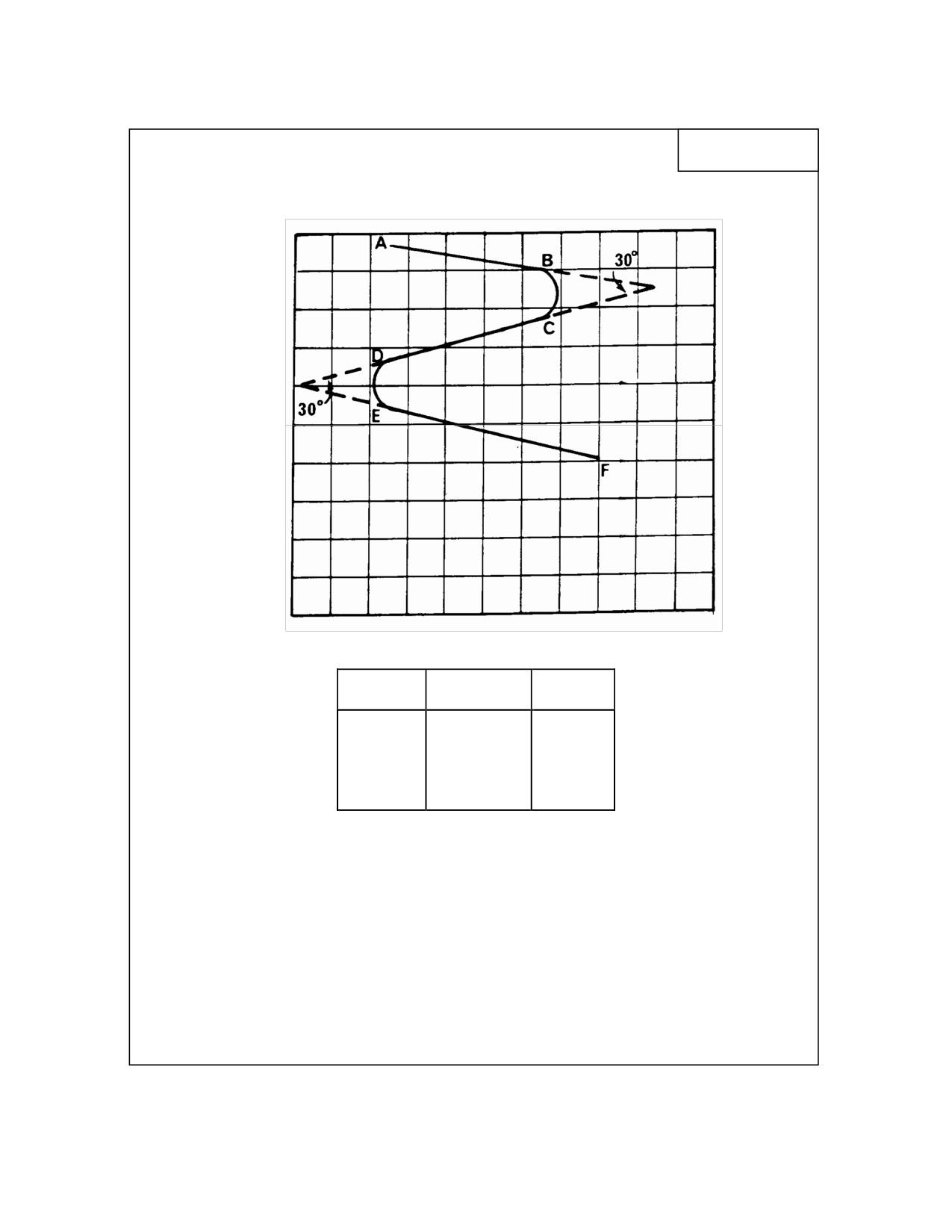
Diagram No. 33
Leg
Time
Speed
(mins)
(kts)
A-B
30
8-10
B-C
15
5-7
C-D
30
8-10
D-E
15
5--7
E-F
30
8-10
3-33
ORIGINAL
NATO-UNCLASSIFIED

NATO-UNCLASSIFIED
MXP-1(D)(NAVY)(AIR)
Table 3-5 Submarine Course and Speed Diagrams (Cont'd)
Diagram No. 41
Leg
Time
Speed
Distance
Time at
(mins)
(kts)
(yds)
Each Point
AB
13
3
1358
A
0
BC
24
4
3243
B
+13
CD
11
2
743
C
+37
DE
20
5
3378
D
+48
EF
10
4
1351
E
+68
FG
7
4
946
F
+78
GH
10
6
2027
G
+85
HI
10
2
675
H
+95
IA'
15
3
522
I
+105
A'
+120
3-34
ORIGINAL
NATO-UNCLASSIFIED

NATO-UNCLASSIFIED
MXP-1(D)(NAVY)(AIR)
Table 3-5 Submarine Course and Speed Diagrams (Cont'd)
Diagram No. 42
Leg
Time
Speed
Distance
Time at
(mins)
(kts)
(yds)
Each Point
AB
20
4
2702
A
0
BC
17
5
2871
B
+20
CD
20
3
2027
C
+37
DE
15
6
3040
D
+57
EF
15
4
2027
E
+72
FG
10
5
1689
F
+87
GH
10
7.5
2534
G
+97
HA'
13
5
2196
H
+107
A'
+120
3-35
ORIGINAL
NATO-UNCLASSIFIED

NATO-UNCLASSIFIED
MXP-1(D)(NAVY)(AIR)
Table 3-5 Submarine Course and Speed Diagrams (Cont'd)
Diagram No. 43
Leg
Time
Speed
Distance
Time at
(mins)
(kts)
(yds)
Each Point
AB
15
2
1013
A
0
BC
10
5
1689
B
+15
CD
10
2
597
C
+25
DE
20
2
1430
D
+35
EF
25
6
5067
E
+55
FG
15
4
2027
F
+80
GH
13
5
2218
G
+95
HI
12
3
1216
H
+108
I
+120
3-36
ORIGINAL
NATO-UNCLASSIFIED

NATO-UNCLASSIFIED
MXP-1(D)(NAVY)(AIR)
Table 3-5 Submarine Course and Speed Diagrams (Cont'd)
Diagram No. 44
Leg
Time
Speed
Distance
Time at
(mins)
(kts)
(yds)
Each Point
AB
14
3
1419
A
0
BC
10
6
2027
B
+14
CD
5
3
507
C
+24
DE
30
3
3040
D
+29
EF
10
4
1351
E
+59
FG
10
5
1689
F
+69
GH
10
7.5
2534
G
+79
HI
10
5
1689
H
+89
IJ
21
3.5
2483
I
+99
J
+120
3-37
ORIGINAL
NATO-UNCLASSIFIED

NATO-UNCLASSIFIED
MXP-1(D)(NAVY)(AIR)
Table 3-5 Submarine Course and Speed Diagrams (Cont'd)
Diagram No. 51
Leg
Time
Speed
Distance
Time at
(mins)
(kts)
(yds)
Each Point
AB
18
3.5
2128
A
0
BC
15
3
1520
B
+18
CD
30
2
2027
C
+33
DE
20
4
2702
D
+63
EF
27
1.5
1368
E
+83
FA'
10
3
1013
F
+110
A'
+120
3-38
ORIGINAL
NATO-UNCLASSIFIED

NATO-UNCLASSIFIED
MXP-1(D)(NAVY)(AIR)
Table 3-5 Submarine Course and Speed Diagrams (Cont'd)
Diagram No. 52
Leg
Time
Speed
Distance
Time at
(mins)
(kts)
(yds)
Each Point
AB
8
3.5
946
A
0
BC
15
3
1520
B
+8
CD
15
4
2027
C
+23
DE
10
4
1351
D
+38
EF
15
5
2534
E
+48
FG
20
2
1351
F
+63
GH
10
3
1013
G
+83
HI
18
2.5
1520
H
+93
IA'
9
3
912
I
+111
A
+120
3-39
ORIGINAL
NATO-UNCLASSIFIED
NATO-UNCLASSIFIED
MXP-1(D)(NAVY)(AIR)
Table 3-5 Submarine Course and Speed Diagrams (Cont'd)
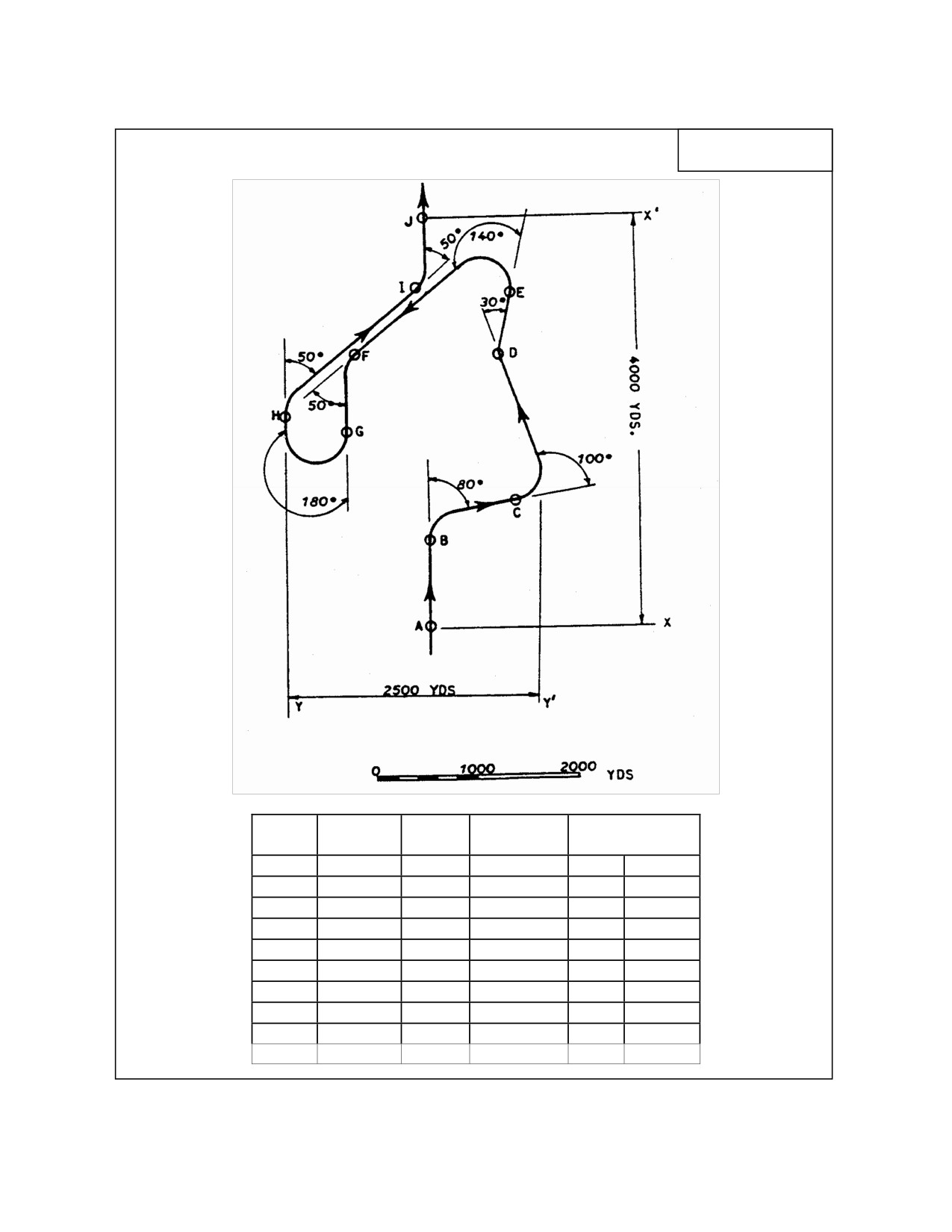
Diagram No. 53
Leg
Time
Speed
Distance
Time at
(mins)
(kts)
(yds)
Each Point
AB
10
2.5
844
A
0
BC
15
2
1013
B
+10
CD
15
3
1520
C
+25
DE
10
2
676
D
+40
EF
15
4
2027
E
+50
FG
15
1.5
760
F
+65
GH
10
3
1013
G
+80
HI
21
2.5
1774
H
+90
IJ
19
2.5
760
I
+111
J
+120
3-40
ORIGINAL
NATO-UNCLASSIFIED

NATO-UNCLASSIFIED
MXP-1(D)(NAVY)(AIR)
Table 3-5 Submarine Course and Speed Diagrams (Cont'd)
Diagram No. 54
Leg
Time
Speed
Distance
Time at
(mins)
(kts)
(yds)
Each
Point
AB
8
2.5
676
A
0
BC
15
3
1520
B
+8
CD
15
4
2027
C
+23
DE
10
5
1689
D
+38
EF
15
2
1013
E
+48
FG
10
4
1352
F
+63
GH
10
2
676
G
+73
HI
10
3
1013
H
+83
IJ
15
2.5
1267
I
+93
JK
12
3.5
1419
J
+108
K
+120
3-41
ORIGINAL
NATO-UNCLASSIFIED
NATO-UNCLASSIFIED
MXP-1(D)(NAVY)(AIR)
Table 3-5 Submarine Course and Speed Diagrams (Cont'd)
Diagram 55
(Spare)
3-42
ORIGINAL
NATO-UNCLASSIFIED

NATO-UNCLASSIFIED
MXP-1(D)(NAVY)(AIR)
Table 3-5 Submarine Course and Speed Diagrams (Cont'd)
Diagram 56
LEG
SPEED
DISTANCE
(KTS)
(YARDS)
AB
6
6000
BC
6
Turn 180°
CD
6
6000
3-43
ORIGINAL
NATO-UNCLASSIFIED

NATO-UNCLASSIFIED
MXP-1(D)(NAVY)(AIR)
Table 3-6 Tracking Exercise Diagrams
Diagram No. 60
CONVERGENCE ZONE TRACKING
THE ZIGZAG MANEUVERS ALLOW THE OPERATORS TO OBSERVE THE
TARGET AS IT PASSES THROUGH THE ANNULUS. THE OPERATOR OBSERVES
CONTACTS OF VARIOUS STRENGTHS, PRACTICES REGAINING SONAR
CONTACT, AND DETERMINES THE WIDTH OF THE CZ ANNULUS. ALSO,
VALUABLE EXPERIENCE IS GAINED IN OBSERVING PHENOMENA WITHIN
ASSOCIATED WITH GAINING AND LOSING CONTACT. THE ZIGZAG
MANOEUVRES WILL PROVIDE PRACTICE IN TEAM CO-ORDINATION
BETWEEN SONAR, CIC, AND THE BRIDGE.
NOTES:
1. BASE COURSE AND SPEED MAY BE ADJUSTED.
2. SUBMARINE MAY BE DIVED AFTER CONTACT
r
3-44
ORIGINAL
NATO-UNCLASSIFIED
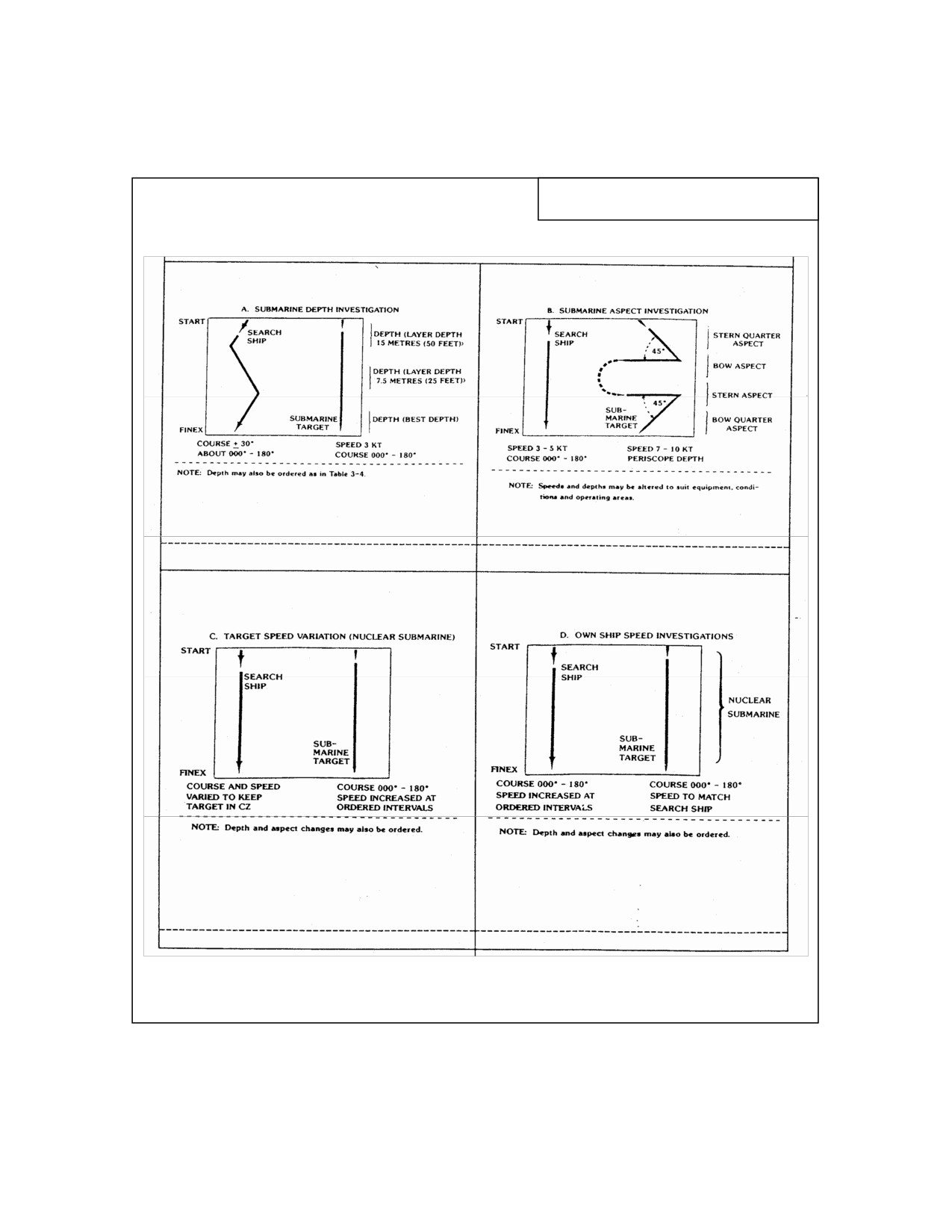
NATO-UNCLASSIFIED
MXP-1(D)(NAVY)(AIR)
Table 3-6 Tracking Exercise Diagrams (Cont'd)
Diagram No. 61
OTHER TRACKING OPTIONS
3-45
ORIGINAL
NATO-UNCLASSIFIED
NATO-UNCLASSIFIED
MXP-1(D)(NAVY)(AIR)
Table 3-7 CASEX A Series - Exercises Involving Ships and/or Helicopters
CASEX
PURPOSE
RECOMMENDED
REMARKS
NO.
DURATION
A-1
Basic Tracking Exercise
1-1/2 hrs
A-2
Basic Coordinated Tracking Exercise
2 hrs
A-3
Basic SAU Exercise
2 hrs
A-4
Advanced SAU Exercise
2-1/2 hrs
A-5
Basic Submarine Attack on a Screened or
3 hrs
Unscreened Target
- Counter Attack not
Allowed
A-6
Intermediate Submarine Attack on a Screened or
3-1/2 hrs
Unscreened Target - Counter Attack Allowed
A-7
NOT RELEASABLE
A-8
Defence of an Open Anchorage or Assault Area
5 hrs
A-9
VDS Tracking Exercise Using Safety Zone
2 hrs
Separation
A-10
VDS Tracking Exercise Using a Submarine
Area and Safety Zone
A-11
Sonar Passive Tracking
A-12
Sonar Passive Tracking (multi-ship)
A-13
Passive Tracking Exercise
A-14
Spares
to
A-20
A-21
Basic Passive Tracking Exercise
A-22
Long-Range Passive Detection and Localization
Exercise
A-23
NOT RELEASABLE
A-24
Intermediate ASW Area Search
3-46
ORIGINAL
NATO-UNCLASSIFIED
NATO-UNCLASSIFIED
MXP-1(D)(NAVY)(AIR)
Table 3-8 CASEX B Series - Exercises Involving ASW Aircraft
CASEX
PURPOSE
RECOMMENDED
REMARKS
NO.
DURATION
B-1
Basic Search, Homing and Attack Exercise
2 hrs
B-2
Basic Localization and Attack Exercise
2 hrs
B-3
Advanced Search, Localization and Attack
4 hrs
Exercise
B-4
Basic ASW Barrier Exercise
12 hrs
B-5
Advanced ASW Barrier Exercise
At least
24 hrs
B-6
Basic Passive Tracking and Attack Exercise
4 hrs
Table 3-9 CASEX C Series - Exercises Involving Multiple Forces
CASEX
PURPOSE
RECOMMENDED
REMARKS
NO.
DURATION
C-1
NOT RELEASABLE
C-2
Basic Coordinated ASW Exercise
3 hrs
C-3
Advanced Coordinated ASW Exercise
3 hrs
or more
C-4
Advanced Coordinated ASW Exercise/
12 hrs
Protection of a Force
or more
C-5
Advanced Coordinated ASW Exercise
12 hrs
Against Transiting/Patrolling Submarines
or more
C-6
VDS Exercise Use Safety Zone Separation
2 hrs
C-7
Defence of Main Body During Opposed
3 hrs
Sortie/ Entry
or more
C-8
NOT RELEASABLE
C-9
ASW Forces Area Search Followed by
5 hours
Submarine Attack on Underway
or more
Replenishment Group
C-10
Coordinated Passive Tracking Exercise by
TAS Units and Aircraft
C-11
Intermediate Coordinated ASW Area Search
C-12
Advanced Coordinated ASW Exercise
(PROWLEX)
3-47
ORIGINAL
NATO-UNCLASSIFIED
NATO-UNCLASSIFIED
MXP-1(D)(NAVY)(AIR)
Table 3-10 CASEX D Series
CASEX
PURPOSE
RECOMMENDED
REMARKS
NO.
DURATION
D-1
NOT RELEASABLE
D-2
NOT RELEASABLE
D-3
NOT RELEASABLE
D-4
NOT RELEASABLE
Table 3-11 CASEX E Series - Exercises of a Miscellaneous Nature
CASEX
PURPOSE
RECOMMENDED
REMARKS
NO.
DURATION
E-1
Familiarization Submarine and ASW Units Exercise
As specified
E-2
NOT RELEASABLE
E-3
Mutual Sensor Exercise
1 hr
E-4
ASW Action Against a Bottomed Submarine or
2 hrs
Target
E-5
Exercise in Searching for a Simulated Submarine
3 hrs
Casualty (SMASHEX)
E-6
Coordinated Submarine Rescue Operations
As specified
E-7
Underwater Look Exercise
2 hrs or more
E-8
Depth Charge Exercise
As specified
E-9
Submarine Escape Exercise
As specified
Table 3-12 CASEX F Series - Synthetic Exercises
CASEX
PURPOSE
RECOMMENDED
REMARKS
NO
DURATION
F-1
Train basic ASW procedures (SAU procedures and
3 hrs
Former
close ASW action) when no submarine is available.
SYNTEX 525
F-2
To exercise advanced ASW procedures when no
3 hrs
Former
submarine is available
SYNTEX 522
3-48
ORIGINAL
NATO-UNCLASSIFIED
NATO-UNCLASSIFIED
MXP-1(D)(NAVY)(AIR)
CASEX A-1
BASIC TRACKING EXERCISE
PURPOSE
To exercise one ASW ship and/or helicopter in basic submarine tracking and attacking.
FORCES REQUIRED
1. One ship and/or helicopter.
2. One submarine.
SITUATION
1. Submarine is on the surface or at PD with the ship and/or helicopter within 4000 yards, and is
required to dive to a Safe Depth, or
2. Helicopter and submarine are in visual contact.
3. Initially, submarine course, speed and depth are to be restricted.
PROCEDURE
1. Establish communications prior to Go Time.
2. Units station themselves in accordance with Article 2260.
3. Submarine reports "Ready".
4. Unit orders submarine to dive.
5. Submarine reports when at Safe Depth by UWT or SST.
6. Unit initiates COMEX.
7. Carry out ASW action.
8. Unit breaks off attacks five minutes before FINEX.
9. At FINEX, submarine is to be surfaced in accordance with Article 2273 unless relaxations in force
otherwise permit.
SPECIAL PROVISIONS
None.
RECORDS
As required.
3-A1-1 (Reverse Blank)
ORIGINAL
NATO-UNCLASSIFIED
INTENTIONALLY BLANK
NATO-UNCLASSIFIED
MXP-1(D)(NAVY)(AIR)
CASEX A-2
BASIC COORDINATED TRACKING EXERCISE
PURPOSE
1. To exercise two or more ASW units in:
a. Tracking and attacking a submarine.
b. Inter-unit plotting and reporting procedures.
2. To exercise a submarine in counter-attacking and evading.
FORCES REQUIRED
1. Two or more ASW ships and/or helicopters.
2. One submarine.
SITUATION
1. Submarine is on the surface or at PD with the ships and/or helicopters within 4000 yards, and is
required to dive to a Safe Depth; and/or
2. Helicopters and submarine are in visual and voice contact. Submarine may be on the surface or at
PD.
3. Initially, submarine course, speed and depth are restricted.
PROCEDURE
1. Establish communications prior to Go Time.
2. Units station themselves in accordance with Article 2260.
3. Submarine reports "Ready".
4. OTC/OCS orders submarine to dive or go to Safe Depth.
5. Submarine reports when at Safe Depth by UWT or SST.
6. OTC/OCS initiates COMEX.
7. Carry out ASW action.
8. Units break off attacks five minutes before FINEX.
9. At FINEX submarine is to be surfaced in accordance with Article 2273 unless relaxations in force
otherwise permit.
3-A2-1
ORIGINAL
NATO-UNCLASSIFIED
NATO-UNCLASSIFIED
MXP-1(D)(NAVY)(AIR)
SPECIAL PROVISIONS
None.
RECORDS
As required.
3-A2-2
ORIGINAL
NATO-UNCLASSIFIED
NATO-UNCLASSIFIED
MXP-1(D)(NAVY)(AIR)
CASEX A-3
BASIC SAU EXERCISE
PURPOSE
1. To exercise two or more ASW units in:
a. Detecting, classifying, tracking and attacking a submarine.
b. Simple SAU procedure.
c. Inter-unit reporting, plotting and control procedures.
2. To exercise a submarine in counter-attacking and evading after detection.
FORCES REQUIRED
1. Two or more ASW units.
2. One submarine.
SITUATION
1. Submarine to remain within 2000 yards of start position until COMEX, unless otherwise directed.
2. Submarine is required to go to a Safe Depth when threatened by ASW ships or helicopters.
3. After COMEX the submarine may be restricted or unrestricted.
4. Start position for ASW units to be 10-15 miles (or as desired) from submarine's start position.
PROCEDURE
1. Units close estimated position of submarine.
2. Submarine goes to Safe Depth in accordance with the Safety Precautions and the relaxations in
force.
3. If the submarine is prematurely forced deep it may return to PD, when safe to do so, provided
COMEX has not been initiated.
4. First unit gaining contact initiates COMEX.
5. Carry out ASW action (see Article 2252, para 1.a.).
6. Submarine remains at Safe Depth until FINEX or Stop Time, depending on relaxations in force.
7. Units break off attacks five minutes before FINEX.
3-A3-1
ORIGINAL
NATO-UNCLASSIFIED
NATO-UNCLASSIFIED
MXP-1(D)(NAVY)(AIR)
8. At FINEX or Stop time, submarine is to be surfaced in accordance with Article 2273, unless
relaxations in force otherwise permit.
SPECIAL PROVISIONS
None.
RECORDS
As required.
3-A3-2
ORIGINAL
NATO-UNCLASSIFIED
NATO-UNCLASSIFIED
MXP-1(D)(NAVY)(AIR)
CASEX A-4
ADVANCED SAU EXERCISE
PURPOSE
1. To exercise two or more ASW units in:
a. detecting, classifying, tracking and attacking a submarine;
b. advanced SAU procedures; and
c. inter-unit plotting, reporting and control procedures.
2. To exercise submarines in counter-attacking and avoiding detection.
FORCES REQUIRED
1. Two or more ASW units.
2. One submarine.
SITUATION
1. Submarine is to remain within specified Submarine Probability Area until COMEX, then it is
unrestricted.
2. ASW units are to be 15-20 miles (or as desired) from the centre of the Submarine Probability
Area.
PROCEDURE
1. Units close estimated position of submarine.
2. Submarine is to attempt to avoid detection while within the Submarine Probability Area.
3. Submarine goes to Safe Depth in accordance with the Safety Precautions and the relaxations in
force.
4. If the submarine is prematurely forced deep, it may return to PD when safe to do so, provided
COMEX has not been initiated.
5. First unit gaining contact initiates COMEX.
6. Carry out ASW action (see Article 2252.1.a.).
7. Submarine remains at Safe Depth until FINEX or Stop Time depending on relaxations in force.
8. Units break off attacks 5 minutes before FINEX.
3-A4-1
ORIGINAL
NATO-UNCLASSIFIED
NATO-UNCLASSIFIED
MXP-1(D)(NAVY)(AIR)
9. At FINEX or Stop Time, submarine is to be surfaced in accordance with Article 2273 unless
relaxations in force otherwise permit.
SPECIAL PROVISIONS
None.
RECORDS
As required.
3-A4-2
ORIGINAL
NATO-UNCLASSIFIED
NATO-UNCLASSIFIED
MXP-1(D)(NAVY)(AIR)
CASEX A-5
BASIC SUBMARINE ATTACK ON A SCREENED OR UNSCREENED TARGET
(COUNTER-ATTACK NOT ALLOWED)
PURPOSE
1. To exercise submarines in simulated or practice torpedo attacks on screened or unscreened targets
and escorts.
2. To exercise ASW units in detecting submarines attacking or penetrating a screen.
3. To exercise ASW units in the detection of torpedoes and the employment of torpedo
countermeasures.
FORCES REQUIRED
1. One or more ships and, if available, helicopters.
2. One or more submarines.
SITUATION
1. Surface units steer a base course and speed to pass known submarine start position as ordered.
2. As the attack proficiency of the submarine improves, the surface units may be allowed to employ
countermeasures as authorized by the relaxations and Exercise Instructions in force.
3. Submarine may be at any depth in start position.
4. Distance between submarines and surface units for each run, is to be specified by the OCS.
PROCEDURE
1. Units close position of submarine.
2. Submarine makes approach and attack.
3. Submarine goes to Safe Depth in accordance with the safety Precautions and the relaxations in
force.
4. If the submarine is prematurely forced deep, it may return to PD, when safe to do so.
5. If ASW units gain contact, they are not to drop back, alter course to investigate, attack or counter-
attack, or initiate COMEX.
6. Submarine attacks should be signalled.
7. Exercise terminates at Stop Time, or for individual submarines when they surface, whichever is
earlier.
(Surfacing procedure in accordance with Article 2273 is to be carried out at Stop Time unless
all submarines have by then surfaced, or unless relaxations in force permit otherwise.)
3-A5-1
ORIGINAL
NATO-UNCLASSIFIED
NATO-UNCLASSIFIED
MXP-1(D)(NAVY)(AIR)
SPECIAL PROVISIONS
1. When practice torpedo firings have been authorized, the following provisions apply:
a. Normally, only one run will be allowed.
b. OCS may specify a minimum torpedo firing range to obtain maximum value in torpedo
detection.
c. Surface ships are not to evade torpedoes, unless the appropriate relaxations are in force.
d. NOT RELEASABLE.
RECORDS
As required.
3-A5-2
ORIGINAL
NATO-UNCLASSIFIED
NATO-UNCLASSIFIED
MXP-1(D)(NAVY)(AIR)
CASEX A-6
INTERMEDIATE SUBMARINE ATTACK IN A SCREENED OR UNSCREENED TARGET
(COUNTER-ATTACK ALLOWED)
PURPOSE
1. To exercise submarines in attacking an unscreened or screened target and evading detection.
2. To exercise units in detecting, attacking and/or counter-attacking submarines.
FORCES REQUIRED
1. One or more ships, and, if available, helicopters.
2. One or more submarines.
SITUATION
1. Surface units steer a base course to pass within 6000 yards, or as specified by the OCE/OCS, of
the initial position of the submarine or centre of the area, employing countermeasures authorized by
Relaxations and Exercise Instructions.
2. Submarines are to avoid detection and achieve a firing position.
3. The initial distance between surface units and submarines will be at least 15 miles or as specified
by the OCE/OCS.
PROCEDURE
1. Units close estimated position of submarine.
2. Submarine makes approach and attacks.
3. Submarine may remain at PD or go to Safe Depth in accordance with the safety precautions and
relaxations in force.
4. The first unit gaining contact initiated COMEX.
5. Carry out ASW action (see Article 2252.1.a.).
6. Submarine attacks may be signalled.
7. Submarine may remain at Safe Depth or RTPD to counter-attack until FINEX or STOP TIME,
depending on relaxations in force.
8. Units break off attacks five minutes before FINEX.
9. At FINEX or Stop Time, submarine is to be surfaced in accordance with Article 2273 unless
relaxations in force otherwise permit.
3-A6-1
CHANGE 4
NATO-UNCLASSIFIED
NATO-UNCLASSIFIED
MXP-1(D)(NAVY)(AIR)
SPECIAL PROVISIONS
1. If more than one submarine is to participate, they are to be stationed at least 5 miles apart, unless
coordinated attacks are allowed.
2. Practice torpedoes may be fired during the exercise until COMEX plus five minutes.
RECORDS
As required.
3-A6-2
CHANGE 4
NATO-UNCLASSIFIED
NATO-UNCLASSIFIED
MXP-1(D)(NAVY)(AIR)
CASEX A-7
NOT RELEASABLE
3-A7-1
ORIGINAL
NATO-UNCLASSIFIED
NATO-UNCLASSIFIED
MXP-1(D)(NAVY)(AIR)
NOT RELEASABLE
3-A7-2
ORIGINAL
NATO-UNCLASSIFIED
NATO-UNCLASSIFIED
MXP-1(D)(NAVY)(AIR)
CASEX A-8
DEFENCE OF AN OPEN ANCHORAGE OR ASSAULT AREA
PURPOSE
1. To exercise ASW units in protecting an exposed anchorage or assault area.
2. To exercise submarines in penetrating a patrol of ASW units and attacking a concentration of
shipping.
3. To exercise participants in conducting inshore operations.
FORCES REQUIRED
1. Two or more target ships, or a reference ship.
2. Two or more ASW ships and/or helicopters.
3. One or more submarines.
SITUATION
1. ASW units defend the designated area while submarines endeavour to penetrate the ASW patrol
and attack shipping or the reference ship.
2. Target ships or reference ship may be at anchor or underway.
PROCEDURE
1. The OSE/OCE designates the area and establishes patrols.
2. At Go Time, or as ordered, the submarine is to dive, remaining in assigned approach sector, and is
to try to penetrate the ASW defence.
3. ASW units defend the area as ordered.
4. Submarines which penetrate the patrol are to indicate simulated torpedo attacks by the appropriate
signals, and avoid detection.
5. First unit gaining contact initiates COMEX.
6. At FINEX or Stop Time, submarine is to be surfaced in accordance with Article 2273, unless
relaxations in force otherwise permit.
SPECIAL PROVISIONS
1. Submarines are to be informed of the limits of the approach sector and may be given information
on the type of patrol used by the ASW units.
3-A8-1
ORIGINAL
NATO-UNCLASSIFIED