Military reference books and manuals (2009-2023, Volume 4) - page 29
AZSPU-HSSE-DOC-00054-2
Page 2 of 61
Incident Investigation and Reporting
7
REPORT DISTRIBUTION
26
8
DEVELOPMENT AND DISTRIBUTION OF LESSONS LEARNED
26
9
STORAGE OF RECORDS
27
10 HSSE & OPERATIONAL INCIDENT REPORTING BOUNDARIES
28
10.1
REPORTING AND RECORDING BOUNDARIES
28
10.2
“OPERATIONAL BOUNDARY”
28
10.3
“OPERATIONAL BOUNDARY” - SPECIAL CASES
30
10.4
“WORK- RELATED” BOUNDARY
30
10.5
ILLUSTRATIVE CASE
30
REFERENCES
32
APPENDIX A - MODEL TERMS OF REFERENCE TEMPLATE
33
APPENDIX B - DEFINITIONS
34
WORK-RELATED
34
BP WORK ENVIRONMENT
34
BUSINESS TRAVEL - BP EMPLOYEE
34
BUSINESS TRAVEL - BP CONTRACTOR
35
EMPLOYMENT STATUS
35
BP WORKFORCE
35
EMPLOYEE
35
CONTRACTOR
35
THIRD PARTY
36
INCIDENT
36
ACCIDENT
36
NEAR MISS
36
FIRST AID CASE
36
MEDICAL TREATMENT CASE
37
INJURY/ILLNESS
37
OCCUPATIONAL ILLNESS
37
OCCUPATIONAL INJURY
38
RECORDABLE OCCUPATIONAL ILLNESS AND INJURY
38
RESTRICTED WORK OR JOB TRANSFER (RW/JT)
39
DAYS AWAY FROM WORK CASE (DAFWC)
39
HIGH POTENTIAL (HIPO) INCIDENT
39
MAJOR INCIDENT (MIA)
39
RECORDABLE FATALITY
39
INCIDENT SEVERITY
40
VEHICLE ACCIDENT
40
SEVERE VEHICLE ACCIDENT
40
LOSS OF PRIMARY CONTAINMENT (LOPC)
40
UNCONTROLLED RELEASE/EVENT
41
PRIMARY CONTAINMENT
41
UNSAFE/UNHEALTHY CONDITION
41
INCIDENT INVESTIGATION
41
10.6
IM RELATED INCIDENT
41
PROCESS SAFETY
42
PROCESS SAFETY INCIDENT
42
EQUIPMENT /PROPERTY DAMAGE (INCIDENT DIRECT COST)
42
HOME AWAY FROM HOME
42
Control Tier:
2
Revision Date: 06 January, 2011
Document Number: AZSPU-HSSE-DOC-00054-2
Print Date: 1 February 2011
PAPER COPIES ARE UNCONTROLLED. THIS COPY VALID ONLY AT THE TIME OF PRINTING. THE CONTROLLED
VERSION OF THIS DOCUMENT CAN BE FOUND AT http://docs.bpweb.bp.com/dkazspu/component/hssesms
AZSPU-HSSE-DOC-00054-2
Page 3 of 61
Incident Investigation and Reporting
EXPLOSION
43
FIRE
43
ACUTE RELEASE
43
FRAUD
43
SECURITY INCIDENT
43
MAJOR SECURITY INCIDENT
44
HIGH POTENTIAL SECURITY INCIDENT
44
MARINE RELATED INCIDENT
44
INCIDENT INVESTIGATION
44
BP‟S RCA INVESTIGATION
44
CRITICAL FACTOR
44
UNSAFE/UNHEALTHY CONDITION
45
“CONTRACT FOR AVIATION SERVICES”
45
“D2D SUPERVISED CONTRACTOR”
45
“DEDICATED TO BP‟S BUSINESS USE”
45
“E&P CONTRACTOR LED FACILITY DOING MATERIAL WORK FOR BP”
45
APPENDIX C - INJURY AND ILLNESS REPORTING DECISION TREE
46
APPENDIX D - SEVERITY MATRIX, HSE IMPACT LEVELS
47
APPENDIX E - SEVERITY MATRIX, BUSINESS IMPACT LEVELS
48
APPENDIX F - POTENTIAL SEVERITY CLASSIFICATION, LOPC OF FLAMMABLE
GASES, LIQUIDS AND OTHER HAZARDOUS CATEGORIES (ACUTE RELEASE)49
APPENDIX G - POTENTIAL SEVERITY CLASSIFICATION, LOPC OF TOXIC
SUBSTANCES (ACUTE RELEASE)
50
APPENDIX H - EXPORTS PU INTERNAL INCIDENT NOTIFICATION REQUIREMENTS
FOR ILLEGAL TAPS
51
APPENDIX I - ONSHORE OPERATIONS EXTERNAL NOTIFICATION REQUIREMENTS
................................................................................................................................ 52
APPENDIX J - INCIDENT CLASSIFICATION, RESOLUTION PROCEDURE
53
APPENDIX K - INITIAL INTERNAL INCIDENT NOTIFICATION FORM
54
APPENDIX L - GUIDANCE ON USE OF DROPS CALCULATOR AND DROPPED OBJECT
HIPO DETERMINATION
55
APPENDIX M - PROCESS SAFETY INCIDENT CLASSIFICATION GUIDANCE
57
REVISION/REVIEW LOG
58
Control Tier:
2
Revision Date: 06 January, 2011
Document Number: AZSPU-HSSE-DOC-00054-2
Print Date: 1 February 2011
PAPER COPIES ARE UNCONTROLLED. THIS COPY VALID ONLY AT THE TIME OF PRINTING. THE CONTROLLED
VERSION OF THIS DOCUMENT CAN BE FOUND AT http://docs.bpweb.bp.com/dkazspu/component/hssesms
AZSPU-HSSE-DOC-00054-2
Page 4 of 61
Incident Investigation and Reporting
1 INTRODUCTION
1.1 PURPOSE
This document describes the procedures employed for reporting and investigating incidents
related to BP activities in the Azerbaijan Strategic Performance Unit (AzSPU) and in the
preparation of associated reports.
Note: The prime objectives of such an investigation are to establish the immediate and root
causes, analyze them, and make recommendations to prevent recurrence of a similar
incident. It is not to attribute blame.
1.2 SCOPE
This process shall be used for all types of incidents, including but not limited to:
Fatalities
Workplace injuries and illness
Security breaches
Spills and leaks
Vehicle accidents
Near misses
All drilling and well operations safety and integrity management accidents,
incidents and significant near misses
Process safety incidents e.g. overpressure of design plant, excursion from design
temperature, formation of hydrate plugs, misdirection of process fluids, ESD or
pressure safety valves lifting (whether to flare or vent)
Plant/technical integrity incidents i.e. any incident where the root cause would be
addressed by the Group Defined Practice - Integrity Management (GDP 5.0-0001)
and there is actual or potential harm to people or the environment, including loss
of primary containment or failure of an engineered system
Marine related incidents
Aviation related incident
Etc.
All types of incidents are to be reported immediately to the supervisor and / or the BP
representative.
1.3 CONTRACTOR INVESTIGATIONS
Contractor management may wish to conduct a separate internal incident investigation for
serious incidents involving contractor employees. BP policy is to respect the wishes of
contractors, and to encourage completion of a joint investigation in a cooperative manner
with representatives of both BP and affected contractors.
For incidents that occur at BP controlled sites or activities the investigation shall be led by a
BP representative.
Control Tier:
2
Revision Date: 06 January, 2011
Document Number: AZSPU-HSSE-DOC-00054-2
Print Date: 1 February 2011
PAPER COPIES ARE UNCONTROLLED. THIS COPY VALID ONLY AT THE TIME OF PRINTING. THE CONTROLLED
VERSION OF THIS DOCUMENT CAN BE FOUND AT http://docs.bpweb.bp.com/dkazspu/component/hssesms
AZSPU-HSSE-DOC-00054-2
Page 5 of 61
Incident Investigation and Reporting
2 RESPONSIBILITIES
2.1 ALL PERSONNEL
Any person involved in or observing an accident or near miss must immediately report it to
his / her supervisor or BP Representative.
2.2 SPU LEADER (SPUL)
SPU Leader is responsible and accountable for ensuring that this procedure is implemented
in the AzSPU and for reporting major incidents and HiPos to the BP Group.
SPU Leader is responsible for
Notification of Major Incidents and HiPos to the appropriate Group Vice President
through personal conversation within 8 hours
Issue of MIA/HiPo notification to “G E&P Incident Notification” distribution list
Being the “owner” of all major incidents in AzSPU (other than fatality incidents, which
require an externally led incident investigation team).
2.3 FUNCTIONAL VICE PRESIDENTS (VPS) OR DESIGNEE (OPERATIONS, MIDSTREAM,
D&C, HSE & ENGINEERING)
Vice President (VP) or designee is responsible and accountable for:
Ensuring that this procedure is implemented in their area of responsibility
Reporting MIA/HiPo/DAFWC incidents to SPU leader
Being the owner of HiPo incidents in their respective Function.
2.4 AREA/WELL/LOGISTIC OPERATIONS MANAGER
Responsible for:
Ensuring that this procedure is implemented in their specific area of responsibility
Reporting level G (health & safety) and all F+ incidents to the relevant VP
Being the owner of actual level F severity incidents in their respective area of
responsibility.
2.5 AZSPU ENTITY AVIATION AUTHORITY
AzSPU Entity Aviation Authority (EAA) is responsible and accountable for:
Ensuring that this procedure is implemented for all aviation incidents
Notifying Segment Aviation Authority and Group Head of Aviation about aviation
incidents and incidents that could require aviation as part of the incident response,
taking due consideration of the notification of the AzSPU Incident timing to ensure
that the notification does not precede the notification to the Functional VP and
Segment Management
Providing the appropriate aviation expertise and resources to the investigation team
Control Tier:
2
Revision Date: 06 January, 2011
Document Number: AZSPU-HSSE-DOC-00054-2
Print Date: 1 February 2011
PAPER COPIES ARE UNCONTROLLED. THIS COPY VALID ONLY AT THE TIME OF PRINTING. THE CONTROLLED
VERSION OF THIS DOCUMENT CAN BE FOUND AT http://docs.bpweb.bp.com/dkazspu/component/hssesms
AZSPU-HSSE-DOC-00054-2
Page 6 of 61
Incident Investigation and Reporting
Consulting with Segment Aviation Authority and Group Head of Aviation on level of
investigation and BP Aviation participation
Acting as conduit to Segment and Group for promulgating lesson learned on aviation
incidents.
2.6 MARINE AUTHORITY
The SPU Marine Authority is responsible and accountable for:
Ensuring that this procedure is implemented for all marine incidents
Reporting MIA/HiPo/DAFWC marine incidents to Single Point Accountability -
Marine
Ensuring SPA-Marine notifies BP Shipping of the incident, taking due
consideration of the notification of the AzSPU Incident timing to ensure that the
notification does not precede the notification to the Functional VP and Segment
Management
Providing the appropriate marine resources to the investigation team
Consulting with BP shipping on level of investigation and BP Shipping participation
Acting as conduit to BP Shipping for promulgating lesson learned.
2.7 SITE MANAGER
Site Manager/OIM/Fleet Operations TL are responsible for estimating the worst probable
(not imaginable) outcome of a particular incident and making an initial assessment of the
severity of the incident and determining the level of management that should own the
investigation process.
(Refer to Section 2.8).
Site Managers are responsible for:
Initial reporting of the incident
Preservation of the incident scene (preservation of physical data and prevention of
destruction/alteration) and early collection of material evidence, taking
photographs etc
Making an initial assessment of the severity of an incident
Requesting drugs and alcohol testing whenever potential for substance abuse is
under question
Obtaining initial witness statements (eyewitnesses) while incident details are still
fresh
Instigating the appropriate investigation process
Assuming ownership of minor incidents on his site
Accepting the Incident Report and allocating the resulting actions
Ensuring that all equipment is verified “fit for purpose” after a significant incident or
event, prior to return to service.
Control Tier:
2
Revision Date: 06 January, 2011
Document Number: AZSPU-HSSE-DOC-00054-2
Print Date: 1 February 2011
PAPER COPIES ARE UNCONTROLLED. THIS COPY VALID ONLY AT THE TIME OF PRINTING. THE CONTROLLED
VERSION OF THIS DOCUMENT CAN BE FOUND AT http://docs.bpweb.bp.com/dkazspu/component/hssesms
AZSPU-HSSE-DOC-00054-2
Page 7 of 61
Incident Investigation and Reporting
Note: The incident scene shall be released for resumption of work only at the direction of the
incident investigation team. This shall be done (with advice from BP legal as needed) at the
direction of, or with the concurrence of, any involved regulatory or law enforcement bodies.
2.8 INCIDENT OWNER
The Owner is the individual who requested the Incident Investigation to be performed and
has the responsibility for the investigation through to closeout of the remedial actions. The
level of the Owner must be commensurate with the severity, or potential severity, of the
incident and should be:
SPU Leader (SPUL) for major incidents in AzSPU (all actual level A-E incidents
other than fatality).
Vice President (VP) for HiPos (potential severity A-E).
Area/Well/Logistics Operations Manager for all actual level F severity incidents.
Site Manager/OIM/Fleet Operations TL actual or potential incident severity Levels
G-H.
The Owner shall:
Appoint the Investigation Team, other than for fatality incidents
Draw up the terms of reference for the investigation
Ensure that incident investigation team leads and members are given adequate
relief from their normal duties to complete the incident investigation
Ensure investigation team is provided with all resources required for investigation
Provide a business overview on actions prior to entry into the tracking system and
shall review each action item for confidentiality
Review the selection of the Responsible Party for handling the action items
Ensure that all new or reassigned action items are entered into the Accident and
Incident database (Traction) under the appropriate category
Review progress reports to ensure that all outstanding action items are being
completed within specified deadlines
Take appropriate action with the Responsible Party if action items are not being
completed within the required deadline
The incident owner shall promptly advise BP Legal of any incidents classified as
“Major Incident”, and of any other incident where the possibility of regulatory action
or litigation exists.
2.9 INVESTIGATOR / INVESTIGATION TEAM
The Investigator/Investigation Team will be appointed by the Investigation Owner (Site
Management, Area/Well/Logistics Operations Manager, VP, SPUL) depending on severity of
incident, and specifics of the case, and is responsible for:
Investigating the circumstances leading to the event
Making recommendations to prevent recurrence
Ensuring that the written report is completed
Ensuring the MIA, HiPo and DAFWC report is handed over to the “owner”.
Control Tier:
2
Revision Date: 06 January, 2011
Document Number: AZSPU-HSSE-DOC-00054-2
Print Date: 1 February 2011
PAPER COPIES ARE UNCONTROLLED. THIS COPY VALID ONLY AT THE TIME OF PRINTING. THE CONTROLLED
VERSION OF THIS DOCUMENT CAN BE FOUND AT http://docs.bpweb.bp.com/dkazspu/component/hssesms
AZSPU-HSSE-DOC-00054-2
Page 8 of 61
Incident Investigation and Reporting
The Investigation Team shall:
Establish the situation before the incident
Determine what happen during the incident
Determine the critical factors
Determine the immediate and system causes
Determine actions to prevent recurrence of a similar incident
Produce the incident report.
Note: Wherever the location of the incident, the investigation team shall not investigate in
circumstances where it may be unsafe to do so. It shall be the responsibility of the
investigation team leader (with help from the BP entity leader as requested) to ensure the
safety of the investigation team members during the investigation.
2.10 APPROVER
The Approver of the incident report will normally be the “Owner” of the incident and he/she is
responsible for agreeing actions with the Investigation Team. If the Owner is not satisfied
that the actions recommended fully address the immediate and system causes of the
incident, he should instruct the Investigation Team to seek further advice and formulate
further actions before he approves the incident report and actions in Traction.
The Approver is responsible for assuring the quality of the investigation report and the data
entered into the Accident and Incident Reporting database (Traction).
The Approver shall:
Review the Incident Report to ensure an accurate document with proper root
cause analysis
Ensure that:
o appropriate causes have been identified
o action items will effectively mitigate the hazards
o action items are clear and provide the Responsible Party with adequate
details to implement the action item
Review the selection of the Responsible Party for handling the action item in order
to ensure that the action item has been assigned to an individual or job position
with sufficient authority and expertise to complete the action
Approve the report in the Accident and Incident database (Traction).
2.11 INCIDENT REPORT ORIGINATOR
The Incident Report Originator is responsible for entering the Incident Report into the
Accident and Incident database (Traction).
Note: This will normally be a nominated Traction operator at the site of the incident.
Control Tier:
2
Revision Date: 06 January, 2011
Document Number: AZSPU-HSSE-DOC-00054-2
Print Date: 1 February 2011
PAPER COPIES ARE UNCONTROLLED. THIS COPY VALID ONLY AT THE TIME OF PRINTING. THE CONTROLLED
VERSION OF THIS DOCUMENT CAN BE FOUND AT http://docs.bpweb.bp.com/dkazspu/component/hssesms
AZSPU-HSSE-DOC-00054-2
Page 9 of 61
Incident Investigation and Reporting
2.12 RESPONSIBLE PARTY
The Responsible Party is the individual who has been assigned an action item arising from
an Owner‟s Incident Investigation. The Responsible Party must have sufficient authority and
expertise to carry out the action.
The Responsible Party shall:
Review validity of assignments of an action item with the Owner, if and when they
consider the assignment inappropriate
Take accountability for ensuring that all of his/her action items are completed by
the target date
Take appropriate action with the Owner if the action items are not being
completed within the desired deadline
Ensure that all comments against their action items, updates of the status of their
action items and closure of their action items when completed are entered into the
Traction database
Ensure actions are approved by the Owner and are closed in Traction.
2.13 HEALTH AND SAFETY MANAGERS (OFFSHORE, MIDSTREAM)
Responsible for:
Providing support to Incident Owners in setting up the Investigation Team.
Control Tier:
2
Revision Date: 06 January, 2011
Document Number: AZSPU-HSSE-DOC-00054-2
Print Date: 1 February 2011
PAPER COPIES ARE UNCONTROLLED. THIS COPY VALID ONLY AT THE TIME OF PRINTING. THE CONTROLLED
VERSION OF THIS DOCUMENT CAN BE FOUND AT http://docs.bpweb.bp.com/dkazspu/component/hssesms

AZSPU-HSSE-DOC-00054-2
Page 10 of 61
Incident Investigation and Reporting
3 RECORDING AND CLASSIFYING INCIDENTS
3.1 REPORTING OF INCIDENTS IN RECORDING SYSTEMS
BP Group has minimum timeframe requirements for incident reporting into appropriate
recording system. These requirements are summarized in Table 4.1 below.
Table 4.1. Requirements for entering incidents into Traction and MIA/HiPo database
Type of Incident
Recording Timescale
Recording System
Major Incidents (MIAs)
<24 hours
MIA/HiPo database
Levels A-E
<5 days
Traction
High Potential Incidents (HiPos)
<24 hours or on
MIA/HiPo database
identification
<5 days
Traction
Any BP Employee Fatality in the BP Work
<24 hours
MIA/HiPo database
Related Boundary
<5 days
Traction
Any BP Contractor Fatality in the BP Work
<24 hours
MIA/HiPo database
Related Boundary
<5 days
Traction
Any Third Party Fatality in the BP Operated
<24 hours
MIA/HiPo database
boundary
<5 days
Traction
Any non work-related Fatality in the BP
<24 hours
MIA/HiPo database
Operated boundary
<5 days
Traction
Loss of Primary Containment (LOPC)
<5 days
Traction
Security incidents
<5 days
Traction
Day Away from Work Case-Employee
<5 days
Traction
Day Away from Work Case-Contractor
<5 days
Traction
Restricted Work/Job Transfer-Employee
<5 days
Traction
Restricted Work/Job Transfer-Contractor
<5 days
Traction
Medical Treatment-Employee
<5 days
Traction
Medical Treatment-Contractor
<5 days
Traction
Loss of consciousness
<5 days
Traction
A significant injury or illness diagnosed by a
<5 days
Traction
physician or other licensed health
professional, such as cancer, chronic
irreversible disease, fractured or cracked
bone, or punctured eardrum
Needlestick and cuts from sharp objects that
<5 days
Traction
are contaminated with another person‟s blood
or other potentially infectious material
Medical removal under Government standards
<5 days
Traction
Occupational hearing loss (current hearing
<5 days
Traction
test must show 10dBA shift from current
baseline and total cumulative hearing loss
must be 25dBA or move above audiometric
zero).
Vehicle Accidents-Employee
<5 days
Traction
Vehicle Accidents-Contractor
<5 days
Traction
Spills >1 bbl
<5 days
Traction
Uncontrolled Releases/Events
<5 days
Traction
Fires
<5 days
Traction
Explosions
<5 days
Traction
MIA/HiPo database is located at: http://miahipo.bpweb.bp.com
Note: If there is any doubt as to whether an incident is within the reporting boundaries of this
procedure it shall be initially reported based on the assumption that it is.
Control Tier:
2
Revision Date: 06 January, 2011
Document Number: AZSPU-HSSE-DOC-00054-2
Print Date: 1 February 2011
PAPER COPIES ARE UNCONTROLLED. THIS COPY VALID ONLY AT THE TIME OF PRINTING. THE CONTROLLED
VERSION OF THIS DOCUMENT CAN BE FOUND AT http://docs.bpweb.bp.com/dkazspu/component/hssesms
AZSPU-HSSE-DOC-00054-2
Page 11 of 61
Incident Investigation and Reporting
Note: The incident should not be recorded in the Traction system if information is classified
as „BP Confidential” of higher under the BP Global Information Handling Standard.
Note: Fraud incidents are not reported through Traction, but should be reported in line with
BP‟s Fraud Reporting Instruction and the local BP entity leader shall notify the local financial
controller or the relevant Segment / Function chief financial officer.
All other type of security incidents should be recorded in the Traction system.
3.2 CLASSIFICATION OF INCIDENT
The Incident Owner shall be accountable for the accuracy of the submitted data, including
classifications.
Incidents and unsafe/unhealthy conditions which are entered into Traction shall be:
Classified for incident actual severity in accordance with Appendix D-E.
Classified for incident potential severity in accordance with Appendix D-E, and
taking into account Figure 6.1.
Loss of Primary Containment (LOPC) incidents that involve an acute release shall
be initially classified for potential severity in accordance with Appendix F-G, based
on the type of substance. This shall establish the minimum potential severity for
recording or notification purposes. Appendix D-E shall then be used to determine if
the potential severity classification should be higher based on the actual
circumstances of the incident.
When the incident severity appears border-line between two levels, initially, the
more severe level shall be chosen. Where tools and calculations are used, the
information provided in conjunction with sound judgment and common sense shall
be used to support the decision.
When an initial recording of severity level is later revised due to additional or new
information, the Incident Owner shall review the new severity classification. Incident Owner
shall also ensure that the appropriate record within the designated HSSE information system
is updated, and applicable local or Group notification is made.
Appendix J shall apply to resolution of requests for clarification from BP group regarding the
recordability or classification of incidents or unsafe / unhealthy conditions.
Note: When entering MIA/HiPo and RI (recordable injury) incidents into Traction it is
mandatory to classify the incident as being related to either:
Process Safety
Integrity Management
Security
Control of Work
Driving
Marine.
Process Safety Incident Classification Guidance is provided in Appendix M.
For every incident the Safety Specialists/TA Team located in the Health and Safety
Organization Offshore (Safety Specialists/TA Team Leader or HSE Incident Investigation
Specialist) has to be informed and consulted to ensure that the selected category is correct.
Control Tier:
2
Revision Date: 06 January, 2011
Document Number: AZSPU-HSSE-DOC-00054-2
Print Date: 1 February 2011
PAPER COPIES ARE UNCONTROLLED. THIS COPY VALID ONLY AT THE TIME OF PRINTING. THE CONTROLLED
VERSION OF THIS DOCUMENT CAN BE FOUND AT http://docs.bpweb.bp.com/dkazspu/component/hssesms
AZSPU-HSSE-DOC-00054-2
Page 12 of 61
Incident Investigation and Reporting
Additionally the LL One Pager report format
(AZSPU-HSSE-DOC-00054-A2) has been
updated to include mandatory indication of incident relatedness to the above categories.
4 TRAINING REQUIREMENTS AND COMPETENCE
4.1 INVESTIGATION TEAM LEADERS
Incident Investigation Team Leaders are considered
“trained” upon completion of a
standardized 12 hour “Basic RCA” training program that instils basic level competency for
Root Cause Analysis.
The training on its own doesn‟t prove competence, therefore the severity of the incident and
the person‟s previous experience in leading investigations shall be considered by the
Incident Owner before nominating the person to act as Investigation Team Leader. Incident
Investigation Team Leaders called on to investigate fatality incidents should receive ”Incident
Manager” training provided by Group Safety Advisor - incident investigation.
Untrained people should not lead RCA investigation.
4.2 ROOT CAUSE SPECIALISTS (RCS)
Root Cause Specialists are considered “trained” upon completion of a standardized 12 hour
“Basic RCA” training program that instils basic level competency for Root Cause Analysis.
The severity of the incident and person‟s previous experience should be considered by the
Incident Owner before the person is nominated to act as Root Cause Specialist.
4.3 MASTER ROOT CAUSE SPECIALIST (MRCS)
Major Incidents (level A-E) and HiPOs will require that at least one incident team member is
trained to Master Root Cause Specialist level. The person is considered “trained” upon
completion of a 3 day “Master RCA” training program. The master-level incident investigator
is the local centre of expertise that can train, coach, and mentor incident investigation team
leads trained at a lower competency level. There should be at least one person trained to
Master Root Cause Specialists level within AzSPU who shall be available to facilitate level A-
E severity incidents.
4.4 TEAM MEMBERS
Although there is no formal requirement for Investigation Team Members (other than Team
Leader and RCS) to attend above mentioned trainings, it is desirable for them to attend the
standard 12 hours “Basic RCA” training program.
Certain incidents will require Human Factors Analysis (HFA) to be performed. Only trained
people shall do this.
Note: A pool of trained RCS and MRCS are available in AzSPU. A rotational weekly
schedule has been developed with the intention that Incident Owner can select the required
MRCS or RCS dependent on the actual or potential severity of the incident. This rotational
schedule also ensures further development and application of RCA investigative techniques.
Control Tier:
2
Revision Date: 06 January, 2011
Document Number: AZSPU-HSSE-DOC-00054-2
Print Date: 1 February 2011
PAPER COPIES ARE UNCONTROLLED. THIS COPY VALID ONLY AT THE TIME OF PRINTING. THE CONTROLLED
VERSION OF THIS DOCUMENT CAN BE FOUND AT http://docs.bpweb.bp.com/dkazspu/component/hssesms
AZSPU-HSSE-DOC-00054-2
Page 13 of 61
Incident Investigation and Reporting
5 CORPORATE NOTIFICATION REQUIREMENTS
The following paragraphs describe incident notification requirements.
5.1 SPECIFIC RESPONSIBILITIES
All incidents shall be reported immediately to the appropriate supervisor or line manager and
through the line management to the Site Manager/OIM/Fleet Operations TL. For level G
incidents (other than H&S) and all level H incidents this requirement is relaxed to 8 hours.
The Site Manager/OIM shall ensure that the scene of the incident is made safe and then
protected from disturbance.
5.1.1 Site Manager/OIM/Fleet Operations TL
Site Manager/OIM/Fleet Operations TL is responsible for notification of all incidents to
Area/Well/Logistics Operations Manager under following notification timetable:
Any MIA, HiPo or DAFWC (Level F
- Health and Safety), immediate verbal
notification
All Level F
(other than Level F
- H&S) and Level G incidents at the earliest
opportunity, but within 8 hours
All Level H incidents at the earliest opportunity, but within 24 hours
For MIAs, HiPOs, injury/illness incidents, and production loss events Site Manager / OIM /
Fleet Operations TL must use the „Initial Internal Incident Notification Form‟ to assist with
verbal notification (see Appendix K)
For drilling related incidents the OIM shall notify the Well Operations Manager and make the
Area Operations Manager aware of the incident. The Well Operations Manager will
determine the level of investigation required.
In addition to their line notification responsibilities the Fleet Operations TL for Marine Related
Incidents shall notify the AzSPU Marine Authority taking due consideration of the notification
timetable.
5.1.2 Area/Well/Logistics Operations Manager/Marine Authority
Area/Well/Logistics Operations Manager is responsible for incident notification to relevant
VP under following notification timetable:
Any MIA or HiPo incidents, immediate verbal notification.
Level F - H&S incidents at the earliest opportunity, but within 8 hours.
Any F (other than H&S) and Level G - H&S incidents at the earliest opportunity, but
within 24 hours.
The Area/Well/Logistics Operations Manager should exercise their best judgment whether
further notification is required for all other incidents.
For Marine Related Incidents the Marine Authority shall notify the AzSPU Single Point
Accountability -Marine.
Control Tier:
2
Revision Date: 06 January, 2011
Document Number: AZSPU-HSSE-DOC-00054-2
Print Date: 1 February 2011
PAPER COPIES ARE UNCONTROLLED. THIS COPY VALID ONLY AT THE TIME OF PRINTING. THE CONTROLLED
VERSION OF THIS DOCUMENT CAN BE FOUND AT http://docs.bpweb.bp.com/dkazspu/component/hssesms
AZSPU-HSSE-DOC-00054-2
Page 14 of 61
Incident Investigation and Reporting
Logistics Manager in role as AzSPU EPRA (Entity Person Responsible for Aviation) shall
additionally to his line management notify AzSPU Entity Aviation Authority (EAA) of any
aviation incidents and incidents that could require aviation as part of the incident response.
5.1.3 Vice President (VP)
The VP is responsible for incident notification to Strategic Performance Unit Leader (SPUL)
under following notification timetable:
Any MIA and HiPo incidents, immediate verbal notification
All Level F - H&S incidents (including DAFWC) at the earliest opportunity, but within
24 hours.
The VP should exercise their best judgment whether further notification is required for all
other incidents.
The Single Point Accountability - Marine shall coordinate and effect the notifications of
Marine or Marine Related incidents to the Group Marine Authority and BP Shipping taking
due consideration of the AzSPU incident notification timing to ensure that the notification
does not precede the notification to the GVP and Segment Management.
Note: All Level A-E marine incident investigations shall be brought to the attention of BP
group marine authority.
5.1.4 Strategic Performance Unit Leader (SPUL)
The SPUL shall verbally notify the Group Vice President of MIA and HiPo incidents at the
earliest opportunity but within 8 hours.
The initial verbal MIA and HiPo notification shall be confirmed with global e-mail notification
within 24 hours using the Major Incident /HIPO announcement proformas (AZSPU-HSSE-
DOC-00054-A7). The SPUL should exercise their best judgment whether further notification
is required for Level F - H&S incidents.
Note: The SPUL shall verbally notify TVP Ops, HSE, Engineering of any BIL (BOTAS
International Limited) MIA/HiPo incidents at the earliest opportunity but within 8 hours.
The initial verbal notification shall be confirmed with email notification to “G E&P Non-Op
Incident Notification” within
24 hours by using the Major Incident /HIPO announcement
proformas (AZSPU-HSSE-DOC-00054-A7).
5.1.5 Incident Notification Details
The notifications should provide the following information:
Type of occurrence (fire, explosion, injury, spill, etc)
Site / location
Date and time of incident
Brief description of the event
Actual severity (Level A-H)
Control Tier:
2
Revision Date: 06 January, 2011
Document Number: AZSPU-HSSE-DOC-00054-2
Print Date: 1 February 2011
PAPER COPIES ARE UNCONTROLLED. THIS COPY VALID ONLY AT THE TIME OF PRINTING. THE CONTROLLED
VERSION OF THIS DOCUMENT CAN BE FOUND AT http://docs.bpweb.bp.com/dkazspu/component/hssesms
AZSPU-HSSE-DOC-00054-2
Page 15 of 61
Incident Investigation and Reporting
Incident category, i.e. injury details, damage or oil / chemical spilled, whichever
relevant
Immediate corrective action taken to prevent further loss
Contact name (person supplying information) and telephone number.
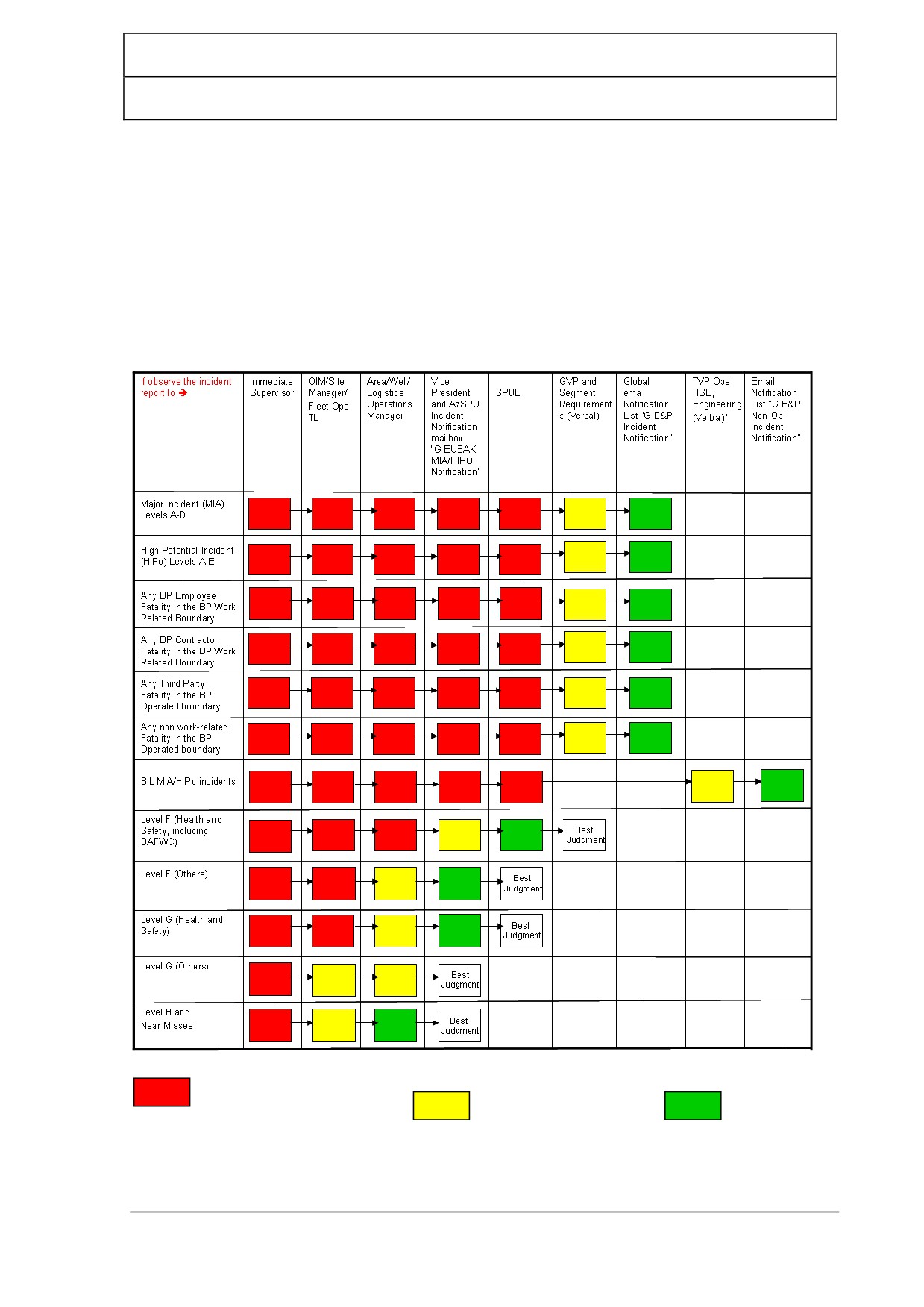
5.2 Incident Notification Flowchart
Summarizing the above, Figure 5.1 describes the AzSPU incident notification flowchart.
Figure 5-1 Incident Notification Flowchart
TVP is a part of ”G E&P Incident Notification” distribution list.
Immediately
Within 8 hours
Within 24 hours
Note 1: Figure 5-1 specifies the minimum incident notification requirements which must be
followed at all times, however more stringent notification requirements may be exercised if
deemed necessary.
Control Tier:
2
Revision Date: 06 January, 2011
Document Number: AZSPU-HSSE-DOC-00054-2
Print Date: 1 February 2011
PAPER COPIES ARE UNCONTROLLED. THIS COPY VALID ONLY AT THE TIME OF PRINTING. THE CONTROLLED
VERSION OF THIS DOCUMENT CAN BE FOUND AT http://docs.bpweb.bp.com/dkazspu/component/hssesms
AZSPU-HSSE-DOC-00054-2
Page 16 of 61
Incident Investigation and Reporting
Note 2: All Major incidents (A-E levels), HiPos and certain security sensitive incidents (e.g.
illegal taps) shall initially be sent to “G EUBAK MIA/HiPo Notification”, and shall not be
distributed any further without prior SPUL agreement. Distribution of MIA and HiPo LL One-
Pager Reports and HiPlus‟s outside AzSPU must be from SPUL office, not from individual
Operating Areas / Facilities.
Note 3: All F-H severity incidents (excluding HiPos and security sensitive incidents) should
be distributed accordingly to “G EUBAK AzSPU incidents_offshore” for offshore incidents
and to “G EUBAK AzSPU incidents_onshore” for onshore incidents.
Note 4: More details on Illegal Tap Incident Notification requirements for Exports PU are
described in Appendix H.
Note 5: Details on external notification requirements for Onshore Operations can be found in
Appendix I.
Note 6: For external notification of material release to the environment the AzSPU Internal &
External Material Release Reporting & Notification Procedure (AZSPU-HSSE-DOC-00075-2)
shall be followed.
Note 7: If for any reason any line position is unavailable (e.g. vacation, unreachable) their
delegate shall assume full responsibility to continue the line notification process.
Note 8: Notifications of Marine or Marine Related Incidents to E&P Segment Marine
Authority and BP Shipping will be coordinated and effected by the AzSPU Single Point
Accountability - Marine taking due consideration of the notification of the AzSPU Incident
timing to ensure that the notification does not precede the notification to the GVP and
Segment Management
Note 9: For a major security or HiPo security incident that may not be in the public domain,
the SPUL shall privately and securely if possible, communicate with the relevant segment or
function designated executive line management, regional security advisor and group head of
S&O. The regional security advisor shall inform additional senior leadership on a need-to-
know basis or based on who can advise or help. The notification chart in Figure 5.1 shall be
used.
Note 10: For drilling related incidents the OIM shall notify the Well Operations Manager and
make the Area Operations Manager aware of the incident. The Well Operations Manager will
determine the level of investigation required.
Note 11: SPUL, who has reason to believe that a fatality is either the result of natural causes
or is self-inflicted, shall consult with the BP regional health director for a preliminary cause
decision.
If the BP regional health director agrees that the fatality appears to be the result of a natural
cause or is self-inflicted, BP group notification shall not be required. If further investigation
provides new information that the fatality is not the result of natural causes or self-inflicted,
then the notification chart in Figure 5.1 shall be used.
If consultation with the BP regional health director is not possible, the BP leader shall comply
with the notification requirements in Figure 5.1.
If the fatality is classified as a natural cause or is self-inflicted, but circumstances associated
with the incident could have other potential consequences resulting in a potential severity
Control Tier:
2
Revision Date: 06 January, 2011
Document Number: AZSPU-HSSE-DOC-00054-2
Print Date: 1 February 2011
PAPER COPIES ARE UNCONTROLLED. THIS COPY VALID ONLY AT THE TIME OF PRINTING. THE CONTROLLED
VERSION OF THIS DOCUMENT CAN BE FOUND AT http://docs.bpweb.bp.com/dkazspu/component/hssesms
AZSPU-HSSE-DOC-00054-2
Page 17 of 61
Incident Investigation and Reporting
level A-D or E classification (e.g., driver, crane operator, or another critical role), then
notification requirements in Figure 5.1 apply.
6 THE INVESTIGATION PROCESS
6.1 DETERMINING INCIDENT SEVERITY
The processes used to investigate an incident always follow the same principles. However,
the make up of the Investigation Team, and the investigation process followed, is determined
by the actual and potential severity of the incident and specifics of the case. For guidelines
on the level of investigation and investigation team make up AZSPU-HSSE-DOC-00054-A3
should be referred to.
If an incident has different types of HSSE and business impacts the most stringent
investigation requirements apply. For instance, an incident with classification level A for
environment and level H for health, safety and security is investigated using level A
requirements.
6.2 DEVIATION FROM INVESTIGATION PROCESS
The relevant VP accountable for the area of operation where the incident occurs shall
request the segment or group head of HSSE for approval of any exceptions from the
requirements of AZSPU-HSSE-DOC-00054-A3 . The relevant VP may request an exception
for an incident that appears to be a special case for the following reasons:
The location of the incident.
The nature of BP‟s relationship to the incident (e.g. the involvement of other parties).
The nature of other investigations taking place, or the possibility of a joint
investigation with a governmental authority or other parties.
The potential for litigation or regulatory action.
When an exception is requested, the relevant head of HSSE shall determine whether to
conduct an investigation, and if so, when and how to do so. If an exception is approved, the
decision of the segment or function head of HSSE as to whether, when and how to
investigate the incident shall replace the requirements of this practice for that specific
incident. The relevant head of HSSE shall inform the group safety adviser-incident
investigation of any exceptions for incidents at level A-E.
When relevant VP requests an exception for levels A-E, the segment head of HSSE (or
functional equivalent) should consult BP legal and
/ or other relevant functions
(e.g.,
security).
The first stage of the process is therefore to make an estimate of the most serious probable
outcome of the incident in order to determine the process to be followed. This will initially be
done by the Site/Wells Manager/OIM.
Note: Potential Incident severity is based upon the most serious probable outcome. For
example:
If a man cuts his finger with a knife, the most likely outcome of the incident is a cut
finger and the potential severity of the incident should be judged on that basis
but...
Control Tier:
2
Revision Date: 06 January, 2011
Document Number: AZSPU-HSSE-DOC-00054-2
Print Date: 1 February 2011
PAPER COPIES ARE UNCONTROLLED. THIS COPY VALID ONLY AT THE TIME OF PRINTING. THE CONTROLLED
VERSION OF THIS DOCUMENT CAN BE FOUND AT http://docs.bpweb.bp.com/dkazspu/component/hssesms
AZSPU-HSSE-DOC-00054-2
Page 18 of 61
Incident Investigation and Reporting
If a man cuts his finger on a power saw, the most serious probable outcome could
easily have been an amputation and the potential severity of the incident is therefore
judged to be much greater.
Additionally the Figure 6.1 below can assist in assessment of the potential severity of
incident.
Figure 6.1 - Guidelines to Assess Potential Severity
Assessment of Potential Severity
Intent: To ensure that the potential severity classification of an incident or unsafe/unhealthy condition is based on the most
serious probable outcome.
Ask: Under different circumstances, could the consequence of the incident or unsafe/unhealthy condition have been more
serious for the:
Health, safety and security of people and the environment?
Equipment (e.g., damage)?
Privilege to operate?
Different circumstances include but are not limited to:
Time of day.
Weather (e.g., wind direction or strength).
Presence or absence of people going about their normal routine/business.
Exceptional intervention of people.
Similar activity with similar controls carried out by the same operation elsewhere.
A source of ignition could have been present, even if the likelihood is low.
If someone or equipment was struck with enough energy to injure an individual or damage/break the equipment, even if
the event was minor.
Consult the HSSE team for advice if the probable serious outcome / consequence seem extremely unlikely. For example, a
wasp sting can occasionally be fatal for someone allergic to wasp stings, but a first-aid case is a much more foreseeable
consequence.
6.2.1 Major Incident (Definition)
A major incident is an incident, including a security incident, involving any one of the
following:
1 or more fatalities associated with BP operations
10 or more injuries or health effects to BP workforce, either permanent or
requiring hospital treatment for more than 24 hours
Significant adverse reaction from authorities, media, NGOs or the general public
Costs from accidental equipment and property damage equal to or exceeding US
$ 1 Million
Environmental Impact with A-E severity level.
6.2.2 High Potential Incident (HiPo) Determination
A High Potential Incident (HiPo) is an Incident or Unsafe/Unhealthy Condition or near miss,
including a security incident, where the most serious probable outcome is a Major Incident.
In addition, this includes any Loss of Primary Containment (LOPC) Incident where the
potential severity is classified at Level E or greater as defined in the Group-Defined Practice
„Reporting of HSSE and Operational Incidents‟ (GDP 4.4-0001).
Control Tier:
2
Revision Date: 06 January, 2011
Document Number: AZSPU-HSSE-DOC-00054-2
Print Date: 1 February 2011
PAPER COPIES ARE UNCONTROLLED. THIS COPY VALID ONLY AT THE TIME OF PRINTING. THE CONTROLLED
VERSION OF THIS DOCUMENT CAN BE FOUND AT http://docs.bpweb.bp.com/dkazspu/component/hssesms

AZSPU-HSSE-DOC-00054-2
Page 19 of 61
Incident Investigation and Reporting
Figure 6-2 facilitates the process of decision making while determining the HiPo relevance
of the incident. A HiPo may not be identified as such at the time of the incident and it may
only be after the investigation that true the severity of the probable outcome becomes clear.
If, after investigation, an incident is found to fit these definitions, it should be reported as a
HiPo, even if it is outside the nominated reporting timeframe, or does not explicitly meet
these definitions. This requires a HiPo to be posted in the MIA/HiPo Database system and
the severity in the Traction Potential Risk Matrix to be increased to level A-E.
Figure 6-2 - HiPo Incident Determination Flowchart
See the guidance on
“use of DROPS Calculator” and on
“Dropped Object HiPo
determination” at Appendix L of this document.
6.3 TRACTION
Traction is a software tool designed to provide a single data entry system for all Health,
Safety, Environmental, Property Damage, Security, Reputation and Business
Interruption/Unit Outage incidents. Traction also offers an actual and potential severity matrix
that allows the user to assess the incident severity on a consistent basis.
6.4 ESTABLISH INVESTIGATION TEAM
The Investigation Team is appointed by the Investigation Owner.
The Owner initiates the RCA investigation by agreeing with and issuing
“Terms of
Reference” to the Investigation Team Leader.
Control Tier:
2
Revision Date: 06 January, 2011
Document Number: AZSPU-HSSE-DOC-00054-2
Print Date: 1 February 2011
PAPER COPIES ARE UNCONTROLLED. THIS COPY VALID ONLY AT THE TIME OF PRINTING. THE CONTROLLED
VERSION OF THIS DOCUMENT CAN BE FOUND AT http://docs.bpweb.bp.com/dkazspu/component/hssesms
AZSPU-HSSE-DOC-00054-2
Page 20 of 61
Incident Investigation and Reporting
6.5 TERMS OF REFERENCE
Terms of Reference detail the requirements of the investigation and give official status to the
investigation. In particular they will:
Identify references
Define the scope of work
List the team members
Provide objectives/guidance
Indicate any requirements for intermediate reporting.
Note: The investigation shall remain strictly within the Terms of Reference and deviate from
them only after discussion with the Owner. A model Terms of Reference template is
provided in Appendix A.
Copies of the Terms of Reference shall be provided to the Investigation Team and the Site
Manager.
The Team Leader of the Investigating Team shall discuss the Terms of Reference with the
Owner to ensure that he is fully briefed.
6.6 TEAM SELECTION
Incident investigation teams are determined according to the type of incident. Generally, the
team will consist of the following:
A member designated as the Investigation Team Leader with seniority dependent
on severity of the incident
At least one person knowledgeable in the process involved, e.g. operations or
technical engineer
A contract employee, contractor management representative, and
/ or HSE
representative if the incident involved the work of a contractor
A person knowledgeable in incident investigation techniques and system cause
analysis - Root Cause Specialist
Other persons, as needed, with appropriate knowledge and experience to
thoroughly investigate and analyze the incident, i.e. may include persons from
other facilities or within the industry as a third party representative in major
investigations.
Note: People directly or indirectly involved in an incident A-E shall not be selected as
members of the incident investigation team.
Note: BP legal should be consulted on the arrangements for appointing any person from
outside BP (e.g., someone with a relevant area of expertise) to participate in the
investigation, whether as a team member or as a provider of expert opinion.
Note: Fatality incidents will require an externally led incident investigation team, with a
member of Group Leadership as a Team Leader trained as “Investigation Manager”
and a master level root cause specialist coming from outside AzSPU. BP‟s RCA
Investigation process shall be used.
All other non-fatality Major Incident (Level A-E) shall have a MRCS on the team.
Control Tier:
2
Revision Date: 06 January, 2011
Document Number: AZSPU-HSSE-DOC-00054-2
Print Date: 1 February 2011
PAPER COPIES ARE UNCONTROLLED. THIS COPY VALID ONLY AT THE TIME OF PRINTING. THE CONTROLLED
VERSION OF THIS DOCUMENT CAN BE FOUND AT http://docs.bpweb.bp.com/dkazspu/component/hssesms
AZSPU-HSSE-DOC-00054-2
Page 21 of 61
Incident Investigation and Reporting
Safety related HiPo investigations shall be led by, or have a member of the team, that
has been trained as a MRCS or „basic‟ RCA, depending on the complexity of the
investigation. BP‟s RCA Investigation process shall be used. The investigation may
be internally led.
Level F (Health&Safety) incidents shall use BP‟s RCA Investigation process.
If a HiPo is not a safety related HiPo, then the actual severity will determine the
required level of investigation.
Only people trained in basic RCA or MRCS shall use Comprehensive List of Causes
(CLC) techniques in RCA investigations.
An incident investigation team assigned to investigate a level A-F security incident
shall include a security professional nominated or approved by the group head of
Security.
The further guidance on required level of investigation and investigation team make
up can be found at AZSPU-HSSE-DOC-00054-A3.
All team members shall be mobilized within 48 hours of the incident.
6.7 CONDUCTING THE INVESTIGATION
The Team Leader is responsible for managing the investigation.
6.7.1 Scope and Objectives
The investigation shall:
Establish the facts surrounding the incident
Review the application of management systems and management practices and
their impact
Identify critical factors, immediate and system causes and make
recommendations to prevent recurrence.
6.8 FACT FINDING
Information on the incident can be obtained by collecting information from people, positions,
parts and papers - PPPP technique.
Interviews with witnesses shall be carried out as soon as possible after the incident; while
the incident is fresh in their minds and before too much discussion has taken place with their
colleagues.
Witnesses should be interviewed individually, so that they are not interrupted or questioned
by others involved. One member of the team should interview the witness and a second
record the interview. The interviewee must sign interview transcripts.
To ensure that all facts are uncovered, ask the broad “who, what, where, when, why and
how” open-ended questions.
Control Tier:
2
Revision Date: 06 January, 2011
Document Number: AZSPU-HSSE-DOC-00054-2
Print Date: 1 February 2011
PAPER COPIES ARE UNCONTROLLED. THIS COPY VALID ONLY AT THE TIME OF PRINTING. THE CONTROLLED
VERSION OF THIS DOCUMENT CAN BE FOUND AT http://docs.bpweb.bp.com/dkazspu/component/hssesms
AZSPU-HSSE-DOC-00054-2
Page 22 of 61
Incident Investigation and Reporting
6.9 ESTABLISH THE SEQUENCE OF EVENTS
As the investigation progresses, the investigators should begin to identify the sequence of
events and concentrate efforts on increasing their knowledge in areas of uncertainty.
As the extent of physical factors involved in an incident becomes clear, the investigators
should shift the emphasis of their investigation and questioning to the system causes and
the reasons for people‟s actions.
Establish a chronology of events by date, time and place. The construction of a diagram
showing the connections between the various events and conditions leading up to the
incident, called Sequence of Events or timeline, is a useful technique in the investigation
process, especially for more complex incidents.
6.10 ESTABLISH AND ANALYZE FINDINGS
The findings of the investigation should establish the immediate and system causes of the
incident so that corrective measures can be taken to prevent future incidents.
6.10.1 Identify Critical Factors and Causes and Make Recommendations
The investigation process shall identify actions to prevent recurrence. This is achieved by
addressing the substandard acts and conditions and by identifying and correcting the latent
failures.
Not all causes can be completely eliminated and some may be eliminated only at prohibitive
cost. Some recommendations will, therefore, be focused on reducing the risk to a tolerable
level, while others will be focused on improving protective systems (the defenses) to limit the
consequences.
At least one recommendation should be made for each finding.
Actions shall be ranked for order or priority as follows.
1. Requires immediate action before activity at the site resumes.
2. Must be completed to an agreed plan.
3. Should be considered but not a priority.
6.10.2 System Cause Analysis
All incident findings should be reviewed to determine the critical factors, immediate causes
and system causes of the incident.
Before starting System Cause Analysis it is important to determine Critical Factors
surrounding the incident. Critical Factors are those actions or conditions that, if eliminated
would have either prevent the incident from happening or reduce its severity.
Identification of system causes of an incident may often reveal underlying management
system failures that resulted in the incident occurring.
System Cause Analysis is a process for analyzing incidents to:
Provide consistent and repeatable results
Provide objective and not punitive results
Provide final results from which system causes can be identified.
Identify actions which can be taken to correct the cause and prevent a similar
type of incident.
Control Tier:
2
Revision Date: 06 January, 2011
Document Number: AZSPU-HSSE-DOC-00054-2
Print Date: 1 February 2011
PAPER COPIES ARE UNCONTROLLED. THIS COPY VALID ONLY AT THE TIME OF PRINTING. THE CONTROLLED
VERSION OF THIS DOCUMENT CAN BE FOUND AT http://docs.bpweb.bp.com/dkazspu/component/hssesms
AZSPU-HSSE-DOC-00054-2
Page 23 of 61
Incident Investigation and Reporting
After examining all the critical factors involved in an incident and arriving at the system
causes, a good check to use is to ask, “If these system causes were corrected, would this
prevent the incident from happening again?” If the answer is no, further evaluation is
needed.
6.10.3 System Cause Analysis - Example
It is very easy to mistake an immediate cause for a system cause of an incident. As stated
above, the system causes of an incident will often be a management system failure. The
following example illustrates this point:
A spill occurred when an employee overflowed a fuel truck while loading it at the bulk
fuel loading facility.
The initial investigation revealed that the operator of the truck overestimated the
amount of fuel required to fill the truck. By the time he realized he was running out of
tank capacity, he couldn’t reach the shutoff switch before the truck overflowed.
The initial finding was that the operator of the fuel truck was inattentive. However
further questioning of the driver and a survey of the scene revealed that the truck
was being loaded from the top and the emergency shutoff switch for top loading was
not functioning properly. This required the operator to climb down off of the truck and
to enter the pump room to shut off the flow of fuel. The malfunctioning switch had
been reported several weeks prior to the incident but had not yet been repaired.
Note: One system cause of the incident was subsequently found to be a management
system that allowed a critical component of an emergency shutdown system to remain
in service while not functioning properly.
After arriving at one of the most obvious causes of the incident, it is important to ask, “Why?”
In the case above, asking why the employee overflowed the tank resulted in the identification
of the malfunctioning switch, and the need for a system to prioritize work requests so critical
safety components are repaired as soon as possible.
The BP Comprehensive List of Causes Chart shall be used to determine system causes for
all incident investigations (AZSPU-HSSE-DOC-00054-A6). A CLC glossary is also available
(AZSPU-HSSE-DOC-00054-A5).
6.10.4 Human Factors Analysis (HFA)
HFA is performed to understand why people intentionally or unintentially behaved as they did
and to identify how to change this type of behaviour for another desired behaviour.
To perform HFA two techniques are used: Antecedent - Behaviour - Consequence analysis
(ABC Analysis) for intentional behaviour, and Human Error Analysis (HEA) for unintentional
behaviour.
It is not suggested that HFA is used in all investigations - rather it should be invoked as
required by investigation teams whenever they need a deeper understanding of intentional or
unintentional behavioural factors.
HFA should be performed once evidence gathering has been completed and critical factors
have been identified and written. It is performed at the beginning of the analysis phase of the
investigation and allows the investigator to reach a deeper understanding around why a
Control Tier:
2
Revision Date: 06 January, 2011
Document Number: AZSPU-HSSE-DOC-00054-2
Print Date: 1 February 2011
PAPER COPIES ARE UNCONTROLLED. THIS COPY VALID ONLY AT THE TIME OF PRINTING. THE CONTROLLED
VERSION OF THIS DOCUMENT CAN BE FOUND AT http://docs.bpweb.bp.com/dkazspu/component/hssesms
AZSPU-HSSE-DOC-00054-2
Page 24 of 61
Incident Investigation and Reporting
person acted or behaved the way they did, so that the investigator is in the best possible
position to recommend appropriate corrective actions.
6.11 COMPILE REPORT
Note: All Incidents need to be reported through the Traction reporting system. For Major,
High Potential and Level F Incidents the RCA Incident Investigation Report must also
be completed. Reports must follow the layout described. Incident Investigation Report
should be completed within 30 days post HIPO/MIA. In cases when extraordinary
circumstances exist which would delay the report, e.g. legal review etc, then adjusted
completion target must be agreed with HSE & Engineering VP before 30 days
elapses who will communicate this to SPUL, as appropriate.
6.11.1 Report Outline
Investigation Team shall use investigation report format provided by BP for completing RCA
investigations.
A blank Investigation Report format with minimum required contents can be found at
AZSPU-HSSE-DOC-00054-A1.
A sample completed report of a fictional incident can be found at AZSPU-HSSE-DOC-
00054-A4.
Note: All formal RCA incident investigations must be marked "draft" or "final". Upon receipt
of comments and approval on draft formal RCA incident investigations, a “final” marked
report will be issued and “draft” versions will be destroyed. Only the corrective actions from
the “final” marked RCA incident investigation report shall be entered into Traction.
6.12 NON-CONTRIBUTORY FACTORS
The Team may find deficiencies when investigating an incident, which have no bearing on
the incident or outcome. If recorded these must be clearly stated as such in the report.
6.13 REVIEW WITH MANAGEMENT
6.13.1 BP Management
All Incident Investigation reports shall be reviewed with management including the incident
owner to confirm that the technical aspects are correct and the Terms of Reference have
been met.
6.13.2 Contractors
Investigations involving contractor owned / operated worksites or equipment, located on BP
operated areas, will be reviewed by BP and contractor management to obtain agreement on
the report.
However the essential element is that the report is agreed internally within BP and that
management accepts the findings. Preferably these findings will not contradict any
contractor investigation however if this does occur then the reasons for the discrepancy
should be investigated.
Control Tier:
2
Revision Date: 06 January, 2011
Document Number: AZSPU-HSSE-DOC-00054-2
Print Date: 1 February 2011
PAPER COPIES ARE UNCONTROLLED. THIS COPY VALID ONLY AT THE TIME OF PRINTING. THE CONTROLLED
VERSION OF THIS DOCUMENT CAN BE FOUND AT http://docs.bpweb.bp.com/dkazspu/component/hssesms
AZSPU-HSSE-DOC-00054-2
Page 25 of 61
Incident Investigation and Reporting
6.13.3 Agree with Owner
The basic causes and actions of all Incident Reports must be agreed with the Owner before
the final „approved‟ or signed off report is produced. Each action in the recommendations
must be assigned to a person accountable for the action, a target date for completion and a
risk ranking (priority high/medium/low).
The Owner is responsible for making the actions, required completion date, and risk ranking,
known to the person accountable for the action and assuring timely completion.
Incident Owner shall determine which of the proposed corrective actions shall be accepted,
which shall be accepted with modification and which shall be rejected. Any changes to
proposed corrective actions shall be documented, along with the reasons for those changes,
and retained within the business. It is the responsibility of the Incident Owner to review any
proposed corrective actions having implications beyond their authority the incident owner
shall copy the report to the person(s) who would be able to accept or implement that action.
6.14 ACTIONS
Recommended actions must state explicitly what is to be done, when and by whom. Before
assigning actions the Responsible Party must be consulted to agree a reasonable timescale
for completion to avoid actions going unnecessarily overdue.
Traction contains three possible choice of priority when entering actions - these are listed
below with their criteria.
6.14.1 Prioritization
The investigation process shall identify actions to prevent recurrence.
At least one recommendation should be made for each finding. The Investigation Team must
consult whatever technical experts it feels may be necessary to determine possible actions.
Actions shall be ranked for order or priority as follows:
High- Requires immediate action before activity at the site resumes
Medium - Must be completed to an agreed plan
Low - Should be considered by the Owner but is not a priority
Note: The decision about the establishment of the target dates for the completion of the
actions should be made and agreed by the Investigation Team and the Owner (e.g. VP,
Site/Installation Management) based on the levels of the priority prior to insertion into
Traction system.
6.14.2 Owner
The Owner (as per section 2.8) shall allocate actions to a Responsible Party. The Owner and
Responsible Party shall reach an understanding on the scope of the action and the timescale
by which it is to be completed.
6.14.3 Responsible Party
The Responsible Party shall ensure that the action is closed out in the Action and Incident
Data Base (Traction). An action will not be considered finalized until the database has been
updated.
Control Tier:
2
Revision Date: 06 January, 2011
Document Number: AZSPU-HSSE-DOC-00054-2
Print Date: 1 February 2011
PAPER COPIES ARE UNCONTROLLED. THIS COPY VALID ONLY AT THE TIME OF PRINTING. THE CONTROLLED
VERSION OF THIS DOCUMENT CAN BE FOUND AT http://docs.bpweb.bp.com/dkazspu/component/hssesms
AZSPU-HSSE-DOC-00054-2
Page 26 of 61
Incident Investigation and Reporting
6.14.4 Close-Out of Actions and use of Traction system
Traction is the system BP uses globally to report all safety related incidents as well as Audits
and Other events. Traction is a web based tool that enables BP to fulfill their commitment to
openly report, investigate, analyze and document all health, safety, security and
environmental incidents. It is expected that all BP reportable incidents that occur during the
course of working activities will be entered into Traction.
Each Operating Area shall establish a process for tracking the close out of actions. The
Managers directly accountable to the VP shall do this on a monthly basis. The VP shall be
notified of the number of overdue actions each month. Actions resulting from Major
Incidents, High Potential Incidents, Day Away From Work Cases and significant audits will
be tracked to resolution at the SPU level in Traction.
All corrective actions from the final incident investigation report will be included into Traction
system for further follow-up and completion.
6.15 INCIDENT REPORT ORIGINATOR
Each Operating Area should appoint Incident Report Originators who will be responsible for
entering Incident Reports into the database and closing actions in the database when
advised to do so by Responsible Parties.
7 REPORT DISTRIBUTION
All RCA incident investigation reports shall as minimum be copied to:
The Owner
The Site Manager (if he is not the Owner)
The Area H&S Team Leader
Health and Safety Managers
(Offshore and Midstream)
(Major Incident and HiPo
Reports).
Note: The investigation team leader shall consult with the security professional team
member when determining the distribution list for any report of a security related incident.
8 DEVELOPMENT AND DISTRIBUTION OF LESSONS LEARNED
The main objective of carrying out an incident investigation is to identify the causes of
incidents and to prevent recurrence. In order to achieve the biggest benefit from the
investigation, the lessons learned need to be distributed to other sites where a similar
incident might occur.
Two types of documents currently utilised in AzSPU can be used for distributing of lessons
learned from accidents and incidents:
AzSPU Lessons Learned (LL) One-Pager (AZSPU-HSSE-DOC-00054-A2).
Safety Flash document.
There is a SPU specific protocol and process timeline established for development and
distribution of LL reports, which is as follows:
LL One-Pager must be issued for all work related MIA and HiPo incidents. Although not
specifically required, individual Sites may choose to issue LL One-Pager for lesser severity
incidents. In any case, LL One-Pager should be developed by the Incident Owner. It is the
responsibility of the Incident Owner (Area Ops Manager) to deliver the lessons learned to the
Control Tier:
2
Revision Date: 06 January, 2011
Document Number: AZSPU-HSSE-DOC-00054-2
Print Date: 1 February 2011
PAPER COPIES ARE UNCONTROLLED. THIS COPY VALID ONLY AT THE TIME OF PRINTING. THE CONTROLLED
VERSION OF THIS DOCUMENT CAN BE FOUND AT http://docs.bpweb.bp.com/dkazspu/component/hssesms
AZSPU-HSSE-DOC-00054-2
Page 27 of 61
Incident Investigation and Reporting
HSE & Engineering VP, or his delegate, for review and agreement before submitting to
SPUL for distribution.
All MIA and HiPo LL One-Pagers must be submitted to SPUL office within 45 days from the
incident date. To ensure timely completion and submission of the MIA and HiPo LL One-
Pagers to the SPUL office, the Safety Specialists/TA Team located in the Health and Safety
Organization Offshore will enter a Traction Item on HSE & Engineering VP upon
classification of HIPO or MIA into Traction to expedite LL after 35 days.
Note: In case the MIA or HiPo LL One-Pager cannot be issued within this timeline, then
target date must be agreed with SPUL via HSE & Engineering VP.
Distribution of MIA and HiPo LL One-Pagers and HiPlus‟s outside AzSPU must be from
SPUL office, not from individual Operating Areas or Facilities. SPUL will circulate LL One-
Pagers to the applicable MIA and HiPo distribution list (G E&P Incident Notification).
Note: HSE & Engineering will also confirm with Segment HSE VP the HIPO/MIAs for which
LL will not be submitted (e.g. non work related fatality).
The SPU Marine Authority is accountable for ensuring marine Lessons learned are issued to
BP Shipping.
9 STORAGE OF RECORDS
The incident shall be entered into the Traction database.
When a site has access to Traction, the report in the database is sufficient record of the
incident.
When a site does not have access to Traction a copy of the report signed by the Originator
and Owner must be retained on the site.
Refer to AzSPU HSSE Record Control Procedure
(AzSPU-HSSE-DOC-00041-2) for
additional guidance.
Note: Incident investigation documents shall be managed in accordance with the applicable
requirements of the BP Global Information Handling Standard.
The incident investigation team shall maintain the confidentiality of the investigation
materials and information, control the flow of information regarding the incident investigation
and release the information only when they find it prudent or necessary to do so, or where
release is required by law.
Note: The incident investigation team should consult with the incident owner and the security
professional in the case of a security incident if there is any doubt as to the correct
classification of a document, under the BP Global Information Handling Standard.
Control Tier:
2
Revision Date: 06 January, 2011
Document Number: AZSPU-HSSE-DOC-00054-2
Print Date: 1 February 2011
PAPER COPIES ARE UNCONTROLLED. THIS COPY VALID ONLY AT THE TIME OF PRINTING. THE CONTROLLED
VERSION OF THIS DOCUMENT CAN BE FOUND AT http://docs.bpweb.bp.com/dkazspu/component/hssesms
AZSPU-HSSE-DOC-00054-2
Page 28 of 61
Incident Investigation and Reporting
10 HSSE & OPERATIONAL INCIDENT REPORTING BOUNDARIES
10.1 REPORTING AND RECORDING BOUNDARIES
This section describes reporting and recording boundaries which are used to determine if the
incident is / is not BP reportable.
Table 10.1 below defines the applicable boundary for various types of incident. If an incident
is determined to be within a boundary described below, then the applicable reporting and
recording requirements apply, noting that an incident may fall into more than one of the
incident types.
Where the table states that the
“Work-related” boundary applies or the
“Operational
Boundary” applies, Figure
10.3 provides a flow-chart with supporting definitions and
guidance to use in determining whether the incident shall be reported.
Table 10.1 - Applicable boundary for each type of incident
Type of incident
Boundary
An incident involving an
“Work-related” Boundary*
injury/illness, fatality, or vehicle
accident to
- BP Employee or
- D2D Supervised Contractor
An incident involving an
“Work - related” due to an event or exposure occurring either
injury/illness, fatality to a BP
(i) at a facility or location that is within the “Operational
Contractor (excluding D2D
Boundary” or
Supervised Contractors)
(ii) during “Business Travel - BP Contractor “or
(iii) during a flight under a BP “Contract for Aviation Services
An incident to a BP contractor
“Work - related” and occurs either
(excluding D2D Supervised
(i) at a facility or location that is within the “Operational
Contractors)
Boundary” or
(ii) during “Business Travel - BP Contractor “or
Security incident
Affects the security of
(i) one or more members of BP‟s workforce (in their capacity
as such) or
(ii) BP premises /facilities or
(iii) BP operation or project.
Explosion
Flammable gas release
Fire
“Operational Boundary”
LOPC includes oil spills
Any other HSSE / Operational
Incident
10.2 “OPERATIONAL BOUNDARY”
An incident is within the “Operational Boundary” if:-
It occurs at a BP-operated facility (which includes unmanned facilities such as wellheads
and pipelines where BP Workforce are not present on a day to day basis, where these
are operated by BP) or;
Control Tier:
2
Revision Date: 06 January, 2011
Document Number: AZSPU-HSSE-DOC-00054-2
Print Date: 1 February 2011
PAPER COPIES ARE UNCONTROLLED. THIS COPY VALID ONLY AT THE TIME OF PRINTING. THE CONTROLLED
VERSION OF THIS DOCUMENT CAN BE FOUND AT http://docs.bpweb.bp.com/dkazspu/component/hssesms

AZSPU-HSSE-DOC-00054-2
Page 29 of 61
Incident Investigation and Reporting
It occurs at a facility operated by a Joint Venture, in respect of which BP has the ability to
determine Board-level decisions.
It occurs at an “E&P contractor-led site doing material work for BP” or;
It is an operational incident that occurs at a BP operated site, irrespective of who is
operating the equipment or.
It involves a facility that meets the relevant criteria in section 10.3 below.
Below shown are AzSPU sites that are deemed to be within and outside of BP Operational
Boundary.
Figure 10.2 - BP Operational Boundaries for AzSPU
Control Tier:
2
Revision Date: 06 January, 2011
Document Number: AZSPU-HSSE-DOC-00054-2
Print Date: 1 February 2011
PAPER COPIES ARE UNCONTROLLED. THIS COPY VALID ONLY AT THE TIME OF PRINTING. THE CONTROLLED
VERSION OF THIS DOCUMENT CAN BE FOUND AT http://docs.bpweb.bp.com/dkazspu/component/hssesms
AZSPU-HSSE-DOC-00054-2
Page 30 of 61
Incident Investigation and Reporting
10.3 “OPERATIONAL BOUNDARY” - SPECIAL CASES
For HSSE and operational reporting purposes the following criteria apply:- “dedicated to BP‟s
business use”
Vessels: BP holds the International Safety Management Code Document of Compliance
(DOC). For example, BP would not hold the DOC for time chartered vessels, spot
chartered vessels, or for vessels that are BP owned but not managed by BP.
Vehicles/Aircraft/Rail transportation: The facility in question is
“dedicated to BP‟s
business use” (see definitions Appendix B).
BP-maintained facilities: The incident involves a facility at a non-BP-operated location
(such as underground storage at a CoDo or DoDo retail site) and BP is responsible for
the maintenance and / or integrity of the facility.
Service Level Agreements: The incident occurs at a non-BP operated location and
involves or is within the scope of a service provided by BP under a Service Level
Agreement or similar contractual arrangement.
10.4
“WORK- RELATED” BOUNDARY
A BP employee (or D2D supervised contractor) injury or illness is considered work-related
(for HSSE Reporting purposes) if an event or exposure in the work environment either
caused or contributed to the resulting condition or significantly aggravated a pre-existing
injury or illness. Work-relatedness is presumed for injuries and illnesses resulting from
events or exposures occurring in the work environment, unless exceptions specifically apply.
For a BP employee or D2D Supervised Contractor, the work environment is the
establishment and other locations where they are present as a condition of their
employment. The work environment includes not only physical locations, but also the
equipment or materials used by the employee or D2D supervised contractor during the
course of his or her work.
Any other BP contractor injury or illness is “work-related” (for HSSE reporting purposes) if an
event or exposure within the boundaries described in the previous table for Contractor
injury/illnesses either caused or contributed to the resulting condition or significantly
aggravated a pre-existing injury or illness. Work-relatedness is presumed for injuries and
illnesses resulting from events or exposures occurring within these boundaries, unless
exceptions specifically apply.
10.5 ILLUSTRATIVE CASE
For example an incident involving a loss of primary containment and an employee injury.
If the incident occurs at a facility operated by BP and injures a BP employee, then it is
within the boundary for LOPC and BP employee injuries, and it is reportable as both an
LOPC and as an Employee injury.
If the incident occurs at a customer‟s premises, which a BP employee is visiting as part
of their work for BP, then it is within the boundary for BP Employee injuries and is
reportable as such. However, it is outside the “Operational Boundary” for LOPC and any
LOPC would therefore not be reportable.
Control Tier:
2
Revision Date: 06 January, 2011
Document Number: AZSPU-HSSE-DOC-00054-2
Print Date: 1 February 2011
PAPER COPIES ARE UNCONTROLLED. THIS COPY VALID ONLY AT THE TIME OF PRINTING. THE CONTROLLED
VERSION OF THIS DOCUMENT CAN BE FOUND AT http://docs.bpweb.bp.com/dkazspu/component/hssesms

AZSPU-HSSE-DOC-00054-2
Page 31 of 61
Incident Investigation and Reporting
Figure 10.3 - Flowchart helping to establish whether an incident is “BP-recordable”
incident for Group reporting purposes
Did it happen to a
BP employee
Yes
?
Did
it happen
to BP Contractor at
a) an asset/ location
Report as BP
Yes
within “Operational Boundary”
No
Yes
Was it work-related ?
Yes
workforce Injury/
b) during “Business Travel
(see section 4)
illness fatality or
- BP Contractor”
vehicle accident
c) during flight under BP
"Contract for Aviation
Services”
Did
?
Start
the incident
with the
involve an
Did incident
Yes
No
Did it happen to a
Go to
Injury/illness or fatality or
Yes
have other
Incident
“D2D Supervised Contractor”*
Box A
vehicle accident
?
outcome **
?
?
No
No
Do not need to
End
No
report as BP
No
workforce injury/
illness, fatality or
vehicle accident
BOX A
Did
Incident occur at
BP Operated asset
Yes
or one of the special cases
(see section 10.2 and 10.3)
?
Did
For injury and illness recordkeeping purposes;
incident occur at asset
No
operated by JV in which
Yes
Report the
* A D2D supervised contractor is a contractor
BP can determine
Incident
individual who is not on BP payroll but if BP
Board level decisions
supervises these employees on a day-to-day basis.
?
(Typically this would be a contractor who BP
supervises in the absence of their own supervisor).
Did
incident occur at
No
Yes
** An incident can have both a personal safety and an
E&P contractor - led
operational outcome e.g. a fire that injures someone
facility doing material work
for BP ? - see the
definition section
No
Do not report the
Incident
Key:
- Work related Boundary
- Operational Boundary
Control Tier:
2
Revision Date: 06 January, 2011
Document Number: AZSPU-HSSE-DOC-00054-2
Print Date: 1 February 2011
PAPER COPIES ARE UNCONTROLLED. THIS COPY VALID ONLY AT THE TIME OF PRINTING. THE CONTROLLED
VERSION OF THIS DOCUMENT CAN BE FOUND AT http://docs.bpweb.bp.com/dkazspu/component/hssesms
AZSPU-HSSE-DOC-00054-2
Page 32 of 61
Incident Investigation and Reporting
REFERENCES
1. Group Defined Practice on Reporting HSSE and Operational Incidents (GDP 4.4-
0001)
2. Group Defined Practice on Incident Investigation (GDP 4.4-0002)
3. BP Group HSE Reporting Definitions
4. BP Group Recommended Practice for Marine Activity (GRP 5.6-0001)
5. Group Major Incident Reporting website
6. HSSE & Operational Data Reporting Requirements
7. Traction
8. Group OMS Glossary
9. Group OMS Library
10. BP Global Information Handling Standard
11. HSSE & Operational Incident Reporting Boundaries
12. Group Defined Practice on Aviation (GDP 3.7-0001)
13. Drilling and Well Operation Practice (GP 10-00)
Control Tier:
2
Revision Date: 06 January, 2011
Document Number: AZSPU-HSSE-DOC-00054-2
Print Date: 1 February 2011
PAPER COPIES ARE UNCONTROLLED. THIS COPY VALID ONLY AT THE TIME OF PRINTING. THE CONTROLLED
VERSION OF THIS DOCUMENT CAN BE FOUND AT http://docs.bpweb.bp.com/dkazspu/component/hssesms
AZSPU-HSSE-DOC-00054-2
Page 33 of 61
Incident Investigation and Reporting
APPENDIX A - MODEL TERMS OF REFERENCE TEMPLATE
INCIDENT INVESTIGATION TEAM
The following Investigation Team members and leadership have been agreed by the
AzSPUL, Area / Wells Operations Manager, and Health and Safety Manager (Offshore,
Midstream).
Name
Position
1
2
3
5
6…etc
The Team Leader appointed by (Position
) is (Name
).
The Team Leader will:
provide methodology guidance for the Investigation Team
ensure compliance with the Terms of Reference
ensure compliance with BP references for incident investigation
ensure consensus among Team Members regarding report contents
ensure persons accountable for actions agree with action(s) and date(s)
report directly to (position), who is the Owner for this Investigation Team
provide daily progress updates to the Owner for the duration of the investigation.
OBJECTIVES
1. Identify and review immediate causes of the incident.
2. Identify and analyze relative people, positions, parts and papers.
3. Identify and review system causes of the accident.
4. Map evidence; establish chronological list of events to identify critical factors.
5. Utilize “Comprehensive List of Causes; A Tool for System Cause Analysis” to analyze the
incident.
6. Develop recommendations, corrective actions and lessons learned for the Owner‟s review
and approval.
Focus is on prevention of recurrence of a like-in-kind incident and communications of
positive optics.
_______________________________(Owner)
Control Tier:
2
Revision Date: 06 January, 2011
Document Number: AZSPU-HSSE-DOC-00054-2
Print Date: 1 February 2011
PAPER COPIES ARE UNCONTROLLED. THIS COPY VALID ONLY AT THE TIME OF PRINTING. THE CONTROLLED
VERSION OF THIS DOCUMENT CAN BE FOUND AT http://docs.bpweb.bp.com/dkazspu/component/hssesms
AZSPU-HSSE-DOC-00054-2
Page 34 of 61
Incident Investigation and Reporting
APPENDIX B - DEFINITIONS
Definitions in this procedure, where appropriate, are identical to BP Group HSE Reporting
Definitions.
Prompt reporting of incidents is essential. Before we can report we must be able to
accurately classify our incidents. The Injury and Illness Reporting Decision Tree in Appendix
F is an aid in this effort.
WORK-RELATED
An incident must be considered work-related if an event or exposure in the work environment
caused or contributed to that incident occurring. For injury or illness, an incident must be
considered work-related if the event or exposure caused or contributed to the resulting
condition or significantly aggravated a pre-existing injury or illness. Work-relatedness is
presumed for injuries and illnesses resulting from events or exposures occurring in the work
environment unless one of the following exceptions applies in its entirety:
Occurs when the employee was present in the work environment as a member of the
general public
Results solely from voluntary participation in a wellness program or in a medical, fitness,
or recreational activity
Involves signs or symptoms that surface at work but result solely from a non-work related
event or exposure
Is solely the result of an employee eating, drinking, or preparing food or drink for
personal consumption
Is solely the result of an employee doing personal tasks at the establishment outside of
the employee‟s assigned working hours
Is solely the result of personal grooming, self medication for a non-work-related
condition, or is intentionally self-inflicted
Is caused by a vehicle accident and it occurs on a company owned parking lot or road
while the employee is commuting
Is the common cold or flu; and/or
Is a mental illness (unless it is post-traumatic stress syndrome where it can be tied to a
specific workplace incident, or are Incidents where the employee voluntarily provides an
opinion from a physician or other licensed health care professional stating the
employee‟s mental illness is work-related).
BP WORK ENVIRONMENT
The establishment and other locations (including marine vessels and vehicles) where one or
more BP Employees and or BP Contractors are working or are present as a condition of their
employment/contract. The work environment includes not only physical locations, but also
the equipment or materials used by the employee or contractor during the course of his or
her work.
BUSINESS TRAVEL - BP EMPLOYEE
Any travel undertaken for the purposes of work activities pursuant to the BP employee‟s
contract of employment with BP plc or one of its subsidiary companies, to the following
extent:
Control Tier:
2
Revision Date: 06 January, 2011
Document Number: AZSPU-HSSE-DOC-00054-2
Print Date: 1 February 2011
PAPER COPIES ARE UNCONTROLLED. THIS COPY VALID ONLY AT THE TIME OF PRINTING. THE CONTROLLED
VERSION OF THIS DOCUMENT CAN BE FOUND AT http://docs.bpweb.bp.com/dkazspu/component/hssesms
AZSPU-HSSE-DOC-00054-2
Page 35 of 61
Incident Investigation and Reporting
It includes the period from the time that person leaves their residence or their normal
place of work until they return or until the time they arrive at their destination and check
into temporary accommodation („home away from home‟)
It includes, on the return trip, the period from when the person checks out of their
temporary accommodation until they arrive at their residence or their normal place of
work.
It includes the whole spectrum of travel, from international travel through to simple acts
like crossing a public road on foot between two BP buildings.
It excludes a person‟s normal commute to and from the office.
It includes travel to the airport for a business trip from the time an employee leaves home
even if that travel follows the same route as their normal commute. If the employee
stops in the office first to work, then the period of the employee‟s business travel starts
from the office and not their home.
It excludes that person‟s commute from their home away from home to their temporary
place of work or a significant detour made for personal reasons.
BUSINESS TRAVEL - BP CONTRACTOR
Any travel undertaken for the purposes of work activities in which the BP Contractor is
engaged in supplying BP plc or one of its subsidiary companies with goods and / or services,
to the following extent:
It includes day to day travel undertaken by a BP Contractor in the course of carrying out
BP work-related activities.
It excludes day to day travel undertaken by the BP Contractor when that person is not
engaged in BP work related activities (such as their normal commute, or any travel
undertaken in the interests of their own employer).
It excludes Contractor mobilization and demobilization prior to work or on completion of
work for BP. If, however, BP directs a contractor to make a journey and specifies or
provides their means of travel (for example, specifies the airline to be taken, the route of
travel, or provides the use of a BP car and driver), such travel would normally be
included. In complex cases such as this guidance should be sought when reporting from
your local HSE manager/champion, or from Finance (HSE Sunbury).
EMPLOYMENT STATUS
We count both Company and Contractor incidents that are work related. Accounting for
Contractor incidents is a function of premises, as well as the nature of work and whether it is
at a 3rd Party fabrication site. A definition for Contractor follows in the next section.
BP WORKFORCE
The BP Workforce comprises all BP Employees, all BP Contractors and all BP Directors.
EMPLOYEE
An individual who has a current contract of employment with BP plc or one of its subsidiary
companies.
CONTRACTOR
An individual under a contractual relationship to supply BP plc or one of its subsidiary
companies with goods and/or services.
A contractual relationship covers:
All individuals contracted directly or sub-contracted
Control Tier:
2
Revision Date: 06 January, 2011
Document Number: AZSPU-HSSE-DOC-00054-2
Print Date: 1 February 2011
PAPER COPIES ARE UNCONTROLLED. THIS COPY VALID ONLY AT THE TIME OF PRINTING. THE CONTROLLED
VERSION OF THIS DOCUMENT CAN BE FOUND AT http://docs.bpweb.bp.com/dkazspu/component/hssesms
AZSPU-HSSE-DOC-00054-2
Page 36 of 61
Incident Investigation and Reporting
All employees of companies contracted directly or sub-contracted
All situations where a contract has not been raised but BP‟s procurement policy
would normally expect there to be a contract in place. This applies to all levels
including sub-contracted relationships.
Note: For the purposes of HSE reporting any sub-contractor is to be treated as if they held a
contract directly with BP plc or one of its subsidiary companies.
THIRD PARTY
Anyone who is not a BP Employee or a BP Contractor as previously defined in this
document.
Members of the BP Workforce may be classified as third parties under specific
circumstances. Three of the most common are:
They are present in the BP Work Environment as a member of the general public (for
example, an office worker refueling their car at a BP Retail Station).
They are present in the BP Work Environment but are still commuting to work under
OSHA definitions
Those periods on a business trip when they are not deemed to be working under
OSHA definitions - for example, during their temporary commute or when residing at
their home away from home.
INCIDENT
An unplanned event or occurrence that affects or has the potential to affect the health or
safety, or security of:
people, or
assets, or
the environment.
ACCIDENT
An unplanned event or occurrence that affects the health or safety, or security of:
people, or
assets, or
the environment.
NEAR MISS
An undesired event that, under slightly different circumstances, could have resulted in harm
to people, damage to assets, environmental harm or unplanned operational shutdown. A
near miss is an incident involving the unintentional transfer of energy but has no negative
consequence.
FIRST AID CASE
An incident is classified as a First Aid if the treatment of the resultant injury or illness is
limited to one or more of the 14 specific treatments below.
These are:
1. Using a non-prescription medication at non-prescription strength
2. Administering tetanus immunizations
3. Cleaning, flushing or soaking wounds on the surface of the skin
Control Tier:
2
Revision Date: 06 January, 2011
Document Number: AZSPU-HSSE-DOC-00054-2
Print Date: 1 February 2011
PAPER COPIES ARE UNCONTROLLED. THIS COPY VALID ONLY AT THE TIME OF PRINTING. THE CONTROLLED
VERSION OF THIS DOCUMENT CAN BE FOUND AT http://docs.bpweb.bp.com/dkazspu/component/hssesms
AZSPU-HSSE-DOC-00054-2
Page 37 of 61
Incident Investigation and Reporting
4. Using wound coverings such as bandages, gauze pads, etc; or using butterfly
bandages
5. Using hot or cold therapy
6. Using any non-rigid means of support, such as elastic bandages, wraps, non-rigid
back belts, etc
7. Using temporary immobilization devices while transporting as accident victim
8. Drilling of a fingernail or toenail to relieve pressure, or draining fluid from a blister
9. Using eye patches
10. Removing foreign bodies from the eye using only irrigation or a cotton swab
11. Removing splinters or foreign material from areas other than the eye by irrigation,
tweezers, cotton swabs or other simple means;
12. Using finger guards
13. Using massages, or
14. Drinking fluids for relief of heat stress.
If the treatment type isn‟t on the list then the case should be considered as medical
treatment and will be counted as a recordable injury or illness.
Note: When determining whether a prescription medicine was used the normal practise is to
apply the definitions used in the country where the incident occurred. However, when
making this classification it should be remembered that the intent is to distinguish those
more severe situations that require a medical practitioner to use strong antibiotics and
painkillers from those that only require simple first aid.
MEDICAL TREATMENT CASE
A case arising from an Incident, in which the management and care of the patient to address
the injury or illness is above and beyond First Aid. Medical Treatment does not include the
conduct of diagnostic procedures, such as x-rays and blood tests, including the
administration of prescription medications used solely for diagnostic purposes.
INJURY/ILLNESS
Injuries are a consequence of instantaneous events.
Instantaneous events are
characterised by a sudden and unexpected physical change which occurs over a short time
and which results in immediate harm to people. A short time may be described as the snap
of your finger or a single breath. Therefore, conditions such as sunburn, welders flash,
friction blisters, or repetitive motion induced conditions are illnesses.
OCCUPATIONAL ILLNESS
An occupational illness is any abnormal condition or disorder, other than one resulting from
an occupational injury, caused by exposure associated with the BP work environment. This
includes acute and chronic illnesses or diseases which may be caused by inhalation,
absorption, ingestion, or direct contact with physical, chemical, biological or psychological
hazards in or associated with the working environment.
Guidance: In the BP work environment, whether an adverse health effect is classified as an
occupational injury or occupational illness is determined by the nature of the original event or
exposure which caused the case. Illnesses are caused by anything other than identifiable
instantaneous events. e.g. if repeated or prolonged exposure is involved, the outcome is
considered to be an illness.
Where an injury or illness has multiple causations, if any of the causation is from a work
activity, it is sufficient to make the case work-related.
Control Tier:
2
Revision Date: 06 January, 2011
Document Number: AZSPU-HSSE-DOC-00054-2
Print Date: 1 February 2011
PAPER COPIES ARE UNCONTROLLED. THIS COPY VALID ONLY AT THE TIME OF PRINTING. THE CONTROLLED
VERSION OF THIS DOCUMENT CAN BE FOUND AT http://docs.bpweb.bp.com/dkazspu/component/hssesms
AZSPU-HSSE-DOC-00054-2
Page 38 of 61
Incident Investigation and Reporting
Examples of occupational illnesses include: work-related upper limb disorders associated
with prolonged computer use; asbestosis due to exposure to asbestos; noise induced
hearing loss due to exposure to noise, gastro-intestinal illness due to food poisoning in the
work environment.
Back cases are always considered injuries, by OSHA definition.
OCCUPATIONAL INJURY
An occupational injury is any harm to an individual caused by an instantaneous event in the
work environment. Instantaneous events are characterised by a sudden and unexpected
physical change which occurs over a short time and which results in immediate harm to
people. A short time may be described as the snap of your finger or a single breath.
Guidance: In the BP work environment, whether an adverse health effect is classified as an
occupational injury or occupational illness is determined by the nature of the original event or
exposure which caused the case. Illnesses are caused by anything other than identifiable
instantaneous events. e.g. if repeated or prolonged exposure is involved, the outcome is
considered to be an illness.
Where an injury or illness has multiple causations, if any of the causation is from a work
activity, it is sufficient to make the case work-related.
"Back cases” should be treated like any other Health incident and dealt with on a case by case basis.
RECORDABLE OCCUPATIONAL ILLNESS AND INJURY
Guidance: There are two sets of criteria for determining recordability, based on OSHA. If a
case meets any of the listed criteria in either the general or specific, it must be considered
recordable.
General:
Death
Days away from work
Restricted work or transfer to another job
Medical treatment beyond first aid
Loss of consciousness
A significant injury or illness diagnosed by a physician or other licensed health
professional, such as:
o Cancer
o Chronic irreversible disease
o Fractured or cracked bone, or
o Punctured eardrum
Specific:
Needlestick and cuts from sharp objects that are contaminated with another person‟s
blood or other potentially infectious material
Medical removal under Government standards
Occupational hearing loss (current hearing test must show 10dBA shift from current
baseline and total cumulative hearing loss must be 25dBA or move above audiometric
zero).
Control Tier:
2
Revision Date: 06 January, 2011
Document Number: AZSPU-HSSE-DOC-00054-2
Print Date: 1 February 2011
PAPER COPIES ARE UNCONTROLLED. THIS COPY VALID ONLY AT THE TIME OF PRINTING. THE CONTROLLED
VERSION OF THIS DOCUMENT CAN BE FOUND AT http://docs.bpweb.bp.com/dkazspu/component/hssesms
AZSPU-HSSE-DOC-00054-2
Page 39 of 61
Incident Investigation and Reporting
RESTRICTED WORK OR JOB TRANSFER (RW/JT)
An incident is classified as a restricted work or job transfer case when:
The member of the BP Workforce is kept from performing one or more of the routine
functions of his or her job, or from working the full workday that he or she would
otherwise have been scheduled to work or is transferred to a different job for all or
part of his/her period of recuperation.
A physician or other licensed health care professional recommends that the member
of the BP Workforce not perform one or more of the routine functions of his or her
job, or not work the full workday that he or she would otherwise have been scheduled
to work or is transferred to a different job for all or part of his/her period of
recuperation.
Guidance: Routine functions are these work activities the member of the BP Workforce
regularly performs at least once a week.
DAYS AWAY FROM WORK CASE (DAFWC)
A work-related injury or illness that would prevent the injured person from working on the day
following that which the injury occurred, whether or not he or she is actually scheduled to
work the following shift. If the medical professional declares that the individual is not fit to
return to work on the day following the injury, then the case is classified as a DAFWC even if
the following day is not a scheduled workday. If a person subsequently must have corrective
surgery or otherwise miss work as a result of the work related injury, and does so during a
scheduled absence then the injury is still considered a DAFWC.
HIGH POTENTIAL (HIPO) INCIDENT
An Incident or Unsafe/Unhealthy Condition or near miss, including a security incident, where
the most serious probable outcome is a Major Incident. In addition, this includes any Loss of
Primary Containment (LOPC) Incident where the potential severity is classified at Level E or
greater as defined in the Group-defined Operating practice „Reporting HSSE and
Operational Incidents‟
Guidance on reporting HiPos: A HiPo may not be identified as such at the time of the
incident and it is only after investigation that true the severity of the probable outcome
becomes clear. If, after investigation, an Incident is found to fit these definitions, it should be
reported as a HiPo, even if it is outside the nominated reporting timeframe.
MAJOR INCIDENT (MIA)
An Incident, including a security incident, involving any one of the following:
1 or more fatalities associated with BP operations
10 or more injuries or health effects to BP workforce, either permanent or
requiring hospital treatment for more than 24 hours.
Significant adverse reaction from authorities, media, NGOs or the general public
Costs from accidental equipment and property damage equal to or exceeding US
$ 1 Million
Environmental Impact with A-E severity level
RECORDABLE FATALITY
A fatality is deemed recordable unless the circumstances indicate that the event is not
relevant to the measurement of the health and safety performance of the Company.
Control Tier:
2
Revision Date: 06 January, 2011
Document Number: AZSPU-HSSE-DOC-00054-2
Print Date: 1 February 2011
PAPER COPIES ARE UNCONTROLLED. THIS COPY VALID ONLY AT THE TIME OF PRINTING. THE CONTROLLED
VERSION OF THIS DOCUMENT CAN BE FOUND AT http://docs.bpweb.bp.com/dkazspu/component/hssesms
AZSPU-HSSE-DOC-00054-2
Page 40 of 61
Incident Investigation and Reporting
Fatalities arising, for example, from suicide, inexplicable personal behaviour or natural
causes would normally be excluded.
INCIDENT SEVERITY
All incidents should be reported. Incident severity is determined per the Traction Severity
Matrix or Severity Matrices in Appendices D-E.
VEHICLE ACCIDENT
A work-related accident involving a motor vehicle that occurs on or off-road resulting in
injury, or loss/damage, or harm to the environment, whether this impacts BP and/or its
contractor directly, or impacts a third party This is irrespective of whether the accident was
preventable or non-preventable. It excludes all accidents where:
The BP Workforce vehicle was legally parked
The journey is to or from the driver‟s home and normal place of work
Minor wear and tear is the case (e.g. stone damage to a windscreen, minor paintwork
damage)
An Incident is the result of vandalism, or theft
A company provided vehicle is being driven on non-work related activities (e.g.
private business, leisure).
SEVERE VEHICLE ACCIDENT
A Vehicle Accident that has been recorded in Traction with a severity level of A to G
inclusive. The very minor severity H incidents are excluded from this measure. If any one of
the following occurs the accident must have a severity level of at least G:
Any incident involving a motor vehicle rollover, or incurring disabling damage requiring
any of the Motor Vehicle(s) involved (BP and/ or 3rd party) to be recovered from scene
with the following exceptions:
Vehicle was operable, yet it was towed due to the driver not being physically fit to safely
operate their motor vehicle
Damaged vehicle is repairable at the scene of the incident, yet it is determined that the
minor repairs, e.g., tire or lamp replacement, cannot be completed safely on the
roadside. Therefore, the motor vehicle is towed to a safe location to complete the minor
repairs.
It is determined based on investigation and corroborating evidence that damages
sustained to a 3rd party motor vehicle rendering it inoperable occurred prior to contacting
the company unit.
Recordable injury to any single person off site
Any off-site spill greater than 1 barrel of product, while in transit, by a company motor
vehicle.
LOSS OF PRIMARY CONTAINMENT (LOPC)
An unplanned or uncontrolled release of material from Primary Containment.
Guidance: Unplanned or unintentional releases are to be reported as loss of primary
containment (LOPC) irrespective of the need for an immediate corrective action. However,
fugitive emissions or gases released to the atmosphere from properly designed and
operating safety devices
(such as a flare, scrubber or relief device designed per API
Standard 521 or an equivalent industry standard) are not considered as a loss of primary
Control Tier:
2
Revision Date: 06 January, 2011
Document Number: AZSPU-HSSE-DOC-00054-2
Print Date: 1 February 2011
PAPER COPIES ARE UNCONTROLLED. THIS COPY VALID ONLY AT THE TIME OF PRINTING. THE CONTROLLED
VERSION OF THIS DOCUMENT CAN BE FOUND AT http://docs.bpweb.bp.com/dkazspu/component/hssesms
AZSPU-HSSE-DOC-00054-2
Page 41 of 61
Incident Investigation and Reporting
containment and are excluded. Releases from safety devices which have not operated as
designed are to be reported as LOPC e.g. liquid releases from a gas flare system.
UNCONTROLLED RELEASE/EVENT
Any uncontrolled event where process fluids are released from primary containment and
which results in the need for immediate corrective action (e.g. shutdown, evacuation or
isolation) to mitigate the effects of loss of containment. Fugitive emissions and minor flange,
hose joint or seal liquid leaks which can be contained by capturing the fluid for safe disposal
should not be included.
Guidance: A „Hydrocarbon Spill Greater than or equal to 1 barrel‟ as defined above should
also be reported as an uncontrolled release, provided it meets the definition of an
uncontrolled release.
When reporting a material release in Traction the additional field “uncontrolled release”
should be checked if the release conforms to the above description.
Note: process fluids are defined as flammable, corrosive or toxic fluids; or inert gases that
could deplete oxygen levels; or otherwise inert fluids by nature of their temperature or
pressure are considered dangerous to people. For examples and further information Refer
Group IM Metrics and Reporting, http://integritymanagement.bpweb.bp.com/.
PRIMARY CONTAINMENT
A tank, vessel, pipe, rail car or equipment intended to serve as the primary container or used
for the transfer of the material. Primary containers may be designed with secondary
containment systems to contain and control the release. Secondary containment systems
include, but are not limited to, tank dykes, curbing around process equipment, drainage
collection systems into segregated oily drain systems, the outer wall of double walled tanks
etc.
UNSAFE/UNHEALTHY CONDITION
Any departure from the required or expected performance or condition of equipment (Plant),
procedures (Process), or People, which if not addressed could result in an Incident, or make
a consequence of an incident more severe. For example, thinning of pipes due to corrosion
or excessive work hours causing fatigue.
INCIDENT INVESTIGATION
The methodical examination of an incident; incident investigation activities are directed
toward identifying the facts and circumstances related to the event, determining the causes,
and developing remedial actions to control the risks.
10.6 IM RELATED INCIDENT
Any incident where the root cause would be addressed by the IM GDP and where there is
actual or potential harm to people or the environment. This includes:
Loss or potential loss of primary containment
OR
The failure of an engineered system (including mechanical, electrical, structural, lifting,
process or process control, and protective systems).
Control Tier:
2
Revision Date: 06 January, 2011
Document Number: AZSPU-HSSE-DOC-00054-2
Print Date: 1 February 2011
PAPER COPIES ARE UNCONTROLLED. THIS COPY VALID ONLY AT THE TIME OF PRINTING. THE CONTROLLED
VERSION OF THIS DOCUMENT CAN BE FOUND AT http://docs.bpweb.bp.com/dkazspu/component/hssesms
AZSPU-HSSE-DOC-00054-2
Page 42 of 61
Incident Investigation and Reporting
PROCESS SAFETY
A disciplined framework for managing the integrity of hazardous operating systems and
processes by applying good design principles, engineering and operating practices. It deals
with the prevention and control of incidents that have the potential to release hazardous
materials or energy. Such incidents can cause toxic effects, fire or explosion and could
ultimately result in serious injuries, property damage, lost production and environmental
impact.
PROCESS SAFETY INCIDENT
An unplanned event or occurrence which has, or could have, released hazardous materials
or energy.
Guidance: Examples of Process Safety Incidents include:
Loss of Primary Containment (e.g. oil spills, gas releases) from process plant
Fires or Explosions resulting from a flammable liquid or gas release
Injuries or Fatalities resulting from a Fire or Explosion.
EQUIPMENT /PROPERTY DAMAGE (INCIDENT DIRECT COST)
Direct cost attributed to an Incident such as replacement value of equipment, cost of repairs,
immediate clean-up, and emergency response.
HOME AWAY FROM HOME
When an employee on travel status checks into a hotel, motel, or other temporary residence,
he or she is considered to have established a "home-away-from-home." In such cases, the
employee's activities must be evaluated in the same manner as an employee who leaves
work and is essentially "at home". If employee gets injured after "home-away-from-home"
has been established this will not be considered work related.
Injures and illnesses that occur to an employee while on travel status are work-related if at
the time of injure or illness the employee was engaged in work activities” in the interest of
BP”.
The normal exclusion for “Home Away From Home” is not applied to BP personnel and
contractors that are working and living in out remote sites
(offshore, onshore) as this
facilities owned, managed or controlled by BP. This means that BP-provided living
accommodations are considered a condition of employment where there is a BP policy or
contractual agreement that employee resides at BP owned, managed or controlled housing.
This will imply that any injury or illness experienced by the employee while at that housing
irrespective of whether injure/illness occurred in employee‟s working hours or off time will be
considered work related unless eliminated from reporting through the use of nine
exceptions to work relationship.
Reference: Clarification letter published by OSHA in 2007. This new exclusion for “Home
Away From Home” is applied in AzSPU from 1st January 2009.
However, if housing made available by BP is accepted by the employee voluntarily, for
example, on a normal landlord-tenant basis and in preference to other reasonably available
facilities, such housing would not constitute a condition of employment.
Control Tier:
2
Revision Date: 06 January, 2011
Document Number: AZSPU-HSSE-DOC-00054-2
Print Date: 1 February 2011
PAPER COPIES ARE UNCONTROLLED. THIS COPY VALID ONLY AT THE TIME OF PRINTING. THE CONTROLLED
VERSION OF THIS DOCUMENT CAN BE FOUND AT http://docs.bpweb.bp.com/dkazspu/component/hssesms
AZSPU-HSSE-DOC-00054-2
Page 43 of 61
Incident Investigation and Reporting
EXPLOSION
An Incident involving the unintentional, rapid and destructive release of materials and / or
energy, including detonations, deflagrations and physical overpressures that result in
physical damage.
Guidance: Any explosion of any kind should be reported.
Explosions are typically related to Process-Safety Incidents. For example:
A 'puff' during a furnace start-up that results in damage to the refractory or bends the
walls
A failure of a pressure control system on a tank that results in an overpressure that
bulges a tank.
Explosions do not include:
An overpressure that results in the activation of a relief valve
An overpressure that results in the burst of a rupture disk
A 'puff' during a furnace start-up that results in no damage to the furnace.
FIRE
An Incident involving either the unintentional ignition of material resulting in flame or smoke,
or an unintentional electrical arc.
Guidance: Any fire of any magnitude should be reported irrespective of whether it is
considered a Process Safety Incident or not.
Examples of fires that may be considered Process Safety Incidents include:
A gas, oil or chemical release that results in a flame.
A tangible indication of a fire in a plant handling hydrocarbons (e.g. soot on the inside
of a distillation tower) where no flame was actually seen.
A fire, including an electrical arc, from a
120 or 220 volt shorted switch in an
operation handling hydrocarbons.
Examples of fires that are not normally considered Process Safety Incidents include:
A paper or cardboard fire in a garbage / trash can in an office building.
A fire during equipment repair in a maintenance shop.
A solvent fire in a laboratory.
Smouldering rags in a pump house (whether or not there is a flame).
A fire in a vehicle in a parking lot.
ACUTE RELEASE
A sudden release of material that reaches or exceeds the LOPC reporting threshold in
approximately one (1) hour or less.
FRAUD
Intentional scheme to obtain money or property belonging to the company by means of false
pretence.
SECURITY INCIDENT
An incident within the scope of this practice that affects the security of BP‟s workforce,
premises or assets, or operation or project. Such an incident includes or may include any of
Control Tier:
2
Revision Date: 06 January, 2011
Document Number: AZSPU-HSSE-DOC-00054-2
Print Date: 1 February 2011
PAPER COPIES ARE UNCONTROLLED. THIS COPY VALID ONLY AT THE TIME OF PRINTING. THE CONTROLLED
VERSION OF THIS DOCUMENT CAN BE FOUND AT http://docs.bpweb.bp.com/dkazspu/component/hssesms
AZSPU-HSSE-DOC-00054-2
Page 44 of 61
Incident Investigation and Reporting
the following: assault / threat, burglary, civil unrest, criminal property damage, drug/alcohol
abuse / possession, robbery, security of information breach, and terrorist / guerrilla activity or
theft.
MAJOR SECURITY INCIDENT
An incident that involves:
Kidnapping of company personnel or contractor‟s staff.
Evacuation of personnel from an operative site.
Security-related shutdowns of a well site, which might may result in present
production losses, thereby significantly affecting total daily production rates in excess
of 10,000 barrels per day (gross) or more.
Civil disturbances in the country, which call for possible or actual evacuation of
personnel.
Bombing, serious sabotage or serious crimes resulting in losses or damages.
Hostage situation.
Overt or explosive attacks against a location, vessel, aircraft, or company personnel
or assets, or explosive attacks.
Significant extortion or blackmail.
HIGH POTENTIAL SECURITY INCIDENT
An incident that involves:
Abductions or short-time (less than 12 hours) detention.
Serious non-compliance with company directives to manage security information.
Attacks against company or contractor personnel, locations or assets, or minor
explosive attacks.
MARINE RELATED INCIDENT
An unplanned event or occurrence that affects or has the potential to affect the health or
safety, or security of; people engaged in marine activity, or the marine systems or floating
structure of marine assets, the ship/shore interface of terminals or incidents involving
pollution of the marine environment.
INCIDENT INVESTIGATION
The methodical examination of an incident; incident investigation activities are directed toward
identifying the facts and circumstances related to the event, determining the causes, and developing
remedial actions to control the risks.
BP‟S RCA INVESTIGATION
An Incident Investigation undertaken by an incident investigation team using BP‟s RCA
process (CLC) for gathering evidence; undertaking interviews; utilising human factor tools;
determining root cause through identification of critical factors, possible immediate and
system causes and subsequent use of the 5-Why technique to identify underlying systemic
causes; developing proposed corrective actions; and submitting an incident investigation
report. Utilization of BP‟s RCA process requires basic root cause specialist or MRCS
training.
CRITICAL FACTOR
An event, action or condition contributing to the incident that, if eliminated would have either
prevent the incident from happening or reduce its severity.
Control Tier:
2
Revision Date: 06 January, 2011
Document Number: AZSPU-HSSE-DOC-00054-2
Print Date: 1 February 2011
PAPER COPIES ARE UNCONTROLLED. THIS COPY VALID ONLY AT THE TIME OF PRINTING. THE CONTROLLED
VERSION OF THIS DOCUMENT CAN BE FOUND AT http://docs.bpweb.bp.com/dkazspu/component/hssesms
AZSPU-HSSE-DOC-00054-2
Page 45 of 61
Incident Investigation and Reporting
UNSAFE/UNHEALTHY CONDITION
Any departure from the required or expected performance or condition of equipment (Plant),
procedures (Process), or People, which if not addressed could result in an Incident, or make
a consequence of an incident more severe. For example, thinning of pipes due to corrosion
or excessive work hours causing fatigue.
“CONTRACT FOR AVIATION SERVICES”
A contract under which aviation services are provided to BP, which include or are expected
to include passenger travel in aircraft (excluding travel by personnel of the aviation supplier,
any aviation operator under the contract, or any personnel of their contractors or
subcontractors):
This definition includes shared services agreements and other such arrangements for the
carriage of passengers, under which BP‟s direct contract may be with another party (such as
another energy company) rather than directly with the aviation operator.
This definition includes BP contracts with an aviation supplier for the provision of emergency
response, where the aircraft are expected to carry passengers.
A turnkey contract involving aviation, including seismic, aeromagnetic or pipeline inspection
services, is not a contract for aviation services if the only personnel to be carried by aircraft
under those contracts are personnel involved in supplying the contracted service to BP.
However, if the contract also provides for the carriage of passengers, then those flights
which carry passengers is not a contract for aviation services shall be deemed
“D2D SUPERVISED CONTRACTOR”
For injury and illness recordkeeping purposes a day to day supervised contractor is a
contractor individual who is not on BP payroll but if BP supervises these employees on a
day-to-day basis.
“DEDICATED TO BP‟S BUSINESS USE”
A vehicle, aircraft or rail rolling stock is dedicated to BP‟s business use, for HSSE reporting
purposes, where it has been designated, normally under contractual terms, to be exclusively
available for the provision of goods and or services to BP during a period of time; the vehicle
is unavailable for business use by other parties. This excludes spot chartered vehicles,
aircraft or rolling stock because these are regularly available for business use by other
parties and as such are not dedicated to BP‟s business use.
“E&P CONTRACTOR LED FACILITY DOING MATERIAL WORK FOR BP”
The following list is intended to illustrate what is meant by the term “E&P contractor led
facility doing material work for BP”. The list is not exhaustive and members of E&P should
refer to the E&P Segment HSSE team if further guidance is needed:
-
An offshore construction vessel, once the vessel is in position and its activities
associated with the BP project have begun.
-
A drilling rig while the rig is secured in the location from which it will perform the well
work for BP (laid anchors for offshore).
-
Seismic activity once within the BP block from earliest of deployment streamers or
entering block.
-
Pipelay vessels while engaged in dedicated BP pipe laying activity.
Control Tier:
2
Revision Date: 06 January, 2011
Document Number: AZSPU-HSSE-DOC-00054-2
Print Date: 1 February 2011
PAPER COPIES ARE UNCONTROLLED. THIS COPY VALID ONLY AT THE TIME OF PRINTING. THE CONTROLLED
VERSION OF THIS DOCUMENT CAN BE FOUND AT http://docs.bpweb.bp.com/dkazspu/component/hssesms

AZSPU-HSSE-DOC-00054-2
Page 46 of 61
Incident Investigation and Reporting
APPENDIX C - INJURY AND ILLNESS REPORTING DECISION TREE
If in the work environment,
assumed work-related unless:
Gather
•
Member of general public,
Information
•
Signs & symptoms surface at
work but result solely from non-
work-related event or exposure,
•
Voluntary participation,
•
Eating, drinking, preparing own
food,
•
Doing personal tasks outside
Did the employee
No
working hours,
•
Personal grooming, self-
experience an
medication, intentional self-
injury or illness?
inflicted injury,
•
Company parking lot while
commuting,
•
Common cold or flu, or
Yes
•
Mental illness.
Other work-related exceptions:
Is the injury or
No
•
Home away from home &
•
Personal detour while on
illness work-
company business.
related?
General Reporting Criteria:
• Death,
Yes
• Days away from work,
• Restricted work or transfer to
another job,
• Medical treatment beyond first
Is the injury or
No
aid,
illness a new
• Loss of consciousness, or
case?
• A significant injury or illness
diagnosed by a physician or other
licensed health professional:
• Cancer,
Update the
• Chronic irreversible disease,
previously
• Fractured or cracked bone, or
• Punctured eardrum.
reported injury
or illness entry if
Yes
necessary.
First aid treatments:
• Non-prescription medication in
non-prescription strength,
Does the injury or
• Tetanus immunizations,
• Cleaning, soaking, flushing wounds
illness meet the
on surface of skin,
No
general reporting
• Use of bandaids, Steri-Strips or
butterfly bandages,
criteria or the
• Hot or cold therapy,
application to the
• Non-rigid means of support,
• Temporary immobilization devices
specific cases?
while transporting an accident
victim,
• Drilling finger or toe nail,
• Eye patch,
• Removing foreign bodies from eye
using irrigation or cotton swab,
Do not
• Removing splinters or other
Report
foreign material from places other
report
the injury
than the eye by simple means,
the injury
• Using finger guards,
or illness.
• Using massages, or
or illness.
• Drinking fluids for relief of heat
stress.
Control Tier:
2
Revision Date: 06 January, 2011
Document Number: AZSPU-HSSE-DOC-00054-2
Print Date: 1 February 2011
PAPER COPIES ARE UNCONTROLLED. THIS COPY VALID ONLY AT THE TIME OF PRINTING. THE CONTROLLED
VERSION OF THIS DOCUMENT CAN BE FOUND AT http://docs.bpweb.bp.com/dkazspu/component/hssesms
AZSPU-HSSE-DOC-00054-2
Page 47 of 61
Incident Investigation and Reporting
APPENDIX D - SEVERITY MATRIX, HSE IMPACT LEVELS
SEVERITY
HEALTH AND SAFETY
ENVIRONMENTAL
LEVEL
A-D
3 or more fatalities.
Event with widespread or extensive damage to any
environment, including sensitive and non-sensitive
Identified onset of life-threatening health
environments, and remains in "unsatisfactory" state
effects to 3 or more individuals.
for a period of > 5 years.
30 or more injuries or health effects, either
Event with widespread or extensive damage to a
permanent or requiring hospital treatment
for more than 24 hours.
non-sensitive environment and can be restored to an
equivalent capability in a period of around 1 year.
Event with localized, widespread or extensive
damage to a sensitive environment and can be
restored to an equivalent capability in a period of
around 1 year.
Event with widespread or extensive damage to a
non-sensitive environment and can only be restored
to a satisfactory / agreed state in a period of more
than 1 year and up to 5 years.
Event with widespread or extensive damage to a
sensitive environment and can only be restored to a
satisfactory / agreed state in a period of more than 1
year and up to 5 years.
Event with widespread damage to a sensitive or non-
sensitive environment and can be stored to an
equivalent capability in a period of months.
Event with extensive damage to a sensitive
environment and can be restored to an equivalent
capability in a period of months.
E
1 to 2 fatalities, acute or chronic, actual or
Event with localized damage to a non-sensitive
alleged.
environment and can be restored to an equivalent
10 or more injuries or health effects, either
capability in a period of 1 year.
permanent or requiring hospital treatment
Event with extensive damage to a non-sensitive
for more than 24 hours.
environment and can be restored to an equivalent
capability in a period of months.
Event with localized damage to a sensitive
environment and can be restored to an equivalent
capability in a period of months.
Event with extensive damage to a sensitive
environment and can be restored to an equivalent
capability in a period of days or weeks.
F
Permanent partial disabilities.
Event with localized damage to a non-sensitive
environment and can be restored to an equivalent
Several non-permanent injuries or health
capability in a period of months.
impacts.
Event with immediate area damage to a sensitive
Days Away From Work Case (DAFWC)
environment and can be restored to an equivalent
capability in a period of months.
Event with extensive damage to a non-sensitive
environment and can be restored to an equivalent
capability in a period of days or weeks.
Event with localized damage to a sensitive
environment and can be restored to an equivalent
capability in a period of days or weeks.
G
Single or multiple recordable injury or
Event with immediate area damage to a non-
health effects from a common source
/
sensitive environment and can be restored to an
event.
equivalent capability in a period of months.
Event with localized damage to a non-sensitive
environment and can be restored to an equivalent
capability in a period of days or weeks.
Event with immediate area damage to a sensitive
environment and can be restored to an equivalent
capability in a period of days or weeks.
H
First aid.
Event with immediate area damage to a non-
sensitive environment and can be restored to an
Single or multiple over-exposures causing
noticeable irritation but no actual health
equivalent capability in a period of days or weeks.
effects.
Control Tier:
2
Revision Date: 06 January, 2011
Document Number: AZSPU-HSSE-DOC-00054-2
Print Date: 1 February 2011
PAPER COPIES ARE UNCONTROLLED. THIS COPY VALID ONLY AT THE TIME OF PRINTING. THE CONTROLLED
VERSION OF THIS DOCUMENT CAN BE FOUND AT http://docs.bpweb.bp.com/dkazspu/component/hssesms
AZSPU-HSSE-DOC-00054-2
Page 48 of 61
Incident Investigation and Reporting
APPENDIX E - SEVERITY MATRIX, BUSINESS IMPACT LEVELS
When categorising business impact severity to meet the requirements of this practice, only equipment /
property damage (replacement cost) as a result of a HSSE incident or unsafe / unhealthy condition
shall be considered.
NON-FINANCIAL IMPACT
SEVERITY
EQUIPMENT/PROPERTY DAMAGE
LEVEL
PRIVILEGE TO OPERATE
>$10m Equipment/Property Damage
Public or investor outrage in markets
A-D
where we have presence or aspirations.
Prolonged adverse national or
international media attention.
Loss of license to operate an asset or
threat of global loss of license to operate.
Intervention from the government.
Severe enforcement action against a
material asset in a non-major market, or
against other assets in a major market.
Widespread adverse social impact.
Damage to relationships with key
stakeholders of benefit to the Segment or
BP group.
Localized or limited interest-group outrage
in a major market.
$1m - $10m Equipment/Property Damage
Other adverse enforcement action by
E
regulators.
Limited interest-group outrage in a non-
major market.
Short term adverse national or
international media coverage.
Damage to relationships with key
stakeholders of benefit to the Strategic
Performance Unit (SPU).
$100k - <$1m Equipment/Property Damage
Regulatory compliance issue which does
F
not lead to regulatory or other higher
severity level consequence.
Prolonged adverse local media coverage.
Local adverse social impact.
Damage to relationships with key
stakeholders of benefit to the Operating
Area.
$25k - <$100k Equipment/Property Damage
G
Short term adverse local media coverage.
Some disruption to local operations (e.g.,
loss of single-road access for less than 24
hours).
<$25k Equipment/Property Damage
H
Isolated and short term complaints from
neighbors (e.g., complaints about specific
noise episode).
Control Tier:
2
Revision Date: 06 January, 2011
Document Number: AZSPU-HSSE-DOC-00054-2
Print Date: 1 February 2011
PAPER COPIES ARE UNCONTROLLED. THIS COPY VALID ONLY AT THE TIME OF PRINTING. THE CONTROLLED
VERSION OF THIS DOCUMENT CAN BE FOUND AT http://docs.bpweb.bp.com/dkazspu/component/hssesms

AZSPU-HSSE-DOC-00054-2
Page 49 of 61
Incident Investigation and Reporting
APPENDIX F - POTENTIAL SEVERITY CLASSIFICATION, LOPC OF
FLAMMABLE GASES, LIQUIDS AND OTHER HAZARDOUS CATEGORIES
(ACUTE RELEASE)
Loss of Primary Containment - Potential Severity Classification
Type of
Flammable Gases and
Flammable Liquids 1
Other Hazardous Categories
Substance
Vapours
including combustible or
corrosive gases/
fluids/vapours or solids
Onshore
Onshore,
Offshore -
Onshore -
Onshore/offshore - loss of
confined
unconfined
loss of
loss of
primary containment.
releases
releases
primary
primary
Oil spills related to marine
containment
containment
Offshore
Offshore
activity.
releases -
releases -
manned
unmanned
facilities
facilities
Level A-D
> 5000 kg
> 50000 kg
> 10000 kg
> 100,000 kg
>1000 bbl (fluids)
>200,000 kg
(gas/vapours/solids)
Level E
500 < 5000
5000 < 50000
1000 <
10000 <
100 <1000 bbl (fluids)
kg
kg
10000 kg
100,000 kg
20,000 <200,000 kg
(gas/vapours/solids)
Level F
50 < 500
500 < 5000
100<1000 kg
1000 < 10000
10 <100 bbl (fluids)
kg
kg
kg
2000 <20,000 kg
(gas/vapours/solids)
Level G
5 < 50 kg
50 < 500 kg
10 < 100 kg
100 < 1000
1 < 10 bbl (fluids)
kg
200 < 2000 kg
(gas/vapours/solids)
Level H
< 5 kg
< 50 kg
< 10 kg
< 100 kg
< 1 bbl (fluids)
< 200 kg (gas/vapours/solids)
Definitions
Definition of flammable gas:
Definition of flammable liquid:
A comprehensive list of substances is
available under the categorization of
Gaseous material, at ambient
Liquids having a flashpoint less than
Packing Group II or III materials as
temperature/pressure, that forms
or equal to 38 ˚C, or
defined by United Nations (UN)
a flammable mixture where the
Dangerous Goods definitions.
High-flash liquids (38 ˚C or higher)
Lower Flammable Limit is <13%,
stored or handled at temperatures
or the range between the Lower
(e.g., corrosives including acid or
above or within 8 ˚C of their closed
and Upper Flammability Limit is
base, organic peroxides, pyrophoric,
cup flashpoint.
>12%.
combustible liquid >38 ˚C flash point,
heating oils)
1 Rule of Thumb: conversion factor is approximately 150 kg = 1 barrel.
Control Tier:
2
Revision Date: 06 January, 2011
Document Number: AZSPU-HSSE-DOC-00054-2
Print Date: 1 February 2011
PAPER COPIES ARE UNCONTROLLED. THIS COPY VALID ONLY AT THE TIME OF PRINTING. THE CONTROLLED
VERSION OF THIS DOCUMENT CAN BE FOUND AT http://docs.bpweb.bp.com/dkazspu/component/hssesms

AZSPU-HSSE-DOC-00054-2
Page 50 of 61
Incident Investigation and Reporting
APPENDIX G - POTENTIAL SEVERITY CLASSIFICATION, LOPC OF TOXIC
SUBSTANCES (ACUTE RELEASE)
Toxic Substances - Potential Severity Classification
(Potential Human Inhalation Hazard)
Substance
Lower Toxicity
Medium Toxicity
Higher Toxicity
Acutely Toxic
Class
Substance
Substance
Substance
Substance
(Class D)
(Class C)
(Class B)
(Class A)
All gas, vapour, mist or aerosol LOPC, regardless of location
Level A-D
> 4000 kg
> 2000 kg
> 1000 kg
> 50 kg
Level E
2000 < 4000 kg
1000 < 2000 kg
250 < 1000 kg
15 < 50 kg
Level F
200 < 2000 kg
100 < 1000 kg
25 < 250 kg
5.0 kg < 15 kg
Level G
50 < 200 kg
25 < 100 kg
5 < 25 kg
0.5 < 5.0 kg
Level H
< 50 kg
< 25 kg
< 5 kg
< 0.5 kg
From proposed CCPS and API guidelines based on UN Dangerous Goods definitions,
November 2007.
Control Tier:
2
Revision Date: 06 January, 2011
Document Number: AZSPU-HSSE-DOC-00054-2
Print Date: 1 February 2011
PAPER COPIES ARE UNCONTROLLED. THIS COPY VALID ONLY AT THE TIME OF PRINTING. THE CONTROLLED
VERSION OF THIS DOCUMENT CAN BE FOUND AT http://docs.bpweb.bp.com/dkazspu/component/hssesms