Military reference books and manuals (2009-2023, Volume 4) - page 27

Azerbaijan Evacuee Management Plan
Page 51 of 56
ERP - Media Representative
Azerbaijan SPU Evacuee Management Checklists
SECTION 4 - 4.7.15
Function
Srl.
Objectives
Time
Initial
Obtain briefing from HR-ESG Manager/Public Information Officer IMT (Command Staff)
A
(Ensure this includes info on location of ERP and the Point of Contact at ERP.).
Actions
B
Always wear your ID Badge.
C
Obtain briefing from ERP Manager.
D
Set up Media office (With Site Coordinator).
At
E
Maintain contact with Public Information Officer IMT (Command Staff).
Evacuation
Ensure all new press releases are forwarded to ERP Manager for distribution to team members, briefing
F
of evacuees and relatives and display on notice boards.
Reception
G
Maintain liaison with contractor representatives (if present).
Point
H
Be prepared to take media queries at ERP.
I
Regularly update ERP Manager/Site Coordinator.
J
Log all actions and submit to ERP Administration Unit.
Control Tier:
2
Revision Date: 1 September 2010
Document Number: AZSPU-HSSE-DOC-00149-2
Print Date: 2/1/2011
PAPER COPIES ARE UNCONTROLLED. THIS COPY VALID ONLY AT THE TIME OF PRINTING.
THE CONTROLLED VERSION OF THIS DOCUMENT CAN BE FOUND AT http://docs.bpweb.bp.com/dkazspu/component/hssesms
Azerbaijan Evacuee Management Plan
Page 52 of 56
Appendixes
Appendix 1 - Hospital Location List
Hospital Location List
Hospital Location List
Hospital Location List
(eng)
(aze)
(ru)
Appendix 2 - Initial Reception Point Evacuees Briefing Guidance
IRP Ev Briefing
IRP Ev Briefing
IRP Ev Briefing
Guidance (eng)
Guidance (aze)
Guidance (ru)
Appendix 3 - Joint Security Guidelines
Joint Security
Joint Security
Joint Security
Guidelines (eng)
Guidelines (aze)
Guidelines (ru)
Appendix 4 - Evacuation Reception Point Evacuee Briefing Guidance
ERC Ev Briefing
ERC Ev Briefing
ERC Ev Briefing
Guidance (eng)
Guidance (aze)
Guidance (ru)
Control Tier:
2
Revision Date: 1 September 2010
Document Number: AZSPU-HSSE-DOC-00149-2
Print Date: 2/1/2011
PAPER COPIES ARE UNCONTROLLED. THIS COPY VALID ONLY AT THE TIME OF PRINTING.
THE CONTROLLED VERSION OF THIS DOCUMENT CAN BE FOUND AT http://docs.bpweb.bp.com/dkazspu/component/hssesms
Azerbaijan Evacuee Management Plan
Page 53 of 56
Appendix 5 - Down Manned Personnel Guidance
Down Manned Pers
Down Manned Pers
Down Manned Pers
Guidance (eng)
Guidance (aze)
Guidance (ru)
Appendix 6 - Personnel Tracking Form
Personnel Tracking
Personnel Tracking
Personnel Tracking
Form (eng)
Form (aze)
Form (ru)
Appendix 7 - Forms Tracking Process and Guidance
Form Tracking Proces
Form Tracking Proces
Form Tracking Proces
and Guid (eng)
and Guid (aze)
and Guid (ru)
Appendix 8 - Relevant Contact Numbers
Relevant Contact
Relevant Contact
Relevant Contact
Numbers (eng)
Numbers (aze)
Numbers (ru)
Appendix 9 - Travel and Accommodation Booking Form
Travel Booking Form
Travel Booking Form
Travel Booking Form
(eng)
(aze)
(ru)
Control Tier:
2
Revision Date: 1 September 2010
Document Number: AZSPU-HSSE-DOC-00149-2
Print Date: 2/1/2011
PAPER COPIES ARE UNCONTROLLED. THIS COPY VALID ONLY AT THE TIME OF PRINTING.
THE CONTROLLED VERSION OF THIS DOCUMENT CAN BE FOUND AT http://docs.bpweb.bp.com/dkazspu/component/hssesms
Azerbaijan Evacuee Management Plan
Page 54 of 56
Appendix 10 - Evacuation Reception Point Relatives Briefing Guidance Notes
ERC Rel Briefing
ERC Rel Briefing
ERC Rel Briefing
Guidance (eng)
Guidance (az).doc
Guidance (ru)
Appendix 11 - Next of Kin Tracking Record
NOK Tracking Record
NOK Tracking Record
NOK Tracking Record
(eng)
(aze)
(ru)
Appendix 12 - Disclaimer Form
Disclaimer (eng)
Disclaimer (az)
Disclaimer (ru)
Appendix 13 - Evacuee Management Plan Aide Memoir
Aide Memoir (eng)
Aide Memoir (aze)
Aide Memoir (ru)
Appendix 14 - Evacuee Management Plan For Midstream PU
EMP for Midstream
PU
Control Tier:
2
Revision Date: 1 September 2010
Document Number: AZSPU-HSSE-DOC-00149-2
Print Date: 2/1/2011
PAPER COPIES ARE UNCONTROLLED. THIS COPY VALID ONLY AT THE TIME OF PRINTING.
THE CONTROLLED VERSION OF THIS DOCUMENT CAN BE FOUND AT http://docs.bpweb.bp.com/dkazspu/component/hssesms
Azerbaijan Evacuee Management Plan
Page 55 of 56
Control Tier:
2
Revision Date: 1 September 2010
Document Number: AZSPU-HSSE-DOC-00149-2
Print Date: 2/1/2011
PAPER COPIES ARE UNCONTROLLED. THIS COPY VALID ONLY AT THE TIME OF PRINTING.
THE CONTROLLED VERSION OF THIS DOCUMENT CAN BE FOUND AT http://docs.bpweb.bp.com/dkazspu/component/hssesms
Azerbaijan Evacuee Management Plan
Page 56 of 56
Revision/Review Log
Revision Date
Authority
Custodian
Revision Details
July 1, 2008
Sue Adlam-Hill
Narmina Sadikhova
Initial Issue July 1, 2008
HR Vice-President
Business Continuity
Planning Advisor
October 30, 2009
Sue Adlam-Hill
Narmina Nabiyeva /
-
Contact numbers have
HR Vice-President
HR Manager Finance
been updated in the
& C&EA
procedure
-
Minor formatting made
September
Sue Adlam-Hill
Vugar Ibrahimov/ HR
-
Certain Titles changed
01,2010
HR Vice-President
ER Manager
-
Minor formatting made
-
Expansion of procedure
Control Tier:
2
Revision Date: 1 September 2010
Document Number: AZSPU-HSSE-DOC-00149-2
Print Date: 2/1/2011
PAPER COPIES ARE UNCONTROLLED. THIS COPY VALID ONLY AT THE TIME OF PRINTING.
THE CONTROLLED VERSION OF THIS DOCUMENT CAN BE FOUND AT
AzSPU Pandemic Preparedness Medical Response Plan
Page 1 of 31
Pandemic Preparedness Medical
Response Plan
AZSPU-HSSE-DOC-00132-2
Authority:
Almaz Agazade -
Custodian:
Shahla Seyidova -
Health Manager
Occupational Health Advisor
Scope:
AzSPU
Document
Administrator:
AzSPU HSE MS Document Coordinator
Issue Date:
25 October 2009
Issuing Dept:
HSE& Engineering
Revision Date:
25 September 2010
Control Tier:
2
Next Review
Date:
25 October 2011
Control Tier:
<<2>>
Revision Date: 25 September 2010
Document Number: << AZSPU-HSSE-DOC-00132-2>>
Print Date:
2/1/201110/26/2010
PAPER COPIES ARE UNCONTROLLED. THIS COPY VALID ONLY AT THE TIME OF PRINTING. THE CONTROLLED VERSION OF THIS DOCUMENT
CAN BE FOUND AT http://docs.bpweb.bp.com/dkazspu/component/hssesms
AzSPU Pandemic Preparedness Medical Response Plan
Page 2 of 31
Introduction
The purpose of this medical response plan is to:
provide guidance for a timely, consistent and coordinated medical response across BP Az SPU in the
event of an influenza pandemic;
provide necessary medical guidance for BP Az SPU medical advisers to support staff and dependents;
minimise the impact of a pandemic and seek to maintain essential company operations.
Background
Influenza is a viral respiratory disease affecting humans and certain animals. Clinical disease ranges from mild
non-specific illness to life threatening pneumonia and death, depending on the nature of the influenza strain
involved and the person or animal species infected. Human influenza is classically a recurrent seasonal illness
which breaks out at various times of the year in different continents (for example, typically late winter and
spring in temperate countries of the Northern hemisphere).
Although seasonal human influenza is certainly responsible for some excess seasonal mortality every year all
over the world (particularly at the extreme ages of the life and chronically ill), the usual mortality rate is
relatively low, and only minimal disruption of essential services occurs during a normal influenza season.
However, when a completely new strain of influenza emerges among human populations, mortality rates can be
much higher than usual (generally from severe respiratory disease), spread can be nearly universal (sometimes
within a matter of months) with disruption of all sectors of society. Such a situation is called a “pandemic."
Historically, influenza pandemics have spread in waves, rapidly encircling the globe and then subsiding after
around 2 years or so. If an influenza pandemic appears, we could expect the following:
Given the high level of global traffic, the pandemic virus will spread rapidly, leaving little time to
prepare.
The 1918 pandemic caused the largest impact in previously healthy young adults. Should this pattern
be repeated in the next pandemic, it would have a substantial impact on the workforce.
Vaccines, antiviral agents and antibiotics to treat secondary infections may be in short supply and may
be unequally distributed. It will take several months before any effective pandemic vaccine becomes
widely available.
Medical facilities will be overwhelmed and health care workforce is likely to be reduced because of
increased exposure and illness.
Widespread illness may result in shortages of personnel to provide essential community services.
More backg1round information on influenza is available at:
Pandemic Influenza:
Influenza A (H1N1):
Avian
influenza
A
(H5N1):
Influenza:
1.0
Medical Response Plan
The BP Az SPU medical response plan contains information on the medical response required at each stage of
the BP strategies. It also includes isolation and quarantining measures to reduce the risk of influenza
transmission.
Control Tier:
<<2>>
Revision Date: 25 September 2010
Document Number: << AZSPU-HSSE-DOC-00132-2>>
Print Date: 2/1/201110/26/2010
PAPER COPIES ARE UNCONTROLLED. THIS COPY VALID ONLY AT THE TIME OF PRINTING. THE CONTROLLED VERSION OF THIS DOCUMENT CAN BE
AzSPU Pandemic Preparedness Medical Response Plan
Page 3 of 31
Section 1 - Implementing the Medical Response Plan
This Section contains the specific recommended action points to be considered for each of the WHO
Pandemic Phases referred to in the WHO Global Influenza Preparedness Plan (2009)*.
The Section also indicates who should be accountable for each action including:
Head-of-Country/Business Unit Manager (abbreviated as “HoC/BU”)
Facilities Manager (abbreviated as “FM”)
Health Manager (abbreviated as ”HM”)
Health Adviser (abbreviated as “HA”)
Individual (abbreviated as “ID”)
In addition to the WHO Pandemic Phases referred to above, BP has developed a series of “Leading
Indicators” which may be used as a guide to initiate implementation of the pandemic response plans,
subject to Head-of-Country approval and endorsement by the BP AzSPU Health Manager.
Name
Almaz Agazade
Role
Health SPA
job title
AzSPU Health Manager
Phone number:
+ 99455 4252253 (mobile
Responsibilities
Activate and manage Medical Pandemic Response
Alternative:
Health Advisor
Plan
Manage the medical contractors during the incident
Ensure availability and accessibility of secondary
care facilities
Ensure that all medical resources are available for
immediate use
Ensure isolation procedures are implemented as
appropriate
The PU Health advisers should work with the Az SPU Health Manager to apply Group Policies locally.
* WHO Pandemic Phases (Global Influenza Preparedness Plan, 2009 revision)
In the 2009 revision of the Pandemic Phase descriptions, WHO has retained the use of a six-phased
approach (contained in the 2005 plan) for easy incorporation of new recommendations and approaches
into existing national preparedness and response plans (see figure below). The grouping and description
of pandemic phases have been revised to make them easier to understand, more precise, and based
upon observable phenomena. Phases 1-3 correlate with preparedness, including capacity development
and response planning activities, while Phases 4-6 clearly signal the need for response and mitigation
efforts. Furthermore, periods after the first pandemic wave are elaborated to facilitate post pandemic
recovery activities.
Control Tier:
<<2>>
Revision Date: 25 September 2010
Document Number: << AZSPU-HSSE-DOC-00132-2>>
Print Date: 2/1/201110/26/2010
PAPER COPIES ARE UNCONTROLLED. THIS COPY VALID ONLY AT THE TIME OF PRINTING. THE CONTROLLED VERSION OF THIS DOCUMENT CAN BE

AzSPU Pandemic Preparedness Medical Response Plan
Page 4 of 31
Section 1 Implementing the Medical Response Plan
Control Tier:
<<2>>
Revision Date: 25 September 2010
Document Number: << AZSPU-HSSE-DOC-00132-2>>
Print Date: 2/1/201110/26/2010
PAPER COPIES ARE UNCONTROLLED. THIS COPY VALID ONLY AT THE TIME OF PRINTING. THE CONTROLLED VERSION OF THIS DOCUMENT CAN BE
AzSPU Pandemic Preparedness Medical Response Plan
Page 5 of 31
The following table shows the actions for implementation of the BP medical plan for influenza pandemic. For
each influenza pandemic phase, as declared by WHO, it outlines specific measures to be considered by Head-
of- Country/Business Unit Manager ( HoC/BU), Facilities Manager (FM), Health Manager(HM)/Health
Adviser (HA) and Individual (ID).
“Affected” means countries where the “novel” influenza virus subtype is
present in animals (as per WHO).
WHO PANDEMIC PHASES
Location of
Specific action points
Action
event
by
(2009 revision)
(Country)
Phase 1-3 - Predominantly Animal Infections: Few Human Infections
In Phase 1 no viruses circulating among
Any affected
- Prepare influenza pandemic medical
HA/HM
animals have been reported to cause
or not yet
response plans
HA
infections in humans.
affected
- Promote the increased use of seasonal
influenza vaccine (see Guideline 3)
In Phase
2 an animal influenza virus
Any affected
In addition to the above:
circulating among domesticated or wild
or not yet
- Issue guidance to minimise the risk of
HA
animals is known to have caused
affected
exposure to animal and human
infection in humans, and is therefore
influenza (see Guideline 1 & 2)
HoC/BU
considered a potential pandemic threat.
- Assess availability of antivirals and
HoC/BU
priorities for supply
-
Assess availability of other
medications and personal protective
FM/HA
equipment (PPE) for medical staff (see
HA
Guideline 4)
- Review infection control procedures
at workplace and clinics
- Monitor the development of a human
vaccine against the strain
In Phase 3 an animal or human-animal
Any affected
In addition to the above:
influenza reassortant virus has caused
or not yet
- Monitor reported cases in affected
HA
sporadic cases or small clusters of
affected
areas
HoC/BU
disease in people, but has not resulted in
- Check stocks of antivirals and prepare
human-to-human transmission sufficient
distribution and dispensing plans for
to sustain community-level outbreaks.
FM/HA
both routine and accelerated issue (see
Limited human-to-human transmission
Section 3)
may occur under some circumstances, for
example, when there is close contact
- Check stocks of personal protective
equipment
(PPE) for medical staff,
between an infected person and an
unprotected caregiver. However, limited
respiratory cases, travellers; personal
HA
thermometers for
“self-monitoring”;
transmission under such restricted
circumstances does not indicate that the
and essential respiratory medications
(e.g. antibiotics) for treatment of cases
virus has gained the level of
transmissibility among humans necessary
(see Guideline 4)
to cause a pandemic.
- Develop procedures for diagnosis,
treatment and containment
(isolation)
of suspected cases and contacts
(see
Guideline 5)
Control Tier:
<<2>>
Revision Date: 25 September 2010
Document Number: << AZSPU-HSSE-DOC-00132-2>>
Print Date: 2/1/201110/26/2010
PAPER COPIES ARE UNCONTROLLED. THIS COPY VALID ONLY AT THE TIME OF PRINTING. THE CONTROLLED VERSION OF THIS DOCUMENT CAN BE

AzSPU Pandemic Preparedness Medical Response Plan
Page 6 of 31
WHO PANDEMIC PHASES
Location of
Specific action points
Action
event
by
(2009 revision)
(Country)
Phase 4 - Sustained Human to Human Transmission
Phase
4 is characterized by verified
Not affected
In addition to the above:
human-to-human transmission of an
- Monitor disease surveillance and
HA
animal or human-animal influenza
guidance from affected countries and
reassortant
virus
able to cause
conduct local risk assessments
FM/HA
“community-level
outbreaks.”
The
- Reiterate guidance to minimise the
ability to cause
sustained disease
risk of exposure to novel influenza
outbreaks in a community marks a
strain and review infection control
significant upwards shift in the risk for a
procedures at workplace and clinics
HM
pandemic. Any country that suspects or
(see Guideline 1 & 2 & 5)
has verified such an event should
- Consider implementing plans for
urgently consult with WHO so that the
FM/HA
situation can be jointly assessed and a
routine issue of antivirals for stand-by
treatment (see Section 3 and Guideline
decision made by the affected country if
implementation of a rapid pandemic
11)
containment operation is warranted.
- Review stocks of personal protective
Phase 4 indicates a significant increase in
equipment
(PPE) for medical staff,
FM/HA
risk of a pandemic but does not
respiratory cases, travellers; personal
necessarily mean that a pandemic is a
thermometers for
“self-monitoring”;
forgone conclusion.
and essential respiratory medications
(e.g. antibiotics) for treatment of cases
(see Guideline 4)
- Conduct pandemic preparedness
training for medical, first-aid, and
general staff
(incl. personal hygiene
and use of PPE)
Affected or
In addition to the above:
close
- Monitor for any travel restrictions
HoC/BU
travel/trade
imposed (see Guideline 6)
HM/HA
links
-
Review options for medical
All
evacuation (medevac) of cases out of
affected areas (see Guideline 4)
- If human to human transmission is
present
in
local
community,
implement actions for Phase 5 (below)
Control Tier:
<<2>>
Revision Date: 25 September 2010
Document Number: << AZSPU-HSSE-DOC-00132-2>>
Print Date: 2/1/201110/26/2010
PAPER COPIES ARE UNCONTROLLED. THIS COPY VALID ONLY AT THE TIME OF PRINTING. THE CONTROLLED VERSION OF THIS DOCUMENT CAN BE
AzSPU Pandemic Preparedness Medical Response Plan
Page 7 of 31
WHO PANDEMIC PHASES
Location of
Specific action points
Action
event
by
(2009 revision)
(Country)
Pandemic Phase 5-6 - Widespread Human Infection
Phase 5 is characterized by human-to-
Not affected
In addition to the above:
human spread of the virus into at least
- Consider implementing plans for
HoC/BU
two countries in one WHO region. While
accelerated issue of antivirals for
most countries will not be affected at this
stand-by treatment (see Section 3 and
stage, the declaration of Phase
5 is a
HM
Guideline 11)
strong signal that a pandemic is imminent
-
Prepare to provide technical
and that the time to finalize the
assistance,
contingency
medical
organization,
communication,
and
staffing and supplies to assist affected
implementation of the planned mitigation
countries if needed
measures is short.
Affected or
In addition to the above:
close
- Heighten monitoring of reported
HA
Note: Phase 5 active in April 2009
travel/trade
cases and disease surveillance
FM/HA
links
- Implement procedures for diagnosis,
treatment and containment (isolation)
HoC/BU
of suspected cases and contacts (see
Guideline 5)
FM
- Consider relocation of dependants
expatriate staff, in line with the
Human Resource Policy Guidelines
FM/HA
- Review resources and capacity built
up in Phase 4 (above) and determine
need for external assistance and
additional supplies
FM/HA
- Develop contingency plans for
overload of clinics and replacement of
ID
medical staff taking rest and
recuperation or falling ill
HA
- Introduce
“self-monitoring” for
respiratory disease including routine
temperature checks (see Guideline 7)
All
- Avoid non-essential gatherings and
face-to-face meetings
(i.e. practice
“social distancing”)
- Monitor the development of a
pandemic influenza vaccine and
priorities for use
- If human-to-human transmission is
present
in
local
community,
implement actions for Phase 6 (below)
Control Tier:
<<2>>
Revision Date: 25 September 2010
Document Number: << AZSPU-HSSE-DOC-00132-2>>
Print Date: 2/1/201110/26/2010
PAPER COPIES ARE UNCONTROLLED. THIS COPY VALID ONLY AT THE TIME OF PRINTING. THE CONTROLLED VERSION OF THIS DOCUMENT CAN BE
AzSPU Pandemic Preparedness Medical Response Plan
Page 8 of 31
WHO PANDEMIC PHASES
Location of
Specific action points
Action
event
by
(2009 revision)
(Country)
Phase
6, the pandemic phase, is
Any affected
In addition to the above:
characterized by community level
or not yet
- Implement full scale measures outlined
HoC/BU
outbreaks in at least one other country
affected
in Phase 5 (above)
FM/HA
in a different WHO region in addition
- Issue antivirals to new staff
(not in
to the criteria defined in Phase
5.
receipt
previously)
for
stand-by
Designation of this phase will indicate
HA
treatment
that a global pandemic is under way.
- Draw on contingency plans for clinic
FM/HM
overload,
medical support staff,
pharmaceutical and other medical
supplies as necessary
HoC/BU
- Prepare to use alternate
(non-health
care) facilities to care for ill staff if
necessary
HA
-
Strengthen employee assistance
programmes (EAPs) and other means to
provide social/psychological support for
HA
staff and dependants
- Monitor for antiviral resistance and
update guidance on use of available
medications
- Provide guidance on the availability
and use of pandemic influenza vaccines
(when available)
Post-peak Period - Possibility of Recurrent Events
During
the post-peak
period,
Any affected
An intensive phase of recovery and
pandemic
disease levels in most
or not yet
evaluation may be required in the post-
countries with adequate surveillance
affected
peak period:
HA
will have dropped below peak observed
- Review effectiveness of treatments and
levels. The post-peak period signifies
HoC/BU
countermeasures
that pandemic activity appears to be
HM/HA
- Update guidelines and procedures
decreasing; however, it is uncertain if
HM/HA
- Restock essential medicines and
additional waves will occur and
HA/HM
countries will need to be prepared for a
supplies
second wave.
- Assess vaccine coverage and update
guidelines for further use
- Monitor disease surveillance data and
Previous pandemics have been
characterized by waves of activity
be prepared for additional waves
spread over months. Once the level of
disease activity drops, a critical
communications task will be to balance
this information with the possibility of
another wave. Pandemic waves can be
separated by months and an immediate
“at-ease” signal may be premature.
Control Tier:
<<2>>
Revision Date: 25 September 2010
Document Number: << AZSPU-HSSE-DOC-00132-2>>
Print Date: 2/1/201110/26/2010
PAPER COPIES ARE UNCONTROLLED. THIS COPY VALID ONLY AT THE TIME OF PRINTING. THE CONTROLLED VERSION OF THIS DOCUMENT CAN BE
AzSPU Pandemic Preparedness Medical Response Plan
Page 9 of 31
WHO PANDEMIC PHASES
Location of
Specific action points
Action
event
by
(2009 revision)
(Country)
Post Pandemic Period - Disease Activity at Seasonal Levels
In the post-pandemic period, influenza
Any affected
An intensive phase of recovery and
disease activity will have returned to
or not yet
evaluation may be required at the end of
levels normally seen for seasonal
affected
a pandemic or between waves:
HA
influenza. It is expected that the
- Review effectiveness of treatments
pandemic virus will behave as a
HoC/BU
and countermeasures
seasonal influenza A virus. At this
HM/HA
- Update guidelines and procedures
stage, it is important to maintain
HA
- Restock essential medicines and
surveillance and update pandemic
preparedness and response plans
supplies
accordingly. An intensive phase of
- Assess vaccine coverage and update
recovery and evaluation may be
guidelines for further use
required.
Section 2 Containment Measures to Reduce Risk of Influenza Transmission
Control Tier:
<<2>>
Revision Date: 25 September 2010
Document Number: << AZSPU-HSSE-DOC-00132-2>>
Print Date: 2/1/201110/26/2010
PAPER COPIES ARE UNCONTROLLED. THIS COPY VALID ONLY AT THE TIME OF PRINTING. THE CONTROLLED VERSION OF THIS DOCUMENT CAN BE

AzSPU Pandemic Preparedness Medical Response Plan
Page 10 of 31
For persons living or travelling within an affected country, the following table outlines specific measures to be
considered by Head-of- Country/Business Unit Manager (HoC/BU), Facilities Manager (FM), Health
Adviser(HM)/Health Manager (HA) and Individual (ID) for each pandemic phase.
“Affected” means countries where the “novel” influenza virus subtype is present in animals (as per WHO).
Measures
Action by
Comments
Phase 3
Phase 4
Phase 5
Phase 6
General information on risk avoidance and
Yes
Yes
Yes
Yes
personal hygiene
Human Cases infected (or suspected) with
the “novel” influenza virus
FM
Yes
Yes
Yes
Yes
Plan to
- Confinement (isolation) as appropriate to
accommodate
FM
Yes
Yes
Yes
Yes
local situation
potentially large
ID
Yes
Yes
Yes
Yes
number of severe
- Surgical face masks for cases
FM
Yes
Yes
Yes
Yes
cases.
- Surgical face masks for persons with
respiratory illness attending clinics
- Appropriate PPE for health care staff in
clinics (including training on use) - see
Guideline 4
Contacts of cases
- Tracing and follow-up of contacts
FM
Yes
Yes
Yes
No
Not feasible once
pandemic starts.
- Voluntary quarantine (home
ID
No
Yes
Yes
No
confinement) and health monitoring
ID
No
Yes
Yes
No
- Surgical face masks if in close contact (<
Reserve
FM
Yes
Yes
Yes
No
1 metre or 3 feet) with others
antivirals for
early treatment
- Refer contacts for medical advice on
once pandemic
short-term prophylaxis (preventive
starts.
treatment) with antivirals
Staff and dependants in affected areas
- Self-health monitoring (incl. temp. check)
ID
No
No
Yes
Yes
Seek early
and reporting of illness
treatment.
ID
Yes
Yes
Yes
Yes
- Voluntary home confinement (do not
Take hygiene
attend work/school) if respiratory
measures to
ID
No
Consider
Consider
Yes
symptoms develop
reduce risk to
ID
No
Consider
Consider
Yes
household
- Avoid public gatherings, functions and
ID
No
No
No
No
members.
non-essential meetings
Consider early if
- Avoid attendance at pre-school, school,
local clusters.
university
ID
No
Yes
Yes
Yes
Follow local
- Wear face-masks in public places
recommendation
s.
- Wear face-masks in public places if
Not known to be
respiratory symptoms (suggestive of
effective in
“novel” influenza virus) develop
preventing
infection.
Should be worn
in public and at
clinics to reduce
transmission to
others.
Workplaces in affected areas
- Promote personal hygiene (hand
FM
Yes
Yes
Yes
Yes
washing) and frequent disinfection of
potentially contaminated surfaces
FM
No
Yes
Yes
Yes
- Appropriate PPE for responders to cases
in the workplace, and for cleaning and
FM
No
No
Yes
Yes
Workplace
Control Tier:
<<2>>
Revision Date: 25 September 2010
Document Number: << AZSPU-HSSE-DOC-00132-2>>
Print Date: 2/1/201110/26/2010
PAPER COPIES ARE UNCONTROLLED. THIS COPY VALID ONLY AT THE TIME OF PRINTING. THE CONTROLLED VERSION OF THIS DOCUMENT CAN BE

AzSPU Pandemic Preparedness Medical Response Plan
Page 11 of 31
catering staff (including training on use) -
temperature
see Guideline 4
checks (incl.
thermal
- Promote self-health monitoring
N/A
No
No
No
No
scanning) is not
recommended.
- Widespread environmental/air
disinfection
Travel to affected areas (where clusters
are occurring) within a country
ID
Yes
Yes
Yes
Yes
- Avoid contact with live pigs, birds and
ID
No
Yes
Yes
Yes
If affected areas
poultry
remain localised.
- Defer non-essential travel to and from
locally affected area
Visitors to and from affected areas
- Visitors with respiratory illness should
ID
Yes
Yes
Yes
Yes
postpone travel
HA
Yes
Yes
Yes
Yes
Information
- General information on outbreak, risk
relevant to
avoidance, personal hygiene and medical
Phase.
ID
Yes
Yes
Yes
Yes
support
ID
No
No
Yes
Yes
- Avoid contact with live poultry and
infected poultry farms
ID
Yes
Yes
Yes
Yes
Seek early
- Self-health monitoring (incl. temp. check)
treatment.
and reporting of illness
HoC/BU
No
No
Yes
Yes
Take hygiene
- Voluntary hotel confinement and do not
measures to
attend work if respiratory symptoms
reduce risk to
develop
hotel members.
- Obtain medical advice on use of
Antivirals may
antivirals (for standby treatment and short-
be reserved for
term prophylaxis) during and after travel
early treatment
out of country
(c.f. prophylaxis)
once pandemic
starts.
Staff and dependants leaving affected
countries
ID
Yes
Yes
Yes
Yes
- Staff with respiratory illness should
HoC/BU
No
No
Yes
Yes
Antivirals may
postpone travel
be reserved for
- Obtain medical advice on use of
early treatment
antivirals (for standby treatment and short-
(c.f. prophylaxis)
term prophylaxis) during and after travel
once pandemic
out of country
starts.
Control Tier:
<<2>>
Revision Date: 25 September 2010
Document Number: << AZSPU-HSSE-DOC-00132-2>>
Print Date: 2/1/201110/26/2010
PAPER COPIES ARE UNCONTROLLED. THIS COPY VALID ONLY AT THE TIME OF PRINTING. THE CONTROLLED VERSION OF THIS DOCUMENT CAN BE
AzSPU Pandemic Preparedness Medical Response Plan
Page 12 of 31
2.0
Medical Supplies
2.1
General Medical Supplies
Individual operating units and responsible medical personnel should consider availability of general medical
supplies and stocks of general drugs and medical supplies (including consumables such as syringes, needles,
etc.) for use during a pandemic.
Antivirals
Antiviral drugs for influenza are now an important adjunct to vaccination for the treatment and prevention of
influenza. However, they are not a substitute for vaccination. When taken before infection or during the early
stage of the disease (within two days of illness onset), antivirals may help prevent infection, and if infection has
already taken hold, their early administration may reduce the duration and severity of illness.
A new class of antivirals, the neuraminidase inhibitors, has been developed which include Oseltamivir
(Tamiflu®) and Zanamivir (Relenza®). These drugs have few adverse side-effects and have shown little
resistance to the virus to date. However, they are currently not widely available for use in many countries.
Other antivirals could potentially have some effectiveness against a new emerging strain of influenza and may
have some use in the health care setting.
Antibiotics
As influenza is often complicated by secondary bacterial infection of the lungs, antibiotics could be life saving
in the case of late-onset pneumonia. Availability and stocks of antibiotics targeted to pulmonary bacterial
infection (such as a fluroquinolone, co-trimoxasole, vancomycin, cephalopsporin, etc) should be assessed.
Note: Antivirals and antibiotics are prescription only medications and purchases must be arranged in
consultation with a BP Az SPU Occupational Health adviser.
Antipyretics
Antipyretic such as paracetamol will be indicated as in most febrile diseases to relieve pain and control fever.
Aspirin is contraindicated in those suspected of having influenza. Antipyretics are generally widely available but
potential use and stocks should be assessed.
2.2
Indicators for Issue of Antivirals to Employees
The accountability for issue of antivirals to employees rests with the Head-of-Country (or delegate) subject to
the Crisis & Continuity Management Team, Regional Health Directors & VP Health confirming a change in risk
due to a “novel” influenza virus sufficient to initiate the issue of antivirals from the Company stockpile.
Antiviral will not be issued to employees until there is a perceived or actual increase in the level of
pandemic risk which is supported by the RGVP, HoC and Health Director and/or as advised by the
WHO or National Alert Authority.
The level of risk to countries will be continuously monitored and informed via the Crisis Management
Network.
Once the trigger for issue is confirmed, an emergency approach to prescribing and dispensing may be
required in high risk, imminently affected countries to ensure the timely delivery.
Note: This guidance does not apply to antiviral stocks required to meet operational needs e.g. where the
Company operates clinics or provides medical care.
Control Tier:
<<2>>
Revision Date: 25 September 2010
Document Number: << AZSPU-HSSE-DOC-00132-2>>
Print Date: 2/1/201110/26/2010
PAPER COPIES ARE UNCONTROLLED. THIS COPY VALID ONLY AT THE TIME OF PRINTING. THE CONTROLLED VERSION OF THIS DOCUMENT CAN BE
AzSPU Pandemic Preparedness Medical Response Plan
Page 13 of 31
Before a decision to issue antivirals to staff is made, the Head-of-Country should seek guidance from the Regional
Health Director on interpreting the global and country indicators outlined below.
Global Indicators
The WHO Phases are escalated on the basis of fixed criteria relating more to geographical spread than severity. An
increase in clusters of cases in a number of countries may lead to Phase escalation but this does not translate
immediately to heightened risk in every country. Country response should not be fixed to WHO Phase changes but
based on appropriate consultation and assessment.
Routine (non-urgent) issue of antivirals will be considered after the declaration of WHO Phase 4 or above.
Accelerated (urgent) issue of antivirals will be considered after the declaration of WHO Phase 5 or above.
Country Indicators
A country risk assessment should be initiated in conjunction with the Country medical adviser/s, the Regional Health
Director and the VP Health to consider additional factors including:
the confirmed presence of human
“novel” influenza cases in the country according to the
WHO/CDC(US) criteria for case definition.
the confirmed presence of human “novel” influenza cases in a neighbouring country and countries with
frequent travel and trade links
the number of such cases and the rate of escalation
the number of cases likely to be imported from outside the country
the number of cases likely resulting from sustained human-to-human transmission in the country
the proximity of cases to local communities and sites
the available evidence concerning the severity of the “novel” influenza (self-limiting, response to
treatment, sensitivity to antivirals, fatalities etc.)
the available evidence on the outbreak from the WHO and CDC investigation team, the local Health
Department/s and other relevant authorities
actions taken by governments and local health authorities e.g. deployment of Strategic National
Stockpiles of antivirals etc.
the capabilities of the local medical infra-structure for diagnosis and treatment and the availability of
antivirals from local clinics
the expected time taken to complete the issue of antivirals to staff
the actions taken in other perceived higher risk countries
the actions taken by other companies or local authorities in the same country or area
the possible communication issues associated with this action including:
o the anticipated reaction of staff
o acceptance by local health authorities
o media response and public sympathy
other potential consequences such as:
o the potential for side-effects in relation to the expected severity of the influenza
o the potential for inappropriate use and the emergence of drug resistance
the depletion of the stockpile and reduced capacity to mitigate later, and possibly
more severe, “waves” of influenza
2.3
Principles Governing Issue of Antivirals to Employees
Primary responsibility for health care management in the event of an Influenza Pandemic
remains with Governments and established health care providers.
Where BP provides health care services, it will continue to provide medical support during a
pandemic (including the provision of antivirals).
Control Tier:
<<2>>
Revision Date: 25 September 2010
Document Number: << AZSPU-HSSE-DOC-00132-2>>
Print Date: 2/1/201110/26/2010
PAPER COPIES ARE UNCONTROLLED. THIS COPY VALID ONLY AT THE TIME OF PRINTING. THE CONTROLLED VERSION OF THIS DOCUMENT CAN BE
AzSPU Pandemic Preparedness Medical Response Plan
Page 14 of 31
In addition to this, BP will endeavour to supply antivirals to all employees when the pandemic
risk increases to supplement limited supplies.
To allow for uncertainty of dose and duration of treatment of a novel pandemic virus and other
contingencies, more than one standard treatment course may be provided for each employee.
Antivirals will only be issued to BP employees and contractor staff occupying roles that would
normally be performed by BP employees as defined in the HR Pandemic policy.
Antivirals will not be issued to employees until there is a perceived or actual increase in the
level of pandemic risk which is supported by WHO advice.
The level of risk to countries will be continuously monitored and informed via the Crisis
Management Network.
The accountability for issue of antivirals will be the Head-of-Country (or delegate) subject to
Group Crisis Team confirming a change in risk sufficient to initiate the issue to employees (see
Guideline 11).
Once the indication for issue is confirmed, an emergency approach to prescribing and dispensing
may be required in high risk, imminently affected countries to ensure the timely delivery.
2.4
Tamiflu® Dispensing Plan
In preparation for any local outbreak or pandemic situation, specific plans for sub-distribution and dispensing of
Tamiflu® should be prepared in conjunction with locally registered medical practitioners (and pharmacists, if
necessary).
As a prescription drug, Tamiflu® will only be issued by BP under medical supervision and in specific
circumstances including:
Emergency treatment of symptoms in the event that employees cannot access local supplies.
Standby treatment for employees travelling to remote or high risk locations or other situations
where BP judges that employees should have ready access to Tamiflu® (such as a perceived or
actual increase in the level of pandemic risk which is supported by WHO advice.
Targetted, short-term prophylaxis
(for
10days) to certain individuals for the purpose of
containing or reducing transmission of the virus early in an outbreak.
Note: As stated above, public health interventions (including early detection and containment) will be
the principal means of control during a widespread pandemic. Because of anticipated limited supplies
of antivirals during a pandemic situation, it will not be feasible or recommended to administer
Tamiflu® to large numbers of well people for long-term (6 weeks) prophylaxis (i.e. prevention of
influenza).
The Tamiflu® Dispensing Plan is outlined below:
This contains the specific recommended action points for each of the WHO Pandemic Phases referred to in the
WHO Global Influenza Preparedness Plan (2009) in planning for potential dispensing of Tamiflu®. These
Sections also indicate who is accountable for each action including:
Head-of-Country (abbreviated as “HoC”)
Facilities Manager (abbreviated as “FM”)
Health Manager/Health Adviser (abbreviated as “HM/HA”)
Individual (abbreviated as “ID”)
In planning for dispensing of Tamiflu® reference should also be made to:
Guideline 9 - Principles Governing Issue of Antivirals to Employees
Guideline 10 - Prescribing & Dispensing Antivirals to Employees
Guideline 11 - Indicators for Issue of Antivirals to Employees
For each influenza pandemic phase, as declared by WHO, the table outlines specific measures to be actioned by
Head-of-Country (HoC), Facilities Manager (FM), Health Adviser (HA) and Individual (abbreviated as
Control Tier:
<<2>>
Revision Date: 25 September 2010
Document Number: << AZSPU-HSSE-DOC-00132-2>>
Print Date: 2/1/201110/26/2010
PAPER COPIES ARE UNCONTROLLED. THIS COPY VALID ONLY AT THE TIME OF PRINTING. THE CONTROLLED VERSION OF THIS DOCUMENT CAN BE
AzSPU Pandemic Preparedness Medical Response Plan
Page 15 of 31
“ID”) in preparation for dispensing of Tamiflu ®.
“Affected” means countries where the “novel” influenza
virus subtype is present in animals (as per WHO).
WHO PANDEMIC PHASES
Location of
Specific action points
Action
event
by
(2009 revision)
(Country)
Phase 1-3 - Predominantly Animal Infections: Few Human Infections
In Phase
1 no viruses circulating among
Any affected
- No specific action
animals have been reported to cause infections
or not yet
in humans.
affected
In Phase 2 an animal influenza virus circulating
Any affected
- Assess availability of Tamiflu® and other
HM
among domesticated or wild animals is known
or not yet
antivirals and priorities for supply
to have caused infection in humans, and is
affected
therefore considered a potential pandemic
threat.
In Phase
3 an animal or human-animal
Not affected
In addition to the above:
influenza reassortant virus has caused sporadic
- Nominate a locally registered medical
HM
cases or small clusters of disease in people, but
practitioner to provide professional oversight for
has not resulted in human-to-human
procurement and dispensing
HM/HA
transmission sufficient to sustain community-
- Procure stocks of Tamiflu® and ensure secure
level outbreaks. Limited human-to-human
storage and handling and inventory control
transmission
may occur under some
HA
circumstances, for example, when there is close
- Prepare and maintain detailed staff listings for
each location
HA
contact between an infected person and an
unprotected caregiver. However, limited
- Develop emergency Tamiflu® dispensing
transmission
under
such
restricted
protocols for treatment of unexpected cases of
HA
circumstances does not indicate that the virus
animal Influenza (“novel virus”)
has gained the level of transmissibility among
- Develop Tamiflu® prescribing and dispensing
humans necessary to cause a pandemic.
plans with provision for both routine and
accelerated issue for stand-by treatment
(and
short-term prophylaxis) of Pandemic Influenza
HA
(see Guideline 9 & 10)
- Develop information/briefing packs for staff
Affected or
In addition to the above:
close
- Deploy stocks of Tamiflu® to strategic
HM/HA
travel/trade
locations and ensure secure storage and handling
links
WHO PANDEMIC PHASES
Location of event
Specific action points
Action
(Country)
by
(2009 revision)
Phase 4 - Sustained Human to Human Transmission
Phase
4 is characterized by verified
Any affected or
In addition to the above:
human-to-human transmission of an
not yet affected
- Monitor disease surveillance and guidance
HA/HM
animal or human-animal influenza
from affected countries and conduct local risk
reassortant
virus
able to cause
assessments
HM/HA
“community-level
outbreaks.”
The
- Review Tamiflu® stocks in strategic locations
ability to cause
sustained disease
HA
- Assess quantities required for prophylaxis,
outbreaks in a community marks a
significant upwards shift in the risk for a
emergency treatment and stand-by treatment of
Pandemic Influenza at sites
HoC/HM
pandemic. Any country that suspects or
has verified such an event should
- Consider implementing dispensing plans for
urgently consult with WHO so that the
routine issue of Tamiflu® for stand-by
ID
situation can be jointly assessed and a
treatment (see Guideline 11)
decision made by the affected country if
- Maintain personal supply of Tamiflu® in a
HoC
implementation of a rapid pandemic
safe location and become familiar with
containment operation is warranted.
instructions for use
Phase 4 indicates a significant increase in
Control Tier:
<<2>>
Revision Date: 25 September 2010
Document Number: << AZSPU-HSSE-DOC-00132-2>>
Print Date: 2/1/201110/26/2010
PAPER COPIES ARE UNCONTROLLED. THIS COPY VALID ONLY AT THE TIME OF PRINTING. THE CONTROLLED VERSION OF THIS DOCUMENT CAN BE
AzSPU Pandemic Preparedness Medical Response Plan
Page 16 of 31
risk of a pandemic but does not
- If human-to-human transmission is present in
necessarily mean that a pandemic is a
the local community, implement actions for
forgone conclusion.
Phase 5 (below)
Pandemic Phase 5-6 - Widespread Human Infection
Phase 5 is characterized by human-to-
Any affected or
- Consider implementing dispensing plans for
All
human spread of the virus into at least
not yet affected
accelerated issue of Tamiflu® for stand-by
two countries in one WHO region. While
treatment (see Guideline 11)
most countries will not be affected at this
stage, the declaration of Phase
5 is a
strong signal that a pandemic is
imminent and that the time to finalize the
organization,
communication,
and
implementation of the planned mitigation
measures is short.
Note: Phase 5 active in April 2009
Phase
6, the pandemic phase, is
Any affected or
In addition to the above:
characterized by community level
not yet affected
- Issue Tamiflu® to new staff (not in receipt
HA
outbreaks in at least one other country in
previously) for stand-by treatment
a different WHO region in addition to the
criteria defined in Phase 5. Designation
of this phase will indicate that a global
pandemic is under way.
Control Tier:
<<2>>
Revision Date: 25 September 2010
Document Number: << AZSPU-HSSE-DOC-00132-2>>
Print Date: 2/1/201110/26/2010
PAPER COPIES ARE UNCONTROLLED. THIS COPY VALID ONLY AT THE TIME OF PRINTING. THE CONTROLLED VERSION OF THIS DOCUMENT CAN BE
AzSPU Pandemic Preparedness Medical Response Plan
Page 17 of 31
WHO PANDEMIC PHASES
Location of
Specific action points
Action by
event (Country)
(2009 revision)
Post-peak Period - Possibility of Recurrent Events
During the post-peak period, pandemic
Any affected or
An intensive phase of recovery and evaluation
disease levels in most countries with
not yet affected
may be required in the post-peak period:
adequate surveillance will have dropped
- Review records for usage, efficacy and
HA
below peak observed levels. The post-peak
adverse side-effects
period signifies that pandemic activity
HM/HA
- Restock essential antiviral supplies
appears to be decreasing; however, it is
HM
uncertain if additional waves will occur
- Be prepared to dispense for additional waves
and countries will need to be prepared for
a second wave.
Previous
pandemics
have
been
characterized by waves of activity spread
over months. Once the level of disease
activity drops, a critical communications
task will be to balance this information
with the possibility of another wave.
Pandemic waves can be separated by
months and an immediate “at-ease” signal
may be premature.
Post Pandemic Period - Disease Activity at Seasonal Levels
In the post-pandemic period, influenza
Any affected or
An intensive phase of recovery and evaluation
disease activity will have returned to levels
not yet affected
may be required at the end of a pandemic or
normally seen for seasonal influenza. It is
between waves:
expected that the pandemic virus will
HA
- Review records for usage, efficacy and
behave as a seasonal influenza A virus. At
adverse side-effects
this stage, it is important to maintain
surveillance
and update pandemic
preparedness
and
response
plans
accordingly. An intensive phase of
recovery and evaluation may be required.
Control Tier:
<<2>>
Revision Date: 25 September 2010
Document Number: << AZSPU-HSSE-DOC-00132-2>>
Print Date: 2/1/201110/26/2010
PAPER COPIES ARE UNCONTROLLED. THIS COPY VALID ONLY AT THE TIME OF PRINTING. THE CONTROLLED VERSION OF THIS DOCUMENT CAN BE
AzSPU Pandemic Preparedness Medical Response Plan
Page 18 of 31
2.5
Tamiflu® Stocks
Primary responsibility for health care management in the event of an Influenza Pandemic remains with
Governments and established health care providers.
In circumstances where Governments may not be able to fully provide appropriate health care
management, BP will endeavor to facilitate the provision of additional health care support through its
internal health care services to employees and dependants including:
assisting with access to the full level of local health services and provisions;
providing additional medical support, prioritizing those at greatest risk;
making every effort to facilitate medical support for individuals on assignment out of their
home country in line with BP Expatriate policy.
If a pandemic is declared it is likely that stocks of medicine useful against influenza, particularly
Tamiflu®, would be rapidly consumed. This is particularly the case in countries where resources are
limited and other health care priorities preclude stockpiling of antivirals.
Therefore it is recommended that BP Az SPU Heads-of-Country/Business Unit Leaders, in conjunction
with BP Az SPU Health advisers, assess the local availability of Tamiflu® and priorities for supply.
This is particularly important in areas where public health and medical services are limited. An
assessment of need should take account of factors such as:
proximity to probable influenza outbreak location/s;
the robustness of local public health infrastructure to contain and limit an outbreak;
the robustness of local medical facilities to provide necessary treatment;
logistics for medical evacuation (medevac) and “shelter-in-place” (if medivac is not possible);
the current level of BP preparedness
(including availability of antivirals, other medical
supplies, potential vaccines);
any other country specific health risks; etc.
the epidemiology of previous pandemics, the likely attack rate etc.
Wherever possible, BP Az SPU will endeavour to facilitate the provision of additional supplies of
Tamiflu® to employees through its health care services.
Tamiflu® is a prescription only medication and the cost varies considerably depending on whether it is
ordered directly from the manufacturer, from a pharmacy or from a clinic. Therefore, purchases should
follow normal BP procurement practices and must be arranged with Head-of-Country approval and
in consultation with Health Manager.
Stocks of Tamiflu® should be under the responsibility of a BP (or BP nominated) medical adviser
at all times. Subject to local legislative requirements, a designated BP person may hold Tamiflu®
stocks on behalf of a doctor who will be responsible for procurement and providing advice on
dispensing and treatment.
Storage of Antivirals - Supplies should be kept in a secure place and stored at 25oC (77oF) within the
The current shelf-life for Tamiflu® capsules is around 5 years and Tamiflu® paediatric suspension is 2
years.
According to the latest recommendations of European Medicines Agency and in view of the recent
outbreak of the novel influenza A/H1N1 virus, the European Medicines Agency has also reviewed
ways to use Tamiflu capsules in case of a shortage. The shelf-life for Tamiflu® paediatric suspension
is 2 years.capsules the shelf-life for Tamiflu was around 5 years however the Agency’s Committee for
Control Tier:
<<2>>
Revision Date: 25 September
2010
Document Number: << AZSPU-HSSE-DOC-00132-2>>
Print Date:
2/1/201110/26/2010
PAPER COPIES ARE UNCONTROLLED. THIS COPY VALID ONLY AT THE TIME OF PRINTING. THE CONTROLLED VERSION OF THIS DOCUMENT
CAN BE FOUND AT http://docs.bpweb.bp.com/dkazspu/component/hssesms
AzSPU Pandemic Preparedness Medical Response Plan
Page 19 of 31
Medicinal Products for Human Use (CHMP) recommended that Tamiflu capsules that are already on
the market may be used for up to two more years after their current five-year expiry date during a
declared pandemic.
EMEA - extension
2.6
Tamiflu® Sub-Distribution
2.6.1 AzSPU Antivirals Distribution Procedures
Storage and Sub-distribution of Antivirals:
Antivirals will initially be supplied to a nominated secure country site. Storage is to be in
accordance with the Storage and Handling Guidelines.
Sub-distribution of antivirals to sites within the country is recommended to facilitate rapid
issue to employees whilst minimizing the possibility of sequestration. This will be based on a
country risk assessment and subject to Regional, HoC, Security and Medical endorsement.
Regional SPA’s and HoC’s should prepare detailed listings of the employees for each proposed
distribution site.
BP Az SPU Tamiflu® stocks should initially be supplied to a nominated secure country site. Storage is
to be in accordance with any local legislative requirements and the guidelines on storage and handling
available from the product distributor or manufacturer.
Sub-distribution of antivirals to sites within the country is recommended to facilitate rapid issue to
employees whilst minimizing the possibility of sequestration. This will be based on a country risk
assessment and subject to Head-of-Country and Health Manager’s endorsement. Guidance is provided
in the Tamiflu® Dispensing Plan below.
To prepare for potential dispensing to individuals, HA should ensure that detailed listings of the
employees are prepared and maintained for each proposed distribution site.
2.7
Prescribing & Dispensing Antivirals to Employees
Local laws and regulations for prescription and dispensing necessitate a country-by-country
approach to the issuing of antivirals.
Where BP operates clinics for employees to access medical treatment, HM are to ensure that
supplies of antivirals are available for treatment.
HM, in conjunction with locally registered medical practitioners and supported by BP Az SPU
Health advisers, are required to prepare a country plan for prescribing and dispensing
antivirals.
The plan should include the provision for both routine
(non-urgent) and
accelerated (urgent) prescribing and dispensing of antivirals to all employees (see below):
Routine (Non-Urgent) Issue of Antivirals
The plan for issue of antivirals to employees should be based on the usual practice for prescribing and
dispensing of “prescription only” medicines, and be fully compliant with local laws and regulations in
the relevant country or countries.
Control Tier:
<<2>>
Revision Date: 25 September
2010
Document Number: << AZSPU-HSSE-DOC-00132-2>>
Print Date:
2/1/201110/26/2010
PAPER COPIES ARE UNCONTROLLED. THIS COPY VALID ONLY AT THE TIME OF PRINTING. THE CONTROLLED VERSION OF THIS DOCUMENT
CAN BE FOUND AT http://docs.bpweb.bp.com/dkazspu/component/hssesms
AzSPU Pandemic Preparedness Medical Response Plan
Page 20 of 31
The dispensing plan should be prepared under the supervision of a locally registered medical
practitioner(s), and with BP medical guidance. To comply with professional standards of practice:
Antivirals should only be dispensed to employees once a prescription has been written
following individual or group consultations (dependent on local regulatory requirements).
Where practicable, prescribing authority may be delegated to another suitably trained health
professional, authorised to act on the practitioners behalf.
Reasonable steps should be taken by the prescribing doctor to ensure that all persons who are
offered antivirals:
- have no medical contraindications to prescribing;
- are made aware of its appropriate use, potential adverse side-effects and actions to take if
they should occur;
- are advised to seek the medical opinion of a “treating” physician before taking antivirals;
- are issued with instructions for self-treatment to be followed as a last resort in the event of
an unreasonable delay between the dispensing of antivirals, and their administration.
Any person(s) with concern(s) should be offered a face-to-face consultation with a medical
practitioner before a prescription is issued.
At the point of issue of antivirals, employees should be given written advice on the
appropriate use of antivirals and informed of other actions they can take to protect themselves
and their families.
The plan should include a system for detailed recording of the issue of antivirals to employees
and other record keeping requirements as advised by the responsible doctor.
Accelerated (Urgent) Issue of Antivirals
The plan for routine issue should continue to be implemented - but accelerated as fast as reasonably
practicable - to ensure the timely delivery in the face of a rapidly increasing pandemic risk.
This may be achieved by:
- allocating additional resources;
- engaging more clinics;
- offering group consultations;
- Implementing e-dispensing; etc.
If regulations are relaxed, such as re-scheduling of antivirals as an over-the-counter (OTC) drug, more
rapid acceleration may be possible(dispensing if regulations are relaxed (e.g. to allow over the counter
dispensing by a pharmacist)
Local regulations may not explicitly provide for emergency dispensing.
2.8
Use of Antiviral Medication
Antivirals for Use against Influenza
When taken before infection or during the early stage of the disease (within two days of illness onset),
antivirals may help prevent infection, and if infection has already taken hold, their early administration
may reduce the duration and severity of illness.
A new class of antivirals, the neuraminidase inhibitors
(including Oseltamivir
(Tamiflu®) and
Zanamivir (Relenza®), have few adverse side-effects and have shown little resistance to the virus to
date. A summary of the potential use and features of the two currently available neuraminidase
inhibitors is contained in the table below:
Control Tier:
<<2>>
Revision Date: 25 September
2010
Document Number: << AZSPU-HSSE-DOC-00132-2>>
Print Date:
2/1/201110/26/2010
PAPER COPIES ARE UNCONTROLLED. THIS COPY VALID ONLY AT THE TIME OF PRINTING. THE CONTROLLED VERSION OF THIS DOCUMENT
CAN BE FOUND AT http://docs.bpweb.bp.com/dkazspu/component/hssesms

AzSPU Pandemic Preparedness Medical Response Plan
Page 21 of 31
Tamiflu®
Relenza®
(Oseltamivir)
(Zanamivir)
Treatment
Adults and children >1 year
Adults and children >7 years
Prophylaxis
Adults and children (above 1 year of age)
Not approved for prophylaxis in
many
countries
Administration
Capsule (and suspension) for oral
Powder for inhalation
Side-effects
Few, minor gastro-intestinal
Bronchospasm
(> 33 million treatments to date)
Shelf-life
5 years
3 years
(2 years for oral suspension)
Storage
At 25oC (77oF)
< 25oC (77oF)
Range 15 - 30oC (59 - 86 oF)
Resistance
< 0.4%
Low (not fully tested)
Market
97%
3%
Other antivirals could potentially have some effectiveness against a new emerging strain of influenza
and may have some use in the health care setting.
The antiviral most likely to be of value in an influenza pandemic is Oseltamivir (know by its tradename
Tamiflu®) which can be taken orally in capsules or paediatric oral suspension (12mg/ml).
2.8.1 Use of Tamiflu®
The complete product information for doctors prescribing Tamiflu®, and a patient information
sheet, are available at the following websites:
Complete prescribing information: http://www.rocheusa.com/products/tamiflu/pi.pdf
Information for health care professionals: http://www.tamiflu.com/hcp/default.aspx
Note: The local pharmacopeia and these sites should be consulted for the most up-to-date prescribing
and product information.
The following brief notes outline the potential use of Tamiflu® during a pandemic. It assumes that the
influenza strain is associated with a high rate of serious illness, in which case, two main situations may
require using Tamiflu®:
1. Treatment with Tamiflu®
Control Tier:
<<2>>
Revision Date: 25 September
2010
Document Number: << AZSPU-HSSE-DOC-00132-2>>
Print Date:
2/1/201110/26/2010
PAPER COPIES ARE UNCONTROLLED. THIS COPY VALID ONLY AT THE TIME OF PRINTING. THE CONTROLLED VERSION OF THIS DOCUMENT
CAN BE FOUND AT http://docs.bpweb.bp.com/dkazspu/component/hssesms
AzSPU Pandemic Preparedness Medical Response Plan
Page 22 of 31
Tamiflu® is a prescription medication approved for the treatment of uncomplicated acute Influenza
(types A and B) in patients over the age of 1 year.
(It is not suitable for patients under the age of 1
year).
During a pandemic, Tamiflu® should only be issued under medical supervision and in specific
circumstances including:
Treatment of influenza symptoms in the event that employees cannot access supplies
through the local health care system;
Standby treatment for employees working in (or travelling to) high risk locations or
other situations where BP judges that employees should have ready access to antivirals
(based on a perceived or actual increase in the level of pandemic risk which is supported
by WHO advice.
Note: For the treatment to be effective it must be started as early as possible after the onset of
symptoms and certainly within 48 hours.
Typical symptoms are summarised below:
Symptoms of Influenza
Abrupt onset of fever above 38 oC /100 oF
Plus any of the following:-
Non-productive cough and; either travel to a
Malaise (Fatigue)
country with an influenza outbreak, or contact
Chills (Rigors)
history with an infected person, or a positive rapid
Headache
test kit result (if available)
Myalgia (Muscle pains)
Sore throat
(Running nose, nausea, vomiting and
diarrhoea are more common in
children than in adults)
CDC (US) & WHO case definitions for human infections with influenza A (including H1N1,
H5N1) are contained in Guideline 8. However, during an influenza pandemic situation, anyone with a
fever, cough and symptoms outlined above may be presumed to have influenza and may be
recommended to commence treatment immediately.
Tamiflu® is available in capsules (75mg & 30 mg) and as a paediatric suspension (12mg/ml) for oral
administration.
Note: If a paediatric suspension is not available, instructions for Emergency Compounding of an
Oral Suspension from Tamiflu® Capsules (final concentration 15mg/ml) and the relevant paediatric
dose
regime
is
available
in
the
prescribing
information
at:
2. Prophylaxis with Tamiflu®
During a widespread pandemic, public health interventions (including early detection and containment)
will be the principal means of control. Because of anticipated limited supplies of antivirals during a
pandemic situation, it will not be feasible or recommended to administer Tamiflu® to large numbers of
well people for long-term prophylaxis (i.e. preventive treatment of influenza).
During a pandemic, Tamiflu® should be reserved for treatment of people who are ill, rather than
prophylaxis (prevention) in well people. However, Tamiflu® can potentially protect from, or reduce
Control Tier:
<<2>>
Revision Date: 25 September
2010
Document Number: << AZSPU-HSSE-DOC-00132-2>>
Print Date:
2/1/201110/26/2010
PAPER COPIES ARE UNCONTROLLED. THIS COPY VALID ONLY AT THE TIME OF PRINTING. THE CONTROLLED VERSION OF THIS DOCUMENT
CAN BE FOUND AT http://docs.bpweb.bp.com/dkazspu/component/hssesms

AzSPU Pandemic Preparedness Medical Response Plan
Page 23 of 31
severity and duration of the disease in those exposed to influenza cases. Therefore, it may be
recommended for short-term, targetted prophylaxis in specific circumstances. Such situations may
include:
Post-exposure: At an early stage, when isolated cases or small outbreaks are occurring,
Tamiflu® can be given to persons known to have been in close and unprotected contact with
suspected or probable influenza cases.* For maximum effect, the drug needs to be started as
soon as possible and within 48 hours of exposure to infection.
*Note: In this context, a close contact is defined as an intimate contact (< 1 metre), providing
care, in the same household, having direct contact with respiratory secretions (saliva droplets
of a suspected case, coughing or sneezing), body fluids and/or excretions of highly suspected
or probable cases (see Guideline 5).
Pre-exposure: BP staff who will be repeatedly exposed to a suspected or probable influenza
cases (e.g. health care staff, essential services field staff working in close proximity with
human or animal cases) could potentially be offered protection with Tamiflu®.* (Prophylaxis
may continue for a maximum of 6 weeks, including one week after the last known exposure).
*Note: Even where supplies of Tamiflu® are sufficient, pre-exposure prophylaxis would be
limited to high-risk exposure during official duty.
Prophylaxis in international travellers. To limit and slow down international spread, BP
will make recommendations for international travel, should an influenza pandemic be
declared. BP travellers should follow these recommendations when they are issued.
Below is the AzSPU anti-virals stocks :
number of treatment courses
Location
first shipment
second shipment
total
Central Azeri (CA) platform
20
200
220
West-Azeri (WA) platform
20
200
220
Chirag platform
20
140
160
Shah Deniz (SD) platform
20
130
150
East Azeri (EA) platform
20
200
220
Istiglal
10
tbc
10
Dada-Gorgud
10
tbc
10
Sangachal Terminal
20
580
600
Ganja MediClub clinic
20
80
100
BP Baku In House OH clinic
0
15127
15127
Baku MediClub Clinic
180
320
500
Baku ISOS Clinic
160
340
500
Tbilisi MediClub Clinic
450
612
1062
Supsa Terminal
50
110
160
PSG1
0
100
100
PSG2
0
100
100
Akhaltsekhi
0
160
160
Bakuriani hotel clinic
0
80
80
Total
1000
18480
19480
available in stock for Az and Geo
19480
2.9
Personal protective equipment (PPE)
Control Tier:
<<2>>
Revision Date: 25 September
2010
Document Number: << AZSPU-HSSE-DOC-00132-2>>
Print Date:
2/1/201110/26/2010
PAPER COPIES ARE UNCONTROLLED. THIS COPY VALID ONLY AT THE TIME OF PRINTING. THE CONTROLLED VERSION OF THIS DOCUMENT
CAN BE FOUND AT http://docs.bpweb.bp.com/dkazspu/component/hssesms
AzSPU Pandemic Preparedness Medical Response Plan
Page 24 of 31
Personal protective equipment (PPE) is primarily for medical staff, first-aid attendants, responders
to suspected cases, and cleaning/catering staff trained how to use it, but it may also be recommended
for other situations outlined below.
Use of Masks to Control Influenza Transmission
The effectiveness of masks in preventing influenza transmission remains uncertain and the widespread
use of masks in the community is not generally recommended. Individuals can shed influenza virus for
1 day before symptoms appear. Therefore masks may not effectively limit transmission in the general
community. Instead, the emphasis should be placed on respiratory hygiene/cough etiquette at home, at
work, and in other public settings (see Guideline 2).
However, wearing a properly fitted procedure mask (i.e with ear loops), surgical mask (i.e. with ties)
or an N95 respirator (for those trained in its use) may offer some protection from respiratory droplets
from an infected person in close proximity (within 1 meter or 3 feet). Also masks may also help limit
the potential for an infected person to contaminate nearby surfaces and objects.
Procedure mask (with ear loops) Surgical mask (with ties)
N95 disposable respirator
Proper selection and training on use (including donning, checking fit, removal and disposal) is
necessary to ensure the effectiveness of any mask or respirator.
The following recommendations focus on the appropriate use of masks in conjunction with other
influenza control strategies in the workplace:
Health-care Personnel
- An N95 or equivalent mask should be worn by health-care
personnel (including first-aiders and responders to influenza cases in the workplace) who
may be in close contact (i.e., within 1 meter or 3 feet) with a person who has symptoms of a
respiratory infection, particularly if fever is present
Suspected Influenza Cases - A surgical or procedure mask should be provided to staff who
are coughing or have other symptoms of a respiratory infection in the workplace. The mask
should be worn until the person leaves the workplace and has received medical advice.
Persons who arrive at a clinic with respiratory symptoms should also be given a surgical mask
on arrival. The mask should be worn until the person leaves the clinic. Persons who are
diagnosed with influenza by a doctor should remain isolated until the illness has resolved
and they have been cleared by a doctor. They should wear a mask when they can’t avoid
close contact with other persons.
Contacts of Suspected or Confirmed Cases - Contacts of suspected or confirmed cases of
influenza should also wear a surgical or procedure mask, as they may be infectious for 1 day
before symptoms develop. Contacts should remain at home for 7 days (i.e. until they are
well outside the incubation period for influenza - typically 1-4 days but may be longer for a
new virus). They should wear a mask when they can’t avoid close contact with other persons.
Cleaning and Catering Staff - Staff who are required to clean potentially contaminated
surfaces should wear a surgical or procedure mask and other appropriate PPE. Also, if a
Control Tier:
<<2>>
Revision Date: 25 September
2010
Document Number: << AZSPU-HSSE-DOC-00132-2>>
Print Date:
2/1/201110/26/2010
PAPER COPIES ARE UNCONTROLLED. THIS COPY VALID ONLY AT THE TIME OF PRINTING. THE CONTROLLED VERSION OF THIS DOCUMENT
CAN BE FOUND AT http://docs.bpweb.bp.com/dkazspu/component/hssesms
AzSPU Pandemic Preparedness Medical Response Plan
Page 25 of 31
person from cleaning or catering staff becomes ill, they may have the potential to cause
widespread transmission and contamination depending on the nature of their duties. To
minimize the potential impact on the facility if such a person becomes ill at work, it may be
recommended that these personnel wear disposable surgical or procedure masks (and gloves)
while carrying out their duties during a pandemic outbreak as an additional precautionary
measure. If the person becomes ill, but has been wearing a mask and gloves for at least 1 day
before the onset of symptoms, then it may not be necessary to designate all staff in the
relevant service area as close contacts
General Staff - Staff should be encouraged to purchase their own supplies of surgical or
procedure masks for personal use should they develop influenza symptoms, so as to minimize
the risk of spreading the virus to others. Also, some individuals may choose to wear a mask
for additional protection for short periods in enclosed, crowded and poorly ventilated
environments such as public transport.
Supply of Personal Protective Equipment (PPE)
Staff providing medical care, and other staff who may be exposed to cases during the course of their
work, or required to clean potentially contaminated surfaces, should be supplied with other appropriate
PPE. In addition to supply, staff must be properly trained in its use.
In the event of a pandemic it is anticipated that masks and other PPE will be in short supply. It is
recommended that offices and operating units assess potential need
(for clinics, for use in the
workplace and for personal use) and determine the stocks required to be able to respond to the
demand.
Supply of PPE is dependent on local specificities, regulation and the availability of quality suppliers
and there will be no central procurement activity or funding. Each Head-of-Country (HoC) and local
businesses, should conduct a local assessment (in conjunction with HM) to identify the items required
and estimate the potential numbers to be supplied. The table below should be used for guidance
purposes only as local requirements will vary.
Control Tier:
<<2>>
Revision Date: 25 September
2010
Document Number: << AZSPU-HSSE-DOC-00132-2>>
Print Date:
2/1/201110/26/2010
PAPER COPIES ARE UNCONTROLLED. THIS COPY VALID ONLY AT THE TIME OF PRINTING. THE CONTROLLED VERSION OF THIS DOCUMENT
CAN BE FOUND AT http://docs.bpweb.bp.com/dkazspu/component/hssesms

AzSPU Pandemic Preparedness Medical Response Plan
Page 26 of 31
Type of PPE
Number of items for each person in the respective Staff Group at the Facility (*)
Clinic Use
Workplace Use
Personal Use
Health-care
Suspected
First-aiders
Suspected
Cleaning
General Staff
Staff involved
Influenza
&
Influenza
and
“Self-purchase”
in
Clinical
Cases
Responders
Cases
Catering
(**)
Treatment
arriving at
to Influenza
appearing
at
Staff
the Clinic
Cases in the
Work
Workplace
Procedure mask
-
10
-
5
150
50
(with ear loops)
or Surgical mask
(with ties)
N95 disposable
500
-
50
-
-
-
respirators
Safety goggles or
25
-
10
-
10
-
face-shield
Surgical gloves
500
-
50
-
-
-
(latex)
Disposable
500
-
50
-
150
-
gloves (plastic)
Aprons
500
-
50
-
150
-
(disposable)
Surgical gowns
500
-
50
-
-
-
(disposable)
Head covers
500
-
50
-
-
-
Shoe
covers
500
-
50
-
-
-
(pair)
Alcohol hand-
500
10
100
5
100
50
rub disinfectant
(disposable
hand-wipes)
Biohazard bag
500
-
50
-
50
-
(large, small)
*Note: These numbers are for guidance purposes only - a local assessment should be done to estimate the potential
need in each workplace. In the face of a full-blown pandemic, it is likely that non-critical operations will shut-down
and therefore the need for PPE will be expected to be less than for critical operations.
**Note: Staff should be encouraged to purchase their own supplies for use should they develop influenza symptoms
so as to minimise the risk of spreading the virus to others.
Further Information about use (donning, removal and disposal) of Personal Protective Equipment is
available at: www.cdc.gov/ncidod/dhqp/ppe.html
3.0
Respiratory Hygiene/Cough Etiquette for Individuals
Human influenza is transmitted from person to person primarily via virus-laden large droplets (particles >5
μm in diameter) that are generated when infected persons cough or sneeze; these large droplets can then be
Control Tier:
<<2>>
Revision Date: 25 September 2010
Document Number: << AZSPU-HSSE-DOC-00132-2>>
Print Date:
2/1/201110/26/2010
PAPER COPIES ARE UNCONTROLLED. THIS COPY VALID ONLY AT THE TIME OF PRINTING. THE CONTROLLED VERSION OF THIS DOCUMENT CAN
AzSPU Pandemic Preparedness Medical Response Plan
Page 27 of 31
directly deposited onto the mucosal surfaces of the upper respiratory tract of susceptible persons who are
near (i.e., within 3 feet) the droplet source.
Transmission also may occur through contact with infectious respiratory secretions both directly (from
person-to-person) and indirectly (by touching contaminated hard surfaces or objects).
The following simple hygiene precautions are important to minimise potential influenza
transmission.
To prevent the transmission of influenza (and other respiratory infections) all-year-round, the following
measures to contain respiratory droplets are recommended for all individuals with symptoms of a
respiratory infection:
Cover your cough (i.e. cover the nose/mouth when coughing or sneezing)
Use tissues to contain respiratory secretions and dispose of them in the nearest waste
receptacle after use
Wash hands with soap and water, alcohol-based hand rub, or antiseptic handwash) after
having contact with respiratory secretions and contaminated objects/materials
In addition, during periods of increased respiratory infection (e.g., when there is increased absenteeism
in schools and work settings or reports of influenza outbreaks)
Wear a mask if you are coughing or sneezing - either a procedure mask (i.e., with elastic ear
loops) or a surgical mask (i.e., with ties) may be used to contain respiratory secretions (an N-95
respirator or equivalent is not necessary for this purpose)
Stay at least 1 meter (3 feet) away from other people and avoid traditional greetings (i.e shaking
hands etc) where possible
Workplaces should ensure the availability of materials such as:
Tissues and no-touch receptacles for used tissue disposal
Conveniently located dispensers of alcohol-based hand rub and, where sinks are available, ensure
that adequate supplies of soap and disposable towels are available
Disposable masks and no-touch receptacles for used mask disposal
Relevant Multi-lingual Posters, such as the following from US CDC, are available from many
local health authorities:
o
“Cover Your Cough” - for use in the workplace
Control Tier:
<<2>>
Revision Date: 25 September 2010
Document Number: << AZSPU-HSSE-DOC-00132-2>>
Print Date:
2/1/201110/26/2010
PAPER COPIES ARE UNCONTROLLED. THIS COPY VALID ONLY AT THE TIME OF PRINTING. THE CONTROLLED VERSION OF THIS DOCUMENT CAN
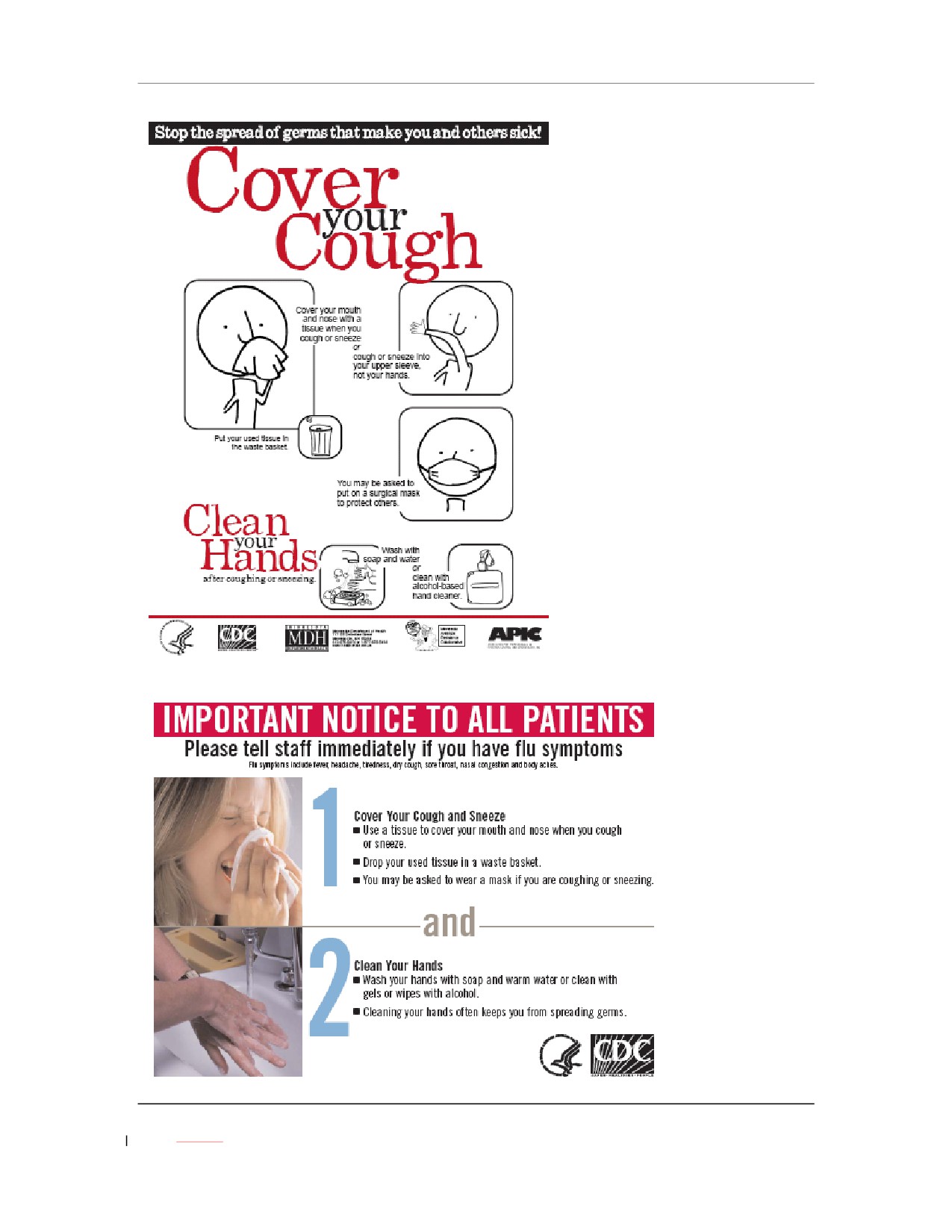
AzSPU Pandemic Preparedness Medical Response Plan
Page 28 of 31
Control Tier:
<<2>>
Revision Date: 25 September 2010
Document Number: << AZSPU-HSSE-DOC-00132-2>>
Print Date:
2/1/201110/26/2010
PAPER COPIES ARE UNCONTROLLED. THIS COPY VALID ONLY AT THE TIME OF PRINTING. THE CONTROLLED VERSION OF THIS DOCUMENT CAN
AzSPU Pandemic Preparedness Medical Response Plan
Page 29 of 31
4.0
Influenza Vaccination
Vaccination against Seasonal Influenza
Vaccination is the principal measure for preventing seasonal influenza and reducing the impact of
epidemics. Various types of influenza vaccines have been available and used for more than 60 years. They
are safe and effective.
Constant genetic changes in influenza viruses mean that the composition of the vaccine must be adjusted
annually to include the most recent circulating influenza viruses. The effectiveness of the vaccine depends
on the degree of similarity between the viruses in the vaccine and those in circulation. Seasonal influenza
vaccine will not protect against avian influenza or a new pandemic influenza strain. However, it is an
effective countermeasure against seasonal influenza, particularly for priority groups most at risk.
WHO and the Centres for Disease Control (US) advice is that all individuals who are at risk of
complications should be vaccinated against seasonal influenza. The priority groups at risk are listed below.
Local licensing requirements will determine the availability of seasonal influenza vaccines in each country.
Staff in the priority groups listed below should consider vaccination. Frequent business travellers and other
staff are also encouraged to take advantage of this protective measure.
The local country or expatriate medical plan will determine if cover is available for the cost of seasonal
influenza vaccination.
For frequent business travellers, BP will generally cover the cost of seasonal influenza vaccination in line
with the travel vaccination policy.
In other situations BP will act in line with national health recommendations and practice in supporting any
local vaccination programmes for influenza. The aim will be to ensure consistency of cover on a national
basis, rather than a segment or business unit basis
However, some higher risk situations, such as staff working on offshore installations and in other confined
accommodation, may require special consideration. BP Az SPU Health Team arranges Flu Vaccination
Campaign for all Az SPU employees each year.
Priority groups for whom annual Seasonal Influenza Vaccination is recommended:
Children aged 6-59 months;
Women who will be pregnant during the influenza season;
Persons aged > 50 years;
Adults and children who have:
- chronic disorders of pulmonary or cardiovascular systems, including asthma (hypertension is
not considered a high-risk condition);
- required regular medical follow-up or hospitalization during the preceding year because of
chronic metabolic disease
(including diabetes mellitus),
renal
dysfunction,
haemoglobinopathies, or immunodeficiency
(including immunodeficiency caused by
medications or by human immunodeficiency virus);
- any condition (e.g., cognitive dysfunction, spinal cord injuries, seizure disorders, or other
neuromuscular disorders) that can compromise respiratory function or the handling of
respiratory secretions, or that can increase the risk for aspiration.
Control Tier:
<<2>>
Revision Date: 25 September 2010
Document Number: << AZSPU-HSSE-DOC-00132-2>>
Print Date:
2/1/201110/26/2010
PAPER COPIES ARE UNCONTROLLED. THIS COPY VALID ONLY AT THE TIME OF PRINTING. THE CONTROLLED VERSION OF THIS DOCUMENT CAN
AzSPU Pandemic Preparedness Medical Response Plan
Page 30 of 31
Children and adolescents (aged 6 months-18years) who are receiving long-term aspirin therapy
and, therefore, might be at risk for experiencing Reye syndrome after influenza infection;
Residents of nursing homes and other chronic-care facilities that house persons of any age who
have chronic medical conditions
Persons who live with or care for persons at high risk for influenza-related complications,
including healthy household contacts and caregivers of children aged 0-59 months; and
Health-care workers.
The following table outlines the features and potential availability of influenza vaccines:
Seasonal Flu Vaccines
Avian Flu H5N1 Vaccines
Pandemic Flu Vaccines
Reformulated every year
Human H5N1 vaccines have
Not available for the first wave
according to expected flu
been developed in a number of
of a pandemic
strains
countries (incl. US, China,
Take 6-9 months to be available
Effectiveness dependent of
Australia)
in significant amounts
match with actual circulating
May provide some cross-
Production limited by world
strains
protection in Pandemic if it
capacity (and eggs)
World capacity 300 million
emerges from Avian flu
“Reverse-genetics” and tissue
doses per year
Production limited by world
culture vaccines may speed-up
Currently made from chicken
capacity (currently 300 million
production
eggs
doses per year)
Tissue culture vaccines under
development
Vaccination against Pandemic Influenza
When a new pandemic virus strain emerges it would be a number of months before a vaccine would be
available. It should be noted that any new pandemic vaccine will initially be in short supply and priority
will need to be given to those most at risk.
The BP Health team will closely follow the development, protective effect and safety of any new
pandemic vaccine and will make recommendations as soon as a vaccine is available.
Pneumococcal vaccination
Pneumococcal pneumonia is a major cause of illness and death all over the world and is a possible
complication of influenza. The currently licensed pneumococcal vaccine has an overall protective efficacy
of about 60%-70%.
Personnel at particular risk of the bacterial pneumonia complication of influenza (including those
with chronic diseases such as congestive heart failure, emphysema, diabetes mellitus, chronic liver
disease, and those who are otherwise immune compromised) should consider immunization against
pneumococcal pneumonia.
5.0 Attachments
Control Tier:
<<2>>
Revision Date: 25 September 2010
Document Number: << AZSPU-HSSE-DOC-00132-2>>
Print Date:
2/1/201110/26/2010
PAPER COPIES ARE UNCONTROLLED. THIS COPY VALID ONLY AT THE TIME OF PRINTING. THE CONTROLLED VERSION OF THIS DOCUMENT CAN
AzSPU Pandemic Preparedness Medical Response Plan
Page 31 of 31
Avian FLu .doc
Swine flu.doc
Revision/Review Log
Revision Date
Authority
Custodian
Revision Details
25 October 2009
Almaz Agazade -
Shahla Seyidova -
Initial Issue
Health Manager
Occupational Health
Advisor
24 September 2010
Health
Occupational Health
Section 1:
Manager/Almaz
Adviser/Shahla Seyidova
Agazade
Health Manager’s Contact
details was updated.
Section 2.5:
Added information from
EMEA on Tamiflu shelf life
Press release from EMEA
is attached
Zabrat heliport was
changed to Baku sea port
in all attachments.
SPS back up clinic was
removed from referral flow
charts in attached
documents and replaced
by
Research institute of lung
diseases.
Section 2.8.1:
In list of Tamiflu storages SPS
back up clinic was replaced by
BP Baku In House OH clinic
Control Tier:
<<2>>
Revision Date: 25 September 2010
Document Number: << AZSPU-HSSE-DOC-00132-2>>
Print Date:
2/1/201110/26/2010
PAPER COPIES ARE UNCONTROLLED. THIS COPY VALID ONLY AT THE TIME OF PRINTING. THE CONTROLLED VERSION OF THIS DOCUMENT CAN
AzSPU List of HSE Definitions
Page 1 of 27
AzSPU List of HSE Definitions
AZSPU-HSSE-DOC-00021-2
Authority:
AzSPU Safety &
Custodian:
AzSPU HSSE MS Team
Compliance Manager
Leader
Scope:
AzSPU Operational
Document
AzSPU HSSE MS
PUs
Administrator:
Document Coordinator
Issue Date:
December 26, 2005
Issuing Dept:
Safety and Compliance
Revision Date:
18 January 2010
Control Tier:
2- AzSPU
Next Review Date:
18 January 2011
Control Tier:
2-AzSPU
Revision Date: January 18, 2010
Document Number: AzSPU-HSSE-DOC-00021-2
Print Date: 2/1/2011
PAPER COPIES ARE UNCONTROLLED. THIS COPY VALID ONLY AT THE TIME OF PRINTING. THE CONTROLLED
VERSION OF THIS DOCUMENT CAN BE FOUND AT http://docs.bpweb.bp.com/dkazspu/
AzSPU List of HSE Definitions
Page 2 of 27
1.0 Purpose/Scope
The purpose of this document is to provide definitions for terms used in the Azerbaijan
Strategic Performance Unit (AzSPU) Health, Safety and Environment (HSE) procedures,
and other related documentation. Individual HSE documents may also list definitions for
terms unique to that document.
2.0 Definitions
Alphabetic List of definitions
The table below lists the terms included alphabetically, with links provided to each term.
Accident
Accountability
ACG
AIOC
ALT
Annual Plan
Assurance
ATS
Audit
Auditor
Audit Finding
Audit Owner
Audit Plan
Audit Protocol
AzSPU
Behavior-based Safety process
BP
BP requirements
BPCS
BTC
Business Processes
CA
CAP
CMER
Compliance Audits
Confidential / Secret
Contingency plan
Continuous Improvement
Contractor
Control Tier:
2-AzSPU
Revision Date: January 18, 2010
Document Number: AzSPU-HSSE-DOC-00021-2
Print Date: 2/1/2011
PAPER COPIES ARE UNCONTROLLED. THIS COPY VALID ONLY AT THE TIME OF PRINTING. THE CONTROLLED
VERSION OF THIS DOCUMENT CAN BE FOUND AT http://docs.bpweb.bp.com/dkazspu/
AzSPU List of HSE Definitions
Page 3 of 27
Contractor Management Representative
Contractor Oversight
Controlled Document
Controlled Document Master List
Corrective Action
CoW
CTM
C&WP
DAFWC (Day Away From Work Case)
Defect
Document
Document Authority
Document Custodian
Document Control Specialist/Administrator
Drugs and Alcohol
EA
Elements of Operating
Employees
Entity or BP Entity
Entity Business Strategy
Environment
Environmental Aspect
Environmental Assessment (EA)
Environmental Event
Environmental Impact
Environmental Management System Audit
Environmental Objective
Environmental Performance
Environmental Policy
Environmental Requirements
Environmental Target
EOP
ERP
ESAP
ESIA
ESMS
External Third-Party Audits
Externally verified statements & ISO certification
Facility
Fatality
Fatigued
Fire
Control Tier:
2-AzSPU
Revision Date: January 18, 2010
Document Number: AzSPU-HSSE-DOC-00021-2
Print Date: 2/1/2011
PAPER COPIES ARE UNCONTROLLED. THIS COPY VALID ONLY AT THE TIME OF PRINTING. THE CONTROLLED
VERSION OF THIS DOCUMENT CAN BE FOUND AT http://docs.bpweb.bp.com/dkazspu/
AzSPU List of HSE Definitions
Page 4 of 27
First Aid
Fit for service
Fitness for task
Formal Independent Audit
Gap Assessment Tool
GHG
GHG Direct Emissions
GHG Indirect Emissions
Group Defined Practice
Group Essentials
Group Enduring Metrics
Group Recommended Practice
HACCP
Hazardous Waste
Health Surveillance
HGA
High Potential Incidents (HiPo)
HSE
HSE Liaison
HSSE Management System
HSSE Policy
HSSE&S MS Management Representative
Human Factors
IEMP
IGA
IM
Implement
Incident Commander (IC)
Injury / Illness
Interested Party
Internal Audit
ISO 14001
Job Description
Journey Management Plan (JMP)
KPI
Leading and Lagging Indicators
Legal and Regulatory requirement
Legal and Regulatory HSSE requirements
Line Management
Local OMS Handbook
Major Accident Risk (MAR) Assessment
Major Incident
Control Tier:
2-AzSPU
Revision Date: January 18, 2010
Document Number: AzSPU-HSSE-DOC-00021-2
Print Date: 2/1/2011
PAPER COPIES ARE UNCONTROLLED. THIS COPY VALID ONLY AT THE TIME OF PRINTING. THE CONTROLLED
VERSION OF THIS DOCUMENT CAN BE FOUND AT http://docs.bpweb.bp.com/dkazspu/
AzSPU List of HSE Definitions
Page 5 of 27
Major Operating Sites
Management Programme
Management Reviews
Management System
Management System Audit
Medical Confidentiality
Medical treatment
MENR
Major Incident
Major Operating Sites
Management System
Medical Confidentiality
MIA (Major Incident Announcement)
MoE
MSDS
Near Miss
NREP
Noncompliance
Nonconformity
OCD
Occupational Illness
Occupational Injury
Objective Evidence
Obsolete Document
OHAIRS
OMS
OHAIRS
Operator
Operating
Operating Management System Framework
Operational Control
Operational Program
Organization
Other Requirements
Oversee
Oversight
Performance improvement cycle
Possible Violation
Potential Violation
Prevention of Pollution
Preventive Action
Principles
Control Tier:
2-AzSPU
Revision Date: January 18, 2010
Document Number: AzSPU-HSSE-DOC-00021-2
Print Date: 2/1/2011
PAPER COPIES ARE UNCONTROLLED. THIS COPY VALID ONLY AT THE TIME OF PRINTING. THE CONTROLLED
VERSION OF THIS DOCUMENT CAN BE FOUND AT http://docs.bpweb.bp.com/dkazspu/
AzSPU List of HSE Definitions
Page 6 of 27
Procedure
Process Safety
Process safety incident
Produced water
Program
PSA
Psychosocial Factors
QPR
Record
Risk
Risk Reduction Measure
Risk Register
Safe, Responsible and Reliable
Safety and Production Critical
SCP
SD
SDA
SOCAR
SSOW
SOC
Social Aspect
Social Management System Audit
Social Objective
Social Performance
Social Policy
Social Target
SPU
STEP
Sub-elements
Supplier Performance Lead
Task Description
Task Statement
Technical Authority
Third Party
Training
TVAR
Unsafe/Unhealthy Condition
Vendor
Verified Site Report
Violation
VTA
WA
Control Tier:
2-AzSPU
Revision Date: January 18, 2010
Document Number: AzSPU-HSSE-DOC-00021-2
Print Date: 2/1/2011
PAPER COPIES ARE UNCONTROLLED. THIS COPY VALID ONLY AT THE TIME OF PRINTING. THE CONTROLLED
VERSION OF THIS DOCUMENT CAN BE FOUND AT http://docs.bpweb.bp.com/dkazspu/
AzSPU List of HSE Definitions
Page 7 of 27
Waste
Waste Management
Workforce
WREP
Accident - Any event results in injury, and/or damage and/or loss
Accountability - The ultimate responsibility for an area of authority defined by the
individual‟s Job Description, and will include authority delegated to a subordinate albeit
temporary or permanent
ACG - Azeri, Chirag and deep water Gunashli
AIOC - Azerbaijan International Operating Company
ALT - Azerbaijan Leadership Team - the highest management level of Azerbaijan
Strategic Performance Unit management.
Annual Plan - The entity annual plan is the documented outcome of the annual planning
process each part of the business uses to address risks, performance delivery and
performance improvement opportunities and allocate resources and budgets
accordingly.
Assurance - The justified confidence that the system of internal control is in place, is fit
for purpose, and is working as intended. Activities being undertaken to be certain that
the system of internal control is embedded and working as intended include self-
verification activities, challenge from outside the line, and rigorous and objective
assessment through audits.
ATS - Action Tracking System.
Audit - A systematic, independent evaluation to determine whether or not the health,
safety, security and environmental management system and its operation comply with
planned arrangements, and whether or not the system is implemented effectively, and is
suitable to fulfil the company‟s health, safety, security and environmental policy and
objectives.
Auditor - Person with the competence to conduct an audit.
Audit Finding - result of the evaluation of the collected audit evidences against audit
criteria.
Control Tier:
2-AzSPU
Revision Date: January 18, 2010
Document Number: AzSPU-HSSE-DOC-00021-2
Print Date: 2/1/2011
PAPER COPIES ARE UNCONTROLLED. THIS COPY VALID ONLY AT THE TIME OF PRINTING. THE CONTROLLED
VERSION OF THIS DOCUMENT CAN BE FOUND AT http://docs.bpweb.bp.com/dkazspu/
AzSPU List of HSE Definitions
Page 8 of 27
Audit Owner - The person in the audited organization who sanctions the audit and/or is
accountable for closing audit findings.
Audit Plan - A planning tool developed for the audit prior to the work taking place. It is
a high level summary of audit objectives, scope, criteria, schedule, logistics, safety
considerations, and team membership.
Audit Protocol - An audit-specific document that addresses the requirements to be
reviewed during the course of the audit, depending on the audit scope and objectives.
AzSPU - Azerbaijan Strategic Performance Unit - the BP Group Strategic Performance
Unit involved in the exploration, drilling, and/or production and transportation of oil and
gas in Azerbaijan, Georgia and Turkey and its territories.
BP - The BP Group
BPCS - BP Exploration (Caspian Sea) Ltd.
Behaviour-based Safety Process - A behaviour-based safety process involves the
workforce in continually improving HSE behaviours through systematic identification of
target safe behaviours, observation, coaching, recording and action. The Safety
Observation Conversations (SOC) process is an example of a behaviour-based safety
process.
BP Requirements - The total of all the BP Group requirements defined by the functions.
BTC - Baku Tbilisi-Ceyhan oil pipeline
Business Processes- Activities undertaken to achieve a specific business outcome.
CA - Central Azeri Platform
CAP - Compliance Assurance Process - a process designed to assure that legal and
other requirements are identified and communicated, and that responsibilities and
internal control mechanisms are in place to maintain compliance with the requirements.
The process also incorporates means for detecting non-compliance and taking corrective
action on the findings.
CMER- Crisis Management and Emergency Response
Compliance Audits - Audits performed to assess compliance with HSSE&S legal and
other requirements.
Confidential/Secret
- Confidential information is information the disclosure,
modification, misuse, or destruction of which could be significantly prejudicial to the
interests of BP businesses and functions, or could cause significant embarrassment or
difficulty for BP businesses and functions or their employees. Personal data must be
classified as Confidential.
Control Tier:
2-AzSPU
Revision Date: January 18, 2010
Document Number: AzSPU-HSSE-DOC-00021-2
Print Date: 2/1/2011
PAPER COPIES ARE UNCONTROLLED. THIS COPY VALID ONLY AT THE TIME OF PRINTING. THE CONTROLLED
VERSION OF THIS DOCUMENT CAN BE FOUND AT http://docs.bpweb.bp.com/dkazspu/
AzSPU List of HSE Definitions
Page 9 of 27
Contingency plan - A pre-established plan to mitigate an unusual situation which has
the potential for harm, which incorporates the best use of local as well as remote
facilities and resources.
Continuous Improvement - Doing better as a result of regular, consistent efforts rather
than episodic or step-wise changes, producing tangible positive improvements either in
performance, efficiency or both. (Centre of Chemical Process safety).
Contractor - An individual under a contractual relationship to supply BP plc or one of its
subsidiary companies with goods and/or services.
A contractual relationship covers:
-All individuals contracted directly or sub-contracted
-All employees of companies contracted directly or sub-contracted
-All situations where a contract has not been raised but BP‟s procurement policy would
normally expect there to be a contract in place. This applies to all levels including sub-
contracted relationships.
Contractor Management Representative - An employee of the contractor who is the
primary contact for the Supplier Performance Lead or HSE Liaison.
Contractor Oversight - Monitoring and reporting of a contractor‟s operations and
HSSE&S performance.
Controlled Document - Documents, records and information that are required to
maintain safe, responsible and reliable operating activity. These could include but are
not limited to procedures & practices, technical studies, drawings, P&IDs, models,
processes, hazard lists, and technical, design and operations data, and product,
medical, occupational exposure and compliance-related records..
Controlled Document Master List - A list of all documents that are controlled.
Corrective Action - Action to eliminate the cause of a detected nonconformity or
noncompliance.
CoW - Control of Work
CTM - Compliance Task Manager is an electronic compliance matrix that helps
businesses manage the relationships between applicable legal requirements,
compliance tasks, accountable BP employee positions, operational controls and
Control Tier:
2-AzSPU
Revision Date: January 18, 2010
Document Number: AzSPU-HSSE-DOC-00021-2
Print Date: 2/1/2011
PAPER COPIES ARE UNCONTROLLED. THIS COPY VALID ONLY AT THE TIME OF PRINTING. THE CONTROLLED
VERSION OF THIS DOCUMENT CAN BE FOUND AT http://docs.bpweb.bp.com/dkazspu/
AzSPU List of HSE Definitions
Page 10 of 27
completion evidence document. The tool is provided to help businesses maintain
justifiable confidence in consistently meeting their HSSE legal obligations.
C&WP - Compression and Water Injection Platform
DAFWC (Day Away From Work Case) - A work-related injury or illness which has
either of the following consequences:
The member of the BP Workforce could not have worked on any day after the injury or
illness, irrespective of whether there was scheduled work.
The member of the BP Workforce comes to work even when a physician or other
licensed health care professional recommends that the individual stays at home.
Defect - Any act or condition which could be changed so as to stabilize or improve
performance.
Document - Information and its supporting medium. The medium can be paper,
magnetic, electronic or optical computer disc, photograph or master sample, or a
combination thereof.
Document Authority - The individual that has executive authority for the document,
making it binding on the organizational entity (e.g., Upstream, Strategic Performance
Unit (SPU), Performance Unit (PU), operations asset [OA], operations site (OS), etc).
Document Custodian - The individual who, in most cases, is the document author or
subject matter expert responsible for the accuracy and management of the document.
Document Control Specialist/Administrator - The person assigned to assist a SPU
and/or PU in receiving and managing original document copies, assigning control
numbers, updating and maintaining master lists, making notification of required reviews,
and removing obsolete documents from and posting new and/or updated documents for
the HSSE&S MS.
Drugs and Alcohol
- includes alcohol, controlled substances, drugs and other
medication (whether illegal, legitimately prescribed or over-the-counter) which can be
inhaled, injected or ingested, and which are capable of affecting performance or
judgment.
EA - East Azeri Platform
Elements of Operating - Describe operating in BP, include the eight elements of
Leadership, Organization, Risk, Procedures, Assets, Optimization, Privilege to Operate,
and Results. Each element and sub-element includes an operating principle.
Employees - People directly employed by a company. These can be BP employees if
working directly for BP or contractor employees if working directly for a contractor.
Control Tier:
2-AzSPU
Revision Date: January 18, 2010
Document Number: AzSPU-HSSE-DOC-00021-2
Print Date: 2/1/2011
PAPER COPIES ARE UNCONTROLLED. THIS COPY VALID ONLY AT THE TIME OF PRINTING. THE CONTROLLED
VERSION OF THIS DOCUMENT CAN BE FOUND AT http://docs.bpweb.bp.com/dkazspu/
AzSPU List of HSE Definitions
Page 11 of 27
Entity or BP Entity - An organizational unit within BP which may be a Performance
Unit, Business Unit, Strategic Performance Unit, Segments or some logical sub group of
one of these, defined by the Segment, Function or Region. Each operating entity will
have a consistent local Operating Management System documented in an OMS
Handbook.
Entity Business Strategy - A multi year (typically 5) look ahead identifying key business
risks and opportunities, outlining the actions needed to address them and estimating
resource needs.
Environment - Surroundings in which an organization operates, including air, water,
land, natural resources, flora, fauna, humans, and their interrelation.
Environmental Aspect -Element of an organization‟s activities or products, or services
that can interact with the environment.
Environmental Assessment (EA) - Local, scheduled, documented self-verifications
that monitor key performance indicators to determine if process outcomes meet
corporate and environmental requirements. Environmental Assessments are conducted
internal to, or in support of, the operation being evaluated. Environmental Assessments
are distinguished from Formal Independent Audits performed by personnel independent
of the operations.
Environmental Event - A situation where a person observes or becomes aware of a
fact or facts that suggest an environmental issue, including, but not limited to
environmental nonconformance and potential or actual violations.
Environmental Impact - Any change to the environment, whether adverse or beneficial,
wholly or partially resulting from an organization‟s environmental aspects.
Environmental Management System Audit - Systematic and documented verification
process of objectively obtaining and evaluating evidence to determine whether an
organization‟s EMS conforms to the EMS audit criteria set by the organization, and for
communicating the results of this process to management and other affected parties.
Environmental Objective
- Overall environmental goal, consistent with the
environmental policy, that an organization sets itself to achieve.
Environmental Performance - Measurable results of an organization‟s management of
its environmental aspects. In the context of EMS, results can be measured against the
organization‟s environmental policy, environmental objectives, environmental targets and
other environmental performance requirements.
Environmental Policy - Overall intentions and direction of an organization related to its
environmental performance as formally expressed by top management. The
environmental policy provides a framework for action and for the setting of environmental
objectives and environmental targets.
Control Tier:
2-AzSPU
Revision Date: January 18, 2010
Document Number: AzSPU-HSSE-DOC-00021-2
Print Date: 2/1/2011
PAPER COPIES ARE UNCONTROLLED. THIS COPY VALID ONLY AT THE TIME OF PRINTING. THE CONTROLLED
VERSION OF THIS DOCUMENT CAN BE FOUND AT http://docs.bpweb.bp.com/dkazspu/
AzSPU List of HSE Definitions
Page 12 of 27
Environmental Requirements
- Applicable international, national, and local
environmental statutes, regulations, enforceable agreements, project-specific
agreements, lender requirements, agency orders, and permits
(also termed legal
requirements).
Environmental Target
- Detailed performance requirement, applicable to the
organization or parts thereof, that arises from the environmental objectives and that
needs to be set and met in order to achieve those objectives.
EOP - Early Oil Project
ERP - Emergency Response Plan
ESAP - Environmental and Social Action Plan.
ESIA - Environmental and Social Impact Assessment.
ESMS - Environmental and Social Management System. That part of an organization‟s
management system used to develop and implement its environmental / social policies
and manage its environmental / social aspects. A MS is a set of interrelated elements
used to establish policy and objectives and to achieve those objectives. A MS includes
organizational structure, planning activities, responsibilities, practices, procedures,
processes and resources.
External Third-Party Audits - Audits conducted by independent third parties outside of
BP. These types of audits include EMS certification to ISO 14001 and other required
external audits.
Externally verified statements & ISO certification - BP AzSPU major sites that have
their Environmental Management Systems
(EMS) certified against the ISO
14001
Standard and an externally Verified Site Report which is publicly available.
Facility - is a generic term used to denote any organizational unit below the BP entity
level. Could denote a site, uniy, etc.
Fatality -
BP AzSPU
Any incident that results in the death of a BP AzSPU Employee
and occurs in the BP Work Environment. This includes both work-related and non
work-related fatalities.
Contractor
Any incident that results in the death of a BP Contractor and
occurs in the BP Work Environment. This includes both work-related and non
work-related fatalities.
Third Party
Any incident that results in the death of a third party who is in or
impacted by the BP Work Environment. This includes both work-related and non
work-related fatalities.
Control Tier:
2-AzSPU
Revision Date: January 18, 2010
Document Number: AzSPU-HSSE-DOC-00021-2
Print Date: 2/1/2011
PAPER COPIES ARE UNCONTROLLED. THIS COPY VALID ONLY AT THE TIME OF PRINTING. THE CONTROLLED
VERSION OF THIS DOCUMENT CAN BE FOUND AT http://docs.bpweb.bp.com/dkazspu/
AzSPU List of HSE Definitions
Page 13 of 27
Fatigued - State of tiredness that is associated with long hours of work, prolonged
periods without sleep, or the requirement to work when the individual would normally be
resting. It is a result of physiological factors and is not a „state of mind‟.
Fire
- Any unintentional fire of any magnitude should be reported, including any
materials which have ignited resulting in flame or smoke, and including
unintentional electrical arcs.
This includes fires that are typically process-safety related. For example:
A gas, oil or chemical release that results in a flame
A tangible indication of a fire (e.g. soot on the inside of a distillation tower) where
no flame was actually seen
A fire on a scaffold board in a process unit
A fire in a vehicle parked by an operating unit
A 120 or 220 volt shorted switch
A fault in a motor control centre or electrical switch gear.
This also includes fires that are not typically process-safety related. For example:
A paper or cardboard fire in a garbage / trash can in an office building
A fire during equipment repair in a maintenance shop
A solvent fire in a laboratory
Smouldering rags in a pump house (no flame)
A fire in a vehicle in a parking lot outside the facility fence.
First Aid - An incident is classified as a First Aid if the treatment of the resultant injury or
illness is limited to one or more of the 14 specific treatments below.
These are:
1. Using a non-prescription medication at non-prescription strength
2. Administering tetanus immunizations
3. Cleaning, flushing or soaking wounds on the surface of the skin
4. Using wound coverings such as bandages, gauze pads, etc; or using butterfly
bandages
5. Using hot or cold therapy
6. Using any non-rigid means of support, such as elastic bandages, wraps, non-
rigid back belts, etc
7. Using temporary immobilization devices while transporting as accident victim
8. Drilling of a fingernail or toenail to relieve pressure, or draining fluid from a blister
9. Using eye patches
10. Removing foreign bodies from the eye using only irrigation or a cotton swab
11. Removing splinters or foreign material from areas other than the eye by
irrigation, tweezers, cotton swabs or other simple means;
12. Using finger guards
13. Using massages, or
Control Tier:
2-AzSPU
Revision Date: January 18, 2010
Document Number: AzSPU-HSSE-DOC-00021-2
Print Date: 2/1/2011
PAPER COPIES ARE UNCONTROLLED. THIS COPY VALID ONLY AT THE TIME OF PRINTING. THE CONTROLLED
VERSION OF THIS DOCUMENT CAN BE FOUND AT http://docs.bpweb.bp.com/dkazspu/
AzSPU List of HSE Definitions
Page 14 of 27
14. Drinking fluids for relief of heat stress.
Control Tier:
2-AzSPU
Revision Date: January 18, 2010
Document Number: AzSPU-HSSE-DOC-00021-2
Print Date: 2/1/2011
PAPER COPIES ARE UNCONTROLLED. THIS COPY VALID ONLY AT THE TIME OF PRINTING. THE CONTROLLED
VERSION OF THIS DOCUMENT CAN BE FOUND AT http://docs.bpweb.bp.com/dkazspu/
AzSPU List of HSE Definitions
Page 15 of 27
Fit for Service -The current condition of a piece of equipment is capable of operating at
defined operating conditions for a defined operating period.
Fitness for Task - Fitness to perform specific tasks that have been identified as carrying
risks that could harm the health and safety of themselves, others or the integrity and
safety of the operations. (i.e. assessment of eyesight for driving).
Formal Independent Audit - An independent review of business activities. It is a
systematic, documented process of collecting and evaluating factual evidence to confirm
an organization‟s adherence to corporate and environmental/social requirements. These
Formal Independent Audits are performed to objectively check BP AzSPU Upstream‟s
operations. Independent groups include BP AzSPU Upstream‟s internal audit group, BP
audit groups, contractors, and technical authorities from operations other than those
being audited. Lead auditors are independent of line responsibilities or Business Unit
affiliation.
Gap Assessment Tool (GAT) -The OMS Group Essentials Gap Assessment Tool
(GAT) - a group developed gap assessment tool for entities to identify and prioritise gaps
against the Group Essentials statements. The GAT is a web based tool, and is
accessible via the OMS Implementation website.
GHG - Greenhouse gases that alter the termal properties of the atmosphere. The main
greenhouse gases are condered to be water vapour, carcon dioxide, chloroflouro
carbons, halons and ozone.
GHG Direct Emissions - Emissions of greenhouse gases from sources that are under
the operational control of the company.
GHG Indirect Emissions - Emissions of greenhouse gases that are consequences of
the activities of the company but occur at sources outside the operational control
boundary.
Group Defined Practice (GDP) - The few (currently 13) group mandatory practices
defining engineering and operating Group requirements primarily focused on identifying,
prioritising and managing risk.
Group Recommended Practice (GRP) - Group engineering and operating practices
containing recommended practice that entities are encouraged to use to deliver the
Group Essentials. Refer to the Integrity Management GDP (GDP 5.0-0001) which
contains Group requirements for the application of Engineering Technical Practices
(ETPs) at entities.
Group Enduring Metrics - The measures used to monitor the delivery of the Group‟s
long-term objectives.
Group Essentials -These are a consolidated list of S&O Function controlled BP Group
requirements categorized against the sub-elements.
HACCP - Hazard Analysis Critical Control Points
Control Tier:
2-AzSPU
Revision Date: January 18, 2010
Document Number: AzSPU-HSSE-DOC-00021-2
Print Date: 2/1/2011
PAPER COPIES ARE UNCONTROLLED. THIS COPY VALID ONLY AT THE TIME OF PRINTING. THE CONTROLLED
VERSION OF THIS DOCUMENT CAN BE FOUND AT http://docs.bpweb.bp.com/dkazspu/
AzSPU List of HSE Definitions
Page 16 of 27
Hazardous Waste - The sum of the operated direct hazardous waste disposed in tonnes
for the year being measured expressed as a percentage of the equivalent waste
disposed for 1999.
Hazardous Waste % =
Operated hazardous waste disposed
Operated hazardous waste disposed in 1999
Health Surveillance - The systematic monitoring of employees exposed to certain
health risks for early signs of biological changes that could indicate damaging exposure
to work related health risks. It seeks to confirm that where employees are potentially
exposed to known workplace hazards, the control measures are effective and the worker
is showing no harmful effect.
Health surveillance is appropriate where potential exposure to a workplace hazard has a
known health effect and there is a validated, reproducible and measurable biological
impact.
HGA - Host Government Agreement
High Potential Incidents (HiPo) - An Incident or Unsafe/Unhealthy Condition or near
miss where the most serious probable outcome is a Major Incident. In addition, this
includes any Loss of Primary Containment Incident where the potential severity is
classified at Level E or greater as defined in the Group-defined Operating practice
„Reporting HSSE and Operational Incidents‟.
HSE - Health, safety and environment
HSE Liaison - Individuals selected to assist in managing a contract.
HSSE Management System - The Company structure, responsibilities, practices,
procedures, processes and resources for implementing health, safety, security and
environmental management.
HSSE Policy - Overall intentions and direction of an organization related to its health,
safety, security and environmental performance as formally expressed by top
management.
HSSE&S MS Management Representative - An individual appointed by Senior
Management who, irrespective of other responsibilities, shall have defined roles,
responsibilities, and authority for:
Ensuring that HSSE&S MS requirements are established, implemented, and
maintained to meet policy requirements, achieve objectives and targets, and
comply with legal and other requirements to which the organization subscribes
Control Tier:
2-AzSPU
Revision Date: January 18, 2010
Document Number: AzSPU-HSSE-DOC-00021-2
Print Date: 2/1/2011
PAPER COPIES ARE UNCONTROLLED. THIS COPY VALID ONLY AT THE TIME OF PRINTING. THE CONTROLLED
VERSION OF THIS DOCUMENT CAN BE FOUND AT http://docs.bpweb.bp.com/dkazspu/
AzSPU List of HSE Definitions
Page 17 of 27
Reporting on the performance of the HSSE&S MS to Senior Management for
review and as a basis for improvement.
Human Factors - Human factors consider how human and individual characteristics
combine with environmental, organisational and job factors to influence workplace
behaviour that could impact health and safety. They recognise that human error often
results from a misalignment between physical and behavioural characteristics of human
beings and the design of jobs, processes, equipment and conditions in the workplace.
Fatigue is a human factor that requires special attention to understand and prevent
accidents in the workplace.
IEMP - Integrated Environmental Monitoring Program
IGA - Inter Governmental Agreement
IM- Integrity Management (BP Group Standard)
Incident - An unplanned event or occurrence that affects or has the potential to affect
the health or safety, or security of:
people, or
assets, or
the environment.
Implement - Put in place a plan, process or procedure and act in accordance with it.
Incident Commander (IC) - An individual designated and trained to command and
control the company‟s emergency response efforts.
Injury/Illness - Injuries are a consequence of instantaneous events. Instantaneous
events are characterised by a sudden and unexpected physical change which occurs
over a short time and which results in immediate harm to people. A short time may be
described as the snap of your finger or a single breath. Therefore, conditions such as
sunburn, welders flash, friction blisters, or repetitive motion induced conditions are
illnesses. Back problems are always considered injuries.
Interested Party - Person or group concerned with or affected by the health, safety,
security, environmental or social performance of an organization.
Internal Audit - A systematic, independent and documented process for obtaining audit
evidence and evaluating it objectively to determine the extent to which the HSSE&S
management system audit criteria set by the organization are fulfilled.
Control Tier:
2-AzSPU
Revision Date: January 18, 2010
Document Number: AzSPU-HSSE-DOC-00021-2
Print Date: 2/1/2011
PAPER COPIES ARE UNCONTROLLED. THIS COPY VALID ONLY AT THE TIME OF PRINTING. THE CONTROLLED
VERSION OF THIS DOCUMENT CAN BE FOUND AT http://docs.bpweb.bp.com/dkazspu/
AzSPU List of HSE Definitions
Page 18 of 27
ISO 14001- ISO 14001 is the specific standard for Environmental Management Systems,
against which certification may be obtained. ISO is a leading international organisation
for standardisation
Job Description - A short document which sets out an employee‟s authority and
responsibilities in the job, who he/she reports to, and who reports to him; what his duties
are and the qualifications necessary to perform those duties.
Journey Management Plan (JMP) - The planned movement of people and equipment
from one place to another including communications, route, scheduled stops, hazard
warnings, provisioning, breakdown and other contingency.
KPI - Key Performance Indicator - a quantifiable measure used to monitor progress in
achieving objectives and targets.
Leading and Lagging Indicators
- Metrics used to measure and/or monitor
performance. Leading indicators measure the inputs leading to an outcome, and lagging
indicators measure the actual outcome.
Legal and Regulatory Requirements - Applicable obligations established by applicable
legislation, regulation, administrative order or notice, permit, consent decree or any other
similar instrument, and any legally binding commitment entered into by BP, where failure
to comply by BP is unlawful and enforceable by a court of law in the relevant jurisdiction.
Legal and Regulatory HSSE Requirements- Legal and regulatory requirements
relating to health, safety, security or the environment.
Line Management - Managers in the line organization that are directly accountable for
HSSE&S issues.
Local OMS Handbook - A document describing the local OMS for an operating entity.
Describes how the OMS framework is implemented in the operating entity, including how
the local OMS is integrated with local business processes. Describes how the operating
entity captures learnings and continuously improves performance.
Major Accident Risk (MAR) Assessment - A risk assessment undertaken using the
Group Major Accident Risk (MAR) process (ETP No. GP 48-50).
Major Incident- A health, safety, security or environmental Incident in which the actual
severity represents a Level A-D or E impact as defined in the Group-Defined Operating
Practice „Reporting HSSE and Operational Incidents‟.
Major Operating Sites - A site or grouping of sites that produce or manage petroleum,
chemical, or manufactured products where such products, their production processes, or
their exploration processes have the potential to cause significant impact on the
environment or the safety and health of employees, neighbours, or consumers. Group
S&O Function will maintain and publish a list of major operating sites.
Control Tier:
2-AzSPU
Revision Date: January 18, 2010
Document Number: AzSPU-HSSE-DOC-00021-2
Print Date: 2/1/2011
PAPER COPIES ARE UNCONTROLLED. THIS COPY VALID ONLY AT THE TIME OF PRINTING. THE CONTROLLED
VERSION OF THIS DOCUMENT CAN BE FOUND AT http://docs.bpweb.bp.com/dkazspu/
AzSPU List of HSE Definitions
Page 19 of 27
Management Programme - Describes the activities required to achieve specific
objectives and targets e.g. the Waste Management Programme details actions,
responsibilities and accountabilities for achieving waste related objectives and targets.
Management Reviews - Formal, documented review carried out by an entity leadership
team to review the effectiveness of the entity local OMS, and to identify, implement and
sustain improvements.
Management System - A management system is the framework of processes and
procedures used to ensure that an organization can fulfill all tasks required to achieve its
objectives
Management system audit - audit of conformance with the management programme
requirements in OMS
Medical Confidential - The ethical principle or legal right that information relating to a
patient will not shared and will be kept safe by health professionals, unless the patient
gives consent permitting disclosure. All clinical data have a degree of confidentiality and
shall be treated as controlled documentation.
Medical Treatment (MT) - An incident is classified as a Medical Treatment (MT) case
when the management and care of the patient to address the injury or illness is above
and beyond First Aid. Medical Treatment does not include the conduct of diagnostic
procedures, such as x-rays and blood tests, including the administration of prescription
medications used solely for diagnostic purposes.
MENR - Ministry of Ecology and Natural Recourses (Azerbaijan)
MIA (Major Incident Announcement) - A Major Incident is an incident, including a
security incident, involving any one of the following:
A fatality associated with BP operations
Multiple serious injuries
Significant adverse reaction from authorities, media, NGOs or the general public
Cost of accidental damage exceeding US $500,000
Oil spill of more than 100 barrels, or less if at a sensitive location (1 barrel = 159
liters)
Release of more than ten tonnes of a classified chemical.
MoE - Ministry of Environment (Georgia)
MSDS - Material Safety Data Sheet issued by manufacturer of chemical substances that
sets out the hazards likely to be encountered by those who come into contact with the
substance. The sheet may also identify recovery procedures following adverse exposure
Control Tier:
2-AzSPU
Revision Date: January 18, 2010
Document Number: AzSPU-HSSE-DOC-00021-2
Print Date: 2/1/2011
PAPER COPIES ARE UNCONTROLLED. THIS COPY VALID ONLY AT THE TIME OF PRINTING. THE CONTROLLED
VERSION OF THIS DOCUMENT CAN BE FOUND AT http://docs.bpweb.bp.com/dkazspu/
AzSPU List of HSE Definitions
Page 20 of 27
Near Miss - An event that under slightly different circumstances could have resulted in
an HSSE&S requirement violation, or a nonconformance.
NREP - Northern Route Export Pipeline
Noncompliance - Noncompliance is a failure to meet regulatory or other requirements.
Nonconformity - Any deviation from established procedures, programs, and other
arrangements related to the HSE MS.
OCD - Organizational capability development
Occupational Illness - An occupational illness is any abnormal condition or disorder,
other than one resulting from an occupational injury, caused by exposure associated with
the BP work environment. This includes acute and chronic illnesses or diseases which
may be caused by inhalation, absorption, ingestion, or direct contact with physical,
chemical, biological or psychological hazards in or associated with the working
environment.
Occupational Injury - An occupational injury is any harm to an individual caused by an
instantaneous event in the work environment. Instantaneous events are characterised by
a sudden and unexpected physical change which occurs over a short time and which
results in immediate harm to people. A short time may be described as the snap of your
finger or a single breath.
Objective Evidence
- A verifiable fact gained through the examination of
documents/records, the observation of field activities or conditions, or conversations with
persons who have firsthand knowledge of the facts.
Obsolete Document - A document that is no longer applicable to the HSSE&S MS
and/or has been replaced by a revised document.
Control Tier:
2-AzSPU
Revision Date: January 18, 2010
Document Number: AzSPU-HSSE-DOC-00021-2
Print Date: 2/1/2011
PAPER COPIES ARE UNCONTROLLED. THIS COPY VALID ONLY AT THE TIME OF PRINTING. THE CONTROLLED
VERSION OF THIS DOCUMENT CAN BE FOUND AT http://docs.bpweb.bp.com/dkazspu/
AzSPU List of HSE Definitions
Page 21 of 27
OMS - Operating Management System, provides a systematic and consistent approach
for managing our operating activities, and delivering competitive performance while
meeting BP‟s commitment to HSSE performance
OHAIRS - Occupational Health and Illness Reporting System
Operator - A specific company or business entity formally designated as managing day-
to-day operations of a given asset.
Operating - All forms of business activity that are involved in managing Projects and
Operations including but not limited to all aspects of Engineering, Marine and HSSE
activities.
Operating Management System (OMS) Framework - A control process that describes
the BP Elements of Operating, Performance Improvement Cycle, and the requirement for
development of a local OMS at each BP operating entity. The framework operates by
applying the OMS Continuous. Improvement process to local business processes to
deliver the outcomes summarized in the eight Elements of Operating. The term is
synonymous with „BP Operating Management System‟.
Operational Control - An implementing procedure, physical control, checklist, training,
employee expertise, or other means of controlling operations to manage significant
environmental aspects and/or legal and other requirements. Examples of physical
controls can include valves, automatic shutoff devices, engineered solutions, signage, etc.
Operational controls, in the form of procedures, stipulate operating criteria.
Operational program - the procedures and processes that specify how operations
barriers are to be implemented, e.g control of work programme, waste management
programme.
Organization - Company, corporation, firm, enterprise, authority, or institution, or part or
combination thereof, whether incorporated or not, public or private, that has its own
functions and administration.
Other Requirements - Requirements to which a SPU subscribes that are in addition to
legal requirements. A BP example is Getting HSE Right.
Oversee - To monitor.
Oversight - Monitoring and Reporting of performance.
Performance Improvement Cycle (PIC) - The annual systematic improvement process
applied at each entity based on the Plan/Do/Check/Act cycle, but with Intent and Risk
Assessment and Prioritisation steps added at the start of the process. The specific
requirements of the PIC are detailed in OMS Part 3.
Possible Violation - A HSSE&S event that may constitute a violation after a complete
review of the facts, or upon further legal analysis of applicable requirements.
Control Tier:
2-AzSPU
Revision Date: January 18, 2010
Document Number: AzSPU-HSSE-DOC-00021-2
Print Date: 2/1/2011
PAPER COPIES ARE UNCONTROLLED. THIS COPY VALID ONLY AT THE TIME OF PRINTING. THE CONTROLLED
VERSION OF THIS DOCUMENT CAN BE FOUND AT http://docs.bpweb.bp.com/dkazspu/
AzSPU List of HSE Definitions
Page 22 of 27
Potential Violation - A possible violation.
Prevention of Pollution - Use of processes, practices, techniques, materials, products,
services or energy to avoid, reduce or control (separately or in combination) the creation,
emission or discharge of any type of pollutant or waste, in order to reduce adverse
environmental impacts. Prevention of pollution can include source reduction or
elimination, process, product or service changes, efficient use of resources, material and
energy substitution, reuse, recovery, recycling, reclamation and treatment.
Preventive Action - An action to eliminate the cause of a potential nonconformity.
Principles - High level statements summarizing the intent of each Element and sub
element of Operating. These Principles are used by members of the operating
community to guide judgments and support decision making, especially in the absence
of any specific group or segment requirement.
Procedure - A specified way to carry out an activity or a process.
Process Safety - to manage the integrity of hazardous operating systems and
processes by applying good design principles, engineering and operating practices
which prevent and control incidents that have the potential to release hazardous
materials or energy.
Process safety incident - An incident related to process safety, a disciplined framework
for managing the integrity of hazardous operating systems and processes by applying
good design principles and engineering practices, dealing with the prevention and
control of incidents that have the potential to release hazardous materials. Such
incidents can cause toxic effects, fire, or explosion and could ultimately result in serious
injuries, property damage, lost production and environmental impact.
Produced water - Formation water from the oil reservoir that is co-produced with the oil
and subsequently separated. Separated perched and condensed water from
gas/condensate fields is included in this category.
Program
- the procedures and processes that specify controls or barriers.
“Programmes” can be operations programmes or management programmes.
PSA - Production Sharing Agreement.
Psychosocial Factors - Factors that may affect employees‟ psychological response to
their work and workplace conditions (including working relations). They may appear
when there is a mismatch between the job requirements and the capabilities, resources
and needs of the individual. Examples include: high workloads, tight deadlines, lack of
control of the work and working methods. Psychosocial factors are important as they
may contribute to stress and musculoskeletal disorders.
QPR - Quarterly Performance Review
Control Tier:
2-AzSPU
Revision Date: January 18, 2010
Document Number: AzSPU-HSSE-DOC-00021-2
Print Date: 2/1/2011
PAPER COPIES ARE UNCONTROLLED. THIS COPY VALID ONLY AT THE TIME OF PRINTING. THE CONTROLLED
VERSION OF THIS DOCUMENT CAN BE FOUND AT http://docs.bpweb.bp.com/dkazspu/
AzSPU List of HSE Definitions
Page 23 of 27
Record - A document stating results achieved or providing evidence of activities
performed.
Risk - A measure of loss / harm to people, the environment, compliance status, Group
reputation, assets or business performance in terms of the product of the probability of
an event occurring and the magnitude of its impact.
Risk Reduction Measures - Measures and actions taken to reduce risk or prevent an
incident occurring, and/or control its impact or frequency, and/or mitigate its effect on
people, the environment, or our business. These measures and actions should be
considered in the following order of preference: Elimination, Prevention, Control,
Mitigation, and Emergency Response. Further detail and information can be found in
GDP 31-00-01 Assessment, prioritisation and management of risk.
Risk Register - A document that identifies hazards and risks relating to the operating
activity of the entity. It will detail the impact and probability of risks and identify plant,
process, people and performance risk reduction measures to manage the risks. (Further
detail in GDP 31-00-01 Risk assessment, prioritisation and management).
Safe, Responsible and Reliable - An outcome where all aspects of Health, Safety,
Security and Environment are well managed and in line with legal and regulatory HSSE
requirements and plant and equipment are operated to achieve planned performance.
Safety and Production Critical - Very important to achieving safe, responsible and
reliable operating.
SCP - South Caucasus Pipeline
SD - Shah Deniz
SDA - Shah Deniz Alpha platform
SOCAR - State Oil Company of the Azerbaijan Republic
SSOW - Safe System of Work
SOC - Safety Observation Conversation
Social Aspect - Elements of an organization‟s activities, products, and services that can
interact with the community or wider stakeholders.
Social Management System Audit - Systematic and documented verification process
of objectively obtaining and evaluating evidence to determine whether an organization‟s
SMS conforms to the SMS audit criteria set by the organization, and for communicating
the results of this process to management and other affected parties.
Control Tier:
2-AzSPU
Revision Date: January 18, 2010
Document Number: AzSPU-HSSE-DOC-00021-2
Print Date: 2/1/2011
PAPER COPIES ARE UNCONTROLLED. THIS COPY VALID ONLY AT THE TIME OF PRINTING. THE CONTROLLED
VERSION OF THIS DOCUMENT CAN BE FOUND AT http://docs.bpweb.bp.com/dkazspu/
AzSPU List of HSE Definitions
Page 24 of 27
Social Objective
- Overall social goal, arising from the social policy, that an
organization sets itself to achieve, and that is quantified where practicable.
Social Performance - Measurable results of the SMS, related to an organization‟s
control of its social aspects, based on its Social Policy, objectives and targets and its
compliance with applicable social requirements.
Social Policy - Statement by an organization of its intentions and principles in relation
to its overall social performance, that provides a framework for action and for the setting
of its social objectives and targets.
Social Target
- Detailed performance requirement, quantified where practicable,
applicable to the organization or parts thereof, that arises from the social objectives and
that needs to be set and met in order to achieve those objectives.
SPU - Strategic Performance Unit - a formally recognized discrete business organization
within the BP Group.
Spill (or hydrocarbon spill) - All spills of hydrocarbon greater than or equal to 1 barrel
(bbl). Spills less than 1 barrel are not included in this metric but must be held locally,
typically in Traction.
(1 barrel = 159 litres = 42 US gallons)
STEP - Sangachal terminal Expansion Project
Control Tier:
2-AzSPU
Revision Date: January 18, 2010
Document Number: AzSPU-HSSE-DOC-00021-2
Print Date: 2/1/2011
PAPER COPIES ARE UNCONTROLLED. THIS COPY VALID ONLY AT THE TIME OF PRINTING. THE CONTROLLED
VERSION OF THIS DOCUMENT CAN BE FOUND AT http://docs.bpweb.bp.com/dkazspu/
AzSPU List of HSE Definitions
Page 25 of 27
Sub-Elements - The sub-elements (currently 48) of the Elements of Operating provide a
more detailed list of operating activities, which are dependent on each other and need to
be selectively and systematically managed using OMS.
Supplier Performance Lead - Individuals selected to assist in overseeing a contract
Task Description - Description of Compliance Task requirement, including actions
required to complete the Task
Task Statement - Statement to summaries the Compliance Task requirement
Technical Authority
(health
/ safety
/ security
/ environmental
/ social
/
management system / external affairs specialist, or other designated HSSE
personnel) - provide input in terms of technical interpretation of Legal and Other
Requirements and changes to Legal and Other Requirements, as required.
Third Party - Person associated with the work, but not a member of our work force.
Training - The process of imparting specific skills and understanding to undertake
defined tasks.
TVAR - Total Vehicle Accident Rate
Unsafe/Unhealthy Condition- Any departure from the required or expected
performance or condition of equipment (Plant), procedures (Process), or People, which if
not addressed could result in an Incident, or make a consequence of an incident more
severe. For example, thinning of pipes due to corrosion or excessive work hours
causing fatigue.
Vendor - A Supplier that provides tangible material or equipment. Company defines any
Vendor that provides On-Site services other than delivery as a Contractor.
Verified Site Report
- An externally verified document which represents the
performance of a particular facility or cluster of facilities that has been published on BP
AzSPU Official web-site.
Control Tier:
2-AzSPU
Revision Date: January 18, 2010
Document Number: AzSPU-HSSE-DOC-00021-2
Print Date: 2/1/2011
PAPER COPIES ARE UNCONTROLLED. THIS COPY VALID ONLY AT THE TIME OF PRINTING. THE CONTROLLED
VERSION OF THIS DOCUMENT CAN BE FOUND AT http://docs.bpweb.bp.com/dkazspu/
AzSPU List of HSE Definitions
Page 26 of 27
Violation - A failure to comply with an HSE requirement.
VTA - Virtual Training Assistance
WA - West Azeri Platform
Waste - Any material, (solid, liquid or gas), which is introduced into work location as a
product of the work but which fulfils no further useful purpose, at that location.
Waste Management - A system to achieve reduction, re-use, reclamation, recycling and
responsible disposal of materials
Workforce - comprises all BP employees, BP Contractors and all BP Directors
WREP - Western Route Export Pipeline
3.0 General Requirements
RD 0.0-0001 BP Group OMS Glossary Reference Document
BP Group HSE Reporting Definitions
ISO 14001 - 3.0 Definitions
OHSAS 18001 - 3.0 Terms and Definitions
4.0 Responsibilities
Not applicable.
5.0 Procedure
Not applicable.
6.0 Key Documents/Tools/References
Not applicable.
Control Tier:
2-AzSPU
Revision Date: January 18, 2010
Document Number: AzSPU-HSSE-DOC-00021-2
Print Date: 2/1/2011
PAPER COPIES ARE UNCONTROLLED. THIS COPY VALID ONLY AT THE TIME OF PRINTING. THE CONTROLLED
VERSION OF THIS DOCUMENT CAN BE FOUND AT http://docs.bpweb.bp.com/dkazspu/
AzSPU List of HSE Definitions
Page 27 of 27
Revision Log
Revision Date
Authority
Custodian
Revision Details
December
26,
Gunther
Yuliy Zaytsev
Initial issue.
2005
Newcombe
November
13,
Gunther
Yuliy Zaytsev
Additional definitions added, number of
2006
Newcombe
existing definitions revised.
November
29,
Yuliy Zaytsev
Farid Jafarov
Additional definitions have been added
2007
from the list of BP Group HSSE
reporting definitions,
number of
existing
definitions
revised and
amended.
January 06, 2009
Yuliy Zaytsev
Idrak Nazarov
Additional definitions were added
January 18, 2010
Yuliy Zaytsev
Idrak Nazarov
Document was revised in accordance
with new OMS Glossary & Definitions,
Additional Definitions were added
where the other‟s definitions were
revised due to new OMS language
Control Tier:
2-AzSPU
Revision Date: January 18, 2010
Document Number: AzSPU-HSSE-DOC-00021-2
Print Date: 2/1/2011
PAPER COPIES ARE UNCONTROLLED. THIS COPY VALID ONLY AT THE TIME OF PRINTING. THE CONTROLLED
VERSION OF THIS DOCUMENT CAN BE FOUND AT http://docs.bpweb.bp.com/dkazspu/
AzSPU Environmental Risk Assessment Procedure
Page 1 of 19
AzSPU
Environmental Risk Assessment
Procedure
Procedure for Environmental Risk Assessment of
Chemicals and Hazardous Substances
AZSPU-HSSE-DOC-00120-2
Authority:
AzSPU Environmental
Custodian:
AzSPU Senior Environmental Advisor
Manager / Faig Askerov
(monitoring)/ Afag Abbasova
Scope:
AzSPU (Azerbaijan)
Document
Administrator:
<< Document Asset Technician Name >>
Issue Date:
31 October 2007
Issuing Dept:
HSE & Technical Directorate
Revision Date:
28 January 2010
Control Tier:
2-AzSPU
Next Review
31 January 2011
Date:
Control Tier:
<<Tier-2-AzSPU>>
Revision Date: 31 January 2010
Document Number: << AZSPU-HSSE-DOC-00120-2>>
Print Date: 2/1/2011
PAPER COPIES ARE UNCONTROLLED. THIS COPY VALID ONLY AT THE TIME OF PRINTING. THE
CONTROLLED VERSION OF THIS DOCUMENT CAN BE FOUND AT
AzSPU Environmental Risk Assessment Procedure
Page 2 of 19
1.0 Purpose/Scope
This procedure describes the process of environmental risk assessment (ERA) for potential
release of chemicals and hazardous substances.
This is a Tier 2 procedure applicable to AzSPU upstream operations for marine waters, and
as such applies primarily to planned or potential
(accidental) release of chemicals and
hazardous substances into the Caspian Sea.
The purpose of the procedure is to define:
-
circumstances under which an ERA is necessary;
-
actions and information required to complete ERA.
While primarily applicable to AzSPU upstream operations for marine waters, the processes
outlined in this document may also be applied to any situation in which it is planned, or
considered possible, that there will be discharge to the environment of a chemical, hazardous
material, or effluent containing such substances or their wastes or reaction products.
This procedure does not replace, nor should it conflict with:
AzSPU Chemical and Hazardous Materials Management Procedure (AZSPU-HSSE-
DOC-00078-2);
Azerbaijan SPU Internal & External Material Release Reporting & Notification
Procedure (AZSPU-HSSE-DOC-00075-2)
The Azerbaijan SPU Spill to Sea Response Plan for Offshore Facilities (AZSPU-
HSSE-DOC-00018-3) or other spill response plans;
Incident Investigation and Reporting Procedure (AZSPU-HSSE-DOC-00054-2)
This procedure has been prepared with reference to:
AzSPU Chemical and Hazardous Materials Management Procedure (AZSPU-HSSE-
DOC-00078-2);
Azerbaijan SPU Internal & External Material Release Reporting & Notification
Procedure (AZSPU-HSSE-DOC-00075-2)
Definitions (AzSPU-HSSE-DOC-00021-2).
Caspian-specific Ecotoxicity Procedures: Methods Development and Implementation
(ERT 97/227) as approved by the Azerbaijan State Committee of Ecology September
2000.
Revision of this procedure and the operational controls detailed therein will be in accordance
with Document Management
(Document AzSPU-HSSE-DOC-00025-2) procedure as
appropriate.
Control Tier:
<<Tier-2-AzSPU>>
Revision Date: 31 January 2010
Document Number: << AZSPU-HSSE-DOC-00120-2>>
Print Date: 2/1/2011
PAPER COPIES ARE UNCONTROLLED. THIS COPY VALID ONLY AT THE TIME OF PRINTING. THE
CONTROLLED VERSION OF THIS DOCUMENT CAN BE FOUND AT
AzSPU Environmental Risk Assessment Procedure
Page 3 of 19
1.1 Limitations
As stated above, this procedure has been developed primarily to be applicable to the planned
or potential discharge from BP upstream operations into marine waters, and as such addresses
primarily issues surrounding chemical selection and use in operations on or around the
Caspian Sea.
The quantitative risk assessment procedure outlined in Section 5.3 assumes use of toxicity
data for Caspian Sea species. This data is based on acute toxicity response, and it should be
noted that issues relating to chronic toxicity response and potential bioaccumulation are not
addressed.
1.2 List of Abbreviations
AzSPU
Azerbaijan Strategic Performance Unit
COSHH
Control of Substances Hazardous to Health
CTM
Compliance Task Manager
ERA
Environmental Risk Assessment
ESIA
Environmental and Social Impact Assessment
PLONOR
Pose Little or No Risk to the Environment
PNEC
Predicted No Effect Concentration
OCNS
Offshore Chemical Notification Scheme
OECD
Organisation for Economic Co-operation and Development
HGA
Host Government Agreement
HSSE
Health, Safety, Security & Environment
HSSEMS
Health, Safety, Security & Environment Management System
MENR
Ministry of Ecology & Natural Resources
PLONOR
Pose Little or No Risk (to the Environment)
PSA
Production Sharing Agreement
Control Tier:
<<Tier-2-AzSPU>>
Revision Date: 31 January 2010
Document Number: << AZSPU-HSSE-DOC-00120-2>>
Print Date: 2/1/2011
PAPER COPIES ARE UNCONTROLLED. THIS COPY VALID ONLY AT THE TIME OF PRINTING. THE
CONTROLLED VERSION OF THIS DOCUMENT CAN BE FOUND AT
AzSPU Environmental Risk Assessment Procedure
Page 4 of 19
2.0 Definitions
For definitions common to the hazardous materials management refer to the AzSPU Chemical
and Hazardous Materials Management Procedure (AZSPU-HSSE-DOC-00078-2).
Refer to Document AzSPU-HSSE-DOC-00021-2 Definitions for definitions common to this
management system. Definitions specific to this procedure are included below:
Term
Definition
Bioaccumulation
The capacity of a chemical to be concentrated in biological tissue to levels
significantly higher than in the environment.
Chronic
A relatively long period of exposure, usually a significant proportion of the
life-span of the organism (often > 10%).
EC50
The median effective concentration. The concentration of a test material
required to cause a 50% effect on a test response such as immobilisation.
Effluent
A liquid discharge to surface waters from an industrial, urban or agricultural
process.
LC50
The median lethal concentration
- the concentration of test substance
estimated to cause mortality in 50% of the test population.
OECD
Organisation for Economic Co-operation and Development.
An
intergovernmental organisation. In the context of this work, OECD publishes
internationally-agreed standard methods for conducting toxicity tests on
chemicals. OECD also publishes the international guidelines on which
member states base their procedures and legislation for Good Laboratory
Practice.
OSPARCOM
An intergovernmental organisation formed by the merging in 1992 of the
(OSPAR)
OSLO Commission and the PARIS Commission. OSPAR co-ordinates
policy and legislation on the discharge of materials from land-based and sea-
based sources. Member nations implement OSPAR decisions through their
own national environmental legislation. Also issues PLONOR list.
PNEC
The Predicted No-Effect Concentration is the concentration of a chemical
below which exposure to a chemical is anticipated to have no impact on a
target species.
Control Tier:
<<Tier-2-AzSPU>>
Revision Date: 31 January 2010
Document Number: << AZSPU-HSSE-DOC-00120-2>>
Print Date: 2/1/2011
PAPER COPIES ARE UNCONTROLLED. THIS COPY VALID ONLY AT THE TIME OF PRINTING. THE
CONTROLLED VERSION OF THIS DOCUMENT CAN BE FOUND AT
AzSPU Environmental Risk Assessment Procedure
Page 5 of 19
3.0 General Requirements
3.1 Applicable standards
The following recognized international standards and legislation specific to the assessment of
environmental risk shall apply as a minimum:
-
OSPAR PLONOR list (acceptable candidate chemicals);
-
OSPAR list I and II and chemicals subject to OSPAR decisions on phasing out or
prohibition (unacceptable candidate chemicals);
-
Chemicals which have passed the OSPAR pre-screening process (e.g. chemicals on the
UK OCNS ranked list) (acceptable candidate chemicals).
3.2 Scheduling Requirements
While this procedure outlines the process for determining the requirement for an
environmental risk, and the general process for undertaking the risk assessment, it should be
recognised that in many (if not most) cases where an ERA is required both internal (AzSPU)
review and external (regulator) review and approval will be required before a chemical is
approved for use or a discharge allowed.
In instances where it is anticipated that an ERA may be required, sufficient time should be
allowed not just to undertake the ERA but to ensure that both the internal and external review
and approval process can be completed prior to the planned use of the chemical or discharge.
Control Tier:
<<Tier-2-AzSPU>>
Revision Date: 31 January 2010
Document Number: << AZSPU-HSSE-DOC-00120-2>>
Print Date: 2/1/2011
PAPER COPIES ARE UNCONTROLLED. THIS COPY VALID ONLY AT THE TIME OF PRINTING. THE
CONTROLLED VERSION OF THIS DOCUMENT CAN BE FOUND AT
AzSPU Environmental Risk Assessment Procedure
Page 6 of 19
4.0 Key Responsibilities
4.1 PU / Asset Environmental Team Leader
The applicable PU/Asset Environmental Team Leader/Environment Manager, or their
designee, shall be responsible for:
Identifying planned or potential discharges and initiating the ERA process in
consultation with the AzSPU Environmental Manager;
Collecting the data and identifying resources required for an ERA;
Undertaking, in consultation with the Central Environmental Team, the initial
assessment of whether an identified planned or potential discharge has received prior
approval;
Overseeing the initial qualitative risk assessment, including engagement of specialist
contractor(s) to conduct the assessment as required (in consultation with AzSPU
Environmental Manager);
Initiating and ensuring completion of the quantitative risk assessment, as required;
Liaising with the AzSPU Environmental Manager with regard requirement for
consultation with Regulators (MENR), and assisting with the consultation as required
under the direction of the AzSPU Environmental Manager;
Maintaining the Asset Discharge Register; and
Ensuring ERA requirements are taken into account during the chemical selection
process, as outlined in Section 5.1 of the AzSPU Chemical and Hazardous Materials
Management Procedure (AZSPU-HSSE-DOC-00078-2);
4.2 AzSPU Environmental Manager
The AzSPU Environmental Manager, or their designee, shall be responsible for..
Assisting the PU/Asset Environmental Team Lead, as requested, in assessing the
need for and scope of an ERA;
Ensuring the database of all records pertaining to the approval process, i.e. ERA,
permits etc, is maintained, and providing advise to the PU/Asset Environmental
Team Lead as to whether prior approval for discharge has been received;
Leading consultations with the regulatory authorities regarding environmental
approval of chemicals used and reporting of discharges containing chemicals;
Ensuring that Asset Environmental Advisors receive adequate training in
environmental risk assessment;
Ensuring central Register of chemicals approved for discharge is maintained and is
regularly updated;
Maintaining and updating this procedure, and revision and maintenance of Schedule
of Environmental Statutory Reports in conjunction with the AzSPU HSSE
Compliance Team and Accountable PU(s) / Asset Group(s).
4.3 Asset Operations Supervisor
The applicable PU/Asset Operations Supervisor, or their designee, shall be responsible for:
Informing PU/Asset Environmental Team Leader/Environment Manager of any
planned or anticipated discharges to the environment;
Control Tier:
<<Tier-2-AzSPU>>
Revision Date: 31 January 2010
Document Number: << AZSPU-HSSE-DOC-00120-2>>
Print Date: 2/1/2011
PAPER COPIES ARE UNCONTROLLED. THIS COPY VALID ONLY AT THE TIME OF PRINTING. THE
CONTROLLED VERSION OF THIS DOCUMENT CAN BE FOUND AT