Military reference books and manuals (2009-2023, Volume 3) - page 24
Domestic Operational Law Handbook
firearms. Testing will include qualification firing in accordance with current qualification
standards;
•
Arms and ammunition will be secured at all times in accordance with appropriate regulations
and policies. Rounds will be chambered only on order of the commander/senior officer/senior
noncommissioned officer present, in coordination and in conjunction with the supported LEA,
except in cases of exigent circumstances;
•
Firearms will not be discharged from moving vehicles (except in self-defense or to defend other
persons);
•
Pilots in command of aircraft have the authority to override an order to chamber rounds while
on board an aircraft;
•
Possession or use of non-issued or personally owned firearms and/or ammunition during
counterdrug support operations is prohibited. National Guard personnel will not accept offers of
weapons or ammunition from LEAs except for use on LEA operated ranges for training
purposes only. The only weapons used for counterdrug support operations will be federally
owned military weapons listed on the unit’s property books;
•
Federally owned military weapons will not be secured in private dwellings at any time;
•
The counterdrug coordinator will direct additional weapons training when, in his judgment, it is
advisable, regardless of the level of training indicated by training and qualification records;
•
National Guard units may use minimum force for the following purposes:
• To defend themselves or other persons;
• To protect property, or prevent loss/destruction of evidence;
• To make arrests if they have arrest powers pursuant to state law and exigent circumstances
require such action.
•
The discharge of any firearm is always considered deadly force; and
•
National Guard members will be thoroughly briefed on the Rules of Engagement and Use of
Force prior to the commencement of any operation.63
63 NGR 500-2, supra note 42, para. 3-6.
Chapter 6
Counterdrug Operations
102
Domestic Operational Law Handbook 2011
CHAPTER 7
MILITARY SUPPORT TO SPECIAL EVENTS
KEY REFERENCES:
•
10 U.S.C. § 422 - Use of Funds for Certain Incidental Purposes.
•
10 U.S.C. § 2012 - Support and Services for Eligible Organizations and Activities Outside the
Department of Defense.
•
10 U.S.C. § 2554 - Equipment and other services: Boy Scout Jamborees.
•
PDD 62 - Protection Against Unconventional Threats to the Homeland and Americans
Overseas, May 22, 1998.
• HSPD 7 - Critical Infrastructure Identification, Prioritization, and Protection, December 17,
2003.
• HSPD 15/NSPD 46 - U.S. Strategy and Policy in the War on Terror (Classified), March 6, 2006.
• DoDD 1100.20 - Support and Services for Eligible Organizations and Activities Outside the
Department of Defense, April 12, 2004.
• DoDD 2000.15 - Support to Special Events, December 8, 2003.1
• Reese, Shawn, Congressional Research Service, RS 22754, National Special Security Events,
March 19, 2008.
A. Introduction
The Department of Defense (DoD) supports a wide variety of special events held within the United
States. There are two general types of support: support to designated special events under statutory
authority and community support as part of innovative readiness training (IRT). Designated special
events include the Boy Scout Jamboree and “National Special Security Events (NSSEs)” such as
major sporting events, e.g. the Olympics, Presidential inaugurations, and international meetings like
the G-8 summit.2 The IRT program allows commanders to conduct training in the civilian
community, but benefit to the community must be incidental to the training.3 IRT support must
provide a training benefit to the participating unit or individual.
B. Designated Special Events
10 U.S.C. § 2554 permits support for Boy Scout Jamborees.4 This provides the Secretary of
Defense authority to lend or otherwise provide the Boy Scouts of America (BSA) with a variety of
equipment to include cots, flags, tents, and other equipment to include expendable medical supplies
without reimbursement. This support may be provided to the BSA in support of both national and
world scout jamborees.5 Further, if the Jamboree is conducted on a military installation, the
1 As of July 2011, the Department of Defense was finalizing a revision and replacement of DoDD 2000.15 with an
Instruction, tentatively numbered DoDI 3025.gg.
2 REESE, SHAWN, Cong. Research Serv., RS 22754, NATIONAL SECURITY SPECIAL EVENTS (2008), at 3-4.
3 Memorandum, Assistant Secretary of the Army (Manpower and Reserve Affairs), subject: Innovative Readiness
Training (IRT), Encl. 1 (28 Mar. 2000) [hereinafter IRT Policy].
4
10 U.S.C. § 2554. Note that the section previously numbered as 2554 has been changed to 10 U.S.C. § 2564 and
relates to the provisioning of DoD support to certain athletic events. These events are discussed infra.
5 See id. § 2554(a.).
Chapter 7
103
Military Support to Special Events
Domestic Operational Law Handbook
Secretary may authorize logistical and personnel support on the military installation.6 Certain
expenses such as those associated with transportation must be reimbursed and in some cases a
payment bond must be secured before the support is rendered.7 Aside from Jamborees, other
military support to the Boy Scouts is authorized under 10 U.S.C. § 508. This more generalized
assistance, which also extends to other youth and charitable organizations, is discussed in Chapter 8
infra.
Congress has also authorized military support to certain sporting events, such as the Olympics or
World Cup soccer.8 In addition to sporting events, other special events may be designated by the
Secretary of Defense for support.9 Such support may be provided on a reimbursable basis or may
be funded by specific appropriations.10
1. Types of Events
a. Sporting Events
Support to certain sporting events is specifically authorized by 10 U.S.C. § 2564. Sporting events
are planned programs of athletic competition and related activities.11 The authorizing legislation
specifically mentions the World Cup Soccer Games, the Goodwill Games, and the Olympics, but
other events may be authorized when special security and safety needs exist.12 Other sporting
events previously supported include the World Alpine Ski Championships and the Special
Olympics. Military forces also provided extensive support during the 1996 and 2002 Olympic
Games held in Atlanta, Georgia and Salt Lake City, Utah, respectively.13
On January 16, 2001, Commander, U.S. Joint Forces Command (JFCOM) formed Joint Task Force-
Olympics (JTF-O) in support of the Salt Lake City Winter Games.14 JTF-O received requests for
assistance from the U.S. Olympic Planning Committee and the Salt Lake Olympic Planning
6 See id. § 2554(g).
7
10 U.S.C. § 2554(b-f).
8
10 U.S.C. § 2564 (a) states:
Security and Safety Assistance. At the request of a federal, state, or local government agency
responsible for providing law enforcement services, security services, or safety services, the Secretary
of Defense may authorize the commander of a military installation or other facility of the Department
of Defense or the commander of a specified or unified combatant command to provide assistance for
the World Cup Soccer Games, the Goodwill Games, the Olympics, and any other civilian sporting
event in support of essential security and safety at such event, but only if the Attorney General
certifies that such assistance is necessary to meet essential security and safety needs.
Note. This section was previously numbered as § 2554 until 2000.
9 U.S. DEP’T OF DEFENSE, DIR. 2000.15, SUPPORT TO SPECIAL EVENTS, para. 3.1 (21 Nov. 1994) [hereinafter DoDD
2000.15]. As noted in note 1, this Directive is currently pending revision and may be replaced in the near future.
10
Id. para. 4.4.
11 DoDD 2000.15, supra note 9, para. 4.4.
12
10 U.S.C. § 2564(a).
13 See U.S. Forces Command, Slide Presentation, 2001 Winter Olympic Games, Joint Task Force-Olympics
FORSCOM Augmentation (22 Feb. 2001) [hereinafter FORSCOM Presentation].
14 Message, 181815Z Jan 01, Commander in Chief, Joint Forces Command, subject: USCINCJFCOM JTF-Olympics
Stand Up Announcement (18 Jan. 2001).
Chapter 7
Military Support to Special Events
104
Domestic Operational Law Handbook 2011
Committee.15 Routine support approved by the Secretary of the Army for this event included
aviation, communications, explosive ordnance disposal, physical security, and temporary
facilities.16 With the establishment of U.S. Northern Command (USNORTHCOM) on September
11, 2003, similar future support missions are now assigned to USNORTHCOM.
b. Non-athletic Events
The Secretary of Defense may also designate non-athletic events to receive support. Non-athletic
events include large events, such as the World’s Fairs, the Universal Postal Union Congress, and the
International Special Olympics.17 Aside from the Boy Scouts Jamboree, DoD may also support
Department of Homeland Security-designated “national special security events” when tasked to do
so.
(1) Events Not Declared National Special Security Events
The Secretary of Defense may designate “non-athletic international or national events to receive
support.”18 The International Monetary Fund and World Bank Group meeting of April 2000 was a
non-athletic event approved for support but not designated a national special security event.19 The
G-8 meeting of 2004 was also designated to receive such support.
(2) National Special Security Events
Pursuant to Homeland Security Presidential Directive 7 (HSPD-7), the Secretary, DHS, makes the
final determination as to whether to designate an event as a national special security event
(NSSE).20 This determination is made after consultation with the Homeland Security Council.21
Other events may be categorized through the use of the Special Events Assessment Rating (SEAR)
process used by the Department of Homeland Security to determine other events that may require
federal support. With respect to NSSEs, the U.S. Secret Service is the lead federal agency
responsible for coordinating, planning, exercising, and implementing security for NSSEs.22
Military assets provided in support of NSSEs may include explosive ordnance disposal (EOD)
teams, technical escort units (TEU),23 geospatial intelligence support,24 and Chemical/Biological
Immediate Response Forces (C/BIRF).25
15 FORSCOM Presentation, supra note 13.
16 Message 141555Z Mar 00, Commander in Chief, Joint Forces Command, subject: USCINCJFCOM 2000 XIX
Olympics PLANORD Feedback (14 Mar. 2000).
17 DoDD 2000.15, supra note 9, para. 3.1.
18
Id.
19 U.S. Forces Command, Operational Briefing, International Monetary Fund and World Bank Group Spring Meeting
11-17 April 2000 (14 Apr. 2000) (classified FOUO).
20 HSPD-7, Critical Infrastructure Identification, Prioritization, and Protection, para. 26 (December 17, 2003).
21
Id.
22 U.S. Secret Service Statement Before the House Committee on the Judiciary, Subcommittee on Crime (24 June 1999)
(Brian L. Stafford, Director, U.S. Secret Service). See also REESE, SHAWN, Cong. Research Serv., RS 22754,
NATIONAL SECURITY SPECIAL EVENTS (2009), at summary; UNITED STATES SECRET SERVICE, National Special Security
23 TEU teams are capable of detecting, rendering safe, and transporting chemical and biological devices.
Chapter 7
105
Military Support to Special Events
Domestic Operational Law Handbook
The designation of an NSSE by the Secretary, DHS, is based upon an analysis of several factors.
These factors include: the anticipated attendance of United States and foreign officials; the size of
the event; and, the significance of the event to include the event’s historical, political, or symbolic
importance.26 Examples of NSSEs receiving DoD support include the NATO 50th Anniversary
Summit, the 1999 visit to the United States by Pope John Paul II, and the World Trade Organization
(WTO) meeting held in Seattle in 1999, and the Republican and Democratic National Conventions
in 2004 and 2008, respectively.27
Further, state operational plans may be triggered by such a designation. For example, prior to the
1999 WTO meeting in Seattle, the Washington National Guard conducted activities pursuant to the
Washington State Comprehensive Emergency Management Plan in support of the WTO.
For a list of designated NSSEs in recent years, see Figure 7-1 below.
Event
Location
Date
World Energy Council Meeting
Houston, TX
Sept.13-17, 1998
NATO 50th Anniversary Celebration
Washington, DC
Apr. 23-25, 1999
World Trade Organization Meeting
Seattle, WA
Nov. 29-Dec. 3, 1999
State of the Union Address
Washington, DC
Jan. 27, 2000
International Monetary Fund Meeting
Washington, DC
Apr. 14-17, 2000
International Naval Review (OpSail)
New York, NY
Jul. 3-9, 2000
Republican National Convention
Philadelphia, PA
Jul. 29-Aug. 4, 2000
Democratic National Convention
Los Angeles, CA
Aug. 14-16, 2000
Presidential Inauguration
Washington, DC
Jan. 20, 2001
Presidential Address to Congress
Washington, DC
Feb. 27, 2001
United Nations General Assembly 56
New York, NY
Nov. 10-16, 2001
State of the Union Address
Washington, DC
Jan. 29, 2002
Super Bowl XXXVI
New Orleans, LA
Feb. 3, 2002
Winter Olympic Games
Salt Lake City, UT
Feb. 8-24, 2002
Super Bowl XXXVII
San Diego, CA
Jan. 26, 2003
State of the Union Address
Washington, DC
Jan. 20, 2004
Super Bowl XXXVIII
Houston, TX
Feb. 1, 2004
Sea Island G8 Summit
Sea Island, GA
Jun. 8-10, 2004
President Reagan State Funeral
Washington, DC
Jun. 11, 2004
Democratic National Convention
Boston, MA
Jul. 26-29, 2004
24
10 U.S.C. § 442, National Geospatial-Intelligence Agency, Missions.
25 For an excellent overview of the process from an interagency perspective, see Briefing, “National Special Security
Events,” prepared by USNORTHCOM and the FBI, Miami, Florida (4 March 2008) (on file with CLAMO).
26 Reese, supra note 2, at 2.
27 See, e.g., Message, 180715Z Oct 99, Department of the Army, subject: World Trade Organization (WTO) Ministerial
Conference (18 Oct. 1999).
Chapter 7
Military Support to Special Events
106
Domestic Operational Law Handbook 2011
Republican National Convention
New York, NY
Aug. 30-Sep. 2, 2004
Presidential Inauguration
Washington, DC
Jan. 20, 2005
State of the Union Address
Washington, DC
Feb. 2, 2005
Super Bowl XXXIX
Jacksonville, FL
Feb. 6, 2005
Super Bowl XL
Detroit, MI
Feb. 5, 2006
President Ford State Funeral
Washington, DC
Jan. 3, 2007
Super Bowl XLI
Miami Gardens, FL
Feb. 4, 2007
State of the Union Address
Washington, DC
Jan. 28, 2008
Democratic National Convention
Denver, CO
Aug. 25-28, 2008
Republican National Convention
Minneapolis-St. Paul, MN
Sept. 1-4, 2008
G-20 Economic Summit
Washington, DC
Nov. 14-15, 2008
Presidential Train Stop Tour
Philadelphia, PA
Jan. 17, 2009
Presidential Train Stop Tour
Wilmington, DE
Jan. 17, 2009
Presidential Train Stop Tour
Baltimore, MD
Jan. 17, 2009
Lincoln Memorial Rally
Washington, DC
Jan. 18, 2009
Presidential Inauguration
Washington, DC
Jan. 20, 2009
State of the Union Address
Washington, DC
Feb. 24, 2009
Super Bowl XLIII
Tampa Bay, FL
Feb. 1, 2009
G-20 Summit
Pittsburgh, PA
Sept. 24-25, 2009
State of the Union Address
Washington, DC
Jan. 27, 2010
The Nuclear Summit
Washington, DC
Apr. 12-13, 2010
State of the Union Address
Washington, DC
Jan. 25, 2011
Figure 7-1. National Special Security Events from 1998 to January 25, 2011.28
2. Requests for Support
a. Processing Requests for Support
There are a variety of special events, each with their own legal support authorities and policies.
Judge advocates must carefully analyze requests, approvals, and types of support when advising
commanders on these kinds of operations.
Requests for military support to sporting-related special events are made by the federal, state, or
29
local agency responsible for providing law enforcement, security, or safety services for the event.
Often, this means that local police or a FBI field office requests the military support. The Attorney
General must then certify that the specific categories of support are “necessary to meet essential
28 Information in Figure 7-1 was collected from two sources. See Reese, supra note 2; E-mail from Natalie Lundin,
Congressional Affairs Liaison, U.S. Secret Service, to Lieutenant Benedict Gullo, Ctr. for Law and Military Operations,
U.S. Army (Jun. 30, 2011, 10:01 EST) (on file with CLAMO).
29
10 U.S.C. § 2554(a).
Chapter 7
107
Military Support to Special Events
Domestic Operational Law Handbook
security and safety needs.”30 Once a request is certified, the support is coordinated through the
Assistant Secretary of Defense for Homeland Defense and Americas’ Security Affairs (ASD(HD &
ASA)) and the Joint Director of Military Support (JDOMS). A 2003 Deputy Secretary of Defense
Memorandum transferred management and coordination of DoD support for these missions from
the Secretary of the Army to ASD(HD & ASA).31
Further, upon the designation of an NSSE by the DHS Secretary, security support for the event is
coordinated through a “unified command model” that includes representatives of all agencies at all
levels of government.32 Lessons learned from these events is collected by the U.S. Secret Service
and used to train federal, state, and local law enforcement and public safety officials who respond to
NSSEs.33 DoD support to NSSEs are authorized pursuant to DoDD 2000.15 and may include
support such as equipment, personnel, technical, or managerial advice or guidance.34
b. Types of Support
In addition to security or safety based assistance that is most commonly requested, other types of
military support may also be authorized.35 Some of the other types of assistance that may be
authorized include equipment, personnel, technical support, managerial advice, or guidance.36 This
“logistically-focused” assistance is provided only to the extent such assistance cannot be reasonably
provided by an outside source and such assistance does not adversely affect military preparedness.37
Security or safety-related support has precedence over logistical assistance.38
c. Funding Support
Military support may be provided on a reimbursable or non-reimbursable basis. Logistical and
security support for international sporting competitions may be paid, in part, from the support for
international sporting competitions (SISC) defense account.39 Organizations requesting logistically
focused assistance for other types of special events must agree to reimburse DoD.40 Such assistance
must be reimbursed in accordance with applicable laws.41
Since FY2006, Congress has provided specific appropriations to fund support to NSSEs. Further, in
additional to general funding for NSSEs that began in FY2006, Congress has also designated funds
30
Id.
31 Memorandum, Deputy Secretary of Defense, subject: Implementation Guidance Regarding the Office of the
Assistant Secretary of Defense for Homeland Defense (25 Mar. 2003).
32 CRS Report, National Security Special Events, supra note 2, at 3.
33
Id.
34 DoDD 2000.15, Support to Special Events, at para. 3.1 to 3.2 (November 21, 2004). Although the focus of the
Directive is primarily sporting events, it also specifically includes “non-athletic special events” at paragraph 3.1.
35
10 U.S.C. § 2564(b).
36 DoDD 2000.15, supra note 9, para. 3.2.
37
10 U.S.C. § 2564 (b)(1) & (2).
38 DoDD 2000.15, supra note 9, para. 4.3.
39 Pub. L. 104-208, div. A, title V, § 5802, 110 Stat. 3009-522 (2006).
40
10 U.S.C. § 2564 (b)(3).
41
10 U.S.C. § 377; U.S. DEP’T OF DEFENSE, REG. 7000.14-R, DEPT. OF DEFENSE FINANCIAL MANAGEMENT
REGULATION (June 2000).
Chapter 7
Military Support to Special Events
108
Domestic Operational Law Handbook 2011
for specified NSSEs since 2004. NSSEs receiving specific appropriations include the Presidential
Nominating Conventions for both parties in 2004 and 2008.
C. Innovative Readiness Training
Through “innovative readiness training” (IRT), military units and personnel can sometimes be used
to assist eligible organizations and activities in “addressing community and civic needs” in the
United States, to include U.S. territories and possessions.42 IRT provides the military the
opportunity to satisfy valid unit and individual training requirements that relate to the military skills
of requested individual military members and which provide a direct and lasting benefit to our
communities.43 Secondary purposes includes building unit and individual morale, generating
positive public support for the military and its capabilities, and enhancing recruiting and retention
efforts.
The IRT Program is the predominate way for commanders to conduct military training in the
civilian community while simultaneously providing support and services to civil authorities and
other eligible civilian organizations and activities.44 IRT is usually conducted by local combat
support units and individuals off-base and within the requesting communities throughout. Although
IRT missions simultaneously support the unit and the local community, the regulations require that
steps be taken to ensure that IRT activities do not impermissibly compete with local commercial
enterprises. This is accomplished by either a determination that there is no reasonably available
commercial alternative, or, by providing a certification of non-competition from the requesting
official that “the commercial entity that would otherwise provide the services agrees to the
provision of such services by the armed forces.”45
IRT projects include, but are not limited to, constructing rural roads, providing medical and dental
care to medically underserved communities, and small building and warehouse construction or re
assembly. While active components may conduct IRT programs, the National Guard and Reserve
elements primarily provide such support.
1. Innovative Readiness Training Procedures
Military units may provide support and services to certain eligible organizations in the United
States, its territories and possessions, and the Commonwealth of Puerto Rico.46 Such assistance
must be provided incidental to training or be otherwise authorized by law.47 Assistance is primarily
42 U.S. DEP’T OF DEFENSE, DIR. 1100.20, SUPPORT AND SERVICES FOR ELIGIBLE ORGANIZATIONS AND ACTIVITIES
OUTSIDE THE DEPARTMENT OF DEFENSE (12 Apr. 2004) [hereinafter DoDD 1100.20], para. 4.1. DoDD 1100.20
implements 10 U.S.C. § 2012.
43
Id. paras. 4.4.2.1.1-4.4.2.1.2.
44
10 U.S.C. § 2012; implemented by DODD 1100.20, supra note 42. For an excellent overview of this program and its
procedures, see Lieutenant Commander W. Kent Davis, Innovative Readiness Training Under 10 U.S.C. § 2012:
Understanding the Congressional Model for Civil-Military Projects, ARMY LAW., Jul. 2001, at 21. Military training in
support of certain community and charitable organizations can also be accomplished through 32 U.S.C. § 508 and U.S.
DEP’T OF DEFENSE, DIR. 3025.17, CIVIL-MILITARY ASSISTANCE FOR CERTAIN YOUTH AND CHARITABLE
ORGANIZATIONS (16 DEC 2004), discussed further in Chapter 8.
45 DoDD 1100.20, supra note 42, paragraph 4.4.1.2.
46
10 U.S.C. § 2012 (2006); DoDD 1100.20, supra note 42.
47
10 U.S.C. § 2012(a).
Chapter 7
109
Military Support to Special Events
Domestic Operational Law Handbook
provided by combat service support units, combat support units, and personnel serving in the areas
of health-care services, general engineering and infrastructure support, and assistance services.48
a. Requests for Assistance
Requests for assistance must come from a “responsible official” of an “eligible organization.”49 A
responsible official is “an individual authorized to represent the organization or activity regarding
the matter of assistance to be provided.”50 There are three categories of eligible organizations. Any
federal, regional, state, or local government entity is an eligible organization.51 Eligible
organizations also include youth and charitable organizations as specified in 32 U.S.C. § 508.
Finally, an entity can be approved as an eligible organization by the Secretary of Defense on a case-
by-case basis.52
The request for IRT assistance must specify that the requested assistance is not reasonably available
from a commercial entity.53 In determining whether assistance from a commercial entity is
reasonably available, it is permissible to consider whether the requesting organization “would be
able, financially or otherwise, to address the specific civic or community need(s) without the
assistance of the Armed Forces.”54 If commercial assistance is reasonably available, the requesting
individual must certify the commercial entity agrees to the provision of such services by the
military.55 An outstanding resource for current materials to support an IRT request can be accessed
via the internet at http://irt.defense.gov/. This site maintains current forms and other materials of
interest to those seeking to process an IRT application.
b. IRT Program Assistance-Nature and Requirements
An organization may request Innovative Readiness Training assistance from a military unit or
individual members. However, the requested IRT assistance must meet three requirements. First, it
must be related to military training. In the case of a military unit, the requested assistance must
accomplish valid unit training requirements (there is an exception to this particular requirement
discussed below).56 Innovative Readiness Training projects must support a unit’s wartime METL.
In the case of assistance by an individual military member, the requested assistance must involve
tasks directly related to the individual’s military occupational specialty (MOS).57 Second, providing
the assistance cannot adversely affect the quality of training or otherwise interfere with a unit or its
48 DoDD 1100.20, supra note 42, para. 4.2.
49
10 U.S.C. § 2012(c)(1).
50 DoDD 1100.20, supra note 42, para. 4.4.1.1.
51
10 U.S.C § 2012(e)(1).
52
Id. § 2012(e)(3).
53
Id. § 2012(c)(2).
54 DoDD 1100.20, supra note 42, para. 4.4.1.2.
55
10 U.S.C. § 2012(c)(2); DoDD 1100.20, supra note 42, para. 4.4.1.2.
56
Id. § 2012(d)(1)(A)(i).
57
Id. § 2012(d)(1)(A)(ii).
Chapter 7
Military Support to Special Events
110
Domestic Operational Law Handbook 2011
members’ abilities to perform military functions.58 Third, providing the assistance cannot result in
a significant increase in training costs.59
There is one exception to the requirement that requested IRT assistance must accomplish valid unit
training requirements. In cases where the assistance consists primarily of military manpower and
will not exceed 100 man-hours, the assistance need not accomplish unit training requirements.60 In
such cases, volunteers will meet manpower requests, and assistance other than manpower will be
extremely limited.61 Military vehicles may only be used, for instance, to provide transportation of
personnel to and from the work site.62 The use of military aircraft is prohibited in these instances.
The second and third requirements must still be met.
2. Legal Considerations for IRT Projects
a. Approval Authority for IRT Projects63
The Office of Assistant Secretary of Defense, Reserve Affairs (OASD/RA) retains approval for all
IRT projects that involve additional funding from OASD/RA, and all projects that require Office of
the Secretary of Defense General Counsel’s review of eligibility.64 All IRT project requests
received directly from requestors that lack military unit sponsors must also be forwarded to
OASD/RA.65 Major Commands (MACOMs) generally approve other IRT projects. For projects
that do not require additional funding or OSD review, the Office, Chief Army Reserve and the
Army National Guard are considered MACOMs. A general officer or equivalent approval signature
is required for all IRT requests.66 Additional requirements may exist if the proposed IRT project
crosses multiple fiscal years.67
b. Processing Requests for IRT Projects
(1) How the IRT Project Request Process Begins
A representative from an eligible organization approaches a commander or command representative
with a concept for a project. The project concept must address a need that is not otherwise being
met. The commander evaluates the project to determine whether it is compatible with unit or
individual METL training requirements. If the project is compatible, the commander than must
determine the feasibility of using the project as a training exercise.
58
Id. § 2012 (d)(1)(B).
59
Id. § 2012 (d)(1)(C).
60
Id. § 2012 (d)(2).
61 DoDD 1100.20, supra note 42, para. 4.4.2.1.3.
62
Id.
63 IRT Policy, supra note 3, encls. 1 & 2.
64 IRT projects requiring OSD/RA approval include those which seek additional funding from OSD, seek to reallocate
IRT funds to another IRT project, or involve requesting entities that need to be assessed for eligibility on a case-by-case
basis.
65 IRT Policy, supra note 3, encls. 1 & 2.
66
Id. encls. 1 & 3.
67
Id.
Chapter 7
111
Military Support to Special Events
Domestic Operational Law Handbook
(2) Contents of IRT Project Requests
If the commander determines the proposed IRT project is feasible as a training exercise, the
commander works with the requestor to assemble the IRT project request. An IRT project request
must contain a cost analysis of the proposed project. The cost analysis includes total program costs
and identifies whether the costs are borne by military department accounts or defense-wide
accounts. The requesting commander must certify that the proposed project will not increase the
cost of the training above the amount the event would cost if it were conducted independent of an
IRT project. The IRT project request must contain a certification of non-competition. The
certification of non-competition states that the requested assistance is not reasonably available from
a commercial entity, or the existing commercial entities agree to the provision of such services by
the military. The IRT project request must also contain an environmental assessment. IRT medical
project proposals have additional submission requirements.68
(3) IRT Project Requests--The Review Process
All IRT project requests must be reviewed for full compliance with applicable guidelines and law.
All IRT project requests must be reviewed and endorsed by a Staff Judge Advocate or legal officer,
a U.S. Property and Fiscal Officer or Federal Budget Officer, and Plans, Operations and Training
officials.69 Depending on the nature of assistance requested, additional endorsements may be
required from medical, dental, or nursing officials. If applicable, the command may inform and
request endorsement from the State Adjutant General of the project state or intergovernmental
agencies.70
c. Claims Arising From IRT Projects
Claims involving Active Duty, Reserve, or National Guard Soldiers that arise from IRT projects are
cognizable under the Federal Tort Claims Act (FTCA) despite the fact that a non-DoD or private
entity derives a benefit from the project. IRT projects are conducted in a federally funded training
status under Title 10 or Title 32 status.71 Community assistance undertaken by National Guard
units that are not IRT projects is accomplished in a state active duty (SAD) status. Claims
generated incident to projects accomplished in SAD status are solely a state responsibility.
68 See Memorandum, Office of the Assistant Secretary of Defense for Reserve Affairs, Subject: Innovative Readiness
Training (IRT) Requirements for Certification of Non-Competition (dated 30 April 2002), attached guidelines, at 2.
69
Id. attached guidelines, at 1.
70
Id. attached guidelines, at 2.
71
Id. attached guidelines, at 1.
Chapter 7
Military Support to Special Events
112
Domestic Operational Law Handbook 2011
CHAPTER 8
MISCELLANEOUS DOMESTIC SUPPORT OPERATIONS
KEY REFERENCES:
•
10 U.S.C. § 422 - Use of Funds for Certain Incidental Purposes
•
10 U.S.C. § 2012 - Support and Services for Eligible Organizations and Activities Outside DoD
•
32 U.S.C. § 508 - Assistance for Certain Youth and Charitable Organizations
•
50 U.S.C. § 404e - National Mission of National Geospatial-Intelligence Agency
•
HSPD-7 - Critical Infrastructure, Identification, Prioritization, and Protection, December 17,
2003.
•
EO 12241 - National Contingency Plan (NCP)
•
EO 12333 - United States Intelligence Activities
•
EO 12580 - Superfund Implementation
•
EO 12656 - Assignment of Emergency Preparedness Responsibilities
•
EO 12657 - Federal Emergency Management Agency Assistance In Emergency Preparedness
Planning At Commercial Nuclear Power Plants
•
Director of Central Intelligence Directive (DCID)1/8 - Management of National Imagery,
Imagery Intelligence, Geospatial, March 21, 2001.
•
DoDD 3020.26 - Department of Defense Continuity Programs, January 9, 2009
•
DoDD 3020.36 - Assignment of National Security Emergency Preparedness, November 2, 1988.
Responsibilities to DoD Components, November 2, 1988 (amended by Change 1, March 12,
1993).
•
DoDD 3025.13 - Employment of Department of Defense Resources in Support of the United
States Secret Service, September 13, 1985.
•
DoDD 3025.18 - Defense Support of Civil Authorities, December 19, 2010.
•
DoDD 3150.8 - DoD Response to Radiological Accidents, June 13, 1996.
•
DoD 3150.8-M - Nuclear Weapon Accident Response Procedures (NARP), February 22, 2005.
•
DoDD 4500.9E - Transportation and Traffic Management, September 11, 2007.
•
DoDD 5030.50 - Employment of Department of Defense Resources in Support of the United
States Postal Service, April 13, 1972.
•
DoDD 5105.60 - National Geospatial-Intelligence Agency (NGA), July 29, 2009.
•
DoDD 5230.16 - Nuclear Accident and Incident Public Affairs (PA) Guidance, December 20,
1993.
•
DoDD 6000.12 - Health Services Operations and Readiness, April 29, 1996.
•
National Military Strategy to Combat Weapons of Mass Destruction (CJCS), February 13, 2006.
•
AR 95-1 - Flight Regulations, November 12, 2008.
•
AR 500-3 - U.S. Army Continuity of Operations Program Policy and Planning, April 18, 2008.
•
NGR 500-1/ANGI 10-8101, National Guard Domestic Operations, June 13, 2008.
•
Defense Threat Reduction Agency, Preliminary Report on Literature Search for Legal Weapons
of Mass Destruction Seminars, March 26, 2002.
A.
Introduction
Domestic support operations supplement the efforts and resources of state and local governments,
and include a variety of lesser-known types of support. While Field Manual 3-07, Stability
Chapter 8
113
Miscellaneous Domestic Support Operations
Domestic Operational Law Handbook
Operations and Support Operations,1 includes responses to natural and man-made disasters,
military assistance to civil disturbances, counterdrug activities, combating terrorism, and support to
law enforcement, this chapter focuses on support missions not previously discussed in this
Handbook.
B. Disaster and Domestic Emergency Assistance
Disaster assistance may include any emergency which endangers life and property, disrupts normal
governmental functions, or results in suffering and damage, of such a magnitude that state and local
resources are overwhelmed.2 An emergency is any occurrence, including natural disaster, military
attack, technological emergency, or other emergency that seriously threatens U.S. national
security.3 Emergencies include man-made emergencies, such as chemical spills, nuclear incidents,
large explosions, postal strikes, mass immigration, and prison riots or other form of civil
disturbance. Some of these emergencies are discussed below.
1. Military Assistance to Safety and Traffic
The Military Assistance to Safety and Traffic (MAST) program is designed to “assist civilian
communities in providing medical emergency helicopter services beyond the capability of the
community.”4 Further, the Secretary of the Army serves as the DoD Executive Agent for the
MAST program.5 DoD support to MAST is governed by DoD Directive (DoDD) 4500.9E,
Transportation and Traffic Management.6 In response to a request from civilian authorities,
military medical helicopter units may provide emergency air evacuation and recovery assistance if
local civilian resources are not available or are not sufficient to respond to emergencies.7
Circumstances for which military support is envisioned are:8
1 U.S. DEP’T OF ARMY, FIELD MANUAL3-07, STABILITY OPERATIONS (Oct. 2008) [hereinafter FM 3-07]. Upon release
which is expected during 2010, judge Advocates should consult, U.S. DEP’T OF ARMY, FIELD MANUAL3-28, CIVIL
SUPPORT OPERATIONS.
2
Id.
3 Exec. Order No. 12656, 3 C.F.R. 585 (1988) [hereinafter EO 12656], in pertinent part states:
Section 101. National Security Emergency Preparedness Policy: (a) The policy of the United States is
to have sufficient capabilities at all levels of government to meet essential defense and civilian needs
during any national security emergency. A national security emergency is any occurrence, including
natural disaster, military attack, technological emergency, or other emergency, that seriously degrades
or seriously threatens the national security of the United States. Policy for national security
emergency preparedness shall be established by the President. Pursuant to the President’s direction,
the National Security Council shall be responsible for developing and administering such policy. All
national security emergency preparedness activities shall be consistent with the Constitution and laws
of the United States and with preservation of the constitutional government of the United States.
See also 42 U.S.C. § 5121(2).
4 U.S. Dep’t of Defense, Dir. 4500.9E, Transportation and Traffic Management at E4.2.1 (11 Sept. 2007) [hereinafter
DoDD 4500.9E]. Note that U.S. Dep’t of Army, Reg. 500-4/U.S. Dep’t of Air Force, Reg. 64-1, Military Assistance to
Safety and Traffic (MAST) (15 Jan. 1982) has been rescinded.
5
Id. para. 1.4.
6
Id.
7
Id. para. E.4.2.1.
8
Id. para. E.4.3.1.
Chapter 8
Miscellaneous Domestic Support Operations
114
Domestic Operational Law Handbook 2011
• Those of a life-saving nature;
• Those specifically authorized by statute;
• Those in direct support of a DoD Mission;
• Those requested by an Agency head pursuant to 31 U.S.C. §§ 1535-36;
• Medical evacuations pursuant to the provisions of DoDD 6000.11, “Patient Movement,”
September 9, 1998;9 and,
• As authorized and funded pursuant to DoDD 7000.14-R, “Department of Defense Financial
Management Regulations (FMRs), Volumes 11A, 11B, and 15.10
Military support is subject to the following limitations:
• Assistance may be provided only in areas where military units able to provide such assistance
regularly are assigned.
• Military units shall not be transferred from one area to another for providing such assistance.
• Assistance may be provided only to the extent that it does not interfere with the performance of
the military mission.
• The provision of assistance shall not cause any increase in funds required for DoD operation.
• The Secretary of Defense, or designee, shall be the final decision authority for commitment of
DoD resources to the MAST program.
• DoD costs incurred in the program shall be funded by the Military Departments within their
annual training program.11
Military units shall not perform emergency medical evacuation missions if support can be provided
by civilian contractors.12
DoD assets provide interim support until civilian assets become available.13 Medical helicopter
units must operate within their allocated training hour program.14 The Secretary of Defense or his
designee is the final decision authority for commitment of resources to the MAST program.15
DoDD 4500.09E provides that assistance “may be provided only to the extent that it does not
interfere with the performance of the military mission.”16
2. Search and Rescue Operations
To the extent possible, the armed forces traditionally provide aviation assistance to civilians only
during times of disaster or distress. For example, during a Stafford Act incident, DoD may provide
search and rescue (SAR) support following a request by FEMA, directed by JDOMS, and approved
9
Id. para. E.4.3.3.1.
10
Id. para. E.4.3.2.
11
Id. paras. E.4.2.3.1-E4.2.3.6.
12
Id. para. E.4.2.1.
13
Id. E.4.2.2.
14
Id. E.4.2.3.6.
15
Id. E.4.2.3.5.
16
Id. E.4.2.3.3.
Chapter 8
115
Miscellaneous Domestic Support Operations
Domestic Operational Law Handbook
by SECDEF.17 However, local commanders may also provide SAR support when an “imminent[ly]
serious” threat to “public health and safety” exists and time does not permit prior approval.18
The Civil Air Patrol (CAP), a volunteer civilian SAR organization, provides SAR services as an
official auxiliary of the U.S. Air Force and represents the primary SAR resource available to the
civil sector. Under the National Response Framework (NRF), FEMA is the primary agency for
Emergency Support Function (ESF) 9, Urban Search & Rescue.19
3. Employment of DoD Resources in Support of the U.S. Postal Service
When a postal work stoppage disrupts mail service on a national, regional, or local basis, DoD may
be directed to support the U.S. Postal Service (USPS) through an interdepartmental transfer of
services.20 When ordered by the President, DoD may be called upon to provide sufficient materials,
supplies, equipment, services, and personnel to enable the USPS to safeguard, process, and deliver
the mail in areas affected by postal work stoppages.21
Authority to support the USPS rests in the President’s authority to use the armed forces to prevent
interference with transporting the mail22 and the authority for interdepartmental transfer of services
and equipment prescribed by the Economy Act23 and implemented by DoD Instruction 4000.19,
Interservice and Intragovernmental Support.24 Upon Presidential declaration of a national
emergency, selective mobilization of the RC to support the USPS is authorized by 10 U.S.C. §
12301.25 Army and Air National Guard units may be called under authority granted in 10 U.S.C. §
12406. Consistent with this use of authority, EO 13527 Establishing Federal Capability for the
Timely Provision of Medical Countermeasures Following a Biological Attack (Dec. 30, 2009)
directs the integration of DoD into plans to provide support to the USPS in delivering medical
countermeasures in the event of biological attack.26
4. National Disaster Medical System
A major natural disaster can produce casualties far beyond the treatment capability of local medical
support. Additionally, medical and health facilities and assets may not escape the effects of a
catastrophic natural disaster. The National Disaster Medical System (NDMS), a national medical
17 DoDD 4515.13-R Air Transportation Eligibility, (Nov. 1994), through change 3, April 9, 1998, para. C5.7; see also
ESF #9.
18
Id. at C.10.11.
19 U.S. Dep’t of Homeland Security, National Response Framework (Jan. 2008) [hereinafter NRF].
20 U.S. Dep’t of Defense, Dir. 5030.50, Employment of Department of Defense Resources in Support of the United
States Postal Services, para. 1 (13 Apr. 1972) [hereinafter DoDD 5030.50].
21
Id. para. 4. (“POLICY AND RESPONSIBILITIES; 4.1. Authority. Legal authority for the employment of military
resources at the direction of the President to reestablish and maintain essential postal service may be found in Section
686 of Title 31, U.S. Code, and Section 411 of Title 39, U.S. Code.”).
22
In re Debs, 158 U.S. 564 (1895).
23 The Economy Act of 1932, 31 U.S.C.A. § 1535 (2006), implemented by 39 U.S.C. § 411 (Cooperation with other
Government Agencies).
24 U.S. Dep’t of Defense, Instr. 4000.19, Interservice and Intragovernmental Support, para. 4.4 (9 Aug. 1995).
25
10 U.S.C. §§ 12301-12304; see also DoDD 5030.50, supra note 20, para. 4.4.1.
26 Exec. Order No. 13527, 75 Fed. Reg. 737 (Jan. 6, 2010).
Chapter 8
Miscellaneous Domestic Support Operations
116
Domestic Operational Law Handbook 2011
response system to supplement and assist state and local medical resources during disasters, is
outlined in DoDD 6000.12, Health Services Operations and Readiness.27 The NDMS is a joint
partnership sponsored by DoD, the Department of Veterans Affairs (DVA), HHS, and FEMA and it
is activated by the Assistant Secretary of Defense for Health Affairs (ASD(HA)).28 Upon
activation, DoD components “shall participate in relief operations to the extent compatible with
U.S. national security” in response to a U.S. domestic disaster.29
Under the National Response Framework, Emergency Support Function (ESF) Number 8, Public
Health and Medical Services Annex,30 HHS is the primary agency.31 The Public Health Service
(PHS), an agency of the DHS, leads this effort by directing the activation of the NDMS.32 Upon
activation, ESF #8 is coordinated by the Secretary of Health and Human Services through the
Office of the Assistant Secretary for Preparedness and Response (ASPR).33 HHS is responsible for
assisting with the assessment of health hazards at a response site and the health protection of both
response workers and the general public. Support is categorized as follows:
• Assessment of health and medical needs;
• Health surveillance;
• Medical personnel;
• Health/medical/veterinary equipment and supplies;
• Patient evacuation;
• Patient care;
• Safety and security of drugs, biologics, and medical devices;
• Blood and blood products;
• Food safety and security;
• Agriculture safety and security;
• All-hazard public health and medical consultation, technical assistance, and support;
• Behavioral health care;
• Public health and medical information;
• Vector control;
• Potable water/wastewater and solid waste disposal;
• Mass fatality management, victim identification, and decontaminating remains;
• Veterinary medical support.34
The NDMS may be activated by the Director, FEMA, or the Assistant Secretary of Health, HHS, in
response to a U.S. domestic disaster.35 The federal government will respond to the crisis by using
27 U.S. Dep’t of Defense, Dir. 6000.12, Health Services Operations and Readiness, para. 4.9 (April 29, 1996)
[hereinafter DoDD 600.12].
28
Id.
29
Id.
30 NRF, Emergency Support Function #8, Public Health and Medical Services Annex (January 2008) [hereinafter ESF
#8].
31
Id. at 8-1.
32
Id. at 8-3.
33
Id.
34
Id. at 8-1-8-2.
Chapter 8
117
Miscellaneous Domestic Support Operations
Domestic Operational Law Handbook
the NDMS to supplement state and local medical resources. DoD components participate to the
extent compatible with U.S. national security. The NDMS Operations Support Center (OSC), once
activated, responds to medical tasks from the Federal Coordinating Officer (FCO) at the Disaster
Field Office (DFO). The DFO includes the Continental United States Army Defense Coordinating
Officer, along with the regional point of contact from the PHS and the NDMS Liaison Officer. The
NDMS OSC assigns Disaster Medical Assistance Teams (DMATs) to the disaster site to help local
authorities with medical management of casualties. The Emergency Management Group (EMG) at
the HHS Secretary’s Operation Center (SOC) coordinates the overall response and maintains
constant communications with the National Operations Center (NOC).36 ESF #8 may request
support from DoD in the form of immediate medical response capabilities. This request may
include DoD support for casualty clearing and staging, patient treatment, and support services such
as surveillance and laboratory diagnostics.37 Further assets that are available from the strategic
national stockpile include: medical equipment and supplies, radiation detection equipment,
ambulance support under the national ambulance contract, transportation support, patient care, and
mortuary services and support.38
5. Animal and Plant Disease Eradication
Under ESF #8, USDA is responsible for providing the resources to control and eradicate an
outbreak of highly contagious or economically devastating animal disease and food security.39 The
DoD is also tasked to support this function by providing available military medical personnel for the
protection of public health to include food and water supplies, and for the support of the medical
treatment of animals.40 The National Guard maintains National Guard Expeditionary Medical
Support (EMEDS) packages that can support these missions with proper authority.41 The National
Guard also maintains the Fatality & Services Recovery Response Team (FSRT).42
6. Mass Immigration Emergency
The Department of Homeland Security (DHS) is charged, in addition to other responsibilities, to
enforce the laws of the United States dealing with immigration.43 The majority of this
responsibility is fulfilled by the routine daily operations of the U.S. Immigration and Customs
Enforcement (ICE)44 of DHS. When individuals enter the United States illegally, they are subject
35 DoDD 6000.12, supra note 27, para. 4.9.
36 ESF #8, supra note 30, at 8-2.
37
Id. at 8-5.
38
Id. at 8-5- 8-8; see also Chart at ESF #8-11-8-12.
39
Id. at 8-10-8-11.
40
Id. at 8-11.
41 National Guard Bureau Regulation 500-1, National Guard Domestic Operations, para. 5-11a (13 June 2008)
[hereinafter NGR 500-1].
42
Id. para. 5-11b.
43 See Homeland Security Act of 2002, Pub. L. No. 107-296, 116 Stat. 2135 (2002) (codified primarily at 6 U.S.C. §§
101-557) [hereinafter HSA 2002]. § 101(B).
44 ICE is the investigative arm of the Department of Homeland Security (DHS). The agency is comprised of several
components from the former Immigration and Naturalization Service (INS), the U.S. Customs Service, and the Federal
Protective Service (FPS). The agency combines the investigative, detention and removal, and intelligence functions of
Chapter 8
Miscellaneous Domestic Support Operations
118
Domestic Operational Law Handbook 2011
to apprehension by law enforcement authorities. ICE then takes action to deport or resettle these
immigrants. If the number of illegal immigrants exceeds the capacity of the ICE, the President may
declare a Mass Immigration Emergency and DoD may be called on to provide support to ICE.
Although not addressed in the NRP, the policies and procedures for a mass immigration emergency
are very similar to NRP emergencies.
DoD may be tasked to assist in initial reception, transportation, housing, and the full range of
support services required. At no time is DoD expected to engage in law enforcement activities or in
the processing of immigrants. FORSCOM, operating with DoD Lead Operational Authority, is
charged by JFCOM to develop and coordinate detailed planning and execution of DoD support
operations in the continental United States. Further, the National Guard supports domestic
emergencies such as mass immigration emergencies in a Civil Support role while in a Title 10
status.45
“National Guard Civil Support,” however, is conducted in a Title 32 status.46
7. Improvised Nuclear Device Incidents
The Nuclear/Radiological Incident Annex of the National Response Framework provides national
policy and assigns responsibility to designated federal departments for the release of nuclear or
radiologic materials, whether purposeful or inadvertent.47 DoD is the coordinating agency for
incidents occurring on all DoD owned or operated facilities, and for incidents involving a nuclear
weapon, special nuclear material, or nuclear components under DoD custody.48 In the event of a
deliberate attack, DHS is the coordinating agency and DOJ is the lead law enforcement authority.49
8. DoD Response to Radiological Accidents
Radiological accidents are defined as a “loss of control over radiation or radioactive material that
presents a hazard to life, health, or property or that may result in any member of the general
population exceeding exposure limits for ionizing radiation.”50 These accidents are not included in
DoDD 3025.18, Defense Support of Civil Authorities. DoDD 3150.8, DoD Response to
Radiological Accidents, outlines DoD support for the FEMA Federal Radiological Emergency
Response Plan (FRERP).51 The FRERP establishes an organized and integrated capability for
timely, coordinated response by federal agencies to peacetime radiological emergencies.52 The
Defense Nuclear Agency is assigned the lead role in coordinating plans with other federal
the former INS with the investigative, intelligence, and air & marine functions of the former Customs Service. All the
functions of the former FPS are also part of ICE.
45 NGR 500-1, supra note 41, para. 4-2.d.
46
Id. para. 4-2d(1-2).
47 U.S. Dep’t of Homeland Security, Nuclear/Radiological Incident Annex, p.1 (June 2008) [hereinafter NRIA].
48
Id. at 8.
49
Id. at 9.
50 U.S. Dep’t of Defense, Dir. 3150.8, DoD Response to Radiological Accidents, E2.1.5 (24 Mar. 1987, certified
current as of 8 Mar. 2003) [hereinafter DoDD 3150.8].
51
Id. para. 1.2.
52 U.S. Commander in Chief, Joint Forces Command, Functional Plan 2504-00, Response to CBRNE
Incidents/Accidents, Annex A (TASK ORGANIZATION), para. 1a(3) (1 May 2000).
Chapter 8
119
Miscellaneous Domestic Support Operations
Domestic Operational Law Handbook
agencies.53 JFCOM provides assistance to an affected area in support of the LFA and under the
overall coordination of a Senior Federal Official, such as a FCO.
The President, through Executive Order (EO) 12241, instructed the Director of FEMA to publish a
plan to protect public health and safety in the event of an accident at a nuclear power plant as part of
the National Contingency Plan.54 EO 12241 is located at DOPLAW Handbook, Supp., App. 2-1.
Pursuant to EO 12657, FEMA is required to provide assistance in emergency preparedness planning
at commercial nuclear power plants.55
(EO 12657 is located in the DOPLAW Handbook, Supp.,
App. 2-5.) FEMA is to ensure that plans and procedures are in place to respond to radiological
emergencies at commercial nuclear power plants in operation. FEMA is also charged with
coordinating the use of Veterans Affairs and military medical facilities. In the event of an accident,
DoD may be required to provide medical and other support.
9. DoD Support to Wildfires
State and local governments have the primary responsibility to prevent and control wildfires.56
DoD policy is to provide emergency assistance to federal agencies in the form of personnel,
equipment, supplies, or fire protection service in cases where a forest or grassland fire emergency is
beyond the capabilities of available resources.57 DoD provides support pursuant to a memorandum
of understanding (MOU) between DoD, the U.S. Department of Agriculture (USDA), and the
Department of the Interior (DOI).58 A copy of the MOU is located at DOPLAW Handbook, Supp.,
App. 8-13.
The primary federal agency responsible for coordinating the federal response to wildfires is the
National Interagency Fire Center (NIFC). The NIFC, located in Boise, Idaho,59 is the nation’s
support center for wildland firefighting60 and is a joint operation of the DOI and USDA.61 Seven
53 DoDD 3150.8, supra note 50, para. 5.1.1.
54 Exec. Order No. 12241, 3 C.F.R. 282 (1980).
55 Exec. Order No. 12657, 3 C.F.R. 611 (1988).
56 U.S. Dep’t of Defense, 3025.1-M, Manual for Civil Emergencies, ch. 1 (General) para. E.8, and ch. 3 (Disasters)
para. B.3.a. (June 1994) [hereinafter DoD 3025.1-M]; Memorandum of Understanding Between the Department of
Defense and the Departments of Agriculture and the Interior, III (Policy) (1975) [hereinafter MOU-USDA/DOI]; see
also NRF, supra note 19, at Emergency Support Function #4 (Firefighting Annex), I. Introduction, para. B. (Scope), IV.
Concept of Operations, A (General), para. 1, and C (Other Organizations); U.S. Commander in Chief, Forces
Command, Functional Plan 2501-00, Military Support to Civil Authorities (MSCA), Annex C (operations), Appendix
27 (wildfire fighting plan), para. 1d(1)(U) (1 May 2000) [hereinafter COMFORSCOM Func Plan 2501-00]; Federal
Wildland Fire Management Policy and Program Review, 21 (18 Dec. 1995) available at
pdf.
57 DoDD 3025.1-M, supra note 56, ch. 3 (Disasters), para. B3a.
58 MOU-USDA/DOI, supra note 56; COMFORSCOM Func Plan 2501-00, supra note 56, App. 27, para. 1e(1).
59 NRF, supra note 19, Emergency Support Function #4 (Firefighting Annex), II. Policies, para. B, VII. Terms and
Definitions, para. D; see also COMFORSCOM Func Plan 2501-00, supra note 56, App. 27, para. 1c(1).
60 DoDD 3025.1-M, supra note 56, para. B.3.a, b; MOU-USDA/DOI, supra note 56, at II. RESPONSIBILITIES, para.
D, and IV. OPERATIONAL PROCEDURES AND FUNDING, para. A1; see also National Interagency Fire Center
61 DoDD 3025.1-M, supra note 56, para. B.3.b.
Chapter 8
Miscellaneous Domestic Support Operations
120
Domestic Operational Law Handbook 2011
federal agencies operate from the NIFC and work together to coordinate and support wildland fire
and disaster operations. These agencies are:
• Bureau of Indian Affairs (BIA);
• Bureau of Land Management (BLM);
• Forest Service (USFS);
• Fish and Wildlife Service (USFWS);
• National Park Service (NPS);
• National Weather Service (NWS); and,
• Office of Aircraft Services (OAS) 62
The NIFC evolved from the “Boise Interagency Fire Center” which was established in 1965. The
Boise Interagency Fire Center began from separate efforts by BLM and USFS to improve fire and
aviation support throughout much of the Great Basin and Intermountain West.63 In early 1993, the
name was changed to the National Interagency Fire Center to reflect a national mission.
If a national fire situation becomes severe, the National Multi-Agency Coordinating (MAC) Group
is activated.64 This group consists of representatives of each of the federal wildland firefighting
agencies. Representatives from the General Services Administration, the U.S. military, and state
forestry services may also participate. The federal and state representatives of this group are
responsible for responding to wildland fires and other emergency events. Depending on the
national fire situation, the MAC group helps set priorities for critical, and occasionally scarce,
equipment, supplies, and personnel.
The National Interagency Coordination Center (NICC) is located within the NIFC. The NICC was
established in 1975 to provide logistical support and intelligence for wildland fires across the
nation. However, because NICC is an “all-risk” coordination center, it also provides support in
response to other emergencies such as floods, hurricanes, and earthquakes. The NICC coordinates
supplies and resources across the United States and provides support to incidents in foreign
countries. The NICC is staffed jointly by BLM and USFS.65 When activity warrants, the NICC
operates 24 hours a day, seven days a week.66
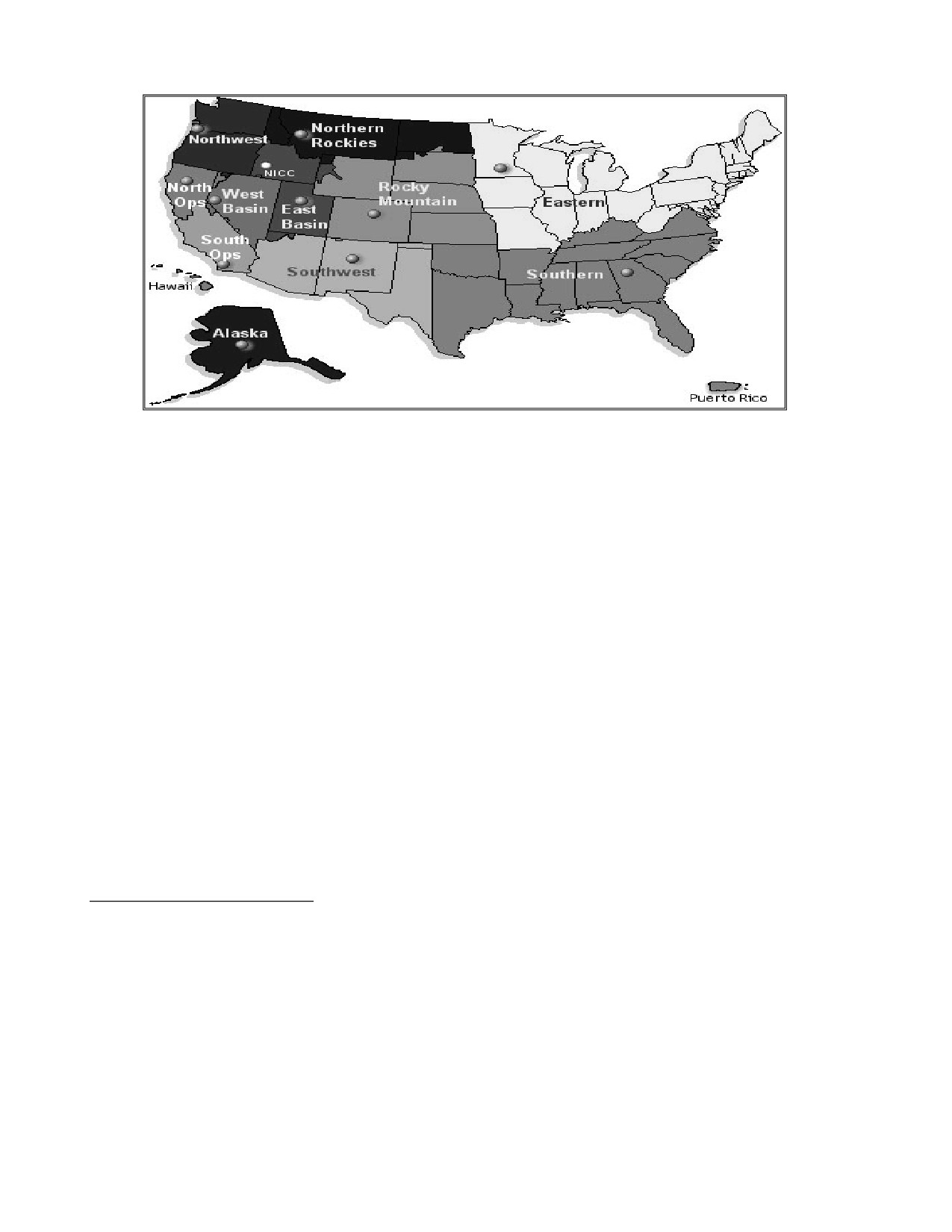
Subordinate to the NICC are eleven “Geographic Area Coordination Centers” (GACCs). Each
GACC is composed of federal and state wildland fire agencies. See Figure 8-1.
62 See NAT’L INTERAGENCY COORDINATION CTR., About Us, http://www.nifc.gov/nicc/about/about.htm (last visited
Jun. 30, 2011) [hereinafter NICC]; see also COMFORSCOM Functional Plan 2501-00, supra note 55, App. 27, para.,
1c(1).
63 See NIFC History at http://www.nifc.gov/nifcmiss.html (“‘Boise’ Interagency Fire Center” is the phrase referred to
MOU-USDA/DOI, supra note 56, rather than NIFC).
65 See COMFORSCOM Func Plan 2501-00, supra note 55, App. 27, para. 1c (1).
Chapter 8
121
Miscellaneous Domestic Support Operations
Domestic Operational Law Handbook
Figure 8-1. Map of Geographical Area Coordination Centers.67
The NICC uses a three-tiered coordination system to respond to wildland fires.68 First, a wildland
fire is initially managed by the local agency that has fire protection responsibility for that area.69
Engines, ground crews, smokejumpers, helicopters with water buckets, and air tankers may all be
used for initial suppression. Various local agencies may work together, sharing personnel and
equipment, to fight new fires and those that escape initial action. If a wildland fire grows to the
point where local personnel and equipment cannot contain the fire, the responsible agency contacts
one of the eleven GACCs, which is the second tier response. The GACC will locate and dispatch
additional firefighters and support personnel throughout the geographic area. The third tier is
triggered when GACCs can no longer meet the requests because they are supporting multiple
incidents, or GACCs are competing for resources. When this occurs, requests for equipment and
supplies are referred to NIFC. See DOPLAW Handbook, Supp., App.8-14, NIFC Area
Coordination Centers.
The NIFC can request DoD assistance in one of two ways.70 First, for wildland fires outside federal
land (on state or private lands), state officials submit their requests for suppression assistance to the
FEMA Regional Director or FCO. The FEMA Regional Director or FCO then requests military
assistance. When the NIFC requires military assistance under its own authorities, it contacts the
Director of Military Support (DOMS). Second, if the response is to an emergency under the
Stafford Act,71 the NIFC requests military assistance from FEMA, which coordinates with DOMS.
67 GEOGRAPHIC AREA COORDINATION CTRS, About Us, http://gacc.nifc.gov/admin/about_us/about_us.htm (last visited
Jun. 30, 2011).
68 See NICC, supra note 62.
69
Id.
70 DoD 3025.1-M, supra note 56, para. B.3.a; MOU-USDA/DOI, supra note 56, III. POLICY, paras. A-B.
71 Under the Stafford Act, an “emergency” is defined as “any occasion or instance for which, in the determination of
the President, federal assistance is needed to supplement State and local efforts and capabilities to save lives and protect
property and public health and safety, or to lesson or avert the threat of catastrophe in any part of the United States. The
Robert T. Stafford Disaster Relief and Emergency Assistance Act, 42 U.S.C. § 5121, et seq., as amended by Public L.
No. 106-390 (2000), § 5170 [hereinafter The Stafford Act].
Chapter 8
Miscellaneous Domestic Support Operations
122
Domestic Operational Law Handbook 2011
DOMS notifies the supported COCOM, who in turn tasks the appropriate component command or
supporting Combatant Command. All requests for military support will then be handled by the
command designated by the supported COCOM.72 The NIFC normally requests a specific number
of firefighters and/or items of equipment. NIFC taskings will provide the necessary information,
such as incident name, location, agency representation, and duration of assignment.
Normally, as part of the efforts of state and local governments to prevent and control wildfires, the
National Guard (NG) will respond in state active duty (SAD) status.73 For example, during the
summer of 2000, ten states provided more than 1,500 NG Soldiers and Airmen who served in SAD
status.74 The NG personnel provided law enforcement support for traffic control, transportation and
aviation support, and firefighters. The Air National Guard (ANG) and Air Force Reserve (AFR)
provided eight C-130 aircraft equipped with the modular airborne firefighting system (MAFFS).
Additionally, federal firefighting officials at NIFC formally requested assistance from DoD. More
than 4,600 active duty Soldiers, Marines and Airmen were committed to augment federal and local
firefighters and law enforcement officials. NIFC instituted a “Preparedness Level 5” indicating that
all federal firefighting resources were fully committed.
The ANG and AFR use the USFS-owned Modular Airborne Fire Fighting System (MAFFS), when
requested, to assist with wildland firefighting during extreme conditions.75 Congress established
the MAFFS Program in the early 1970s as a wildland fire program, not a military program. The
objective of the MAFFS program is to provide emergency capability to supplement the existing
commercial air tanker support on wildfires. The NICC can activate the MAFFS when all other
contract air tankers are committed, or are otherwise unable to meet requests for air operations. The
request for MAFFS activation is approved by the national MAFFS liaison officer, who is the USFS
director at NIFC. This request is then formally submitted to DOMS. Governors of states where NG
MAFFS units are stationed may activate MAFFS missions within their state boundaries when
covered by a memorandum of understanding with the USFS. In accordance with military
requirements for initial qualification and recurrent training, MAFFS crews are trained every year
with Forest Service national aviation operations personnel.
72 DoD 3025.1-M, supra note 56, para. B.3.d.
73 This is distinguished from Title 32 and Title 10 status for NG personnel. See infra Chapter 10, Reserve Components.
74 See DoD News Release, More Troops Tabbed to Battle Montana Wildfires, Aug. 23, 2000,
http://osd.dtic.mil/news/Aug2000/n08232000_20008231.html (last visited Jun. 30, 2011).
75 DoD 3025.1-M, supra note 56, ch. 3 (Disasters), para. B.3.f.; see also Modular Airborne Fire Fighting System
(MAFFS) Fact Sheet at http://www.fs.fed.us/fire/aviation/fixed_wing/maffs/index.html (last visited Jun. 30, 2011). A
MAFFS is a self-contained and pressurized, reusable 3,000 gallon aerial fluid dispersal system that allows Lockheed C
130 cargo/utility aircraft to be converted to wildland firefighting air tankers without structural modification to the
aircraft. The 3,000 gallons of retardant are discharged in about five seconds through two tubes exiting the rear ramp of
the plane. Most MAFFS are “single-shot” systems, meaning the full load is discharged at one time. One load may lay
down a “line” about one-quarter-mile-long and sixty feet wide. The units are loaded with either water or retardant—a
chemical that inhibits the combustion potential of vegetation on the ground. This allows firefighters on the ground to
rapidly take advantage of the retardant effect, which helps in line-building efforts. The retardant’s bright red or fuchsia
color helps pilots observe the accuracy of their drops on the edge of the fire.
Chapter 8
123
Miscellaneous Domestic Support Operations
Domestic Operational Law Handbook
There are currently eight MAFFS units in the system. Two are positioned at each of the following
Air National Guard and Air Force Reserve locations:
•
153rd Airlift Wing (AW), Cheyenne, WY (ANG);
•
146th AW, Port Hueneme, CA (ANG);
•
145th AW, Charlotte, NC (ANG); and,
•
302nd AW, Peterson AFB, Colorado Springs, CO (AFR)
The mobilization of MAAFS resources requires a pre-deployment analysis. Prior to deployment of
these assets, local foresters are responsible for ensuring that regional, commercially-available assets
are unavailable or already committed to a mission. Similarly, if assets are sought by the NICC,
commercial assets must be unavailable at the national level. Payments are governed by the
appropriate Memorandum of Understanding-Collection Agreements. These agreements are among
the military authority and the Forestry Service.76
C. Environmental Missions
The military services and DoD carry out an environmental program focused on DoD facilities.
However, DoD may also be called upon to provide environmental assistance during an emergency
or for domestic contingency operations involving a major federal response to an environmental
disaster. The military is a member of the national and regional response teams responsible for
preparing for and responding to hazardous substance spills under the Comprehensive Environmental
Response, Compensation, and Liability Act (CERCLA) and the National Oil and Hazardous
Substances Contingency Plan (the NCP).77
The NCP is the federal government’s plan for emergency response to discharge of oil into the
navigable waters of the United States and to releases of chemicals into the environment. The NCP
was developed to ensure that the resources and expertise of the federal government would be
immediately available for those oil and hazardous substance incidents requiring national or regional
response.
Under the NRF, the Environmental Protection Agency (EPA) has primary responsibility for ESF
10, Hazardous Materials.78 DOMS coordinates the DoD response in support of FEMA and the
NCP.79 The scope of operations includes detection, identification, containment, and cleanup or
disposal of released hazardous materials. Other operations under ESF-10 include actions such as
household hazardous waste collection, permitting and monitoring of debris disposal, water and air
quality monitoring and protection, and protection of natural resources.
Executive Order 12580 directs the NCP to provide for a National Response Team (NRT) for
national planning and coordination of preparedness and response actions. The NRT is composed of
76 See U.S. FIRE AND AVIATION MGMT., Modular Airborne Firefighting System,
http://www.fs.fed.us/fire/aviation/fixed_wing/maffs/system.html (last visited Jun. 30, 2011).
77 Comprehensive Environmental Response, Compensation and Liability Act, 42 U.S.C.A. §§ 9601-9675 (2006); The
National Oil and Hazardous Substances Pollution Contingency Plan, 40 C.F.R. § 300, et. seq. (1997) [hereinafter NCP].
78 NRF, supra note 19, Emergency Support Function #10, Hazardous Materials Annex.
79 U.S. Dep’t of Defense, Dir. 5030.41, Oil and Hazardous Substances Pollution Prevention and Contingency Program
(1 June 1977, C1, 26 Sept. 1978) [hereinafter DoDD 5030.41].
Chapter 8
Miscellaneous Domestic Support Operations
124
Domestic Operational Law Handbook 2011
representatives of appropriate federal departments and agencies, including DoD.80 See DOPLAW
Handbook, Supp., App. 2-3, EO 12580. Regional response teams (RRTs), the regional counterpart
to the NRT, plan and coordinate regional preparedness and response actions. EPA chairs the
standing NRT.
The NRF ESF #10 Hazardous Materials Annex, Relation to Existing Response under the NCP, the
National Response System, and the National and Regional Response Teams, sets forth the tiered
levels and responsibilities for response.81 DoD provides expertise through the U.S. Army Corps of
Engineers (USACE) and the U.S. Navy. DoD provides the Federal On-Scene Coordinator (FOSC)
for all hazardous substance releases, except oil spills, that originate from DoD facilities or vessels.82
The Regional Response Teams (RRTs) provide regional planning and preparation before a pollution
incident as well as coordination and advice after an incident occurs.83 The two principal
components of the RRT are the Standing RRT and the Incident Specific RRT. The Standing RRT is
comprised of all the departments and agencies of the NRT plus the involved states, and is co
chaired by EPA and the Coast Guard. The USACE is the principal agency for the Army’s
environmental response and appoints Army representatives to the RRT. The Incident Specific RRT
is comprised of RRT members who have specific expertise or equipment that could assist the FOSC
in responding to an incident. Either EPA or the Coast Guard chairs the incident specific RRT,
depending on the location of the spill.84
The operational level of environmental response management is performed by the FOSC. The
FOSC ensures a timely, effective response is conducted which minimizes damage to the
environment. The FOSC and either EPA, for inland areas, or the USCG, for coastal areas, are the
principal participants for federal response actions. DoD and the Department of Energy provide the
FOSC when there is a hazardous release from their facilities or vessels, and respond to their own
authorities. The FOSC coordinates all federal containment, removal, and disposal efforts, and
federal resources. The FOSC is also the point of contact for the coordination of federal efforts with
those of the local response community.85
1. The Deepwater Horizon Oil Spill
Major environmental contingency operations within the United States may be handled exclusively
under the NCP without a Presidential declaration of a major disaster under the Stafford Act. During
the Deepwater Horizon crisis in 2010, there was substantial confusion in the public and in press
reports regarding the applicability of the Stafford Act to response operations. There was never a
Stafford Act declaration during the Deepwater Horizon response.
80 Exec. Order No. 12,580, 3 C.F.R. 193 (1987); see also DoDD 5030.41, supra note 79, para. 5.4.
81 NRF, supra note 19, ESF# 10, Relation to Existing Response under the NCP, the National Response System, and the
National and Regional Response Teams.
82 NCP, supra note 77, § 30.5, Definition.
83 NRF, supra note 19, ESF# 10.
84
Id.
85 NAT’L RESPONSE CTR., National Response System, http://www.nrc.uscg.mil/nrsinfo.html (last visited Jun. 30, 2011).
Chapter 8
125
Miscellaneous Domestic Support Operations
Domestic Operational Law Handbook
Despite the magnitude of that emergency, all operations were conducted under the President’s
delegable authorities under the Clean Water Act86 and the NCP. Those authorities specifically
provide mechanisms by which the “Responsible Parties” for the discharge87 directly pay all removal
costs and certain damages arising from the discharge.88 Consequently, a Stafford Act declaration
was not necessary during Deepwater Horizon because the primary responsible party, BP, directly
funded all removal costs. The National Incident Commander,89 Admiral Thad Allen, U.S. Coast
Guard, and the FOSC (a position occupied during 2010 by several Coast Guard flag and senior-
level officers) coordinated the response and directed BP’s activities in close coordination with state
and local leaders.
However, if other events caused or exacerbated damage to the Gulf Coast during the Deepwater
Horizon clean-up efforts, e.g., a hurricane or similar event, a Stafford Act response may have been
directed for those contingencies in addition to the environmental response already ongoing pursuant
to the Clean Water Act and the NCP. In such a scenario, all response activities would have been
jointly coordinated from a Unified Command.
D. Missions in Support of Law Enforcement
1. Support of United States Secret Service
DoDD 3025.13, Employment of Department of Defense Resources in Support of the United States
Secret Service, provides for reimbursable support of the Secret Service and identifies
reimbursement accounting procedures.90 Requests for assistance go through the White House
Military Office or DoD Executive Secretary.91
2. Imagery Intelligence and Geospatial Support
The National Geospatial-Intelligence Agency (NGA) has a mission to support domestic operations
through the use of its organic assets. DCID 1/8 provides that NGA will use its products “from
national satellite and airborne reconnaissance systems . . . in support of [f]ederal departments and
agencies.”92 Although the use of intelligence assets are subject to extensive regulation (see chapter
9), this capability provides appropriate federal agencies access to real-time and near real-time
imagery and geospatial support.
86
33 U.S.C. §1321(c).
87 Among the Responsible Parties in DEEPWATER HORIZON were BP (formed after the merger of British Petroleum
and Amoco in 2001) and Transocean.
88
33 U.S.C. § 2702(a). In oil discharge situations, the federal government may use the Oil Spill Liability Trust Fund to
pay costs related to oil spill removal activities. Responsible Parties reimburse the fund for these costs. The statute
recognizes that reimbursement may not be available when a Responsible Party is insolvent or cannot be identified.
89
40 C.F.R. § 300.323(c) provides that a National Incident Commander (NIC) may be appointed for a “Spill of
National Significance.” The NIC assumes the role of the FOSC in communicating with effected parties and the public
and coordinating federal, state, local and international resources at the national level.
90 U.S. DEP’T OF DEFENSE, DIR. 3025.13, EMPLOYMENT OF DEPARTMENT OF DEFENSE RESOURCES IN SUPPORT OF THE
UNITED STATES SECRET SERVICE, PARAS. 3.1, 3.2 (13 Sept. 1985).
91
Id. para. 3.4.2.
92 DIRECTOR OF CENTRAL INTELLIGENCE DIRECTIVE (DCID)1/8 - MANAGEMENT OF NATIONAL IMAGERY, IMAGERY
INTELLIGENCE, GEOSPATIAL (21 March 2001), D.2b.ii. See also U.S. DEP’T OF DEFENSE, DIR. 5105.60, NATIONAL
GEOSPATIAL-INTELLIGENCE AGENCY, PARAS. 6.(a).(6).(b) (29 July 2009).
Chapter 8
Miscellaneous Domestic Support Operations
126
Domestic Operational Law Handbook 2011
Intelligence activities in the United States are governed broadly by Executive Order 12333. EO
12333 prohibits directed collection on U.S. persons through the use of overhead reconnaissance by
intelligence agencies.93 EO 12333, however, grants broad authority to U.S. intelligence agencies to
provide direct support to other federal agencies. This support can be extended to local law
enforcement in circumstances where lives are at risk.94 Such support, however, requires approval
of the General Counsel of the Supporting Agency.
The NGA under its various authorities provides imagery and geospatial support in a variety of
domestic support operations. These operations include homeland security, civil support, and
support to law enforcement missions. NGA’s support to homeland security includes support to
special events (see chapter 7) and to exercises in support of homeland security training. NGA
provides civil support in natural disasters and in other agency and DoD missions to include
vulnerability studies. Support to law enforcement can include the use of imagery to provide
situational awareness or other forms of assistance.
3. Critical Asset Assurance Program
EO 12656 requires that every federal department and agency identify and develop plans to protect
facilities and resources essential to the nation’s defense and welfare in order to minimize
disruptions of essential services during national security emergencies. Security emergencies may
result from natural disasters, military attack, or any other event that seriously degrades the security
of the United States.95
4. Continuity of Operations Policies and Planning
EO 12656 requires heads of federal agencies to ensure the continuity of essential functions during a
national security emergency.96 DoDD 3020.26, Continuity of Operations Policy and Planning,
implements EO 12656 by tasking all DoD components to prepare plans for the continuity of
operations and of government during an emergency.97 (See DOPLAW Handbook, Supp., App. 2-4,
EO 12656, Emergency Preparedness. See also Appendix 8-16, PDD-NSC-67. DoDD 3020.36,
Assignment of National Security Emergency Preparedness (NSEP) Responsibilities to DoD
Components, overlaps DoDD 3020.26. Under DoDD 3020.36, each DoD component shares the
general responsibilities for emergency preparedness, mobilization planning, and crisis management
in ensuring the continuity of government in any national security or domestic emergency
situation.98 DoDD 3020.36 also requires the identification of alternate headquarters, emergency
relocation sites, and other permanent facilities to be used during emergencies.99
93 See Exec. Order No. 12333, 3 C.F.R. 200 (1982), reprinted in 50 U.S.C. § 401.
94
Id. at para. 2.6(c).
95 EO 12656, supra note 3, sec.204.
96 EO 12656, supra note 3, sec.202.
97 U.S. DEP’T OF DEFENSE, DIR. 3020.26, CONTINUITY OF OPERATIONS POLICY AND PLANNING, para. 4.1 (Oct. 1988).
98 U.S. DEP’T OF DEFENSE, DIR. 3020.36, ASSIGNMENT OF NATIONAL SECURITY EMERGENCY PREPAREDNESS (NSEP)
RESPONSIBILITIES TO DOD COMPONENTS, PARA. 4.2 (2 Nov. 1988).
99
Id.
Chapter 8
127
Miscellaneous Domestic Support Operations
Domestic Operational Law Handbook
5. Explosive Ordnance Disposal
DoDD 5160.62, Single Manager Responsibility for Military Explosive Ordnance Disposal
Technology and Training, establishes the Navy as the single agency for service support of the non
nuclear explosive ordnance disposal (EOD) program.100 Army Regulation 75-14/OPNAVINST
8027.1E/ARF 136-8/MCO 8027.1B, Interservice Responsibilities for Explosive Ordnance Disposal,
delineates EOD areas of responsibilities for the Army, Navy, Marine Corps, and Air Force.101
The EOD mission within the Department of the Army is defined in AR 75-15, Responsibilities and
Procedures for Explosive Ordnance. The mission includes providing “assistance to public safety
and law enforcement agencies” and conducting “explosive ordnance disposal ‘bomb and sabotage’
training for civil preparedness, law enforcement, fire protection[,] and other public officials.”102 It
also includes providing “explosive ordnance disposal support to the Departments of Energy and
Justice in the neutralization of improvised nuclear devices in accordance with current agreements
and directives.”103 The Army should primarily provide training or advice, rather than physical
assistance. AR 75-15 provides:
The Department of the Army is not responsible for responding to, or disposing of,
nonmilitary commercial-type explosives, chemicals, or dangerous articles in the
possession of, or controlled by commercial concerns or civilian agencies. Assistance
may be provided, when requested by federal agencies or civil authorities, in the
interest of preserving public safety. Where a delay in responding to a request for
assistance from other activities would endanger life or cause injury, commanders
may authorize assistance to that extent necessary, to prevent injury or death. EOD
personnel may act as technical consultants or advisors, or they may render safety and
disposal procedures if requested.
Thus, EOD forces should only provide physical assistance when the explosive is a DoD munitions
or when necessary under immediate response authority to save lives.
E. Community Assistance
The most frequently conducted domestic support operations involve community assistance. These
missions include public works, education, training, minor construction projects, and providing color
guards for local events. Intended to address unmet needs, they should avoid duplication or
competition with the civilian sector. Activities vary widely, ranging from individual Soldier
100 U.S. DEP’T OF ARMY, REG. 75-15, RESPONSIBILITIES AND PROCEDURES FOR EXPLOSIVE ORDNANCE, para. 1-7 (22
Feb. 2005). AR 75-15 does not apply to the Army Reserves or Army National Guard.
101
Id. paras. 1-1, 2-1. The Army has EOD responsibility on Army installations and on landmass areas not specifically
assigned as the responsibility of the Navy, Marine Corps, or the Air Force. The Department of the Navy is responsible
for: EOD activities on Navy installations; explosive ordnance in the physical possession of the Navy; in assigned
operational areas; within the oceans and contiguous waters, up to the high water mark of sea coasts, inlets, bays,
harbors, and rivers; in any rivers, canals or enclosed bodies of water; and for the rendering safe and disposal of
underwater explosive ordnance. The Department of the Air Force and the Marine Corps have EOD responsibility on
their own installations, for explosive ordnance in their physical possession, and in assigned operational areas.
102
Id. para. 1-4.
103
Id.
Chapter 8
Miscellaneous Domestic Support Operations
128