Military reference books and manuals (2009-2023, Volume 3) - page 13
Domestic Operational Law Handbook 2013
• Legality - compliance with the law.
• Lethality - potential use of lethal force by or against DoD forces.
Per DoDD 3025.18, The Secretary of Defense (SECDEF) is the approval authority for assistance in
civil disturbances, responses to chemical, biological, radiological, and nuclear events, defense
assistance to civilian law enforcement agencies (except as authorized by DoDI 3025.21 as discussed
below), and support that has the potential for lethality.
When Combatant Command-assigned forces are to be used, there must be coordination with the
Chairman of the Joint Chiefs of Staff (CJCS). SECDEF approval is not required when immediate
response authority of the local commander under DODD 3025.18 is used, but a reassessment of the
appropriateness of the use of this authority is required within the first 72 hours of a response.25
E. Disaster and Emergency Relief26
The Stafford Act provides four means by which the federal government may become involved in a
disaster and relief effort: the President may declare the area a major disaster27; the President may
declare the area an emergency28; the President may send in DoD assets on an emergency basis to
“preserve life and property”;29 and the President may send in federal assets where an emergency
occurs in an area over which the federal government exercises primary responsibility by virtue of
the Constitution or federal statute.30
The Department of Homeland Security, through the Federal Emergency Management Agency
(FEMA) directs and coordinates the federal response on behalf of the President. DHS has prepared
the National Response Framework, which defines fifteen Emergency Support Functions (ESFs) for
which certain federal agencies have either a primary or supporting role. The Corps of Engineers is
the primary agency for ESF #3, Public Works and Engineering. DoD is a supporting agency for all
others.
FEMA appoints a Federal Coordinating Officer (FCO), typically the senior FEMA official on-
scene. Because of the likelihood of DoD involvement, a Defense Coordinating Officer (DCO) is
25 See U.S. DEP’T OF DEFENSE, DIR. 3025.18, DEFENSE SUPPORT OF CIVIL AUTHORITIES para 4.g.(2) (21 Sep. 2012)
[hereinafter DoDD 3025.18] (stating that “[t]he DoD official directing a response under immediate response authority
shall reassess whether there remains a necessity for the Department of Defense to respond under this authority as soon
as practicable but, if immediate response activities have not yet ended, not later than 72 hours after the request for
assistance was received.”).
26 See generally Disaster Relief Act Amendments of 1974 (Stafford Act), Pub. L. No. 93-288, 88 Stat. 143 (1974);
DoDD 3025.18, supra note 25; U.S. DEP’T OF DEFENSE, MAN. DOD 3025.1-M, DOD MANUAL FOR CIVIL EMERGENCIES
(Jun. 1994) [hereinafter DOD 3025.1-M]; NATIONAL GUARD BUREAU, REG. 500-1/ANGI 10-8101, NATIONAL GUARD
DOMESTIC OPERATIONS (13 Jun. 2008) [hereinafter NGR 500-1]; CHIEF OF NAVAL OPERATIONS, INSTR. 3440.16D;
NAVY DEFENSE SUPPORT OF CIVIL AUTHORITIES PROGRAM (29 Jun 2009); U.S. DEP’T OF AIR FORCE, INSTR. 10-801,
DEFENSE SUPPORT OF CIVIL AUTHORITIES (DSCA) (19 Sept. 2012) [hereinafter AFI 10-801].
27 See 42 U.S.C. § 5170 (2013).
28 See 42 U.S.C. § 5191 (2013) (same criteria as for a major disaster, except it also requires that the governor define the
type and amount of federal aid required, and total federal assistance may not exceed $5 million).
29 See 42 U.S.C. § 5170b(c) (2013).
30 See 42 U.S.C. § 5191(b) (2013).
Chapter 12
Funding Domestic Support Operations
214
Domestic Operational Law Handbook 2013
assigned to the FCO. The DCO, an O-6 or above, is identified from a Training Support Brigade
(TSB). Training Support Brigades are located throughout the continental United States (CONUS).
Training Support Brigade commanders are dual-hatted as DCOs. The DCO will be the FCO’s
single point of contact for DoD support. The FCO issues Mission Assignments, defining the task
and maximum reimbursement amount, to the federal agencies responding.
The Department of Defense is reimbursed by FEMA for the incremental costs of providing support
pursuant to the DCO’s tasking in response to the FEMA mission assignment. Incremental expenses
are reimbursed, or those expenses incurred by the agency providing the military assistance that—
but for the request for assistance—would not otherwise have incurred these expenses. The
Department of Defense Financial Management Regulation (FMR) 7000.14-R, vol. 12, ch. 6, para.
060204, lists the following costs as eligible for reimbursement:
• Overtime, travel, and per diem of permanent DoD civilian personnel
• Wages, travel, and per diem of temporary DoD civilian personnel assigned solely to
performance of services directed by the Executive Agent
• Travel and per diem of active duty military, and costs of reserve component personnel called to
active duty by a federal official who is assigned solely to the performance of services directed
by the Executive Agent
• Cost of work, services, and material procured under contract for the purposes of providing
assistance directed by the Executive Agent
• Cost of materials, equipment and supplies (including transportation, repair and maintenance)
from regular stocks used in providing directed assistance
• All costs incurred which are paid from trust, revolving, or other funds, and whose
reimbursement the law requires
• Other costs submitted with written justification or otherwise agreed to in writing by the Joint
Director of Military Support or appropriate Service representative
Requests for reimbursement may be made through use of the SF-1080, Voucher for Transfers
between Appropriations or Funds. It is important to note that Federal agencies which exceed the
reimbursement amount, or execute tasks not within the Mission Assignment, may not be
reimbursed.
For the DoD response, the Assistant Secretary of Defense for Homeland Defense and Americas’
Security Affairs (ASD(HD&ASA)) is the DoD lead for disaster relief operations. As such, they are
the approval authority for all such support, unless it involves Combatant Command-assigned forces.
The Joint Director of Military Support (JDOMS) is the ASD(HD&ASA) agent. The JDOMS
coordinates and monitors the DoD effort. The JDOMS normally produces the Execute Order and
obtains the SECDEF’s signature for a given mission. USNORTHCOM (CONUS, Alaska, Puerto
Rico, and the Virgin Islands) and USPACOM (Hawaii, and Pacific possessions and territories) are
responsible for developing disaster response plans and for the execution of those plans needed for a
response. They may form a Joint Task Force for this purpose.
1. Immediate Response Authority (IRA)
Immediate response authority permits local military commanders to act immediately to save lives,
prevent human suffering, and mitigate great property damage in imminently serious conditions
when time does not permit approval from higher headquarters. Types of support authorized include
Chapter 12
215
Funding Domestic Support Operations
Domestic Operational Law Handbook 2013
rescue, evacuation, and emergency treatment of casualties; emergency restoration of essential public
services; emergency removal of debris and explosive ordnance; and recovery and disposal of the
dead. This type of support is provided on a reimbursable basis, but assistance should not be denied
because the requester is unable or unwilling to commit to reimbursement.
Immediate response authority is very limited and should be invoked only for bona fide emergencies.
Contemporaneous coordination with JDOMS and ASD(HD&ASA) should always occur in these
scenarios, and in any other case potentially involving this type of assistance to civil authorities. The
JDOMS has indicated that this assistance should not exceed 72 hours. To obtain reimbursement for
costs incurred as a result of an immediate response, DoD should request reimbursement from the
state or local government to whom assistance was provided. Often, the state and local governments
do not have the available funding to reimburse. As a result, in the past DoD has looked to the
Defense Emergency Response Fund for reimbursement.
2.
Defense Emergency Response Fund (DERF)
The DERF was created in the FY90 National Defense Appropriation Act, Pub. L. 101-165, in
response to Hurricane Hugo. Under this provision, “the Fund is available for providing
reimbursement to currently applicable appropriations of the [DoD] for supplies and services
provided in anticipation of requests from other Federal Departments and agencies and State and
local governments for assistance on a reimbursable basis to respond to natural and manmade
disasters.”
In FY94, § 8131 of the National Defense Appropriation Act, Pub. L. No. 103-139, amended the
FY90 provision giving DoD the ability to request reimbursement from the DERF for its own
disaster response efforts. Specifically, the language provides: “the Fund may be used, in addition to
other funds available to DoD for such purposes, for expenses of DoD which are incurred in
supplying supplies and services furnished in response to natural or manmade disasters.”
Prior to November 2003, if the state and local government failed to reimburse, the command would
forward reimbursement to the DERF.31 This fund was available for providing reimbursement to
currently applicable appropriations of DoD for supplies and services provided in anticipation of
requests from other federal departments and agencies and from state and local governments for
assistance on a reimbursable basis to respond to natural or manmade disasters.
Since November 2003, the DERF has been closed out.32 The Act that closed out DERF provided
that, effective November 1, 2003, adjustments to obligations that before such date would have been
properly chargeable to the DERF shall be charged to current appropriations available for the same
purpose.33 Now, it may be possible to seek reimbursement through FEMA. On rare occasions,
FEMA has provided reimbursement to the DoD for IRA assistance by “ratifying” the DoD action
after the fact. Such ratification, however, is done on a case-by-case basis. Commanders cannot rely
on FEMA doing so in every case. FEMA is under no obligation to reimburse the DoD for response
actions taken prior to a Presidential Declaration and in some case may not have the legal authority
to reimburse DoD if no Presidential declaration occurs. If no one reimburses the affected
31 See DoD 7000.14-R, supra note 23, ch. 6.
32 Closed out in § 1105 of the FY04 Emergency Supplemental Appropriations Act.
33
Id.
Chapter 12
Funding Domestic Support Operations
216
Domestic Operational Law Handbook 2013
command, the costs of the Immediate Response assistance are funded through unit O&M, which is
the most likely outcome. In some rare circumstances, such as man-made disasters, funding
available under OPERATION NOBLE EAGLE may provide a solution.
3. Disaster Support Involving Law Enforcement Authorities
The Stafford Act is not an exception to the Posse Comitatus Act (PCA). Therefore, any support that
includes direct involvement in the enforcement of the civil law must undergo the PCA analysis
discussed below. Typical areas of concern include directing traffic, guarding supply depots, and
patrolling. National Guard personnel, acting in their Title 32 (State) status, should be used
whenever possible. Law enforcement duties that involve military functions may be permissible
(e.g., guarding a military supply depot).
F. Civil Disturbances34
The maintenance of law and order is primarily vested in state and local officials. Involvement of
military forces will only be appropriate in extraordinary circumstances. Use of the military under
these authorities to conduct law enforcement activities is a specific exception to the PCA. The
probable order of employment of forces in response to a certain situation will be (1) local and state
police; (2) National Guard in their state status; (3) federal civil law enforcement officials; and (4)
Federal military troops, to include National Guard called to active federal service.
The insurrection statutes permit the President to use the armed forces domestically under certain
circumstances. The Attorney General coordinates all federal government activities relating to civil
disturbances. If the President decides to respond to the situation, he must first issue a proclamation
to the insurgents, prepared by the Attorney General, directing them to disperse within a limited
time.35 At the end of that time period, the President may issue an Executive Order directing the use
of armed forces. The Attorney General appoints a Senior Civilian Representative of the Attorney
General (SCRAG) as his action agent.
For the DoD response, SECDEF has reserved the authority to approve support in response to civil
disturbances.36 Although the civilian authorities have the primary responsibility for civil
disturbances, military forces shall remain under military command and control at all times. Military
forces shall not be used for civil disturbances unless specifically directed by the President (pursuant
to 10 U.S.C. §§ 331-335), except for emergency employment of military forces in the following
limited circumstances:
• To prevent the loss of life or wanton destruction of property or to restore governmental
functioning, in cases of civil disturbances, if the duly constituted authority local authorities are
34 U.S. CONST. art. IV, § 4: “The United States shall guarantee to every State in this Union a Republican Form of
Government, and shall protect each of them against Invasion; and on Application of the Legislature, or of the Executive
(when the Legislature cannot be convened), against domestic Violence”; Insurrections, 10 U.S.C. §§ 331-335 (2013);
U.S. DEP’T OF DEFENSE, INST. 3025.21, DEFENSE SUPPORT OF CIVILIAN LAW ENFORCEMENT AGENCIES (27 Feb. 2013),
[hereinafter DoDI 3025.21].
35 See 10 U.S.C. § 334 (2013).
36 See DoDD 3025.18, supra note 25, para. 4.j.
Chapter 12
217
Funding Domestic Support Operations
Domestic Operational Law Handbook 2013
unable to control the situation and circumstances preclude obtaining prior Presidential
authorization.
• When duly constituted state or local authorities are unable or decline to provide adequate
protection for federal property or functions.
Although employment under these authorities permits direct enforcement of the law by military
forces, the military’s role in law enforcement should be minimized as much as possible. DoD’s role
is to support the civilian authorities, not replace them. Once the President directs the employment
of military forces (federal), then this is a DoD mission and O&M funds are used to cover the cost.
G. Support to Civilian Law Enforcement37
Although certain activities could be considered law enforcement type activities, they do not violate
the PCA because they do not involve use of military personnel to provide direct assistance. With
proper approval, DoD activities may make equipment (including associated supplies and spare
parts) or facilities available to Federal, state, or local law enforcement officials for law enforcement
purposes.
Under 10 U.S.C. § 374(a), SECDEF may make DoD personnel available for the maintenance of
equipment provided, to include equipment provided pursuant to 10 U.S.C. § 372. Under 10 U.S.C.
§ 374(b)(1), SECDEF may, upon a request from the head of a federal law enforcement agency,
make DoD personnel available to operate equipment with respect to criminal violations of the
Controlled Substances Act, the Immigration and Naturalization Act, the Tariff Act of 1930, the
Maritime Drug Law Enforcement Act, and any law, foreign or domestic, prohibiting terrorist
activities; a foreign or domestic counter-terrorism operation; or a rendition of a suspected terrorist
from a foreign country to the United States to stand trial.
Under 10 U.S.C. § 374(b)(2), DoD personnel made available to a civilian law enforcement agency
may operate equipment for the following purposes:
• Detection, monitoring, and communication of the movement of air and sea traffic
• Detection, monitoring, and communication of the movement of surface traffic outside of the
geographic boundary of the United States and within the United States not to exceed 25 miles of
the boundary if the initial detection occurred outside the boundary
• Aerial reconnaissance
• Interception of vessels or aircraft detected outside the land area of the United States for the
purposes of communicating with and directing said vehicle to a specific location
• Operating equipment to facilitate communications
• Subject to joint approval by SECDEF and Attorney General:
¾ Transportation of civilian law enforcement personnel along with any other civilian or
military personnel who are supporting, or conducting, a joint operation with civilian law
enforcement personnel
37 See generally 10 U.S.C. §§ 372-374, 377; DODI 3025.21, supra note 34; NGR 500-1, supra note 26; U.S. DEP’T OF
NAVY, SEC’Y NAVY INSTR. 5820.7C, COOPERATION WITH CIVILIAN LAW ENFORCEMENT OFFICIALS, para. 8 (26 Jan.
2006) [hereinafter SECNAVINST 5820.7C]; U.S. DEP’T OF ARMY, REG. 700-131, LOAN, LEASE, AND DONATION OF
ARMY MATERIEL (24 Aug. 2004); AFI 10-801, supra note 26.
Chapter 12
Funding Domestic Support Operations
218
Domestic Operational Law Handbook 2013
¾ Operation of a base of operations
¾ Transportation of suspected terrorists from foreign countries to the U.S. for trial (so
long as the requesting federal law enforcement agency provides all security for such
transportation and maintains custody over the suspect through the duration of the
transportation).
1. Economy Act
Pursuant to 10 U.S.C. § 377, the support provided between federal agencies under these authorities
is reimbursable under the Economy Act, unless the support is provided in the normal course of
training or operations, or the support results in a substantially equivalent training value. Under 31
U.S.C. § 1535, an Economy Act order may be placed by the head of an agency (delegable down to a
warranted contracting officer) with another agency. The order may be a Military Interdepartmental
Purchase Request (MIPR), a Memorandum of Understanding (MOU) for support, or an interagency
agreement. Form is not the key—content is the critical matter. The definition of “agency” includes
military departments.38 The content defines the type of support to be rendered and the
reimbursement to be provided.
2. Miscellaneous Receipts
The Miscellaneous Receipts Statute, 31 U.S.C. § 3302(b), requires that any dollars received by an
agency must go into the general treasury, without any deduction for any charges or claims, unless
there is a positive authority like the Economy Act that allows an agency to retain the money.
Although the language in 10 U.S.C. § 372 et seq. authorizes support to state and local civilian law
enforcement agencies, the reimbursement provision in 10 U.S.C. § 377 provides no mechanism for
reimbursement except for support between federal agencies. If commanders loan equipment to state
or local CLEAs under this authority, any reimbursement obtained would go into Miscellaneous
Receipts. It is important to note that reimbursement is required, unless the law allows a waiver.
The only way to avoid this problem is for the commander to lease the equipment under 10 U.S.C. §
2667. The Leasing Statute provides a mechanism for reimbursement. If a loan is authorized, there
must be no adverse impact on national security or military preparedness. (Specific details regarding
the Leasing Statute are in Section L of this Chapter)
The Secretary of the Army has statutory authority to approve loans, leases, and donations of Army
material. The Chief, Integrated Logistics Support Division (DALO-SMP) is responsible for acting
on loan and lease request and loan and lease extensions forwarded for
Headquarters, Department of the Army (HQDA) review by major Army Commands (MACOMs).
AR 700-131 contains detailed procedures on the loan or transfer of Army property. For the Navy
and Marine Corps, the Assistant Secretary of the Navy (SECNAV) (Manpower and Reserve
Affairs) may approve requests for non-lethal equipment for more than sixty days. All other requests
may be approved as specified in SECNAVINST 5820.7C. For the Air Force, AFI 10-801 states that
in circumstances not immediately threatening to human life, causing human suffering, or
threatening great property damage, requests for equipment or facilities for federal, state, or local
civilian officials (including include law enforcement) should be addressed in accordance with AFI
23-119 and AFI 32-9003. For the National Guard (NG), the loan of weapons, combat/tactical
38 FAR, supra note 12, at pt. 2.101.
Chapter 12
219
Funding Domestic Support Operations
Domestic Operational Law Handbook 2013
vehicles, vessels and aircraft require approval of the service secretary or their designee. Requests
for loan/lease of NG equipment, which require HQDA or HQAF approval, will be reviewed by
National Guard Bureau (NGB) (NGR 500-1/ANGI 10-8101); however, it must be remembered that
SECDEF is the approval authority for all DoD support to counterterrorism operations, emergency
support to civil disturbances, and law enforcement agencies that will result in a planned event with
the potential for confrontation with named individuals/groups or use of lethal force.
3.
Excess Property
In addition to loan/lease authority, The National Defense Authorization Act of 1997 added a new
section to Title 10. Section 2576a, “Excess Personal Property; Sale or Donation for law
enforcement activities,” permits DoD to provide excess personal property suitable for use in
counter-drug and counter-terrorism activities to federal and state agencies. 10 U.S.C. § 2576
authorizes the surplus sale of military equipment to state and local law enforcement and firefighting
agencies. 10 U.S.C. § 2576(a) authorizes the surplus sale of military equipment to federal and state
agencies suitable for carrying out law enforcement, firefighting, homeland security, and emergency
management services. The state or local agency must initiate a request for the equipment. 10
U.S.C. § 2576a and § 2576b provide additional mechanisms for the transfer of excess property
(without sale) to law enforcement and firefighting agencies. As of October 1, 1995, the Defense
Logistics Agency manages these programs.
4.
Expert Advice and Training39
DoD components are authorized to give expert advice and/or training to Federal, state, and local law
enforcement in certain cases. Overarching policy regarding the provision of this assistance is found
at 32 C.F.R. § 182, and more specific policy is found in DoDI 3025.21.
DoD components may provide, subject to approval limitations in DoDI 3025.21, expert advice to
Federal, state, or local law enforcement officials in accordance with 10 U.S.C. § 373. A specific
example of this type of support is military working dog team support to civilian law enforcement.
The dogs have been analogized to equipment, and their handlers to providers of expert advice.40
Direct assistance by DoD personnel in activities that are fundamentally civilian law enforcement
operations is not permitted, except as specifically authorized by DoDI 3025.21.41
DoD components may also provide, subject to approval limitations in DoDI 3025.21, training to
Federal, State, and local civilian law enforcement officials. This does not permit large-scale or
elaborate DoD training, and does not permit regular or direct involvement of DoD personnel in
39 See generally 10 U.S.C. §§ 373, 375, 377 (2013); 50 U.S.C. § 2316; DODI 3025.21, supra note 34, Encl. 5;
SECNAVINST 5820.7C, supra note 37, paras. 9.a.(4)-(5); AFI 10-801, supra note 26.
40 See generally U.S. DEP’T OF DEFENSE, DIR. 5200.31E, DOD MILITARY WORKING DOG (MWD) PROGRAM, (10 Aug.
2011) [hereinafter DODD 5200.31E]; U.S. DEP’T OF AIR FORCE, AFI 31-121, MILITARY WORKING DOG PROGRAM (17
Oct. 2012), 32 C.F.R. §182 (2013).
41 Specific examples where direct assistance is permitted include the case of the execution of a quarantine under 42
U.S.C. § 97, when such actions are necessary to prevent significant loss of life and wanton destruction of property and
are necessary to restoring governmental function, and when action is needed to protect national parks and other certain
federal lands, among many other instances. DODI 3025.21, supra note 34, Encl. 3.
Chapter 12
Funding Domestic Support Operations
220
Domestic Operational Law Handbook 2013
activities that are fundamentally civilian law enforcement operations, except as otherwise
authorized by DoDI 3025.21 (see footnote 41 infra).
Training can only be given when the use of non-DoD personnel would be unfeasible or impractical
from a cost or time perspective, and when it would not otherwise compromise military preparedness
of the United States. It may not involve DoD personnel participating in a law enforcement
operation, unless specifically authorized under DoDI 3025.21. Training assistance must be
provided at a location where there is not a reasonable likelihood of a confrontation between law
enforcement personnel and civilians, unless otherwise authorized by law.
The provision of “advanced military training” is not allowed under DoDI 3025.21. Advanced
military training includes advanced marksmanship training, sniper training, military operations in
urban terrain (MOUT), advanced MOUT, close quarters battle/close quarters combat, and similar
training. SECDEF policy on advanced military training in this context is discussed further in
Deputy Secretary of Defense Memorandum “DoD Training Support to U.S. Civilian Law
Enforcement Agencies,” June 29, 1996, and Deputy Secretary of Defense Memorandum “Request
for Exception to Policy,” November 12, 1996 (both available from the Office of the Assistant
Secretary of Defense for Homeland Defense and Americas’ Security Affairs (ASD (HD & ASA),
room 3D247, 2600 Defense Pentagon, Washington D.C. 20301).
The Secretary of Defense is the approval authority for requests for direct assistance in support of
civilian law enforcement agencies, including those responding with assets with the potential for
lethality, except for the use of emergency authority as provided for under DoDD 3025.18 or under
one of the exceptions provided in DoDI 3025.21. Requests that involve Defense Intelligence and
Counterintelligence entities are subject to approval by the Secretary of Defense and the guidance in
DoDD 5240.01, DoD Intelligence Activities and DoD 5240.1-R, Procedures Governing the
Activities of DoD Intelligence Components That Affect U.S. Persons (see Chapter 9 infra for
further guidance).
Otherwise, the Secretaries of the Military Departments and the Directors of the Defense Agencies
may, in coordination with the ASD(HD&ASA), approve the use of DoD personnel:
• To provide training or expert advice in accordance with DoDI 3025.21
• For equipment maintenance in accordance with the specific provisions of enclosure 3 of DoDI
3025.21
• To monitor and communicate the movement of air and sea traffic in accordance with the
specific provisions of enclosure 3 of DoDI 3025.21
All other requests, including those in which subordinate authorities recommend disapproval, shall
be submitted promptly to the ASD(HD&ASA) for consideration by the Secretary of Defense, as
appropriate.42
Support provided under these authorities to a federal agency is reimbursable under the Economy
Act, unless the support is provided in the normal course of training or operations, or the support
results in a substantially equivalent training value. It is important to note that pursuant to 31 U.S.C.
42 DODI 3025.21, supra note 34.
Chapter 12
221
Funding Domestic Support Operations
Domestic Operational Law Handbook 2013
§ 6505, under the “Intergovernmental Cooperation Act,” federal agencies are authorized to provide
to state and local governments “statistical and other studies and compilations, development projects,
technical tests and evaluations, technical information, training activities, surveys, reports, and
documents and other similar services that an executive agent is especially competent and authorized
by law to perform.”
31 U.S.C. § 6505 is very specific and does not include the type of operational assistance that state
and local governments request from DoD. Two common requests DoD may encounter are for the
provision of “technical information and training activities.” OMB Circular A-97 defines these two
as follows: 1) training of the type which the federal agency is authorized by law to conduct for
federal personnel and others or which is similar to such training; and 2) technical information, data
processing, communications, and personnel management systems services which the federal agency
normally provides for itself or others under existing authorities.
A reimbursement mechanism is provided under 31 U.S.C. § 6505 between the federal and
state/local level. Reimbursements received by the federal agency for the costs of services provided
will be deposited to the credit of the principal appropriation or other account from which the costs
of providing the services have been paid or are to be charged. It is important to remember that these
reimbursed dollars do not go into the Miscellaneous Receipts account.
5.
Sharing Information43
Any information collected in the normal course of military operations may be provided to
appropriate civilian law enforcement agencies. Collection must be compatible with military
training and planning. To the maximum extent practicable, the needs of civilian law enforcement
officials shall be taken into account in planning and execution of military training and operations.44
H. Counterdrug Support45
Counterdrug support operations have become an important activity within DoD. All DoD support is
coordinated through the Office of the Defense Coordinator for Drug Enforcement Policy and
Support (DEP&S), which is located within the Office of the Assistant Secretary of Defense for
Special Operations and Low Intensity Conflict (ASD (SO/LIC)). DoD support to counterdrug
operations is funded through annual DoD appropriations unlike other support provided by DoD,
which must be reimbursed by the agency receiving support. The Office of the Defense Coordinator
for Drug Enforcement Policy and Support channels this appropriated money to the providers of
counterdrug support.
43
10 U.S.C. § 371 (2013); DoDI 3025.21, supra note 34, Encl. 7; SECNAVINST 5820.7C, supra note 37, para. 7; AFI
10-801, supra note 26, Attachment 1, ch. 3.
44
10 U.S.C. § 371(b) (2013).
45
10 U.S.C. § 124 (2013); 32 U.S.C. § 112 (2013); Sec. 1004, FY91 NDAA as amended by sec. 1021, FY02 NDAA;
sec. 1031, FY97 NDAA; sec. 1033, FY98 NDAA; OFFICE OF THE DEFENSE COORDINATOR FOR DRUG ENFORCEMENT
POLICY AND SUPPORT, POLICY OF 26 JAN. 1995, PRIORITIES, POLICIES, AND PROCEDURES FOR DEPARTMENT OF DEFENSE
COUNTERDRUG SUPPORT TO DOMESTIC DRUG LAW ENFORCEMENT AGENCIES (26 Jan. 1995); CHAIRMAN JOINT CHIEFS
OF STAFF, INSTR. 3710.01B, DOD COUNTERDRUG SUPPORT (26 Jan. 2007) [hereinafter CJCSI 3710.01B]; NATIONAL
GUARD BUREAU, REG. 500-2/ANGI 10-801, NATIONAL GUARD COUNTERDRUG SUPPORT (28 Aug. 2008).
Chapter 12
Funding Domestic Support Operations
222
Domestic Operational Law Handbook 2013
1. Detection and Monitoring
DoD is the lead federal agency for detection and monitoring (D&M) of aerial and maritime transit
of illegal drugs into the United States.46 D&M is therefore a DoD mission. Although a military
mission, D&M is to be carried out in support of federal, state, and local law enforcement
authorities. Note that the statute does not extend to D&M missions covering land transit (i.e., the
Mexican border). Interception of vessels or aircraft is permissible outside the land area of the
United States to identify and direct the vessel or aircraft to a location designated by the supported
civilian authorities. Detection and monitoring missions involve airborne (Airborne Warning and
Control Systems (AWACS), aerostats), seaborne (primarily U.S. Navy (USN) vessels), and land-
based radar (to include Remote Over The Horizon Radar (ROTHR)) sites. Federal funding for
National Guard counterdrug activities, to include pay, allowances, travel expenses, and operations
and maintenance expenses is provided pursuant to 32 U.S.C. § 112. The State must prepare a drug
interdiction and counter-drug activities plan. The Office of the Defense Coordinator for Drug
Enforcement Policy and Support reviews each State’s implementation plan and disburses funds.
2. Additional Support
Congress has given DoD additional authorities to support federal, state, local, and foreign
governments that have counterdrug responsibilities. These are in addition to the authorities
contained in 10 U.S.C. §§ 371-377 (discussed above). These have not been codified, however, so it
is necessary to refer to the public laws instead. Many of these are reproduced in the notes following
10 U.S.C. § 374 in the annotated codes. Section 1004 of the 1991 NDAA, as amended, is the
primary authority used for counterdrug operations. The statute permits broad support to federal,
state, and local as well as foreign authorities (when requested by a federal counterdrug agency,
typically the Drug Enforcement Agency (DEA) or a member of the State Department country team
that has counterdrug responsibilities). These authorities are not exceptions to the Posse Comitatus
Act, and any support provided must comply with the restrictions of the PCA. Additionally, any
domestic training provided must comply with the Deputy Secretary of Defense policy on advanced
training.
Types of permitted support include maintenance and repair of equipment; transportation of
personnel (United States and foreign), equipment, and supplies CONUS/OCONUS; establishment
of bases of operations CONUS/OCONUS; training of law enforcement personnel, to include
associated support and training expenses; detection and monitoring of air, sea, surface traffic
outside the United States, and within twenty-five miles of the border if the detection occurred
outside the United States; construction of roads, fences, and lighting along U.S. border; linguist and
intelligence analyst services; aerial and ground reconnaissance; and establishment of command,
control, communication, and computer networks for improved integration of law enforcement,
active military, and National Guard activities.
Approval authorities are contained in CJCSI 3710.01B. Non-operational support—that which does
not involve the active participation of DoD personnel—including the provision of equipment only,
use of facilities, and formal schoolhouse training, is requested and approved in accordance with
DoDI 3025.21 and implementing Service regulations, discussed above. For operational support, the
46
10 U.S.C. § 124 (2013).
Chapter 12
223
Funding Domestic Support Operations
Domestic Operational Law Handbook 2013
Secretary of Defense is the approval authority. The approval will typically be reflected in a CJCS-
issued deployment order.
The SECDEF has delegated approval authority for certain missions to Combatant Commanders,
with the ability for further delegation, but no delegation lower than a flag officer. The delegation
from SECDEF depends on the type of support provided, the number of personnel provided, and the
length of the mission.47 One example is: for certain missions along the southwest border of the
U.S., the delegation runs from SECDEF to NORTHCOM to Joint Task Force North (JTF North).
Requests for DoD support must meet the following criteria:
• Support request must have a clear counterdrug connection
• Support request must originate with federal, state or local agency having counterdrug
responsibilities
• Request must be for support DoD is authorized to provide
• Support must clearly assist with counterdrug activities of agency
• Support is consistent with DoD support of the National Drug Control Strategy
• DEP&S Priorities for the provision of support
• Multi-jurisdictional, multi-agency task forces that are in a high intensity drug trafficking area
(HIDTA)
• Individual agencies in a HIDTA
• Multi-jurisdictional, multi-agency task forces not in a HIDTA
• Individual agencies not in a HIDTA
• All approved CD operational support must have military training value
Under § 1206, of the FY 1990 NDAA, Congress directed the armed forces, to the maximum extent
practicable, to conduct training exercises in declared drug interdiction areas. In § 1031 of the FY
1997 NDAA, Congress authorized and provided additional funding specifically for enhanced
support to Mexico. The support involves the transfer of certain non-lethal specialized equipment
such as communication, radar, navigation, and photo equipment. Under § 1033, FY 1998 NDAA,
Congress authorized, and provided additional funding specifically for, enhanced support to
Colombia and Peru. Section 1021 of the FY 2004 NDAA, expands the list of eligible countries to
include Afghanistan, Bolivia, Ecuador, Pakistan, Tajikistan, Turkmenistan, and Uzbekistan. This
authority is subject to extension by the annual National Defense Authorization Act; and was
extended by § 1021 of the FY 2009 National Defense Authorization Act.
I.
Innovative Readiness Training48
Innovative Readiness Training (IRT) is primarily a guard and reserve program and is similar in
appearance to 10 U.S.C. § 401, Humanitarian and Civic Assistance (HCA) for overseas operations.
IRT is military training conducted off base in the civilian community that utilizes the units and
individuals of the armed forces under the jurisdiction of the Secretary of a military department or a
combatant commander, to assist civilian efforts in addressing civic and community needs of the
47 See CJCSI 3710.01B, supra note 45.
48
10 U.S.C. § 2012 (2013); U.S. DEP’T OF DEFENSE, DIR. 1100.20, SUPPORT AND SERVICES FOR ELIGIBLE
ORGANIZATIONS AND ACTIVITIES OUTSIDE THE DEPARTMENT OF DEFENSE (12 Apr. 2004).
Chapter 12
Funding Domestic Support Operations
224
Domestic Operational Law Handbook 2013
United States, its territories and possessions, and the Commonwealth of Puerto Rico as provided for
within 10 U.S.C. § 2012.
Examples of IRT activities include constructing rural roads and aircraft runways, small building and
warehouse construction in remote areas; transporting medical supplies, equipment and material to
medically underserved areas of the country; and providing medical and dental care to Native
Americans, Alaska Natives, and other medically underserved communities.
Any federal, regional, state, or local governmental entity is eligible to receive the assistance, as are
youth and charitable organizations specified in § 508 of Title 32, and any other entity as may be
approved by SECDEF on a case-by-case basis. There must be a relationship to military training.
Assistance may be provided only if: (1) the assistance provided accomplishes valid unit training
requirements; or (2) the assistance provided by an individual involves tasks that directly relate to the
specific Military Occupational Specialty (MOS) of the military member.
An exception exists if the unit assistance consists primarily of military manpower and the total
amount of such assistance on a particular project does not exceed 100 man-hours. For most
projects, the requests will be fulfilled by volunteers and any assistance other than manpower will be
extremely limited. Government vehicles may be used, but only to provide transportation to and
from the work site. The use of Government aircraft is prohibited.
Operations and Maintenance funding expenditures are authorized for expendable readiness training
items only. These may include, but are not limited to, the following: fuel; equipment lease; travel;
training supplies; and incidental costs to support the training not normally provided for a
deployment. Innovative Readiness Training O&M funds are not authorized for the payment of
civilian manpower contracts, e.g., contracting a civilian labor force to perform duties related to IRT
activities.49 DoD policy memorandum dated 24 Aug. 2000 provides guidance that annual National
Defense Authorization and Appropriation Acts will authorize the transfer of a certain amount of
defense-wide O&M funds ($20 million in FY03) to be transferred to fund pay and allowances for
personnel working on IRT program projects. In April 2002, DoD issued additional guidelines to
include the requirement for a Certification of Non-Competition with other public or private sector
organizations. This comports with the statutory language that “the assistance is not reasonably
available from a commercial entity.” Innovative Readiness Training assistance is not authorized in
response to natural or man-made disasters or in support of civilian law enforcement.
J. DoD Support to Special Events50
Upon the request of a Federal, state, or local government agency responsible for providing law
enforcement services, security services, or safety services, the SECDEF may authorize the
commander of a military installation or other DoD facility or a Combatant Commander to provide
assistance for special events, including international sporting events such as World Cup Soccer
Games, the Goodwill Games, the Olympics, and any other civilian sporting event. The Attorney
General must certify that such assistance is necessary to meet essential security or safety needs.
49
19 July 1999, DoD Policy Memorandum Regarding Innovative Readiness Training O&M Funds (on file with
CLAMO).
50
10 U.S.C. § 2564 (2013); U.S. DEP’T OF DEFENSE, INST. 3025.20, DEFENSE SUPPORT OF SPECIAL EVENTS (6 Apr.
2012) [hereinafter DoDI 3025.20].
Chapter 12
225
Funding Domestic Support Operations
Domestic Operational Law Handbook 2013
Additional conditions are that such assistance cannot reasonably be met by another source or
agency, that there is no adverse impact on military readiness, and that the requesting agency agrees
to reimburse DoD. It is important to note that the applicable statutory provision for these events
does not apply to Special Olympics and The Paralympics because the assistance is authorized and
funded under a different authority, the Support for International Sporting Competitions (SISC)
account that funds support of International Sporting Competitions. Support provided under this
statute, 10 U.S.C. § 2564, is reimbursable under the Economy Act, unless the support is provided in
the normal course of training or operations, or the support results in a substantially equivalent
training value.
The SISC account is a “no year” account that consolidated appropriations of previous events. As
noted earlier, DoD transfers O&M into this account. Because the account is set up as a “no year use
until expended account,” that rule applies to any money transferred into the account. The account
authorized the funding of logistical and security support (other than pay and non-travel-related
allowances of members of the Armed Forces of the United States, except for members of the
reserve components thereof called or ordered to active duty in connection with providing such
support).
In the NDAA for fiscal year 2002, Pub. L. No. 107-107, § 302, Congress amended the law to
include state active duty and full-time National Guard to be included in the definition of “active
duty.” Under this change, the SISC account could fund the pay and non-travel-related allowances
of these two groups of individuals when they provided essential security and safety support during
the 2002 Winter Olympic Games and the 2002 Paralympic Games. In the same provision, Congress
waived the requirement that the Attorney General had to certify that support was necessary for the
2002 Winter Olympic Games. It is important to note that this waiver was event-specific, and
ordinarily certification by the Attorney General is required.
K. Support to Private Organizations and Individuals
1.
Boy Scouts of America
10 U.S.C. § 2554 allows DoD to provide equipment and transportation to the Boy Scouts for
National and World Jamborees. Support is provided on a no-cost basis to the U.S. government and
requires bonding to ensure reimbursement.
2.
Girl Scouts of America
10 U.S.C. § 2555 allows DoD to provide transportation only to Girl Scouts to support international
Girl Scout events. Support is provided on a no-cost basis to the U.S. government and requires
bonding to ensure reimbursement.
3.
National Veterans’ Organizations
10 U.S.C. § 2551 allows DoD to provide equipment and barracks to national veterans’ organizations
to support state and national conventions or national youth athletic tournaments. Support is
provided on a no-cost basis to the U.S. government and requires bonding to ensure reimbursement.
Chapter 12
Funding Domestic Support Operations
226
Domestic Operational Law Handbook 2013
4. American Red Cross
10 U.S.C. § 2552 allows DoD to provide equipment for instruction and practice to the American
Red Cross. Support is provided on a no-cost basis to the U.S. government and requires bonding
(twice value of equipment loaned) to ensure reimbursement.
5. National Military Associations
DoD is allowed by 10 U.S.C. § 2558 to provide specified support to designated “National Military
Associations” for their national conventions. Specified support includes limited air and ground
transportation, communications, medical assistance, administrative support, and security support.
Support is provided under the following conditions: (1) the Service Secretary concerned has
approved the support in advance; (2) the support is provided in conjunction with training in
appropriate military skills; and (3) support can be provided within existing funds otherwise
available to the Service Secretary concerned, i.e., O&M funds.
6. Homeless Individuals
10 U.S.C. § 2556 allows DoD to provide incidental services to shelter homeless individuals. These
incidental services include utilities, bedding, security, transportation, renovation of facilities, minor
repairs to make facility available, and property liability insurance. Support is on a non-
reimbursable basis and may not have an adverse impact on military readiness or interfere with
military operations.
L. Loan or Lease of Non-Excess Property of a Military Department51
1. Authorized Loan or Lease of Non-Excess Property
Generally, the Economy Act, 10 U.S.C. § 1535, governs the loan of DoD material to other federal
agencies. DoD may provide supplies and equipment to other federal agencies on a reimbursable
basis. The leasing statute, 10 U.S.C. § 2667, governs the lease of DoD property to organizations
outside the government when a determination has been made that: (1) for the period of the lease, the
materiel is not needed for public use; (2) it is not excess property; and (3) the lease will promote the
national defense or be in the public interest.
The Army is the only service that has a regulation specifically governing the loan or lease of its
materiel: AR 700-131. Army Policy is that Army materiel is intended for the Army mission. Army
material will only be loaned or leased under compelling circumstances and when the material
sought is not otherwise needed for mission requirements. Agencies loaning or leasing materiel from
an Army activity are responsible for all costs associated with the loan or lease to include shipping,
return, and repair of the materiel. Loans and leases are primarily approved on the basis of their
purpose and duration. The following factors will be considered in determining whether to approve
a loan or lease:
51
10 U.S.C. § 2667 (2013); U.S. DEP’T OF ARMY, REG. 700-131, LOAN, LEASE, AND DONATION OF ARMY MATERIEL
(23 Aug. 2004); U.S. DEP’T OF ARMY, REG. 725-1, SPECIAL AUTHORIZATION AND PROCEDURES FOR ISSUES, SALES, AND
LOANS (17 Oct. 2003).
Chapter 12
227
Funding Domestic Support Operations
Domestic Operational Law Handbook 2013
• Military requirements and priorities
• Stocks and programmed Army requirements
• Type classification with pending changes
• Minimum diversion of Army stocks
• The adequacy of the borrower’s resources
• The availability of alternative resources such as commercial leases
• The eligibility of the recipient
The approval authority for a loan or lease of Army materiel varies based on the category of
equipment being requested. Table 2-1, AR 700-131 provides a comprehensive list of the categories
of equipment that may be loaned or leased, and the proper approval authority. Army material
loaned or leased in response to a natural or manmade disaster will be reported to JDOMS as soon as
possible. The property officer who is accountable for the equipment loaned or leased will keep all
records of loans of DoD material. Loans are made at no additional cost to the government.
Borrowers are responsible for all incremental costs (costs above the normal Army operating
expenses) and these will be identified and added into the loan agreement.
Agencies loaning or leasing materiel from an Army activity are responsible for all costs associated
with the loan or lease to include shipping, return, and repair of the materiel. Reimbursable
incremental costs include the following:
• Any overtime pay and pay of additional civilian personnel required to accompany, operate,
maintain, or safeguard borrowed equipment
• Travel and per diem expenses of Army personnel (military and civilian)
• Packing, crating, handling, and shipping from supply source to destination and return, to include
port loading and off loading
• All transportation, including return for repair and renovation
• Hourly rate for the use of Army aircraft
• Petroleum, oils, and lubricants (including aviation fuel)
• The cost of material lost, destroyed, or damaged beyond economical repair
• Utilities (gas, water, heat, and electricity)
• Any modification or rehabilitation or real property that affects its future use by the Army;
• Overhaul of returned material
• Repair parts used in maintenance and renovation
• Price decline of borrowed stock fund material at which returned property can be sold
• Issue and turn-in inspection labor costs
• Charges for the use of vehicles, except petroleum, oils, and lubricants and per diem costs
• Use of real property
• Restoration costs for historical property
• Lease fees
It is important to note that in addition to the above reimbursable costs, leases require the borrower
to pay a lease fee equal to the fair market value of the lease interest in the property.
Chapter 12
Funding Domestic Support Operations
228
Domestic Operational Law Handbook 2013
2. Emergency Exceptions
Emergency loans or leases are those made to prevent “loss of life, grave bodily harm, or major
destruction of property, and when the lack of communications facilities prevents the use of normal
procedures.” Emergency loans and leases will not be withheld because a formal reimbursement
agreement has not been negotiated and concluded. Additionally, loans or leases that would
otherwise be permitted by service regulations may be approved under emergency conditions at the
local level, vice the approval level designated in Table 2-1 of AR 700-131. Emergency requests for
the loan or lease of Army materiel may be made verbally or electronically. The borrower must send
a formal written request to the lending agency as soon as possible, and must complete a loan or
lease agreement within five days of the original transaction.
3. Additional Requirements
Leases carry additional requirements under AR 700-131. Army materiel will not be leased if a
reasonable counterpart can be purchased or leased in the commercial market. Leases are limited to
a maximum five-year term unless the Secretary of the Army (SECARMY), or one of his designees,
approves an extended lease term. The SECARMY also has the authority to revoke a loan or a lease
at any time. Lessees must post a surety bond to cover damage or loss of the leased property and, if
necessary, show proof of either vehicular or hull insurance. In an emergency a lease may be made
without a bond, but the bond must be posted within five days of the lease. FAR Part 28 governs the
bonding requirements. The SECARMY must approve any bond forfeiture. Bonds are normally
forfeited when the materiel is not returned at the end of the lease period or the lessee refuses to pay
for damage or other lease expenses.
Once a loan or lease is approved, a loan or lease agreement will be entered into before the materiel
is delivered. The agreement will reflect the statutory basis for the loan or lease, and will describe in
detail all terms of the loan or lease and the responsibilities of both parties. The official accountable
for the property of the borrowing activity must sign the loan or lease agreement. The loan or lease
agreement will be held by the activity that issues the material until final settlement. When DoD has
made a lease of personal property, the costs associated with the lease are placed into a special
account established for the respective defense agency whose property is subject to the lease.
Amounts in the account are available solely for maintenance, repair, restoration or replacement of
leased personal property.
M. Military Assistance to Safety and Traffic52
Under the MAST program, DoD provides aerial MEDEVAC services to civilian communities who
have no comparable services or until such time as they can be established. The participating
command pays for the funding of the program, i.e., it is funded by unit O&M funds. Also,
participation in the MAST program shall not cause an increase in the funding required to operate
the unit. The appropriate state or local officials provide special equipment and/or radios necessary
to participate in the program at no cost to the U.S. Government. U.S. Government officials will
provide supervision and technical assistance for the installation of radio equipment. Non-DoD
physicians, nurses, and emergency medical personnel may be transported in conjunction with a
52 DOD 3025.1-M, supra note 26.
Chapter 12
229
Funding Domestic Support Operations
Domestic Operational Law Handbook 2013
MAST mission. Normally, one next-of-kin may be transported if necessary for the best interests of
the patient. Any other transportation of non-DoD personnel is governed by service regulations.
N. Explosive Ordnance Disposal53
Explosive Ordnance Disposal (EOD) is the detection, identification, field evaluation, rendering safe,
recovery, and final disposition of unexploded explosive ordnance (UXO).54 Explosive Ordnance
Disposal operations outside of DoD installations are primarily the responsibility of civil authorities.
DoD may provide EOD assistance, in the form of EOD actions and/or advice, upon request from
federal agencies or civil authorities at any level, when the service concerned determines that such
assistance is required or desirable in the interest of public safety.55 Each service is responsible for
all self-caused Explosive Ordnance contamination on its own installations and operation bases.56
EOD assistance involving formerly used defense sites (FUDS) will be funded from the Environment
Restoration Accounts.57 Services must request reimbursement for EOD services rendered for non-
DoD incidents from the requesting agency.58
O. Military Working Dogs59
Military working dogs include patrol dogs, and patrol dogs with specialized training in either
narcotic/contraband detection or explosive detection. Explosive Detector Dog team assistance may
be provided to federal agencies or civil authorities. Upon a request from a federal agency or state or
local civilian authority at any level, the installation commander concerned will make a
determination that such assistance is required in the interest of public safety.60 Requests for
assistance may only be honored from civilian authorities, not private citizens.61 Requesting
agencies must agree to meet reimbursement requirements and utilize DD Form 1926 (Explosive
Ordnance Disposal Civil Release and Reimbursement Agreement).62
53 U.S. DEP’T OF ARMY, U.S. DEP’T OF NAVY, AND U.S. DEP’T OF AIR FORCE, REG. 75-14/INSTR. 8027.1G/MARINE
CORPS ORDER 8027.1D/REG. 136-8, INTERSERVICE RESPONSIBILITIES FOR EXPLOSIVE ORDNANCE DISPOSAL (14 Feb.
1992) [hereinafter AR 75-14]; U.S. DEP’T OF ARMY, REG. 75-15, RESPONSIBILITIES AND PROCEDURES FOR EXPLOSIVE
ORDNANCE (1 Nov. 1978) [hereinafter AR 75-15]; DODI 3025.21, supra note 34, Encl. 5.
54 AR 75-14, supra note 53, para. 3f.
55
Id., para. 7b(3).
56
Id., para. 7d(3)(a).
57
Id., para. 7d(3)(e).
58 AR 75-15, supra note 53, para. 3-2d.
59 DODD 5200.31E, supra note 40; U.S. DEP’T OF ARMY, REG. 190-12, MILITARY WORKING DOGS (11 Mar. 2013)
[hereinafter AR 190-12].
60
Id., para. 4-11a(1).
61
Id., para. 4-11b(1).
62
Id., para. 4-11b(2).
Chapter 12
Funding Domestic Support Operations
230
Domestic Operational Law Handbook 2013
P. Miscellaneous Support63
To respond to an emergency involving biological or chemical weapons of mass destruction that is
beyond the capabilities of the civil authorities to handle, the Secretary of the Department of
Homeland Security may request DoD assistance directly. Available assistance would include
monitoring, containing, disabling, and disposing of the weapon. For weapons of mass destruction,
federal funding is provided to DoD to develop and maintain domestic terrorism rapid response
teams (Civil Support Teams) to aid Federal, state, and local officials and responders. Civil Support
Teams are composed of full time Army and Air National Guard members. These teams are
federally resourced, trained, evaluated, and they operate under Federal doctrine. They perform their
missions, however, primarily under the command and control of state governors. See Chapters 3
and 6 for more information on these teams.
Q. Miscellaneous Exceptions
DoDI 3025.21, Encl. 3, para. 1.b., contains a list of situations containing express authorization for
the use of military forces to enforce the civil law. Among them are the protection of the President,
Vice President, and other dignitaries; and assistance in the case of crimes against members of
Congress, foreign officials, or involving nuclear materials.
63
10 U.S.C. §§ 379, 382 (2013); National Defense Authorization Act for Fiscal Year 1997, Pub. L. 104-201, Title
XIV (Defense Against Weapons of Mass Destruction), 110 Stat. 2422 (1996); U.S. DEP’T OF DEFENSE, DIR. S-5210.36,
PROVISION OF DOD SENSITIVE SUPPORT TO DOD COMPONENTS AND OTHER DEPARTMENTS AND AGENCIES OF THE U.S.
GOVERNMENT (U) (6 NOV. 2008).
Chapter 12
231
Funding Domestic Support Operations
COUNTERINSURGENCY
(COIN)
ANA 3-24
June 2007
ANA 3-24
THIS PAGE INTENTIONALLY LEFT BLANK
2
ANA 3-24
Foreword
This manual takes a general approach to COIN. The Army recognizes that every
insurgency is contextual and presents its own set of challenges. You cannot fight the
Taliban the way you would fight the former Soviet Union; the application of principles
and fundamentals to deal with each vary considerably. Nonetheless, all insurgencies,
even today’s highly adaptable strains, remain wars amongst the people, employ variations
of standard themes, and adhere to elements of a recognizable revolutionary campaign
plan. This manual therefore addresses the common characteristics of insurgencies. It
strives to provide those carrying out a counterinsurgency campaign a solid foundation on
which to build in seeking to understand and address specific insurgencies.
A counterinsurgency campaign is, as described in this manual, a mix of offensive,
defensive, and stability operations, conducted along multiple lines of operation. It
requires Soldiers to employ a mix of both familiar combat tasks and skills more often
associated with nonmilitary agencies, with the balance between them varying depending
on the local situation. This is not easy. Leaders at all levels must adjust their approach
constantly, ensuring that their elements are ready each day to be greeted with a
handshake or a hand grenade, to be nation builders as well as warriors, to help reestablish
institutions and local security forces, to assist in the rebuilding of infrastructure and basic
services, and to facilitate the establishment of local governance and the rule of law. The
list of such tasks is a long one and involves extensive coordination and cooperation with
a myriad of intergovernmental, indigenous, and international agencies. Indeed, the
responsibilities of leaders in a counterinsurgency campaign are daunting - and the
discussions in this manual endeavor to alert them to the challenges of such campaigns
and to suggest general approaches for grappling with those challenges.
Conducting a successful counterinsurgency campaign thus requires a flexible, adaptive
force led by agile, well-informed, culturally astute leaders. It is our hope that this manual
provides the necessary guidelines to succeed in such a campaign, in operations that,
inevitably, are exceedingly difficult and complex. Our Soldiers deserve nothing less.
3
ANA 3-24
Contents
Page
PREFACE
9
Chapter 1
INSURGENCY AND COUNTERINSURGENCY
10
Overview
10
Aspects of Insurgency
11
Aspects of Counterinsurgency
29
Summary
40
Chapter 2
UNITY OF EFFORT: INTEGRATING CIVILIAN
42
AND MILITARY ACTIVITIES
Integration
42
Key Counterinsurgency Participant and their Likely
46
Roles
Key Responsibilities in Counterinsurgency
50
Civilian and Military Integration Mechanisms
52
Tactical-level Interagency Considerations
53
Summary
54
Chapter 3
INTELLIGENCE IN COUNTERINSURGENCY
55
Section 1 - Intelligence Characteristics of
55
Counterinsurgency
Section II - Predeployment Planning and
56
Intelligence Preparation of the Battlefield
Define the Operational Environment
57
Describe the Effects of the Operational Environment
57
Evaluate the Threat
68
Determine Threat Courses of Action
71
Section III - Intelligence, Surveillance and
73
Reconnaissance
The Intelligence - Operations Dynamic
75
Surveillance and Reconnaissance Considerations
77
Considerations for Other Intelligence Disciplines
78
Section IV - Counterintelligence and
79
Counterreconnaissance
Section V - Analysis
79
Current Operations
81
Network Analysis
82
Intelligence Reach
82
Continuity
83
4
ANA 3-24
Section VI - Intelligence Collaboration and Fusion
83
Intelligence Cell and Working Groups
83
Protecting Sources
84
National Integration
84
Summary
85
Chapter 4
DESIGNING COUNTERINSURGENCY
86
OPERATIONS
The Importance of Campaign Design
86
The Relationship Between Design and Planning
86
The Nature of Design
87
Elements of Design
88
Campaign Design for Counterinsurgency
89
Summary
93
Chapter 5
EXECUTING COUNTERINSURGENCY
94
OPERATIONS
The Nature of Counterinsurgency Operations
94
Logical Lines of Operations in Counterinsurgency
96
Common Logical Lines of Operations in
100
Counterinsurgency
Counterinsurgency Approaches
112
Assessment of Counterinsurgency Operations
121
Targeting
124
Learning and Adaptation
127
Summary
127
Chapter 6
DEVELOPING NATIONAL SECURITY FORCES
128
Overview
128
Challenges, Resources and End State
129
Framework for Development
134
Police in Counterinsurgency
147
Chapter 7
LEADERSHIP AND ETHICS FOR
151
COUNTERINSURGENCY
Leadership in Counterinsurgency
151
Ethics
155
Warfighting Versus Policing
156
Detention and Interrogation
158
The Learning Imperative
160
Summary
160
Chapter 8
BUILDING AND SUSTAINING CAPABILITY AND
161
CAPACITY
Logistic Considerations in Counterinsurgency
161
Operations
5
ANA 3-24
Logistic Support to Logical Lines of Operations
166
National Support Contractors
179
Summary
179
Appendix A
A GUIDE FOR ACTION: PLAN, PREPARE,
181
EXECUTE AND ASSESS
Plan
181
Prepare
182
Execute
185
Ending the Tour
191
Three “What Ifs”
191
Conclusion
192
Appendix B
INTELLIGENCE PREPARATION OF THE
193
BATTLEFIELD
Section I - Intelligence preparation of the Battlefield
193
Steps
Section II - Define the Operational Environment
193
Section III - Describe the Effects of the Operational
194
Environment
Civil Considerations
194
Terrain Analysis
205
Weather Analysis
205
Military Aspects of Terrain (OCOKA) and Civil
206
Considerations
Section IV - Evaluate the Threat
206
Insurgency-related Threats
206
Opportunities
207
Objective and Motivation Identification
207
Popular Support or Tolerance
208
Support Activities - Capabilities and Vulnerabilities
210
Information and Media Activities - Capabilities and
211
Vulnerabilities
Political Activities
212
Violent Activities
212
Insurgent Organizational Structure and Key
214
Personalities
Section V - Determine Threat Courses of Action
215
Insurgent Strategies
215
Tactical Courses of Action
217
Appendix C
LEGAL CONSIDERATIONS
220
Authorization to Use Military Force
220
Rules of Engagement
220
The Law of War
221
Internal Armed Conflict
221
6
ANA 3-24
Detention and Interrogation
223
Enforcing Discipline of Forces
224
Humanitarian Relief and Reconstruction
225
Domestic Claims
225
Establishing the Rule of Law
225
Appendix D
SOCIAL NETWORK ANALYSIS
227
Networks and Insurgents
227
Performing Social Network Analysis
228
Social Network Data Collection
229
Social Network Graphs and Insurgent Organization
231
Social Network Measures
233
The Network Perspective
236
Appendix E
AIRPOWER IN COUNTERINSURGENCY
238
Overview
238
The Advantages of Airpower
239
Airpower in the Strike Role
239
Airpower in Intelligence Collection
239
The Role of High-Tech Assets
240
The Role of Low-Tech Assets
240
The Airpower Command Structure
241
Building the Nation’s Airpower Capability
241
Appendix F
LEARNING COUNTERINSURGENCY
243
GLOSSARY OF TERMS
245
FIGURES
Figure 1-1
Possible counterinsurgency phases
13
Figure 1-2
Support for an insurgency
29
Figure 1-3
Successful and unsuccessful counterinsurgency operational
40
practices
Figure 4-1
Design planning continuum
87
Figure 4-2
Iterative campaign design
91
Figure 5-1
Common counterinsurgency operational-level logical lines of
98
operations
Figure 5-2
The effect of proper application of LLOs in counterinsurgency
99
Figure 5-3
The strengthening effect of interrelated LLOs
100
Figure 5-4
Unit application of the essential services logical lines of operations
108
Figure 6-1
Matrix of security force development
137
Figure 8-1
Conventional and counterinsurgency operations contrasted
162
Figure 8-2
Comparison of essential services availability to insurgent
174
effectiveness
Figure D-1
Simple network
229
Figure D-2
Large complex network
229
7
ANA 3-24
Figure D-3
Dyad examples
230
Figure D-4
Activities matrix
231
Figure D-5
Network organization with high connections
232
Figure D-6
Fragmented network
232
Figure D-7
Assessments
233
Figure D-8
Hypothetical regional insurgency
233
Figure D-9
Comparison of subgroup densities
234
Figure D-10
Density shift
235
8
ANA 3-24
Preface
This manual establishes doctrine (fundamental principles) for military operations in a
counterinsurgency environment. It is based on lessons learned from previous
counterinsurgencies and relevant combat operations. It is also based on existing interim
doctrine, and doctrine recently developed. Many people who articulate and apply ANA
policy and those who conduct operations in counterinsurgency environments are neither
conversant nor familiar with the principles of insurgencies and counterinsurgencies. This
is not surprising, considering that these subjects have been generally neglected in broader
military doctrine and national security policies over the last 40 years ago. This manual is
designed to reverse that trend. It is also designed to merge traditional approaches to
counterinsurgency with the realities of a new international arena shaped by technological
advances and globalization. To make this text useful to leaders involved in
counterinsurgency operations regardless of where these operations may occur, the
doctrine contained herein is broad in scope and involves principles applicable to various
areas of operation. This manual is not focused on any region or country. Insurgencies
have many common characteristics and patterns, while their ideological basis may vary
widely. Fundamental to all counterinsurgencies is the need to assist local authorities to
secure the populace and thereby separate the people from the insurgents while enhancing
the legitimacy of the government. Insurgents thrive on terrorizing and intimidating the
population to gain control over them. Thus, creating chaos to undercut and reduce
governmental legitimacy and authority, and fostering overall instability. But ANA forces
must also appreciate the importance of other agencies and other missions in achieving a
lasting victory. They must be prepared to render required assistance as well as perform
traditionally nonmilitary tasks. The primary audience for this manual is leaders and
planners at the Kandak level and above. This manual applies to the Afghan National
Army, unless otherwise stated.
9
ANA 3-24
Chapter 1
Insurgency and Counterinsurgency
Counterinsurgency is not just thinking man’s warfare—it is the graduate level of war.
This chapter provides backg1round information on insurgency and counterinsurgency
(COIN). The first half of this chapter describes insurgency, while the second part
examines the much more complex challenge of countering it. The chapter concludes
with a set of principles and imperatives necessary for success in COIN.
OVERVIEW
1.1 Insurgency and counterinsurgency are subsets of war. Though globalization and
technological advancement have influenced contemporary conflict, the nature of war in
this century is the same as it has been since ancient times, “…a violent clash of interests
between or among organized groups characterized by the use of military force.” Success
in war still depends on a group’s ability to mobilize support for its political interests and
generate sufficient violence to achieve political consequences. Means to achieve these
goals are not limited to regular armies employed by a nation-state. At its core, war is a
violent struggle between hostile, independent, and irreconcilable wills attempting to
impose their desires on another. It is a complex interaction between human beings and is
played out in a continuous process of action, reaction, and adaptation. As an extension of
both policy and politics with the addition of military force, war can take different forms
across the spectrum of conflict. It may range from large-scale forces engaged in
conventional warfare to subtler forms of conflict that barely reach the threshold of
violence. It is within this spectrum that insurgency and counterinsurgency exist.
1.2 Insurgency and its tactics are as old as warfare itself. Doctrine defines an
insurgency as an organized movement aimed at the overthrow of a constituted
government through the use of subversion and armed conflict (Ministry of Defense
Dictionary of Military Terms). Counterinsurgency is those political, economic, military,
paramilitary, psychological, and civic actions taken by a government to defeat an
insurgency (Ministry of Defense Dictionary of Military Terms).
1.3 Those definitions are a good starting point, but they do not properly highlight the key
paradox that insurgency and counterinsurgency are distinctly different types of
operations. However, they are related, though opposing, and are two sides of a
phenomenon that has sometimes been called revolutionary war or internal war.
1.4 Political power is the central issue in an insurgency, and each side has this as its aim.
The insurgent attempts to overthrow or subvert an established government or authority;
the counterinsurgent uses all of the instruments of national power to support the
government in restoring and enforcing the rule of law. Counterinsurgency thus involves
the controlled application of national power in political, information, economic, social,
military, and diplomatic fields and disciplines. Its scale and complexity should never be
10
ANA 3-24
underestimated by leaders and planners; indeed, the possible scale and complexity must
be understood before the beginning of any such operation.
ASPECTS OF INSURGENCY
1.5 Governments can be overthrown in a number of ways. A revolution is an unplanned,
spontaneous explosion of popular will. At another extreme is a coup d’etat, where a small
group of plotters replace state leaders with little support from the people at large. An
insurgency is an organized, protracted politico-military struggle designed to weaken
government control and legitimacy while increasing insurgent control. Insurgencies
normally seek to either overthrow the existing social order and reallocate power within
the country, or to break away from state control and form an autonomous area.
Insurgency is always a form of internal war, while coups and revolutions can become
such a war if they do not come to an immediate resolution. As the name “internal wars”
implies, these are primarily conflicts within states, not conflicts between states, and they
all contain at least some element of civil war.
1.6 The one possible exception to this rule involves what can be termed a “liberation
insurgency,” where indigenous elements seek to expel or overthrow what they perceive to
be a foreign or occupation government. Such a resistance movement could be mounted
by a legitimate government-in-exile as well as by elements competing for that role.
1.7 Even in internal wars, the involvement of outside actors is to be expected. Today
there is a growing global aspect in the form of transnational extremist organizations
linked to and exploiting the internal conditions that plague failed and failing states and
result in conditions ripe for insurgency. In all cases, however, the long term objective for
all sides remains acceptance of the legitimacy of one side’s claim to political power by
the people of the state or region.
1.8 Calling the terrorist or guerrilla tactics common to insurgency “unconventional” or
“irregular” can be very misleading, since they have been among the most common
approaches to warfare throughout history. Any combatant prefers a quick, cheap,
overwhelming victory to a long, bloody, protracted struggle. But to achieve success in the
face of superior resources and technology, weaker actors have had to adapt. Opponents
who have offset fire and surveillance advantages by operating close to civilians and news
media have been more successful in achieving their aims. This does not mean that
counterinsurgents do not face open warfare. Insurgents resort to conventional military
operations if conditions seem right, in addition to using milder means such as nonviolent
political mobilization of people, legal political action, and strikes.
1.9 The contest of internal war is not “fair,” as most of the rules favor the insurgent. That
is why insurgency has been a common approach used by the weak to combat the strong.
At the beginning of a conflict, insurgents have the strategic initiative. Though they may
be prodded into violence by regime changes or government actions, the insurgents
generally initiate the war. They may strive to disguise their intentions, and the potential
counterinsurgent will be at a great disadvantage until political and military leaders
11
ANA 3-24
recognize that an insurgency exists and are able to determine its makeup and
characteristics to facilitate a coordinated reaction. While the government prepares to
respond, the insurgent is gaining strength and creating increasing disruptions throughout
the state. The existing government normally has an initial advantage in resources, but that
edge is counterbalanced by the requirement to maintain order. The insurgent succeeds by
sowing chaos and disorder anywhere; the government fails unless it maintains order
everywhere.
1.10 The vast and necessary resources expended for security by the counterinsurgent
always dwarf those of their opponents, and successful COIN often requires a very high
force ratio. That is a major reason why protracted wars are hard for a counterinsurgent to
sustain. The scale and complexity of COIN should never be underestimated. The effort
requires a firm political will and extreme patience on the part of the government, its
people, and countries providing support. The widespread security requirements also limit
flexibility, again ceding initiative to the insurgents.
1.11 Insurgents have an additional advantage in shaping the information environment.
While the counterinsurgent seeking to preserve legitimacy must stick to the truth and
make sure that words are backed up by appropriate deeds, the insurgent can make
exorbitant promises and point out governmental shortcomings, many caused by the
insurgency. Ironically, as the insurgent achieves more success and begins to control
larger portions of the populace, this capability diminishes. Thus, it may produce new
vulnerabilities to be exploited by an adaptive counterinsurgent.
1.12 COIN is not an approach to war that can be classified simply as foreign internal
defense. It features full spectrum operations, including stability operations, like any other
campaign (See Figure 1-1). The course of an insurgency involves significant variations in
the proportion of effort devoted to the different types of operations by region and time. In
all cases, however, insurgencies will not be defeated by simply killing insurgents. Since
the insurgent begins with the strategic initiative, the counterinsurgent is usually
involved initially in more defensive than offensive operations. To regain the initiative, the
counterinsurgent strategy focuses on stability operations, addressing the root causes of
societal discontent through reforms or reconstruction projects, performing other measures
to positively influence the support of the people, and conducting combat operations
against insurgent forces. As the counterinsurgent gains success, offensive and defensive
operations become more in balance and eventually diminish in importance compared to
stability operations. Victory cannot be gained until the people accept the legitimacy of the
government mounting COIN and stop actively and passively supporting the insurgents.
12
ANA 3-24
Figure 1-1. Possible Counterinsurgency Phases
THE EVOLUTION OF INSURGENCY
1-13. Revolutionary situations may result from regime changes, external interventions,
and grievances carefully nurtured and manipulated by unscrupulous leaders. Sometimes
societies are most prone to unrest not when conditions are the worst, but when the
situation begins to improve and people’s expectations rise. Influences of globalization
and the international media may create a sense of relative deprivation, contributing to
increased discontent as well.
1-14. Insurgency has taken many forms over time, from struggles for independence
against colonial powers, to the rising of disadvantaged ethnic or religious groups against
their rivals, to resistance to foreign invaders. The student of insurgency and practitioner
of counterinsurgency must begin by understanding the specific circumstances of their
particular situation; while studying the history of this mode of warfare, they must also
understand how varied it can be.
1-15. Interconnectedness and information technology are new aspects of this
contemporary wave of insurgencies. Insurgents can now link with allied groups,
including criminal organizations, throughout the state, region, and world, joining in loose
organizations with common objectives but different motivations. Breaking up these
networks can be difficult.
1-16. The contemporary environment also features a new kind of globalized insurgency,
represented by Al Qaeda, and in Afghanistan, the Taliban. These groups seek to
transform the Islamic world and reorder its relationship with the rest of the globe. Such
groups feed on local grievances, integrate them into broader ideologies, and link disparate
conflicts through globalized communications, finances, and technology. While the scale
of the effort is new, the grievances and methods that sustain it are not. As in other
insurgencies, terrorism, subversion, propaganda, and open warfare are its tools. But
13
ANA 3-24
defeating such an enemy requires a similarly globalized response to deal with the array of
linked resources and conflicts that sustain it.
INSURGENTS AND THEIR APPROACHES
1-17. Each insurgency is unique, although there may be similarities among them. In all
cases, the insurgents’ aim is to force political change; any military action is secondary
and subordinate, a means to an end. Few insurgencies fit neatly into any rigid
classification. Examining the specific type of insurgency one faces enables commanders
and staffs to build a more accurate picture of the insurgents and the thinking behind their
overall campaign plan. Such an examination identifies the following:
Root cause or causes of the insurgency.
Extent to which it enjoys support, both internally and externally.
Bases on which insurgents appeal to the target population.
Insurgents’ motivation and depth of commitment.
Likely insurgent weapons and tactics.
Operational environment in which insurgents seek to initiate and develop their
campaign.
Counterinsurgent commanders may face a confusing and shifting coalition of many kinds
of opponents, who may very well be at odds with one another.
1-18. There are several types of insurgents. These first four seek to completely change the
existing political system:
Anarchists seek disorder as their desired end state and consider any political
authority illegitimate.
Egalitarians seek to impose a centrally controlled political system to ensure
equitable distribution of resources and a radically transformed social structure.
Traditionalists desire a return to some golden age or religious-based value
system. Often their goals are regional or international, and their rigid ideological
structure leaves little room for compromise or negotiation.
Pluralists profess traditional Western values, such as freedom and liberty, and
aim to establish liberal democracies.
1-19. The remaining types of insurgents do not seek total political power in a state:
Secessionists seek to withdraw altogether to pursue their own independent destiny
or to join a different state.
Reformists aim to use violence to make changes within a state to create a more
equitable distribution of political and economic power.
Preservationists use their own illegal violence against anyone trying to make
changes or institute reforms.
Commercialists pursue economic gain, a behavior seen in some clans and
warlords in less-developed societies.
14
ANA 3-24
INSURGENT STRATEGIES
1-20. Counterinsurgents not only have to be able to determine what motivates their
opponents, which will influence the development of programs designed to attack the root
causes of the insurgency, but also what sort of strategy is being used to advance the
insurgent cause. Analysis of the insurgent approach shapes counterinsurgent military
options. Insurgent strategies include the following:
Conspiratorial.
Military-focus.
Urban warfare.
Protracted popular war.
Traditional.
Conspiratorial
1-21. A conspiratorial strategy involves a few leaders and a militant cadre or activist
party seizing control of government structures or exploiting a revolutionary situation.
Such insurgents remain secretive as long as possible, emerging only when success can be
achieved quickly. This approach usually involves the creation of a small, secretive,
“vanguard” party or force. Like the Bolsheviks, successful insurgents using this approach
may have to create security forces and mass support later to maintain power after seizing
it.
Military-focus
1-22. Other strategies aim to create their own revolutionary possibilities or force the issue
primarily through the application of military force. A small group of guerrillas taking up
arms in a rural environment where grievances exist could eventually gather enough
support to achieve their aims. Some secessionist insurgencies have relied on major
conventional forces to try to secure their independence. Militarily focused insurgencies
conducted by Islamic extremist groups have little or no political structure and spread their
control through movement of combat forces rather than political subversion.
Urban
1-23. Organizations have pursued an urban warfare strategy to achieve their aims. This
approach uses terrorist tactics in cities to sow disorder and create government repression,
though such activities have not generated much success without wider rural support.
However, as societies become more urbanized and insurgent networks more
sophisticated, this approach may become more successful. When facing adequately run
internal security forces, urban insurgencies typically have a conspiratorial cellular
structure recruited along lines of close association—family, tribal, religious affiliation,
political party, or social groups.
15
ANA 3-24
Protracted Popular War
1-24. Protracted conflicts favor insurgents, and no strategy makes better use of that
asymmetry than the People’s War conducted so well by the Chinese Communists and
adapted by the North Vietnamese and Algerians. While this complex approach is
relatively uncommon, it is the most difficult to counter. Mao Zedong’s model divides
structurally into parallel political and military hierarchies, with the political hierarchy
dominant. The overall strategic direction of the conflict comes from a centralized
command element. The bulk of the effort is political subversion through united fronts and
mass movements. Subversion often precedes the introduction of military forces into a
region, and elements of the political cadre often remain behind after government forces
have driven out the military elements. The guerrilla force expects to eventually wage a
conventional war and seeks to form large conventional (what Mao calls “main force”)
units.
1-25. Mao’s “Theory of Protracted War” outlines a three-phased politico-military
approach:
Strategic Defensive. The enemy has the much stronger correlation of forces, and
the insurgent must concentrate on survival and building support. Bases are
established, local leaders recruited, and cellular networks and parallel
governments established. The primary military activity is selective terrorist strikes
to gain popular support and influence recalcitrant individuals.
Strategic Stalemate. Guerrilla warfare becomes the most important activity, as
force correlations approach equilibrium. In the political arena, the insurgent
concentrates on separating the people from the government and expanding areas
of control.
Strategic Offensive. The insurgent now has superior strength. Military forces
move to more conventional operations to destroy government military capability,
while political actions are designed to completely displace all government
authorities.
1-26. Maoist strategy does not require a sequential or complete application of all three
stages. The aim is the seizure of political power within the state, and if the government’s
will and capability collapses early in the process, so much the better. Later insurgent
practitioners of this strategy have added new twists, to include rejecting the notion of an
eventual switch to large-scale conventional operations. The Algerian insurgents could not
manage much military success at all, but they were able to garner decisive popular
support through superior organizational skills and astute propaganda that leveraged
French mistakes. The North Vietnamese developed a detailed variant known as dau
tranh, “the struggle,” which featured a variant of the logical lines of operations (LLO)
that will be explained in Chapter 5. Besides modifying the three phases of military
activity developed by Mao, they delineated specific political lines of operations to be
conducted among the enemy population, enemy soldiers, and friendly forces. Though the
North Vietnamese approach envisioned a culminating “general offensive-general
uprising,” which never occurred as they expected, it was also designed to achieve victory
by whatever means were effective. It did not attack one specific enemy center of gravity
16
ANA 3-24
but instead put pressure on several, believing that over time victory would result from the
activities of one or many lines of operation.
1-27. These protracted People’s War approaches are not only conducted non-sequentially
along multiple politico-military lines of operations, but also are locally configured. One
province could be in a guerrilla war while another was experiencing terrorist attacks.
There may be differences in political activities between villages in the same province.
The result is more than just a “three-block war”; it is a shifting “mosaic war” that is very
difficult for a counterinsurgent to envision as a coherent whole, let alone centralize.
This pattern can exist for any single insurgency, Maoist or not, and the COIN
environment can become incredibly complex.
Traditional
1-28. Many contemporary insurgencies fit a more traditional approach based on clan,
tribe, or ethnic group. Such an insurgency typically has entire communities join the effort
as a whole, bringing with them their existing social/military hierarchy. There is not
necessarily a dual Maoist military/political hierarchy, and insurgent mobilization
strategies are often aimed at the leadership of other clans and tribes.
MOBILIZATION MEANS AND CAUSES
1-29. The primary struggle in an internal war is to mobilize people in a battle for
legitimacy. The insurgent gathers the resources to sustain that struggle while
discouraging support for the government. Two aspects of this effort are mobilization
means and causes.
Mobilization Means
1-30. There are five means to mobilize popular support:
Persuasion.
Coercion.
Reaction to abuses.
Foreign support.
Apolitical motivations.
A mixture of them may motivate any one individual.
Persuasion
1-31. Political, social, security, and economic benefits entice people to support one side
or the other. Ideology/religion is one means of persuasion, especially for the
elites/leadership. In this case, legitimacy derives from the consent of the governed,
though leaders and led can have very different motivations.
17
ANA 3-24
Coercion
1-32. In the eyes of some, a government that cannot protect its people forfeits the right to
rule. Legitimacy in this instance is determined by the old adage “Might makes right,” as
citizens seek to ally with groups who can guarantee safety. In some areas of Iraq and
Afghanistan, for instance, militias established themselves as extra-governmental actors
for the physical security of the population. Insurgents may use coercive force to provide
security for people or else to intimidate them into active or passive support. Kidnapping
or killing local leaders or their families is a common insurgent tactic to discourage
anyone from working with the government. Militias sometimes use the promise of
security, or the threat to take it away, to maintain control of cities and towns.
Reaction to Abuses
1-33. A government that abuses its people or is tyrannical generates resistance to its rule.
People who have been injured, maltreated, victimized, dishonored, or had close friends or
relatives killed by the government, particularly by its security forces, may lash back at
their attackers. Security force abuses and the social upheaval caused by collateral damage
from combat can be major escalating factors for insurgencies.
Foreign Support
1-34. Foreign governments or nongovernmental organizations can provide expertise,
international legitimacy, and money to buy or exacerbate a conflict. In Chechnya in 1999,
there was no popular support for the renewal of fighting, but the war resumed because
foreign supporters and warlords had enough money to hire a guerrilla army.
Apolitical Motivations
1-35. Criminals, mercenaries, people attracted by the holy warrior’s romantic status, and
others whose self-image is being a fighter for a cause might also join an insurgency.
Political solutions might not satisfy them enough to end their participation. Fighters who
have joined for a paycheck will probably become bandits once the formal conflict ends
unless there are jobs for them. This category includes opportunists who exploit the
absence of security to engage in economically lucrative criminal activity, such as kidnap-
ping and theft.
Causes
1-36. A cause is a principle or movement militantly defended or supported. Insurgent
leaders often seek to adopt attractive and persuasive causes to mobilize support. These
causes often stem from what Mao described as the unresolved contradictions that exist
within any society or culture. Often, contradictions are based on real problems. However,
insurgents may create artificial contradictions using propaganda and misinformation.
Insurgents have much to gain by not limiting themselves to a single cause. By selecting
18
ANA 3-24
an assortment of causes and tailoring them for the various groups within the society,
insurgents increase their base of sympathetic and complicit support.
1-37. Insurgents employ deep-seated strategic causes as well as temporary local causes,
adding or deleting them as circumstances demand. Leaders often use a bait-and-switch
approach to draw in supporters, appealing initially to local grievances to lure followers
into a broader movement. Without an attractive cause, an insurgency might not be able to
sustain itself. But a carefully chosen cause is a formidable and intangible asset that can
provide a fledgling movement a long-term, concrete base of support. The ideal cause
attracts the most people while alienating the fewest. It is one the counterinsurgent cannot
undermine the insurgency by advocating. Insurgents must be able to fully identify
themselves with the cause and those attracted to it.
1-38. Potential insurgents can capitalize on a wealth of potential causes. Any country
ruled by a small group without broad popular participation provides a political cause for
insurgents. Exploited or repressed social groups—be they entire classes, ethnic groups, or
small elites—may support larger causes in reaction to their own, narrower grievances.
Economic inequities can nurture revolutionary unrest, as can racial or ethnic persecution.
As previously noted, an efficient insurgent propaganda campaign can also turn an
artificial problem into a real one.
1-39. A skillful counterinsurgent can deal a significant blow to an insurgency by
appropriating its cause. Insurgents often exploit multiple causes, making the
counterinsurgents’ problems more acute. In the end, any successful counterinsurgency
expecting lasting results against a serious insurgency must address in some way the
underlying conditions that produced the revolutionary situation. These may be very
different in each local area, requiring a complex set of solutions.
1-40. As was noted earlier, insurgents now use communications technology, including the
Internet, to link with allied groups within and outside the country, joining in loose
organizations with a common objective but very different motivations. For many groups
involved with the current radical Islamic insurgency, decrying the very globalization that
allows them to coordinate their activities and achieve synergy is one of their main causes.
Thus, even though the old adage “all politics is local” remains applicable to modern
insurgencies, they may have global dimensions.
Mobilizing Resources
1-41. Insurgents resort to such tactics as guerrilla warfare and terrorism not only because
of their disadvantages in manpower or organization, but also because they usually begin
with limited or inadequate resources compared to the counterinsurgent. To strengthen and
sustain their effort, insurgents require money, supplies, and weapons.
1-42. Weapons are especially important. In some parts of the world, lack of an access to
weapons may forestall insurgency as an option for pursuing political change.
Unfortunately, there is widespread availability of weapons, with especially large
surpluses in the most violent areas of the world. Skillful counter-insurgents cut off the
19
ANA 3-24
flow of arms into the theater and eliminate their source. Insurgents can obtain weapons
through legal or illegal purchases or from foreign sources. A common tactic is to capture
them from government forces.
1-43. Income is essential not just to purchase weapons, but also to pay recruits and buy
the compliance of corrupt government officials. Money and supplies can be obtained
through many sources. Foreign support has already been mentioned. Local supporters or
international front organizations may provide donations.
Sometimes legitimate businesses can be established to furnish funding. In areas
controlled by insurgent forces, confiscation or taxation might be utilized. Another
common source of funding is criminal activity.
INSURGENCY AND CRIME
1-44. Sustainment requirements often drive insurgents into relationships with organized
crime or into criminal activity themselves. Funding has a great influence on the character
of an insurgency and its vulnerabilities. Insurgent doctrine is critical in determining
materiel requirements. Maoist approaches emphasizing mobilization of the masses
require a greater level of resources, both human and material, than a focoist emphasis
primarily upon armed action. The first requires the resources necessary to construct and
maintain a true counterstate. (A counterstate is a competing structure set up by an
insurgent to replace the government in power. It includes the administrative and
bureaucratic trappings of political power, and performs the normal functions of
government). The second requires only what is necessary to sustain a military campaign.
A conspiratorial approach requires even less.
1-45. Reaping windfall profits and avoiding the costs and difficulties involved in securing
external support makes illegal activity attractive to insurgents. While taxation of a mass
base is inherently low-return, kidnapping, extortion, and drugs—to cite three prominent
examples of activities favored by insurgents—are very lucrative. Failed and failing states
with rich natural resources like oil are particularly lucrative areas for criminal activity.
1-46. It stands to reason that any insurgent movement that increasingly devotes
exceptional amounts of time and effort to fund-raising must of necessity shortchange
ideological or even armed action. Some criminals and organized crime organizations may
also begin to develop ideologies and counterstate attributes without actually becoming
insurgencies.
1-47. Throughout history there has been no shortage of insurgencies that have
degenerated to criminality. This often occurred as the primary movements disintegrated
and remaining elements were cast adrift. Doctrinal thinking has long held that such
disintegration is desirable because it takes a truly dangerous ideologically inspired body
of disaffiliated individuals and replaces it with a less dangerous but more diverse body,
normally of very uneven character. The first is a security threat, the second a
law-and-order concern. This should not be interpreted, of course, as denigrating the
armed capacity of a law-and-order threat. A successful counterinsurgent is prepared to
20
ANA 3-24
deal with this disintegration. The best solution is eliminating both the insurgency and any
criminal threats its elimination produces.
ELEMENTS OF INSURGENCY
1-48. Though the previous passages highlight the many varieties of insurgency, they
share some common attributes. An insurgent organization normally consists of five
elements:
Leaders.
Combatants (main forces, regional forces, local forces).
Political cadre (also called militants or the party).
Auxiliaries (active followers who provide important support services).
Mass base (the bulk of the membership).
1-49. The proportions of these elements relative to the larger movement depend on the
strategic approach adopted by the insurgency. A conspiratorial approach does not pay
much attention to combatants or a mass base. Some groups downplay the importance of a
political cadre and emphasize military action to generate popular support. The People’s
War approach is the most complex: If the state presence has been eliminated, the
elements can exist openly. If the state remains a continuous or occasional presence, the
elements must maintain a clandestine existence.
Leaders
1-50. The leaders control the insurgent movement. They are the “idea people” and the
planners. They usually exercise leadership through force of personality, the power of
revolutionary ideas, or personal charisma. In some insurgencies, they may hold their
position through clan or tribal authority.
Combatants
1-51. The combatants do the actual fighting and provide security. They are often
mistaken for the movement itself. They exist only to support the insurgency’s broader
political agenda. The combatants maintain local control. They also protect and expand the
shadow government and counterstate, if the insurgency seeks to set up such institutions.
Political Cadre
1-52. The cadre is the political core of the insurgency. They are actively engaged in the
struggle to accomplish insurgent goals. They may also be designated as a formal party to
signify their political importance. They implement guidance and procedures provided by
the leadership. Modern noncommunist insurgents rarely, if ever, use the term “cadre,” but
usually include a group that performs similar functions.
1-53. The cadre assesses the grievances in local areas and carries out activities that satisfy
them. They then attribute the solutions they have provided to the insurgent movement
itself. As the insurgency matures, deeds become more important to make insurgent
21
ANA 3-24
slogans meaningful to the population. Larger societal issues, such as foreign presence,
facilitate such political activism, because these larger issues may be blamed for life’s
smaller problems. Destroying the state bureaucracy or preventing national reconstruction
after a conflict to sow disorder and sever legitimate links with the people is a common
insurgent tactic. In time, the cadre may seek to replace that bureaucracy and assume
functions in a shadow government.
Auxiliaries
1-54. Auxiliaries are active sympathizers who provide important support services. They
may run safe houses or store weapons and supplies but do not participate in direct action.
Mass Base
1-55. The mass base consists of the followers of the insurgent movement, the supporting
populace. Mass base members are often recruited and indoctrinated by the cadre, though
in many politically charged situations or traditional insurgencies such active pursuit is not
necessary. Mass base members may continue in their normal positions in society. Many,
however, lead clandestine lives for the insurgent movement. They may even pursue
full-time positions within the insurgency. For example, combatants normally begin as
members of the mass base before becoming armed manpower. Such roles are particularly
hard to define in a tribal or clan-based insurgency, where there is no clear cadre, and
people will drift between combatant, auxiliary, and follower status as needed.
Employing the Elements
1-56. The insurgent leaders provide organizational and managerial skills to transform
mobilized individuals and communities into an effective force for armed political action.
What results, as in any conflict, is a contest of resource mobilization and force
deployment. A state is challenged by a revolutionary or resistance movement that may
also seek to create a counterstate. No objective force level guarantees victory for either
side. It is frequently stated that a 10 to 1 or 20 to 1 combatant ratio of counterinsurgents
to insurgents is necessary for counterinsurgency victory. In reality, no such fixed ratios
exist. As in any war, all correlations of forces to defeat an insurgency depend on the
situation. Of necessity, however, counterinsurgency is manpower intensive because of the
requirements to maintain widespread order and security. And counterinsurgents might
have to adopt different approaches to deal with each element of the insurgency.
Auxiliaries might be co-opted by economic reforms. Fanatic combatants will have to be
killed or captured.
DYNAMICS OF AN INSURGENCY
1-57. Insurgencies also contain several common dynamics:
Leadership.
Objectives.
Ideology.
22
ANA 3-24
Environment and geography.
External support and sanctuaries.
Phasing and timing.
These provide a framework for analysis that can reveal the insurgency’s strengths and
weaknesses. Although analysts can examine the following dynamics separately, they
must study their interaction to fully understand an insurgency.
Leadership
1-58. Leadership is critical to any insurgency. Insurgency is not simply random violence.
It is directed and focused violence aimed at achieving an object beyond the war that is
political in nature. It requires leadership to provide vision, direction, guidance,
coordination, and organizational coherence. Successful insurgent leaders make their
cause known to the people and gain popular support. Their key tasks are to break the ties
between the people and the government and to establish credibility for their movement.
Their education, backg1round, family, social connections, social positions and experiences
contribute to their ability to organize and inspire resistance and insurgency.
1-59. Revolutionary insurgent movements usually begin as the tangible manifestation of
political estrangement. Alienated elite members, however defined (for example, a school
teacher is an “elite member” in most of the world), advance alternatives to existing
conditions. As their movement grows, leaders decide which approach to adopt. The level
of decentralization of responsibility and authority drives the precise structure and
operational procedures of the insurgency. Extreme decentralization results in a movement
that rarely functions as a coherent body. It is, however, capable of inflicting substantial
casualties and damage. Loose networks find it difficult to create a viable counterstate and
therefore have great difficulty seizing political power. However, they are also very hard
to destroy and can continue to sow disorder, even when degraded. It takes very little
coordination to disrupt most states.
1-60. Many contemporary insurgencies involve mobilization based on clan, tribe, or
ethnic group. These insurgencies are often led by traditional authority figures, such as
sheikhs and religious leaders. Rather than being codified in impersonal rules, traditional
authority is usually invested in a hereditary line or invested in a particular office by a
higher power. As the Indonesian Dar ’ul Islam rebellions of 1948 and 1961 demonstrate,
traditional authority figures often wield enough power, especially in rural areas, to single-
handedly drive an insurgency. This type of insurgency can be defeated by co-opting the
responsible traditional authority figure.
Objectives
1-61. Effective analysis of an insurgency requires identifying its strategic, operational,
and tactical objectives. The strategic objective is the insurgents’ desired end state, or how
the insurgents will use power. Operational objectives are those that the insurgents pursue
as part of the total process of destroying government legitimacy and progressively
23
ANA 3-24
establishing their desired end state. Tactical objectives are the immediate aims of
insurgent acts, and can be psychological and physical in nature. One example of a
psychological objective is gaining support for the insurgency by the assassination of local
government officials. An example of a physical objective is the disruption of government
services by the attack and seizure of a key facility. These tactical acts are linked to higher
purposes. In fact, the levels of war often become so collapsed and nested that they are
difficult to discern separately. Commanders and staffs must prepare to deal with that
complexity. In both insurgency and counterinsurgency, tactical actions may have
immediate strategic effects.
Ideology and Narrative
1-62. Ideas are a motivating factor in insurgent violence. Insurgencies gather recruits and
amass popular support through ideological appeal. Recruits are often young men
suffering from frustrated hopes and unable to improve their lot in life. The insurgent
group provides them identity, purpose, and community in addition to physical, economic,
and psychological security. The movement’s ideology explains its followers’ tribulations
and provides a course of action to remedy those ills. The most powerful ideologies tap
latent, emotional concerns of the populace, such as the desire for justice, religious beliefs,
or liberation from foreign occupation. Ideology provides a prism, including a vocabulary
and analytical categories, through which the situation is assessed. Thus ideology can
shape the movement’s organization and operational methods.
1-63. The central mechanism through which ideologies are expressed and absorbed is the
narrative. A narrative is an organizational scheme expressed in story form. Narratives are
central to the representation of identity, particularly the collective identity of groups such
as religions, nations, and cultures. Stories about a community’s history provide models of
how actions and consequences are linked and are often the basis for strategies, actions,
and interpretation of the intentions of other actors. Insurgent organizations such as
Al Qaeda use narratives very efficiently in the development of a legitimating ideology. In
the jihadist narrative, Osama Bin Laden’s depiction of himself as a man purified in the
mountains of Afghanistan who begins converting followers and punishing the infidels,
resonates powerfully with the historic figure of Mohammed. In the collective imagination
of Bin Laden and his followers, Islamic history is a story about the decline of the umma
and the inevitable triumph against Western imperialism. Only through jihad can Islam
be renewed both politically and theologically.
1-64. Though insurgencies have historically been phenomena specific to nation-states,
there have been a number of transnational insurgencies. Likewise, there have been efforts
by external powers to tap or create general upheaval by coordinating national
insurgencies so that they take on a transnational character. The effort of the Moscow-
directed Communist International between the two world wars is possibly the best
historical illustration. The recent activities of Al Qaeda are another attempt to create and
support such a transnational array of insurgencies. Operational-level commanders address
elements of the transnational movement within their theater of operations, while other
government agencies and higher-level officials must deal with the national-strategic
response to such threats.
24
ANA 3-24
Environment and Geography
1-65. Environment and geography, including cultural and demographic factors, affect all
participants in a conflict. The manner in which insurgents and counterinsurgents adapt to
these realities creates advantages and disadvantages for each. The effects of these factors
are immediately visible at the tactical level, where they are perhaps the predominant
influence on decisions regarding force structure and doctrine (including tactics,
techniques, and procedures). Insurgencies in an urban environment present a different set
of planning considerations than those in rural environments. Border areas contiguous to
states that may wittingly or unwittingly provide external support and sanctuary to the
insurgents are a particularly vulnerable area for counterinsurgents. Chapter 3 discusses
his dynamic.
External Support and Sanctuaries
1-66. Access to external resources and sanctuaries has always been a factor influencing
the effectiveness of insurgencies. External support can provide political, psychological,
and material resources that might otherwise be limited or totally unavailable. Such
assistance does not need to come just from neighboring states, however. Insurgents can
be supported from countries outside the region looking for political or economic
influence. Insurgencies may turn to criminal elements for funding or take advantage of
the interconnected nature of the Internet to create a network of support among
nongovernmental organizations, even in the United States. Ethnically displaced
communities also provide a form of external support and sanctuary, particularly in a
transnational insurgency.
1-67. The meaning of sanctuary is evolving. Sanctuaries were traditionally physical safe
havens, such as base areas, and this form of safe haven still exists. But insurgents today
can also draw on “virtual” sanctuaries in the Internet, global financial systems, and
international media that make their actions seem acceptable or laudable to the population.
1-68. Historically, sanctuary in neighboring countries has provided insurgents with a
sheltered zone to rebuild and reorganize without fear of counterinsurgent interference.
The impressive targeting abilities of modern weaponry and intelligence gathering
technology make insurgents in isolation, even in neighboring states, more vulnerable than
those hidden among the population. Thus, contemporary insurgencies often develop in
urban environments and try to avoid concentration. This dispersion limits effectiveness in
seizing power, but increases survivability.
1-69. The changed security environments in the last twenty years have resulted in greater
concern for the role of nonstate actors in insurgencies. Nonstate actors, such as
transnational terrorist organizations, often represent a security threat beyond the areas
they inhabit. The same nonstate actors often team with insurgents and, in this sense,
profit from the conflict. Insurgency can open up sanctuaries within a state over which the
host nation’s forces cannot extend control or significant influence. In these sanctuaries,
nonstate actors with hostile intentions can develop unimpaired. When it is to their
25
ANA 3-24
advantage, they provide support for insurgencies and, in turn, derive physical support for
their purposes in much the same fashion a parasite does from its host. For these reasons,
the issue of sanctuary cannot be ignored in campaign strategy. Effective
counterinsurgency operations work to reduce and destroy such sanctuaries.
Phasing and Timing
1-70. Insurgencies often pass through common phases of development. Not all
insurgencies experience such phased development, and progression through all phases is
not a requirement for success. The same insurgent movement may be in different phases
in different regions of a country. Insurgencies can also revert to an earlier phase when
under pressure. Indeed, this is the key strength of a phased approach, which provides
fallback positions for the insurgents when threatened. They then resume development
when favorable conditions return. While the traditional Maoist phases may not provide a
complete template for understanding contemporary insurgencies, they do explain a
shifting mosaic of activities that are usually present in some form.
1-71. Versions of the Maoist concept have been used by movements as diverse as
communist and Islamist insurgencies because it is logical and based on mass
mobilization. Strategic movement from one phase to another incorporates the operational
and tactical activity typical of earlier phases. It does not end them. In fact, forces that win
a mosaic war can conduct both types, rapidly transitioning between them as required.
1-72. If the insurgents adopt a conspiratorial approach emphasizing quick or armed action
and deemphasizing political organization, these phases do not necessarily apply. In many
ways these are less complex strategies to counter, though the counterinsurgent must not
lose sight of the overall importance of long-term political objectives in dealing with any
insurgent approach.
INSURGENT NETWORKS
1-73. Insurgents use the technological, economic, and social aspects of globalization to
create networks involving a wide array of partners. Networking is a tool available to
traditional territorially-rooted insurgencies and extends the range and variety of both their
military and political actions. Other groups exist almost entirely in networks with little
physical presence in their target countries. Networked organizations do not have a center
of gravity in the traditional sense—rather the network’s links themselves may become
centers of gravity. Networked organizations are very hard to destroy and tend to heal,
adapt, and learn rapidly. However, they have a limited chance of attaining strategic
success themselves because they have a difficult time mustering and focusing power. The
best they can hope for is to create a security vacuum leading to a collapse of the targeted
regime’s will and then to gain in the competition for the spoils. However, their enhanced
abilities to sow disorder and survive present particularly difficult problems for
counterinsurgents.
INSURGENT VULNERABILITIES
26
ANA 3-24
1-74. While this chapter so far has stressed the difficulties insurgencies present, they do
have vulnerabilities that may be exploited by a skilled counterinsurgent. This process is
discussed in more detail in Chapters 4 and 5. However, a few of these potential
vulnerabilities are worth highlighting here.
Secrecy
1-75. Any group beginning from a position of weakness that intends to use force and
violence to prosecute its political aims must initially adopt a covert approach for their
planning and activities. This practice can become counterproductive once an active
insurgency begins. Excessive secrecy can limit insurgent freedom of action, lessen or
distort information about insurgent goals and ideals, and restrict communication
within the insurgency. One of the ways insurgent groups attempt to avoid the effects of
too much secrecy is splitting into political and military wings, to deal separately with the
public (political) requirements of an insurgency while still conducting clandestine
(military) actions.
Mobilization
1-76. In the early stages of an insurgency especially, movements may be tempted to go to
almost any extremes to attract followers. To mobilize their base of support, insurgent
groups use a combination of propaganda and intimidation, and they may overreach in
both. Counterinsurgents should be able to use information operations to effectively
exploit inconsistencies in the insurgents’ message as well as their excessive
uses of force or intimidation.
Base of Operations
1-77. Insurgents can experience serious difficulty finding a viable base of operations. If
the chosen location is too far away from the major centers of activity, it is potentially
secure but out of touch with the people and vulnerable to isolation. If the base is too near
to centers of activity, the insurgency can be open to observation and perhaps infiltration.
It is also closer to the machinery of state control. Bases close to national borders can be
attractive when they are beyond the authority or reach of the counterinsurgent force
yet safe enough to avoid the unwanted suspicions of the neighboring authority or
population. Timely, resolute counterinsurgent action to exploit poor enemy base locations
and eliminate or disrupt good ones can do much to weaken an insurgency.
Financial Weakness
1-78. All insurgencies require funding to a greater or lesser extent. Working with
criminal organizations brings insurgents into contact with unreliable and vulnerable
groups who could attract undue attention from the authorities. It also creates vulnerability
to counterinsurgent intelligence operations. Funding from outside donors may come with
a political price that could distort and affect the overall aim of an insurgency, weakening
27
ANA 3-24
its popular appeal. Insurgent financial weakness can also be exploited by
counterinsurgents and exacerbated by controls and regulations to limit the movement and
exchange of goods and funds, particularly if an insurgency is being funded from outside
the state.
Internal Divisions
1-79. Counterinsurgents remain alert for signs of divisions within an insurgent
movement. A series of successes by the counterinsurgent force or some errors made by
insurgent groups could cause some members to question their cause or even challenge the
leadership of the insurgency. In addition, relations within an insurgent movement, like
other social networks, will not remain harmonious if small groups form to vie for power.
Rifts that exist between insurgent leaders, if identified, can be exploited. An offer of
amnesty or a seemingly generous compromise offered by the counterinsurgent could also
cause division within an insurgency and present opportunities to split or weaken the
movement.
Maintaining Momentum
1-80. Controlling the pace and timing of operations is vital to the success of any
insurgency. Insurgents, if they have planned properly, control when the war begins and
have some measure of control over subsequent activity. But many insurgencies have
failed to capitalize on their initial opportunities or have allowed the pace of events and
scope of activities to be dictated by a skilled counterinsurgent force. If insurgent
momentum is lost, the strategic initiative can be regained by the counterinsurgent.
Informants
1-81. There is nothing more demoralizing to insurgents than the realization that people
inside their movement or trusted supporters among the public are providing information
to the state authorities. While informers have sometimes been infiltrated into
insurgencies, it is more common to achieve success by turning someone who is already in
the organization or is an auxiliary who has contact with key insurgents (for example, the
couriers or suppliers who are the links between clandestine cells and their base of
supporters). Turning is the intelligence term for persuading such a person to become an
informer. This may be best achieved by discovering a participant who has become
dissatisfied with the insurgency or who, for personal or family reasons, wants to leave it.
Counterinsurgents may further exercise pressure to turn by arousing fear of prosecution
or by offering rewards. Informers must be confident that they and their families will be
protected against retribution.
ASPECTS OF COUNTERINSURGENCY
1-82. In almost every case, the counterinsurgent faces a populace containing an active
minority supporting a government and a similar militant faction opposing it. To be
successful, the government must be accepted as legitimate by most of that uncommitted
28
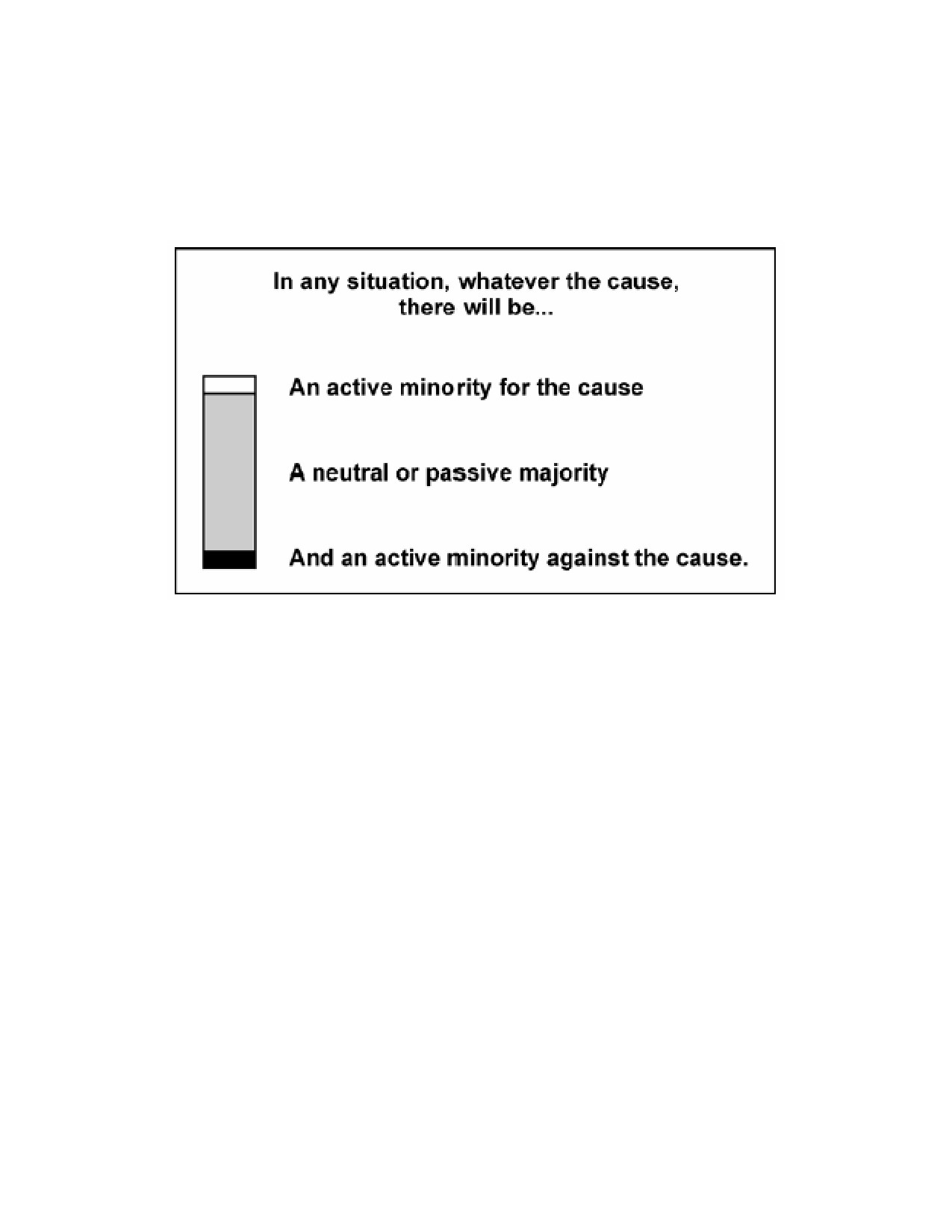
ANA 3-24
middle, which also includes passive supporters of both sides (See Figure 1-2.). Because
of the ease of sowing disorder, it is usually not enough for a counterinsurgent to get 51
percent of popular support; a solid majority is often essential. However, for an insurgent
with strong support from external agencies or criminal elements, a passive populace may
be all that is necessary to facilitate seizing political power.
Figure 1-2. Support for an Insurgency
1-83. Upon assuming a COIN mission, Soldiers and the police must not only be prepared
to identify their opponents and the approaches to insurgency they are applying.
Counterinsurgents must also understand the broader strategic context within which they
are operating. The level of violence and state of infrastructure influences the type and
amount of resources from sources within and outside the Ministry of Defense that can be
drawn upon. The number and type of outside agencies shape the amount of interagency
and international coordination required.
1-84. The rest of this manual presents detailed discussions about conducting
counterinsurgency operations. The following discussion addresses some general themes
shape the chapters that follow. It addresses the following:
Principles derived from past insurgencies.
Imperatives based on current COIN operations.
Paradoxes present in a COIN environment.
Successful and unsuccessful COIN practices.
1-85. The principles and imperatives of modern counterinsurgency derived from that
historical record and detailed below provide some guideposts for forces engaged in
counterinsurgency operations. However, counterinsurgency is complicated, and even
following the principles and imperatives does not guarantee success. This paradox is
present in all forms of warfare but is most obvious in counterinsurgency. The following
29
ANA 3-24
principles and imperatives are presented in the belief that understanding them helps to
illuminate the challenges inherent in defeating an insurgency.
HISTORICAL PRINCIPLES
1-86. The following principles are derived from past insurgencies.
Legitimacy is the Main Objective
1-87. The primary objective of any counterinsurgent is to foster the development of
effective governance by a legitimate government. All governments rule through a
combination of consent and coercion. Governments described as “legitimate” rule
primarily with the consent of the governed, while those described as “illegitimate” tend to
rely mainly or entirely on coercion. Their citizens obey the state for fear of the
consequences of doing otherwise, rather than because they voluntarily accept its rule. A
government that derives its powers from the governed tends to be accepted by its citizens
as legitimate. It still uses coercion—for example, against criminals—but the bulk of the
population voluntarily accepts its governance.
1-88. In Western, liberal tradition, a government that derives its just powers from the
people and responds to their desires while looking out for their welfare is accepted as
legitimate. In theocratic societies, political and religious authorities are fused, and
political figures are accepted as legitimate because the populace views them as
implementing the will of God. Medieval monarchies claimed “the divine right of kings”
and imperial China governed with “the mandate of heaven.” Since the 1979 revolution,
Iran has operated on the theocratic “rule of the jurists.” In other societies, “might makes
right” and security is the prime determinants of legitimacy.
1-89. Legitimacy makes it easier for the state to carry out its key functions, which include
the capability to regulate social relationships, extract resources and appropriate or use
resources in determined ways. A legitimate government can develop these capabilities
more easily, allowing it to competently manage, coordinate, and sustain collective
security as well as political, economic, and social development. Conversely, illegitimate
states typically fail to regulate society, or can only do so by the application of
overwhelming coercion (“police states”). Legitimate governance is inherently stable
because it engenders societal support to adequately manage the internal problems,
change, and conflict that invariably affect individual and collective well-being.
Conversely, governance that is not legitimate is inherently unstable because as soon as
the state’s coercive power is disrupted the population ceases to obey it. Thus legitimate
governments tend to be resilient and exercise better governance, while illegitimate states
tend to be fragile and poorly administered.
1-90. Five indicators of legitimacy that can be used to analyze threats to stability include:
Frequent selection of leaders in a manner considered just and fair by a substantial
majority of the population.
A high level of popular participation in or support for the political process.
30
ANA 3-24
A low level of corruption.
A culturally acceptable level or rate of political, economic, and social
development.
A high level of regime acceptance by major social institutions.
1-91. Governments that score high in these categories probably have the support of an
adequate majority of the population. Every culture, however, has varying concepts of
acceptable levels of development, corruption, and participation. The first two indicators
above reflect Western concepts. For some societies, it may be enough for a government
to only provide security and some basic services. However, that concept of security could
be very broad, and different groups could have widely divergent expectations.
1-92. During mission analysis for a COIN effort, commanders and staffs determine what
the host population defines as effective and legitimate governance, since this influences
all ensuing operations. Additionally, planners may also consider perceptions of
legitimacy held by outside supporters of the government or the insurgents. But the most
important attitude remains that of the indigenous population, who in the end will decide
the ultimate victor of the conflict.
1-93. The rule of law is a major factor in assuring voluntary acceptance of a
government’s authority and, therefore, its legitimacy. Because power may be exercised
illegitimately by individuals who use the instruments of a state for personal ends, a
government’s respect for pre-existing and impersonal legal rules can provide the key to
gaining it widespread and enduring societal support. Such governmental respect for
rules—ideally ones recorded in a constitution and in laws adopted through a credible and
democratic process—is the essence of rule of law. As such, it is a powerful potential
force in counterinsurgency.
1-94. Military action can address the symptoms of a loss of legitimacy. However,
restoring legitimacy can only be accomplished using all instruments of national power.
Without the host-nation government achieving legitimacy, COIN cannot succeed.
Unity of Effort is Essential
1-95. Unity of effort must pervade every echelon. Otherwise, well-intentioned but
uncoordinated actions can cancel each other out or provide a competent insurgent many
vulnerabilities to exploit. Ideally a counterinsurgent should have authority over all
government agencies involved in operations. However, the best situation that military
commanders can generally hope for is to be able to achieve unity of effort through
communication and liaison with those responsible for the nonmilitary agencies.
1-96. Nongovernmental organizations often play an important role at the local level.
Many such agencies resist being overtly involved with military forces, but efforts to
establish some kind of liaison are needed. The most important connections are those with
joint, interagency, multinational, and host-nation organizations to ensure, as much as
31
ANA 3-24
possible, that objectives are shared and actions and messages synchronized. Achieving
synergy is another essential element for effective COIN.
Political Factors are Primary
1-97. General Chang Ting-chen of Mao Zedong’s Central Committee once stated that
revolutionary war was 80 percent political action and only 20 percent military. At the
time he was involved with establishing special schools to train the extensive political
cadres that accompanied the victorious communist forces that completed their conquest
of mainland China in 1949. While in the initial stages of COIN, military actions appear
especially predominant, political objectives must retain primacy. Commanders conduct
all operations with consideration of their contribution toward strengthening the
legitimacy of the government and achieving the political goals set by the government.
The political and military aspects of insurgencies are so bound together as to usually be
inseparable, and most insurgent approaches recognize that fact. Military actions
conducted without proper assessment of political effects at best result in reduced
effectiveness and at worst are counterproductive. Resolving most insurgencies requires a
political solution, and it is imperative that the actions of the counterinsurgent do not make
achieving that political solution more difficult.
Understand the Environment
1-98. The local population is a critical center of gravity of an insurgency. Successful
conduct of counterinsurgency operations depends on thoroughly understanding the
society and culture within which they are being conducted. Soldiers must understand the
following about the population in the area of operations (AO):
How key groups in the society are organized.
Relationships and tensions among them.
Ideologies and narratives that resonate with the groups.
Group interests and motivations.
Means by which groups communicate.
The society’s leadership system.
1-99. In the vast majority of counterinsurgency operations since 1945, the insurgents
have held a distinct advantage in their level of local knowledge. They speak the language,
move easily within the society, and are more likely to understand the interests of the
population. Thus, effective counterinsurgency requires a leap of imagination and a
peculiar skill set not encountered in conventional warfare. The interconnected,
politico-military nature of insurgency and COIN requires immersion in the people and
their lives to achieve victory. Successful COIN operations require Soldiers at every
echelon to possess the following within the cultural context of the AO:
A clear, nuanced, and empathetic appreciation of the essential nature of the
conflict.
An understanding of the motivation, strengths, and weaknesses of the insurgents.
Knowledge of the roles of other actors in the AO.
32
ANA 3-24
Without this understanding of the environment, intelligence cannot be understood and
properly applied.
Intelligence Drives Operations
1-100. Without good intelligence, a counterinsurgent is like a blind boxer, wasting energy
flailing at an unseen opponent and perhaps causing unintended harm. With good
intelligence, a counterinsurgent is like a surgeon, cutting out cancerous tissue while
keeping other vital organs intact. Effective operations are shaped by carefully considered
actionable intelligence, gathered and analyzed at the lowest possible levels and
disseminated and distributed throughout the force.
1-101. Because of the dispersed nature of COIN, counterinsurgents’ own operations are a
key generator of intelligence. A cycle develops where operations produce intelligence
that drives subsequent operations. Tactical reporting by units, members of the country
team, and associated civilian agencies is of equal or greater importance than reporting by
specialized intelligence assets. These factors, along with the need to generate a superior
tempo, drive the requirement to produce and disseminate intelligence at the lowest
practical level.
Isolate Insurgents from Their Cause and Support
1-102. It is easier to cut an insurgency off and let it die than to kill every insurgent.
Attempting to kill every insurgent is normally impossible. It can also be
counterproductive, generating popular resentment, creating martyrs that motivate new
recruits, and producing cycles of revenge. Dynamic insurgencies also replace losses
quickly. A skillful counterinsurgent cuts off the sources of that recuperative power. Some
can be reduced by redressing the social, political, and economic grievances that fuel the
insurgency. Physical support can be cut off by population control or border security.
International or local legal action might be required to limit financial support. As the host
government increases its own legitimacy, the people begin to more actively assist it,
eventually marginalizing and stigmatizing insurgents to the point where their legitimacy
is destroyed. Victory is gained not when this isolation is achieved, but when it is
permanently maintained by and with the active support of the populace.
Establish Security Under the Rule of Law
1-103. The cornerstone of any COIN effort is security for the civilian population.
Without that, no permanent reforms can be implemented, and disorder spreads. To
establish legitimacy, security activities move as quickly as feasible from major combat
operations to law enforcement. When insurgents are seen as criminals they lose public
support; if they are dealt with by an established legal system in line with local
culture and practices, the legitimacy of the host government is enhanced. This process
takes time, but Soldiers remain aware of the legal procedures applicable to their conduct
and work to apply them. They also assist in the establishment of the indigenous
institutions that sustain that legal regime, including police forces, court systems, and
penal facilities.
33
ANA 3-24
1-104. Illegitimate actions by government officials, security forces, and multinational
partners are those involving the use of power without authority. Efforts to build a
legitimate government through illegitimate action—including unjustified or excessive use
of force, unlawful detention, torture, or punishment without trial—are self-defeating,
even against insurgents who conceal themselves amid noncombatants and flout the law.
Moreover, participation in counterinsurgency operations by ANA forces must be
pursuant to local law, which includes domestic laws and international treaties to which
the Islamic Republic of Afghanistan is party too (See Appendix C). Any human rights
abuses or legal violations committed by ANA forces quickly become known throughout
the local population and eventually around the world because of the globalized media and
work to undermine the COIN effort.
1-105. Every action by counterinsurgents leaves a “forensic trace” that may need to be
used in a court of law. Counterinsurgents document all their activities to preserve,
wherever possible, a chain of evidence— and often more importantly, as a means to
counter insurgent propaganda.
Prepare for a Long-Term Commitment
1-106. By its nature, insurgency is protracted. The conduct of counterinsurgency always
demands considerable expenditures of time and resources. Even if people prefer the host-
nation government to the insurgents, they do not actively support that government unless
they are convinced the counterinsurgent forces have the means, ability, stamina, and will
to win. The insurgent’s primary battle is against the indigenous government, but
multinational support can be crucial to building public faith in that government’s
viability. Insurgents and local populations often believe that a few casualties or a few
years will cause the multinational support to abandon a COIN effort. Constant
reaffirmations of commitment, backed by deeds, can overcome that perception and
bolster faith in the steadfastness of external support.
1-107. Preparing for the necessarily protracted support of COIN requires putting in place
purpose-dedicated headquarters and support structures designed for long-term operations.
Planning and commitments should be based on sustainable operating tempo and
personnel tempo limits for the various components of the force. Even in situations where
the multinational goal is reducing its military force levels as quickly as possible, some
support for host-nation institutions usually remains for a long time.
1-108. At the strategic level, winning and maintaining the support of the Afghan people
for a protracted COIN deployment is arguably the critical activity. Military commanders
are almost never directly involved in this process, which is properly a political activity.
They take care to ensure that their actions and statements, and the conduct of the
operation neither make it more difficult for elected leaders to maintain public support nor
undermine public confidence.
CONTEMPORARY IMPERATIVES OF COUNTERINSURGENCY
34
ANA 3-24
1-109. Recent experiences with counterinsurgency have highlighted an important set of
additional imperatives to keep in mind for success.
Manage Information and Expectations
1-110. Information and expectations are related, and both are carefully managed by a
skillful counterinsurgent. To limit discontent and build support, a host government and
any counterinsurgents assisting it create and maintain a realistic set of expectations
among the populace, friendly military forces, and the international community.
Information operations (including its related activities of public affairs, and civil-
military operations) are key tools to accomplish this. Achieving steady progress toward a
set of reasonable expectations can increase the population’s tolerance for the inevitable
inconveniences entailed by ongoing counterinsurgency operations. Where large
multinational forces are present to help establish a regime, such progress can extend the
period before an army of liberation becomes perceived as an army of occupation.
1-111. Multinational countries start with an automatic disadvantage because of their
reputation for accomplishment, what some call the “man on the moon syndrome.” This
refers to the expressed disbelief that nations that can put men on the moon cannot quickly
restore basic services. Agencies trying to fan enthusiasm for their efforts should also
avoid making exorbitant promises. In some cultures, failure to deliver promised results is
automatically interpreted as deliberate deception, not good intentions gone awry. In other
cultures, exorbitant promises are the norm, and people do not expect them to be kept. So
counterinsurgents must understand these local norms and employ locally tailored
approaches to ensure expectations are controlled. Managing expectations also involves
demonstrating economic and political progress to show the populace how life is
improving. Increasing the number of people who feel they have a stake in the success of
the state and its government is a key to successful COIN. In the final judgment, victory
comes by convincing the people that their life will be better under the government than
under the insurgent.
1-112. Both the counterinsurgent and the host government ensure that their deeds match
their words. They also understand that any action has an information reaction, carefully
consider that impact on the many audiences involved in the war and on the sidelines, and
work actively to shape the responses that further their ends. In particular, messages to
different audiences must be consistent. In the worldwide information environment, local
people in a counterinsurgency theater can access the Internet and satellite television to
find out what messages the counterinsurgent is sending to the international community.
Any perceived inconsistency destroys credibility and undermines COIN efforts.
Use Measured Force
1-113. Any use of force generates a series of reactions. There may be times when an
overwhelming effort is necessary to intimidate an opponent or reassure the populace. But
the type and amount of force to be applied, and who wields it, should be carefully
35
ANA 3-24
calculated by a counterinsurgent for any operation. An operation that kills five insurgents
is counterproductive if the collateral damage or the creation of blood feuds leads to the
recruitment of fifty more.
1-114. In a COIN environment, it is vital for commanders to adopt appropriate and
measured levels of force that accomplish the mission without causing unnecessary loss of
life or suffering. Normally, the counterinsurgent can minimize potential loss of life by
employing escalation of force procedures, especially at checkpoints and roadblocks, and
during convoy operations. The concept of escalation of force refers to the use of lesser
means of force when such use is likely to achieve the desired effects and Soldiers
can do so without endangering themselves, others, or the mission. Escalation of force
procedures are not limitations on the right of self-defense, including deadly force, when
such force is necessary to defend against a hostile act or demonstrated hostile intent.
Commanders must be familiar with the concept of force escalation and ensure that their
Soldiers are properly trained in its use.
1-115. Who wields force is also important. Providing the police have a reasonable
reputation for competence and impartiality, it is better to let police handle urban raids
than Soldiers, even if the police are not as well armed or capable as military units, since
the populace is likely to view that application of force as more legitimate. In other
circumstances, police may be seen as part of a particular ethnic or sectarian group that
oppresses the general population, and hence their use may be counterproductive. So,
effective counterinsurgents understand the character of the local police and popular
perceptions of both police and military units to ensure that the application of force is
measured and reinforces the rule of law.
Learn and Adapt
1-116. An effective counterinsurgent force is a learning organization. Insurgents
constantly shift between military and political phases and approaches. In addition,
networked insurgents constantly exchange information about their enemy’s
vulnerabilities—including with other insurgents in distant theaters. A skillful
counterinsurgent is able to adapt at least as fast as the insurgents. Every unit needs to be
able to make observations, draw lessons, apply them, and assess results. Headquarters
must develop an effective system to circulate best practices throughout the command
quickly. Combatant commanders might also need to seek new laws or policies to
authorize or resource necessary changes. Insurgents will shift their areas of operations
looking for weak links, so widespread competence is required throughout the
counterinsurgent force.
36
ANA 3-24
Empower the Lowest Levels
1-117. Mission command is the conduct of military operations through decentralized
execution based upon mission orders for effective mission accomplishment. Successful
mission command results from subordinate leaders at all echelons exercising disciplined
initiative within the commander’s intent to accomplish missions. It requires an
environment of trust and mutual understanding (ANA 1-3.6). It is the Army’s preferred
method for commanding and controlling forces during all types of operations. Under
mission command, commanders provide subordinates with a mission, their commander’s
intent, a concept of operations, and resources adequate to accomplish the mission. Higher
commanders empower subordinates to make decisions within the commander’s intent.
They leave details of execution to their subordinates and require them to use initiative
and judgment to accomplish the mission.
1-118. Mission command is ideally suited to the mosaic nature of insurgency and COIN.
Local commanders have the best grasp of their situations. Under mission command, they
are given access to or control of the assets needed to produce actionable intelligence and
manage information operations and civil-military operations. Effective COIN operations
are decentralized. Higher commanders owe it to their subordinates to push as many
capabilities as possible down to their level. Mission command encourages subordinates’
initiative within legal limits. It facilitates the learning process that must occur at every
level. Mission command is a major characteristic of a counterinsurgency force that can
adapt and react as quickly as the insurgents.
Support the Nation
1-119. ANA and security forces committed to COIN are there to assist the government.
In the end, the nation has to win its own war. Achieving this requires the development of
viable local leaders and institutions. ANA forces and agencies can help, but national
elements must be able to accept responsibilities to achieve real victory. While it may be
easier for ANA military units to conduct operations themselves, it is better to work to
strengthen local forces and then assist them. Host governments have the final
responsibility to solve their own problems. Eventually all foreign armies are seen as
interlopers or occupiers, and the sooner the main effort can be turned over to host-nation
institutions, the better.
PARADOXES OF COUNTERINSURGENCY
1-120. The principles and imperatives discussed above reveal that COIN presents a
complex and often unfamiliar set of missions and considerations for a military
commander. In many ways, the conduct of counterinsurgency is counterintuitive to the
traditional view of war—although it has actually formed a substantial part of
Afghanistan’s actual experience. Some representative paradoxes of COIN are presented
here as examples of the different mindset required.
37
ANA 3-24
The More You Protect Your Force, The Less Secure You Are
1-121. Ultimate success in COIN is gained by protecting the populace, not the COIN
force. If military forces stay locked up in compounds, they lose touch with the people,
appear to be running scared, and cede the initiative to the insurgents. Patrols must be
conducted, risk must be shared, and contact maintained. This ensures access to the
intelligence needed to drive operations and reinforces the connections with the people
that establish real legitimacy.
The More Force Used, the Less Effective It Is
1-122. Any use of force produces many effects, not all of which can be foreseen. The
more force applied, the greater the chance of collateral damage and mistakes. It also
increases the opportunity for insurgent propaganda to portray lethal military activities as
brutal. The precise and discriminate use of force also strengthens the rule of law that
needs to be established.
The More Successful COIN is, the Less Force That Can be Used and the More Risk
That Must be Accepted
1-123. This is really a corollary to the previous paradox. As the level of insurgent
violence drops, the requirements of international law and the expectations of the populace
allow less use of military actions by the counterinsurgent. More reliance is placed on
police work. Rules of engagement get stricter, and troops have to exercise increased
restraint. Soldiers may also have to accept more risk to maintain involvement with the
people.
Sometimes Doing Nothing is the Best Reaction
1-124. Often an insurgent carries out a terrorist act or guerrilla raid with the primary
purpose of enticing the counterinsurgent to overreact, or at least to react in a way that can
then be exploited. If a careful assessment of the effects of a course of action concludes
that more negative than positive effects may result, an alternative should be considered—
potentially including a decision not to act.
The Best Weapons for COIN Do Not Shoot
1-125. Counterinsurgents achieve the most meaningful success by gaining popular
support and legitimacy for the government, not by killing insurgents. Security plays an
important role in setting the stage for other progress, but lasting victory comes from a
vibrant economy, political participation, and restored hope. Often dollars and ballots have
a more important impact than bombs and bullets. Soldiers prepare to engage in a host of
nonmilitary missions to support COIN. Everyone has a role in nation-building!
The Local Government Doing Something Tolerably is Sometimes Better Than Us
Doing It Well For Them
38
ANA 3-24
1-126. It is just as important to consider who performs an operation as to assess how well
it is done. In cases where ANA have supported a local government, long-term success
requires the establishment of viable local leaders and institutions that can carry on
without significant support. The longer that process takes, the more popular support in
the in the local area will wane, and the more the local populace will question the
legitimacy of their own forces and government. If the local government cannot perform
tolerably, the COIN force may have to act. Experience, knowledge of the AO, and
cultural sensitivity are essential to deciding when such action is necessary.
If A Tactic Works This Week, It Might Not Work Next Week; If It Works In This
Province, It Might Not Work In The Next
1-127. Competent insurgents are adaptive and today are often part of a widespread
network that constantly and instantly communicates. Insurgents quickly disseminate
information about successful COIN practices throughout the insurgency and adapt to
them. Indeed, the more effective a COIN tactic is, the faster it becomes out of date
because the insurgents have a greater need to counter it. Effective leaders at all levels
avoid complacency and are at least as adaptive as their enemies. There is no “silver
bullet” set of procedures for COIN. Constantly developing new practices is essential.
Tactical Success Guarantees Nothing
1-128. When COL Harry Summers (USA) allegedly told a North Vietnamese counterpart
in 1975 that “You know you never defeated us on the battlefield,” the reply supposedly
was, “That may be so, but it is also irrelevant.” Military actions by themselves cannot
achieve success in COIN. Tactical actions must not only be linked to operational and
strategic military objectives, but also to the essential political goals of COIN. Without
those connections, lives and resources may be wasted for no real gain.
Most of the Important Decisions are Not Made By Generals
1-129. Successful COIN relies on the competence and judgment of Soldiers at all levels.
Senior leaders set the proper tone for actions by their organizations with thorough
training and clear guidance, and then trust their subordinates to do the right thing.
Preparation for tactical-level leaders requires more than Service doctrine; they must also
be trained and educated to adapt to their local situations, understand the legal and ethical
implications of their actions, and exercise subordinates’ initiative and sound judgment to
meet their senior commanders’ intent.
SUCCESSFUL AND UNSUCCESSFUL PRACTICES
1-130. Figure 1-3 lists some practices that have contributed significantly to success or
failure in past counterinsurgencies.
39
ANA 3-24
SUCCESSFUL PRACTICES
UNSUCCESSFUL PRACTICES
-Emphasis on intelligence.
-Place priority on killing and capturing the
enemy, not on engaging the population.
-Focus on the population, their needs,
-Conduct kandak-sized operations as the
and security.
norm.
-Isolate insurgent from the population.
-Concentrate military forces in large bases
-Appoint a single authority, usually a
for protection.
dynamic, charismatic leader.
-Focus special operations forces primarily
-Conduct effective, pervasive
on raiding.
psychological operations.
-Place a low priority on assigning quality
-Provide amnesty and rehabilitation for
advisors to local forces.
insurgents.
-Build and train local security forces in the
-Place police in the lead with military
image of the ANA.
support.
-Ignore peacetime government processes,
-Expand and diversify the police force.
including legal procedures.
-Train military forces to conduct
-Allow open borders and airspace.
counterinsurgency operations.
-Embed special operations forces and
advisors with local authorities.
-Deny the insurgents sanctuary.
Figure 1-3. Successful and Unsuccessful Counterinsurgency Practices
SUMMARY
1-131. Counterinsurgency is an extremely complex form of warfare—truly “war at the
graduate level.” At its core, counterinsurgency warfare is a struggle for the support of the
population. Their protection and welfare is the center of gravity for friendly forces.
1-132. Gaining and maintaining that support is a formidable challenge. There are a host
of non-military agencies whose efforts must be synchronized and coordinated with those
of the military to achieve these aims. Popular support allows counterinsurgents to
develop the intelligence necessary to identify and defeat the insurgents. Intelligence
drives operations in successful counterinsurgency operations; those operations
in turn provide additional intelligence, driving further operations. Designing and then
executing a campaign to garner the support of the population requires careful
coordination of several logical lines of operations to produce success over time. One of
these lines is developing host nation security forces who can take over primary
responsibility for combating the insurgency. COIN also places distinct burdens on
leaders and logisticians. All of these aspects of COIN are described and analyzed in the
chapters that follow.
1-133. Insurgents are also fighting for the support of the population, but are constrained
by neither the law of war nor the bounds of human decency. They do anything to
preserve their greatest advantage, the ability to hide among the people. These amoral
enemies survive by their wits, constantly adapting to the situation. To defeat them, it is
40
ANA 3-24
essential that counterinsurgent forces develop the ability to learn and adapt rapidly and
continuously. This manual focuses on this “learn and adapt” counterinsurgency
imperative as it discusses ways to gain and maintain the support of the people.
41
ANA 3-24
Chapter 2
Unity of Effort: Integrating Civilian and Military Activities
Essential though it is, the military action is secondary to the political one, its primary
purpose being to afford the political power enough freedom to work safely with the
population.
This chapter begins by discussing the principles involved in integrating the activities of
military and civilian organizations. It then describes the categories of organizations
usually involved in counterinsurgency operations. After that, it discusses how
responsibilities may be assigned and the mechanisms used to integrate civilian and
military activities. It concludes by listing information commanders need to know about
civilian agencies operating in their area of operations.
INTEGRATION
2-1. Although military efforts are necessary and important, they are only effective if
integrated into a comprehensive strategy employing all instruments of national power. A
successful counterinsurgency (COIN) meets the contested population’s needs while
protecting it from the insurgents. Effective COIN operations ultimately render the
insurgents irrelevant. This requires military forces engaged in COIN to:
Be acutely aware of the roles and capabilities of international, and governmental
partners.
Include other participants in planning at every level.
Be supportive of civilian efforts.
If necessary, conduct or participate in political, social, informational, and
economic programs.
2-2. The integration of civilian and military efforts is crucial in COIN and must be
focused on supporting the local population and the government. Political, social, and
economic programs are usually more valuable than conventional military operations as a
means to address root causes of conflict and undermine an insurgency. In COIN, military
personnel, diplomats, police, politicians, humanitarian aid workers, contractors, and local
leaders are faced with making decisions and solving problems in a complex and acutely
challenging environment. Controlling the level of violence is a key element of the
struggle. The insurgents often benefit from a high level of violence and societal insecurity
that discourages or precludes nonmilitary participants from helping the local population.
The higher the level of violence that defines the operational environment, the less likely it
is that nonmilitary organizations, particularly external agencies, can work with the local
population to address social, political, economic and other challenges. The more benign
the security environment, the more likely it is that civilian agencies can provide their
resources and expertise, and relieve the burden on the military forces.
2-3. Organized combat is an expertise that only military forces are required to possess.
Military forces do apply their combat skills to fighting insurgents; however, they can and
42
ANA 3-24
should be engaged in using their capabilities to meet the local population’s fundamental
needs as well. Only regaining active and continued support of the government by the
local population can deprive an insurgency of its power and appeal. The military forces’
primary function in COIN is protecting that population. However, military force is not
the sole means to provide security or defeat insurgents. Indeed, a dilemma for military
forces engaged in COIN is that they frequently have greater potential to undermine policy
objectives through excessive emphasis on military force than to achieve the overarching
political goals that define success. This dilemma places tremendous importance on the
measured application of coercive force by COIN forces.
2-4. Durable policy success requires balancing the measured use of force with an
emphasis on nonmilitary programs. Although political, social and economic programs are
most commonly and appropriately associated with civilian organizations and expertise,
the salient aspect of such programs is their effective implementation, not who performs
the tasks. If adequate civilian capacity is not available, members of the military forces
must be prepared to fill the gap. COIN programs for political, social, and economic well-
being are essential elements for developing local capacity that will command popular
support when properly perceived. COIN is also a battle of ideas, and insurgents exploit
actions and programs to create misperceptions and further their cause. Comprehensive
informational programs are necessary to amplify the messages of positive deeds and to
counter insurgent propaganda.
2-5. COIN is fought among the population, and the counterinsurgents bear responsibility
for the people’s well-being in all its manifestations. These include the following:
Security from violence and crime.
Provision of basic economic needs.
Maintenance of infrastructure.
Sustainment of key social and cultural institutions.
Other aspects that contribute to a society’s basic quality of life.
The COIN program must address all aspects of the local population’s concerns in a
unified fashion. Insurgents succeed by maintaining turbulence and highlighting local
costs due to gaps in the COIN effort. COIN forces success by eliminating turbulence and
meeting the population’s basic needs.
2-6. Success in counterinsurgency requires the application of national resources along
multiple lines of operations. (See Chapter 5.) The fact that efforts along one line of
operations can easily affect progress in others means that uncoordinated actions are
frequently counterproductive.
2-7. Lines of operations in COIN focus primarily on the population. Each line is
dependent on the others. Their interdependence is similar to factors in a multiplication
equation: if the value of one of the lines of operations is zero, the overall product is zero.
Many of these lines of operations require the application of expertise usually found in
civilian organizations. These include:
43
ANA 3-24
Islamic Republic of Afghanistan agencies other than the Ministry of Defense
(MOD).
International organizations (such as the United Nations and its many
suborganizations).
Nongovernmental organizations (NGOs).
Private corporations.
Other organizations that wield diplomatic, informational, and economic power.
These civilian organizations bring expertise and capabilities that complement those of
military forces engaged in COIN operations. At the same time, civilian capabilities
cannot be brought to bear without the security provided by military forces. The
interdependent relationship of all these groups must be understood and orchestrated to
achieve harmony of action and coherent results.
UNITY OF COMMAND
2-8. Where possible, formal relationships should be established and maintained for unity
of command. For all elements of the Islamic Republic of Afghanistan engaged in a
particular COIN mission, formal command and control using established command
relationships within a clear hierarchy should be taken for granted. Unity of command
should also extend to all military forces supporting the nation. The ultimate objective of
these arrangements is for local military forces, police, and other security forces to
establish effective command and control while attaining a monopoly on the legitimate use
of violence within the society.
2-9. As important as the principle of unity of command is to military operations, it is one
of the most difficult and sensitive issues to resolve in COIN. Afghan and other external
military participation in COIN are inherently problematic, as it influences perceptions of
the capacity and legitimacy of local security forces. Although unity of command of
military forces may be desirable, it may be impractical due to political considerations.
Political sensitivities about the perceived subordination of national forces to those of
other states or international organizations often preclude strong command relationships.
The differing goals and fundamental independence of NGOs and local organizations
frequently prevent formal relationships. In the absence of formal relationships governed
by command authority, military leaders seek to persuade and influence other participants
to contribute to attaining COIN objectives. Informal or less authoritative relationships
include coordination and liaison with other participants. In some cases, direct interaction
among various organizations may be impractical or undesirable. Basic awareness and
general information sharing may be the most that can be accomplished.
UNITY OF EFFORT
2-10. Informed and strong leadership is a foundation of successful COIN operations. The
focus of leadership must be on the central problems that affect the local population. A
clear vision of resolution should infuse all efforts, regardless of the specific agencies or
individuals charged with their execution (See Chapter 4). All elements supporting the
COIN should strive for maximum unity of effort. Given the primacy of political
44
ANA 3-24
considerations, military forces often support civilian efforts. However, the mosaic nature
of COIN operations means that lead responsibility shifts among military, civilian, and
governmental authorities. Regardless, military leaders must be prepared to assume local
leadership for COIN efforts and remember that the organizing imperative is to focus on
what needs to be done, not on who does it.
2-11. Countering an insurgency begins with understanding the complex environment and
the numerous competing forces acting upon it. Gaining an understanding of the
environment—to include the insurgents, affected populace, and disparate organizations
attempting to counter the insurgency—is essential to an integrated COIN operation. The
complexity of resolving the causes of the insurgency and integrating actions across
multiple and interrelated lines of operations requires an understanding of the civilian and
military capabilities, activities, and vision of resolution. Just as Soldiers use different
tactics to achieve an objective, so the various agencies acting to re-establish stability may
differ in goals and approaches. When their actions are allowed to adversely impact each
other, the population suffers and insurgents identify gaps to exploit. Integrated actions are
essential to defeat the ideologies professed by insurgents. A shared understanding of the
operation’s purpose provides a unifying theme for COIN efforts. Through a common
understanding of that purpose, the COIN team can design an operation that promotes
effective collaboration and coordination among all agencies and the affected population.
COORDINATION AND LIAISON
2-12. A vast array of organizations can influence successful COIN operations. Given the
complex diplomatic, informational, military, and economic context of an insurgency,
there is no way for military leaders to assert command over all elements—nor should
they try to do so. Among interagency partners, NGOs, and private organizations, there
are many interests and agendas that military forces will be unable to control.
Additionally, local legitimacy is frequently affected by the degree to which local
institutions are perceived as independent and capable without external support.
Nevertheless, military leaders should make every effort to ensure that actions in support
of the COIN are as well integrated as possible. Active leadership by military leaders is
imperative to conduct coordination, establish liaison (formal and informal) and share
information among various groups working on behalf of the local population. Influencing
and persuading groups beyond a commander’s direct control requires great skill and often
great subtlety. As actively as commanders may pursue unity of effort, they should also be
mindful of the visibility of their role and recognize the wisdom of acting indirectly and in
ways that allow credit for success to go to others— particularly local individuals and
organizations.
2-13. Local leaders, informal associations, families, tribes, some private enterprises, some
humanitarian groups, and the media often play critical roles in influencing the outcome of
a COIN but are beyond the control of military forces or civilian governing institutions.
Commanders remain aware of the influence of such groups and are prepared to work
with, through, or around them.
45
ANA 3-24
KEY COUNTERINSURGENCY PARTICIPANTS AND THEIR LIKELY
ROLES
2-14. Likely participants in COIN operations include the following:
ANA forces.
Multinational forces.
The government.
Nongovernmental organizations.
International organizations.
Multinational corporations and contractors.
Civil authorities.
MILITARY FORCES
2-15. The role of military forces in COIN operations is extensive. As one of the most
demanding and complex forms of warfare, COIN draws heavily on the broad range of
capabilities of the joint force. Military forces must be prepared to conduct a different mix
of offensive, defensive and stability operations from that expected in major combat
operations. Air, and land elements all contribute to successful operations and to the vital
effort to cut off and isolate insurgents from the populations they seek to control.
Nonetheless, the Army usually furnishes the principal military contributions to COIN.
Within the land forces, special operations forces (SOF) are particularly valuable to COIN
due to their specialized capabilities: civil affairs, psychological operations, intelligence,
language skills, and regional-specific knowledge. SOF can also provide very light, agile,
high-capability teams that can operate discreetly in local communities.
2-16. Afghan military forces are vastly capable. Designed predominantly for
conventional warfare, they nonetheless have the essential components to successfully
prosecute COIN. The most important assets in COIN are disciplined Soldiers with
adaptive, self-aware, and intelligent leaders. There are also elements of the military
forces that are particularly relevant to common COIN challenges. For example, COIN
often requires dismounted infantry, human intelligence, language specialists, military
police, engineers, medical units, logistical support, legal affairs, and contracting
elements. All of these elements are found in the Army.
2-17. Afghan forces help paramilitary, and police forces conduct COIN operations,
including area security and local security operations. Afghan forces advise and assist in
finding, dispersing, capturing, and defeating the insurgent force, while emphasizing the
training of other forces to perform essential defense functions. The current and more
extensive national security demands for such efforts require that all Afghan Forces be
prepared to contribute to the establishment and training of local security forces.
2-18. Land combat forces conduct full spectrum operations to disrupt or destroy insurgent
military capabilities. Land forces use offensive combat operations to disrupt insurgent
efforts to establish base areas and consolidate their forces. They conduct defensive
operations to provide area and local security. They conduct stability operations to thwart
46
ANA 3-24
insurgent efforts to control or disrupt people’s lives and routine activities. In all
applications of combat power, Afghan forces first ensure that likely costs do not
outweigh or undermine other more important COIN efforts.
2-19. Most valuable to long-term success in winning the support of the population are the
contributions land forces can make by conducting stability operations. A stability
operation is an operation to establish, preserve, and exploit security and control over
areas, populations, and resources (ANA 1-3). Forces engaged in stability operations
establish, safeguard, or restore basic civil services. They act directly and in support of
governmental agencies. Success in stability operations enables the local population and
government agencies of the nation to resume or develop the capabilities needed to
conduct COIN operations and create the conditions that will permit Afghan military
forces to disengage.
2-20. Military forces can also use their capabilities to enable the efforts of nonmilitary
participants. Logistics, transportation, equipment, personnel, and other assets can support
interagency partners and other civilian organizations.
MULTINATIONAL MILITARY FORCES
2-21. Afghan military forces may operate in a COIN environment with coalition forces.
In a COIN operation, Afghan forces will probably operate with the security forces of the
local population. Many other countries’ military forces bring cultural backg1rounds,
historical experiences, and other capabilities that can be particularly valuable to COIN
efforts.
2-22. However, nations join coalitions for varied policy aims. Although missions may be
ostensibly similar, rules of engagement, home-country policies, and sensitivities will
differ among multinational partners. Afghan military leaders require a strong cultural and
political awareness of other multinational military partners.
NONMILITARY COUNTERINSURGENCY PARTICIPANTS
2-23. Many nonmilitary organizations may be engaged in supporting the ANA as it
confronts an insurgency. Some of these organizations are discussed below.
Government Organizations
2-24. Commanders must be familiar with government organizations and aware of the
capabilities they can provide for COIN. During planning, all forces should determine
which organizations are supporting their function or operating in their AO. Commanders
and civilian leaders of government organizations should collaboratively plan and
coordinate actions to avoid conflict or duplication of effort. Within the Islamic Republic
of Afghanistan, key organizations include:
Ministry of Defense.
Ministry of the Interior.
47
ANA 3-24
Ministry of Transportation/Aviation.
Ministry of Justice.
Ministry of Finance.
Ministry of Agriculture.
Ministry of Commerce.
General Department of Intelligence.
Nongovernmental Organizations
2-25. Doctrine defines a nongovernmental organization as a private, self-governing, not-
for-profit organization dedicated to alleviating human suffering; and/or promoting
education, health care, economic development, environmental protection, human rights
and conflict resolution; and/or encouraging the establishment of democratic institutions
and civil society (MOD Dictionary of Military Terms). There are several thousand NGOs
of many different types. Their activities are governed by their organizing charters and the
motivations of their members. Some NGOs receive at least part of their funding from
national governments or international governmental organizations and may become
implementing partners in accordance with specific grants or contracts. (For example,
USAID provides some NGO funding.) In these cases, the funding organization often
gains oversight and authority over how the funds are used.
2-26. Some NGOs maintain strict independence from governments and other belligerents
in a conflict and do not want to be seen directly associating with military forces. Gaining
their support and coordinating operations with them can be difficult. While establishing
basic awareness of these groups and their activities may be the most commanders can
achieve, it is important to note the role of NGOs in resolving an insurgency. Many of
these NGOs arrive before military forces and remain long afterwards. They can support
lasting stability. To the greatest extent possible, the military should complement and not
override their capabilities. Building a complementary and trust-based relationship is vital.
Examples of NGOs include:
International Committee of the Red Cross.
Afghan Red Crescent
World Vision.
Médecins sans Frontières (Doctors Without Borders).
Cooperative for Assistance and Relief Everywhere (CARE).
Oxford Committee for Famine Relief (OXFAM).
Save the Children.
Mercy Corps.
Academy for Educational Development.
International Organizations
2-27. The most notable international organization is the United Nations (UN). Regional
organizations like the European Union may be involved in some COIN operations. The
UN in particular has many subordinate or affiliated agencies that are active around the
world. Depending on the nature of the situation and the needs of the country involved,
any of several UN organizations may be present, such as the following:
48
ANA 3-24
Office of the Chief of Humanitarian Affairs.
Department of Peacekeeping Operations.
World Food Program.
UN Refugee Agency (known by the acronym for its director, the UN High
Commissioner for Refugees—UNHCR).
UN High Commissioner for Human Rights.
UN Development Program.
Multinational Corporations and Contractors
2-28. Multinational corporations often engage in reconstruction, economic development,
and governance activities. At a minimum, commanders should know which companies
are present in their AO and where those companies are conducting business. Such
information can prevent fratricide or destruction of private property.
2-29. Recently, private contractors from firms providing military-related services have
become more prominent in theaters of operations. This category includes armed
contractors providing an array of security services to the Islamic Republic of
Afghanistan, NGOs, and private businesses. There are also many businesses that market
expertise in areas related to supporting governance, economics, education, and other
aspects of civil society. Providing capabilities similar to some NGOs, these firms often
attain contracts through government agencies.
2-30. When contractors or other businesses are being paid to support Afghan military or
other government agencies, the principle of unity of command should apply.
Commanders should be able to influence contractors’ performance through Islamic
Republic of Afghanistan contract supervisors. When under contract to the Afghan
National Government, such contractors should behave as an extension of the
organizations or agencies for which they work. Commanders should identify contractors
operating in their AO and determine the nature of their contract, existing accountability
mechanisms, and appropriate coordination relationships.
National Civil Authorities
2-31. Sovereignty issues are among the most difficult for commanders conducting COIN
operations, both in regard to forces contributed by other nations and by the Islamic
Republic of Afghanistan. Often, commanders are required to lead through coordination,
communication, and consensus, in addition to traditional command practices. Political
sensitivities must be acknowledged. Commanders and subordinates often act as diplomats
as well as warriors. Within military units, legal officers and their staffs are particularly
valuable for clarifying legal arrangements with the host nation. To avoid adverse effects
on operations, commanders should address all sovereignty issues through the chain of
command. As much as possible, sovereignty issues should be addressed before executing
operations. Examples of key sovereignty issues include the following:
Collecting and sharing information.
Basing.
Overflight rights.
49
ANA 3-24
Aerial ports of debarkation.
Location and access.
Border crossings.
Force protection.
Jurisdiction over members of multinational forces.
2-32. Commanders should create coordinating mechanisms, such as committees or liaison
elements, to facilitate cooperation and build trust with authorities. Military or nonmilitary
representatives should have leading roles in such mechanisms. These organizations
facilitate operations by reducing sensitivities and misunderstandings while removing
impediments. Sovereignty issues can be formally resolved through the development of
appropriate technical agreements to augment existing or recently developed status of
forces agreements. In many cases, security assistance organizations, NGOs, and
international organizations have detailed local knowledge and reservoirs of good will that
can facilitate the establishment of a positive and constructive relationship with the local
authorities.
2-33. Coordination and support should exist down to local levels (such as villages and
neighborhoods). Soldiers should be aware of the political and societal structures in their
AOs. Political structures usually have designated leaders responsible to the government
and people. However, the societal structure may include informal leaders who operate
outside the political structure. These leaders may be economic (such as businessmen),
theological (such as mullahs), informational (such as newspaper publishers or
journalists), or family-based (such as elders or tribal leaders). Some societal leaders may
emerge due to charisma or other intangible influences. Commanders should identify the
key leaders and the manner in which they are likely to influence COIN efforts.
KEY RESPONSIBILITIES IN COUNTERINSURGENCY
2-34. Noted counterinsurgency author David Galula wisely stated, “To confine soldiers to
purely military functions while urgent and vital tasks have to be done, and nobody else is
available to undertake them, would be senseless. The soldier must then be prepared to
become…a social worker, a civil engineer, a schoolteacher, a nurse, a boy scout. But only
for as long as he cannot be replaced, for it is better to entrust civilian tasks to civilians.”
PREFERRED DIVISION OF LABOR
2-35. The preference in COIN is always to have civilians carry out civilian tasks. Civilian
agencies or individuals with the greatest expertise for a given task should perform it—
with special preference for legitimate local civil authorities. Although there are many
international civilian agencies that possess greater expertise than military forces for
meeting the fundamental needs of a population under assault, the ability of such agencies
to deploy to in sustainable numbers and with ready access to necessary resources is
usually limited. The degree of violence in the AO also affects the ability of civilian
agencies to operate. The more violent the environment, the more difficult it is for
civilians to operate effectively. Hence, the preferred or ideal division of labor is
50
ANA 3-24
frequently unattainable. The more violent the insurgency, the more unrealistic is this
preferred division of labor.
REALISTIC DIVISION OF LABOR
2-36. By default, military forces often possess the only readily available capability to
meet many of the fundamental needs of local populations. Human decency and the law of
war require land forces to assist populations in their AOs. Leaders at all levels prepare to
address civilian needs. Leaders identify people in their units with regional expertise,
interagency know-how, civil-military competence, and other critical skills that can
usefully support a local population and the local government. Useful skill sets may
include the following:
Knowledge, cultural understanding, and appreciation of the region.
Functional skills for interagency and local government coordination (for example,
liaison, negotiation, and appropriate social or political relationships).
Language skills enabling more effective coordination with NGOs and
multinational partners.
Knowledge of the civil foundations for infrastructure, economy, governance, or
other lines of operation being pursued as part of the COIN effort.
2-37. Islamic Republic of Afghanistan and international agencies rarely have the
resources and capabilities needed to address all tasks required in a COIN environment.
Successfully accomplishing a COIN mission requires leaders who are adaptive in their
thinking and understand that they must be prepared to address the required tasks with
available resources. They must understand that the overall purpose is always guided by
the fact that long-term security does not come solely or even primarily from a gun; it
comes from an integrated and balanced application of efforts along all lines of operations,
with the goal of supporting the local population and achieving legitimacy of the
government.
TRANSITIONS
2-38. Regardless of the division of labor, an important recurring feature of COIN is the
transition of responsibility and participation in key lines of operations. As consistently
and conscientiously as possible, military leaders ensure continuity in meeting the needs
of the local government and the local population. The same general guidelines that
govern battle handovers apply to transitions between participants in COIN. Whether the
transition is from one military unit to another or from a military unit to civilian agencies
(external or local), everyone involved requires a clear understanding of tasks and
responsibilities to be passed from one element to the next. Maintaining unity of effort is
particularly important during transitions, especially between elements of different
capabilities and capacity. Relationships tend to break down during transitions. Transition
is not a single event, where all activity happens at once. It is a rolling process of little
handoffs between different actors along several streams of activities, and there are
usually multiple transitions for any one stream of activity over time. Using the
coordination mechanisms in the next section can help to create and sustain the linkages
that support effective transitions without compromising unity of effort.
51
ANA 3-24
CIVILIAN AND MILITARY INTEGRATION MECHANISMS
2-39. Applying the principle of unity of effort is possible in many organizational forms.
The first choice should be to identify existing coordination mechanisms and incorporate
them into comprehensive COIN efforts. This includes existing Islamic Republic of
Afghanistan, multinational, and local government mechanisms. Context is extremely
important. Although many of these structures exist and are often employed in other types
of missions, there is an acute and fundamental difference in an insurgency environment.
The nature of the conflict and its focus on the population makes civilian and military
unity a decisive point for the insurgents. The following discussion highlights some of the
well established, general mechanisms for civilian and military integration. Many civil-
military organizations and mechanisms have been created for specific missions. Although
the names and acronyms differ, in their general outlines they usually reflect the concepts
portrayed in the following sections.
2-40. The Islamic Republic of Afghanistan influences events nationally through the
effective employment of the instruments of national power. These instruments are
diplomatic, informational, military and economic and are coordinated by the appropriate
agency.
2-41. The Ministry of Defense and the Ministry of the Interior are the President’s
principal forums for considering national security and foreign policy matters. They serve
as the President’s principal means for coordinating policy among various interagency
organizations.
JOINT INTERAGENCY COORDINATION GROUP
2-42. A Joint Interagency Coordination Groups (JIACGs) helps commanders in the
conduct of COIN operations by providing interagency support of plans, operations,
contingencies, and initiatives. The goal of a JIACG is to provide timely, usable
information and advice from an interagency perspective to the commander by
information sharing, integration, synchronization, training, and exercising. JIACGs may
include representatives from other national ministries and agencies, province and local
authorities, and liaison officers from other components. The interagency representatives
and liaison officers are the subject matter experts for their respective agencies and
commands, and provide the critical bridge between the commander and interagency
organizations.
2-43. In a protracted counterinsurgency, ANA forces may be spread extensively
throughout the country. This creates a greater need for additional mechanisms to extend
civilian oversight and assistance to match the scope of the challenge. Operating with a
clear understanding of the guiding political aims, members of the military at all levels
must be prepared to exercise judgment and act without the benefit of immediate civilian
oversight and control. At each subordinate political level of the government, military and
civilian leaders should establish a coordinating structure, such as a civil-military
operations center (CMOC), that includes representatives of the government, security
forces, as well as multinational forces and agencies. CMOCs facilitate the integration of
52
ANA 3-24
military and political actions. Below the national level, additional structures may be
established where military commanders and civilian leaders can meet directly with local
leaders to discuss issues. Where possible, international organizations and NGOs should
be encouraged to participate in coordination meetings to ensure their actions are
integrated with military and national government plans.
CIVIL-MILITARY OPERATIONS CENTER
2-44. Another mechanism that can be used for bringing elements together for
coordination is the CMOC. CMOCs can be established at all levels of command. CMOCs
coordinate the interaction of the ANA and multinational military forces with a wide
variety of civilian agencies. A CMOC is not designed, nor should it be used as, a
command and control element. However, it does provide a useful venue to transmit the
commander’s guidance to other agencies and exchange information, and to facilitate
complementary and unified efforts.
2-45. Overall management of a CMOC may be assigned to a multinational force
commander, shared by an ANA and a multinational commander, or shared by an ANA
commander and a civilian agency head. A CMOC is an operations center that can be used
to build on-site, interagency coordination to achieve unity of effort. There is no
established structure for a CMOC; its size and composition depend on the situation.
Senior civil affairs officers normally serve as the CMOC director and deputy director.
Other military participants usually include civil affairs, legal, operations, logistics,
engineering, and medical sections of the supported headquarters. Civilian members of a
CMOC may include U.S. government organizations, multinational partners, international
organizations, Islamic Republic of Afghanistan members or other local organizations, and
NGOs.
TACTICAL-LEVEL INTERAGENCY CONSIDERATIONS
2-46. Tactical units may find interagency expertise pushed to their level when they are
responsible for large AOs in a COIN environment. Tactical units down to company level
must be prepared to integrate their efforts with civilian organizations.
2-47. To ensure integration of interagency capabilities, units should conduct coordination
with all interagency representatives and organizations that enter their AO. Despite the
best efforts to coordinate, often the fog and friction inherent in COIN will lead to civilian
organizations entering an AO without prior coordination. Below is a suggested list for
conducting coordination with interagency and other nonmilitary organizations who may
operate in a unit’s AO:
Identify organizational structures and leadership.
Identify key objectives, responsibilities, capabilities, and programs.
Develop common courses of action or options for inclusion in planning,
movement coordination, and security briefings.
Develop relationships that enable the greatest possible integration.
Assign liaison officers to the most important civilian organizations.
Define problems in clear and unambiguous terms.
53
ANA 3-24
2-48. Other useful information about the organizations includes the following:
Intended duration of operations.
Location of bases of operations.
Number of personnel (names, descriptions).
Type, color, number and license numbers of civilian vehicles.
Other resources in the AO.
Local groups and agencies with whom they are working.
Terms of reference or operating procedures.
SUMMARY
2-49. As President John F. Kennedy, of the United States, eloquently noted, “You
[military professionals] must know something about strategy and tactics and logistics, but
also economics and politics and diplomacy and history. You must know everything you
can know about military power, and you must also understand the limits of military
power. You must understand that few of the important problems of our time have…been
finally solved by military power alone.” Nowhere is this insight more relevant than in
COIN. Successful COIN requires unity of effort in bringing all instruments of national
power to bear. Civilian agencies can contribute directly to military operations,
particularly by providing intelligence. That theme will be developed in more detail in the
next chapter.
54
ANA 3-24
Chapter 3
Intelligence in Counterinsurgency
Everything good that happens seems to come from good intelligence.
General Creighton Abrams
Effective, accurate, and timely intelligence is essential to the conduct of any form of
warfare. This maxim applies especially to counterinsurgency operations, as the ultimate
success or failure of the mission depends on the effectiveness of the intelligence effort.
This chapter builds upon previous concepts to further describe insurgencies, requirements
for intelligence preparation of the battlefield and pre-deployment planning, collection and
analysis of intelligence in counterinsurgency, intelligence fusion, and general
methodology for integrating intelligence to support operations. This chapter does not
supersede processes in ANA military doctrine but instead provides specific guidance for
counterinsurgency.
ECTION I - INTELLIGENCE
3-1. Counterinsurgency (COIN) is an intelligence war. The function of intelligence in
COIN is to facilitate understanding of the operational environment, with emphasis on the
populace, nation, and insurgents, so commanders can best address the issues driving the
insurgency. Both insurgents and counterinsurgents require an effective intelligence
capability to be successful. They attempt to create and maintain intelligence networks
while trying to neutralize their opponent’s intelligence capabilities.
3-2. Intelligence in COIN is about people. ANA forces must understand the people of the
nation, the insurgents, and the local government. Commanders and planners must have
insight into cultures, perceptions, values, beliefs, interests and decision-making processes
of individuals and groups. These requirements are the basis for collection and analytical
efforts.
3-3. Intelligence and operations feed back on one another. Effective intelligence drives
effective operations, which produce more intelligence. Similarly, ineffective or inaccurate
intelligence produces ineffective operations, which reduce the availability of intelligence.
3-4. All operations have an intelligence component to them. This is because all Soldiers
are potential intelligence collectors whenever they interact with the people. Operations
should therefore always include intelligence collection requirements.
3-5. Insurgencies are local. They vary greatly in time and space. The insurgency one
Kandak faces will often be different from that of an adjacent Kandak. This shifting
mosaic nature of insurgencies coupled with the fact that all Soldiers are intelligence
collectors means all echelons are both intelligence producers and consumers, resulting in
a bottom-up flow of intelligence. This pattern also means that tactical units at brigade and
55
ANA 3-24
below will require a great deal of support for both intelligence collection and analysis, as
their organic intelligence structure will often be inadequate.
3-6. Counterinsurgency occurs in a joint, interagency, and multinational environment at
all echelons. Soldiers must coordinate intelligence collection and analysis with foreign
militaries, foreign intelligence services, and many different intelligence organizations.
3-7. The purpose of pre-deployment planning and intelligence preparation of the
battlefield (IPB) is to develop an understanding of the operating environment to drive
planning and pre-deployment training. Pre-deployment intelligence must be as detailed as
possible and focus on the nation, its people, and insurgents in the AO. Commanders and
staffs use pre-deployment intelligence to establish a plan for addressing the underlying
causes of the insurgency and to prepare their units to interact with the populace in an
appropriate manner. The desired end state is that commanders and their subordinates are
not surprised by what they encounter.
3-8. Preparation for deployment begins with IPB. This is the systematic, continuous
process of analyzing the threat and environment in a specific geographic area. It is
accomplished via the four steps:
Define the operational environment.
Describe the effects of the environment.
Evaluate the threat.
Determine threat courses of action.
3-9. IPB in COIN places great emphasis on people and leaders in an area of operations
(AO). (IPB is covered in depth in Appendix B.) Though IPB is a continuous process and
products resulting from it will be revised throughout the mission, the initial products
created prior to deployment are of particular importance for the reasons explained above.
Whenever possible, personnel must conduct a very thorough and detailed IPB in
preparation for deployment. IPB in COIN requires intelligence personnel to work in areas
such as economics, anthropology, and governance that may be outside their expertise.
Therefore, integrating staffs and drawing upon the knowledge of non-intelligence
personnel and external subject matter experts with local and regional knowledge are
critical to effective unit preparation.
3-10. If there are already units deployed, these are the best potential sources of
intelligence available. Deploying units should make an effort to reach forward to units in
the field. Governmental agencies are often able to provide country studies and other
backg1round information on the enemy. Open-source intelligence is also very important to
pre-deployment IPB. In many cases, backg1round information on the populace, cultures,
languages, history, and government of an AO may be found in open sources. These
include books, magazines, encyclopedias, web sites, maps, and atlases.
56
ANA 3-24
DEFINE THE OPERATIONAL ENVIRONMENT
3-11. The operational environment consists of the air, land, and associated adversary,
friendly, and neutral systems (political, military, economic, social, informational,
infrastructure, legal, and others) that are relevant to a specific operation. At the tactical
and operational levels, defining the operational environment involves defining a unit’s
AO and then establishing an area of interest. AOs may be relatively static, but people and
information flow through the AO continuously. Therefore, when defining an area of
interest, both physical and human geography are taken into account. This is because an
AO will often cut across not just physical lines of communication, such as roads, but also
areas that are tribally, economically, or culturally interrelated. For instance, tribal and
family groups in Afghanistan cross national borders into neighboring countries. The
cross-border ties allow insurgents safe haven outside of their country and aid them in
cross-border smuggling. The area of interest can be large relative to the AO, as it must
often account for the various influences that affect the AO such as:
Cultural geography: family, tribal, ethnic, religious, or other links that go beyond
the AO.
Communications links to other regions.
Economic links to other regions.
Media influence on the local populace and multinational partners.
External financial, moral, and logistic support of the enemy.
3-12. At the theater level, this can mean the area of interest is global if enemy forces have
an international financial network or are able to affect popular support or multinational
partners. At the tactical level, this means commands must be aware of activities in
neighboring regions and population centers that affect the population in their AO.
3-13. As explained in Chapter 2, another consideration for defining the operational
environment is to learn the lower, adjacent, and higher units of the COIN force. In
addition, determine the non-Ministry of Defense (MOD) agencies, multinational forces,
nongovernmental organizations, and organizations in the AO. Knowledge of these units
and organizations allows for establishment of working relationships and procedures for
sharing intelligence. These relationships and procedures are critical to developing a
comprehensive common operational picture (COP) and enabling unity of effort.
DESCRIBE THE EFFECTS OF THE OPERATIONAL ENVIRONMENT
3-14. This step involves developing an understanding of the operational environment and
is critical to the success of operations. It includes:
Civil considerations, with emphasis on the people, history, and local government
in the AO.
Terrain analysis (physical geography): with emphasis on complex terrain,
suburban and urban terrain, key infrastructure, and lines of communication.
Weather analysis, with attention given to the weather’s effects on activities of the
population, such as agriculture, smuggling, or insurgent actions.
57
ANA 3-24
3-15. All staff members are involved in this step. This improves the knowledge base used
to develop an understanding of the AO. For instance, civil affairs personnel receive
training in analysis of populations, cultures, and economic development, and can
contribute greatly to understanding the civil considerations of an AO.
3-16. The products that result from describing the effects of the operational environment
influence operations from the theater level down to the fire team. The description informs
political activities and economic policies of theater-level commanders, and drives
information operations and civil-military operations planning. The knowledge gained
affects the way Soldiers interact with the populace.
CIVIL CONSIDERATIONS: SOCIO-CULTURAL FACTORS ANALYSIS
3-17. Civil considerations are how the manmade infrastructure, civilian institutions, and
attitudes and activities of the civilian leaders, populations, and organizations within an
area of operations influence the conduct of military operations. The memory aid
ASCOPE expresses the six characteristics of civil considerations: areas, structures,
capabilities, organizations, people, and events.
3-18. While all characteristics of civil considerations are important, understanding the
people characteristic (cultural awareness) is particularly key in COIN. Cultural awareness
involves understanding of socio-cultural factors and their impact on military operations.
Socio-cultural factors analysis is used to develop cultural awareness. There are six socio-
cultural considerations:
Society.
Social structure.
Culture.
Power and authority.
Interests.
Economics.
Society
3-19. A society can be defined as a population whose members are subject to the same
political authority, occupy a common territory, have a common culture, and share a sense
of identity. A society is not easily created or destroyed, but it is possible to do so through
genocide or war.
3-20. No society is homogeneous. A society usually has a dominant culture, but can also
have a vast number of secondary cultures. Different societies may share similar cultures,
but societies are not static. Societies change over time due to war or migration.
3-21. Understanding the societies in the AO allows COIN forces to achieve objectives
and gain support. Commanders also consider societies outside the AO whose actions,
opinions, or political influence can affect the mission.
58
ANA 3-24
Social Structure
3-22. Each society is composed of both social structure and culture. Social structure
refers to the relations among groups of persons within a system of groups. Social
structure is persistent over time, meaning that it is regular and continuous despite
disturbances, and the relation between the parts holds steady even as groups expand or
contract. In an army, for example, the structure consists of the arrangement into groups
like brigades, Kandaks, and companies, and the arrangement into ranks. In a society, the
social structure includes groups, institutions, organizations, and networks. Social
structure involves the arrangement of the parts that constitute society, the organization of
social positions, and the distribution of people within those positions.
Groups
3-23. A group is two or more people regularly interacting on the basis of shared
expectations of others’ behavior and who have interrelated statuses and roles. In an AO,
the social structure will include a variety of groups, including racial groups, ethnic
groups, religious groups and/or tribal groups and other kinship-based groups.
3-24. A race is a human group that defines itself or is defined by other groups as different
by virtue of innate physical characteristics. Biologically, there is no such thing as race
among human beings; race is a social category.
3-25. An ethnic group is a human community whose learned cultural practices, language,
history, ancestry, or religion, distinguish them from others. Members of ethnic groups see
themselves as different from other groups in a society, and are recognized as such by
others. Religious groups may be subsets of larger ethnic groups.
3-26. Tribes are generally defined as autonomous, genealogically structured groups in
which the rights of individuals are largely determined by their ancestry and belonging to
a particular lineage. Tribes are essentially adaptive social networks, organized by
extended kinship and descent, with common needs for physical and economic security.
3-27. Understanding the composition of groups in the AO is of vital importance for
COIN operations, especially because insurgents may organize around racial, ethnic,
religious, or tribal identities. Furthermore, tensions or hostilities between groups in an
AO may destabilize a society and provide opportunities for insurgents. Commanders
should thus identify powerful groups both inside and outside of their AO, and identify the
formal relationships (such as treaties or alliances) and the informal relationships (such as
tolerance or friction) between groups. Commanders should identify cleavages between
groups and cross-cutting ties (for example, religious alignments that cut across ethnic
differences). Insurgent leadership and their rank and file may belong to separate groups,
or the bulk of the population may differ from the insurgents. These characteristics may
suggest courses of action aimed at reinforcing or widening seams among insurgents or
between insurgents and the population.
59
ANA 3-24
Networks
3-28. Networks, which are a series of direct and indirect ties from one actor to a
collection of others, may be an important element within a social structure. Common
types of networks include elite networks, prison networks, tribal networks, and
neighborhood networks. Networks can have many purposes: economic, criminal, and
emotional. Network analysis should consider both the structure of the network and the
nature of the interactions between network actors.
Institutions
3-29. Groups engaged in patterned activity to complete a common task are called
institutions. Educational institutions bring together groups and individuals who statuses
and roles concern teaching and learning. Military institutions bring together groups and
individuals whose statuses and roles concern defense and security. Institutions, the basic
building blocks of societies, are continuous through many generations and continue to
exist even when the individuals that compose them are replaced.
Organizations
3-30. Organizations, both formal and informal, are institutions that have bounded
membership, defined goals, established operations, fixed facilities or meeting places, and
a means of financial or logistic support. In an AO, organizations may control, direct,
restrain, or regulate the local populace. Thus, commanders should identify influential
organizations both inside and outside of their AO, which members of what groups belong
to the organization, and how their activities may affect military operations. The next step
is to determine how these organizations affect the local populace, whose interests they
fulfill, and what role they play in influencing local perceptions. Planners can generally
group these organizations into communicating, religious, economic, governance, and
social.
3-31. Communicating organizations have the power to influence a population’s
perceptions.
3-32. Religious organizations regulate norms, restrain or empower activities, reaffirm
worldviews, and provide social support. A religious organization differs from a religious
group: whereas a religious group is a general category, such as Islam, a religious
organization is a specific community, such as Shia or Sunni Islam..
3-33. Economic organizations provide employment, help regulate and stabilize monetary
flow, assist in development, and create social networks.
3-34. Social institutions, such as schools, civil society groups, and sports teams, provide
support to the population, create social networks, and can influence ideologies.
Organizations may belong to more than one category. For instance, an influential
religious organization may also be a communicating organization.
60
ANA 3-24
Roles and Statuses
3-35. To facilitate COIN operations, the most common roles, statuses, and institutions
within the society must be identified. Individuals in any given society interact as
members with social positions, referred to as a status. Most societies associate particular
statuses with particular social groups, such as family, lineage, ethnicity, or religion.
Statuses may be achieved by meeting certain criteria, or may be ascribed by birth.
Statuses are often reciprocal, such as that of husband and wife or teacher and student.
Every status carries a cluster of expected behaviors, such as how a person in that status is
expected to think, feel, and act, as well as expectations about how they should be treated
by others.
Social Norms
3-36. Violation of a role prescribed by a given status, such as failing to feed one’s
children, results in social disapproval. The standard of conduct for social roles is known
as a ‘social norm.’ A social norm is what people are expected to do or should do, rather
than what people actually do. Norms may be either moral (incest prohibition, homicide
prohibition) or customary (prayer before a meal, removing shoes be- fore entering a
house). When a person’s behavior does not conform to social norms, the person may be
sanctioned. Understanding roles, statuses, and social norms within an AO can clarify and
provide guidance to COIN forces about expected behavior.
Culture
3-37. Once the social structure has been thoroughly mapped out, COIN forces should
identify and analyze the culture of the society as a whole, and of each major group within
the society. Whereas social structure (groups, institutions, organizations) comprises the
relationships among groups, institutions, and individuals within a society, culture (ideas,
norms, rituals, codes of behavior) provides the meaning to individuals within the society.
For example, families are a core institutional building block of social structure, found
universally. However, marital monogamy, expectations of a certain number of children,
and willingness to live with in-laws are all matters of culture, and are highly variable in
different societies. Social structure can be thought of as a skeleton, and culture is like the
muscle on the bones. The two are mutually dependent and reinforcing, and a change in
one results in a change in the other.
3-38. Culture is “web of meaning” shared by members of a particular society or group
within a society. Culture has the following characteristics:
Culture is a system of shared beliefs, values, customs, behaviors, and artifacts that
the members of society use to cope with their world and with one another.
Culture is learned, though a process called enculturation.
Culture is shared by members of a society; there is no “culture of one.”
Culture is patterned, meaning that people in a society live and think in ways that
form definite, repeating patterns.
61