Military reference books and manuals (2009-2023, Volume 1) - page 10
DoDM 3025.01-V1, August 11, 2016
APPENDIX 9C: DOD HEALTH AND MEDICAL
9C.1. GENERAL.
a. A major disaster (e.g., natural or man-made disaster, emerging infectious disease) or
complex catastrophe will demand the rapid assistance of public health and medical services to
save lives, decrease morbidity, and limit the public health and medical effects of the disaster.
(1) In such events, the large number of expected casualties (patients) and affected
persons (e.g., infectious but asymptomatic) may quickly exceed the public health and medical
capabilities of SLTT jurisdictions.
(2) Private medical practices and healthcare facilities may become quickly overwhelmed
with healthy citizens who are concerned about becoming ill, even though they are not exposed to
the agent or suffering from any diagnosable disease, injury, or condition.
(3) U.S. public health assets (e.g., laboratories, clinics, and programs for the elderly,
children, and other populations) and their services may become limited or unavailable.
(4) In the face of massive increases in demand for patient care, pharmaceuticals,
vaccines, and medical supplies and equipment may become short in supply due to disruptions in
private industry, and in supply and transportation systems.
b. The Department of Health and Human Services (HHS) is the primary Department for ESF
#8, “Public Health and Medical Services.” Through ESF #8, the Federal Government will
furnish public health and medical capabilities to supplement SLTT public health and medical
response capabilities. A full description of department and agency relationships, roles, and
responsibilities may be found in the National Response Framework.
c. The National Disaster Medical System (NDMS) is a partnership among HHS, DoD, the
Department of Veterans Affairs (VA), and DHS/FEMA that works in collaboration with States
and appropriate public or private entities to augment SLTT public health and medical disaster
response. The NDMS may provide:
(1) Deployable HHS medical and support personnel, teams, supplies, and equipment.
(2) DoD patient movement (primarily adult hospital inpatients) from an aerial port of
embarkation to DoD or VA Federal Coordinating Centers that receive evacuated patients in
unaffected areas of the United States.
(3) Definitive medical care for NDMS patients in participating NDMS civilian hospitals
(DoD and VA arranged).
(4) Support to DoD and the VA in caring for military casualties resulting from military
contingencies or in time of war. Section 300hh-11 of Title 42, U.S.C., describes the NDMS, and
DoDI 6010.22 establishes policy for DoD participation in the NDMS.
APPENDIX 9C: DOD HEALTH AND MEDICAL
28

DoDM 3025.01-V1, August 11, 2016
d. The National Strategy for Biosurveillance defines biosurveillance as the process of
gathering, integrating, interpreting, and communicating essential information related to all-
hazards threats or disease activity affecting human, animal, or plant health to achieve early
detection and warning, to contribute to overall situational awareness of the health aspects of an
incident, and to enable better decision-making at all levels.
(1) DoD conducts biosurveillance-related activities in the areas of comprehensive health
surveillance, food protection and zoonotic disease surveillance, CBRN detection and monitoring,
medical intelligence (international), and installation environmental (air) monitoring through
various Military Department/Service programs.
(2) Information from the law enforcement community and intelligence may also
contribute to preventing, detecting, and responding to threats and events.
e. Federal military commanders and responsible DoD officials may provide public health
and medical support under immediate response authority, as described in DoDD 3025.18. See
Section 5 of Volume 2 of this manual for additional information on immediate response
authority.
9C.2. KEY AUTHORITIES AND REFERENCES Table 7 lists key authorities and
references for DoD health and medical supplies.
Table 7. Key Authorities and References for DoD Health and Medical Support
Key Authority/Reference
Description
Provides a limited waiver of the government’s sovereign immunity
Section 2671 et. seq of
for certain tort claims and provides that the Federal Government
Title 28, U.S.C., also
may be held liable for the negligent or wrongful acts or omissions
known as the “Federal Tort
of its employees while acting within the scope of their duties, to the
Claims Act”
extent that the United States has waived its sovereign immunity.
Immunizes DoD health-care providers acting within the scope of
Section 1089 of Title 10,
their duties from being sued in their individual capacity and by
U.S.C. also known as the
providing that claimants must seek relief in accordance with the
"Gonzales Act"
Federal Tort Claims Act.
Provides authority for DoD health-care providers to practice the
health profession or professions of the health-care professional at
any location in any State, the District of Columbia, or a
Section 1094 (d) of Title
Commonwealth, territory, or possession of the United States,
10, U.S.C.
regardless of where such health-care professional or the patient are
located, so long as the practice is within the scope of the authorized
federal duties.
Establishes the NDMS and its partnership among HHS, DoD, VA,
Section 300hh-11 of Title
and DHS. The statute describes the purposes, budget, and other
42, U.S.C.
aspects of NDMS.
Provides authority for the provision of reimbursable support from
Economy Act
one federal department or agency to another.
APPENDIX 9C: DOD HEALTH AND MEDICAL
29
DoDM 3025.01-V1, August 11, 2016
Table 7. Key Authorities and References for DoD Health and Medical Support, Continued
Key Authority/Reference
Description
Establishes the President’s ability to declare an emergency or major
disaster, thereby permitting mobilization of federal assistance in
Stafford Act
response to a request from the affected State. FEMA reimburses
DoD pursuant to this authority.
Pandemic and All- Hazards
Provides key legal authorities to sustain and strengthen U.S.
Preparedness
preparedness for public health emergencies involving CBRN
Reauthorization Act of
agents, as well as emerging infectious disease threats.
2013 (Public Law 113-5)
Establishes policy for U.S. biodefense to confront the biological
weapons threat. Integrates national and homeland security,
Homeland Security
medical, public health, intelligence, diplomatic, and law
Presidential Directive-10
enforcement communities. Pillars of this program are threat
awareness, prevention and protection, surveillance and detection,
and response and recovery.
Establishes a National Strategy for Public Health and Medical
Preparedness for natural and manmade catastrophic health events
that result in a number of ill or injured persons sufficient to
overwhelm the capabilities of immediate local and regional
emergency response and health care systems. Emphasizes the need
Homeland Security
for national, integrated biosurveillance and laboratory diagnostics
Presidential Directive-21
systems, medical surge and rapid response capabilities, medical
countermeasures (MCM) stockpiling and distribution, and a
comprehensive plan for promoting community public health and
medical preparedness to assist State and local authorities in
building resilient communities.
Establishes policy for civil-military innovative readiness training.
For medical innovative readiness training, healthcare assistance
activities must comply with all applicable local, State, federal, and
DoDD 1100.20
military requirements governing the qualifications of participating
military healthcare providers, and regulating the delivery of
healthcare in the particular locale, State, or region.
Establishes DoD policy and assigns responsibilities for DSCA;
DoDD 3025.18
provides guidance for the execution of DSCA; authorizes the use of
immediate response authority.
Establishes the responsibilities, functions, relationships, and
DoDD 5136.01
authorities of the Assistant Secretary of Defense for Health Affairs
(ASD(HA)).
Establishes the Defense Health Agency and prescribes its mission,
DoDD 5136.13
organization, management, responsibilities, functions,
relationships, and authorities.
Establishes policy and responsibilities for matters related to health
service support, including but not limited to medical manpower,
DoDD 6000.12E
military medical training, medical logistics, and the Armed
Services Blood Program (ASBP).
APPENDIX 9C: DOD HEALTH AND MEDICAL
30
DoDM 3025.01-V1, August 11, 2016
Table 7. Key Authorities and References for DoD Health and Medical Support, Continued
Key Authority/Reference
Description
Establishes policy and assigns responsibilities for veterinary public
and animal health services to prevent and control animal diseases
and conditions that present a public health threat to the military
community, and to provide food and water protection. Designates
DoDD 6400.04E
the Secretary of the Army as the DoD Executive Agent for DoD
Veterinary Public and Animal Health Services. Provides veterinary
coordination, manning, and support to plan and conduct
agricultural, veterinary public health, and animal health activities
across the range of military operations, including DSCA.
Establishes policy, assigns responsibilities, and prescribes
procedures for the implementation of armed services medical
DoDI 5154.06
regulating during peacetime and contingency operations, both
military and DSCA.
Establishes policies, roles, and responsibilities for the
DoDI 6000.11
implementation of the DoD global, including DSCA, patient
movement missions.
Establishes policy for DoD participation in the NDMS, a joint
federal, State, and local mutual aid response system, to provide a
DoDI 6010.22
coordinated medical response, patient movement, and definitive
patient care during a military health emergency, U.S. national
emergency, or U.S. domestic disaster.
Establishes policy and responsibilities for health care eligibility in
DoDI 6025.23
accordance with the Secretarial Designee (SECDES) program.
Establishes policies, responsibilities, and procedures for
developing, implementing, and sustaining installation emergency
DoDI 6055.17
management programs at DoD installations worldwide for all
hazards, including medical response to incidents.
Defines a public health emergency within DoD and provides
guidance for managing the effect of public health emergencies in
DoD caused by all-hazards incidents. Clarifies public health
emergency management roles and responsibilities of the military
commander, public health emergency officer, and military
treatment facility (MTF) commander or officer in charge. Creates
the MTF Emergency Manager, and establishes policy for Disaster
Mental Health Response (DMHR) and DMHR teams. Includes
DoDI 6200.03
policy authorizing DoD laboratories that are members of, or
participate in, the Laboratory Response Network (LRN) of the
Centers for Disease and Prevention (CDC) to accept specimens
from non-DoD health care beneficiaries for analysis, in relation to
actual or potential public health emergencies, using LRN protocols
and tests in accordance with limited authority of the SECDES
Program and without reimbursement to DoD, and providing that
laboratory diagnostic services for non-DoD health care
beneficiaries that would result in significant incremental costs will
APPENDIX 9C: DOD HEALTH AND MEDICAL
31
DoDM 3025.01-V1, August 11, 2016
Table 7. Key Authorities and References for DoD Health and Medical Support, Continued
Key Authority/Reference
Description
be conducted as DSCA in accordance with DoDD 3025.18. Also
see the March 16, 2013, ASD(HA) Memorandum.
Designates the National Center for Medical Intelligence (NCMI) as
the DoD lead activity for the production of medical intelligence
within DoD and unifies DoD medical intelligence activities.
Describes NCMI roles and responsibilities, including preparing
integrated, all-source intelligence for DoD and other government
DoDI 6420.01
and international organizations on foreign health threats, foreign
medical capabilities, infectious disease, environmental health risks,
biotechnology, and biomedical subjects of national and military
importance, support to force protection, and other medical issues to
protect U.S. interests worldwide.
Establishes policies, responsibilities, and instructions for the DoD
Laboratory Network. Includes a forum that allows DoD
laboratories, programs, and activities with analytic or response
capabilities to coordinate execution, develop consensus, and make
DoDI 6440.03
recommendations governing the detection; identification,
characterization, and diagnosis; and reporting of CBRN agents,
infectious diseases, and other all-hazards agents of military or
national significance in support of DoD’s global and homeland
defense missions.
Implements policy for the ASBP. The ASBP responds to public
health emergencies by supporting civilian authorities as
coordinated through the American Association of Blood Banks
DoDI 6480.04
Inter-organizational Task Force on Domestic Disasters and Acts of
Terrorism in accordance with the National Response Framework,
ESF #8 “Public Health and Medical Services.”
Establishes policy and responsibilities for routine, comprehensive
health surveillance of DoD personnel throughout their military
service or DoD civilian employment. Establishes the Armed
DoDD 6490.02E
Forces Health Surveillance Center (AFHSC) as the single source
for DoD-level health surveillance information. Designates the
Secretary of the Army as the DoD Executive Agent for the AFHSC
in accordance with DoDD 5101.1.
Chapters 1, 3, and 4 of
Provides procedures for reimbursement for support provided
DoD Financial
pursuant to the Economy Act. Provides policy and procedures for
Management Regulation
establishing appropriate fees for authorized services that DoD
7000.14-R, Volume 11A
organizations supply.
Provides structures for implementing nationwide response policy
National Response
and operational coordination for all types of domestic incidents.
Framework
HHS is the primary Department for ESF #8, “Public Health and
Medical Services.”
Response Federal
Describes how the Federal Government delivers core capabilities
Interagency Operational
for the response mission area. It builds upon the National Response
APPENDIX 9C: DOD HEALTH AND MEDICAL
32
DoDM 3025.01-V1, August 11, 2016
Table 7. Key Authorities and References for DoD Health and Medical Support, Continued
Key Authority/Reference
Description
Plan
Framework and describes the concept of operations for integrating
and synchronizing federal capabilities and identifying supporting
tasks.
National Response
Outlines the actions, roles, and responsibilities associated with
Framework Biological
response to a human disease outbreak of known or unknown origin
Incident Annex
requiring federal assistance.
Provides a comprehensive national strategy that focuses on goals of
National Health Security
protecting people’s health in the case of an emergency. Guides
Strategy and its
U.S. efforts to minimize the risks associated with a wide range of
Implementation Plan
potential large-scale incidents that put the health and well-being of
the U.S. population at risk.
Provides guiding principles that provide a foundation for bio-
National Strategy for
surveillance activities and specific enablers to achieve a well-
Biosurveillance and its
integrated, national bio-surveillance enterprise. It also identifies
Implementation Plan
core functions and enabling focus areas.
Outlines the Federal Government’s approach to reducing the risks
of biological weapons proliferation and terrorism. One of the
National Strategy for
responsibilities of the Federal Government is to advance global
Countering Biological
situational awareness, disease surveillance, resilience, and other
Threats
activities to counter specific threats from those who would seek to
develop or use biological weapons.
Establishes requirement to integrate, synchronize, and coordinate
DoD’s ongoing biosurveillance-related activities; defines
biosurveillance for DoD; and establishes a requirement to enable
Deputy Secretary of
information sharing with external partners, including the World
Defense Memorandum,
Health Organization, international governmental or NGO partners
June 13, 2013
in multilateral or bilateral settings, other federal departments and
agencies, and SLTT agencies. Establishes the DoD definition
“biosurveillance.”
Prescribes roles and responsibilities of the NDMS partners (HHS,
National Disaster Medical
DoD, VA, and DHS/FEMA) regarding deployable medical teams
System Partner MOA
and individuals, patient movement, and definitive medical care in
NDMS hospitals.
MOA for Integrated
Reflects intent of DoD and other federal departments and agencies
Consortium of Laboratory
to work cooperatively to optimize national laboratory preparedness
Networks
and provide mutual support wherever possible.
DoD- United States
Strengthens collaboration and promotes effective interagency
Department of Agriculture
preparedness and response to animal diseases and other all-hazards
(USDA) MOA
incidents that may constitute a potential or an actual emergency
“Concerning Response to
situation.
Animal Diseases and Other
All-Hazards Incidents”
DoD-HHS/Food and Drug
Enhances information sharing and collaboration on food protection
Administration (FDA)
between DoD and the FDA by promoting efficient utilization of
APPENDIX 9C: DOD HEALTH AND MEDICAL
33

DoDM 3025.01-V1, August 11, 2016
Table 7. Key Authorities and References for DoD Health and Medical Support, Continued
Key Authority/Reference
Description
MOU Concerning Food
interagency expertise, technologies, and tools to improve product
Protection
risk identification, validation, and analysis. The MOU also builds
interagency infrastructure and processes to increase food protection
in a global food supply.
Establishes a framework to coordinate mutual support in the event
Interagency Agreement
of a shortfall in critical medical material (pharmaceuticals,
Between HHS and DoD for
biologics, and medical and surgical supplies) and equipment
Support of Contingency
needed by HHS or DoD to prepare for, respond to, or recover from
Medical Materiel
the public health and medical consequences of a domestic
Requirements
catastrophic incident or incident of national significance.
Provides clarification regarding the use of the SECDES Program
authority to provide DoD support to the LRN as specified in DoDI
6200.03. During an actual or potential public health emergency,
DoD laboratories participating in the LRN are authorized to accept
and test non-military healthcare system (non-MHS) beneficiary
samples in accordance with authority of the SECDES; see DoDI
Assistant Secretary of
6025.23 and Section 1074(c) of Title 10, U.S.C. DoD laboratory
Defense for Health Affairs
testing of non-MHS specimens may continue on a non-
(ASD(HA)) Memorandum,
reimbursable basis until the point when DoD laboratories begin to
March 26, 2013
incur a significant increase in the incremental costs of their
operations, at which time DoD laboratory support of the LRN
would transition to DSCA and be conducted on a cost-reimbursable
basis in accordance with DoDD 3025.18. The process to convert
DoD laboratory testing support of the LRN to DSCA is described
in this memorandum.
Delegates limited authority to combatant commanders with DSCA
DSCA EXORD
responsibilities to respond to actual or potential emergencies or
disasters, including by providing medical support.
Directs DoD to maintain and be prepared to provide a domestic
CBRN response capability. Delegates limited approval authority to
Domestic CBRN Response
CDRUSNORTHCOM and CDRUSPACOM to provide a rapid and
EXORD
flexible federal response for domestic CBRN emergencies and
disasters.
9C.3. EXAMPLES OF POSSIBLE DOD SUPPORT Examples of possible DoD Health and
Medical support include:
a. Assessment of public health and medical needs.
b. Health and environmental (air) surveillance.
c. Modeling assistance.
d. Joint Regional Medical Plans and Operations officers.
APPENDIX 9C: DOD HEALTH AND MEDICAL
34
DoDM 3025.01-V1, August 11, 2016
e. NDMS patient movement, regulation of patients transported on DoD transportation assets,
patient reception, and definitive medical care in civilian NDMS hospitals.
f. Patient medical care and mental health assistance.
g. Deployable medical platforms and units, health care providers, and medical support staff.
h. Preventive medicine, environmental health, occupational health, and epidemiology
assistance.
i. Patient decontamination.
j. Laboratory diagnostics, confirmatory testing, DoD laboratory testing support of the CDC’s
LRN or other federal department and agency-sponsored laboratory network participating in the
Integrated Consortium of Laboratory Networks or SLTT entity.
k. Medical equipment and supplies, pharmaceuticals, vaccines, blood, and blood products.
l. Telemedicine assistance, medical and surgical consultation, and technical assistance.
m. Medical fatality management assistance, limited victim identification, autopsy, and other
fatality management assistance, including remains transport and mortuary affairs.
n. Isolation and quarantine planning and assistance.
o. Vector control.
p. Zoonotic (animal) surveillance, veterinary public health and animal health services,
animal disease response.
q. Food and water safety.
9C.4. REQUEST FOR ASSISTANCE PROCEDURES.
a. See Section 5 of Volume 2 of this manual for procedures concerning the use of immediate
response authority.
b. Requests for assistance for DoD support during natural and man-made disasters are
usually made by FEMA pursuant to the authority of the Stafford Act. See Section 4 of Volume 2
of this manual for procedures for such requests for assistance.
c. Requests for assistance may be in accordance with local emergency response MOAs and
MOUs and funded through pre-arranged resource agreements. See Section 4 for more
information on such MOAs and MOUs.
d. For requests for assistance pursuant to the Economy Act, other federal departments and
agencies will send a written request to the DoD Executive Secretary with a commitment for
reimbursement. The request should be addressed to the Secretary of Defense, the Deputy
APPENDIX 9C: DOD HEALTH AND MEDICAL
35
DoDM 3025.01-V1, August 11, 2016
Secretary of Defense, or the DoD Executive Secretary, 1000 Defense, Pentagon, Washington,
DC, 20301-1000.
9C.5. FUNDING AND REIMBURSEMENT
a. Stafford Act. FEMA provides DoD reimbursement for FEMA-requested support
pursuant to the provisions of the Stafford Act.
b. Economy Act. For support provided other than pursuant to the provisions of the Stafford
Act, reimbursement is usually provided pursuant to the Economy Act. The Economy Act
provides an authority and reimbursement mechanism for federal departments and agencies to
provide support to one another.
APPENDIX 9C: DOD HEALTH AND MEDICAL
36
DoDM 3025.01-V1, August 11, 2016
APPENDIX 9D: EOD
9D.1. GENERAL.
a. Rendering safe and disposing of improvised devices, non-military commercial explosives,
or similar dangerous articles reported or discovered outside DoD installations are primarily the
responsibility of civil authorities. DoD is responsible for disposal of military munitions that
have (or appear to have) DoD origins found outside DoD installations.
b. Federal military commanders and responsible DoD officials may provide EOD support
under immediate response authority to save lives, prevent human suffering, and mitigate great
property damage under imminently serious conditions, as described in DoDD 3025.18. DoD
personnel will not participate in search or seizure of ordnance as part of a civilian law
enforcement investigation. DoD personnel may, however, render safe military munitions and
take possession of military munitions for appropriate disposition at the request of civilian law
enforcement officials when such military munitions have already been discovered and seized by
civilian law enforcement personnel. See Section 5 of Volume 2 of this manual for additional
information on immediate response authority.
c. Routine requests (25 or fewer teams) from the USSS or DOS for EOD directly in support
of President or Vice President protective missions and other authorized protectees in the
USNORTHCOM AOR are coordinated and approved through CDRUSNORTHCOM or his or
her designated representative. In the USPACOM AOR, CDRUSPACOM has assigned EOD
forces for this protective mission.
d. All other requests from civil authorities for EOD support require Secretary of Defense
approval.
e. Guidance for planning and execution requirements for Combatant Commanders (CCDRs)
and the Military Departments in responding to DoD military munitions is found in DoD 6055.09-
M-V7.
9D.2. KEY AUTHORITIES AND REFERENCES. Table 8 lists key authorities and
references for EOD.
Table 8. Key Authorities and References for EOD
Key Authority/Reference
Description
Provides authority for the provision of reimbursable support
Economy Act
from one federal department or agency to another.
Requires DoD to provide assistance on a temporary basis
without reimbursement when assisting the USSS in its duties
Section 6 of Public Law 94-
directly related to the protection of the President or the Vice
524
President or other officer immediately next in order of
succession to the office of the President.
APPENDIX 9D: EXPLOSIVE ORDNANCE DISPOSAL
37

DoDM 3025.01-V1, August 11, 2016
Table 8. Key Authorities and References for EOD, Continued
Key Authority/Reference
Description
Presidential Policy
Provides the whole-of-government approach to countering
Directive-17
improvised explosive devices.
Establishes the Assistant Secretary of Defense for Special
Operations and Low-Intensity Conflict as the OSD point of
DoDD 5160.62
contact for the Single Manager and the Executive Manager for
EOD Technology and Training, the EOD Program Board, and
the Military Departments on EOD policies and issues.
Identifies CDRUSNORTHCOM as the responsible official to
coordinate routine requests (25 or fewer teams) for EOD directly
in support of President or Vice President protective missions and
DoDD 3025.13
other authorized protectees. Non-routine requests (more than 25
teams) for EOD or requests for non-EOD search capabilities in
support of EOD requests will be coordinated through the DoD
Executive Secretary.
DoDI 3025.19
Establishes procedures for DoD EOD support of the USSS.
Establishes policy and provides guidance for domestic EOD
support of civilian law enforcement agencies. DoD EOD
personnel may provide immediate response for EOD support in
DoDI 3025.21
support of civil authorities, when requested, in accordance with
DoDD 3025.18 and may provide for disposition of military
munitions in accordance with parts 260-270 of Title 40, Code of
Federal Regulations (CFR).
Defines first responders as fire fighters, law enforcement and
security personnel, emergency medical technicians, and EOD
DoDI 6055.17
personnel who provide the initial, immediate response to an all-
hazards incident.
Provides guidance for planning and execution requirements for
DoD 6055.09-M-V7
DoD Components in responding to DoD military munitions.
Chapters 1, 3 and 4, as
Provides procedures for reimbursement for support provided
appropriate of DoD
pursuant to the Economy Act.
Financial Management
Regulation 7000.14-R,
Volume 11A
Provides joint doctrine for planning and executing counter-
Joint Publication 3-15.1
improvised explosive device operations.
Authorizes CDRUSNORTHCOM to approve routine requests
DoD Routine EOD and
(25 or fewer teams) for EOD directly in support of President or
EDD Support to USSS and
Vice President protective missions and other authorized
DOS EXORD
protectees.
APPENDIX 9D: EXPLOSIVE ORDNANCE DISPOSAL
38
DoDM 3025.01-V1, August 11, 2016
9D.3. EXAMPLES OF POSSIBLE DOD SUPPORT. Examples of possible DoD support for
EOD include:
a. EOD teams.
b. EOD coordinators.
c. EOD task force commanders.
d. Safe transport and disposal of explosive ordnance.
9D.4. REQUEST FOR ASSISTANCE PROCEDURES.
a. Procedures for request for assistance by civilian law enforcement agencies are found in
DoDI 3025.21.
b. Procedures for EOD support of the USSS are found in DoDD 3025.13 and DoDI 3025.19.
c. Procedures for immediate response authority are found in Section 5 of Volume 2 of this
manual.
9D.5. FUNDING AND REIMBURSEMENT.
a. Presidential Protection. In accordance with the Section 6 of Public Law 94-524, the
Secretary of Defense provides temporary support to the USSS that is directly related to the
security of the President, Vice President, or the next in line of succession on a non-reimbursable
basis.
b. Military Munitions. Reimbursement is not required for EOD support involving military
munitions, discarded military munitions, and unexploded ordnance that have DoD origins or
appear to have DoD origins.
c. Economy Act. The Economy Act provides authority for the provision of support and
reimbursement from one federal department or agency to another for goods or services.
APPENDIX 9D: EXPLOSIVE ORDNANCE DISPOSAL
39
DoDM 3025.01-V1, August 11, 2016
APPENDIX 9E: MILITARY WORKING DOGS (MWD)
9E.1. GENERAL
a. The Secretary of the Air Force is the DoD Executive Agent for the DoD MWD Program
and coordinates MWD tasking requests, including support of the USSS, DOS, U.S. Customs and
Border Protection, Department of Justice, Drug Enforcement Administration, and other law
enforcement agencies, as appropriate, in accordance with DoDD 5200.31E.
b. Federal military commanders and responsible DoD officials may provide EDD support
under immediate response authority to save lives, prevent human suffering, and mitigate great
property damage under imminently serious conditions as described in DoDD 3025.18. See
Section 5 of Volume 2 of this manual for additional information on immediate response
authority.
c. Routine requests (25 or fewer teams) from the USSS or DOS for EDD directly in support
of President or Vice President protective missions and other authorized protectees are
coordinated through the Secretary of the Air Force or his or her designated representative.
d. Non-routine requests (more than 25 teams) for EDD are coordinated through the DoD
Executive Secretary.
9E.2. KEY AUTHORITIES AND REFERENCES. Table 9 lists key authorities and
references for MWD.
Table 9. Key Authorities and References for MWD
Key Authority/Reference
Description
Provides authority for the provision of reimbursable support
Economy Act
from one federal department or agency to another.
Requires DoD to provide assistance on a temporary basis
without reimbursement when assisting the USSS in its duties
Section 6 of Public Law 94-
directly related to the protection of the President or the Vice
524
President or other officer immediately next in order of
succession to the office of the President.
Sections 371-378 of Title 10,
Authorizes limited categories of DoD support for civilian law
U.S.C.
enforcement agencies.
Presidential Policy Directive-
Provides the whole-of-government approach to countering
17
improvised explosive devices.
DoDD 3025.13
Establishes policy for DoD support of the USSS. Routine
requests (25 or fewer teams) for EDD directly in support of
President or Vice President protective missions and other
authorized protectees are coordinated through the Secretary of
the Air Force or his or her designated representative.
APPENDIX 9E: MILITARY WORKING DOGS (MWDS)
40
DoDM 3025.01-V1, August 11, 2016
Table 9. Key Authorities and References for MWD, Continued
Key Authority/Reference
Description
DoDD 5200.31E
Designates the Secretary of the Air Force as the DoD Executive
Agent for MWD resourcing, training, utilization. The Under
Secretary of Defense for Intelligence oversees the DoD EA for
the DoD MWD Program in providing for end-user requirements.
Establishes policy for veterinary public and animal health
DoDD 6400.04E
services. Army veterinarians provide clinical and regulatory
veterinary services for DoD-owned animals.
DoDI 3025.19
Provides procedures for DoD EDD support of the USSS.
Establishes policy and guidance for domestic EOD support of
civilian law enforcement agencies. DoD officials, including
local military commanders, may provide EDD support of local
DoDI 3025.21
civil authorities to save lives, prevent human suffering, and
mitigate great property damage under imminently serious
conditions in accordance with DoDD 3025.18.
Chapters 1, 3, and 4, as
Provides procedures for reimbursement for support provided
appropriate of DoD Financial
pursuant to the Economy Act.
Management Regulation
7000.14-R, Volume 11A
Authorizes the Secretary of the Air Force to approve routine
CJCS DoD Routine EOD and
requests (25 or fewer teams) for EDD directly in support of
EDD Support to USSS and
President or Vice President protective missions and other
DOS EXORD
authorized protectees.
9E.3. EXAMPLES OF POSSIBLE DOD SUPPORT. Examples of possible DoD support for
MWD include:
a. EDD (and handler).
b. EDD coordinators.
c. Army veterinarians and technicians.
9E.4. REQUEST FOR ASSISTANCE PROCEDURES.
a. Procedures for requests for assistance by civilian law enforcement agencies are found in
DoDI 3025.21.
b. Procedures for EDD support of the USSS are found in DoDD 3025.13 and DoDI 3025.19.
c. Procedures for immediate response authority are found in Section 5 of Volume 2 of this
manual.
APPENDIX 9E: MILITARY WORKING DOGS (MWDS)
41
DoDM 3025.01-V1, August 11, 2016
d. All other requests are through the DoD Executive Secretary in accordance with DoDD
3025.18.
9E.5. FUNDING AND REIMBURSEMENT.
a. Presidential Protection. In accordance with Section 6 of Public Law 94-524, the
Secretary of Defense provides temporary support to the USSS that is directly related to the
security of the President, Vice President, or other officer immediately next in line of succession
on a non-reimbursable basis.
b. Economy Act. The Economy Act provides the authority for the provision of support and
reimbursement from one federal department or agency to another for goods or services.
APPENDIX 9E: MILITARY WORKING DOGS (MWDS)
42
DoDM 3025.01-V1, August 11, 2016
SECTION 10: TRANSFER OF DOD TECHNOLOGY AND EQUIPMENT TO
FIRST RESPONDERS
10.1. GENERAL.
a. Section 1401 of Public Law 107-314 leverages DoD’s technology and logistics
capabilities to assist first responders. The DoD DPSI implements Section 1401 of Public Law
107-314 in DoDD 5535.3.
b. OASD(HD&GS) maintains an unclassified brochure to introduce non-DoD entities to the
DPSI. The brochure can be found at
information can be found on the ASD(HD&GS) website at
c. The return of DoD excess property is in accordance with Volume 1 of DoDM 4160.21 and
the MOAs between the Defense Logistics Agency (DLA) and the governor-appointed State and
territorial coordinators.
10.2. KEY AUTHORITIES AND REFERENCES. Table 10 lists key authorities and
references for the transfer of DoD technology and equipment to first responders.
Table 10. Key Authorities and References for Transfer of DoD Technology and Equipment
to First Responders
Key Authority/Reference
Description
Requires the Secretary of Defense to appoint a responsible
Section 1401 of Public Law
senior DoD official to identify, evaluate, deploy, and transfer
107-314
to federal, State, and local first responders technology items
and equipment in support of homeland security.
Authority for State and local governments to purchase,
through DoD, law enforcement equipment suitable for
Section 381 of Title 10, U.S.C.
counter-drug, homeland security, and emergency response
activities. For more information, go to
Authority for the Secretary of Defense to transfer to federal
and State agencies excess personal property of DoD for law
Section 2576a of Title 10,
enforcement activities. For more information, go to
U.S.C.
LawEnforcement.aspx
Authority for DoD to transfer to firefighting agencies in a
Section 2576b of Title 10,
State any excess DoD personal property suitable for use in
U.S.C.
providing fire and emergency medical services. For more
information, go to https://www.fs.fed.us/fire/partners/fepp
SECTION 10: TRANSFER OF DOD TECHNOLOGY AND EQUIPMENT TO FIRST RESPONDERS
43

DoDM 3025.01-V1, August 11, 2016
Table 10. Key Authorities and References for Transfer of DoD Technology and Equipment
to First Responders, Continued
Key Authority/Reference
Description
DoDD 5535.3
Policy for DoD domestic technology transfer.
Procedures for implementation of the DoD technology
DoDI 5535.8
transfer programs.
DoD policy to coordinate the transfer of DoD technology
DoDI 5535.10
items, equipment, and services to federal, State, and local
government first responders.
DoDM 4160.21, Volume 1
Procedures for the disposition of DoD personal property.
SECTION 10: TRANSFER OF DOD TECHNOLOGY AND EQUIPMENT TO FIRST RESPONDERS
44
DoDM 3025.01-V1, August 11, 2016
SECTION 11: USACE, DEFENSE AGENCIES, AND THE CIVIL AIR
PATROL
11.1. In addition to the Military Departments and CCMDs, other areas of DoD provide support
of non-DoD entities. DoD Components operate in accordance with the authority of legal
statutes, Presidential Executive orders, and DoD policies.
11.2. The USACE is a Department of the Army entity within DoD that is known for its civil
works projects. But the USACE is also called upon during major disasters and emergencies to
help with the response and recovery efforts. See Appendix 11A for additional information on the
USACE.
11.3. Defense Agencies are established through statutes or by decision of the President or the
Secretary of Defense. The list of Defense Agencies can be found in DoDD 5100.01.
a. Some Defense Agencies, such as the Defense Logistics Agency (DLA), National
Geospatial-Intelligence Agency (NGA), Defense Threat Reduction Agency (DTRA), and
Defense Information Systems Agency (DISA), have specialized capabilities that are well suited
to support civil authorities.
b. See Appendices 11B, 11C, 11D, and 11E for additional information on DLA, NGA,
DTRA, and DISA, respectively.
11.4. In accordance with the DSCA EXORD, the Directors of Defense Agencies provide
personnel, equipment, and other support as requested and approved by the Secretary of Defense.
These directors also ensure that the Joint Staff and Office of the Secretary of Defense is aware of
all support requested and provided directly to the identified primary agency, as well as to the
supported CCDR for inclusion at the daily operations and intelligence update briefing.
11.5. CAP is a volunteer civilian auxiliary of the U.S. Air Force that has SAR capabilities that
may be employed during emergencies and disasters. See Appendix 11F for additional
information on CAP.
SECTION 11: USACE, DEFENSE AGENCIES, AND THE CIVIL AIR PATROL
45
DoDM 3025.01-V1, August 11, 2016
APPENDIX 11A: U.S. ARMY CORPS OF ENGINEERS
11A.1. GENERAL.
a. The USACE is a component of the Department of the Army that is well known for its civil
works projects. Although generally associated with dams, levees, and flood control works in the
United States, USACE is involved in a wide range of public works throughout the world.
b. In accordance with Section 701n of Title 33, U.S. Code, also known and referred to in this
manual as “Public Law 84-99,” the Chief of Engineers is authorized to undertake activities,
including disaster preparedness, advance measures, emergency operations (Disaster Response
and Post Flood Response), rehabilitation of flood risk management projects threatened or
destroyed by flood, protection or repair of federally authorized shore protective works threatened
or damaged by coastal storm, provision of emergency water due to drought or contaminated
source, emergency dredging, and flood-related rescue operations.
c. In accordance with the Stafford Act, FEMA may request that DoD use available
personnel, supplies, facilities, and other resources to provide assistance in the event of a major
disaster or emergency declaration.
(1) Under the National Response Framework, DoD, through the USACE, is the ESF
Coordinator for ESF #3, Public Works and Engineering.
(2) USACE coordinates ESF #3 activities throughout the preparedness, response, and
recovery phases of incident management, and the USACE and other DoD entities may provide
support following appropriate approval.
d. USACE maintains LNOs at both USNORTHCOM and USPACOM to assist in providing
a common operating picture at the CCMD level. These LNOs ensure close coordination between
the USACE and the supported CCDR on USACE operational roles and missions during a
disaster response. When not providing support during a disaster, USACE LNOs work with
CCMD staff to ensure that the USACE is included in operational plans and exercises.
e. In accordance with Part 300 of Title 40, CFR, also known in this volume as “National Oil
and Hazardous Substances Pollution Contingency Plan,” the USACE, in a support role, may be
called upon to provide assistance during preparedness planning for or in an actual response to oil
or hazardous substance releases as part of the federal effort. The U.S. Coast Guard coordinates
this effort for coastal and inland waterway systems, and the Environmental Protection Agency
coordinates for all other areas.
11A.2. KEY AUTHORITIES AND REFERENCES. Table 11 lists key authorities and
references for the USACE.
APPENDIX 11A: U.S. ARMY CORPS OF ENGINEERS
46
DoDM 3025.01-V1, August 11, 2016
Table 11. Key Authorities and References for the USACE
Key Authority/Reference
Description
Authorizes the USACE to provide disaster response and
Public Law 84-99
post-flood response.
Establishes the President’s ability to declare an emergency
or major disaster, thereby permitting mobilization of federal
Stafford Act
assistance. FEMA provides reimbursement to the USACE
pursuant to the provisions of the Stafford Act.
Provides authority for the provision of reimbursable support
Economy Act
from one federal department or agency to another.
Chapters 1, 3, and 4 of DoD
Provides procedures for reimbursement for support
Financial Management
provided pursuant to the Economy Act. Provides policy and
Regulation 7000.14-R, Volume
procedures for establishing appropriate fees for authorized
11A
services that DoD organizations supply.
Provides structure for implementing nationwide response
National Response Framework
policy and operational coordination for all types of domestic
incidents. Includes ESF #3, Public Works and Engineering.
Describes how the Federal Government delivers core
capabilities for the response mission area. It builds upon
Response Federal Interagency
the National Response Framework and describes the
Operational Plan
concept of operations for integrating and synchronizing
federal capabilities and identifying supporting tasks.
Establishes policies for the Civil Emergency Management
USACE Regulation ER 500-1-1
Program of the USACE.
USACE Regulation ER 500-1-
Establishes polices and planning guidance for the execution
28
of ESF #3 - Public Works and Engineering.
Strengthens collaboration and promotes effective
DoD-USDA MOA “Concerning
interagency preparedness and response to animal diseases
Response to Animal Diseases
and other all-hazards incidents that may constitute a
and Other All-Hazards
potential or an actual emergency situation. The USACE
Incidents”
may remove contaminated and non-contaminated debris,
including animal carcasses.
11A.3. EXAMPLES OF POSSIBLE DOD SUPPORT. Examples of possible DoD support
for USACE include:
a. Flood fight efforts.
b. Technical assistance.
c. Issuance of supplies.
d. Loan of equipment or expedient flood fight products.
e. Rescue operations.
APPENDIX 11A: U.S. ARMY CORPS OF ENGINEERS
47
DoDM 3025.01-V1, August 11, 2016
f. Contingency contracting.
g. Pumps.
h. Construction of temporary, expedient access roads.
i. Emergency dredging.
j. Debris clearance.
k. Temporary emergency power.
11A.4. REQUEST FOR ASSISTANCE PROCEDURES. Procedures for requests for
assistance are in USACE Regulations ER 500-1-1 and ER 500-1-28, and in interagency
agreements.
11A.5. FUNDING AND REIMBURSEMENT. USACE Regulation ER 500-1-1 provides
guidance for funding and reimbursement requirements.
a. Stafford Act. In response to Presidentially declared disasters and emergencies, FEMA
generally reimburses the USACE pursuant to the provisions of the Stafford Act.
b. Economy Act. For support provided other than pursuant to the provisions of the Stafford
Act, reimbursement generally is provided pursuant to the Economy Act. The Economy Act
provides an authority and reimbursement mechanism for federal departments and agencies to
provide support to one another.
c. Public Law 84-99. The USACE may provide emergency assistance pursuant to Public
Law 84-99 for post-flood response activities to protect lives and protect improved properties.
d. Chief of Engineers Support. The USACE may, in limited circumstances, accept orders
to provide services to a federal, State, or local agency in accordance with Section 3036 of Title
10, U.S.C.
APPENDIX 11A: U.S. ARMY CORPS OF ENGINEERS
48

DoDM 3025.01-V1, August 11, 2016
APPENDIX 11B: DLA
11B.1. GENERAL.
a. DLA provides effective and efficient worldwide logistics support in both peacetime and
wartime to the Military Departments and the Combatant Commands, as well as to other DoD
Components and federal departments and agencies and, when authorized by law, State and local
government organizations, foreign governments, and international organizations.
b. In accordance with DoDD 5105.22, the Director, DLA, is authorized to enter into support
and service agreements and performance-based agreements with the Military Departments, the
other DoD Components, and other federal departments and agencies. DLA and FEMA use an
interagency agreement for DLA logistics support in response to domestic disasters. FEMA,
using mission assignments, also requests DoD assistance that may be executed by DLA.
c. Additional information for DLA is on the unclassified website at URL http://www.dla.mil
and on the classified network at URL http://www.dla.smil.mil.
11B.2. KEY AUTHORITIES AND REFERENCES. Table 12 lists the key authorities and
references for DLA.
Table 12. Key Authorities and References for DLA
Key Authority/Reference
Description
Section 193 of Title 10, U.S.C.
Defines DLA as a combat support agency.
Establishes DLA’s requirement to "recover the full costs of
Section 2208 of Title 10, U.S.C.
the goods and services provided" when using working-
capital funds.
Authorizes DLA to enter into support and service
agreements and performance-based agreements with the
DoDD 5105.22
Military Departments, other DoD Components, and other
federal departments and agencies.
Designates the Director, DLA, as the DoD Executive Agent
DoDD 5101.09E
for medical materials for DoD.
Implements the policy in DoDD 5101.09E by assigning
responsibilities and establishing procedures for the DoD
DoDI 5101.15
Medical Materiel Executive Agency and established the
Defense Medical Logistics Supply Chain Council in
accordance with DoDI 5105.18.
DoDD 5101.8
Designates the Director, DLA, as the DoD Executive Agent
for Bulk Petroleum for DoD.
Designates the Director, DLA, as the Executive Agent for
DoDD 5101.10E
Subsistence for DoD.
APPENDIX 11B: DLA
49

DoDM 3025.01-V1, August 11, 2016
Table 12. Key Authorities and References for DLA, Continued
Key Authority/Reference
Description
Designates the Director, DLA, as the Executive Agent for
DoDD 5101.12
Construction/ Barrier Materiel for DoD.
Provides DoD energy logistics support concepts,
Chapter 14 of DoD 4140.25-M,
coordination, reporting procedures, and the integrated joint
Volume 2
planning processes which DoD will utilize in support of
military joint operations, DSCA, and adaptive planning.
Joint Publication 4-0
Provides joint doctrine for logistics.
Interagency Agreement between
Agreement for DLA to procure for FEMA for responses to
FEMA and DLA
domestic disasters.
11B.3. EXAMPLES OF POSSIBLE DOD SUPPORT Examples of possible DoD support for
DLA include:
a. Meals.
b. Commercial meal alternatives.
c. Health and comfort kits.
d. Bottled water.
e. Tents.
f. Generators.
g. Cots.
h. Fuel.
i. Pharmaceuticals.
j. Medical surgical supplies and equipment.
k. Communications equipment.
l. Portable shelters.
m. Construction material and equipment items.
n. Logistical services directly associated with furnishing items of supply.
o. Pre-disaster preparation and planning.
p. LNOs.
APPENDIX 11B: DLA
50
DoDM 3025.01-V1, August 11, 2016
q. Subject matter experts.
11B.4. REQUEST FOR ASSISTANCE PROCEDURES. Procedures for FEMA requesting
assistance during disasters is in accordance with the Interagency Agreement between FEMA and
DLA and through the mission assignment/request for assistance process.
11B.5. FUNDING AND REIMBURSEMENT. In accordance with the Interagency
Agreement between FEMA and DLA and Section 2208 of Title 10, U.S.C., FEMA must provide
reimbursement for the full costs of the goods and services provided by DLA, including DLA’s
established cost recovery rate. FEMA provides DLA reimbursement pursuant to the provisions
of the Stafford Act when DLA provides support in response to a FEMA request for DoD
assistance through the mission assignment process.
APPENDIX 11B: DLA
51
DoDM 3025.01-V1, August 11, 2016
APPENDIX 11C: NGA
11C.1. GENERAL.
a. NGA is the U.S. primary source of GEOINT for DoD and the Intelligence Community.
As a DoD combat support agency and a member of the Intelligence Community, NGA provides
GEOINT in support of U.S. national security objectives, which includes safety of navigation,
humanitarian assistance and disaster relief, and support to all DoD missions. GEOINT is the
exploitation and analysis of imagery and geospatial information that describes, assesses, and
visually depicts physical features and geographically referenced activities on the earth. GEOINT
consists of imagery, imagery intelligence, and geospatial information.
b. NGA has broad authorities, including statutes, executive orders, and DoD and IC policies
to provide GEOINT support to other federal departments and agencies.
11C.2. KEY AUTHORITIES AND REFERENCES. Table 13 lists key authorities and
reference for NGA.
Table 13. Key Authorities and References for NGA
Key Authority/Reference
Description
Establishes the President’s ability to declare an emergency or
major disaster, thereby permitting mobilization of federal
Stafford Act
assistance in response to a request from the affected States.
FEMA provides NGA reimbursement pursuant to the
provisions of the Stafford Act.
Provides authority for the provision of reimbursable support
Economy Act
from one federal department or agency to another.
Section 193 of Title 10, U.S.C.
Defines NGA as a combat support agency.
Section 442 of Title 10, U.S.C.
Authorizes NGA to support U.S. national security objectives.
Section 467 of Title 10, U.S.C.
Provides the definition of GEOINT.
Section 3045 of Title 50,
Requirement for NGA to support the GEOINT requirements
U.S.C.
of DOS and other federal departments and agencies.
Designates the Director, NGA, as the Functional Manager
Executive Order 12333
for GEOINT. NGA provides GEOINT support for national
and departmental requirements.
Establishes the President’s Intelligence Advisory Board and
Executive Order 13462
the Intelligence Oversight Board.
Authorizes NGA to support the operations of other federal
DoDD 5105.60
departments and agencies with national security information.
Provides procedures governing activities of DoD intelligence
DoD 5240.1-R
components that affect U.S. persons.
Establishes policies and guidance for GEOINT operations
DoDI 3115.15
and activities.
APPENDIX 11C: NGA
52
DoDM 3025.01-V1, August 11, 2016
Table 13. Key Authorities and References for NGA, Continued
Key Authority/Reference
Description
Chapters 1, 3, and 4, as
Provides procedures for reimbursement for support
appropriate, of DoD Financial
provided pursuant to the Economy Act.
Management Regulation
7000.14-R, Volume 11A
Describes roles, GEOINT operational processes, planning,
Joint Publication 2-03
coordination, production, dissemination, existing
architectures, and assessment of GEOINT.
Establishes a framework for partnership and cooperation in
MOU Among the NGA, USDA,
the application of geospatial data to the mapping and
and DOI
management of wildland fires.
11C.3. EXAMPLES OF POSSIBLE DOD SUPPORT. Examples of possible DoD support
for NGA include:
a. GEOINT, consisting of imagery, imagery intelligence, and geospatial information.
b. Damage assessment.
c. Vulnerability studies.
11C.4. REQUEST FOR ASSISTANCE PROCEDURES. GEOINT Online is a website that
is unifying existing NGA web-based capabilities for online, on-demand discovery of and access
to GEOINT content, services, expertise, and support. GEOINT Online is an element of the
strategy to transform NGA from solely a product producer to a GEOINT Services Provider with
integrated access to GEOINT content, services, expertise, and support. To request assistance
from NGA, log onto the NGA Website at: https://apps.nga.mil. An agency or organization
seeking domestic imagery from NGA is required to obtain a valid Proper Use Memorandum
(PUM) from NGA. PUMs are valid for 1 year from the date of approval and may be renewed,
upon request, on an annual basis.
11C.5. FUNDING AND REIMBURSEMENT.
a. Stafford Act. In response to Presidentially declared disasters and emergencies, FEMA
provides NGA reimbursement pursuant to the provisions of the Stafford Act.
b. Economy Act. For support provided other than pursuant to the provisions of the Stafford
Act, reimbursement generally is provided pursuant to the Economy Act. The Economy Act
provides an authority and reimbursement mechanism for federal departments and agencies to
provide support to one another.
APPENDIX 11C: NGA
53
DoDM 3025.01-V1, August 11, 2016
c. Section 3045 of Title 50, U.S.C. NGA is required to provide support to the Department
of State and other federal departments and agencies in accordance with Section 3045 of Title 50,
U.S.C.
APPENDIX 11C: NGA
54
DoDM 3025.01-V1, August 11, 2016
APPENDIX 11D: DTRA
11D.1. GENERAL.
a. DTRA is a Defense Agency and a DoD combat support agency with specialized
capabilities for countering weapons of mass destruction (CWMD) that also provides CWMD
support to other federal departments and agencies.
b. The mission of DTRA is to safeguard the United States and its allies and partners from
WMD threats globally.
c. DTRA has a unique role in DoD efforts regarding CWMD and supports a broad range of
activities across the CWMD mission. DTRA provides integrated technical and operational
solutions, as well as intellectual capital, to inform and support both DoD and national-level
policies and strategies to address WMD threats to the homeland as well as to the warfighter.
DTRA supports the CWMD activities of the U.S. Government and its allies and partners at the
nexus between WMD and terrorism.
d. DTRA, in support of DHS, serves as the Interagency Modeling Atmospheric and
Assessment Center (IMAAC) Technical Operations Hub that produces, coordinates, and
disseminates consequence predictions for atmospheric release incidents for the Federal
Government.
(1) When requested under Homeland Security Presidential Directive-5, DTRA Technical
Reachback responds and provides analyses for IMAAC.
(2) IMAAC generates the single federal prediction of atmospheric dispersions and their
consequences utilizing the best available resources from the Federal Government.
(3) Technical Reachback will collaborate with other participating agencies to determine
the best response and disseminate this unified federal response to participating agencies and
requesters. DTRA performs this role on a fee-for-service agreement with DHS.
e. On behalf of the Commander, U.S. Strategic Command, DTRA provides, hosts, and
maintains a central repository listing of U.S. Government CWMD capabilities, assets, and units
capable of supporting CWMD operations.
11D.2. KEY AUTHORITIES AND REFERENCES. Table 14 lists key authorities and
references for DTRA.
APPENDIX 11D: DTRA
55
DoDM 3025.01-V1, August 11, 2016
Table 14. Key Authorities and References for DTRA
Key Authority/Reference
Description
Establishes the President’s ability to declare an emergency
or major disaster, thereby permitting mobilization of federal
Stafford Act
assistance in response to a request from the affected States.
FEMA reimburses DoD pursuant to this authority.
Provides authority for the provision of reimbursable support
Economy Act
from one federal department or agency to another.
Directs federal departments and agencies to share terrorism
Executive Order 13388
information in order to protect the territory, people, and
interests of the United States.
Requires the Secretary of Homeland Security to develop
Homeland Security Presidential
and administer the National Incident Management System
Directive-5
and the National Response Framework.
Provides the authorities and responsibilities for DTRA.
DoDD 5105.62
DTRA supports the CWMD activities of the U.S.
Government.
Chapters 1, 3, and 4, as
Provides procedures for reimbursement for support
appropriate, of DoD Financial
provided pursuant to the Economy Act.
Management Regulation
7000.14-R, Volume 11A
Provides fundamental principles and guidance for
Joint Publication 3-40
combating WMD and their means of delivery.
Provides guidance and instructions for DoD response to
CBRN incidents in the homeland. DTRA, in coordination
CJCS Instruction 3125.01C
with the Joint Staff, provides CBRN technical advice and
assistance support of other federal departments and
agencies.
11D.3. EXAMPLES OF POSSIBLE DOD SUPPORT. Examples of possible DoD support
for DTRA include:
a. Technical information reachback support.
b. CBRNE decision support system for planning, operations, and post-event analysis.
c. Subject matter expertise in doctrine, training, readiness, modeling and simulation.
d. Consequence management advisory teams.
e. Nuclear detection capabilities.
f. Vulnerability assessments.
g. Nuclear and radiological incident preparedness training and exercises.
APPENDIX 11D: DTRA
56
DoDM 3025.01-V1, August 11, 2016
h. WMD attack attribution.
i. LNOs.
11D.4. REQUEST FOR ASSISTANCE PROCEDURES. The DTRA Joint Operations
Center provides around-the-clock global WMD awareness to the agency’s internal and external
customers. Contact information for the DTRA Joint Operations Center can be found at:
11D.5. FUNDING AND REIMBURSEMENT.
a. Stafford Act. In response to Presidentially declared disasters and emergencies, FEMA
provides DTRA reimbursement pursuant to the provisions of the Stafford Act.
b. Economy Act. For support provided other than pursuant to the provisions of the Stafford
Act, reimbursement generally is provided pursuant to the Economy Act. The Economy Act
provides an authority and reimbursement mechanism for federal departments and agencies to
provide support to one another.
APPENDIX 11D: DTRA
57
DoDM 3025.01-V1, August 11, 2016
APPENDIX 11E: DISA
11E.1. GENERAL.
a. DISA is a combat support agency that provides, operates, and ensures command and
control, information-sharing capabilities, and a globally accessible enterprise information
infrastructure in direct support of joint warfighters, national-level leaders, and other mission and
coalition partners across the full spectrum of operations.
b. DISA provides support to the National Security Council, the White House Military Office
(WHMO), and the USSS. See Section 12 of Volume 3 of this manual for additional information
on Presidential support.
c. DISA provides communications system support for counter-drug missions. See Section 6
of Volume 3 of this manual for additional information on DoD support of counter-drug
operations.
d. During disaster or emergency responses conducted in accordance with the Stafford Act, a
CCDR may request DISA capabilities through the request-for-forces process to fulfill requests
for assistance from FEMA. See Section 4 of Volume 2 of this manual for procedures for
requesting DoD capabilities in response to disasters and emergencies.
11E.2. KEY AUTHORITIES AND REFERENCES. Table 15 lists key authorities and
references for DISA.
Table 15. Key Authorities and References for DISA
Key Authority/Reference
Description
Establishes the President’s ability to declare an emergency or
major disaster, thereby permitting mobilization of federal
Stafford Act
assistance in response to a request from the affected States.
FEMA reimburses DoD pursuant to this authority.
Provides authority for the provision of reimbursable support
Economy Act
from one federal department or agency to another.
Section 193 of Title 10, U.S.C.
Defines DISA as a combat support agency.
Establishes policy for DoD support of the USSS. DISA
DoDD 3025.13
provides liaison with and communications support for the
USSS.
Provides authorities and responsibilities for DISA. DISA
provides communications support to the National Security
Council and WHMO. Assigns DISA the responsibility of
DoDD 5105.19
providing communications systems support for the detection
and monitoring of aerial and maritime transit of illegal drugs
into the United States.
APPENDIX 11E: DISA
58
DoDM 3025.01-V1, August 11, 2016
Table 15. Key Authorities and References for DISA, Continued
Key Authorities/References
Description
Chapters 1, 3, and 4, as
Provides procedures for reimbursement for support
appropriate, of DoD Financial
provided pursuant to the Economy Act.
Management Regulation
7000.14-R, Volume 11A
Provides guidelines regarding information systems and
Joint Publication 6-0
networks as part of the Global Information Grid.
11E.3. EXAMPLES OF POSSIBLE DOD SUPPORT. Examples of possible DoD support for
DISA include:
a. Communications.
b. Technical analysis and engineering.
c. Command and control structure.
d. Rapid response teams.
e. LNOs.
11E.4. REQUEST FOR ASSISTANCE PROCEDURES.
a. For support of the National Security Council, WHMO, and the USSS, see Section 12 of
Volume 3 of this manual concerning Presidential support.
b. For communications system support for counter-drug missions, see Section 6 of Volume 3
of this manual.
c. For natural and man-made disasters and emergencies, see Section 4 of Volume 2 of this
manual for procedures concerning requests for DoD capabilities.
11E.5. FUNDING AND REIMBURSEMENT.
a. In response to Presidentially declared disasters and emergencies, FEMA provides DISA
with reimbursement pursuant to the provisions of the Stafford Act.
b. For support provided other than pursuant to the provisions of the Stafford Act,
reimbursement generally is provided pursuant to the Economy Act. The Economy Act provides
an authority and reimbursement mechanism for federal departments and agencies to provide
support to one another.
APPENDIX 11E: DISA
59
DoDM 3025.01-V1, August 11, 2016
APPENDIX 11F: CAP
11F.1. GENERAL.
a. CAP is a volunteer, non-profit, private corporation federally chartered by an Act of
Congress. By law, it is a civilian auxiliary of the U.S. Air Force. CAP is not a Military Service
and can only provide noncombatant support. Although similar in organization and dress to the
Air Force, CAP performs its services through the use of unpaid volunteers. The Air Force and
other users reimburse CAP for certain actual expenses.
b. Organized into eight regions and 52 wings, CAP can perform both civil and military
noncombatant missions. These include SAR, continental U.S. airborne reconnaissance for
damage assessment, airborne and ground radiological monitoring, route survey and movement
control, light-load airlift and courier service, radio communications and transportation missions.
The Air Force National Security Emergency Preparedness (AFNSEP) office is normally the
point of contact with CAP. Because CAP is a volunteer auxiliary of the Air Force, CAP may
accept or decline missions based on hazardous or severe conditions.
c. The Air Force is authorized to reimburse CAP for fuel, lubricants, communications, and
aircraft maintenance expenses incurred in carrying out noncombatant missions in support of the
Air Force. When CAP units participate in DSCA operations under the auspices of the Air Force,
funding to CAP members and units is generally limited to:
(1) Ground and aviation fuel and lubricants consumed during DSCA missions authorized
by the AFNSEP Division.
(2) Communications expenses incurred while alerting or controlling CAP members
participating in DSCA missions authorized by the AFNSEP Division.
(3) Aircraft maintenance expenses incurred while participating in DSCA missions.
d. The AFNSEP Office authorizes DSCA missions for CAP reimbursement claims. CAP
units prepare and process reimbursement claims based on whether a disaster or emergency has
been declared by the President under the Stafford Act.
e. The Commanders, 1st, 11th, and 13th Air Forces, have delegated authority to approve
CAP missions in support of civil authorities.
11F.2. KEY AUTHORITIES AND REFERENCES. Table 16 lists key authorities and
references for CAP.
APPENDIX 11F: CAP
60

DoDM 3025.01-V1, August 11, 2016
Table 16. Key Authorities and References for CAP
Key Authority/Reference
Description
Establishes the President’s ability to declare an emergency
or major disaster thereby permitting mobilization of federal
Stafford Act
assistance in response to a request from the affected States.
FEMA reimburses CAP pursuant to this authority.
Establishes that the Secretary of the Air Force may use the
Section 9442 of Title 10, U.S.C.
services of CAP to fulfill the noncombat programs and
missions of the Department of the Air Force.
Section 40301 of Title 36,
Provides the federal charter for CAP.
U.S.C.
Establishes that CAP support may include, but is not limited
to, Air Force-assigned missions in support of homeland
Air Force Policy Directive 10-
security operations, consequence management, support of
27
civilian law enforcement, training missions, search and
rescue, disaster relief, cadet orientation flights and other
civil and military support.
Establishes that the Secretary of the Air Force can employ
the services of CAP in lieu of or to supplement Air Force
Air Force Instruction 10-801
resources to fulfill the non-combat programs and missions
of the Air Force including DSCA.
Provides guidance for CAP mission coordination and
Air Force Instruction 10-2701
approval.
11F.3. EXAMPLES OF POSSIBLE DOD SUPPORT. Examples of possible DoD support
for CAP include:
a. Situational awareness.
b. Damage assessment (observation, photography, hyper-spectral imaging).
c. Evacuation monitoring.
d. Light airlift.
11F.4. REQUEST FOR ASSISTANCE PROCEDURES. Requests for assistance during
natural and man-made disasters are pursuant to the authority of the Stafford Act through FEMA.
See Section 4 of Volume 2 of this manual for procedures for requests for assistance.
11F.5. FUNDING AND REIMBURSEMENT. FEMA provides CAP reimbursement pursuant
to the provisions of the Stafford Act.
APPENDIX 11F: CAP
61
DoDM 3025.01-V1, August 11, 2016
GLOSSARY
G.1. ACRONYMS.
AFNSEP
Air Force National Security Emergency Preparedness
AOR
area of responsibility
ASBP
Armed Services Blood Program
ASD(HA)
Assistant Secretary of Defense for Health Affairs
ASD(HD&GS)
Assistant Secretary of Defense for Homeland Defense and Global
Security
C2CRE
command and control chemical, biological, radiological, and nuclear
response element
CAP
Civil Air Patrol
CBRN
chemical, biological, radiological, nuclear
CBRNE
chemical, biological, radiological, nuclear, and high-yield explosives
CCDR
Combatant Commander
CCMD
Combatant Command
CDC
Centers for Disease and Prevention
CDRUSNORTHCOM
Commander, U.S. Northern Command
CDRUSPACOM
Commander, U.S. Pacific Command
CJCS
Chairman of the Joint Chiefs of Staff
CWMD
countering weapons of mass destruction
DCRF
defense chemical, biological, radiological, and nuclear response force
DHS
Department of Homeland Security
D-IADS
Deployable Integrated Air Defense
DISA
Defense Information Systems Agency
DLA
Defense Logistics Agency
DMHR
Disaster Mental Health Response
DoDD
DoD Directive
DoDI
DoD Instruction
DOS
Department of State
DPSI
Defense Domestic Preparedness Support Initiative
DSC-OC
Dual Status Commander Orientation Course
DSCA
Defense Support of Civil Authorities
DSCA ES
DSCA Executive Seminar
DTRA
Defense Threat Reduction Agency
EDD
explosive detection dog
EOD
explosive ordnance disposal
ESF
Emergency Support Function
EXORD
execute order
F2F
Face-to-Face
FDA
Food and Drug Administration
GLOSSARY
62
DoDM 3025.01-V1, August 11, 2016
FEMA
Federal Emergency Management Agency
GEOINT
geospatial intelligence
HHS
Department of Health and Human Services
JCTC
JTF Commander Training Course
JDOC
Joint Domestic Operations Course
JFHQ - State
Joint Forces Headquarters - State
JOC
Joint Operations Center
JOCTC
Joint Operations Center Training Course
JRSOITC
Joint Reception, Staging, Onward Movement, and Integration Training
Course
JSTC
JTF Staff Training Course
JTF
Joint Task Force
LNO
liaison officer
LRN
laboratory response network
MAA
mutual aid agreement
MCM
medical countermeasures
MOA
memorandum of agreement
MOU
memorandum of understanding
MTF
military treatment facility
MWD
military working dog
NCMI
National Center for Medical Intelligence
NDMS
National Disaster Medical System
NEP
National Exercise Program
NGA
National Geospatial-Intelligence Agency
NGB
National Guard Bureau
NGO
non-governmental organization
non-MHS
non-military healthcare system
NSP
National Search and Rescue Plan
OASD(HD&GS)
Office of the Assistant Secretary of Defense for Homeland Defense and
Global Security
RUF
rules for the use of force
SAR
search and rescue
SECDES
Secretarial Designee Program
SLTT
State, local, tribal, and territorial
URL
uniform resource locator
USACE
U.S. Army Corps of Engineers
GLOSSARY
63
DoDM 3025.01-V1, August 11, 2016
U.S.C.
United States.S. Code
USDA
United States Department of Agriculture
USNORTHCOM
United States Northern Command
USPACOM
United States Pacific Command
USSS
United States Secret Service
VA
Department of Veterans Affairs
WHMO
White House Military Office
WMD-CST
weapons of mass destruction-civil support team
G.2. DEFINITIONS. Unless otherwise noted, these terms and their definitions are for the
purpose of this issuance.
biosurveillance. Defined in the June 13, 2013, Deputy Secretary of Defense Memorandum.
complex catastrophe. Defined in Joint Publication 1-02.
consequence management advisory team. DTRA teams that provide task-organized,
deployable, and technical expertise support, advice, and hazard prediction assistance for DoD
and other federal departments and agencies during all phases of accidents or incidents of a
chemical, biological, radiological, or nuclear nature. Teams often have additional specialists in
public affairs, legal, radiobiology, and other fields, working across the Federal Government and
academia to provide timely mission critical information to U.S. warfighters and partners.
DSCA. Defined in DoDD 3025.18.
ESF. The primary federal coordinating structure for building, sustaining, and delivering the
response core capabilities as specified in the National Response Framework.
first responder. Defined in DoDI 6055.17.
immediate response authority. Defined in DoDD 3025.18.
MAA. Defined in DoDI 6055.17.
Military Department. Defined in Joint Publication 1-02.
RUF. Directive to guide U.S. forces on the use of force during various operations.
vector control. Any method to limit or eradicate the mammals, birds, insects, or other
arthropods that transmit disease pathogens. The most frequent type of vector control is mosquito
control using a variety of strategies.
zoonotic. A disease that can be transmitted from animals to people or, more specifically, a
disease that normally exists in animals but that can infect humans.
GLOSSARY
64
DoDM 3025.01-V1, August 11, 2016
REFERENCES
Air Force Instruction 10-2701, “Organization and Function of the Civil Air Patrol,” July 31,
2014
Air Force Instruction 10-801, “Defense Support of Civil Authorities (DSCA),” December 23,
20151
Air Force Policy Directive 10-27, “Civil Air Patrol,” October 16, 2014
Assistant Secretary of Defense (Health Affairs) Memorandum, “Clarification Regarding the Use
of Secretarial Designee Program Authority to Provide Support to the LRN,” March 26,
2013
Chairman of the Joint Chiefs of Staff Instruction 3121.01B, “Standing Rules
of Engagement/Standing Rules for the Use of Force for U.S. Forces,” June 13, 20052
Chairman of the Joint Chiefs of Staff Instruction 3125.01C, “Defense Response to Chemical,
Biological, Radiological, and Nuclear (CBRN) Incident in the Homeland,” June 4, 2012
Chairman of the Joint Chiefs of Staff Message, “Domestic Chemical, Biological, Radiological,
and Nuclear (CBRN) Response EXORD,” DTG 241452Z March 20163
Chairman of the Joint Chiefs of Staff Message, “Defense Support of Civil
Authorities (DSCA)” Execute Order, DTG 071415Z June 20134
Chairman of the Joint Chiefs of Staff Message, “DoD Routine EOD and EDD Support
to the U.S. Secret Service (USSS) and Department of State (DOS)” Execute Order,
DTG 191731Z October 20125
Chairman of the Joint Chiefs of Staff Message, “FY13 Elegant Argus EXORD,”
DTG 011909Z, February 20136
Chairman of the Joint Chiefs of Staff Message, “Granite Shadow EXORD,” DTG
211715Z, June 20137
Chairman of the Joint Chiefs of Staff Message, “Standing EXORD For Emergency Preparedness
in the National Capital Region,” DTG 291637Z October 20138
Chapter 14 of DoD 4140.25-M, Volume 2, “Military Joint Operations, Military Support
to Civil Authorities (MSCA) and Planning,” February 16, 2006
Code of Federal Regulations, Title 409
Department of Health and Human Services, “National Health Security Strategy 2015-2018,”
February 201510
1 Available on the Internet at http://www.e-publishing.af.mil/
2 Document is classified. Copies may be obtained from the classified network at
3 Document is for official use only. Copies may be requested by contacting OASD(HD&GS), osd.pentagon.ousd-
policy.list.civil-support@mail.mil
4 Copies may be requested by contacting OASD(HD&GS), osd.pentagon.ousd-policy.list.civil-support@mail.mil
5 Copies may be requested by contacting OASD(HD&GS), osd.pentagon.ousd-policy.list.civil-support@mail.mil
6 Document is classified. Copies may be requested by contacting OASD(HD&GS), osd.pentagon.ousd-
policy.list.civil-support@mail.mil
7 Document is classified. Copies may be requested by contacting OASD(HD&GS), osd.pentagon.ousd-
policy.list.civil-support@mail.mil
8 Document is classified. Copies may be requested by contacting OASD(HD&GS), osd.pentagon.ousd-
policy.list.civil-support@mail.mil
REFERENCES
65
DoDM 3025.01-V1, August 11, 2016
Department of Homeland Security, “National Incident Management System,” December 18,
200811
Department of Homeland Security, “National Response Framework,” May 2013
Department of Homeland Security, “Response Federal Interagency Operational Plan,”
July 2014
Deputy Secretary of Defense Memorandum, “Interim Guidance for Implementing the National
Strategy for Biosurveillance,” June 13, 2013
DoD 5240.1-R, “Procedures Governing the Activities of DoD Intelligence Components That
Affect United States Persons,” December 1982
DoD 6055.09-M-V7, “DoD Ammunition and Explosives Safety Standards: Criteria for
Unexploded Ordnance, Munitions Response, Waste Military Munitions, and Material
Potentially Presenting an Explosive Hazard,” February 29, 2008, as amended
DoD 7000.14-R, “Department of Defense Financial Management Regulation (FMR),” Volume
11A, “Reimbursable Operations Policy,” current edition12
DoD Directive 1100.20, “Support and Services for Eligible Organizations and Activities Outside
the Department of Defense,” April 12, 2004
DoD Directive 3025.13, “Employment of DoD Capabilities in Support of the U.S. Secret Service
(USSS), Department of Homeland Security (DHS),” October 8, 2010
DoD Directive 3025.18, “Defense Support of Civil Authorities (DSCA),” December 29, 2010, as
amended
DoD Directive 3150.08, “DoD Response to Nuclear and Radiological Incidents,” January 20,
2010
DoD Directive 5100.01, “Functions of the Department of Defense and Its Major Components,”
December 21, 2010
DoD Directive 5101.1, “DoD Executive Agent,” September 3, 2002, as amended
DoD Directive 5101.8, “DoD Executive Agent (DoD EA) for Bulk Petroleum,” August 11, 2004
DoD Directive 5101.09E, “Class VIIIA Medical Material Supply Management,” September 29,
2015
DoD Directive 5101.10E, “DoD Executive Agent (DoD EA) for Subsistence,” October 26, 2016
DoD Directive 5101.12E, “DoD Executive Agent (DoD EA) for Construction/Barrier Materiel,”
January 9, 2015
DoD Directive 5105.19, “Defense Information Systems Agency (DISA),” July 25, 2006
DoD Directive 5105.22, “Defense Logistics Agency (DLA),” May 17, 2006
DoD Directive 5105.60, “National Geospatial-Intelligence Agency (NGA),” July 29, 2009
DoD Directive 5105.62, “Defense Threat Reduction Agency (DTRA),” April 24, 2013, as
amended
DoD Directive 5105.83, “National Guard Joint Force Headquarters-State (NG JFHQs-State),
January 5, 2011, as amended
DoD Directive 5111.13, “Assistant Secretary of Defense for Homeland Defense and Americas’
Security Affairs (ASD(HD&ASA)),” January 16, 2009
10 Available on the Internet at http://www.phe.gov/Preparedness/planning/authority/nhss/Documents/nhss-ip.pdf
11 Available on the Internet at http://www.fema.gov/national-incident-management-system
12 Available on the USD(C)/CFO at http://comptroller.defense.gov/FMR.aspx
REFERENCES
66
DoDM 3025.01-V1, August 11, 2016
DoD Directive 5136.01, “Assistant Secretary of Defense for Health Affairs (ASD(HA)),”
September 30, 2013
DoD Directive 5136.13, “Defense Health Agency (DHA),” September 30, 2013
DoD Directive 5160.62, “Single Manager Responsibility for Military Explosive Ordnance
Disposal Technology and Training (EODT&T),” June 3, 2011
DoD Directive 5200.27, “Acquisition of Information Concerning Persons and Organizations not
Affiliated with the Department of Defense,” January 7, 1980
DoD Directive 5200.31E, “DoD Military Working Dog (MWD) Program,” August 10, 2011
DoD Directive 5210.56, “Carrying of Firearms and the Use of Force by DoD Personnel Engaged
in Security, Law and Order, or Counterintelligence Activities,” April 1, 2011
DoD Directive 5240.01, “DoD Intelligence Activities,” August 27, 2007, as amended
DoD Directive 5535.3, “DoD Domestic Technology Transfer (T2) Program,” May 21, 1999
DoD Directive 6000.12E, “Health Service Support,” January 6, 2011, as amended
DoD Directive 6400.04E, “DoD Veterinary Public and Animal Health Services,” June 27, 2013
DoD Directive 6490.02E, “Comprehensive Health Surveillance,” February 8, 2012, as amended
DoD Directive S-5210.36, “Provision of DoD Sensitive Support to DoD Components and Other
Departments and Agencies of the U.S. Government," November 6, 2008, as amended
DoD Instruction 3003.01, “DoD Support to Civil Search and Rescue (SAR),” September 26,
2011
DoD Instruction 3020.47, “DoD Participation in the National Exercise Program (NEP),” January
9, 2009
DoD Instruction 3025.19, “Procedures for Sharing Information with and Providing Support to
the U.S. Secret Service (USSS), Department of Homeland Security (DHS),” November 29,
2011
DoD Instruction 3025.21, “Defense Support of Civilian Law Enforcement Agencies,” February
27, 2013
DoD Instruction 3025.22, “The Use of the National Guard for Defense Support of Civil
Authorities,” July 26, 2013
DoD Instruction 3115.15, “Geospatial Intelligence (GEOINT),” December 6, 2011
DoD Instruction 4000.19, “Support Agreements,” April 25, 2013
DoD Instruction 4515.13, “Air Transportation Eligibility,” January 22, 2016, as amended
DoD Instruction 5101.15, “DoD Medical Materiel Executive Agent (MMEA) Implementation
Guidance,” May 4, 2012
DoD Instruction 5105.18, “DoD Intergovernmental and Intragovernmental Committee
Management Program,” July 10, 2009, as amended
DoD Instruction 5154.06, “Armed Services Medical Regulating,” October 20, 2011, as amended
DoD Instruction 5535.8, “DoD Technology Transfer (T2) Program,” May 14, 1999
DoD Instruction 5535.10, “Coordination of DoD Efforts to Identify, Evaluate, and Transfer DoD
Technology Items, Equipment, and Services to Federal, State, and Local First Responders,”
November 24, 2009
DoD Instruction 6000.11, “Patient Movement (PM),” May 4, 2012
DoD Instruction 6010.22, “National Disaster Medical System (NDMS),” April 14, 2016
DoD Instruction 6025.23, “Health Care Eligibility Under the Secretarial Designee (SECDES)
Program and Related Special Authorities,” September 16, 2011, as amended
DoD Instruction 6055.06, “DoD Fire and Emergency Services (F&ES) Program,” December 21,
2006
REFERENCES
67
DoDM 3025.01-V1, August 11, 2016
DoD Instruction 6055.17, “DoD Installation Emergency Management (IEM) Program, January
13, 2009, as amended
DoD Instruction 6200.03, “Public Health Emergency Management within the Department of
Defense,” March 5, 2010, as amended
DoD Instruction 6420.01, “National Center for Medical Intelligence (NCMI),” March 20, 2009,
as amended
DoD Instruction 6440.03, “DoD Laboratory Network (DLN),” June 10, 2011
DoD Instruction 6480.04, “Armed Services Blood Program Operational Procedures,” August 13,
2012, as amended
DoD Instruction 8582.01, “Security of Unclassified DoD Information on Non-DoD Information
Systems,” June 6, 2012
DoD Manual 3150.08, “Nuclear Weapon Accident Response Procedures (NARP),” August 22,
2013
DoD Manual 4160.21, Volume 1, “Defense Materiel Disposition: Disposal Guidance and
Procedures,” October 22, 2015
Executive Order 12333, “United States Intelligence Activities,” December 4, 1981, as amended
Executive Order 13388, “Further Strengthening the Sharing of Terrorism Information to Protect
Americans,” October 25, 2005
Executive Order 13462, “President's Intelligence Advisory Board and Intelligence Oversight
Board,” February 28, 2009
Homeland Security Presidential Directive-5, “Management of Domestic Incidents,” February 28,
2003
Homeland Security Presidential Directive-10, “Biodefense for the 21st Century,” April 28,
200413
Homeland Security Presidential Directive-21, “Public Health and Medical Preparedness,”
October 18, 200714
Interagency Agreement between the Federal Emergency Management Agency and the Defense
Logistics Agency, March 12, 2012
Interagency Agreement Between HHS and DoD for Support of Contingency Medical Materiel
Requirements, May 5, 200515
Joint Publication 1-02, “Department of Defense Dictionary of Military and Associated Terms,”
current edition
Joint Publication 2-03, “Geospatial Intelligence in Joint Operations,” current edition
Joint Publication 3-08, “Interorganizational Coordination During Joint Operations,” June 24,
2011
Joint Publication 3-15.1, “Counter-Improvised Explosive Device Operations,” January 9, 2012
Joint Publication 3-28, “Defense Support of Civil Authorities,” July 31, 2013
Joint Publication 3-40, “Countering Weapons of Mass Destruction,” October 31, 2014
13 Available on the Internet at http://www.gpo.gov/fdsys/pkg/CPRT-110HPRT39618/pdf/CPRT-
14 Available on the Internet at http://www.gpo.gov/fdsys/pkg/PPP-2007-book2/pdf/PPP-2007-book2-doc-
15 Copies may be requested by contacting OASD(HD&GS), osd.pentagon.ousd-policy.list.civil-support@mail.mil
REFERENCES
68
DoDM 3025.01-V1, August 11, 2016
Joint Publication 3-41, “Chemical, Biological, Radiological, and Nuclear Consequence
Management,” June 21, 2012
Joint Publication 4-0, “Joint Logistics,” current edition
Joint Publication 6-0, “Joint Communications System,” June 10, 2010
Memorandum of Agreement Between the U.S. Department of Defense and the U.S. Department
of Agriculture Concerning Response to Animal Diseases and Other All-Hazards Incidents,
February 201616
Memorandum of Agreement for an Integrated Consortium of Laboratory Networks (ICLN), June
200517
Memorandum of Understanding Among the National Geospatial-Intelligence Agency and the
Forest Service of the U.S. Department of Agriculture and the Bureau of Land Management
Fish and Wildlife Services National Park Service Bureau of Indian Affairs of the U.S.
Department of Interior 2015-0062, January 6, 201518
Memorandum of Understanding Between U.S. Department of Defense and the U.S. Department
of Health and Human Services Food and Drug Administration Concerning Food Protection,
January 201019
National Disaster Medical System Memorandum of Agreement Among the Departments of
Homeland Security, Health and Human Services, Veterans Affairs, and Defense, October
24, 200520
National Search and Rescue Committee, “Catastrophic Incident Search and Rescue Addendum to
the National Search and Rescue Supplement to the International Aeronautical and Maritime
Search and Rescue Manual Version 2.0,” current edition21
National Search and Rescue Committee, “United States National Search and Rescue Supplement
to the International Aeronautical and Maritime Search and Rescue Manual,” current
edition22
National Security Council, “National Strategy for Countering Biological Threats,” November
200923
National Security Presidential Directive-28, “United States Nuclear Weapons Command and
Control, Safety, and Security,” June 20, 200324
National Security Presidential Directive-51/Homeland Security Presidential Directive-20,
“National Continuity Policy,” May 9, 2007
Office of the President, “National Strategy for Biosurveillance,” July 2012
Presidential Policy Directive-17, “Countering Improvised Explosive Devices,” June 14, 2012
16 Copies may be requested by contacting OASD(HD&GS), osd.pentagon.ousd-policy.list.civil-support@mail.mil
17 Available on the Internet at https://www.icln.org/docs/moa.pdf
18 Copies may be requested by contacting NGA IWG-R3, IWG-R3_PD_Managers@nga.mil
19 Available on the Internet at
m227417.htm
20 Available on the Internet at http://ndms.fhpr.osd.mil/
21 Available on the Internet at http://www.uscg.mil/hq/cg5/cg534/nsarc/CISAddendum2.0_Nov09.pdf
22 Available on the Internet at http://www.uscg.mil/hq/cg5/cg534/manuals/Natl_SAR_Supp.pdf
23 Available on the Internet at
24 Document is classified and can be obtained on the classified network at
REFERENCES
69
DoDM 3025.01-V1, August 11, 2016
Presidential Policy Directive-8, “National Preparedness,” March 30, 2011
Public Law 94-524, “Presidential Protection Assistance Act of 1976,” as amended
Secretaries of the Departments of Defense, Interior, and Transportation; Administrator of the
National Aeronautics and Space Administration; and Chair of the Federal Communications
Commission; “National Search and Rescue Plan of the United States,” January 2007, as
amended
Public Law 107-314, Section 401, “National Defense Authorization Act for Fiscal Year 2003,”
December 2, 2002
Public Law 108-458, “Intelligence Reform and Terrorism Prevention Act of 2004,” December
17, 2004
Public Law 113-5, “Pandemic and All-Hazards Preparedness Reauthorization Act of 2013,”
March 13, 2013
Public Law 94-524, “Presidential Protection Assistance Act of 1976,” as amended
Secretaries of the Departments of Defense, Interior, and Transportation; Administrator of the
National Aeronautics and Space Administration; and Chair of the Federal Communications
Commission; “National Search and Rescue Plan of the United States,” January 2007, as
amended
The Constitution of the United States of America, September 17, 1787, as amended
United States Code, Title 10
United States Code, Title 18
United States Code, Title 28
United States Code, Title 31, Section 1535 (also known as “The Economy Act)
United States Code, Title 32
United States Code, Title 33, Section 701n
United States Code, Title 36, Section 40301
United States Code, Title 42
United States Code, Title 50
U.S. Army Corps of Engineers Regulation ER 500-1-1, “Emergency Employment of Army and
Other Resources, Civil Emergency Management Program,” September 30, 2001
U.S. Army Corps of Engineers Regulation ER 500-1-28, “Emergency Employment of Army and
Other Resources, National Response Planning Guide,” January 31, 2011
REFERENCES
70

DOD MANUAL 3025.01, VOLUME 2
DEFENSE SUPPORT OF CIVIL AUTHORITIES: DOD
INCIDENT RESPONSE
Originating Component: Office of the Under Secretary of Defense for Policy
Effective:
August 11, 2016
Releasability:
Cleared for public release. Available on the Internet from the DoD
Issuances Website at http://www.dtic.mil/whs/directives.
Approved by:
Brian P. McKeon, Acting Under Secretary of Defense for Policy
Purpose: This issuance is composed of several volumes, each containing its own purpose. In
accordance with the authority in DoD Directives (DoDDs) 5111.13 and 3025.18:
• This manual:
o Assigns responsibilities and establishes procedures for Defense Support of Civil
Authorities (DSCA).
o Identifies authorities for DoD Components to provide support of civil authorities
and non-DoD entities. For DoD support described in this manual that is not
under the oversight of the Assistant Secretary of Defense for Homeland Defense
and Global Security (ASD(HD&GS)), this manual identifies the offices of
responsibility and oversight.
• This volume provides general information and references for incidents, disasters, and
emergencies that may require DoD support.
DoDM 3025.01, Vol. 2, August 11, 2016
TABLE OF CONTENTS
SECTION 1: GENERAL ISSUANCE INFORMATION
6
Applicability
6
SECTION 2: RESPONSIBILITIES
7
2.1. ASD(HD&GS)
7
2.2. DoD and OSD Component Heads
7
SECTION 3: INCIDENT RESPONSE
8
SECTION 4: NATURAL AND MAN-MADE DISASTERS AND EMERGENCIES
10
4.1. General
10
a. Local and State Responsibilities
10
b. Federal Support
10
c. PSMAs
12
d. DoD Support
12
e. Interagency Partner Guide
12
f. Complex Catastrophes
13
4.2. Key Authorities and References
13
4.3. Examples of Possible DoD Support
14
4.4. Request for Assistance Procedures
15
a. FEMA MAs From a Federal Coordinating Officer (FCO) (FEMA Regions or Joint
Field Office (JFO))
15
b. FEMA MAs From the FEMA Administrator (National Level)
16
4.5. Funding and Reimbursement
16
APPENDIX 4A: SECDEF COMPLEX CATASTROPHE DECISION MATRIX
18
APPENDIX 4B: DEFENSE SUPPORT REQUIREMENTS
26
APPENDIX 4C: POTENTIAL GENERAL PURPOSE FORCE CONTRIBUTIONS DURING A COMPLEX
CATASTROPHE
38
a. Planning
38
b. Public Information and Warning
39
c. Operational Coordination
39
d. Critical Transportation
40
e. Environmental Response/Health and Safety
40
f. Fatality Management Services
40
g. Infrastructure Systems
41
h. Mass Care Services
41
i. Mass SAR Operations
41
j. On-scene Security, Protection, and Law Enforcement
42
k. Operational Communications
42
l. Public Health, Healthcare, and Emergency Medical Services
42
m. Situational Awareness
42
SECTION 5: IMMEDIATE RESPONSE AUTHORITY
44
5.1. General
44
5.2. Key Authorities and References
44
5.3. Examples of Possible DoD Support Using Immediate Response Authority
45
5.4. DoD Support not Covered by Immediate Response Authority
46
TABLE OF CONTENTS
2
DoDM 3025.01, Vol. 2, August 11, 2016
5.5. Request for Assistance in Accordance with Immediate Response Authority Procedures.
46
5.6. Funding and Reimbursement
49
SECTION 6: PSMAS
50
6.1. General
50
6.2. Key Authorities and References
50
6.3. Procedures for Developing or Updating Pre-Scripted MAs
51
SECTION 7: DOD SUPPORT OF WILDLAND FIREFIGHTING OPERATIONS
53
7.1. General
53
7.2. Key Authorities and References
53
7.3. Examples of Possible DoD Support
54
a. Defense Liaisons
54
b. C-130 Aircraft Equipped with MAFFS
55
c. Firefighting Personnel
55
d. Rotary-Wing Aircraft
56
7.4. Request for Assistance Procedures
56
7.5. Funding and Reimbursement
57
7.6. Coordination
57
7.7. Points of Contact
57
SECTION 8: OIL AND HAZARDOUS SUBSTANCES
58
8.1. General
58
8.2. Key Authorities and References
59
8.3. Examples of Possible DoD Support
60
8.4. Request for Assistance Procedures
62
8.5. Funding and Reimbursement
62
a. Fiscal Responsibility
62
b. OSC Funding Streams
62
c. MOA Between the U.S. Navy and the USCG
62
d. Stafford Act
63
e. Economy Act
63
SECTION 9: NUCLEAR AND RADIOLOGICAL INCIDENT SUPPORT
64
9.1. General
64
9.2. Key Authorities and References
64
9.3. Examples of Possible DoD Support
67
9.4. Request for Assistance Procedures
68
9.5. Funding and Reimbursement
68
a. Stafford Act
68
b. Economy Act
68
SECTION 10: ANIMAL AND PLANT DISEASE RESPONSE
69
10.1. General
69
10.2. Key Authorities and References
69
10.3. Examples of Possible DoD Support
70
10.4. Request for Assistance Procedures
71
10.5. Funding and Reimbursement
71
a. Stafford Act
71
TABLE OF CONTENTS
3
DoDM 3025.01, Vol. 2, August 11, 2016
b. Economy Act
71
SECTION 11: MCM DISTRIBUTION
72
11.1. General
72
11.2. Key Authorities and References
72
11.3. Examples of Possible DoD Support
75
11.4. Request for Assistance Procedures
75
11.5. Funding and Reimbursement
75
a. Stafford Act
75
b. Economy Act
75
SECTION 12: PANDEMIC INFLUENZA AND INFECTIOUS DISEASE
76
12.1. General
76
12.2. Key Authorities and References
76
12.3. Examples of Possible DoD Support
78
12.4. Request for Assistance Procedures
79
12.5. Funding and Reimbursement
79
a. Stafford Act
79
b. Economy Act
80
SECTION 13: MASS MIGRATION
81
13.1. General
81
13.2. Key Authorities and References
81
13.3. Examples of Possible DoD Support
82
13.4. Request for DoD Assistance Procedures
83
13.5. Funding and Reimbursement
83
a. Stafford Act
83
b. Economy Act
83
SECTION 14: CIVIL DISTURBANCE OPERATIONS
84
14.1. General
84
14.2. Key Authorities and References
84
14.3. Examples of Possible DoD Support
85
14.4. Procedures for Request for Assistance
85
14.5. Funding and Reimbursement
85
APPENDIX 14A: EMERGENCY AUTHORITY
86
1. General
86
2. Key Authorities and References
87
3. Examples of Circumstances that may Lead to the Use of Emergency Authority
87
4. Emergency Authority Procedures
87
5. Engagement
88
6. Funding and Reimbursement
88
GLOSSARY
89
G.1. Acronyms
89
G.2. Definitions
91
REFERENCES
93
TABLES
TABLE OF CONTENTS
4
DoDM 3025.01, Vol. 2, August 11, 2016
Table 1. Key Authorities and References for Natural and Man-made Disasters and Emergencies
....................................................................................................................................................... 13
Table 2. SecDef Complex Catastrophe Decision Matrix
19
Table 3. Potential Civil Support Requirements for DoD During a Complex Catastrophe
27
Table 4. Key Authorities and References for Immediate Response Authority
45
Table 5. Key Authorities and References for PSMAs
50
Table 6. Key Authorities and References for Wildland Firefighting Operations
54
Table 7. Key Authorities and References for Oil and Hazardous Substances
59
Table 8. Key Authorities and References for Nuclear and Radiological Incident Support
65
Table 9. Key Authorities and References for Animal and Plant Disease Response
69
Table 10. Key Authorities and References for MCM Distribution
72
Table 11. Key Authorities and References for Pandemic Influenza and Infectious Disease
77
Table 12. Key Authorities and References for Mass Migration
81
Table 13. Key Authorities and References for Civil Disturbance Operations
84
Table 14. Comparison of Emergency Authority with Immediate Response Authority
86
Table 15. Key Authorities and References for Emergency Authority
87
Table 16. Situations for Emergency Authority
88
FIGURES
Figure 1. Sample FEMA Mission Assignment
11
Figure 2. Sample PSMA
52
TABLE OF CONTENTS
5
DoDM 3025.01, Vol. 2, August 11, 2016
SECTION 1: GENERAL ISSUANCE INFORMATION
APPLICABILITY. This issuance applies to OSD, the Military Departments, the Office of the
Chairman of the Joint Chiefs of Staff and the Joint Staff, the Combatant Commands, the Office
of the Inspector General of the Department of Defense, the Defense Agencies, the DoD Field
Activities, and all other organizational entities within DoD (referred to collectively in this
issuance as the “DoD Components”).
SECTION 1: GENERAL ISSUANCE INFORMATION
6
DoDM 3025.01, Vol. 2, August 11, 2016
SECTION 2: RESPONSIBILITIES
2.1. ASD(HD&GS). Under the authority, direction, and control of the Under Secretary of
Defense for Policy, the ASD(HD&GS):
a. Acts on behalf of the Secretary of Defense in accordance with DoD Instruction (DoDI)
5111.13 and DoDD 3025.18.
b. Coordinates DSCA policy matters to obtain Secretary of Defense and Under Secretary of
Defense for Policy approval, when appropriate.
c. Participates in and provides oversight for coordinating or facilitating planning activities
within DoD, or with other federal departments and agencies, as needed.
d. Oversees and monitors compliance with this volume.
2.2. DOD AND OSD COMPONENT HEADS. DoD and OSD Component heads:
a. Ensure that development of DoD issuances, concept plans, interagency agreements, and
memorandums of understanding or agreement with external agencies are consistent with this
volume.
b. Ensure Component compliance with financial management guidance related to support
provided for DSCA operations, including guidance related to tracking costs and seeking
reimbursement.
SECTION 2: RESPONSIBILITIES
7
DoDM 3025.01, Vol. 2, August 11, 2016
SECTION 3: INCIDENT RESPONSE
3.1. DoD has a long history of supporting civil authorities in response to disasters and
emergencies. Defense support is primarily drawn from the existing warfighting capabilities of
DoD.
3.2. The majority of natural and man-made disasters are handled at the local and State levels;
DoD support as portrayed in the media is mostly in response to large-scale natural disasters, such
as hurricanes and severe weather. Following a Presidential declaration in accordance with the
Robert T. Stafford Disaster Relief and Emergency Assistance Act (Section 5121, et. seq., of Title
42, United States Code (U.S.C.), referred to in this volume as the “Stafford Act”), the
Department of Homeland Security (DHS)/Federal Emergency Management Agency (FEMA)
acts as the lead federal agency for coordinating the federal response. See Section 4 of this
volume for information about DoD support during natural and man-made disasters.
3.3. In accordance with DoDD 3025.18, DoD officials have immediate response authority to
respond temporarily to a request from civil authorities facing imminently serious conditions in
order to save lives, prevent human suffering, or mitigate great property damage. Immediate
response authority may be used in incidents where limited time does not permit approval from
higher authority through the normal request for DoD assistance processes. See Section 5 of this
volume for detailed information about immediate response authority.
3.4. FEMA uses pre-scripted mission assignments (PSMAs) to facilitate writing mission
assignments (MAs) to request DoD support. See Section 6 of this volume for information
concerning PSMAs.
3.5. FEMA does not manage all disaster and emergency response activities. For example:
a. The Federal Bureau of Investigation is the lead for terrorism incidents. Presidential policy
directives, Section 831 of Title 18, U.S.C., Section 382 of Title 10 U.S.C., and other applicable
laws govern DoD domestic counter-terrorism operational response and countering weapons of
mass destruction (WMD) support.
b. The Department of the Interior (DOI) and the United States Department of Agriculture
(USDA) may be responsible for wildland fire management. See Section 7 of this volume for
more information.
c. Incidents involving oil and hazardous substance spills may be managed by a federal on-
scene coordinator (FOSC). See Section 8 of this volume for more information.
d. Nuclear and radiological incidents; animal and plant disease response; biological events
requiring medical countermeasures (MCM) distribution; pandemic influenza and infectious
SECTION 3: INCIDENT RESPONSE
8
DoDM 3025.01, Vol. 2, August 11, 2016
disease; and mass migrations also may have other lead federal departments or agencies. See
Sections 9 - 13 of this volume for information on these types of disasters and emergencies.
3.6. In the event of a domestic civil disturbance, State and local law enforcement agencies are
the primary response agencies. Governors may use National Guard forces in State active duty
status or, if approved by DoD, Title 32, U.S.C., status to aid State and local law enforcement
agencies. In extreme situations, the President may order federal military forces to engage in
domestic civil disturbance operations. Section 14 of this volume describes the conditions for
such DoD involvement. In extraordinary emergency circumstances, federal military
commanders have authority to engage temporarily in necessary activities in order to quell a
large-scale, unexpected, domestic civil disturbance in accordance with DoDD 3025.18. See
Appendix 14A of this volume for information on emergency authority.
3.7. The National Response Framework and the National Incident Management System describe
the roles and responsibilities of federal, State, territorial, tribal, and local governments during a
response to a disaster or emergency. Joint Publication 3-28 describes DoD planning
considerations for inter-organizational coordination during a response.
SECTION 3: INCIDENT RESPONSE
9
DoDM 3025.01, Vol. 2, August 11, 2016
SECTION 4: NATURAL AND MAN-MADE DISASTERS AND
EMERGENCIES
4.1. GENERAL.
a. Local and State Responsibilities. Primary responsibility for responding to disasters and
emergencies (both natural and man-made) rests with State and local authorities. When a disaster
threatens or occurs, local authorities take immediate steps to warn and evacuate citizens, protect
life and property, and alleviate suffering. If additional help is needed, the Governor may direct
execution of the State’s emergency plan, use State law enforcement and public safety agencies,
activate State National Guard forces, or commit other State resources as the situation demands.
Governors may also request aid from other States through the Emergency Management
Assistance Compact.
b. Federal Support. When the response or recovery requirements are beyond, or
anticipated to be beyond, the capabilities of State and local governments, the Governor may
request federal assistance. As the lead federal agency, FEMA submits MAs to federal
departments and agencies to provide capabilities for the federal response. See Paragraph 4.4. of
this volume for the DoD request for assistance process procedures and Figure 1 for an example
of a FEMA MA.
SECTION 4: NATURAL AND MAN-MADE NATURAL DISASTERS AND EMERGENCIES
10
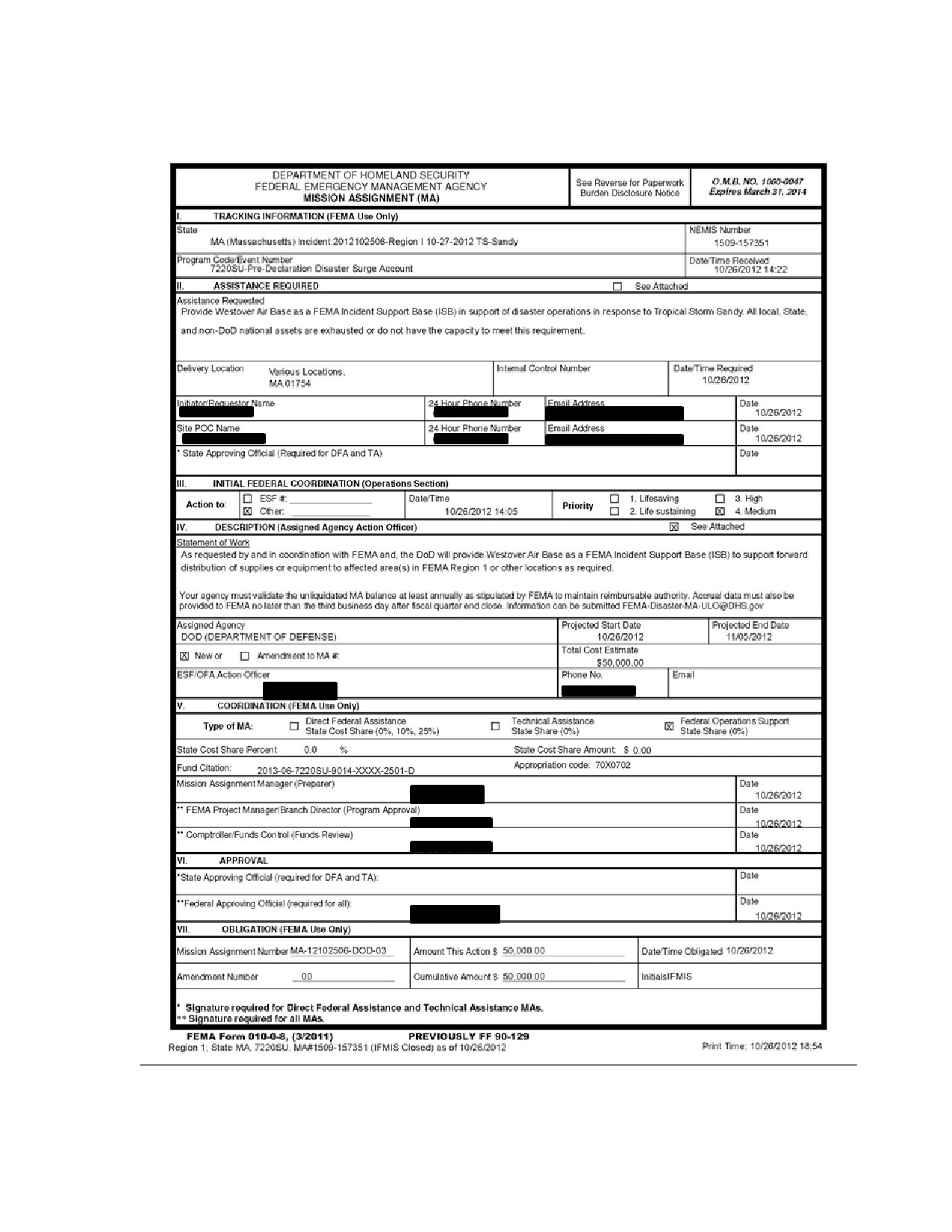
DoDM 3025.01, Vol. 2, August 11, 2016
Figure 1. Sample FEMA Mission Assignment
SECTION 4: NATURAL AND MAN-MADE NATURAL DISASTERS AND EMERGENCIES
11
DoDM 3025.01, Vol. 2, August 11, 2016
c. PSMAs. FEMA, in close coordination with the appropriate federal department or agency,
develops PSMAs to expedite the development of formal MAs during disasters and emergencies.
Although these PSMAs are designed to reduce the time it takes to staff a request, they do not
pre-approve support. The ASD(HD&GS) is the lead for all new or revised PSMAs for DoD
support, excluding those concerning support from the National Geospatial-Intelligence Agency
(NGA), the Defense Logistics Agency (DLA), and the U.S. Army Corps of Engineers (USACE).
See Section 6 of this volume for additional information on PSMAs.
d. DoD Support. DoD has various capabilities and capacity to provide a significant amount
of support when requested by FEMA in accordance with the Stafford Act. In accordance with
the standing DSCA Execute Order (EXORD), the Commander, U.S. Northern Command
(CDRUSNORTHCOM) and Commander, U.S. Pacific Command (CDRUSPACOM) are
supported Combatant Commanders (CCDRs). Other Combatant Commands, the Military
Departments, and the Defense Agencies support CDRUSNORTHCOM and CDRUSPACOM in
the DSCA response. Some DoD organizations have specific authorities to provide direct support
of FEMA in coordination with the supported CCDRs. All DSCA requests for assistance are
evaluated using the criteria in DoDD 3025.18.
(1) USACE. Under the National Response Framework, DoD, through the USACE, is the
emergency support function (ESF) coordinator for ESF #3, Public Works and Engineering. The
USACE coordinates ESF #3 activities throughout the preparedness, response, and recovery
phases of incident management, and the USACE and other DoD entities may provide support
following appropriate approval. The USACE may, in limited circumstances when other federal
funding is available, accept reimbursable orders from State and local entities in accordance with
Section 3036 of Title 10, U.S.C. See Appendix 11A of Volume 1 of this manual for additional
information on the USACE.
(2) DLA. As prescribed in DoDD 5105.22, the Director, DLA, may enter into support
and service agreements and performance-based agreements with other federal departments and
agencies. See Appendix 11B of Volume 1 of this manual for additional information on DLA.
(3) NGA. NGA has various authorities, including statutes, executive orders, and DoD
and Intelligence Community policy to support the geospatial intelligence requirements of the
Department of State (DOS) and other federal departments and agencies, including FEMA. See
Appendix 11C of Volume 1 of this manual for additional information on NGA.
(4) Defense Threat Reduction Agency (DTRA). DTRA provides support of other federal
departments and agencies for incidents involving WMD, as prescribed in DoDD 5105.62. See
Appendix 11D of Volume 1 of this manual for additional information on DTRA.
e. Interagency Partner Guide. The Office of the Assistant Secretary of Defense for
Homeland Defense and Global Security (OASD(HD&GS)) maintains a DSCA Interagency
Partner Guide. The purpose of this guide is to enable non-DoD entities to understand more fully
the role of DSCA, how to request support, and under what conditions that support is appropriate.
The latest version of the guide can be found at:
fenseIntegrationDSCA.aspx.
SECTION 4: NATURAL AND MAN-MADE NATURAL DISASTERS AND EMERGENCIES
12
DoDM 3025.01, Vol. 2, August 11, 2016
f. Complex Catastrophes. Though disasters and emergencies can become complex
catastrophes, none has yet met the requisite criteria to be called a complex catastrophe. During
complex catastrophes, the Secretary of Defense (SecDef) and senior DoD officials may consider
additional actions. See Appendix 4A of this volume for the SecDef decision matrix used during
a complex catastrophe. To aid in planning for a complex catastrophe, Appendix 4B of this
volume lists considerations DoD Components can use for developing plans based on FEMA
ESFs. Appendix 4C of this volume discusses potential missions for DoD general purpose forces.
4.2. KEY AUTHORITIES AND REFERENCES. Table 1 lists key authorities and references
for natural and man-made disasters and emergencies.
Table 1. Key Authorities and References for Natural and Man-made Disasters and
Emergencies
Key Authority/Reference
Description
Establishes the President’s ability to declare an emergency
or major disaster, thereby permitting mobilization of federal
Stafford Act
assistance. FEMA reimburses DoD pursuant to this
authority.
Provides authority for the provision of support and
Section 1535 of Title 31,
reimbursement from one federal department or agency to
U.S.C., also known and referred
another for goods or services. This authority is rarely used
to in this volume as “The
when there is a Stafford Act declaration for major disasters
Economy Act”
and emergencies.
Part 206 of Title 44, Code of
FEMA regulations that implement the Stafford Act and
Federal Regulations (CFR)
provide that FEMA reimburses DoD for incremental costs.
Directs the Secretary of Homeland Security to develop and
Homeland Security Presidential
administer the National Incident Management System and
Directive-5
the National Response Framework.
Guidance that seeks to strengthen the security and resilience
of the United States through systematic preparation for the
Presidential Policy Directive-8
threats that pose the greatest risk to U.S. security, including
acts of terrorism, cyber-attacks, pandemics, and catastrophic
natural disasters.
Assigns national security emergency preparedness
Executive Order 12656
responsibilities to federal departments and agencies.
Directs SecDef to oversee the development, testing,
implementation, and sustainment of national security and
Executive Order 13618
emergency preparedness communications that are directly
responsive to the national security needs of the President,
Vice President, and senior national leadership.
Presents the guiding principles that enable all response
partners to prepare for and provide a unified national
National Response Framework
response to disasters and emergencies, from the smallest
incident to the largest catastrophe.
SECTION 4: NATURAL AND MAN-MADE NATURAL DISASTERS AND EMERGENCIES
13

DoDM 3025.01, Vol. 2, August 11, 2016
Table 1. Key Authorities and References for Natural and Man-made Disasters and
Emergencies, Continued
Key Authority/Reference
Description
Establishes DoD policy and assigns responsibilities for
DSCA, including for incidents involving natural and man-
DoDD 3025.18
made disasters; provides guidance for the execution of
DSCA; authorizes immediate response authority.
Specifies accounting and reporting of DoD-affiliated
DoDI 3001.02
personnel following a natural or man-made disaster.
Provides guidance for installation emergency management
DoDI 6055.17
programs at DoD installations for “all hazards.”
Provides procedures for reimbursement for support
Chapters 1, 3, and 4 of Volume
provided pursuant to the Economy Act, including if used
11A of DoD Financial
during major disasters and emergencies. Provides policy
Management Regulation
and procedures for establishing appropriate fees for
7000.14-R
authorized services that DoD organizations supply.
Chapter 23 of Volume 12 of
Specifies incremental costs that are eligible for
DoD Financial Management
reimbursement, including for DoD support in response to
Regulation 7000.14-R
major disasters and emergencies.
Delegates limited approval authority to combatant
commanders with DSCA responsibilities, normally
CDRUSNORTHCOM or CDRUSPACOM, for routine and
historical requests for assistance to provide a rapid and
DSCA EXORD
flexible DoD response to other federal departments and
agencies for potential or actual disasters or emergencies
within the United States and its territories, possessions, and
protectorates.
Directs DoD to maintain and be prepared to provide a
Domestic Chemical, Biological,
domestic CBRN response capability. Delegates limited
Radiological, Nuclear (CBRN)
approval authority to CDRUSNORTHCOM and
Response EXORD
CDRUSPACOM to provide a rapid and flexible federal
response for domestic CBRN emergencies and disasters.
Provides guidelines and principles for DSCA, including in
Joint Publication 3-28
response to incidents such as major disasters and
emergencies.
4.3. EXAMPLES OF POSSIBLE DOD SUPPORT. DoD possesses capabilities and capacity
to support another federal department or agency coordinating support to fulfill a State or local
request for assistance. Examples of DoD support include:
a. Defense coordinating officers (DCOs), Defense coordinating elements (DCEs),
emergency preparedness liaison officers (EPLOs), planners, and liaison officers (LNOs).
b. Incident support bases.
SECTION 4: NATURAL AND MAN-MADE NATURAL DISASTERS AND EMERGENCIES
14
DoDM 3025.01, Vol. 2, August 11, 2016
c. Aerial assets for imagery and damage assessments.
d. Rotary-wing aircraft for search and rescue (SAR).
e. Transportation (ground and air).
f. Communications.
g. Temporary medical treatment facilities.
h. Aero-medical patient movement and definitive care in National Disaster Medical System
(NDMS) hospitals.
i. Manpower and equipment.
4.4. REQUEST FOR ASSISTANCE PROCEDURES. DoD provides its disaster and
emergency support of FEMA in response to approved FEMA MAs. Most FEMA MAs are
generated at the FEMA regional offices or joint field offices based upon requests from State and
local officials. Some FEMA MAs are generated at the national level and normally are employed
when FEMA is attempting to pre-position capabilities in advance of State and local needs. As
much as possible, PSMAs are used to develop FEMA MAs. See Section 6 of this volume for
additional information on PSMAs.
a. FEMA MAs From a Federal Coordinating Officer (FCO) (FEMA Regions or Joint
Field Office (JFO)).
(1) The FCO presents a FEMA MA to the DCO.
(2) The DCO validates the MA using criteria in DoDD 3025.18, including:
(a) Legality (compliance with laws).
(b) Lethality (potential use of lethal force by or against DoD forces).
(c) Risk (safety of DoD forces).
(d) Cost (including the source of funding and the effect on the DoD budget).
(e) Appropriateness (whether providing the requested support is in the interest of
DoD).
(f) Readiness (impact on DoD’s ability to perform its other primary missions).
(3) The CCDR (USNORTHCOM or USPACOM) may approve MAs within the CCDR’s
existing authorities (e.g., standing SecDef-approved EXORD).
(4) If the CCDR does not have the authority to approve the MA, the CCDR forwards the
MA to Joint Staff/Homeland Defense Division, DSCA Branch (J33). Joint Staff/J33 forwards
SECTION 4: NATURAL AND MAN-MADE NATURAL DISASTERS AND EMERGENCIES
15
DoDM 3025.01, Vol. 2, August 11, 2016
the request to OASD(HD&GS) and the DoD Executive Secretariat for staffing (OSD-level) and
SecDef decision. The ASD(HD&GS) has been delegated the authority to approve requests for
certain forms of assistance in accordance with DoDD 5111.13. The Joint Staff/J33 prepares an
EXORD for SecDef approval, if appropriate. If approved, DoD provides support. For life-
saving and time-sensitive MAs, the approval may be made verbally with confirmatory
documents to follow.
b. FEMA MAs From the FEMA Administrator (National Level). There are occasions
where the FEMA Administrator may request that federal partners provide capabilities without a
FEMA region request.
(1) The FEMA Administrator may present a FEMA MA to the DoD liaison element at
the National Response Coordination Center (NRCC).
(2) The DoD liaison element at the NRCC conducts the necessary coordination to ensure
that the DCOs in the affected FEMA regions understand the purpose of the Administrator’s MA.
DoD may deploy the requested capability to a DoD installation and be prepared to employ when
the affected FEMA region requests the capability.
(3) The DCO in the affected region processes employment of the FEMA MA, as
described in Paragraph 4.4.a. of this volume.
(4) If the FEMA region JFO in which the requested capability will be employed is not
activated, the DoD LNO element at the NRCC will forward the MA to the geographical CCDR
(CDRUSNORTHCOM or CDRUSPACOM). The CCDR may approve MAs within the CCDR’s
existing authorities (normally pursuant to a standing SecDef-approved EXORD).
(5) If a CCDR does not have the authority to approve the MA, the CCDR forwards the
MA to Joint Staff/J33 for staffing and SecDef decision. SecDef has delegated the authority to
approve requests for certain forms of assistance, in accordance with DoDD 5111.13.
4.5. FUNDING AND REIMBURSEMENT.
a. Pursuant to the Stafford Act, the President may direct any federal department or agency,
with or without reimbursement, to utilize its authorities and resources in support of FEMA for
responding to disasters and emergencies. DSCA is provided on a cost-reimbursable basis, unless
otherwise directed by the President or SecDef. DoD Components may be required to fund the
costs of DSCA initially within existing resources, with the understanding that the requesting
agencies may provide reimbursement.
b. FEMA provides DoD reimbursement pursuant to the provisions of the Stafford Act.
c. The Economy Act also provides authority and a reimbursement mechanism for federal
departments and agencies to support one another.
Appendices
SECTION 4: NATURAL AND MAN-MADE NATURAL DISASTERS AND EMERGENCIES
16
DoDM 3025.01, Vol. 2, August 11, 2016
1. SecDef Complex Catastrophe Decision Matrix
2. Defense Support Requirements in a Complex Catastrophe
3. Potential General Purpose Force Contributions During a Complex Catastrophe
SECTION 4: NATURAL AND MAN-MADE NATURAL DISASTERS AND EMERGENCIES
17
DoDM 3025.01, Vol. 2, August 11, 2016
APPENDIX 4A: SECDEF COMPLEX CATASTROPHE DECISION MATRIX
1. The matrix at Table 2 describes decisions that may be required before or during a complex
catastrophe and the effects and risks of those decisions. Decisions that SecDef has delegated to
others or made through DoD issuances, EXORDs, or other authoritative guidance documents are
not included. This matrix does not prescribe new policy, but rather provides senior DoD leaders
and their staffs with a shared understanding of likely and known decision points.
2. The decision matrix is also a useful tool during other domestic incidents that do not rise to the
level of complex catastrophe. SecDef may make various decisions as requirements and stresses
on DoD change over time and the scope of the incident becomes more apparent.
3. The decision matrix is colored orange for geo-political considerations of an incident, yellow
for legal authorities associated with employing DoD capabilities, blue for forces and command
relationships, and green for funding considerations.
APPENDIX 4A: SECDEF COMPLETE CATASTROPHIC DECISION MATRIX
18

DoDM 3025.01, Vol. 2, August 11, 2016
Table 2. SecDef Complex Catastrophe Decision Matrix
Category
Key Decisions
Considerations
Non-DoD Involvement
Risk to DoD
Required Actions
State government capabilities
FEMA/DHS and other federal
Overuse of the “complex
Using the CJCS Emergency
are overwhelmed and unable
partners may request DoD
catastrophe” designation may
Action Plan process, convene
to respond to event
assistance on an
increase expectations for
a consultative assessment
effectively. This will
unprecedented scale and
other disasters and dilute the
process among SecDef,
eventually lead to a State
scope, including non-
meaning of the term and
CJCS, relevant CCDRs, and
request for federal assistance
traditional response roles that
preparedness for a true
other senior DoD leadership.
and a Presidential declaration
may require exceptions to
complex catastrophe.
of a major disaster or
policy or waivers of
SecDef determines whether
emergency.
restrictions, as appropriate.
Meeting the unprecedented
DoD should treat an incident
resource demands of a
as a complex catastrophe
The affected area is
complex catastrophe may
based upon the magnitude of
experiencing critical life-
require DoD to assume
the catastrophe.
sustaining infrastructure
significant risk to other DoD
failures that could cause
missions and affect readiness
SecDef approves and orders
cascading failures of
across the Department.
the level of support to the
interconnected critical
response, including forces
1(a) Identify
1. Nature of
infrastructure or that are due
and exceptions to policy, as
incident as a
Incident
to a cascading and unforeseen
necessary.
“complex
effect of a previous
catastrophe”
infrastructure failure.
SecDef notifies the President
During any major disaster (as
of worldwide risk and
defined in the Stafford Act),
readiness issues in order to
after issuing either a major
provide the level of support
disaster or emergency
required.
declaration, the President may
direct DoD to provide
accelerated federal assistance
and support in the absence of
specific requests for
assistance where necessary to
save lives, prevent human
suffering, or mitigate severe
damage.
There are an extraordinarily
APPENDIX 4A: SECDEF COMPLETE CATASTROPHIC DECISION MATRIX
19

DoDM 3025.01, Vol. 2, August 11, 2016
Table 2. SecDef Complex Catastrophe Decision Matrix, Continued
Category
Key Decisions
Considerations
Non-DoD Involvement
Risk to DoD
Required Actions
high number of injuries,
fatalities, and displaced
persons across the affected
area, which may span
multiple States and FEMA
regions.
The magnitude of public and
private infrastructure failure
(e.g., power, water,
transportation, DoD facilities,
telecommunications) will
severely affect public health
and safety on a large scale
and over an extended period
of time.
A deliberate SecDef decision
clearly defines the anticipated
scope of DoD’s involvement
and the need to expedite the
deployment and employment
of responding DoD forces.
Identifying the incident as a
complex catastrophe does not
necessarily authorize
deployment or employment of
federal forces. This decision
is internal to DoD, and does
not affect, nor is it reliant
upon, decisions outside DoD
(e.g., major disaster or
emergency declaration).
APPENDIX 4A: SECDEF COMPLETE CATASTROPHIC DECISION MATRIX
20

DoDM 3025.01, Vol. 2, August 11, 2016
Table 2. SecDef Complex Catastrophe Decision Matrix, Continued
Category
Key Decisions
Considerations
Non-DoD Involvement
Risk to DoD
Required Actions
May be appropriate when
Governors must agree to the
FEMA, by regulation, does
SecDef and the Governors
State-directed National Guard
use of their National Guard
not reimburse DoD for Title
concerned must approve.
units are the best sourcing
forces in Title 32 status, and
32 status costs unless agreed
2(a) Authorize
solution to satisfy
will provide command and
upon in advance, which could
Title 32, U.S.C.,
reimbursable requests for
control and oversight via the
result in unfunded
Section 502(f)
DoD assistance from federal
Adjutant General for the
requirements later in the
status for the use
departments or agencies.
duration of the mission.
fiscal year.
of State-directed
National Guard
Does not provide SecDef
forces for DSCA
command and control of
National Guard forces used as
part of DoD support.
Section 515 of Public Law
Section 515 requires that
Congress may see this waiver
SecDef approves.
110-181 (the National
SecDef submit a report to
as excessive in use of Reserve
Defense Authorization Act
Congress explaining the
personnel.
OSD notifies DoD
for Fiscal Year 2008),
rationale for the waiver.
stakeholders.
requires that Reserve
2.
Component members who
OSD submits a report to
Legal
will be called or ordered to
Congress.
Authorities
active duty for a period of
more than 30 days in support
2(b) Order non-
of a contingency operation
National Guard
receive notice in advance of
Reserve forces to
the mobilization date. In so
active duty
far as is practicable, the
pursuant to
notice must be provided not
Section 12304a of
less than 30 days before the
Title 10, U.S.C.
mobilization date, but with a
goal of 90 days before the
mobilization date.
SecDef may waive the
advance-notice requirement,
or authorize shorter notice
than the minimum specified
above, during a war or
national emergency declared
APPENDIX 4A: SECDEF COMPLETE CATASTROPHIC DECISION MATRIX
21

DoDM 3025.01, Vol. 2, August 11, 2016
Table 2. SecDef Complex Catastrophe Decision Matrix, Continued
Category
Key Decisions
Considerations
Non-DoD Involvement
Risk to DoD
Required Actions
by the President or Congress
or to meet mission
requirements. If the waiver
or reduction is made on
account of mission
requirements, SecDef must
submit to Congress a report
detailing the reasons for the
waiver or reduction and the
mission requirements at issue.
Activation for less than 30
days does not require a
waiver.
In a major emergency, it may
None required.
This may affect Military
CDRUSNORTHCOM or
be necessary for SecDef to
Department authorities and
CDRUSPACOM requests
issue voice orders to transfer
responsibilities as the force
that SecDef transfer forces
selected Title 10 status forces
providers to determine the
and authorize the exercise of
3(a) Emergency
in the United States to
best sourcing solution.
OPCON of specific available
transfer of
CDRUSNORTHCOM or
DoD forces in the United
specific available
CDRUSPACOM, and
Assuming OPCON, rapidly
States if such use would not
forces to
authorize that Commander to
establishing Command and
interfere with those forces
CDRUSNORTHC
exercise OPCON over such
Control, and integrating large
scheduled for or engaged in
3.
OM or
forces.
numbers of units may create
the execution of specific
Forces and
CDRUSPACOM,
headquarters staffing
operational missions
Command
and authorization
CDRUSNORTHCOM or
problems for
approved by the President or
Relationships
of the exercise of
CDRUSPACOM may not
USNORTHCOM or
SecDef.
operational
assume OPCON of forces in
USPACOM.
control (OPCON)
the United States for a major
SecDef, with advice from the
by
emergency if such use would
Costs associated with the
CJCS and the Secretaries of
CDRUSNORTHC
interfere with those forces
activities of forces not
the Military Departments,
OM or
scheduled for or actually
supporting a specific MA
approves the emergency
CDRUSPACOM
engaged in the execution of
from the lead federal agency
transfer of forces OPCON to
specific operational missions
may not be reimbursed.
CDRUSNORTHCOM or
approved by the President or
CDRUSPACOM through
SecDef.
Large commitments of
voice or written orders.
capabilities and forces may
APPENDIX 4A: SECDEF COMPLETE CATASTROPHIC DECISION MATRIX
22

DoDM 3025.01, Vol. 2, August 11, 2016
Table 2. SecDef Complex Catastrophe Decision Matrix, Continued
Category
Key Decisions
Considerations
Non-DoD Involvement
Risk to DoD
Required Actions
Does not apply to National
have a significant impact on
Guard personnel in State
other DoD missions,
active duty or Title 32 status.
including existing
These National Guard
commitments to other theaters
personnel will remain under
and overseas contingency
the command and control of
operations.
their respective Governors.
Not adhering to established
processes or a lack of
understanding of how existing
processes are being
“streamlined” may result in
inappropriate capabilities or
forces being delivered and not
achieving Presidential
objectives.
The President has delegated
States request the
DoD lacks official policy
SecDef approves the
to SecDef his authority to
appointment of a trained
concerning the use of a DSC
appointment of the DSC.
approve either a Regular
National Guard officer as
for multi-state disaster
Army or Regular Air Force
DSC.
response.
CCDRs must clearly define
officer or an officer of the
the Title 10 command and
Army National Guard or the
Governor must approve any
control and associated
Air National Guard to serve
DSC.
procedures.
simultaneously in both federal
and State statuses.
3(b) Approve
Dual-Status
Title 10 and National Guard
Commander
forces employed in the same
(DSC)
State may need a single
commander separately
exercising federal and State
authority to facilitate unity of
effort.
The CDRUSNORTHCOM
and CDRUSPACOM, in
coordination with the CJCS
APPENDIX 4A: SECDEF COMPLETE CATASTROPHIC DECISION MATRIX
23

DoDM 3025.01, Vol. 2, August 11, 2016
Table 2. SecDef Complex Catastrophe Decision Matrix, Continued
Category
Key Decisions
Considerations
Non-DoD Involvement
Risk to DoD
Required Actions
and the Chief, National Guard
Bureau, may concur in the
State’s nomination of a
trained National Guard
officer, or may request the
appointment of a trained
Regular Army or Regular Air
Force officer to serve as DSC.
Urgency of response requires
None required.
Response to the incident may
The CJCS provides a
that DoD source disaster
affect the allocation of forces
recommendation, and SecDef
3(c) Increase
response needs ahead of
for other missions.
approves.
sourcing priority
requirements for other
missions.
Urgency of response requires
None required.
Capabilities used to transport
The CJCS provides a
that DoD transport resources
resources for the domestic
recommendation on, and
3(d) Increase
for the incident before
incident may disrupt the flow
SecDef approves, any
transportation
transporting resources for
of resources to other theaters.
necessary changes to the
priority
other missions.
movement priority of certain
resources.
FEMA will reimburse DoD
None required.
Total costs will vary based on
Varies based on the additional
from the Disaster Relief Fund
the situation and support
costs. Unless specific SecDef
(DRF) for incremental costs
provided.
direction is provided, DoD
generally associated with
Component heads decide
supporting a FEMA MA,
Without reimbursement or a
whether to accept additional
unless the President directs
source of supplemental
costs and risks.
DoD to provide support
funding, DoD may have to
4(a) Accept non-
4.
without reimbursement
reallocate funding internally.
DoD may utilize
reimbursable
Funding
pursuant to the Stafford Act.
reprogramming and
costs
Accepting non-reimbursable
realignment authorities to
Although DRF funding is not
costs during a complex
cover costs, if needed and
available for activities
catastrophe could create
where available.
undertaken requiring a
additional expectations during
coordinated DoD response
normal DSCA operations.
DoD may be authorized to
before declaration of the
request supplemental funding
disaster or emergency, FEMA
Unless Congress appropriates
from Congress.
APPENDIX 4A: SECDEF COMPLETE CATASTROPHIC DECISION MATRIX
24

DoDM 3025.01, Vol. 2, August 11, 2016
Table 2. SecDef Complex Catastrophe Decision Matrix, Continued
Category
Key Decisions
Considerations
Non-DoD Involvement
Risk to DoD
Required Actions
requests for DoD
supplemental funds or DoD
prepositioning of resources
decides to use other funding
Pre-coordination with FEMA
before declaration of the
mechanisms, the Secretaries
is necessary for DoD to
disaster or emergency are
of the Military Departments
obtain reimbursement of pay
reimbursed to DoD from the
can expect to bear any pay
and allowances of Reserve
DRF on the basis of actual
and allowance costs for those
Component personnel ordered
costs.
Reserve Component members
to duty to fulfill FEMA’s
serving under the authority of
MA.
FEMA will reimburse DoD
Section 12304a of Title 10,
for costs such as travel,
U.S.C., or Section 502(f) of
Request that FEMA
lodging, and operations and
Title 32, U.S.C.
reimburse DoD for the pay
maintenance. However,
and allowances of the non-
FEMA, by regulation, does
Without reimbursement or a
National Guard Reserve
not reimburse DoD for the
source of supplemental
personnel called to active
pay and allowance costs of
funding, DoD may have to
duty under Section 12304a of
Reserve Component
reallocate funding internally,
Title 10, U.S.C., for the sole
personnel ordered to duty in a
which may have an impact on
purpose of providing disaster
Title 10 status or National
readiness, ongoing
relief as temporary federal
Guard personnel in Title 32
operations, and future
employees as permitted in
status, unless agreed upon in
operations or crises.
Part 206.8(c)(2) of Title 44,
advance.
CFR.
The severity of conditions
and competing requirements.
APPENDIX 4A: SECDEF COMPLETE CATASTROPHIC DECISION MATRIX
25
DoDM 3025.01, Vol. 2, August 11, 2016
APPENDIX 4B: DEFENSE SUPPORT REQUIREMENTS
1. Under the National Response Framework, DoD is an ESF coordinator or support agency for
the 14 ESFs that build, sustain, and deliver response capabilities.
2. Table 3 outlines the potential civil support requirements, organized by ESF, that could be
requested of DoD when a complex catastrophe occurs. Each of the requirements listed will
likely be compounded when the catastrophe persists for a prolonged period; when multiple
conditions and cascading effects are present; or if any CBRN conditions are introduced. Table 3
helps form planning considerations in DoD complex catastrophe planning efforts.
APPENDIX 4B: DEFENSE SUPPORT REQUIREMENTS
26
DoDM 3025.01, Vol. 2, August 11, 2016
Table 3. Potential Civil Support Requirements for DoD During a Complex Catastrophe
ESF #/ Title
ESF
Effects of a Complex Catastrophe
Potential Civil Support
Coordinator
Requirements for DoD
ESF #1/
Department of
Transportation infrastructure (mass transit, tunnels, bridges,
- Civil engineering
Transportation
Transportation
roads, rail, maritime, pipeline, air) is degraded or rendered
assessment teams
inoperable. Transportation systems may be shut down
- Air traffic and airspace
regionally or nationally for traffic management or to mitigate
management teams
damage from further attacks. Mass transit may fail due to an
- Air navigation services
inability to replenish fuel supplies. Access to fuel may be
capabilities
limited due to prolonged power failure and an inability to
- Airfield reconstitution
pump or acquire fuel for generators. Infrastructure failures
teams
will create difficulty in moving responders and supplies into
- Strategic transportation
the affected area, and moving evacuees and patients out. A
support
large-scale population movement out of the affected area will
- Ground transportation
create additional capabilities requirements as congestion builds
support
and the need for evacuation and temporary shelter increases.
- Maritime and riverine
transportation
Pipelines provide the majority of our national capability to
- Expeditionary bridging or
move refined petroleum products and other critical resources
ferrying capabilities
between regions of the country. Disruption of major raw
- Restoration of inland
material pipelines from production fields to the refinery areas,
waterways, ports, and
and finished product lines from refineries to end users in the
harbors, including
mid-continent and both coasts, would quickly result in severe
dredging and debris
shortages of required energy resources. There may not be
removal
sufficient capacity in truck, rail, or maritime assets to meet the
- Assistance in restoring
demand in the event of major pipeline disruptions.
transportation
infrastructure
- Route clearance
- Capabilities to move,
store, and distribute fuels
- Weather support
APPENDIX 4B: DEFENSE SUPPORT REQUIREMENTS
27
DoDM 3025.01, Vol. 2, August 11, 2016
Table 3. Potential Civil Support Requirements for DoD During a Complex Catastrophe, Continued
ESF #/ Title
ESF
Effects of a Complex Catastrophe
Potential Civil Support
Coordinator
Requirements for DoD
ESF #2/
DHS
Communications (e.g., satellite, GPS, internet, television,
- Communications support
Communications
radio) systems may be degraded or rendered inoperable.
to the JFO and associated
Mechanisms routinely used to identify, position, and source
field teams
requirements may be inoperable. Situational awareness of
- Communications
DoD leaders may be impaired.
capabilities support to
restore public safety and
Increased difficulty in providing follow-on instructions to
first responder networks
affected populations, the degradation or loss of cellular and
- Capability to broadcast
data networks, and the loss of the ability to charge mobile
public messages and
devices may complicate efforts to provide life-saving or life-
provide support for local,
sustaining support such as sheltering, evacuation, or
State, and federal
distribution of food and water. These losses may also lower
emergency responders
the morale of the affected population and exacerbate negative
- Satellite communications
attitudes and perceptions towards civil authorities.
capabilities, land mobile
radios (very high
frequency and ultra high
frequency)
- Very high frequency and
ultra high frequency radio
capabilities
ESF #3/ Public
DoD/USACE
Public works may be damaged in the affected areas. Of chief
- The USACE is the ESF
Works and
concern will be hospitals and public services (e.g., water and
#3 Coordinator. The
Engineering
wastewater systems; energy supplies, including electricity,
USACE coordinates ESF
petroleum, and natural gas; waterways, including ports,
#3 activities throughout
channels, dams, and navigation locks).
the preparedness,
response, and recovery
phases of incident
management, and the
USACE and other DoD
APPENDIX 4B: DEFENSE SUPPORT REQUIREMENTS
28
DoDM 3025.01, Vol. 2, August 11, 2016
Table 3. Potential Civil Support Requirements for DoD During a Complex Catastrophe, Continued
ESF #/ Title
ESF
Effects of a Complex Catastrophe
Potential Civil Support
Coordinator
Requirements for DoD
entities may provide
support following
appropriate approval.
- Pre-incident and post-
incident assessments and
triage of public works
and infrastructure
- Emergency contracting
support for life-saving
and life-sustaining
services
- Technical assistance
- Engineering and
construction expertise
- Emergency route
clearance
- Debris removal and
disposal
- Infrastructure
stabilization or
demolition
- Construction of
temporary critical public
facilities
- Unwatering tunnels
- Power restoration and
generation
ESF #4/
USDA/Forest
Large-scale fires may overwhelm local and State capabilities.
- Provide personnel,
Firefighting
Service
Access to water and fuel may affect firefighting operations.
equipment, and supplies
APPENDIX 4B: DEFENSE SUPPORT REQUIREMENTS
29

DoDM 3025.01, Vol. 2, August 11, 2016
Table 3. Potential Civil Support Requirements for DoD During a Complex Catastrophe, Continued
ESF #/ Title
ESF
Effects of a Complex Catastrophe
Potential Civil Support
Coordinator
Requirements for DoD
Potential complications include natural gas fires caused by
- Airborne firefighting
ruptured pipelines.
services
ESF #5/
DHS/FEMA
State and local command, control, and coordination
- Incident Support Base
Information and
capabilities may be overwhelmed for large-scale events.
- Operations coordination
Planning
Additional assistance will be requested by State and local
and direction
authorities for specific and tailored capabilities from
- Logistics management
DHS/FEMA. Degraded communications will impair
- Coordination personnel
situational awareness and the ability to address changes in the
- Environmental and
operational environment as they arise.
geospatial remote sensing
data and information
- Planning
- Information and warning
- Incident awareness and
assessment
ESF #6/ Mass
DHS/FEMA
The affected population may become displaced while in search
- Construction,
Care, Emergency
of shelter, sustenance, and safety. In areas where there is
engineering, and project
Assistance,
large-scale disruption or destruction of physical transportation
management for
Housing, and
infrastructure, there may be large pockets of people who
temporary housing and
Human Services
cannot displace and are in need of mass care (e.g., sheltering).
shelter
A high number of people in the general population displaced
- Inspect mass care shelters
as a result of WMDs or pandemic disease may overwhelm
- Food and water storage
civilian capabilities, especially if the loss of key infrastructure
and distribution
(power, public works and sanitation, supply chain) makes it
- Mass embarkation site
difficult to provide mass care or emergency assistance or to
- Sheltering, feeding, and
maintain a sanitary environment. Areas adjacent to the
clothing
affected areas will become overwhelmed with the displaced
- Infant care (e.g. baby
populace.
formula)
- Pet shelter and
APPENDIX 4B: DEFENSE SUPPORT REQUIREMENTS
30
DoDM 3025.01, Vol. 2, August 11, 2016
Table 3. Potential Civil Support Requirements for DoD During a Complex Catastrophe, Continued
ESF #/ Title
ESF
Effects of a Complex Catastrophe
Potential Civil Support
Coordinator
Requirements for DoD
Displaced personnel may show up without appropriate
veterinarian support
clothing, baby formula, and diapers, and with pets.
ESF #7/ Logistics
General
The supply chain will be disrupted. GSA and the logistics
- Emergency relief
Management and
Services
sections in the JFOs may become overwhelmed.
supplies, including
Resource Support
Administration
subsistence, water,
(GSA)
medical materials,
administrative supplies,
petroleum products,
engineering and
construction supplies
- Incident support base or
federal team staging area
- Contracting services
- Support fuel and
commodity distribution
points
- Temporary housing on
DoD installations
- Grounds to house FEMA-
procured temporary
housing
- Logistics planning
support
- Cots and blankets
- Tarps or plastic sheeting
ESF #8/ Public
Department of
Medical services (e.g., hospitals, nursing homes, patient care)
- Public health and medical
Health and
Health and
may be unable to be provided at fixed sites. Although many
services
Medical Services
Human
hospitals and other care facilities critical to disaster response
- Health surveillance
Services
efforts have backup diesel-powered generators, few are likely
- Patient evacuation
APPENDIX 4B: DEFENSE SUPPORT REQUIREMENTS
31

DoDM 3025.01, Vol. 2, August 11, 2016
Table 3. Potential Civil Support Requirements for DoD During a Complex Catastrophe, Continued
ESF #/ Title
ESF
Effects of a Complex Catastrophe
Potential Civil Support
Coordinator
Requirements for DoD
(HHS)
to have sufficient fuel on hand to offset a power outage lasting
- Evacuation of seriously ill
weeks to months, and companies responsible for resupplying
or injured patients
them could face a radical mismatch between supply and
- Inpatient medical care
demand. For disasters with extensive physical effects, not
(definitive care) through
only will disruption and destruction of physical supply lines
NDMS civilian hospitals
have an impact, but structural damage to the buildings
- Preventive medicine and
themselves may render care sites unusable, and create a rescue
public health assistance
and extraction situation for patients and staff. Casualties may
- Safety, security, and
overwhelm civilian medical capabilities, especially if the loss
distribution of MCM and
of key infrastructure (e.g., power, public works and sanitation,
vaccines
supply chain) makes it difficult to administer care that requires
- Food safety and security
a sanitary environment. Additionally, patient evacuation from
- Potable water support
islands is more difficult.
- Fatality management
assistance (e.g., remains
recovery, storage,
transport, identification,
mortuary affairs)
- Mass vaccination or
MCM distribution
- Veterinary medical
support
- Behavioral health care
- Vector control
- Durable and consumable
medical equipment
- Casualty clearing and
staging
- Patient treatment
- Health surveillance and
laboratory diagnostics
APPENDIX 4B: DEFENSE SUPPORT REQUIREMENTS
32

DoDM 3025.01, Vol. 2, August 11, 2016
Table 3. Potential Civil Support Requirements for DoD During a Complex Catastrophe, Continued
ESF #/ Title
ESF
Effects of a Complex Catastrophe
Potential Civil Support
Coordinator
Requirements for DoD
- Medical equipment and
supplies (including for
patient quarantine)
ESF #9/ SAR
DHS/U.S.
State and local SAR capabilities may be overwhelmed, and
- Urban SAR teams
Coast Guard
adjacent States will be unable or reluctant to provide SAR due
- Waterborne, coastal, or
(USCG)
to their own SAR requirements or their perceived future need.
maritime SAR
Significant DoD resources will be coordinated through the
- Inland and wilderness
Joint Personnel Recovery Center/Personnel Recovery
SAR
Coordination Center. Infrastructure loss in areas such as
- Aeronautical SAR
transportation (physical infrastructure, availability of land
- Satellite imagery or
routes and landing sites), energy (fuel), supply chain (short-
imagery-derived products
term maintenance requirements for high-operational tempo),
and analysis
power, communications, and oil and hazardous material
- Structural engineers
(HAZMAT) or CBRN environments may affect provision of
- Technical rescue and
SAR. Significant numbers of general purpose forces may be
general purpose forces
required for large-scale urban SAR.
ESF #10/ Oil and
DHS/USCG
The Environmental Protection Agency (EPA) may be
- Airborne assessment
Hazardous
overwhelmed by multiple chemical fires and spills, and access
- CBRN detection,
Materials
to contracted response capabilities may be limited. The EPA
packaging, transportation,
Response
will seek DoD capabilities to detect, monitor, or mitigate the
treatment, demolition,
effects of chemical fires or spills. Cascading effects include
decontamination, and
significant population emergency evacuation. The
disposal
interconnection between large-scale oil and HAZMAT failures
- Ocean engineering
and CBRN on other infrastructure and ESFs is important and
technical support,
will stress any contracting and mitigation support.
including marine salvage
and diving services
- Pollution abatement
resources and equipment
for land and water
APPENDIX 4B: DEFENSE SUPPORT REQUIREMENTS
33
DoDM 3025.01, Vol. 2, August 11, 2016
Table 3. Potential Civil Support Requirements for DoD During a Complex Catastrophe, Continued
ESF #/ Title
ESF
Effects of a Complex Catastrophe
Potential Civil Support
Coordinator
Requirements for DoD
ESF #11/
USDA
Disruptions of public works and supply chains may lead to
- Storage facilities for dry,
Agriculture and
food and water insecurity. The affected population may move
chilled, and frozen food
Natural Resources
in search of sustainment. Even short-term disruptions could
- Transportation, handling
lead to civil unrest. Wide-scale disruption or destruction of
equipment, and support
agricultural infrastructure likely will have longer-lasting
personnel to move and
effects on the ability to produce and distribute food on a
distribute food
national scale. From a public safety perspective, the most
- Assistance in the
immediate concern will be the impact on municipal water
identification, control,
systems that depend on commercial electric power. With
and eradication of animal
water sources less secure, food and water contamination could
and zoonotic disease, or
lead to water borne diseases. Longer-term, regional power
plant pest and disease
failure could lead to failure of backup power supplies,
- Laboratory and diagnostic
resulting in food contamination.
support
- Assistance with the safety
and well-being of
household pets and
service animals
- Removal and disposal of
contaminated and non-
contaminated debris,
including animal
carcasses
- Emergency repair of
water systems, including
navigation, flood control,
drinking water, and
wastewater collection
ESF #12/ Energy
Department of
The electrical power grid is perhaps the best recognized
- Spot power generation
Energy (DOE)
component of critical infrastructure. The interdependency
- Damage assessment and
APPENDIX 4B: DEFENSE SUPPORT REQUIREMENTS
34

DoDM 3025.01, Vol. 2, August 11, 2016
Table 3. Potential Civil Support Requirements for DoD During a Complex Catastrophe, Continued
ESF #/ Title
ESF
Effects of a Complex Catastrophe
Potential Civil Support
Coordinator
Requirements for DoD
between the electrical grid and other critical infrastructure is
technical support for
demonstrated. Risks to the electrical grid include excessive
power generation and
power demand, outdated equipment, improper maintenance,
distribution
accidents, natural disasters (e.g., hurricanes, earthquakes,
- Fuel transportation,
wildfires, geomagnetic storms), and disruptive or deliberate
storage and distribution
attacks on unsecure automated control systems.
(gasoline, diesel, JP-5,
propane)
Most people have experienced the cascading (second and third
order) effects of short-duration or localized electrical power
failures (e.g., food spoilage, heating and cooling, cell phone
failure). Longer-term or regional power failures have the
potential to cause significant cascading effects on the United
States.
The vast majority of this infrastructure and the electric grid
that supports its function reside in the civilian or private sector
and outside DoD’s control. Disruption of the commercial
electric power grid, triggering cascading, region-wide failures
of critical infrastructure, may result in a complex catastrophe.
The net effect of physical damage to high-voltage
transformers, pipelines, refinery operations, and other hard-to-
replace components could be lengthy power outages across
numerous States, with the potential for rolling blackouts across
the United States. The availability of key components for
power generation and transmission may be limited, resulting in
protracted interruption of fuel supplies for electricity-
generating plants. These risks are magnified by the highly
interconnected nature of information and infrastructure
systems.
APPENDIX 4B: DEFENSE SUPPORT REQUIREMENTS
35
DoDM 3025.01, Vol. 2, August 11, 2016
Table 3. Potential Civil Support Requirements for DoD During a Complex Catastrophe, Continued
ESF #/ Title
ESF
Effects of a Complex Catastrophe
Potential Civil Support
Coordinator
Requirements for DoD
As the largest consumer of energy in the United States, DoD is
dependent on commercial electricity sources outside its
ownership and control for secure, uninterrupted power to
support critical missions. Approximately 99 percent of the
electricity consumed by DoD facilities originates offsite, while
approximately 85 percent of critical electricity infrastructure
itself is commercially owned.
Second-order effects resulting from loss of the electric grid
include loss of critical infrastructure such as communications,
water, transportation, and medical services. The degradation
or failure of these services will further expose the affected
population to third- and fourth-order effects, many of which
will be further complicated by weather.
ESF #13/ Public
Department of
Governance and the rule of law can break down if conditions
- Security assessment
Safety and
Justice (DOJ)
deteriorate for reasons that may or may not be related to the
- General law enforcement
Security
failure of infrastructure, and the level of failure may not be the
assistance
main contributor. The capabilities of State and local law
- Critical infrastructure
enforcement may require augmentation, depending upon the
security
severity of breakdown. Security of certain sites and
- Security escorts
commodities may need to be maintained or restored at
- Access control
domestic key terrain, such as food stockpiles and financial
- Site security
deposit locations.
- Wellness checks
- Explosive ordnance
Unless specifically authorized by statute and directed by the
disposal
President, no DoD personnel will become involved in direct
civilian law enforcement activities, including, but not limited
to, search, seizure, arrest, apprehension, stop and frisk,
APPENDIX 4B: DEFENSE SUPPORT REQUIREMENTS
36
DoDM 3025.01, Vol. 2, August 11, 2016
Table 3. Potential Civil Support Requirements for DoD During a Complex Catastrophe, Continued
ESF #/ Title
ESF
Effects of a Complex Catastrophe
Potential Civil Support
Coordinator
Requirements for DoD
surveillance, pursuit, interrogation, investigation, and evidence
collection.
ESF #14/ N/A
DHS/FEMA
Although DoD may be called upon during the response phase
- Post-disaster planning and
of a catastrophe, it will be difficult to withdraw DoD support
technical assistance for
Superseded by the
before civil authorities have reconstituted their capabilities.
local, State, and federal
National Disaster
DoD’s goal will be to stabilize the incident and return to
agencies
Recovery
normalcy as soon as possible, in line with the restoration of the
- Transition (withdrawal of
Framework
capabilities of civil authorities. USACE will continue to
DoD support) planning
maintain its ESF #3 responsibilities throughout the recovery
with civilian authorities
phase.
ESF #15/ External
DHS
DHS will be challenged to ensure the coordination, timeliness,
- Dissemination of pre-
Affairs
and accessibility of accurate information provided to the
scripted messages and
public, media, and private sector, and could look to DoD to
synchronized regional
provide assistance.
public messaging
- Contingency radio
communications support
- Combat Camera
- Common operating
picture
APPENDIX 4B: DEFENSE SUPPORT REQUIREMENTS
37