Military reference books and manuals (2009-2023, Volume 1) - page 8

NATO UNCLASSIFIED
• Consolidation:
In the context of establishing and/or
supporting authorities and organisations
entrusted with security tasks, the technical
qualification,
command and control
organisation and equipment of Military Police
forces make them particularly eligible for
such tasks. This includes (among others):
o training security forces
o giving advice to security forces
o partnering security forces
• Other tasks:
Acting as mediators and performing training
o carrying out military police tasks in the
functions, Military Police forces closely cooperate
scope of the national/international force
with authorities and organisations entrusted with
package
policing and security tasks in the area of
operations as well as with other military and
6.2.15 Military Information Support
civilian host nation authorities and agencies
Operations (MISO)
responsible for public order. Particularly by
PsyOp assets and activities enable military leaders
training security forces such as national military
at operational and tactical levels to address
-
police and civilian police forces, the German
directly and straightforward
- the mindset and
Military Police make a sizable contribution to
sentiments of adversaries, parties to a conflict, and
establishing and maintaining state structures.
the civilian population in the area of operations to
influence their demeanour, attitude and intentions
•
Combat:
in favour of the conduct of the operation.
The Military Police provide dedicated support
to operations by committing military police
Thus, they add to the military leader’s spectrum of
capabilities as required by the given situation,
influence and his scope of action the opportunity
mission and operation. In addition to their
of being effective without resorting to lethal or
originary tasks they supply specific and
kinetic weapons.
common capabilities in direct tactical support
of special forces and in support of special
PsyOp forces contribute to a common situation
picture with their findings on the psychological
operations.
and socio-cultural situation, their analyses and
•
Control:
assessments of the communication situation
Where the mission
- depending on the
among target audiences, the media situation in the
mandate
- encompasses establishing and
area of operations, and information activities by
maintaining public security and order by
the enemy.
military forces, the German Military Police
will, by virtue of their police-specific skillset
PsyOp forces provide cross-cultural advice on
and training, assume such tasks vis-à-vis the
operations. Cross-cultural operational advisors
civilian population in the area of operations.
deal with, in a dedicated and demand-oriented
This also includes:
way, any information on social, political, cultural,
o operating and backing up facilities of
ethnic, religious and historical facts and
local security forces (police stations) if
conditions that is needed to assess the security
and as long as regular police are not
situation and to plan and conduct operations. On
available in sufficient strength
behalf of the responsible military commander they
o conducting patrols and operating
exert influence on key individuals and groups
checkpoints to help with the surveillance
within their networks for the purpose of the
and protection of areas
operational objective.
o assisting in matters of custody and
detention
Information supplied by such advisors is
necessary for the early identification of conflicts
o conducting search-and-seize operations
and searches with the aid of service dogs,
and timely de-escalating measures. Maintaining
constant and direct contact to formal and informal
as the case may be
o assisting with crowd and riot control
local leaders also helps enhance the level of
protection of own forces. Information gained must
(CRC)
o making inquiries and investigations to
be regularly exchanged with military intelligence
personnel at the relevant HQ, and resulting
clear up crimes
o performing other policing or police-like
assessments coordinated.
tasks.
Cross-cultural operational advice encompasses:
- 40 -
NATO UNCLASSIFIED
• advice to military decision-makers with the
6.2.16 CIMIC Personnel
preparation
and conduct Bundeswehr
With a view to the prevailing situation and the
missions;
stance of the civilian population, movements of
• advice to soldiers who establish and maintain
refugees, critical infrastructure including sensitive
contacts with decision-makers and the local
areas, the assessment and conduct of flanking
population in the area of operations, as well
support measures by own forces, and the
as
assurance of permanent and approachable
• the development and cultivation of human
availability, CIMIC constitutes an essential
contacts with relevant persons and the use of
element in the conduct of operations.
such contacts for information collection.
CIMIC personnel have special capabilities of
Apart from the all-arms tasks outlined under 6.1,
communicating and cooperating with civilian
PsyOp forces are capable of performing the
authorities and actors. The level of protection and
following tasks as a military contribution to
tactical mobility of their vehicles as well as their
establishing security and state order:
command and control support equipment ensure
that they are integrated well into the operational
•
Control:
forces and adapted to the requirements of the
o effective, target group-specific activities
operation concerned. CIMIC staff elements
within the information environment to
provide advice to military leaders in all matters of
influence the population and INS via all
civil-military cooperation. Moreover, CIMIC staff
available media
(TV, video, radio,
elements assess, display and evaluate the civilian
printed material, internet etc.) while
situation; during the estimate of the civilian
drawing on the assistance of tactical
situation they assess the influence factors of the
PsyOp groups, and in that process
civilian environment. By doing so, they contribute
- analysis and assessment of the
to a holistic estimate of the situation. CIMIC
psychological situation of the target
functions relating to the
(civilian) medical and
groups
health services are fulfilled by assets of the
- analysis,
assessment
of
and
Bundeswehr Medical Service.
countermeasures
against
hostile
information activities
As far as the estimate of the civilian situation is
- supply of information to the local
concerned, those factors of the civilian
population
on
unlawful
environment are evaluated which may impact on
acts/consequences of hostile actions
the conduct of operations and/or put the success of
- demotivation of INS
own operations at risk. When encountering factors
- mobilisation of the local population’s
viewed as critical it has to be decided how the
support against the INS
mission can be accomplished and how unwanted
- measures to win understanding for
effects of the own conduct of operations on
military efforts to establish security
friendly forces, the population or specific
and state order among the local
population groups could be prevented or reduced.
population
The influencing factors of the civilian
- support of the host nation with the
environment must be duly investigated with
publication of official statements
regard to possible correlations.
- information of the population on the
situation and guidelines on how to
If the estimate of the civilian situation produces a
behave appropriately.
direct/indirect threat to own forces or if any such
•
Consolidation:
threat cannot be ruled out, the relevant influencing
o training and counseling of local military
factors will be dealt with by the J2/G2 division of
and civilian actors performing public
the HQ in question. Information gained must be
relations functions
exchanged with intelligence personnel of the HQ
•
Other tasks:
at regular intervals.
o reducing the effects of hostile
The situation and stance of the civilian population
information activities
may be sustainably influenced in a positive way
o assessing the effects of operations on the
by dedicated CIMIC activities, which may
information environment
ultimately contribute to an overall success. This is
o providing cross-cultural operational
achieved particularly by CIMIC activities
advice to military leaders
conducted at short notice and with immediately
visible results. Usually this requires support by
other forces
(e.g. engineers, CBRN defence,
logisticians or medical staff). In this context,
CIMIC activities are always directly linked to the
objectives of the operation.
- 41 -
NATO UNCLASSIFIED
Apart from the all-arms tasks outlined under 6.1,
6.2.17 Electronic Warfare Forces
CIMIC forces are capable of performing the
To conduct electronic warfare
(EW), the force
following tasks as a military contribution to
commander is provided - besides weapon system-
establishing security and state order:
specific electronic warfare assets
- with EW
•
Consolidation:
assets to conduct EW not specific to a weapon
o providing advice and training to relevant,
system as an EW Task Force that carries out
civilian actors of the host nation also
electronic support measures and electronic
involving
CIMIC specialists
on
countermeasures
.With the aid of electronic
capabilities in the following fields of
support measures
(ESM) the EW Task Force
activity:
directly contributes to the operational picture by
- public affairs,
situation, target and post-strike reconnaissance.
- civilian infrastructure,
Furthermore, they ensure that the automatic ESM
- humanitarian aid,
systems for platform protection are supplied with
- trade and industry, as well as
reference data.
- cultural affairs
Automatic ESM systems detect and identify
o cultivating
contacts,
exchanging
electromagnetic emissions of adversaries and/or
information and coordinating measures
parties to a conflict and their weapon systems as
with civilian actors
threats and, where needed, trigger protective
•
Other tasks:
systems. The sensor data produced in the process
o
giving advice to military leaders with
may then be evaluated further.
regard to
- civilian influences on the conduct of
Electronic countermeasures
(ECM) not only
operations,
affect the adversary’s command and control
- the effects of military measures on the
capability but also the employment options of
civilian environment
enemy weapon systems. Countermeasures
o
the
development,
improvement,
comprise electronic deception, jamming and
consolidation and cultivation of a
neutralisation of enemy reconnaissance and
network of information and relations
weapon sensor systems as well as detection and
with civilian actors
command and control systems by using
o
effective,
professional
cooperation,
electromagnetic jamming transmitters, false
coordination and consultation with
targets or LASER operation. Furthermore, the
civilian authorities and actors;
effects of electronic countermeasures come to bear
o
coordination of humanitarian emergency
against military and especially against civilian
relief measures
communication means and systems used by INS.
o
update, display and estimate of the
EW Task Forces are occasionally employed in
civilian situation with the exception of
isolated operations and generally cater for their
the (civilian) medical and public health
own security. Depending on the threat situation,
system
however, they must be supported by extra security
o
contribution to the military decision-
forces. The military commander must take this
making process, among other things, by
into account in his task organisation and operation
- identifying and rating facilities woth
plan. Commanders conduct EW specific to a
protecting
(critical infrastructure and
weapon system for platform protection within
sensitive areas);
their areas of responsibility.
- finding key personnel and multipliers
in civilian organisations, authorities,
The EW Task Force is capable, among other
facilities and among the civilian
things, of reconnoitering hostile communication
population
links including cellular networks, jamming such
- assessing options for CIMIC support
networks and detecting radar emissions.
activities
The aim of these activities is to detect INS
- supporting the process of rating the
network structures and to identify individuals.
availability and utilisation of civilian
Furthermore, under certain circumstances, the
resources
information transfer of INS may be impeded to
o
taking part in operations, among other
such an extent that INS can barely take action in
things, by
time or no action at all. Communication,
- ensuring emergency relief supplies to
detection, navigation, command and control and
the civilian population in interaction
guiding systems may be influenced in such a way
with other forces;
that their effect is reduced, the commander’s
- participating in measures by third
intent remains unclear and wrong assumptions by
parties during humanitarian disaster
the INS are caused or confirmed.
relief operations
- 42 -
NATO UNCLASSIFIED
Apart from the all-arms tasks outlined under 6.1,
6.2.19 Geoinformation Forces
EW Task Forces are capable of performing the
The military role in establishing security and state
following tasks as a military contribution to
order is significantly dependent on the area and
establishing security and state order:
prevailing environmental conditions.
• Consolidation:
As part of geographic information support such
o providing training and advice to local
data are assessed by geographic information staff.
electronic warfare forces
At national level the provision of geographic
• Other tasks:
information on operations is the responsibility of
o reconnoitering and identifying electronic
the Bundeswehr Geoinformation Service; this is
signals
done in cooperation and coordination with
o impeding the enemy’s communication
multinational regulations on geoinformation
possibilities
support. The document to be observed in this
o facilitating
own
communication
context is ANNEX T40 to the OPLAN of the
possibilities
operation concerned. Other German organisations
o protecting march serials and convoys
operating in the area must be furnished with
against RCIED by means of RCIED
geoinformation across departmental boundaries.
jamming systems
The Bundeswehr Geoinformation Office
6.2.18 Computer Network Operations Forces
(AGeoBw) may assist with the preparation of
operations by providing
(CNO)
INS frequently use computer networks to
• material on fundamental regional studies (e.g.
communicate with each other and to deliberately
regional military-geographic information),
spread incorrect information. This can be
and
countered by friendly CNO. To this end, gaining
• geoinformation data and products for
control over key areas and objects (command and
planning operations (e.g. selected map series,
control systems, centres and systems of
high-resolution satellite images, information
communication, among other things) plays a
on climate and weather, etc.).
decisive role as CNO could easily be initiated
from such points.
In the future, geoinfo data will be made available
largely iaw the NATO concept for the Recognised
One particular advantage of employing CNO lies
Environmental Picture
(REP). The REP is to
in the fact that it can be brought to effect at a long
become the Bundeswehr Geoinformation Service's
distance from the target, depending on the
contribution to the common relevant operational
situation and mission. This means, that CNO
picture for network-enabled operations.
forces may operate from their camp or even from
the home country, which means that they would
Geoinfo personnel at the headquarters and local
be exposed to a very low threat or none at all. If,
staffs are employed at the Military Intelligence
for technical reasons, CNO forces have to be
Cell and the Geoinformation Centre. Such
employed directly within danger zones, however,
personnel may assist with preparing special
they will be under severe threat and hardly able to
products. This also includes presenting
protect themselves.
information collected on operations.
With regard to the military role in establishing
If required, the Bundeswehr Geoinformation
security and state order it must be borne in mind
Office may assist with modular Geoinformation
that as far as requests for effects to CNO forces
task groups that may, for instance, provide support
are made, the time needed to conduct CNO and to
in the field of terrain survey and terrain geology
satisfy the requests can hardly be predicted. That
on operations.
is why CNO forces are more suited to conduct
missions that are not under any acute time limit or
linked to follow-up operations, but are of a more
flanking nature.
For that reason, CNO forces are usually not placed
under the command of the tactical commander on
the ground but directed to support in strategic or
operational regard.
Due to limited resources, CNO forces are
available for effects only and not for further
40 In
accordance
with
SHAPE
tactical measures to help establish security and
J5PLANS/COPD(T)FEB10
“Comprehensive
state order.
Operations Planning Directive”
- 43 -
NATO UNCLASSIFIED
6.3 Contributions made by Special Forces41
6.4 Contributions made by Air Forces
Special Forces are especially suited to conduct
Air power essentially characterises almost all
operations in the course of which collateral
military operations. Because of their inherent
damage to uninvolved parties and any escalation
characteristics air forces are particularly flexible
must be kept under control, limited or avoided, or
and thus in a position to establish main efforts and
which require particular secrecy.42Special forces
be effective even at short notice and over long
operations comprise43 (if applicable, in interaction
ranges.
with Army forces with advanced capabilities for
special operations44) for example:
Air forces with their special capabilities act as
force multipliers and as such support forces
• offensive action to counter terrorist threats
employed on the ground.
and to fight subversive forces by the precise
In detail, they contribute to the military role in
elimination of such threats before they
establishing security and state order by:
become effective;
• airborne aerial strike/air defence forces,
• combat operations even in the depth of the
• ground-based air defence,
area against targets of strategic or operational
relevance;
• point defence forces,
• airborne reconnaissance forces, as well as
• covert operations;
• air transport forces.
• detention of target persons as well as
confiscation and documentation of important
6.4.1 Airborne aerial strike/air defence forces
material.
Because of their capability of being deployed
What is particularly important in the scope of the
flexibly and in area-wide operations, airborne
military role to help establish security and state
aerial strike forces and air defence forces
order is not only the Special Forces’ capability of
decisively contribute to gaining and maintaining
conducting special reconnaissance but also of
the initiative even over opponents appearing
taking discriminate offensive action such as
quickly and unexpectedly, and deny them possible
eliminating, fixing or detaining opposing high-
areas of retreat.
value targets, but also their capability of
rescuing/freeing own or friendly high-value
targets. Special Forces are mainly effective
against command and control structures of INS
and able to carry out precise attacks.
In the scope of supporting sovereign measures
they may provide assistance in the development
and training of special forces of the host nation.
If Special Forces’ operations need to be
coordinated with those of other forces, it must be
considered that the sensitivity of information
concerning the Special Forces must at all times be
Moreover, instead of directly making use of their
weighed carefully against the information
weapon systems they may also have a deterring
requirement of the other forces involved.
effect to INS and supporters by simply showing
Special Forces’ operations must always be
force in the area of operations.
harmonised particularly in an overall operational
In the scope of the military role to help establish
approach to ensure that the image established
security and state order, airborne strike and air
among the local population through the entirety of
defence forces may be effectively employed by:
own information efforts is not impaired.
• Threat elimination:
o providing precise and responsive support
of own forces (including those of the host
nation) by Joint Fire Support when
41 Cf.
Allied
Joint
Doctrine
for
directly countering of attacks (Close Air
Counterinsurgency (COIN) (Ratification Draft
Support)
2) and the Subconcept for the Employment of
o supporting the interdiction of areas
Special Operation Forces.
and/or disrupting lines of communication
42 Army Regulation HDv 100/100, para. 10043.
of the INS (Air Interdiction)
43 See “Special Forces Operations” Subconcept,
o precisely and timely engaging ground
2004, Chapter 1.3.
targets from the air
44 See “Special Operations” Subconcept, 2004,
Chapters 3.2.1.5 and 3.3.1.
- 44 -
NATO UNCLASSIFIED
• Establishing
a safe
and secure
6.4.3 Air Force Ground Combat Support
environment:
Forces
o combat air patrol operations
(both to
As a matter of principle, Air Force ground combat
support the host nations in their efforts to
support forces perform the following tasks on
perform sovereign tasks as well as to
operations:
show force)
•
Main tasks of the Air Force ground combat
• Consolidating a safe and secure
support forces on operations
environment:
o protection of facilities of the Air Force
o contributing to the establishment and
training of air forces of the host nation
and the adjoining area
- protection of mobile and static objects
• Enabling/supporting measures:
of the Air Force
o making available command and control
- protection of special infrastructure of
facilities
(Air Operations Centre,
the Air Force on operations
Deployable Control and Reporting
- support in setting-up and operating a
Centre) needed for the coordination and
remote operational basis
command and control of air operations
- protection of special weapons
o surveilling (possibly even remote) areas
o protection of approaching or departing
from the air.
airborne platforms and those on the
ground
6.4.2 Ground-based Air Defence
o protection of the ground-based air
Flying platforms (e.g. drones) used by INS will
defence forces of the Air Force
increasingly get into focus. Ground-based air
o protection of air transport assets on the
defence forces are equipped with powerful
ground
sensors, effective weapons and command and
o support of the task of Combat Search and
control systems so that they can contribute to
Rescue
providing protection in the scope of establishing
o tactical and technical advice to the
security and state order. They can be brought to
command echelons on the ground
bear against the overall spectrum of potential
o support of Air Force field intelligence
aerial threats including defence against tactical
forces
ballistic missiles in the lower intercept layer.
•
Secondary tasks of the Air Force ground
Ground-based air defence forces with their
combat support forces on operations
organic sensors are able to perform tasks such as
o creating a stable environment inside and,
searches, detection, identification, tracking and
if required, outside the adjoining area of
target illumination and thus contribute to the
the installation
recognised air picture.
o supporting special operations such as
Ground-based air defence forces employed in the
evacuation operations etc.
scope of the military contribution to help establish
o supporting the process of securing of
evidence
security and state order be effective as follows:
o participating in Fact Finding/Site Survey
• Threat elimination:
Tasks
o air defence
o supporting humanitarian aid and urgent
- protection of individual objects
emergency aid missions
- protection of groups of objects
As a matter of principle and on account of their
- area defence
equipment and training, Air Force ground combat
- protection of mobile operations
support forces in the scope of the military role in
- static employment even for camp
establishing security and state order are eligible to
security especially for countering
perform the following tasks - along the lines of
tactical
ballistic
missiles
and
chapter 6.2.1 infantry:
unmanned aerial vehicles
• Consolidating a safe and secure
• Threat elimination:
environment:
o seizing, gaining and reaching of confined
o training air defence forces
areas and mission-essential infrastructure
o giving advice to air defence units
within the respective area of operations
• Enabling/supporting measures:
and/or adjoining area of the installation
o airspace surveillance
even in urban and difficult terrain.
o contribution to the overall air situation
o surveilling, securing and defending
confined areas and mission-essential
infrastructure within the respective area
of operations and/or adjoining area of the
installation even in urban terrain.
- 45 -

NATO UNCLASSIFIED
• Establishing
a safe
and secure
o monitoring movement routes, patrols etc.
environment:
and consequently detecting/preventing
o conducting patrols
ambushes, IED attacks etc.
o setting up and operating checkpoints
o detecting and observing military,
o searching; area screening
paramilitary and mission-relevant non-
o operation of combat outposts
military groups
o interdicting areas
o supporting in fire fights by moving forces
• Consolidating a safe and secure
towards the enemy, preventing hit-and-
run tactics
environment:
o training local armed forces
o collecting data and information on target
and post-strike analysis
This task devolves upon the Air Force ground
o monitoring (possibly even remote) areas
combat support forces and must be carried out in
from the air.
coordination with other employed forces
responsible for that area.
6.4.5 Air Transport Forces
Operational and tactical air transport is provided
6.4.4 Airborne Reconnaissance Forces
by means of transport aircraft and helicopter
Manned and unmanned airborne reconnaissance
assets
(cf. Chapter 6.2.10) ensuring mobility of
forces have a broad spectrum of various sensors -
own forces within the area of operations. Air
high-resolution cameras, thermal-imaging devices,
transport forces continue to be available for
radar etc. Depending on the system used they are
MEDIVAC and only in exceptional cases for
capable of transmitting reconnaissance results to
CASEVAC missions, too.
ground forces in real time and/or near real time. .
By doing so, they provide information as a basis
for target allocation, planning/conduct of other
missions or even for the protection of own forces,
for instance by giving warnings on emplaced IED.
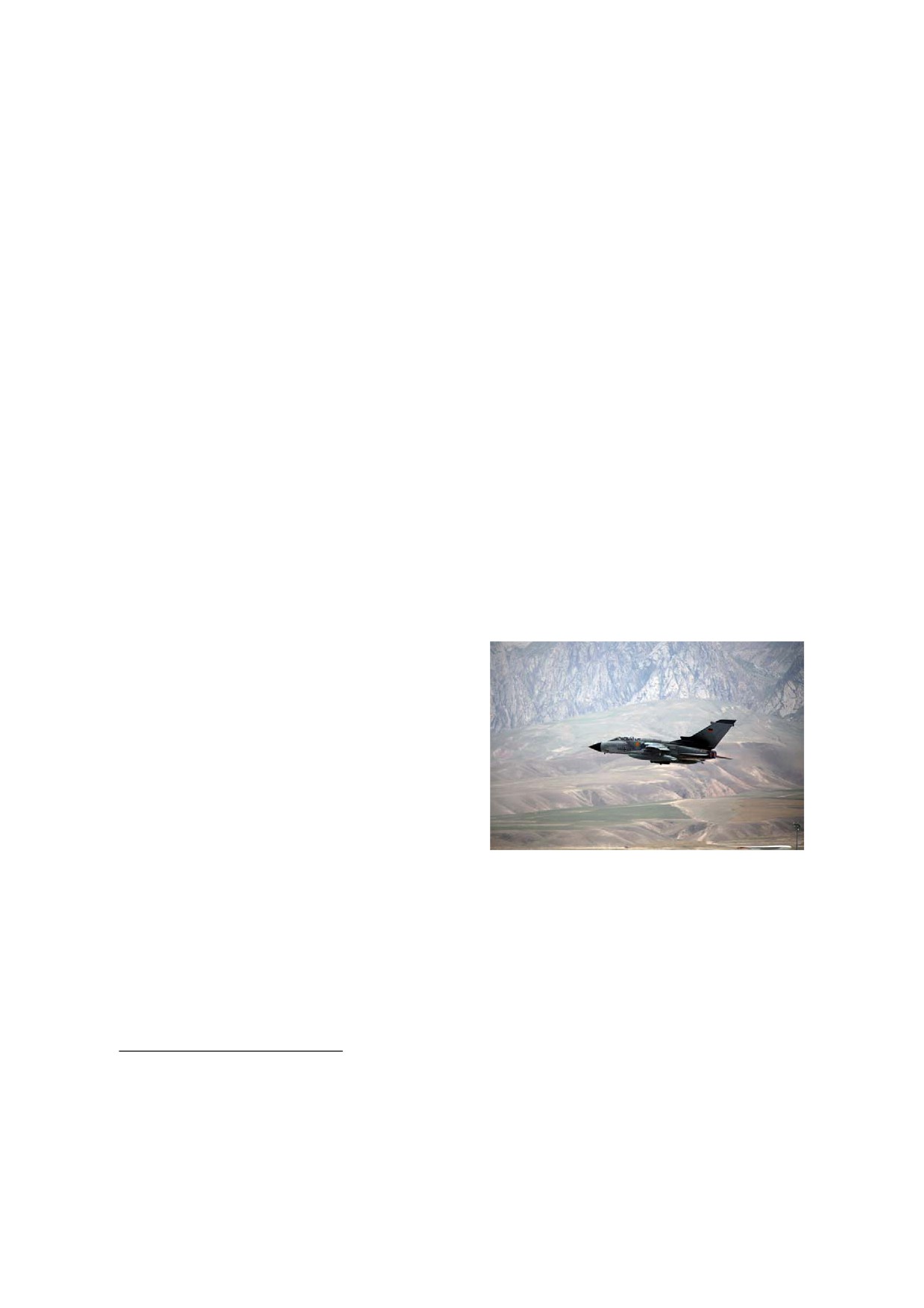
Manned systems
(for example TORNADO
RECCE) are able to cover long distances within
little time and allow the main effort to be shifted
instantaneously. They may enhance their range
and endurance by air-to-air refuelling and are
capable of transmitting sensor data in near real
time. Unmanned systems
(e.g. HERON
1)
compared to manned systems are rather slow,
In addition, helicopter crews of the air transport
however, thanks to their extended loiter time they
forces provide their capacities in the field of
allow for continuous and detailed reconnaissance
search and rescue as well as in the overall
and assessment of the situation in the area of
spectrum of personnel recovery with a focus on
operations (>24 h depending on configuration and
Combat Search and Rescue of isolated personnel.
flight profile).
Aided by highly sensitive
reconnaissance
technology
(electro-optical,
Outside the perimeter of operational facilities,
infrared, radar) reconnaissance results needed for
helicopters are particularly threatened during
the estimate of the situation can be provided via
takeoff and landing. Therefore envisaged landing
radio and/or satellite communication in near real
zones must be secured by ground forces to provide
time and almost independent of the weather and
best possible protection from direct fire. This can
light conditions.
not always be guaranteed for Combat Search and
Rescue operations due to the constraints of the
In the scope of the military role to help establish
mission and situation. This is why situation-
security and state order, airborne reconnaissance
oriented freedom of decision as well as the
forces may be assigned the following tasks:
capability of self-protection are indispensable for
• Consolidating a safe and secure
Combat Search and Rescue forces.
environment:
Air transport forces may be assigned the following
o contributing to the establishment and
tasks in the scope of the military role to help
training of the air forces of the host
establish security and state order:
nation
• Enabling/supporting measures:
• Establishing
a safe
and secure
o performing
reconnaissance
tasks
environment:
inclusiding reporting and transfer of
o supporting transports of security forces,
sensor data
medical personnel, casualties, injured or
o monitoring areas of high interest;
sick persons as well as transports of relief
developing a “Pattern of Life”
supplies
- 46 -
NATO UNCLASSIFIED
•
Consolidating a safe and secure
On the whole, naval forces can be effectively
environment:
employed in any suboperation aimed to help
o assisting with the establishment and
establish security and state order. Their tasks may
training of air forces of the host nation
include:
o assisting with setting up an aeronautical
•
Threat elimination:
search and rescue organisation in the host
o disrupting maritime supply lines and
nation
lines of movement of INS
•
Enabling/supporting measures:
o engaging land-based targets by the JFS
o performing operational and tactical air
engagement network
transport for quick deployment of
o supporting special operations and Special
reserves and/or reinforcements allows for
Forces operations
the point of main effort to be shifted
•
Establishing
a safe
and secure
rapidly even over longer distances
environment:
(which is an important contribution to
o countering direct attacks, in particular
create of moments of surprise and thus to
from the sea and from the air
gain the initiative)
(this measure
o assuming sovereign maritime policing
encompasses, besides airland operations,
tasks by conducting sea-based patrols
delivery and/or airdropping of personnel
(establishing public order)
as a method of insertion).
o supporting civilian organisations in the
o ensuring follow-on supply of own forces
context of subsidiary aid, providing
even over longer distances (resulting in
goods and services:
enhanced sustainability even of isolated
- transporting and delivering relief
and/or remote units as well as to relieve
goods
to
distribution
the burden on the land forces so the
agencies/organisations ashore to help
number of convoys moving by road can
people in distress
be reduced)
- supporting and contributing to the
o conducting
qualified
aeromedical
provision of medical supplies to the
evacuation in the scope of FWD and/or
civilian population in a safe and
TAC AIRMEDEVAC
secure environment
o planning/conducting operations within
•
Consolidating a safe and secure
the overall spectrum of personnel
environment:
recovery
o helping with establishing and training
naval forces of the host nation
6.5 Contributions by Naval Forces
•
Enabling/supporting measures:
Naval forces are capable of developing maritime
o contributing
to
intelligence
and
space adjacent to an area of operations so that it
reconnaissance efforts
can be used as a base for joint operations. In the
o providing convoy escorts
scope of the military role in establishing security
o transporting own forces
(personnel,
and state order they usually act as force enablers
materiel, ammunition) by sea into the
and multipliers for the composite forces and thus
area of operations or the vicinity thereof
raise the number of tactical and operational
o ensuring supplies to friendly forces by
options for the conduct of operations.
sea to enhance their sustainability
Even ahead of military ground operations can
o providing medical care aboard sea-based
naval forces be deployed in the intended area of
platforms
operations. In the scope of Maritime Security and
o employing sea-based platforms to
Maritime Interdiction Operations they may
exercise command and control of initial
prepare the employment of land forces by
operations by land forces
displaying commitment and resolve, performing
o keeping open sea routes (incl. of harbour
sea-based reconnaissance and carrying out
installations) and merchant shipping
surveillance tasks.
routes as a basis for the deployment of
own forces and the provision of supplies
Using sea-based platforms, naval forces also allow
to the local population.
headquarters required for command and control of
the operation to be based early enough close to the
area of operations and to contribute to the
development of a joint situation picture. Land
operations close to the coast can thus be led by a
command based in a secure and logistically self-
sufficient environment.
- 47 -
VS - NUR FÜR DEN DIENSTGEBRAUCH
Part
C
Annex
C1 Guiding principles on the conduct of military measures to establishing security and state order in
crisis areas45
Security and state order are established in an extremely complex environment where - on the assumption of
the classical conduct of operations - employed military forces often have to change their way of traditional
thinking. The following guiding principles shall provide food for thought - but not restrain it. The situation on
the ground determines to what extent individual guiding principles can be applied in practice.
The more you protect your force, the less secure you may be.
The success of military measures to establish security and state order is, among other things, achieved by
affording protection to the population. In this context, military forces must visibly show their commitment
throughout the area. If they keep to their (protected) facilities they will inevitably lose contact with the
population and give the insurgents freedom of action. Therefore, the commander’s challenge is to strike a
balance between integrating his troops firmly into the population and giving them maximum protection.
The more force is used the less effective it may be.
The use of coercive force or even violence has side effects the extent of which can not be anticipated. Any
collateral damage to uninvolved parties or other mistakes will help the insurgents find a basis for propaganda
that will depict the forces on operation as troops bent on brutality.
Approaches that work well today need not necessarily do so tomorrow. If it is successful in one particular
area it will not necessarily apply to others.
Insurgents are very flexible and often part of a busy communication network. They quickly adapt to identified
tactics of opposing actors and are just as fast at spreading all relevant information among fellow fighters.
Local problems often require local solutions: “All COIN is local!”
A tactical success may be a strategic defeat.
Western armed forces will certainly win most tactical battles on account of their superior training, equipment
and command and control. Strategically this may be irrelevant and in the worst case distract from impending
strategic defeat. Likewise, tactical success - for instance a village stabilisation operation - may have strategic
effects as it may serve as a reference for future developments and provide an example for a sustainable defeat
of insurgency.
Military success in itself is no guarantee at all.
Military measures alone, however important they may be, cannot ensure success in establishing security and
state order. In some situations, a local teacher or doctor may turn out to be more efficient at tackling
insurgency than an entire infantry company.
Sometimes “doing nothing at all” is the best response.
Frequently actions taken by insurgents primarily aim to make operational military forces overreact, which can
subsequently be exploited for propaganda purposes. In this context, measures by friendly forces that have a
high symbolic value or the potential of being misconstrued must be carefully considered beforehand to avoid
triggering hostile propaganda and thus thwart the overall objective of the operation.
45 Cf. Allied Joint Doctrine for Counterinsurgency (COIN) (Ratification Draft 2), Chapter 5 - The Military
Contribution, Section III - Paradoxes.
- 48 -
VS - NUR FÜR DEN DIENSTGEBRAUCH
Some of the most suitable weapons cannot even fire.
Military measures with regard to establishing security and state order are often most effective and sustainable
if the focus is not on eliminating INS. The crucial fight is not the one against INS but the one to win the minds
of the population. Depending on the concrete local situation military forces must therefore work towards
establishing security and state order by rather non-kinetic measures.
It is often more beneficial to have forces of the host nation take a measure with imperfection than to have
own forces do it with exactitude and precision.
With a view to consolidating the local authority’s legitimacy it is essential to give measures a “local touch”.
Failing that, a feeling of dependence may emerge, impairing the reputation of the host nation government.
Many crucial decisions are not made by generals.
Successful military measures and operations require the competence and judgment of servicemen and women
of all levels. In practice, decisions at tactical level are often made by young military leaders and sometimes
even by the rank and file (“strategic corporals”), which sometimes has strategic consequences (e.g. at
checkpoints when a decision is to be made whether to open fire or not).
C2 List of abbreviations
Abbreviation/
Acronym
Meaning
ABRA
Artilleriebeobachtungsradar - artillery surveillance radar
Artillerie Daten-, Lage- und Einsatzrechnerverbund - artillery information
ADLER
network
Amt für Geoinformationswesen der Bundeswehr - the Bundeswehr Geo
AGeoBw
Information Office
AJP
Allied Joint Publication
Abbildende luftgestützte Aufklärungsdrohne im Nächstbereich - airborne
ALADIN
close-in range imaging reconnaissance drone
CNO
computer network operations
COBRA
counterbattery radar
COIN
counterinsurgency
CRC
crowd and riot control
Einsatzvorbereitende Ausbildung für Konfliktverhütung und Krisenbewältigung
EAKK
- predeployment training for conflict prevention and crisis management
EK/EW
Elektronischer Kampf - electronic warfare
EloGM
Elektronische Gegenmaßnahmen - electronic countermeasures
EloSM
Elektronische Schutzmaßnahmen - electronic protective measures
EloUM
Elektronische Unterstützungsmaßnahmen - electronic support measures
EMS
Elektromagnetisches Spektrum - electromagnetic spectrum
EOD
explosive ordonance disposal
FAC
forward air controller
Führungsinformationssystem des Heeres - German Army Command and
FüInfoSysH
Control and Information System
Führungs- und (Waffen-)Einsatzsystem - command, control, information, and
FüWES
weapons control system
Geo Info
Geoinformation
Geoinformationsdienst der Bundeswehr - Bundeswehr Geoinformation
GeoInfoDBw
Service
GeoInfoW
Geoinformationswesen - Geoinformation Affairs
- 49 -
VS - NUR FÜR DEN DIENSTGEBRAUCH
Abbreviation/
Acronym
Meaning
GO
governmental organisation
HAufklKr
Kräfte der Heeresaufklärungstruppe - Army ISR Corps
Heeresflugabwehr-, Aufklärungs- und Gefechtsführungssystem - Army Air
HFlaAFüSys
Defence Surveillance and Command and Control System
HUMINT
human intelligence
IEB
Interkulturelle Einsatzberatung - cross-cultural operational advice
IED
improvised explosive device
InfoOp
Informationsoperationen - information operations
INS
insurgents
IO
international organisation
JFST
joint fire support team
KZO
Kleinfluggerät Zielortung - small air vehicle for target location
leSpähGrp
Leichte Spähgruppe - light reconnaissance squad
LuSK
Luftstreitkräfte - air forces
LSO i. E.
Leitender Sanitätsoffizier im Einsatz - force surgeon
MANPADS
manportable air defence system
MANTIS
modular automatic and network-capable targeting and interception system
MEDINT
medical intelligence
Mikroaufklärungsdrohne im Ortsbereich - micro drone for local area
MIKADO
reconnaissance
MilNachrL
Militärische Nachrichtenlage - military intelligence situation
MilNW
military intelligence
NG&A
Nachrichtengewinnung und Aufklärung - intelligence and reconnaissance
NGO
non-governmental organisation
ObjSKrLw
Objektschutzkräfte der Luftwaffe - Air Force ground combat support forces
OpInfoKr
Kräfte der Operativen Information - military information support operations
OPSEC
operations security
OSINT
open sources intelligence
REP
recognised environmental picture
RFI
request for information
SanDstBw
Sanitätsdienst der Bundeswehr - Bundeswehr Medical Service
SpezKr
Spezialkräfte - special forces
SpezlKr H
Spezialisierte Kräfte Heer - Army Specialised Forces
STF
Streitkräftegemeinsame Taktische Feuerunterstützung - joint fire support
TTP
tactics, techniques and procedures
ZMilNW
Zentrales Militärisches Nachrichtenwesen - military intelligence centre
ZMZ/A
Zivil-militärische Zusammenarbeit/Ausland - civil-military cooperation (CIMIC)
ZSanDstBw
Zentraler Sanitätsdienst der Bundeswehr - Bundeswehr Joint Medical Service
- 50 -
VS - NUR FÜR DEN DIENSTGEBRAUCH
C3 Reference documents and recommended reading
1.
BMVg - Minister - vom 25.10.2006, Weißbuch 2006
2.
BMVg - BM/Fü S VI 2 - Az 09-02-04/VS-NfD vom 09.08.2004, Konzeption der Bundeswehr (KdB)
3.
BMVg - Sts/Fü S IV 1 - vom 10.12.2008, ZDv 31/1 VS-NfD Logistische Unterstützung von Einsätzen
der Bundeswehr, DSK FF410120083
4.
BMVg - GenInsp/Fü S V 6 - Az 09-02-05/VS-NfD vom 27.10.2004, Teilkonzeption Einsatz der
Spezialkräfte (TK EinsSpezKr)
5.
BMVg - GenInsp/Fü S II 2 - Az 41-50-02/VS-NfD vom 28.04.2008, Teilkonzeption Elektronischer
Kampf der Bundeswehr (TK EK Bw)
6.
BMVg - GenInsp/Fü S V 4 - Az 09-02-05/VS-NfD vom 09.07.2007, Teilkonzeption Feldjägerwesen der
Bundeswehr (TK FJgWesBw)
7.
BMVg
- GenInsp/Fü S V
2
- Az
09-02-05/VS-NfD vom
17.02.2005, Teilkonzeption
Informationsoperationen der Bundeswehr (TK InfoOpBw)
8.
BMVg - GenInsp/Fü S II 1 - Az 05-00/VS-NfD vom 04.11.2008, Teilkonzeption Militärisches
Nachrichtenwesen (TK MilNW)
9.
BMVg
- GenInsp/Fü S II
6
- Az
09-02-05/VS-NfD vom
06.07.2005, Teilkonzeption
Geoinformationswesen der Bundeswehr (TK GeoInfoWBw)
10.
BMVg - GenInsp/Fü SKB I 4 - Az 31-60-05/VS-NfD vom 08.03.2002, Teilkonzeption Operative
Information der Bundeswehr (TK OpInfoBw)
11.
BMVg - GenInsp/Fü H III 2 - Az 09-02-05/VS-NfD vom 03.06.2008, Teilkonzeption Operationen im
urbanen Umfeld (TK UrbOp)
12.
BMVg - GenInsp/Fü H III 2 - Az 32-13-00/VS-NfD vom 03.04.2006, Teilkonzeption Schutz von
Kräften und Einrichtungen im Einsatz (TK Schutz)
13.
BMVg - GenInsp/Fü S VI 2 - Az 09-02-05/VS-NfD vom 20.11.2006, Teilkonzeption Vernetzte
Operationsführung (TK NetOpFü)
14.
BMVg - GenInsp/Fü S IV 3 - Az 08-08-00/OFFEN vom 03.03.2009, Teilkonzeption Zivil-Militärische
Zusammenarbeit der Bundeswehr (TK ZMZBw)
15.
BMVg
- GenInsp/M II IT
1
- Az
09-02-05/VS-NfD vom
08.08.2006, Teilkonzeption
Führungsunterstützung Bundeswehr und IT-System der Bundeswehr (TK FüUstgBw und IT-SysBw)
16.
BMVg
- GenInsp/Fü S IV
3
- Az
99-64-10/VS-NfD vom
27.11.2006, Teilkonzeption
Kampfmittelabwehr der Bundeswehr (TK KpfmAbwBw)
17.
BMVg
- GenInsp/Fü S V
2
- Az
09-02-05/VS-NfD vom
09.05.2005, Teilkonzeption
Computernetzwerkoperation (TK CNO)
18.
BMVg - GenInsp/Fü S II
2
- Az
04-03-12/VS-NfD
(noch nicht erlassen), Teilkonzeption
Nachrichtengewinnung und Aufklärung (TK NG&A), Expose V2, Stand: 22.10.2009
19.
BMVg - InspH/Fü H III 2 - Az 09-02-05/VS-NfD vom 23.12.2004, Einzelkonzeption Spezielle
Operationen (EK SpezlOp)
20.
BMVg - InspH/Fü H III
1
- vom
05.11.2007, HDv
100/100 VS-NfD Truppenführung von
Landstreitkräften (TF), DSK HH320220020
21.
ZTransf Bw: Streitkräfte, Fähigkeiten und Technologie im
21. Jahrhundert
- Strategische
Zukunftsanalyse 2035, Gesamtergebnisse und Handlungsempfehlungen, Waldbröl (2005)
22.
SKUKdo FüUstg/G6 vom 11.09.08, Vorläufiges Gesamtkonzept für die Kräfte des Aufgabenbereichs
Führungsunterstützung der Streitkräftebasis (VorlGesKonz FüUstgKr SKB)
23.
Heeresamt I 1/I 7 - Az 31-05-50/VS-NfD vom 30.05.2008, Ergebnisbericht zum CD&E-Vorhaben
Urbane Operationen 2010
24.
NATO -AAP-6 Glossary of Terms and Definitions (English and French) (2009)
- 51 -
VS - NUR FÜR DEN DIENSTGEBRAUCH
25.
NATO - AJP-3.2 Allied Joint Doctrine for Land Operations (Oktober 2009)
26.
NATO - AJP-3.10 Allied Joint Doctrine for Information Operations (November 2009)
27.
NATO - AJP-3.4.4 Allied Joint Doctrine for Counterinsurgency (COIN) (Ratification Draft 2, März
2010)
28.
NATO - SACT - Joint Operational Guidelines 01/04 Counterinsurgency (COIN) (Version 1.6, April
2010)
29.
USA - National Security Council: National Strategy for Victory in Iraq (November 2005)
30.
USA - FM 3-07 Stability Operations (September 2008)
31.
USA - FM 3-24 Counterinsurgency (Dezember 2006)
32.
USA - FMI 3-24.2 Tactics in Counterinsurgency (März 2009)
33.
USA - JP 3-24 Counterinsurgency Operations (Oktober 2009)
34.
USA - USMC Small-Unit Leaders’ Guide to Counterinsurgency, Quantico (2006)
35.
GBR - Joint Doctrine Note 2/07: Countering Irregular Activity within a Comprehensive Approach,
Shrivenham (März 2007)
36.
GBR - British Army Field Manual Volume 1 Part 10: Countering Insurgency (Oktober 2009)
37.
FRA - Centre de Doctrine d’Emploi des Forces: Doctrine de Contre Rébellion, Paris (Januar 2009)
38.
Grunewald/Meyfeld/Fuchs, IED-Bedrohung und Counterinsurgency in Kunduz
- Erfahrungen des
Fallschirmjägerbataillons 373, in: Der Deutsche Fallschirmjäger 2/2008
39.
Noetzel/Zapfe, Aufstandsbekämpfung als Auftrag, SWP-Studie, Berlin (Mai 2008)
40.
Noetzel/Schreer, Strategien zur Aufstandsbekämpfung, in: SWP-Aktuell 3 (Januar 2008)
41.
Alderson, Learning, Adapting, Applying - US Counterinsurgency Doctrine and Practice, in: RUSI
Journal, volume 152 no. 6 (Dezember 2007)
42.
Bickers, An Approach to Counter Threat Operations within a Counterinsurgency Environment, in: The
Royal Engineers Journal, volume 122 no. 1 (2008)
43.
Donahue/Fenzel, Combating a modern insurgency: Combined Task Force Devil in Afghanistan, in:
Military Review (März-April 2008).
44.
Galula, Counterinsurgency Warfare - Theory and Practice, Westport (2006)
45.
Gompert/Gordon, War by Other Means
- Building Complete and Balanced Capabilities for
Counterinsurgency, RAND Counterinsurgency Study - Final Report, Santa Monica (2008)
46.
Kilcullen, Accidental Guerrilla, Oxford, 2009, ISBN: 978-0-19-536834-5
47.
Kilcullen, Counterinsurgency Redux, in: Survival, volume 48 no. 4: (Winter 2006-07)
48.
Kilcullen, Twenty-eight Articles - Fundamentals of Company level Counterinsurgency (März 2006)
49.
Lawrence, Seven Pillars of Wisdom, London (1997)
50.
Petraeus, Learning Counterinsurgency: Observations from Soldiering in Iraq, in: Military Review
(Januar-Februar 2006)
51.
Robinson, Tell me how this ends - General David Petraeus and the search for a way out of Iraq, New
York (2008)
52.
Schnaubelt, What NATO can learn from „the surge“ in Iraq, Research Paper no. 40, NATO Defense
College, Rome (Oktober 2008)
- 52 -

FOR OFFICIAL USE ONLY
Department of Homeland Security
Special Programs Security Division (SSPD)
Accreditation and Technical Support Branch (ATSB)
SENSITIVE COMPARTMENTED INFORMATION FACILITY (SCIF)
STANDARD CONSTRUCTION & DESIGN PACKAGE
August 2007
Office of Security
Washington DC 20528
FOR OFFICIAL USE ONLY
TABLE OF CONTENTS
CHANGE PAGE
IV
INTRODUCTION
VI
PURPOSE
VII
AUTHORITIES
VIII
DEFINITIONS
IX
ADMINISTRATIVE PROCEDURES
1
SCIF ACCREDITATION REQUIREMENTS
1
CONCEPT AND PRECONSTRUCTION APPROVAL
1
THE FIXED FACILITY CHECKLIST (FFC)
1
CONSTRUCTION REQUIREMENTS AND SPECIFICATIONS
2
HANDLING AND DISTRIBUTION OF DRAWINGS
2
CONSTRUCTION STANDARDS
3
MILEPOSTS FOR INSPECTION
3
GENERAL NOTES
4
EXPANDED METAL MESH SPECIFICATIONS
6
SCIF PERIMETER WALLS
7
SCIF DOORS
7
PRIMARY ENTRANCE DOOR
8
SECONDARY ENTRANCE DOORS
9
SCIF EMERGENCY EXIT DOOR
9
DIELECTRIC BREAKS
10
DUCTS
10
TECHNICAL SECURITY
11
TELEPHONE SECURITY
11
COMPUTERIZED TELEPHONE SYSTEMS (CTS)
11
RF ATTENUATION & TEMPEST MITIGATION
12
RF WINDOW FILM SPECIFICATIONS
12
SOUND ATTENUATION
14
STC RATINGS
14
TESTING PROCEDURES
14
WINDOWS
15
ACCESSIBLE WINDOWS
15
INTRUSION DETECTION SYSTEM (IDS)
16
ALARM COVERAGE
16
DATA / TELEPHONES / POWER
17
DEDICATED POWER PANEL
17
DEDICATED GROUND
17
ii
FOR OFFICIAL USE ONLY
COMPUTER EQUIPMENT ROOM (CER) SHUNT-TRIP BREAKER
17
UNITERRUPTIBLE POWER SUPPLY (OPTIONAL UPS)
17
TEMPEST FILTERING
18
HVAC COMPUTER EQUIPMENT ROOM (CER) REQUIREMENTS
18
HVAC AIR CONDITIONING
18
TEMPERATURE ADJUSTMENTS
18
HUMIDITY RANGE
18
AIR SUPPLY DISSIPATION
19
AIR HANDLER LOCATION
19
COMMUNICATION LINE INSTALLATION
19
CONVEYANCE SYSTEMS INSTALLED IN CEILINGS
19
RED CONVEYANCE SYSTEMS UTILIZING WIRE
19
ACCESSIBILITY
19
CONVEYANCE BENDS
19
CONVEYANCE SYSTEMS BETWEEN SCIFS
20
PROTECTED DISTRIBUTION SYSTEM(S) (PDS)
21
PROTECTED DISTRIBUTION SYSTEMS (PDS) APPROVAL REQUEST
22
CONNECTIVITY GUIDELINES / GENERAL SPECIFICATIONS
24
COMMERCIAL DEMARCATION
24
WIDE AREA NETWORK(S) (WAN) CONNECTIVITY
24
SECURE VIDEO TELECONFERENCING
24
NON-SECURE (BLACK) WALL PLATES (VOICE AND DATA)
25
NON-SECURE VOICE CABLE DISTRIBUTION
25
SECURE (RED) WALL PLATES (VOICE AND DATA)
26
SECURE VOICE CABLE DISTRIBUTION (TDM)
26
SECURE VOICE CABLE DISTRIBUTION (IP)
26
INFRASTRUCTURE CABLING
26
STANDARD WALL DESIGNS / DUCT DETAILS / FIGURES
27
WALL TYPE 1 - ACOUSTICALLY-TREATED PARTITION
28
WALL TYPE 2: - ACOUSTICALLY-TREATED PARTITION (STC-45)
29
WALL TYPE 3A: - SCIF WALL PERIMETER WALL PARTITION
30
WALL TYPE 3B - SCIF WALL PARTITION ON PERIMETER WALL
31
WALL TYPE 4 - SECURE PERIMETER PARTITION
32
TRANSFER DUCT -Z-DUCT / PASSIVE AIR RETURN
33
MANBAR BARRIER
34
SECURITY BAR DETAIL
35
SECURITY GRILL/PERIMETER WALL ELEVATION DETAIL
36
SAMPLE - UL FIRE RATED / STC RATED / DOOR AND FRAME ASSEMBLY
37
SUGGESTED CABLE TELEVISION ISOLATION EQUIPMENT (FIBERPLEX)
38
SUGGESTED CABLE TELEVISION ISOLATION EQUIPMENT (PCT-FTX3R)
42
SUGGESTED FIRE ALARM ANNUCIATOR EQUIPMENT (HORN STROBE)
44
SUGGESTED FIRE ALARM ANNUCIATOR EQUIPMENT (SPEAKER ASSEMBLY)
45
SUGGESTED PUBLIC ANNOUNCEMENT (PA) SYSTEM EQUIPMENT
46
BEST PRACTICES
48
iii
FOR OFFICIAL USE ONLY
CHANGE PAGE
No.
CHANGE
CHANGE DATE
1.
ORIGINAL DOCUMENT RELEASE (ODR)
8-16-07
2.
Change page 9 & page 16, approved BMS types
8-30-2007
3.
Change administrative
9-10-2007
4.
5.
6.
7.
8.
9.
10.
11.
12.
13.
14.
15.
16.
17.
18.
19.
20.
21.
22.
23.
24.
25.
26.
27.
28.
29.
30.
31.
32.
33.
34.
35.
36.
37.
38.
39.
40.
41.
42.
iv
FOR OFFICIAL USE ONLY
FOREWORD
This handbook is issued under the authority of the Director Central Intelligence Directive
(DCID) 6/9, "Physical Security Standards for Sensitive Compartmented Information
Facilities" and The Department of Homeland Security, Management Directive 11043,
"Sensitive Compartmented Information Program Management".
This handbook applies to the Department of Homeland Security (DHS), its Components
(excluding the United States Coast Guard), Directorates, Offices, and Field Activities.
References made in this handbook to DHS will be considered to include all Components
(excluding the United States Coast Guard), Directorates, Offices, and Field Activities,
and entities encompassed under the jurisdiction of the Homeland Security Act and
amendments thereto. The United States Coast Guard maintains their designated
membership in the Intelligence Community and will continue to manage and operate its
own intelligence program.
This handbook also applies to contractors in SCI Facilities (SCIFs) accredited by the
DHS and to DHS SCI contract efforts conducted within facilities accredited by other
agencies and approved for joint use by co-utilization agreement.
Heads of DHS Intelligence Components may issue supplementary instructions when
necessary, to address unique situations to meet mission requirements within their
respective components. All supplementary instructions must be approved by the
Cognizant Security Authority (CSA) prior to implementation. Provisions outlined in this
handbook take precedence over previously issued legacy manuals, instructions,
guidance and other publications.
Comments regarding and/or recommendations to change this handbook, should be
directed to the DHS Security Office, ATTN: Special Security Programs Division (SSPD),
Accreditation and Technical Support Branch.
v
FOR OFFICIAL USE ONLY
INTRODUCTION
This handbook contains standard security designs and procedures common to Sensitive
Compartmented Facilities
(SCIF) and physical security construction standard and
established by the Director National Intelligence
(DNI) for protection of classified
intelligence information. Users should refer to Director of Central Intelligence Directives
(DCIDS) and other documents cited under Authorities for guidance on specific security
functions.
vi
FOR OFFICIAL USE ONLY
PURPOSE
This handbook contains security procedures, and details for the construction of
Sensitive Compartmented Information Facilities (SCIF) for the Department of Homeland
Security
(DHS). This handbook provides key milestones, construction standards,
electrical and technical guidance for use when planning and executing the construction
of DHS SCI Facilities (SCIFs).
This reference manual should be used as a guide for construction professionals,
engineers, architects, Special Security Officers and project managers to ensure the
required construction standards are established and meet DHS and DCID minimum
requirements.
Adherence to this guide will assist in facility accreditation in accordance with DCID 6/9
standards.
DHS Facilities Division, construction professionals, engineers, architects, Special
Security Officers and project managers should verify their design intent and concept of
operation through the Cognizant Security Authority (CSA) prior to entering into a DHS
SCIF construction project.
Approval of a SCIF Concept of Operations
(CONOPS) is critical to the facility
accreditation and should be the initial documentation established prior to beginning,
planning and or construction of an SCI facility.
Make all CONOPS approval requests through the Office of Security, ATTN: Special
Security Programs Division, Chief Security Officer.
vii
FOR OFFICIAL USE ONLY
AUTHORITIES
1.
The Homeland Security Act of 2002, P. L. 107-296
2.
The National Security Act of 1947, 50 U.S.C. 401
3.
Executive Order 12333 “United States Intelligence Activities”
4.
Executive Order 12829, “National Industrial Security Program”
5.
Executive Order 12958, as amended, “Classified National Security Information”
6.
Executive Order 12968, “Access to Classified Information”
7.
Executive Order 13284, “Establishment of the Department of Homeland Security”
8.
Director of Central Intelligence Directive (DCID) 6/1, “Security Policy for Sensitive
Compartmented Information and Security Policy Manual”
9.
DCID 6/3, “Protecting Sensitive Compartmented Information Within Information
Systems”
10.
DCID 6/4, “Personnel Security Standards and Procedures Governing Eligibility for
Access to Sensitive Compartmented Information”
11.
DCID 6/7, “Intelligence Disclosure Policy”
12.
DCID 6/9, “Physical Security Standards for Sensitive Compartmented Information
Facilities”
13.
Department of Homeland Security Delegation Number 8000.1, “Delegation to
Chief, Office of Security of Determination Authority and Cognizant Security
Authority”
14.
Designation of Chief Security Officer as Senior Agency Official, March 3, 2004
15.
Department of Homeland Security Management Directive number 11043 Sensitive
Compartmented Information Program Management
viii
FOR OFFICIAL USE ONLY
DEFINITIONS
A. Accreditation is the formal approval of a specific place, referred to as a Sensitive
Compartmented Information Facility (SCIF), that meets prescribed physical, technical,
and personnel security standards.
B. Cognizant Security Authority (CSA) is the individual designated by a Senior
Official of the Intelligence Community (SOIC) to serve as the responsible official for all
aspects of security program management with respect to protection of intelligence
sources and methods under SOIC responsibility. The CSA for DHS is the Chief Security
Officer.
C. Contractor Special Security Officer (CSSO) administers the receipt, control, and
accountability of SCI materials and the SCI security functions for contractor facilities.
D. Information System Security Manager (ISSM) The security official responsible for
the IS security program for a specific Directorate, Office, or contractor facility.
E. Information System Security Officer
(ISSO) The security official, either
government or contractor, responsible for the security posture of a specific Information
System.
F. Intelligence Community includes United States Government agencies and
organizations and activities identified in the National Security Act of 1947.
G. National Foreign Intelligence Board is chaired by the Director of Central
Intelligence and is comprised of Intelligence Community members and distinguished
civilians appointed by the President.
H. Need-to-know is a determination made by an authorized holder of classified
information that a prospective recipient requires access to specific classified information
in order to perform a lawful and authorized function. Such person shall possess an
appropriate security clearance and access approvals in accordance with Executive
Orders 12958, as amended, and 12968, as well as DCID 6/4.
I. Senior Agency Official is the official designated by the agency head under section
5.4(d) of E.O. 12958, as amended, who directs and administers the agency’s program
under which information is classified, safeguarded, and declassified. The Senior Agency
Official for DHS is the Chief Security Officer.
J. Senior Official of the Intelligence Community
(SOIC) is the head of an
organization within the Intelligence Community, as defined by the National Security Act
of 1947. Within DHS there are five SOICs: The Secretary, the Deputy Secretary, the
Under Secretary for Information Analysis and Infrastructure Protection, the Assistant
Secretary for Information Analysis, and the Assistant Commandant for Intelligence for
the United States Coast Guard.
ix
FOR OFFICIAL USE ONLY
K. Sensitive Compartmented Information (SCI) is classified information concerning,
or derived from, intelligence sources, methods, or analytical processes requiring
handling within formal access control systems established by the Director Central
Intelligence (DCI). SCI is also referred to as "codeword" information. The sensitivity of
this information requires that it be protected in a much more controlled environment
than other classified information. Therefore, the DCI has established special policies
and procedures for the protection of SCI. These policies and procedures are
promulgated through Director of Central Intelligence Directives (DCIDs).
L. SCI Facility (SCIF) is an accredited area, room, group of rooms, buildings, or
installation where SCI may be used, stored, discussed and/or processed.
M. Security Clearance is a formal authorization for an employee with a specific need-
to-know to have access to information that is classified as Confidential, Secret, or Top
Secret in the interest of national security or the defense of the United States.
N. Special Security Officer (SSO) works under the direction of the Chief, Special
Security Programs Division and administers the receipt, control and accountability of
SCI. The SSO oversees SCI security functions and reporting requirements for
subordinate SCIFs.
O. Special Security Representative (SSR) works under the direction of the supporting
SSO, and is responsible for the day-to-day management and implementation of SCI
security and administrative instructions for a separate, subordinate DHS SCIF.
P. Technical Surveillance Countermeasures are techniques and measures used
to detect and nullify a wide variety of technologies used to obtain unauthorized access
to classified national security information, restricted data, and/or unclassified sensitive
information.
Q. Telecommunications and Automated Information Systems (TAIS) is defined as
any telecommunications or computer related equipment, or interconnected system or
subsystems of equipment, that is used in the acquisition, storage, manipulation,
management, movement, control, display, switching, interchange, transmission, or
reception of voice or data
(digital or analog), including software, firmware, and
hardware.
R. TEMPEST: Telecommunications Electronics Material Protected from Emanating
Spurious Transmissions or Transient Electromagnetic Pulse Emanation Standard.
Refers to external electromagnetic radiation from data processing equipment and the
security measures used to prevent them.
x
FOR OFFICIAL USE ONLY
ADMINISTRATIVE PROCEDURES
SCIF ACCREDITATION REQUIREMENTS
The Special Security Programs Division (SSPD) under authority of the Chief Security
Officer (CSO) is the sole accrediting authority for DHS SCIFs. Divisions are responsible
for ensuring SCIFs are established only when clear operational requirements dictate,
and when existing SCIFs are not adequate to support the requirements. A clear, active
SCI mission must exist before a SCIF is requested. SCI will not be discussed or
introduced into the proposed SCIF until the facility is formerly accredited by SSPD.
SCIF accreditation involves two basic steps: Concept and preconstruction approval, and
Accreditation.
CONCEPT AND PRECONSTRUCTION APPROVAL
The concept approval step is a key element in future accreditation actions. Concept of
Operations (CONOPS) approval certifies that clear operational requirements exist for
the SCIF and there is no existing SCIF to support the requirement. Upon receipt of the
CONOPS approval, the Directorate or Component Special Security Officer (SSO) will
coordinate directly with SSPD on all matters pertaining to physical security/TEMPEST
and accreditation of that SCIF. The SSO will send an information copy of any
documentation to the appropriate Division Head. Divisions will not impose procedures
which hinder this process. The CONOPS approval request, via Memorandum, will
include the exact location of the proposed SCIF (Street Address and City); required
level of SCI accesses (SI/TK/G/HCS, etc.); the storage requirement (Closed Storage,
Open Storage or Continuous Operations (24/7 operations) and brief description of
operation.
The DHS Chief Security Officer, or designee, is authorized to grant concept approval to
establish a SCIF and to validate the requirement for the requested level of SCI. The
CSO or designee will issue a concept validation (CONOPS) approval Memorandum to
the requesting organization, with an information copy to the supporting SSO.
The SCIF design will balance threats and vulnerabilities against appropriate security
measures to reach an acceptable level of risk. Proper security planning for a SCIF is
intended to deny foreign intelligence services and other unauthorized personnel the
opportunity for undetected entry into theses facilities and exploitation of sensitive
activities.
THE FIXED FACILITY CHECKLIST (FFC)
This is the primary document in the decision making process for granting an
accreditation. The preconstruction FFC must describe in sufficient detail the types and
methods of construction to determine if the SCIF construction will satisfy physical
security criteria listed in DCID 6/9. Complete (to the extent possible) and submit the
preconstruction FFC for the proposed SCIF along with a drawing of the space and the
CONOPS request to SSPD. SSPD will review physical security preconstruction plans
1
FOR OFFICIAL USE ONLY
for SCIF construction, expansion, or modification and will provide preconstruction
advice, assistance, and formal written approval. Construction will not begin until SSPD
provides formal preconstruction approval to proceed with construction.
CONSTRUCTION REQUIREMENTS AND SPECIFICATIONS
Prior to SCIF construction, SSPD must be provided with a copy of all preconstruction
drawings for approval. Based upon a threat analysis, additional technical or physical
enhancements may be required. Upon receipt of the drawings, SSPD will provide a
written concurrence/non-concurrence within ten working days.
HANDLING AND DISTRIBUTION OF DRAWINGS
Drawings should be considered and marked For Official Use Only and handled in
accordance with The Freedom of Information Act, The Intelligence Authorization Act of
2002 amending the FOIA and Privacy Act requirements accordingly.
Where possible drawings should be sanitized and a separate key document should be
maintained by authorized personnel providing detailed description of rooms, mechanical
and electrical details.
Drawings should have limited information regarding the activity or agency occupying the
SCIF, etc. Drawings should reference all rooms by number with a separate key
reference maintained separate from the drawing describing the room and requirements.
Drawings shall limit any indication(s) of function(s) or mission(s) of the facility.
Drawings shall not use the term (SCIF). As an alternative, another name, coding
system or number should be assigned at the discretion of the facilities project
manager and with concurrence from SSPD to identify SCI rooms and facilities.
2
FOR OFFICIAL USE ONLY
CONSTRUCTION STANDARDS
MILEPOSTS FOR INSPECTION
Special Programs Security Division (SSPD) or Cognizant Security Authority (CSA)
assigned representative must inspect the construction points described below.
1. During wall construction, but before its completion, all wall layers need to be
inspected.
2. Following installation/welding of expanded metal in walls, but before walls are
covered in sheetrock.
3. Following the installation of any duct grills, non-conductive breaks, or inspection
ports.
4. Following any modification to seal cable trays (e.g. welding plates; installation of
grill etc.) but before the tray is sealed.
5. Inspection of doors and hardware as specified, i.e. once doors are hung and all
equipment is installed to include door sweeps, thresholds, and gaskets.
6. Final inspection to include confirmation of wall-to-ceiling
(slab-to-slab)
construction; complete sealing around all penetrations in perimeter walls,
completion of walls above false ceiling in a workman-like manner to include
painting both sides, and complete labeling of both ends of all telephone, fiber,
and electrical circuits, to include all wiring and conveyance methods.
Many of these items shown above will be inspected at the same time, e.g.
penetrations requiring dielectric breaks will be inspected as available at
the same time that the expanded metal installation is inspected.
Ceiling tiles will not be installed until after the final inspection, so as to facilitate
access to the plenum, and prevent damage to the tiles.
** Every element of SCIF perimeter wall(s) installation must be made available for
inspection by the government representative prior to concealment. **
3
FOR OFFICIAL USE ONLY
CONSTRUCTION STANDARDS
GENERAL NOTES
1.
Building owner shall coordinate with government representative to obtain final
tenant approval and acceptance of build-out. This may not be applicable in
all locations, i.e. NAC facilities.
2.
Any openings greater than 96 square inches in cross sectional area that
penetrate any demising or perimeter wall must have a grill barrier unless the
government representative (SSPD) certifies the opening is not man-passable.
All grillwork frames shall be visible from the exterior of ductwork. A 12" X 12"
(approximate) lockable access port shall be installed to permit periodic
inspection of the grill. The access port shall allow visual and physical
inspection of the grill or man-bar installation. All access ports shall be on
tenant (secure) side of wall, and positioned such that access is not restricted.
The actual size of the access port may vary, but shall be no less than 9" X 9"
square. Tenant approval is required.
3.
All existing wiring penetrating tenant spaces shall be removed or relocated.
The only wiring approved to penetrate tenant space shall be wiring that is
required by building code, or for tenant use. Remaining wiring will be labeled
for identification. All wire penetrations shall be in conduit (unless otherwise
dictated by code) and approved by the government representative (SSPD).
4.
All abandoned equipment and conduit must be removed. Contractor shall fill
voids with tenant-approved method.
5.
All conduit or trough systems that penetrate perimeter walls, floors, or ceilings
shall be fitted with dielectric (non-conductive) breaks, and must be on tenant
(secure) side beginning within 6" of walls, floors, or ceilings, and should be no
longer than 6". If this cannot be accomplished, SSPD will review and provide
recommendations for mitigation of piping, fire systems, conduit or other
penetrations, i.e., single point grounding, wrapping, isolation or isolated
grounding.
6.
Any trough system below floor or above ceiling shall be sealed, and the
government representative (SSPD) shall approve both the method and type
of seal.
7.
Government project manager shall perform a final acceptance and inspection
before the space is released for occupancy.
8.
It is recommended that a Special Programs Security Division (SSPD) or
Cognizant Security Authority (CSA) assigned representative be present with
project manager during final acceptance inspection.
4
FOR OFFICIAL USE ONLY
CONSTRUCTION STANDARDS
GENERAL NOTES
9.
Contractor shall coordinate directly with government representative regarding
location of existing and proposed mechanical penetrations and man-bar
(grillwork) installation. Coordination shall occur prior to any mechanical
system procurement.
10.
All demising wall penetrations shall be reviewed and approved by government
security representative (SSPD) and shall have non-conductive breaks. If this
cannot be accomplished, SSPD will review and provide recommendations for
mitigation of piping, fire systems, conduit or other penetrations, i.e.,
grounding, wrapping, or isolation.
5
FOR OFFICIAL USE ONLY
CONSTRUCTION STANDARDS
EXPANDED METAL MESH SPECIFICATIONS
1.
Expanded metal mesh shall meet ASTM F1267-89 type, Class 1 standard and
shall have the following characteristics:
a. Strand thickness: No. 9 - 10 gauge minimum (flattened)
b. Weight:
195 lbs/csf minimum
c. Material:
Carbon Steel
d. Shape:
Flattened
e. Pattern:
Diamond
f. Dimensions: 3.20 inch maximum (long opening) (LWD) 1.33 inch
maximum (short opening) (SWD)
g. Recommended mesh: 3/4" #9 (10 ga)
2.
Mesh shall be fastened to steel stud and top and bottom runners using either
screw or weld attachment. Screws or weld shall be spaced at 6" on center
maximum, with all corners fastened to the framing. Mesh splice shall occur at
studs only. Splice between supports is not permitted unless: a) such splice is
welded continuously top to bottom; b) mesh is overlapped three inches, and
fastened or welded every six inches.
3.
Steel framing receiving metal mesh shall be 16 gauge minimum.
4.
Screws shall be self-drilling #8 shank minimum (1/4" minimum penetration into
steel framing.) Fasteners must be used from the secure side of the mesh. 1/2
inch washers must be installed when using screws to deter ability to pull mesh
over tops of screw heads.
5.
Welds shall be 1/8" x ½" long fillet type excepting at unsupported splices where
the weld must be continuous.
6.
There can be no gap in coverage. Gaps may be closed with steel studding or flat
metal welded (or fasted where welding is not permitted) to the secure side of the
expanded metal.
7.
A determination for use of expanded metal within SCIF walls will be made based
upon threat assessment, facility type, government owned vs. leased, location as
well as other factors.
8.
The Nebraska Avenue Complex (NAC) has a waiver for metal mesh
requirements for SCIF construction.
6
FOR OFFICIAL USE ONLY
CONSTRUCTION SPECIFICATIONS
Prior to SCIF construction, SSPD must be provided with a copy of all preconstruction
drawings for approval. Based upon a threat analysis, additional technical or physical
enhancements may be required. Upon receipt of the drawings, SSPD will provide a
written concurrence/nonoccurrence within ten working days.
SCIF PERIMETER WALLS
Perimeter walls must be true floor to true ceiling, finished and painted. Perimeter walls
will be constructed in the following manner:
1.
On the interior (secure side) of the perimeter wall, install one layer expanded metal
mesh, standard flattened with diamond pattern, carbon steel with minimum
flattened thickness of .120 inches (i.e., ¾ inch # 9 - 10 gauge mesh). The
maximum dimensions of the long opening are 2.1 inches (80 millimeters) and the
short opening is .923 inches (34 millimeters). Secure mesh to the metal framing
via welding or with self-tapping #8 shank pan head screws at 6 inch (150
millimeters) on center maximum horizontally and vertically and a minimum of 7
millimeters penetration into the metal framing. Washers will be used to ensure
secure fastening. Reference expanded metal mesh requirements for weld and
installation instructions.
2.
The interior (secure side) of the perimeter wall must consist of two layers 5/8 inch
drywall mounted, on top of the metal mesh, on 16 gauge metal studs @ 16 inches
O.C.
3.
For perimeter walls that are adjacent to exterior building walls composed of
substantive material, CMU, concrete block, steel, brick, etc., one layer of drywall
may be eliminated. Reference wall detail type 3A and type 3B of this document.
4.
Install a layer of 3 ½ inch sound batting or mineral wool material in the wall cavity.
This construction method should provide a sound attention level of sound
transmission class (STC) rating of 45 or greater.
5.
On the exterior (non-secure side), install one layer of 5/8 inch drywall, with
staggered seams, horizontally and vertically. Drywall should be staggered when
using foil backed drywall. Drywall staggering is not required when using a foil
barrier stapled between the two layers of drywall.
SCIF DOORS
Doors and frames shall meet or exceed an STC 45 rating at a minimum. The entire
door, frame, partition, and door hardware assembly shall be designed and specified by
the A/E firm to ensure the required STC rating is achieved.
7
FOR OFFICIAL USE ONLY
Additionally, doors must meet a minimum forced entry requirement and be composed of
a material that will withstand a forced entry attempt by
Doors will meet the following requirements:
1.
Solid wood stave core door, a minimum of 1 ¾ inches thick, or
2.
16 gauge metal cladding over wood or composition materials, a minimum of 1 ¾
inches thick, or
3.
Metal fire or acoustical protection doors, a minimum of 1 ¾ inches thick., or
4.
A joined metal rolling door, minimum of 22 gauge, used as a loading dock or
garage structure must be approved on a case-by-case basis.
5.
All doors will be tested and meet a minimum Sound Transmission Class (STC) of
45. Install door sweeps, gaskets, astragal or overlapping molding to meet the
STC-45 rating. All doors will have heavy duty automatic door closures.
6.
If door(s) are equipped with hinges located on the exterior side of the door where
it opens into an uncontrolled area outside of the SCIF, the hinge pins will be
treated to prevent removal (e.g. pined, brazed, set screws, spot welded, etc.).
7.
The non-active door of a double door configuration must be secured at the top
(door jam) and bottom (floor) with heavy duty sliding deadbolts. Install heavy duty
throw bolts on the inactive leaf (type Sergeant and Greenleaf (S&G) SM 181
slide locks on top and bottom or equivalent heavy duty slide bolts).
8.
Use of wireless door opening devices is prohibited on garage doors. Remote
door release devices are also prohibited unless approved in advance by the
SSPD.
9.
Install a UL 634 compliant (level 2) Balanced Magnetic Switch (BMS) which
contains three or more balanced magnetic switches. A BMS is required on all
doors that make up and or are apart of the SCIF perimeter boundaries/walls.
PRIMARY ENTRANCE DOOR
There will be one designated primary entrance door, unless approved in advance in
writing from the CSO, Office of Security. The primary door must be equipped with a
DHS installed GSA-approved combination lock (X09), an electric door latch rated at
2000 lbs force entry, and one-way door peep viewing port.
The door must have high security locking hardware (Medeco, Schlage Primus, Assa or
similar approved hardware) that can override the access controlled electric door latch.
Locking hardware shall meet UL 437 standards. The primary entrance door must be
equipped with an automatic door closer and a dual access control device (key pad with
8
FOR OFFICIAL USE ONLY
PIN and proximity card), in addition to the currently installed GSA-approved combination
lock (X-09).
Install acoustical gasketing around the door and door sweeps to achieve an STC-45
sound rating. Reference Sound Attenuation.
SECONDARY ENTRANCE DOORS
These must be approved in advance by the SSPD. Secondary doors must be secured
with approved deadlocking door hardware for securing the space after hours. The
access control to this door must be disabled during periods of minimum staffing (6p.m. -
6a.m.). The keyway must be blanked on these doors.
SCIF EMERGENCY EXIT DOOR
The SCIF emergency exit door will be equipped with the following:
1. Deadlocking panic hardware (Von Duprin 9857-EO-F/9957-EO-F Three Point
Latching Fire Device or similar) on the inside and have no exterior hardware.
2. Automatic door closer.
3. Balanced magnetic switch (BMS), Sentrol Model 2700 series, Harco
Magnasphere HSD or equivalent (armed 24/7).
4. Local enunciator to alert personnel working in the area someone exited the
facility due to emergency condition or other.
5. Install acoustical gasketing around the door and door sweeps to achieve and
STC-45 sound rating.
6. Exposed hinges must be treated to prevent removal of the door (e.g., welded, set
screws, etc).
9
FOR OFFICIAL USE ONLY
CONSTRUCTION SPECIFICATIONS
DIELECTRIC BREAKS
DHS multi-tenant facilities must have non-metallic breaks on ducts, electrical conduits
and water/sewer pipes that penetrate the SCIF perimeter. If this cannot be
accomplished, SSPD will review and provide recommendations for mitigation of piping,
fire systems, conduit or other penetrations, i.e., grounding, wrapping, or isolation.
DUCTS
Ducts over 96 square inches that penetrate the SCIF perimeter wall must have man
bars installed at the point of entry. An inspection port must also be installed for visual
verification and routine inspection on the secure side of the duct. Ducts with any
dimensions less than 6” do not require man bars.
10
FOR OFFICIAL USE ONLY
TECHNICAL SECURITY
TELEPHONE SECURITY
To prevent telephone lines and telephone instruments that service a SCIF from being
used as clandestine listening devices, the following controls will be required:
1. All incoming telephone cables and wires which penetrate a facility's perimeter will
enter the facility through one opening and be placed under control at the interior face of
the perimeter by the following:
a. All active incoming lines will be accounted for by the number of pairs in use, by
telephone and extension number, and the number of excess/unused pairs in existence.
The accounting will be updated whenever the status of a pair of wires is changed.
b. All excess/unused incoming wires will be either removed or disconnected and
grounded in a manner which prevents their unauthorized use.
2. The number of telephone instruments servicing a SCIF will be limited to those
operationally necessary. All telephone instruments will be equipped with a non-
resonating ringer, a positive disconnect either automatic or manual plug and jack, and,
in certain installations a line filter. Specially designed, for U.S. Government use,
telephone instruments and associated security devices are available from telephone
companies. When planning the telephone system for a SCIF, advance consultation with
SSPD is encouraged to obtain advice regarding recommended telephone instruments,
associated security devices, installation design, and the required "certification of need"
to obtain specially designed instruments and devices.
COMPUTERIZED TELEPHONE SYSTEMS (CTS)
Computerized telephone systems (CTS) or Voice Over Internet Protocol (VoIP) systems
within the SCIF must meet Telephone Security Group (TSG) TSG-2 standards or utilize
approved TSG type 6 equipment.
If the room is a “discussion area”, all telephones installed in the space must be TSG-6
approved telephones, as an alternative, a TSG-2 configuration may be approved and
utilized.
1. Administrative telephone systems are a potential source for fortuitous conduction
of Compromising Emanations (CE) due to their proximity to building maintenance
areas and their signal line distribution outside the facility. Additional protection is
recommended when commercial telephones are located in a RED
electromagnetic environment. The most effective protection is provided by line
disconnection switches and telephone line optical isolators that use waveguide
below cutoff. The use of these devices or telephone filters must be approved by
11
FOR OFFICIAL USE ONLY
the CTTA. These devices should be considered only when installing. replacing or
retrofitting telephone systems.
2.
Remember that the administrative telephone system and its associated wiring
are BLACK. The telephone system cabling should be routed in a separate
distribution system. If filters or isolators are required and approved by the CTTA,
the lines should be filtered/isolated where they egress the inspectable space or
facility. Locating the filters/isolators at the controlled space is not recommended
because the equipment TEMPEST zone may extend beyond the controlled
space. In addition, fewer filters/, isolators will be necessary if the trunk lines
rather than the individual phone lines are filtered/isolated.
3.
CATV: Cable Television service into the SCIF must be electrically isolated at the
point of entry. SSPD recommends the use of Fiber Plex Incorporated Uni-
Directional (Simplex) Composite Video Optical Transmitter and Optical Receiver
models (FOI-2170) and (FOI-2172) or similar isolation device also PCT
International's 1310 nm Rackmount Transmitter (PCT-FTX3R) suitable for NTSC
or PAL television signal transmission. Analog bandwidth to 870 MHz allows for
advanced services such as HDTV, VOD, PPV, and high speed data as well as
traditional cable TV.
4.
Fire alarm horn strobes and horn enunciators installed inside of the SCIF will
have a self amplified speaker configuration. Wheelock models SA-70 and SA-
70s or similar device(s) are recommended.
RF ATTENUATION & TEMPEST MITIGATION
Based upon a threat determination and analysis of the proposed SCIF site, location and
mission, RF Attenuation may be required. A determination will be made by SSPD prior
to construction of the facility in accordance with CNSS 7000 and NSTISSI 7000,
TEMPEST countermeasures for facilities, date May 2004. If a determination is made
that TEMPEST countermeasures are required the following information is provided:
1. On the interior (secure side), on top of the metal mesh, install two layers of 5/8
inch foil back drywall, with staggered seams, horizontally and vertically.
2. The preferred method of RF mitigation is to install to two layers of drywall: Install
one layer of 5/8 inch drywall. Install a layer of TVM Ultra NT Radiant barrier foil
(part # 1800 48 125s) or equivalent approved product. Seams must be
overlapped and taped with metallic tape, or folded appropriately. Install a second
layer of regular 5/8 inch drywall on top of the foil barrier.
RF WINDOW FILM SPECIFICATIONS
The following are the technical recommendations for all clear window film installed as
an after market item. The preferred method is the film to be installed between the
glazing as part of the window construction process prior to being placed in the window
12
FOR OFFICIAL USE ONLY
frame.
1. Radio Frequency attenuation greater than or equal to: 30dB from 30MHz to 1.5
GHz.
2. Infrared attenuation greater than or equal to: 80% at 800 nm (nanometer) 90% at
900 nm 94% at 1000 nm 98% at 1550 nm - 2300 nm
3. Ultra Violet attenuation greater than or equal to: 70% at wavelengths less than
400 nm 90% at 375 nm 90% at 350 nm
4. Total visible (400nm - 780 nm ) transmission greater Than or equal to 60%
5. Glazing system blast rated to GSA Glass Fragment Hazard Ranking 2. Can also
be put within the PVB of the glass, (preferred and much cheaper).
The DHS only aware of two manufacturers that provide a window glazing product that
meet or exceed these requirements, 3M and Signals Defense. DHS SSPD is available
to review any other product that may be used in lieu of these suggested vendors.
13
FOR OFFICIAL USE ONLY
SOUND ATTENUATION
Acoustical protection measures and sound masking systems are designed to protect
discussion of classified information from being inadvertently overheard by the casual
passerby. Secure Area and SCIF perimeter walls, doors, windows, floors and ceilings,
including all openings, will provide sufficient sound attenuation to preclude inadvertent
disclosure of conversation.
The ability of a Secure Area or SCIF structure to retain sound within the perimeter is
rated using a descriptive value, the STC. All DHS Secure Areas and SCIFs will meet
Sound Group III - STC of 45 or better. Higher levels are required for amplified sound
(e.g., video teleconferencing).
STC RATINGS
Sound Group III - STC of 45 or better. Loud speech can be faintly heard but not
understood. Normal speech is unintelligible.
Sound Group IV - STC of 50 or better. Very loud sounds, such as loud singing, brass
musical instruments or a radio at full volume, can be heard only faintly or not at all.
TESTING PROCEDURES
1. Procedures for measuring the sound attenuation levels of a completed structure can
be found in, "Tentative Recommended Practices for Measurement of Airborne Sound
Insulation in Buildings," Publication No. E-336-67T, American Society of Testing and
Materials.
2. Another acceptable procedure is found in the DCI Security Committee
memorandum, "Sound Attenuation Test for Secure Conference Rooms," dated 7 Feb
78.
14
FOR OFFICIAL USE ONLY
WINDOWS
Where windows exist affording visual surveillance of personnel, documents, materials,
or activities within the SCIF, the windows shall be made opaque or equipped with
blinds, drapes, or other coverings precluding such visual surveillance. All accessible
perimeter windows at ground level (less than 18 feet above the ground) shall be
covered by an Intrusion Detection System (IDS).
ACCESSIBLE WINDOWS
This should be interpreted to mean any windows which are less than 18 feet above the
ground measured from the bottom of the window, or are easily accessible by means of
objects directly beneath the windows, (e.g. roofs, fire escapes, electrical transformer, air
conditioning units, vegetation or landscaping which can be climbed) will be constructed
from or covered with materials which will provide protection from forced entry. The
protection provided to the windows needs to be no stronger than the strength of the
contiguous walls. Vertical Metal bars 1/2 inch thick, welded 6 inches on center will be
installed on all accessible windows. Additional horizontal bars must be used to prevent
spreading. As an alternative, Exeter, Level 5, or Kane Screens Level 5 (Crimeshield) or
similar product may be used. Secure areas located within fenced and guarded
government compounds with a 24/7 armed guard presence or equivalent may eliminate
this requirement if the windows are made inoperable by either permanently sealing
them or equipping them on the inside with a locking mechanism. In these instances,
shock-type glass break sensors must be installed on accessible windows. All windows
will be protected by Passive Infra-Red (PIR) motion sensors.
15
FOR OFFICIAL USE ONLY
INTRUSION DETECTION SYSTEM (IDS)
An IDS must detect an unauthorized or authorized penetration in the secure area. An
IDS complements other physical security measures and consists of Intrusion Detection
Equipment, Security Forces and Operating procedures.)
IDS systems shall be installed in accordance with Annex B of the DCID 6/9.
ALARM COVERAGE
The facility will have adequate alarm coverage:
1. Install Sentrol Model 2700 series, Harco Magnasphere HSD or equivalent (armed
24/7) on all perimeter doors.
2. Install a UL 634 compliant (level 2) Balanced Magnetic Switch (BMS) which
contains three or more balanced magnetic switches.
3. A BMS is required on all doors that make up and or are apart of the SCIF
perimeter boundaries/walls.
4. Interior space must have full passive infrared (PIR) coverage.
5. Install alarm key pad inside the room, next to the primary entrance door.
6. Install alarm control panel inside the room or equipment closet.
7. IDS must be an independent system contained within the SCIF perimeter.
8. Alarm must be monitored by the DHS, FPS Mega Centers, or other UL 2050
Compliant monitoring station.
9. Alarm installer and monitoring location must be UL 2050 compliant.
10. Any wiring for the IDS or ACS penetrating the SCIF perimeter must be protected
utilizing 128 bit encryption.
11. Access control to be provided with a electronic access control device.
IDS systems shall be installed in accordance with Annex B of the DCID 6/9.
16
FOR OFFICIAL USE ONLY
DATA / TELEPHONES / POWER
DEDICATED POWER PANEL
Electrical power connected to the communication equipment must be controlled via a
separate Power Distribution Unit (PDU). Within a SCIF / Computer equipment room a
circuit breaker from a preexisting PDU, which meets CIO shunt-trip requirements may
be utilized. The PDU will be dedicated to installed communication equipment located
within the CER; no power shall be fed from this panel that would service anything
outside the SCIF. Reference NSTISSI 7000 TEMPEST Countermeasures for Facilities
and contact SPECIAL SECURITY PROGRAMS DIVISIONS (SSPD) for additional
guidance. The dedicated power panel shall be surfaced mounted on, or recessed in, an
interior wall (IAW NEC) within the SCIF. The OCAO shall determine specific location of
the dedicated power panel and PDU voltage/amperage requirements during planning
phase.
DEDICATED GROUND
A dedicated ground conductor shall be provided. The dedicated ground installation
from the SCIF power panel to the ground point shall conform to National Electric code
(NEC) and local code requirements. The total resistance of the ground conductor
(minimum #2 AWG stranded green copper wire) between the SCIF technical ground
bus and the building ground point shall also conform to NEC and local code
requirements. Reference NSTISSAM TEMPEST/2-95, Red/Black Installation Guidance
and contact SPECIAL SECURITY PROGRAMS DIVISIONS (SSPD) for additional
guidance.
COMPUTER EQUIPMENT ROOM (CER) SHUNT-TRIP BREAKER
The dedicated power panel shall be equipped with a shunt-trip main circuit breaker.
When activated, the shunt-trip eliminates power distribution to communications
equipment within CER when temperature exceeds a set level. Equipment Cabinet
Power Communication equipment cabinets shall be directly hard-wired to the CER
dedicated power panel.
UNITERRUPTIBLE POWER SUPPLY (OPTIONAL UPS)
Provides a degree of protection to attached equipment in the event of a short duration
power outage. If communications requirements dictate UPS installation, any existing
UPS may be utilized when placed prior to the CER PDU main power feed. However,
when a communication equipment cabinet is protected by an individual UPS being
supplied by CER PDU direct power, UPS will require ability to monitor the shunt-trip
breaker connected to temperature thermostat and remove voltage distribution to
protected equipment if a shunt-trip activation occurs. In the event customer determines
they are unable to provide adequate UPS service to CER, OCIO engineer will evaluate,
on a case-by-case basis, site requirements and determine if UPS unit(s) will be supplied
to protect equipment contained within equipment cabinet(s).
17
FOR OFFICIAL USE ONLY
Uninterruptible Power Supply (UPS)
(For the protection of classified non-encrypted data processing)
The APC Smart-UPS design which utilizes a line-interactive topology as defined as a
Topaz isolation transformer, two Solar Electronics 8012-50-R-24-BNC LISNs (with line
impedance stabilization networks), and an Avtron K490 load bank as a secondary
power isolation unit for the protection of classified non-encrypted data processing for
desktop/laptop computer solutions at DHS. This is a baseline for desktop/laptop
workstation only, if power isolation is needed.
A separate CTTA approval is required for any equipment racks that support Top Secret
or above installation under National Security Telecommunications and Information
Systems Security Advisory Memorandum (NSTISSAM) TEMPEST 2-95A.
The APC Smart-UPS design will meet all requirements of Director of Central
Intelligence Directives (DCID) 6/9 and Intelligence Community guidance under the
provisions of DHS Management Directive, 11043, Sensitive Compartmented Information
Program Management and NSTISSAM TEMPEST 2-95A “Amendment to Advisory
Memorandum RED/BLACK Installation Guidance”.
TEMPEST FILTERING
TEMPEST filtering shall be done IAW applicable security documents. Reference
NSTISSAM TEMPEST/2-95, Red/Black Installation Guidance and contact SPECIAL
SECURITY PROGRAMS DIVISIONS (SSPD) for additional guidance.
HVAC COMPUTER EQUIPMENT ROOM (CER) REQUIREMENTS
HVAC AIR CONDITIONING
The CER requires cooled and filtered air. The air supply shall be a 24-hour/day 7-
day/week system and be separately zoned and controlled from within the CER. Air
filtering shall meet commercial codes.
TEMPERATURE ADJUSTMENTS
The room air supply shall be adjustable and provide a nominal return air temperature
range between 64º and 75º Fahrenheit with all communications equipment installed and
operational. National Security Agency standard.
HUMIDITY RANGE
Air supply humidity range shall be maintainable between 30 and 60 percent.
18
FOR OFFICIAL USE ONLY
AIR SUPPLY DISSIPATION
The supply design shall be capable of dissipating a specified BTU/hr figure that meets
the installed communications equipment wattage and humidity air input requirements.
CIO project manager shall be responsible for ensuring the air dissipation specifications
to provide to the site facilities personnel. Heat Dissipation guidelines are 750 to 5,000
BTUs per hour per cabinet. The following formula will be used to determine BTUs
generated by installed equipment:
(Watts) x (.05689) x (60 Hz) = BTUs per Hour
(Watts): Total watts consumed by installed communications equipment in a CER.
AIR HANDLER LOCATION
Coordination with the OCAO must be made prior to the installation of any type of air
handling unit. OCAO also requires information regarding any planned air duct
installations or preexisting infrastructure alterations. This will negate any interference
with the CER design and installation. The location of the air handler should be in such a
fashion to limit the amount of overhead obstructions. It is recommended a stand-alone
wall unit be considered. The customer may contact the heating/air conditioning vendor
of their choice for price and installation guidelines.
COMMUNICATION LINE INSTALLATION
Communication lines shall be installed in an approved conveyance; they shall not be
installed loosely in ceilings, loosely installed under floors, or installed under carpeting.
CONVEYANCE SYSTEMS INSTALLED IN CEILINGS
Conveyance systems installed in the ceiling shall be no greater than 12 feet from the
finished floor.
RED CONVEYANCE SYSTEMS UTILIZING WIRE
ACCESSIBILITY
All RED main backbone grid conveyance systems shall be accessible; therefore they
shall not be installed within walls. This requirement does not apply for RED drop
conveyances extending off the main backbone grid to individual stations (i.e., phones,
PCs, etc.). Special security requirements may exist where a common wall is shared
with uncleared individuals. Contact SPECIAL SECURITY PROGRAMS DIVISIONS
(SSPD) for guidance.
CONVEYANCE BENDS
All conveyance bends shall meet EIA / TIA standards.
19
FOR OFFICIAL USE ONLY
CONVEYANCE SYSTEMS BETWEEN SCIFS
Conveyance systems between SCIFs that transit non-SCIF areas will require the
approval of SPECIAL SECURITY PROGRAMS DIVISIONS (SSPD). Media shall reside
within a Protected Distribution System (PDS) or utilize Type 1 encryption. Contact
SPECIAL SECURITY PROGRAMS DIVISIONS (SSPD) for guidance.
20
FOR OFFICIAL USE ONLY
PROTECTED DISTRIBUTION SYSTEM(S) (PDS)
PDS are used to transmit unencrypted classified NSI through an area of lesser
classification or control. If the classified NSI is unencrypted, the PDS must provide
adequate electrical, electromagnetic, and physical safeguards to deter exploitation.
Since PDS can be penetrated, given the opportunity and adequate time, a philosophy of
detection of attempted penetration shall be employed. Careful consideration is given to
the application before PDS is selected in preference to another INFOSEC system.
There may be economic, technical, or operational factors making PDS necessary in
comparison to other INFOSEC systems. Although proper design and installation of
PDS are important, continued physical security integrity after installation is critical. The
cost and operational impact of maintaining the security of the system should be
assessed prior to acquisition and installation, since such costs can easily exceed the
installation cost.
Reference the National Security Telecommunications and Information Systems Security
(NSTISSI) No.7003, 13 December 1996, PROTECTIVE DISTRIBUTION SYSTEMS
(PDS) for detailed guidance on use of PDS.
All PDS must be approved in writing by the DHS Certified Technical TEMPEST
Authority (CTTA).
21
FOR OFFICIAL USE ONLY
PROTECTED DISTRIBUTION SYSTEMS (PDS) APPROVAL REQUEST
Requests for PDS approval shall be completed by the responsible SSO and forwarded
to the department or agency Approval Authority, DHS Special Programs Security
Division. It shall include the following information in each listed category:
1.
Installation Site (Identify the organization where the PDS will be installed and a
point-of-contact’s name and phone number);
2.
Installation Activity (Identify the organization responsible for the installation of the
PDS, and a point-of-contact’s name and phone number);
3.
System Information (Provide a description of the components directly connecting to
the PDS, and a summary of the type of cable used in the PDS (e.g., fiber optics,
shielded twisted pair, coaxial cable) and the electrical parameters (e.g., voltage
and current levels);
4.
Security Profile (Identify the highest classification of NSI processed on the PDS (if
special category information, identify the specific categories or compartments
processed); and provide a percentage breakdown of the type of NSI processed on
the PDS);
5.
Facility Security (This section provides information concerning the security
conditions of the facility where the PDS will be located by providing the following);
a. Indicate on a map of the residential and commercial area, the facility’s
approximate location;
b. Indicate a fenced facility’s fence location on the map and describe the type
of fencing construction (also, indicate if a perimeter Intrusion Detection
System (IDS) is installed);
c. Indicate the automobile, pedestrian, and amphibious access points on the
map;
d. Are guards posted at these access points, and what hours are the access
points open;
e. Is a personnel badge recognition system used; are access lists
maintained; and is an escort required for uncleared personnel;
f. Is a registration control system used for vehicles, employees, visitors, and
tradesmen;
6.
Building Security (This section requests information on security conditions of the
building(s) within which the PDS will be installed as follows);
a. Provide a floor plan of the building(s), describe the exterior and interior
construction, and identify whether or not the building’s perimeter has an
IDS installed;
22
FOR OFFICIAL USE ONLY
b. Indicate on the floor plan the access points to the building(s) (all windows
accessible from the ground, fire escapes, etc. should be identified and any
implemented window tamper protection devices should be described);
c. Are guards posted at the building access points, what hours are the
access points open, and are cipher/simplex locks used for administrative
access control to the building;
d. Indicate what type of doors and locks secure the access points;
e. Is a personnel badge recognition systems in use and are access lists
maintained;
f. Indicate the clearance level of personnel entering the building, and if a
clearance is required for unescorted access to the building;
g. Specify how the movement and operation of custodial, maintenance, and
vending personnel is controlled, and if this requires an escort or
continuous surveillance for uncleared personnel;
7.
Protected Distribution Systems (PDS) (This section describes the security condition
of PDS by providing the following information);
a. Provide classification level of the area controlled, and indicate if uncleared
personnel are monitored?
b. Indicate on a map or floor plan the location and routing of the proposed
PDS. Describe its construction;
c. Describe the inspection procedures for detection of tampering; and
d. Will the PDS be alarmed, if so, describe in detail.
23
FOR OFFICIAL USE ONLY
CONNECTIVITY GUIDELINES / GENERAL SPECIFICATIONS
COMMERCIAL DEMARCATION
Adequate space to meet installation requirements for common carrier interface /
demarcation equipment shall be provided. The customer site is responsible for
extending incoming Telco service from the Commercial Demarcation point to CER; a
termination point (i.e. RJ-48) will be provided within the CER, which now becomes
OCIO's service demarcation point. This includes installation of required conduit and
cabling, terminating and cross connecting cabling at both ends and testing and labeling
termination within CER.
During initial site survey, media and cable specifications will be determined. Generally
this shall be copper cabling, either individually shielded pairs or two individually jacketed
cables, segregating Transmit and Receive signals from Telco. The number of pairs
installed to be dictated by site requirements. The CIO project manager shall determine
specific location of the commercial service termination point within the CER
WIDE AREA NETWORK(S) (WAN) CONNECTIVITY
The customer is responsible for installing cable, connecting their infrastructure, to the
GFE router. They must enter the cabinet via the existing conveyance and this cabling
will be laced inside the cabinet using current installation practices, under the supervision
of a COMM Maintenance technician. If the customer has chosen to install a fiber
infrastructure they will be responsible for providing the conversion device (transceiver)
for converting the signal from copper to fiber.
SECURE VIDEO TELECONFERENCING
Installation of video infrastructure shall employ the same type of media as the data
infrastructure. The current network standard video equipment employs Video over IP
technology and will use RJ45 connectors from the designated video wall plate to the
video component. Cat 5 or higher UTP cabling will meet the video needs, however UTP
may only be utilized if placed within Red conveyance devoid of any Black cabling; STP
cabling is required if previously annotated requirement is unobtainable. If the site
employs a fiber distribution system, fiber optic modems designed for fiber infrastructure
& video will be utilized.
All commercially procured equipment to support the Video Teleconferencing (VTC)
network within a SCIF requires a technical security evaluation prior to its installation and
use, as well as Program Security approval.
Whether the media type is copper or fiber, both require a dedicated, continuous run
between the VTC location(s), i.e. conference room, back to the CER. An exception to
this is when Video/IP is being utilized for VTC purposes; termination is usually
accomplished at a switch within an IDF location. The CIO project manager shall
determine specific location.
24
FOR OFFICIAL USE ONLY
If the customer site will only be provided DHS SCI Wide Area Network connectivity then
a special connection will be required from the DHS SCI Wide Area Network router to the
video components, bypassing the customers DHS SCI Wide Area Network firewall.
Wall plates will be marked as red or black and ideally, different type connectors should
be used to prevent accidental connections.
NON-SECURE (BLACK) WALL PLATES (VOICE AND DATA)
The customer shall install, terminate and label all Black outlet/wall plates. All cables will
be labeled at both ends. Wall plates shall be of a modular dual RJ-45 (digital data or
voice) or RJ-11 (analog voice) jack types as appropriate. Labels on all cables shall
indicate room and jack location for user end of the cable. The COMM preferred
approach to infrastructure cabling is to utilize Cat 5 Shielded Twisted Pair (STP) copper
wire for all voice cabling; CIO project manager shall specify specific cabling and pin-out
(i.e. EIA-T568A or T568B) requirements. Station drops to extend from user office to
MDF not located in CER. Terminate at MDF onto 110 blocks. Clearly label all drops at
both user office and MDF.
NON-SECURE VOICE CABLE DISTRIBUTION
The design and installation of the unclassified (black) voice system in the SCIF must
comply with Annex G, DCID 6/9 requirements. The exception to this would be if the
customer were a government organization occupying government owned or leased
space, in which case administrative (black) phone services may be provided by COMM.
However, cable infrastructure installation shall remain the customer’s responsibility.
Program Security in conjunction with resolution of potential physical and technical
security concerns must approve any administrative telephone system speakerphone
capability, on a case-by-case basis. COMM requires an administrative phone be
installed within close proximity to CER equipment to facilitate possible maintenance
coordination activities. Contact SPECIAL SECURITY PROGRAMS DIVISIONS (SSPD)
for additional guidance regarding any limitations.
25
FOR OFFICIAL USE ONLY
SECURE (RED) WALL PLATES (VOICE AND DATA)
The customer shall install, terminate and label all data outlet/wall plates. All cables will
be labeled at both ends. The COMM preferred approach to infrastructure cabling is to
utilize Cat 5 Shielded Twisted Pair (STP) copper wire for all voice cabling; CIO project
manager shall specify specific cable and pin-out (i.e. EIA-T568A or T568B)
requirements.
If media type is Multimode (MM) fiber, wall plates shall be terminated in accordance with
pre-established facility standards. All cables will be properly identified at both
termination ends.
SECURE VOICE CABLE DISTRIBUTION (TDM)
The cables shall be terminated and labeled at a termination block (i.e. 66/110) at the
CER end, and CIO project manager shall specify specific cable and pin-out (i.e. EIA-
T568A or T568B) requirements at office drop end.
SECURE VOICE CABLE DISTRIBUTION (IP)
Secure Voice cables shall be terminated at a termination block (i.e. 66/110) at the CER
end, and CIO project manager shall specify specific cable and pin-out (i.e. EIA-T568A
or T568B) requirements. CIO project manager may tailor as appropriate to facilitate
specific installation requirements.
INFRASTRUCTURE CABLING
The COMM preferred approach to infrastructure cabling is to utilize Cat 5 Shielded
Twisted Pair (STP) copper wire for all secure data and voice cabling. This type of
infrastructure is more cost effective than fiber for the cabling, installation and the cost of
associated switching equipment.
For larger installations with multiple TC/IDF closets, COMM recommends using multi-
mode fiber optic cable be run from the CER to the TC/IDF, with Cat 5 STP copper
extending out from the TC/IDF to the wall plate. In this case fiber optics must be
terminated to a fiber optic patch panel within TC/IDF.
STP cabling, which supports secure voice (TDM only) connectivity, will be terminated at
a 110 punch down block within CER and any TC/IDF as it transverses between the
customer’s wall plate and CER location. These connections shall be labeled and tested
by the installer.
STP cabling, which supports secure data connectivity will be terminated per CIO project
manager’s direction. COMM recommends utilization of patch panels for versatility, and
for addressing any varying security levels that may require isolation. Regarding data
connections, cables will be terminated at a patch panel.
26
FOR OFFICIAL USE ONLY
STANDARD WALL DESIGNS / DUCT DETAILS / FIGURES
** Every element of SCIF perimeter wall(s) installation must be made available for
inspection by the government representative prior to concealment. **
27
FOR OFFICIAL USE ONLY

WALL TYPE 1 - ACOUSTICALLY-TREATED PARTITION
(NOT A SCIF PERIMETER PARTITION)
Structural Deck
Sealant both sides
20 GA Mtl Runner, top and
bottom, anchored with PAF
@ 12" (305) O.C.
3 5/8" (92) 20 GA Mtl Studs
@ 16" (405) O.C. with
horizontal bracing as required
3 1/2" (90) sound attenuation blanket.
Full height
Scheduled Ceiling
5/8" (16) GWB both
sides
Sealant both sides
Scheduled flooring and base
Structural Deck
Rev. 02-01-07
Wall Type 1 (Acoustic Wall)
(NOT A SCIF PERIMETER PARTITION)
28
FOR OFFICIAL USE ONLY

WALL TYPE 2: - ACOUSTICALLY-TREATED PARTITION (STC-45)
(NOT A SCIF PERIMETER PARTITION)
Structural Deck
Sealant both sides
20 GA Mtl Runner, top and bottom, anchored
with PAF @ 12" (305) O.C.
3 5/8" (92) 20 GA Mtl Studs @ 16" (405) O.C.
with horizontal bracing as required
3 1/2" (90) sound attenuation blanket.
Full height
Scheduled Ceiling
5/8" (16) GWB.
2 layers of 5/8" (16) GWB.
Sealant both sides
Scheduled flooring and base
Structural Deck
Rev. 02-01-07
Wall Type 2 (STC 45)
(Compartment and Closed Storage Wall)
29
FOR OFFICIAL USE ONLY

WALL TYPE 3A: - SCIF WALL PERIMETER WALL PARTITION
NON-SECURE SIDE
SECURE SIDE
Structural Deck
Sealant, both sides
Ferrous pipe
16 GA Mtl Runner, top and bottom,
Sleeve, seal both end
3/4" #9-10 GA Expanded Metal Mesh,
weld or screw to metal framing @ 6"
O.C. vertically @ each stud and 6" O.C.
Non-ferrous coupling
horizontally @ top & bottom track
Di-electric break (6"
Di-electric break
(152) max.)
Sheetmetal Duct
Manbars on Steel angle frame screwed
to wall framing at duct opening
Access door
Sealant all around duct
opening, both sides
1 layer of TVM Building Products "ULTRA NT-
RADIANT rFOIL" between the 2 layers of 5/8"
Mtl Framing all around
GWB. Overlap foil joint 6" and tape with
duct penetration
aluminum "rFoil" tape.*
Scheduled Ceiling
3 5/8" (92) 16 GA Mtl Studs @ 16" (406) O.C.
Foil backed Ceiling
2 Layers of 5/8" (16) GWB. Stagger
joints, tape and finish with joint compound
5/8" (16) GWB
and paint slab to slab.
3 1/2" (89) Sound
Sealant, both sides, (caulk)
attenuation blanket.
Full height
Scheduled flooring and base
Structural Deck
Rev. 02-01-07
Wall Type 3A (SCIF PERIMETER WALL PARTITION)
Conduit/pipe penetrations through wall type A6a shall be sealed all around, and shall be fitted with a dielectric
break within 6" (152) of the wall at the secure side of the room.
Duct penetrations on the wall type 3A shall be sealed all around, and shall be fitted with a dielectric break
within 6" (152) at the secure room side of the wall. A 12"X12" (305x305) access panel shall be provided in the
bottom of the duct. Duct openings larger than 96 SqIn (61,935) (unless one dimension is 6" (152) or less) shall
be protected with 1/2" (13) manbars spaced and welded at 6" (152) O.C. horizontally and vertically - refer
manbar detail.
"ULTRA NT- RADIANT rFOIL" shall be used between the 2 layers of 5/8" GWB. Overlap foil joint 6" and tape
with aluminum "rFoil" tape, or approved equivalent product
* 2 layers of 5/8" aluminum foil backed GWB may be used in lieu of "ULTRA NT- RADIANT rFOIL". First layer
of GWB joints shall be taped with "rFoil" tape. Joints of second layer shall be offset staggered from joints in
first layer.
Partition shall be sealed continuously with an acoustical sealant wherever it abuts another element (i.e. wall,
column, mullion, etc.) Gypsum board joints shall be taped and finished with joint compound slab to slab.
Expanded Carbon Steel Security Mesh to be ASTM A569/569M, ASTM F1267, Type II, Class1, standard,
flattened, style 3/4" #9-10 GA, 171 lbs/csf. SWD=.923" (23), LWD=2.1"(53) with overall thickness of 0.120 with
max. open area of 63%. Metal mesh to be welded or screwed to metal framing at 6" (150) O.C. at each stud
and horizontally at top and bottom track.If screws are used as the method of attachment
1"diameter
shall be used with each screw.
If wall abuts adjoining tenant, all electrical wiring and boxes shall be surface mounted on the secure side.
30
FOR OFFICIAL USE ONLY

WALL TYPE 3B - SCIF WALL PARTITION ON PERIMETER WALL
SECURE SIDE
Structural Deck
Sealant, top and bottom, both sides
Exterior CMU wall.
1layer of "ULTRA NT- RADIANT rFOIL", apply to
Mtl furring by TVM Building Products. Overlap foil
joint 6" and tape with aluminum "rFoil" tape.*
7/8" (22) Mtl furring @ 24" (405) O.C. vertically.
Anchored with PAF @ 6"(152) O.C. max.
Scheduled Ceiling
1Layer of 5/8" (16) type GWB*. Stagger
Joints
tape and finish with joint
.ompound and paint slab to slab.
Sealant, top and bottom, both sides
Scheduled flooring and base
Structural Deck
Rev. 02-01-07
Wall Type 3B (Building Perimeter SCIF Wall)
Conduit /pipe penetrations through wall type 3B shall be sealed all around. Partition shall
be sealed continuously with a sealant wherever it abuts another element (i.e. wall,
column, mullion, etc.) A double layer of RF foil (example product TVM ultra Radiant NT
Foil) or similar approved product. Overlap foil joint 6” and tape with aluminum “rFoil” tape.
** 2 layers of 5/8” 2 layers of 5/8" aluminum foil backed GWB may be used in lieu of
"ULTRA NT- RADIANT rFOIL". First layer of GWB joints shall be taped with "rFoil" tape.
Joints of second layer shall be offset staggered from joints in first layer.
** Every element of SCIF perimeter wall(s) installation must be made available for
inspection by the government representative prior to concealment. **
31
FOR OFFICIAL USE ONLY

WALL TYPE 4 - SECURE PERIMETER PARTITION
(NON-SCIF PERIMETER PARTITION)
NON-SECURE SIDE
SECURE SIDE
16 GA Mtl Runner, top and bottom, anchored with
Structural Deck
PAF @ 6" (152) O.C.
3/4" #9-10 GA Expanded Metal Mesh, weld or
Sealant all around
screw to wall framing @ 6" O.C. vertically @ each
duct opening,
stud and 6" O.C. horizontally at top and bottom
both sides
track.
Sheet metal Duct
Mtl Framing all
around duct
Access door
penetration
Manbars on Steel angle frame welded or
screwed to wall framing at duct opening
5/8" (16) GWB
3 5/8" (92) 16 GA Mtl Studs @ 16" (405) O.C.
Scheduled Ceiling
2 Layers of 5/8" (16) GWB. Stagger Joints,
tape and finish with joint compound and paint
3 1/2" (89) Sound
slab to slab.
attenuation blanket.
Sealant, top and bottom, both sides
Full height
Scheduled flooring and base
Structural Deck
Rev. 02-01-07
Wall Type 4 (Collateral Area Perimeter Wall, STC-45)
Conduit/pipe penetrations through wall type 4 shall be sealed all around.
Duct penetrations through wall type 4 shall sealed all around, and shall be fitted with a 12"X12"
(305x305) access panel in the bottom of the duct on the Secure Side. Duct openings larger than 96
Sq in (61,935) (unless one dimension is 6" (152) or less) shall be protected with 1/2" (13) manbars
spaced and welded at 6" (152) O.C. horizontally and vertically - refer to manbar detail.
Partition shall be sealed continuously with a sealant wherever it abuts another element (i.e. wall,
column, mullion, etc.)
Expanded Carbon Steel Security Mesh to be ASTM A569/569M, ASTM F1267, Type II, Class 1,
standard, flattened, style 3/4" #9-10 GA, 171 lbs/csf. SWD=.923" (23), LWD=2.1"(53) with overall
thickness of 0.120 with max. open area of 63%. Metal mesh to be welded or screwed to metal
framing at 6" (152) O.C. at each stud and 6" O.C. horizontally @ top & bottom track. If screws are
used as the method of attachment 1"diameter washer shall be used with each screw.
If wall abuts adjoining tenant, all electrical wiring and boxes shall be surface mounted on the secure
side.
32
FOR OFFICIAL USE ONLY

TRANSFER DUCT -Z-DUCT / PASSIVE AIR RETURN
SECURE SIDE
Acoustically lined, thru-wall
sheet metal transfer duct
Inspection port *
(In bottom of duct)
Manbar @ partition type 3A,3B,
and 4 only (if duct opening size)
exceeds 96 SI (61935)
3x
min.
STC 45 or
Acoustically rated partition
(Plan view)
3x
x
SECURE SIDE
Note: Return air grilles shall be min. 25'-0" (7620) from 'Z'
duct opening
Rev. 02-01-2007
Duct Penetration (Plan View)
If the Z-Duct cannot be placed on the secure side of the facility it can be placed on the
exterior of the SCIF but must be inspectible. A high security hasp and pad lock must
be installed on the inspection port if located on the exterior of the SCIF.
* Inspection port(s) shall allow space for visual and physical inspection of man-
bar installation.
33
FOR OFFICIAL USE ONLY
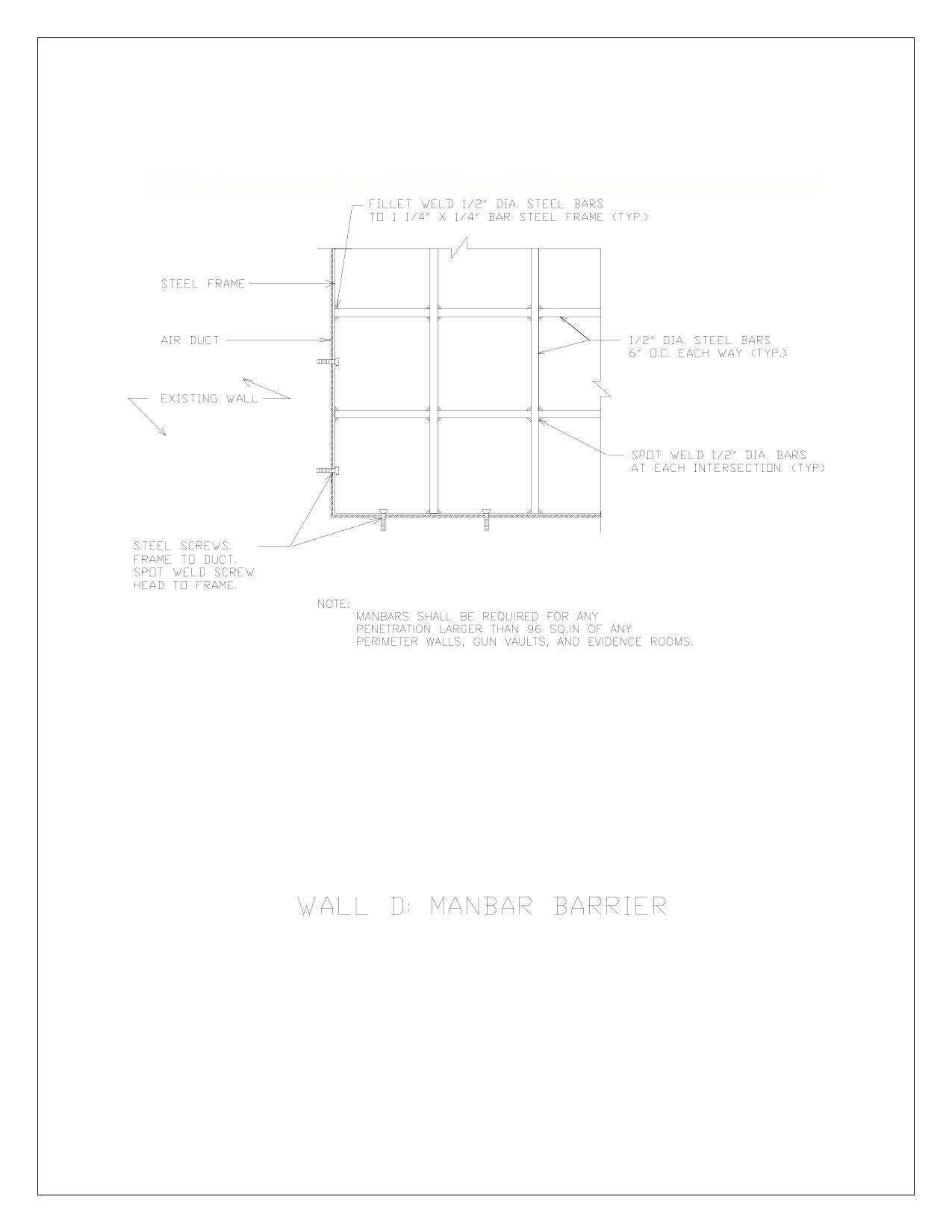
MANBAR BARRIER
NOT TO SCALE
REV: 02-01-2007
34
FOR OFFICIAL USE ONLY

SECURITY BAR DETAIL
35
FOR OFFICIAL USE ONLY

SECURITY GRILL/PERIMETER WALL ELEVATION DETAIL
3 5/8' (92) 16 GA Mtl Studs @ 16"
2" x 3" x 3/16' (50x75x5)
(405) O.C. with horizontal bracing
continuous frame at duct
at 4"-0" (1220) O.C. Min
penetration larger than 96
(2288) SI with 1/2 " (13) DIA
Steel Runner top and Bottom
rebar @ 6" (125) OC each way
Anchor to structure with ½" (13)
welded into frames and
expansion bolt 2'0" (610) O.C.
intersections.
Horizontal Bracing at 4'0"
No. 9, 10 gauge expanded
(1220) O.C. Mini
metal welded to steel studs
and runners 6" (150) OC.
5/8" (16) PAINTED
GYP BOARD
CEILING TILE
WELDED STEEL
DOOR FRAME
BASE
NOT TO SCALE
REV: 02-01-2007
36
FOR OFFICIAL USE ONLY

SAMPLE - UL FIRE RATED / STC RATED / DOOR AND FRAME ASSEMBLY
37
FOR OFFICIAL USE ONLY

SUGGESTED CABLE TELEVISION ISOLATION EQUIPMENT (FIBERPLEX)
NOT TO SCALE
REV: 02-01-2007
38
FOR OFFICIAL USE ONLY
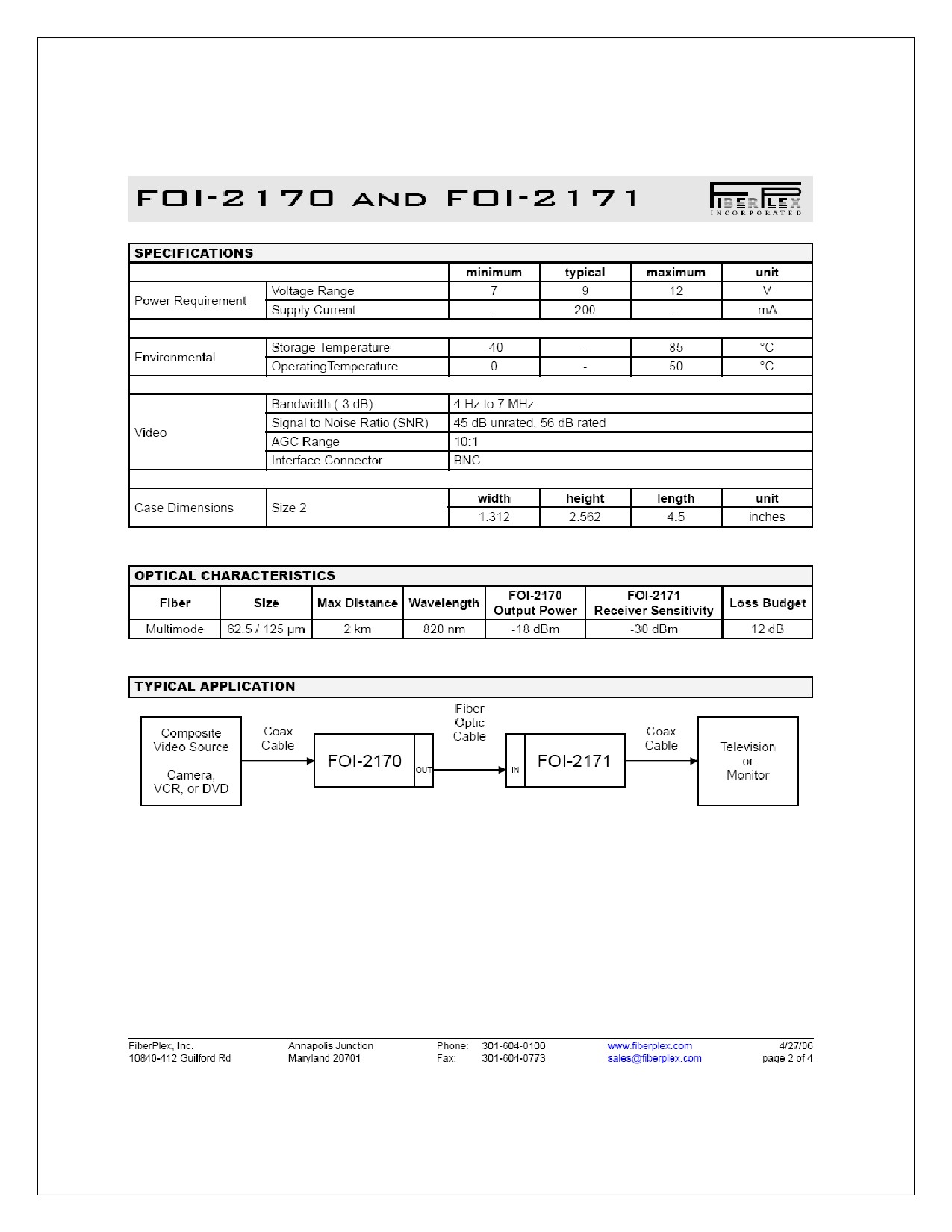
SUGGESTED CABLE TELEVISION ISOLATION EQUIPMENT
39
FOR OFFICIAL USE ONLY

SUGGESTED CABLE TELEVISION ISOLATION EQUIPMENT
40
FOR OFFICIAL USE ONLY

SUGGESTED CABLE TELEVISION ISOLATION EQUIPMENT
41
FOR OFFICIAL USE ONLY
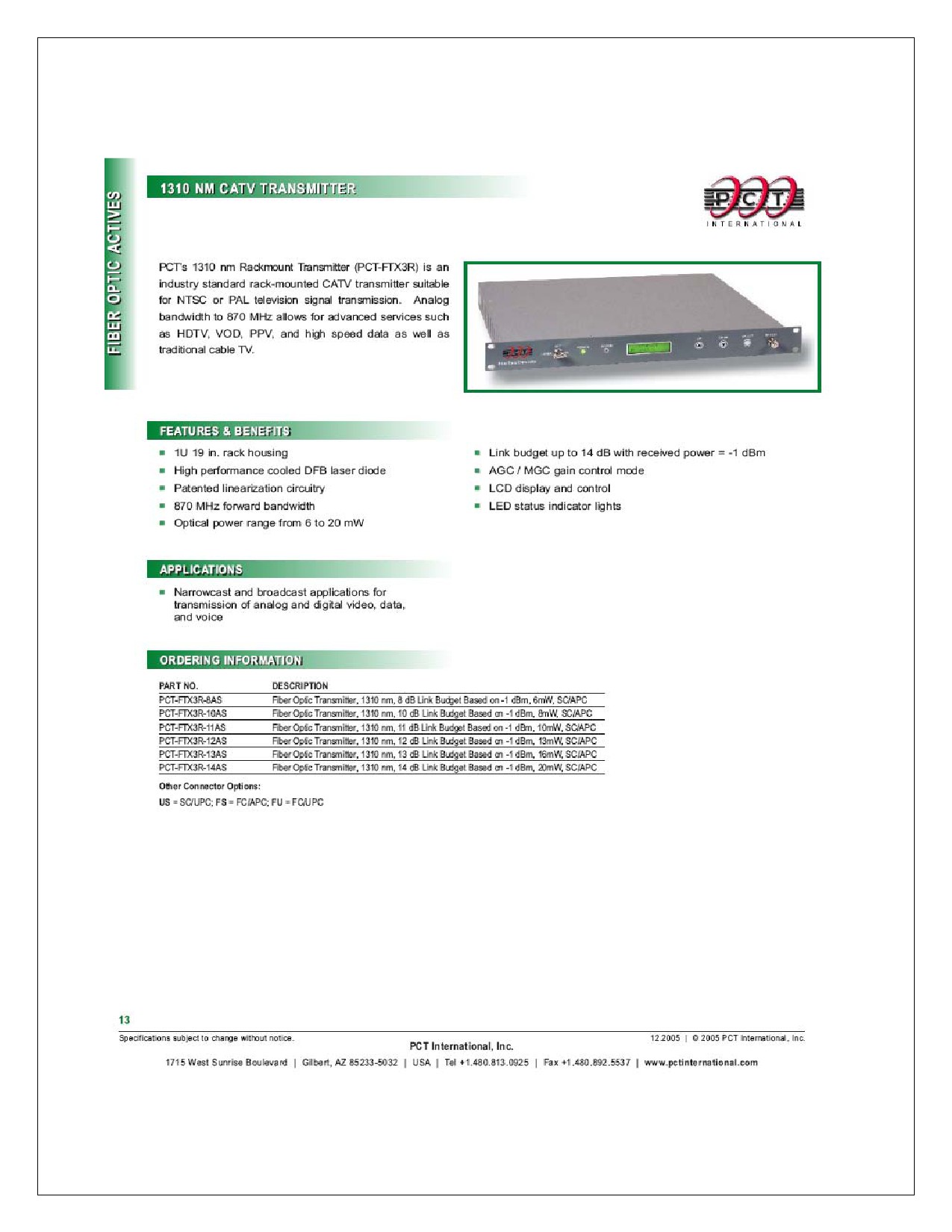
SUGGESTED CABLE TELEVISION ISOLATION EQUIPMENT (PCT-FTX3R)
42
FOR OFFICIAL USE ONLY
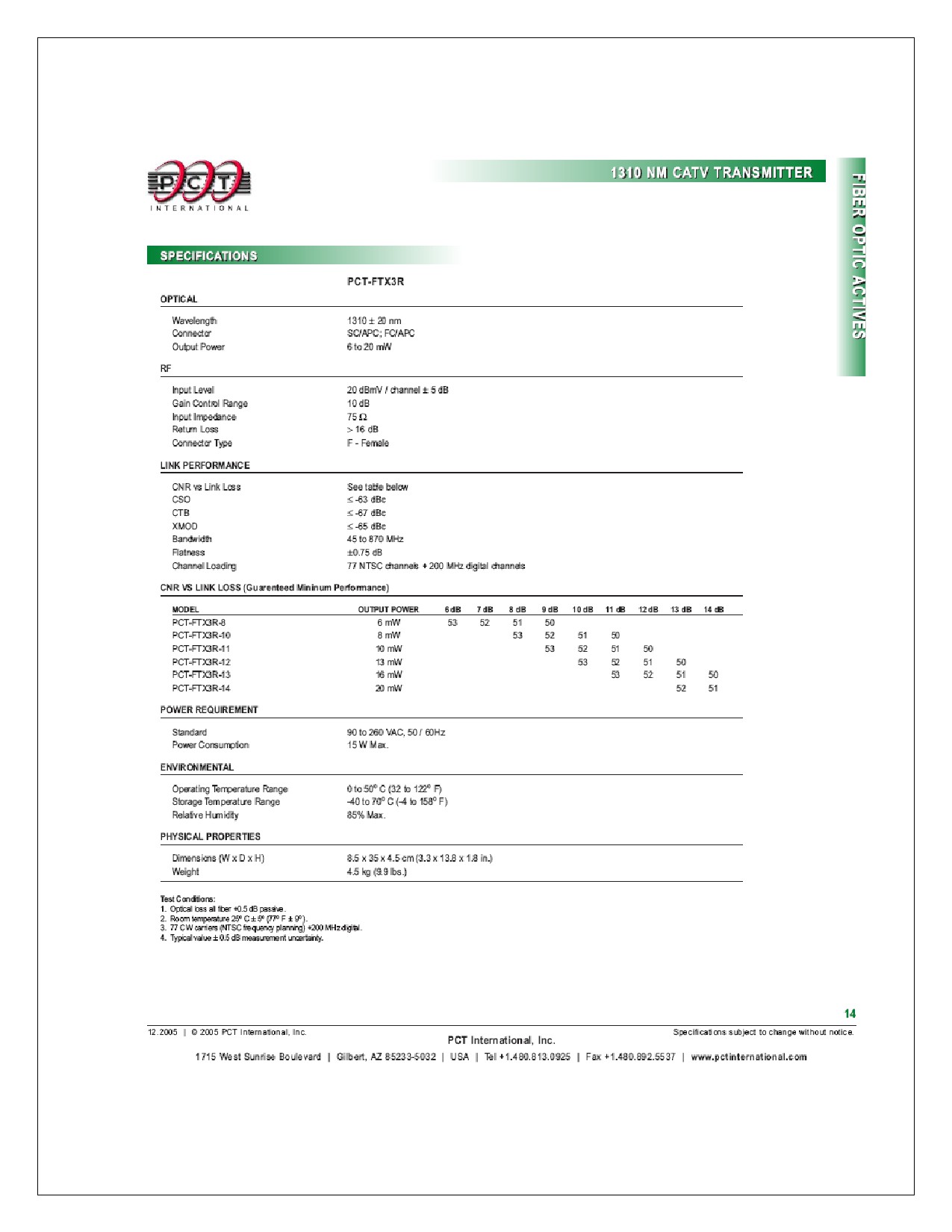
SUGGESTED CABLE TELEVISION ISOLATION EQUIPMENT (PCT-FTX3R)
43
FOR OFFICIAL USE ONLY
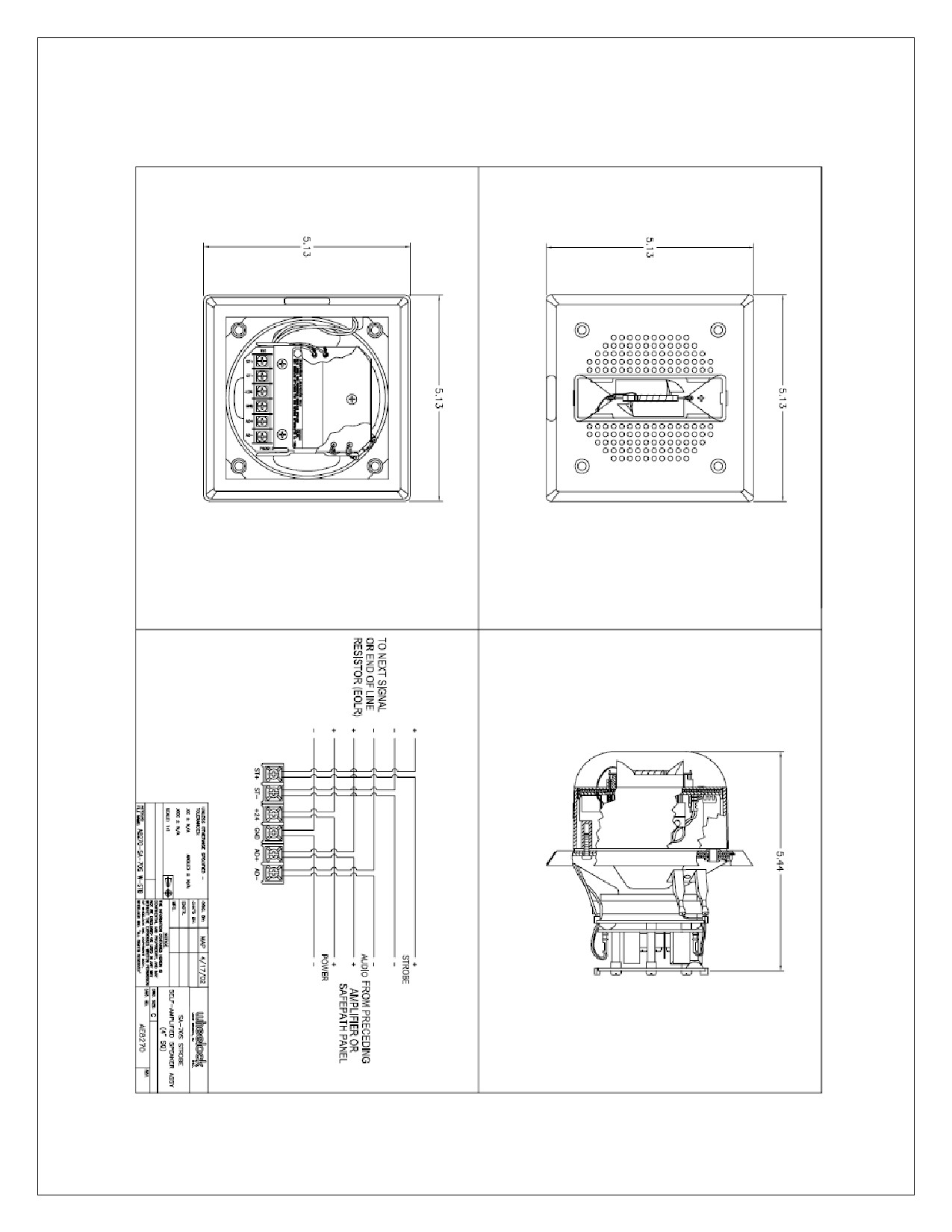
SUGGESTED FIRE ALARM ANNUCIATOR EQUIPMENT (HORN STROBE)
44
FOR OFFICIAL USE ONLY

SUGGESTED FIRE ALARM ANNUCIATOR EQUIPMENT (SPEAKER ASSEMBLY)
45
FOR OFFICIAL USE ONLY

SUGGESTED PUBLIC ANNOUNCEMENT (PA) SYSTEM EQUIPMENT
46
FOR OFFICIAL USE ONLY

SUGGESTED PUBLIC ANNOUNCEMENT (PA) SYSTEM EQUIPMENT
47
FOR OFFICIAL USE ONLY
BEST PRACTICES
48
FOR OFFICIAL USE ONLY

49
FOR OFFICIAL USE ONLY
National Guard Regulation 500-5/
Air National Guard Instruction 10-208
Emergency Employment of Army and Other
Resources
National Guard
Domestic Law
Enforcement Support
and Mission
Assurance Operations
National Guard Bureau
Arlington, VA 22202-3231
August 18, 2010
UNCLASSIFIED
SUMMARY of CHANGE
NGR 500-5/ANGI 10-208
National Guard Domestic Law Enforcement Support and Mission Assurance
Operations
August 18, 2010
This is a new publication.
National Guard Bureau
NGR 500-5/ANGI 10-208
Arlington, VA 22201-3231
August 18, 2010
Emergency Employment of Army and Other Resources
National Guard Domestic Law Enforcement Support and Mission Assurance Operations
By Order of the Secretary of Defense:
CRAIG R. MCKINLEY
General, USAF
Chief, National Guard Bureau
Official:
JOHN D. SELMER
Lt Col, USAF
Chief, Strategy and Policy Division
History. This is a new publication in the 500 series.
Summary. This regulation/instruction prescribes policies, procedures, responsibilities, and direction for activities
related to National Guard domestic law enforcement support and mission assurance operations. It governs the
training, planning, preparations, and operations of National Guard units and forces in the Homeland, hereafter referred
to as National Guard Domestic Operations (NGDO) as they relate to domestic law enforcement support and mission
assurance operations, to include Provost Marshal, Antiterrorism, Force Protection and Security Operations, Threat
Information Cells, National Guard Reaction Force, non-lethal capabilities, and critical infrastructure protection.
Applicability. This regulation/instruction applies to the National Guard Bureau (NGB) and to the Army National
Guard (ARNG) and Air National Guard (ANG) of the 50 States, the Commonwealth of Puerto Rico, the District of
Columbia, Guam, and the Virgin Islands, hereafter referred to as the several states. It does not apply to National
Guard units or forces when they are serving in their federal role in the Army National Guard of the United States or
the Air National Guard of the United States. When operating in their federal status, these units and forces are under
Department of Defense (DOD) direction and control. This regulation does apply to National Guard members
conducting National Guard Counterdrug support operations; however, they shall refer to NGR 500-2/ANGI 1-0801,
for the counterdrug support specific procedures and policy.
Proponent and exception authority. The proponent of this regulation/instruction is the Director, Domestic
Operations, National Guard Bureau (NGB-J3/DO). The proponent has the authority to approve exceptions to this
regulation/instruction that are consistent with controlling law and regulation. Submit requests for exception to
policy as set forth in this regulation/instruction to the Chief, National Guard Bureau (CNGB), ATTN: NGB-J3/DO,
1411 Jefferson Davis Highway, Arlington, VA 22202-3231. All requests must contain information detailing the
reason(s) for the exception, that it will meet applicable federal, state, tribal, and local laws, and how it will affect any
related state program(s).
Management Control Process. This regulation/instruction contains management control provisions, but does not
identify key management controls that must be evaluated.
Supplementation. Supplementation of this regulation/instruction is prohibited without prior approval from the
Chief, National Guard Bureau (CNGB), ATTN: NGB-J3/DO, 1411 Jefferson Davis Highway, Arlington, VA
22202-3231.
i
NGR 500-5/ANGI 10-802
August 18, 2010
Suggested Improvements. Users are encouraged to send comments and suggested improvements on DA Form
2028 (Recommended Changes to Publications and Blank Forms) directly to the Chief, National Guard Bureau
(CNGB), ATTN: NGB-J3/DO, 1411 Jefferson Davis Highway, Arlington, VA 22202-3231.
Effective Date and Implementation. This regulation/instruction is effective immediately. The NGB (National
Guard Bureau) Joint Staff and Service Directorates and the National Guard of the several states shall revise existing
documents or develop implementing documents as necessary to comply with this regulation/instruction.
Distribution. A/F;X.
_____________________________________________________________________________________________
Contents
Chapter 1
Introduction
1-1. Purpose
1-2. References
1-3. Explanation of Abbreviations and Terms
Chapter 2
Responsibilities
2-1. Chief, National Guard Bureau (CNGB)
2-2. Director, Army National Guard (DARNG)
2-3. Director, Air National Guard (DANG)
2-4. Adjutant General (TAG)
2-5. Director, Joint Staff, National Guard Bureau
2-6. National Guard Bureau Provost Marshal
2-7. National Guard Bureau J-34 Division Chief
2-8. State Provost Marshal
2-9. State J-34 Division Chief
2-10. State Antiterrorism Officer
Chapter 3
Policy
3-1. General
3-2. State Policy
3-3. Federal Policy
3-4. Interagency Coordination
3-5. Cross Border Operations in Canada or Mexico
Chapter 4
Authorities and Restrictions
4-1. The National Guard
4-2. Command and Control Authorities
4-3. Legal Considerations
4-4. Rules of Engagement and Rules for the Use of Force (ROE/RUF)
Chapter 5
National Guard Domestic Law Enforcement Operations
5-1. Introduction
5-2. Support to Domestic Law Enforcement
5-3. Civil Disturbance Support Operations
5-4. Border Security Operations
5-5. Equipment and Training Support
5-6. Use of Non-Standard Weapons and Ammunition
ii
August 18, 2010
NGR 500-5/ANGI 10-208
Chapter 6
Mission Assurance Operations
6-1. Critical Infrastructure Protection
6-2. Joint Antiterrorism Force Protection Program
6-3. Law Enforcement Information Sharing
Chapter 7
National Guard Domestic Law Enforcement and Mission Assurance Capabilities
7-1. State National Guard Reaction Force (NGRF)
7-2. National Guard Joint Force Headquarters-State Provost Marshal- J-34 (JFHQ-State-PM)
7-3. Nonlethal Capabilities Program
Chapter 8
Planning
8-1. Planning Considerations
8-2. Planning Requirements
8-3. Law Enforcement Support Planning Priorities
8-4. The National Response Framework (NRF)
8-5. The National Incident Management System (NIMS)
8-6. The Emergency Management Assistance Compact (EMAC)
8-7. Emergency Support Function 13 - Public Safety and Security
Chapter 9
Reporting
9-1. General
9-2. Mission Reporting
9-3. NGB Provost Marshal Lessons Learned Remedial Action Program
Chapter 10
Funding
10-1. General
10-2. State Active Duty (SAD)
10-3. Title 32
10-4. Title 10
10-5. The Economy Act
10-6. The Robert T. Stafford Disaster Relief Act
10-7. Immediate Response Authority
10-8. The Antideficiency Act
Appendices
A. References
B.
National Guard Domestic Law Enforcement Support Operations After Action Report
C.
National Guard Domestic Law Enforcement Support Lessons Learned Report
D.
The Posse Comitatus Act
E.
Statutory Authorities for the Use of the Armed Forces
F.
Procedures for Requesting Nonlethal Equipment from the Consequence Management Support Center
(CoMSUPCEN)
Glossary
iii
NGR 500-5/ANGI 10-802
August 18, 2010
This page intentionally left blank.
iv
August 18, 2010
NGR 500-5/ANGI 10-208
Chapter 1
Introduction
1-1. Purpose
a. Consolidate the policy and responsibilities for National Guard law enforcement support and mission assurance
operations.
b. Define consistent terminology and concepts for use by the National Guard Bureau and the National Guard of
the several states for the planning and conduct of domestic law enforcement support and mission assurance
operations.
c. Provide direction for the planning and reporting requirements for National Guard domestic law enforcement
support and mission assurance operations.
d. Define National Guard capabilities for domestic law enforcement support and mission assurance operations.
1-2. References
Required and related publications and prescribed and reference forms are listed in Appendix A.
1-3. Explanation of Abbreviations and Terms
Abbreviations and terms used in this publication are listed in the glossary.
Chapter 2
Responsibilities
2-1. Chief, National Guard Bureau (CNGB)
a. Serves as the principal advisor to the Secretaries of the Army and Air Force and to the Army and Air Force
Chiefs of Staff on matters relating to the National Guard, the Army National Guard of the United States, and the Air
National Guard of the United States, including domestic law enforcement support and mission assurance operations.
b. Serves as a principal advisor to the Secretary of Defense, through the Chairman of the Joint Chiefs of Staff, on
matters involving non-federalized National Guard forces and on other matters as determined by the Secretary of
Defense.
c. Ensures that the National Guard Bureau performs those functions described in DOD Directive 5105.77 as
needed to support the conduct of National Guard domestic law enforcement support and mission assurance
operations.
d. Serves as the Department of Defense’s official channel of communication with the Adjutants General (TAGs),
but has no authority to command the National Guard.
e. Assists the Adjutants General in assessing the impact of requested law enforcement support activities on the
military training and readiness of the National Guard.
f. Develops, maintains, and promulgates National Guard Domestic Operations readiness and reporting systems
and processes.
g. Prescribes the law enforcement and mission assurance training discipline and training requirements for the
Army National Guard (ARNG) and the Air National Guard (ANG).
h. Assists the Secretary of Defense in facilitating and coordinating the use of National Guard personnel and
resources operating under Title 32 status or in support of state missions with other federal agencies, the TAGs of the
several states, U.S. Joint Forces Command, and with the Combatant Commands with geographic responsibility for
the United States.
2-2. Director, Army National Guard (DARNG)
a. Serves as the conduit between the Army Chief of Staff and the CNGB in all matters relating to ARNG
involvement in National Guard Domestic Operations, including National Guard domestic law enforcement support
and mission assurance operations.
b. Directs resources to support domestic operations.
c. Administers Army National Guard resources for force structure, personnel, facilities, training, and equipment.
1
NGR 500-5/ANGI 10-802
August 18, 2010
2-3. Director, Air National Guard (DANG)
a. Serves as the conduit between the Air Force Chief of Staff and the CNGB in all matters relating to ANG
involvement in National Guard Domestic Operations, including National Guard domestic law enforcement support
and mission assurance operations.
b. Directs resources to support domestic operations.
c. Administers Air National Guard resources for force structure, personnel, facilities, training, and equipment.
2-4. Adjutant General (TAG)
a. Typically serves, in accordance with state law, as the principal advisor to the Governor on military matters.
The Adjutant General (or Commanding General, where appropriate) directs and oversees the daily activities of the
state National Guard in order to accomplish the statutory and regulatory functions assigned.
b. Maintains the training and readiness of their assigned forces, ensuring that those forces are able to conduct all
assigned state and federal missions, including National Guard domestic law enforcement support and mission
assurance operations.
c. Supports the CNGB in his/her role as the channel of communications between the several states and the
Secretary of Defense on matters relating to the National Guard. Operates and maintains a Joint Operations Center
(JOC) with the capability to receive and respond to classified messages, execute command and control operations,
and provide situational awareness of National Guard activities and operations.
d. Complies with the reporting requirements specified in this publication.
2-5. Director, Joint Staff, National Guard Bureau
a. Directs the Joint Staff of the National Guard Bureau and is subordinate to the CNGB.
b. Leads and directs NGB Joint Staff actions to assist the CNGB in accomplishing his/her responsibilities for the
strategic direction of the National Guard forces; their operation under unified command; and their integration into an
efficient team of land and air forces.
c. Assists the CNGB in the decision making and execution process of National Guard missions and performs
such other duties as the CNGB may prescribe.
d. Coordinates NG state-to-state assistance if requested.
e. Directly supervises the National Guard Bureau Provost Marshal.
2-6. National Guard Bureau Provost Marshal
a. Is a member of the CNGB’s special staff.
b. Serves as the principal advisor to the CNGB and all senior National Guard Bureau leadership on all issues
related to force protection, law enforcement, antiterrorism, security, critical infrastructure protection and domestic
threats.
c. Serves as the primary liaison on the NGB staff to military and civil law enforcement agencies.
d. Responds to requests for information relevant to criminal intelligence and law enforcement sensitive
information in accordance with governing directives, laws and regulations.
2-7. National Guard Bureau J-34 Division Chief (NGB J-34)
a. Is the NGB J-3’s principal advisor on all issues related to force protection, law enforcement, antiterrorism,
security and domestic threats.
b. Oversees the management and resourcing of National Guard domestic law enforcement support and mission
assurance capabilities.
c. Facilitates, develops and supports, as appropriate, the training discipline and training requirements for
National Guard domestic law enforcement support and mission assurance operations.
d. Develops guidance and direction as needed to support National Guard domestic law enforcement support and
mission assurance operations, including the integration and coordination of joint, interagency and intergovernmental
matters.
e. Maintains operational awareness of all National Guard law enforcement operations to include state provost
marshal functions, critical incident response and National Guard Reaction Forces.
f. Develops National Guard critical infrastructure program strategic policy guidance.
g. Is the NGB’s antiterrorism and force protection officer.
h. Serves as the proponent for the NGB Antiterrorism Strategic Plan.
2