Kia Niro Hybrid / Plug-in Hybrid (2022 year). Manual in english - page 18
What to do in an emergency
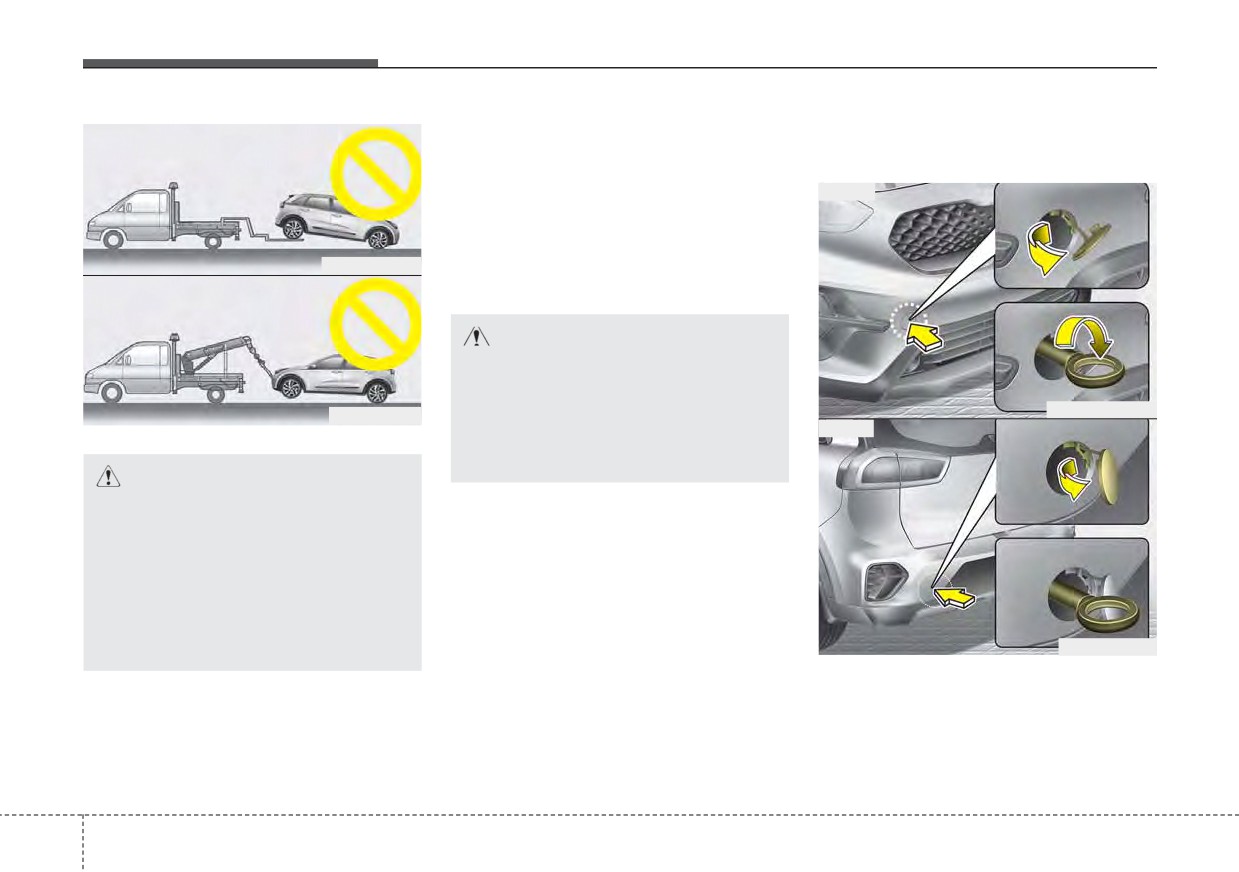
When towing your vehicle in an
Removable towing hook
emergency without wheel dollies :
(if equipped)
1. Set the ignition switch in the ACC
■ Front
position.
2. Place the transmission shift lever
in N (Neutral).
ODEP061012
3. Release the parking brake.
CAUTION - Towing gear
position
Failure to place the transmis-
ODEP061011
sion shift lever in N
(Neutral)
ODEP061241N
■ Rear
may cause internal damage to
the transmission.
CAUTION
- Towing
•
Do not tow the vehicle back-
wards with the front wheels on
the ground as this may cause
damage to the vehicle.
•
Do not tow with sling-type
equipment. Use wheel lift or
flatbed equipment.
ODEP061015L
1. Open the liftgate, and remove the
towing hook from the tool case.
2. Remove the hole cover pressing
the lower part of the cover on the
bumper.
6
40
What to do in an emergency
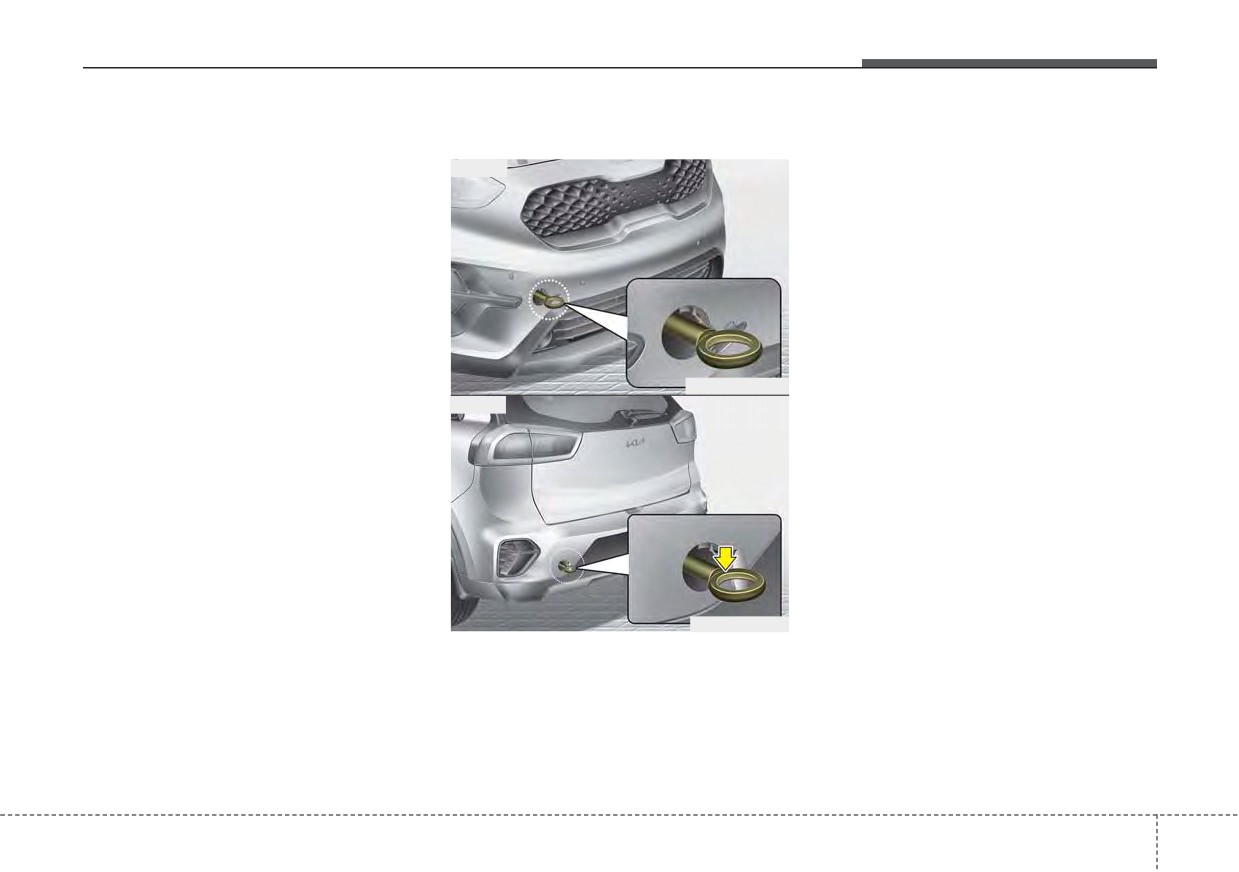
3. Install the towing hook by turning it
Emergency towing
If towing service is not available in an
clockwise into the hole until it is
emergency, your vehicle may be
■ Front
fully secured.
temporarily towed using a cable or
chain secured to the emergency tow-
4. Remove the towing hook
and
ing hook under the front (or rear) of
install the cover after use.
the vehicle. Use extreme caution
when towing the vehicle. A driver
must be in the vehicle to steer it and
operate the brakes.
Towing in this manner may be done
only on hard-surfaced roads for a
ODEP061016L
short distance and at low speed.
■ Rear
Also, the wheels, axles, power train,
steering and brakes must all be in
good condition.
• Do not use the tow hooks to pull a
vehicle out of mud, sand or other
conditions from which the vehicle
cannot be driven out under its own
power.
• Avoid towing a vehicle heavier than
the vehicle doing the towing.
ODEP061017L
• The drivers of both vehicles should
If towing
is
necessary, have it
communicate with each other fre-
done by an authorized Kia dealer
quently.
or a commercial tow truck service.
6
41
What to do in an emergency
CAUTION
WARNING - Emergency
Using a portion of the vehicle
Towing Precautions
other than the tow hooks for
Use extreme caution when tow-
towing may damage the body of
ing the vehicle.
your vehicle.
•
Avoid sudden starts or erratic
driving maneuvers which
would place excessive stress
•
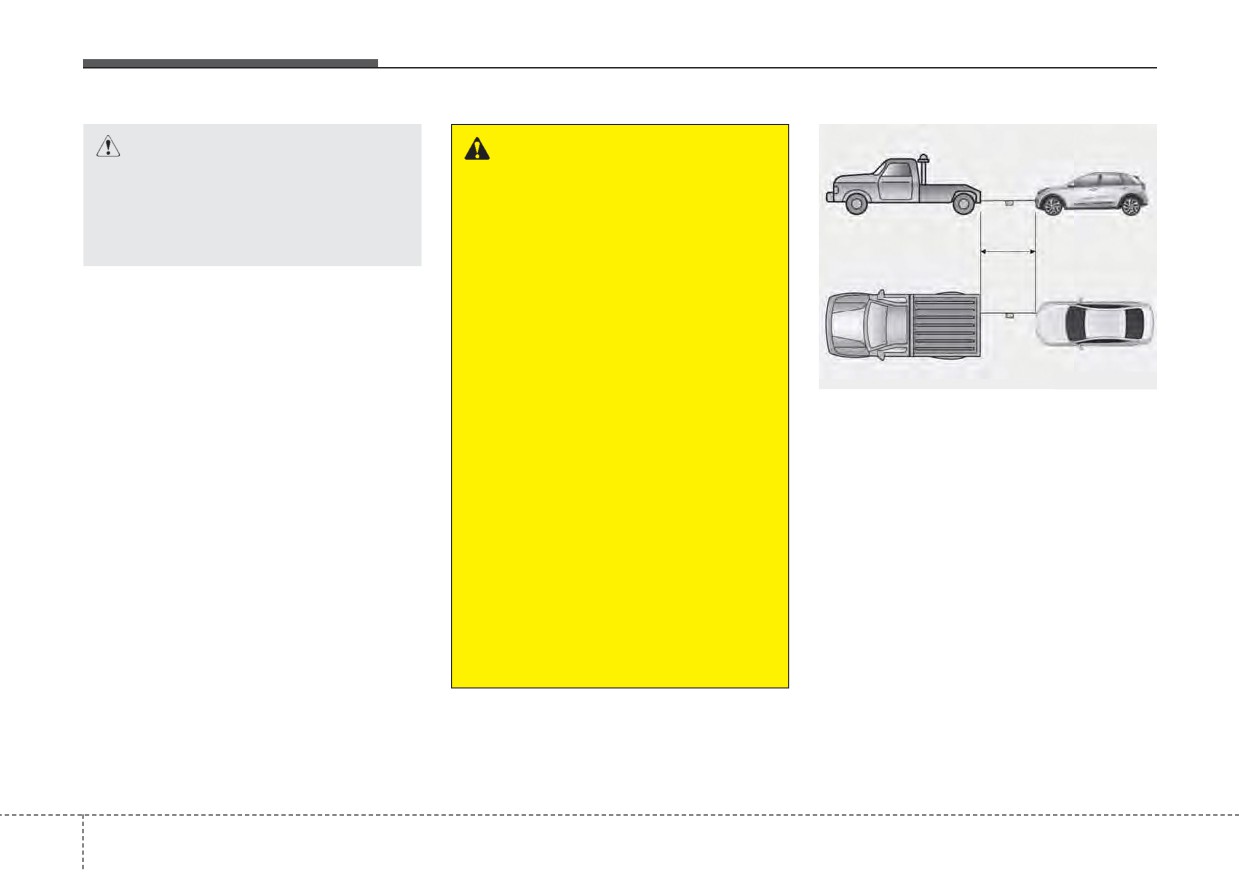
Attach a towing strap to the tow
on the emergency towing hook
hook.
and towing cable or chain. The
•
Use only a cable or chain specifical-
hook and towing cable or
ly intended for use in towing vehi-
ODEP061238L
chain may break and cause
cles. Securely fasten the cable or
serious injury or damage.
•
Use a towing strap less than 16
chain to the towing hook provided.
feet (5 m) long. Attach a white or
•
If the disabled vehicle is
•
Accelerate or decelerate the vehicle
red cloth (about 12 inches (30 cm)
unable to be moved, do not
in a slow and gradual manner while
wide) in the middle of the strap for
forcibly continue the towing.
maintaining tension on the tow rope
easy visibility.
We recommend that you con-
or chain to start or drive the vehicle,
tact an authorized Kia dealer
•
Drive carefully so that the towing
otherwise tow hooks and the vehi-
or a commercial tow truck
strap is not loosened during tow-
cle may be damaged.
service for assistance.
ing.
•
Before emergency towing, check if
•
Tow the vehicle as straight
•
The driver must be in the vehicle
the hook is not broken or damaged.
ahead as possible.
for steering and braking operations
•
Fasten the towing cable or chain
•
Keep away from the vehicle
when the vehicle is towed and pas-
securely to the hook.
sengers other than the driver must
during towing.
•
Do not jerk the hook. Apply it
not be allowed to be on board.
steadily and with even force.
•
To avoid damaging the hook, do not
pull from the side or at a vertical
angle. Always pull straight ahead.
6
42
What to do in an emergency
Emergency towing precautions
• If the car is being towed with all
four wheels on the ground, it can
•
Turn the ignition switch to ACC so
be towed only from the front. Be
the steering wheel isn’t locked.
sure that the transmission is in N
•
Place the transmission shift lever in
(Neutral). Be sure the steering is
N (Neutral).
unlocked by placing the ignition
•
Release the parking bake.
switch in the ACC position. A driver
•
Press the brake pedal with more
must be in the towed vehicle to
force than normal since you will
operate the steering and brakes.
have reduced brake performance.
•
More steering effort will be
CAUTION - Dual clutch
required because the power steer-
transmission
ing system will be disabled.
Before towing, check the dual
•
If you are driving down a long hill,
clutch transmission for fluid
the brakes may overheat and brake
leaks under your vehicle. If the
performance will be reduced. Stop
dual clutch transmission fluid is
often and let the brakes cool off.
leaking, flatbed equipment or a
•
To avoid serious damage to the
towing dolly must be used.
dual clutch transmission, limit the
vehicle speed to 10 mph (15 km/h)
and drive less than 1 mile (1.5 km)
when towing. (for Dual clutch trans-
mission vehicle.)
6
43
What to do in an emergency
IF AN ACCIDENT OCCURS
• If you need towing, refer to
WARNING - High voltage
"Towing" in the previous pages.
WARNING - Submersion
components
• When the vehicle is severely dam-
in water
• For your safety, do not touch
aged, remain a safe distance of 50
Do not touch your vehicle if it
high voltage cables, connec-
feet (15 meter) or more between
has been submerged in water.
tors and package modules.
your
vehicle
and
other
The high-voltage battery may
High voltage components are
vehicles/flammables.
cause shock or may catch fire.
orange in color.
Immediately contact the author-
ities and advise them of the
• Exposed cables or wires may
If a fire occurs :
condition of your vehicle and
be visible inside or outside of
Immediately call emergency services
that a hybrid vehicle is involved.
the vehicle. Never touch the
(911) and advise the emergency
wires or cables, because an
responders that a hybrid vehicle is
electric shock, serious injury,
involved.
or death may occur.
✽ NOTICE
Any gas or electrolyte leakage from
your vehicle is not only poisonous but
also flammable. Upon witnessing one
of those, make sure your car is parked
in a safe area away from any roads,
open the windows, and maintain a
safe distance away from the vehicle.
Immediately contact an authorized
Kia dealer and advise them that a
hybrid vehicle is involved.
6
44
Maintenance
Engine compartment
7-4
Parking brake
7-32
Maintenance services
7-5
• Checking the parking brake
7-32
• Owner’s responsibility
7-5
Air cleaner
7-33
• Owner maintenance precautions
7-6
• Filter replacement
7-33
Owner maintenance
7-7
Climate control air filter
7-35
• Owner maintenance schedule
7-7
• Filter inspection
7-35
Scheduled maintenance service
7-9
Wiper blades
7-37
Explanation of scheduled maintenance items . . . 7-15
• Blade inspection
7-37
• Blade replacement
7-37
Checking fluid levels
7-18
Battery (Plug-in Hybrid)
7-40
Engine oil
7-19
• For best battery service
7-40
• Checking the engine oil level
7-19
• Recharging the battery
7-41
• Changing the engine oil and filter
7-20
• Reset items
7-42
Coolant
7-22
Tires and wheels
7-43
• Checking the coolant level
7-22
• Tire care
7-43
• Engine coolant
7-23
• Recommended cold tire inflation pressures
7-43
• Inverter coolant
7-23
• Tire pressure
7-44
• Recommended coolant
7-24
• Checking tire inflation pressure
7-44
• Changing the coolant
7-26
• Tire rotation
7-45
Brake fluid
7-27
7
• Wheel alignment and tire balance
7-46
• Checking the brake fluid level
7-27
• Tire replacement
7-47
Engine clutch actuator fluid
7-29
• Wheel replacement
7-47
• Checking the engine clutch actuator fluid level
7-29
• Tire traction
7-48
Washer fluid
7-31
• Tire maintenance
7-48
• Checking the washer fluid level
7-31
• Tire sidewall labeling
7-48
• Tire terminology and definitions
7-52
• Front turn signal (LED type) bulb replacement
• All season tires
7-55
(Headlamp type B)
7-94
• Summer tires
7-55
• Front side marker (LED type) bulb replacement
• Snow tires
7-56
(Headlamp type B)
7-94
• Tire chains
7-56
• Daytime running lamp/Position lamp (LED type)
• Radial-ply tires
7-56
bulb replacement
7-94
• Low aspect ratio tire
7-57
• Front fog lamp (Bulb/LED type) bulb
Fuses
7-59
replacement
7-95
• Inner panel fuse replacement
7-60
• Stop and tail lamp, Rear turn signal lamp
• Engine compartment fuse replacement
7-62
(Bulb type) bulb replacement
7-95
• Fuse/relay panel description
7-65
• Tail lamp (inside) (Bulb type) bulb replacement . . . 7-96
• Rear side marker (Bulb type) bulb replacement . . . 7-97
Light bulbs
7-87
• Stop and tail lamp (LED type) bulb replacement . . 7-99
• Bulb replacement precaution
7-87
• Rear side marker (LED type) bulb replacement . . . 7-99
• Light bulb position (Front)
7-88
• Back-up lamp (Bulb type) bulb replacement
7-99
• Light bulb position (Rear)
7-89
• License plate lamp (Bulb type) bulb replacement . 7-100
• Light bulb position (Side)
7-90
• High mounted stop lamp (LED type) bulb
• Headlamp (High/Low beam) (Bulb type) bulb
replacement
7-100
replacement (Headlamp type A)
7-91
• Side repeater lamp (LED type) bulb replacement. . 7-101
• Front turn signal lamp (Bulb type) bulb
7
• Map lamp (Bulb type) bulb replacement
7-101
replacement (Headlamp type A)
7-92
• Map lamp (LED type) bulb replacement
7-102
• Front side marker (Bulb type) bulb replacement
• Vanity mirror lamp (Bulb type) bulb replacement. . 7-102
(Headlamp type A)
7-93
• Room lamp (Bulb type) bulb replacement
7-103
• Headlamp (High/Low beam) (LED type) bulb
• Room lamp (LED type) bulb replacement
7-103
replacement (Headlamp type B)
7-93
• Liftgate room lamp (Bulb type) bulb replacement. . 7-104
• Liftgate room lamp (LED type) bulb replacement. . 7-104
Appearance care
7-105
• Exterior care
7-105
• Interior care
7-111
Emission control system
7-115
• Crankcase emission control system
7-115
• Evaporative emission control (including ORVR:
Onboard Refueling Vapor Recovery) system
7-115
• Exhaust emission control system
7-116
California perchlorate notice
7-118
7
Maintenance
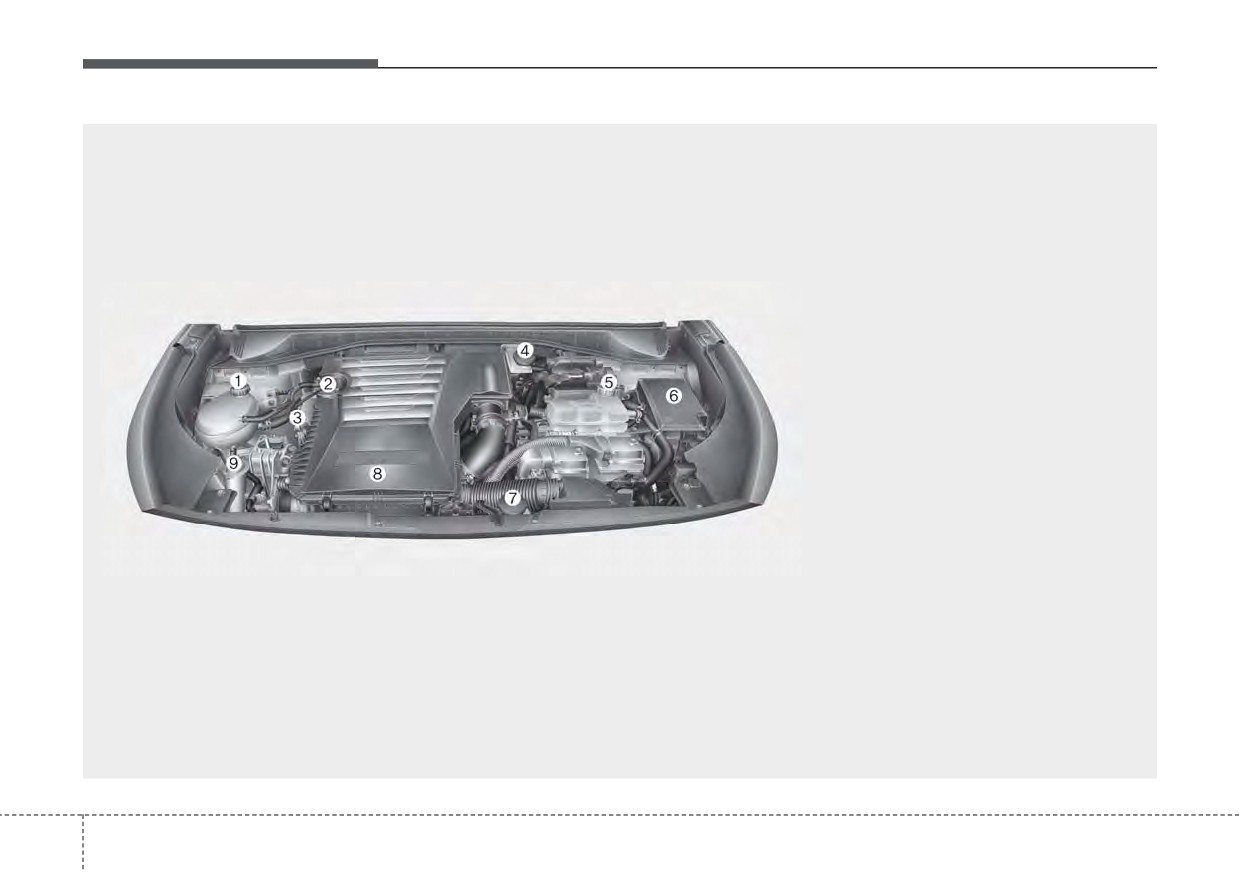
ENGINE COMPARTMENT
■ (Gasoline) 1.6 GDi
1. Engine coolant reservoir
2. Engine oil filler cap
3. Engine oil dipstick
4. Brake fluid reservoir
5. Inverter coolant reservoir
6. Fuse box
7. Engine clutch actuator reservoir tank
8. Air cleaner
9. Windshield washer fluid reservoir
❈ The actual engine room in the vehicle may differ from the illustration.
ODEP079115
7
4
Maintenance
MAINTENANCE SERVICES
You should exercise the utmost care
Owner’s responsibility
Repairs and adjustments required as
to prevent damage to your vehicle
a result of improper maintenance or
and injury to yourself whenever per-
a lack of required maintenance are
forming any maintenance or inspec-
✽ NOTICE
not covered.
tion procedures.
Maintenance Service and Record
We recommend you have your vehi-
Should you have any doubts con-
Retention are the owner's responsi-
cle maintained and repaired by an
cerning the inspection or servicing of
bility.
authorized Kia dealer. An authorized
your vehicle, we strongly recom-
You should retain documents that
Kia dealer meets Kia’s high service
mend that you have an authorized
show proper maintenance has been
quality standards and receives tech-
Kia dealer perform this work.
performed on your vehicle in accor-
nical support from Kia in order to pro-
dance with the scheduled mainte-
vide you with a high level of service
An authorized Kia dealer has factory-
nance service charts shown on the
satisfaction.
trained technicians and genuine Kia
following pages. You need this infor-
parts to service your vehicle proper-
mation to establish your compliance
ly. For expert advice and quality serv-
with the servicing and maintenance
✽ NOTICE - NHTSA Safety
ice, see an authorized Kia dealer.
requirements of your vehicle war-
Corrosion Alert
Inadequate, incomplete or insuffi-
ranties.
The National Highway Traffic
cient servicing may result in opera-
Detailed warranty information is
Safety Administration (NHTSA) has
tional problems with your vehicle that
provided in your Warranty &
issued a general warning to all vehi-
could lead to vehicle damage, an
Consumer Information manual.
cle owners of all brands regarding
accident, or personal injury.
the risks associated with vehicle
underbody corrosion. From your
initial purchase, take the following
steps to prevent unsafe corrosion
damage to your vehicle:
(Continued)
7
5
Maintenance
(Continued)
Owner maintenance precau-
•
Wash the undercarriage of your
tions
WARNING - Maintenance
vehicle regularly during the win-
work
Improper or incomplete service may
ter and whenever your vehicle has
result in problems. This section gives
Do not wear jewelry or loose
been exposed to such salts or
clothing while working under
instructions only for the maintenance
chemicals.
items that are easy to perform.
the hood of your vehicle with
•
Do a thorough washing of the
the engine running. These can
undercarriage at the end of the
As explained earlier in this section,
become entangled in moving
several procedures can be done only
winter.
parts, if you must run the
•
Use professional service techni-
by an authorized Kia dealer with spe-
engine while working under the
cial tools.
cians or governmental inspection
hood, make certain that you
stations to annually inspect for
remove all jewelry
(especially
corrosion.
✽ NOTICE
rings, bracelets, watches, and
•
Immediately seek an inspection of
necklaces) and all neckties,
Improper owner maintenance dur-
your vehicle if you become visual-
scarves, and similar loose
ing the warranty period may affect
ly aware of corrosion flaking or
clothing before getting near the
warranty coverage. For details, read
scaling or if you become aware of
engine or cooling fans.
the separate Warranty & Consumer
a change in vehicle performance,
Information manual provided with
such as soft or spongy brakes, flu-
the vehicle. If you're unsure about
ids leaking, impairment of direc-
any servicing or maintenance proce-
WARNING - Touching
tional control, suspension noises
dure, have it done by an authorized
metal parts
or rattling metal straps.
Kia dealer.
NHTSA further advises that after
Do not touch metal parts
a vehicle is 7 years old, it is essen-
(including strut bars) while the
tial that you take these indicated
engine is operating or hot.
maintenance steps to ensure that
Doing so could result in serious
you protect yourself from unsafe
bodily injury. Turn the engine off
corrosion conditions.
and wait until the metal parts
cool down to perform any main-
tenance work on the vehicle.
7
6
Maintenance
OWNER MAINTENANCE
The following lists are vehicle checks
Owner maintenance schedule
While operating your vehicle:
and inspections that should be per-
When you stop for fuel:
•
Note any changes in the sound of
formed by the owner or an author-
the exhaust or any smell of
ized Kia dealer at the frequencies
• Check the coolant level in coolant
exhaust fumes in the vehicle.
indicated to help ensure safe,
reservoir.
•
Check for vibrations in the steering
dependable operation of your vehi-
• Check the windshield washer fluid
wheel. Notice any increased steer-
cle.
level.
ing effort or looseness in the steer-
Any adverse conditions should be
• Look for low or under-inflated tires.
ing wheel, or change in its straight-
brought to the attention of your deal-
ahead position.
er as soon as possible.
WARNING - Hot coolant
•
Notice if your vehicle constantly
These Owner Maintenance Checks
turns slightly or “pulls” to one side
Be careful when checking your
are generally not covered by war-
when traveling on smooth, level
engine coolant level when the
ranties and you may be charged for
road.
engine is hot. Scalding hot
labor, parts and lubricants used.
coolant and steam may blow
•
When stopping, listen and check
out under pressure.
for unusual sounds, pulling to one
side, increased brake pedal travel
or “hard-to-push” brake pedal.
•
If any slipping or changes in the
operation of your transmission
WARNING
occurs, take your vehicle to an
When you open the engine
authorized Kia dealer.
hood, turn the Hybrid system
•
Check the dual clutch transmission
off. If not, it may result in death
P (Park) function.
or serious injury because of the
high voltage flow.
•
Check the parking brake.
•
Check for fluid leaks under your
vehicle (water dripping from the air
conditioning system during or after
use is normal).
7
7
Maintenance
At least monthly:
At least twice a year
At least once a year :
(i.e., every Spring and Fall) :
•
Check the coolant level in the
•
Clean the body and door drain
engine coolant reservoir.
• Check the radiator, heater and air
holes.
conditioning hoses for leaks or
•
Check the operation of all exterior
•
Lubricate the door hinges and
lights, including the stoplights, turn
damage.
check the hood hinges.
signals and hazard warning flash-
• Check the windshield washer
•
Lubricate the door and hood locks
ers.
spray and wiper operation. Clean
and latches.
•
Check the inflation pressures of all
the wiper blades with clean cloth
•
Lubricate the door rubber weather-
tires including the spare for tires
dampened with washer fluid.
strips.
that are worn, show uneven wear,
• Check the headlight alignment.
•
Check the air conditioning system.
or are damaged.
• Check the muffler, exhaust pipes,
•
Inspect and lubricate dual clutch
•
Check for loose wheel lug nuts.
shields and clamps.
transmission linkage and controls.
• Check the lap/shoulder belts for
•
Clean the battery and terminals.
wear and function.
•
Check the brake fluid level.
7
8
Maintenance
SCHEDULED MAINTENANCE SERVICE
Follow the Normal Maintenance
•
Driving on uphill, downhill, or
If your vehicle is operated under the
Schedule if the vehicle is usually
mountain roads repeatedly.
above conditions, you should
operated where none of the following
inspect, replace or refill more fre-
•
Using for towing or camping, and
conditions apply. If any of the following
quently than the following Normal
driving with loading on the roof.
conditions
apply,
follow
the
Maintenance Schedule. After
120
•
Driving for patrol car, taxi, other
Maintenance Under Severe Usage
months or 150,000 miles continue to
commercial use of vehicle towing.
Conditions.
follow the prescribed maintenance
•
Frequently driving under high
intervals.
•
Repeatedly driving short distance
speed or rapid acceleration/decel-
of less than 5 miles (8 km) in nor-
eration.
mal temperature or less than 10
✽ NOTICE
miles (16 km) in freezing tempera-
•
Frequently driving in stop-and-go
After
10 years or
100,000 miles
ture.
conditions.
(150,000 km), we recommend to use
•
Extensive engine idling or low
severe maintenance schedule.
speed driving for long distances.
•
Driving on rough, dusty, muddy,
unpaved, graveled or salt-spread
roads.
•
Driving in areas using salt or other
corrosive materials or in very cold
weather.
•
Driving in heavy dust condition.
•
Driving in heavy traffic area.
7
9
Maintenance
Normal Maintenance Schedule - Non Turbo Models
The following maintenance services must be performed to ensure good emission control and performance.
Keep receipts for all vehicle services to protect your warranty. Where both mileage and date are shown, the frequen-
cy of service is determined by whichever occurs first.
MAINTENANCE
Number of months or driving distance, whichever comes first
INTERVALS
Months
12
24
36
48
60
72
84
96
108
120
132
144
156
Miles×1,000
8
16
24
32
40
48
56
64
72
80
88
96
104
MAINTENANCE
ITEM
Km×1,000
13
26
39
52
65
78
91
104
117
130
143
156
169
Rotate tires
Rotate every 8,000 miles (13,000 km)
Fuel additives *1
Add every 8,000 miles (13,000 km) or 12 months
Engine oil and engine
(Gasoline)
R
R
R
R
R
R
R
R
R
R
R
R
R
oil filter *2
1.6 GDi
Climate control air filter
I
R
I
R
I
R
I
R
I
R
I
R
I
Engine clutch actuator fluid
Air cleaner filter
I
I
R
I
I
R
I
I
R
I
I
R
I
Inspect every 8,000 miles (13,000 km) or 12 months,
Brake fluid
Replace every 48,000 miles (78,000 km) or 48 months
Inspect every 8,000 miles (13,000 km) or 12 months,
HSG belt *3
Replace every 64,000 miles (104,000 km) or 48 months
(Gasoline)
Spark plugs
Replace every 96,000 miles (156,000 km)
1.6 GDi
At first, replace at 120,000 miles (195,000 km) or 120 months,
Coolant (Engine/Inverter)
after that, replace every 24,000 miles (39,000 km) or 24 months
7
10
Maintenance
Normal Maintenance Schedule - Non Turbo Models (CONT.)
MAINTENANCE
Number of months or driving distance, whichever comes first
INTERVALS
Months
12
24
36
48
60
72
84
96
108
120
132
144
156
Miles×1,000
8
16
24
32
40
48
56
64
72
80
88
96
104
MAINTENANCE
ITEM
Km×1,000
13
26
39
52
65
78
91
104
117
130
143
156
169
Battery condition
Vacuum hose
Exhaust system
Brake lines, hoses and connections
Brake discs and pads
I
I
I
I
I
I
I
I
I
I
I
I
I
Suspension ball joints
Steering gear rack, linkage and boots
Air conditioner compressor
Engine clutch actuator hose and lines
Parking brake
Driveshaft and boots
Fuel tank and fuel cap
-
I
-
I
-
I
-
I
-
I
-
I
-
Fuel lines, hoses and connections
Fuel tank air filter *4
Cooling system
-
-
-
I
-
I
-
I
-
I
-
I
-
Dual clutch transmission fluid
-
-
-
I
-
-
-
I
-
-
-
I
-
7
11
Maintenance
I
: Inspect and if necessary, adjust, correct, clean or replace.
R : Replace or change.
*1
: If TOP TIER Detergent Gasoline is not available, one bottle of additive is recommended. Additives are available from your author-
ized Kia dealer along with information on how to use them. Do not mix other additives.
*2
: As it is normal for engine oil to be consumed during driving, the engine oil level should be checked on regular basis. The engine
oil change interval for normal operating conditions is based on the use of the recommended engine specification. If the recom-
mended engine oil specification is not used, then replace the engine oil according to the maintenance schedule under severe
operating conditions.
*3
: Inspect HSG belt for evidence of cuts, cracks, excessive wear or oil saturation and replace if necessary. If HSG belt noise
occurred, readjust HSG belt tension before replace.
*4
: Fuel tank air filter are considered to be maintenance free but periodic inspection is recommended for this maintenance sched-
ule depends on fuel quality.
❈ As it is normal for engine oil to be consumed during driving, the amount of engine oil should be checked regularly.
❈ The replacement cycle of engine oil is set by the period which the performance of our recommended engine oil is maintained.
• Fuel filter (gasoline engine): The fuel filter is considered to be maintenance free but periodic inspection is recommended for this
maintenance schedule depends on fuel quality.
- If there are some important safety matters like fuel flow restriction, surging, loss of power, hard starting problem etc., replace
the fuel filter immediately regardless of maintenance schedule and consult an authorized Kia dealer for details.
7
12
Maintenance
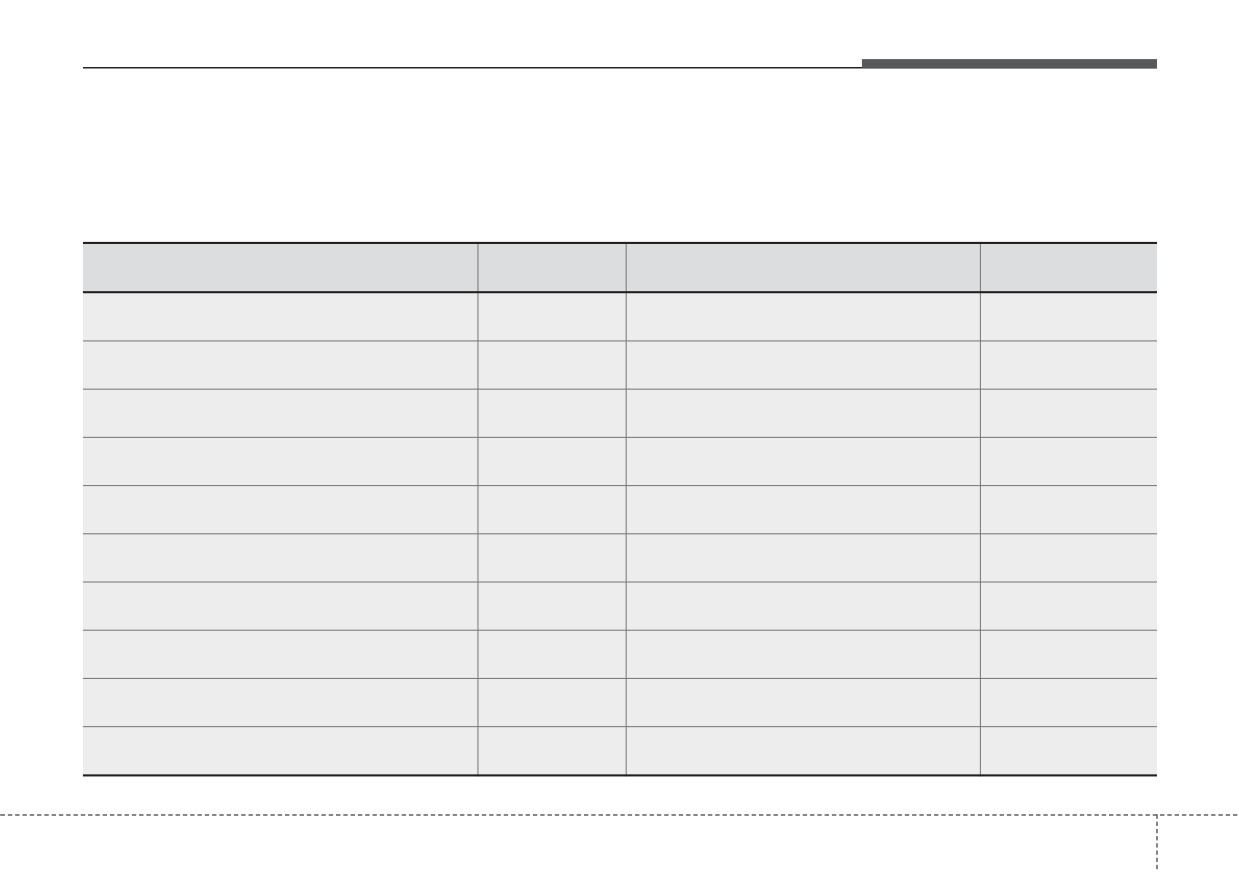
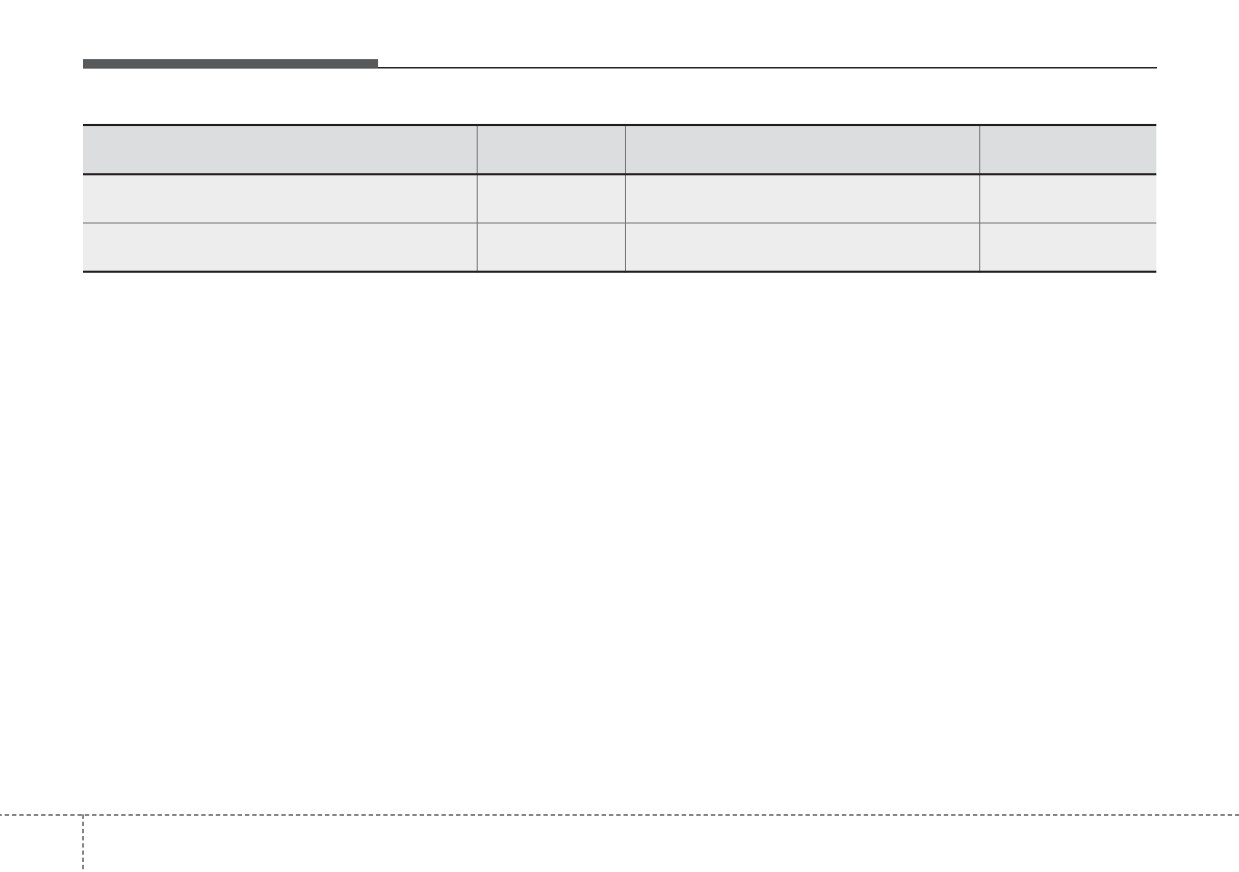
Maintenance Under Severe Usage Conditions - Non Turbo Models
The following items must be serviced more frequently on cars normally used under severe driving conditions. Refer
to the chart below for the appropriate maintenance intervals.
R : Replace I : Inspect and, after inspection, clean, adjust, repair or replace if necessary
MAINTENANCE
DRIVING
MAINTENANCE ITEM
MAINTENANCE INTERVALS
OPERATION
CONDITION
Every 5,000 miles (8,000 km)
A, B, C, D, E,
Engine oil and engine oil filter
R
or 6 months
F, G, H, I, J, K
Every 32,000 miles (52,000 km)
HSG (Hybrid Starter & Generator) belt
R
C, D, E, K
or 24 months
A, C, D, E, F, G, H,
Dual clutch transmission fluid
R
Every 64,000 miles (104,000 km)
I, J
Climate control air filter
R
More frequently
C, E, G
Air cleaner filter
R
More frequently
C, E
Spark plugs
R
More frequently
A, B, F, G, H, I, K
Every 8,000 miles (13,000 km)
HSG (Hybrid Starter & Generator) belt
I
C, D, E, K
or 12 months
Parking brake
I
More frequently
C, D, G, H, I
Brake discs, pads and calipers
I
More frequently
C, D, E, G, H, J, K, I
Suspension ball joints
I
More frequently
C, D, E, F, G
7
13
Maintenance
MAINTENANCE
DRIVING
MAINTENANCE ITEM
MAINTENANCE INTERVALS
OPERATION
CONDITION
Steering gear rack, linkage and boots
I
More frequently
C, D, E, F, G, H, I
C, D, E, F,
Drive shafts and boots
I
More frequently
G, H, I, J
Severe driving conditions
A-Repeatedly driving short distance of less than 5 miles (8 km)
E-Driving in heavy dust condition
in normal temperature or less than 10 miles (16 km) in freez-
F-Driving in heavy traffic area
ing temperature
G-Driving on uphill, downhill, or mountain road repeatedly
B-Extensive engine idling or low speed driving for long
H-Using for towing or camping and driving with loading on the
dis- tances
roof.
C-Driving on rough, dusty, muddy, unpaved, graveled or salt-
I
- Driving as a patrol car, taxi, other commercial use or vehicle
spread roads
towing
D-Driving in areas using salt or other corrosive materials or in
J -Frequently driving under high speed or rapid
very cold weather
acceleration/deceleration.
K-Frequently driving in stop-and-go conditions
7
14
Maintenance
EXPLANATION OF SCHEDULED MAINTENANCE ITEMS
Engine oil and filter
Fuel filter (for gasoline)
Fuel lines, fuel hoses and con-
nections
The engine oil and filter should be
Kia gasoline vehicles are equipped a
changed at the intervals specified in
lifetime fuel filter that integrated with
Check the fuel lines, fuel hoses and
the maintenance schedule. If the
the fuel tank. Regular maintenance
connections for leakage and dam-
vehicle is being driven in severe con-
or replacement is not needed but
age. Have an authorized Kia dealer
ditions, more frequent oil and filter
depends on fuel quality. If there are
replace any damaged or leaking
changes are required.
some important safety matters like
parts immediately.
fuel flow restriction, surging, loss of
power, hard starting problem etc, fuel
HSG (Hybrid starter & genera-
Fuel tank and fuel cap
filter inspection or replace is needed.
tor) belt
The fuel filter be Inspected or
The vapor hose and fuel filler cap
The HSG belt should be changed at
should be inspected at those inter-
replaced by an authorized Kia dealer.
the intervals specified in the mainte-
vals specified in the maintenance
nance schedule.
schedule. Make sure that a new fuel
tank and fuel cap is correctly
replaced.
7
15
Maintenance
Vacuum crankcase ventilation
Air cleaner filter
Coolant (Engine / Inverter)
hoses
A Genuine Kia air cleaner filter is
The coolant should be changed at
Inspect the surface of hoses for evi-
recommended when the filter is
the intervals specified in the mainte-
dence of heat and/or mechanical
replaced.
nance schedule.
damage. Hard and brittle rubber,
cracking, tears, cuts, abrasions, and
Spark plugs
Dual clutch transmission Fluid
excessive swelling indicate deterio-
ration. Particular attention should be
Make sure to install new spark plugs
Inspect the dual clutch transmission
paid to examine those hose surfaces
of the correct heat range.
fluid according to the maintenance
nearest to high heat sources, such
When assembling parts, be sure to
schedule.
as the exhaust manifold.
wipe the inside and outside of the
Inspect the hose routing to assure
boot bottom of the ignition coil and
Brake hoses and lines
that the hoses do not come in con-
the insulator of the spark plug with a
tact with any heat source, sharp
soft cloth to prevent contamination of
Visually check for proper installation,
edges or moving component which
the spark plug insulator.
chafing, cracks, deterioration and
might cause heat damage or
any leakage. Replace any deteriorat-
mechanical wear. Inspect all hose
ed or damaged parts immediately.
Cooling system
connections, such as clamps and
couplings, to make sure they are
Check the cooling system compo-
secure, and that no leaks are pres-
nents, such as the radiator, coolant
ent. Hoses should be replaced
reservoir, hoses and connections for
immediately if there is any evidence
leakage and damage. Replace any
of deterioration or damage.
damaged parts.
7
16
Maintenance
✽ NOTICE - NHTSA Safety
(Continued)
Brake fluid
Corrosion Alert
1. Wash the undercarriage of your
Check the brake fluid level in the
vehicle regularly throughout the
NHTSA has warned all vehicle own-
brake fluid reservoir. The level should
winter and do a thorough washing
ers of all brands that they must main-
be between “MIN” and “MAX” marks
in the spring to remove road salt
tain their vehicles in a manner which
on the side of the reservoir. Use only
and other de-icing chemicals.
will prevent brake hose and brake line
hydraulic brake fluid conforming to
2. Monitor the brake system for
failures due to corrosion when such
DOT 4 specification.
signs of corrosion by having regu-
vehicles are exposed to winter road
lar professional inspections and
salt and related chemicals. While seri-
watching for signs of problems,
Parking brake
ous corrosion conditions typically only
including loss of brake fluid,
manifest themselves as safety issues
Inspect the parking brake system
unusual leaks and soft or spongy
after 7 years of vehicle use, the corro-
including the parking brake pedal
feel in the brake pedal.
sion process starts immediately and
and cables.
3. Replace the entire brake pipe
thus underbody cleaning maintenance
assembly if you find severe corro-
must commence from your vehicle's
sion that causes scaling or flaking
Brake discs, pads and calipers
first exposure to road salts and chem-
of brake components.
icals. NHTSA urges vehicle owners to
Check the pads for excessive wear,
take the following steps to prevent
discs for run out and wear, and
corrosion:
calipers for fluid leakage.
(Continued)
7 17
Maintenance
CHECKING FLUID LEVELS
Exhaust pipe and muffler
Steering gear box, linkage &
When checking engine oil, engine
boots/lower arm ball joint
coolant, brake fluid, and washer fluid,
Visually inspect the exhaust pipes,
always be sure to clean the area
muffler and hangers for cracks, dete-
With the vehicle stopped and engine
around any filler plug, drain plug, or
rioration, or damage. Start the
off, check for excessive free-play in
dipstick before checking or draining
engine and listen carefully for any
the steering wheel.
any lubricant or fluid. This is espe-
exhaust gas leakage. Tighten con-
Check the linkage for bends or dam-
cially important in dusty or sandy
nections or replace parts as neces-
age. Check the dust boots and ball
areas and when the vehicle is used
sary.
joints for deterioration, cracks, or
on unpaved roads. Cleaning the plug
damage. Replace any damaged
and dipstick areas will prevent dirt
Suspension mounting bolts
parts.
and grit from entering the engine and
other mechanisms that could be
Check the suspension connections
Drive shafts and boots
damaged.
for looseness or damage. Retighten
to the specified torque.
Check the drive shafts, boots and
clamps for cracks, deterioration, or
damage. Replace any damaged
parts and, if necessary, repack the
grease.
Air conditioning refrigerant
Check the air conditioning lines and
connections for leakage and dam-
age.
7
18
Maintenance
ENGINE OIL
Checking the engine oil level
■ (Gasoline) 1.6 GDi
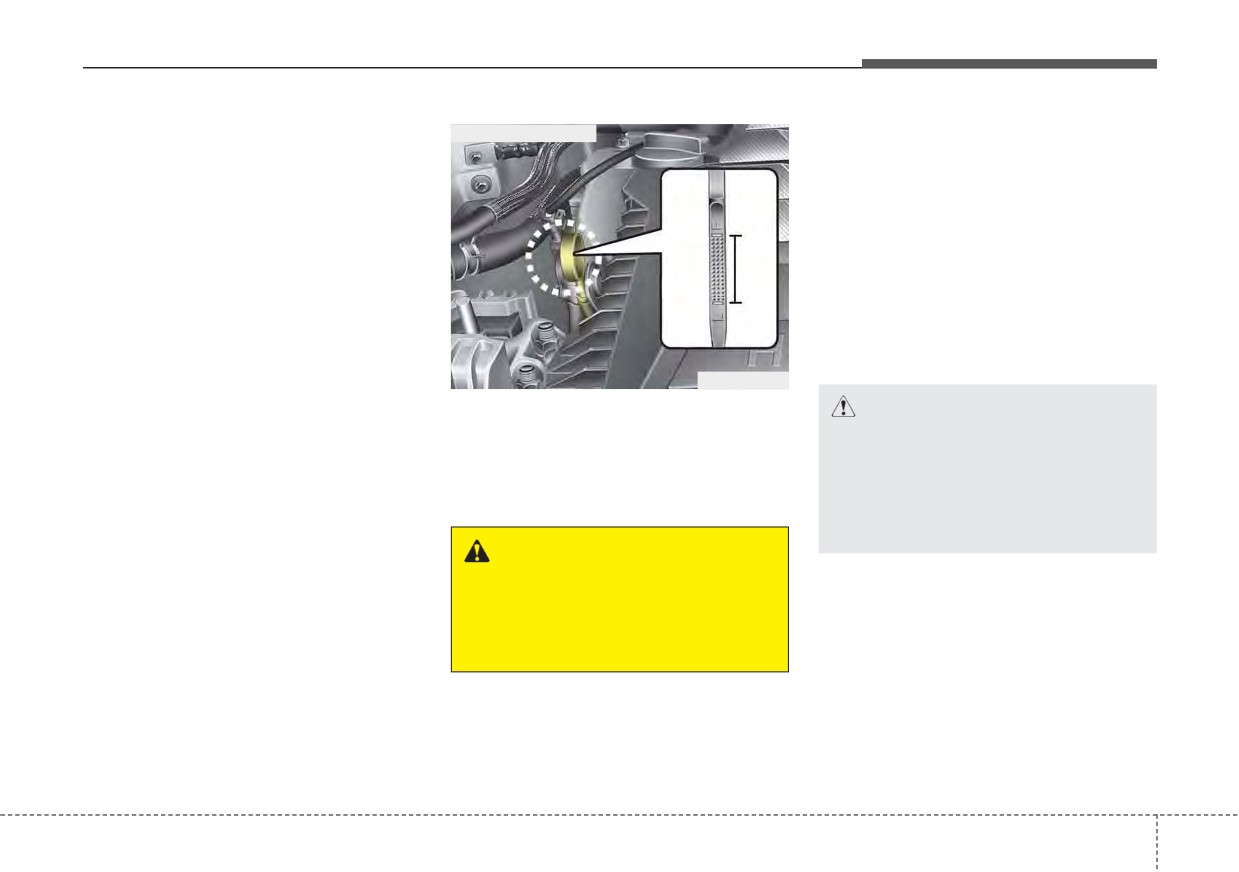
3. Turn the engine off, remove the oil
filler cap and pull the dipstick out.
Engine oil is used for lubricating,
Wait for 15 minutes for the oil to
cooling, and operating various
return to the oil pan.
hydraulic components in the engine.
4. Wipe the dipstick clean and rein-
Engine oil consumption while driving
sert it fully.
is normal, and it is necessary to
5. Pull the dipstick out again and
check and refill the engine oil regu-
check the level. Check if the oil
larly. Also, check and refill the oil
level is between the F-L line, and if
level within the recommended main-
it is below the L line, add enough
tenance schedule to prevent deterio-
oil to bring the level to F line.
ration of oil performance.
ODE076002
Check the engine oil following the
CAUTION
below procedure.
1. Be sure the
vehicle
is on level
ground.
When you wipe the oil level
2. Start the engine and allow it to
gauge, you should wipe it with a
reach normal operating tempera-
clean cloth.
ture.
When mixed with debris, it can
cause engine damage.
WARNING - Radiator hose
Be very careful not to touch the
radiator hose when checking or
adding engine oil as it may be
hot enough to burn you.
7
19
Maintenance
■ (Gasoline) 1.6 GDi
•
Do not spill engine oil when adding
Changing the engine oil and
or changing engine oil. Wipe off
filter
spilled oil immediately.
Have engine oil and filter changed by
•
The engine oil consumption may
an authorized Kia dealer according
increase while you break in a new
to the Maintenance Schedule at the
vehicle and it will be stabilized after
beginning of this chapter.
driving
4,000 miles (6,000 km).
•
If the maintenance schedule to
•
The engine oil consumption can be
replace engine oil is exceeded, the
affected by driving habits, climate
engine oil performance may deterio-
conditions, traffic conditions, oil
rate, and the engine condition may
quality, etc. Therefore, it is recom-
be affected. Therefore, replace the
ODEP071003
mended that you inspect the
engine oil according to the mainte-
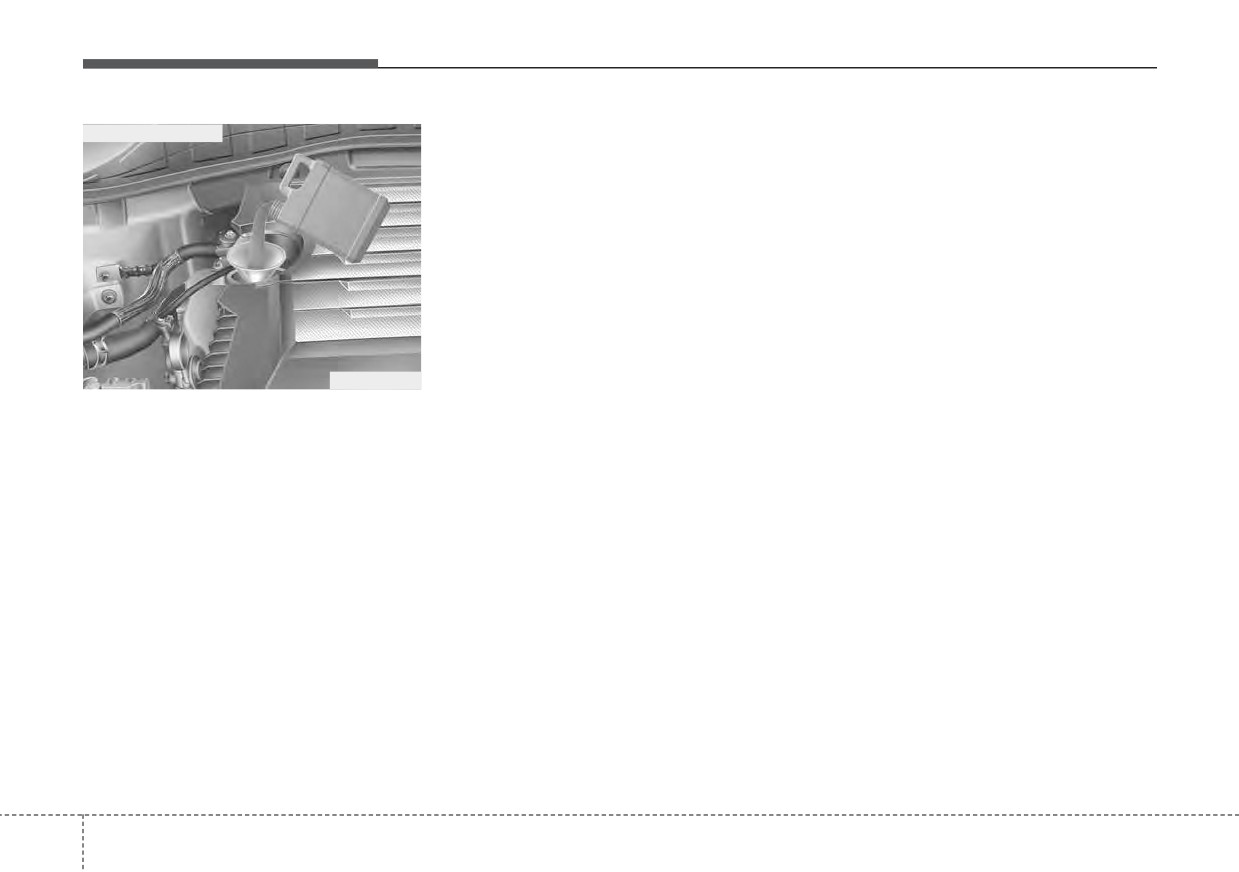
Use a funnel to help prevent oil
engine oil level regularly and refill it
nance schedule.
from being spilled on engine com-
if necessary.
•
To keep the engine in optimal condi-
ponents.
tion, use the recommended engine
oil and filter. If the recommended
Use only the specified engine oil.
engine oil and filter are not used
(Refer to “Recommended lubricants
replace it according to the mainte-
and capacities” in chapter 8.)
nance schedule under severe usage
conditions.
•
The purpose of the maintenance
schedule for engine oil replace-
ment is to prevent oil deterioration
and it is irrelevant to oil consump-
tion. Check and refill engine oil reg-
ularly.
7
20
Maintenance
WARNING - Used engine
oil
Used engine oil may cause irrita-
tion or cancer of the skin if left in
contact with the skin for pro-
longed periods of time. Always
protect your skin by washing
your hands thoroughly with
soap and warm water as soon as
possible after handling used oil.
Do not leave used engine oil
within the reach of children.
CAUTION
The engine oil is very hot imme-
diately after the vehicle has
been driven and can cause
burns during replacement.
Replace the engine oil after the
engine oil has cooled down.
7
21
Maintenance
COOLANT
The high-pressure cooling system
Checking the coolant level
•
Turn the engine off and wait until it
has a reservoir filled with year round
cools down. Use extreme care
antifreeze coolant. The reservoir is
when removing the radiator cap.
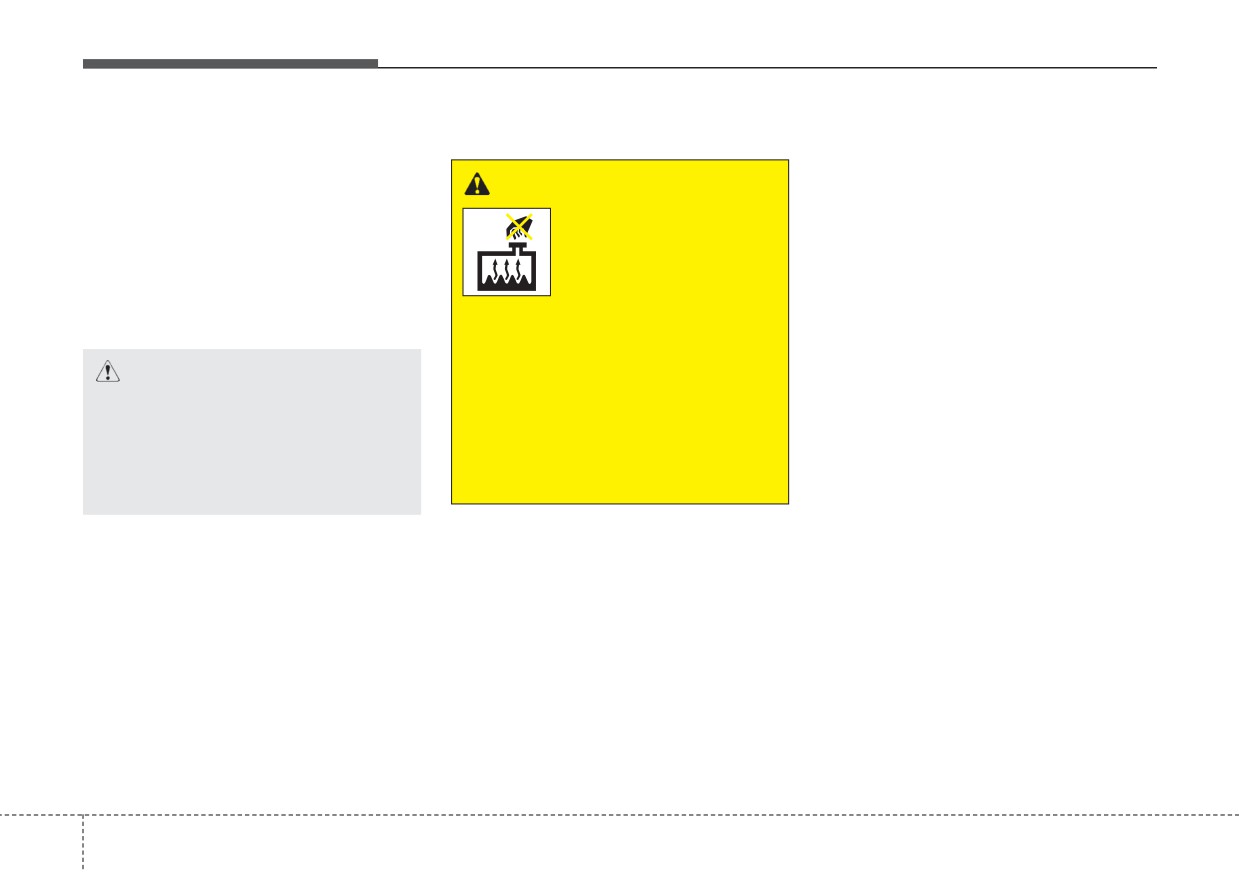
WARNING
filled at the factory.
Wrap a thick towel around it, and
Removing radiator
turn it counterclockwise slowly to
Check the antifreeze protection and
cap
the first stop. Step back while the
coolant level at least once a year: at
pressure is released from the cool-
the beginning of the winter season,
ing system.
and before traveling to a colder cli-
mate.
When you are sure all the pressure
Never attempt to remove the
has been released, press down on
radiator cap while the engine is
the cap, using a thick towel, and
operating or hot. Doing so
CAUTION -
Radiator cap
continue turning counterclockwise
might lead to cooling system
Never attempt to remove the
to remove it.
and engine damage and could
radiator cap while the engine is
•
Even if the engine is not operating,
result in serious personal injury
operating or hot. Doing so
do not remove the radiator cap or
from escaping hot coolant or
might lead to cooling system
the drain plug while the engine and
steam.
and engine damage.
radiator are hot. Hot coolant and
steam may still blow out under
pressure, causing serious injury.
The engine coolant and/or inverter
coolant level is influenced by the
hybrid system temperature. Before
checking or refilling the engine
coolant and/or inverter coolant,
turn the hybrid vehicle off.
7
22
Maintenance
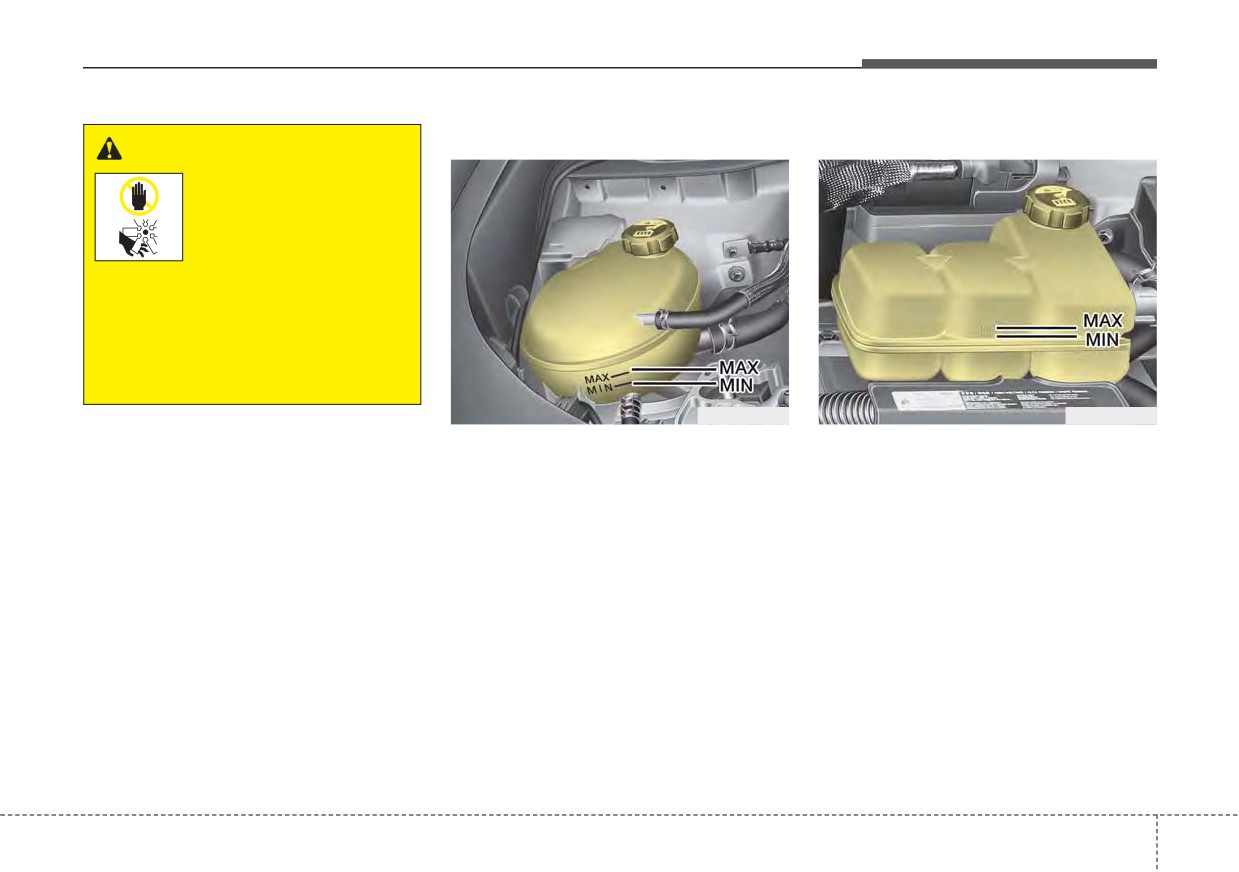
Engine coolant
Inverter coolant
WARNING - Cooling fan
Use caution when
working near the
blade of the cooling
fan. The electric
motor (cooling fan) is
controlled by engine coolant
temperature, refrigerant pres-
sure and vehicle speed. It may
sometimes operate even when
the engine is not running.
ODE076005
ODEP079053
Check the condition and connections
The coolant level should be filled
of all cooling system hoses and
between MAX and MIN marks on the
heater hoses. Replace any swollen
side of the coolant reservoir when
or deteriorated hoses.
the engine is cool.
The coolant level should be filled
If the coolant level is low, add enough
between MAX and MIN marks on the
specified coolant to provide protec-
side of the coolant reservoir when
tion against freezing and corrosion.
the engine is cool.
Bring the level to MAX, but do not
overfill. If frequent additions are
If the coolant level is low, add enough
required, see an authorized Kia deal-
specified coolant to provide protec-
er for a cooling system inspection.
tion against freezing and corrosion.
Bring the level to MAX, but do not
overfill. If frequent additions are
required, see an authorized Kia deal-
er for a cooling system inspection.
7
23
Maintenance
Recommended coolant
For mixture percentage, refer to the
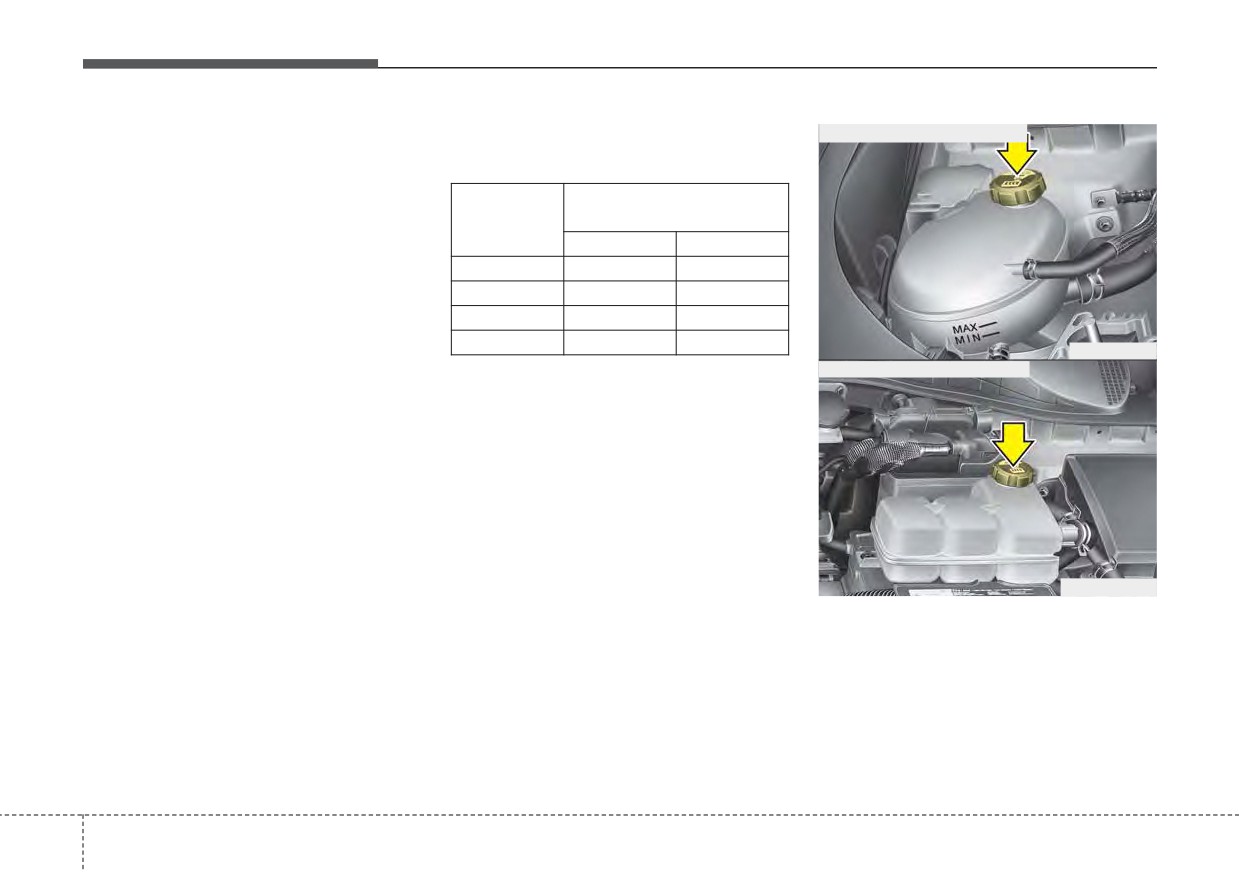
■ Engine coolant reservoir cap
following table.
•
When adding coolant, use only
deionized water or soft water for
Mixture Percentage
your vehicle and never mix hard
Ambient
(volume)
water in the coolant filled at the fac-
Temperature
Antifreeze
Water
tory. An improper coolant mixture
5°F (-15°C)
35
65
can result in serious malfunction or
engine damage.
-13°F (-25°C)
40
60
-31°F (-35°C)
50
50
•
The engine in your vehicle has alu-
-49°F (-45°C)
60
40
minum engine parts and must be
ODE076006
protected by an ethylene-glycol
■ Inverter coolant reservoir cap
with phosphate based coolant to
prevent corrosion and freezing.
•
DO NOT USE alcohol or methanol
coolant or mix them with the spec-
ified coolant.
•
Do not use a solution that contains
more than 60% antifreeze or less
than
35% antifreeze. This would
reduce the effectiveness of the
ODEP079004
solution.
7 24
Maintenance
■ Engine room rear view
✽ NOTICE
WARNING
Make sure the coolant cap is proper-
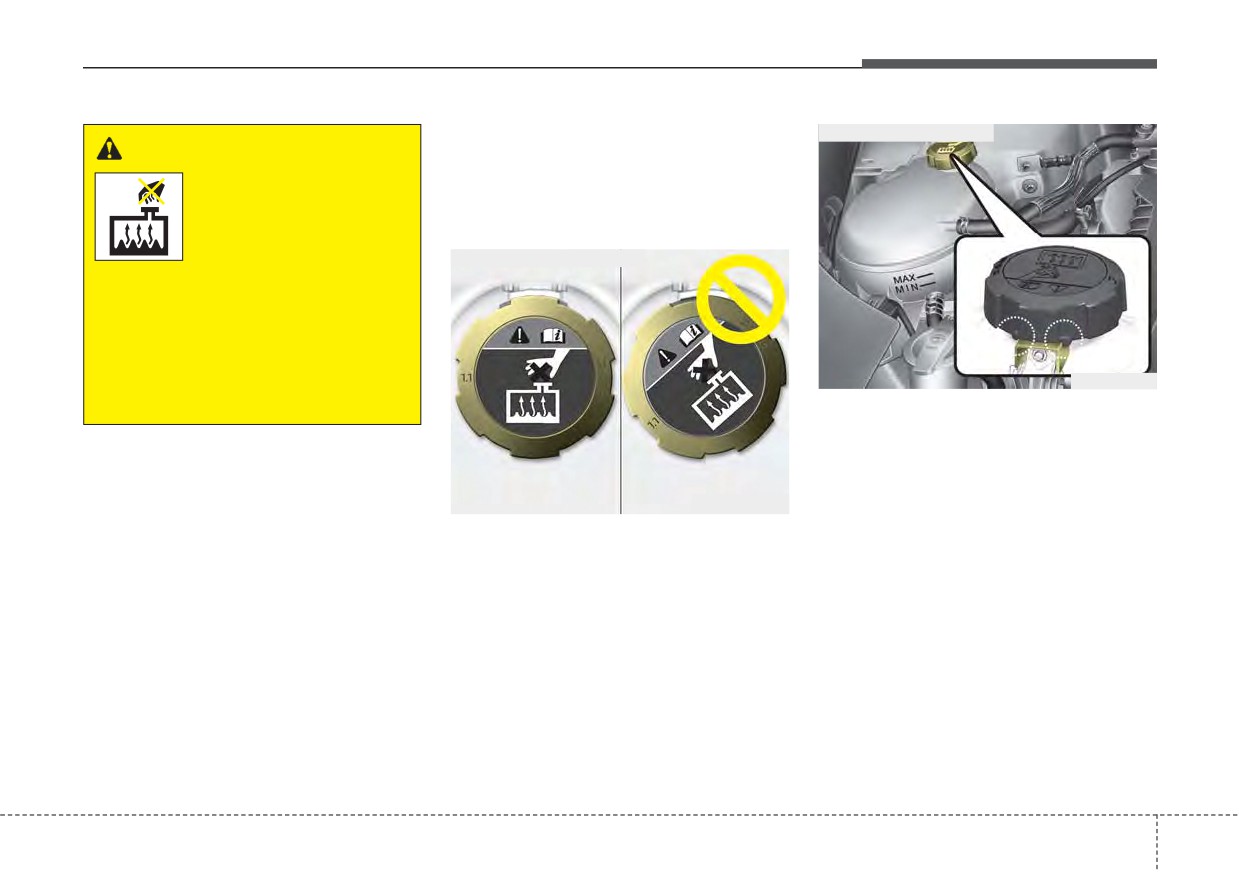
Radiator cap
ly closed after refill of coolant.
Otherwise the engine could be over-
heated while driving.
■ Engine room front view
Do not remove the radiator cap
when the engine and radiator
are hot. Scalding hot coolant
and steam may blow out under
pressure which may result in
ODE076007
serious injury.
2. Make sure that the tiny protru-
sions inside the coolant cap
should be securely interlocked.
OQL075072
1. Check if the radiator cap label is
straight front.
7
25
Maintenance
Changing the coolant
Have the coolant changed by an
authorized Kia dealer according to
the Maintenance Schedule at the
beginning of this chapter.
CAUTION
Put a thick cloth or fabric
around the radiator cap before
refilling the coolant in order to
prevent the coolant from over-
flowing into engine parts such
as the generator.
7
26
Maintenance
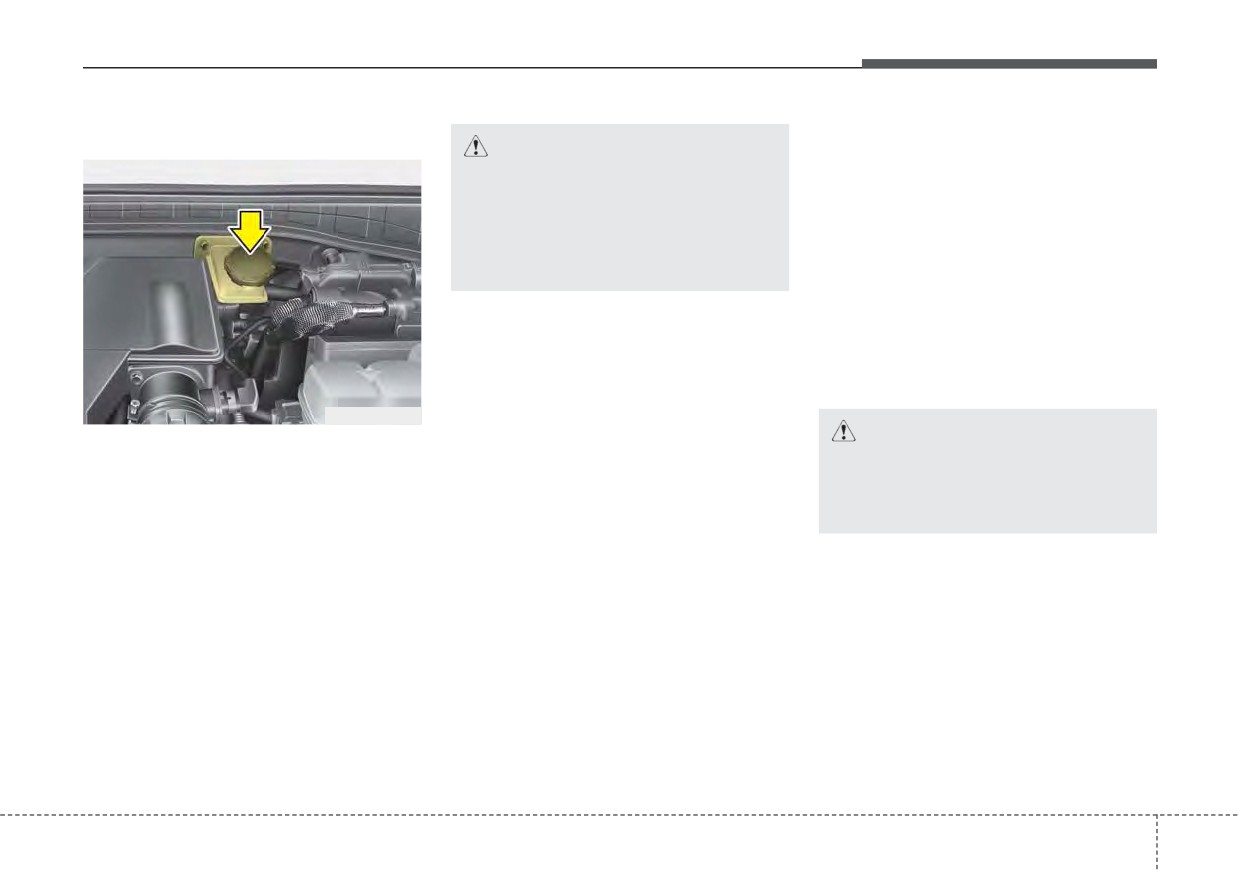
BRAKE FLUID
Checking the brake fluid level
In the event the brake system
CAUTION
- Proper fluid
requires frequent additions of fluid,
Only use brake fluid in brake
the vehicle should be inspected by
system. Small amounts of
an authorized Kia dealer.
improper fluids (such as engine
When changing and adding brake
oil) can cause damage to the
fluid, handle it carefully. Do not let it
brake system.
come in contact with your eyes. If
brake fluid should come in contact
with your eyes, immediately flush
Periodically check that the fluid level
them with a large quantity of fresh
in the brake fluid reservoir is
tap water. Have your eyes examined
between MIN and MAX. The level will
by a doctor as soon as possible.
fall with accumulated mileage. This is
ODEP079008
a normal condition associated with
the wear of brake linings. If the fluid
CAUTION - Brake fluid
Check the fluid level in the reservoir
level is excessively low, have the
Do not allow brake fluid to con-
periodically. The fluid level should be
brake system checked by an author-
tact the vehicle's body paint, as
between MAX (Maximum) and MIN
ized Kia dealer.
paint damage will result.
(Minimum) marks on the side of the
reservoir.
Before removing the reservoir cap
Use only the specified brake fluid.
Brake fluid, which has been exposed
and adding brake fluid, clean the
(Refer to “Recommended lubricants
to open air for an extended time
area around the reservoir cap thor-
and capacities” in chapter 8.)
should never be used as its quality
oughly to prevent brake fluid contam-
cannot be guaranteed. It should be
ination.
disposed of properly.
Never mix different types of fluid.
7
27