Toyota C-HR (2019 year). Manual - part 14
 

  Index      Toyota     Toyota C-HR - service manual 2019 year in english


Search            


Content   ..  12  13  14  15   ..


Toyota C-HR (2019 year). Manual - part 14


209

4-3. Operating the lights and wipers

4

Drivin

g

The windshield wiper and washer can be operated when

Vehicles without a smart key system

The engine switch is in the “ON” position.

Vehicles with a smart key system

The engine switch is in IGNITION ON mode.

Effects of vehicle speed on wiper operation (vehicles with rain-sensing
windshield wipers)
Even  when  the  wipers  are  not  in  “AUTO”  mode,  wiper  operation  varies
depending on vehicle speed when the washer is being used (delay until drip
prevention wiper sweep occurs).

Raindrop sensor (vehicles with rain-sensing windshield wipers)

If the wiper switch is turned to the “AUTO” position while the engine switch is
in  IGNITION  ON  mode,  the  wiper  will  operate  once  to  show  that  “AUTO”
mode is activated.

If the temperature of the raindrop sensor is 194

F (90C) or higher, or 5F

(-15

C) or lower, automatic operation may not occur. In this case, operate

the wipers in any mode other than “AUTO”.

If no windshield washer fluid sprays
Check that the washer nozzles are not blocked if there is washer fluid in the
windshield washer fluid reservoir.

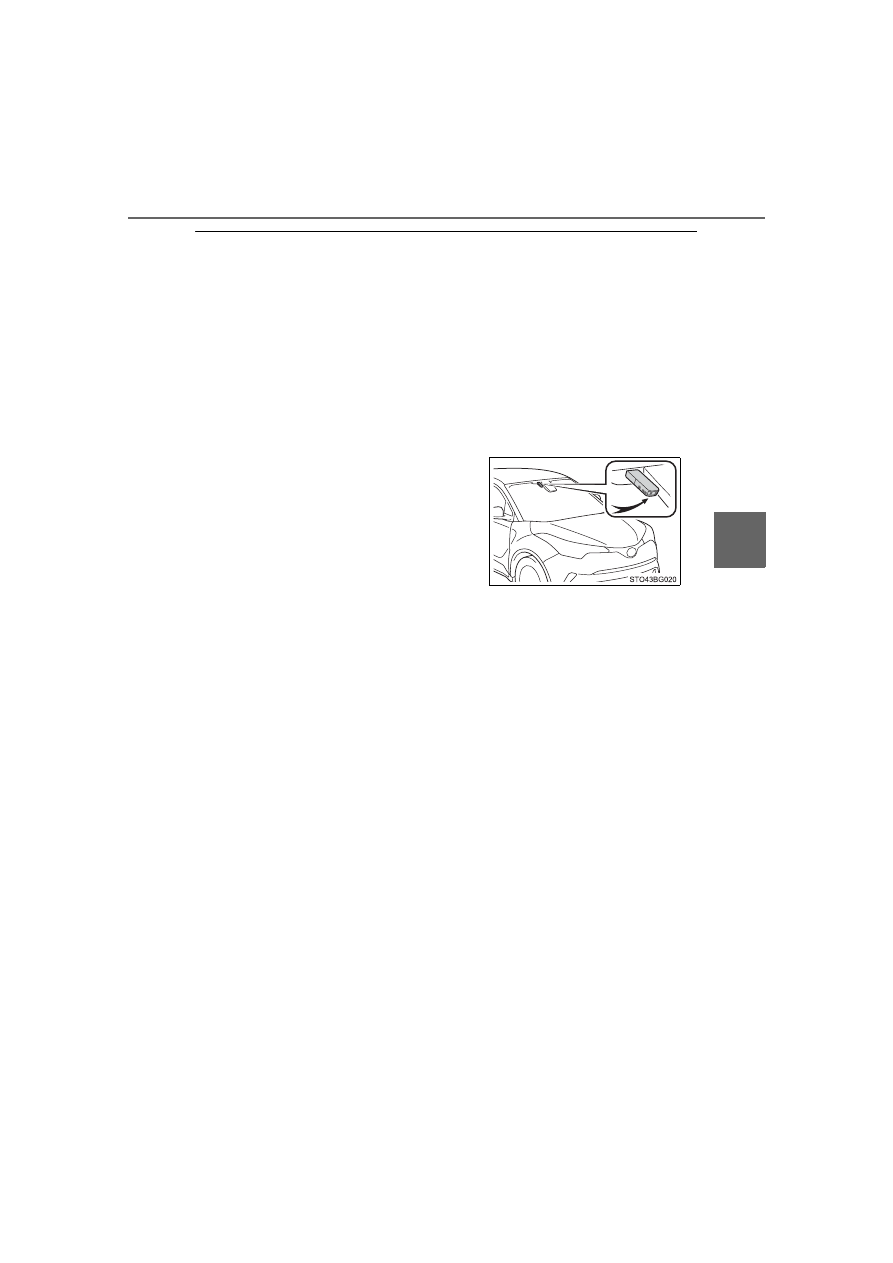
The raindrop sensor judges the amount
of raindrops.
An optical sensor is adopted. It may not
operate properly when sunlight from the
rising or setting of the sun intermittently
strikes  the  windshield,  or  if  bugs,  etc.,
are present on the windshield.

210

4-3. Operating the lights and wipers

WARNING

Caution regarding the use of washer fluid
When it is cold, do not use the washer fluid until the windshield becomes
warm. The fluid may freeze on the windshield and cause low visibility. This
may lead to an accident, resulting in death or serious injury.

Caution regarding the use of windshield wipers in “AUTO” mode (vehi-
cles with rain-sensing windshield wipers)
The windshield wipers may operate unexpectedly if the sensor is touched or
the windshield is subject to vibration in “AUTO” mode. Take care that your
fingers, etc., do not become caught in the windshield wipers.

NOTICE

When the windshield is dry
Do not use the wipers, as they may damage the windshield.

When there is no washer fluid spray from the nozzle
Damage  to  the  washer  fluid  pump  may  be  caused  if  the  lever  is  pulled
toward you and held continually.

When a nozzle becomes blocked
In this case, contact your Toyota dealer.
Do not try to clear it with a pin or other object. The nozzle will be damaged.

211

4-3. Operating the lights and wipers

4

Drivin

g

Rear window wiper and washer

Turning the 

 switch turns on the rear window wiper and washer

as follows:

*

1

 or 

*

2

Off

*

1

 or 

*

2

Intermittent window wiper oper-
ation

*

1

 or 

*

2

Normal window wiper operation

*

1

: For U.S.A.

*

2

: For Canada

Washer/wiper dual operation

The  wiper  will  automatically  oper-
ate  a  couple  of  times  after  the
washer squirts.

Operating instructions

212

4-3. Operating the lights and wipers

The rear window wiper and washer can be operated when

Vehicles without a smart key system

The engine switch is in the “ON” position.

Vehicles with a smart key system

The engine switch is in IGNITION ON mode.

If no windshield washer fluid sprays
Check  that  the  washer  nozzle  is  not  blocked  if  there  is  washer  fluid  in  the
windshield washer fluid reservoir.

NOTICE

When the rear window is dry
Do not use the wiper, as it may damage the rear window.

When the washer fluid tank is empty
Do not operate the switch continually as the washer fluid pump may over-
heat.

When a nozzle becomes blocked
In this case, contact your Toyota dealer. 
Do not try to clear it with a pin or other object. The nozzle will be damaged.

213

4-4. Refueling

4

Drivin

g

Opening the fuel tank cap

● Vehicles without a smart key system

Turn the engine switch to the “LOCK” position and ensure that all
the doors and windows are closed.

● Vehicles with a smart key system

Turn the engine switch off and ensure that all the doors and win-
dows are closed.

● Confirm the type of fuel.

Fuel types
P. 470

Fuel tank opening for unleaded gasoline
To  help  prevent  incorrect  fueling,  your  vehicle  has  a  fuel  tank  opening  that
only accommodates the special nozzle on unleaded fuel pumps.

Perform the following steps to open the fuel tank cap: 

Before refueling the vehicle

214

4-4. Refueling

WARNING

When refueling the vehicle
Observe the following precautions while refueling the vehicle. Failure to do
so may result in death or serious injury.

After  exiting  the  vehicle  and  before  opening  the  fuel  door,  touch  an
unpainted metal surface to discharge any static electricity. It is important to
discharge static electricity before refueling because sparks resulting from
static electricity can cause fuel vapors to ignite while refueling.

Always hold the grips on the fuel tank cap and turn it slowly to remove it. 
A  whooshing  sound  may  be  heard  when  the  fuel  tank  cap  is  loosened.
Wait until the sound cannot be heard before fully removing the cap. In hot
weather, pressurized fuel may spray out the filler neck and cause injury.

Do  not  allow  anyone  that  has  not  discharged  static  electricity  from  their
body to come close to an open fuel tank.

Do not inhale vaporized fuel.
Fuel contains substances that are harmful if inhaled.

Do not smoke while refueling the vehicle.
Doing so may cause the fuel to ignite and cause a fire.

Do not return to the vehicle or touch any person or object that is statically
charged.
This may cause static electricity to build up, resulting in a possible ignition
hazard.

When refueling
Observe the following precautions to prevent fuel overflowing from the fuel
tank:

Securely insert the fuel nozzle into the fuel filler neck.

Stop filling the tank after the fuel nozzle automatically clicks off.

Do not top off the fuel tank.

NOTICE

Refueling
Do not spill fuel during refueling. 
Doing  so  may  damage  the  vehicle,  such  as  causing  the  emission  control
system to operate abnormally, or damaging fuel system components, or the
vehicle’s painted surface.

215

4-4. Refueling

4

Drivin

g

Press  the  opener  to  open  the
fuel filler door.

Turn the fuel tank cap slowly to
remove  it  and  hang  it  on  the
back of the fuel filler door.

When the fuel filler door cannot be opened

Opening the fuel tank cap

1

2

Open  the  back  door  and  remove  the
cover underneath the luggage compart-
ment light.

Pull the lever backward and check that
the fuel filler door opens.

1

2

216

4-4. Refueling

After  refueling,  turn  the  fuel  tank
cap  until  you  hear  a  click.  Once
the  cap  is  released,  it  will  turn
slightly in the opposite direction.

Closing the fuel tank cap

WARNING

When replacing the fuel tank cap
Do not use anything but a genuine Toyota fuel tank cap designed for your
vehicle.  Doing  so  may  cause  a  fire  or  other  incident  which  may  result  in
death or serious injury.

217

4-5. Using the driving support systems

4

Drivin

g

Toyota Safety Sense P

PCS (Pre-Collision System)

P. 224

LDA (Lane Departure Alert with steering control)

P. 238

Automatic High Beam

P. 200

Dynamic radar cruise control with full-speed range

P. 248

The Toyota Safety Sense P consists of the following drive assist
systems and contributes to a safe and comfortable driving expe-
rience:

WARNING

Toyota Safety Sense P
The Toyota  Safety  Sense  P  is  designed  to operate  under  the  assumption
that the driver will drive safely, and is designed to help reduce the impact to
the occupants and the vehicle in the case of a collision or assist the driver in
normal driving conditions.
As there is a limit to the degree of recognition accuracy and control perfor-
mance that this system can provide, do not overly rely on this system. The
driver is always responsible for paying attention to the vehicle’s surround-
ings and driving safely.

218

4-5. Using the driving support systems

The  pre-collision  system  is  equipped  with  a  sophisticated  computer
that will record certain data, such as:

• Accelerator status
• Brake status
• Vehicle speed
• Operation status of the pre-collision system functions
• Information (such as the distance and relative speed between your

vehicle and the vehicle ahead or other objects)

• Images from the camera sensor (available only when the pre-colli-

sion braking function or the pre-collision brake assist function was
operating)

The  pre-collision  system  does  not  record  conversations  sounds  or
images of the inside of the vehicle.
● Data usage

Toyota  may  use  the  data  recorded  in  this  computer  to  diagnose
malfunctions,  conduct  research  and  development,  and  improve
quality.
Toyota will not disclose the recorded data to a third party except:

• With the consent of the vehicle owner or with the consent of the

lessee if the vehicle is leased

• In response to an official request by the police, a court of law or a

government agency

• For use by Toyota in a lawsuit
• For  research  purposes  where  the  data  is  not  tied  to  a  specific

vehicle or vehicle owner

● Recorded images can be erased using a specialized device.

The image recording function can be disabled. However, if the func-
tion is disabled, data from when the pre-collision system operates
will not be available.

Vehicle data recording

219

4-5. Using the driving support systems

4

Drivin

g

Two types of sensors, located behind the front grille and windshield,
detect information necessary to operate the drive assist systems.

Radar sensor
Camera sensor

Sensors

WARNING

To avoid malfunction of the radar sensor
Observe the following precautions.
Otherwise, the radar sensor may not operate properly, possibly leading to
an accident resulting in death or serious injury.

Keep the radar sensor and front grille emblem clean at all times.

Radar sensor
Front grille emblem

If  the  front  of  the  radar  sensor  or  the
front or back of the front grille emblem
is dirty or covered with water droplets,
snow, etc., clean it.
Clean the radar sensor and front grille
emblem with a soft cloth so you do not
mark or damage them.

220

4-5. Using the driving support systems

WARNING

Do  not  attach  accessories,  stickers  (including  transparent  stickers)  or
other items to the radar sensor, front grille emblem or surrounding area.

Do not subject the radar sensor or surrounding area to a strong impact. 
If  the  radar  sensor, front grille, or  front  bumper has  been  subjected to  a
strong impact, have the vehicle inspected by your Toyota dealer.

Do not disassemble the radar sensor.

Do not modify or paint the radar sensor, front grille emblem or surrounding
area.

If the radar sensor, front grille, or front bumper needs to be removed and
installed, or replaced, contact your Toyota dealer.

To avoid malfunction of the camera sensor
Observe the following precautions.
Otherwise, the camera sensor may not operate properly, possibly leading to
an accident resulting in death or serious injury.

Keep the windshield clean at all times.
• If  the  windshield  is  dirty  or  covered  with  an  oily  film,  water  droplets,

snow, etc., clear the windshield.

• If a glass coating agent is applied to the windshield, it will still be neces-

sary to use the windshield wipers to remove water droplets, etc. from
the area of the windshield in front of the camera sensor.

• If the inner side of the windshield where the camera sensor is installed

is dirty, contact your Toyota dealer.

B: Approximately  7.9  in.  (20  cm)  (Approximately  4.0  in.  (10  cm)  to  the

right and left from the center of the camera sensor)

Do not attach objects, such as stickers,
transparent  stickers,  etc.,  and  so  forth,
to  the  outer  side  of  the  windshield  in
front  of  the  camera  sensor  (shaded
area in the illustration).
A:  From  the  top  of  the  windshield  to

approximately  0.4  in.  (1  cm)  below
the bottom of the camera sensor

221

4-5. Using the driving support systems

4

Drivin

g

WARNING

If the part of the windshield in front of the camera sensor is fogged up or
covered with condensation or ice, use the windshield defogger to remove
the fog, condensation or ice. (

P. 295)

If water droplets cannot be properly removed from the area of the wind-
shield in front of the camera sensor by the windshield wipers, replace the
wiper insert or wiper blade.
If  the  wiper  inserts  or  wiper  blades  need  to  be  replaced,  contact  your
Toyota dealer.

Do not attach window tinting to the windshield.

Replace the windshield if it is damaged or cracked. 
If the windshield needs to be replaced, contact your Toyota dealer.

Do not get the camera sensor wet.

Do not allow bright lights to shine into the camera sensor.

Do not dirty or damage the camera sensor. 
When cleaning the inside of the windshield, do not allow glass cleaner to
contact the lens. Also, do not touch the lens. 
If the lens is dirty or damaged, contact your Toyota dealer.

Do not subject the camera sensor to a strong impact.

Do not change the installation position or direction of the camera sensor or
remove it. 

Do not disassemble the camera sensor.

Do not modify any components of the vehicle around the camera sensor
(inside rear view mirror, etc.) or ceiling.

Do not attach any accessories that may obstruct the camera sensor to the
hood, front grille or front bumper. Contact your Toyota dealer for details.

If a surfboard or other long object is to be mounted on the roof, make sure
that it will not obstruct the camera sensor.

Do not modify the headlights or other lights.

224

4-5. Using the driving support systems

PCS (Pre-Collision System)

The pre-collision system uses a radar sensor and camera sen-
sor to detect vehicles and pedestrians in front of your vehicle.
When the system determines that the possibility of a frontal col-
lision with a vehicle or pedestrian is high, a warning operates to
urge  the  driver  to  take  evasive  action  and  the  potential  brake
pressure is increased to help the driver avoid the collision. If the
system determines that the possibility of a frontal collision with
a  vehicle  or  pedestrian  is  extremely  high,  the  brakes  are  auto-
matically applied to help avoid the collision or help reduce the
impact of the collision.

The pre-collision system can be disabled/enabled and the warning
timing can be changed. (

P. 228)


Content   ..  12  13  14  15   ..