Toyota Avalon Hybrid (2019 year). Manual - part 31
 

  Index      Toyota     Toyota Avalon Hybrid - service manual 2019 year in english


Search            


Content   ..  29  30  31  32   ..


Toyota Avalon Hybrid (2019 year). Manual - part 31


481

7-2. Steps to take in an emergency

7

W

hen
 troub

le arises

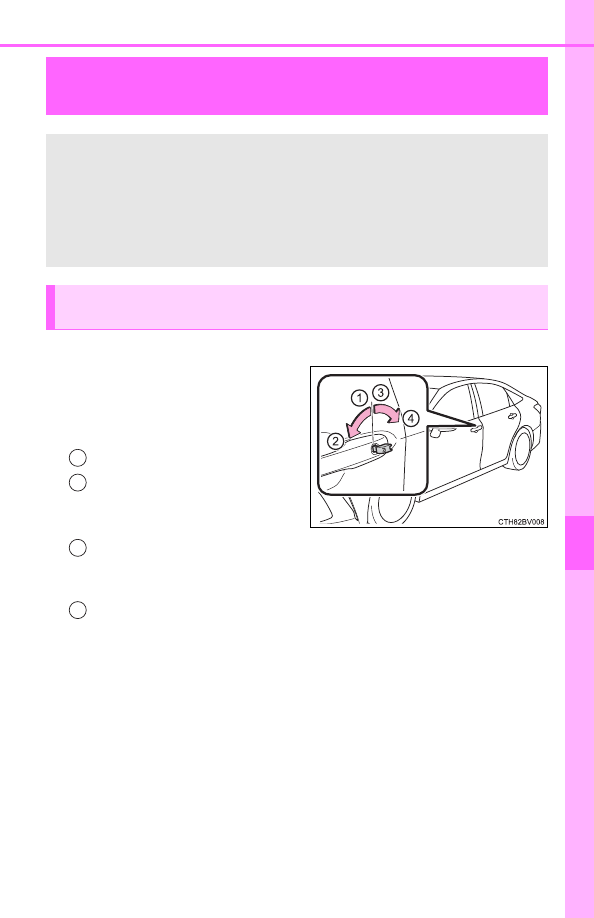
Doors
Using the mechanical key (

P.

129) in order to perform the fol-
lowing operations (driver’s door
only):

Locks all doors
Closes  the  windows  and  the
moon  roof

*

1

  (turn  and

hold)

*

2

Unlocks the door

Turning the key rearward unlocks the driver's door. Turning the key once
again unlocks the other doors.

Opens the windows and the moon roof

*

1

 (turn and hold)

*

2

*

1

: If equipped

*

2

: This setting must be customized at your Toyota dealer.

If the electronic key does not operate 

properly

If  communication  between  the  electronic  key  and  vehicle  is
interrupted  (

P.  145)  or  the  electronic  key  cannot  be  used

because the battery is depleted, the smart key system and wire-
less  remote  control  cannot  be  used.  In  such  cases,  the  doors
and trunk can be opened and the hybrid system can be started
by following the procedure below.

Locking  and  unlocking  the  doors,  unlocking  the  trunk  and  key
linked functions

1
2

3

4

482

7-2. Steps to take in an emergency

Trunk
Turn the mechanical key clock-
wise to open.

Ensure  that  the  shift  lever  is  in  P  and  firmly  depress  the  brake
pedal.
Touch  the  Toyota  emblem  side
of  the  electronic  key  to  the
power switch.

When  the  electronic  key  is
detected, a buzzer sounds and the
power switch will turn to ON mode.
When  the  smart  key  system  is
deactivated  in  customization  set-
ting,  the  power  switch  will  turn  to
ACCESSORY mode.

Firmly depress the brake pedal and check that 

 is displayed

on the multi-information display.
Press the power switch shortly and firmly.

In the event that the power switch still cannot be started, contact your
Toyota dealer.

Starting the hybrid system

1

2

3

4

483

7-2. Steps to take in an emergency

7

W

hen
 troub

le arises

Stopping the hybrid system
Shift the shift lever to P and press the power switch as you normally do when
stopping the hybrid system.

Replacing the key battery
As the above procedure is a temporary measure, it is recommended that the
electronic key battery be replaced immediately when the battery is depleted.
(

P. 439)

Changing power switch modes
Release the brake pedal and press the power switch in step 

 above.

The hybrid system does not start and modes will be changed each time the
switch is pressed. (

P. 191)

When the electronic key does not work properly

Make sure that the smart key system has not been deactivated in the cus-
tomization setting. If it is off, turn the function on. 
(Customizable features: 

P. 522)

Check if battery-saving mode is set. If it is set, cancel the function. 
(

P. 144)

WARNING

When using the mechanical key and operating the power windows or
moon roof 
Operate the power window or moon roof after checking to make sure that
there  is  no  possibility  of  any  passenger  having  any  of  their  body  parts
caught in the window or moon roof. Also, do not allow children to operate
the mechanical key. It is possible for children and other passengers to get
caught in the power window or moon roof.

3

484

7-2. Steps to take in an emergency

If you have a set of jumper (or booster) cables and a second vehicle
with a 12-volt battery, you can jump start your vehicle by following the
steps below.

Confirm  that  the  electronic  key
is being carried.

When  connecting  the  jumper  (or
booster) cables, depending on the
situation,  the  alarm  may  activate
and doors locked. (

P. 84)

Open the hood and remove the
fuse box cover.

Push the tabs in and lift the lid off.

Open  the  exclusive  jump  start-
ing terminal cover.

If the 12-volt battery is discharged

The following procedures may be used to start the hybrid sys-
tem if the vehicle’s 12-volt battery is discharged.
You can also call your Toyota dealer or a qualified repair shop.

1

2

3

485

7-2. Steps to take in an emergency

7

W

hen
 troub

le arises

Connect the jumper cables according to the following procedure:

Connect  a  positive  jumper  cable  clamp  to  the  exclusive  jump
starting terminal on your vehicle.
Connect the clamp on the other end of the positive cable to the
positive (+) battery terminal on the second vehicle.
Connect a negative cable clamp to the negative (-) battery termi-
nal on the second vehicle.
Connect  the  clamp  at  the  other  end  of  the  negative  cable  to  a
solid, stationary, unpainted metallic point away from the exclusive
jump  starting  terminal  and  any  moving  parts,  as  shown  in  the
illustration.

4

1

2

3

4

486

7-2. Steps to take in an emergency

Start the engine of the second vehicle. Increase the engine speed
slightly  and  maintain  at  that  level  for  approximately  5  minutes  to
recharge the 12-volt battery of your vehicle.
Open  and  close  any  of  the  doors  of  your  vehicle  with  the  power
switch off.
Maintain the engine speed of the second vehicle and turn the power
switch to ON mode, then start the vehicle's engine.
Make sure the “READY” indicator comes on. If the indicator does
not come on, contact your Toyota dealer.
Once the hybrid system has started, remove the jumper cables in
the exact reverse order from which they were connected.
Close the exclusive jump starting terminal cover, and reinstall the
fuse box cover to its original position.

Once  the  hybrid  system  starts,  have  the  vehicle  inspected  at  your
Toyota dealer as soon as possible.

5

6

7

8

9

10

487

7-2. Steps to take in an emergency

7

W

hen
 troub

le arises

Starting the hybrid system when the 12-volt battery is discharged 
The hybrid system cannot be started by push-starting.

To prevent 12-volt battery discharge

Turn off the headlights and the audio system while the hybrid system is off.

Turn off any unnecessary electrical components when the vehicle is running
at a low speed for an extended period, such as in heavy traffic.

When the 12-volt battery is removed or discharged

Information  stored  in  the  ECU  is  cleared.  When  the  12-volt  battery  is
depleted, have the vehicle inspected at your Toyota dealer.

Some systems may require initialization. (

P. 531)

When removing the 12-volt battery terminals
When the 12-volt battery terminals are removed, the information stored in the
ECU is cleared. Before removing the 12-volt battery terminals, contact your
Toyota dealer.

Charging the 12-volt battery
The electricity stored in the 12-volt battery will discharge gradually even when
the vehicle is not in use, due to natural discharge and the draining effects of
certain electrical appliances. If the vehicle is left for a long time, the 12-volt
battery may discharge, and the hybrid system may be unable to start. (The
12-volt battery recharges automatically while the hybrid system is operating.)

When recharging or replacing the 12-volt battery

In some cases, it may not be possible to unlock the doors using the smart
key system when the 12-volt battery is discharged. Use the wireless remote
control or the mechanical key to lock or unlock the doors.

The hybrid system may not start on the first attempt after the 12-volt battery
has recharged but will start normally after the second attempt. This is not a
malfunction.

The power switch mode is memorized by the vehicle. When the 12-volt bat-
tery is reconnected, the system will return to the mode it was in before the
12-volt  battery  was  discharged.  Before  disconnecting  the  12-volt  battery,
turn the power switch off. 
If you are unsure what mode the power switch was in before the 12-volt bat-
tery discharged, be especially careful when reconnecting the 12-volt battery.

488

7-2. Steps to take in an emergency

When replacing the 12-volt battery

Use a Central Degassing type 12-volt battery (European Regulations).

Use a 12-volt battery that the case size is same as the previous one (LN2),
20  hour  rate  capacity  (20HR)  is  equivalent  (64Ah)  or  greater,  and  perfor-
mance rating (CCA) is equivalent (356A) or greater.
• If the sizes differ, the 12-volt battery cannot be properly secured.
• If the 20 hour rate capacity is low, even if the time period where the vehi-

cle is not used is a short time, the 12-volt battery may discharge and the
hybrid system may not be able to start.

Use a 12-volt battery with a handle. If a 12-volt battery without a handle is
used, removal is more difficult.

For details, consult your Toyota dealer.

After replacing, firmly attach the follow-
ing items to the exhaust hole of the 12-
volt battery.
• Use  the  exhaust  hose  that  was

attached to the 12-volt battery before
replacing and confirm that it is firmly
connected to the hole section of the
vehicle.

• Use  the  exhaust  hole  plug  included

with  the  12-volt  battery  replaced  or
the one installed on the battery prior
to  the  replacement.  (Depending  on
the 12-volt battery to be replaced, the
exhaust hole may be plugged.)

Exhaust hole plug
Exhaust hole
Exhaust hose
Hole section of the vehicle

1
2
3
4

489

7-2. Steps to take in an emergency

7

W

hen
 troub

le arises

WARNING

When removing the 12-volt battery terminals
Always remove the negative (-) terminal first. If the positive (+) terminal con-
tacts  any  metal  in  the  surrounding  area  when  the  positive  (+)  terminal  is
removed, a spark may occur, leading to a fire in addition to electrical shocks
and death or serious injury.

Avoiding 12-volt battery fires or explosions
Observe the following precautions to prevent accidentally igniting the flam-
mable gas that may be emitted from the 12-volt battery:

Make sure each jumper cable is connected to the correct terminal and that
it is not unintentionally in contact with any other than the intended terminal.

Do not allow the other end of the jumper cable connected to the “+” termi-
nal to come into contact with any other parts or metal surfaces in the area,
such as brackets or unpainted metal.

Do not allow the + and - clamps of the jumper cables to come into contact
with each other.

Do  not smoke,  use matches, cigarette lighters  or  allow  open flame near
the 12-volt battery.

12-volt battery precautions
The  12-volt  battery  contains  poisonous  and  corrosive  acidic  electrolyte,
while related parts contain lead and lead compounds. Observe the following
precautions when handling the 12-volt battery:

When  working  with  the  12-volt  battery,  always  wear  safety  glasses  and
take care not to allow any battery fluids (acid) to come into contact with
skin, clothing or the vehicle body.

Do not lean over the 12-volt battery.

In  the  event  that  battery  fluid  comes  into  contact  with  the  skin  or  eyes,
immediately wash the affected area with water and seek medical attention.
Place a wet sponge or cloth over the affected area until medical attention
can be received.

Always wash your hands after handling the 12-volt battery support, termi-
nals, and other 12-volt battery-related parts.

Do not allow children near the 12-volt battery.

After recharging the 12-volt battery
Have the 12-volt battery inspected at your Toyota dealer as soon as possi-
ble.
If the 12-volt battery is deteriorating, continued use may cause the 12-volt
battery to emit a malodorous gas, which may be detrimental to the health of
passengers.

490

7-2. Steps to take in an emergency

WARNING

When replacing the 12-volt battery
After replacing, securely attach the exhaust hose and exhaust hole plug to
the  exhaust  hole  of  the  replaced  12-volt  battery.  If  not  properly  installed,
gases (hydrogen) may leak into the vehicle interior, and there is the possi-
ble danger of the gas igniting and exploding.

NOTICE

When handling jumper cables
When connecting the jumper cables, ensure that they do not become entan-
gled in the cooling fan or engine drive belt.

To prevent damaging the vehicle
The exclusive jump starting terminal is to be used when charging the 12-volt
battery  from  another  vehicle  in  an  emergency.  It  cannot  be  used  to  jump
start another vehicle.

491

7-2. Steps to take in an emergency

7

W

hen
 troub

le arises

If the needle of the engine coolant temperature gauge enters
the  red  zone  or  “Engine  Coolant  Temp  High  Stop  in  a  Safe
Place See Owner’s Manual” is shown on the multi-information
display
Stop the vehicle in a safe place and turn off the air conditioning sys-
tem, and then stop the hybrid system.
If you see steam: 
Carefully lift the hood after the steam subsides.
If you do not see steam:
Carefully lift the hood.
After  the  hybrid  system  has
cooled 

down 

sufficiently,

inspect  the  hoses  and  radiator
core (radiator) for any leaks.

Radiator
Cooling fan

If a large amount of coolant leaks,
immediately  contact  your  Toyota
dealer.

If your vehicle overheats

The following may indicate that your vehicle is overheating.

● The  needle  of  the  engine  coolant  temperature  gauge  (P.  92)

enters  the  red  zone or a loss  of  hybrid  system  power  is  experi-
enced. (For example, the vehicle speed does not increase.)

● “Engine  Coolant Temp  High  Stop  in  a  Safe  Place  See  Owner’s

Manual” or “Hybrid System Overheated Reduced Output Power”
is shown on the multi-information display

● Steam comes out from under the hood.

Correction procedures

1

2

3

1
2

492

7-2. Steps to take in an emergency

The coolant level is satisfactory
if  it  is  between  the  “F”  and  “L”
lines on the reservoir.

Reservoir
“F” line
“L” line
Radiator cap

Add coolant if necessary.

Water  can  be  used  in  an  emer-
gency if coolant is unavailable.

Start the hybrid system and turn the air conditioning system on to
check that the radiator cooling fan operates and to check for cool-
ant leaks from the radiator or hoses.

The fan operates when the air conditioning system is turned on immedi-
ately after a cold start. Confirm that the fan is operating by checking the fan
sound and air flow. If it is difficult to check these, turn the air conditioning
system on and off repeatedly. (The fan may not operate in freezing tem-
peratures.)

If the fan is not operating: 
Stop the hybrid system immediately and contact your Toyota dealer.
If the fan is operating: 
Have the vehicle inspected at the nearest Toyota dealer.

4

1
2
3
4

5

6

7

493

7-2. Steps to take in an emergency

7

W

hen
 troub

le arises

If  “Hybrid  System  Overheated  Reduced  Output  Power”  is
shown on the multi-information display

Stop the vehicle in a safe place.
Stop the hybrid system and carefully lift the hood.
After  the  hybrid  system  has
cooled  down,  inspect  the
hoses  and  radiator  core
(radiator) for any leaks.

Radiator
Cooling fan

If  a  large  amount  of  coolant
leaks,  immediately  contact
your Toyota dealer.

The coolant level is satisfac-
tory  if  it  is  between  the
“FULL”  and  “LOW”  lines  on
the reservoir.

Reservoir
“FULL”
“LOW”

Add coolant if necessary.

Water can be used in an emer-
gency if coolant is unavailable.

1
2
3

1
2

4

1
2
3

5

494

7-2. Steps to take in an emergency

After  stopping  the  hybrid  system  and  waiting  for  5  minutes  or
more, start the hybrid system again and check for the multi-infor-
mation display.
If the message does not disappear:

Stop the hybrid system and contact your Toyota dealer.

If the message is not displayed:

The hybrid system temperature has dropped and the vehicle
may be driven normally.

However, if the message appears again frequently, contact your Toyota
dealer.

WARNING

To  prevent  an  accident  or  injury  when  inspecting  under  the  hood  of
your vehicle
Observe the following precautions. 
Failure to do so may result in serious injury such as burns.

If steam is seen coming from under the hood, do not open the hood until
the steam has subsided. The engine compartment may be very hot.

After the hybrid system has been turned off, check that the “READY” indi-
cator is off. When the hybrid system is operating, the gasoline engine may
automatically  start,  or  the  cooling  fan  may  suddenly  operate  even  if  the
gasoline engine stops. Do not touch or approach rotating parts such as the
fan, which may lead to fingers or clothing (especially a tie, a scarf or a muf-
fler) getting caught, resulting in serious injury.

Do  not  loosen  the  radiator  cap  and  the  coolant  reservoir  cap  while  the
hybrid system and radiator are hot.
High temperature steam or coolant could spray out.

NOTICE

When adding engine/power control unit coolant
Wait until the hybrid system has cooled down before adding engine/power
control unit coolant.
When adding coolant, do so slowly. Adding cool coolant to a hot hybrid sys-
tem too quickly can cause damage to the hybrid system.

To prevent damage to the cooling system
Observe the following precautions:

Avoid contaminating the coolant with foreign matter (such as sand or dust
etc.).

Do not use any coolant additives.

6

495

7-2. Steps to take in an emergency

7

W

hen
 troub

le arises

Stop  the  hybrid  system.  Set  the  parking  brake  and  shift  the  shift
lever to P.
Remove the mud, snow or sand from around the front wheels.
Place wood, stones or some other material under the front wheels
to help provide traction.
Restart the hybrid system.
Shift the shift lever to D or R and release the parking brake. Then,
while exercising caution, depress the accelerator pedal.

When it is difficult to free the vehicle

If the vehicle becomes stuck

Carry out the following procedures if the tires spin or the vehicle
becomes stuck in mud, dirt or snow:

1

2
3

4
5

Press 

 to turn off TRAC.

WARNING

When attempting to free a stuck vehicle
If you choose to push the vehicle back and forth to free it, make sure the
surrounding area is clear to avoid striking other vehicles, objects or people.
The vehicle may also lunge forward or lunge back suddenly as it becomes
free. Use extreme caution.

When shifting the shift lever
Be careful not to shift the shift lever with the accelerator pedal depressed.
This  may  lead  to  unexpected  rapid  acceleration  of  the  vehicle  that  may
cause an accident resulting in death or serious injury.

496

7-2. Steps to take in an emergency

NOTICE

To avoid damaging the transmission and other components

Avoid  spinning  the  front  wheels  and  depressing  the  accelerator  pedal
more than necessary.

If  the  vehicle  remains  stuck even  after  these procedures  are  performed,
the vehicle may require towing to be freed.


Content   ..  29  30  31  32   ..