Suzuki Grand Vitara JB627. Service manual - part 13
1A-1 Engine General Information and Diagnosis:
Engine
Engine General Information and Diagnosis
Precautions
Precautions on Engine Service
S6JB0B1100001
The following information on engine service should be
noted carefully, as it is important in preventing damage,
and in contributing to reliable engine performance.
• When raising or supporting engine for any reason, do
not use a jack under oil pan. Due to small clearance
between oil pan and oil pump strainer, jacking against
oil pan may cause it to be bent against strainer
resulting in damaged oil pick-up unit.
• It should be kept in mind, while working on engine,
that 12-volt electrical system is capable of violent and
damaging short circuits. When performing any work
where electrical terminals could possibly be
grounded, ground cable of the battery should be
disconnected at battery.
• Any time the air cleaner, air intake pipe, throttle body
or intake manifold is removed, the intake opening
should be covered. This will protect against accidental
entrance of foreign material which could follow intake
passage into cylinder and cause extensive damage
when engine is started.
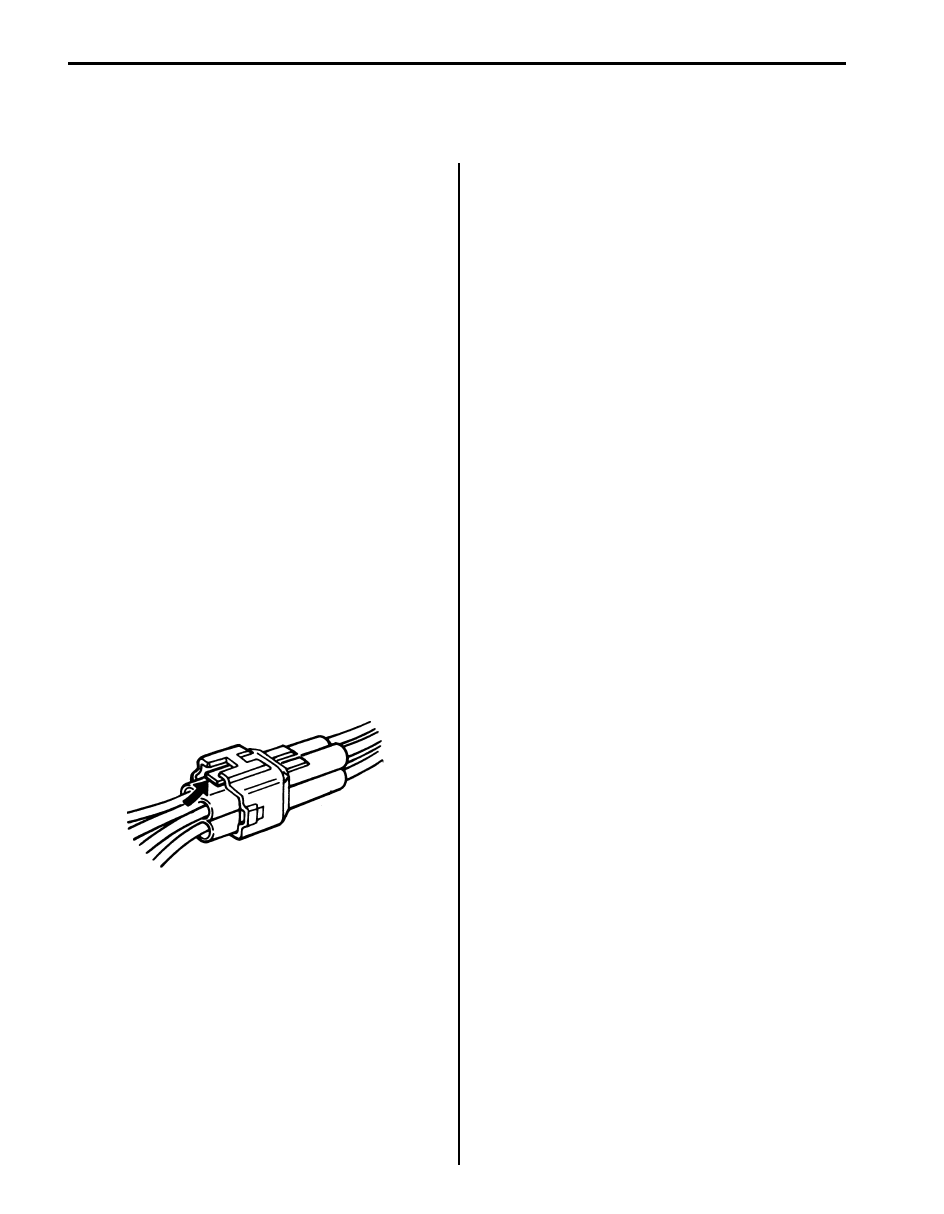
• When disconnecting couplers, don’t pull wire harness
but make sure to hold coupler itself. With lock type
coupler, be sure to unlock before disconnection.
Attempt to disconnect coupler without unlocking may
result in damage to coupler. When connecting lock
type coupler, insert it till clicking sound is heard and
connect it securely.
Precautions in Diagnosing Trouble
S6JB0B1100002
• Don’t disconnect couplers from ECM, battery cable
from battery, ECM ground wire harness from engine
or main fuse before confirming diagnostic information
(DTC, freeze frame data, etc.) stored in ECM memory.
Such disconnection will erase memorized information
in ECM memory.
• Diagnostic information stored in ECM memory can be
cleared as well as checked by using SUZUKI scan
tool or OBD generic scan tool. Before using scan tool,
read its Operator’s (Instruction) Manual carefully to
have good understanding as to what functions are
available and how to use it.
• It is indistinguishable which module turns on MIL
because not only ECM but also TCM (A/T model)
turns on MIL (For details of on-board diagnostic
system for A/T model, refer to “On-Board Diagnostic
System Description in Section 5A”). Therefore, check
both ECM and TCM (A/T model) for DTC when MIL
lights on. When checking ECM for DTC, keep in mind
that DTC is displayed on the scan tool as follows
depending on the scan tool used.
– SUZUKI scan tool displays DTC detected by ECM.
– OBD generic scan tool displays DTC detected by
each of ECM and TCM (A/T model) simultaneously.
• Priorities for diagnosing troubles
If two or more diagnostic trouble codes (DTCs) are
stored, proceed to the flow of the DTC which has
detected earliest in the order and follow the instruction
in that table.
If no instructions are given, troubleshoot diagnostic
trouble codes according to the following priorities.
a. Diagnostic trouble codes (DTCs) other than DTC
P0171 / P0172 / P0174 / P0175 (Fuel system too
lean/too rich), DTC P0300 / P0301 / P0302 /
P0303 / P0304 / P0305 / P0306 (Misfire detected)
and DTC P0401 / P0402 (EGR flow malfunction)
b. DTC P0171 / P0172 / P0174 / P0175 (Fuel
system too lean/too rich) and DTC P0401 / P0402
(EGR flow malfunction)
c. DTC P0300 / P0301 / P0302 / P0303 / P0304 /
P0305 / P0306 (Misfire detected)
IYSQ01110001-01