SsangYong Rodius (2013 year). Service manual - part 176
 

  Index      SsangYong     SsangYong Rodius - service and repair manual 2013 year


Search            


Content   ..  174  175  176  177   ..


SsangYong Rodius (2013 year). Service manual - part 176


12-8

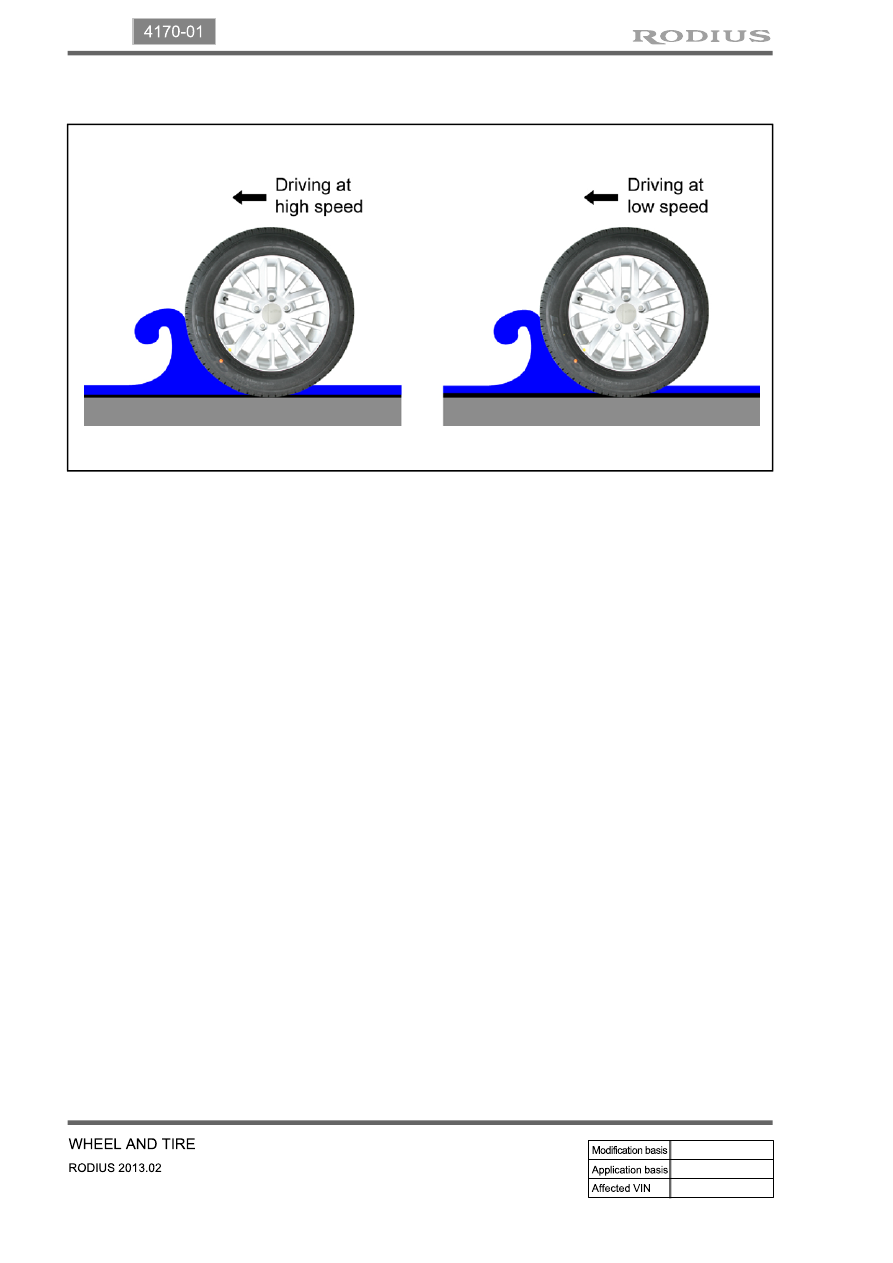
When the vehicle is driven on a road surface covered with water at high speed, tires do not contact 

with the road surface but rotate floating on a thin film of water.

It causes brake failure, lower traction force and losing the steering performance. 

To prevent this, increase the tire inflation pressure, use tires with leaf shape tread which is not worn. 

However, it is a best measure to drive slowly. 

2) Hydroplaning

12-9

4170-01

If weight is not equally distributed around the wheel, unbalance centrifugal force by the wheel rotation 

produces vibration. As the centrifugal force is produced proportional to the square of the rotating 

speed, the wheel weight should be balanced even at high speed. There are two types of the tire and 

wheel balancing: static and dynamic. Abnormal vibration may also occur due to unbalanced rigidity or 

size of tires. 

1) Static Balance

When the free rotation of the wheel is 

allowed, the heavier part is stopped on the 

bottom if the wheel weight is unbalanced 

and this is called "Static Unbalance". Also, 

the state at which tire's stop position is not 

same is called "Static Balance" when the 

wheel is rotated again. If the part A is heavier 

as shown in the figure 1, add the balance 

weight of a weight corresponding to 

unbalanced weight from B to A to maintain 

the static balance. If the static balance is not 

maintained, tramping, up and down vibration 

of the wheels, occurs. 

2) Dynamic Balance

The static unbalance of the wheel creates 

the vibration in the vertical direction, but 

the dynamic unbalance creates the 

vibration in the lateral direction. As shown 

in the figure 2 (a), if two parts, (2) and (3), 

are heavier when the wheels are under the 

static balance condition, dynamic 

unbalance is created, resulting in shimmy, 

left and right vibration of the wheels, and 

the torque Fxa is applied in the axial 

direction. To correct the dynamic 

unbalance, add the balance weight of a 

same weight for two points of  the 

circumference of the rim, A and B, as 

shown in the figure 2 (b), and apply the 

torque in the opposite direction to the 

torque Fxa to offset in order to ensure 

smooth rotation of the wheel. 

Center

a

a

Fxa

Fxa

F

F

A

B

(a)

(b)

[Figure 1]

[Figure 2]

3. WHEEL BALANCE

12-10

4. WHEEL ALIGNMENT

▶Toe-in

▶Camber

In automotive engineering, toe, also known as 

tracking, is the symmetric angle that each wheel 

makes with the longitudinal axis of the vehicle, as 

a function of static geometry, and kinematic and 

compliant effects. This can be contrasted with 

steer, which is the anti-symmetric angle, i.e. both 

wheels point to the left or right, in parallel 

(roughly). Positive toe, or toe in, is the front of the 

wheel pointing in towards the center line of the 

vehicle. Negative toe, or toe out, is the front of the 

wheel pointing away from the center line of the 

vehicle. Toe can be measured in linear units, at 

the front of the tire, or as an angular deflection.

Camber is the angle made by the wheels of a 

vehicle; specifically, it is the angle between the 

vertical axis of the wheels used for steering and 

the vertical axis of the vehicle when viewed from 

the front or rear. It is used in the design of 

steering and suspension. If the top of the wheel 

is farther out than the bottom (that is, away from 

the axle), it is called positive camber; if the 

bottom of the wheel is farther out than the top, it 

is called negative camber.

Wheel alignment consists of adjusting the angles of the wheels so that they are parallel to each other 

and perpendicular to the ground, thus maximizing tire life and ensures straight and true tracking along 

a straight and level road.

Camber angle alters the handling qualities of a particular suspension design; in particular, negative 

camber improves grip when cornering. This is because it places the tire at a better angle to the road, 

transmitting the forces through the vertical plane of the tire rather than through a shear force across it. 

Another reason for negative camber is that a rubber tire tends to roll on itself while cornering. Negative 

camber can also be caused by excessive weight on the front wheels. This is commonly seen on 

modified cars with larger engines than standard; the weight of the modified engine can make the 

wheels negatively camber. The inside edge of the contact patch would begin to lift off of the ground if 

the tire had zero camber, reducing the area of the contact patch. This effect is compensated for by 

applying negative camber, maximizing the contact patch area. Note that this is only true for the outside 

tire during the turn; the inside tire would benefit most from positive camber.

12-11

4170-01

▶Caster

Caster is the angle to which the steering pivot 

axis is tilted forward or rearward from vertical, as 

viewed from the side. If the pivot axis is tilted 

backward (that is, the top pivot is positioned 

farther rearward than the bottom pivot), then the 

caster is positive; if it's tilted forward, then the 

caster is negative.

Positive caster tends to straighten the wheel 

when the vehicle is traveling forward, and thus 

is used to enhance straight-line stability. The 

mechanism that causes this tendency is clearly 

illustrated by the castering front wheels of a 

vehicle. The steering axis of a vehicle wheel is 

set forward of where the wheel contacts the 

ground. As the vehicle is driving forward, the 

steering axis pulls the wheel along, and since 

the wheel drags along the ground, it falls directly 

in line behind the steering axis. The force that 

causes the wheel to follow the steering axis is 

proportional to the distance between the 

steering axis and the wheel-to-ground contact 

patch-the greater the distance, the greater the 

force. This distance is referred to as "trail."


Content   ..  174  175  176  177   ..