SsangYong Actyon Sports II. Service manual - part 144
 

  Index      SsangYong     SsangYong Actyon Sports II - service and repair manual 2012-2013 year


Search            


Content   ..  142  143  144  145   ..


SsangYong Actyon Sports II. Service manual - part 144


09-24

Front/Rear Brake Assembly

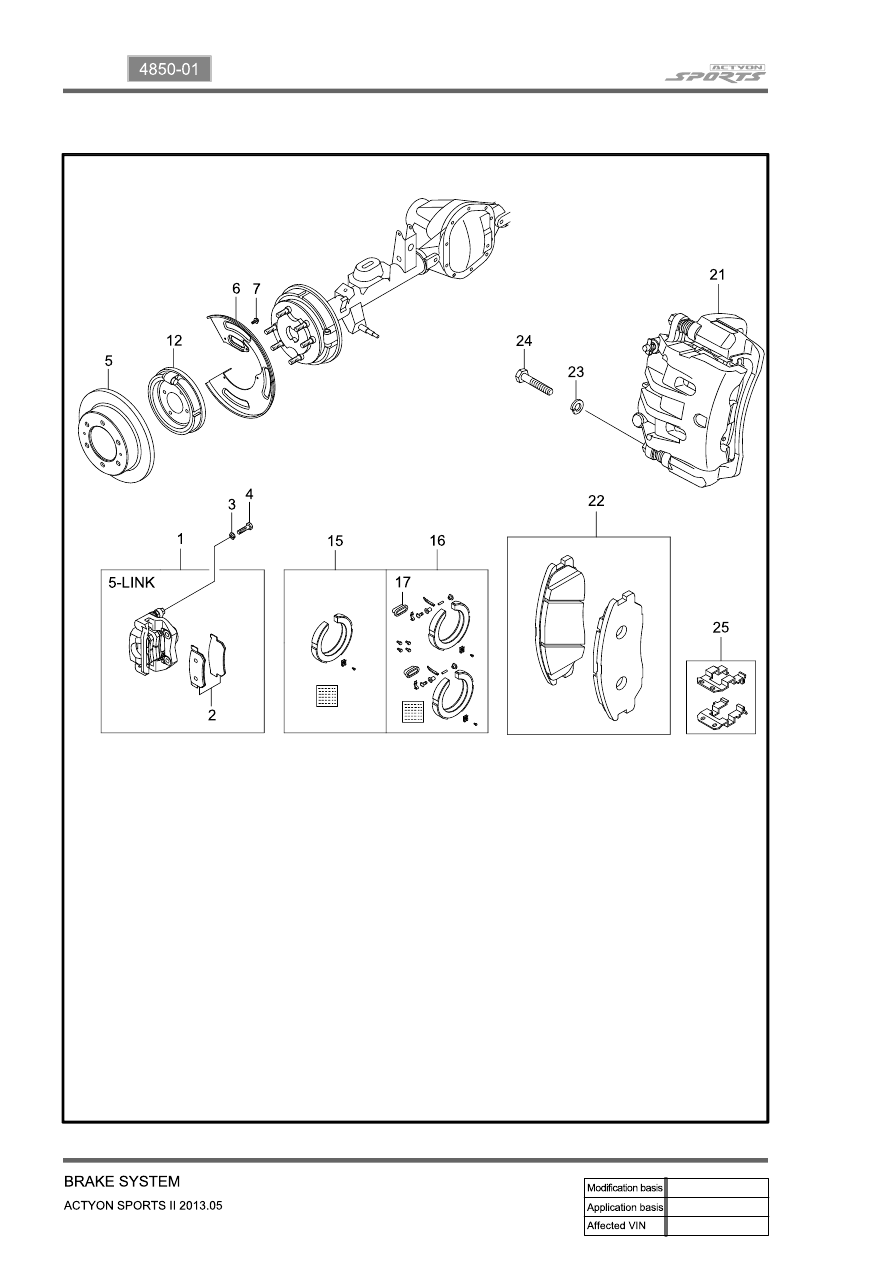
Front brake caliper assembly

Front brake pad

Washer

Front caliper mounting bolt 

(25.5~30.4 Nm)

Caliper clip set

21.

22.

23.

24.

25.

Rear brake caliper assembly

Rear brake pad

Washer

Bolt (52.9~63.7 Nm)

Rear brake disc

Rear disc brake dust shield

Bolt

Rear drum brake assembly

Parking brake shoe

Parking brake repair kit

Rear axle shaft grommet

1.

2.

3.

4.

5.

6.

7.

12.

15.

16.

17.

09-25

4850-01

Parking Brake

Parking brake lever assembly

Equalizer

Nut (9.8~12.7 Nm)

Front brake mounting bracket

Bolt

Parking brake rear cable assembly

Parking brake rear cable assembly

Bolt (9.8~12.7 Nm)

Parking brake cable retaining ring

1.

3.

4.

5.

6.

10.

11.

12.

13.

09-26

1. OVERVIEW

Even though a driver cuts off the power, while driving, the vehicle continues to move due to the law of 

inertia. Therefore, a braking device is needed to stop the vehicle. The brake system normally uses the 

frictional discs that converts the kinetic energy to the thermal energy by frictional operation. The brake 

system consists of the brake disc (front wheel), brake disc or drum (rear wheel), parking brake 

(mechanical type), master cylinder, booster, pedal and supply lines (pipes and hoses).

Hydraulic Brake

▶ 

Brake Pedal

This system uses the leverage effect and 

Pascal's principle. When depressing the brake 

pedal, the pedal pressure is increased by 

booster and is delivered to master cylinder to 

generate hydraulic pressure. The hydraulic 

pressure generated by the master cylinder is 

delivered to the brake caliper through the brake 

pipes or hoses. This hydraulic pressure pushes 

the brake calipers, accordingly the caliper pads 

are contacted to brake disc to generate the 

braking force.

Brake pedal uses the leverage effect to apply 

bigger force to the brake master cylinder.

09-27

4850-01

Braking distance & stopping distance

Stopping distance = free running distance + braking distance

What is stopping distance?

A certain distance (free running distance + braking distance) is needed from the moment an obstacle 

appears ahead until you bring your vehicle to a complete stop. This is called as stopping distance.

What is braking distance?

Tire slip occurs until the vehicle stops completely when the the brake is applied.

This slip is what we call a braking distance.

What is free running distance?

The free running distance is the time from the driver sees the obstacles and begins to prepare for 

depressing the brake pedal until the moment the brake pedal is depressed.


Content   ..  142  143  144  145   ..