SsangYong Actyon Sports II. Service manual - part 140
 

  Index      SsangYong     SsangYong Actyon Sports II - service and repair manual 2012-2013 year


Search            


Content   ..  138  139  140  141   ..


SsangYong Actyon Sports II. Service manual - part 140


09-8

Problem

Possible Cause

Action

Increased pedal stroke

Air in brake line

Bleed air

Oil leak

Repair

Worn brake pad

Replace

Excessive clearance between push rod and master 
cylinder

Adjust

Worn or damaged piston seal

Replace

Brake dragging

Parking brake is not fully released

Release

Incorrect adjustment of parking brake

Adjust

Incorrectly adjusted clearance of parking brake shoe

Adjust

Faulty brake pedal return spring

Replace

Incorrectly adjusted free play of brake pedal

Adjust

Faulty master cylinder

Replace

Lack of lubrication in sliding parts

Lubricate

Faulty brake booster (vacuum leak)

Repair

Wear, hardening or poor contact of brake pad

Replace

Oil or water on lining

Repair or replace

Fixed or broken parking brake cable

Replace

Excessive stroke of brake lever

Adjust notch

Faulty auto clearance adjuster

Repair

Poor parking 

brake

Increased stroke of 
parking brake lever

Loosened parking brake cable

Adjust or replace

Incorrectly adjusted parking brake cable

Adjus

Defective automatic lining clearance adjuster

Repair or replace

Worn brake lining

Replace

09-9

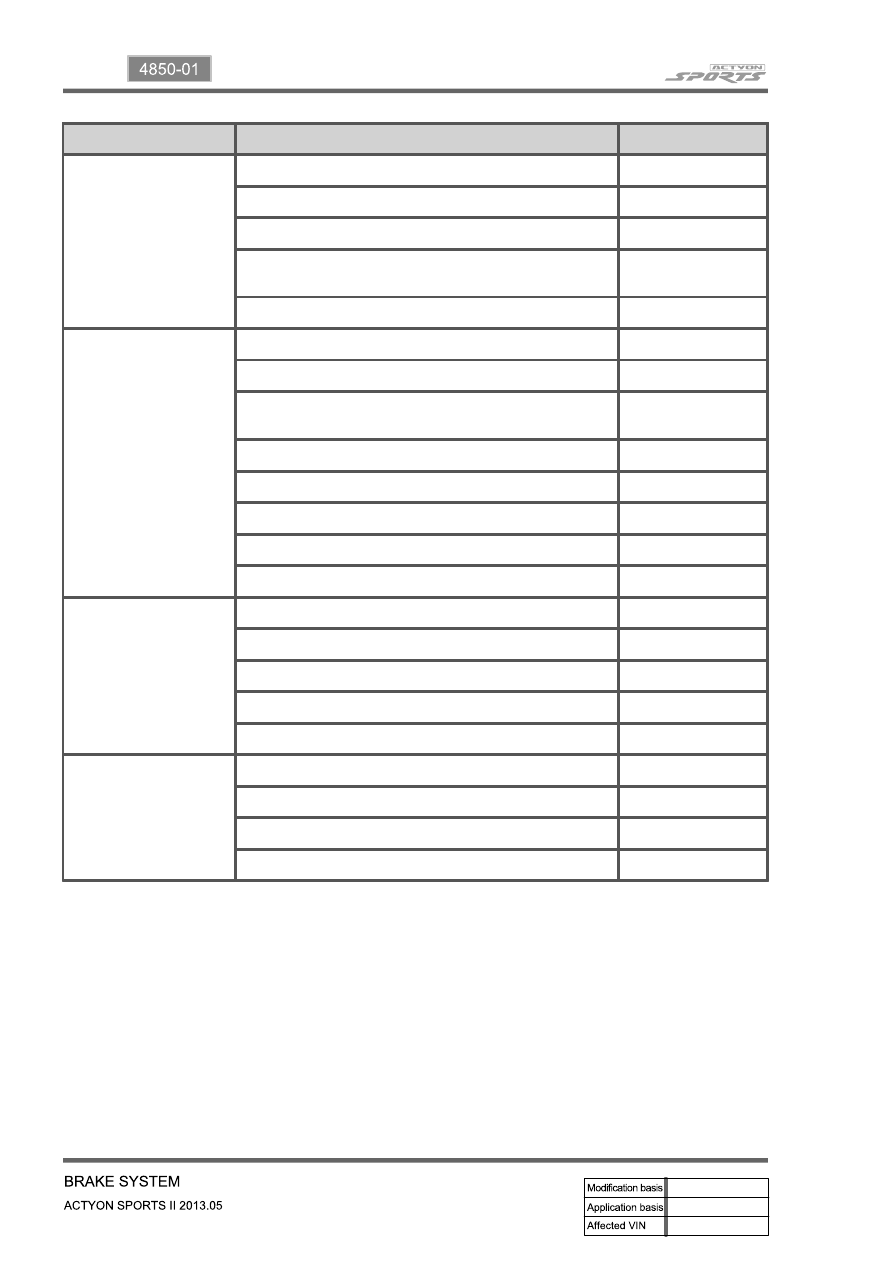
4850-01

Problem

Cause

Action

Burning smell around 
tire

Too frequent braking in high driving speed

Reduce the use of 

foot brake/use 

engine brake 

properly

Used only foot brake during downhill driving

Driving with foot on brake pedal

Get off the foot from 

pedal

Foreign materials such as dirt or sand in brake system

Replace: caliper, 

wheel cylinder, 

master cylinder, 

return spring

Broken return spring in shoe assembly

Replace

Incorrectly adjusted parking brake cable

Adjust

Incorrect wheel or wheel cover 
(generating the heat)

Replace

09-10

This section describes the noise phenomena occurred possibly in the brake system operation. 

Distinguish between the information given below and the actual problems and then, inspect the vehicle 

and take appropriate measures.

Noise symptoms and Causes

-

Symptom 1. If depressing the brake pedal when the engine is cold, "screeching" sound always 

occurs and, after driving for a while, the sound disappears..

This usually occurs in the morning. When the temperature goes down, the dew condensation 

phenomenon sets moisture on the brake disc as the window frost forms. Due to this moisture, the iron 

within the brake disc and pad oxidizes, forming undetectable micro-rusts on the disc surface. When 

starting the engine under this condition, noise may sound due to the friction of micro-rusts. When 

operating the brake several times, the disc temperature goes up and the micro-rusts come off and the 

noise goes away. Depending on the driving conditions, noise gets louder when slightly depressing the 

brake pedal and oppositely, noise is smaller when deeply depressing the brake pedal. This is simply a 

physical phenomenon, called "morning effect" in professional terms, and does not imply any problems 

with the brake system.

Symptom 2. Slip or screech after the brake pad replacement.

This usually occurs when the bed-in is not made between the disc and the pad's friction material. The 

bed-in is a state that the brake system normally works and gives no noise out, when, after about 300 km 

city driving, the contact area of the pad friction material is enlarged and the disk is in complete contact 

with the pad's friction material. Therefore, for some time after the brake disk/pad replacement, the brake 

system poorly operates or noise (abnormal sound) occurs due to the partial contact.

Symptom 3. "Groaning" sound occurs in the automatic transmission vehicle when slightly taking the foot 

off the brake pedal to slowly start after waiting for the signal, or slightly depressing the brake pedal.

This is the noise "Creep groan" that occurs when, in both the automatic and manual transmission, 

slightly releasing the brake pedal in the neutral gear at downhill roads. 

It frequently occurs at the low braking power and low speed, through the following process. When 

operating the brake system at low speed and low pressure, adhesion and slip repeatedly take place 

between the brake disk and the friction material, and this makes the braking power inconstant, instantly 

increasing or decreasing, and gives out the brake noise. 

It is also a physical phenomenon and has no relation with the brake performance.

BRAKE OPERATION AND NOISE

09-11

4850-01

4. AIR BLEEDING

Fill up the brake fluid up to "MAX" line on the 

reservoir.

1.

Fill the reservoir with brake fluid and pump the 

brake pedal several times. Then keep it 

depressed.

2.

Loosen the bleed screw and collect the 

bleeding brake fluid from the brake line with 

the order in the figure.

3.

Fill the reservoir with the brake fluid as much 

as it bleeded, and continue to bleeding 

operation.

Never reuse the used brake fluid.

Use only specifies brake fluid (DOT 4). Add brake fluid between MAX and MIN lines on the 

reservoir (0.7 to 0.8 liters).

Be careful not to splash the brake fluid on painted area or body.

Make sure that any foreign material does not get into brake line.

Always work with another staff.

-

-

-

-

-


Content   ..  138  139  140  141   ..