Renault Megane (2018 year). Manual - part 15
 

  Index      Renault     Renault Megane - service manual 2018 year in english


Search            


Content   ..  13  14  15  16   ..


Renault Megane (2018 year). Manual - part 15


3.38

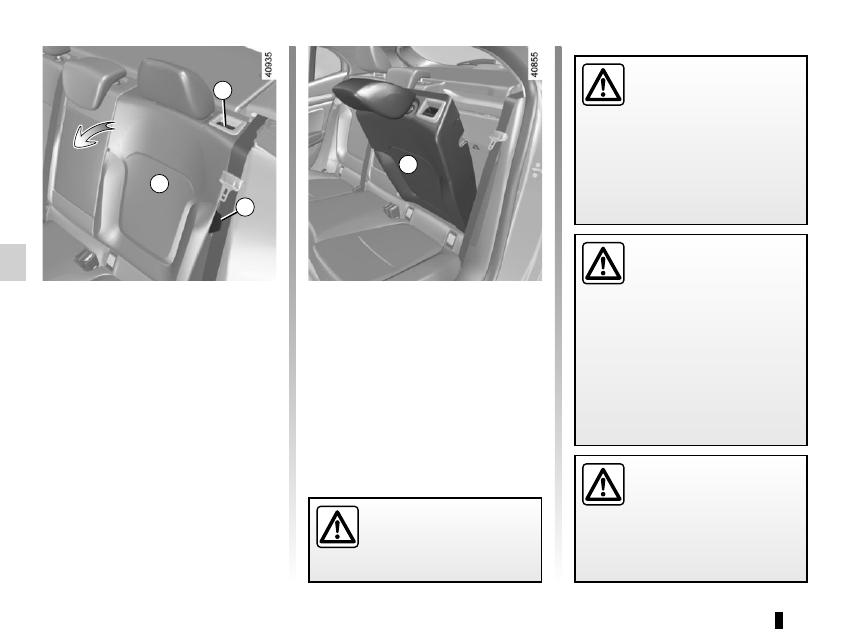
To manually fold down the 

seatbacks

Ensure that the front seats are far 

enough forward.
Raise the side headrests to the highest 

position and lower the central headrest 

fully.
Depending on the vehicle, put the seat 

belt in the belt guide 2 to avoid damag-

ing it, or buckle it its own unit. This will 

prevent the seat belt becoming trapped 

when the seat is returned to its position 

for use. In all cases, check that the seat 

belts are operating correctly.

Pull the control 1 and lower the seat-

back A.
To replace the seatback, proceed in 

the reverse order to removal.

Refit the seatback and click it back into 

place.

REAR BENCH SEAT 

(1/2)

For safety reasons, carry 

out any adjustments when 

the vehicle is not being 

driven.

When moving the rear 

seats, ensure that nothing 

obstructs the anchorage 

points (passenger’s arm or 

leg, a pet, gravel, cloth, toys, etc.).

A

1

The configuration of the 

two-seat bench with the 

small seatback B pulled 

down, does not allow the 

central seat to be used as it would 

be impossible to buckle the seat belt 

(belt buckles inaccessible).

When refitting the seat-

back, make sure it is cor-

rectly locked in place.

If seat covers are fitted

make sure these do not prevent the 

seatback latch from locking in.

Make sure that the seat belts are 

positioned correctly.

Reposition the headrests.

B

2

3.39

REAR BENCH SEAT 

(2/2)

To automatically fold down 

the seatbacks (flat position)

(Estate version)
From the boot, pulling the control 3 

enables you to automatically unlock the 

rear bench seatbacks to get a flat floor.

3

When moving the rear 

seats, ensure that nothing 

obstructs the anchorage 

points (passenger’s arm or 

leg, a pet, gravel, cloth, toys, etc.).

Conditions of use
– Vehicle stationary;

– luggage compartment lid open;

– rear seat belts locked.

Operating faults
If all user conditions have been ful-

filled and the folding action still fails to 

operate, please contact an authorised 

dealer.

3.40

Depending on the vehicle, there are 

various ways to unlock and operate the 

luggage compartment lid:
–  by the locking/unlocking button on 

the remote control key (refer to the 

information on “Radiofrequency 

Remote Control: use” in section 1);

–  by the locking/unlocking button on 

card RENAULT (refer to the informa-

tion on "Card RENAULT: use in sec-

tion 1);

–  via the external boot lid control;
–  using the hands-free function;
–  using the dashboard control.

LUGGAGE COMPARTMENT: 4 DOOR VERSION (1/3)

2

Manual controls

To open
Depending on the vehicle, press the 

dashboard control 1 or the button 2, the 

tailgate opens automatically.
Note: ensure that the surrounding 

space is sufficient to permit operation 

of the boot lid before you open it.

Ensure that nobody is close 

to the moving parts when 

opening/closing the boot lid.
Risk of injury.

When opening or closing the lug-

gage compartment lid, ensure that 

nothing obstructs the manoeuvre.

As a safety precaution, 

the doors should only be 

opened or closed when the 

vehicle is stationary.

Risk of injury.

1

3.41

LUGGAGE COMPARTMENT: 4-DOOR VERSION (2/3)

The sensor detects the approach and 

then the removal of your foot and trig-

gers the opening of the boot lid.
Do not keep your foot in the air. Perform 

the movement without stopping and wi-

thout touching the rear bumper.

Using the hands-free function
The hands-free function enables 

access to the luggage compartment 

when you have your hands full.
Ensure that the RENAULT card is ap-

proximately 1 metre away in the cen-

tral area of the rear bumper of the vehi-

cle (area B). With the ignition off, stand 

approximately 45 cm from the vehicle’s 

rear bumper and move your foot for-

wards and backwards in area A.

A

B

Disable the “hands-free” 

function before you:

– wash the vehicle in a 

roller-type car wash;

–  wash the vehicle by hand;

–  handle the towbar;

– ...
Risk of accidental opening of the 

luggage compartment lid which 

may cause injury.

2

To close
Lower the boot lid using the handle 

inside the boot to assist you.

3.42

Activation/deactivation of the 

hands-free function
From the multimedia screen, select 

“Vehicle”, “User settings”, “Use hands-

free card: open/close”. Select “ON" 

or "OFF" to activate or deactivate the 

function.

Usage features of the hands-free 

function
–  The hands-free function is no longer 

available after a few days of lack of 

movement of the vehicle, or after 

around 15 minutes if the vehicle is 

unlocked. To reactivate it, use the 

unlocking button on the RENAULT 

card.

–  The hands-free function is only avail-

able if the vehicle is stationary and 

the engine is switched off (and not 

on standby with the Stop and start 

function).

–  The ‘hands-free’ feature may not 

work if the vehicle is equipped with a 

towbar or is in an area of high elec-

tromagnetic radiation.

Opening the doors manually 

from the inside

If it is impossible to unlock the tailgate, 

it can be done manually from inside:
–  access the luggage compartment by 

folding forward the seatback(s) of 

the rear bench seat;

– insert a flat-blade screwdriver or 

similar under the carpet above the 

mechanism  3 and slide the unit as 

shown in the illustration;

–  push the boot lid to open it.

3

User precautions
–  Before opening the tailgate, ensure 

that the surrounding space is suffi-

cient to permit operation of the tail-

gate. Otherwise, stop the movement 

of the boot lid before it makes con-

tact.

–  The system may experience tempo-

rary difficulties if one of the sensors 

integrated in the rear of the bumper 

is obscured (by dirt, mud, snow, grit-

ting salt, etc.). Clean the sensors. If 

there is still a problem, contact an 

approved dealer.

Note: in very cold weather conditions, 

the automatic opening may not work if 

the tailgate seals are frozen.

LUGGAGE COMPARTMENT: 4-DOOR VERSION (3/3)

The attachment of any 

carrying device (bike rack, 

luggage box etc.) resting on 

the luggage compartment 

lid is prohibited. To install a carrying 

device on your vehicle, contact an 

Approved Dealer.

3.43

LUGGAGE COMPARTMENT: 5-DOOR VERSION

To open
Press button 1 and lift the tailgate.

To close
Lower the tailgate using the handles 2 

inside the tailgate to help you.

1

Opening manually from 

inside the vehicle

Special note:
If it is impossible to unlock the tailgate, 

it can be done from inside.
–  access the luggage compartment by 

folding forward the seatback(s) of 

the rear bench seat,

–  insert a pencil or similar object in 

cavity 3 and slide the unit as shown 

in the illustration,

–  push the tailgate to open it.

2

3

The attaching of any carry-

ing device (bike rack, lug-

gage box, etc.) resting on 

the luggage compartment 

lid is prohibited. To install a carrying 

device on your vehicle, contact an 

Approved Dealer.

3.44

Removal

Unhook the two cords 1 (tailgate side).

Do not place any heavy or 

hard object on the parcel 

shelf. These may pose a 

risk to the vehicle occu-

pants if the driver has to brake sud-

denly or if the vehicle is involved in 

an accident.

Unclip the rear parcel shelf 2 and pull it 

towards you.
To refit it, proceed in reverse order to 

removal.

REAR PARCEL SHELF

1

2

3.45

To remove the flexible 

section of the luggage 

compartment cover 2

Press handle 1 to release the pins from 

their mounting points located on each 

side of the luggage compartment.
Allow the luggage cover to roll up.

LUGGAGE COMPARTMENT COVER

Do not place any heavy or solid objects on the luggage cover. These may 

pose a risk to the vehicle occupants if the driver has to brake suddenly or 

if the vehicle is involved in an accident.

1

Removing/refitting the 

luggage cover 2

Slide section 3 (movement A) and lift 

the right-hand side (movement B) of 

the roller at the same time.
Then lift the left-hand side of the roller 

and then remove the assembly.
To refit the luggage cover, carry out this 

procedure in reverse.

B

3

2

2

4

C

3

A

1

A

Luggage compartment cover 

storage 2

Lift section 4 of the luggage compart-

ment floor.
Pivot the luggage cover so that the 

handle 1 is visible and towards the front 

of the vehicle.
Store the luggage cover, handle 1 for-

wards, firstly by inserting the left-hand 

side into its housing, then insert the 

right-hand side (movement C) by slid-

ing section 3 (movement A).
Close the luggage compartment floor.

3.46

–  if using the net for the first time, to 

access the anchorage points 4 lo-

cated under the carpet, contact an 

Approved Dealer;

–  attach the two hooks 5 for the net 

straps 3 to the anchoring points 4;

–  adjust the net strap 3 so that it is taut.

3

LUGGAGE NET 

(1/2)

Fitting the luggage net 

behind the front seats

Inside the vehicle on each side:
– lower cover 1 to gain access to the 

anchoring points for the top part of 

the luggage net;

–  insert the top rod of net 2 into the an-

choring points;

Depending on the vehicle, this may be 

used when transporting animals or lug-

gage to isolate them from the passen-

ger section.
It can be positioned:
–  behind the rear seats A;
–  behind the front seats B.

The luggage net is de-

signed to retain a maximum 

weight of 10 kg.
Risk of injury.

Do not install the luggage net in this position when a passenger is occu-

pying a rear seat.

A

B

1

2

5

4

3.47

LUGGAGE NET 

(2/2)

6

– fix the net belt hook 9 onto the ancho-

ring points 10;
– adjust net strap 8 so that it is taut. The 

seatbacks must not touch the luggage 

net.

Fitting the luggage net 

behind the rear seats

Inside the vehicle on each side:
– lift cover 6 to access the luggage net 

upper mounting rail;

–  insert upper rod 7 for the net into the 

rail;

10

9

6

7

8

3.48

BOOT STORAGE SPACE AND FITTINGS 

(1/5)

Always place objects being trans-

ported so that the heaviest items 

are resting against the back of the 

rear bench seat.

2

Storage under the carpet

To gain access to this, lift the boot 

carpet 1 using the tab 2.

1

3

2

1

3

4

The false floor can be attached using 

the hook 4 in the housing 3.

3.49

Separation position
This enables you to compartmentalise 

the boot into two separate spaces.
Slide your fingers under the spaces 7.

C

A

Storage position
This allows for more space to store 

things in the boot.
– Remove part B then part A of the 

mobile floor;

– place part A then part B   under the 

supports 5 and 6.

B

BOOT STORAGE SPACE AND FITTINGS 

(2/5)

7

Mobile floor

(Estate version)
It is made up of two independent 

parts, A and B.
When the rear seats are folded down, 

this position provides a flat floor.

5

6

Maximum load allowed on the 

mobile floor when flat: 50 kg evenly 

distributed.

A

B

3.50

Storage under floor

To access it, lift part B of the mobile 

floor using the handle 8, then place it on 

part A.

BOOT STORAGE SPACE AND FITTINGS 

(3/5)

C

8

B

Lift part C into the vertical position until 

it locks.

9

A

10

Lift part A using handle 10 and place it 

on the lugs 9.

3.51

Storage compartment 12

(Estate version)

12

Bag hooks 11

Maximum weight per hook: 5 kg.

BOOT STORAGE SPACE AND FITTINGS 

(4/5)

11

14

Storage compartment 13

(four-door version)
To remove the tailboard 14, pull up-

wards until it unclips. 
To replace the tailboard, push it into its 

housing until you hear a click.

13

11

3.52

BOOT STORAGE SPACE AND FITTINGS 

(5/5)

Always position the heaviest items directly on the floor. Use the lashing 

points 15 on the boot floor, if these are fitted to the vehicle. The luggage 

should be loaded in such a way that no items will be thrown forward and 

strike the occupants if the driver has to brake suddenly. Fasten the rear 

seat belts, even if the seats are not occupied.

15

Anchorage points

Attachment points 15

If your vehicle is not equipped with 

anchorage points, you can get them 

from an authorised dealer.

Always place objects being trans-

ported so that the heaviest items 

are resting against the back of the 

rear bench seat.

8

15

15

3.53

TRANSPORTING OBJECTS IN THE LUGGAGE COMPARTMENT 

Always position the objects transported 

so that the largest surface is against:

–  The rear bench seatback for normal 

loads (example A).

– The front seatbacks with the rear 

seatbacks folded down, as is the case 

for maximum loads (example B).

If you have to place objects on the folded 

seatback, it is necessary that you lower 

the headrests before folding the seat-

back so that it can be folded as flat as 

possible against the seat.

B

A

1

Always position the heavi-

est items directly on the 

floor. Use the lashing 

points 1 on the boot floor, if 

these are fitted to the vehicle. The 

luggage should be loaded in such a 

way that no items will be thrown for-

ward and strike the occupants if the 

driver has to brake suddenly. Fasten 

the rear seat belts, even if the seats 

are not occupied.

B


Content   ..  13  14  15  16   ..