Peugeot Partner (2017 year). Manual - part 9
 

  Index      Peugeot     Peugeot Partner - service manual 2017 year in english


Search            copyright infringement  


Content   ..  7  8  9  10   ..


Peugeot Partner (2017 year). Manual - part 9


127

CHECKS

7

Partner-2-VU_en_Chap07_Verification_ed02-2016

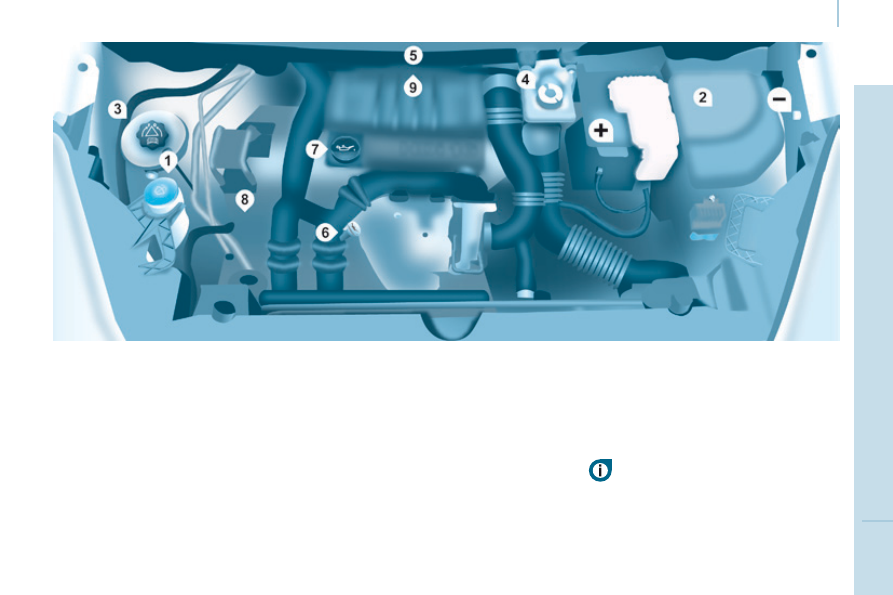
Under the bonnet

DIESEL ENGINE

4.

  Brake and clutch fluid reservoir.

5.

  Air filter.

6.  Engine oil dipstick.
7.

  Engine oil filler cap.

8.

  Power steering fluid reservoir.

9.  Priming pump
 

(except BlueHDi engines).

1.

  Screenwash fluid reservoir.

2. Fusebox.
3.  Engine coolant header tank.

Battery connections:

+  Positive terminal.

Negative point (earth).

Take care when working under the bonnet.

128

Partner-2-VU_en_Chap07_Verification_ed02-2016

Levels

LEVELS

Oil change

This must be carried out at 

the intervals specified in the 

manufacturer's servicing schedule. Ask 
for advice from a PEUGEOT dealer.
Remove the dipstick before filling.

Check the level after filling (never 

exceed the max mark).
Refit the oil filler cap before closing the 

bonnet.

Changing the brake fluid

The brake fluid must be changed at 

the intervals stated, according to the 
manufacturer's servicing schedule.
Use fluids recommended by the 

manufacturer, which meet the DOT4 
standard.
The level must be between the MIN 
and MAX marks on the reservoir.
If fluid has to be added frequently, 

this indicates a fault which must be 
checked by a PEUGEOT dealer or 

a qualified workshop as soon as 

possible.

Warning lamps

If you have to remove / refit the 

engine style cover, handle it with 

care to avoid damaging the fixing clips.

Oil level

It is recommended that the oil level be 

checked every 3 000 miles (5 000 km) 

and topped up if necessary between oil 
changes.
Check the level with the vehicle level, 
engine cold, using the dipstick.

Dipstick

Viscosity selection
In all cases, the oil selected must 

meet the requirements specified in the 

manufacturer's service schedule.

These regular maintenance 
operations will keep your vehicle 
in good working order. Ask for 

advice from a PEUGEOT dealer or 
refer to the warranty and maintenance 
record in the handbook pack.

Checks using the warning lamps in 
the instrument panel is described 
in chapter 3, "Instruments and 
controls" section.

There are two marks on 
the dipstick:
A = maximum
If you fill past this mark, 

contact a PEUGEOT 

dealer or a qualified 

workshop.
B = minimum
Never allow the level to 
fall below this mark.
To maintain the reliability 
of engines and emission 
control systems, the use 
of additives in engine oil 
is prohibited.

129

CHECKS

7

Partner-2-VU_en_Chap07_Verification_ed02-2016

Levels

Cooling system

Only use the fluid recommended by the 

manufacturer.
Otherwise, you risk seriously damaging 
your engine.
When the engine is warm, the 
temperature of the coolant is controlled 
by the engine fan. As this fan can 
operate with the ignition key removed 
and because the cooling system is 
pressurised, wait for at least one hour 
after the engine has stopped before 
carrying out any work.
Slacken the cap by 1/4 of a turn to 
release the pressure to prevent any 
risk of scalding. When the pressure 
has dropped, remove the cap and top 
up the level with coolant.
If fluid has to be added frequently, 

this indicates a fault which must be 
checked by a PEUGEOT dealer as 
soon as possible.

Power steering fluid level

The vehicle must be parked on level 
ground with the engine cold. Unscrew 
the cap integrated with the gauge and 
check the level which must be between 
the MIN and MAX marks.

In order to regenerate the filter, you 

are advised to drive at a speed higher 

than 40 mph (60 km/h) for at least five 

minutes as soon as possible, when 

traffic conditions permit (until the 

message disappears and the service 
warning lamp goes off).
During regeneration of the particle 

emission filter, the noise of a relay 

operating may be heard under the 
dashboard.
If the message is still displayed and 
if the service warning lamp remains 
on, contact a PEUGEOT dealer or a 

qualified workshop.

Topping up
The level must be between the MIN 
and MAX marks on the expansion 

bottle. If more than 1 litre of fluid is 

required to top up the level, have 
the system checked by a PEUGEOT 

dealer or a qualified workshop.

Screenwash level

For best quality cleaning and for your 
safety, we would advise that you use 
products of the PEUGEOT range.
For optimum cleaning and to avoid 

freezing, this fluid must not be topped 

up or replaced with plain water.
Capacity of the screenwash reservoir: 
approximately 3 litres.

Diesel additive level 
(Diesel with particle 
filter)

Topping up
This additive must be topped up by 

a PEUGEOT dealer or a qualified 

workshop without delay.

Waste products

Avoid prolonged contact of used oil 
with the skin.
Brake fluid is harmful to health and 

very corrosive.
Do not dispose of used oil, brake fluid 

or coolant into drains or into the ground 
but into the containers dedicated to this 
use at a PEUGEOT dealer (France) or 
an authorised waste disposal site.

The minimum level of this additive 
is indicated by lighting of the service 
warning lamp, accompanied by an 
audible signal and a message in the 
screen.
When this occurs with the engine 
running it is due to the start of 

saturation of the particle filter 

(exceptionally prolonged urban type 
driving conditions: low speed, long 

traffic jams, ...).

130

Partner-2-VU_en_Chap07_Verification_ed02-2016

Checks

CHECKS

Carbon filter and passenger 
compartment filter

An access flap allows replacement of 

the filters.

The carbon filter permits continuous 

and effective filtering of dust.

If the passenger compartment filter 

becomes blocked, this may reduce the 
performance of the air conditioning 
system and generate unpleasant 
odours.
We recommend the use of a combined 

passenger compartment filter. By 

means of its second special active 

filter, it contributes to the purification 

of the air breathed by the occupants 
and the cleanness of the passenger 
compartment (reduction of allergic 
symptoms, unpleasant odours and 
greasy deposits).

Battery

At the start of summer or winter, have 
your battery checked by a PEUGEOT 

dealer or a qualified workshop.

Brake pads

Brake pad wear depends on the style 
of driving, in particular for vehicles 
which are used in town, over short 
distances. It may be necessary to 
check the thickness of the pads, even 
between services.
Unless there is a leak on the circuit, a 

drop in the brake fluid level indicates 

that the brake pads are worn.

Brake disc / drum wear

For information on checking the brake 
disc / drum wear, contact a PEUGEOT 
dealer.

Parking brake

Where the parking brake travel is too great 
or there is a reduction in the performance 
of the system, the parking brake should be 
adjusted, even between services.
Have the system checked by a 

PEUGEOT dealer or a qualified 

workshop.

Refer to theservicing and warranty 
booklet for the replacement interval for 
these components.
Depending on the environment (dusty 
atmosphere...) and the use of the 
vehicle (urban driving...), change them 
twice as often if necessary.

131

CHECKS

7

Partner-2-VU_en_Chap07_Verification_ed02-2016

Checks

Good practice

Bleeding water from the Diesel 
filter

Manual gearbox

Have the level checked in accordance with 
the manufacturer's servicing schedule.

In order to avoid damaging the 
electrical units, we strongly advise 
you not to use high pressure 
washing to clean the engine 

compartment.

After washing the vehicle dampness, 
or in winter, ice may form on the brake 

discs and pads: braking efficiency may 

be reduced. Make some light brake 
applications to dry and de-ice the 
brakes.

If this warning lamp comes 

on, bleed the filter. Otherwise 

bleed regularly each time the 
engine oil is changed.

To drain the water, unscrew the bleed 

screw located on the filter.
Operate until all of the water no longer 

flows in the transparent pipe, then 

tighten the bleed screw.

Particle filter (Diesel)

Maintenance of the particle filter must 

be carried out by a PEUGEOT dealer.
On acceleration after the vehicle has 
been running for a prolonged period 
at very low speed or at idle, you may, 
in exceptional circumstances, notice 
the emission of water vapour at the 
exhaust. This water vapour does not 
have any adverse effect on vehicle 
handling or the environment.

Oil filter

Change the filter regularly in 

accordance with the manufacturer's 
servicing schedule.

 HDi engines use advanced 
technology. All work requires 
special training, so should be 
entrusted to a PEUGEOT dealer.

Depending on country of sale.

Only use products recommended by 
PEUGEOT or products of equivalent 

quality and specification.
In order to optimise the operation 
of units as important as the braking 
system, PEUGEOT selects and offers 

specific products.

132

Partner-2-VU_en_Chap07_Verification_ed02-2016

Fuel

REFUELLING

Low fuel level

Filling
The fuel tank must be filled with the 

engine off.
-  Open the fuel filler flap.

Insert the key, then turn it a quarter 
turn.

Remove the cap and hook it onto 
the clip located on the inside of the 

flap.

When filling with fuel, with the fuel 

filler flap open, ensure that no one 

attempts to open the sliding side 
door.

When the low fuel level is 
reached, this warning lamp 
comes on.

You then have approximately 8 litres 
of fuel remaining.
Fill up without delay to avoid running 
out of fuel.
Never risk driving until you run out of 
fuel as this may damage the emissions 
control and injection systems.

A label affixed to the inside of the flap 

reminds you of the type of fuel to be 
used.
You must fill with at least 5 litres of fuel 

for it to be registered by the fuel gauge.
When the fuel filler cap is opened, 

there may be a slight inrush of air. This 
vacuum is entirely normal and is due to 
the sealing of the fuel system.
When filling the fuel tank, do not 

continue after the 3

rd

 cut-off of the 

nozzle. This could cause malfunctions.
The capacity of the fuel tank is 

approximately 60 litres (or 55 litres 

according to version).
-  After filling the fuel tank, lock the 

cap and close the flap.

133

CHECKS

7

Partner-2-VU_en_Chap07_Verification_ed02-2016

Fuel

Travelling abroad
Certain fuels could damage the 

engine of your vehicle. In certain 
countries, the use of a particular 

fuel may be required (specific 

octane rating, specific sales 

name…) to ensure correct operation 
of the engine.
For any additional information, contact 
your dealer.

Fuel used for petrol engines

The petrol engines are compatible with 
bio-fuels that conform to current and 
future European standards and can be 

obtained from filling stations:

Petrol that meets the EN228 
standard, mixed with a bio-fuel 

meeting the EN15376 standard.

The only petrol additives 
authorised for use are those 

that meet the B715001 

standard.

Fuel used for Diesel engines

The Diesel engines are compatible 
with biofuels that conform to current 
and future European standards and 

can be obtained from filling stations:

Diesel fuel that meets 

standard EN590 mixed 

with a biofuel that meets 
standard EN14214 
(possibly containing up 

to 7 % Fatty Acid Methyl 

Ester),

The use of B20 or B30 fuel 
meeting standard EN16709 
is possible in your Diesel 
engine. However, this use, 
even occasional, requires 
strict application of the 
special servicing conditions 
referred to as "Arduous 
conditions".

Diesel fuel that meets 
standard EN16734 mixed 
with a biofuel that meets 
standard EN14214 
(possibly containing up to 

10 % Fatty Acid Methyl 

Ester),

For more information, contact a 

PEUGEOT dealer or a qualified 

workshop.

-  Paraffinic Diesel fuel that 

meets standard EN15940 

mixed with a biofuel that 
meets standard EN14214 
(possibly containing up 

to 7 % Fatty Acid Methyl 

Ester).

The use of any other type of (bio)
fuel (vegetable or animal oils, 
pure or diluted, domestic fuel...) 

is strictly prohibited (risk of damage to 
the engine and fuel system).

The only Diesel additives 
authorised for use are those that 

meet the B715000 standard.

134

Partner-2-VU_en_Chap07_Verification_ed02-2016

Fuel

FUEL CUT-OFF

The flashing of this warning 

lamp is accompanied by a 
message in the screen.

Check that there is no odour or 
leakage of fuel outside the vehicle and 
re-establish the fuel supply:

switch off the ignition (STOP 
position),

remove the key,

put the key back in the ignition,

switch on the ignition and start.

DIESEL PRIMING PUMP

In a serious collision, a mechanism 
automatically prevents fuel from 
reaching the engine.

If you run out of fuel, it is necessary to 
prime the fuel circuit.

Other HDi engines

-  Fill the fuel tank with at least five 

litres of Diesel.

Squeeze and release the manual 
priming pump, under the bonnet, 
under the protective cover.

Operate the starter until the engine 
starts.

BlueHDi engine

Fill the fuel tank with at least 

five litres of Diesel.

Switch on the ignition (without 
starting the engine).

Wait around 6 seconds and switch 
off the ignition.

Repeat the operation 10 times.

Operate the starter to run the 
engine.

135

CHECKS

7

Partner-2-VU_en_Chap07_Verification_ed02-2016

AdBlue

®

BLUEHDI AND ADBLUE

®

SCR technology

AdBlue

®

 is the brand name of the 

solution needed for operation of the 
SCR system.

BlueHDi vehicles have a specific 

AdBlue

®

 additive tank with a capacity 

of 17 litres.
It has an exterior filler with a 

blue filler 

cap, located to the left of the Diesel 

fuel filler cap.
Filling of the AdBlue

®

 tank can be 

done using 5 or 10 litre containers, 

1.89 litre bottles, or when at a fuel 

filling station equipped with a special 

AdBlue

®

 delivery pump for light 

vehicles.

The aim of BlueHDi is to reduce the 
emissions of NOx (nitrous oxides) in 

the air by up to 90%, using a system 

that converts NOx into water vapour 
and nitrogen in a dedicated catalytic 
converter: SCR (Selective Catalytic 
Reduction).
This objective meets the "Euro 6" 
emissions standard adopted by the 
European Union aimed at limiting the 
emissions of pollutants from internal 
combustion engines.
The SCR technology used on BlueHDi 
engines involves the injection of 
AdBlue

®

 into the exhaust system.

This operation can also be carried 
out by a PEUGEOT dealer or a 

qualified workshop.

Please note that the high delivery 

pumps at some filling stations, 

intended only for lorries and coaches, 
are not suitable for cars or light 
commercial vehicles.
Never use these pumps.

136

Partner-2-VU_en_Chap07_Verification_ed02-2016

AdBlue

®

Good practice
While the quantity of AdBlue

®

 in 

the additive tank is sufficient, no 

information is displayed.
On the other hand, once the fluid 

level drops to the quantity needed 

for a range of 1 500 miles (2 400 km) 

driving, you are warned by different 
temporary signals (warning lamp, 
message, audible signal).
As more miles are covered, these 
signals intensify and the message 
becomes permanent.
When the AdBlue

®

 tank is empty, 

restarting becomes impossible.
It is strongly recommended that you 
do not wait for the successive alerts 
before topping-up the AdBlue

®

 additive, 

but do this as soon as possible.

Filling the AdBlue

®

 tank

For light vehicles, 5 or 10 litre 

containers and 1.89 litre 
(1/2 US gallon) bottles are available 
from PEUGEOT dealers, until they are 
equipped with AdBlue

®

 delivery pumps.

If you want to fill the AdBlue

®

 tank 

yourself, ensure that you have a 

suitable filler pipe, which may or may 

not be supplied with the additive 
container.

137

CHECKS

7

Partner-2-VU_en_Chap07_Verification_ed02-2016

AdBlue

®

Range indicators

Rules on the display of alerts

For more information on the 
displays and warning lamps, refer 
to chapter 3, "Instruments and 
controls" section.

Range greater than 1 500 miles  
(2 400 km)
No information displayed.

Once the 1 500 miles (2 400 km) 

threshold is reached, the UREA 
warning lamp comes on temporarily 
and the remaining range message is 
displayed.
The alert is repeated every 200 miles 
(300 km) until the next threshold is 
reached.
Every time the ignition is switched 
on, the alert is given, together with an 
audible signal.

Remaining range less than 
1 500 miles (2 400 km) and greater 
than 350 miles (600 km)

Driving range

With the touch screen:

If the range is greater than 3 100 miles 

(5 000 km), a range value is not given.

Press this button to display 
the information.

select the "Driving 
assistance" menu,

select "Diagnostic",

select CHECK.

Different levels of alert are triggered 
according to the remaining driving 
range threshold
You will be informed as each mileage 
threshold is reached and the alerts will 
change from temporary to permanent.

The 1

st

 is triggered at a remaining 

driving range of 1 500 miles 

(2 400 km).

The 2

nd

 is triggered at a remaining 

driving range of 350 miles 

(600 km).

Up to 0 miles, at which point it will 
be impossible to restart the engine 
after a stop.

138

Partner-2-VU_en_Chap07_Verification_ed02-2016

AdBlue

®

Once the 350 miles (600 km) threshold 

is reached, the UREA warning lamp 

flashes and the Service warning lamp 

comes on, accompanied by a message 
on the remaining driving range.
The alert is repeated every 30 seconds 
with an update of the remaining driving 

range in steps of 30 miles (50 km) 

travelled.
Every time the ignition is switched 
on, the alert is given together with an 
audible signal.
At 0 miles the system installed in 
the vehicle to meet the emissions 
standard will prevent engine 
starting
.

Your vehicle's exhaust emissions no 
longer meet the "Euro 6" standard and 
the engine will not start.

To be able to restart the vehicle, you 
must add at least 4 litres of AdBlue

®

.

Pour the additive into the tank (by 

the filler with the blue cap).

Switch on the ignition without 
starting.

Wait 10 seconds before starting the 
engine.

Remaining range less than 350 miles 
(600 km) and more than 0 miles

Starting prevented, breakdown related 
to a lack of AdBlue

®

 in the special tank

The 0 fluid level has been reached.

Avoid waiting until the 
remaining range is 0 miles!

The alert is repeated when driving until 
the AdBlue

®

 tank has been topped-up 

with sufficient additive.
Unless the additive in the special 
additive tank is topped-up, you risk 
immobilisation of the vehicle.

Following this, make a further fill 

to the special additive tank, the 
capacity of which is 17 litres.

Or go to a PEUGEOT dealer or a 

qualified workshop.

139

CHECKS

7

Partner-2-VU_en_Chap07_Verification_ed02-2016

AdBlue

®

Fault with the SCR system

The UREA, Service and diagnostic 
warning lamps comes on.
Every time the ignition is switched on, 

the emissions fault is confirmed by an 

audible signal and a message.
If it is a temporary fault, the alert 
disappears as soon as the exhaust 
emissions return to the levels required 
by the standard.

Fault confirmed
In addition to the previous signals, 

the UREA warning lamp flashes and 

the remaining range allowed will be 
displayed in miles (kilometres).
The alert will be repeated every 
30 seconds with an update of the 
driving range in steps of 30 miles  

(50 km).
Go to a PEUGEOT dealer or a 

qualified workshop as soon as 

possible.
You risk not being able to start the 
engine.

Starting prevented, having 
covered the 700 miles (1 100 km)

Detection

At each attempt at starting, the alert is 
activated and the message "Emissions 
fault: Starting prevented" is displayed.

 On the other hand, if the warning 
lamps are still on after 30 miles 

(50 km) of driving, the fault is 

confirmed.

An engine start prevention system 
will be activated automatically after 
700 miles (1 100 km) travelled 

following this confirmation.
Go to a PEUGEOT dealer or a 

qualified workshop.

140

Partner-2-VU_en_Chap07_Verification_ed02-2016

AdBlue

®

Refilling / Topping-up the 
AdBlue

®

Precautions to take
Use only AdBlue

®

 that meets the ISO 

22241 standard.
The AdBlue

®

 fluid is an urea-based 

solution.
This fluid is non-flammable, colourless 

and odourless.
To be kept in a cool area.

Containers (5 or 10 litres) and 
bottles (1.89 litres) of AdBlue

®

Please check the use-by date.
Read the instructions on the label.
Ensure that you have a suitable 

filler pipe, which may or may not be 

supplied with the container.

Filling

In the event of an overflow, wipe 

around the filler mouth using a 

damp cloth.

If any AdBlue

®

 fluid is split or splashed 

on to you, wash immediately with cold 
water or wipe yourself with a clean 
damp cloth.
If the fluid has crystallised, clean it off 

using a sponge and hot water.

Ensure that the vehicle is parked on a 

flat and level surface.
Pour the contents of the container / 
bottle into the dedicated tank.

After filling the AdBlue

®

 tank, observe 

the following procedure:

Switch on the ignition without 
starting.

Wait 10 seconds before starting the 
engine.

Never dispose of empty AdBlue

®


containers and bottles in the 
household waste.

Place them in a special container 
provided this purpose or take them to 
your dealer.

To facilitate filling, an adaptor is 

available from PEUGEOT dealers.

141

CHECKS

7

Partner-2-VU_en_Chap07_Verification_ed02-2016

AdBlue

®

Keep AdBlue

®

 out of the reach  

of children, in its original  
container.

Never transfer AdBlue

®

 to another 

container: it would loose its purity.
Never dilute the fluid with water.

Never pour the fluid into the Diesel  

fuel tank.

Recommendations on storage

Never store containers or bottles of 
AdBlue

®

 in your vehicle.

Freezing of the AdBlue

®

AdBlue

®

 freezes at about -11°C (12.2° F) 

and deteriorates above 25°C (77°F).
It is recommended that containers and 
bottles be stored in a cool area and 
protected from direct sunlight.
Under these conditions, the fluid can 

be kept for at least a year.
Additive that has been frozen can 
be used once it has thawed out in 
ambient air.

The SCR system includes an 
AdBlue

®

 tank heater that ensures 

operation of the vehicle in normal 
conditions.

In exceptional situations, such as when 
the vehicle is kept at temperatures 

below -15°C (5°F) for a long period, 

there may be an emission fault alert 
related to freezing of the AdBlue

®


additive.
Park the vehicle in an area at a more 
moderate temperature for a few hours 
until the AdBlue

®

 becomes a fluid 

again.
The emissions warning lamp does not 
go off immediately, but does so after a 
few miles of driving.

142

Battery

Partner-2-VU_en_Chap08_Aide-rapide_ed02-2016

BATTERY

Before disconnecting the battery, you 
must wait for 2 minutes after switching 
off the ignition.
Never disconnect a terminal when the 
engine is running.
Never charge a battery without first 

disconnecting the terminals.
After every reconnection of the battery, 
switch on the ignition and wait 1 minute 
before starting to allow the electronic 
systems to be initialised. If problems 
remain after doing this, please contact 

a PEUGEOT dealer or a qualified 

workshop.
After changing bulbs, wait 
approximately 3 minutes before 
reconnecting the battery.

It is advisable to disconnect the 
battery if the vehicle is not to be used 
for a period of more than one month.

To charge the battery using a 
battery charger

Disconnect the battery.

Follow the instructions for use 
given by the battery charger 
manufacturer.

Reconnect starting with the 
negative (-) terminal.

Check that the terminals and 
connectors are clean. If they are 
covered with sulphate (white or 
greenish deposit), disconnect them 
and clean them.

To start the vehicle from 
another battery

Connect the red cable to the 
positive (+) terminals of the two 
batteries.

Connect one end of the green 
or black cable to the negative (-) 
terminal of the slave battery.

Connect the other end of the green 
or black cable to an earth point on 
the broken down vehicle as far as 
possible from the battery.

Operate the starter, let the engine run.

Wait for the engine to return to idle, 
then disconnect the cables.

The presence of this label 
indicates the use of a 12 V 
lead-acid battery with special 

technology and specification, for which 

the involvement of a PEUGEOT dealer 

or qualified workshop is required when 

replacing or disconnecting the battery.
Failure to observe this 
recommendation may cause premature 
wear of the battery.

After refitting the battery, the Stop & 

Start system will only be active after 
several hours depending on the 
climatic conditions and the state of 
charge of the battery (up to about 
8 hours).

The Stop & Start battery does not have 
to be disconnected for charging.


Content   ..  7  8  9  10   ..