Peugeot 5008 (2017 year). Manual - part 9
 

  Index      Peugeot     Peugeot 5008 - service manual 2017 year in english


Search            copyright infringement  


Content   ..  7  8  9  10   ..


Peugeot 5008 (2017 year). Manual - part 9


127

4

Lighting and visibility

Direction indicators

If you forget to cancel the direction 
indicators for more than twenty seconds, 
the volume of the audible signal will 
increase if the speed is above 40 mph 
(60 km/h).

Three flashes

F  Press briefly upwards or downwards, 

without going beyond the point of 
resistance; the direction indicators will flash 
3 times.

On versions fitted with LED direction indicators, 
the line of LEDs is illuminated sequentially.
The brightness of the daytime running lamps 
is reduced during sequential operation of the 
direction indicators.

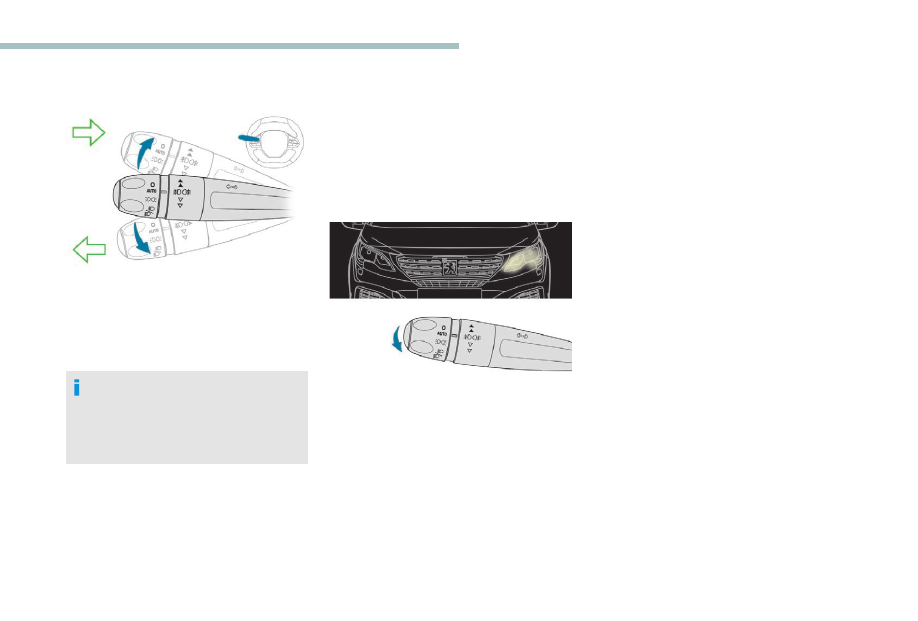
Parking lamps

F  Left: lower the lighting control stalk passing 

the point of resistance.

F  Right: raise the lighting control stalk passing 

the point of resistance.

Side markers for the vehicle by illumination of 
the sidelamps on the traffic side only.
F  Depending on version, within one minute 

of switching off the ignition, operate the 
lighting control stalk up or down depending 
on the traffic side (e.g. when parking on the 
right, lighting control stalk downwards; the 
left-hand sidelamps come on).

This is confirmed by an audible signal and 
illumination of the corresponding direction 
indicator lamp in the instrument panel.
To switch off the parking lamps, return the 
lighting control stalk to the central position.

128

Lighting and visibility

Headlamp adjustment

Manual adjustment of the 
halogen headlamps

To avoid causing a nuisance to other road 
users, the halogen headlamp beams should be 
adjusted in height according to the load in the 
vehicle.

The initial setting is position "0".

Automatic adjustment of 
"Full LED" technology 
headlamps

If a fault occurs, this warning lamp 
comes on in the instrument panel, 
accompanied by a message and an 
audible signal.

The system then places the headlamp beams 
in the lowest position.
Have the system checked by a PEUGEOT 
dealer or a qualified workshop.

Do not touch the "Full LED" headlamps. 
Risk of electrocution!

0

Driver or driver + front passenger.

-

Driver + front passenger + rear 
passengers.

1

5 people.

-

5 people + loads in the boot.

2

Driver + loads in the boot.

Automatic illumination of 
headlamps

When a low level of ambient light is detected by 
the sunshine sensor, the number plate lamps, 
sidelamps and dipped beam headlamps are 
switched on automatically, without any action 
on the part of the driver. They can also come 
on if rain is detected, at the same time as 
automatic operation of the windscreen wipers.
As soon as the brightness returns to a 
sufficient level or after the windscreen wipers 
are switched off, the lamps are switched off 
automatically.

Switching on

This system automatically adjusts the height 
of the beams from this type of headlamp, 
according to the load in the vehicle, to avoid 
causing a nuisance to other road users.

F  Turn the ring to the "AUTO" position.
When the function is activated, a message is 
also displayed.

129

4

Lighting and visibility

Switching off

F  Turn the ring to another position.
Deactivation of the function is accompanied by 
the display of a message.

Operating fault

In the event of a malfunction of the 
sunshine sensor, the lighting comes 
on, this warning lamp is displayed in 
the instrument panel accompanied 
by an audible signal and/or a 
message.
Contact a PEUGEOT dealer or a 
qualified workshop.

Do not cover the sunshine sensor, linked 
with the rain sensor and located at the 
top centre of the windscreen behind the 
rear view mirror; the associated functions 
would no longer be controlled.

In fog or snow, the sunshine sensor may 
detect sufficient light. In this case, the 
lighting will not come on automatically.

Automatic guide-me-home 
lighting

With the "Automatic illumination of headlamps" 
function activated, under low ambient light, the 
sidelamps, dipped beam headlamps and door 
mirror spotlamps come on automatically when 
the ignition is switched off.

Activation, deactivation and the duration of the 
guide-me-home lighting are set in the vehicle 
parameters menu in the screen.

Manual guide-me-home 
lighting

The temporary illumination of the dipped beam 
headlamps after the vehicle's ignition has been 
switched off makes the driver's exit easier 
when the light is poor.

Switching on

Switching off

For versions without "Automatic illumination 
of headlamps", the manual guide-me-home 
lighting switches off automatically after 
30 seconds.
For versions with "Automatic illumination of 
headlamps", the period of operation of the 
manual guide-me-home lighting is the same 
as that set for the automatic guide-me-home 
lighting.

F  With the ignition off, "flash" the headlamps 

using the lighting control stalk.

F  A further "headlamp flash" switches the 

function off.

130

Lighting and visibility

Automatic exterior welcome 
lighting

With the "Automatic illumination of headlamps" 
function activated, under low ambient light, the 
sidelamps, dipped beam headlamps and door 
mirror spotlamps come on automatically when 
the vehicle is unlocked.

Activation, deactivation and the duration of the 
exterior welcome lighting are set in the vehicle 
parameters menu in the screen.

Welcome lighting

Availability of this function depends on version.

Door mirror spotlamps

Switching on

When the front courtesy lamp 
switch is in this position, 
the spotlamps come on 
automatically:

Whatever the position of the front courtesy 
lamp switch, they also come on with the 
exterior welcome lighting and the guide-me-
home lighting.

Switching off

They go off automatically after 30 seconds.

F  Make a short press on this 

remote control button.

The sidelamps, dipped beam headlamps, 
number plate lamps and door mirror spotlamps 
come on for 30 seconds. Pressing again before 
the end of the timed period switches off the 
lighting immediately.

To make your approach to the vehicle easier, 
these illuminate:
-  the zones facing the driver’s and 

passenger’s doors,

-  the zones forward of the mirror and 

rearward of the front doors.

-  when you unlock the vehicle,
-  on opening a door,
-  when a request to locate the vehicle is 

received from the remote control.

131

4

Lighting and visibility

Automatic headlamp 
dipping

System which automatically changes between 
dipped and main beam according to the 
ambient light level and the driving conditions, 
using a camera located at the top of the 
windscreen.

This system is a driving aid.
The driver remains responsible for the 
vehicle's lighting, its correct use for the 
prevailing conditions of light, visibility, 
traffic and observation of driving and 
vehicle regulations.

The system will be operational as soon as 
you have exceeded 16 mph (25 km/h).
If the speed drops below 9 mph (15 km/h), 
the system no longer operates.

132

Lighting and visibility

If the situation requires a change of headlamp 
beam, the driver can take over at any time.
F  Flashing the headlamps pauses the function 

and the system changes to "automatic 
illumination of headlamps" mode:
-  if the "AUTO" and "Dipped beam" 

indicator lamps are on, the system 
changes to main beam,

-  if the "AUTO" and "Main beam" indicator 

lamps are on, the system changes to 
dipped beam.

To reactivate the function, flash the headlamps 
again.

The system may suffer interference or not 
work correctly:
-  under poor visibility conditions (snow, 

heavy rain, etc.),

-  if the windscreen is dirty, misted or 

obscured (by a sticker, etc.) in front of 
the camera,

-  if the vehicle is facing highly reflective 

signs.

When the system detects thick fog, it 
temporarily deactivates the function.
The system is not able to detect:
-  road users that do not have their own 

lighting, such as pedestrians,

-  vehicles whose lighting is obscured 

(for example: vehicles running behind a 
safety barrier on a motorway),

-  vehicles at the top or bottom of a 

steep slope, on winding roads, on 
crossroads.

Operation

Pause

Activation / Deactivation

F  Turn the lighting control stalk ring to the 

"AUTO" position.

The system state remains in memory when the 
ignition is switched off.

F  In the Vehicle / Driving menu, 

select the "Driving functions
tab, then "Automatic headlamp 
dip
".

If the ambient light level is sufficient and/or if 
the traffic conditions do not allow illumination of 
the main beam headlamps:

dipped beam is maintained, this 
indicator lamp comes on in the 
instrument panel.

If the ambient light level is very low and the 
traffic conditions permit:

main beam comes on 
automatically: this indicator 
lamp comes on in the instrument 
panel.

When the system detects thick fog, it 
temporarily deactivates the function.
As soon as the vehicle leaves the area of thick 
fog, the function reactivates automatically.

This indicator lamp goes off while 
the function is deactivated.

133

4

Lighting and visibility

Cornering lighting

Activation / Deactivation

The cornering lighting can be 
activated or deactivated in the 
Vehicle / Driving menu of the touch 
screen.

Switching on

This system starts:
-  when the corresponding direction indicator 

is switched on,

or
-  from a certain angle of rotation of the 

steering wheel.

Switching off

The system does not operate:
-  below a certain angle of rotation of the 

steering wheel,

-  above 25 mph (40 km/h),
-  when reverse gear is engaged.

Present on vehicles fitted with "Full LED" 
technology headlamps, this system makes use 
of the beam from a front foglamp to illuminate 
the inside of a bend, when the main or dipped 
beam headlamps are on and the vehicle speed 
is below 25 mph (40 km/h) (urban driving, 
winding road, junctions, parking manoeuvres, 
etc.).

With cornering lighting

Without cornering lighting

134

Lighting and visibility

Wiper control stalk

Programming

Your vehicle may also include some functions 
that can be configured:
-  automatic rain sensitive windscreen wipers,
-  rear wiping on engaging reverse gear.

In wintry conditions, remove snow, ice or 
frost present on the windscreen, around 
the wiper arms and blades and the 
windscreen seal, before operating the 
wipers.

Do not operate the wipers on a dry 
windscreen. Under extremely hot or cold 
conditions, ensure that the wiper blades 
are not stuck to the windscreen before 
operating the wipers.

Without AUTO wiping

With AUTO wiping

Windscreen wipers

Single wipe (press downwards or 
pull the stalk briefly towards you, 
then release).

or

Automatic wiping (press 
down, then release).
Single wipe (pull the stalk 
briefly towards you).

A.  Wiping speed control stalk: raise or lower 

the stalk to the desired position.

Fast wiping (heavy rain).

Normal wiping (moderate rain).

Intermittent wiping (proportional to 
the speed of the vehicle).

Stop.

135

4

Lighting and visibility

Rear wiper

Reverse gear

When reverse gear is engaged, the rear wiper 
will come into operation automatically if the 
front windscreen wipers are operating.

The system is activated or deactivated via the 
vehicle parameters menu in the screen.
This function is activated by default.

In the event of snow or hard frost or if 
a bicycle carrier is fitted to a towbar, 
deactivate the automatic rear wiper via the 
vehicle settings menu.

Front screenwash

B.  Rear wiper selection ring: turn the ring 

to place the desired symbol against the 
marking.

Off.

Intermittent wipe.

Wash-wipe.

Turn the ring fully; the rear screen wash, 
then the rear wiper automatically operate for 
a set duration.

To avoid damaging the wiper blades, do 
not operate the windscreen washer if the 
windscreen washer reservoir is empty.
Only operate the windscreen washer if 
there is no risk of the fluid freezing on the 
windscreen and hindering visibility. Always 
use windscreen washer fluid suitable for 
low temperatures during the winter period.

F  Pull the wiper control stalk towards you.
The screenwash and then the wiper operate for 
a set period of time.

The windscreen wash includes a wiper 
blade system with integral washer jets.
The screenwash fluid is sprayed along the 
length of the wiper blade. This improves 
visibility and reduces the consumption of 
screenwash fluid.
In some cases, depending on the contents 
or colour of the fluid and the outside 
lighting, the fluid spray may be hardly 
noticeable.

136

Lighting and visibility

Special position of the 
windscreen wipers

This position is used for cleaning or 
replacement of the wiper blades. It can also be 
useful, in winter, to release the wiper blades 
from the windscreen.

Automatic windscreen 
wipers

The windscreen wipers operate automatically, 
adapting their speed to the intensity of the 
rainfall without any action on the part of the 
driver.
Detection of rainfall is by means of a sensor at 
the top centre of the windscreen, behind the 
rear view mirror.

Switching on

F  In the minute following ignition switch-off, 

any operation of the wiper control stalk will 
position the wiper blades vertically.

F  To park the wiper blades again, switch on 

the ignition and operate the wiper stalk.

To maintain the effectiveness of the wiper 
blades, it is advisable to:
-  handle them with care,
-  clean them regularly using soapy 

water,

-  avoid using them to retain cardboard 

on the windscreen,

-  replace them at the first signs of wear.

F  Give a short downwards push to the control.
A wiping cycle confirms that the instruction has 
been accepted.

This warning lamp comes on in the 
instrument panel, accompanied by a 
message.

137

4

Lighting and visibility

Switching off

Malfunction

F  Give the control stalk another brief push 

downwards or place the control stalk in 
another position (Intor 2).

This warning lamp goes off in the 
instrument panel, accompanied by a 
message.

The automatic rain sensitive windscreen 
wipers must be reactivated by pushing the 
control stalk downwards, if the ignition has 
been off for more than one minute.

If a fault occurs with the automatic rain 
sensitive wipers, the wipers will operate in 
intermittent mode.
Have them checked by a PEUGEOT dealer or a 
qualified workshop.

Do not cover the rain sensor, linked with 
the sunshine sensor and located at the top 
centre of the windscreen.
Switch off the automatic rain sensitive wipers 
when using an automatic car wash.
In winter, it is advisable to wait until the 
windscreen is completely clear of ice before 
activating the automatic rain sensitive wipers.

138

Safety

General safety 
recommendations

Labels are attached in different places on 
your vehicle. They include safety warnings 
as well as identification information for 
your vehicle. Do not remove them: they 
are an integral part of your vehicle.

For any work on your vehicle, use a 
qualified workshop that has the technical 
information, skills and equipment required, 
all of which a PEUGEOT dealer is able to 
provide.

We draw your attention to the following 
points:
-  The fitting of electrical equipment 

or accessories not approved by 
PEUGEOT may cause excessive 
current consumption and faults and 
failures with the electrical system of 
your vehicle. Contact a PEUGEOT 
dealer for information on the range of 
recommended accessories.

-  As a safety measure, access to 

the diagnostic socket, used for the 
vehicle's electronic systems, is 
reserved strictly for PEUGEOT dealers 
or qualified workshops, equipped 
with the special tools required (risk 
of malfunctions of the vehicle's 
electronic systems that could cause 
breakdowns or serious accidents). 
The manufacturer cannot be held 
responsible if this advice is not 
followed.

-  Any modification or adaptation not 

intended or authorised by PEUGEOT 
or carried out without meeting the 
technical requirements defined by 
the manufacturer will result in the 
suspension of the legal and contractual 
warranties.

Installation of accessory radio 
communication transmitters
Before installing a radio communication 
transmitter, you must contact a PEUGEOT 
dealer for the specification of transmitters 
which can be fitted (frequency, maximum 
power, aerial position, specific installation 
requirements), in line with the Vehicle 
Electromagnetic Compatibility Directive 
(2004/104/EC).

Depending on country regulations, some 
safety equipment may be compulsory: 
high visibility safety vests, warning 
triangles, breathalysers, spare bulbs, 
spare fuses, fire extinguisher, first aid kit, 
mud flaps at the rear of the vehicle, etc.

139

5

Safety

Hazard warning lamps

Automatic operation of 
hazard warning lamps

When braking in an emergency, depending on 
the force of deceleration, the hazard warning 
lamps come on automatically. They switch off 
automatically the first time you accelerate.
It is also possible to switch them off by pressing 
the switch on the dashboard.

Horn

Audible warning system to alert other road 
users to an imminent danger.

Visual warning with all of the direction 
indicators flashing to alert other road users to a 
vehicle breakdown, towing or accident.

F  Press this button, all of the direction 

indicators flash.

They can operate with the ignition off.

F  Press the central part of the multifunction 

steering wheel.

Emergency or assistance 
call

140

Safety

The green indicator lamp remains on (without 
flashing) when communication is established.
It goes off at the end of the call.

"Peugeot Connect SOS" immediately locates 
your vehicle, contacts you in your own 
language**, and, where necessary, requests 
the appropriate public emergency services 
to be sent. In countries where the service is 
not operational, the call is sent directly to the 
emergency services (112) without location.

If an impact is detected by the airbag 
control unit, and independently of the 
deployment of any airbags, an emergency 
call is made automatically.

If you benefit from the Peugeot Connect 
Packs offer with the SOS and assistance 
pack included, there are additional 
services available to you in your personal 
space, via the website for your country.

Operation of the system

When the ignition is switched on, 
the green indicator lamp comes 
on for 3 seconds indicating that 
the system is operating correctly.

For all countries except Russia, Belarus 
and Kazakhstan.

The red indicator lamp is on 
continuously: there is a system 
fault.

The red indicator lamp flashes: replace the 
back-up battery.

In either case, the emergency and assistance 
calls may not function.
Contact a qualified repairer as soon as 
possible.

The system's fault does not prevent the 
vehicle from being driven.

Peugeot Connect SOS

**  As per the geographic coverage of 

"Peugeot Connect SOS", "Peugeot Connect 
Assistance" and the official national 
language chosen by the owner of the 
vehicle.


The list of countries covered and PEUGEOT 
CONNECT services is available from 
dealers or on the website for your country.

In an emergency, press this 
button for more than 2 seconds.
The flashing green LED and 
the voice message confirm that 
the call has been made to the 
"Peugeot Connect SOS" call 
centre*.

Pressing this button again 
immediately cancels the call.
The green indicator lamp goes 
off.

*  In accordance with the general conditions 

of use for the service available from dealers 
and subject to technological and technical 
limitations.

The red indicator lamp flashes 
then goes off: there is a system 
fault.

The red indicator lamp is on continuously: 
replace the back-up battery.

For Russia, Belarus and Kazakhstan.

141

5

Safety

Peugeot Connect 
Assistance

**  As per the geographic coverage of 

"Peugeot Connect SOS", "Peugeot Connect 
Assistance" and the official national 
language chosen by the owner of the 
vehicle.


The list of countries covered and PEUGEOT 
CONNECT services is available from 
dealers or on the website for your country.

Press this button for more than 
2 seconds to request assistance 
if the vehicle breaks down.

A voice message confirms that the call has 
been made**.

Pressing this button again 
immediately cancels the request.

The cancellation is confirmed by a voice 
message.

Geo-location

If you purchased your vehicle outside the 
Brand network, we invite you to check 
the configuration of these services and, 
if desired, have a dealer change it to suit 
your wishes. In a multilingual country, 
configuration is possible in the official 
national language of your choice.

For technical reasons, particularly 
to improve the quality of PEUGEOT 
CONNECT services to customers, the 
manufacturer reserves the right to carry 
out updates to the vehicle's on-board 
telematic system.

You can deactivate geo-location by 
simultaneously pressing the "Peugeot Connect 
SOS" and "Peugeot Connect Assistance" 
buttons, followed by a press on "Peugeot 
Connect Assistance" to confirm.

To reactivate geo-location, simultaneously 
press the "Peugeot Connect SOS" and 
"Peugeot Connect Assistance" buttons again, 
followed by a press on "Peugeot Connect 
Assistance" to confirm.

142

Safety

Electronic stability control 
(ESC)

A set of the following Electronic Stability 
systems:
-  anti-lock braking system (ABS) and 

electronic brake force distribution (EBFD),

-  emergency braking assistance (EBA),
-  wheel anti-slip regulation (ASR) or traction 

control,

-  dynamic stability control (DSC).
-  trailer stability assist (TSA).

Definitions

Anti-lock braking system (ABS) 
and electronic brake force 
distribution (EBFD)

These systems improve the stability and 
manoeuvrability of your vehicle when braking 
and contribute towards improved control in 
corners, in particular on poor or slippery road 
surfaces.
The ABS prevents wheel lock in the event of 
emergency braking.
The electronic brake force distribution system 
manages the braking pressure wheel by wheel.

Emergency braking assistance

In an emergency, this system enables you to 
reach the optimum braking pressure more 
quickly and therefore reduce the stopping 
distance.
It is triggered in relation to the speed at which 
the brake pedal is pressed. This is felt by a 
reduction in the resistance of the pedal and an 
increase in braking efficiency.

Anti-slip regulation (ASR)

This system optimises traction in order to 
avoid wheel slip by acting on the brakes of 
the driving wheels and on the engine. It also 
improves the directional stability of the vehicle 
on acceleration.

Dynamic stability control (DSC)

If there is a difference between the path 
followed by the vehicle and that required by the 
driver, this system monitors each wheel and 
automatically acts on the brake of one or more 
wheels and on the engine to return the vehicle 
to the required path, within the limits of the laws 
of physics.

Trailer stability assist (TSA)

This system allows control of the vehicle to be 
retained when towing a trailer, so as to avoid 
the risk of snaking.

Anti-lock braking system 
(ABS) and electronic brake 
force distribution (EBFD)

The fixed illumination of this warning 
lamp signals that there is a fault with 
the ABS.

The vehicle retains conventional braking. Drive 
carefully at moderate speed.
Contact a PEUGEOT dealer or a qualified 
workshop as soon as possible.

Illumination of this warning lamp, 
linked with the STOP and ABS 
warning lamps, accompanied by 
the display of a message and an 
audible signal, signals that there is a 
fault with the electronic brake force 
distribution (EBFD).

You must stop as soon as it is safe to do so.
Call on a PEUGEOT dealer or a qualified 
workshop.


Content   ..  7  8  9  10   ..