Peugeot 308 CC Dag (2010.5). Manual - part 17
 

  Index      Peugeot     Peugeot 308 CC Dag 2010.5 - service manual in english


Search            


Content   ..  15  16  17  18   ..


Peugeot 308 CC Dag (2010.5). Manual - part 17


242

 Avoid ferries 

Recalculate

  Settings 

Navi volume

POI categories on MAP

Set parameters for risk areas

 Display on map 

 Visual alert 

 Sound alert   

3

2

4

3

3

3

4

4

4

  Dial from address book  

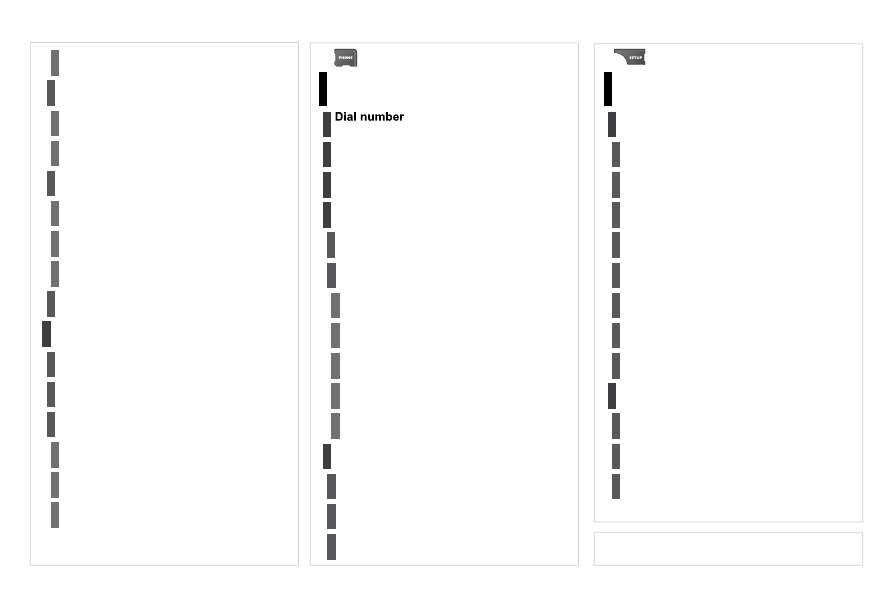
  "Phone" Menu 

Search phone

  Call lists  

  Connect phone 

Select ring tone

Phone/Ring tone volume

Phones connected

Enter mailbox number

  Settings 

 Disconnect phone 

 Rename phone 

 Delete pairing 

 Delete all pairings 

 Show details  

  "SETUP" menu 

  System language *  

English

Español

Deutsch

Italiano

Français

Nederlands

Polski

Portuguese

  Date & Time *  

Set date & time

Date format

Time format

1

2

2

2

2

3

3

4

4

4

4

4

2

3

3

3

1

2

3

3

3

3

3

3

3

3

3

3

3

2

 Avoid motorways 

Route dynamics

 Traffi c independent 

 Semi-dynamic 

Avoidance criteria

 Avoid toll roads 

 Optimized route 

3

3

4

4

4

4

4

  *   Available according to model.  

243

  * Available according to model.  

 Dark blue 

MAP colour

 Night mode for MAP

  Units 

 Day mode for MAP

  Vehicle *  

Vehicle information

 Alert log 

 Status of functions  

Temperature

 Celsius 

 Fahrenheit 

Metric/Imperial

 Kilometres (Consumption: l/100) 

 Kilometres (Consumption: km/l) 

 Miles (Consumption: MPG)  

  System 

 Auto. Day/Night for MAP  

Factory reset

Software version

Automatic scrolling

3

4

4

2

4

3

4

4

2

3

4

4

3

4

4

4

2

4

3

3

3

Colour

 Pop titanium 

 Toffee 

 Blue steel 

 Technogrey 

3

4

4

4

4

  Display 

Brightness

2

3

244

 FREQUENTLY ASKED QUESTIONS 

QUESTION

ANSWER

SOLUTION

 There is a difference in 
sound quality between 
the different audio 

sources (radio, CD…). 

 For optimum sound quality, the audio settings (Volume, Bass, 

Treble, Ambience, Loudness) can be adapted to the different sound 

sources, which may result in audible differences when changing source 

(radio, CD…). 

 Check that the audio settings (Volume, Bass, 

Treble, Ambience, Loudness) are adapted to 

the sources listened to. It is advisable to set 

the AUDIO functions (Bass, Treble, Front-Rear 

Balance, Left-Right Balance) to the middle 

position, select the Linear musical ambience and 

set the loudness correction to the "Active" position 

in CD mode or to the "Inactive" position in radio 

mode. 

 The CD is ejected 

automatically or is not 

played by the player. 

 The CD is inserted upside down, is unplayable, does not contain any 

audio data or contains an audio format which the player cannot play. 

 The CD is protected by an anti-pirating protection system which is not 

recognised by the audio equipment. 

   -  

Check that the CD is inserted in the player the 
right way up. 

  -  

Check the condition of the CD: the CD cannot 

be played if it is too damaged. 

  -  

Check the content in the case of a recorded 
CD: consult the advice in the Audio section. 

  -   The audio equipment's CD player does not 

play DVDs. 

  -  

Because of their quality level, certain 
writeable CDs will not be played by the audio 

system.  

 The CD player sound is 
poor. 

 The CD used is scratched or of poor quality. 

 Insert good quality CDs and store them in suitable 

conditions. 

 The audio equipment settings (bass, treble, ambiences) are unsuitable. 

 Set the treble or bass level to 0, without selecting 

an ambience. 

245

QUESTION

ANSWER

SOLUTION

 The stored stations do 

not function (no sound, 

87.5 Mhz is displayed…) 

 An incorrect waveband is selected. 

 Press the BAND AST button to return to the 

waveband (AM, FM1, FM2, FMAST) on which the 

stations are stored. 

 The quality of reception 
of the radio station 
listened to gradually 
deteriorates or the stored 
stations do not function 

(no sound, 87.5 Mhz is 

displayed…). 

 The vehicle is too far from the transmitter used by the station listened 

to or there is no transmitter in the geographical area through which the 

vehicle is travelling. 

 Activate the RDS function to enable the system 

to check whether there is a more powerful 

transmitter in the geographical area. 

 The environment (hills, buildings, tunnels, basement car parks…) block 

reception, including in RDS mode. 

 This phenomenon is normal and does not indicate 

a failure of the audio equipment. 

 The aerial is absent or has been damaged (for example when going 

through a car wash or into an underground car park). 

 Have the aerial checked by a PEUGEOT dealer. 

 Sound cut-outs of 1 to 

2 seconds in radio mode. 

 During this brief sound cut-out, the RDS searches for any frequency 

permitting better reception of the station. 

 Deactivate the RDS function if the phenomenon is 

too frequent and always on the same route. 

 With the engine off, 

the audio equipment 

switches off after a few 

minutes of use. 

 When the engine is switched off, the audio equipment operating time 

depends on the battery charge. 
 The switch-off is normal: the audio equipment switches to economy mode 

and switches off to prevent discharging of the vehicle's battery. 

 Start the vehicle's engine to increase the battery 
charge. 

246

QUESTION

ANSWER

SOLUTION

 TA is selected. However, 

certain traffi c jams 

along the route are not 

indicated in real time. 

 On starting, it is several minutes before the system begins to receive the 

traffi c information. 

 Wait until the traffi c information is being received 

correctly (displaying of the traffi c information 

symbols on the map). 

 In certain countries, only major routes (motorways…) are listed for the 

traffi c information. 

 This phenomenon is normal. The system is 

dependent on the traffi c information available. 

 I receive a speed camera 

alert for a camera which 

is not on my route. 

 The system announces all speed cameras located in a conical zone 

forward of the vehicle. It may detect speed cameras on nearby or parallel 

roads. 

 Zoom the map to view the exact position of the 

speed camera. 

 The audible speed 

camera alert is not 

working. 

 Audible alerts are not active. 

 Activate audible alerts in Navigation Menu, 

Settings, Set parameters for risk areas. 

 The alert volume level is set to minimum. 

 Increase the speed camera alert volume. 

 The altitude is not 
displayed. 

 On starting, the initialisation of the GPS may take up to 3 minutes to 

receive more than 3 satellites correctly. 

 Wait until the system has started up completely. 

Check that there is a GPS coverage of at least 

3 satellites (long press on the SETUP button, then 

select GPS coverage). 

 Depending on the geographical environment (tunnel…) or the weather, 

the conditions of reception of the GPS signal may vary. 

 This phenomenon is normal. The system is 

dependent on the conditions of reception of the 
GPS signal. 

 The route is not 
calculated successfully. 

 The exclusion criteria may confl ict with the current location (exclusion of 

toll roads on a motorway with tolls). 

 Check the exclusion criteria. 

247

QUESTION

ANSWER

SOLUTION

 There is a long waiting 

time after inserting a CD. 

 When a new medium is inserted, the system reads a certain amount of 

data (directory, title, artist, etc.). This may take a few seconds. 

 This phenomenon is normal. 

 I cannot connect my 

Bluetooth telephone. 

 The telephone's Bluetooth function may be deactivated or the equipment 

may not be visible. 

   -  

Check that your telephone's Bluetooth 
function is activated. 

  -  

Check that your telephone is visible.  

 A telephone connected 
by Bluetooth is inaudible. 

 The volume level depends on both the system and the telephone. 

 Increase the Peugeot Connect Navigation volume 

setting, possibly to maximum, and increase the 

telephone volume level if necessary. 

249

PEUGEOT CONNECT SOUND 

  Your Peugeot Connect Sound is coded in such a way 
that it will only operate in your vehicle. If it is to be 
installed in another vehicle, contact a PEUGEOT dealer 

for confi guration of the system.  

  For safety reasons, the driver should only carry out 
operations which require prolonged attention while the 
vehicle is stationary. 
 When the engine is off, and in order to prevent 

discharging of the battery, the audio system may switch 

off after a few minutes.   

  RADIO/BLUETOOTH 

  01  First steps   
  02  Steering mounted controls   
  03  Main menu   
  04  Audio   
  05  Peugeot Connect USB   
  06  Bluetooth  
  07  Configuration   
  08  Screen menu map   
  Frequently asked questions   

p.  
p.  
p.  
p.  
p.  
p.  
p.  
p.  
p.  

 250
 251
 252
 253
 256
 259
 261
 262
 265

 CONTENTS 

250

01

1

2

2

10

10

11

11

13

13

14

14

15

15

3

3

4

4

5

5

6

6

7

7

8

8

9

9

12

12

 FIRST STEPS 

       1.   On/Off and volume adjustment. 

  2.   CD eject. 

  3.   Selection of the display on the screen from 

the following modes:  


Audio (AUDIO), Vehicle Diagnostics and 
Telephone (TEL) functions. 

  4.   Selection of source:   
 

radio, audio CD/MP3 CD, USB, Jack 

connection, Streaming. 

  5.   Selection of FM1, FM2, FMast and AM 

wavebands. 

  6.   Setting audio options: front/rear balance, 

left/right balance, loudness, sound 

ambience. 

  7.   Display the list of local stations, of the tracks 

on the CD or of the MP3 folders. 

  8.   Abandon current operation. 
  9.   TA (Traffi c Announcement) function on/off.   


Long press: access to the PTY (Types of 

radio programme) mode. 

  10.   Confi rmation. 

  11.   Automatic search for a lower/higher 

frequency.  


Selection of previous/next CD, MP3 or USB 
track. 

  12.   Selection of a lower/higher radio frequency.  
 

Selection of the previous/next MP3 folder.   


Selection of the previous/next USB 

equipment folder/genre/artist/playlist. 

  13.   Display the general menu. 

  14.   Buttons 1 to 6:  
 

Selection of a stored radio station.  


Long press: store a station. 

  15.   The DARK button changes the display on 

the screen to improve driving comfort at 

night.   


1st press: lighting the upper band only.   


2nd press: display of a black screen.   


3rd press: return to the standard display.  

251

02  STEERING MOUNTED CONTROLS 

  RADIO: selection of the next stored station. 

 USB: selection of the next genre/artist/folder from 

the classifi cation list. 

 Selection of the next item on a menu.  

RADIO: selection of the previous stored station. 

 USB: selection of the previous genre/artist/folder 

from the classifi cation list. 

 Selection of the previous item on a menu.  

  RADIO: automatic search for a higher frequency. 

 CD/MP3/USB: selection of the next track. 

 CD/USB: continuous press: fast forwards play. 

 Selection of the previous item.  

  RADIO: automatic search for a lower frequency. 

 CD/MP3/USB: selection of the previous track. 

 CD/USB: continuous press: fast reverse. 

 Selection of the next item.   

    -  

Change of sound source. 

  -   Confi rmation of a selection. 
  -  

Pick up/Hang up the telephone. 

  -   Press for more than 2 seconds: 

access to the telephone menu.   

  Volume increase.  

  Volume decrease.  

  Mute: press the volume 

increase and decrease 

buttons simultaneously. 
 The sound is restored 
by pressing one of the 

two volume buttons.  

252

03  MAIN MENU 

AUDIO FUNCTIONS

 : radio, 

CD, USB, options. 

> MONOCHROME SCREEN C 

  For a detailed global view of the 

menus available, refer to the 

"Screen menu map" section of 

this chapter.   

TELEPHONE

 : hands-free kit, 

pairing, management of a call. 

PERSONALISATION-
CONFIGURATION

 : vehicle 

parameters, display, languages. 

VEHICLE DIAGNOSTICS

 : alerts log.  

253

04

1

2

3

4

1

2

3

4

 AUDIO 

 Press the SOURCE button several 

times in succession and select the 

radio.  

  Press the BAND AST button to select 

a waveband: FM1, FM2, FMast, AM.  

  Briefl y press one of the buttons to 

carry out an automatic search of the 

radio stations.  

  Press one of the buttons to carry 

out a manual search of the radio 

stations.  

  Press the LIST REFRESH button to 
display the list of stations received 

locally (30 stations maximum). 

 To update this list, press for more 

than two seconds.   

 The external environment (hills, buildings, tunnels, basement car parks, ...) 

may block reception, including in RDS mode. This is a normal effect of the 

way in which radio waves are transmitted and does not indicate any failure 

of the audio system. 

  RDS 

       RADIO 

  SELECTING A STATION 

 Press the MENU button. 

 Select AUDIO FUNCTIONS then 
press OK. 

 Select the FM WAVEBAND 
PREFERENCES function then press OK. 

 Select ACTIVATE RDS then press 
OK. RDS appears on the screen. 

 The RDS, if displayed, enables you to continue listening to the same 

station by automatic retuning to alternative fequencies. However, in 

certain conditions, coverage of an RDS station may not be assured 

throughout the country as radio stations do not cover 100 % of the 

territory. This explains the loss of reception of the station during a journey.  

254

04

1

2

3

AUDIO

  Insert circular compact discs only. 

 Some anti-pirating systems, on original discs or CDs copied using a 

personal recorder, may cause faults which are no refl ection on the 

quality of the original player. 
 Without pressing the EJECT button, insert a CD in the player, play 

begins automatically.  

  CD 

 PLAYING A CD 

  To play a disc which has already been 
inserted, press the SOURCE button 

several times in succession and 

select CD.  

  Press one of the buttons to select a 
track on the CD.  

  Press the LIST REFRESH button to display the list of tracks on 
the CD.  

  Press and hold one of the buttons for 
fast forward or backward.   

       RECEIVING TA MESSAGES 

  Press the TA button to activate or 

deactivate traffi c messages.   

  The TA (Traffi c Announcement) function gives priority to TA alert 

messages. To operate, this function needs good reception of a 

radio station transmitting this type of message. When a traffi c 

report is transmitted, the current audio source (Radio, CD, ...) is 

interrupted automatically to play the TA message. Normal playback 

of the audio source resumes at the end of the transmission of 

the message.  

255

04

1

2

3

  The MP3 format, an abbreviation of MPEG 1.2 & 2.5 Audio Layer 3, 

is an audio compression standard which permits the recording of 

several tens of music fi les on a single disc.  

  In order to be able to play a recorded CDR or CDRW, when 

recording, the ISO 9660 level 1.2 or Joliet fi le format is 

recommended. 

 If the disc is recorded in another format, it may not be played 

correctly. 
 It is recommended that the same recording format is always 

used for an individual disc, with as low a speed as possible 

(4x maximum) for optimum sound quality. 

 In the particular case of a multi-session CD, the Joliet format is 

recommended.  

  The audio system will only play fi les with the extension ".mp3" with 

a sampling rate of 22.05 KHz or 44.1 KHz. No other type of fi le 

(.wma, .mp4, .m3u...) can be played.  

  It is advisable to restrict fi le names to 20 characters without using 

special characters (e.g. " ? ; ù) to avoid any playing or displaying 

problems.   

             MP3 CD 

  INFORMATION AND ADVICE  

AUDIO

  Empty CDs are not recognised and may damage the system.  

  Insert an MP3 compilation in the player. 

 The audio equipment searches for all of the music tracks, which 

may take anything between a few seconds and several tens of 

seconds, before play begins.  

          MP3 CD 
 PLAYING AN MP3 COMPILATION 

  On a single disc, the CD player can read up to 255 MP3 fi les 

spread over 8 folder levels. However, it is advisable to keep to 

a limit of two levels to reduce the access time before the CD is 

played. 
 While the CD is being played, the folder structure is not followed.  
All of the fi les are displayed on a single level.  

  To play a disc which has already 
been inserted, press the SOURCE 

button several times in succession 

and select CD.  

  Press one of the buttons to select a 
track on the CD.  

  Press the LIST REFRESH button to display the list of directories of 

the MP3 compilation.  

  Press and hold one of the buttons for 
fast forward or backward play.   

256

05

1

1

2

3

 PEUGEOT CONNECT USB 

  The system puts together playlists (temporary memory) created 

over a period which depends on the capacity of the USB device. 
 The other sources are available during this time. 

 The playlists are updated each time the ignition is switched off or 

each time a USB memory stick is connected. 

 When connecting for the fi rst time, the classifi cation suggested 

is by folder. When you reconnect, the classifi cation selected 

previously is retained.   

 Connect the memory stick to the port, directly or 

using a lead. If the audio equipment is switched 

on, the USB source is detected as soon as it 

is connected. Play begins automatically after a 

delay which depends on the capacity of the USB 

memory stick. 

 The fi le formats recognised are .mp3 (mpeg1 

layer 3 only), .wma (standard 9 only, 128 kbits/sec 

compression), .wav and .ogg. 

 The playlists types accepted are m3u, .pls, .wpl.  

  This unit consists of a USB port and an auxiliary 

Jack socket * . The audio fi les are transmitted 

from portable equipment such as a digital 

player or a USB memory stick to your Peugeot 

Connect Sound to be listened to via the vehicle's 
speakers.  

  USB memory stick (1.1, 1.2 and 2.0) or iPod 

®

  of 

generation 5 or later: 

   -   USB memory sticks should be formatted 

FAT or FAT 32 (NTFS not supported), 

  -  

the iPod 

®

  lead is essential, 

®

  -   navigation through the fi le database is by 

means of the steering mounted controls, 

  -  

the iPod 

®

  software should be regularly 

®

updated for the best connection.   

  The list of compatible equipment and the compression rates supported 

are available from PEUGEOT dealers.  

             USING THE PEUGEOT CONNECT USB 

  CONNECTING A USB MEMORY STICK 

  Other iPod 

®

  players of earlier generations and 

®

players using the MTP protocol * : 
   -  

play via Jack-Jack lead only (not supplied), 

  -   navigation through the fi le database is from 

the portable device.   

  *   According to vehicle.  

257

05

4

2

3

1

5

 PEUGEOT CONNECT USB 

  USING THE PEUGEOT CONNECT USB 

  Press LIST briefl y to display the 

previously selected classifi cation. 
 Navigate through the list using the left/
right and up/down buttons. 
 Confi rm the selection by pressing OK.  

 The lists available are Artist, Genre and Playlist (as defi ned on 

the iPod 

®

 ). 

®

 Selection and Navigation are described in steps 1 to 5 above.  

  Do not connect a hard disk or USB devices other than audio 

equipment to the USB port. This could damage your installation.   

  CONNECTING AN iPOD 

®

AN iPOD 

AN iPOD    VIA THE USB PORT 

®

  Press one of these buttons to gain 
access to the previous/next track on 

the classifi cation list currently being 

played. 
 Press and hold one of the buttons for 
fast forward or backward play.  

  Press one of these buttons to gain 
access to the previous/next Genre, 
Folder, Artist or Playlist on the 

classifi cation list currently being 

played.  

  Press and hold LIST to display the 

different classifi cations. 
 Select by Folder/Artist/Genre/Playlist, 

press OK to select the classifi cation 

required, then press OK again to confi rm. 

   -   by Folder: all folders containing audio 

fi les recognised on the peripheral 

device, classifi ed in alphabetical 

order without following the fl ow chart. 

  -   by Artist: all of the artist names 

defi ned in the ID3 Tags, classifi ed in 

alphabetical order. 

  -   by Genre: all of the genres defi ned in 

the ID3 Tags. 

  -   by Playlist: in accordance with the 

playlists recorded on the USB device.   

258

05

1

2

1

2

 The display and control is via the portable device.  

 First adjust the volume of your portable device. 

 Then adjust the volume of your 

audio system. 

             USING THE AUXILIARY SOCKET (AUX) 
 JACK SOCKET OR RCA SOCKET 

(according to vehicle) 

  ADJUSTING THE VOLUME OF 
THE AUXILIARY SOURCE 

 PEUGEOT CONNECT USB 

 The auxiliary socket, JACK or RCA, permits the connection of a 

portable device (MP3 player...). 

 Do not connect a device to both the USB port and the auxiliary 

JACK socket simultaneously. 

 Connect the portable device 
(MP3 player…) to the auxiliary 
JACK socket or to the audio sockets 
(white and red, RCA type) using a 
suitable cable (not supplied). 

 Press the SOURCE button several 

times in succession and select AUX.  


Content   ..  15  16  17  18   ..