Peugeot 307 Break (2007 year). Manual - part 8
 

  Index      Peugeot     Peugeot 307 Break - service manual 2007 year in english


Search            


Content   ..  6  7  8  9   ..


Peugeot 307 Break (2007 year). Manual - part 8


100

This  cruise  control,  of  the  new 

generation,  is  linked  with  the  speed 

limiter. It has a display on the instru-

ment  panel  to  indicate  the  memo-

rised reference speed.

It  enables  the  vehicle  to  maintain  a 

steady  speed  programmed  by  the 

driver.

In order for it to be memorised or ac-

tivated,  the  vehicle  speed  must  be 

greater  than  25  mph  (40  km/h)  with 

at least fourth gear engaged for vehi-

cles fitted with a manual gearbox.

On vehicles fitted with an automatic 

gearbox,  the  lever  must  be  in  posi-

tion 

D, or in at least second gear in 

sequential mode.

When  the  cruise  control  function 

is  activated,  pressing  this  button 

enables  you  to  display  the  distance 

recorders.

After  a  few  seconds  or  when  this 

button  is  pressed  again,  the  display 

returns to the cruise control function.

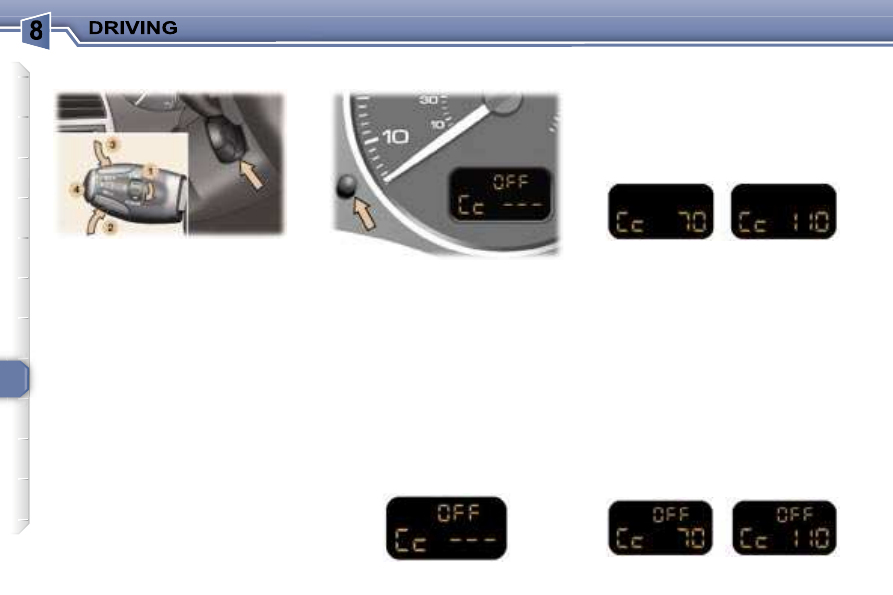
First activation/memorising a 

reference speed

As  soon  as  you  reach  the  chosen 

speed, press button 

2 or 3. This mem-

orises the speed and the display indi-

cates (e.g. at 70 mph (110 km/h)):

Selecting the function

 Place  switch 

1  in  the  CRUISE 

position.  The  cruise  control  is 

not  yet  active  and  no  speed  has 

been memorised. The display in-

dicates: 

Note:  It  is  possible  to  accelerate 

and  drive  momentarily  at  a  speed 

greater  than  the  memorised  speed. 

The value memorised flashes. When 

the accelerator pedal is released, the 

vehicle  will  return  to  the  memorised 

speed.

Cancelling the cruise control

If you wish to cancel the cruise control:

 Press  button 

4  or  the  brake  or 

clutch pedal. 

The display indicates (e.g. at 70 mph 

(110 km/h)):

*  According to country.

CRUISE CONTROL*

Instrument panel display

101

Cancelling the memorised 

reference speed

 When  the  vehicle  becomes 

stationary,  after  switching  off  the 

ignition,  the  system  no  longer 

memorises a speed.

Contact a PEUGEOT dealer to have 

the system checked.

When  changing  the  memo-

rised  reference  speed  by 

means of a maintained press, 

pay  attention  as  the  speed 

can increase or decrease rapidly.

Do not use the cruise control on slip-

pery roads or in heavy traffic.

In  the  event  of  a  steep  slope,  the 

cruise  control  cannot  prevent  the 

vehicle  from  exceeding  the  pro-

grammed speed.

In any event, the cruise control can-

not replace the need to comply with 

speed  limits,  nor  can  it  replace  the 

need for vigilance and responsibility 

on the part of the driver.

To  prevent  the  mat  from  becoming 

caught under the pedals:

-  ensure  that  the  mat  is  positioned 

correctly.

-  never fit one mat on top of another.

Reactivating the cruise control

After  cancellation  of  the  cruise  con-

trol, 

press button 4. Your vehicle will 

return to the last memorised speed. 

The display indicates (e.g. at 70 mph 

(110 km/h)):

Changing the memorised 

reference speed

To memorise a speed higher than the 

previous one, there are two options:

Without using the accelerator:

 press button 

3;

A  brief  press  increases  by  1 mph 

(1 km/h). 

An  extended  press  increases  by 

5 mph (5 km/h).

A  maintained  press  increases  in 

steps of 5 mph (5 km/h).

Using the accelerator:

 exceed the memorised speed un-

til the required speed is reached,

 press button 

or 3.

Switching the function off

 Place dial 

1 in position 0 to switch 

the system off.

Operating fault

In the event of a cruise control mal-

function,  the  memorised  speed  is 

erased,  the  dashes  flash  for  a  few 

seconds:

To memorise a speed lower than the 

previous one:

 press button 

2;

A  brief  press  decreases  by  1 mph 

(1 km/h). 

A  brief  press  decreases  by  1 mph 

A  brief  press  decreases  by  1 mph 

An  extended  press  decreases  by 

5 mph (5 km/h).

An  extended  press  decreases  by 

An  extended  press  decreases  by 

A  maintained  press  decreases  in 

steps of 5 mph (5 km/h).

102

This cruise control has a display on 

the  instrument  panel  to  indicate  the 

memorised reference speed.

It  enables  the  vehicle  to  maintain  a 

steady  speed  programmed  by  the 

driver.

In order for it to be memorised or ac-

tivated,  the  vehicle  speed  must  be 

greater  than  25  mph  (40  km/h)  with 

at least fourth gear engaged for vehi-

cles fitted with a manual gearbox.

On vehicles fitted with an automatic 

gearbox,  the  lever  must  be  in  posi-

tion 

D or at least second gear must 

be  engaged  in  sequential  driving 

mode.

When the cruise control function is ac-

tivated,  pressing  this  button  enables 

you to display the distance recorder.

After  a  few  seconds  or  when  this 

button  is  pressed  again,  the  display 

returns to the cruise control function.

First activation/

memorising a reference speed

As  soon  as  you  reach  the  chosen 

speed, press button 

2 or 3. This mem-

orises the speed and the display indi-

cates (e.g. at 70 mph (110 km/h)):

Selecting the function

 Place switch 

in the ON position. 

The cruise control is not yet active 

and  no  speed  has  been  memo-

rised. The display indicates: 

Note:  It  is  possible  to  accelerate 

and  drive  momentarily  at  a  speed 

greater  than  the  memorised  speed. 

The value memorised flashes. When 

the accelerator pedal is released, the 

vehicle  will  return  to  the  memorised 

speed.

Cancelling the cruise control

If you wish to cancel the cruise control:

 Press  button 

4  or  the  brake  or 

clutch pedal. 

The display indicates (e.g. at 70 mph 

(110 km/h)):

*  According to country.

Instrument panel display

CRUISE CONTROL*

103

Reactivating the cruise control

After  cancellation  of  the  cruise  con-

trol, 

press button 4. Your vehicle will 

return to the last memorised speed. 

The display indicates (e.g. at 70 mph 

(110 km/h)):

Cancelling the memorised 

reference speed

 When the vehicle is stationary, af-

ter the ignition has been switched 

off,  the  system  no  longer  stores 

any speed.

Changing the memorised 

reference speed

To memorise a speed higher than the 

previous one, there are two options:

Without using the accelerator:

 press button 

3;

A  brief  press  increases  by  1 mph 

(1 km/h). 

An  extended  press  increases  by 

5 mph (5 km/h).

A  maintained  press  increases  in 

steps of 5 mph (5 km/h).

Using the accelerator:

 exceed the memorised speed un-

til the required speed is reached,

 press button 

or 3.

Switching the function off

 Place dial 

1 in the OFF position to 

switch the system off.

Operating fault

In the event of a cruise control mal-

function,  the  memorised  speed  is 

erased,  the  dashes  flash  for  a  few 

seconds:

Contact a PEUGEOT dealer to have 

the system checked.

When  changing  the  memo-

rised  reference  speed  by 

means of a maintained press, 

pay  attention  as  the  speed 

can increase or decrease rapidly.

Do  not  use  the  cruise  control  on 

slippery roads or in heavy traffic.

In  the  event  of  a  steep  slope,  the 

cruise  control  cannot  prevent  the 

vehicle  from  exceeding  the  pro-

grammed speed.

In any event, the cruise control can-

not replace the need to observe the 

speed  limits,  nor  can  it  replace  the 

need for vigilance and responsibility 

on the part of the driver.

To  prevent  the  mat  from  becoming 

caught under the pedals:

-  ensure  that  the  mat  is  positioned 

correctly.

-  never fit one mat on top of another.

To memorise a speed lower than the 

previous one:

 press button 

2;

A  brief  press  decreases  by  1 mph 

(1 km/h). 

A  brief  press  decreases  by  1 mph 

A  brief  press  decreases  by  1 mph 

An  extended  press  decreases  by 

5 mph (5 km/h).

An  extended  press  decreases  by 

An  extended  press  decreases  by 

A  maintained  press  decreases  in 

steps of 5 mph (5 km/h).

104

VISUAL AND AUDIBLE REAR 

PARKING ASSISTANCE

This system consists of four proximity 

sensors, located in the rear bumper.

This  detects  any  obstacle  (person, 

vehicle,  tree,  gate,  etc.)  behind  the 

vehicle.  Nevertheless,  it  cannot  de-

tect obstacles located just below the 

bumper.

An  object,  such  as  a  stake,  a  road-

works  cone  or  any  other  similar 

object may be detected at the begin-

ning  of  the  manoeuvre,  but  may  no 

longer be detected when the vehicle 

comes close to it.

Note:  this  function  will  be  disarmed 

automatically  when  the  vehicle  is 

towing a trailer or when a bicycle car-

rier is fitted (vehicle fitted with towing 

attachment or bicycle carrier recom-

mended by PEUGEOT). 

In bad or wintry weather, ensure that 

the  sensors  are  not  covered  with 

mud,  frost  or  snow.  When  reverse 

gear  is  engaged,  an  audible  signal 

(long  bleep)  indicates  that  the  sen-

sors may be dirty.

The proximity information is given by: 

-  an  audible  signal,  which  becomes 

more  rapid  as  the  vehicle  ap-

proaches the obstacle,

-  a graphic on the multifunction dis-

play,  with  blocks  which  become 

progressively closer to the vehicle.

Depending  on  the  multifunction  dis-

play, the audible signal is transmitted 

by a buzzer or by the rear speakers 

which transmit:

-  on the right if an obstacle is detect-

ed on the right,

-  on the left if an obstacle is detected 

on the left,

-  on the right and on the left if an ob-

stacle is detected in the centre.

When the distance between the rear 

of  the  vehicle  and  the  obstacle  is 

less  than  approximately  thirty  centi-

metres,  the  audible  signal  becomes 

continuous and the "Danger" symbol 

appears depending on the multifunc-

tion display.

 

Change  to  neutral,  the  system  is 

again inactive.

If there is an operating fault, 

when  reverse  gear  is  en-

gaged,  the  service  warning 

light comes on, accompanied 

by  an  audible  signal  (short  bleep) 

and a message on the multifunction 

display.

Contact a PEUGEOT dealer.

Activation/Deactivation

Activation

The  system  is  activated  as  soon  as 

reverse gear is engaged.

This  is  accompanied  by  an  audible 

signal  and  displaying  of  the  vehi-

cle,  depending  on  the  multifunction 

display.

The system can be activat-

ed  or  deactivated  from  the 

multifunction  display  con-

figuration menu.

The  activation  and  deacti-

vation of the system are memorised 

when the engine is switched off.

Switching the system off

106

Tilt the handle on the left-hand side 

under the fascia to the right.

Lift the catch and raise the bonnet.

Secure  the  strut 

to hold the bonnet 

open.

Before  closing  the 

bonnet, 

replace 

the  strut  in  its 

housing.

RUNNING OUT OF FUEL 

(DIESEL)

If  you  should  run  out  of  fuel,  it  is 

necessary to re-prime the circuit.

The  repriming  pump,  the  degas 

screw  and  the  transparent  pipe  are 

located under the bonnet (see corre-

sponding drawing):

OPENING THE BONNET

From inside 

From outside

Bonnet strut

To close

Lower  the  bonnet  and  release  it  at 

the end of its travel. 

Check  that  the  bonnet  is  properly 

locked. 

1.6 litre HDI 16V engine

-  fill the fuel tank with at least five li-

tres of diesel,

-  unclip the style cover to access the 

repriming pump,

-  squeeze  and  release  the  manual 

repriming  pump  until  fuel  appears 

in  the  transparent  pipe  with  the 

green connector,

-  operate the starter until the engine 

starts.

2 litre HDI 16V engine 

-  fill the fuel tank with at least five li-

tres of diesel,

-  unclip the style cover to access the 

repriming pump,

-  unscrew the degas screw,

-  squeeze  and  release  the  manual 

repriming pump until diesel is seen 

escaping via the degas screw,

-  retighten the degas screw,

-  operate the starter until the engine 

starts.

107

1.  Power steering reservoir.

2.  Windscreen and headlamp 

wash reservoir.

3.  Coolant reservoir.

4.  Brake fluid reservoir.

5.  Battery.

6.  Fuse box.

7.  Air filter.

8.  Dipstick.

9.  Engine oil reservoir.

1.4 LITRE 16V PETROL ENGINE 

108

1.  Power steering reservoir.

2.  Windscreen/headlamp wash 

reservoir.

3.  Coolant reservoir.

4.  Brake fluid reservoir.

5.  Battery.

6.  Fuse box.

7.  Air filter. 

8.  Dipstick.

9.  Engine oil reservoir.

1.6 LITRE 16V PETROL ENGINE

109

1.  Power steering reservoir.

2.  Windscreen/headlamp wash 

reservoir.

3.  Coolant reservoir.

4.  Brake fluid reservoir.

5.  Battery.

6.  Fuse box.

7.  Air filter.

8.  Dipstick.

9.  Engine oil reservoir.

2 LITRE 16V PETROL ENGINE

110

1.  Power steering reservoir.

2.  Windscreen/headlamp wash 

reservoir.

3.  Coolant reservoir.

4.  Brake fluid reservoir.

5.  Battery

6.  Fuse box.

7.  Air filter.

8.  Dipstick.

9.  Engine oil reservoir.

2 LITRE 16V (180 bhp) PETROL ENGINE

111

1.  Power steering reservoir.

2.  Windscreen/headlamp wash 

reservoir.

3.  Coolant reservoir.

4.  Brake fluid reservoir.

5.  Battery.

6.  Fuse box.

7.  Dipstick.

8.  Engine oil reservoir.

9.  Priming pump.

1.6 LITRE 16V TURBO DIESEL HDI ENGINE (90 bhp/110 bhp)

112

1.  Power steering reservoir.

2.  Windscreen/headlamp wash 

reservoir. 

3.  Coolant reservoir. 

4.  Brake fluid reservoir.

5.  Battery.

6.  Fuse box.

7.  Air filter.

8.  Engine oil reservoir.

9.  Dipstick.

10.  Priming pump.

11.  Degas screw.

2 LITRE 16V TURBO DIESEL HDI ENGINE (136 bhp)

113

CHECKING THE LEVELS

There  are  two  marks  on 

the dipstick:

A = maximum

Never fill past this mark.

B = minimum

Oil change

According to the information given in 

the servicing booklet.
Viscosity selection

In all cases, the oil selected must meet 

the manufacturer’s requirements.

Note:  the  coolant  does  not  need  to 

be changed.

Dipstick

Cooling system

Use  the  fluid  recommended  by  the 

manufacturer.

When  the  engine  is  warm,  the  tem-

perature  of  the  coolant  is  controlled 

by the engine fan. This fan can oper-

ate with the ignition off.

In the case of vehicles fitted with 

a  particle  emission  filter,  the  fan 

can  operate  after  the  vehicle  has 

stopped, even when the engine is 

cold.

In addition, as the cooling system is 

pressurised, wait for at least one hour 

after the engine has stopped before 

carrying out any work.

Slacken  the  cap  by  two  turns  to  re-

lease  the  pressure  to  prevent  any 

risk  of  scalding.  When  the  pressure 

has  dropped,  remove  the  cap  and 

top up the level.

Windscreen and headlamp 

wash level

Diesel additive level (Diesel 

with particle emission filter)

If the service warning light comes on, 

accompanied by a message and an 

audible  signal,  this  indicates  a  low 

diesel additive level.

This additive must be topped up.

Contact a PEUGEOT dealer as soon 

as possible.

Brake fluid level

*  According to engine.

Oil level

To  maintain  the  reliability  of 

engines and emission control 

systems, the use of additives 

in engine oil is prohibited.

The  level  should  always  be 

above  the  MIN  mark  and 

close to the MAX mark.

Power steering reservoir

Remove  the  style  trim*  (see  § 

“Changing a bulb - Front lights”).

Open  the  reservoir,  with  the  engine 

at  ambient  temperature.  The  level 

should  always  be  above  the  MIN. 

mark and close to the MAX. mark.

For best quality cleaning and 

for your safety, we would ad-

vise  that  you  use  products 

recommended by PEUGEOT.

Check the level regularly and 

top up between changes. The 

maximum consumption is 0.5 l 

per 600 miles (1 000 km).

Check the level with the ve-

hicle level, engine cold, using the oil 

level gauge on the instrument panel 

or the dipstick. 

Replacement  must  be  car-

ried  out  according  to  the 

manufacturer’s 

servicing 

schedule.

Use fluids recommended by 

the  manufacturer,  which  fulfil  DOT4 

standards.

114

CHECKS

Where the handbrake travel 

is too great or there is a re-

duction in the performance 

of  the  system,  the  hand-

brake  should  be  adjusted, 

even between services.

Have  the  system  checked  by  a 

PEUGEOT dealer.

Air filter and passenger 

compartment filter 

Particle emission filter 

(Diesel)

It is imperative that the particle emis-

sion filter is maintained in accordance 

with  the  manufacturer’s  servicing 

schedule, by a PEUGEOT dealer.

Brake  pad  wear  depends 

on  the  style  of  driving,  in 

particular for vehicles which 

are used in town, over short 

distances.

Disc and drum wear status

For any information relating to the wear 

status of the surfaces of the discs and 

drums, contact a PEUGEOT dealer.

Only  use  products  recom-

mended  by  PEUGEOT  or 

products of equivalent quality 

and characteristics.

To  ensure  best  perform-

ance from components as important 

as the power steering and the brak-

ing  system,  PEUGEOT  selects  and 

offers quite specific products.

To  prevent  damage  to  the  electrical 

units, high pressure washing to clean

the  engine  compartment  is  strictly 

prohibited.

Oil filter

Used products

Avoid  all  prolonged  contact  of  the 

used oil with the skin.

Brake  fluid  is  harmful  to  health  and 

very corrosive.

Note: following prolonged operation 

of the vehicle at very low speed or at 

idle,  you  may,  in  exceptional  cases, 

notice  discharges  of  water  vapour 

at the exhaust on acceleration. This 

has no effect on the behaviour of the 

vehicle or on the environment.

Do not dispose of used oil, 

brake  fluid  or  coolant  into 

drains or onto the ground.

Empty the used oil into the 

containers provided for this 

purpose in the PEUGEOT network.

Battery

At the start of winter, have 

your  battery  checked  by  a 

PEUGEOT dealer.

Have  the  filter  elements  re-

placed regularly.

 If you drive 

in dusty conditions, change 

them twice as often.

Brake pads

It may be necessary to check 

the  thickness  of  the  pads, 

even between services.

Handbrake

Change  the  filter  regularly, 

in accordance with the serv-

icing schedule.

Manual gearbox

This  does  not  require  an  oil 

change. Have the level checked 

in  accordance  with  the  manu-

facturer’s servicing schedule.
To  check  the  main  levels 

and certain components, in 

accordance with the manu-

facturer’s servicing sched-

ule, refer to the pages of the 

servicing booklet which correspond 

to your vehicle’s engine.

114

CHECKS

Where the handbrake travel 

is too great or there is a re-

duction in the performance 

of  the  system,  the  hand-

brake  should  be  adjusted, 

even between services.

Have  the  system  checked  by  a 

PEUGEOT dealer.

Air filter and passenger 

compartment filter 

Particle emission filter 

(Diesel)

It is imperative that the particle emis-

sion filter is maintained in accordance 

with  the  manufacturer’s  servicing 

schedule, by a PEUGEOT dealer.

Brake  pad  wear  depends 

on  the  style  of  driving,  in 

particular for vehicles which 

are used in town, over short 

distances.

Disc and drum wear status

For any information relating to the wear 

status of the surfaces of the discs and 

drums, contact a PEUGEOT dealer.

Only  use  products  recom-

mended  by  PEUGEOT  or 

products of equivalent quality 

and characteristics.

To  ensure  best  perform-

ance from components as important 

as the power steering and the brak-

ing  system,  PEUGEOT  selects  and 

offers quite specific products.

To  prevent  damage  to  the  electrical 

units, high pressure washing to clean

the  engine  compartment  is  strictly 

prohibited.

Oil filter

Used products

Avoid  all  prolonged  contact  of  the 

used oil with the skin.

Brake  fluid  is  harmful  to  health  and 

very corrosive.

Note: following prolonged operation 

of the vehicle at very low speed or at 

idle,  you  may,  in  exceptional  cases, 

notice  discharges  of  water  vapour 

at the exhaust on acceleration. This 

has no effect on the behaviour of the 

vehicle or on the environment.

Do not dispose of used oil, 

brake  fluid  or  coolant  into 

drains or onto the ground.

Empty the used oil into the 

containers provided for this 

purpose in the PEUGEOT network.

Battery

At the start of winter, have 

your  battery  checked  by  a 

PEUGEOT dealer.

Have  the  filter  elements  re-

placed regularly.

 If you drive 

in dusty conditions, change 

them twice as often.

Brake pads

It may be necessary to check 

the  thickness  of  the  pads, 

even between services.

Handbrake

Change  the  filter  regularly, 

in accordance with the serv-

icing schedule.

Manual gearbox

This  does  not  require  an  oil 

change. Have the level checked 

in  accordance  with  the  manu-

facturer’s servicing schedule.
To  check  the  main  levels 

and certain components, in 

accordance with the manu-

facturer’s servicing sched-

ule, refer to the pages of the 

servicing booklet which correspond 

to your vehicle’s engine.

10

115

1.  Wheelbrace.

2.  Jack with handle.

3.  Centralising tool.

4.  Socket for anti-theft bolt.

5.  Removable towing eye.

6.  Alloy wheel bolt trim remover.

7.  Alloy wheel trim remover.

Parking the vehicle

 If  possible,  park  the  vehicle  on 

level,  stable  and  non-slippery 

ground.

 Apply  the  handbrake,  switch  off 

the ignition and engage first or re-

verse gear (position 

P for the au-

tomatic gearbox).

To  gain  access  to  the  spare  wheel 

and the jack in the boot, lift the floor 

using the handle.

CHANGING A WHEEL (SALOON)

Tools 

The following tools are located in a holder in the centre of the spare wheel:

A diagram on the holder indicates the location of the tools.


Content   ..  6  7  8  9   ..