Nissan Qashqai (2007-2010). Manual - part 886
 

  Index      Nissan     Nissan Qashqai - service and repair manual 2007 - 2010 year


Search            copyright infringement  


Content   ..  884  885  886  887   ..


Nissan Qashqai (2007-2010). Manual - part 886


HA-114

< SYMPTOM DIAGNOSIS >

[MANUAL AIR CONDITIONER (HR/MR)]

REFRIGERATION SYSTEM SYMPTOMS

SYMPTOM DIAGNOSIS

REFRIGERATION SYSTEM SYMPTOMS

SYMPTOM DIAGNOSIS PROCEDURE

SYMPTOM DIAGNOSIS PROCEDURE : Trouble Diagnosis For Unusual Pressure

INFOID:0000000001098135

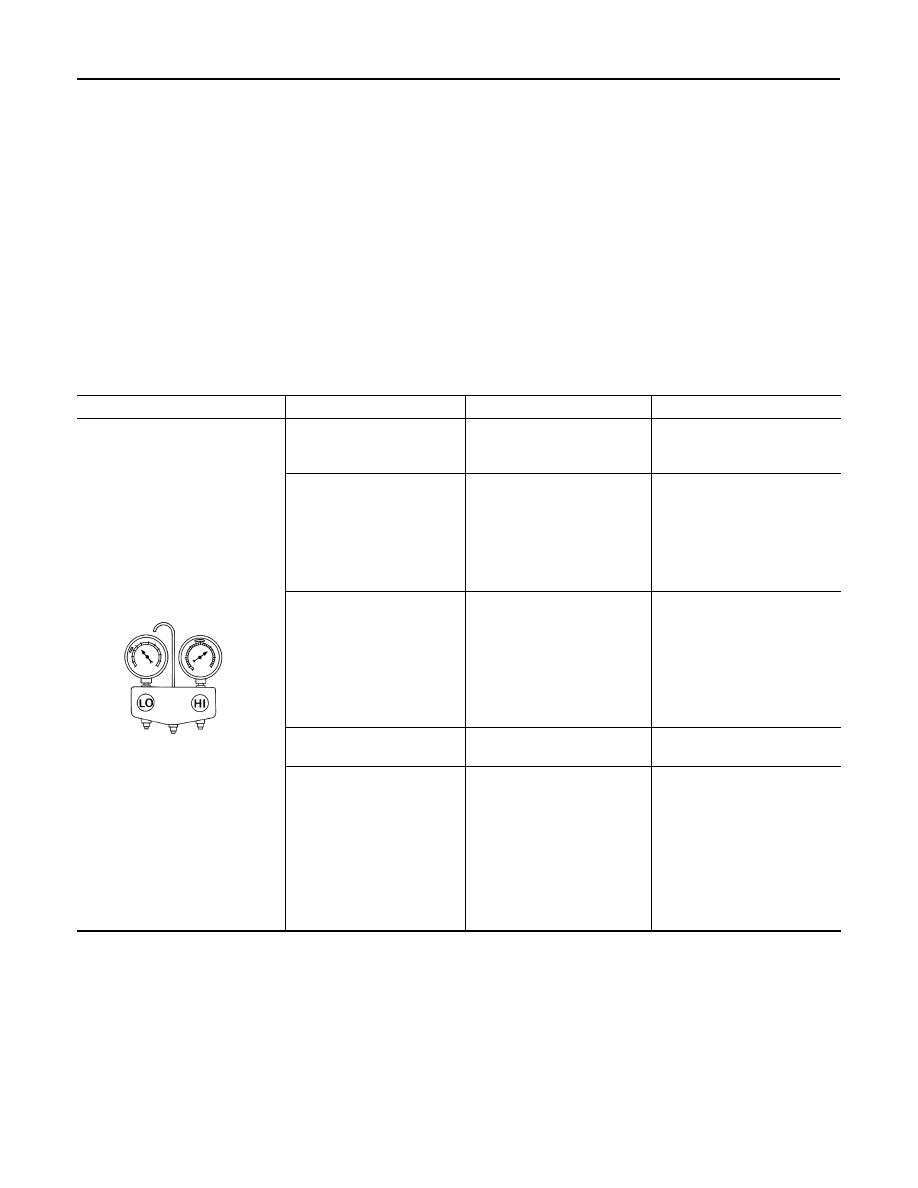
Whenever system’s high and/or low side pressure(s) is/are unusual, diagnose using a manifold gauge. The
marker above the gauge scale in the following tables indicates the standard (usual) pressure range. Since the
standard (usual) pressure, however, differs from vehicle to vehicle, refer to above table (Ambient air tempera-
ture-to-operating pressure table).

BOTH HIGH- AND LOW-PRESSURE SIDES ARE TOO HIGH

BOTH HIGH- AND LOW-PRESSURE SIDES ARE TOO HIGH : Symptom Table

INFOID:0000000001098136

HIGH-PRESSURE SIDE IS TOO HIGH AND LOW-PRESSURE SIDE IS TOO LOW

HIGH-PRESSURE SIDE IS TOO HIGH AND LOW-PRESSURE SIDE IS TOO LOW : 
Symptom Table

INFOID:0000000001098137

Gauge indication

Refrigerant cycle

Probable cause

Corrective action

Both high- and low-pressure sides 
are too high.

The pressure returns to nor-
mal is reduced soon after wa-
ter is splashed on condenser.

Excessive refrigerant charge in 
refrigeration cycle.

Reduce refrigerant until speci-
fied pressure is obtained.

Air suction by cooling fan is in-
sufficient.

Insufficient condenser cooling 
performance.

1.

Condenser fins are 
clogged.

2.

Improper fan rotation of 
cooling fan.

• Clean condenser.
• Check and repair cooling fan 

as necessary.

• Low-pressure pipe is not 

cold.

• When compressor is 

stopped high-pressure val-
ue quickly drops by approx-

imately 196 kPa (2 kg/cm

2

28 psi). It then decreases 
gradually thereafter.

Poor heat exchange in con-
denser
(After compressor operation 
stops, high-pressure decreas-
es too slowly.).

Air in refrigeration cycle.

Evacuate repeatedly and re-
charge system.

Engine tends to overheat.

Engine cooling systems mal-
function.

Check and repair each engine 
cooling system.

• An area of the low-pressure 

pipe is colder than areas 
near the evaporator outlet.

• Low-pressure pipe is some-

times covered with frost.

• Excessive liquid refrigerant 

on low-pressure side.

• Excessive refrigerant dis-

charge flow.

• Expansion valve is open a lit-

tle compared with the speci-
fication.


Improper expansion valve ad-
justment.

Replace expansion valve.

AC359A

REFRIGERATION SYSTEM SYMPTOMS

HA-115

< SYMPTOM DIAGNOSIS >

[MANUAL AIR CONDITIONER (HR/MR)]

C

D

E

F

G

H

J

K

L

M

A

B

HA

N

O

P

HIGH-PRESSURE SIDE IS TOO LOW AND LOW-PRESSURE SIDE IS TOO HIGH

HIGH-PRESSURE SIDE IS TOO LOW AND LOW-PRESSURE SIDE IS TOO HIGH : 
Symptom Table

INFOID:0000000001098138

BOTH HIGH- AND LOW-PRESSURE SIDES ARE TOO LOW

BOTH HIGH- AND LOW-PRESSURE SIDES ARE TOO LOW : Symptom Table

INFOID:0000000001098139

Gauge indication

Refrigerant cycle

Probable cause

Corrective action

High-pressure side is too high and 
low-pressure side is too low.

Upper side of condenser and 
high-pressure side are hot, 
however, liquid tank is not so 
hot.

High-pressure tube or parts lo-
cated between compressor 
and condenser are clogged or 
crushed.

• Check and repair or replace 

malfunctioning parts.

• Check lubricant for contami-

nation.

AC360A

Gauge indication

Refrigerant cycle

Probable cause

Corrective action

High-pressure side is too low and 
low-pressure side is too high.

High- and low-pressure sides 
become equal soon after com-
pressor operation stops.

Compressor pressure opera-
tion is improper.

Damaged inside compressor 
packings.

Replace compressor.

No temperature difference be-
tween high- and low-pressure 
sides.

Compressor pressure opera-
tion is improper.

Damaged inside compressor 
packings.

Replace compressor.

AC356A

HA-116

< SYMPTOM DIAGNOSIS >

[MANUAL AIR CONDITIONER (HR/MR)]

REFRIGERATION SYSTEM SYMPTOMS

LOW-PRESSURE SIDE SOMETIMES BECOMES NEGATIVE

LOW-PRESSURE SIDE SOMETIMES BECOMES NEGATIVE : Symptom Table

INFOID:0000000001098140

LOW-PRESSURE SIDE BECOMES NEGATIVE

LOW-PRESSURE SIDE BECOMES NEGATIVE : Symptom Table

INFOID:0000000001098141

Gauge indication

Refrigerant cycle

Probable cause

Corrective action

Both high- and low-pressure sides 
are too low.

• There is a big temperature 

difference between liquid 
tank outlet and inlet. Outlet 
temperature is extremely 
low.

• Liquid tank inlet and expan-

sion valve are frosted.

Liquid tank inside is slightly 
clogged.

• Replace liquid tank.
• Check lubricant for contami-

nation.

• Temperature of expansion 

valve inlet is extremely low 
as compared with areas 
near liquid tank.

• Expansion valve inlet is 

frosted.

• Temperature difference oc-

curs somewhere in high-
pressure side.

High-pressure pipe located be-
tween liquid tank and expan-
sion valve is clogged.

• Check and repair malfunc-

tioning parts.

• Check lubricant for contami-

nation.

Expansion valve and liquid 
tank are warm or slightly cool 
when touched.

Low refrigerant charge.

Leaking fittings or compo-
nents.

Check refrigerant for leaks. 
Refer to 

HA-132, "Refrigerant 

Leaks"

 (HR/MR), 

HA-183, "Re-

frigerant Leaks"

 (K9K).

There is a big temperature dif-
ference between expansion 
valve inlet and outlet while the 
valve itself is frosted.

Expansion valve closes a little 
compared with the specifica-
tion.

1.

Improper expansion 
valve adjustment.

2.

Malfunctioning expansion 
valve.

3.

Outlet and inlet may be 
clogged.

• Remove foreign particles by 

using compressed air.

• Replace expansion valve.
• Check lubricant for contami-

nation.

An area of the low-pressure 
pipe is colder than areas near 
the evaporator outlet.

Low-pressure pipe is clogged 
or crushed.

• Check and repair malfunc-

tioning parts.

• Check lubricant for contami-

nation.

Air flow volume is not enough 
or is too low.

Evaporator is frozen.

• Replace compressor.
• Repair evaporator fins.
• Replace evaporator.
• Refer  to 

HAC-153, "Diagno-

sis Procedure"

.

AC353A

Gauge indication

Refrigerant cycle

Probable cause

Corrective action

Low-pressure side sometimes be-
comes negative.

• Air conditioning system does 

not function and does not cy-
clically cool the compart-
ment air.

• The system constantly func-

tions for a certain period of 
time after compressor is 
stopped and restarted.

Refrigerant does not discharge 
cyclically.

Moisture is frozen at expan-
sion valve outlet and inlet.

Water is mixed with refrigerant.

• Drain water from refrigerant 

or replace refrigerant.

• Replace liquid tank.

AC354A

REFRIGERATION SYSTEM SYMPTOMS

HA-117

< SYMPTOM DIAGNOSIS >

[MANUAL AIR CONDITIONER (HR/MR)]

C

D

E

F

G

H

J

K

L

M

A

B

HA

N

O

P

Gauge indication

Refrigerant cycle

Probable cause

Corrective action

Low-pressure side becomes nega-
tive.

Liquid tank or front/rear side of 
expansion valve’s pipe is frost-
ed or wet with dew.

High-pressure side is closed 
and refrigerant does not flow.

Expansion valve or liquid tank 
is frosted.

Leave the system at rest until 
no frost is present. Start it 
again to check whether or not 
the malfunction is caused by 
water or foreign particles.
• If water is the cause, initially 

cooling is okay. Then the wa-
ter freezes causing a block-
age. Drain water from 
refrigerant or replace refrig-
erant.

• If due to foreign particles, re-

move expansion valve and 
remove the particles with dry 
and compressed air (not 
shop air).

• If either of the above meth-

ods cannot correct the mal-
function, replace expansion 
valve.

• Replace liquid tank.
• Check lubricant for contami-

nation.

AC362A


Content   ..  884  885  886  887   ..