Lexus UX 300e (2023 year). Manual in english - page 8
 

  Index      Manuals     Lexus UX 300e (2023 year). Manual in english


Search            copyright infringement  


Content      ..     6      7      8      9     ..


Lexus UX 300e (2023 year). Manual in english - page 8


253

5

5-3. Operating the lights and wipers

Dr

ivin
g

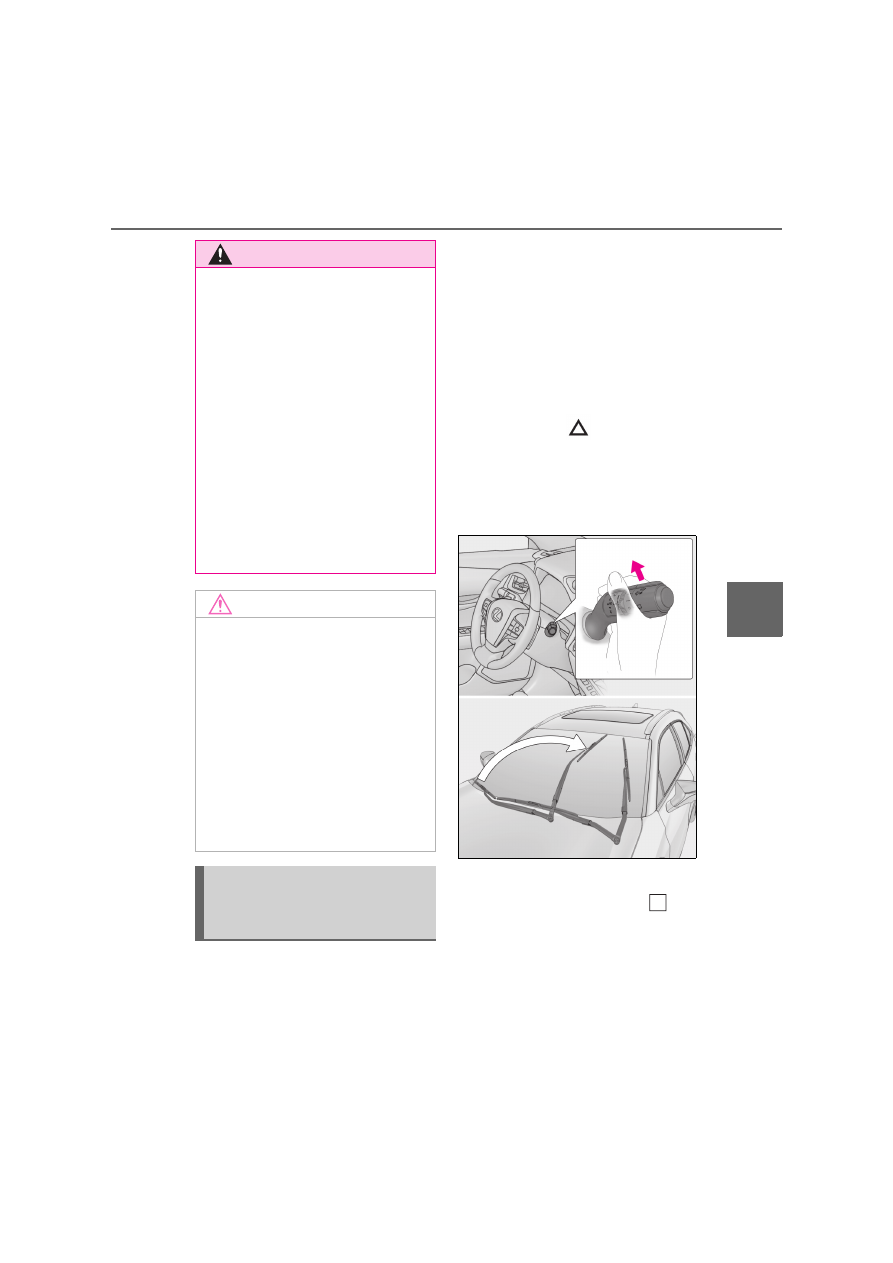
When the windshield wipers are not 
being used, they retract to below the 
hood. To enable the windshield wipers 
to be lifted when parking in cold condi-

tions or when replacing a windshield 
wiper insert, change the rest position of 
the windshield wipers to the service 
position using the wiper lever.

Q

Raising the wipers to the service 
position

Within approximately 45 seconds of 
turning the power switch off, move the 
wiper lever to the 

 position and 

hold it for approximately 2 seconds or 
more.

The wipers will move to the service posi-
tion.

Q

Lifting the windshield wipers

While holding the hook portion 

 of 

the wiper arm, lift the windshield wiper 
from the windshield.

WARNING

Q

Caution regarding the use of wind-

shield wipers in AUTO mode (vehi-

cles with rain-sensing windshield 

wipers)

The windshield wipers may operate 

unexpectedly if the sensor is touched or 

the windshield is subject to vibration in 

AUTO mode. Take care that your fin-

gers, etc. do not become caught in the 

windshield wipers.

Q

Caution regarding the use of washer 

fluid

When it is cold, do not use the washer 

fluid until the windshield becomes warm. 

The fluid may freeze on the windshield 

and cause low visibility. This may lead to 

an accident, resulting in death or serious 

injury.

NOTICE

Q

When the washer fluid tank is empty

Do not operate the switch continually as 

the washer fluid pump may overheat.

Q

When a nozzle becomes blocked

In this case, contact any authorized 

Lexus retailer or Lexus authorized 

repairer, or any reliable repairer.

Do not try to clear it with a pin or other 

object. The nozzle will be damaged.

Q

To prevent 12-volt battery discharge

Do not leave the wipers on longer than 

necessary when the EV system is off.

Changing the windshield wiper 
rest position/Lifting the wind-
shield wipers

A

254

5-3. Operating the lights and wipers

Q

Lowering the windshield wipers to the 

retracted position

With the windshield wipers placed on the 

windshield, turn the power switch to ON 

and then move the wiper lever to an operat-

ing position. When the wiper switch is 

turned off, the windshield wipers will stop at 

the retracted position. Even if the wipers 

deviate while the power switch is OFF, the 

wipers will return to the normal position.

NOTICE

Q

When lifting the windshield wipers

O

Do not lift the windshield wipers when 

they are in the retracted position 

below the hood. Otherwise, they may 

contact the hood, possibly resulting in 

damage to a windshield wiper and/or 

the hood.

O

Do not lift a windshield wiper by the 

wiper blade. Otherwise, the wiper 

blade may be deformed.

O

Do not operate the wiper lever when 

the windshield wipers are lifted. Oth-

erwise, the windshield wipers may 

contact the hood, possibly resulting in 

damage to the windshield wipers 

and/or hood.

255

5

5-3. Operating the lights and wipers

Dr

ivin
g

Operating the 

 switch operates 

the rear wiper as follows:

1

 Off

2

 Intermittent operation

3

 Normal operation

4

 Washer/wiper dual opera-

tion

Pushing the lever operates the wiper and 
washer.
The wiper will automatically operate a cou-
ple of times after the washer squirts.

Q

The rear window wiper and washer can 

be operated when

The power switch is in ON.

Q

If no windshield washer fluid sprays

Check that the washer nozzles are not 

blocked, if there is washer fluid in the 

washer fluid tank.

Q

Reverse-linked rear window wiper 

function

When the shift position is shifted to R when 

the front wipers are operating, the rear win-

dow wiper will operate once.

Q

Back door opening linked rear window 

wiper stop function

When the rear window wiper is operating, if 

the back door is opened while the vehicle is 

stopped, operation of the rear window 

wiper will be stopped to prevent anyone 

near the vehicle from being sprayed by 

water from the wiper. When the back door 
is closed, wiper operation will resume.

*

*

: The setting must be customized at any 

authorized Lexus retailer or Lexus autho-
rized repairer, or any reliable repairer.

Q

Customization

Setting of the reverse-linked function can 

Rear window wiper and 
washer

The rear window wiper and washer 
can be used by operating the lever.

NOTICE

Q

When the rear window is dry

Do not use the wiper, as it may damage 

the rear window.

Operating the wiper lever

256

5-3. Operating the lights and wipers

be changed. (Customizable fea-

tures:

P.482)

NOTICE

Q

When the washer fluid tank is empty

Do not operate the switch continually as 

the washer fluid pump may overheat.

Q

When a nozzle becomes blocked

In this case, contact any authorized 

Lexus retailer or Lexus authorized 

repairer, or any reliable repairer.

Do not try to clear it with a pin or other 

object. The nozzle will be damaged.

Q

To prevent 12-volt battery discharge

Do not leave the wiper on longer than 

necessary when the EV system is off.

257

5

5-4. Using the driving support systems

Dr

ivin
g

5-4.Using the driving support systems

Q

PCS (Pre-Collision System)

P.262

Q

LTA (Lane Tracing Assist)

P.269

Q

AHS (Adaptive High-beam Sys-
tem)

*

P.242

Q

AHB (Automatic High Beam)

*

P.246

Q

RSA (Road Sign Assist)

P.278

Q

Dynamic radar cruise control with 
full-speed range

P.282

*

: If equipped

Two types of sensors, located behind 
the front grille and windshield, detect 
information necessary to operate the 
drive assist systems.

Radar sensor

Front camera

Lexus Safety System +

The Lexus Safety System + consists 
of the following drive assist systems 
and contributes to a safe and com-
fortable driving experience:

Driving assist system

WARNING

Q

Lexus Safety System +

The Lexus Safety System + is designed to 

operate under the assumption that the 

driver will drive safely, and is designed to 

help reduce the impact to the occupants 

and the vehicle in the case of a collision 

or assist the driver in normal driving con-

ditions.
As there is a limit to the degree of recog-

nition accuracy and control performance 

that this system can provide, do not 

overly rely on this system. The driver is 

always responsible for paying attention 

to the vehicle’s surroundings and driving 

safely.

Sensors

A
B

258

5-4. Using the driving support systems

WARNING

Q

To avoid malfunction of the radar sen-

sor

Observe the following precautions.
Otherwise, the radar sensor may not 

operate properly, possibly leading to an 

accident resulting in death or serious 

injury.

O

Keep the radar sensor and the radar 

sensor cover clean at all times.

Radar sensor

Radar sensor cover

If the front of the radar sensor or the front 
or back of the radar sensor cover is dirty 
or covered with water droplets, snow, 
etc., clean it.
Clean the radar sensor and radar sensor 
cover with a soft cloth to avoid damaging 
them.

O

Do not attach accessories, stickers 

(including transparent stickers) or 

other items to the radar sensor, radar 

sensor cover or surrounding area.

O

Do not subject the radar sensor or its 

surrounding area to a strong impact. 

If the radar sensor, front grille, or front 

bumper has been subjected to a 

strong impact, have the vehicle 

inspected by any authorized Lexus 

retailer or Lexus authorized repairer, 

or any reliable repairer.

O

Do not disassemble the radar sensor.

A

B

O

Do not modify or paint the radar sen-

sor or radar sensor cover.

O

In the following cases, the radar sensor 

must be recalibrated. Contact any 

authorized Lexus retailer or Lexus 

authorized repairer, or any reliable 

repairer for details.

• When the radar sensor or front grille 

are removed and installed, or replaced

• When the front bumper is replaced

Q

To avoid malfunction of the front 

camera

Observe the following precautions.
Otherwise, the front camera may not 

operate properly, possibly leading to an 

accident resulting in death or serious 

injury.

O

Keep the windshield clean at all times.

• If the windshield is dirty or covered 

with an oily film, water droplets, snow, 

etc., clean the windshield.

• If a glass coating agent is applied to the 

windshield, it will still be necessary to 

use the windshield wipers to remove 

water droplets, etc. from the area of 

the windshield in front of the front 

camera.

• If the inner side of the windshield 

where the front camera is installed is 

dirty, contact any authorized Lexus 

retailer or Lexus authorized repairer, 

or any reliable repairer.

259

5

5-4. Using the driving support systems

Dr

ivin
g

WARNING

O

Do not attach objects, such as stickers, 

transparent stickers, etc., to the outer 

side of the windshield in front of the 

front camera (shaded area in the illus-

tration).

From the top of the windshield to 
approximately 1 cm (0.4 in.) below 
the bottom of the front camera

Approximately 20 cm (7.9 in.) 
(Approximately 10 cm [4.0 in.] to the 
right and left from the center of the 
front camera)

O

If the part of the windshield in front of 

the front camera is fogged up or cov-

ered with condensation, or ice, use the 

windshield defogger to remove the 

fog, condensation, or ice. (

P.347)

O

If water droplets cannot be properly 

removed from the area of the wind-

shield in front of the front camera by 

the windshield wipers, replace the 

wiper insert or wiper blade.

O

Do not attach window tint to the wind-

shield.

O

Replace the windshield if it is damaged 

or cracked. 

After replacing the windshield, the 

front camera must be recalibrated. 

Contact any authorized Lexus retailer 

or Lexus authorized repairer, or any 

reliable repairer for details.

O

Do not allow liquids to contact the 

front camera.

A

B

O

Do not allow bright lights to shine into 

the front camera.

O

Do not dirty or damage the front cam-

era. 

When cleaning the inside of the wind-

shield, do not allow glass cleaner to 

contact the lens of the front camera. 

Also, do not touch the lens. 

If the lens is dirty or damaged, contact 

any authorized Lexus retailer or Lexus 

authorized repairer, or any reliable 

repairer.

O

Do not subject the front camera to a 

strong impact.

O

Do not change the installation position 

or direction of the front camera or 

remove it.

O

Do not disassemble the front camera.

O

Do not modify any components of the 

vehicle around the front camera 

(inside rear view mirror, etc.) or ceil-

ing.

O

Do not attach any accessories to the 

hood, front grille or front bumper that 

may obstruct the front camera. Con-

tact any authorized Lexus retailer or 

Lexus authorized repairer, or any reli-

able repairer for details.

O

If a surfboard or other long object is to 

be mounted on the roof, make sure 

that it will not obstruct the front cam-

era.

O

Do not modify the headlights or other 

lights.

260

5-4. Using the driving support systems

Q

If a warning message is displayed on the multi-information display

A system may be temporarily unavailable or there may be a malfunction in the system.

O

In the following situations, perform the actions specified in the table. When the normal 

operating conditions are detected, the message will disappear and the system will 

become operational.

If the message does not disappear, contact any authorized Lexus retailer or Lexus autho-
rized repairer, or any reliable repairer.

O

In the following situations, if the situation has changed (or the vehicle has been driven for 

some time) and the normal operating conditions are detected, the message will disap-

pear and the system will become operational.

If the message does not disappear, contact any authorized Lexus retailer or Lexus autho-
rized repairer, or any reliable repairer.
• When the temperature around the radar sensor is outside of the operational range, such 

Situation

Actions

When the area around a camera is covered 
with dirt, moisture (fogged up, covered with 
condensation, ice, etc.), or other foreign 
matter

Using the wiper and A/C function, remove 
the dirt and other attached matter. 
(

P.347)

When the temperature around the front 
camera is outside of the operational range, 
such as when the vehicle is in the sun or in an 
extremely cold environment

If the front camera is hot, such as after the 
vehicle had been parked in the sun, use the 
air conditioning system to decrease the tem-
perature around the front camera.
If a sunshade was used when the vehicle was 
parked, depending on its type, the sunlight 
reflected from the surface of the sunshade 
may cause the temperature of the front cam-
era to become excessively high.

If the front camera is cold, such after the 
vehicle is parked in an extremely cold envi-
ronment, use the air conditioning system to 
increase the temperature around the front 
camera.

The area in front of the front camera is 
obstructed, such as when the hood is open 
or a sticker is attached to the part of the 
windshield in front of the front camera.

Close the hood, remove the sticker, etc. to 
clear the obstruction.

When “Pre-Collision System Unavailable” is 
displayed.

Check whether there is attached materials 
on the radar sensor and radar sensor cover, 
and if there is, remove it.

261

5

5-4. Using the driving support systems

Dr

ivin
g

as when the vehicle is in the sun or in an extremely cold environment

• When the front camera cannot detect objects in front of the vehicle, such as when driving 

in the dark, snow, or fog, or when bright lights are shining into the front camera

• Depending on the conditions in the vicinity of the vehicle, the radar may judge the sur-

rounding environment can not be properly recognized. In that case, “Pre-Collision Sys-

tem Unavailable” is displayed.

262

5-4. Using the driving support systems

The system can detect the following:

Vehicles

Bicyclists

Pedestrians

Q

Pre-collision warning

When the system determines that the 
possibility of a frontal collision is high, a 
buzzer will sound and a warning mes-
sage will be displayed on the multi-

information display to urge the driver 
to take evasive action.

Q

Pre-collision brake assist

When the system determines that the 
possibility of a frontal collision is high, 
the system applies greater braking 
force in relation to how strongly the 
brake pedal is depressed.

Q

Pre-collision braking

If the system determines that the possi-
bility of a frontal collision is extremely 
high, the brakes are automatically 
applied to help avoid the collision or 
reduce the impact of the collision.

PCS (Pre-Collision System)

The pre-collision system uses a 
radar sensor and front camera to 
detect objects (

P.262) in front of 

the vehicle. When the system deter-
mines that the possibility of a frontal 
collision with an object is high, a 
warning operates to urge the driver 
to take evasive action and the 
potential brake pressure is 
increased to help the driver avoid 
the collision. If the system deter-
mines that the possibility of a frontal 
collision with an object is extremely 
high, the brakes are automatically 
applied to help avoid the collision or 
help reduce the impact of the colli-
sion.

The pre-collision system can be dis-
abled/enabled and the warning tim-
ing can be changed. (

P.264)

Detectable objects

System functions

WARNING

Q

Limitations of the pre-collision sys-

tem

O

The driver is solely responsible for safe 

driving. Always drive safely, taking 

care to observe your surroundings. Do 

not use the pre-collision system 

instead of normal braking operations 

under any circumstances. This system 

will not prevent collisions or lessen col-

lision damage or injury in every situa-

tion. Do not overly rely on this system. 

Failure to do so may lead to an acci-

dent, resulting in death or serious 

injury.

263

5

5-4. Using the driving support systems

Dr

ivin
g

WARNING

O

Although this system is designed to 

help avoid a collision or help reduce 

the impact of the collision, its effective-

ness may change according to various 

conditions, therefore the system may 

not always be able to achieve the same 

level of performance. Read the follow-

ing conditions carefully. Do not overly 

rely on this system and always drive 

carefully.

• Conditions under which the system 

may operate even if there is no possi-

bility of a collision: 

P.266

• Conditions under which the system 

may not operate properly: 

P.267

O

Do not attempt to test the operation of 

the pre-collision system yourself. 

Depending on the objects used for 

testing (dummies, cardboard objects 

imitating detectable objects, etc.), the 

system may not operate properly, pos-

sibly leading to an accident.

Q

Pre-collision braking

O

When the pre-collision braking func-

tion is operating, a large amount of 

braking force will be applied.

O

If the vehicle is stopped by the opera-

tion of the pre-collision braking func-

tion, the pre-collision braking function 

operation will be canceled after 

approximately 2 seconds. Depress the 

brake pedal as necessary.

O

The pre-collision braking function may 

not operate if certain operations are 

performed by the driver. If the acceler-

ator pedal is being depressed strongly 

or the steering wheel is being turned, 

the system may determine that the 

driver is taking evasive action and pos-

sibly prevent the pre-collision braking 

function from operating.

O

In some situations, while the pre-colli-

sion braking function is operating, 

operation of the function may be can-

celed if the accelerator pedal is 

depressed strongly or the steering 

wheel is turned and the system deter-

mines that the driver is taking evasive 

action.

O

If the brake pedal is being depressed, 

the system may determine that the 

driver is taking evasive action and pos-

sibly delay the operation timing of the 

pre-collision braking function.

Q

When to disable the pre-collision sys-

tem

In the following situations, disable the 

system, as it may not operate properly, 

possibly leading to an accident resulting 

in death or serious injury:

O

When the vehicle is being towed

O

When your vehicle is towing another 

vehicle

O

When transporting the vehicle via 

truck, boat, train or similar means of 

transportation

O

When the vehicle is raised on a lift with 

the EV system on and the tires are 

allowed to rotate freely

O

When inspecting the vehicle using a 

drum tester such as a chassis 

dynamometer or speedometer tester, 

or when using an on vehicle wheel bal-

ancer

O

When a strong impact is applied to the 

front bumper or front grille, due to an 

accident or other reasons

O

If the vehicle cannot be driven in a sta-

ble manner, such as when the vehicle 

has been in an accident or is malfunc-

tioning

O

When the vehicle is driven in a sporty 

manner or off-road

264

5-4. Using the driving support systems

Q

Enabling/disabling the pre-colli-
sion system

The pre-collision system can be 
enabled/disabled on 

 (

P.164) of 

the multi-information display.

The system is automatically enabled each 
time the power switch is turned to ON.

If the system is disabled, the PCS warn-
ing light will turn on and a message will 
be displayed on the multi-information 
display.

Q

Changing the pre-collision warn-
ing timing

The pre-collision warning timing can 
be changed on 

 (

P.164) of the 

multi-information display.

The warning timing setting is retained 
when the power switch is turned off. How-
ever, if the pre-collision system is disabled 
and re-enabled, the operation timing will 
return to the default setting (middle).

1

Early

2

Middle

This is the default setting.

3

Late

Q

Operational conditions

The pre-collision system is enabled and the system determines that the possibility of a fron-

WARNING

O

When the tires are not properly 

inflated

O

When the tires are very worn

O

When tires of a size other than speci-

fied are installed

O

When tire chains are installed

O

When a compact spare tire or an 

emergency tire puncture repair kit is 

used

O

If equipment (snow plow, etc.) that 

may obstruct the radar sensor or front 

camera is temporarily installed to the 

vehicle

Changing settings of the pre-
collision system

265

5

5-4. Using the driving support systems

Dr

ivin
g

tal collision with a detected object is high.
Each function is operational at the following speed

O

Pre-collision warning

O

Pre-collision brake assist

O

Pre-collision braking

The system may not operate in the following situations:

O

If a 12-volt battery terminal has been disconnected and reconnected and then the vehicle 

has not been driven for a certain amount of time

O

If the shift position is in R

O

When the VSC OFF indicator is illuminated (only the pre-collision warning function will 

be operational)

Q

Object detection function

The system detects objects based on their 

size, profile, motion, etc. However, an 

object may not be detected depending on 

the surrounding brightness and the motion, 

posture, and angle of the detected object, 

preventing the system from operating 

properly. (

P.267) 

The illustration shows an image of detect-

able objects.

Detectable objects

Vehicle speed

Relative speed between your 

vehicle and object

Vehicles

Approx. 10 to 180 km/h (7 to 

110 mph)

Approx. 10 to 180 km/h (7 to 

110 mph)

Bicyclists and pedestrians

Approx. 10 to 80 km/h (7 to 

50 mph)

Approx. 10 to 80 km/h (7 to 

50 mph)

Detectable objects

Vehicle speed

Relative speed between your 

vehicle and object

Vehicles

Approx. 30 to 180 km/h (20 

to 110 mph)

Approx. 30 to 180 km/h (20 

to 110 mph)

Bicyclists and pedestrians

Approx. 30 to 80 km/h (20 

to 50 mph)

Approx. 30 to 80 km/h (20 

to 50 mph)

Detectable objects

Vehicle speed

Relative speed between your 

vehicle and object

Vehicles

Approx. 10 to 180 km/h (7 to 

110 mph)

Approx. 10 to 180 km/h (7 to 

110 mph)

Bicyclists and pedestrians

Approx. 10 to 80 km/h (7 to 

50 mph)

Approx. 10 to 80 km/h (7 to 

50 mph)

266

5-4. Using the driving support systems

Q

Cancelation of the pre-collision braking

If either of the following occur while the 

pre-collision braking function is operating, 

it will be canceled:

O

The accelerator pedal is depressed 

strongly.

O

The steering wheel is turned sharply or 

abruptly.

Q

Conditions under which the system may 

operate even if there is no possibility of a 

collision

O

In some situations such as the following, 

the system may determine that there is a 

possibility of a frontal collision and oper-

ate.

• When passing a detectable object, etc.

• When changing lanes while overtaking a 

detectable object, etc.

• When approaching a detectable object 

in an adjacent lane or on the roadside, 

such as when changing the course of 

travel or driving on a winding road

• When rapidly closing on a detectable 

object, etc.

• When approaching objects on the road-

side, such as detectable objects, guard-

rails, utility poles, trees, or walls

• When there is a detectable object or 

other object by the roadside at the 

entrance of a curve

• When there are patterns or paint in front 

of your vehicle that may be mistaken for a 

detectable object

• When the front of your vehicle is hit by 

water, snow, dust, etc.

• When overtaking a detectable object 

that is changing lanes or making a 

right/left turn

• When passing a detectable object in an 

oncoming lane that is stopped to make a 

right/left turn

• When a detectable object approaches 

very close and then stops before entering 

the path of your vehicle

• If the front of your vehicle is raised or low-

ered, such as when on an uneven or 

undulating road surface

• When driving on a road surrounded by a 

structure, such as in a tunnel or on an iron 

bridge

• When there is a metal object (manhole 

cover, steel plate, etc.), steps, or a protru-

sion in front of your vehicle

• When passing under an object (road 

267

5

5-4. Using the driving support systems

Dr

ivin
g

sign, billboard, etc.)

• When approaching an electric toll gate 

barrier, parking area barrier, or other 

barrier that opens and closes

• When using an automatic car wash

• When driving through or under objects 

that may contact your vehicle, such as 

thick grass, tree branches, or a banner

• When driving through steam or smoke

• When driving near an object that reflects 

radio waves, such as a large truck or 

guardrail

• When driving near a TV tower, broad-

casting station, electric power plant, or 

other location where strong radio waves 

or electrical noise may be present

Q

Situations in which the system may not 

operate properly

O

In some situations such as the following, 

an object may not be detected by the 

radar sensor and front camera, prevent-

ing the system from operating properly:

• When a detectable object is approaching 

your vehicle

• When your vehicle or a detectable object 

is wobbling

• If a detectable object makes an abrupt 

maneuver (such as sudden swerving, 

acceleration or deceleration)

• When your vehicle approaches a detect-

able object rapidly

• When a detectable object is not directly 

in front of your vehicle

• When a detectable object is near a wall, 

fence, guardrail, manhole cover, vehicle, 

steel plate on the road, etc.

• When a detectable object is under a 

structure

• When part of a detectable object is hid-

den by an object, such as large baggage, 

an umbrella, or guardrail

• When multiple detectable objects are 

close together

• If the sun or other light is shining directly 

on a detectable object

• When a detectable object is a shade of 

white and looks extremely bright

• When a detectable object appears to be 

nearly the same color or brightness as its 

surroundings

• If a detectable object cuts or suddenly 

emerges in front of your vehicle

• When the front of your vehicle is hit by 

water, snow, dust, etc.

• When a very bright light ahead, such as 

the sun or the headlights of oncoming 

traffic, shines directly into the front cam-

era

• When approaching the side or front of a 

vehicle ahead

• If a vehicle ahead is a motorcycle

• If a vehicle ahead is narrow, such as a 

personal mobility vehicle

• If a preceding vehicle has a small rear 

end, such as an unloaded truck

• If a preceding vehicle has a low rear end, 

such as a low bed trailer

268

5-4. Using the driving support systems

• If a vehicle ahead has extremely high 

ground clearance

• If a vehicle ahead is carrying a load which 

protrudes past its rear bumper

• If a vehicle ahead is irregularly shaped, 

such as a tractor or side car

• If a vehicle ahead is a child sized bicycle, 

a bicycle that is carrying a large load, a 

bicycle ridden by more than one person, 

or a uniquely shaped bicycle (bicycle with 

a child seat, tandem bicycle, etc.)

• If a pedestrian/or the riding height of a 

bicyclist ahead is shorter than approxi-

mately 1 m (3.2 ft.) or taller than approxi-

mately 2 m (6.5 ft.)

• If a pedestrian/bicyclist is wearing over-

sized clothing (a rain coat, long skirt, 

etc.), making their silhouette obscure

• If a pedestrian is bending forward or 

squatting or bicyclist is bending forward

• If a pedestrian/bicyclist is moving fast

• If a pedestrian is pushing a stroller, 

wheelchair, bicycle or other vehicle

• When driving in inclement weather such 

as heavy rain, fog, snow or a sandstorm

• When driving through steam or smoke

• When the surrounding area is dim, such 

as at dawn or dusk, or while at night or in 

a tunnel, making a detectable object 

appear to be nearly the same color as its 

surroundings

• When driving in a place where the sur-

rounding brightness changes suddenly, 

such as at the entrance or exit of a tunnel

• After the EV system has started the vehi-

cle has not been driven for a certain 

amount of time

• While making a left/right turn and for a 

few seconds after making a left/right turn

• While driving on a curve and for a few 

seconds after driving on a curve

• If your vehicle is skidding

• If the front of the vehicle is raised or low-

ered

• If the wheels are misaligned

• If a wiper blade is blocking the front cam-

era

• The vehicle is being driven at extremely 

high speeds

• When driving on a hill

• If the radar sensor or front camera is mis-

aligned

O

In some situations such as the following, 

sufficient braking force may not be 

obtained, preventing the system from 

performing properly:

• If the braking functions cannot operate to 

their full extent, such as when the brake 

parts are extremely cold, extremely hot, 

or wet

• If the vehicle is not properly maintained 

(brakes or tires are excessively worn, 

improper tire inflation pressure, etc.)

• When the vehicle is being driven on a 

gravel road or other slippery surface

Q

If VSC is disabled

O

If VSC is disabled (

P.329), the pre-

collision brake assist and pre-collision 

braking functions are also disabled.

O

The PCS warning light will turn on and 

“VSC Turned Off Pre-Collision Brake 

System Unavailable” will be displayed on 

the multi-information display.

269

5

5-4. Using the driving support systems

Dr

ivin
g

LTA (Lane Tracing Assist)

While driving on a road with clear 
white (yellow) lane lines, the LTA 
system warns the driver if the vehi-
cle may deviate from the current 
lane or course

*

, and also can 

slightly operate the steering wheel 
to help avoid deviation from the 
lane or course

*

. Also, while the 

dynamic radar cruise control with 
full-speed range is operating, this 
system will operate the steering 
wheel to maintain the vehicle’s lane 
position.

The LTA system recognizes white 
(yellow) lane lines or a course

*


using the front camera. Addition-
ally, it detects preceding vehicles 
using the front camera and radar.

*

: Boundary between asphalt and the 

side of the road, such as grass, soil, or 
a curb

WARNING

Q

Before using LTA system

O

Do not rely solely upon the LTA sys-

tem. The LTA system does not auto-

matically drive the vehicle or reduce 

the amount of attention that must be 

paid to the area in front of the vehicle. 

The driver must always assume full 

responsibility for driving safely by pay-

ing careful attention to the surround-

ing conditions and operating the 

steering wheel to correct the path of 

the vehicle. Also, the driver must take 

adequate breaks when fatigued, such 

as from driving for a long period of 

time.

O

Failure to perform appropriate driving 

operations and pay careful attention 

may lead to an accident, resulting in 

death or serious injury.

O

When not using the LTA system, use 

the LTA switch to turn the system off.

Q

Situations unsuitable for LTA system

In the following situations, use the LTA 

switch to turn the system off. Failure to do 

so may lead to an accident, resulting in 

death or serious injury.

O

Vehicle is driven on a road surface 

which is slippery due to rainy weather, 

fallen snow, freezing, etc.

O

Vehicle is driven on a snow-covered 

road.

O

White (yellow) lines are difficult to see 

due to rain, snow, fog, dust, etc.

O

Vehicle is driven in a temporary lane 

or restricted lane due to construction 

work.

O

Vehicle is driven in a construction 

zone.

O

A spare tire, tire chains, etc. are 

equipped.

270

5-4. Using the driving support systems

WARNING

O

When the tires have been excessively 

worn, or when the tire inflation pres-

sure is low.

O

During emergency towing

Q

Preventing LTA system malfunctions 

and operations performed by mistake

O

Do not modify the headlights or place 

stickers, etc. on the surface of the 

lights.

O

Do not modify the suspension etc. If 

the suspension etc. needs to be 

replaced, contact any authorized 

Lexus retailer or Lexus authorized 

repairer, or any reliable repairer.

O

Do not install or place anything on the 

hood or grille. Also, do not install a 

grille guard (bull bars, kangaroo bar, 

etc.).

O

If your windshield needs repairs, con-

tact any authorized Lexus retailer or 

Lexus authorized repairer, or any reli-

able repairer.

Q

Conditions in which functions may 

not operate properly

In the following situations, the functions 

may not operate properly and the vehi-

cle may depart from its lane. Drive safely 

by always paying careful attention to 

your surroundings and operate the 

steering wheel to correct the path of the 

vehicle without relying solely on the func-

tions.

O

When the follow-up cruising display is 

displayed (

P.274) and the preced-

ing vehicle changes lanes. (Your vehi-

cle may follow the preceding vehicle 

and also change lanes.)

O

When the follow-up cruising display is 

displayed (

P.274) and the preced-

ing vehicle is swaying. (Your vehicle 

may sway accordingly and depart from 

the lane.)

O

When the follow-up cruising display is 

displayed (

P.274) and the preced-

ing vehicle departs from its lane. (Your 

vehicle may follow the preceding vehi-

cle and depart from the lane.)

O

When the follow-up cruising display is 

displayed (

P.274) and the preced-

ing vehicle is being driven extremely 

close to the left/right lane line. (Your 

vehicle may follow the preceding vehi-

cle and depart from the lane.)

O

Vehicle is being driven around a sharp 

curve.

271

5

5-4. Using the driving support systems

Dr

ivin
g

WARNING

O

Objects or patterns that could be mis-

taken for white (yellow) lines are pres-

ent on the side of the road (guardrails, 

reflective poles, etc.).

O

Vehicle is driven where the road 

diverges, merges, etc.

O

Repair marks of asphalt, white (yellow) 

lines, etc. are present due to road 

repair.

O

There are shadows on the road that 

run parallel with, or cover, the white 

(yellow) lines.

O

The vehicle is driven in an area without 

white (yellow) lines, such as in front of 

a tollgate or checkpoint, or at an inter-

section, etc.

O

The white (yellow) lines are cracked, 

“Raised pavement marker” or stones 

are present.

O

The white (yellow) lines cannot be 

seen or are difficult to see due to sand, 

etc.

O

The vehicle is driven on a road surface 

that is wet due to rain, puddles, etc.

O

The traffic lines are yellow (which may 

be more difficult to recognize than 

lines that are white).

O

The white (yellow) lines cross over a 

curb, etc.

O

The vehicle is driven on a bright sur-

face, such as concrete.

O

If the edge of the road is not clear or 

straight.

O

The vehicle is driven on a surface that 

is bright due to reflected light, etc.

O

The vehicle is driven in an area where 

the brightness changes suddenly, such 

as at the entrances and exits of tunnels, 

etc.

O

Light from the headlights of an oncom-

ing vehicle, the sun, etc. enters the 

camera.

O

The vehicle is driven on a slope.

O

The vehicle is driven on a road which 

tilts left or right, or a winding road.

O

The vehicle is driven on an unpaved or 

rough road.

O

The traffic lane is excessively narrow 

or wide.

O

The vehicle is extremely tilted due to 

carrying heavy luggage or having 

improper tire pressure.

272

5-4. Using the driving support systems

Q

Lane departure alert function

When the system determines that the 
vehicle might depart from its lane or 
course

*

, a warning is displayed on the 

multi-information display, and either a 
warning buzzer will sound or the steer-
ing wheel will vibrate to alert the driver.
When the warning buzzer sounds or 
the steering wheel vibrates, check the 
area around your vehicle and carefully 

operate the steering wheel to move the 
vehicle back to the center of the lane.
Vehicle with BSM: When the system 
determines that the vehicle might 
depart from its lane and that the possi-
bility of a collision with an overtaking 
vehicle in the adjacent lane is high, the 
lane departure alert will operate even if 
the turn signals are operating.

*

: Boundary between asphalt and the side 

of the road, such as grass, soil, or a curb

Q

Steering assist function

When the system determines that the 
vehicle might depart from its lane or 
course

*

, the system provides assis-

tance as necessary by operating the 
steering wheel in small amounts for a 
short period of time to keep the vehicle 
in its lane.
If the system detects that the steering 
wheel has not been operated for a 

WARNING

O

The distance to the preceding vehicle 

is extremely short.

O

The vehicle is moving up and down a 

large amount due to road conditions 

during driving (poor roads or road 

seams).

O

When driving in a tunnel or at night 

with the headlights off or when a head-

light is dim due to its lens being dirty or 

it being misaligned.

O

The vehicle is struck by a crosswind.

O

The vehicle is affected by wind from a 

vehicle driven in a nearby lane.

O

The vehicle has just changed lanes or 

crossed an intersection.

O

Tires which differ by structure, manu-

facturer, brand or tread pattern are 

used.

O

When tires of a size other than speci-

fied are installed.

O

Snow tires, etc. are equipped.

O

The vehicle is being driven at 

extremely high speeds.

Functions included in LTA sys-
tem

273

5

5-4. Using the driving support systems

Dr

ivin
g

fixed amount of time or the steering 
wheel is not being firmly gripped, a 
warning is displayed on the multi-infor-
mation display and the function is tem-
porarily canceled.
Vehicle with BSM: When the system 
determines that the vehicle might 
depart from its lane and that the possi-
bility of a collision with an overtaking 
vehicle in the adjacent lane is high, the 
steering assist function will operate 
even if the turn signals are operating.

*

: Boundary between asphalt and the side 

of the road, such as grass, soil, or a curb

Q

Vehicle sway warning function

When the vehicle is swaying within a 
lane, the warning buzzer will sound 
and a message will be displayed on the 
multi-information display to alert the 
driver.

Q

Lane centering function

This function is linked with dynamic 
radar cruise control with full-speed 
range and provides the required assis-
tance by operating the steering wheel 
to keep the vehicle in its current lane.
When dynamic radar cruise control 
with full-speed range is not operating, 
the lane centering function does not 
operate.
In situations where the white (yellow) 
lane lines are difficult to see or are not 
visible, such as when in a traffic jam, this 
function will operate to help follow a 
preceding vehicle by monitoring the 
position of the preceding vehicle.
If the system detects that the steering 
wheel has not been operated for a 
fixed amount of time or the steering 
wheel is not being firmly gripped, a 
warning is displayed on the multi-infor-

274

5-4. Using the driving support systems

mation display and the function is tem-
porarily canceled.

Press the LTA switch to turn the LTA 
system on.
The LTA indicator illuminates and a 
message is displayed on the multi-
information display.
Press the LTA switch again to turn the 
LTA system off.
When the LTA system is turned on or 
off, operation of the LTA system con-
tinues in the same condition the next 
time the EV system is started.

LTA indicator

The illumination condition of the indicator 
informs the driver of the system operation 
status.
Illuminated in white:
LTA system is operating.
Illuminated in green:
Steering wheel assistance of the steering 
assist function or lane centering function is 
operating.
Flashing in orange:
Lane departure alert function is operating.

Operation display of steering 
wheel operation support

Displayed when the multi-information dis-
play is switched to the driving support sys-
tem information display.
Indicates that steering wheel assistance of 

Turning LTA system on

Indications on multi-information 
display

A

B

275

5

5-4. Using the driving support systems

Dr

ivin
g

the steering assist function or lane center-
ing function is operating.
Both outer sides of the lane are displayed:
Indicates that steering wheel assist of the 
lane centering function is operating.
One outer side of the lane is displayed:
Indicates that steering wheel assist of the 
steering assist function is operating.
Both outer sides of the lane are flashing:
Alerts the driver that their input is neces-
sary to stay in the center of the lane (lane 
centering function).

Follow-up cruising display

Displayed when the multi-information dis-
play is switched to the driving support sys-
tem information display.
Indicates that steering assist of the lane 
centering function is operating by monitor-
ing the position of a preceding vehicle.
When the follow-up cruising display is dis-
played, if the preceding vehicle moves, 
your vehicle may move in the same way. 
Always pay careful attention to your sur-
roundings and operate the steering wheel 
as necessary to correct the path of the 
vehicle and ensure safety.

Lane departure alert function dis-
play

Displayed when the multi-information dis-
play is switched to the driving support sys-
tem information display.

Inside of displayed lines is white

Indicates that the system is recognizing 
white (yellow) lines or a course

*

. When the 

vehicle departs from its lane, the white line 
displayed on the side the vehicle departs 
from flashes orange.

Inside of displayed lines is black

Indicates that the system is not able to rec-
ognize white (yellow) lines or a course

*

 or 

is temporarily canceled.

*

: Boundary between asphalt and the side 

of the road, such as grass, soil, or a curb

Q

Operation conditions of each function

O

Lane departure alert function

This function operates when all of the fol-
lowing conditions are met.
• LTA is turned on.

• Vehicle speed is approximately 50 km/h 

(32 mph) or more.

*1

• System recognizes white (yellow) lane 

lines or a course

*2

. (When a white [yel-

C

D

276

5-4. Using the driving support systems

low] line or course

*2

 is recognized on 

only one side, the system will operate 

only for the recognized side.)

• Width of traffic lane is approximately 3 m 

(9.8 ft.) or more.

• Turn signal lever is not operated. (Vehi-

cles with BSM: Except when another 

vehicle is in the lane on the side where 

the turn signal was operated)

• Vehicle is not being driven around a 

sharp curve.

• No system malfunctions are detected. 

(

P.278)

*1

: The function operates even if the vehicle 

speed is less than approximately 50 
km/h (32 mph) when the lane centering 
function is operating.

*2

: Boundary between asphalt and the side 

of the road, such as grass, soil, or a curb

O

Steering assist function

This function operates when all of the fol-
lowing conditions are met in addition to the 
operation conditions for the lane departure 
alert function.
• Setting for “Steering Assist” in 

 of the 

multi-information display is set to “On”. 

(

P.164)

• Vehicle is not accelerated or decelerated 

by a fixed amount or more.

• Steering wheel is not operated with a 

steering force level suitable for changing 

lanes.

• ABS, VSC, TRC and PCS are not oper-

ating.

• TRC or VSC is not turned off.

• Hands off steering wheel warning is not 

displayed. (

P.277)

O

Vehicle sway warning function

This function operates when all of the fol-
lowing conditions are met.
• Setting for “Warning” in 

 of the multi-

information display is set to “On”. 

(

P.164)

• Vehicle speed is approximately 50 km/h 

(32 mph) or more.

• Width of traffic lane is approximately 3 m 

(9.8 ft.) or more.

• No system malfunctions are detected. 

(

P.278)

O

Lane centering function

This function operates when all of the fol-
lowing conditions are met.
• LTA is turned on.

• Setting for “Steering Assist” and “Lane 

Centre” in 

 of the multi-information 

display are set to “On”. (

P.164)

• This function recognizes white (yellow) 

lane lines or the position of a preceding 

vehicle (except when the preceding vehi-

cle is small, such as a motorcycle).

• The dynamic radar cruise control with 

full-speed range is operating in vehicle-

to-vehicle distance control mode.

• Width of traffic lane is approximately 3 to 

4 m (10 to 13 ft.).

• Turn signal lever is not operated.

• Vehicle is not being driven around a 

sharp curve.

• No system malfunctions are detected. 

(

P.278)

• Vehicle does not accelerate or deceler-

ate by a fixed amount or more.

• Steering wheel is not operated with a 

steering force level suitable for changing 

lanes.

• ABS, VSC, TRC and PCS are not oper-

ating.

• TRC or VSC is not turned off.

• Hands off steering wheel warning is not 

displayed. (

P.277)

• The vehicle is being driven in the center 

of a lane.

• Steering assist function is not operating.

Q

Temporary cancelation of functions

O

When operation conditions are no lon-

ger met, a function may be temporarily 

canceled. However, when the operation 

conditions are met again, operation of 

the function is automatically restored. 

(

P.275)

O

If the operation conditions (

P.275) are 

no longer met while the lane centering 

function is operating, the steering wheel 

may vibrate and the buzzer may sound to 

indicate that the function has been tem-

277

5

5-4. Using the driving support systems

Dr

ivin
g

porarily canceled. However, if the Steer-

ing wheel vibration customization setting 

is set to On, the system will notify the 

driver by vibrating the steering wheel 

instead of sounding the buzzer.

Q

Steering assist function/lane centering 

function

O

Depending on the vehicle speed, lane 

departure situation, road conditions, etc., 

the driver may not feel the function is 

operating or the function may not oper-

ate at all.

O

The steering control of the function is 

overridden by the driver’s steering wheel 

operation.

O

Do not attempt to test the operation of 

the steering assist function.

Q

Lane departure alert function

O

The warning buzzer may be difficult to 

hear due to external noise, audio play-

back, etc. Also, it may be difficult to feel 

steering wheel vibrations due to the road 

conditions, etc.

O

If the edge of the course

*

 is not clear or 

straight, the lane departure alert function 

may not operate.

O

Vehicles with BSM: It may not be possi-

ble for the system to determine if there is 

a danger of a collision with a vehicle in an 

adjacent lane.

O

Do not attempt to test the operation of 

the lane departure alert function.

*

: Boundary between asphalt and the side 

of the road, such as grass, soil, or a curb

Q

Hands off steering wheel warning

In the following situations, a warning mes-

sage urging the driver to hold the steering 

wheel and the symbol shown in the illustra-

tion are displayed on the multi-information 

display to warn the driver. The warning 

stops when the system determines that the 

driver holds the steering wheel. Always 

keep your hands on the steering wheel 

when using this system, regardless of warn-

ings.

O

When the system determines that the 

driver is driving without holding the steer-

ing wheel while the system is operating

If the driver continues to keep their hands 
off of the steering wheel, the buzzer sounds, 
the driver is warned and the function is tem-
porarily canceled. This warning also oper-
ates in the same way when the driver 
continuously operates the steering wheel 
only a small amount. The buzzer also 
sounds even if the alert type is set to Steer-
ing wheel vibration.

O

When the system determines that the 

vehicle may deviate from the lane while 

driving around a curve while the lane 

centering function is operating.

Depending on the vehicle condition and 
road conditions, the warning may not oper-
ate. Also, if the system determines that the 
vehicle is driving around a curve, warnings 
will occur earlier than during straight-lane 
driving.

O

When the system determines that the 

driver is driving without holding the steer-

ing wheel while the steering wheel assist 

of the steering assist function is operat-

ing.

If the driver continues to keep their hands 
off of the steering wheel and the steering 
wheel assist is operating, the buzzer sounds 
and the driver is warned. Each time the 
buzzer sounds, the continuing time of the 
buzzer becomes longer.
The buzzer also sounds even if the alert 
type is set to Steering wheel vibration.

278

5-4. Using the driving support systems

Q

Vehicle sway warning function

When the system determines that the vehi-

cle is swaying while the vehicle sway warn-

ing function is operating, a buzzer sounds 

and a warning message urging the driver to 

rest and the symbol shown in the illustration 

are simultaneously displayed on the multi-

information display.

Depending on the vehicle and road condi-

tions, the warning may not operate.

Q

Warning message

If the following warning message is dis-

played on the multi-information display and 

the LTA indicator illuminates in orange, fol-

low the appropriate troubleshooting proce-

dure. Also, if a different warning message is 

displayed, follow the instructions displayed 

on the screen.

O

“LTA Malfunction Visit Your Dealer”

The system may not be operating properly. 
Have the vehicle inspected by any autho-
rized Lexus retailer or Lexus authorized 
repairer, or any reliable repairer.

O

“LTA Unavailable”

The system is temporarily canceled due to a 
malfunction in a sensor other than the front 
camera. Turn the LTA system off, wait for a 
little while, and then turn the LTA system 
back on.

O

“LTA Unavailable at Current Speed”

The function cannot be used as the vehicle 
speed exceeds the LTA operation range. 
Drive slower.

Q

Customization

Function settings can be changed.
(Customizable features: 

P.483)

When the front camera recognizes a 
sign and/or information of a sign is 

RSA (Road Sign Assist)

The RSA system recognizes spe-
cific road signs using the front cam-
era and/or navigation system 
(when speed limit information is 
available) to provide information to 
the driver via the display.

If the system judges that the vehicle 
is being driven over the speed limit, 
performing prohibited actions, etc. 
according to the recognized road 
signs, it notifies the driver through a 
visual notification and notification 
buzzer or steering wheel vibration.

WARNING

Q

Before using the RSA

Do not rely solely upon the RSA system. 

RSA is a system which supports the 

driver by providing information, but it is 

not a replacement for a driver’s own 

vision and awareness. Drive safely by 

always paying careful attention to the 

traffic rules.

Indication on the multi-informa-
tion display

279

5

5-4. Using the driving support systems

Dr

ivin
g

available from the navigation system, 
the sign will be displayed on the multi-
information display.

When the driving support system 
information display is selected, a 
maximum of 3 signs can be dis-
played. (

P.164)

When a tab other than the driving 
support system information display 
is selected, the following types of 
road signs will be displayed. 
(

P.164)

• Speed limit begins/ends sign
• Speed limit related information sign 

(Motorway, Expressway, Urban area, 
Residential area)

• End of prohibition sign

• No-entry  sign

*

 (when notification is nec-

essary)

• Speed limit with supplemental sign 

(Ramp way only)

*

: For vehicles with navigation system

If signs other than speed limit signs are rec-
ognized, they will be displayed in an over-
lapping stack under the current speed limit 
sign.

The following types of road signs, 
including electronic signs and blinking 
signs, are displayed.

A non-official (not meeting the Vienna 
Convention) or a recently introduced traf-
fic sign may not be displayed.

Speed limit road signs

*

: Speed limit begins/Maximum 

speed zone begins

: Speed limit ends/Maximum 

speed zone ends

*

: No speed limit information 

 is dis-

played when speed limit sign or speed 
limit related sign information is not avail-
able.

Speed limit related information

*1, 2

: Motorway entrance

Supported types of road signs

280

5-4. Using the driving support systems

: Motorway exit

: Expressway entrance

: Expressway exit

: Urban area beginning

: Urban area ending

: Urban area beginning

: Urban area ending

: Residential area beginning

: Residential area ending

*1

: Displayed when a sign is recognized 

but speed limit information for the road 
is not available from the navigation sys-
tem

*2

: No speed limit information 

 is dis-

played when speed limit sign or speed 
limit related sign information is not 
available.

No-overtaking road signs

: No overtaking begins

: No overtaking ends

Other road signs

: No-entry

*

: End of prohibition

: Stop

*

: For vehicles with navigation system

Speed limit with supplemental 
mark

*1

: Wet

: Rain

: Ice

: Supplemental mark exists

*2

: Exit ramp on right

*3

: Exit ramp on left

*3

: Time

*1

: Displayed simultaneously with speed 

limit.

*2

: Contents not recognized.

*3

: If the turn signal indicator is not oper-

ated when changing lanes, the mark 
does not display.

281

5

5-4. Using the driving support systems

Dr

ivin
g

In the following situations, the RSA sys-
tem will notify the driver.

When the vehicle speed exceeds 
the speed notification threshold of 
the speed limit sign displayed, the 
sign display will be emphasized and 
a buzzer will sound.

When the RSA system recognizes a 
no-entry sign and detects that the 
vehicle has entered a no-entry area 
based on the map information of the 
navigation system, the no-entry sign 
flashes and a buzzer will sound. (For 
vehicles with navigation system)

If it is detected that your vehicle is 
overtaking when a no overtaking 
sign is displayed on the multi-infor-
mation display, the displayed sign 
will flash and a steering wheel will 
vibrate.
Depending on the situation, traffic 
environment (traffic direction, 
speed unit) may be detected incor-
rectly and a notification function 
may not operate properly.

Q

Setting procedure

1

Press 

 or 

 of the meter control 

switches and select 

2

Press 

 or 

 of the meter control 

switches and select “Vehicle Settings”, 

then press “OK”

3

Press 

 or 

 of the meter control 

switches and select 

, then press 

“OK”

4

Press 

 or 

 of the meter control 

switches and select “RSA”, then press 

“OK”

Q

Automatic turn-off of RSA sign display

One or more signs automatically turn off in 

the following situations.

O

No sign has been recognized for a cer-

tain distance.

O

The road changes due to a left or right 

turn, etc.

Q

Conditions in which the function may 

not operate or detect correctly

In the following situations, RSA does not 

operate normally and may not recognize 

signs, display the incorrect sign, etc. How-

ever, this does not indicate a malfunction.

O

The front camera is misaligned due to a 

strong impact being applied to the sen-

sor, etc.

O

Dirt, snow, stickers, etc. are on the wind-

shield near the front camera.

O

In inclement weather such as heavy rain, 

fog, snow or sand storms.

O

Light from an oncoming vehicle, the sun, 

etc. enters the front camera.

O

The sign is dirty, faded, tilted or bent.

O

The contrast of electronic sign is low.

O

All or part of the sign is hidden by the 

leaves of a tree, a pole, etc.

O

The sign is only visible to the front camera 

for a short amount of time.

O

The driving scene (turning, lane change, 

etc.) is judged incorrectly.

O

If a sign not appropriate for the currently 

traveled lane, but the sign exists directly 

after a freeway branches, or in an adja-

cent lane just before merging.

O

Stickers are attached to the rear of the 

preceding vehicle.

O

A sign resembling a system compatible 

sign is recognized.

O

Side road speed signs may be detected 

and displayed (if positioned in sight of the 

front camera) while the vehicle is travel-

Notification function

282

5-4. Using the driving support systems

ing on the main road.

O

Roundabout exit road speed signs may 

be detected and displayed (if positioned 

in sight of the front camera) while travel-

ing on a roundabout.

O

The front of the vehicle is raised or low-

ered due to the carried load.

O

The surrounding brightness is not suffi-

cient or changes suddenly.

O

When a sign intended for trucks, etc. is 

recognized.

O

The vehicle is driven in a country with a 

different direction of traffic.

O

The navigation system map data is out-

dated.

O

The navigation system is not operating.

O

The speed information displayed on the 

meter and on the navigation system may 

be different due to the navigation system 

using map data.

Q

Speed limit sign display

If the power switch was last turned off while 

a speed limit sign was displayed on the 

multi-information display, the same sign dis-

plays again when the power switch is turned 

to ON.

Q

Customization

Some functions can be customized. (Cus-

tomizable features: 

P.483)

Q

Meter display

Multi-information display

Set speed

Indicators

Dynamic radar cruise con-
trol with full-speed range

In vehicle-to-vehicle distance con-
trol mode, the vehicle automati-
cally accelerates, decelerates and 
stops to match the speed changes 
of the preceding vehicle even if the 
accelerator pedal is not depressed. 
In constant speed control mode, 
the vehicle runs at a fixed speed.
Use the dynamic radar cruise con-
trol with full-speed range on free-
ways and highways.

Vehicle-to-vehicle distance con-
trol mode (

P.285)

Constant speed control mode 
(

P.289)

System components

A
B
C

283

5

5-4. Using the driving support systems

Dr

ivin
g

Q

Operation switches

Vehicle-to-vehicle distance switch

“+RES” switch

Cruise control main switch

Cancel switch

“-SET” switch

WARNING

Q

Before using dynamic radar cruise 

control with full-speed range

O

Driving safely is the sole responsibility 

of the driver. Do not rely solely on the 

system, and drive safely by always pay-

ing careful attention to your surround-

ings.

O

The dynamic radar cruise control with 

full-speed range provides driving 

assistance to reduce the driver’s bur-

den. However, there are limitations to 

the assistance provided. 

Read the following conditions care-

fully. Do not overly rely on this system 

and always drive carefully.

• When the sensor may not be correctly 

detecting the vehicle ahead: 

P.291

• Conditions under which the vehicle-

to-vehicle distance control mode may 

not function correctly: 

P.292

A
B
C
D

E

O

Set the speed appropriately depend-

ing on the speed limit, traffic flow, road 

conditions, weather conditions, etc. 

The driver is responsible for checking 

the set speed.

O

Even when the system is functioning 

normally, the condition of the preced-

ing vehicle as detected by the system 

may differ from the condition 

observed by the driver. Therefore, the 

driver must always remain alert, assess 

the danger of each situation and drive 

safely. Relying solely on this system or 

assuming the system ensures safety 

while driving can lead to an accident, 

resulting in death or serious injury.

O

Switch the dynamic radar cruise con-

trol with full-speed range setting to off, 

using the cruise control main switch 

when not in use.

Q

Cautions regarding the driving assist 

systems

Observe the following precautions, as 

there are limitations to the assistance 

provided by the system.

Failure to do so may cause an accident 

resulting in death or serious injury.

O

Assisting the driver to measure follow-

ing distance

The dynamic radar cruise control with 

full-speed range is only intended to 

help the driver in determining the fol-

lowing distance between the driver’s 

own vehicle and a designated vehicle 

traveling ahead. It is not a mechanism 

that allows careless or inattentive driv-

ing, and it is not a system that can assist 

the driver in low-visibility conditions. It 

is still necessary for driver to pay close 

attention to the vehicle’s surroundings.

284

5-4. Using the driving support systems

WARNING

O

Assisting the driver to judge proper 

following distance

The dynamic radar cruise control with 

full-speed range determines whether 

the following distance between the 

driver’s own vehicle and a designated 

vehicle traveling ahead is within a set 

range. It is not capable of making any 

other type of judgement. Therefore, it 

is absolutely necessary for the driver to 

remain vigilant and to determine 

whether or not there is a possibility of 

danger in any given situation.

O

Assisting the driver to operate the 

vehicle

The dynamic radar cruise control with 

full-speed range does not include 

functions which will prevent or avoid 

collisions with vehicles ahead of your 

vehicle. Therefore, if there is ever any 

possibility of danger, the driver must 

take immediate and direct control of 

the vehicle and act appropriately in 

order to ensure the safety of all 

involved.

Q

Situations unsuitable for dynamic 

radar cruise control with full-speed 

range

Do not use dynamic radar cruise control 

with full-speed range in any of the follow-

ing situations.
Doing so may result in inappropriate 

speed control and could cause an acci-

dent resulting in death or serious injury.

O

Roads where there are pedestrians, 

cyclists, etc.

O

In heavy traffic

O

On roads with sharp bends

O

On winding roads

O

On slippery roads, such as those cov-

ered with rain, ice or snow

O

On steep downhills, or where there 

are sudden changes between sharp up 

and down gradients 

Vehicle speed may exceed the set 

speed when driving down a steep hill.

O

At entrances to freeways and high-

ways

O

When weather conditions are bad 

enough that they may prevent the sen-

sors from detecting correctly (fog, 

snow, sandstorm, heavy rain, etc.)

O

When there is rain, snow, etc. on the 

front surface of the radar or front cam-

era

O

In traffic conditions that require fre-

quent repeated acceleration and 

deceleration

O

During emergency towing

O

When an approach warning buzzer is 

heard often


Content      ..     6      7      8      9     ..