Lexus LS500 (2023 year). Manual in english - page 9
 

  Index      Manuals     Lexus LS500 (2023 year). Manual in english


Search            copyright infringement  


Content      ..     7      8      9      10     ..


Lexus LS500 (2023 year). Manual in english - page 9


278

4-5. Using the driving support systems

Cotton, snow and other materials that 

absorb sound waves

Sharply-angled objects

Low objects

Tall objects with upper sections project-

ing outwards in the direction of your vehi-

cle

People may not be detected if they are 

wearing certain types of clothing.

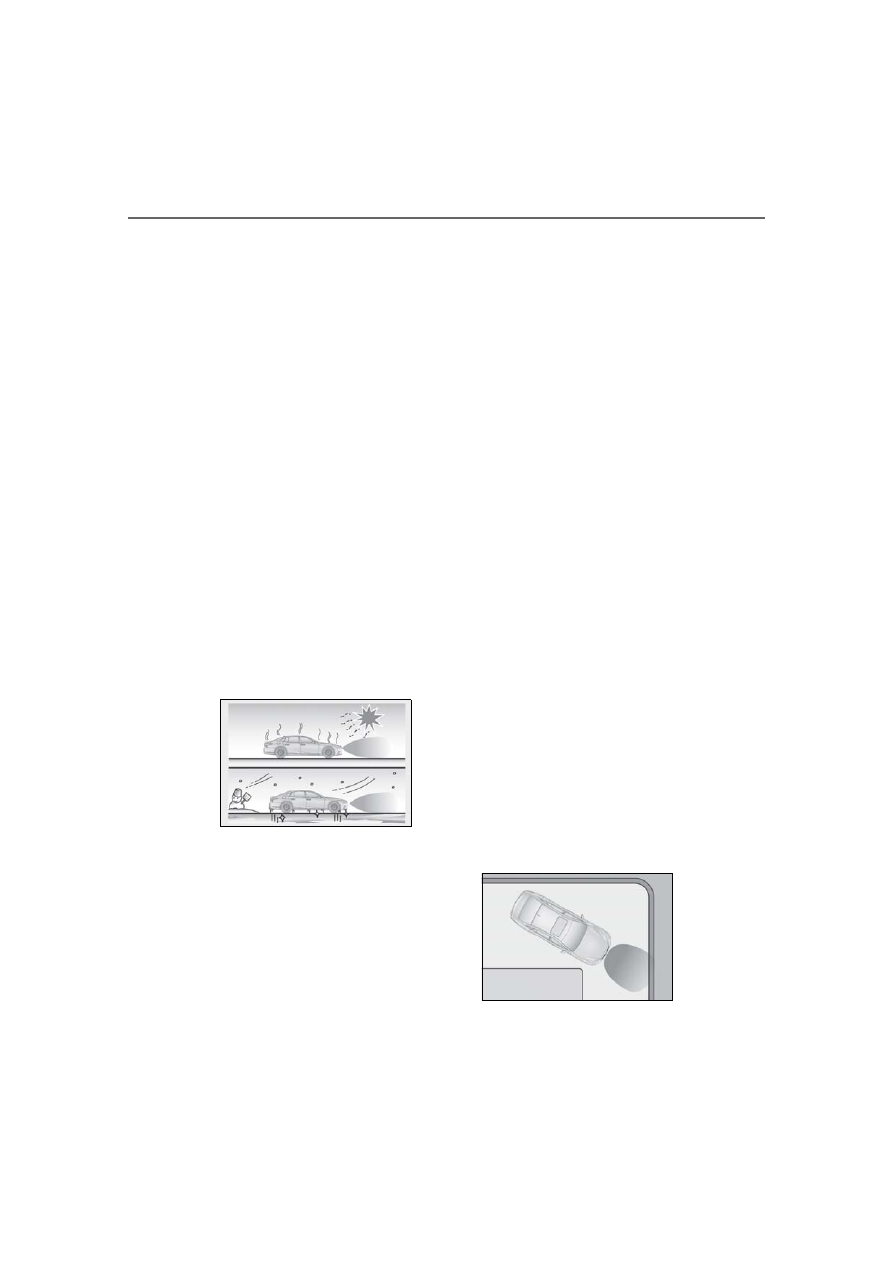
Situations in which the system may not 

operate properly

Certain vehicle conditions and the sur-

rounding environment may affect the ability 

of a sensor to correctly detect objects. Par-

ticular instances where this may occur are 

listed below.

There is dirt, snow, water drops or ice on 

a sensor. (Cleaning the sensors will 

resolve this problem.)

A sensor is frozen. (Thawing the area will 

resolve this problem.) 

In especially cold weather, if a sensor is 

frozen the sensor display may be dis-

played abnormally, or objects, such as a 

wall, may not be detected.

When a sensor or the area around a sen-

sor is extremely hot or cold.

On an extremely bumpy road, on an 

incline, on gravel, or on grass.

When vehicle horns, vehicle detectors, 

motorcycle engines, air brakes of large 

vehicles, the clearance sonar of other 

vehicles or other devices which produce 

ultrasonic waves are near the vehicle

A sensor is coated with a sheet of spray 

or heavy rain.

If objects draw too close to the sensor.

When a pedestrian is wearing clothing 

that does not reflect ultrasonic waves (ex. 

skirts with gathers or frills).

When objects that are not perpendicular 

to the ground, not perpendicular to the 

vehicle traveling direction, uneven, or 

waving are in the detection range.

Strong wind is blowing

When driving in inclement weather such 

as fog, snow or a sandstorm

When an object that cannot be detected 

is between the vehicle and a detected 

object

If an object such as a vehicle, motorcycle, 

bicycle or pedestrian cuts in front of the 

vehicle or runs out from the side of the 

vehicle

If the orientation of a sensor has been 

changed due to a collision or other 

impact

When equipment that may obstruct a 

sensor is installed, such as a towing eye-

let, bumper protector (an additional trim 

strip, etc.), bicycle carrier, or snow plow

If the front of the vehicle is raised or low-

ered due to the carried load

If the vehicle cannot be driven in a stable 

manner, such as when the vehicle has 

been in an accident or is malfunctioning

When a tire chains, compact spare tire or 

an emergency tire puncture repair kit is 

used

Situations in which the system may 

operate even if there is no possibility of a 

collision

In some situations, such as the following, the 

system may operate even though there is no 

possibility of a collision.

When driving on a narrow road

When driving toward a banner, flag, 

low-hanging branch or boom barrier 

279

4-5. Using the driving support systems

4

Driving

(such as those used at railroad crossings, 

toll gates and parking lots)

When there is a rut or hole in the surface 

of the road

When driving on a metal cover (grating), 

such as those used for drainage ditches

When driving up or down a steep slope

If a sensor is hit by a large amount of 

water, such as when driving on a flooded 

road

There is dirt, snow, water drops or ice on 

a sensor. (Cleaning the sensors will 

resolve this problem.)

A sensor is coated with a sheet of spray 

or heavy rain

When driving in inclement weather such 

as fog, snow or a sandstorm

When strong winds are blowing

When vehicle horns, vehicle detectors, 

motorcycle engines, air brakes of large 

vehicles, the clearance sonar of other 

vehicles or other devices which produce 

ultrasonic waves are near the vehicle

If the front of the vehicle is raised or low-

ered due to the carried load

If the orientation of a sensor has been 

changed due to a collision or other 

impact

The vehicle is approaching a tall or 

curved curb

Driving close to columns (H-shaped steel 

beams, etc.) in multi-story parking 

garages, construction sites, etc.

If the vehicle cannot be driven in a stable 

manner, such as when the vehicle has 

been in an accident or is malfunctioning

On an extremely bumpy road, on an 

incline, on gravel, or on grass

When a tire chains, compact spare tire or 

an emergency tire puncture repair kit is 

used

If a battery terminal has been discon-

nected and reconnected

The system needs to be initialized. To initial-

ize the system, drive the vehicle straight 

ahead for 5 seconds or more at a speed of 

approximately 22 mph (35 km/h) or more. 

Additionally, for vehicles with the Parking 

Support Brake function, turn the steering 

wheel fully to the left and right with the vehi-

cle stopped.

Detection range of the sensors

Approximately 3.3 ft. (100 cm)
Approximately 4.9 ft. (150 cm)
Approximately 2.0 ft. (60 cm)

The diagram shows the detection range of 
the sensors. Note that the sensors cannot 

System detection range

A
B
C

280

4-5. Using the driving support systems

detect objects that are extremely close to 
the vehicle.
The range of the sensors may change 
depending on the shape of the object, etc.

Buzzer operation and approximate 
distance to object

A buzzer sounds when the sensors are 
operating. When 2 or more objects are 
detected simultaneously, the buzzer 
sounds for the nearest object.

Buzzer: Sounds intermittently

*

Front center sensor: Approximately 3.3 ft. 
(100 cm) to 2.0 ft. (60 cm)
Rear center sensor: Approximately 4.9 ft. 
(150 cm) to 2.0 ft. (60 cm)

Buzzer: Sounds in short intervals

*

Approximately 2.0 ft. (60 cm) to 1.5 ft. (45 
cm)

Buzzer: Sounds in extremely short 
intervals

*

Approximately 1.5 ft. (45 cm) to 1.0 ft. (30 
cm)

Buzzer: Sounds continuously

Less than approximately 1.0 ft. (30 cm)

*

: The buzzer beeps faster as the vehicle 

approaches an object. 
Automatic buzzer mute function: After a 
buzzer begins sounding, if the distance 
between the vehicle and the detected 
object does not become shorter, the 
buzzer will be muted automatically.

*

: If equipped

RCTA (Rear Cross Traffic 
Alert) function

*

The RCTA function uses the BSM 
rear side radar sensors installed 
behind the rear bumper. This func-
tion is intended to assist the driver 
in checking areas that are not easily 
visible when backing up.

WARNING

Cautions regarding the use of the sys-

tem

There is a limit to the degree of recogni-

tion accuracy and control performance 

that this system can provide, do not 

overly rely on this system. The driver is 

always responsible for paying attention 

to the vehicle’s surroundings and driving 

safely. (

P.269)

To ensure the system can operate 

properly

P.270

281

4-5. Using the driving support systems

4

Driving

Meter control switches

Turning the RCTA function on/off.
When the RCTA function is disabled, the 
RCTA OFF indicator illuminates.

Outside rear view mirror indicators

When a vehicle approaching from the right 
or left at the rear of the vehicle is detected, 
both outside rear view mirror indicators 
will flash.

Center Display

If a vehicle approaching from the right or 
left at the rear of the vehicle is detected, 
the RCTA icon (

P.282) for the detected 

side will be displayed on the Center Dis-
play. This illustration shows an example of a 
vehicle approaching from both sides of the 
vehicle.

RCTA buzzer

If a vehicle approaching from the right or 
left at the rear of the vehicle is detected, a 
buzzer will sound. The buzzer also sounds 
for approximately 1 second immediately 

after the RCTA function is turned on.

Use the meter control switches to 
enable/disable the RCTA function. 
(

P.79)

1

Press 

 or 

 to select 

.

2

Press 

 or 

 to select “PKSA” 

and then press 

.

3

Press 

 or 

 to select “RCTA” 

and then press 

.

When the RCTA function is disabled, the 

RCTA OFF indicator (

P.66) illuminates. 

(Each time the engine switch is turned off 

then changed to IGNITION ON mode, 

the RCTA function will be enabled auto-

matically.)

Outside rear view mirror indicator visi-

bility

In strong sunlight, the outside rear view mir-

ror indicator may be difficult to see.

Hearing the RCTA buzzer

The RCTA buzzer may be difficult to hear 

over loud noises, such as if the audio system 

volume is high.

When “RCTA Not Available” is shown 

on the multi-information display

Water, snow, mud, etc., may be attached to 

the rear bumper around the sensors. 

(

P.270) Removing the water, snow, mud, 

etc., from the attached to the rear bumper 

around the sensors to normal.
Additionally, the function may not function 

normally when used in extremely hot or 

cold environments.

Rear side radar sensors

P.270

System components

A

B

C

D

Turning the RCTA function 
on/off

282

4-5. Using the driving support systems

Operation of the RCTA function

The RCTA function uses rear side 
radar sensors to detect vehicles 
approaching from the right or left at 
the rear of the vehicle and alerts the 
driver of the presence of such vehicles 
by flashing the outside rear view mirror 
indicators and sounding a buzzer.

Approaching vehicles
Detection areas of approaching 
vehicles

RCTA icon display

When a vehicle approaching from the 
right or left at the rear of the vehicle is 
detected, the following will be dis-
played on the Center Display.

Example (Lexus parking assist mon-
itor) (if equipped): Vehicles are 
approaching from both sides of the 
vehicle

RCTA function detection areas

The areas that vehicles can be 
detected in are outlined below.

The buzzer can alert the driver of 
faster vehicles approaching from far-
ther away.
Example:

The RCTA function is operational when

The RCTA function operates when all of the 

following conditions are met:

The engine switch is in IGNITION ON 

mode.

The RCTA function is on.

The shift position is in R.

RCTA function

A
B

Approaching vehi-

cle speed

 Approximate 

alert distance

34 mph (56 km/h) 

(fast)

131 ft. (40 m)

5 mph (8 km/h) 

(slow)

18 ft. (5.5 m)

A

283

4-5. Using the driving support systems

4

Driving

The vehicle speed is approximately 9 

mph (15 km/h) or less.

The approaching vehicle speed is 

between approximately 5 mph (8 km/h) 

and 34 mph (56 km/h).

Setting the buzzer volume

The buzzer volume can be adjusted on the 

multi-information display. (

P.274)

Conditions under which the system will 

not detect a vehicle

The RCTA function is not designed to 

detect the following types of vehicles and/or 

objects:

Vehicles approaching from directly 

behind

Vehicles backing up in a parking space 

next to your vehicle

Vehicles that the sensors cannot detect 

due to obstructions

Guardrails, walls, signs, parked vehicles 
and similar stationary objects

*

Small motorcycles, bicycles, pedestrians, 
etc.

*

Vehicles moving away from your vehicle

Vehicles approaching from the parking 
spaces next to your vehicle

*

The distance between the sensor and 

approaching vehicle gets too close

*

: Depending on the conditions, detection 

of a vehicle and/or object may occur.

Situations in which the system may not 

operate properly

The RCTA function may not detect vehicles 

correctly in the following situations:

When the sensor is misaligned due to a 

strong impact to the sensor or its sur-

rounding area

When mud, snow, ice, a sticker, etc.,is 

covering the sensor or surrounding area 

on the position above the rear bumper

When driving on a road surface that is 

wet with standing water during bad 

weather, such as heavy rain, snow, or fog

When multiple vehicles are approaching 

with only a small gap between each vehi-

cle

When a vehicle is approaching at high 

speed

When equipment that may obstruct a 

sensor is installed, such as a towing eye-

let, bumper protector (an additional trim 

strip, etc.), bicycle carrier, or snow plow

When backing up on a slope with a sharp 

change in grade

When backing out of a sharp angle park-

ing spot

When towing a trailer

When there is a significant difference in 

height between your vehicle and the 

vehicle that enters the detection area

284

4-5. Using the driving support systems

When a sensor or the area around a sen-

sor is extremely hot or cold

If the suspension has been modified or 

tires of a size other than specified are 

installed

If the front of the vehicle is raised or low-

ered due to the carried load

When turning while backing up

When a vehicle turns into the detection 

area

Situations in which the system may 

operate even if there is no possibility of a 

collision

Instances of the RCTA function unneces-

sary detecting a vehicle and/or object may 

increase in the following situations:

When the parking space faces a street 

and vehicles are being driven on the 

street

When the distance between your vehicle 

and metal objects, such as a guardrail, 

wall, sign, or parked vehicle, which may 

reflect electrical waves toward the rear of 

the vehicle, is short

When equipment that may obstruct a 

sensor is installed, such as a towing eye-

let, bumper protector (an additional trim 

strip, etc.), bicycle carrier, or snow plow

When a vehicle passes by the side of your 

vehicle

When a detected vehicle turns while 

approaching the vehicle

When there are spinning objects near 

your vehicle such as the fan of an air con-

ditioning unit

When water is splashed or sprayed 

toward the rear bumper, such as from a 

sprinkler

Moving objects (flags, exhaust fumes, 

large rain droplets or snowflakes, rain 

water on the road surface, etc.)

When the distance between your vehicle 

and a guardrail, wall, etc., that enters the 

detection area is short

Gratings and gutters

When a sensor or the area around a sen-

285

4-5. Using the driving support systems

4

Driving

sor is extremely hot or cold

If the suspension has been modified or 

tires of a size other than specified are 

installed

If the front of the vehicle is raised or low-

ered due to the carried load

*

: If equipped

RCD (Rear Camera Detec-
tion) function

*

When the vehicle is backing up, the 
rear camera detection function can 
detect pedestrians in the detection 
area behind the vehicle. If a pedes-
trian is detected, a buzzer will 
sound and an icon will be displayed 
on the Center Display to inform the 
driver of the pedestrian.

WARNING

Cautions regarding the use of the sys-

tem

The recognition and control capabilities 

for this system are limited.

The driver should always drive safely by 

always being responsible without over 

relying on the system and have a under-

standing of the surrounding situations.

To ensure the system can operate 

properly

Observe the following, otherwise there is 

the danger that could lead to an acci-

dent.

Always clean the camera with damag-

ing it.

Do not install market electronic parts 

(such as Illuminated license plate, fog 

lamps, etc.) in the camera vicinity.

Do not subject the camera vicinity to 

strong impacts. If the vicinity is sub-

jected to a strong impact, have the 

vehicle inspected at your Lexus dealer.

Do not disassemble, remodel or paint 

the camera.

Do not attach accessories or stickers 

to the camera.

286

4-5. Using the driving support systems

Pedestrian detection icons

Displayed automatically when a pedestrian 
is detected.

Use the meter control switches to 
enable/disable the RCD function. 
(

P.79)

1

Press 

 or 

 to select 

.

2

Press 

 or 

 to select “PKSA” 

and then press 

.

3

Press 

 or 

 to select “RCD” 

and then press 

.

When the RCD function is disabled, the 

RCD OFF indicator (

P.66) illuminates.

If the rear camera detection function 
detects a pedestrian in the detection 
area, the buzzer and pedestrian detec-
tion will operate as follows:

If a pedestrian is detected in area 

Buzzer: Sounds repeatedly
Pedestrian detection icon: Blinks
If a pedestrian is detected in area 

Buzzer (When the vehicle is sta-
tionary): Sounds 3 times
Buzzer (When the vehicle is back-
ing up, when a pedestrian 
approaches the rear of the vehicle): 
Sounds repeatedly

WARNING

Do not install market protection parts 

(bumper trim, etc.) to the rear bumper.

Maintain suitable tire air pressure.

Make sure the trunk is completely 

closed.

RCD function is turned off

In the following situations the system 

turns off. The RCD function may not 

operate properly and thus there is the 

danger that an accident may occur.

The contents mentioned above are not 

observed.

Suspensions other than Lexus genuine 

parts are installed.

RCD display

Turning the RCD function on/off

A

When a pedestrian is detected

A

A

B

B

287

4-5. Using the driving support systems

4

Driving

Pedestrian detection icon: Blinks
If the system determines that your 
vehicle may collide with a pedes-
trian in area 
Buzzer: Sounds repeatedly
Pedestrian detection icon: Blinks

The rear camera detection function is 

operational when

The engine switch is in IGNITION ON 

mode.

RCD function is on.

The shift position is in R.

Setting the buzzer volume

The buzzer volume can be adjusted on the 

multi-information display. (

P.274)

If “Rear Camera Detection Unavailable 

Remove the Dirt of Rear Camera” is dis-

played on the multi-information display

A rear camera lens may be dirty or covered 

with snow or ice. In such cases, if it is 

removed from the rear camera lens, the sys-

tem should return to normal. (It may be nec-

essary to drive the vehicle for some time 

before the system returns to normal.)

If “Rear Camera Detection Unavail-

able” is displayed on the multi-informa-

tion display

If the trunk lid is open, fully close it.

If this message is displayed only when the 

R shift position is selected, the rear cam-

era lens may be dirty. Clean the rear 

camera lens.

Situations in which the system may not 

operate properly

Some pedestrians, such as the following, 

may not be detected by the rear camera 

detection function, preventing the func-

tion from operating properly:

• Pedestrians who are bending forward or 

squatting

• Pedestrians who are lying down

• Pedestrians who are running

• Pedestrians who suddenly enter the 

detection area

• People riding a bicycle, skateboard, or 

other light vehicle

• Pedestrians wearing oversized clothing 

such as a rain coat, long skirt, etc., making 

their silhouette obscure

• Pedestrians whose body is partially hid-

den by an object, such as a cart or 

umbrella

• Pedestrians which are obscured by dark-

ness, such as at night

In some situations, such as the following, 

pedestrians may not be detected by the 

rear camera detection function, prevent-

ing the function from operating properly:

• When backing up in inclement weather 

(rain, snow, fog, etc.)

• When the rear camera is obscured (dirt, 

snow, ice, etc. are attached) or scratched

• When a very bright light, such as the sun, 

or the headlights of another vehicle, 

shines directly into the rear camera

• When backing up in a place where the 

surrounding brightness changes sud-

denly, such as at the entrance or exit of a 

garage or underground parking lot

• When backing up in a dim environment 

such as during dusk or in an underground 

parking lot

• When the camera position and direction 

are deviated

• When a towing hook is attached

• When water droplets are flowing on the 

camera lens

• When the vehicle height is extremely 

changed (nose up, nose down)

• When tire chains or an emergency tire 

puncture repair kit is used

• If the suspension has been modified or 

tires of a size other than specified are 

installed

• When install market electronic parts 

(such as Illuminated license plate, fog 

lamps, etc.) in the camera vicinity

• If a bumper protector, such as an addi-

tional trim strip, is installed to the rear 

bumper

Situations in which the system may 

operate unexpectedly

Even though there are no pedestrians in 

the detection area, some objects, such as 

the following, may be detected, possibly 

causing the rear camera detection func-

tion to operate.

• Three dimensional objects, such as a 

C

C

288

4-5. Using the driving support systems

pole, traffic cone, fence, or parked vehi-

cle

• Moving objects, such as a car or motor-

cycle

• Objects moving toward your vehicle 

when backing up, such as flags or pud-

dles (or airborne matter, such as smoke, 

steam, rain, or snow)

• Cobblestone or gravel roads, tram rails, 

road repairs, white lines, pedestrian 

crossings or fallen leaves on the road

• Metal covers (gratings), such as those 

used for drainage ditches

• Objects reflected in a puddle or on a wet 

road surface

• Shadows  on  the  road

In some situations, such as the following, 

the rear camera detection function may 

operate even though there are no pedes-

trians in the detection area.

• When backing up toward the roadside or 

a bump on the road

• When backing up toward an 

incline/decline

• If the rear of the vehicle is raised or low-

ered due to the carried load

• When install market electronic parts 

(such as Illuminated license plate, fog 

lamps, etc.) in the camera vicinity

• If a bumper protector, such as an addi-

tional trim strip, is installed to the rear 

bumper

• If the orientation of the rear camera has 

been changed

• If a towing eyelet is installed to the rear of 

the vehicle

• When water is flowing over the rear cam-

era lens

• When the rear camera is obscured (dirt, 

snow, ice, etc. are attached) or scratched

• If there is a flashing light in the detection 

area, such as the emergency flashers of 

another vehicle

• When a tire chains or an emergency tire 

puncture repair kit is used

Situations in which the rear camera 

detection function may be difficult to 

notice

• If buzzer may be difficult to hear if the 

surrounding area is noisy, the volume of 

the audio system volume is high, the air 

conditioning system is being used, etc.

• If the temperature in the cabin is 

extremely high or low, the audio system 

screen may not operate correctly.

289

4-5. Using the driving support systems

4

Driving

*

: If equipped

Parking Support Brake function 
(static objects)

Ultrasonic sensors are used to detect 
static objects, such as a wall, in the 
detection area when driving at a low 
speed or backing up. (

P.294)

Parking Support Brake function 
(rear-crossing vehicles)

Rear radar sensors are used to detect 
approaching vehicles in the detection 
area behind the vehicle when backing 
up. (

P.296)

Parking Support Brake function 
(rear pedestrians) (if equipped)

A rear camera sensor is used to detect 
pedestrians in the detection area 
behind the vehicle when backing up. 
(

P.298)

PKSB (Parking Support 
Brake)

*

The Parking Support Brake system 
consists of the following functions 
that operate when driving at a low 
speed or backing up, such as when 
parking. When the system deter-
mines that a collision with a 
detected object or pedestrian is 
high, a warning operates to urge 
the driver to take evasive action. If 
the system determines that the pos-
sibility of a collision with a detected 
object or pedestrian is extremely 
high, the brakes are automatically 
applied to help avoid the collision or 
help reduce the impact of the colli-
sion.

PKSB (Parking Support Brake) 
system

WARNING

Cautions regarding the use of the sys-

tem

Do not overly rely on the system, as 

doing so may lead to an accident. Always 

drive while checking the safety of the sur-

roundings of the vehicle.

Depending on the vehicle and road con-

ditions, weather, etc., the system may not 

operate.

The detection capabilities of sensors, 

radars and camera are limited. Always 

drive while checking the safety of the sur-

roundings of the vehicle.

Do not attempt to test the operation of 

this system by driving the vehicle 

toward another vehicle, a person or 

detected object, as it may not operate 

properly, possibly leading to an acci-

dent.

The driver is solely responsible for safe 

driving. Always drive carefully, taking 

care to observe your surroundings. 

The Parking Support Brake system is 

designed to provide support to lessen 

the severity of collisions. However, it 

may not operate in some situations.

The Parking Support Brake system is 

not designed to stop the vehicle com-

pletely. Additionally, even if the system 

has stopped the vehicle, it is necessary 

to depress the brake pedal immedi-

ately as brake control will be canceled 

after approximately 2 seconds.

It is extremely dangerous to check the 

system operations by intentionally 

driving the vehicle into the direction of 

a wall, etc. Never attempt such actions.

290

4-5. Using the driving support systems

The Parking Support Brake can be 
enabled/disabled on the multi-informa-
tion display. All of the Parking Support 
Brake functions (static objects, 
rear-crossing vehicles, and rear pedes-
trians) are enabled/disabled simultane-
ously.
Use the meter control switches to 
enable/disable the parking support 
brake. (

P.79)

1

Press 

 or 

 to select 

.

2

Press 

 or 

 to select 


and then press 

.

When the Parking Support Brake is dis-

abled, the PKSB OFF indicator (

P.66) 

WARNING

When to disable the Parking Support 

Brake

In the following situations, disable the 

Parking Support Brake as the system 

may operate even though there is no 

possibility of a collision.

When inspecting the vehicle using a 

chassis roller, chassis dynamo or free 

roller

When loading the vehicle onto a boat, 

truck or other transport vessel

If the suspension has been modified or 

tires of a size other than specified are 

installed

If the front of the vehicle is raised or 

lowered due to the carried load

When equipment that may obstruct a 

sensor is installed, such as a towing 

eyelet, bumper protector (an addi-

tional trim strip, etc.), bicycle carrier, or 

snow plow

When using automatic car washing 

devices

If the vehicle cannot be driven in a sta-

ble manner, such as when the vehicle 

has been in an accident or is malfunc-

tioning

When the vehicle is driven in a sporty 

manner or off-road

When the tires are not properly 

inflated

When the tires are very worn

When a tire chains, compact spare tire 

or an emergency tire puncture repair 

kit is used

During emergency towing

Precautions for the suspension

Do not modify the suspension of the 

vehicle. If the height or tilt of the vehicle is 

changed, the sensors may not be able to 

detect detectable objects and the system 

may not operate correctly, possibly lead-

ing to an accident.

NOTICE

If “Parking Support Brake Unavail-

able” is displayed on the multi-infor-

mation display

If this message is displayed immediately 

after the engine switch is changed to 

IGNITION ON mode, operate the vehi-

cle carefully, paying attention to your sur-

roundings. It may be necessary to drive 

the vehicle for a certain amount of time 

before the system returns to normal. (If 

the system is not return to normal after 

driving for a while, clean the rear camera 

lens.)

Enabling/Disabling the Parking 
Support Brake

291

4-5. Using the driving support systems

4

Driving

illuminates.
To re-enable the system when it was dis-
abled, select 

 on the multi-information 

display, select 

 and then On. If dis-

abled using this method, the system will not 

be re-enabled by turning the engine switch 

off and then to IGNITION ON mode.

If the engine output restriction control 
or brake control operates, a buzzer will 
sound and a message will be displayed 
on the Center Display and multi-infor-
mation display, to alert the driver.

Depending on the situation, engine output 
restriction control will operate to either 
limit acceleration or restrict output as 
much as possible.
On vehicles with a head-up display, the 
head-up display will display the same mes-
sage as the multi-information display.

Engine output restriction control is 
operating (acceleration restriction)

Acceleration greater than a certain 
amount is restricted by the system.
Center Display (Panoramic view monitor): 
No warning displayed
Multi-information display: “Object 
Detected Acceleration Reduced”
PKSB OFF indicator: Not illuminated
Buzzer: Does not sound

Engine output restriction control is 
operating (output restricted as 
much as possible)

The system has determined that stron-
ger-than-normal brake operation is neces-
sary.

Center Display (Panoramic view monitor): 
“BRAKE!”
Multi-information display: “BRAKE!”
PKSB OFF indicator: Not illuminated
Buzzer: Short beep

Brake control is operating

The system determined that emergency 
braking is necessary.
Center Display (Panoramic view monitor): 
“BRAKE!”
Multi-information display: “BRAKE!”
PKSB OFF indicator: Not illuminated
Buzzer: Short beep

Vehicle stopped by system opera-
tion

The vehicle has been stopped by brake 
control operation.
Center Display (Panoramic view monitor): 
“Press Brake Pedal”
Multi-information display: “Switch to 
Brake” (If the accelerator pedal is not 
depressed, “Press Brake Pedal” will be dis-
played.)
PKSB OFF indicator: Illuminated
Buzzer: Short beep

If the Parking Support Brake deter-
mines that a collision with a detected 
object or pedestrian is possible, the 
engine output will be restricted to 
restrain any increase in the vehicle 
speed. (Engine output restriction con-
trol: See figure 2.)
Additionally, if the accelerator pedal 
continues to be depressed, the brakes 
will be applied automatically to reduce 

Displays and buzzers for engine 
output restriction control and 
brake control

System overview

292

4-5. Using the driving support systems

the vehicle speed. (Brake control: See 
figure 3.)

Figure 1 When the PKSB (Parking 
Support Brake) is disabled

Engine output
Braking force
Time

Figure 2 When engine output 
restriction control operates

Engine output
Braking force
Time
Engine output restriction control 
begins operating
System determines that possibility 
of collision with detected object is 
high
Engine output reduced
Example: Multi-information display: 

“BRAKE!”

Figure 3 When brake control oper-
ates

Engine output
Braking force
Time
Engine output restriction control 
begins operating
System determines that possibility 
of collision with detected object is 
high
Engine output reduced
System determines that possibility 
of collision with detected object is 
extremely high
Brake control begins operating
Brake control strength increased
Example: Multi-information display: 
“BRAKE!”
Example: Multi-information display: 
“Switch to Brake”

If the Parking Support Brake has oper-

ated

If the vehicle is stopped due to operation of 

the Parking Support Brake, the Parking 

Support Brake will be disabled and the 

PKSB OFF indicator will illuminate. If the 

Parking Support Brake operates unneces-

A
B
C

A
B
C
D

E

F

G

A
B
C
D

E

F

G

H

I

J

K

293

4-5. Using the driving support systems

4

Driving

sarily, brake control can be canceled by 

depressing the brake pedal or waiting for 

approximately 2 seconds for it to automati-

cally be canceled. Then, the vehicle can be 

operated by depressing the accelerator 

pedal.

Re-enabling the Parking Support Brake

To re-enable the Parking Support Brake 

when it has been disabled due to operation 

of the Parking Support Brake, either enable 

the system again (

P.290), or turn the 

engine switch off and then back to IGNI-

TION ON mode.
Additionally, if any of the following condi-

tions are met, the system will be re-enabled 

automatically and the PKSB OFF indicator 

will turn off:

The P shift position is selected

The object is no longer detected in the 

traveling direction of the vehicle

The traveling direction of the vehicle 
changes

*

*

: Except when the Parking Support Brake 

function (rear pedestrians) operated.

If “Parking Support Brake Unavailable” 

is displayed on the multi-information 

display

If this message is displayed only when the 

R shift position is selected, the rear cam-

era lens may be dirty. Clean the camera 

lens. If this message is displayed when the 

shift position is any position other than R, 

a sensor on the front or rear bumper may 

be dirty. Clean the sensors and their sur-

rounding area on the bumpers.

Initialization may not have been per-

formed after a battery terminal was dis-

connected and reconnected. Initialize the 

system. (

P.293)

If this message continues to be displayed 

even after initialization, have the vehicle 

inspected by your Lexus dealer.

If “Parking Support Brake Unavailable” 

and “Parking Assist Unavailable” are 

displayed on the multi-information dis-

play

Water may be continuously flowing over the 

sensor surface, such as in a heavy rain. 

When the system determines that it is nor-

mal, the system will return to normal.

If “Parking Support Brake Unavailable” 

and “Clean Parking Assist Sensor” are 

displayed on the multi-information dis-

play

A sensor may be covered with water 

drops, ice, snow, dirt, etc. Remove the 

water drops, ice, snow, dirt, etc., from the 

sensor to return the system to normal. If 

this message continues to be displayed 

even after cleaning the sensor, or is dis-

played even though the sensor is clean, 

have the vehicle inspected by your Lexus 

dealer.

A sensor may be frozen. Once the ice 

melts, the system will return to normal.

If a battery terminal has been discon-

nected and reconnected

The system needs to be initialized. To initial-

ize the system, drive the vehicle straight 

ahead for 5 seconds or more at a speed of 

approximately 22 mph (35 km/h) or more. 

Additionally, for vehicles with the Parking 

Support Brake function, turn the steering 

wheel fully to the left and right with the vehi-

cle stopped.

294

4-5. Using the driving support systems

*

: If  equipped

This function will operate in situations 
such as the following if an object is 
detected in the traveling direction of 
the vehicle.

When traveling at a low speed and 
the brake pedal is not depressed, or 
is depressed late

When the accelerator pedal is 
depressed excessively

When the vehicle moves in the unin-
tended direction due to the wrong 
shift position being selected

Parking Support Brake func-
tion (static objects)

*

If the sensors detect a static object, 
such as a wall, in the travelling 
direction of the vehicle and the sys-
tem determines that a collision may 
occur due to the vehicle suddenly 
moving forward due to an acciden-
tal accelerator pedal operation, the 
vehicle moving the unintended 
direction due to the wrong shift 
position being selected, or while 
parking or traveling at low speeds, 
the system will operate to lessen 
the impact with the detected static 
object and reduce the resulting 
damage.

Examples of function operation

295

4-5. Using the driving support systems

4

Driving

P.275

The function will operate when

The function will operate when the PKSB 

OFF indicator (

P.67) is not illuminated or 

flashing and all of the following conditions 

are met:

Engine output restriction control

• The Parking Support Brake is enabled.

• The vehicle speed is approximately 9 

mph (15 km/h) or less.

• There is a static object in the traveling 

direction of the vehicle and approxi-

mately 6 to 13 ft. (2 to 4 m) away.

• The Parking Support Brake determines 

that a stronger-than-normal brake opera-

tion is necessary to avoid a collision.

Brake control

• Engine output restriction control is oper-

ating.

• The Parking Support Brake determines 

that an immediate brake operation is nec-

essary to avoid a collision.

The function will stop operating when

The function will stop operating if any of the 

following conditions are met:

Engine output restriction control

• The Parking Support Brake is disabled.

• The system determines that the collision 

has become avoidable with normal brake 

operation.

• The static object is no longer approxi-

mately 6 to 13 ft. (2 to 4 m) away from the 

vehicle or in the traveling direction of the 

vehicle.

Brake control

• The Parking Support Brake is disabled.

• Approximately 2 seconds have elapsed 

since the vehicle was stopped by brake 

control.

• The brake pedal is depressed after the 

vehicle is stopped by brake control.

• The static object is no longer approxi-

mately 6 to 13 ft. (2 to 4 m) away from the 

vehicle or in the traveling direction of the 

vehicle.

Detection range of the function

The detection range of the Parking Support 

Brake function (static objects) differs from 

the detection range of the intuitive parking 

assist. (

P.279) Therefore, even if the intui-

tive parking assist detects an object and 

provides a warning, the Parking Support 

Brake function (static objects) may not start 

operating.

Objects which the system may not be 

properly detected

P.277

Situations in which the system may not 

operate properly

P.278

Types of sensors

WARNING

To ensure the system can operate 

properly

P.276

If the Parking Support Brake function 

(static objects) operates unnecessar-

ily, such as at a railroad crossing

P.292

Notes when washing the vehicle

P.277

296

4-5. Using the driving support systems

Situations in which the system may 

operate even if there is no possibility of a 

collision

P.278

*

: If equipped

This function will operate in situations 
such as the following if a vehicle is 
detected in the traveling direction of 
the vehicle.

When reversing, a vehicle is 
approaching and the brake pedal is 
not depressed, or is depressed late

P.270

Parking Support Brake func-
tion (rear-crossing vehicles)

*

If a rear radar sensor detects a vehi-
cle approaching from the right or 
left at the rear of the vehicle and the 
system determines that the possi-
bility of a collision is high, this func-
tion will perform brake control to 
reduce the likelihood of an impact 
with the approaching vehicle.

Examples of function operation

Types of sensors

WARNING

To ensure the system can operate 

properly

P.270

297

4-5. Using the driving support systems

4

Driving

The Parking Support Brake function 

(rear-crossing vehicles) will operate 

when

The function will operate when the PKSB 

OFF indicator (

P.68) is not illuminated or 

flashing and all of the following conditions 

are met:

Engine output restriction control

• The Parking Support Brake is enabled.

• The vehicle speed is approximately 9 

mph (15 km/h) or less.

• Vehicles which are approaching from the 

right or left at the rear of the vehicle at a 

traveling speed of approximately 5 mph 

(8 km/h) or more.

• The shift position is in R.

• The Parking Support Brake determines 

that a stronger than normal brake opera-

tion is necessary to avoid a collision with 

an approaching vehicle.

Brake control

• Engine output restriction control is oper-

ating.

• The Parking Support Brake determines 

that an emergency brake operation is 

necessary to avoid a collision with an 

approaching vehicle.

The Parking Support Brake function 

(rear-crossing vehicles) will stop operat-

ing when

The function will stop operating if any of the 

following conditions are met:

Engine output restriction control

• The Parking Support Brake is disabled.

• The collision becomes avoidable with 

normal brake operation.

• A vehicle is no longer approaching from 

the right or left at the rear of the vehicle.

Brake control

• The Parking Support Brake is disabled.

• Approximately 2 seconds have elapsed 

since the vehicle was stopped by brake 

control.

• The brake pedal is depressed after the 

vehicle is stopped by brake control.

• A vehicle is no longer approaching from 

the right or left at the rear of the vehicle.

Detection area of the Parking Support 

Brake function (rear-crossing vehicles)

The detection area of the Parking Support 

Brake function (rear-crossing vehicles) dif-

fers from the detection area of the RCTA 

function (

P.282). Therefore, even if the 

RCTA function detects a vehicle and pro-

vides an alert, the Parking Support Brake 

function (rear-crossing vehicles) may not 

start operating.

Situations in which the system may not 

operate properly

P.283

Situations in which the system may 

operate even if there is no possibility of a 

collision

P.284

298

4-5. Using the driving support systems

*

: If equipped

When a pedestrian is detected behind 
the vehicle while backing up, the brake 
pedal is not depressed or is depressed 
late.

Displays a message to urge the driver 
to take evasive action when a pedes-
trian is detected in the detection area 
behind the vehicle.

A message will also be displayed on the 
multi-information display and head-up dis-
play (if equipped).

Pedestrian detection icons
Brake reminder

Parking Support Brake function (rear 

pedestrians) will operate when

The function will operate when the PKSB 

OFF indicator (

P.68) is not illuminated or 

flashing and all of the following conditions 

are met:

Engine output restriction control

• The Parking Support Brake is enabled.

Parking Support Brake func-
tion (rear pedestrians)

*

If the rear camera sensor detects a 
pedestrian behind the vehicle while 
backing up and the system deter-
mines that the possibility of collid-
ing with the detected pedestrian is 
high, a buzzer will sound. If the sys-
tem determines that the possibility 
of colliding with the detected 
pedestrian is extremely high, the 
brakes will be applied automatically 
to help reduce the impact of the 
collision.

Examples of system operation

Display

WARNING

If the Parking Support Brake function 

(rear pedestrians) operates unneces-

sarily

Depress the brake pedal immediately 

after the Parking Support Brake function 

(rear pedestrians) operates. (Operation 

of the function is canceled by depressing 

the brake pedal.)

Correct use of the Parking Support 

Brake function (rear pedestrians)

P.285

A

B

299

4-5. Using the driving support systems

4

Driving

• The vehicle speed is 9 mph (15 km/h) or 

less.

• The shift position is in R.

• A pedestrian is behind the vehicle.

• The system determines that a slightly 

stronger brake operation than usual is 

needed to avoid a collision.

Brake control

• Engine output restriction control is oper-

ating.

• The Parking Support Brake determines 

that an emergency brake operation is 

necessary to avoid a collision with a 

pedestrians.

The Parking Support Brake function 

(rear pedestrians) will stop operating 

when

The function will stop operating if any of the 

following conditions are met:

Engine output restriction control

• The Parking Support Brake is disabled.

• The collision becomes avoidable with 

normal brake operation.

• The pedestrian is no longer detected 

behind your vehicle.

Brake control

• The Parking Support Brake is disabled.

• Approximately 2 seconds have elapsed 

since the vehicle was stopped by brake 

control.

• The brake pedal is depressed after the 

vehicle is stopped by brake control.

Re-enabling the Parking Support Brake 

function (rear pedestrians)

P.293

Detection area of the Parking Support 

Brake function (rear pedestrians)

The detection area of the Parking Support 

Brake function (rear pedestrians) differs 

from the detection area of the RCD func-

tion (

P.286). Therefore, even if the RCD 

function detects a pedestrian and provides 

an alert, the Parking Support Brake function 

(rear pedestrians) may not start operating.

Situations in which the system may not 

operate properly

P.287

Situations in which the system may 

operate unexpectedly

P.287

300

4-5. Using the driving support systems

Vehicles without Adaptive Variable 
Suspension System

1

Normal mode

Provides an optimal balance of fuel econ-
omy, quietness, and dynamic performance. 
Suitable for city driving.
Press the switch to change the driving 
mode to normal mode when not in normal 
mode.

2

Eco drive mode

Helps the driver accelerate in an 
eco-friendly manner and improve fuel 
economy through moderate throttle char-
acteristics and by controlling the operation 
of the air conditioning system (heat-
ing/cooling).
When not in Eco drive mode, if the driving 
mode select switch is turned backward, the 
Eco drive mode indicator will come on.

3

Sport mode

Controls the transmission and engine to 
provide quick, powerful acceleration. This 
mode also changes the steering feel, mak-
ing it suitable for when agile driving 
response is desired, such as when driving 

on roads with many curves.
When not in sport mode, if the driving 
mode select switch is turned forward, the 
sport mode indicator will comes on.

Vehicles with Adaptive Variable 
Suspension System

Except F SPORT models
F SPORT models

1

Normal mode/Custom mode

Normal mode and custom mode are 
selected by pressing the driving mode 
select switch. Each time the switch is 
pressed, the driving mode changes 
between normal mode and custom mode.
When normal mode is selected, the normal 
mode indicator comes on.
When custom mode is selected, the cus-
tom mode indicator comes on.
Press the switch to change the driving 
mode to normal mode when not in normal 
mode.
• Normal mode
Provides an optimal balance of fuel econ-
omy, quietness, and dynamic performance. 

Driving mode select switch

The driving modes can be selected 
to suit driving condition.

Selecting a drive mode

A
B

301

4-5. Using the driving support systems

4

Driving

Suitable for city driving.
When the shift position is in D, an appropri-
ate gear for sporty driving may automati-
cally be selected according to driver 
performance and driving conditions.
• Custom  mode
Allows you to drive with the powertrain, 
chassis and air conditioning system func-
tions set to your preferred settings. Cus-
tom mode settings can only be changed on 
the drive mode customization display of 
the Center Display. (

P.470)

2

Comfort mode

By controlling the suspension, riding com-
fort is further enhanced. Suitable for city 
driving.
When not in comfort mode and the driving 
mode select switch is turned backward, the 
comfort mode indicator comes on.

3

Eco drive mode

Helps the driver accelerate in an 
eco-friendly manner and improve fuel 
economy through moderate throttle char-
acteristics and by controlling the operation 
of the air conditioning system (heat-
ing/cooling).
When in comfort mode, if the driving mode 
select switch is turned backward, the Eco 
drive mode indicator comes on.

4

Sport mode

• Sport  S  mode
Controls the transmission and engine to 
provide quick, powerful acceleration. This 
mode is suitable for when agile driving 
response is desired, such as when driving 
on roads with many curves.
When not in Sport S mode, if the driving 
mode select switch is turned forward, the 
Sport S mode indicator comes on.
• Sport  S+  mode
Helps to ensure steering performance and 
driving stability by simultaneously con-

trolling the steering and suspension in 
addition to the transmission and engine. 
Suitable for sportier driving.
When in Sport S mode, if the driving mode 
select switch is turned forward, the Sport 
S+ mode indicator comes on.

If the driving mode select switch is oper-

ated while the opening screen is being 

displayed

If the driving mode select switch is operated 

while the opening screen is being displayed, 

the driving mode will be changed and the 

meter display will change accordingly after 

the opening screen operation has com-

pleted.

Operation of the air conditioning sys-

tem in Eco drive mode

Eco drive mode controls the heating/cool-

ing operations and fan speed of the air con-

ditioning system to enhance fuel efficiency. 

To improve air conditioning performance, 

perform the following operations:

Turn off eco air conditioning mode 

(

P.322)

Adjust the fan speed (

P.318)

Turn off Eco drive mode

Automatic deactivation of sport mode 

and custom mode

If the engine switch is turned off after driv-

ing in sport mode or custom mode, the 

drive mode will be changed to normal 

mode.

302

4-5. Using the driving support systems

*

: If equipped

Situations in which the vehicle height 

control may not operate properly

In the following situations, the vehicle 

height may change slowly or may not 

change to the correct height:

• When the vehicle comes into contact 

with snow, ice, stone, etc.

• When the ambient temperature is low

• When the accumulator tank pressure is 

low

In the following situations, the vehicle 

height may not change:

• If the hood or trunk is not fully closed

• If the brake pedal depressed and the 

vehicle is stopped

• When the vehicle is on a significantly 

uneven or undulating road

• When the vehicle is on a slanted road or a 

slope

Operating sound of the air suspension 

compressor and valves

In the following situations the air suspension 

compressor and valves may operate and a 

sound may be heard, but this does not indi-

cate a malfunction.

When passengers enter or exit the vehi-

cle or cargo is loaded or unloaded, caus-

ing the vehicle height to change

When the height of the vehicle is 

changed using the vehicle height adjust-

ment switch

When the doors are opened/closed

When the doors are locked/unlocked

When the accumulator tank pressure is 

low

When the accumulator tank pressure is low, 

the air suspension compressor and valves 

may operate repeatedly even though the 

vehicle height is not being changed. This 

does not indicate a malfunction.

When “Air Suspension System Malfunc-

tion Visit Your Dealer” is displayed on 

the multi-information display

The system may not operate properly. Have 

the vehicle inspected by your Lexus dealer.

Customization

Some functions can be customized. 

(

P.470)

Electronically modulated air 
suspension

*

The height of the vehicle when driv-
ing can be selected using the vehi-
cle height adjustment switch. The 
selected height level will be main-
tained regardless of the number of 
passengers or weight of cargo.

Additionally, settings of the follow-
ing functions can be changed:

Enabling/Disabling controls of 
access mode

Temporarily disabling vehicle 
height control

WARNING

Precautions for the electronically 

modulated air suspension

Even if the engine is not running, the 

vehicle height may change through 

vehicle height control. Be sure to keep 

your hands and feet away from the 

area underneath the vehicle and 

between the tires and vehicle body. 

Otherwise part of your body may get 

caught, possibly causing an injury.

In situations such as the following, 

make sure to disable all functions of 

the vehicle height control of the elec-

tronically modulated air suspension. 

Otherwise, the vehicle height may 

change and part or your body may be 

caught under the vehicle, possibly 

causing injury.

• When the vehicle is parked on a curb

• If any of the wheels is not touching the 

ground

303

4-5. Using the driving support systems

4

Driving

To adjust the vehicle height to one 
appropriate for road and driving con-
ditions, press the vehicle height adjust-
ment switch.
Turns high mode on/off.

When high mode is enabled, the high 
mode indicator on the meter will illuminate.
The vehicle height will increase by approxi-
mately 0.8 in. (20 mm) from its normal 
position.
When the vehicle height is increased by a 
control of access mode press the vehicle 

height adjustment switch twice to 
enable/disable high mode.

The vehicle height adjustment switch 

can be used to change the mode when

The engine switch is in IGNITION ON 

mode.

System protection function

If the vehicle height is repeatedly increased 

and decreased using the vehicle height 

adjustment switch, etc., the system may not 

operate temporarily.

In order to improve the ease of enter-
ing and exiting the vehicle, the vehicle 
height will automatically increase when 
the P shift position is selected and a 
door is opened.
When any of the following conditions 
are met, the vehicle will return to its 

WARNING

• If the vehicle needs to be jacked up

• If the vehicle is to be tied down

• If the vehicle is to be towed

NOTICE

Parking precaution

If the vehicle is parked for a long time, 

the vehicle height may change due to 

changes in the ambient temperature. 

When parking the vehicle, make sure 

that the area above and below the 

vehicle is clear, so that the vehicle will 

not contact anything if its height 

changes.

Be careful when parking the vehicle in 

an area with a low ceiling or near low 

hanging objects, as the vehicle height 

will increase when passengers exit the 

vehicle and exit control of access 

mode operates.

When the doors are closed or locked, 

the vehicle height may decrease. 

When parking in a parking lot with a 

device which raises to contact the bot-

tom of the vehicle, make sure to dis-

able the vehicle height control.

Selecting the vehicle height

WARNING

When operating the vehicle height 

adjustment switch

When operating the vehicle height 

adjustment switch, make sure to check 

the safety of the area around the vehicle, 

as the vehicle height may change and 

part of someone’s body may be caught 

under the vehicle, possibly causing injury.

Vehicle height control when 
entering/exiting the vehicle 
(“Access Mode”)

304

4-5. Using the driving support systems

previous height:

A certain amount of time has 
elapsed since the doors were closed

The vehicle speed reaches approxi-
mately 3 mph (5 km/h)

The doors are locked using the 
smart access system with push-but-
ton start or wireless remote control

Enabling/Disabling access mode

1

Press the 

 or 

 meter control 

switch to select 

.

2

Press the 

 or 

 meter control 

switch to select “Vehicle Settings” 
and then press 

.

3

Press the 

 or 

 meter control 

switch to select 

 and then 

press .

4

Press the 

 or 

 meter control 

switch to select “Access Mode” and 
then press 

.

The setting will change between 
enabled/disabled each time the 


meter control switch is pressed.

When the vehicle height has been 

increased by a control of access mode

Press the vehicle height adjustment switch 

with the engine switch in any mode to return 

the vehicle to its previous vehicle height.

Access mode operation

Access mode will not operate if the vehi-

cle is not parked on a level road surface.

Depending on the current vehicle height, 

access mode may not operate.

After the doors are unlocked, if access 

mode operates, the vehicle height will 

increase by approximately 0.8 in. (20 

mm) from its normal position. After the 

vehicle has been driven, if access mode 

operates, the vehicle height will increase 

by approximately 0.4 in. (10 mm) from its 

normal position.

If the doors are opened and closed 

repeatedly, the system may not operate 

temporarily.

Vehicle height control can be tempo-
rarily disabled using the meter control 
switches. (

P.79)

When to temporarily disable vehicle height 
control:

P.302

1

Press 

 or 

 to select 

.

2

Press 

 or 

 to select “Vehicle 

Settings” and then press 

.

3

Press 

 or 

 to select 


and then press 

.

4

Press 

 or 

 to select “Height 

Control” and then press 

.

This setting is memorized even if the 
engine switch is turned off.

Even if the vehicle height control func-
tions are disabled, they will be enabled 
automatically when the vehicle speed 
reaches approximately 19 mph (30 
km/h).

Temporarily disabling vehicle 
height control

305

4-5. Using the driving support systems

4

Driving

ECB (Electronically Controlled 
Brake System) (vehicles with Lexus 
Safety System + A)

The electronically controlled system 
generates braking force correspond-
ing to the brake operation

ABS (Anti-lock Brake System)

Helps to prevent wheel lock when the 
brakes are applied suddenly, or if the 
brakes are applied while driving on a 
slippery road surface

Brake assist

Generates an increased level of brak-
ing force after the brake pedal is 
depressed when the system detects a 
panic stop situation

VSC (Vehicle Stability Control)

Helps the driver to control skidding 
when swerving suddenly or turning on 
slippery road surfaces.

TRAC (Traction Control)

Helps to maintain drive power and pre-
vent the drive wheels from spinning 

when starting the vehicle or accelerat-
ing on slippery roads

Hill-start assist control

Helps to reduce the backward move-
ment of the vehicle when starting on an 
uphill

VGRS (Variable Gear Ratio Steer-
ing) (if equipped)

Adjusts the front wheel turning angle in 
accordance with the vehicle speed and 
steering wheel movement

DRS (Dynamic Rear Steering) (if 
equipped)

Contributes to the turning characteris-
tics and responsiveness of the vehicle 
by adjusting the rear wheel angle of the 
vehicle in accordance with steering 
wheel movement.

EPS (Electric Power Steering)

Employs an electric motor to reduce 
the amount of effort needed to turn the 
steering wheel.

Active stabilizer suspension sys-
tem (if equipped)

Reduces sway when cornering accord-
ing to steering wheel movement in 
order to maintain a stable vehicle pos-
ture.

Adaptive Variable Suspension Sys-
tem (if equipped)

By independently controlling the 
damping force of the shock absorbers 
for each of the 4 wheels according to 
the road and driving conditions, this 
system helps riding comfort with supe-
rior vehicle stability, and helps good 

Driving assist systems

To keep driving safety and perfor-
mance, the following systems oper-
ate automatically in response to 
various driving situations. Be aware, 
however, that these systems are 
supplementary and should not be 
relied upon too heavily when oper-
ating the vehicle.

Summary of the driving assist 
systems

306

4-5. Using the driving support systems

vehicle posture.
Also, the damping force changes 
depending on the selected driving 
mode. (

P.300)

LDH (Lexus Dynamic Handling 
system) (if equipped)

Provides integrated control of the 
VGRS, DRS and EPS. Contributes to 
turning characteristics at low speeds, 
responsiveness at medium speeds and 
safety at high speeds by controlling the 
steering angle of the front and rear 
wheels in accordance with the steering 
wheel operation and vehicle speed.

VDIM (Vehicle Dynamics Inte-
grated Management)

Provides integrated control of the 
ABS, brake assist, TRAC, VSC, 
hill-start assist control, EPS, VGRS (if 
equipped), DRS (if equipped), active 
stabilizer suspension system (if 
equipped) and Adaptive Variable Sus-
pension System (if equipped)
Helps to maintain vehicle stability when 
swerving on slippery road surfaces by 
controlling the brakes, engine output, 
steering assist, and steering ratio

The Secondary Collision Brake

When the SRS airbag sensor detects a 
collision and the system operates, the 
brakes and stop lights are automati-
cally controlled to reduce the vehicle 
speed and help reduce the possibility 
of further damage due to a secondary 
collision.

When the TRAC/VSC systems are 

operating (vehicles without Lexus 

Safety System + A)

The slip indicator light will flash while the 

TRAC/VSC systems are operating.

When the TRAC/VSC/ABS systems are 

operating (vehicles with Lexus Safety 

System + A)

The slip indicator light will flash while the 

TRAC/VSC/ABS systems are operating.

Disabling the TRAC system

If the vehicle gets stuck in mud, dirt or snow, 

the TRAC system may reduce power from 
the engine to the wheels. Pressing the 


switch to turn the system off may make it 

easier for you to rock the vehicle in order to 

free it.
To turn the TRAC system off, quickly press 
and release the 

 switch.

The “Traction Control Turned Off” will be 
shown on the multi-information display.

Press the 

 switch again to turn the sys-

tem back on.

307

4-5. Using the driving support systems

4

Driving

Turning both TRAC and VSC systems

To turn the TRAC and VSC systems off, 
press and hold the 

 switch for more 

than 3 seconds while the vehicle is stopped.
The VSC OFF indicator light will come on 
and the “Traction Control Turned Off” will 
be shown on the multi-information display.

*

Press the 

 switch again to turn the sys-

tem back on.

*

: On vehicles with PCS (Pre-Collision 

System), PCS will also be disabled (only 
Pre-Collision warning is available). The 
PCS warning light will come on and a 
message will be displayed on the 
multi-information display. (

P.219, 

230)

When the message is displayed on the 

multi-information display showing that 

TRAC has been disabled even if the 

 switch has not been pressed

TRAC is temporary deactivated. If the infor-

mation continues to show, contact your 

Lexus dealer.

Operating conditions of hill-start assist 

control

When the following four conditions are met, 

the hill-start assist control will operate:

The shift position is in a position other 

than P or N (when stating off for-

ward/backward on an upward incline)

The vehicle is stopped

The accelerator pedal is not depressed

The parking brake is not engaged

Engine switch is turned to IGNITION 

ON mode

Automatic system cancelation of 

hill-start assist control

The hill-start assist control will turn off in any 

of the following situations:

Shift the shift position to P or N

The accelerator pedal is depressed

The parking brake is engaged

2 seconds at maximum elapsed after the 

brake pedal is released

Engine switch is turned Off

VGRS is disabled when

VGRS may stop operating in the following 

situations.

In this event, the steering wheel may move 

from its straight forward position, but it will 

return when the system restarts.

When the steering wheel is operated for 

an extended period of time while the 

vehicle is stopped or is moving very 

slowly (on vehicles with LDH, DRS is dis-

abled together with VGRS)

When the steering wheel has been held 

fully to the left or right

The center position of the steering wheel 

may change when VGRS is disabled. How-

ever, the position will return to normal after 

VGRS is reactivated.

When the battery is disconnected (vehi-

cles with VGRS)

The steering wheel may move from its 

straight forward position, but this will be 

corrected automatically when driving.

Sounds and vibrations caused by the 

ABS, brake assist, VSC, TRAC, hill-start 

assist control and VGRS systems

A sound may be heard from the engine 

compartment when the brake pedal is 

depressed repeatedly, when the engine is 

started or just after the vehicle begins to 

move. This sound does not indicate that a 

malfunction has occurred in any of these 

systems.

Any of the following conditions may 

occur when the above systems are oper-

ating. None of these indicates that a mal-

function has occurred.

• Vibrations may be felt through the vehicle 

308

4-5. Using the driving support systems

body and steering.

• A motor sound may be heard also after 

the vehicle comes to a stop.

• Vehicles without Lexus Safety System + 

A: The brake pedal may pulsate slightly 

after the ABS is activated.

• Vehicles without Lexus Safety System + 

A: The brake pedal may move down 

slightly after the ABS is activated.

ECB operating sound

ECB operating sound may be heard in the 

following cases, but it does not indicate that 

a malfunction has occurred.

Operating sound heard from the engine 

compartment when the brake pedal is 

operated.

Motor sound of the brake system heard 

from the front part of the vehicle when 

the driver’s door is opened.

Operating sound heard from the engine 

compartment when one or two minutes 

passed after the stop of the engine.

Automatic reactivation of TRAC and 

VSC systems

After turning the TRAC and VSC systems 

off, the systems will be automatically 

re-enabled in the following situations:

When the engine switch is turned off

If only the TRAC system is turned off, the 

TRAC will turn on when vehicle speed 

increases

If both the TRAC and VSC systems are 

turned off, automatic re-enabling will not 

occur when vehicle speed increases.

Reduced effectiveness of the EPS sys-

tem

The effectiveness of the EPS system is 

reduced to prevent the system from over-

heating when there is frequent steering 

input over an extended period of time. The 

steering wheel may feel heavy as a result. 

Should this occur, refrain from excessive 

steering input or stop the vehicle and turn 

the engine off. The EPS system should 

return to normal within 10 minutes.

Secondary Collision Brake operating 

conditions

The system operates when the SRS airbag 

sensor detects a collision while the vehicle 

is in motion. However, the system does not 

operate in any of the following situations.

When driving at a low speed

Components are damaged

Secondary Collision Brake automatic 

cancellation

The system is automatically canceled in any 

of the following situations.

The vehicle speed has decreased to a 

certain speed

A certain amount of time elapses during 

operation

The accelerator pedal is depressed a 

large amount

When “Check VGRS System” or 

“CHECK DRS” is displayed on the 

multi-information display

The VGRS or DRS may not operate prop-

erly. Have the vehicle inspected by your 

Lexus dealer.

WARNING

The ABS does not operate effectively 

when

The limits of tire gripping performance 

have been exceeded (such as exces-

sively worn tires on a snow covered 

road).

The vehicle hydroplanes while driving 

at high speed on wet or slick roads.

Stopping distance when the ABS is 

operating may exceed that of normal 

conditions

The ABS is not designed to shorten the 

vehicle’s stopping distance. Always main-

tain a safe distance from the vehicle in 

front of you, especially in the following 

situations:

When driving on dirt, gravel or 

snow-covered roads

When driving with tire chains

When driving over bumps in the road

309

4-5. Using the driving support systems

4

Driving

WARNING

When driving over roads with potholes 

or uneven surfaces

TRAC/VSC may not operate effec-

tively when

Directional control and power may not 

be achievable while driving on slippery 

road surfaces, even if the TRAC/VSC 

system is operating. Drive the vehicle 

carefully in conditions where stability and 

power may be lost.

Hill-start assist control does not oper-

ate effectively when

Do not overly rely on hill-start assist 

control. Hill-start assist control may 

not operate effectively on steep 

inclines and roads covered with ice.

Unlike the parking brake, hill-start 

assist control is not intended to hold 

the vehicle stationary for an extended 

period of time. Do not attempt to use 

hill-start assist control to hold the vehi-

cle on an incline, as doing so may lead 

to an accident.

When the TRAC/VSC is activated 

(vehicles without Lexus Safety Sys-

tem + A)

The slip indicator light flashes. Always 

drive carefully. Reckless driving may 

cause an accident. Exercise particular 

care when the indicator light flashes.

When the TRAC/ABS/VSC is acti-

vated (vehicles with Lexus Safety Sys-

tem + A)

The slip indicator light flashes. Always 

drive carefully. Reckless driving may 

cause an accident. Exercise particular 

care when the indicator light flashes.

When the TRAC/VSC systems are 

turned off

Be especially careful and drive at a speed 

appropriate to the road conditions. As 

these are the systems to help ensure 

vehicle stability and driving force, do not 

turn the TRAC/VSC systems off unless 

necessary.

Replacing tires

Make sure that all tires are of the speci-

fied size, brand, tread pattern and total 

load capacity. In addition, make sure that 

the tires are inflated to the recom-

mended tire inflation pressure level.

The ABS, TRAC and VSC systems will 

not function correctly if different tires are 

installed on the vehicle.

Contact your Lexus dealer for further 

information when replacing tires or 

wheels.

Handling of tires and the suspension

Using tires with any kind of problem or 

modifying the suspension will affect the 

driving assist systems, and may cause a 

system to malfunction.

Secondary Collision Brake

Do not rely solely upon the Secondary 

Collision Brake. This system is designed 

to help reduce the possibility of further 

damage due to a secondary collision, 

however, that effect changes according 

to various conditions. Overly relying on 

the system may result in death or serious 

injury.


Content      ..     7      8      9      10     ..