Jaguar XK. Service manual - part 58
 

  Index      Jaguar     Jaguar XK - service and repair manual 2007 year


Search            


Content   ..  56  57  58  59   ..


Jaguar XK. Service manual - part 58


235

Wheels and tires

R

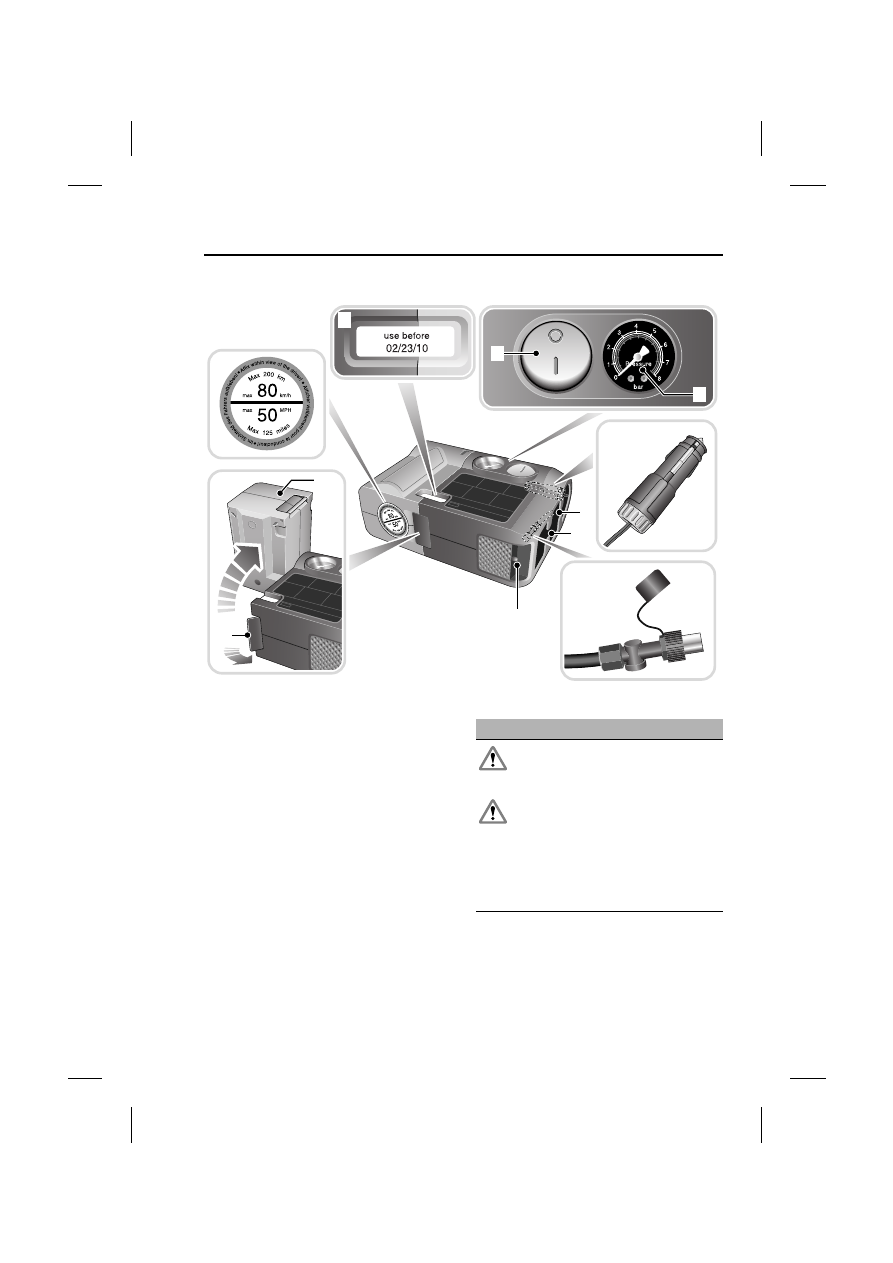
Jaguar tire repair kit

1. Maximum speed label. 80 km/h (50 

mph).

2. Shelf-life date label.

3. Compressor On/Off switch. (I = On. 0 

= Off.)

4. Tire pressure gauge.

5. Tire inflation hose.

6. Compressor power cable.

7. Inflation hose connector.

8. Power cable connector.

9. Built-in lamp.

10. Safety catch.

11. Sealant container section (orange).

Using the Jaguar tire repair kit

E92368

7

8

1

3

4

2

6

5

11

10

9

WARNINGS

Avoid skin contact with the 
sealant which contains natural 
rubber latex.

If the tire inflation pressure does 
not reach 1.8 bar (26 psi) within 
seven minutes, the tire may have 

suffered excessive damage. A temporary 
repair will not be possible, and the 
vehicle should not be driven until the tire 
has been replaced.

Wheels and tires

236

L

Note: All vehicle drivers and occupants 
should be made aware that a temporary 
repair has been made to a tire fitted to the 
vehicle. They should also be made aware 
of the special driving conditions imposed 
when using a repaired tire.

Repair procedure

1. Peel off the maximum speed label 1

Attach the label to the facia in the 
driver's field of view. Take care not to 
obstruct any of the instruments or 
warning indicators.

2. Uncoil the compressor power cable 

and the inflation hose  and 6.

3. Remove the valve cap from the 

damaged tire.

4. Connect the inflation hose 7 to the tire 

valve. Ensure that the hose is 
screwed on firmly.

5. Release the safety catch 10 and 

swivel the sealant container section 
of the repair kit 90 degress to the 
main body until it clicks firmly into 
place 11.

6. Ensure that the orange compressor 

switch 3 is in the OFF O position.

7. Insert the power cable connector 8 

into an auxiliary power socket.  See 
AUXILIARY POWER SOCKETS 
(page 153).

8. Unless the vehicle is in an enclosed or 

poorly ventilated area, start the 
engine.

CAUTIONS

Before attempting a tire repair, 
ensure that the vehicle is parked 
safely, as far away from passing 

traffic as possible.

Ensure that the parking brake is 
applied, and P (Park) is selected.

Do not attempt to remove foreign 
objects such as nails, screws, etc. 
from the tire.

Always run the engine when using 
the compressor, unless the vehicle 
is in an enclosed, or poorly 

ventilated space as this may cause 
asphyxiation.

To prevent overheating do not 
operate the compressor 
continuously for longer than ten 

minutes.

WARNING

Check the tire sidewall prior to 
inflation. If there are any cracks, 
bumps or similar damage, do not 

attempt to inflate the tire. Do not stand 
directly beside the tire while the 
compressor is pumping. Watch the tire 
sidewall. If any cracks, bumps or similar 
damage appear, turn off the compressor 
and let the air out by means of the 
pressure relief valve. Do not continue to 
use the tire.

237

Wheels and tires

R

9. Set the compressor switch to the ON, 

I, position.

10. Inflate the tire for no longer than 

seven minutes to a minimum of 1.8 
bar (26 psi) and a maximum of 3.5 bar 
(51 psi).

11. During the inflation, switch the 

compressor off briefly to check the 
tire pressure using the gauge 
mounted on the compressor.
• When pumping the sealant through 

the tire valve, the pressure may rise 
up to 6 bar (87 psi). The pressure 
will drop again after approximately 
30 seconds.

• It should not take longer than seven 

minutes to inflate the tire. If after 
seven minutes the tire has not 
reached the minimum pressure, the 
tire should not be used.

12. Once the tire has been inflated to at 

least 1.8 bar (26 psi), switch off the 
compressor. If desired the engine 
may be turned off after the 
compressor has been turned off.

13. Remove the power connector from 

the auxiliary power socket.

14. Remove the inflation hose from the 

tire valve by unscrewing it as quickly 
as possible (counterclockwise).

15. Replace the inflation hose protective 

cap, and the tire valve cap.

16. Swivel the sealant container section 

back to its original position and close 
the safety catch.

17. Ensure that the tire repair kit is placed 

securely in the vehicle. You will need 
to use the kit to check the tire 
pressure after 3km (2 miles) so ensure 
that it is easily accessible.

18. Immediately drive the vehicle for 3 km 

(2 miles) to allow the sealant to coat 
the inner surface of the tire and form 
a seal at the puncture. Do not drive 
any faster than 80 km/h (50 mph), 
observe the sticker indicating the 
maximum permissible speed.

Checking the tire pressure after a 
repair

1. Drive the vehicle for 3 km (2 miles) 

then stop in a safe place. Carry out a 
visual examination of the tires 
condition.

2. Make sure that the sealant container 

section is in its original position.

3. Screw the inflation hose connector 

firmly onto the tire valve.

4. Read the tire pressure from the 

gauge.

5. If the pressure of the sealant filled tire 

is above 1.3 bar (19 psi) adjust the 
pressure to the correct value.  See 
TIRE CARE (page 223).

WARNINGS

When driving the vehicle, if you 
experience vibrations, abnormal 
steering, or noises, reduce speed 

immediately. Drive with extreme caution 
and reduced speed, to the first safe 
place to stop the vehicle. Visually 
examine the tire and check its pressure. 
If there are any signs of damage or 
deformity to the tire, or the tire pressure 
is below 1.3 bar (19 psi), do not continue 
driving.

Consult a tire repair centre, or 
your Jaguar Dealer for advice 
concerning the replacement of a 

tire after using a tire repair kit.

Wheels and tires

238

L

6. Ensure that the compressor switch is 

in the OFF position (O), and insert the 
power cable connector into an 
auxiliary power socket. 

If the vehicle is in a well ventilated 
area, start the engine.

7. Switch the compressor to ON (I), and 

inflate the tire to the correct pressure.

8. To check the tire pressure, turn OFF 

the compressor then read the 
pressure from the gauge.

9. When the compressor is OFF, if the 

tire pressure is too high, release the 
required amount of pressure using 
the pressure relief valve.

10. Once the tire is inflated to the correct 

pressure, switch OFF the compressor 
and remove the power plug from the 
auxiliary socket.
• The use of the tire repair kit sealant 

may lead to error prompts and 
incorrect readings of the Tire 
Pressure Monitoring System. 
Therefore, use the tire repair kit 
pressure gauge to check and adjust 
the damaged tire's inflation 
pressure.

11. Unscrew the inflation hose connector 

from the tire valve, replace the tire 
valve cap and the inflation hose 
connector protective cap.

12. Ensure that the tire repair kit is placed 

securely in the vehicle.

13. Drive to the nearest tire repair centre, 

or Jaguar Dealer for a replacement 
tire to be fitted. Ensure that you make 
the repair centre aware that the tire 
repair kit has been used before the 
tire is removed.

14. Both the tire inflation hose, and the 

sealant container should be replaced 
once a new tire has been fitted.

Only sealant containers which 
are completely empty should 
be disposed of with normal 

household waste. Sealant containers 
which contain some sealant, and the tire 
inflation hose, should be disposed of by a 
tire specialist, or your Jaguar Dealer in 
compliance with local waste disposal 
regulations.

TIRE PRESSURE MONITORING 
SYSTEM (TPMS)

Note: 

Non-approved accessories may interfere 
with the system. If this occurs, TIRE 
PRESSURE SYSTEM FAULT
 is 
displayed in the message centre.

Tires may affect the performance of the 
TPMS. Always replace tires in 
accordance with recommendations.  See 
TECHNICAL SPECIFICATIONS 
(page 249).

WARNING

The TPMS is not a substitute for 
manually checking tire pressures. 
Tire pressures should be checked 

regularly using an accurate pressure 
gauge when cold. Failure to properly 
maintain your tire pressures could 
increase the risk of tire failure, with 
consequential loss of vehicle control and 
personal injury.

The TPMS cannot register damage to a 
tire. Regularly check the condition of 
your tires, especially if the vehicle is 
driven off road.


Content   ..  56  57  58  59   ..