Jaguar XJ (X350). Service manual - part 1076


  Index      Jaguar     Jaguar XJ (X350) - service and repair manual 2003-2009 year


Search            


Content   ..  1074  1075  1076  1077   ..


Jaguar XJ (X350). Service manual - part 1076
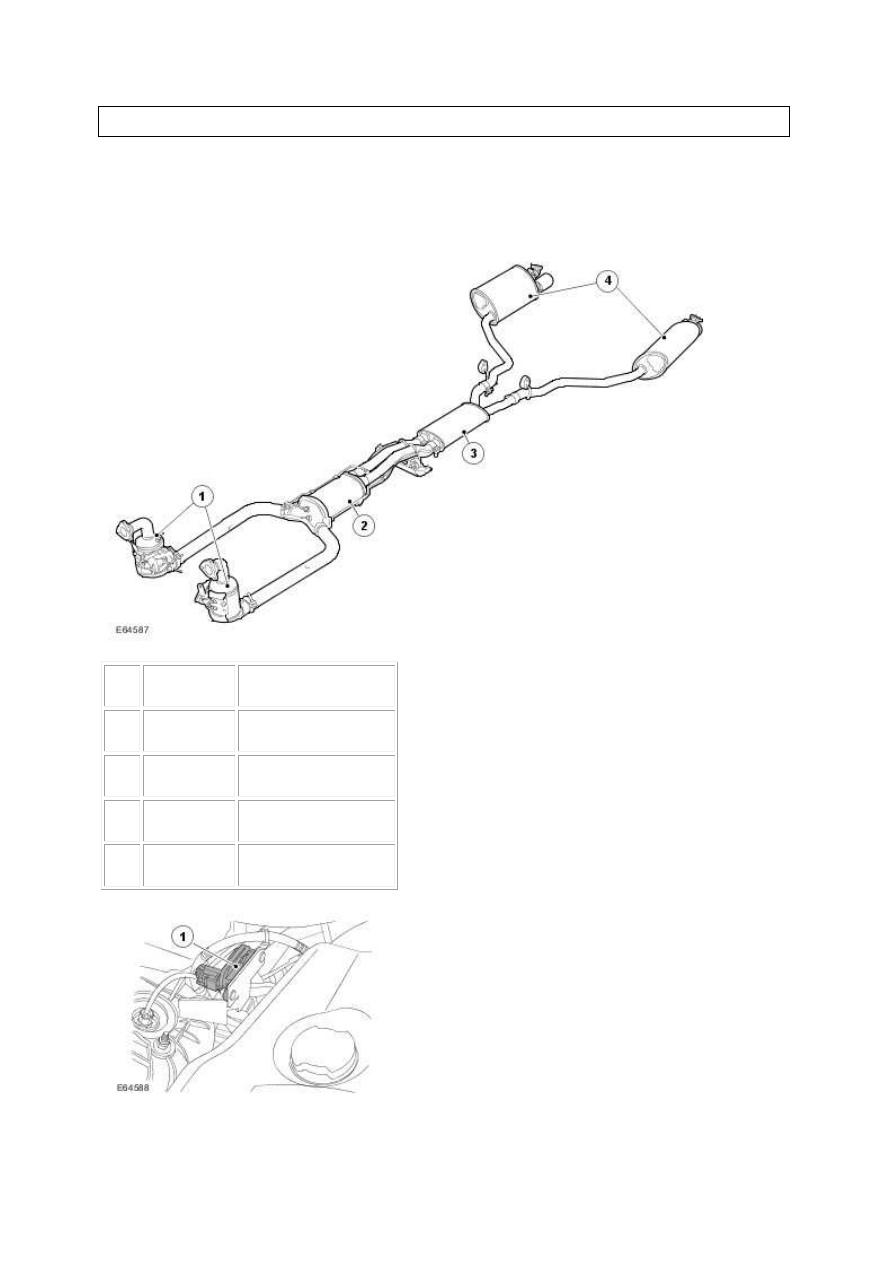


Description and operation


Exhaust System   


Item


Part Number


Description


1


Catalytic converters


2


Diesel particulate filter


3


Front muffler


4


Muffler and tailpipes


Item


Part Number


Description


1


Diesel particulate filter differential pressure sensor


The exhaust system for various engines are of similar design but utilize different internal elements to 

achieve a distinct exhaust note for each variant. 

Catalytic Converters 

The catalytic converters are of a monolithic structure and are coated in platinum. The platinum 

coating is used to control the emissions of hydrocarbons (HC), carbon monoxide (CO) and oxides of 

nitrogen (NOx) and to convert them into less harmful products for example carbon dioxide (CO) 

nitrogen (N) and water (HO). 


The catalytic converters are connected to the turbocharger by a three nut flange and is sealed by a 

gasket. Exhaust jointing compound must not be applied to these joints due to the possibility of 

catalytic converter contamination. Avoid allowing any foreign particles of debris into the catalytic 

downpipe as this can result in damage to the catalytic converter. 

Diesel Particulate Filter 

In order to meet strict Euro IV emission limits there is now a stipulation to reduce gaseous and 

particulate emissions greatly. The primary component within the exhaust system of the diesel is the 

diesel particulate filter. The diesel particulate filter uses new filter technology based on a combined 

filter and oxidation catalytic converter to store, and when conditions allow, destroy the particulates. 

The diesel particulate filter is of a silicon carbide filter construction. It has an additional wash coating 

on its filter surface of platinum and other active components which are used in the manufacture of 

oxidation catalytic converters. The exhaust gasses pass through the filter, leaving the particulates 

behind that are too big to pass through the filters pores. With engine management intervention and 

the catalytic coating this will promote particulate combustion and oxidation of carbon monoxide (CO) 

and hydrocarbon (HC) emissions. By carrying out this process, this will regenerate the diesel 

particulate filter to prevent increased back-pressure and the possibility of a completely blocked filter. 

Diesel particulate filter differential pressure sensor  

The diesel particulate filter differential pressure sensor monitors the differential pressure in the 

pipeline, upstream and downstream of the diesel particulate filter. The filtering of the particulates 

will lead to a greater resistance to the exhaust gas flow through the diesel particulate filter. This 

leads to a greater pressure difference upstream and downstream of the diesel particulate filter. The 

diesel particulate filter differential pressure sensor is a membrane sensor with strain resistances. The 

strain resistances change depending on the pressure difference. This leads to a change in the signal 

voltage. This signal is one of the parameters required for the strategy of the regeneration of the 

diesel particulate filter. 


Exhaust System – Armoured 

Muffler and Tailpipe 

The exhaust system is modified so that the engine cannot be stalled by stopping the flow of exhaust 

system emissions. Unique muffler and tailpipes are installed to the vehicle for this purpose. 

Vehicles 

www.

Diagnosis and testing


Exhaust System   

Overview 

2006MY sees the introduction of diesel to X350 and is accompanied by a diesel particulate filter 

(DPF) system to comply with strict stage four emissions requirements. The engine management 

system (EMS) makes use of 7-digit diagnostic trouble codes (DTCs) rather than the familiar 5-digit. 


Refer to the DTC index in this section for guidance on how to use these codes with the Jaguar 

approved diagnostic system or a scan tool. 


For information on the operation of the system,  

Exhaust System   

Inspection and Verification 

1 . Verify the customer concern.  


2 . Visually inspect for obvious signs of mechanical or electrical damage.  

Mechanical 


Electrical 


Leaks  

Metal fatigue  

Pipes, mufflers and catalytic converters 

Diesel particulate filter (DPF)  

DPF differential pressure sensor tubes  

Joints  

Mountings  

Clearance around components 


Battery charge and condition 

Wiring harness  

Electrical connector(s)  

5 volt sensor supply  

Sensor(s)  

Engine control module (ECM) 


3 . If an obvious cause for an observed or reported concern is found, correct the cause (if possible) 

before proceeding to the next step.  


4 . If the cause is not visually evident use the Jaguar approved diagnostic system or a scan tool to 

retrieve the fault codes before proceeding to the DTC index, or the symptom chart if no DTCs are set.  

Symptom Chart 

Symptom 


Possible source 


Action 


Noisy or 

leaking 

exhaust 


Exhaust system/components 


Install new components as necessary.  

Exhaust System - 2.7L V6 - TdV6  


Lack of power 


Air intake system fault  

Diesel particulate fliter (DPF) 

blocked/restricted  

Restricted exhaust system  

Low fuel pressure  

Exhaust gas recirculation 

(EGR) valve(s) fault  

Turbocharger(s) fault 


Check the air intake system,  

Intake Air Distribution and Filtering  Check for a 

blocked DPF or catalytic converter, install new 

components as necessary.  

Diesel Particulate Filter (DPF)  or  

Catalytic Converter - 2.7L V6 - TdV6 (17.50.05)  

Check the fuel pressure,  

Fuel Charging and Controls  For EGR tests,  

Engine Emission Control  For turbocharger tests,  

Turbocharger  


DTC index 

NOTE:  


Generic scan tools may not read the codes listed, or may read only 5-digit codes. Match the 5 

digits from the scan tool to the first 5 digits of the 7-digit code listed to identify the fault (the last 

2 digits give extra information read by the manufacturer-approved diagnostic system). 


NOTE:  


For a full list of powertrain DTCs, 

Electronic Engine Controls  


P024B00 

Diesel particulate filter 

(DPF) temperature 

sensor - catalyst 

downstream circuit 

range/performance 

(right hand bank) 


Temperature sensor - 

catalyst 
downstream 
circuit: high 
resistance  

Temperature sensor - 

catalyst 
downstream 
circuit: short 

For temperature sensor - catalyst 

downstream circuit tests, GO to 

Pinpoint Test  G552286p2.


www.


Content   ..  1074  1075  1076  1077   ..