Content .. 1263 1264 1265 1266 ..
Isuzu Amigo / Axiom / Trooper / Rodeo / VehiCross. Service manual - part 1265
6E1–136
RODEO Y22SE 2.2L ENGINE DRIVEABILITY AND EMISSION
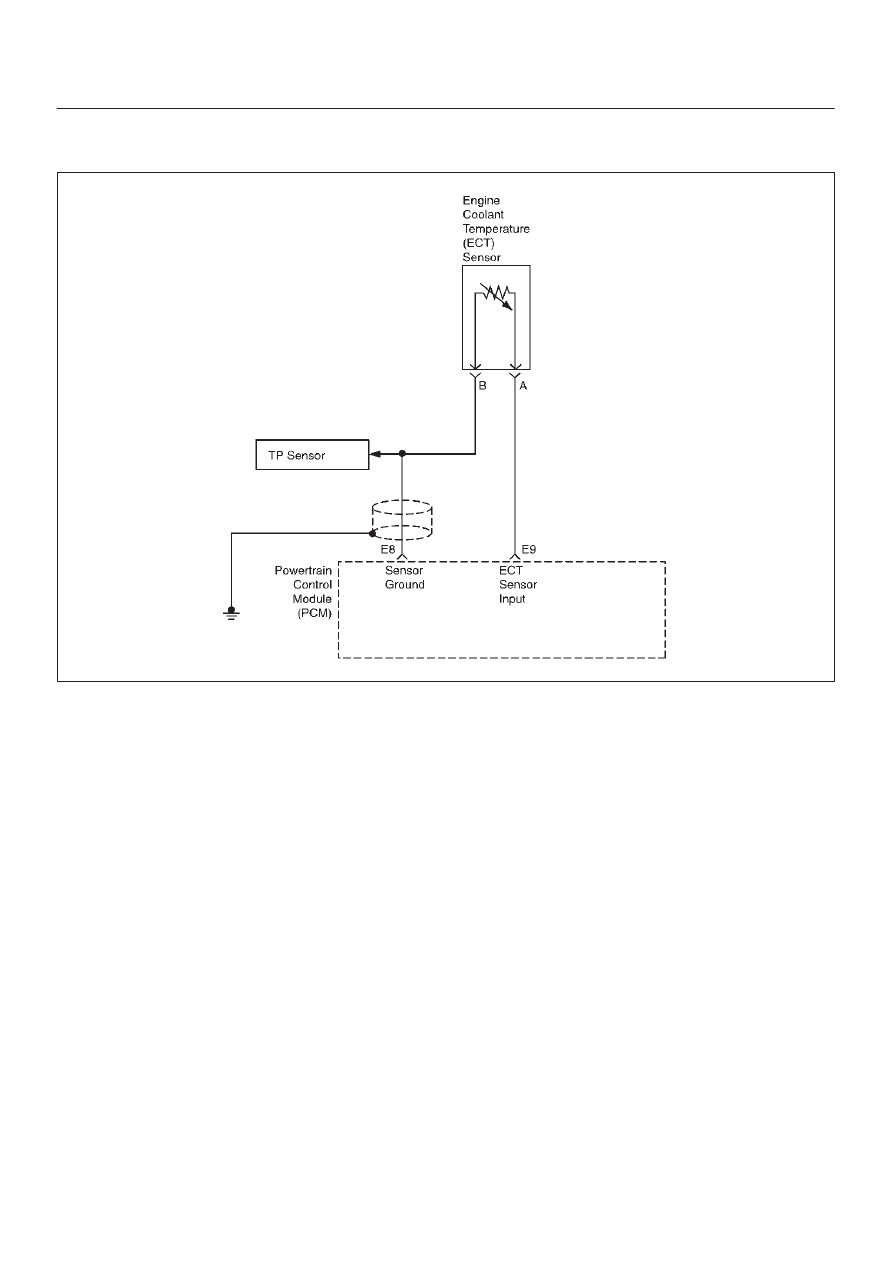
DIAGNOSTIC TROUBLE CODE (DTC) P0118 ENGINE COOLANT
TEMPERATURE (ECT) SENSOR CIRCUIT HIGH INPUT
060R100028
Circuit Description
The engine coolant temperature (ECT) sensor is a
thermistor mounted in the engine coolant stream. The
powertrain control module (PCM) applies a voltage
(about 5 volts) through a pull–up resistor to the ECT signal
circuit. When the engine coolant is cold, the sensor
(thermistor) resistance is high, therefore the PCM will
measure a high signal voltage. As the engine coolant
warms, the sensor resistance becomes less, and the
ECT signal voltage measured at the PCM drops. With a
fully warmed up engine, the ECT signal voltage should
measure about 1.5 to 2.0 volts. If the PCM detect a
continuous open in the ECT sensor or circuit, then a code
P0118 will set. DTC P0118 is a type A code.
Conditions for Setting the DTC
D
Engine running time is longer than 180 seconds.
D
The ECT sensor signal indicates an engine coolant
temperature of –39
°
C (–38
°
F) or less (about 5 volts)
for a total of 12.5 seconds over a 25–second period.
The above conditions are met for 100 test failures within a
200 test sample(125 msec/test)
Action Taken When the DTC Sets
D
The PCM will illuminate the malfunction indicator lamp
(MIL) the first time the fault is detected.
D
The PCM will substitute the ECT reading with a default
engine coolant temperature value. The default value is
based on start–up intake air temperature and running
time.
D
The PCM will store conditions which were present
when the DTC was set as Freeze Frame and in the
Failure Records data.
Conditions for Clearing the MIL/DTC
D
The PCM will turn the MIL OFF on the third consecutive
trip cycle during which the diagnostic has been run and
the fault condition is no longer present.
D
A history Diagnostic Trouble Code P0118 will clear
after 40 consecutive warm–up cycles have occurred
without a fault.
D
Diagnostic Trouble Code P0118 can be cleared by
using the Scan Tool’s ”Clear Info” function.
Diagnostic Aids
Check for the following conditions:
D
Poor connection at PCM – Inspect harness connectors
for backed–out terminals, improper mating, broken
locks, improperly formed or damaged terminals, and
poor terminal–to–wire connection.
D
Damaged harness – Inspect the wiring harness for
damage, shorts to ground, shorts to battery positive,
and open circuit. If the harness appears to be OK,
observe the ECT display on the Tech 2 while moving
connectors and wiring harnesses related to the ECT
sensor. A change in the ECT display will indicate the
location of the fault.