Isuzu engine C22NE / 22LE / 20LE. Service manual - part 86
DRIVEABILITY AND EMISSIONS 6E1-173
0.5
YEL/
GRN
0.5
GRN
0.5
RED
0.5
RED
0.5
GRN
0.5
RED
Manifold
Absolute
Pressure
(MAP)
Sensor
F10
B2
0.5
GRN
B7
A3
5 Volt
Reference
Signal
MAP Sensor
Input
Sensor
Ground
0.75
L
B8
0.75
G
B1
A B
C
Intake
Air Temperature
Sensor
Throttle Position
Sensor
Engine
Control
Module
(ECM)
HI
OUT
LO
0.5
G
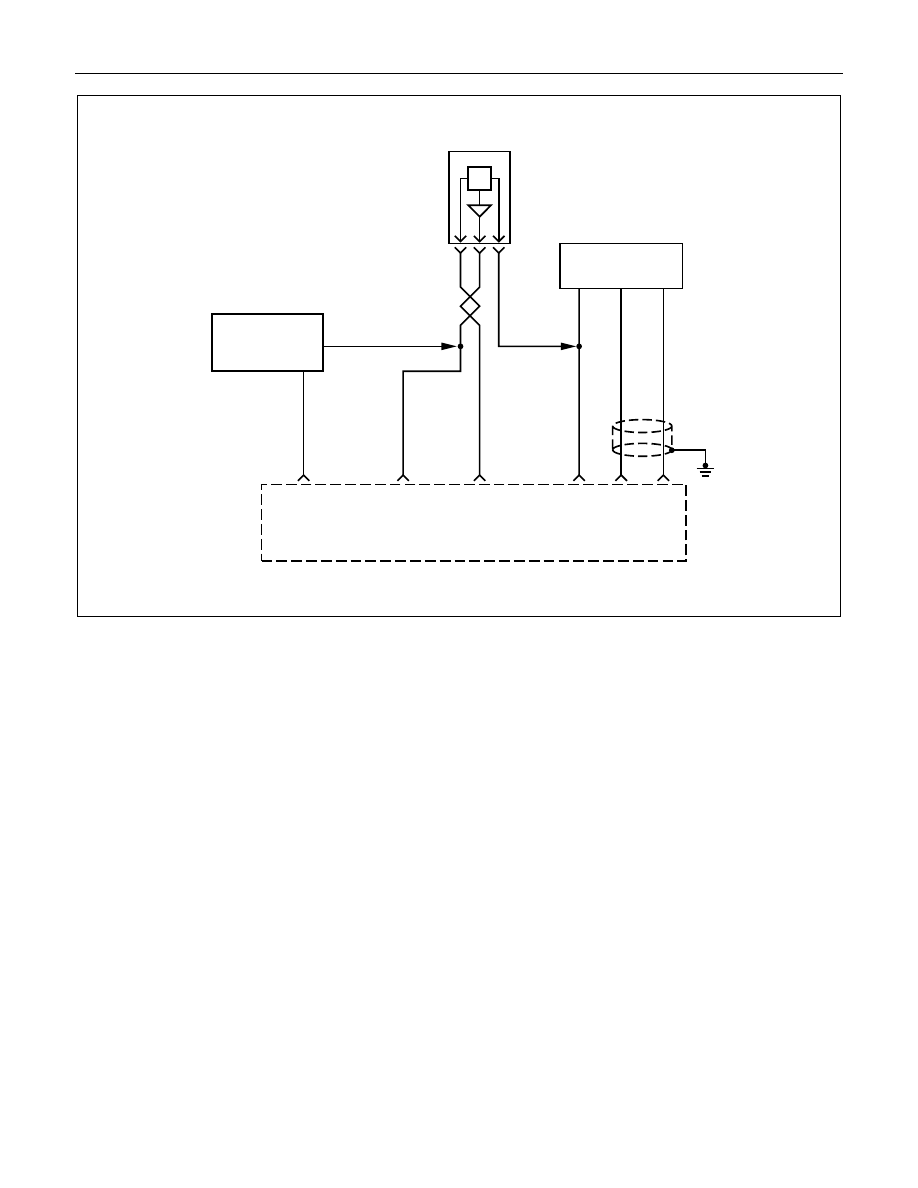
DIAGNOSTIC TROUBLE CODE (DTC) (Flash DTC = 33)
MANIFOLD ABSOLUTE PRESSURE (MAP) TOO HIGH
Circuit Description
The manifold absolute pressure (MAP) sensor
responds to changes in intake manifold pressure. The
MAP sensor signal voltage to the engine control
module (ECM) varies from below 2 volts at idle (low
manifold pressure) to above 4 volts with the ignition
ON, engine not running or at wide-open throttle (high
manifold pressure).
A "speed density" method of determining engine load
is used. This is calculated using inputs from the MAP
sensor, the CKP Sensor, and the Intake Air
Temperature (IAT) sensor. The MAP sensor is the
main sensor used in this calculation, and measuring
engine load is its main function. The ECM monitors
the MAP signals for voltages outside the normal range
of the MAP sensor. This code defects a short to MAP
signal voltage in the MAP sensor circuit. Diagnostic
Trouble Code 33 will be set.
Conditions for Setting the DTC
• No TP sensor Diagnostic Trouble Codes 21 or 22
present.
• Engine is running.
• Not in power enrich mode.
• Throttle Position Sensor value is less than 1%.
• Altitude Compensated Manifold Absolute Pressure
is greater than 95kpa.
Action Taken When the DTC Sets
• The ECM will illuminate the malfunction indicator
lamp (MIL).
Conditions for Clearing the MIL/DTC
Once the ECM determines that a fault(s) has been
rectified then the CEL will switch OFF, although the
fault code will remain in the ECM memory.
Any fault codes will remain in ECM memory until -
1. They are cleared by disconnecting the Battery for
more than 30 seconds.
2. A service tool such as Tech 2 is used to clear them.
3. Ten consecutive starts without logging a fault.