Isuzu Trooper (2000 year). Service manual - part 46
2A–14
POWER ASSISTED SYSTEM
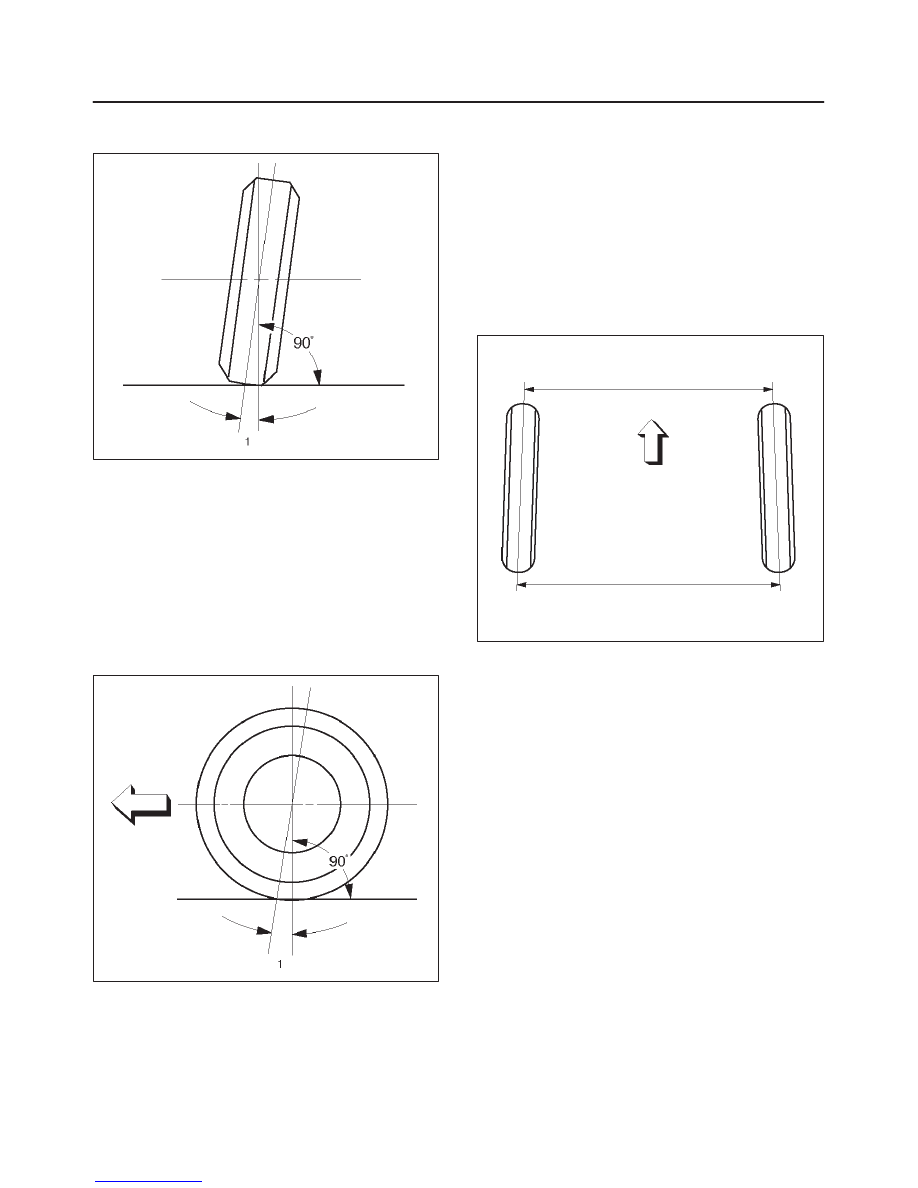
Camber:
This illustration is viewed from the front of the vehicle.
480RS004
Camber is the vertical tilting inward or outward of the front
wheels. When the wheels tilt outward at the top, the
camber is positive (+). When the wheels tilt inward at the
top, the camber is negative (–). The amount of tilt
measured in degrees from the vertical is called the
camber angle (1). If camber is extreme or unequal
between the wheels, improper steering and excessive tire
wear will result. Negative camber causes wear on the
inside of the tire, while positive camber causes wear to the
outside.
Caster:
This illustration is viewed from the side of the vehicle.
480RS005
Caster(1) is the vertical tilting of the wheel axis either
forward or backward (when viewed from the side of the
vehicle). A backward tilt is positive(+) and a forward tilt is
negative (–). On the short and long arm type suspension
you cannot see a caster angle without a special
instrument, but if you look straight down from the top of
the upper control arm to the ground, the ball joints do not
line up (fore and aft) when a caster angle other than 0
degree is present. With a positive angle, the lower ball
joint would be slightly ahead (toward the front of the
vehicle) of the upper ball joint center line.
Toe-in:
This illustration is viewed from the top of the vehicle.
480RS003
Toe-in is the measured amount the front wheels are
turned in. The actual amount of toe-in is normally a
fraction of a degree. Toe-in is measured from the center
of the tire treads or from the inside of the tires. The
purpose of toe-in is to insure parallel rolling of the front
wheels and to offset any small deflections of the wheel
support system which occurs when the vehicle is rolling
forward. Incorrect toe-in results in excessive toe-in and
unstable steering. Toe-in is the last alignment to be set in
the front end alignment procedure.
Inspection
Before making any adjustments affecting caster, camber
or toe-in, the following front end inspection should be
made.
1. Inspect the tires for proper inflation pressure. Refer to
Main Data and Specifications in Wheel and Tire
System section.
2. Make sure that the vehicle is unladen condition (With
no passenger or loading).
3. Make sure that the spare tire is installed at the normal
position.
4. Inspect the front wheel bearings for proper
adjustment. Refer to Front Hub and Disc Overhaul in
Suspension section.
5. Inspect the ball joints, tie rod ends and relay rods. If
excessive looseness is noted, correct before
adjusting. Refer to Steering Linkage in this section.