Isuzu KB P190. Service manual - part 382
 

  Index      Isuzu     Isuzu KB P190 - service and repair manual 2007 year


Search            


Content   ..  380  381  382  383   ..


Isuzu KB P190. Service manual - part 382


ENGINE COOLING (4JK1/4JJ1)  6B-5 

Radiator 

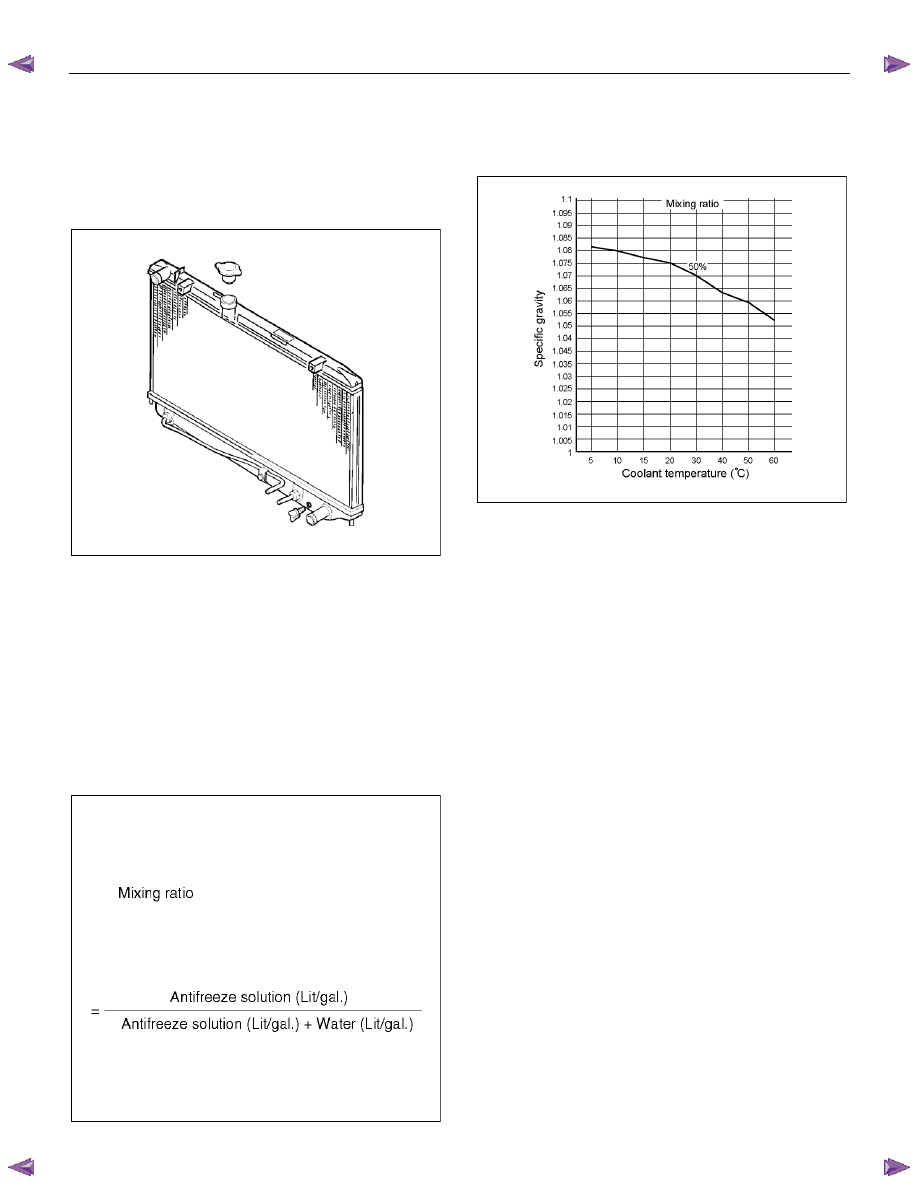
The radiator is a tube type with corrugated fins. In order
to raise the boiling point of the coolant, the radiator is
fitted with a cap in which the valve is operated at 93.3 -
122.7 kPa (0.95 - 1.25 kg / cm

/ 13.5 - 17.8 psi) 

pressure. (No oil cooler provided for M/T) 


RTW56BSH000301

Antifreeze Solution 

NOTE: 
Antifreeze solution + Water = Total cooling system
capacity. 

Total Cooling System Capacity Lit 

(US / UK gal) (US pint) 

M/T 8.7 (2.3/1.9) (18.4) 

A/T 8.6 (2.3/1.9) (18.2) 

See section 0B MAINTENANCE AND LUBRICATION


F06RW005


NOTE: 
To maintain the corrosion resistance of the aluminum
radiator, water and antifreeze must be combined in a
1:1 solution (50% antifreeze and 50% water). 


RTW76BSH000201


6B-6  ENGINE COOLING (4JK1/4JJ1) 

Diagnosis 

Engine Cooling Trouble 

Condition Possible 

Cause Correction 

Low Engine Coolant level 

Replenish 

Thermo meter unit faulty 

Replace 

Faulty thermostat 

Replace 

Faulty Engine Coolant temperature 
sensor 

Repair or replace 

Clogged radiator 

Clean or replace 

Faulty radiator cap 

Replace 

Low engine oil level or use of 
improper engine oil 

Replenish or change oil 

Clogged exhaust system 

Clean exhaust system or replace 
faulty parts 

Faulty Throttle Position sensor 

Replace throttle valve assembly 

Open or shorted Throttle Position 
sensor circuit 

Repair or replace 

Engine overheating 

Damaged cylinder head gasket 

Replace 

Engine overcooling 

Faulty thermostat 

Replace 

Faulty thermostat 

Replace 

Engine slow to warm–up 

Thermo unit faulty 

Replace 


ENGINE COOLING (4JK1/4JJ1)  6B-7 

Draining and Refilling Cooling System 

Before draining the cooling system, inspect the system
and perform any necessary service to ensure that it is
clean, does not leak and is in proper working order.
The engine coolant (EC) level should be between the
“MIN" and “MAX" lines of the reserve tank when the
engine is cold. If low, check for leakage and add EC up
to the “MAX" line. 

There should not be any excessive deposit of rust or
scales around the radiator cap or radiator filler hole, and
the EC should also be free from oil. 

Replace the EC if excessively dirty. 


1.  Remove the radiator skid plate. 

2. Completely drain the cooling system by opening

the drain plug at the bottom of the radiator. 


RTW56BSH000301

3.  Remove the radiator cap. 

WARNING: 
To avoid the danger of being burned, do not
remove the cap while the engine and radiator are
still hot.  Scalding fluid and steam can be blown out
under pressure. 

4.  Disconnect all hoses from the EC reserve tank. 


Scrub and clean the inside of the reserve tank with

soap and water.  Flush it well with clean water,

then drain it.   Install the reserve tank and hoses. 


5. Refill the cooling system with the EC using a 

solution that is at least 50 percent antifreeze. 


Procedure for filling with coolant (in case of full change).

•  Make sure that the engine is cool. 
•  Open radiator cap and pour coolant up to filler 

neck. 

•  Pour coolant into reservoir tank up to “MAX" line. 
•  Tighten radiator cap and start the engine. After

idling for 2 to 3 minutes, stop the engine and 

reopen the radiator cap. If the water level is lower, 

replenish. 

WARNING: 
When the coolant is heated to a high temperature,
be sure not to loosen or remove the radiator cap.
Otherwise you might get scalded by hot vapor or 
boiling water.  To open the radiator cap, put a piece 
of thick cloth on the cap and loosen the cap slowly
to reduce the pressure when the coolant has
become cooler. 

•  After tightening the radiator cap, warm up the

engine at about 2000 rpm. Set heater adjustment 

to the highest temperature position, and let the 

coolant circulate also into heater water system. 

•  Check to see the thermostat has opened through 

the needle position of the water thermometer, 

conduct a 5–minute idling again and stop the 

engine. 

•  When the engine has been cooled, check filler 

neck for water level and replenish if required. 

Should extreme shortage of coolant be found, 

check the cooling system and reservoir tank hose 

for leakage. 

•  Pour coolant into the reservoir tank up to “MAX" 

line. 

6B-8  ENGINE COOLING (4JK1/4JJ1) 

Water Pump 

Read this Section carefully before performing any
removal and installation procedure. This Section gives
you important points as well as the order of operation.
Be sure that you understand everything in this Section
before you begin. 


Removal 

1.  Remove the engine cover. 

2.  Radiator Upper Hose 

a.  Partially drain the engine coolant. 

b.  Remove the radiator upper hose. 


RTW56FSH000101

3.  Water Outlet Pipe 

a.  Disconnect the turbocharger-cooling pipe from

the outlet pipe. 

b. Loosen the fixing bolt and remove the water

outlet bolt. 

4.  Upper Fan Shroud 

5.  Fan and Fan Clutch 

a.  Loosen the fan clutch nuts. 

b.  Remove the fan together with the fan clutch.

Take care not to damage the radiator core. 

6.  Fan Drive Belt and Pulley 

a. 

Loosen the tension adjust bolt on the

generator. 

b.  Remove the fan drive belt with the fan pulley. 


RTW56ASH025401

7. Water Pump 

a.  Remove the water pump bolts and nuts. 

b.  Remove the water pump. 


RTW56BSH000201


Content   ..  380  381  382  383   ..