Hyundai Coupe (2008 year). Manual - part 19
2 DRIVING YOUR HYUNDAI
SMOOTH CORNERING
18
o
Keep your car clean. For maximum
o
Don't "labour" or "over-rev" the en-
C150A01A-EAT
service, your Hyundai should be kept
gine. Labouring is driving too slowly
Avoid braking or gear changing in cor-
clean and free of corrosive materi-
in too high a gear resulting in the
ners, especially when roads are wet.
als. It is especially important that
vehicle kangarooing. If this happens,
Ideally, corners should always be taken
mud, dirt, ice, etc. not be allowed to
shift to a lower gear. Over-revving is
under gentle acceleration. If you follow
accumulate on the underside of the
racing the engine beyond its safe
these suggestions, tyre wear will be
car. This extra weight can result in
limit. This can be avoided by shifting
held to a minimum.
increased fuel consumption and also
at the recommended speeds.
contribute to corrosion.
o
Use your air conditioning sparingly.
o
Travel lightly. Don't carry unneces-
The air conditioning system is oper-
sary weight in your car. Weight re-
ated by engine power so your fuel
duces fuel economy.
economy is reduced when you use it.
o
Don't let the engine idle longer than
necessary. If you are waiting (and
not in traffic), turn off your engine and
restart only when you're ready to go.
o
Remember, your Hyundai does not
require extended warm-up. After the
engine has started, allow the engine
to run for 10 to 20 seconds prior to
placing the vehicle in gear. In very
cold weather, however, give your
engine a slightly longer warm-up pe-
riod.
DRIVING YOUR HYUNDAI
2
WINTER MOTORING
19
DC170A1-E
ZC170C1-E
ZC170D1-E
Anti-freeze/Corrosion inhibitor
Door Locks
The onset of winter conditions subject
motor vehicles to greater operating de-
The cooling system must always con-
Should the door lock mechanism be-
mands. Therefore, the following sug-
tain an Ethylene-Glycol based anti-
come frozen, a proprietary lock de-icer
gestions will assist in maintaining peak
freeze solution. The system is filled
should be used. Alternatively, warming
performance and reliability during these
during manufacture with solution of the
the door key may thaw the door lock.
periods:
correct strength which should be
However, the key should be handled
checked before the onset of winter and
carefully to avoid burning the fingers.
adjusted or changed as required.
Never attempt to thaw a frozen door
lock using hot water, since the water
ZC170B1-E
NOTE:
will eventually freeze and compound
Electrical System
The anti-freeze solution contains a
the problem.
Winter conditions impose severe de-
corrosion inhibitor to prevent degra-
mands upon vehicle electrical systems,
dation of the aluminium castings
NOTE:
particularly the charging circuit. The
contained within the engine. There-
The proper temperature for using the
battery condition and performance along
fore, never, drain the system and
immobiliser key is from -40°C to
with the alternator performance and
refill with water only.
80°C (-40°F to 176°F). If you heat the
drive belt condition should be checked
immobiliser key over 80°C (176°F) to
prior to the onset of winter.
In addition, anti-freeze solution must
open the frozen lock, it may cause
ALWAYS be used in vehicles fitted with
damage to the transponder in its
air conditioning, to prevent the heater
head.
matrix from freezing and subsequently
bursting with the refrigeration system in
use.
2 DRIVING YOUR HYUNDAI
TRAILER OR VEHICLE
20
TOWING
ZC170E1-E
o
The formation of snow or ice build up
YC200A2-E
Windscreen Washers & Wipers
inside the wheel arches may inter-
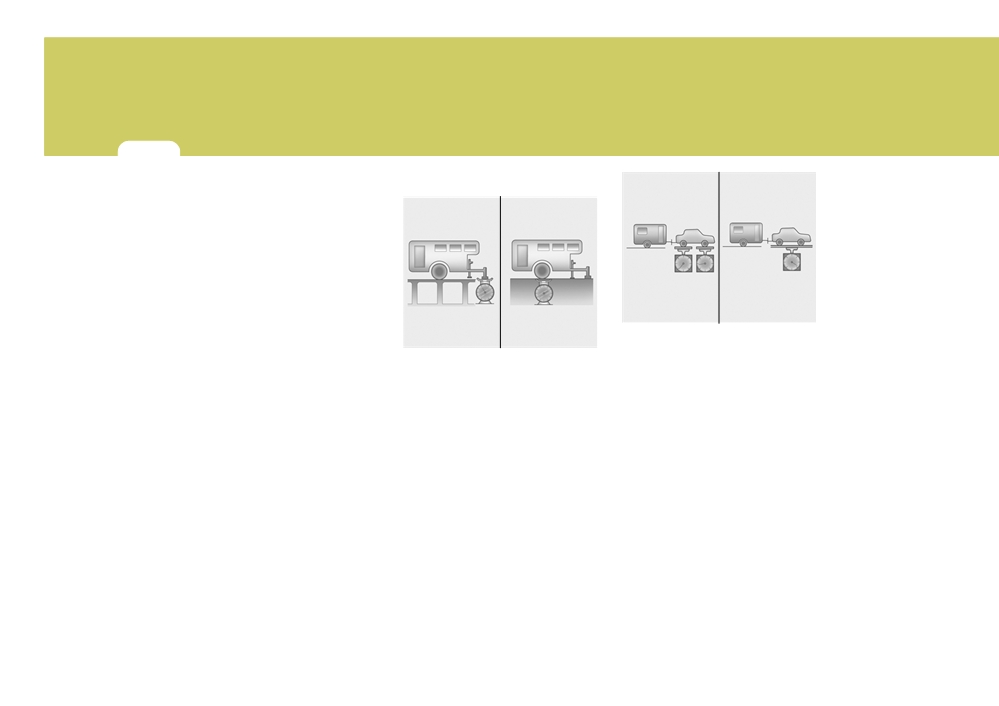
If you are considering towing with your
The windscreen washer bottle should
fere with the roadwheels or steering
car, you should first check with your
mechanism. In such instances, un-
Local Laws to determine their legal
be filled with a solution of water and a
usual noises or an increase in steer-
requirements.
proprietary winter screen wash addi-
tive. The windscreen wipers should not
ing effort may result. Therefore, en-
Since laws vary from county to county,
sure that the wheelarches are
the requirements for towing trailers,
be used if the blades are frozen to the
checked periodically and any accu-
cars, or other types of vehicles or appa-
windscreen or if they are covered with
snow, before this is removed.
mulated snow or ice removed.
ratus may differ. Ask your Hyundai
o
It is advisable to carry emergency
authorised repairer for further details
equipment including, torch, shovel,
before towing.
NOTE:
tow rope, blankets etc., if a journey is
Never allow undiluted screen washer
to be undertaken into areas of severe
fluid additive to spill upon the
road conditions.
!
paintwork or use engine coolant anti-
CAUTION:
freeze since damage to the paintwork
Do not carry out any towing with
may result.
your car during it's first 1000 miles in
order to allow both the engine to
o When driving in extreme conditions,
have properly run-in and the clutch
the windscreen wiper blades may fail
(manual transaxle) to have correctly
to clear the screen properly due to
bedded-in. Failure to heed this cau-
the formation of ice upon the blade
tion may result in serious engine or
edge. It will therefore be necessary
transaxle damage.
to periodically remove such ice to
restore their efficiency.
o If the power operated door mirrors
become frozen, attempts to adjust
these may damage the mechanism.
DRIVING YOUR HYUNDAI
2
21
YC200B2-E
YC200C4-E
Trailer Towbars
Trailer Brakes
!
CAUTION:
If your trailer is equipped with a braking
Select the proper towbar and ball com-
o Never connect a trailer brake sys-
system, make sure it conforms to local
bination, making sure that its location is
tem directly to the vehicle brake
regulations and that it is properly in-
compatible with that of the trailer or
system.
vehicle being towed.
stalled and operating correctly.
o When towing a trailer on steep
Use a quality non-equalizing towbar
grades (in excess of 6%) pay close
which distributes the nose weight uni-
NOTE:
attention to the engine coolant
formly throughout the chassis.
If you tow a trailer or vehicle, your
temperature gauge to ensure the
car will require more frequent main-
engine does not overheat. If the
The towbar should be bolted securely to
tenance due to the additional load.
needle of the coolant temperature
the car and installed by a qualified
See Maintenance Under Severe Us-
gauge moves across the dial to-
technician.
age Conditions" on page 5-7.
wards "H" (HOT), pull over and
stop as soon as it is safe to do so,
and allow the engine to idle until it
cools down. You may proceed
once the engine has cooled suffi-
ciently.
2 DRIVING YOUR HYUNDAI
22
YC200D2-E
C190E01GK-EAT
Safety Cables
Trailer Weight Limit
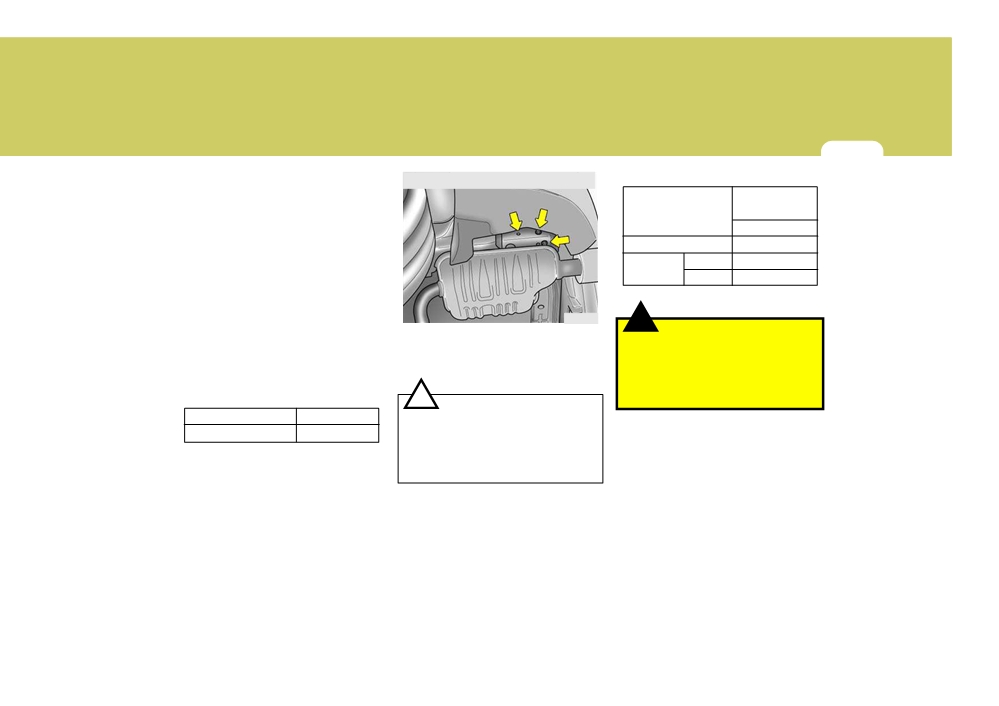
Should the towbar connection between
your car and the trailer or vehicle you
are towing fail, the trailer or vehicle
could wander dangerously across other
lanes of traffic and ultimately leave the
roadway. To eliminate this potentially
dangerous situation, safety cable, at-
Gross Axle Weight
Gross Vehicle
tached between your car and the trailer
Weight
or towed vehicle, are required.
C190E02L
Nose weight
Total trailer weight
2. The total gross vehicle weight with
C190E01L
trailer must not exceed the Gross
Nose weights can be increased or de-
Vehicle Weight Rating (GVWR)
creased by re-distributing the load in
shown on the vehicle identifica-
the trailer.
tion plate (see page 8-2). The total
This can be verified by checking the
gross vehicle weight is the com-
total weight of the loaded trailer and
bined weight of the vehicle, driver,
then checking the nose weight.
all passengers and their luggage,
cargo, towbar hitch, trailer nose
NOTE:
weight and other optional equip-
1. Never load the trailer with more
ment.
weight in the back than in the
front. About 60% of the trailer
load should be in the front half
on the trailer and the remaining
40% in the rear.
DRIVING YOUR HYUNDAI
2
23
3. The front or rear axle weight must
View from below the vehicle coupling point
Lbs. (Kg)
not exceed the Gross Axle Weight
Maximum
Rating (GAWR) shown on the ve-
Towable Weight
hicle identification plate
(see
page 8-2). It is possible that your
Trailer
towing package does not exceed
Without Brake Type
1,212 (550)
the GVWR but exceeds the
With Brake
1.6L
2,645 (1,200)
GAWR.
Type
2.0L/2.7L
3,086 (1,400)
Improper trailer loading and/or
too much luggage in the luggage
compartment can overload the
HGK260
rear axle. Redistribute the load
!
and check the axle weight again.
5. The maximum permissible over-
WARNING:
4. The maximum permissible static
hang of the coupling point is 38.97
Improper loading of your car and
vertical load(nose weight) on the
inches.
trailer can seriously affect its steer-
coupling device is;
ing and braking performance caus-
ing a crash which could cause seri-
Lbs. (Kg)
ous injury or death.
!
CAUTION:
1.6L
110 (50)
The following specifications are
2.0L/2.7L
132 (60)
recommended when towing a
trailer. The loaded trailer weight
cannot safely exceed the values in
the chart.
2 DRIVING YOUR HYUNDAI
24
YC200E3-E
8. When parking your car and trailer,
13.Avoid holding the brake pedal down
Trailer or Vehicle Towing Tips
especially on a hill, be sure to follow
too long or too frequently. This could
all the normal precautions. Turn your
cause the brakes to overheat, re-
1. Before towing, check towbar ball and
front wheels into the curb, set the
sulting in reduced braking efficiency.
safety cable connections as well as
parking brake firmly, and put the
14.When going down a hill, shift into a
proper operation of the trailer running
transaxle in 1st or Reverse (manual)
lower gear and use the engine brak-
lights, brake lights, and turn signals.
or Park (automatic). In addition we
ing effect.
2. Always drive your vehicle at a mod-
advise the use of wheel chocks at
When climbing a long grade, down-
erate speed (Less than 60 mph).
each of the trailer's tyres.
shift the transaxle to a lower gear
3. Trailer towing requires more fuel than
9. If the trailer has electric brakes, start
and reduce speed to reduce chances
normal conditions.
your vehicle and trailer moving, and
of engine overloading and/or over-
4. To maintain engine braking effi-
then apply the trailer brake controller
heating.
ciency, do not tow a trailer with the
by hand to be sure the brakes are
15.If you have to stop whilst going
transaxle in fifth gear
(manual
working. This lets you check your
uphill, do not hold the vehicle in
transaxle) or overdrive (automatic
electrical connection at the same
place by pressing on the accelera-
transaxle).
time.
tor. This can cause the automatic
5. Always secure items in the trailer to
10.During your trip, check occasionally
transaxle to overheat. Use the park-
prevent load shift whilst driving.
to be sure that the load is secure,
ing brake or footbrake.
6. Check the condition and air pressure
and that the lights and any trailer
of all tyres on the trailer and your car.
brakes are still working.
NOTE:
Low tyre pressure can seriously af-
fect the handling. Also check the
11.Avoid jerky starts, sudden accel-
When towing, check transaxle fluid
spare tyre.
eration or sudden stops.
more frequently.
12.Avoid sharp turns and rapid lane
7. The vehicle/trailer combination is
changes.
more affected by crosswind and buf-
feting. When being passed by a large
vehicle, keep a constant speed and
steer straight ahead. If there is too
much wind buffeting, slow down to
get out of the other vehicle's air
turbulence.
DRIVING YOUR HYUNDAI
2
25
!
CAUTION:
If overheating should occur when
towing, (temperature gauge reads
near red zone), taking the following
action may reduce or eliminate the
problem.
1. Turn off the air conditioner.
2. Reduce highway speed.
3. Select a lower gear when going
uphill.
4. Whilst in stop and go traffic, place
the gear selector in park or neutral
and idle the engine at a higher
speed.

IN CASE OF EMERGENCY
If the Engine will not Start
3-2
Jump Starting
3-3
If the Engine Overheats
3-4
Temporary Spare Tyre
3-5
In the Event of a Puncture
3-6
3
Changing a Flat Tyre
3-7
If Your Vehicle Must be Towed
3-11
Emergency Towing
3-13
If You Lose Your Keys
3-14
3
3 IN CASE OF EMERGENCY
IF THE ENGINE WILL NOT
2
START
SD020A1-E
SD020B1-E
4. Do not attempt to push or tow start
Seek assistance from the nearest
If the Engine Cannot be Cranked
the vehicle, refer to "Jump Starting"
Hyundai authorised repairer with regard
for information regarding engine start-
to the method of ignition and fuel sys-
ing when the battery is discharged.
tem diagnosis.
!
WARNING:
D010C01A-EAT
If the engine refuses to start, no
If Engine Turns Over Normally
attempt should be made to push or
but Does Not Start
tow start the vehicle. Vehicles with
1. Check fuel level.
automatic transaxle or fuel injec-
D010B01GK
2. With the key in the off position,
tion will not be able to be started in
Check all connectors at ignition coils
this manner since no drive is trans-
1. If the vehicle is fitted with manual
and spark plugs. Reconnect any
mitted through the automatic
transaxle, ensure that the clutch
that may be disconnected or loose.
transaxle whilst the engine is not
pedal is depressed whilst cranking
3. Check the fuel line in the engine
running, and in the case of fuel
the engine. If the vehicle is fitted
room.
injected derivatives, the fuel pump
with automatic transaxle, ensure
4. If engine still refuses to start, call a
will not operate under tow start
that the transaxle selector is at the
Hyundai authorised repairer or seek
conditions. In addition, if the ve-
"P" or"N" position.
other qualified assistance.
hicle is equipped with an exhaust
2. Check the battery terminals and
catalyst, damage to the catalyst may
connections to ensure that these
result if the vehicle is tow started.
are clean and also tight.
3. If the ignition warning lights dim when
the engine is cranked and the battery
terminals have been checked, a dis-
charged battery is indicated.
IN CASE OF EMERGENCY
3
JUMP STARTING
3
D010D01A-EAT
SD030A2-E
If Engine Stalls While Driving
1.6L/2.0L
!
CAUTION:
1. Reduce your speed gradually, keep-
Personal injury and damage to the
ing a straight line. Move cautiously
Dis-
vehicle may occur if jump starting
off the road to a safe place.
charged
is not performed correctly. If any
2. Turn on your hazard lights.
battery
doubt exists as to how this opera-
3. Try to start the engine again. If your
tion should be performed, seek as-
vehicle will not start, contact a
sistance from qualified personnel.
Hyundai authorised repairer or seek
other qualified assistance.
Booster battery
HGK4001
!
WARNING:
2.7L
Discharged
Motor vehicle batteries contain
F020100AUN
battery
sulphuric acid and emit hydrogen
If the engine stalls at a crossroad or
gas. Protective clothing should be
crossing
worn and care exercised to prevent
If the engine stalls at a crossroad or
the acid from coming into contact
crossing, set the shift lever in the N
with skin or clothing and the ve-
(Neutral) position and then push the
hicle. Naked lights should not be
vehicle to a safe place. If your vehicle
permitted in the vicinity of the bat-
has a manual transaxle not equipped
tery. Care should be exercised to
with the ignition lock switch, the vehicle
prevent sparks occurring during
Booster battery
can move forward by shifting to the
connection. If acid accidentally
HGK4002
2(second) or 3(third) gear and then turn-
comes into contact with skin or
ing the starter without depressing the
eyes, the affected area should im-
clutch pedal.
mediately be flushed with copious
amounts of water and medical as-
sistance sought.

3 IN CASE OF EMERGENCY
IF THE ENGINE OVERHEATS
4
1. Ensure that the booster battery is 12
7. Switch "ON" the main beam
SD040A2-E
volt type. If the booster battery is
headlamps before carefully remov-
If the temperature gauge indicates
installed in another vehicle, ensure
ing the jumper cables have been
overheating:
that the two vehicles are not touch-
removed, switch "OFF" the main
ing.
beam headlamps.
1. Pull off the road and stop as soon as
2. Turn off all unnecessary electrical
it is safe to do so.
equipment in both vehicles.
2. Place the gear selector lever in "P"
3. Ensure that the engine of the ve-
!
(automatic), or neutral
(manual
CAUTION:
hicle providing the jump start is run-
transaxle) and set the parking brake.
If the jump cables are incorrectly
ning prior to connection of the jump
If the air conditioning is on, turn it off.
installed, damage to the vehicle elec-
cables.
3. If coolant is running out under the
trical system may occur, in particu-
4. Connect the red jump cable to the
car or steam is coming out from
lar the electronic components such
positive (+) terminal of the booster
under the bonnet stop the engine.
as the Fuel Injection system com-
battery and the other end to the
Do not open the bonnet until the
puter and the Automatic Transaxle
positive
(+) terminal of the dis-
coolant has stopped running or the
computer. The battery must never
charged battery.
steaming has stopped. If there is no
be disconnected whilst the engine
5. Attach the black jump cable to the
visible loss of coolant and no steam,
is running.
negative (-) terminal of the booster
leave the engine running and check
battery, and the other end to a ground
to be sure the engine cooling fan is
point within the engine compartment
operating.
of the vehicle with the flat battery. Do
If the fan is not running, turn the
not connect to the negative battery
engine off.
terminal of the flat battery since
4. Check to see if the water pump drive
sparks may be generated with the
belt is broken. If it is not missing,
subsequent risk of explosion.
check to see that it is tight. If the
6. Raise the booster vehicle engine
drive belt seems to be satisfactory,
speed to 2,000 r.p.m. and start the
check for coolant leaking from the
engine of the vehicle with the flat
radiator, hoses or under the car. (If
battery.
the air conditioning had been in use,
it is normal for cold water to be
draining from it).
IN CASE OF EMERGENCY
3
TEMPORARY SPARE TYRE
5
6. If the cause of the overheating can-
D040A01GK-EAT
not be found, wait until the engine
The following instructions for the tem-
!
WARNING:
temperature has returned to normal.
porary spare tyre should be observed:
Then, if coolant has been lost, care-
Whilst the engine is running, keep
fully add coolant to the reservoir
1. Check inflation pressure as soon as
hands and clothing away from mov-
ing parts such as the fan and drive
(page 6-10) to bring the fluid level in
practical after installing the spare
the reservoir up to the base of the
tyre, and adjust to the specified
belts to prevent injury.
radiator fill opening. Fill the coolant
pressure. The tyre pressure should
expansion tank to the halfway mark.
be periodically checked and main-
5. If the water pump drive belt is broken
To ensure the correct water to cool-
tained at the specified pressure
or coolant is leaking out, stop the
ant mix is obtained after top up,
whilst the tyre is stored.
engine immediately and call the near-
testing by an authorised repairer is
est Hyundai authorised repairer for
required.
Spare Tyre Pressure
assistance.
7. Proceed with caution until it is estab-
Tyre Size
T125/70 R16
lished that the engine is operating
normally. If the engine overheats
Inflation Pressure
420 kPa (60 psi)
repeatedly, the advice of a Hyundai
!
WARNING:
authorised repairer should be sought.
2. The spare tyre should only be used
Do not remove the radiator cap when
temporarily and should be returned
the engine is hot since steam and
to the luggage compartment as soon
!
boiling water may be ejected from
as the original tyre can be repaired
CAUTION:
the radiator resulting in burns or
or replaced.
Serious loss of coolant indicates
scalding.
3. Continuous use at speeds of over
there is a leak in the cooling system
50 mph (80 km/h) is not recom-
and this should be checked as soon
mended.
as possible by a Hyundai authorised
4. As the temporary spare tyre is spe-
repairer.
cifically designed for your car, it
should not be used on any other
vehicle.
3 IN CASE OF EMERGENCY
IN THE EVENT OF A PUNC-
6
TURE
5. The temporary spare tyre should not
D040B01A-EAT
SD060A1-E
be used on any other wheels, nor
Handling the Spare Tyre
If a puncture occurs whilst driving the
should standard tyre, snow tyre,
vehicle:
wheel covers or trim rings be used
1. Bring the car to rest as soon as it is
with the temporary spare wheel. If
safe to do so and with the minimum
such use is attempted, damage to
amount of braking required which
these items or other car compo-
will assist in maintaining the maxi-
nents may occur.
mum amount of control. The vehicle
6. The temporary spare tyre pressure
should be parked wherever pos-
should be checked once a month
sible upon firm level ground to facili-
whilst the tyre is stored.
tate wheel changing.
2. If the vehicle is creating a hazard
HGK4010A
and the road conditions do not per-
!
CAUTION:
mit the wheel to be changed safely,
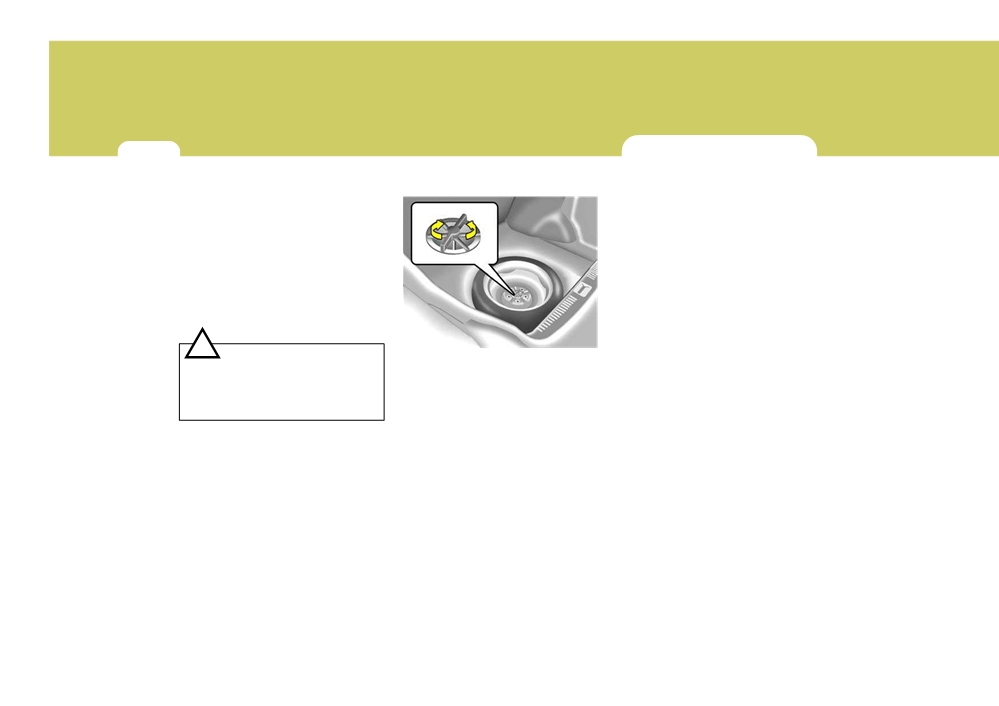
Remove the installation bolt to remove
o Do not use snow chains with
assistance should be sought.
the spare tyre. To replace the spare tyre
3. Passengers must not be allowed to
your temporary spare tyre.
in its storage compartment, tighten the
o Do not use more than one tempo-
remain inside the vehicle during
bolt firmly with your fingers until there is
rary spare tyre at a time.
wheel changing. If a puncture oc-
no more play in the spare tyre.
curs whilst the vehicle is on a
motorway, the passengers should
take refuge on the motorway em-
bankment to avoid the possibility of
injury occurring should the vehicle
be struck by other motorway traffic.
4. Wheel changing should be per-
formed according to the following
instructions.
IN CASE OF EMERGENCY
3
CHANGING A FLAT TYRE
7
SD070A1-E
D060B01GK-EAT
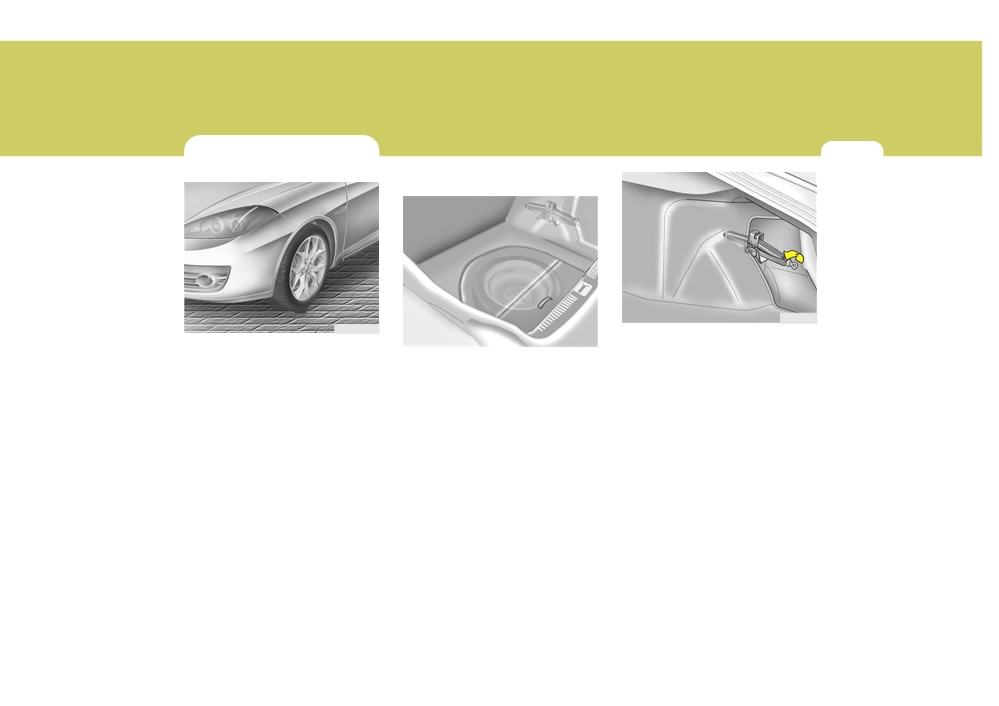
1. Obtain Spare Tyre and Tool
HGK4009
OGK036060
The jack is located behind the right side
HGK4008
It is of the utmost importance that care
of luggage trim. Remove the jack cover
is exercised when changing road
Remove the spare tyre, jack and tool
with screwing the bolts. Turn the jack
wheels. Ensure that the parking brake
bag from the boot.
end counterclockwise to lower the jack
is set and that the gear shift lever is in
height by using a screw driver or wrench
reverse (P, if the vehicle has automatic
bar and remove it from the bracket.
transaxle).
3 IN CASE OF EMERGENCY
8
SD070D1-E
ZD070F1-E
D060E01A-AAT
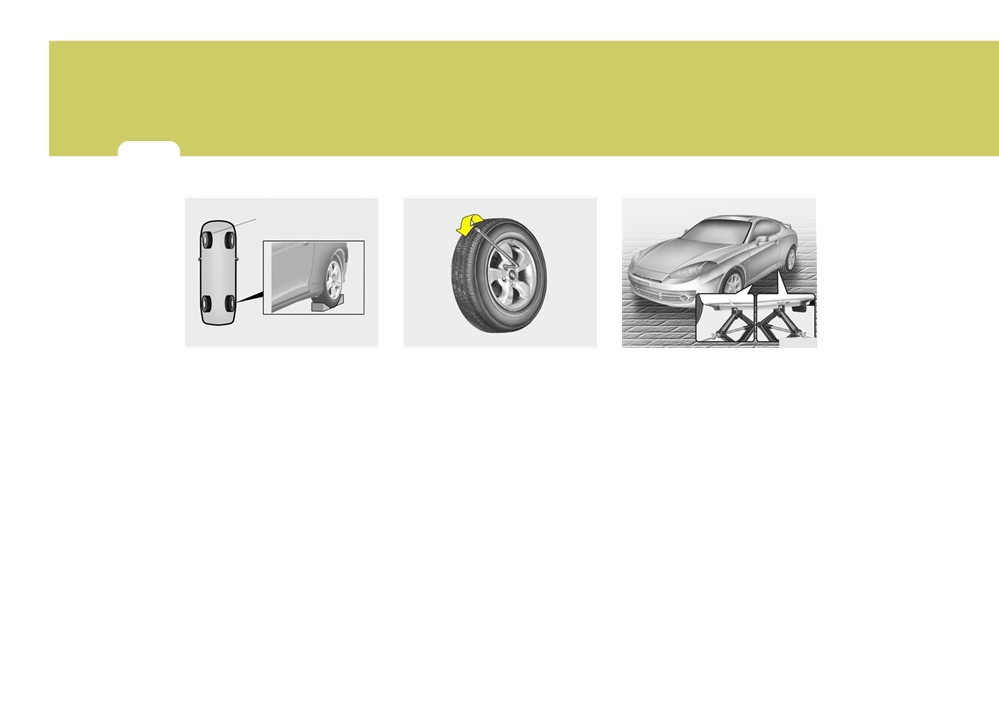
2. Block the Wheel
3. Loosen Wheel Nuts
4. Put the Jack in Place
Flat tyre
HGK4011
HGK4013
OGK036401
Block the wheel that is diagonally oppo-
The wheel nuts should be loosened
The base of the jack should be placed
site from the flat tyre to prevent the
slightly before raising the car. To loosen
on firm, level ground. The jack should
vehicle from rolling when the car is
the nuts, turn the wrench handle coun-
be positioned as shown in the illustra-
raised on the jack.
terclockwise. When doing this, be sure
tion.
that the socket is seated completely
over the nut so it cannot slip off. For
maximum leverage, position the
wrench so the handle is to the right as
shown in the drawing. Then, whilst
holding the wrench near the end of the
handle, pull up on it with steady pres-
sure. Do not remove the nuts at this
time. Just loosen them about one-half
turn.
IN CASE OF EMERGENCY
3
9
SD070G1-E
D060G02Y-EAT
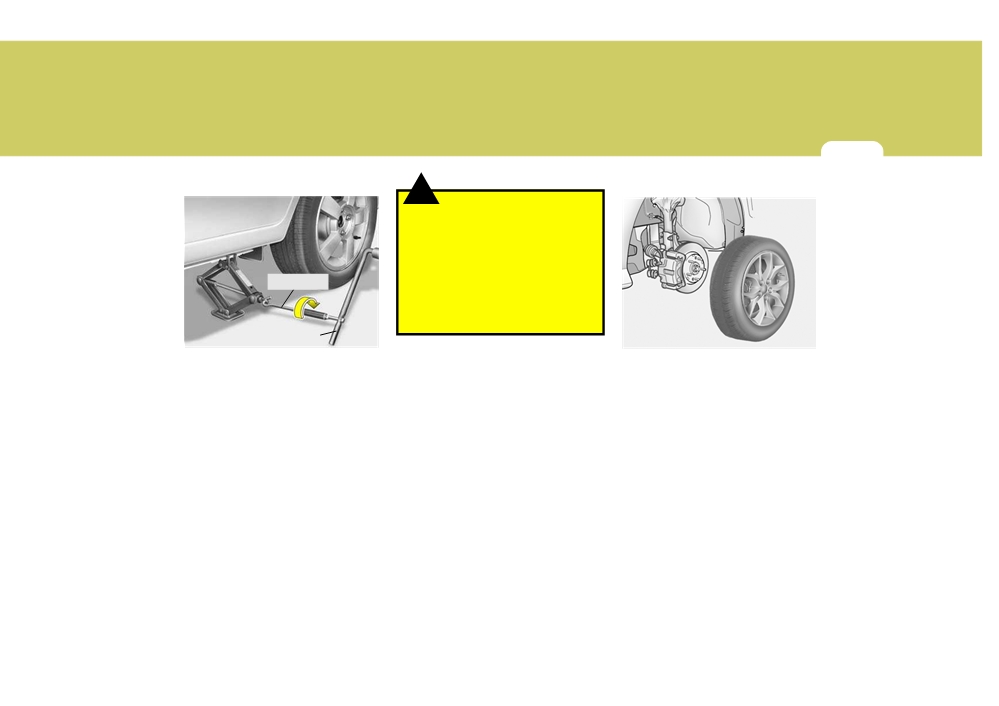
5. Raising the Car
6. Changing Wheels
!
WARNING:
Do not get under the car when it is
supported by the jack! The jack is
solely designed for wheel chang-
ing and is not intended to support
the vehicle for other purposes. The
Wrench bar
use of purpose designed supports
is necessary whilst the vehicle is
raised and the operator is required
to get underneath.
Wheel nut wrench
D060F01MC
OGK036403
After inserting a wrench bar into the
Loosen the wheel nuts and remove
wheel nut wrench, install the wrench
them with your fingers. slide the wheel
bar into the jack as shown in the draw-
off the studs and lay it flat so it cannot
ing. As the jack begins to raise the
roll away. To put the wheel on the hub,
vehicle, double check that it is properly
pick up the spare tyre, line up the holes
positioned and will not slip. If the jack
with the studs and slide the wheel onto
is on soft ground or sand, it may be
them. If this is difficult, tip the wheel
necessary to place a stout piece of
slightly and get the top hole in the
timber under the base of the jack to
wheel lined up with the top stud. Then
prevent it from sinking.
jiggle the wheel back and forth until the
Raise the car high enough so that the
wheel can be slid over the other studs.
fully inflated spare tyre can be in-
stalled.