Harley Davidson Sportster Models 2009. Service Repair Manual - page 50
4.19
DTC P0131, P0132, P0134, P0151, P0152, P0154
GENERAL
Oxygen Sensor
. The Oxygen (O2) sensor provides a signal
to the ECM which indicates whether the engine is running rich
or lean.
•
A DTC P0131 (front) or P0151 (rear) is set when the ECM
detects an excessively lean condition for a specified length
of time. DTCs may also set if O2 sensor fails.
•
A DTC P0132 (front) or P0152 (rear) is set when the ECM
detects an excessively rich condition for a specified length
of time. DTCs may also set if O2 sensor fails.
•
A DTC P0134 is set when the front O2 sensor circuit is
open or sensor is too cold to respond. A DTC P0154 is
set when the rear O2 sensor circuit is open or sensor is
too cold to respond.
When the air/fuel mixture is ideal, approximately 14.6 parts air
to 1 part fuel, the voltage will be approximately 0.45V.
Table 4-28. Code Description
DESCRIPTION
DTC
Front O2 sensor low or engine running lean
P0131
Engine running rich
P0132
Front O2 sensor open/not responding/high
P0134
Rear O2 sensor low or engine running lean
P0151
Engine running rich
P0152
Rear O2 sensor open/not responding/high
P0154
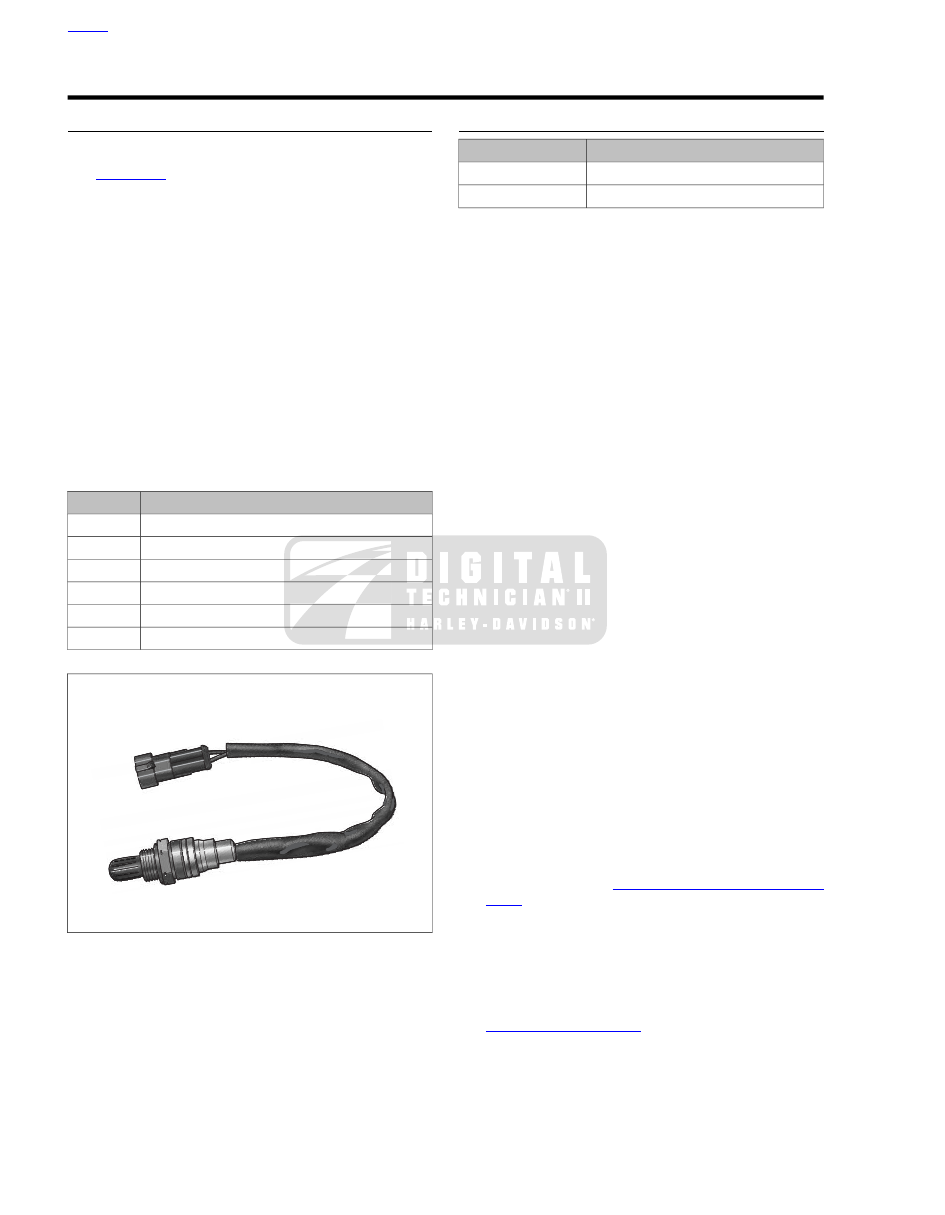
ed02856
Figure 4-39. Oxygen Sensor
DIAGNOSTICS
TOOL NAME
PART NUMBER
BREAKOUT BOX
HD-43876
DIGITAL TECHNICIAN II
HD-48650
Diagnostic Tips
Diagnostic codes for the O2 sensor may be seen during the
vehicle break-in period. The O2 sensor diagnostic codes will
not illuminate the check engine lamp for current or historic
codes and will only be indicated by DIGITAL TECHNICIAN
II (Part No. HD-48650) or odometer self-diagnostics. If the
diagnostic codes are reported during the break-in period, clear
or ignore the codes until the break-in period is completed. All
historic O2 sensor diagnostic codes are to be ignored and
cleared.
The DVOM displays the signal from the O2 sensor in volts.
This voltage will have an average value tending towards lean,
rich or ideal value depending on operating temperature of the
engine, engine speed and throttle position. An open/short to
voltage or short to ground in the (PK/O) wire (front) and
(PK/GN) wire (rear) will cause the engine to run rich (short to
ground) or lean (short to voltage) until fault is detected. Once
fault is detected, vehicle will run in open loop.
Check for the following conditions:
•
Poor connection. Inspect the ECM harness connector
[78], fuel injector connectors [84, 85] and O2 sensor con-
nector wiring for backed out terminals, improper mating,
inoperative locks, improperly formed or damaged ter-
minals, poor terminal-to-wire connection and damaged
harness.
•
Dirty/stuck open injectors. The motorcycle may run lean
(dirty/clogged injectors) or rich (stuck open injectors) if
there is an injector problem. This could also cause poor
fuel economy and performance.
•
Loose oxygen sensor. If the O2 sensor is loose, engine
performance may be affected. This could also show up
as a slow changing O2 sensor voltage.
•
Loose/leaking exhaust. This can cause a poor ground
connection for sensor or allow fresh air into the exhaust
system. If fresh air enters exhaust system, the O2 sensor
will read a lean condition, causing the system to go rich.
•
Engine misfire. See
.
Diagnostic Notes
Each reference number below correlates to a circled number
on the flowchart(s).
1.
Connect a BREAKOUT BOX (Part No. HD-43876) between
EFI wire harness and ECM before measuring voltage. See
.
2.
5 volts is typical for a cold engine. Once the O2 sensors
are up to operating temperature, typical voltage is 0.45
volt.
3.
See Intake Leak Test in the service manual.
4-82 2009 Sportster Diagnostics: Engine Management