Harley Davidson Sportster Models 2009. Service Repair Manual - page 12
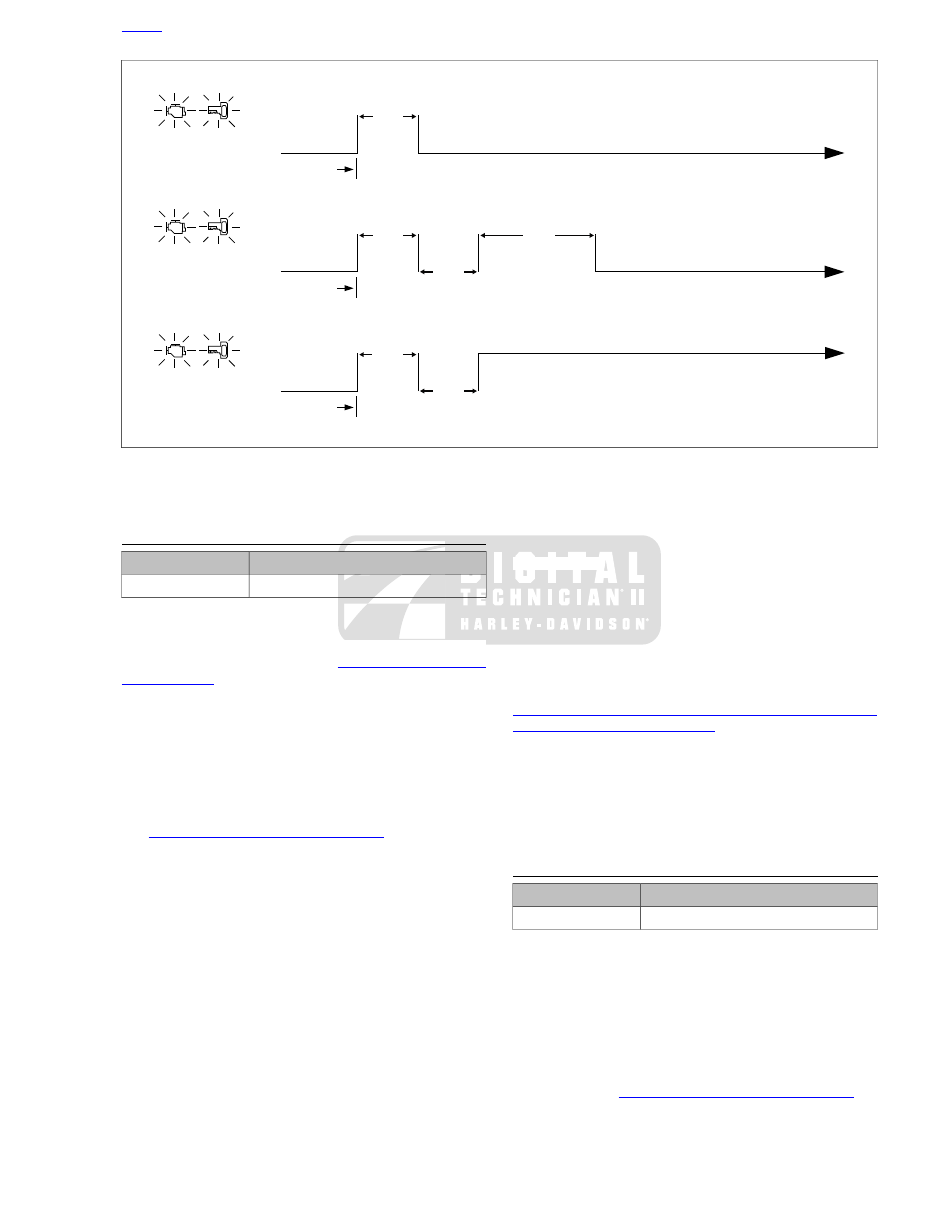
ON
ON
ON
OFF
OFF
OFF
Key On
Key On
Key On
Lamp OFF: No Current or Historic DTCs
Lamp OFF
Lamp ON 8 Seconds:
Only Historic DTCs Exist
Lamp Remains ON: Current DTC*
* Historic DTCs May Also Exist
4 Sec.
4 Sec.
4 Sec.
4 Sec.
8 Sec.
4 Sec.
em01046
Figure 4-5. Check Engine Lamp Operation
CODE TYPES
TOOL NAME
PART NUMBER
DIGITAL TECHNICIAN II
HD-48650
There are two types of DTCs: current and historic. If a DTC is
stored, it can be read using either a computer-based diagnostic
package called DIGITAL TECHNICIAN II (Part No. HD-48650)
or odometer self-diagnostics. See
.
NOTES
•
To differentiate between current and historic DTCs, a
computer-based diagnostic package called DIGITAL
TECHNICIAN II (Part No. HD-48650) must be employed.
•
All DTCs reside in the memory of the ECM, TSM/TSSM/
HFSM, speedometer or tachometer until the DTC is
cleared by use of the odometer self-diagnostics. See
•
A historic DTC is also cleared after a total of 50 trips has
elapsed. A trip consists of a start and run cycle. After the
50 trip retention period, the DTC is automatically erased
from memory providing that no subsequent faults of the
same type are detected in that period.
Current
Current DTCs are those which are present during the current
ignition cycle. See the appropriate flowcharts for solutions.
Historic
If a particular problem happens to resolve itself, the active
status problem is dropped and it becomes a historic DTC rather
than a current DTC.
Historic DTCs can only be retrieved using a computer-based
diagnostic package called DIGITAL TECHNICIAN II (Part
No. HD-48650).
Historic DTCs are stored for 50 ignition cycles after any DTC
was last set as current to assist in the diagnosis of intermittent
faults. On the 50th cycle, the DTC will clear itself. The check
engine lamp will not indicate the existence of only historic
DTCs.
It is important to note that historic DTCs will exist whenever
the system indicates the existence of a current fault. See
4.4 CHECKING FOR DIAGNOSTIC TROUBLE CODES: EFI,
Multiple Diagnostic Trouble Codes
if multiple DTCs are found.
Diagnostic charts are designed for use with current DTCs and
as a result they frequently suggest part replacement. When
diagnosing a historic DTC the charts can be helpful but should
not lead to part replacement without verification the part is
faulty.
RETRIEVING DIAGNOSTIC TROUBLE
CODES
TOOL NAME
PART NUMBER
DIGITAL TECHNICIAN II
HD-48650
The engine management system provides two levels of dia-
gnostics.
•
The most sophisticated mode employs a computer-based
diagnostic package called DIGITAL TECHNICIAN II (Part
No. HD-48650).
•
The second mode requires using the odometer self dia-
gnostics. Speedometer, tachometer (if equipped),
TSM/TSSM/HFSM and ECM DTCs can be accessed and
cleared. See
2009 Sportster Diagnostics: Engine Management 4-7