Harley Davidson 1986-2003 XL/XLH Sportster. Service Manual - page 6
4. Remove the starter as described in Chapter Twelve. Mo-
mentarily connect a fully charged 12-volt battery to the
starter as shown in Figure 7. If the starter is operational, it
will turn when connected to the battery. Disconnect the bat-
tery and note the following:
a. If the starter turns, perform the solenoid pull-in and
hold-in tests as described in
Solenoid Testing (Bench
Tests)
in this section.
b. If the starter does not turn, disassemble the starter as
described in Chapter Twelve, and check it for opens,
shorts and grounds.
5. Check for voltage at the starter button. Note the follow-
ing:
a. If there is voltage at the starter button, test the starter
relay as described in this section.
b. If there is no voltage at the starter button, check conti-
nuity across the starter button. If there is voltage lead-
ing to the starter button but no voltage leaving the
starter button, replace the button switch and retest. If
there is no voltage leading to the starter button, check
the starter button wiring for dirty or loose-fitting ter-
minals or damaged wiring; clean and/or repair as re-
quired.
Starter spins but does not engage
If the starter spins but the pinion gear does not engage the
clutch shell ring gear, perform the following:
1. Remove the primary drive cover as described in Chapter
Six or Chapter Seven.
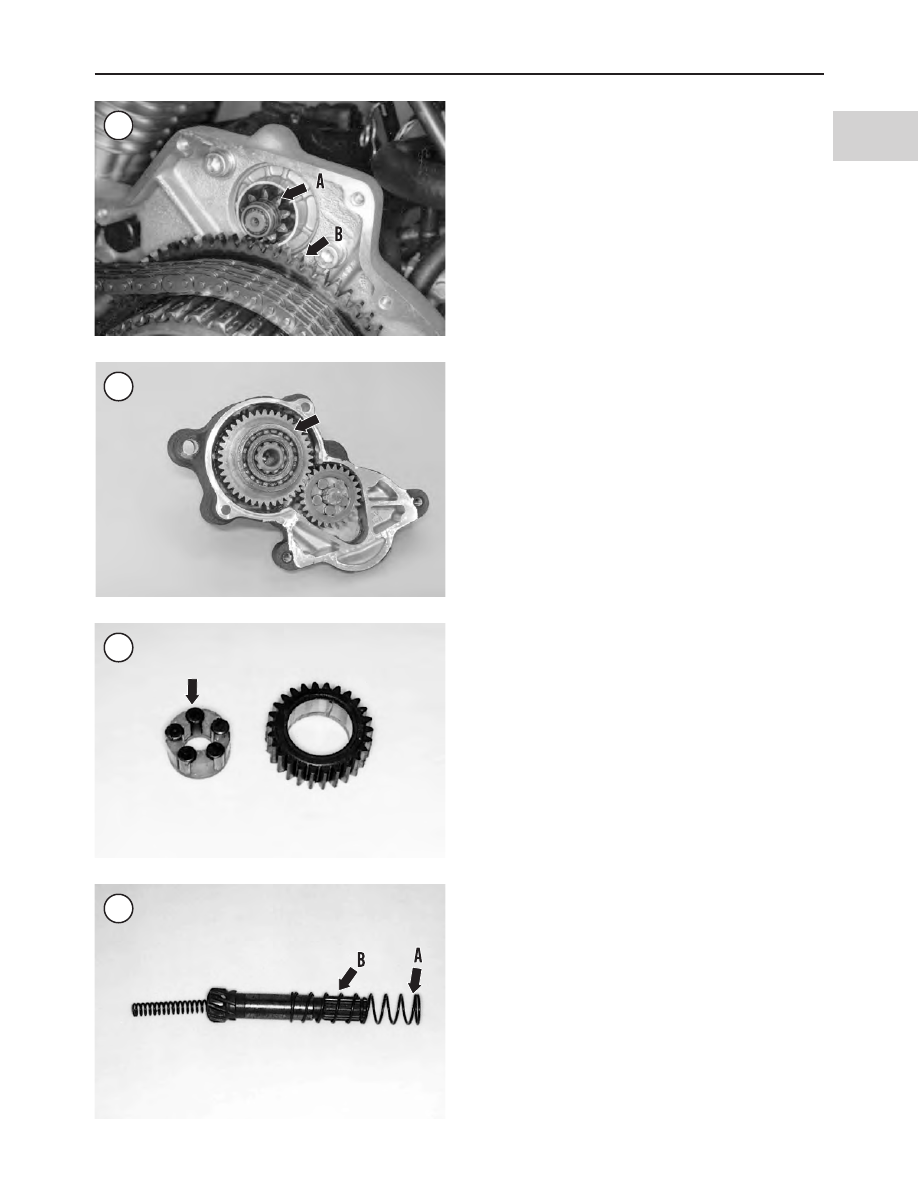
2. Check the starter pinion gear (A, Figure 8). If the
teeth are chipped or worn, inspect the clutch shell ring
gear (B, Figure 8) for the same problems. Note the fol-
lowing:
a. If the starter pinion gear or clutch ring gear is dam-
aged, service the parts.
b. If the starter pinion gear and clutch shell ring gear are
not damaged, continue with Step 3.
3. Remove and disassemble the starter as described in
Chapter Twelve. Then check the overrunning clutch assem-
bly (Figure 9) for the following:
a. Roller damage (Figure 10).
b. Compression spring damage (A, Figure 11).
c. Excessively worn or damaged pinion teeth (A, Fig-
ure 8).
d. Pinion does not run in overrunning direction.
e. Damaged clutch shaft splines (B, Figure 11).
f. Damaged overrunning clutch assembly (Figure
12).
4. Replace worn or damaged parts as required.
TROUBLESHOOTING
37
2
8
9
10
11