Ford E-250 (2006 year). Manual - part 19
 

  Index      Ford     Ford E-250 - service manual 2006 year in english


Search            


Content   ..  17  18  19  20   ..


Ford E-250 (2006 year). Manual - part 19


Do not put anything on or over the air bag module. Placing
objects on or over the air bag inflation area may cause those

objects to be propelled by the air bag into your face and torso causing
serious injury.

Do not attempt to service, repair, or modify the airbag
supplemental restraint systems or its fuses. See your authorized

dealer.

Modifying or adding equipment to the front end of the vehicle
(including frame, bumper, front end body structure and tow

hooks) may affect the performance of the airbag system, increasing the
risk of injury. Do not modify the front end of the vehicle.

Additional equipment may affect the performance of the airbag
sensors increasing the risk of injury. Please refer to the Body

Builders Layout Book for instructions about the appropriate
installation of additional equipment.

Children and airbags

Children must always be properly
restrained. Accident statistics
suggest that children are safer when
properly restrained in the rear
seating positions than in the front
seating position. Failure to follow
these instructions may increase the
risk of injury in a collision.

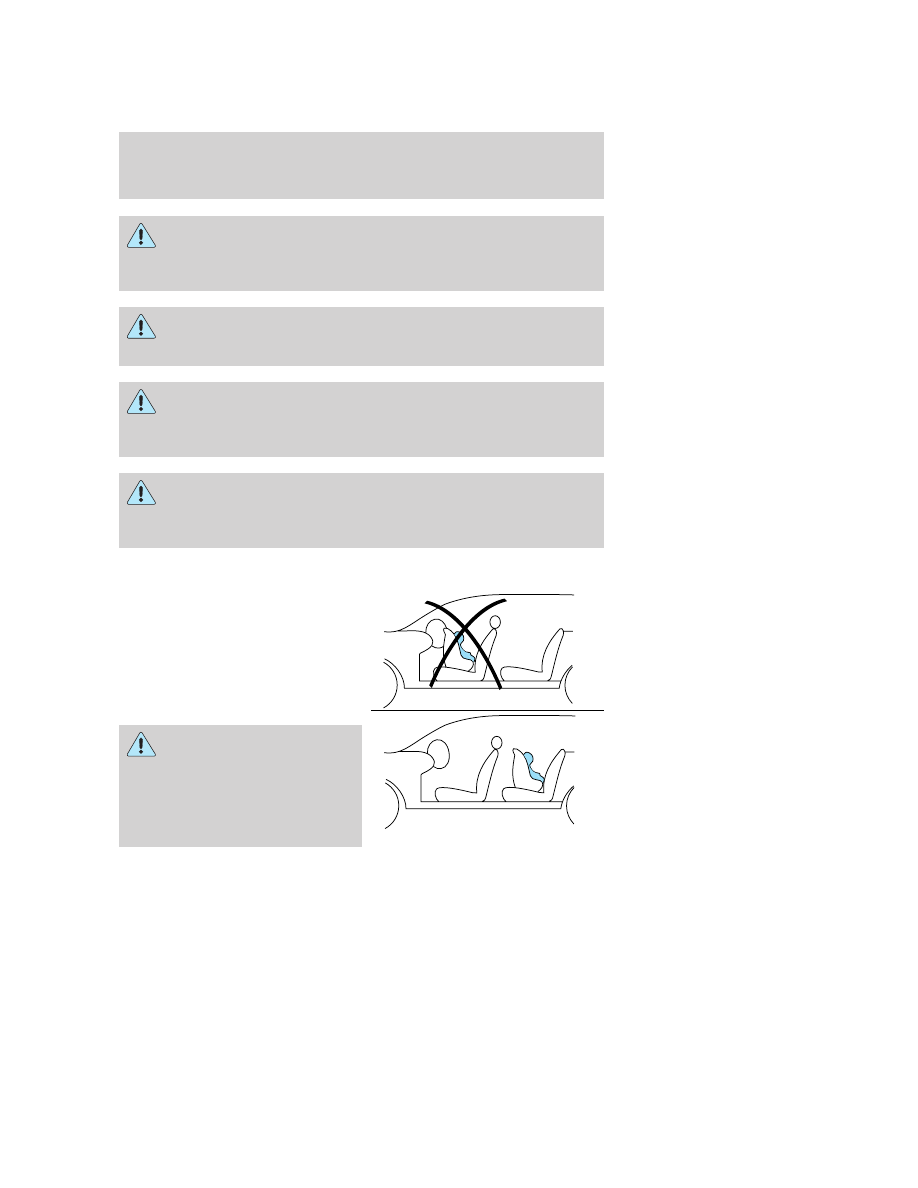
Airbags can kill or injure a
child in a child seat.

NEVER place a rear-facing child
seat in front of an active airbag. If
you must use a forward-facing
child seat in the front seat, move
the seat all the way back.

Seating and Safety Restraints

77

How does the airbag supplemental restraint system work?

The airbag SRS is designed to
activate when the vehicle sustains a
longitudinal deceleration sufficient
to cause the airbag sensors to close
an electrical circuit that initiates
airbag inflation. The fact that the
airbags did not inflate in a collision
does not mean that something is
wrong with the system. Rather, it
means the forces were not sufficient
enough to cause activation. Airbags
are designed to inflate in frontal and
near-frontal collisions, not rollover, side-impact, or rear-impacts unless
the collision causes sufficient longitudinal deceleration.

The airbags inflate and deflate
rapidly upon activation. After airbag
deployment, it is normal to notice a
smoke-like, powdery residue or
smell the burnt propellant. This may
consist of cornstarch, talcum
powder or sodium compounds which
may irritate the skin and eyes, but
none of the residue is toxic.

While the SRS is designed to help
reduce serious injuries, contact with
a deploying airbag may also cause
abrasions, swelling or temporary
hearing loss. Because airbags must
inflate rapidly and with considerable
force, there is the risk of death or
serious injuries such as fractures, facial and eye injuries or internal
injuries, particularly to occupants who are not properly restrained or are
otherwise out of position at the time of airbag deployment. It is
extremely important that occupants be properly restrained as far away
from the airbag module as possible while maintaining vehicle control.

The SRS consists of:
• driver and passenger airbag modules (which include the inflators and

airbags)

• one or more impact and safing sensors

Seating and Safety Restraints

78

• a readiness light and tone
• a diagnostic module
• and the electrical wiring which connects the components
The diagnostic module monitors its own internal circuits and the
supplemental airbag electrical system wiring (including the impact
sensors), the system wiring, the airbag system readiness light, the airbag
back up power and the airbag ignitors.

Several air bag system components get hot after inflation. Do not
touch them after inflation.

If the air bag has deployed, the air bag will not function
again and must be replaced immediately. 
If the air bag is not

replaced, the unrepaired area will increase the risk of injury in a
collision.

Determining if the system is operational

The SRS uses a readiness light in the instrument cluster or a tone to
indicate the condition of the system. Refer to Airbag readiness section
in the Instrument Cluster chapter. Routine maintenance of the airbag is
not required.

A difficulty with the system is indicated by one or more of the following:
• The readiness light will either

flash or stay lit.

• The readiness light will not

illuminate immediately after ignition is turned on.

• A series of five beeps will be heard. The tone pattern will repeat

periodically until the problem and/or light are repaired.

If any of these things happen, even intermittently, have the SRS serviced
at an authorized dealer immediately. Unless serviced, the system may not
function properly in the event of a collision.

Disposal of airbags and airbag equipped vehicles (including
pretensioners)

See your authorized dealer. Airbags MUST BE disposed of by qualified
personnel.

Seating and Safety Restraints

79

Passenger airbag ON/OFF switch (if equipped)

Note: The passenger airbag ON/OFF
switch is on vehicles with no rear
seats and a gross vehicle weight
rating (GVWR) greater than 8500.
See Vehicle loading – with and
without a trailer 
in the Tires,
Wheels, and loading 
chapter.

An airbag ON/OFF switch
has been installed in this

vehicle. Before driving, always
look at the face of the switch to
be sure the switch is in the proper
position in accordance with these
instructions and warnings. Failure
to put the switch in a proper
position can increase the risk of
serious injury or death in a
collision.

Turning the passenger airbag off

1. Insert the ignition key, turn the
switch to OFF position and hold in
OFF position while removing the
key.

2. When the ignition is turned to the
ON position the OFF light
illuminates briefly, momentarily
shuts off and then turns back on.
This indicates that the passenger
airbag is deactivated.

If the light fails to illuminate when the passenger air bag switch
is in the OFF position and the ignition switch is in ON, have the

passenger air bag switch serviced at your Ford or Lincoln-Mercury
dealer immediately.

Seating and Safety Restraints

80


Content   ..  17  18  19  20   ..