Citroen C4 (2023 year). Manual in english - page 1
8
For your information
Main Owner’s Manual
Please note that this manual applies to all models and all equipment, includ-
ing options. Therefore, you may find some explanations for equipment not
installed on your vehicle.
Also, for the models to be mounted and remodeled, specification information
that changes due to mounting and remodeling is not written in this manual.
All specifications provided in this manual are current at the time of printing.
However, because of the Toyota policy of continual product improvement, we
reserve the right to make changes at any time without notice.
Depending on specifications, the vehicle shown in the illustrations may differ
from your vehicle in terms of equipment.
For Eurasian Economic Union: The information on the procedure for the safe
use of the vehicle and its systems, presented on the manufacturer’s labels on
the body in English, is intended only for service workers.
Accessories, spare parts and modification of your Toyota
Both genuine Toyota and a wide variety of other spare parts and accessories
for Toyota vehicles are currently available on the market. Should it be deter-
mined that any of the genuine Toyota parts or accessories supplied with the
vehicle need to be replaced, Toyota recommends that genuine Toyota parts
or accessories, be used to replace them. Other parts or accessories of
matching quality can also be used. Toyota cannot accept any liability or guar-
antee spare parts and accessories which are not genuine Toyota products,
nor for replacement or installation involving such parts. In addition, damage
or performance problems resulting from the use of non-genuine Toyota spare
parts or accessories may not be covered under warranty.
Also, remodeling like this will have an effect on advanced safety equipment
such as Toyota Safety Sense and there is a danger that it will not work prop-
erly or the danger that it may work in situations where it should not be work-
ing.
9
Installation of an RF-transmitter system
The installation of an RF-transmitter system in your vehicle could affect elec-
tronic systems such as:
●Multiport fuel injection system/sequential multiport fuel injection system
● Toyota Safety Sense
●Cruise control system
● Anti-lock brake system
● SRS airbag system
● Seat belt pretensioner system
Be sure to check with any authorized Toyota retailer or Toyota authorized
repairer, or any reliable repairer for precautionary measures or special
instructions regarding installation of an RF-transmitter system.
Further information regarding frequency bands, power levels, antenna posi-
tions and installation provisions for the installation of RF-transmitters, is avail-
able on request at any authorized Toyota retailer or Toyota authorized
repairer, or any reliable repairer.
10
Vehicle data recording
The vehicle is equipped with sophisticated computers that will record certain
data, such as:
• Engine speed/Electric motor speed (traction motor speed)
• Accelerator status
• Brake status
• Vehicle speed
• Operation status of the driving assist systems
• Images from the cameras
Your vehicle is equipped with cameras. Contact any authorized Toyota
retailer or Toyota authorized repairer, or any reliable repairer for the loca-
tion of recording cameras.
The recorded data varies according to the vehicle grade level, options and
destinations with which it is equipped.
These computers do not record conversations or sounds, and only record
images outside of the vehicle in certain situations.
● Data usage
Toyota may use the data recorded in this computer to diagnose malfunctions,
conduct research and development, and improve quality.
Toyota will not disclose the recorded data to a third party except:
• With the consent of the vehicle owner or with the consent of the lessee if
the vehicle is leased
• In response to an official request by the police, a court of law or a govern-
ment agency
• For use by Toyota in a lawsuit
• For research purposes where the data is not tied to a specific vehicle or
vehicle owner
● Recorded image information can be erased by any authorized Toyota
retailer or Toyota authorized repairer, or any reliable repairer.
The image recording function can be disabled. However, if the function is dis-
abled, data from when the system operates will not be available.
11
Scrapping of your Toyota
The SRS airbag and seat belt pretensioner devices in your Toyota contain
explosive chemicals. If the vehicle is scrapped with the airbags and seat belt
pretensioners left as they are, this may cause an accident such as fire. Be
sure to have the systems of the SRS airbag and seat belt pretensioner
removed and disposed of by a qualified service shop or by any authorized
Toyota retailer or Toyota authorized repairer, or any reliable repairer before
you scrap your vehicle.
“QR Code”
The word
“QR Code” is registered trademark of DENSO WAVE
INCORPORATED in Japan and other countries.
WARNING
■ General precautions while driving
Driving under the influence: Never drive your vehicle when under the influ-
ence of alcohol or drugs that have impaired your ability to operate your vehi-
cle. Alcohol and certain drugs delay reaction time, impair judgment and
reduce coordination, which could lead to an accident that could result in
death or serious injury.
Defensive driving: Always drive defensively. Anticipate mistakes that other
drivers or pedestrians might make and be ready to avoid accidents.
Driver distraction: Always give your full attention to driving. Anything that
distracts the driver, such as adjusting controls, talking on a cellular phone or
reading can result in a collision with resulting death or serious injury to you,
your occupants or others.
■ General precaution regarding children’s safety
Never leave children unattended in the vehicle, and never allow children to
have or use the key.
Children may be able to start the vehicle or shift the vehicle into neutral.
There is also a danger that children may injure themselves by playing with
the windows or other features of the vehicle. In addition, heat build-up or
extremely cold temperatures inside the vehicle can be fatal to children.
12
Checking your vehicle’s model
Check the model code to see what type of model your vehicle is.
1
G U N 1 2 5
- D T T H
W
2
3
4
5
6
7
1
Basic code
TGN16: Models with 2TR-FE engine
GUN16: Models with 1GD-FTV engine
GUN15: Models with 2GD-FTV engine
2
Driving system
2:
4WD models
3: Pre Runner (2WD models)
3
Cab type
B: Single-cab
C: Smart-cab
D: Double-cab
4
Made in
N: South Africa
T: Thailand
5
Transmission type
T: Automatic transmission
M: 5-speed manual transmission
F:
6-speed manual transmission
6
Grade
H: HIGH
S: STD
L: LOW
7
Destination
W:
Models for European countries etc.
Blank: Models for Kazakhstan etc.
13
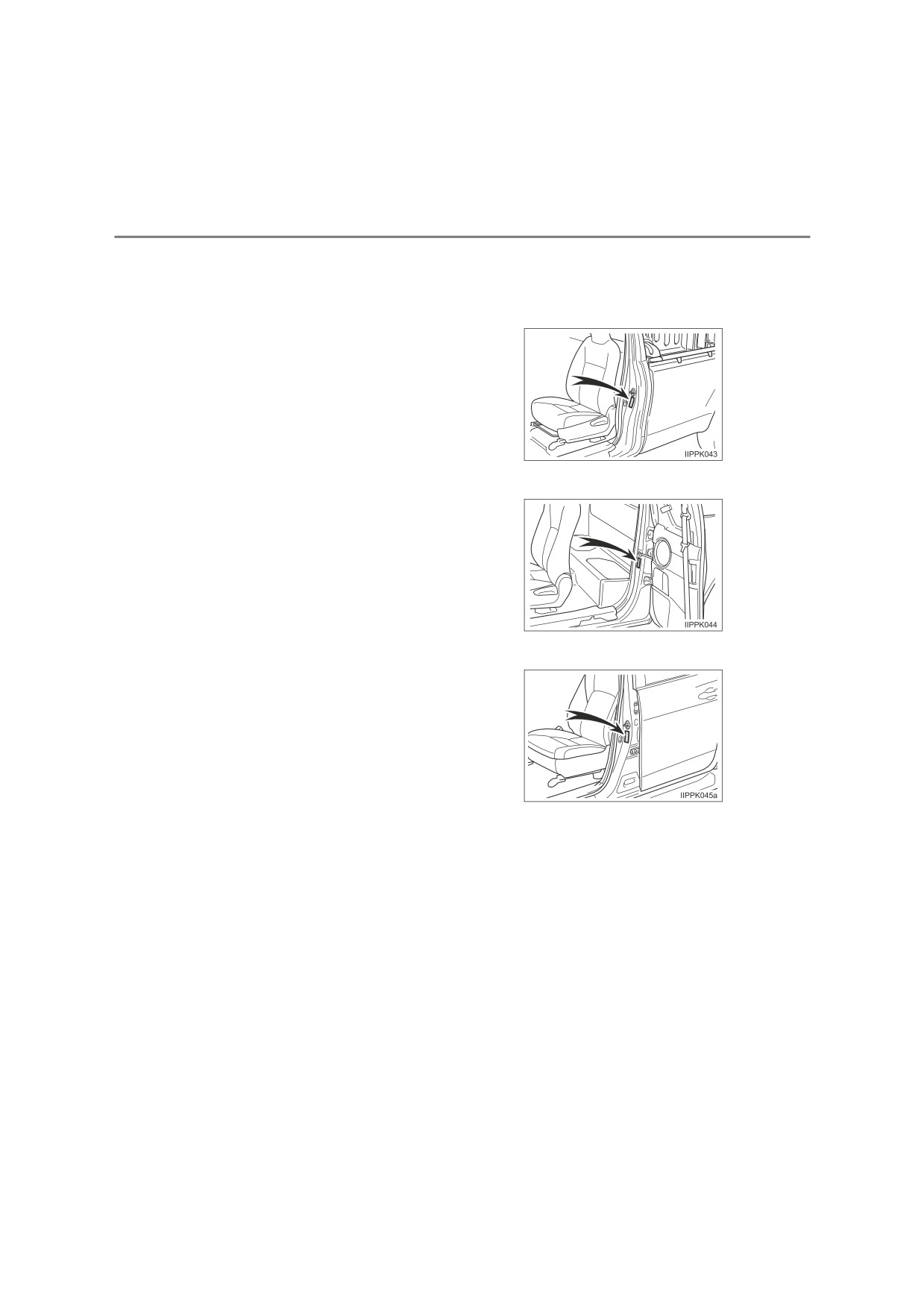
The model code appears on the manufacturer’s label with the heading
“MODEL”.
The manufacturer’s label is located on the left pillar.
Type A
Type B
Type C
14
Reading this manual
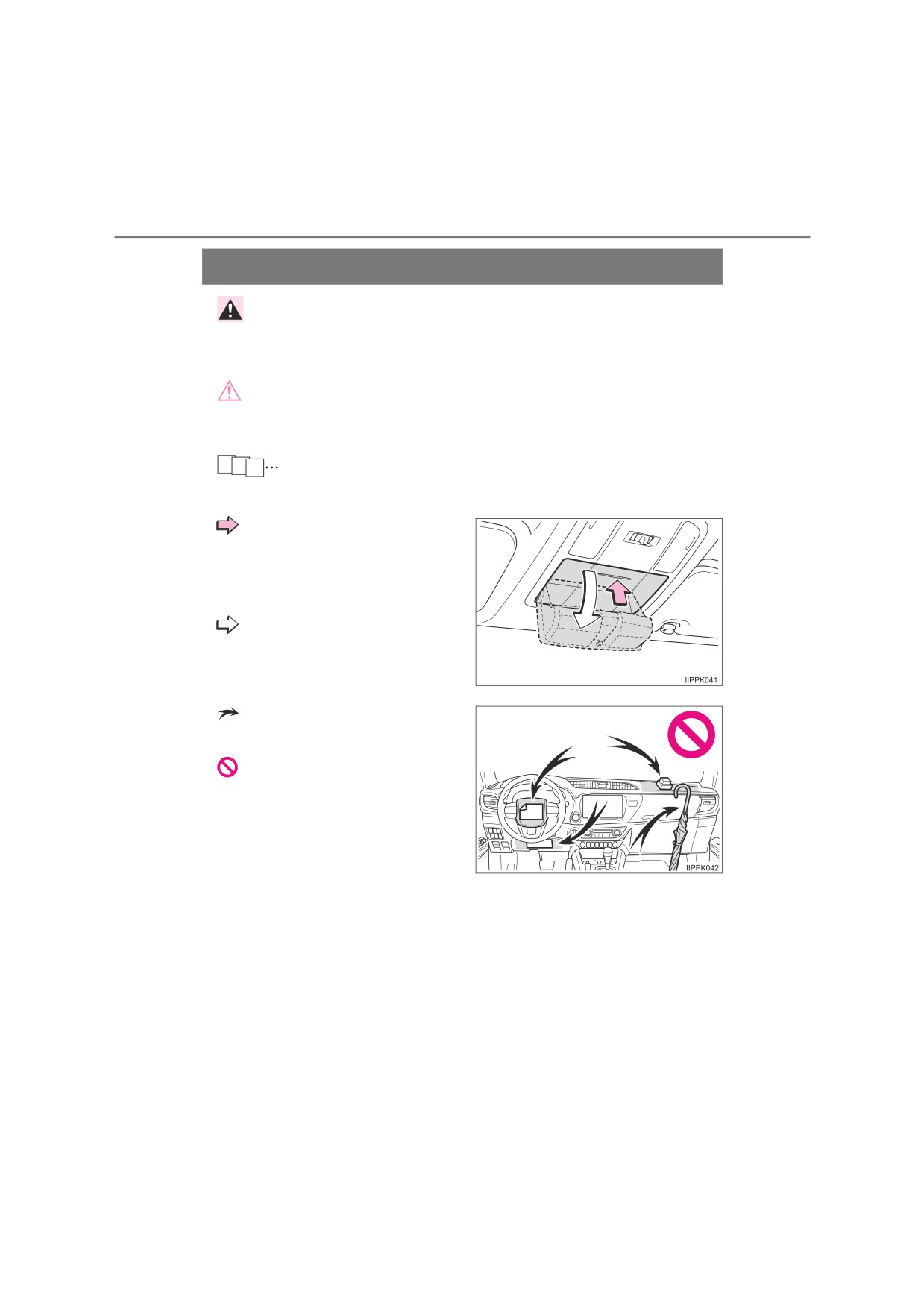
WARNING:
Explains something that, if not obeyed, could cause death or
serious injury to people.
NOTICE:
Explains something that, if not obeyed, could cause damage to
or a malfunction in the vehicle or its equipment.
1
2
3
Indicates operating or working procedures. Follow the steps
in numerical order.
Indicates the action
(push-
ing, turning, etc.) used to
operate switches and other
devices.
Indicates the outcome of an
operation (e.g. a lid opens).
Indicates the component or
position being explained.
Means “Do not”, “Do not do
this”, or “Do not let this hap-
pen”.

15
How to search
■ Searching by name
• Alphabetical index
P. 658
■ Searching by installation
position
• Pictorial index
P. 16
■ Searching by symptom or
sound
• What to do if...
(Troubleshooting)
P. 654
■ Searching by title
• Table of contents
P. 2
16
Pictorial index
Pictorial index
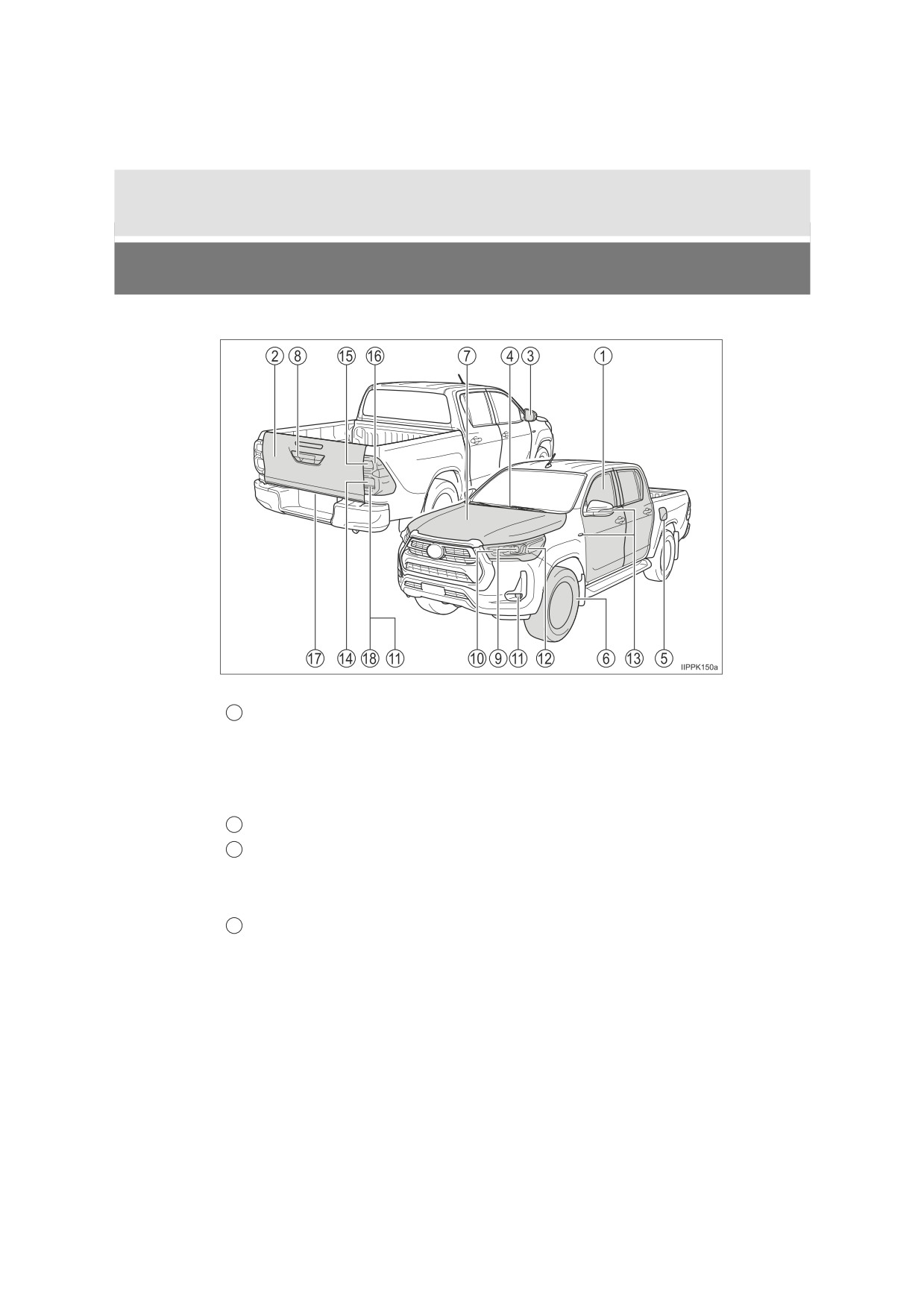
■Exterior
The design of the vehicle exterior may differ depending on the grade, etc.
1
Side doors
P. 151
Access panels (smart-cab models only)
P. 157
Locking/unlocking
P. 151
Opening/closing the door glasses
P. 183
Locking/unlocking by using the mechanical key*1
P. 598
Warning lights*1/warning messages*1
P. 153, 568
2
Tailgate*1
P. 158
3
Outside rear view mirrors
P. 180
Adjusting the mirror angle
P. 180
Folding the mirrors
P. 181
Defogging the mirrors*1
P. 433, 442
4
Windshield wipers
P. 256
Precautions against winter season
P. 372
To prevent freezing (windshield wiper de-icer)*1
P. 434, 442

Pictorial index
17
5
Fuel filler door*1
P. 259
Refueling method
P. 259
Fuel type/fuel tank capacity
P. 625
6
Tires
P. 505
Tire size/inflation pressure
P. 637
Winter tires/tire chain
P. 372
Checking/rotation
P. 506
Coping with flat tires
P. 579
7
Hood
P. 482
Opening
P. 482
Engine oil
P. 626
Coping with overheat
P. 608
8
Camera*1, 2
Light bulbs of the exterior lights for driving
(Replacing method: P. 523, Watts: P. 640)
9
Headlights
P. 246
10
Front position lights/daytime running lights*1
P. 246
11
Front fog lights*1/rear fog light*1, 3
P. 253
12
Front turn signal lights
P. 244
13
Side turn signal lights (fender-mounted type or
mirror-mounted type)
P. 244
14
Rear turn signal lights
P. 244
15
Stop lights
Downhill assist control system*1
P. 362
16
Tail lights
P. 246
17
License plate light
P. 246
18
Back-up lights*3
Shifting the shift lever to R
P. 229, 237
*1: If equipped
*2: Refer to “Navigation and multimedia system Owner’s manual” or
“Multimedia Owner’s Manual”.
*3: They may be located on the opposite side depending on the target region.
18
Pictorial index
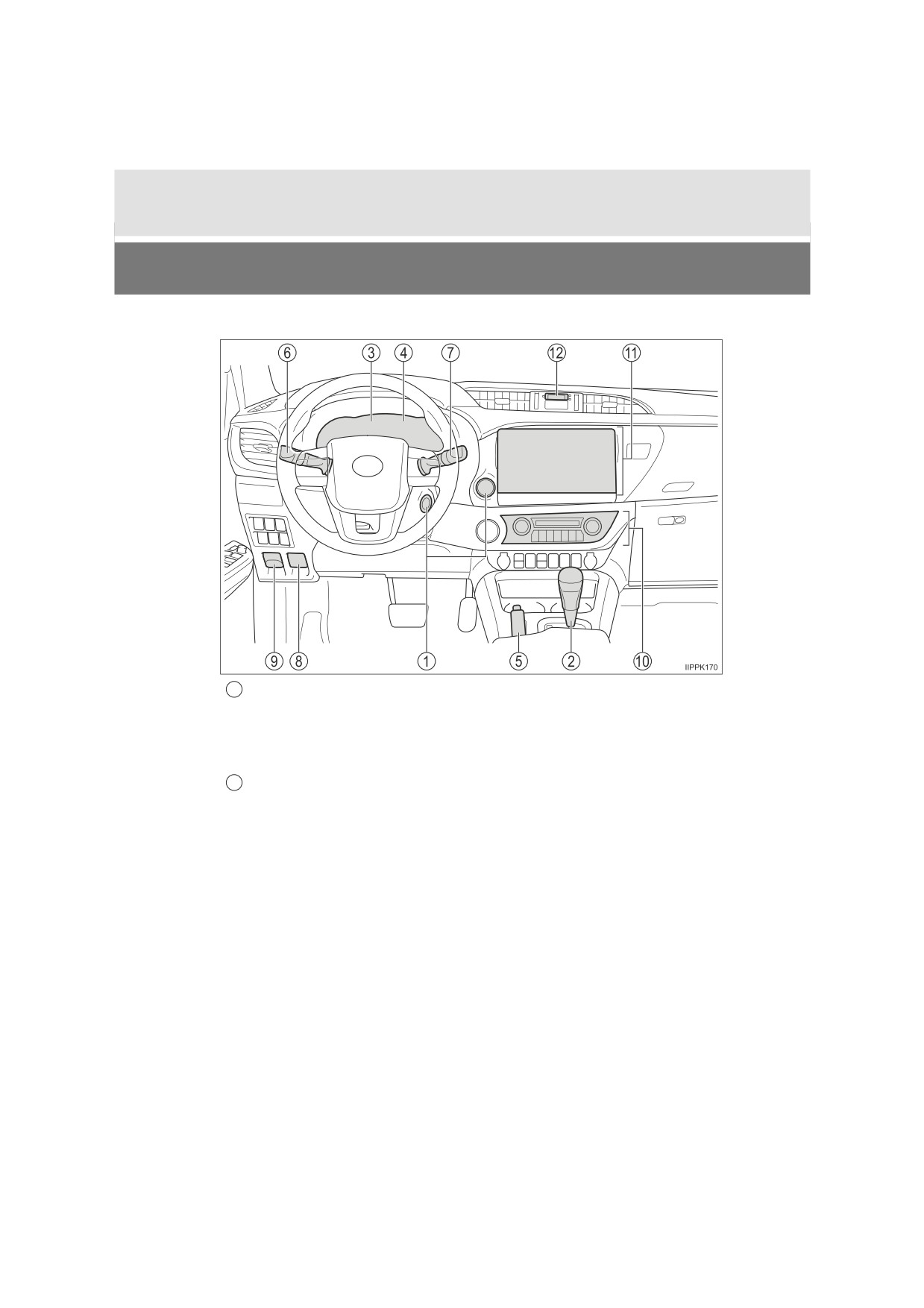
■Instrument panel (Left-hand drive vehicles)
1
Engine switch
P. 218, 221
Starting the engine/changing the positions or modes . . . P. 218, 221
Emergency stop of the engine
P. 553
When the engine will not start
P. 596
Warning messages*1
P. 573
2
Shift lever (Automatic transmission)
P. 229
Changing the shift position
P. 229
Precautions against towing
P. 557
When the shift lever does not move
P. 235
Shift lever (Manual transmission)
P. 237
Changing the shift position
P. 237
Precautions against towing
P. 557
Pictorial index
19
3
Meters
P. 128
Reading the meters
P. 128
Adjusting the instrument panel light*1
P. 128
Warning lights/indicator lights
P. 120
When the warning lights come on
P. 564
4
Multi-information display*1
P. 133
When the warning messages are displayed
P. 573
5
Parking brake lever
P. 245
Applying/releasing
P. 245
Precautions against winter season
P. 373
Warning light/buzzer
P. 564
6
Turn signal lever
P. 244
Headlight switch
P. 246
Headlights/front position lights/tail lights/
daytime running lights*1
P. 246
Front fog lights*1/rear fog light*1
P. 253
7
Windshield wiper and washer switch
P. 256
Usage
P. 256
Adding washer fluid
P. 496
Warning messages*1
P. 573
8
Hood lock release lever
P. 482
9
Fuel filler door opener*1
P. 261
10
Manual air conditioning system*1
P. 432
Automatic air conditioning system*1
P. 439
11
Audio system*1
P. 376
AUX port/USB port
P. 379
Multimedia system*1, 2
Navigation system*1, 2
Rear view monitor system*1, 2
12
Clock
P. 463
*1: If equipped
*2: Refer to “Navigation and multimedia system Owner’s manual” or
“Multimedia Owner’s Manual”.
20
Pictorial index
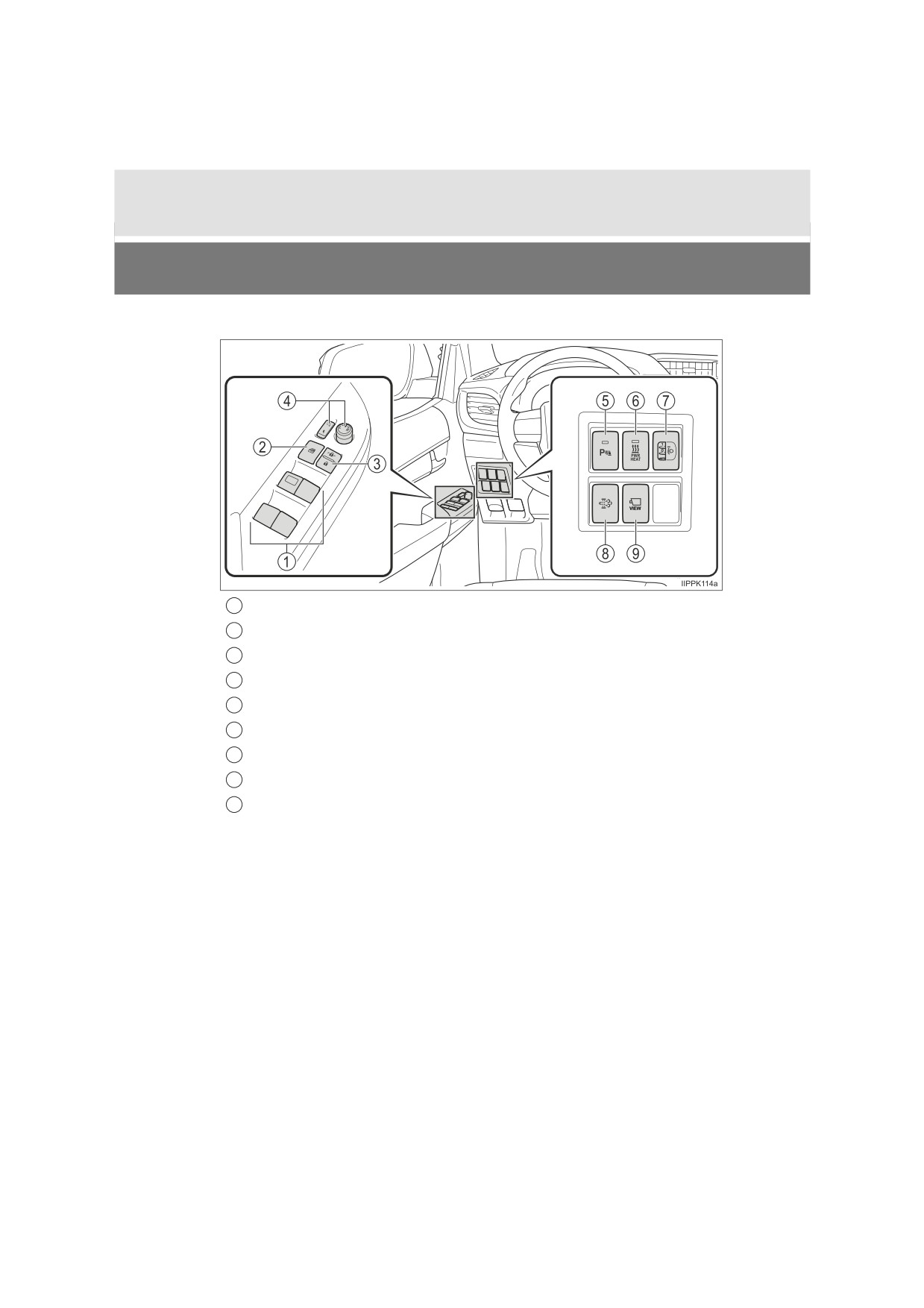
■Switches (Left-hand drive vehicles)
1
Power window switches*1
P. 183
2
Window lock switch*1
P. 184
3
Door lock switch*1
P. 153
4
Outside rear view mirror switches*1
P. 180
5
Toyota parking assist-sensor switch*1
P. 319
6
Power heater switch*1
P. 434, 442
7
Manual headlight leveling dial*1
P. 248
8
DPF system switch*1
P. 367
9
Camera switch*1, 2
Pictorial index
21
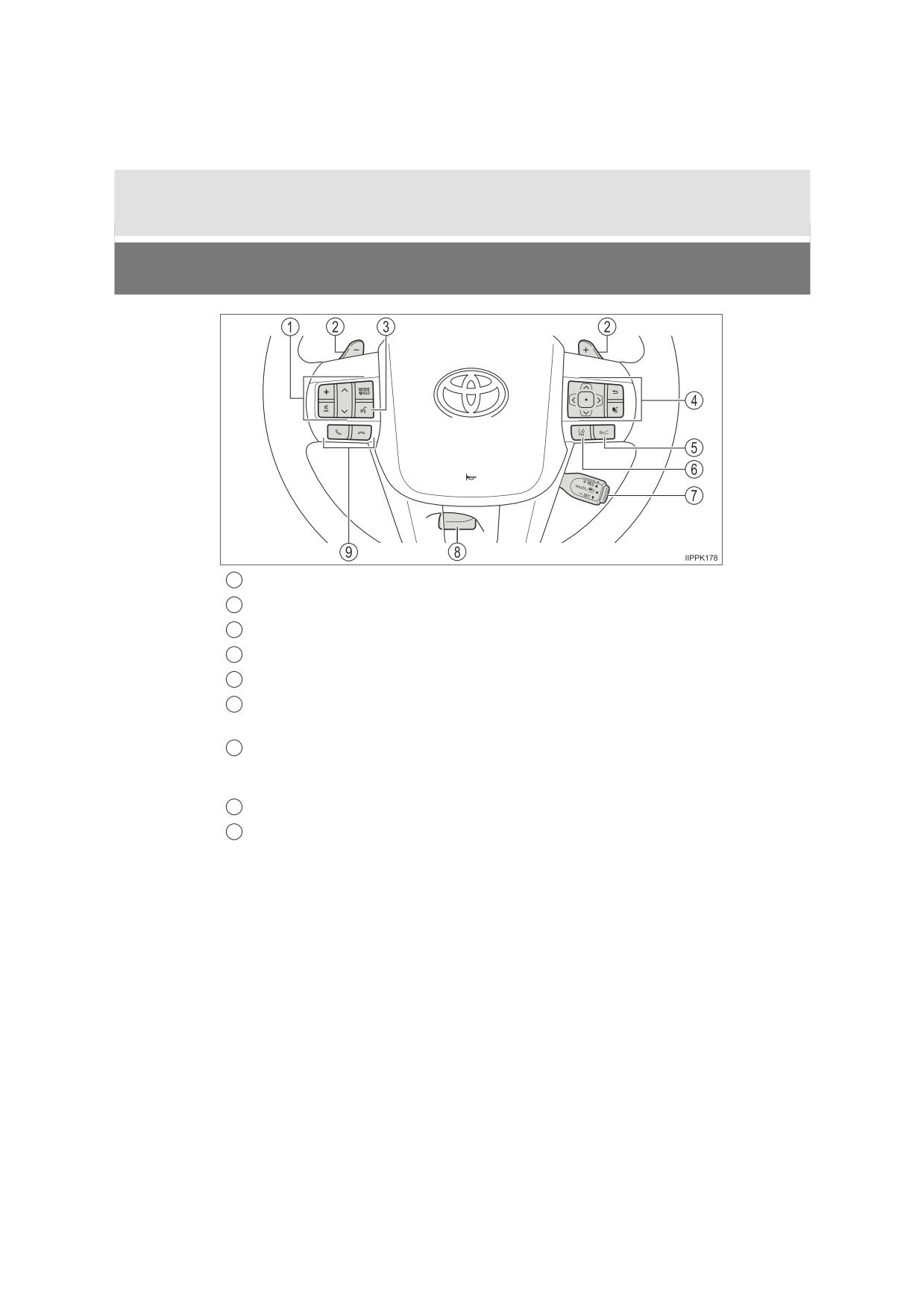
1
Audio remote control switches*1, 2
P. 377, 468
2
Paddle shift switches*1
P. 232, 233
3
Talk switch*1, 2, 3
P. 468
4
Meter control switches*1
P. 134
5
Vehicle-to-vehicle distance switch*1
P. 307
6
LDA (Lane Departure Alert with Yaw Assist Function)
switch*1
P. 282
7
Cruise control switch*1
Dynamic radar cruise control*1
P. 299
Cruise control*1
P. 315
8
Tilt steering lock release lever
P. 176
9
Telephone switches*1, 2
P. 134, 411, 468
*1: If equipped
*2: Refer to “Navigation and multimedia system Owner’s manual” or
“Multimedia Owner’s Manual”.
*3: The switch can not be used depending on the type of audio system or
navigation system, or is not available in some countries or areas.
22
Pictorial index
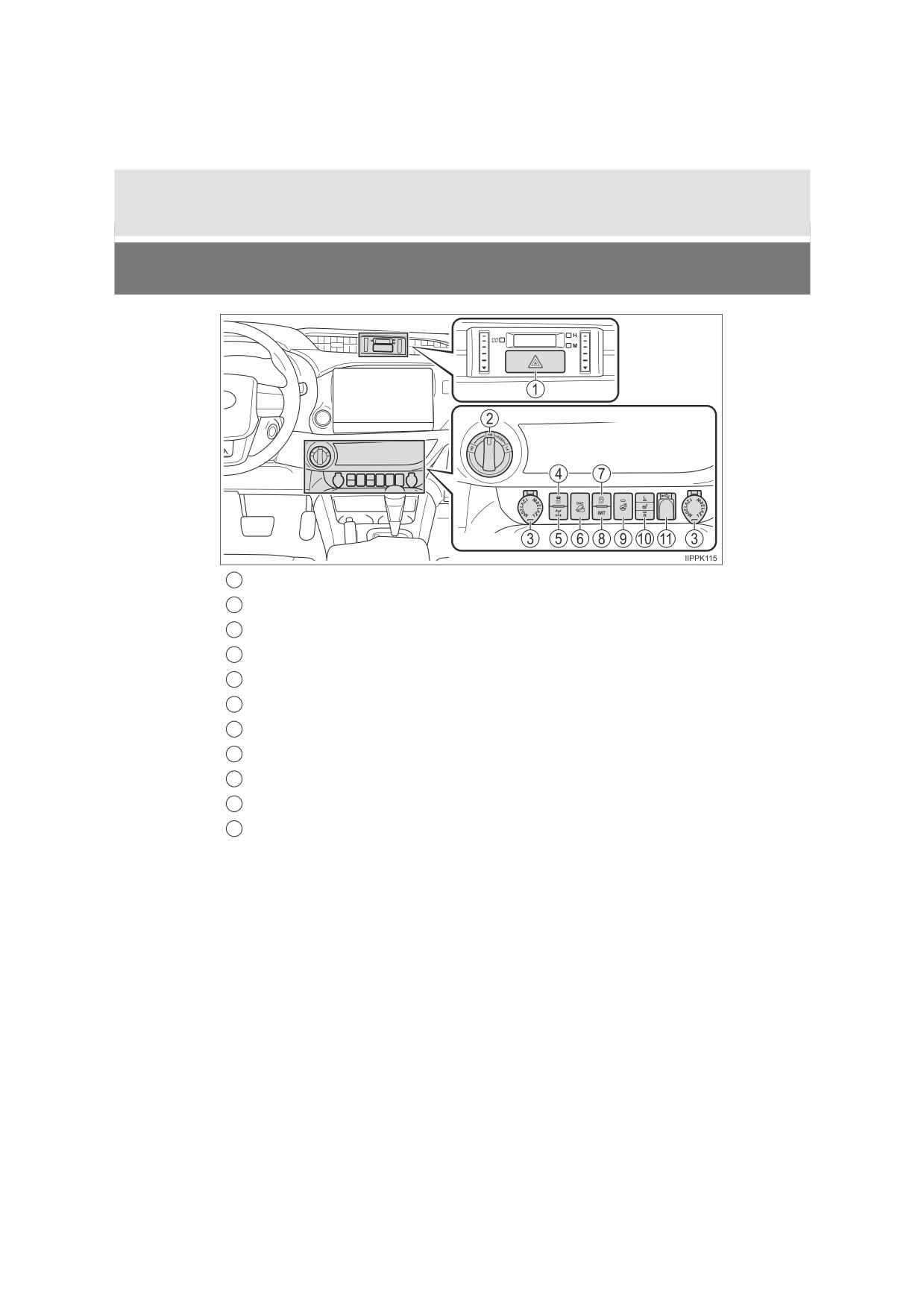
1
Emergency flasher switch
P. 552
2
Front-wheel drive control switch*1
P. 329
3
Power outlets*1
P. 464
4
VSC OFF switch*1
P. 355
5
Rear differential lock switch*1
P. 339
6
“DAC” (Downhill Assist Control system) switch*1
P. 362
7
Stop & Start cancel switch*1
P. 344
8
“iMT” switch*1
P. 239
9
Heated steering wheel switch*1
P. 448
10
Seat heater switches*1
P. 448
11
USB port*1, 2
Pictorial index
23
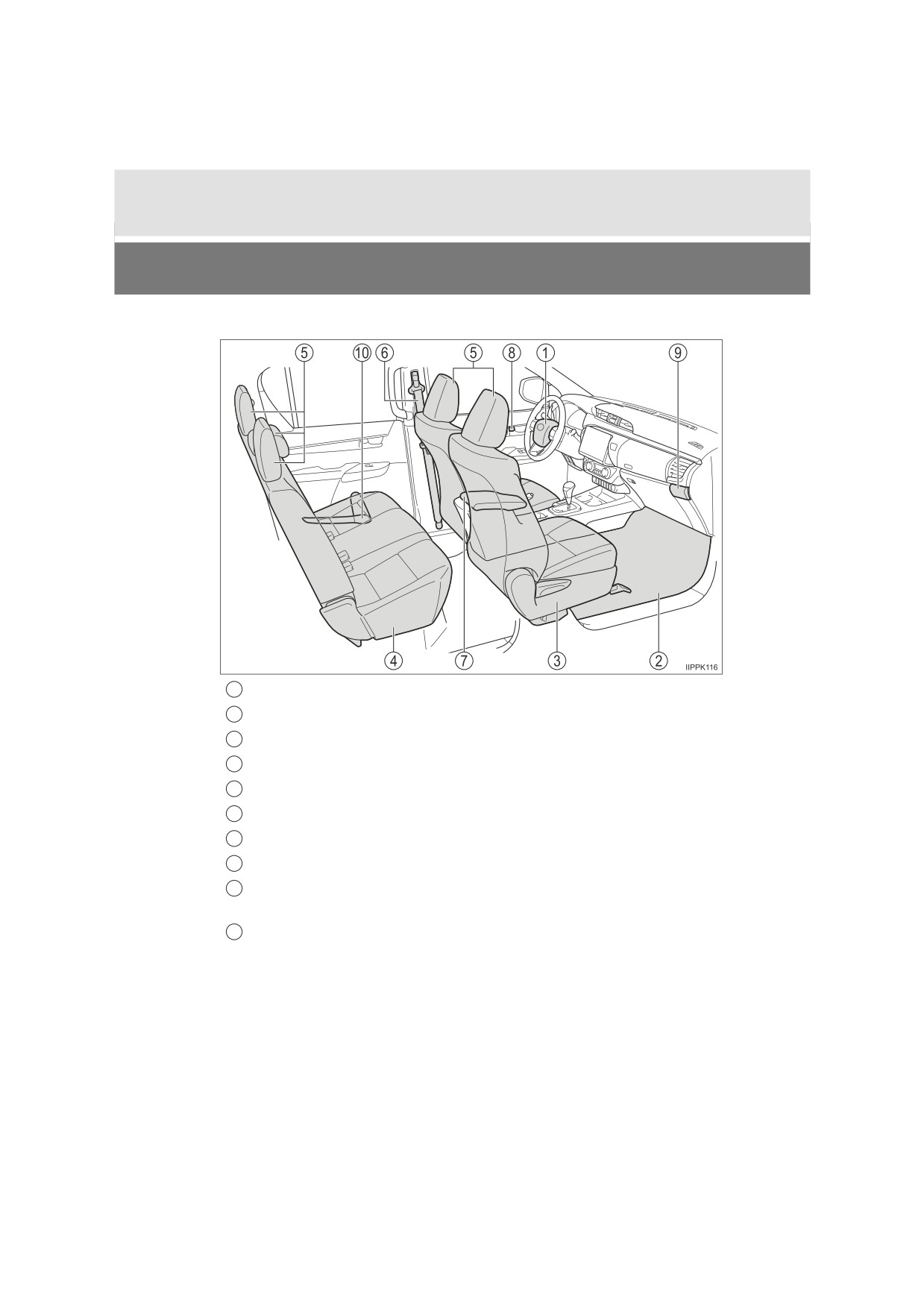
■Interior (Left-hand drive vehicles)
1
SRS airbags
P. 45
2
Floor mats
P. 36
3
Front seats
P. 168
4
Rear seats*1
P. 170
5
Head restraints
P. 173
6
Seat belts
P. 40
7
Console box*1
P. 455
8
Inside lock buttons
P. 153
9
Cup holders
P. 456
Auxiliary boxes
P. 458
10
Bottle holders*1
P. 457
*1: If equipped
*2: Refer to “Navigation and multimedia system Owner’s manual” or
“Multimedia Owner’s Manual”.
24
Pictorial index
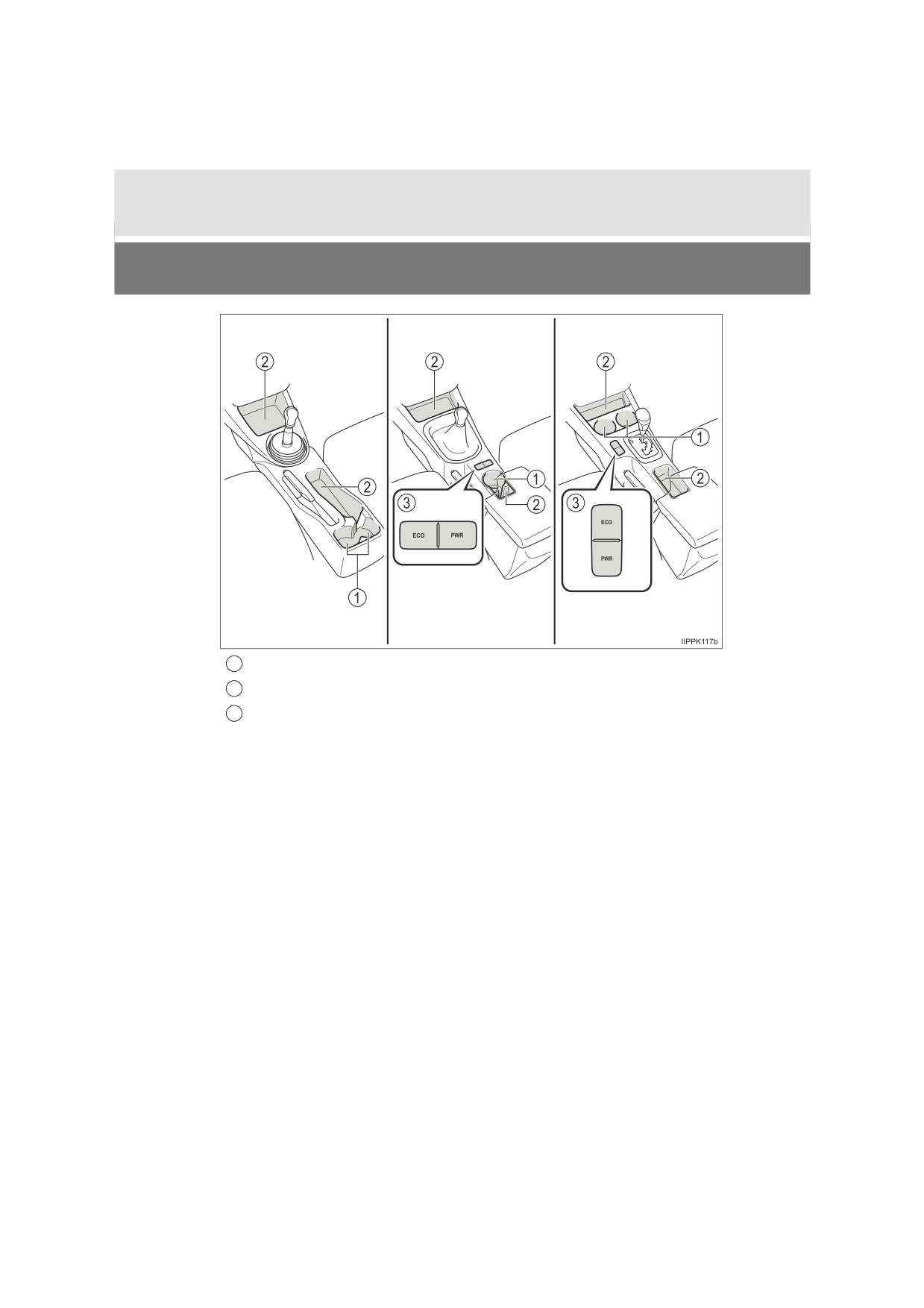
1
Cup holders*1
P. 456
2
Auxiliary boxes*1
P. 458
3
Driving mode select switches*1
P. 231, 238
Pictorial index
25
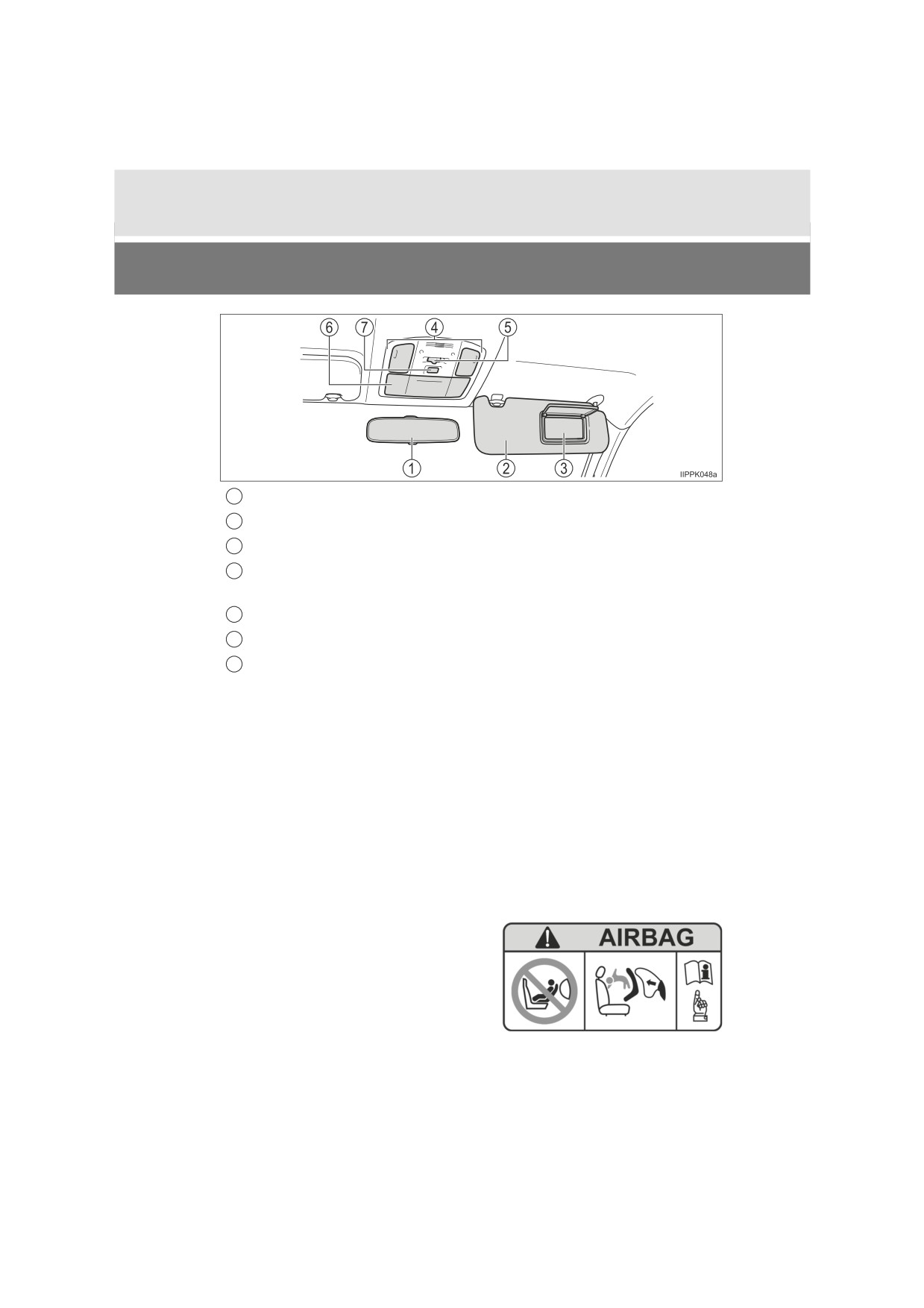
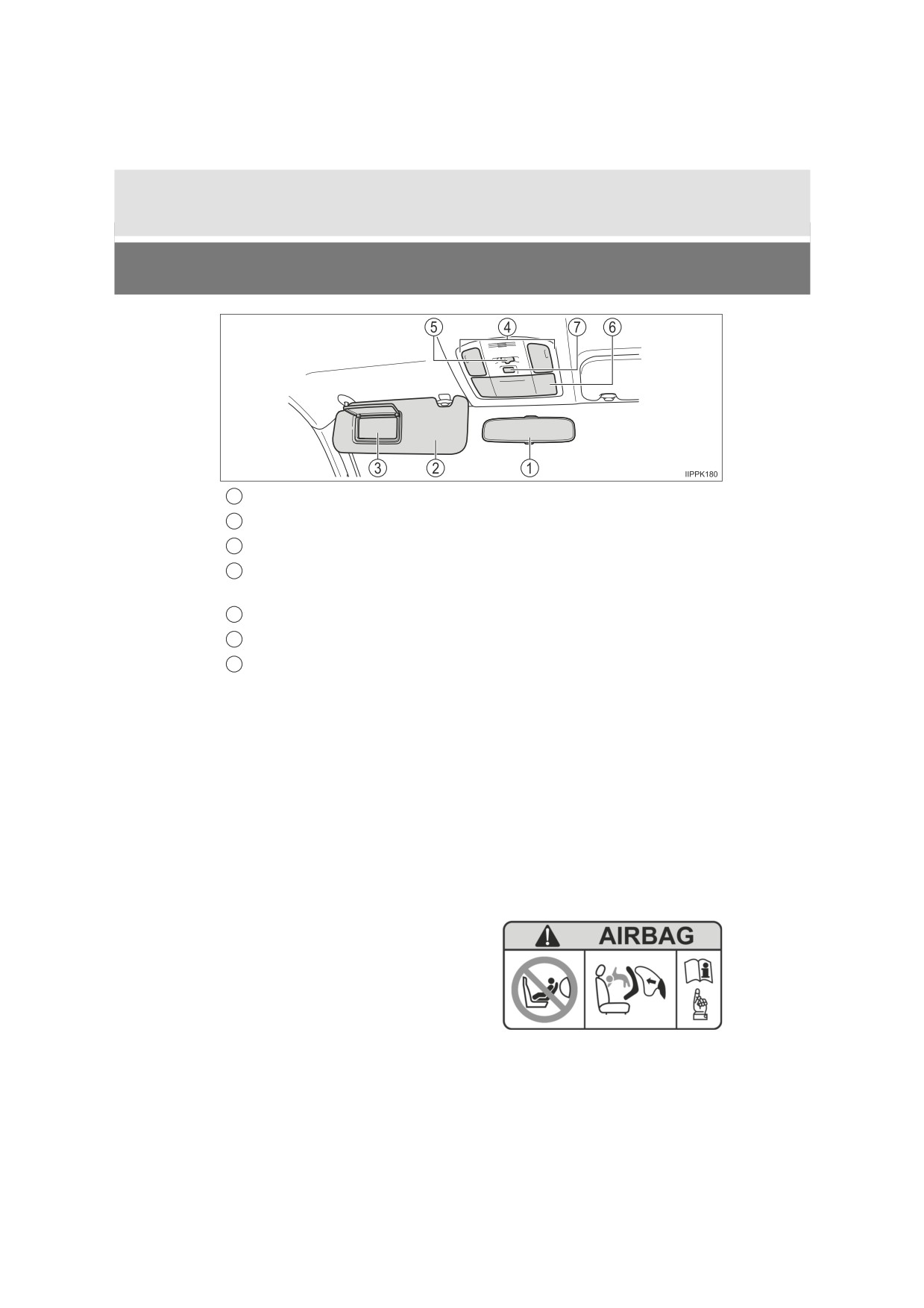
1
Inside rear view mirror
P. 178
2
Sun visors*2
P. 462
3
Vanity mirror*1
P. 462
4
Personal lights
P. 452
Interior lights*1, 3
P. 452
5
Personal/interior light main switch
P. 452
6
Auxiliary boxes
P. 458
7
“SOS” button*1
P. 96, 108
*1: If equipped
*2: NEVER use a rearward facing child
restraint on a seat protected by an
ACTIVE AIRBAG in front of it, DEATH
or SERIOUS INJURY to the CHILD can
occur. (P. 70)
*3: The illustration shows the front, but they are also equipped in the rear.
26
Pictorial index
■Instrument panel (Right-hand drive vehicles)
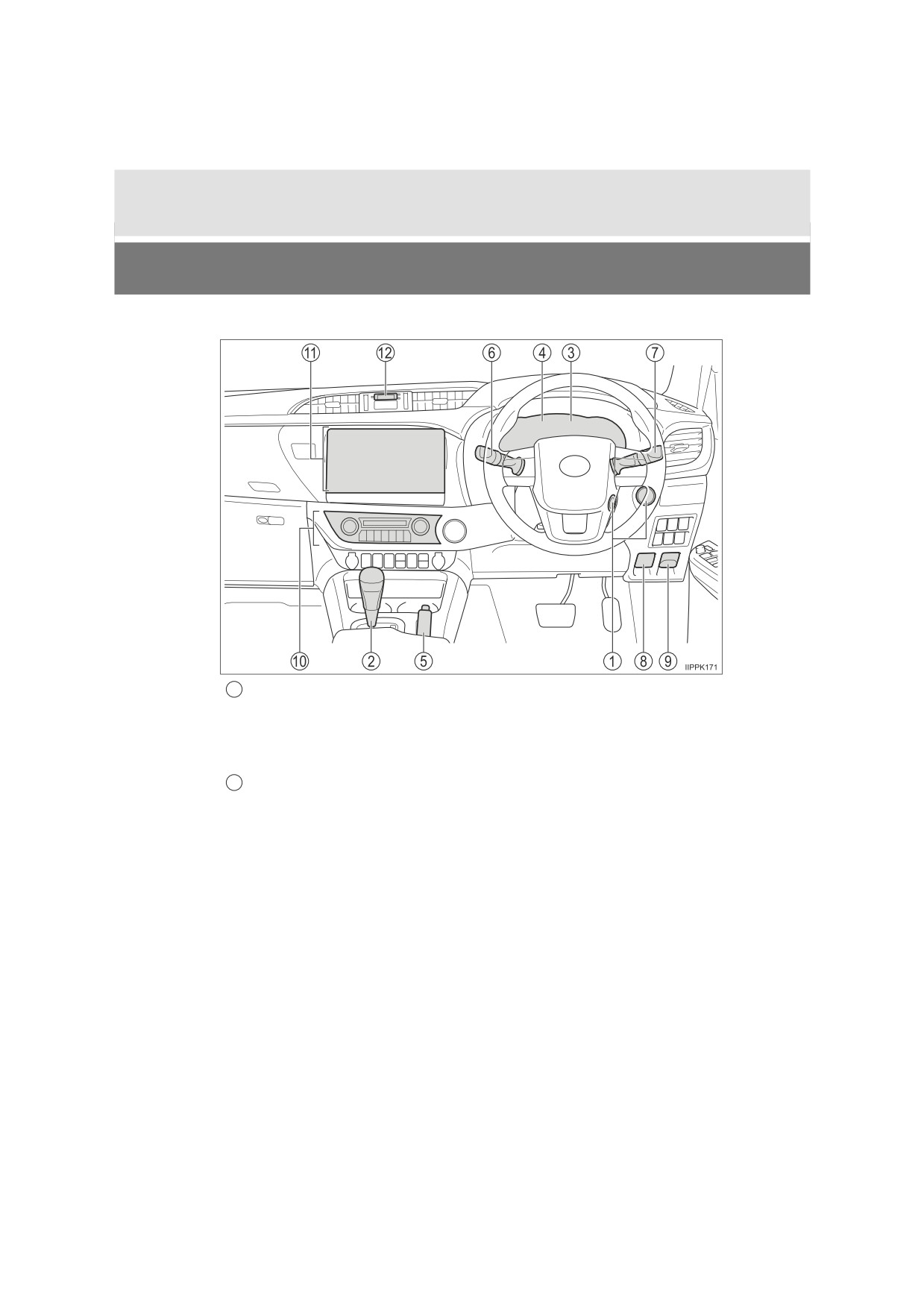
1
Engine switch
P. 218, 221
Starting the
engine/changing the positions or modes . . . P. 218, 221
Emergency
stop of the engine.
. . . . . . . . . . . . . . . . . . . . . . . . P. 553
When the engine will not start .
. . . . . . . . . . . . . . . . . . . . . . . . P. 596
Warning messages
P. 573
2
Shift lever (Automatic transmission)
P. 229
Changing the shift position
P. 229
Precautions against towing
P. 557
When the shift lever does not move
P. 235
Shift lever (Manual transmission)
P. 237
Changing the shift position
P. 237
Precautions against towing
P. 557
Pictorial index
27
3
Meters
P. 128
Reading the meters
P. 128
Adjusting the instrument panel light
P. 128
Warning lights/indicator lights
P. 120
When the warning lights come on
P. 564
4
Multi-information display
P. 133
When the warning messages are displayed
P. 573
5
Parking brake lever
P. 245
Applying/releasing
P. 245
Precautions against winter season
P. 373
Warning light/buzzer
P. 564
6
Turn signal lever
P. 244
Headlight switch
P. 246
Headlights/front position lights/tail lights/
daytime running lights
P. 246
Front fog lights*1/rear fog light*1
P. 253
7
Windshield wiper and washer switch
P. 256
Usage
P. 256
Adding washer fluid
P. 496
Warning messages
P. 573
8
Hood lock release lever
P. 482
9
Fuel filler door opener*1
P. 261
10
Manual air conditioning system*1
P. 432
Automatic air conditioning system*1
P. 439
11
Audio system*1
P. 376
AUX port/USB port
P. 379
Multimedia system*1, 2
Navigation system*1, 2
Rear view monitor system*1, 2
12
Clock
P. 463
*1: If equipped
*2: Refer to “Navigation and multimedia system Owner’s manual” or
“Multimedia Owner’s Manual”.
28
Pictorial index
■Switches (Right-hand drive vehicles)
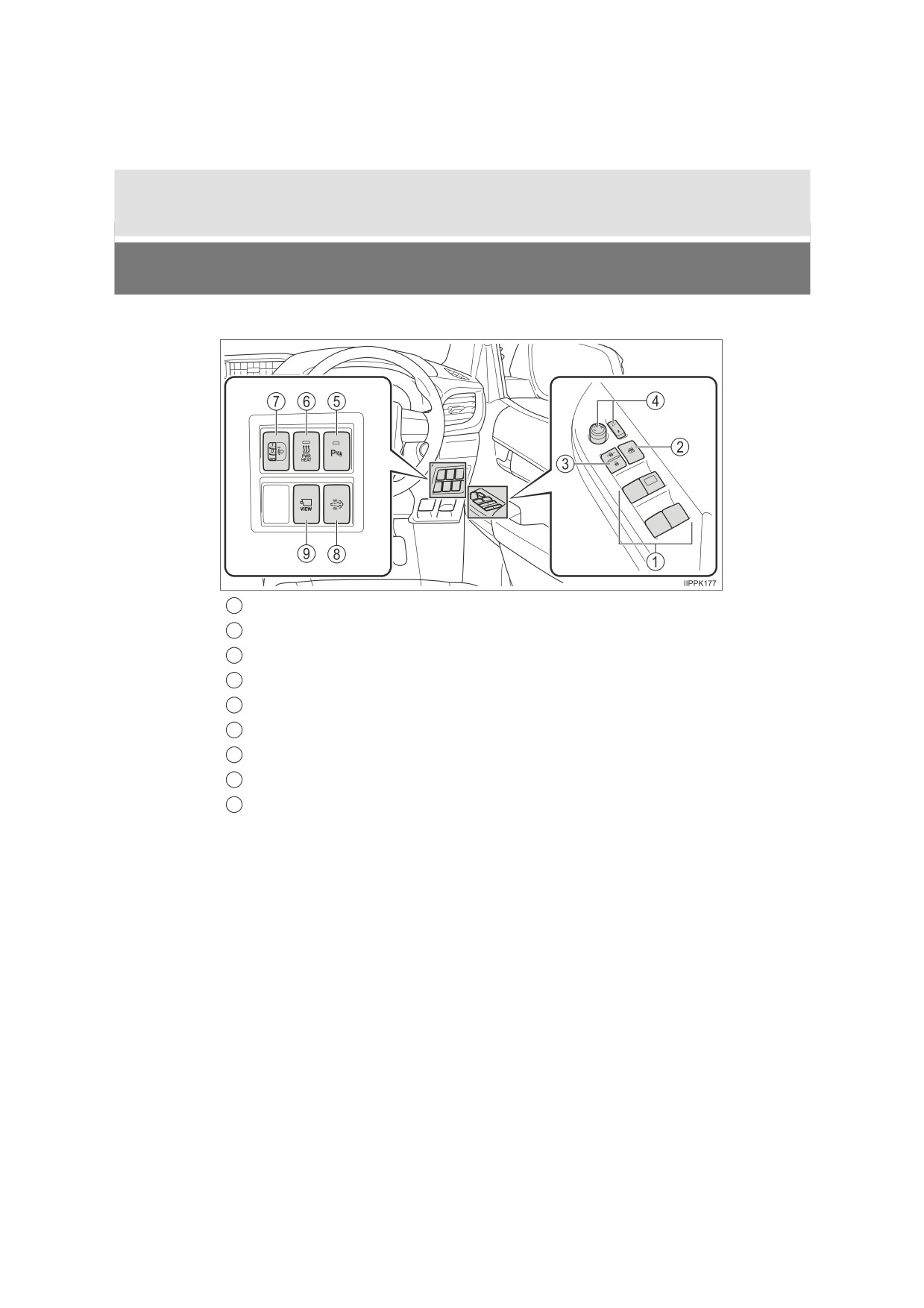
1
Power window switches
P. 183
2
Window lock switch
P. 184
3
Door lock switch
P. 153
4
Outside rear view mirror switches*1
P. 180
5
Toyota parking assist-sensor switch*1
P. 319
6
Power heater switch
P. 434, 442
7
Manual headlight leveling dial*1
P. 248
8
DPF system switch
P. 367
9
Camera switch*1, 2
Pictorial index
29
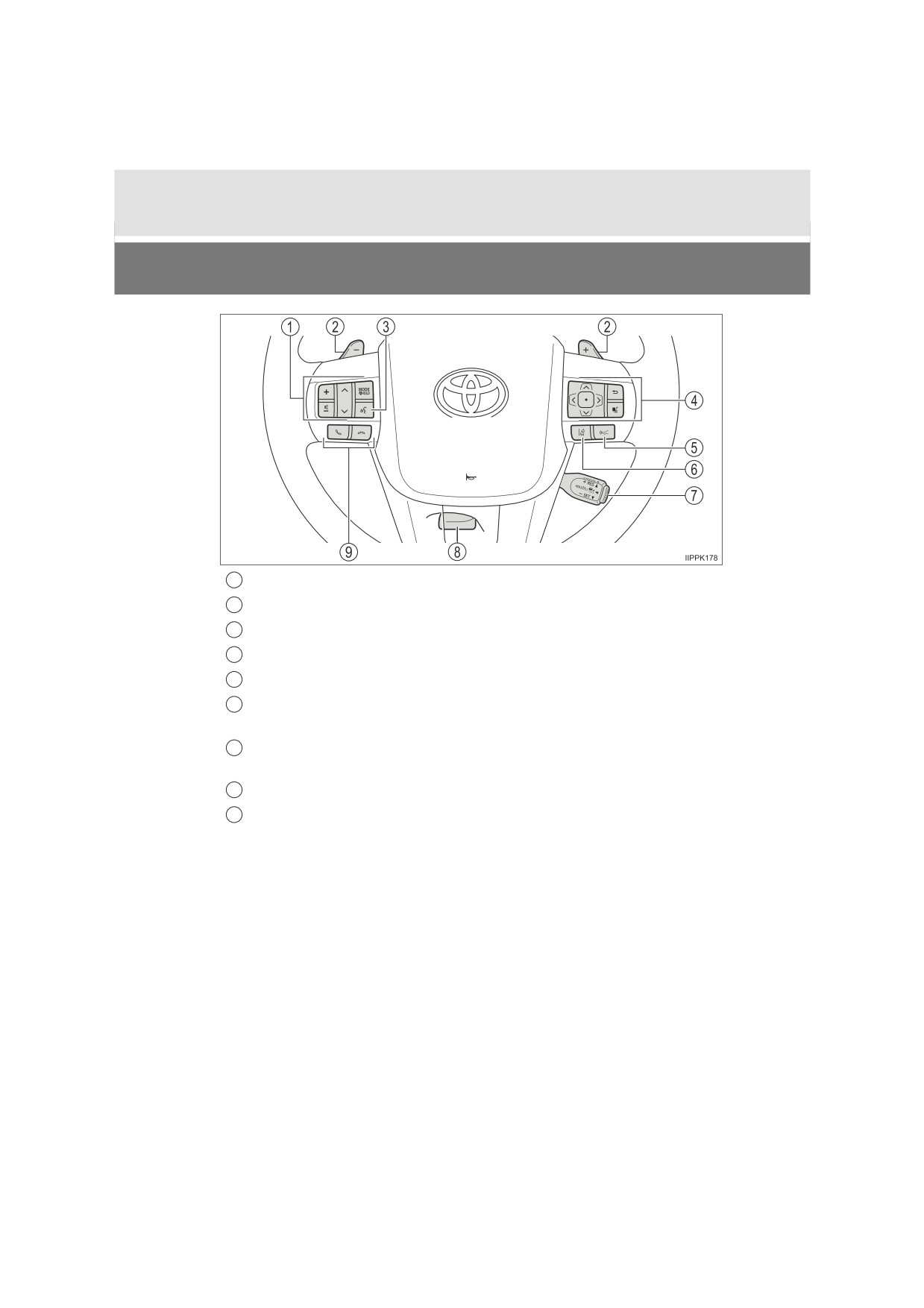
1
Audio remote control switches*2
P. 377, 468
2
Paddle shift switches*1
P. 232, 233
3
Talk switch*2, 3
P. 468
4
Meter control switches
P. 134
5
Vehicle-to-vehicle distance switch
P. 307
6
LDA (Lane Departure Alert with Yaw Assist Function)
switch
P. 282
7
Cruise control switch
Dynamic radar cruise control
P. 299
8
Tilt steering lock release lever
P. 176
9
Telephone switches*2
P. 134, 411, 468
*1: If equipped
*2: Refer to “Navigation and multimedia system Owner’s manual” or
“Multimedia Owner’s Manual”.
*3: The switch can not be used depending on the type of
audio system or navigation system.
30
Pictorial index
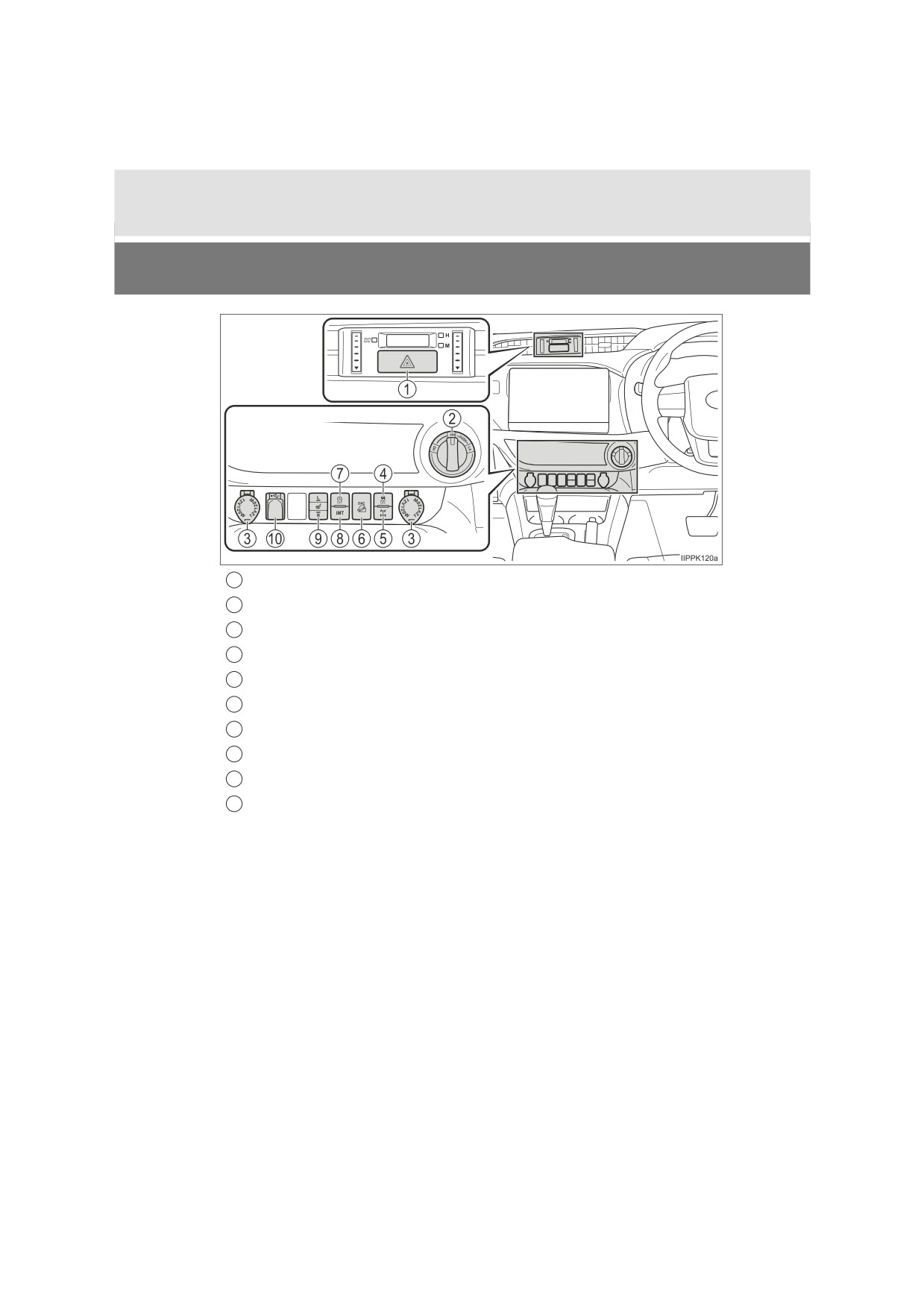
1
Emergency flasher switch
P. 552
2
Front-wheel drive control switch
P. 329
3
Power outlets*1
P. 464
4
VSC OFF switch
P. 355
5
Rear differential lock switch*1
P. 339
6
“DAC” (Downhill Assist Control system) switch*1
P. 362
7
Stop & Start cancel switch*1
P. 344
8
“iMT” switch*1
P. 239
9
Seat heater switches*1
P. 448
10
USB port*1, 2
Pictorial index
31
■Interior (Right-hand drive vehicles)
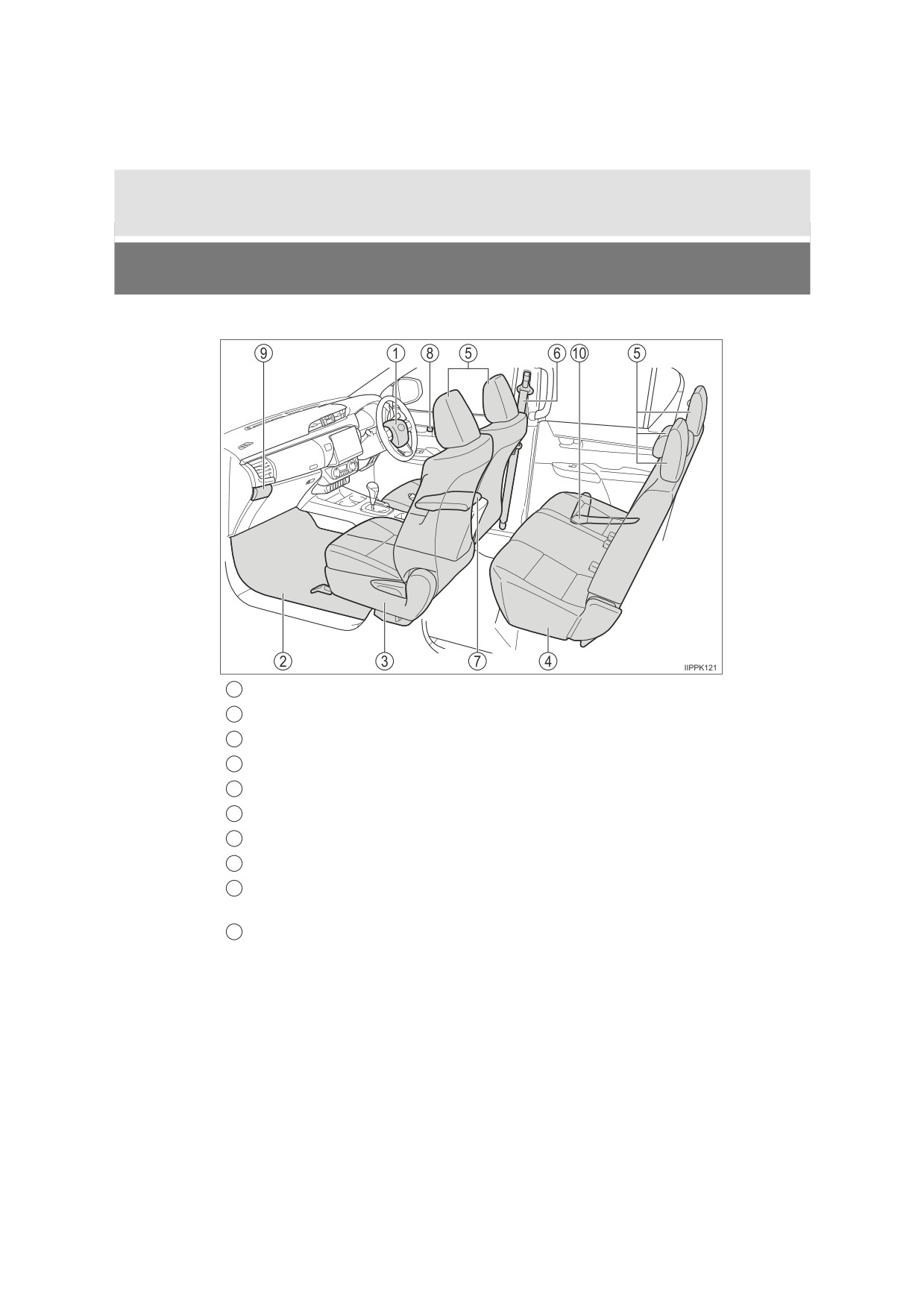
1
SRS airbags
P. 45
2
Floor mats
P. 36
3
Front seats
P. 168
4
Rear seats*1
P. 170
5
Head restraints
P. 173
6
Seat belts
P. 40
7
Console box*1
P. 455
8
Inside lock buttons
P. 153
9
Cup holders
P. 456
Auxiliary boxes
P. 458
10
Bottle holders*1
P. 457
*1: If equipped
*2: Refer to “Navigation and multimedia system Owner’s manual” or
“Multimedia Owner’s Manual”.
32
Pictorial index
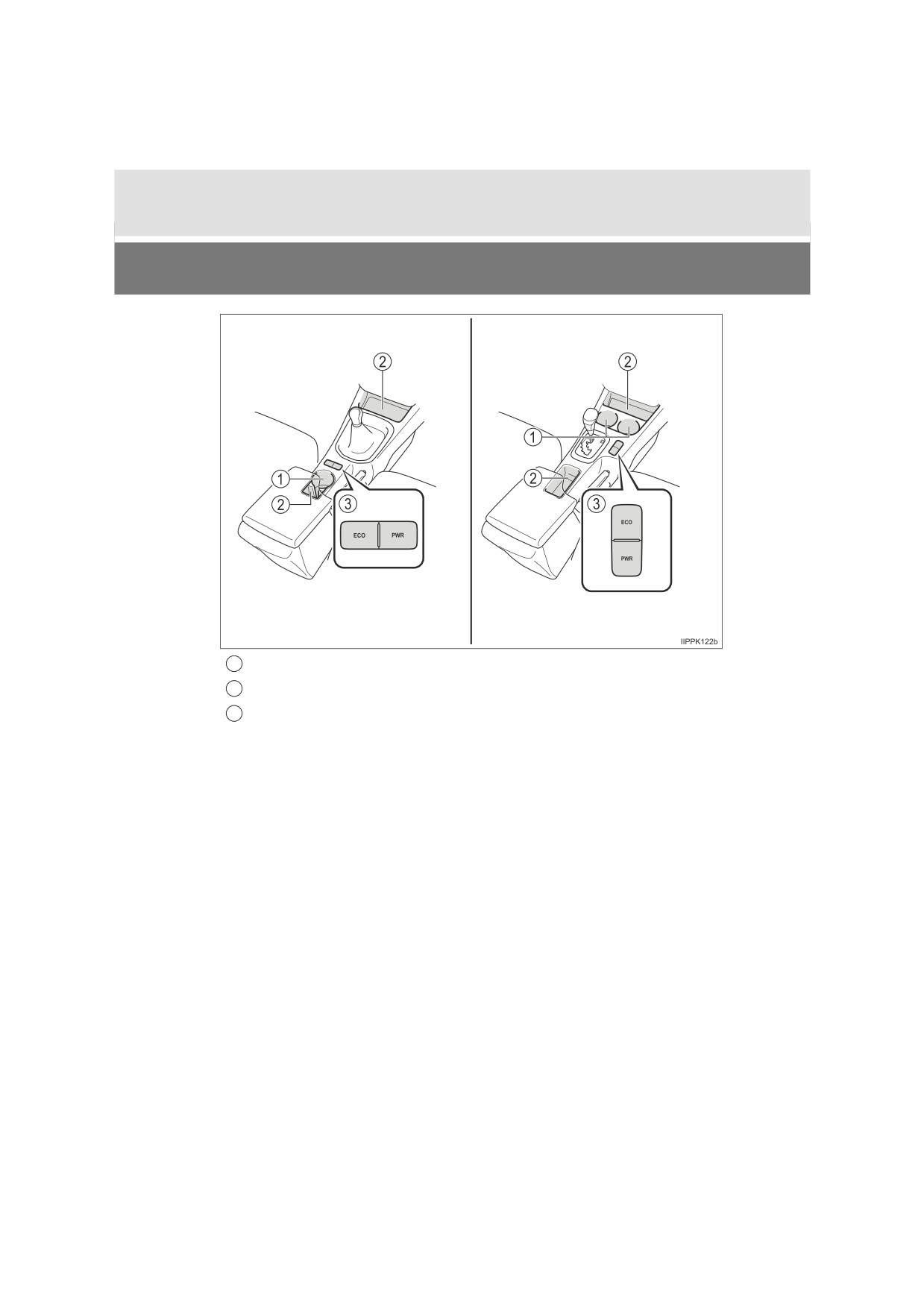
1
Cup holders*1
P. 456
2
Auxiliary boxes*1
P. 458
3
Driving mode select switches
P. 231, 238
Pictorial index
33
1
Inside rear view mirror
P. 178
2
Sun visors*2
P. 462
3
Vanity mirror*1
P. 462
4
Personal lights
P. 452
Interior lights*1, 3
P. 452
5
Personal/interior light main switch
P. 452
6
Auxiliary boxes
P. 458
7
“SOS” button*1
P. 96
*1: If equipped
*2: NEVER use a rearward facing child
restraint on a seat protected by an
ACTIVE AIRBAG in front of it, DEATH
or SERIOUS INJURY to the CHILD can
occur. (P. 70)
*3: The illustration shows the front, but they are also equipped in the rear.
34
Pictorial index
35
For safety and security
1
1-1. For safe use
Before driving
36
For safe driving
38
Seat belts
40
SRS airbags
45
Exhaust gas precautions
56
1-2. Child safety
Front passenger occupant
classification system
57
Airbag manual on-off
system
62
Riding with children
64
Child restraint systems
65
1-3. Emergency assistance
eCall
96
ERA-GLONASS/EVAK
108
1-4. Theft deterrent system
Engine immobilizer
system
113
Alarm
115
36
1-1. For safe use
Before driving
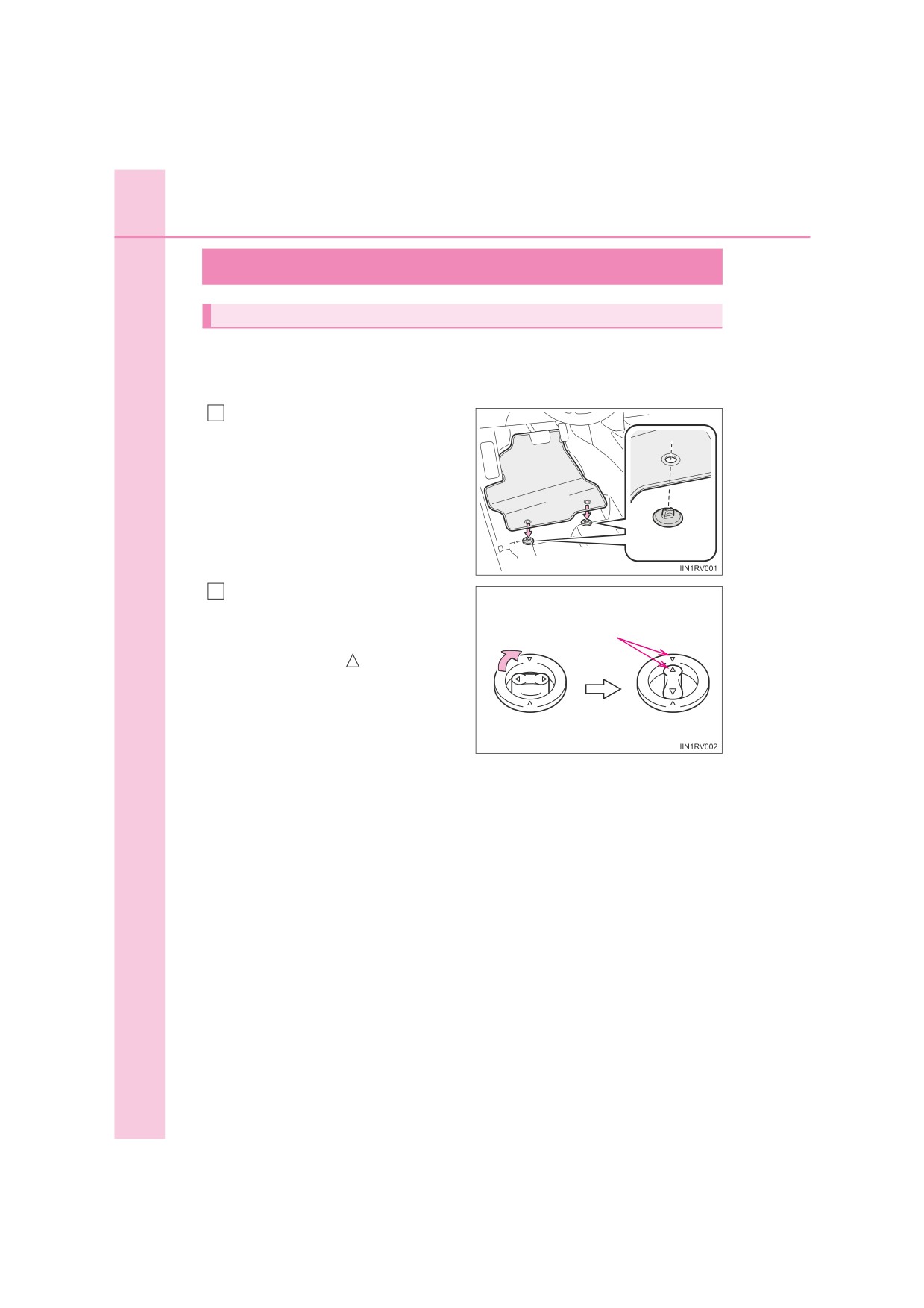
Floor mat
Use only floor mats designed specifically for vehicles of the same
model and model year as your vehicle. Fix them securely in place
onto the carpet.
Insert the retaining hooks (clips)
1
into the floor mat eyelets.
Turn the upper knob of each
2
retaining hook (clip) to secure
the floor mats in place.
*
*: Always align the
marks.
The shape of the retaining hooks (clips) may differ from that shown in the
illustration.
1-1. For safe use
37
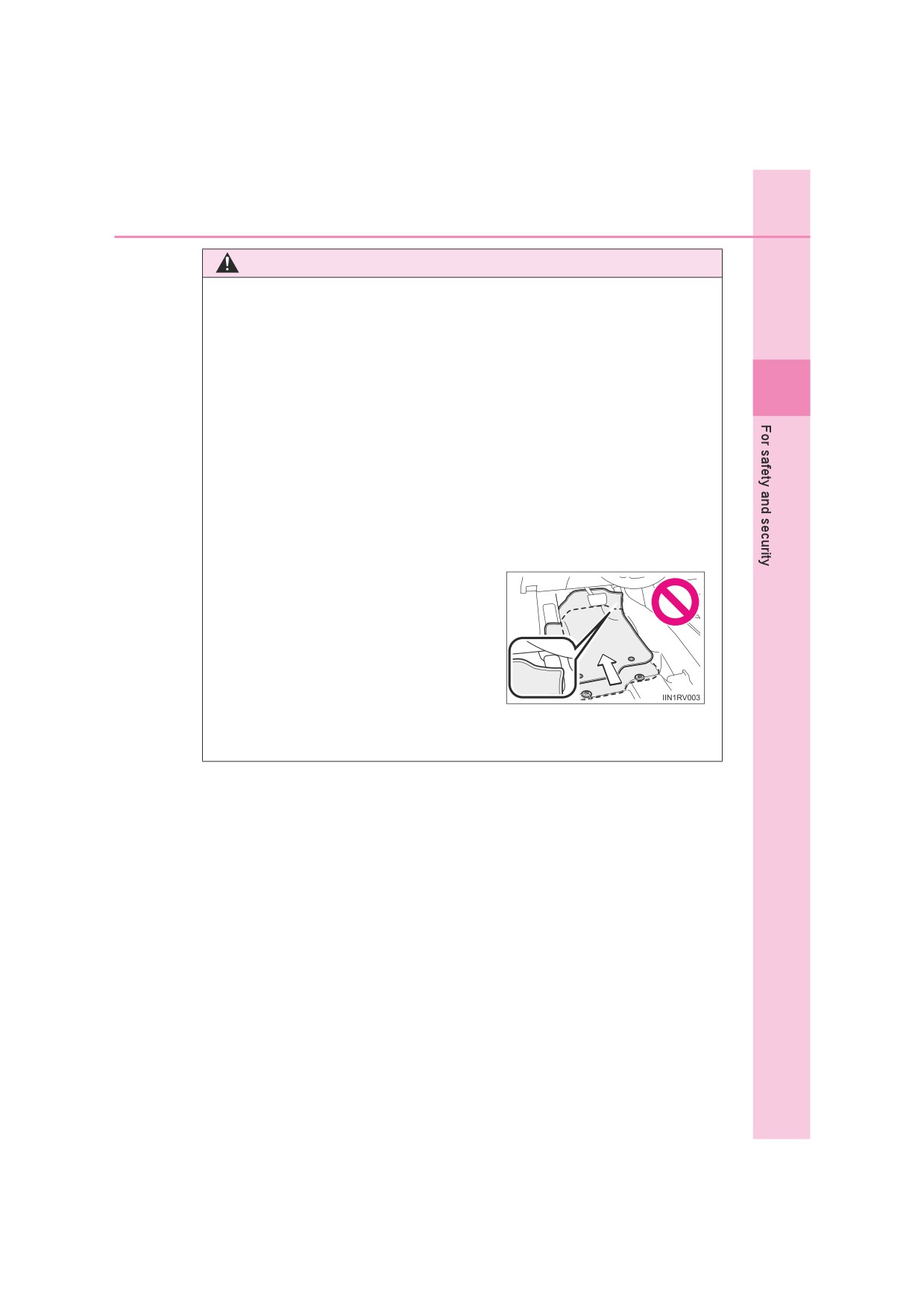
WARNING
Observe the following precautions.
Failure to do so may cause the driver’s floor mat to slip, possibly interfering
with the pedals while driving. An unexpectedly high speed may result or it may
become difficult to stop the vehicle. This could lead to an accident, resulting in
death or serious injury.
1
■ When installing the driver’s floor mat
●Do not use floor mats designed for other models or different model year
vehicles, even if they are Toyota Genuine floor mats.
●Only use floor mats designed for the driver’s seat.
● Always install the floor mat securely using the retaining hooks (clips) pro-
vided.
●Do not use two or more floor mats on top of each other.
●Do not place the floor mat bottom-side up or upside-down.
■ Before driving
●Check that the floor mat is securely
fixed in the correct place with all the
provided retaining hooks
(clips). Be
especially careful to perform this check
after cleaning the floor.
●With the engine stopped and the shift
lever in P (automatic transmission) or N
(manual transmission), fully depress
each pedal to the floor to make sure it
does not interfere with the floor mat.
38
1-1. For safe use
For safe driving
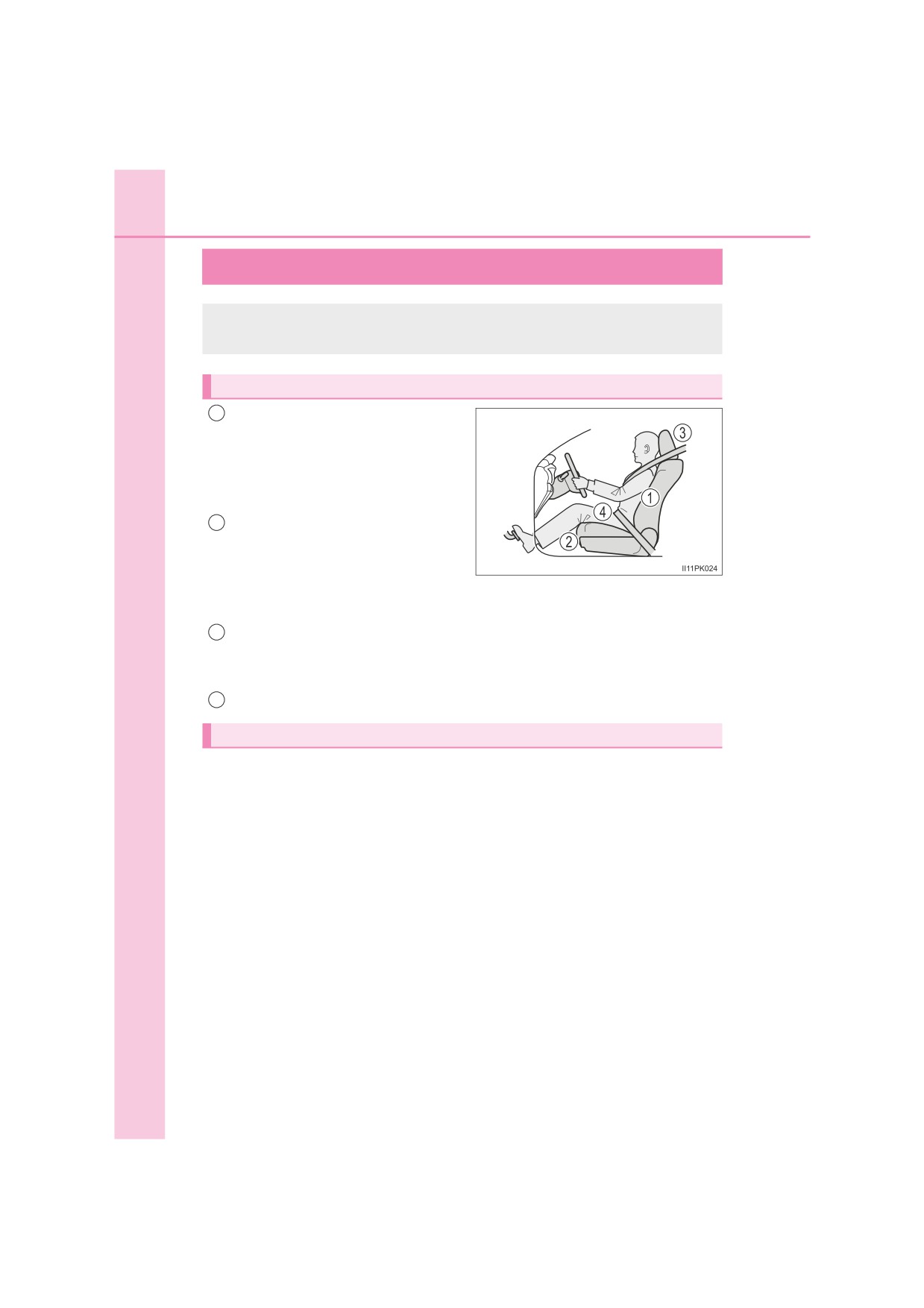
For safe driving, adjust the seat and mirror to an appropriate
position before driving.
Correct driving posture
Adjust the angle of the seat-
1
back so that you are sitting
straight up and so that you do
not have to lean forward to
steer. (P. 168)
Adjust the seat so that you can
2
depress the pedals fully and so
that your arms bend slightly at
the elbow when gripping the
steering wheel. (P. 168)
Vehicles with adjustable type head restraint: Lock the head restraint
3
in place with the center of the head restraint closest to the top of
your ears. (P. 173)
Wear the seat belt correctly. (P. 40)
4
Correct use of the seat belts
Make sure that all occupants are wearing their seat belts before driv-
ing the vehicle. (P. 40)
Use a child restraint system appropriate for the child until the child
becomes large enough to properly wear the vehicle’s seat belt.
(P. 65)
1-1. For safe use
39
Adjusting the mirrors
Make sure that you can see backward clearly by adjusting the inside
and outside rear view mirrors properly. (P. 178, 180)
WARNING
Observe the following precautions.
1
Failure to do so may result in death or serious injury.
●Do not adjust the position of the driver’s seat while driving.
Doing so could cause the driver to lose control of the vehicle.
●Do not place a cushion between the driver or passenger and the seatback.
A cushion may prevent correct posture from being achieved, and reduce
the effectiveness of the seat belt and head restraint.
●Do not place anything under the front seats.
Objects placed under the front seats may become jammed in the seat
tracks and stop the seat from locking in place. This may lead to an acci-
dent and the adjustment mechanism may also be damaged.
● Always observe the legal speed limit when driving on public roads.
●When driving over long distances, take regular breaks before you start to
feel tired.
Also, if you feel tired or sleepy while driving, do not force yourself to con-
tinue driving and take a break immediately.
40
1-1. For safe use
Seat belts
Make sure that all occupants are wearing their seat belts before
driving the vehicle.
Correct use of the seat belts
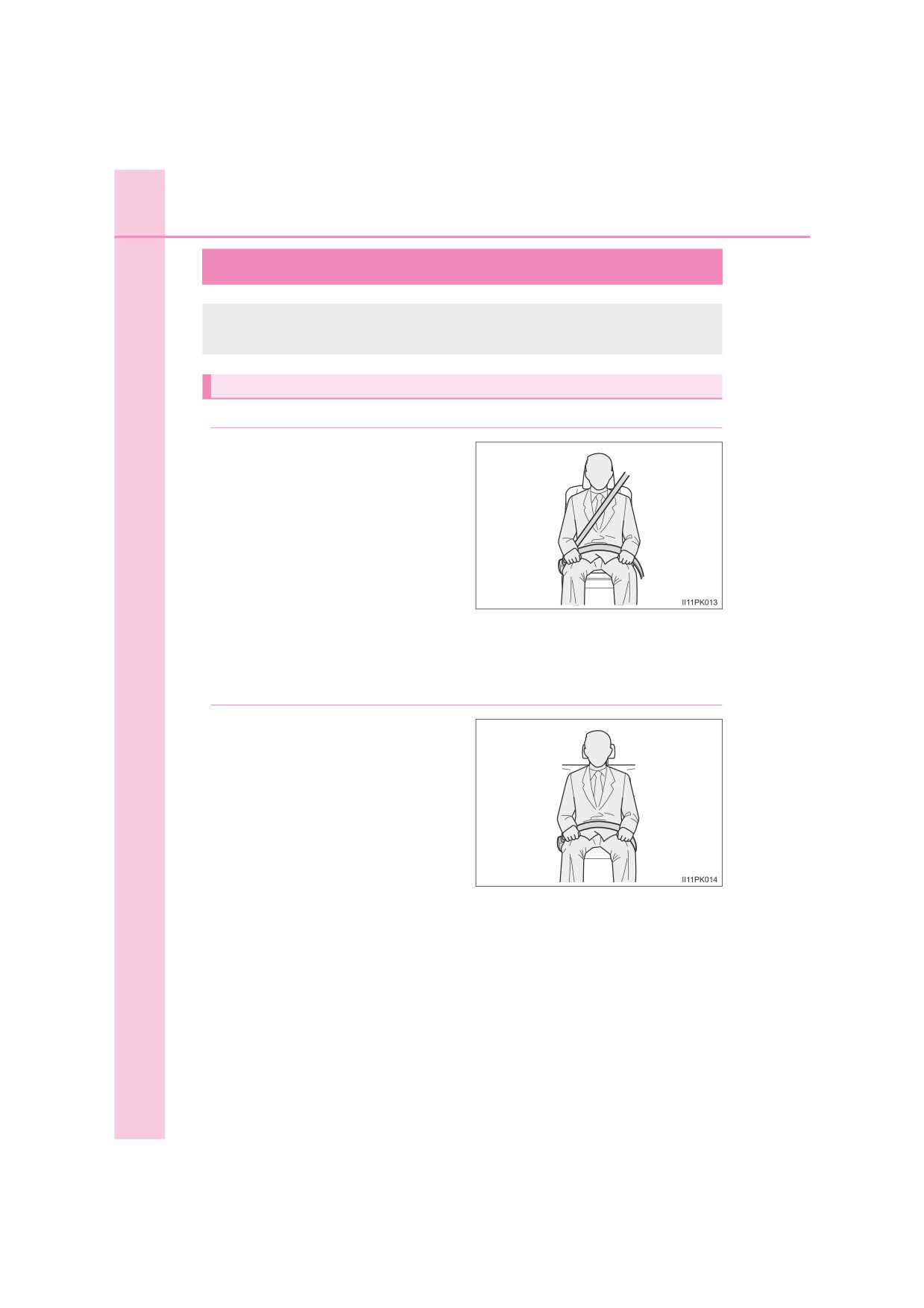
◆ 3-point type
● Extend the shoulder belt so
that it comes fully over the
shoulder, but does not come
into contact with the neck or
slide off the shoulder.
● Position the lap belt as low
as possible over the hips.
● Adjust the position of the
seatback. Sit up straight and
well back in the seat.
● Do not twist the seat belt.
◆ 2-point type (if equipped)
● Position the lap belt as low
as possible over the hips and
remove excess length of the
belt.
● Do not twist the seat belt.
1-1. For safe use
41
Fastening and releasing the seat belt
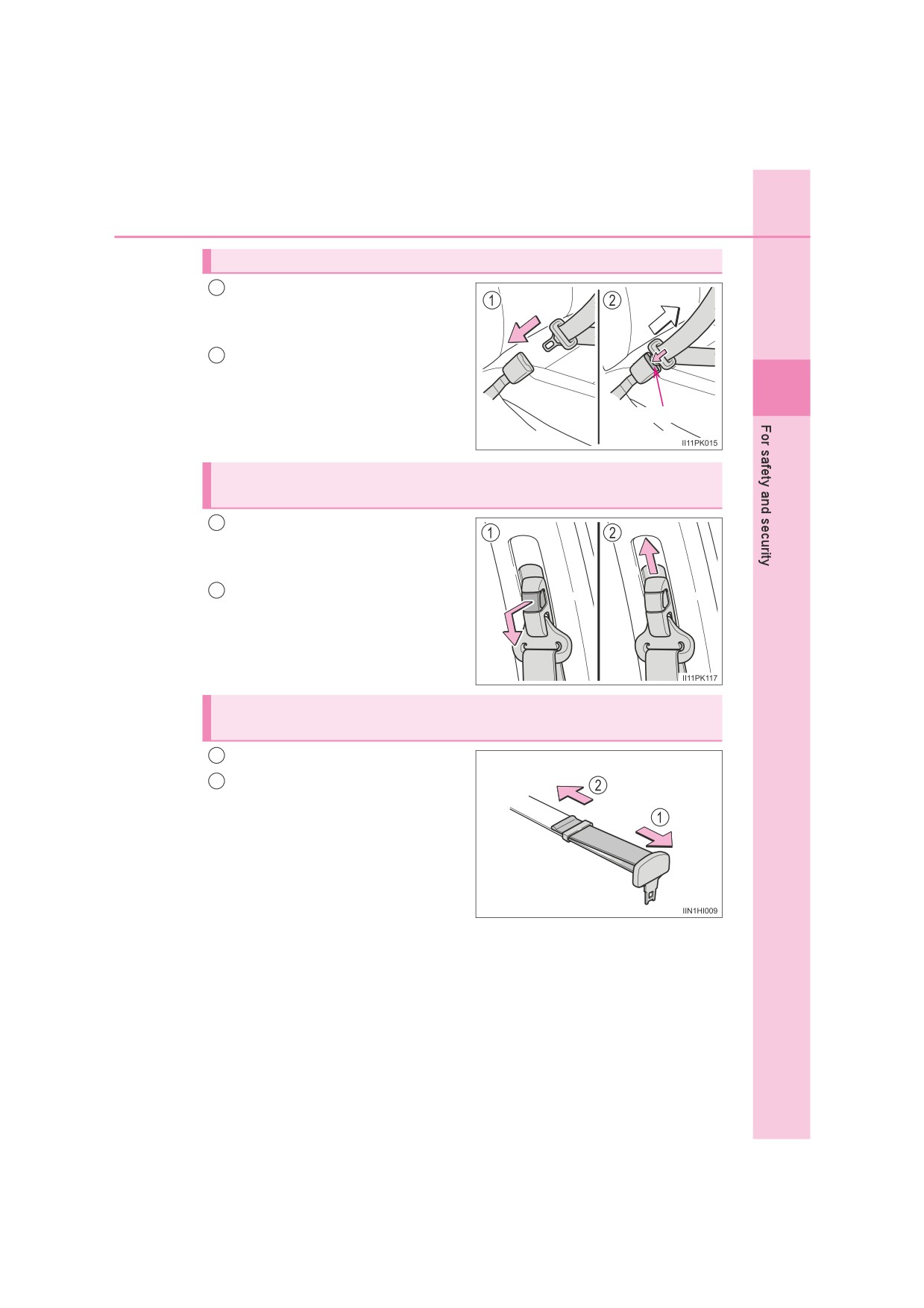
To fasten the seat belt, push the
1
plate into the buckle until a click
sound is heard.
2
To release the seat belt, press
the release button.
1
Release button
Adjusting the seat belt shoulder anchor height (if equipped for
front seats)
Push the seat belt shoulder
1
anchor down while pulling the
lock release knob.
2
Push the seat belt shoulder
anchor up.
Move the height adjuster up and
down as needed until you hear a
click.
Adjusting the length of the belt
(2-point type seat belt)
(if
equipped)
1
Lengthen
2
Shorten
42
1-1. For safe use
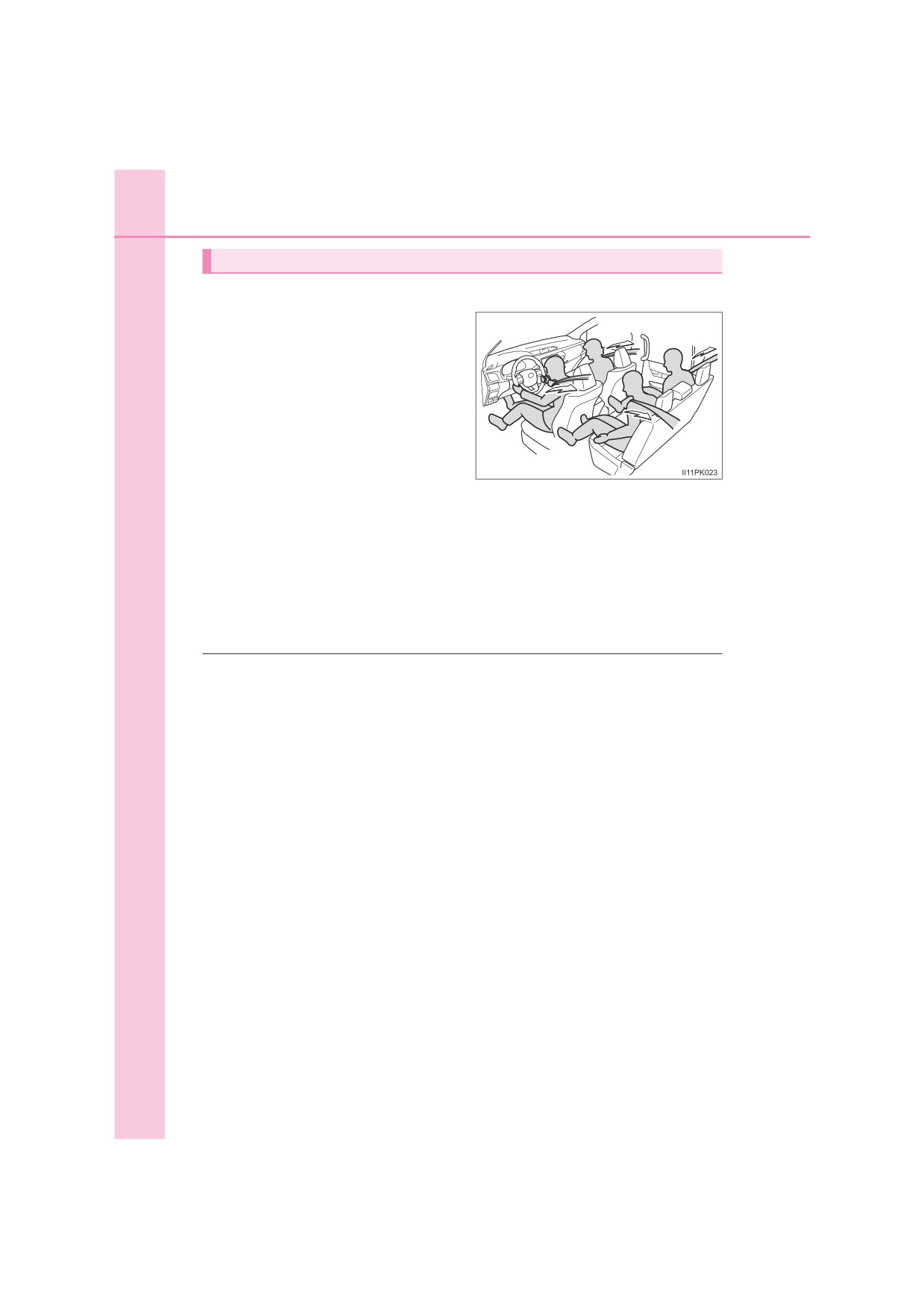
Seat belt pretensioners (if equipped)
Vehicles without SRS side and curtain shield airbags
The pretensioners help the seat
belts to quickly restrain the occu-
pants by retracting the seat belts
when the vehicle is subjected to
certain types of severe frontal col-
lision.
The pretensioners do not activate
in the event of a minor frontal
impact, a side impact, a rear
impact or a vehicle rollover.
Vehicles with SRS side and curtain shield airbags
The pretensioners help the seat belts to quickly restrain the occupants
by retracting the seat belts when the vehicle is subjected to certain
types of severe frontal or side collision.
The pretensioners do not activate in the event of a minor frontal impact, a
minor side impact, a rear impact or a vehicle rollover.
■ Emergency locking retractor (ELR) (3-point type seat belt)
The retractor will lock the belt during a sudden stop or on impact. It may also
lock if you lean forward too quickly. A slow, easy motion will allow the belt to
extend so that you can move around fully.
■ Child seat belt usage
The seat belts of your vehicle were principally designed for persons of adult
size.
●Use a child restraint system appropriate for the child, until the child
becomes large enough to properly wear the vehicle’s seat belt. ( P. 65)
● When the child becomes large enough to properly wear the vehicle’s seat
belt, follow the instructions regarding seat belt usage. (P. 40)
■ Replacing the belt after the pretensioner has been activated
If the vehicle is involved in multiple collisions, the pretensioner will activate for
the first collision, but will not activate for the second or subsequent collisions.
■ Seat belt regulations
If seat belt regulations exist in the country where you reside, please contact
any authorized Toyota retailer or Toyota authorized repairer, or any reliable
repairer for seat belt replacement or installation.
1-1. For safe use
43
WARNING
Observe the following precautions to reduce the risk of injury in the event of
sudden braking, sudden swerving or an accident.
Failure to do so may cause death or serious injury.
■ Wearing a seat belt
● Ensure that all passengers wear a seat belt.
1
● Always wear a seat belt properly.
●Each seat belt should be used by one person only. Do not use a seat belt
for more than one person at once, including children.
● Toyota recommends that children be seated in the rear seat and always
use a seat belt and/or an appropriate child restraint system.
● To achieve a proper seating position, do not recline the seat more than
necessary. The seat belt is most effective when the occupants are sitting
up straight and well back in the seats.
●Do not wear the shoulder belt under your arm.
● Always wear your seat belt low and snug across your hips.
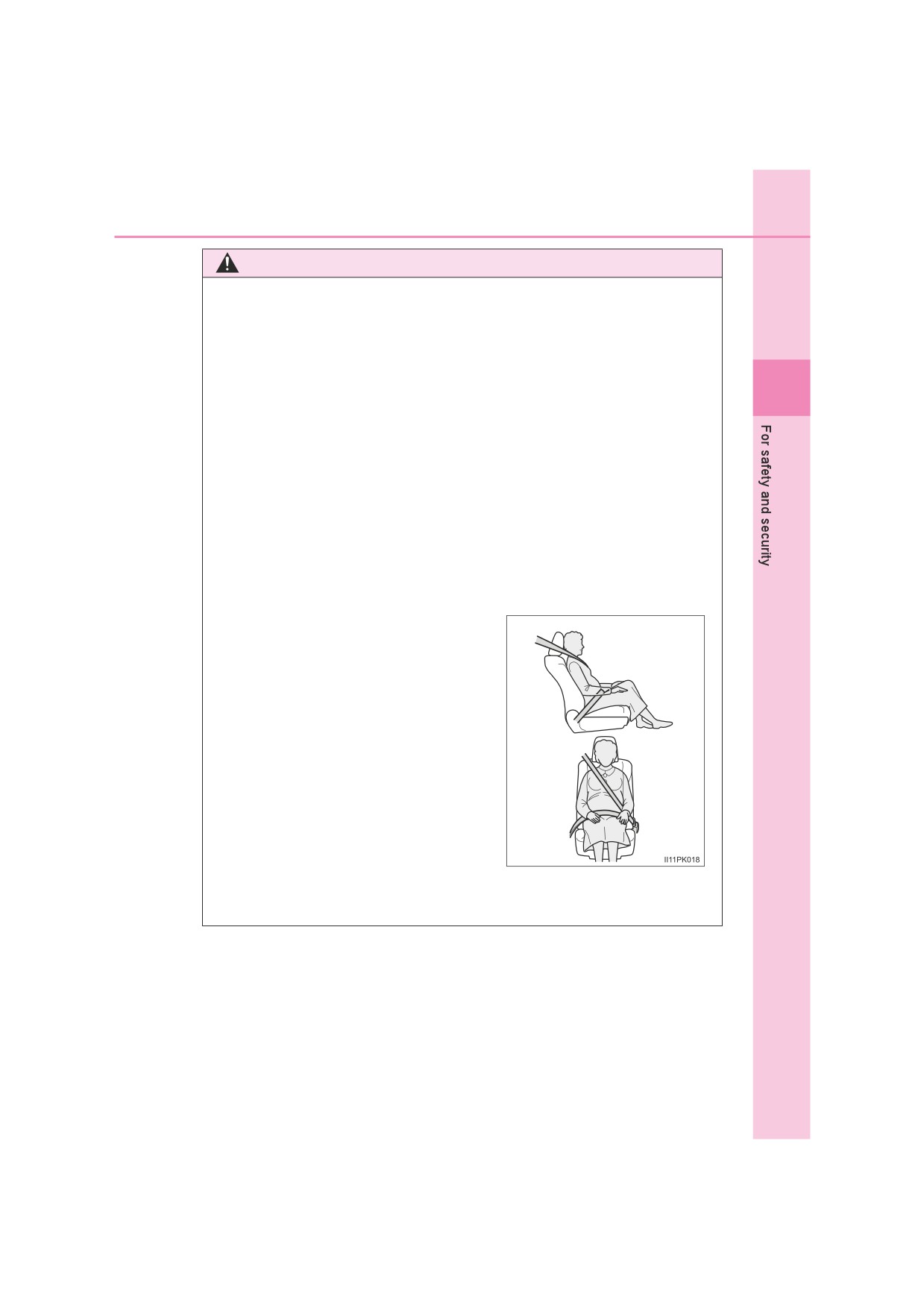
■ Pregnant women
Obtain medical advice and wear the seat
belt in the proper way. (P. 40)
Women who are pregnant should posi-
tion the lap belt as low as possible over
the hips in the same manner as other
occupants, extending the shoulder belt
completely over the shoulder and avoid-
ing belt contact with the rounding of the
abdominal area.
If the seat belt is not worn properly, not
only the pregnant woman, but also the
fetus could suffer death or serious injury
as a result of sudden braking or a colli-
sion.
■ People suffering illness
Obtain medical advice and wear the seat belt in the proper way. (P. 40)
44
1-1. For safe use
WARNING
■ When children are in the vehicle
P. 89
■ Seat belt pretensioners
●Do not place anything, such as a cushion, on the front passenger’s seat.
Doing so will disperse the passenger’s weight, which prevents the sensor
from detecting the passenger’s weight properly. As a result, the seat belt
pretensioner for the front passenger’s seat may not activate in the event of
a collision.
● If the pretensioner has activated, the SRS warning light will come on. In
that case, the seat belt cannot be used again and must be replaced at any
authorized Toyota retailer or Toyota authorized repairer, or any reliable
repairer.
■ Adjustable shoulder anchor (if equipped)
Always make sure the shoulder belt is positioned across the center of your
shoulder. The belt should be kept away from your neck, but not falling off
your shoulder. Failure to do so could reduce the amount of protection in an
accident and cause death or serious injuries in the event of a sudden stop,
sudden swerve or accident. (P. 41)
■ Seat belt damage and wear
●Do not damage the seat belts by allowing the belt, plate, or buckle to be
jammed in the door.
●Inspect the seat belt system periodically. Check for cuts, fraying, and loose
parts. Do not use a damaged seat belt until it is replaced. Damaged seat
belts cannot protect an occupant from death or serious injury.
● Ensure that the belt and plate are locked and the belt is not twisted.
If the seat belt does not function correctly, immediately contact any autho-
rized Toyota retailer or Toyota authorized repairer, or any reliable repairer.
●Replace the seat assembly, including the belts, if your vehicle has been
involved in a serious accident, even if there is no obvious damage.
●Do not attempt to install, remove, modify, disassemble or dispose of the
seat belts. Have any necessary repairs carried out by any authorized
Toyota retailer or Toyota authorized repairer, or any reliable repairer. Inap-
propriate handling may lead to incorrect operation.
1-1. For safe use
45
SRS airbags
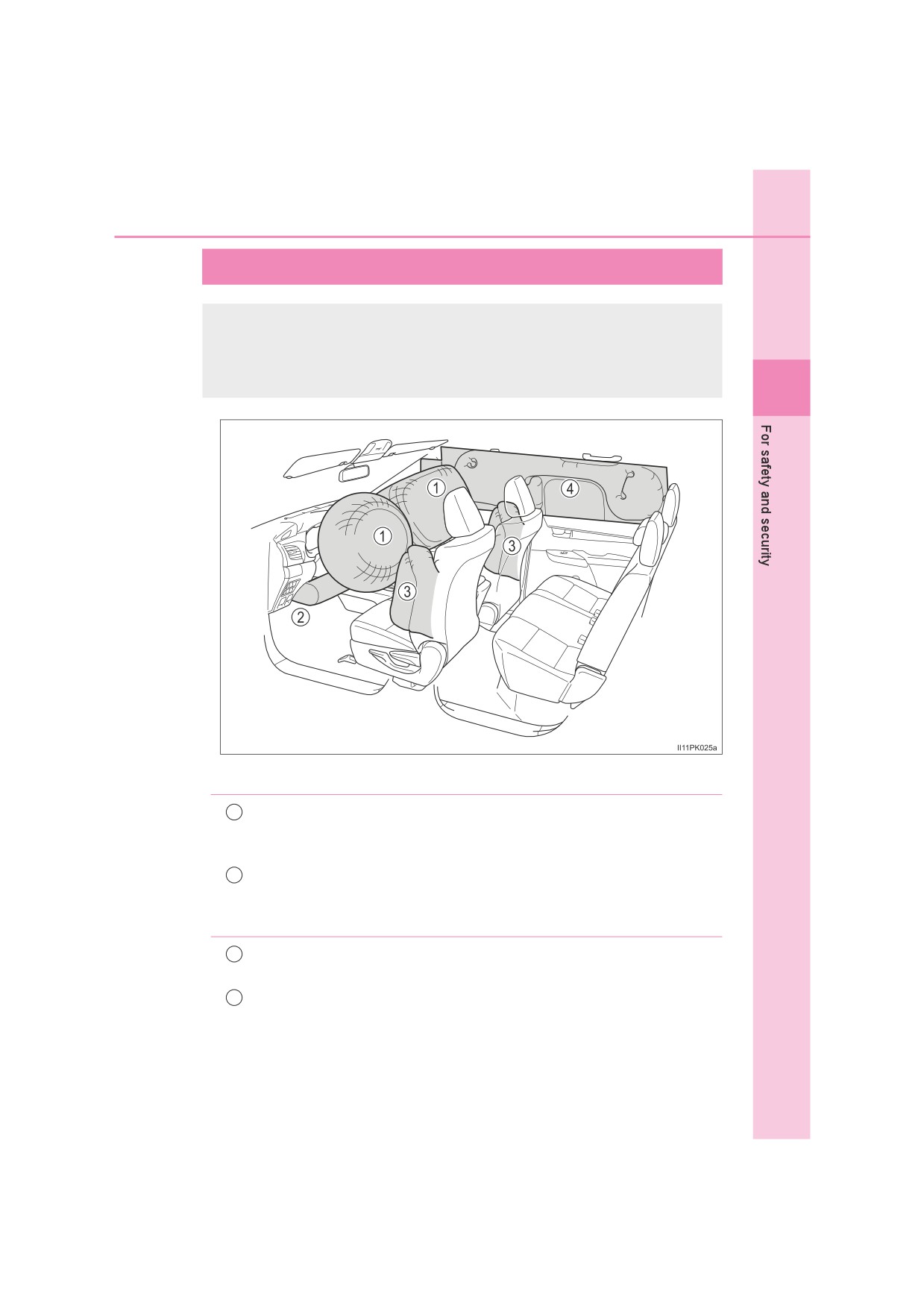
The SRS airbags inflate when the vehicle is subjected to certain
types of severe impacts that may cause significant injury to the
occupants. They work together with the seat belts to help reduce
the risk of death or serious injury.
1
◆ SRS front airbags
SRS driver airbag/front passenger airbag
1
Can help protect the head and chest of the driver and front pas-
senger from impact with interior components
SRS driver’s knee airbag
2
Can help provide driver protection
◆ SRS side and curtain shield airbags
SRS side airbags (if equipped)
3
Can help protect the torso of the front seat occupants
SRS curtain shield airbags (if equipped)
4
Can help protect primarily the head of occupants in the outer
seats
46
1-1. For safe use
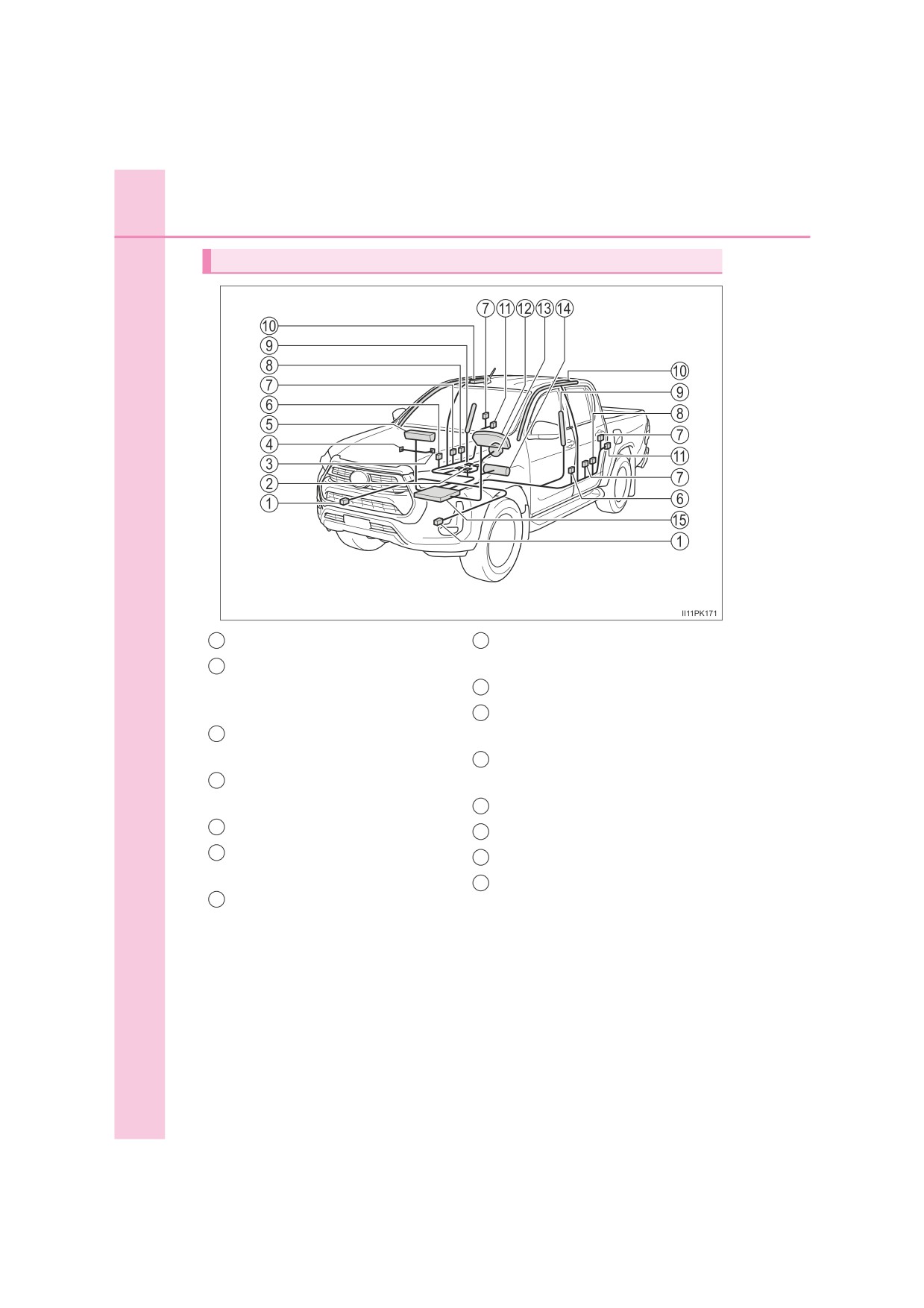
SRS airbag system components
1
Front impact sensors
8
Safing sensor
(front)
(if
2
Front passenger occupant clas-
equipped)
sification system
(ECU and
9
Side airbags (if equipped)
sensors) (if equipped)
10
Curtain shield airbags
3
“PASSENGER AIR BAG” indi-
(if equipped)
cator (if equipped)
11
Side impact sensors (rear)
4
Airbag manual on-off switch
(if equipped)
(if equipped)
12
SRS warning light
5
Front passenger airbag
13
Driver airbag
6
Side impact sensors
(front
14
Driver’s knee airbag
door) (if equipped)
15
Airbag sensor assembly
7
Seat belt pretensioners and
force limiters (if equipped)
//////////////////////////////////////////