Citroen Nemo Dag (2010 year). Manual - part 7
 

  Index      Citroen     Citroen Nemo Dag - service manual 2010 year in english


Search            


Content   ..  5  6  7  8   ..


Citroen Nemo Dag (2010 year). Manual - part 7


8

9

4

EA

SE 

O

F

 U

SE 

a

n

d

 C

O

MF

O

R

T

Practical information

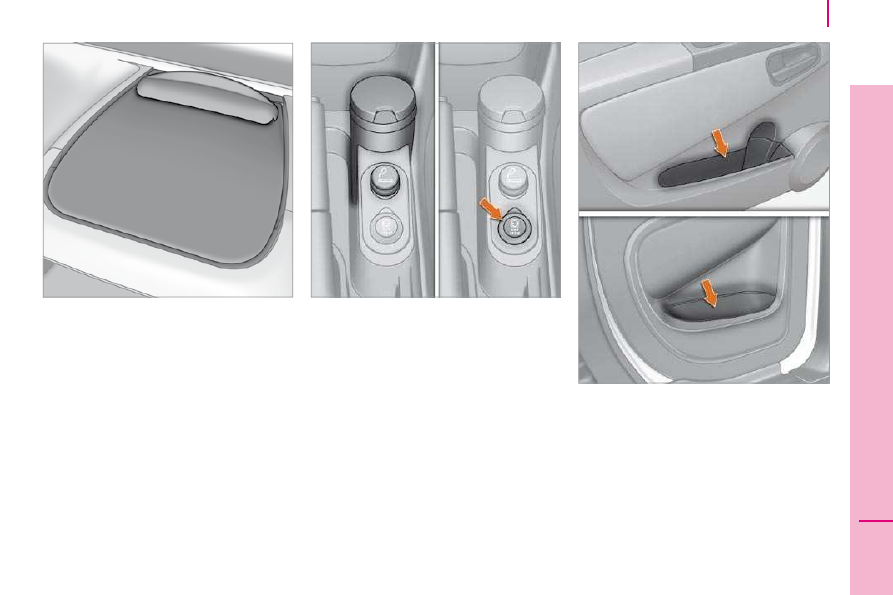
  Smoker's kit 

 Located at the base of the centre console, 
this consists of a cigar lighter and an 
ashtray.  

  12 V socket (180 W max) 

 An accessory socket is provided next to the 
cigar lighter.  

 FRONT FITTINGS   

  Folding writing table (Light van) 

 This is located in the centre of the fascia 
panel. In the absence of a table, the vehicle 
is fitted with a storage compartment. 
 The clip can be used to secure A5 format 
documents, slips, etc. 
 Pull the top of the table to unfold it, push to 
fold it.  

  Storage compartment in the door trays 

 With recess for storing a 1 litre bottle.  

9

0

Practical information

  Sun visor 

 To avoid glare from ahead, fold and direct 
the sun visor down. 
 Toll cards, tickets, etc. can be slipped into 
the sun visor on the driver's side. 
 The sun visor on the passenger's side may 
be fitted with a courtesy mirror.  

  Glove box 

 To open it raise the handle. 
 It can accommodate a laptop computer. 
 It provides storage for the handbook pack.  

  Spectacles storage (Combi) 

 There is a spectacles storage compartment 
on the driver's side, above the door. 
 To open it, unclip the cover pulling at the 
centre.  

9

1

4

EA

SE 

O

F

 U

SE 

a

n

d

 C

O

MF

O

R

T

Practical information

 LOAD SPACE FITTINGS 

  Stowing rings 

 There are 6 stowing rings on the rear floor to 
secure your loads. 
 As a safety precaution in case of sharp 
braking, you are advised to place heavy 
objects as far forwards towards the driver's 
seat as possible. 

  Storage tray 

 A storage tray is provided at the rear left of 
the load space.  

  Torch 

 A magnetic torch is provided at the rear right 
of the load space. 
 Remove the torch from its base by 
pressing the button then pivoting the torch 
downwards by 90 degrees. 
 To switch on the torch, slide the switch 
forwards. 
 To change the 4 rechargeable batteries 
(NiMH type), remove the protective cover 
from the torch. 
 To put the torch back in place, engage it in the 
notches on the base and pivot it upwards. 

  Ladder type vertical partition 

 Behind the driver's seat, a ladder type 
vertical partition protects the driver against 
the risk of load movement.  

  Partitions 

 Panel, glazed, mid-height panel with grille 
and modular vertical grille type partitions are 
available for your light van.  

   Carrying passengers in the load space 
is not permitted. 

  It is advisable to immobilise the load 
by securing it firmly using the stowing 
rings on the floor.  

 The torch's storage batteries recharge 
automatically while driving. 
 An additional lamp is fitted in the middle 
of the torch housing (refer to the "Interior 
lighting" section).  

9

2

Practical information

  Modular vertical grille 

 Operations: 

  3.   Lift the catch, located at the lower part of 

the grille. 

  4.   Pivot the grille and insert the catch in the 

space provided on the passenger seat 
back.   

   1.   Place the passenger seat in the folded 

position. 

  2.   Lift the catch, located at the upper part of 

the grille. 

 You can obtain a two-part partition grille. 
 Associated with the retractable seat, the 
grille increases the driver's safety by 
isolating him from the front load. 

9

3

4

EA

SE 

O

F

 U

SE 

a

n

d

 C

O

MF

O

R

T

Practical information

 REAR LAYOUT 

  Stowing rings 

 There are 4 stowing rings on the rear floor to 
secure your luggage.  

       Luggage retaining net 

 Hooked onto the stowing rings, this enables 
you to secure your luggage.  

  Rear shelf 

 Unfold the shelf to conceal the contents of 
the boot from sight from the outside. 
 Fold the shelf back on itself for easier 
access to the contents of the boot. 
 Store the shelf behind the rear bench seat 
when loading bulky items vertically. 

  Removing the shelf 

 Fold the shelf back on itself. 
 Lift the shelf to approximately 60°. 
 Unclip the shelf's side fixings from its 
supports. 
 Remove the shelf. 
 Store the folded shelf in the location behind 
the rear bench seat. 
 To put the shelf back in place, carry out 
these operations in reverse order.   

9

4

Practical information

  Retaining straps 

 There are two retaining straps on the left-
hand side of the boot. 
 They secure the tool kit.  

  Torch 

 A magnetic torch is provided on the right-
hand side of the boot. 
 Remove the torch from its base by 
pressing the button then pivoting the torch 
downwards by 90 degrees. 
 To switch on the torch, slide the switch 
forwards. 
 To change the 4 storage batteries
(NiMH type), remove the protective cover, 
located on the torch. 
 To put the torch back in place, engage it in
the notches on the base and pivot it upwards. 
 The torch's storage batteries recharge 
automatically while driving. 
 A boot lamp is installed in the centre of
the torch base (refer to the "Interior lighting" 
section).  

9

5

4

EA

SE 

O

F

 U

SE 

a

n

d

 C

O

MF

O

R

T

Practical information

 INTERIOR LIGHTING 

  Front courtesy lamp 

 This is located in the centre of the roof. 
 It can be activated by: 
   -   tilting the lens, 

  -   opening or closing a door, 

  -   locking or unlocking the vehicle.  

 It switches off automatically, after a few 
minutes, if the doors remain open, or when 
the ignition is switched on. 
 The courtesy lamp may be fitted with an 
alarm sensor, a microphone for the hands-
free kit and reading lights. 
 The reading lampshave right-hand and left-
hand switches.  

  Rear courtesy lamp 

 This is located on the upper part of the rear 
right side. 
 Press the side of the courtesy lamp lens to 
switch it on or off. 
 It comes on automatically when a door is 
opened.  

  Good practice 

 It switches off automatically: 
   -   if the switch is not pressed down, 

  -   in all cases within approximately 

15 minutes if the doors remain open, 

  -   when the ignition is switched on, 

  -   when the vehicle is locked.   

  Boot lamp 

 This is located in the centre of the torch 
base. 
 The lamp operates in accordance with
the three positions of the switch below. 

 Permanently on. 

 In this  "AUTO"  position, it comes 
on gradually when the vehicle is 
unlocked and when a rear door or 
the tailgate is opened. 

 It switches off automatically, after a few 
minutes, if a rear door or the tailgate remains 
open, or when the ignition is switched on. 

 Permanently off.  

9

6

   Driving safely   

 PARKING BRAKE 

  Applying 

 Pull the parking brake lever up to immobilise 
your vehicle. 
 Check that the parking brake is applied 
firmly before leaving the vehicle. 

  If the parking brake is still on or 
has not been released properly, 
this is indicated by this warning 
lamp which comes on on the 
instrument panel. 

 When parking on a slope, direct your wheels 
towards the pavement and pull the parking 
brake lever up. 
 There is no advantage in engaging a gear 
after parking the vehicle, particularly if the 
vehicle is loaded.  

  Releasing 

 Pull the lever and press the button to lower 
the parking brake lever.  

 HAZARD WARNING LIGHTS 

 Press this button, the two direction 
indicators flash. 
 They operate with the ignition off.  
 When the hazard warning lights are switched 
on, the change of direction function, via the 
right-hand or left-hand direction indicator, is 
deactivated. 

9

7

5

SA

F

ET

Y

   Driving safely   

 HORN 

 Press the centre of the steering wheel.  

  Anti-lock braking system and 
electronic brake force distribution 

 Linked systems which improve the stability 
and manoeuvrability of your vehicle when 
braking, in particular on poor or slippery 
surfaces. 

BRAKING ASSISTANCE SYSTEMS 

 Group of supplementary systems which help 
you to obtain optimum braking in complete 
safety in emergency situations: 
   -   anti-lock braking system (ABS), 

  -   electronic brake force distribution 

(EBFD), 

  -   emergency braking assistance (EBA).  

  Activation 

 The anti-lock braking system comes into 
operation automatically when there is a risk 
of wheel lock. 
 Normal operation of the ABS may make 
itself felt by slight vibration of the brake 
pedal accompanied by some noise.  

   When braking in an emergency, press 
very firmly without releasing the 
pressure.  

  Operating fault 

 If this warning lamp comes on, 
accompanied by an audible signal 
and a message in the instrument 
panel screen, it indicates a fault 

with the anti-lock braking system which 
could result in loss of control of the vehicle 
when braking. 

 If this warning lamp comes on, 
together with the  ABS  warning 
lamp, accompanied by a message 
in the instrument panel screen, 

it indicates a fault with the electronic brake 
force distribution which could result in loss 
of control of the vehicle when braking. 
  You must stop as soon as it is safe to do so.  

  Good practice 

 The ABS system does not provide shorter 
braking distances. On very slippery surfaces 
(black ice, oil...) the ABS can extend braking 
distances. For emergency braking, press the 
brake pedal hard and do not release it, even 
on a slipper surface; you will then be able to 
steer the vehicle and avoid an obstacle. 
 When replacing wheels (tyres and 
rims), ensure that they conform to the 
manufacturer's recommendations.   

 In either case, contact a CITROËN dealer. 

 For maximum braking efficiency, a 
bedding-in period of around 300 miles 

(500 kilometres) is needed. During this 
period it is recommended that you avoid 
harsh, repeated or prolonged braking.  

9

7

5

SA

F

ET

Y

   Driving safely   

 HORN 

 Press the centre of the steering wheel.  

  Anti-lock braking system and 
electronic brake force distribution 

 Linked systems which improve the stability 
and manoeuvrability of your vehicle when 
braking, in particular on poor or slippery 
surfaces. 

BRAKING ASSISTANCE SYSTEMS 

 Group of supplementary systems which help 
you to obtain optimum braking in complete 
safety in emergency situations: 
   -   anti-lock braking system (ABS), 

  -   electronic brake force distribution 

(EBFD), 

  -   emergency braking assistance (EBA).  

  Activation 

 The anti-lock braking system comes into 
operation automatically when there is a risk 
of wheel lock. 
 Normal operation of the ABS may make 
itself felt by slight vibration of the brake 
pedal accompanied by some noise.  

   When braking in an emergency, press 
very firmly without releasing the 
pressure.  

  Operating fault 

 If this warning lamp comes on, 
accompanied by an audible signal 
and a message in the instrument 
panel screen, it indicates a fault 

with the anti-lock braking system which 
could result in loss of control of the vehicle 
when braking. 

 If this warning lamp comes on, 
together with the  ABS  warning 
lamp, accompanied by a message 
in the instrument panel screen, 

it indicates a fault with the electronic brake 
force distribution which could result in loss 
of control of the vehicle when braking. 
  You must stop as soon as it is safe to do so.  

  Good practice 

 The ABS system does not provide shorter 
braking distances. On very slippery surfaces 
(black ice, oil...) the ABS can extend braking 
distances. For emergency braking, press the 
brake pedal hard and do not release it, even 
on a slipper surface; you will then be able to 
steer the vehicle and avoid an obstacle. 
 When replacing wheels (tyres and 
rims), ensure that they conform to the 
manufacturer's recommendations.   

 In either case, contact a CITROËN dealer. 

 For maximum braking efficiency, a 
bedding-in period of around 300 miles 

(500 kilometres) is needed. During this 
period it is recommended that you avoid 
harsh, repeated or prolonged braking.  

9

8

   Driving safely   

          Emergency braking assistance *  

 System which, in an emergency, enables 
you to reach the optimum braking pressure 
more quickly, thus reducing the stopping 
distance. The emergency braking assistance 
is an integral part of the ESP system 

  Activation 

 It is brought into play by the speed at which 
the brake pedal is pressed. 
 The effect of this is a reduction in the 
resistance of the pedal and an increase in 
braking efficiency. 
 When braking in an emergency, press firmly 
without releasing the pressure.  

  Good practice 

 This system cannot be deactivated by the 
driver.   

  *   Depending on country of sale.  

TRAJECTORY CONTROL SYSTEMS 

  Electronic stability programme (ESP) 

  The electronic stability programme acts on 
the brake of one or more wheels and on the 
engine to keep the vehicle on the trajectory 
required by the driver, within the limits of the 
laws of physics.  

  Activation 

 The ESP system is activated automatically 
each time the vehicle is started and cannot 
be deactivated. 
 It comes into operation in the event of a grip 
or trajectory problem. 

 Illumination of this warning lamp 
and the warning lamp in the 
 "ASR OFF"  button, accompanied 
by a message in the instrument 

panel screen, indicates a fault with the ESP 
system, which is deactivated automatically. 
 Have it checked by a CITROËN dealer.   

  Anti-slip regulation (ASR) and engine 
control (MSR) 

 Anti-slip regulation (also known as traction 
control) optimises traction, avoiding wheel 
spin by acting on the brakes of the driving 
wheels and the engine. 
 Engine control is an integral part of the ASR 
system and intervenes when a sudden gear 
change is made or of one of the driving 
wheels looses grip, by reducing engine 
torque to avoid loss of stability of the vehicle. 

  Activation 

 These systems are activated automatically 
every time the vehicle is started. 
 In the event of a problem od adhesion or 
trajectory, these systems come into play.  

  Deactivation 

 In exceptional conditions (starting a vehicle 
which is bogged down, stuck in snow, 
on soft ground...), it may be advisable to 
deactivate the ASR system, so that the 
wheels can spin freely and regain grip. 
      Press the  "ASR OFF"  button, located in 

the middle of the dashboard.  

 If the button's warning lamp comes 
on, accompained by a message in the 
instrument panel screen, this indicates that 
the ASR system is deactivated.  

 This is indicated by flashing of this 
warning lamp in the instrument 
panel.  

  Operating fault 

9

8

   Driving safely   

          Emergency braking assistance *  

 System which, in an emergency, enables 
you to reach the optimum braking pressure 
more quickly, thus reducing the stopping 
distance. The emergency braking assistance 
is an integral part of the ESP system 

  Activation 

 It is brought into play by the speed at which 
the brake pedal is pressed. 
 The effect of this is a reduction in the 
resistance of the pedal and an increase in 
braking efficiency. 
 When braking in an emergency, press firmly 
without releasing the pressure.  

  Good practice 

 This system cannot be deactivated by the 
driver.   

  *   Depending on country of sale.  

TRAJECTORY CONTROL SYSTEMS 

  Electronic stability programme (ESP) 

  The electronic stability programme acts on 
the brake of one or more wheels and on the 
engine to keep the vehicle on the trajectory 
required by the driver, within the limits of the 
laws of physics.  

  Activation 

 The ESP system is activated automatically 
each time the vehicle is started and cannot 
be deactivated. 
 It comes into operation in the event of a grip 
or trajectory problem. 

 Illumination of this warning lamp 
and the warning lamp in the 
 "ASR OFF"  button, accompanied 
by a message in the instrument 

panel screen, indicates a fault with the ESP 
system, which is deactivated automatically. 
 Have it checked by a CITROËN dealer.   

  Anti-slip regulation (ASR) and engine 
control (MSR) 

 Anti-slip regulation (also known as traction 
control) optimises traction, avoiding wheel 
spin by acting on the brakes of the driving 
wheels and the engine. 
 Engine control is an integral part of the ASR 
system and intervenes when a sudden gear 
change is made or of one of the driving 
wheels looses grip, by reducing engine 
torque to avoid loss of stability of the vehicle. 

  Activation 

 These systems are activated automatically 
every time the vehicle is started. 
 In the event of a problem od adhesion or 
trajectory, these systems come into play.  

  Deactivation 

 In exceptional conditions (starting a vehicle 
which is bogged down, stuck in snow, 
on soft ground...), it may be advisable to 
deactivate the ASR system, so that the 
wheels can spin freely and regain grip. 
      Press the  "ASR OFF"  button, located in 

the middle of the dashboard.  

 If the button's warning lamp comes 
on, accompained by a message in the 
instrument panel screen, this indicates that 
the ASR system is deactivated.  

 This is indicated by flashing of this 
warning lamp in the instrument 
panel.  

  Operating fault 

9

9

5

SA

F

ET

Y

   Driving safely   

  Reactivation 

 The ASR system is reactivated automatically 
every time the ignition is switched back on. 
      Press the  "ASR OFF"  button again to 

reactivate it manually.   

  Operating fault 

 If this warning lamp comes on, 
accompanied by a message in 
the instrument panel screen, this 
indicates a fault with the ASR 

system, which is deactivated automatically. 
 Have the systems checked by a CITROËN 
dealer.  

  Good practice 

 The ASR system offers exceptional safety 
in normal driving, but this should not 
encourage the driver to take extra risks or 
drive at high speed. 
 The correct functioning of this system 
depends on observation of the 
manufacturer's recommendations regarding 
the wheels (tyres and rims), the braking 
components, the electronic components and 
the assembly and repair procedures used by 
CITROËN dealers. 
 After an impact, have these systems 
checked by a CITROËN dealer.   

1

0

0

   Driving safely   

       Intelligent Traction Control 

 System to improve traction on slippery 
surfaces (snow, black ice, mud...) 
 This system checks for situations of difficult 
surface adhesion that could make it difficult 
to move off or make progress. 
 In these situations,  Intelligent Traction 
Control
  takes over from the  ASR  system, 
by transferring drive to the wheel with the 
best grip on the ground to provide the best 
traction and trajectory control. 

  Activation 

 On starting the vehicle, the system is 
deactivated. 
 Press the button, located on the dashboard, 
to activate the system; the warning lamp in 
the button comes on.  
The system is active up to about 18 mph 
(30 km/h). 
 Once the speed exceed 18 mph (30 km/h, 
the system is deactivated automatically, but 
the warning lamp in the button comes on. 
 The system is reactivated automatically 
as soon as the speed drops below 18 mph 
(30 km/h).  

  Deactivation 

 Press the button, located on the dashboard, 
to deactivate the system; the warning lamp 
in the button goes off and the  ASR  system is 
active again.  

  Operating fault 

 This warning lamp comes on in 
the instrument panel if there is a 
fault with the system.   

1

0

1

5

SA

F

ET

Y

   Seat belts   

 FRONT SEAT BELTS 

 The front seats are fitted with pre-tensioners 
and force limiters. 

  Fastening 

 Pull the strap, then insert the tongue into the 
buckle. 
 Check that the seat belt is fastened correctly 
by pulling the strap. 
 The lap belt must be positioned as low as 
possible on the pelvis. The chest belt must 
pass over the hollow of the shoulder. 

  Inertia reel seat belts 

 These are fitted with a device which locks 
automatically in the event of a collision or 
emergency braking. 
 Safety in the event of a front impact has 
been improved by the introduction of 
pretensioning and force limiting seat belts. 
Depending on the seriousness of the 
impact, the pretensioning system instantly 
tightens the seat belt against the body of the 
occupant. 
 The pretensioning seat belts are active when 
the ignition is on. 
 The force limiter reduces the pressure of the 
seat belt against the body of the occupant in 
the event of an accident.  

  Driver's seat belt not fastened warning 
lamp 

 When the vehicle is started, this 
warning lamp comes on if the 
driver has not fastened their seat 
belt.  

 REAR SEAT BELTS (COMBI) 

 The 3-seat bench is fitted with three-point 
inertia reel seat belts with force limiter. 
 The centre seat has a seat belt guide and 
inertia reel, integrated with the seat back. 

 When a seat belt is not in use, you can 
store its buckle in the housing provided 
in the bench seat cushion. 

  if the driver's seat belt is unfastened, 
the START mode of Stop & Start will 

not be invoked. The engine can only be 
restarted using the ignition key.   

1

0

2

   Seat belts   

  Good practice 

 The driver must ensure that all passengers 
fasten their seat belt correctly. 
 Wherever you are seated in the vehicle, 
always fasten your seat belt, even for short 
journeys. 
 The seat belts are fitted with an inertia reel 
which automatically adjusts the length of the 
strap to your size. The seat belt is rolled up 
automatically when not in use. 
 Ensure that the seat belt is rolled up 
correctly after use. 
 After folding or moving a seat, ensure that 
the seat belt is rolled up correctly in its 
compartment and that the buckle is ready to 
accommodate the tongue. 

The force limiter reduces the pressure of the 
seat belt against the body of the occupants. 
The equipment fitted to these seat belts is 
operational when the ignition is switched on. 
  The inertia reels are fitted with a device 
which automatically locks the strap in the 
event of a collision or emergency braking or 
if the vehicle rolls over. 

     The airbag warning light comes 
on if the pretensioners are 
triggered.  Consult a CITROËN 
dealer . 

 Depending on the nature and seriousness 
of any impact, the pretensioning device may 
be triggered before and independently of 
inflation of the airbags. It instantly tightens 
the seat belts against the body of the 
occupants. 
 The triggering of the pretensioners is 
accompanied by a slight discharge of 
harmless smoke and a noise, due to the 
activation of the pyrotechnic cartridge 
incorporated in the system.

 In order to be effective, a seat belt must: 
   -   restrain one person only, 

  -   must not be twisted, check by pulling in 

front of you with an even movement, 

  -   be tightened as close to the body as 

possible.  

 The upper part of the seat belt should be 
positioned in the hollow of the shoulder. 
 The lap part should be placed as low as 
possible on the pelvis. 
 Do not invert the seat belt buckles as they 
will not fulfil their role completely. If the 
seats are fitted with armrests, the lap part of 
the seat belt should always pass under the 
armrest. 
 Check that the seat belt is fastened correctly 
by pulling the strap firmly. 

  Recommendations for children: 

   -   use a suitable child seat if the passenger 

is less than 12 years old or shorter than 
one metre fifty, 

  -   never allow a child to travel on your lap, 

even with the seat belt fastened.  

 For further information regarding child 
seats, refer to the "Children on board" 
section of chapter 5. 

 In accordance with current safety 
regulations, your CITROËN dealer 
guarantees all work or any checks, from 
testing to maintenance, on your seat belt 
equipment. 
 Have the seat belts checked regularly 
(even after a minor impact) by a CITROËN 
dealer: they must not show any signs of 
wear, cutting or fraying and they must not be 
transformed or modified. 

 Clean the seat belt straps with soapy 
water or a textile cleaning product, sold 
by a CITROËN dealer.   


Content   ..  5  6  7  8   ..