Citroen DS4 (2017 year). Manual - part 19
 

  Index      Citroen     Citroen DS4 - service manual 2017 year in english


Search            


Content   ..  17  18  19  20   ..


Citroen DS4 (2017 year). Manual - part 19


08

287

In the event of a breakdown

DS4_en_Chap08_en-cas-de-panne_ed01-2016

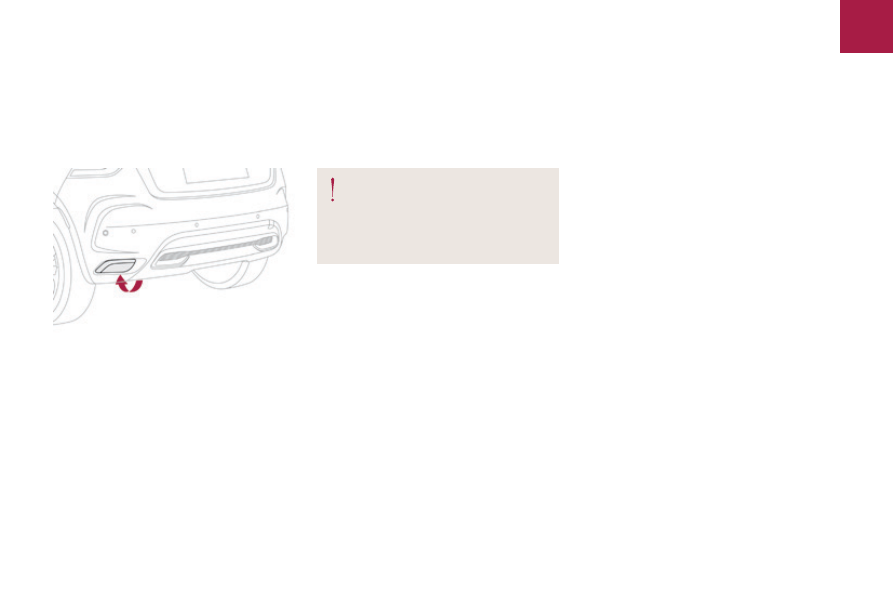
These bulbs are replaced from outside the rear 
bumper:
F

  pass your hand under the bumper,

F

  turn the bulb holder a quarter turn and 

remove it,

F

  turn the bulb a quarter turn, pull it out and 

fit a new bulb.

For reassembly, carry out these operations in 
reverse order.

Take care not to touch the silencer; 
there is a risk of burns if changing a 
bulb within a few minutes of switching 
off the ignition.

Changing foglamp bulbs

08

288

In the event of a breakdown

DS4_en_Chap08_en-cas-de-panne_ed01-2016

Changing a fuse

The extraction tweezer is fitted to the back of 
the dashboard fusebox cover.
For access to it:
F

  unclip the cover by pulling at the top right, 

then left,

F

  disengage the cover completely and turn it 

over,

Access to the tools

F

  remove the carrier on which the tweezer is 

fitted.

Before changing a fuse:
F

  the cause of the failure must be identified 

and rectified,

F

  all electrical consumers must be 

switched off,

F

  the vehicle must be immobilised with the 

ignition off,

F

  identify the failed fuse using the tables and 

layout drawings in the following pages.

Changing a fuse

Good

Failed

The replacement of a fuse not shown in 
the tables below may cause a serious 
malfunction of your vehicle. Contact 
a CITROËN dealer or a qualified 
workshop.

Tweezer

To replace a fuse, you must:
F

  use the special tweezer to extract the fuse 

from its housing and check the condition of 
its filament.

F

  always replace the failed fuse with a fuse 

of the same rating (same colour); using a 
different rating could cause faults (risk of 
fire).

If the fuse fails again soon after replacement, 
have the vehicle's electrical system checked by 
a CITROËN dealer or a qualified workshop.

08

289

In the event of a breakdown

DS4_en_Chap08_en-cas-de-panne_ed01-2016

Dashboard fuses

The fuseboxes are located in the lower 
dashboard (left-hand side).

F

  Unclip the cover by pulling the right-hand 

upper part, then left.

Installing electrical 

accessories

Your vehicle's electrical system is 
designed to operate with standard or 
optional equipment.
Before installing other electrical 
equipment or accessories on your 
vehicle, contact a CITROËN dealer or a 
qualified workshop.

CITROËN will not accept responsibility 
for the cost incurred in repairing your 
vehicle or for rectifying malfunctions 
resulting from the installation of 
accessories not supplied and not 
recommended by CITROËN and 
not installed in accordance with its 
instructions, in particular when the 
combined consumption of all of the 
additional equipment connected 
exceeds 10 milliamperes.

Access to the fuses

08

290

In the event of a breakdown

DS4_en_Chap08_en-cas-de-panne_ed01-2016

Fuse N°

Rating

Functions

F8

3 A

Alarm siren, alarm ECU.

F13

10 A

Cigarette lighter / Front 12 V socket.

F14

10 A

12 V socket in boot.

F16

3 A

Lighting for the large multifunctional storage unit, rear map 
reading lamps, glove box illumination.

F17

3 A

Sun visor illumination, front map reading lamps.

F28

15 A

Audio system, radio (after-market).

F30

20 A

Rear wiper.

F32

10 A

Hi-Fi amplifier.

Fusebox 2

Fuse N°

Rating

Functions

F36

15 A

Rear 12 V socket.

F37

-

Not used.

F38

-

Not used.

F39

-

Not used.

F40

25 A

230 V / 50 Hz socket.

Fuse tables

Fusebox 1

08

291

In the event of a breakdown

DS4_en_Chap08_en-cas-de-panne_ed01-2016

The fusebox is placed in the engine 
compartment near the battery (left-hand side).

Engine compartment fuses

Fuse N°

Rating

Functions

F19

30 A

Windscreen wipers slow / fast speed.

F20

15 A

Front and rear screenwash pump.

F21

20 A

Headlamp wash pump.

F22

15 A

Horn.

F23

15 A

Right-hand main beam headlamp.

F24

15 A

Left-hand main beam headlamp.

F27

5 A

Left-hand dipped headlamp.

F28

5 A

Right-hand dipped headlamp.

Fuse table

Access to the fuses

F

  Unclip the cover.

F

  Change the fuse.

F

  When you have finished, close the cover 

carefully to ensure correct sealing of the 
fusebox.

08

292

In the event of a breakdown

DS4_en_Chap08_en-cas-de-panne_ed01-2016

12 V battery

Access to the battery

Procedure for starting the engine using another battery or charging a discharged battery.

If your vehicle has an automatic 
gearbox, do not try to start the engine 
by pushing the vehicle.

General points

Lead-acid starter batteries

Batteries contain harmful substances 
such as sulphuric acid and lead.
They must be disposed of in 
accordance with regulations and must 
not, in any circumstances, be discarded 
with household waste.
Take used remote control batteries and 
vehicle batteries to a special collection 
point.

Protect your eyes and face before 
handling the battery.
All operations on the battery must be 
carried out in a well ventilated area and 
away from naked flames and sources 
of sparks, so as to avoid the risk of 
explosion or fire.
Wash your hands afterwards.

The battery is located under the bonnet.
For access to the (+) terminal:
F

  release the bonnet using the interior lever, 

then the exterior safety catch,

F

  raise the bonnet and secure it with its stay,

F  lift the plastic cover for access to 

the (+) terminal.

08

293

In the event of a breakdown

DS4_en_Chap08_en-cas-de-panne_ed01-2016

F

  Connect the red cable to the positive 

terminal (+) of the flat battery A (at the metal 
elbow) then to the positive terminal (+) of the 
slave battery B

 or the booster.

F

  Connect one end of the green or black 

cable to the negative terminal (-) of the 
slave battery B or the booster (or earth 
point on the other vehicle).

F

  Connect the other end of the green or black 

cable to the earth point C

 on the broken 

down vehicle.

F

  Start the engine of the vehicle with the 

good battery and leave it running for a 
few minutes.

F

  Operate the starter on the broken down 

vehicle and let the engine run.


If the engine does not start straight away, 
switch off the ignition and wait a few 
moments before trying again.

Starting using another battery

Never try to start the engine by 
connecting a battery charger.
Never use a 24 V or higher battery 
booster.
First check that the slave battery has a 
nominal voltage of 12 V and a capacity 
at least equal to that of the discharged 
battery.
The two vehicles must not be in contact 
with each other.
Switch off the electrical consumers on 
both vehicles (audio system, wipers, 
lighting, ...).
Ensure that the jump lead cables do 
not pass close to moving parts of the 
engine (cooling fan, belts, ...).
Do not disconnect the (+) terminal when 
the engine is running.

When your vehicle's battery is discharged, the 
engine can be started using a slave battery 
(external or on another vehicle) and jump lead 
cables or a battery booster.

F

  Wait until the engine returns to idle then 

disconnect the jump lead cables in the 
reverse order.

F

  Refit the plastic cover to the (+) terminal, if 

your vehicle has one.

F

  Allow the engine to run for at least 

30 minutes, by driving or with the vehicle 
stationary, so that the battery reaches an 
adequate state of charge.

Some functions, including Stop & Start, 
are not available if the battery is not 
sufficiently charged.

F

  Raise the plastic cover on the (+) terminal, 

if your vehicle has one.

08

294

In the event of a breakdown

DS4_en_Chap08_en-cas-de-panne_ed01-2016

If you envisage charging your vehicle's 
battery yourself, use only a charger 
compatible with lead-acid batteries of a 
nominal voltage of 12 V.

If this label is present, it is essential 
to use only a 12 V charger, to avoid 
causing irreversible damage to the 
electrical components related to the 
Stop & Start system.

Never try to charge a frozen battery.
If the battery has been frozen, have 
it checked by a CITROËN dealer or 
a qualified workshop, who will check 
that the internal components have not 
been damaged and the casing is not 
cracked, which could cause a leak of 
toxic and corrosive acid.

Charging the battery using a battery charger

For optimum service life of the battery, it is 
essential to maintain an adequate state of 
charge.
In some circumstances it may be necessary to 
charge the battery:

if you use your vehicle essentially for short 
journeys,

-  if the vehicle is to be taken off the road for 

several weeks.

Contact a CITROËN dealer or a qualified 
workshop.

It is not necessary to disconnect the 
battery.

Follow the instructions for use provided 
by the manufacturer of the charger.
Never reverse polarities.

F

  Switch off the ignition.

F

  Switch off all electrical consumers (audio 

system, lighting, wipers, ...).

F

  Switch off the charger B before connecting 

the cables to the battery, so as to avoid any 
dangerous sparks.

F

  Ensure that the charger cables are in good 

condition.

F  Raise the plastic cover, if your vehicle has 

one, on the (+) terminal.

F

  Connect the charger B cables as follows:

-  the positive (+) red cable to the (+) 

terminal of the battery A,

-  the negative (-) black cable to the earth 

point C

 on the vehicle.

F

  At the end of the charging operation, switch 

off the charger B before disconnecting the 
cables from the battery A.

08

295

In the event of a breakdown

DS4_en_Chap08_en-cas-de-panne_ed01-2016

In order to maintain an adequate state 
of charge for starting the engine, it is 
recommended that the battery be disconnected 
if the vehicle is taken out of service for a long 
period.
Before disconnecting the battery:
F

  close all openings (doors, boot, windows),

F

  switch off all electrical consumers (audio 

system, wipers, lighting, etc.),

F

  switch off the ignition and wait for 

four minutes.

At the battery, it is only necessary to 
disconnect the (+) terminal.

Disconnecting the battery

The Stop & Start system may not be 
operational during the trip following the 
first engine start.
In this case, the system will only be 
available again after a continuous 
period of immobilisation of the vehicle, 
a period which depends on the exterior 
temperature and the state of charge of 
the battery (up to about 8 hours).

F  Raise the lever A

 fully.

F

  Refit the open clamp B on the (+) terminal.

F

  Push the clamp B fully down.

F

  Lower the lever A to lock the clamp B.

Do not force the lever as locking 
will not be possible if the clamp is 
not positioned correctly; start the 
procedure again.

Following reconnection of the 

battery

After reconnecting the battery, switch on the 
ignition and wait 1 minute before starting to 
allow initialisation of the electronic systems.
However, if minor problems persist following 
this operation, contact a CITROËN dealer or a 
qualified workshop.
Referring to the corresponding section, you 
must yourself initialise or reset certain systems, 
such as:
-  the one-touch electric windows,
-  the date and time,
-  the settings of the audio system or of the 

satellite navigation system.

Quick-release terminal clamp

F  Raise the lever A

 fully to release the clamp B.

F

  Remove the clamp B by lifting it off.

Disconnecting the (+) terminal

Reconnecting the (+) terminal

08

296

In the event of a breakdown

DS4_en_Chap08_en-cas-de-panne_ed01-2016

Towing the vehicle

Procedure for having your vehicle towed or for towing another vehicle using a removable towing eye.

The towing eye is installed in the boot under 
the floor.
To gain access to it:
F  open the boot,

Access to the tools

General recommendations

Observe the legislation in force in your 
country.
Ensure that the weight of the towing 
vehicle is higher than that of the towed 
vehicle.
The driver must remain at the wheel 
of the towed vehicle and must have a 
valid driving licence.
When towing a vehicle with all four 
wheels on the ground, always use an 
approved towing arm; rope and straps 
are prohibited.
The towing vehicle must move off 
gently.
When towing a vehicle with the engine 
off, there is no longer any power 
assistance for braking or steering.

In the following cases, you must always call 
on a professional recovery service:
-  vehicle broken down on a motorway or 

fast road,

-  four-wheel drive vehicle,
-  when it is not possible to put the gearbox 

into neutral, unlock the steering, or 
release the parking brake,

-  towing with only two wheels on the 

ground,

-  where there is no approved towing arm 

available...

F  raise the floor,
F

  secure it by hooking its cord on the hook 

on the rear parcel shelf support,

F

  remove the towing eye from the holder.

08

297

In the event of a breakdown

DS4_en_Chap08_en-cas-de-panne_ed01-2016

F

  On the front bumper, unclip the cover by 

pressing on the left.

F

  Screw the towing eye in fully.

F

  Install the towing arm.

Towing your vehicle

Towing another vehicle

F

  Place the gear lever in neutral 

(position N

 on an automatic 

gearbox).


Failure to observe this instruction 
could result in damage to 
certain components (braking, 
transmission...) and the absence 
of braking assistance the next time 
the engine is started.

F

  Unlock the steering and release the 

parking brake.

F

  Switch on the hazard warning lamps on 

both vehicles.

F

  Move off gently, drive slowly and for a short 

distance.

F

  On the rear bumper, unclip the cover by 

pressing at the top.

F

  Screw the towing eye in fully.

F

  Install the towing arm.

F

  Switch on the hazard warning lamps on 

both vehicles.

F

  Move off gently, drive slowly and for a short 

distance.

08

298

In the event of a breakdown

DS4_en_Chap08_en-cas-de-panne_ed01-2016

Running out of fuel (Diesel)

On vehicles fitted with Diesel engines, the fuel 
system must be primed if you run out of fuel.
For all versions other than BlueHDi, refer to the 
corresponding engine compartment view.

Other HDi engines

(except BlueHDi version)

For more information on Diesel 
misfuel prevention
, refer to the 
corresponding section.

If the engine does not start first 
time, don't keep trying but start the 
procedure again from the beginning.

F

  Add at least five litres of Diesel fuel to the 

tank.

F

  Open the bonnet.

F

  If necessary, unclip the styling cover for 

access to the priming pump.

F

  Squeeze and release the priming 

pump repeatedly until resistance 
is felt (there may be resistance at 
the first press).

F

  Operate the starter to start the engine 

(if the engine does not start at the first 
attempt, wait around 15 seconds before 
trying again).

F

  If the engine does not start after a few 

attempts, operate the priming pump again 
then start the engine.

F

  Refit the styling cover and clip it in place.

F

  Close the bonnet.

BlueHDi engines

F

  Fill the fuel tank with at least five litres of 

Diesel.

F

  Switch on the ignition (without starting the 

engine).

F

  Wait around 6 seconds and switch off the 

ignition.

F

  Repeat the operation 10 times.

F

  Operate the starter to run the engine.

08

299

In the event of a breakdown

DS4_en_Chap08_en-cas-de-panne_ed01-2016

DS4_en_Chap09_caracteristiques_ed01-2016

TECHNICAL DATA

09

DS4_en_Chap09_caracteristiques_ed01-2016

09

302

Technical data

DS4_en_Chap09_caracteristiques_ed01-2016

Engines

Engine characteristics

The engine characteristics (capacity, maximum 
power, maximum engine speed, fuel, CO

2


emissions, etc.) for your vehicle are given in 
the registration document, as well as in sales 
brochures.
These characteristics correspond to the 
values type-approved on a test bed, under 
conditions defined in European legislation 
(Directive 1999/99/EC).
For more information, contact a CITROËN 
dealer or a qualified workshop.

Weights

Weights and towed loads

The maximum weights and towed loads for your 
vehicle are given are given in the registration 
document, as well as in sales brochures.
These values are also present on the 
manufacturer's plate or label.
For more information, contact a CITROËN 
dealer or a qualified workshop.

The kerb weight is equal to the unladen 
weight + driver (75 kg).
The GTW and towed load values indicated 
apply up to a maximum altitude of 
1 000 metres; the towed load mentioned 
must be reduced by 10 % for every additional 
1 000 metres.
The weight of the braked trailer can be 
increased, within the GTW limit, on condition 
that the GVW of the towing vehicle is reduced 
by the same amount.
The recommended nose weight is the vertical 
load on the towbar ball (removable with or 
without tools).
GVW:

  gross vehicle weight, the maximum 

authorised vehicle weight.

GTW:

  gross train weight, the maximum 

authorised weight of vehicle plus trailer.

High exterior temperatures may result 
in a reduction in the performance of 
the vehicle to protect the engine; when 
the exterior temperature is higher than 
37 °C, limit the towed weight.

If the exterior temperature is high, it 
is recommended that the engine be 
allowed to idle for 1 to 2 minutes after 
the vehicle comes to a stop, to facilitate 
its cooling.

Towing with a lightly loaded vehicle can 
adversely affect roadholding.
Braking distances are increased when 
towing a trailer.
Never exceed 60 mph (100 km/h) when 
towing (comply with the legislation in 
force in your country).


Content   ..  17  18  19  20   ..