Citroen C4 (2016 year). Manual - part 13
 

  Index      Citroen     Citroen C4 - service manual 2016 year in english


Search            


Content   ..  11  12  13  14   ..


Citroen C4 (2016 year). Manual - part 13


6

Driving

191

C4-2_en_Chap06_conduite_ed02-2015

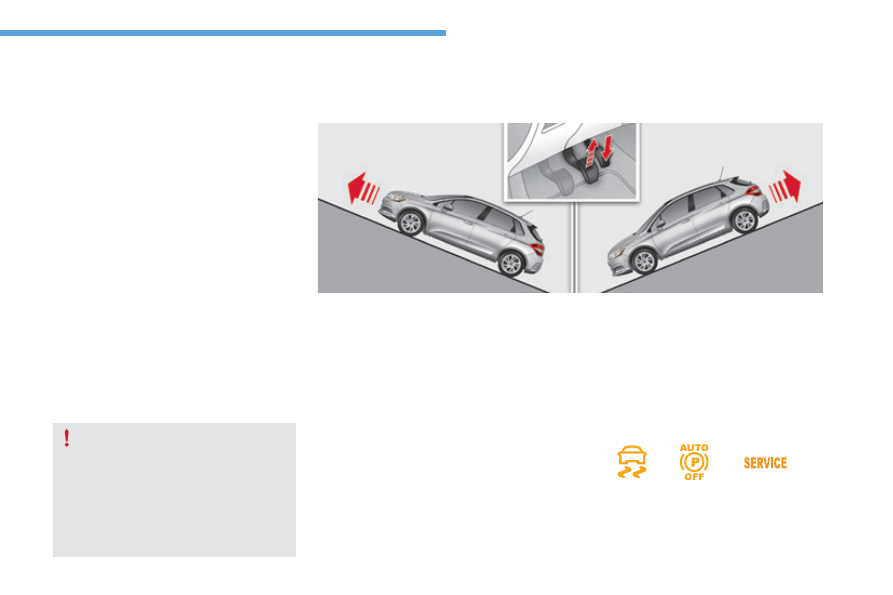
Hill start assist

On an ascending slope, with the vehicle 
stationary, the vehicle is held for a brief 
moment when you release the brake pedal:
-  if you are in first gear or neutral with a 

manual gearbox,

if you are in position D or M with an 
automatic gearbox.

Operation

On a descending slope, with the vehicle 
stationary and reverse gear engaged, the 
vehicle is held for a brief moment when you 
release the brake pedal.

Operating fault

If a fault occurs with the system, these warning 
lamps come on. Contact a CITROËN dealer 
or a qualified workshop to have the system 
checked.

System which keeps your vehicle immobilised 
temporarily (approximately 2 seconds) when 
starting on a gradient, the time it takes to 
move your foot from the brake pedal to the 
accelerator pedal.

This function is only active when:
-  the vehicle is completely stationary, with 

your foot on the brake pedal,

-  when certain conditions of gradient are 

met,

-  with the driver’s door closed.
The hill start assist function cannot be 
deactivated.

Do not leave the vehicle while it is being 
held in the hill start assist phase.
If you need to leave the vehicle while 
the engine is running, apply the parking 
brake manually then ensure that the 
parking brake warning lamp is on (not 
flashing) in the instrument panel.

Driving

192

C4-2_en_Chap06_conduite_ed02-2015

Tyre under-inflation detection

System which automatically checks the 
pressures of the tyres while driving.
The system continuously monitors the 
pressures of the four tyres, as soon as the 
vehicle is moving.
A pressure sensor is located in the valve of 
each tyre (except the spare wheel).
The system triggers an alert if a drop in 
pressure is detected in one or more tyres.

The tyre under-inflation detection system is an 
aid to driving which does not replace the need 
for vigilance on the part of the driver.

This system does not avoid the need 
to check the tyre pressures regularly 
(including the spare wheel) and before 
a long journey.
Driving with under-inflated tyres 
adversely affects road holding, 
extends braking distances and causes 
premature tyre wear, particularly under 
arduous conditions (vehicle loaded, 
high speed, long journey).

The tyre pressures for your vehicle can 
be found on the tyre pressure label.
The tyre pressures must be checked 
when the tyres cold (vehicle stopped 
for 1 hour or after driving for less then 
6 miles (10 km) at moderate speed). 
Otherwise, add 0.3 bar to the values 
indicated on the label.
For more information on identification 
markings, including the tyre pressure 
label, refer to the corresponding 
section.

Driving with under-inflated tyres 
increases fuel consumption.

6

Driving

193

C4-2_en_Chap06_conduite_ed02-2015

The flashing and then fixed 
illumination of the under-inflation 
warning lamp accompanied by the 
illumination of the service warning 
lamp indicates a fault with the system.

Operating fault

The alert is given by the fixed 
illumination of this warning lamp, 
accompanied by an audible signal, 
and depending on equipment, the 
display of a message.

Under-inflation alert

In the event of a problem on one of the tyres, 
the symbol or the message appears, according 
to equipment, to identify it.

F

  Reduce speed, avoid sudden steering 

movements or harsh brake applications.

F

  Stop as soon as it is safe to do so.

In this case, monitoring of the tyre pressures is 
not assured.

F

  If you have a compressor (the one in the 

temporary puncture repair kit for example), 
check the four tyre pressures when cold.


If it is not possible to check the tyre 
pressures at the time, drive carefully at 
reduced speed.

 or
F  In the event of a puncture, use the 

temporary puncture repair kit or the spare 
wheel (according to equipment).

Go to a CITROËN dealer or a qualified 
workshop to have the system checked or, 
following the repair of a puncture, to have the 
original wheel, equipped with a sensor, refitted.
Any tyre repair or replacement on a wheel 
fitted with this system must be carried out by a 
CITROËN dealer or a qualified workshop.
If after changing a tyre, a wheel is not detected 
by your vehicle (fitting snow tyres for example), 
you must have the system reinitialised by a 
CITROËN dealer or a qualified workshop.

The loss of pressure detected does not 
always lead to visible deformation of 
the tyre.
Do not rely on just a visual check.

This alert is also displayed when one or 
more wheels is not fitted with a sensor 
(for example, a space-saver or steel 
spare wheel).

The alert is maintained until the tyre or 
tyres concerned is reinflated, repaired 
or replaced.
The spare wheel (space-saver type or a 
steel rim) does not have a sensor.

Driving

194

C4-2_en_Chap06_conduite_ed02-2015

Lane departure warning system

Activation

Deactivation

Detection

Operating fault

System which detects the involuntary crossing 
of longitudinal traffic lane markings on the 
ground (solid or broken line).
Sensors, fitted below the front bumper, trigger 
a warning if the vehicle drifts over a lane 
marking (speed higher than 50 mph (80 km/h)).
This system is particularly useful on motorways 
and main roads.

In the event of a malfunction, the 
service warning lamp comes on, 
accompanied by an audible signal 
and a message in the screen.

Contact a CITROËN dealer or a qualified 
workshop.

The lane departure warning system 
cannot in any circumstances replace 
the need for vigilance on the part of the 
driver.
It is necessary to observe driving 
regulations and take a break every 
two hours.

The detection may be impeded:
-  if the sensors are dirty (mud, snow...),
-  if the markings on the ground are 

worn,

if there is little contrast between the 
markings on the ground and the 
road surface.

You are warned by the vibration of the driver's 
seat cushion:
-  on the right-hand side, if the marking on 

the ground has been crossed on the right,

-  on the left-hand side, if the marking on the 

ground has been crossed on the left.

No warning is transmitted while the direction 
indicator is active and for approximately 
20 seconds after the direction indicator is 
switched off.
A warning may be transmitted if a direction 
marking (e.g. arrow) or non-standard marking 
(e.g. graffiti) is crossed.

F

  When switching the ignition on or with 

the engine running, press this button; the 
indicator lamp comes on.

F

  Press this button again, the indicator lamp 

goes off.

The status of the system remains in the 
memory when the ignition is switched off.

6

Driving

195

C4-2_en_Chap06_conduite_ed02-2015

Blind spot sensors

This driving assistance system warns the driver 
of the presence of another vehicle in the blind 
spot angle of their vehicle (areas masked from 
the driver's field of vision), as soon as this 
presents a potential danger.

Operation

F

  On switching on the ignition, or engine 

running, press this button to activate the 
function; the warning lamp comes on.

Sensors fitted in the front and rear bumpers 
monitor the blind spots.

A warning lamp appears in the door mirror on 
the side in question:
-  immediately, when being overtaken,

after a delay of about one second, when 
overtaking a vehicle slowly.

This system is designed to improve 
safety when driving and is in no 
circumstances a substitute for the use 
of the interior rear view mirror and door 
mirrors. It is the driver's responsibility to 
constantly check the traffic, to assess 
the distances and relative speeds 
of other vehicles and to predict their 
movements before deciding whether to 
change lane.
The blind spot sensor system can never 
replace the need for vigilance on the 
part of the driver.

Driving

196

C4-2_en_Chap06_conduite_ed02-2015

No alert will be given in the following situations:
-  in the presence of immobile objects 

(parked vehicles, barriers, street lamps, 
road signs...),

-  with vehicles moving in the opposite 

direction,

-  driving on a sinuous road or a sharp 

corner,

The alert is given by a warning lamp which 
comes on in the door mirror on the side in 
question as soon as a vehicle - car, lorry,  
cycle - is detected.
For this, the following conditions must be met:
-  all the vehicles must be moving in the 

same direction,

-  the speed of your vehicle is between 7 and 

75 mph (12 and 140 km/h),

-  when you overtake a vehicle with a speed 

difference of less than 6 mph (10 km/h),

-  when a vehicle overtakes you with a speed 

difference of less than 15 mph (25 km/h),

-  the traffic must be flowing normally,
-  in the case of an overtaking manoeuvre, 

if this is prolonged and the vehicle being 
overtaken remains in the blind spot,

-  you are driving on a straight or slightly 

curved road,

-  your vehicle is not pulling a trailer, a 

caravan...

-  when overtaking (or being overtaken by) a 

very long vehicle (lorry, coach...) which is 
at the same time detected at the rear in the 
blind spot angle and present in the driver's 
forward field of vision,

-  in very heavy traffic: vehicles detected in 

front and behind are confused with a lorry 
or a stationary object,

-  when overtaking quickly.

6

Driving

197

C4-2_en_Chap06_conduite_ed02-2015

F

  To deactivate the system, press this button 

again; the warning lamp goes off.

The state of the system remains in memory on 
switching off the ignition.

Operating fault

The system is automatically deactivated 
when towing with a towbar approved by 
CITROËN.

The system may suffer temporary 
interference in certain weather 
conditions (rain, hail...).
In particular, driving on a wet surface 
or moving from a dry area to a wet area 
can cause false alerts (for example, the 
presence of a fog of water droplets in 
the blind spot angle is interpreted as a 
vehicle).
In bad or wintry weather, ensure that 
the sensors are not covered by mud, ice 
or snow.
Take care not to cover the warning zone 
in the door mirrors or the detection 
zones on the front and rear bumpers 
with adhesive labels or other objects; 
they may hamper the correct operation 
of the system.

In the event of a fault, the warning lamp in the 
button flashes then goes off.
Have it checked by a CITROËN dealer or a 
qualified workshop.

Driving

198

C4-2_en_Chap06_conduite_ed02-2015

6.

  Speed limiter on / pause indication.

7.

  Speed limiter mode selection indication.

8.

  Programmed speed value.

9.

  Selection of a memorised speed setting.

Displays in the instrument panel

Speed limiter

1.

  Speed limiter mode selection wheel.

2.

  Programmed value decrease button.

3.

  Programmed value increase button.

4.

  Speed limiter on / pause button.

5.

  Display memorised speed settings button.

Steering mounted controls

System which prevents the vehicle from exceeding the speed programmed by the driver.

The speed limiter is switched on manually.
The minimum programmed speed is 
20 mph (30 km/h).
The programmed speed remains in the 
system memory when the ignition is 
switched off.

The speed limiter is a driving aid that 
cannot, in any circumstances, replace the 
need to observe speed limits or the need 
for vigilance on the part of the driver.

6

Driving

199

C4-2_en_Chap06_conduite_ed02-2015

Switching on

F

  If the speed setting is suitable (last speed 

setting programmed in the system) press 
button 4

 to switch the speed limiter on.

F  Turn the wheel 1 to the "LIMIT" position 

to select the speed limiter; the function is 
paused.

F

  Pressing button 4 temporarily interrupts the 

function (pause).

Adjusting the limit speed 
setting

You do not have to switch the speed limiter on 
in order to set the speed.

To modify the limit speed setting from the 
current speed of the vehicle:
F

  in steps of +/- 1 mph (km/h), make 

successive short presses on button 2 or 3,

F

  continuously, in steps of +/- 5 mph (km/h), 

press and hold button 2 or 3

.

To modify the limit speed setting using 
memorised speeds and from the touch screen 
tablet:
F  press button 5

 to display the six memorised 

speed settings,

F  press the button for the desired speed 

setting.

This setting becomes the new limit speed.

To modify the limit speed setting using 
memorised speeds and from your Audio system 
(only with the monochrome screen C):
F

  with the system first activated.

For more information on memorising speeds, 
refer to the corresponding section.
F

  make a long press on button 2 or 3, the 

system displays the memorised speed 
closest to the actual speed of the vehicle; 
this setting becomes the new limit speed.

F

  to choose another memorised speed, make 

another long press on button 2 or 3.

Driving

200

C4-2_en_Chap06_conduite_ed02-2015

On a steep descent or in the event of 
sharp acceleration, the speed limiter 
will not be able to prevent the vehicle 
from exceeding the programmed speed.

The use of mats not approved by 
CITROËN may interfere with the 
operation of the speed limiter.
To avoid any risk of jamming of the 
pedals:
-  ensure that the mat is positioned 

correctly,

-  do not fit one mat on top of another.

Temporarily exceeding the 
programmed speed

F

  If you want to temporarily exceed the 

programmed limit speed, press firmly on 
the accelerator pedal, going beyond the 
point of resistance

.

The speed limiter is deactivated temporarily 
and the displayed programmed speed flashes.

Switching off

When the limit speed is exceeded but is not 
due to action by the driver, there is an audible 
signal to complete the alert.
Once the speed of the vehicle returns to 
the programmed setting, the speed limiter 
functions again: the display of the programmed 
speed setting becomes steady again.

F  Turn wheel 1 to the "0"

 position: the 

display of information on the speed limiter 
disappears.

Operating fault

Flashing dashes indicate a fault with the speed 
limiter.
Have it checked by a CITROËN dealer or a 
qualified workshop.

6

Driving

201

C4-2_en_Chap06_conduite_ed02-2015

Cruise control

1.

  Cruise control mode selection wheel.

2.

  Button for setting the current speed of the 

vehicle as the cruise setting or lowering the 
cruise setting.

3.

  Button for setting the current speed of the 

vehicle as the cruise setting or raising the 
cruise setting.

4.

  Cruise control pause / resume button.

5.

  Display memorised speed settings button.

Steering mounted controls

6.

  Cruise control pause / resume indication.

7.

  Cruise control mode selected indication.

8.

  Cruise speed setting.

9.

  Selecting a memorised cruise speed.

Displays in the instrument panel

The operation of the cruise control can be 
interrupted (pause):
-  by pressing control 4 or by pressing the 

brake or clutch pedal,

-  automatically, if operation of the dynamic 

stability control system is triggered.

Switching off the ignition cancels any 
programmed speed setting.

The cruise control is switched on 
manually.
It requires a minimum vehicle speed of 
25 mph (40 km/h) as well as:
-  with a manual gearbox, the 

engagement of fourth gear or 
higher,

-  with an automatic gearbox, the gear 

selector at position D or second 
gear or higher in manual mode.

System which automatically maintains the cruising speed of the vehicle at a setting programmed by 
the driver, without any action on the accelerator pedal.

The cruise control system is a driving aid 
that cannot, in any circumstances, replace 
the need to observe speed limits, nor the 
need for vigilance on the part of the driver.

As a safety measure, you are advised 
to keep your feet near the pedals at all 
times.

Driving

202

C4-2_en_Chap06_conduite_ed02-2015

Switching on

F  To start the cruise control and set a cruise 

speed, once the vehicle has reached the 
desired speed, press button 2 or 3

: the 

current speed of your vehicle becomes the 
cruise speed setting.


You can release the accelerator pedal.

F  Turn the wheel 1 to the "CRUISE" position 

to select cruise control mode; the function 
is paused.

F

  Pressing button 4 interrupts operation of 

the system (pause).

Take care: pressing and holding 
button 2 or 3

 results in a rapid change 

in the speed of your vehicle.

F

  Pressing button 4 again restores operation 

of the cruise control (ON).

As a precaution, it is recommended 
that the cruise speed chosen be close 
to the current speed of your vehicle, so 
as to avoid any sudden acceleration or 
deceleration of the vehicle.

Adjusting the cruise speed 
setting

The cruise control must be activated.

To modify the cruise speed setting from the 
current speed of the vehicle:
F

  in steps of + or - 1 mph (km/h), make 

repeated short presses on button 2 or 3,

F

  continuously, in steps of + or - 5 mph 

(km/h), press and hold button 2 or 3.

To modify the cruise speed setting using 
memorised speeds and from the touch screen 
tablet:
F  press button 5

 to display the six memorised 

speed settings,

F  press the button for the desired speed 

setting.

This setting becomes the new cruise speed.

To modify the cruise speed setting using 
memorised speeds and from your Audio system 
(only with the monochrome screen C):
F

  with the system first activated.

For more information on memorising speeds, 
refer to the corresponding section.
F

  make a long press on button 2 or 3, the 

system displays the memorised speed 
closest to the actual speed of the vehicle; 
this setting becomes the new cruise speed.

F

  to choose another memorised speed, make 

another long press on button 2 or 3.

6

Driving

203

C4-2_en_Chap06_conduite_ed02-2015

Temporarily exceeding the 
programmed speed

When descending a steep hill, the 
cruise control system cannot prevent 
the vehicle from exceeding the 
programmed speed.

When required (overtaking manoeuvre...), it is 
possible to exceed the programmed speed by 
pressing the accelerator pedal.
The cruise control is temporarily overridden 
and the programmed speed setting flashes.

Only use the cruise control if the traffic 
conditions will allow you to drive for a 
certain time at a steady speed and at a 
safe distance from the vehicle ahead.
Do not activate the cruise control in 
urban areas, in heavy traffic, on winding 
or steep roads, on slippery or flooded 
roads, or in conditions of poor visibility 
(heavy rain, fog, falling snow...).
In some circumstances, it may not 
be possible to maintain or reach the 
programmed speed: towing, vehicle 
heavily loaded, steep climb.

The use of mats not approved by 
CITROËN may interfere with the 
operation of the cruise control.
To avoid any risk of jamming of the 
pedals:
-  ensure that the mat is positioned 

correctly,

-  never fit one mat on top of another.

To return to the programmed speed, simply 
release the accelerator pedal.
Once the vehicle has returned to the 
programmed speed, the cruise control takes 
over again: the display of the programmed 
speed setting becomes steady again.

You may have to brake to control the speed of 
your vehicle. In this case, the cruise control is 
automatically paused.
To activate the system again, press button 4.

Switching off

F  Turn wheel 1 to the "0"

 position: the cruise 

control information disappears from the 
screen.

Operating fault

Flashing dashes indicate a fault with the cruise 
control system.
Have it checked by a CITROËN dealer or a 
qualified workshop.

Driving

204

C4-2_en_Chap06_conduite_ed02-2015

Memorising speeds

"MEM" button

F  Press this button to display the list of 

memorised speed settings.

As a safety measure, the driver must 
only modify a speed setting when 
stationary.

This function allows speed settings to be registered which will then be offered as settings for two systems: the speed limiter (a maximum speed) and 
the cruise control (cruising speed).
You can memorise up to six speed settings in the system, depending on version. By default, some speed settings are already memorised.

Activating the function
Modifying a speed setting

With your Audio system

F

  Go to the main menu by pressing the 

"MENU"

 button.

F

  Select the"Personalisation-configuration" 

menu and confirm.

F

  Select "Vehicle parameters" menu and 

confirm.

F

  Select the "Driving assistance" line and 

conform.

F

  Select "Speeds memorised" line and 

confirm.

F

  Select "Activation" to activate the function.

F

  Select the speed setting to be modified and 

confirm.

F

  Modify the speed setting.

F  Select "OK

" and confirm to save the 

modifications.

6

Driving

205

C4-2_en_Chap06_conduite_ed02-2015

Modifying a speed setting

F  Press this button to select the 

"Driving

" menu.

F

  In the secondary page, press 

"Speed settings

".

F

  Select the system for which you want to 

memorise new speed settings:

●  speed limiter

or

●  cruise control.

F

  Choose the speed setting to be modified.

"MEM" button

Press this button to select a speed settings for 
use by the speed limiter or cruise control.
Refer to the corresponding section.

With the touch screen 
tablet

F

  Enter the new value using the numerical 

keypad and confirm.

F

  Confirm to save the modification and quit 

the menu.

Driving

206

C4-2_en_Chap06_conduite_ed02-2015

Parking sensors

The system is switched on by engaging reverse 
gear.
This is confirmed by an audible signal.
The system is switched off when you come out 
of reverse gear.

Rear parking sensors

Audible assistance

The proximity information is given by an 
intermittent audible signal, the frequency of which 
increases as the vehicle approaches the obstacle.
The sound emitted by the speaker (right or left) 
indicates the side on which the obstacle is located.
When the distance between the vehicle and 
the obstacle becomes less than approximately 
thirty centimetres, the audible signal becomes 
continuous.

Visual assistance

This supplements the audible signal by 
displaying bars in the screen which move 
progressively nearer to the vehicle.
When the obstacle is very close, the "Danger" 
symbol is displayed in the screen.

This system cannot in any circumstances replace 
the need for vigilance on the part of the driver.

This system indicates the proximity of an 
obstacle (person, vehicle, tree, gate, etc.) 
which comes within the field of detection of 
sensors located in the bumper.
Certain types of obstacle (stake, roadworks 
cone, etc.) detected initially will no longer be 
detected at the end of the manoeuvre, if they 
are located in blind spots in the sensors' field 
of detection.


Content   ..  11  12  13  14   ..