Citroen C4 Picasso (2017 year). Manual - part 18
 

  Index      Citroen     Citroen C4 Picasso - service manual 2017 year in english


Search            


Content   ..  16  17  18  19   ..


Citroen C4 Picasso (2017 year). Manual - part 18


271

7

Practical information

C4-Picasso-II_en_Chap07_info-pratiques_ed02-2016

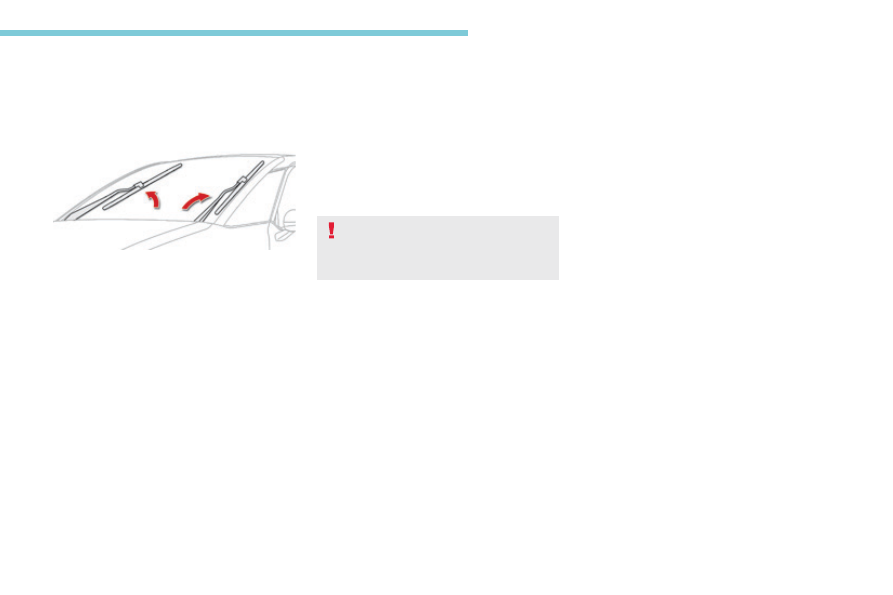
Changing a wiper blade

F

  Within one minute after switching off 

the ignition, operate the wiper stalk to 
position the wiper blades vertically on the 
windscreen,

 or
F

  From one minute after switching off the 

ignition, reposition the arms manually.

Removing

F

  Raise the corresponding wiper arm.

F

  Unclip the wiper blade and remove it.

Fitting

F

  Put the corresponding new wiper blade in 

place and clip it.

F

  Fold down the wiper arm carefully.

After fitting a front wiper 
blade

F

  Switch on the ignition.

F

  Operate the wiper stalk again to park the 

wiper blades.

Replacement of the arms must be done 
by a CITROËN dealer or a qualified 
workshop.

Before removing a front 
wiper blade

272

Practical information

C4-Picasso-II_en_Chap07_info-pratiques_ed02-2016

Roof bars

For safety reasons and to avoid damaging the 
roof, it is essential to use transverse roof bars 
that are approved for your vehicle.

Observe the fitting instructions and the 
conditions of use given in the information 
provided with the roof bars.

Version with 
longitudinal bars

To install the roof bars, you must secure 
them only to the four anchorage points in the 
roof frame. These points are masked by the 
vehicle's doors when closed.
The roof bar fixings include a stud that should 
be introduced into the aperture at each 
anchorage point.

Version without longitudinal 
bars

You must fit the transverse bars to the 
longitudinal bars at the fixing points indicated 
by engraved markings on the longitudinal bars.

Recommendations

F

  Distribute the load evenly, avoiding 

overloading on one side.

F

  Arrange the heaviest part of the load as 

close as possible to the roof.

F

  Anchor the load securely and fit a warning 

flag if part of it overhangs the vehicle.

F

  Drive gently, as the vehicle will be more 

liable to the effects of side winds (vehicle 

stability may be affected).

F

  Remove the roof bars as soon as they are 

no longer needed.

Maximum load, distributed over the roof 
bars, for a loading height not exceeding 
40 cm: 80 kg.
This value is subject to change, please 
check the maximum load stated in the 
instructions provided with he roof bars.
If the height exceeds 40 cm, adapt the 
speed of the vehicle to the profile of the 
road to avoid damaging the roof bars 
and the fixings on the vehicle.
Please refer to national legislation so as 
to meet the requirements on carrying 
objects that are longer than the vehicle.

When carrying long objects, it is 
recommended that you deactivate the 
motorised operation of the tailgate.

273

7

Practical information

C4-Picasso-II_en_Chap07_info-pratiques_ed02-2016

TOTAL & CITROËN

Partners in performance and 
protecting the environment

Innovation in the search for 
performance

For over 40 year, the TOTAL Research and 
Development departments have developed lubricants 
for CITROËN, to match the latest technical innovations 
on CITROËN vehicles, both for competition and for 
everyday motoring.
For you, this is an assurance that you will obtain the 
best performance from your engine.

Optimum protection for 
your engine

By having your CITROËN vehicle 
serviced with TOTAL lubricants, you are 
contributing towards improving the life 
and performance of your engine, while 
also protecting the environment.

274

Practical information

C4-Picasso-II_en_Chap07_info-pratiques_ed02-2016

Bonnet

F

  Open the left hand front door.

F

  Lift the safety catch and raise the bonnet.

F

  Unclip the stay from its housing and place 

it in the support slot to hold the bonnet 
open.

Opening

F

  Pull the release lever, located at the bottom 

of the door aperture, towards you.

Before doing anything under the 
bonnet, switch off the Stop & Start 
system to avoid any risk of injury 
resulting from an automatic change to 
START mode.

The cooling fan may start after switching off the engine: take care with articles and 
clothing that might be caught by the fan blades.

Do not open the bonnet under very 
windy conditions.

The location of the interior bonnet 
release lever prevents opening of the 
bonnet when the left hand front door 
is shut.
When the engine is hot, handle the 
exterior safety catch and the stay with 
care (risk of burns), using the protected 
area.
When the bonnet is open, take care not 
to damage the safety catch.

Because of the presence of electrical equipment under the bonnet, it is recommended that 
exposure to water (rain, washing, ...) be limited.

Closing

F

  Take the stay out of its support slot.

F

  Clip the stay back into its housing.

F

  Lower the bonnet and release it at the end 

of its travel.

F

  Pull on the bonnet to check that it has 

latched correctly.

275

7

Practical information

C4-Picasso-II_en_Chap07_info-pratiques_ed02-2016

1.

  Screenwash and headlamp wash reservoir.

2.

  Coolant reservoir.

3.

  Brake fluid reservoir.

4.

  Battery / Fuses.

5.

  Fusebox.

6.

  Air filter.

7.

  Engine oil dipstick.

8.

  Engine oil filler cap.

9.

  Remote earth point.

Petrol engines

276

Practical information

C4-Picasso-II_en_Chap07_info-pratiques_ed02-2016

1.

  Screenwash and headlamp wash reservoir.

2.

  Coolant reservoir.

3.

  Brake fluid reservoir.

4.

  Battery / Fuses.

5.

  Fusebox.

6.

  Air filter.

7.

  Engine oil dipstick.

8.

  Engine oil filler cap.

9.

  Priming pump*.

10.

  Remote earth point.

Diesel engines

* According to engine.

277

7

Practical information

C4-Picasso-II_en_Chap07_info-pratiques_ed02-2016

Checking levels

Take care when working under the bonnet, as certain areas of the engine may be extremely hot (risk of burns) and the cooling fan could start at 
any time (even with the ignition off).

Engine oil level

The check is carried out either when 
the ignition is switched on using the 
oil level indicator in the instrument 
panel for vehicles so equipped, or 
using the dipstick.

Checking using the dipstick

The location of the dipstick is shown in the 
corresponding underbonnet layout view.
F

  Take the dipstick by its coloured grip and 

remove it completely.

F

  Wipe the end of the dipstick using a clean 

non-fluffy cloth.

F

  Refit the dipstick and push fully down, then 

pull it out again to make the visual check: 
the correct level is between the marks A 
and B.

It is normal to top-up the oil level between 
two services (or oil changes). CITROËN 
recommends that you check the level,  
and top-up if necessary, every 3 000 miles  
(5 000 kms).

Check all of these levels regularly, in line with the manufacturer's service schedule. Top them up if necessary, unless otherwise indicated.
If a level drops significantly, have the corresponding system checked by a CITROËN dealer or a qualified workshop.

To ensure that the reading is correct, 
your vehicle must be parked on a level 
surface with the engine having been off 
for more than 30 minutes.

A = MAX

B = MIN

If you find that the level is above the A mark or 
below the B

 mark, do not start the engine.

If the level is above the MAX

 mark (risk 

of damage to the engine), contact a 
CITROËN dealer or a qualified workshop.

If the level is below the MIN

 mark, you 

must top-up the engine oil.

278

Practical information

C4-Picasso-II_en_Chap07_info-pratiques_ed02-2016

The brake fluid level should be close 
to the "MAX" mark. If it is not, check 
the brake pad wear.

Brake fluid level

Changing the fluid

Refer to the manufacturer's service schedule 
for details of the interval for this operation.

Fluid specification

The brake fluid must conform to the 
manufacturer's recommendations.

Topping-up the engine oil level

The location of the oil filler cap is shown in the 
corresponding underbonnet layout view.
F  Unscrew the oil filler cap to reveal the filler 

aperture.

F

  Add oil in small quantities, avoiding any 

spills on engine components (risk of fire).

F

  Wait a few minutes before checking the 

level again using the dipstick.

F

  Add more oil if necessary.

F

  After checking the level, carefully refit the 

oil filler cap and the dipstick in its tube.

Engine oil change

Refer to the manufacturer's service schedule 
for details of the interval for this operation.
In order to maintain the reliability of the engine 
and emission control system, never use 
additives in the engine oil.

After topping-up the oil, the check when 
switching on the ignition with the oil 
level indicator in the instrument panel 
is not valid during the 30 minutes after 
topping-up.

Oil grade

Before topping-up the oil or changing the oil, 
check that the oil is the correct grade for your 
engine and conforms to the manufacturer's 
recommendations.

reservoir low level is reached this warning lamp 
comes on in the instrument panel, accompanied 
by an audible signal and a message.
The warning lamp comes on when the ignition is 
switched on, or every time the stalk is operated, 
until the reservoir is refilled.
Next time you stop, refill the screenwash / 
headlamp wash reservoir.

Screenwash/headlamp 
wash level low

In the case of vehicles fitted with 
headlamp washers, when the fluid 

279

7

Practical information

C4-Picasso-II_en_Chap07_info-pratiques_ed02-2016

Coolant level

Check the coolant level regularly.

The check and top-up must only be done with 
the engine cold.
A low coolant level presents a risk of serious 
damage to your engine.
The coolant level should be close to the "MAX" 
mark but should never exceed it.
If the level is close to or below the "MIN" mark, 
it is essential to top-up.

When the engine is hot, the temperature of the 
coolant is regulated by the fan.
In addition, as the cooling system is pressurised, 
wait at least one hour after switching off the 
engine before carrying out any work.
To avoid the risk of scalding in the event of 
an urgent need to top-up, with a cloth around 
the cap, unscrew it by two turns to allow the 
pressure to drop. When the pressure has 
dropped, remove the cap and top-up the level.
Once the pressure has dropped, remove the cap 
and top-up the level.

The cooling fan may start after switching 
off the engine: take care with articles and 
clothing that might be caught by the fan 
blades.

It is normal to top-up this fluid between 
services.

Fluid specification

The coolant must conform to the 
manufacturer's recommendations.

Topping-up

The reservoir must be topped-up without delay 
by a CITROËN dealer or a qualified workshop.

Diesel fuel additive level 
(Diesel with particle filter)

The additive reservoir low level is 
indicated by fixed illumination of this 

Avoid prolonged contact of used oil or 
fluids with the skin.
Most of these fluids are harmful to 
health or indeed very corrosive.

Do not discard used oil or fluids into 
sewers or onto the ground.
Take used oil to a CITROËN dealer or 
a qualified workshop (France) or to an 
authorised waste disposal site.

Used products

warning lamp, accompanied by an audible 
signal and a message that the particle filter 
additive level is too low.

280

Practical information

C4-Picasso-II_en_Chap07_info-pratiques_ed02-2016

Checks

12 V battery

The battery does not require any 
maintenance.
However, check that the terminals 
are clean and correctly tightened, 
particularly in summer and winter.

Refer to the manufacturer's 
service schedule for details of the 
replacement intervals for these 
components.

Air filter and passenger compartment filter

Replace the oil filter each time the 
engine oil is changed.
Refer to the manufacturer's 
service schedule for details of 
the replacement interval for this 
component.

Oil filter

The presence of this label, in particular 
with the Stop & Start system, indicates 

the use of a specific 12 V lead-acid 

battery with special technology and 

specification. 

The involvement of a CITROËN dealer 

or a qualified workshop is essential when 

replacing or disconnecting the battery.

Unless otherwise indicated, check these components in accordance with the manufacturer's service schedule and according to your engine.
Otherwise, have them checked by a CITROËN dealer or a qualified workshop.

Depending on the environment (e.g. dusty 
atmosphere) and the use of the vehicle 
(e.g. city driving), replace them twice as often 
if necessary

.

A clogged passenger compartment filter may 
have an adverse effect on the performance 
of the air conditioning system and generate 
undesirable odours.

Particle filter (Diesel)

The start of saturation of the particle 
filter is indicated by the fixed 
illumination of this warning lamp 
accompanied by a warning message.

As soon as the traffic conditions permit, 
regenerate the filter by driving at a 
speed of at least 40 mph (60 km/h) until 
the warning lamp goes off.
If the warning lamp stays on, this 
indicates a low additive level.
For more information on Checking 
levels

 and the Diesel additive level in 

particular, refer to the corresponding 
section.
On a new vehicle, the first particle 
filter regeneration operations may be 
accompanied by a "burning" smell, 
which is perfectly normal.
Following prolonged operation of the 
vehicle at very low speed or at idle, 
you may, in exceptional circumstances, 
notice the emission of water vapour at 
the exhaust on acceleration. This does 
not affect the behaviour of the vehicle 
or the environment.

When carrying out work on the battery, refer 
to the "12 V battery

" section for details of the 

precautions to be taken before disconnecting 
the battery and following its reconnection.

281

7

Practical information

C4-Picasso-II_en_Chap07_info-pratiques_ed02-2016

Brake wear depends on the style 
of driving, particularly in the case 
of vehicles used in town, over short 
distances. It may be necessary to have 
the condition of the brakes checked, 
even between vehicle services.

Brake pads

For information on checking brake 
disc wear, contact a CITROËN dealer 
or a qualified workshop.

Brake disc wear

Only use products recommended by 
CITROËN or products of equivalent 
quality and specification.
In order to optimise the operation of 
units as important as those in the 
braking system, CITROËN selects and 
offers very specific products.
After washing the vehicle, dampness, 
or in wintry conditions, ice can form 
on the brake discs and pads: braking 
efficiency may be reduced. Make light 
brake applications to dry and defrost 
the brakes.

Electric parking brake

For more information, refer to the "Electric 
parking brake - Operating faults

" section.

This system does not require any 
routine servicing. However, in the 
event of a problem, have the system 
checked by a CITROËN dealer or a 
qualified workshop.

Manual gearbox

The gearbox does not require any 
maintenance (no oil change).
Refer to the manufacturer's service 
schedule for the checking interval for 
this component.

Automatic gearbox

The gearbox does not require any 
maintenance (no oil change).
Refer to the manufacturer's service 
schedule for details of the level 
checking interval for this component.

To avoid damaging the electrical units, 
never use

 a high pressure jet wash in 

the engine compartment.

Unless there is a leak in the circuit, a drop in 
the brake fluid level indicates that the brake 
pads are worn.

282

Practical information

C4-Picasso-II_en_Chap07_info-pratiques_ed02-2016

AdBlue

®

 additive and SCR system

for BlueHDi Diesel engines

To assure respect for the environment and 
conformity with the new Euro 6 emissions 
standard, without adversely affecting the 
performance or fuel consumption of Diesel 
engines, CITROËN has taken the decision to 
equip its vehicles with an effective system that 
associates SCR (Selective Catalytic Reduction) 
with a particle filter (FAP) for the treatment of 
exhaust gases.

SCR system

Using a fluid called AdBlue

®

 containing urea, a 

catalytic converter turns up to 85% of nitrogen 
oxides (NOx) into nitrogen and water, which are 
harmless to health and the environment.

The AdBlue

®

 is held in a special tank with a 

capacity of about 17 litres: this provides a driving 
range of about 12 500 miles (20 000 km). An 
alert is triggered automatically to warn you when 
the reserve level is reached: you can then drive 
about 1 500 miles (2 400 km) before the tank is 
empty.

During each scheduled service of your vehicle 
by a CITROËN dealer or a qualified workshop, 
the AdBlue

®

 tank is refilled in order to allow 

normal operation of the SCR system.

If the estimated mileage of your vehicle 
between two services is greater than  
12 500 miles (20 000 km), it will be necessary 
to top-up the AdBlue

®

.

Once the AdBlue

®

 tank is empty, a 

system required by regulations prevents 
starting of the engine.
If the SCR system is faulty, the level 
of emissions from your vehicle will no 
longer meet the Euro 6 standard: your 
vehicle becomes polluting.
In the event of a confirmed fault 
with the SCR system, you must go 
to a CITROËN dealer or a qualified 
workshop as soon as possible: after 
a running distance of 650 miles 
(1 100 km), a system will be triggered 
automatically to prevent engine starting.
In either case, a range indicator gives 
you the distance you can travel before 
the vehicle is immobilised.

283

7

Practical information

C4-Picasso-II_en_Chap07_info-pratiques_ed02-2016

Freezing of the AdBlue

®

AdBlue

®

 freezes at temperatures below 

around -11°C.
The SCR system includes a heater 
for the AdBlue

®

 tank, allowing you 

to continue driving in all weather 
conditions.

Topping-up the AdBlue

®

Filling the AdBlue

®

 tank is an operation 

included in every routine service on your 
vehicle by a CITROËN dealer or a qualified 
workshop.
Nevertheless, given the capacity of the tank, it 
may be necessary to top-up the fluid between 
services, more particularly if an alert (warning 
lamps and a message) signals the requirement.
You can go to a CITROËN dealer or a qualified 
workshop.
If you envisage topping-up yourself, please 
read the following warnings carefully.

Precautions in use

Use only AdBlue

®

 fluid that meets the 

ISO 22241 standard.

AdBlue

®

 is a urea-based solution. This liquid is 

non-flammable, colourless and odourless (kept 
in a cool area).
In the event of contact with the skin, wash 
the affected area with soap and water. In the 
event of contact with the eyes, wash (irrigate) 
the eyes with large amounts of water or with 
an eye wash solution for at least 15 minutes. 
If a burning sensation or irritation persists, get 
medical attention.
If swallowed, immediately wash out the mouth 
with clean water and then drink plenty of water.
In certain conditions (high temperature, for 
example), the risk of release of ammonia 
cannot be excluded: do not inhale the fluid. 
Ammonia vapour has an irritant effect on 
mucous membranes (eyes, nose and throat).

The supply in a non-drip container or bottle 
simplifies topping-up. You can obtain 1.89 litre 
(half a US gallon) bottles or 5 litre containers 
from a CITROËN dealer or a qualified 
workshop.

Never dilute AdBlue

®

 with water.

Never pour AdBlue

®

 into the Diesel fuel 

tank.

Never top-up from an AdBlue

®


dispenser reserved for heavy goods 
vehicles.

Keep AdBlue

®

 out of the reach of 

children, in its original container or 
bottle.
Never transfer AdBlue

®

 to another 

container: it would lose its purity.

284

Practical information

C4-Picasso-II_en_Chap07_info-pratiques_ed02-2016

Recommendations on storage

AdBlue

®

 freezes at about -11°C and 

deteriorates above 25°C. It is recommended 
that bottles be stored in a cool area and 
protected from direct sunlight.
Under these conditions, the fluid can be kept 
for at least a year.
If the additive has frozen, it can be used once it 
has completely thawed out.

Procedure

Before topping-up, ensure that the vehicle is 
parked on a flat and level surface.
In wintry conditions, ensure that the 
temperature of the vehicle is above -11°C. 
Otherwise, by freezing, the AdBlue

®

 cannot 

be poured into its tank. Park your vehicle in a 
warmer area for a few hours to allow the top-up 
to be carried out.

F

  Press the START/STOP button to switch 

off the engine.

F

  For access to the AdBlue

®

 tank, raise the 

boot floor, or on 7-seat versions, unfold the 
right hand seat in the third row.

Never store bottles of AdBlue

®

 in your 

vehicle.

F

  Without pressing, turn the black cap a 

quarter turn anti-clockwise and lift it off.

F

  Turn the blue cap a 6

th

 of a turn anti-

clockwise.

F

  Lift off the cap.

F

  Obtain a bottle of AdBlue

®

. After first 

checking the use-by date, read carefully 
the instructions on use on the label before 
pouring the contents of the bottle into your 
vehicle's AdBlue

®

 tank.

285

7

Practical information

C4-Picasso-II_en_Chap07_info-pratiques_ed02-2016

Important

: if your vehicle's AdBlue

®


tank is completely empty - which is 
confirmed by the alert messages and 
the impossibility of starting the engine, 
you must add at least 3.8 litres of fluid.

Important: when topping-up after 
running out of AdBlue

®

, signalled 

by the message "Top-up AdBlue: 
Starting prevented", you must wait 
for approximately 5 minutes before 
switching on the ignition, without 
opening the driver's door, unlocking 
the vehicle, placing the key of the 
"Keyless Entry and Starting" system 
inside the vehicle or inserting the 
electronic key in the reader.
Switch on the ignition, wait for 
10 seconds, then start the engine.

If any fluid is spilt or splashed, wash 
immediately with cold water or wipe with 
a damp cloth.
If the fluid has crystallised, clean it off 
using a sponge and hot water.

F

  After emptying the bottle, wipe away any 

spillage around the tank filler using a damp 
cloth.

F

  Refit the blue cap to the tank and turn it a 

6

th

 of a turn clockwise, to its stop.

F

  Refit the black cap and turn it a quarter of 

a turn clockwise without pressing. Ensure 
that the indicator on the cap lines up with 
the indicator on the support.

F

  Depending on equipment, return the spare 

wheel and/or the storage box to the bottom 
of the boot.

F

  Refit the boot carpet and close the tailgate.

Do not dispose of AdBlue

®

 bottles or 

containers in the household waste.
Place them in a container provided 
for this purpose or take them to your 
dealer.

286

In the event of a breakdown

C4-Picasso-II_en_Chap08_en-cas-panne_ed02-2016

Warning triangle

This safety device should be used in addition to the hazard 
warning lamps.
Its presence in the vehicle is mandatory in some countries.

A location for stowing the warning triangle is 
provided in the tailgate interior trim.

Placing the triangle in  
the road

F

  Place the triangle behind the vehicle, as 

required by the legislation in force in your 
country.

Before leaving your vehicle to set up 
and install the triangle, switch on the 
hazard warning lamps and put on your 
high visibility vest.

Refer to the instructions provided by the 
supplier on folding and unfolding the 
triangle.


Content   ..  16  17  18  19   ..