Citroen C3 (2017 year). Manual - part 12
 

  Index      Citroen     Citroen C3 - service manual 2017 year in english


Search            


Content   ..  10  11  12  13   ..


Citroen C3 (2017 year). Manual - part 12


175

6

Driving

B618_en_Chap06_conduite_ed01-2016

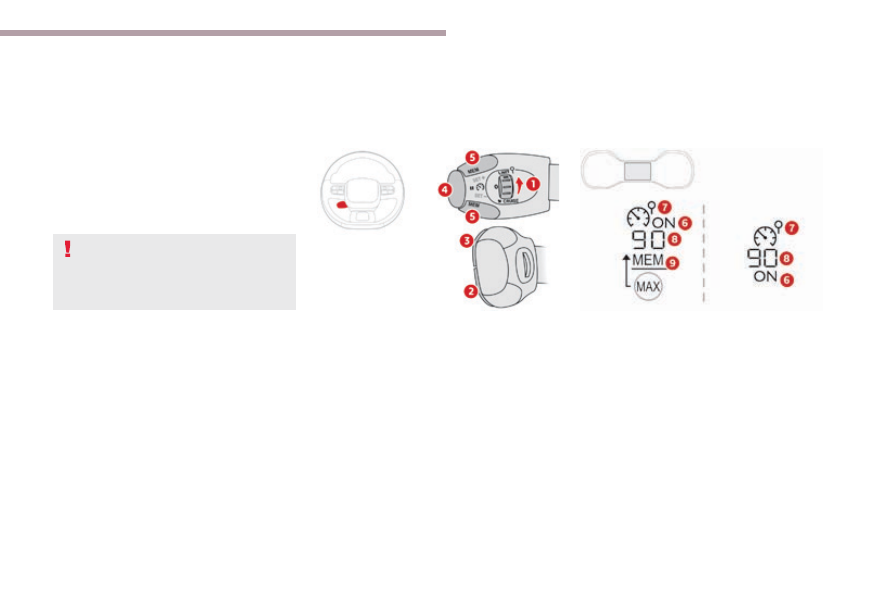
Steering mounted controls

6.

  Speed limiter on / pause indication.

7.

  Speed limiter mode selection indication.

8. 

Programmed speed setting value.

9.

  Speed suggested by the speed limit 

recognition system.

Speed limiter

System which prevents the vehicle from exceeding the speed programmed by the driver.

The speed limiter is a driving aid that 
cannot, in any circumstances, replace the 
need to observe speed limits or the need 
for vigilance on the part of the driver.

1.

  Select speed limiter mode.

2.

  Decrease the programmed value.

3.

  Increase the programmed value.

4.

  Speed limiter On / Pause.

5.

  Accept the speed suggested by the speed 

limit recognition system or, depending on 
version,


Display the memorised speed settings.

Displays in the instrument panel

The speed limiter is switched on manually.
The minimum programmed speed is 20 mph 
(30 km/h).
The programmed speed remains in the system 
memory when the ignition is switched off.

For more information on Memorising speeds 
or Speed limit recognition, refer to the 
corresponding section.

176

Driving

B618_en_Chap06_conduite_ed01-2016

Switching on

F

  Turn the thumbwheel 1 to the "LIMIT" 

position to select the speed limiter; the 
function is paused.

Adjusting the limit speed setting

To modify the limit speed setting:
F

  in steps of +/- 1 mph (km/h), make 

successive short presses on button 2 or 3,

F

  continuously, in steps of +/- 5 mph (km/h), 

press and hold button 2 or 3

.

F

  If the speed setting is suitable (last speed 

setting programmed in the system), press 
button 4

 to switch the speed limiter on.

F

  Pressing button 4 again temporarily 

interrupts the function (pause).

To modify the speed limiter setting using the 
speed suggested by the speed limit recognition 
system:
F

  the speed suggested is displayed in the 

instrument panel,

F

  make a first press on button 5; a message 

is displayed to confirm the memorisation 
request,

F  press button 5

 again to save the suggested 

speed.

This value is then displayed in the instrument 
panel as the new speed limiter setting.

To modify the limit speed setting using 
memorised speeds and from the touch screen:
F  press button 5

 to display the six memorised 

speed settings,

F  press the button for the desired speed 

setting.

This setting becomes the new limit speed.

177

6

Driving

B618_en_Chap06_conduite_ed01-2016

On a steep descent or in the event of 
sharp acceleration, the speed limiter 
will not be able to prevent the vehicle 
from exceeding the programmed speed.

Switching off

When the limit speed is exceeded but this is not 
due to action by the driver, there is an audible 
signal to complete the alert.
Once the speed of the vehicle returns to 
the programmed setting, the speed limiter 
functions again: the display of the programmed 
speed setting becomes steady again.

F

  If you want to temporarily exceed the 

programmed limit speed, press firmly on 
the accelerator pedal, going beyond the 
point of resistance

.

The speed limiter is deactivated temporarily 
and the displayed programmed speed flashes.

Temporarily exceeding the 
programmed speed

F

  Turn the thumbwheel 1 to the "0" position: 

the display of information on the speed 
limiter disappears.

Operating fault

Flashing dashes indicate a fault with the speed 
limiter.
Have it checked by a CITROËN dealer or a 
qualified workshop.

The use of mats not approved by 
CITROËN may interfere with the 
operation of the speed limiter.
To avoid any risk of jamming of the 
pedals:
-  ensure that the mat is positioned 

correctly,

-  never fit one mat on top of another.

178

Driving

B618_en_Chap06_conduite_ed01-2016

Steering mounted controls

6.

  Cruise control mode selected indication.

7.

  Cruise control pause / resume indication.

8.

  Programmed cruise speed setting.

9.

  Speed suggested by the speed limit 

recognition system.

Cruise control

System which automatically maintains the cruising speed of the vehicle at a setting programmed by the driver, without any action on the accelerator 
pedal.

The cruise control system is a driving aid 
that cannot, in any circumstances, replace 
the need to observe speed limits, nor the 
need for vigilance on the part of the driver.
As a safety measure, you are advised to 
keep your feet near the pedals at all times.

1.

  Select cruise control mode.

2.  Set the current speed of the vehicle as the 

cruise setting or lower the cruise setting.

3.  Set the current speed of the vehicle as the 

cruise setting or raise the cruise setting.

4.

  Pause / Resume cruise control.

5.

  Accept the speed suggested by the speed 

limit recognition system or, depending on 
version,


Display the memorised speed settings.

For more information on Memorising speeds 
or Speed limit recognition, refer to the 
corresponding section.

Displays in the instrument panel

The cruise control is switched on 
manually.
It requires a minimum vehicle speed of 
25 mph (40 km/h), as well as:
-  with a manual gearbox, the 

engagement of third gear or higher,

-  with an automatic gearbox, the gear 

selector in D

 mode or second gear 

or higher in M mode.

Speed regulation remains active after 
changing gear on vehicles fitted with a 
manual gearbox and Stop & Start.

Switching off the ignition cancels any 
programmed speed setting.

The operation of the cruise control can be 
interrupted (pause):
-  by pressing control 4 or by pressing the 

brake pedal,

-  automatically, if operation of the dynamic 

stability control system is triggered.

179

6

Driving

B618_en_Chap06_conduite_ed01-2016

Switching on

F

  Turn the thumbwheel 1 to the "CRUISE" 

position to select cruise control mode; the 
function is paused.

F  To start the cruise control and set a cruise 

speed, once the vehicle has reached the 
desired speed, press button 2 or 3

: the 

current speed of your vehicle becomes the 
cruise speed setting.


You can release the accelerator pedal.

F

  Pressing button 4 interrupts operation of 

the system (pause).

F

  Pressing button 4 again restores operation 

of the cruise control (ON).

Take care: pressing and holding 
button 2 or 3

 results in a rapid change 

in the speed of your vehicle.

Modifying the cruise speed 
setting

The cruise control must be active.
To modify the cruise speed setting from the 
current speed of the vehicle:
F

  in steps of + or - 1 mph (km/h), make 

repeated short presses on button 2 or 3,

F

  continuously, in steps of + or - 5 mph 

(km/h), press and hold button 2 or 3.

To modify the cruise speed setting using the 
speed suggested by the speed limit recognition 
system:
F

  the speed suggested is displayed in the 

instrument panel,

F

  make a first press on button 5; a message 

is displayed to confirm the memorisation 
request,

F  press button 5

 again to save the suggested 

speed.

This value is then displayed in the instrument 
panel as the new cruise speed setting.

180

Driving

B618_en_Chap06_conduite_ed01-2016

When descending a steep hill, the 
cruise control system cannot prevent 
the vehicle from exceeding the 
programmed speed.

As a precaution, it is recommended 
that the cruise speed chosen be close 
to the current speed of your vehicle, so 
as to avoid any sudden acceleration or 
deceleration of the vehicle.

When required (overtaking manoeuvre, etc.), it 
is possible to exceed the programmed speed 
by pressing the accelerator pedal.
The cruise control is temporarily overridden 
and the programmed speed setting flashes.

You may have to brake to control the speed of 
your vehicle. In this case, the cruise control is 
automatically paused.
To activate the system again, with the speed 
of the vehicle above 25 mph (40 km/h), press 
button 4

.

Temporarily exceeding the 
programmed speed

To return to the programmed speed, simply 
release the accelerator pedal.
Once the vehicle has returned to the 
programmed speed, the cruise control takes 
over again: the display of the programmed 
speed setting becomes steady again.

Switching off

F

  Turn the thumbwheel 1 to the "0" position: 

the cruise control information disappears 
from the screen.

To modify the cruise speed setting using 
memorised speeds and from the touch screen:
F  press button 5

 to display the six memorised 

speed settings,

F  press the button for the desired speed 

setting.

This setting becomes the new cruise speed.

181

6

Driving

B618_en_Chap06_conduite_ed01-2016

Operating fault

Flashing dashes indicate a fault with the cruise 
control system.
Have it checked by a CITROËN dealer or a 
qualified workshop.

Only use the cruise control if the traffic 
conditions will allow you to drive for a 
certain time at a steady speed and at a 
safe distance from the vehicle ahead.
Do not activate the cruise control in 
urban areas, in heavy traffic, on winding 
or steep roads, on slippery or flooded 
roads, or in conditions of poor visibility 
(heavy rain, fog, falling snow, etc.).
In some circumstances, it may not be 
possible to maintain or reach the cruise 
speed set: towing, vehicle heavily 
loaded, steep climb, etc.

The use of mats not approved by 
CITROËN may interfere with the 
operation of the cruise control.
To avoid any risk of jamming of the 
pedals:
-  ensure that the mat is positioned 

correctly,

-  never fit one mat on top of another.

182

Driving

B618_en_Chap06_conduite_ed01-2016

Fatigue detection system

As soon as the speed of the vehicle 
drops below 40 mph (65 km/h), the 
system goes into standby.
The driving time is counted again once 
the speed is above 40 mph (65 km/h).

It is recommended that you take a break as soon as you feel tired or at least every two hours.

The system cannot in any 
circumstances replace the need for 
vigilance on the part of the driver.
Do not take the wheel if you are tired.

Driving time warning

The system triggers an alert once it detects that 
the driver has not taken a break after two hours 
of driving at a speed above 40 mph (65 km/h).

This alert takes the form of the display of a 
message encouraging you to take a break, 
accompanied by an audible signal.
If the driver does not follow this advice, the 
alert is repeated hourly until the vehicle is 
stopped.

The system resets itself if one of the following 
conditions is met:
-  engine running, the vehicle has been 

stationary for more than 15 minutes,

-  the ignition has been switched off for a 

few minutes,

-  the driver's seat belt is unfastened and 

their door is open.

Activation / Deactivation

The system is activated or deactivated via the 
vehicle configuration menu.
For more information on the menu, refer to the 
part covering your screen in the "Dashboard 
instruments" section.

The state of the system stays in memory when 
the ignition is switched off.

183

6

Driving

B618_en_Chap06_conduite_ed01-2016

Lane Departure Warning System

System which, using a camera which 
recognises solid or broken lines, detects the 
involuntary crossing of longitudinal traffic lane 
markings on the ground.
To provide safe driving, the camera analyses 
the image then, if the driver's attention drops 
and the speed is higher than 37 mph (60 km/h), 
triggers a warning if there is an unexpected 
change of direction.
This system is particularly useful on motorways 
and main roads.

This system is a driving aid that cannot, 
in any circumstances, replace the need 
for vigilance on the part of the driver.

The detection may be impeded:
-  if the markings on the ground are 

worn,

if there is little contrast between the 
markings on the ground and the 
road surface,

if the windscreen is dirty,

-  in certain weather conditions: fog, 

heavy rain, snow, shade, bright 
sunlight or direct exposure to the 
sun (low sun, leaving a tunnel, etc.).

Activation / Deactivation

Activation and deactivation of the 
function is done by pressing this 
button.

The status of the system remains in memory 
when the ignition is switched off.

Detection

If an unexpected change of direction 
is detected, you are alerted by 
this warning lamp flashing in the 
instrument panel and an audible 
signal.

No warning is transmitted if a direction indicator 
is active and for approximately 20 seconds 
after the direction indicator is switched off.

Operating fault

In the event of a fault, this 
warning lamp flashes for approximately 
10 seconds then switches off.

Contact a CITROËN dealer or a qualified 
workshop.

The indicator lamp in the button indicates the 
status of the function:
-  On: the function is activated.
-  Off: the function is deactivated.

184

Driving

B618_en_Chap06_conduite_ed01-2016

Blind Spot Monitoring System

This system warns the driver of the presence of 
another vehicle in the blind spot angle of their 
vehicle (areas masked from the driver's field 
of vision), as soon as this presents a potential 
danger.

A fixed warning lamp appears in the door mirror 
on the side in question:
-  immediately, when being overtaken,

after a delay of about one second, when 
overtaking a vehicle slowly.

This system is designed to improve safety when driving and is in no circumstances a 
substitute for the use of the interior rear view mirror and door mirrors. It is the driver's 
responsibility to constantly check the traffic, to assess the distances and relative speeds of 
other vehicles and to predict their movements before deciding whether to change lane.
This system is a driving aid that cannot, in any circumstances, replace the need for 
vigilance on the part of the driver.

Activation / Deactivation

Activation and deactivation of the system is 
done in the vehicle configuration menu.

This indicator lamp comes on in the 
instrument panel.

Sensors fitted in the front and rear bumpers 
monitor the blind spots.

To deactivate the system, go to the vehicle 
configuration menu again.
The indicator lamp goes off.

The system is automatically deactivated 
when towing with a towbar approved by 
CITROËN.

The status of the system remains in memory on 
switching off the ignition.

185

6

Driving

B618_en_Chap06_conduite_ed01-2016

Operation

The alert is given by a warning lamp which 
comes on in the door mirror on the side in 
question as soon as a vehicle - car, lorry, 
bicycle - is detected.
The following conditions must be met for this:
-  all vehicles are moving in the same 

direction and in adjacent lanes,

-  the speed of your vehicle is between 7 and 

87 mph (12 and 140 km/h),

-  you overtake a vehicle with a speed 

difference of less than 6 mph (10 km/h),

-  a vehicle overtakes you with a speed 

difference of less than 16 mph (25 km/h),

-  the traffic is flowing normally,
-  in the case of an overtaking manoeuvre, 

if this is prolonged and the vehicle being 
overtaken remains in the blind spot,

-  you are driving on a straight or slightly 

curved road,

-  your vehicle is not pulling a trailer, a 

caravan, etc.

No alert will be given in the following situations:
-  in the presence of non-moving objects 

(parked vehicles, barriers, street lamps, 
road signs, etc.),

-  with vehicles moving in the opposite 

direction,

-  driving on a winding road or a sharp corner,

-  when overtaking (or being overtaken by) a 

very long vehicle (lorry, coach, etc.) which 
is at the same time detected at the rear 
in the blind spot angle and present in the 
driver's forward field of vision,

-  in very heavy traffic: vehicles detected in 

front and behind are confused with a lorry 
or a stationary object,

-  when overtaking quickly.

186

Driving

B618_en_Chap06_conduite_ed01-2016

In the event of a fault, this warning 
lamp flashes for a few moments in 
the instrument panel, accompanied 
by illumination of the Service warning 
lamp and the display of a message.

The system may suffer temporary 
interference in certain weather 
conditions (rain, hail, etc.).
In particular, driving on a wet surface 
or moving from a dry area to a wet area 
can cause false alerts (for example, the 
presence of a fog of water droplets in 
the blind spot angle is interpreted as a 
vehicle).
In bad or wintry weather, ensure that 
the sensors are not covered by mud, 
ice or snow.
Take care not to cover the warning zone 
in the door mirrors or the detection 
zones on the front and rear bumpers 
with adhesive labels or other objects; 
they may hamper the correct operation 
of the system.

High pressure jet wash
When washing your vehicle, direct the 
lance at least 30 cm away from the 
sensors.

Operating fault

Contact a CITROËN dealer or a qualified 
workshop to have the system checked.

187

6

Driving

B618_en_Chap06_conduite_ed01-2016

Parking sensors

This system indicates the proximity of an 
obstacle (e.g. pedestrian, vehicle, tree, gate) 
which comes within the field of detection of 
sensors located in the bumper.
Certain types of obstacle (e.g. stake, 
roadworks cone) detected initially will no longer 
be detected at the end of the manoeuvre, if 
they are located in blind spots in the sensors' 
field of detection.

This system cannot in any circumstances replace 
the need for vigilance on the part of the driver.

Rear parking sensors

The system is switched on by engaging reverse 
gear.
This is confirmed by an audible signal.
The system is switched off when you come out 
of reverse gear.

Audible assistance

The proximity information is given by an 
intermittent audible signal, the frequency of 
which increases as the vehicle approaches the 
obstacle.
The sound emitted by the speaker (right-hand 
or left-hand) indicates the side on which the 
obstacle is located.
When the distance between the vehicle and 
the obstacle becomes less than approximately 
thirty centimetres, the audible signal becomes 
continuous.

Visual assistance

This supplements the audible signal by 
displaying bars in the screen which move 
progressively nearer to the vehicle.
When the obstacle is very close, the "Danger" 
symbol is displayed in the screen.

188

Driving

B618_en_Chap06_conduite_ed01-2016

Deactivation or activation of the system is done 
via the vehicle configuration menu.

The system will be deactivated 
automatically if a trailer is being 
towed or a bicycle carrier is fitted on 
a towbar (vehicle fitted with a towbar 
installed in line with the manufacturer's 
recommendations).

In bad or wintry weather, ensure that 
the sensors are not covered with mud, 
ice or snow. When reverse gear is 
engaged, an audible signal (long beep) 
indicates that the sensors may be dirty.
Certain sound sources (motorcycle, 
lorry, pneumatic drill, etc.) may trigger 
the audible signals of the parking 
sensor system.

High pressure jet wash
When washing your vehicle, do not 
direct the lance within 30 cm of the 
sensors.

Deactivation / Activation

In the event of a fault, when reverse 
gear is engaged, this warning lamp 
lights up in the instrument panel, 
accompanied by a message and an 
audible signal.

Operating fault

Contact a CITROËN dealer or a qualified 
workshop to have the system checked.

189

6

Driving

B618_en_Chap06_conduite_ed01-2016

Reversing camera

The reversing camera is activated automatically 
when reverse gear is engaged.
The image is displayed in the touch screen.

The reversing camera cannot, in any 
circumstances, replace the need for 
vigilance on the part of of the driver.

Opening the tailgate causes the display 
to disappear.

The reversing camera function may be 
supplemented with parking sensors.

High pressure jet washing
When washing your vehicle, do not 
direct the lance within 30 cm of the 
camera lens.

Clean the reversing camera regularly 
using a soft, dry cloth.

The blue lines represent the general direction 
of the vehicle (the gap represents the width of 
your vehicle except for the door mirrors).
The red lines represent a distance of about 
30 cm beyond the edge of your vehicle's rear 
bumper.
The green lines represent distances of  
about 1 and 2 metres beyond the edge of your 
vehicle's rear bumper.

It is normal to see part of the number plate 
displayed at the bottom of the screen.

190

Driving

B618_en_Chap06_conduite_ed01-2016

Driving with under-inflated tyres 
increases fuel consumption.

The under-inflation detection system 
does not replace the need for vigilance 
on the part of the driver.
This system does not avoid the need to 
check the tyre pressures (including the 
spare wheel) every month as well as 
before a long journey.
Driving with under-inflated tyres impairs 
road holding, extends braking distances 
and causes premature tyre wear, 
particularly under arduous conditions 
(high loading, high speed, long journey).

The inflation pressures defined for 
your vehicle can be found on the tyre 
pressure label.
For more information on the 
Identification markings, refer to the 
corresponding section.

Snow chains
The system does not have to be 
reinitialised after fitting or removing 
snow chains.

Under-inflation detection

System which automatically checks the pressures of the tyres while driving.

The system monitors the pressures in the four 
tyres, once the vehicle is moving.
It compares the information given by the four 
wheel speed sensors with reference values, 
which must be reinitialised every time the 
tyre pressures are adjusted or a wheel 
changed

.

The system triggers an alert as soon as it 
detects a drop in the inflation pressure of one 
or more tyres.

Checking tyre pressures
This check should be done when 
the tyres are "cold" (vehicle stopped 
for 1 hour or after a journey of less than 
6 miles (10 km) at moderate speeds).
Otherwise, add 0.3 bar to the pressures 
shown on the label.


Content   ..  10  11  12  13   ..